
128
Mochamad Kevin Romadhona Bambang Sugeng Ariadi Subagyono Dwi Agustin - Examining Sustainability
Dimension in Corporate Social Responsibility of ExxonMobil Cepu: An Overview of Socio-Cultural ....
Examining Sustainability Dimension in Corporate Social
Responsibility of ExxonMobil Cepu: An Overview of Socio-Cultural
and Economic Aspects
Mochamad Kevin Romadhona
1
Bambang Sugeng Ariadi Subagyono
2
Dwi Agustin
3
Abstract
Perusahaan ExxonMobil yang bergerak dalam bidang eksplorasi sumber daya alam memegang peranan penting
dalam mewujudkan keberlanjutan dalam tanggung jawab sosial perusahaan. Konsep keberlanjutan berkaitan
erat dengan
profit, people,
dan
planet
(3P) yang dikemukakan oleh John Elkington. Komitmen perusahaan dalam
menjalankan program CSR serta manfaat yang diberikan didasari pada sosio-kultural dan ekonomi yang juga mendasari
penelitian ini. Tujuan penelitian ini adalah mengidentifikasi manfaat dari program CSR pada aspek sosio-kultural
dan ekonomi serta implementasi keberlanjutan dalam tanggung jawab sosial perusahaan. Metode yang digunakan
adalah kuantitatif-deskriptif dengan cara observasi dan wawancara mendalam untuk mendukung temuan data
lapangaan. Konsep keberlanjutan dalam tanggung jawab sosial perusahaan berkaitan dengan kebermanfaatan yang
berkelanjutan meliputi aspek socio-kultural dan economi ke dalam lima kategori utama dengan sembilan pertanyaan.
Hasil penelitian dengan menggunakan konsep keberlanjutan dalam tanggung jawab sosial perusahaan minyak pada
ExxonMobil Blok Cepu menunjukkan bahwa dari sembilan kategori item hanya lima yang memiliki kebermanfaatan
secara socio-kultural dan ekonomi. Hal tersebut membuktikan bahwa perusahaan ExxonMobil cukup berkomitmen
dalam mengimplementasikan konsep keberlanjutan dalam tanggung jawab sosial perusahaan. Sehingga perlu adanya
eveluasi terhadap program tanggung jawab sosial perusahaan yang akan datang.
Kata Kunci:
Sustainability, Corporate Social Responsibility, Manfaat Socio-Cultural, Manfaat Ekonomi
Abstract
Sustainability in corporate social responsibility is essential. ExxonMobil Company, engaged in natural resource exploration,
plays a vital role in realizing sustainability in corporate social responsibility. The concept of sustainability is closely related
to the 3Ps (profit, people, and planet), which John Elkington discovered. The company’s commitment to implementing
CSR programs and the benefits provided are based on sociocultural and economic conditions underlying this research.
This study aims to identify the benefits of CSR programs in sociocultural and economic aspects and the implementation
of sustainability in corporate social responsibility. The method used is descriptive quantitative with an observational
approach, as well as an in-depth, in-depth review technique to support the findings of field data. The sociocultural and
economic aspects of the research are categorized into eight main categories. Field findings show that in several types,
ExxonMobil’s CSR program can still not benefit the community of Ringintunggal village, Gayam, Bojonegoro Regency.
Keywords
:
Sustainability, Corporate Social Responsibility, Socio-Culture Benefit, Economic Benefit
1
Faculty of Social and Political Science, Universitas Airlangga (email correspondence: mochamad.
kevin.romadhona-2020@alumni.unair.ac.id)
2
Fakultas Hukum Universitas Airlangga (email: bambang.sas@fh.unair.ac.id
3
Shanxi University of Finance and Economics, China (email: adwi30085@gmail.com)
Introduction
The issue of CSR became an essential issue in
the 1970s (A. Carroll, 2008). Globally, the term
corporate social responsibility (CSR) has been
used since John Elkington’s work on Cannibals
with Forks: The Triple Bottom Line in 21st
.
Century Business appeared in 1998 (Jang &
Ardichvili, 2020). Elkington’s work describes
three main components regarding sustainable
development: economic growth, environmental
protection, and social equity (Bina, 2013).
Elkington’s three main concepts concentrate on
profit, the planet, and people (Ekins & Zenghelis,
2021). Because a good company is not only
concerned with economic benefits, but it also
has a concern for environmental sustainability
and community welfare (Bocken, Short, Rana,
& Evans, 2014). The CSR concept discovered
Journal of Social Development Studies
Volume 3, Issue 2, September 2022, pp. 128-141
ISSN 2721-3870 (Print), 2721-3889 (Online)
Doi: https://doi.org/10.22146/jsds.5038
129
Journal of Social Development Studies, 3(2), 2022, 128-141
by Etkins has become the company’s guideline
for corporate social responsibility activities
(Lindman, Ranängen, & Kauppila, 2020).
Several empirical studies have been
conducted and have resulted in findings that the
urgency of CSR encourages companies in several
American and European countries to practice
measurement, recognition
,
and disclosure of
externalities
(Chen, Hung, & Wang, 2018).
In
Indonesia, many problems regarding CSR have
been carried out. The results of the study state
that many companies have developed CSR based
on concern for the interests of other parties
more broadly than the interests of the Company
(Nadapdap & Hutabarat, 2017). According to
several studies in Indonesia, it is stated that
companies in Indonesia use the annual report
only as a
debt holder
and
shareholder
report
(Wijantini, 2006). These facts become an
obstacle to the running of the corporation and
create a corporate culture, social shifts, culture,
social jealousy, and environmental damage, then
encourages many companies to start developing
CSR, which is intended to show concern for the
interests of other parties more broadly than the
interests of different parties company only (Erni
R. Ernawan, 2014).
As a developing country, Indonesia has
many areas that investors and/or shareholders
can use to educate companies at the local level
(Pratikto, Yazid, & Dewi, 2020). The company
is widespread in various parts of Indonesia,
with the pros and cons of development for the
government and the surrounding community.
For this reason, the existence of policies related
to CSR is shown so that pros and cons in the
company can reap the benefits and improve
the welfare of the general public, particularly
the affected communities around the company.
With globalization and the ease of licensing
provided by the government (Aristeus, 2019),
many companies were established in East
Java Province, reaching 5,495 (BPS East Java,
2019). Industrial activities related to natural
exploration must directly implement the
program of
corporate social responsibility
(CSR)
(Muhajir Haris & Priyo Purnomo, 2016).
Corporate social responsibility
is a business
commitment to act ethically, operate legally and
contribute to improving the economy and the
quality of life of employees and their families,
local communities, and society at large (Clement
K Sankat, 2002). According to the
world business
council for sustainable development
(WBCSD),
business is committed to contributing to
sustainable economic growth, working with
company employees, their families, as well as
local communities and society as a whole, to
improve the quality of life (Hys & Hawrysz,
2012). The community’s perception of the
existence of a company can lead to barriers and
certification, which causes social jealousy in
the community. The company only distributes
program grants to certain parties (Marcelo et
al., 2004). Thus, CSR is considered not right on
target and has no impact on the welfare and
independence of the community around the
Company (Zainuddin Rela et al., 2020).
Corporate social responsibility is an effort
on the company’s part to maintain corporate
ethics (Fahham, 2011). In implementing CSR, it is
necessary to pay attention to three main aspects:
company profits, environmental sustainability,
and the welfare of the people affected by the
company. (Aryawan, Rahyuda, & Ekawati, 2017).
Corporate social responsibility in achieving goals
is closely related to
setting
the social environment
(location) the company was founded (Rosita,
2010). Companies’ CSR programs vary
widely, including entrepreneurship training,
education, infrastructure development, financial
assistance, and health. Management of business
organizations based on
agency theory
is the
responsibility of management-oriented
companies, and owners experience changes to
a modern management perspective based on
stakeholders
(Rampling, 2013)
.
Corporate Social Responsibility has been
regulated in Law Number 40 of 2007 concerning
Limited Liability Companies, as well as Law
Number 25 of 2007 concerning Investment
(Andrini, 2016), and Regulation of the Minister
of State-Owned Enterprises Number Per-
5/MBU/2007, which related to the BUMN
partnership program with Small Business
and the Community Development Program
(Nayenggita, 2019). Law Number 40 of 2007
states that corporate social responsibility and the
environment are the company’s commitment to
participate in sustainable economic development
to improve the quality of life and the environment
that is beneficial, both for the company itself,
the local community, and society in general
(Fahham, 2011). While in Law Number 25 of
2007 Article 15 letter b, it is explained that every
investment is obliged to (b) carry out corporate
130
Mochamad Kevin Romadhona Bambang Sugeng Ariadi Subagyono Dwi Agustin - Examining Sustainability
Dimension in Corporate Social Responsibility of ExxonMobil Cepu: An Overview of Socio-Cultural ....
social responsibility. In other words, corporate
social responsibility is responsible for creating
a harmonious, balanced relationship under the
local community’s environment, values, norms,
and culture (Bunawan, 2017).
In the implementation process, several
companies provide CSR outside their social
boundaries or provide more significant CSR in
aid programs and infrastructure improvements.
The company’s existence can also threaten the
surrounding community. When the purposes of
the community and their interests are neglected,
companies with claims of CSR programs have not
been able to optimize program implementation.
Ideally, the relationship between the company
and the community and the environment must
be well maintained to create a positive image of
the Company (Chanafi, Fauzi, & Sunarti, 2015).
The impact of the Company’s CSR program is the
social and economic changes in the community
around the company.
One of the companies in East Java Province
that has a CSR program involving the community
around industrial activities is ExxonMobil.
ExxonMobil is a company engaged in the mining
sector, namely oil and gas management. Exxon
Mobil was established in Indonesia in 1898.
One of the locations where the ExxonMobil
company was founded is in the Cepu block; on
September 17, 2005, there was an agreement
on a cooperation contract (KKS-Cepu). The Cepu
block area covers Central Java and East Java.
ExxonMobil Cepu Limited (EMCL), Ampolex
Cepu Pte Ltd., PT Pertamina EP Cepu, and four
Regional Owned Enterprises: PT Sarana Patra
Hulu Cepu (Central Java), PT Asri Dharma
Sejahtera (Bojonegoro), PT Blora Patragas Hulu
(Blora), and PT Petrogas Jatim Utama (East Java)
which joined together in the Cepu cooperation
contract (KKS-Cepu) (ExxonMobil, 2005). Based
on
the Annual Report: Sustainability Highlights,
ExxonMobil has contributed to the Program
launched by the United Nations (UN), namely
the Sustainable Development Goals (SDGs).
ExxonMobil has positively impacted social,
economic, health, education, environment,
gender equality, and environmentally friendly
energy by involving various parties such
as the community, customers, employees,
government, non-governmental organizations,
and
shareholders
(ExxonMobil, 2020).
Based on this explanation and studies
related to Corporate Social Responsibility
(CSR). Therefore, it is important to analyze the
implementation of ExxonMobil’s CSR program
in the Cepu Block and the Social and Economic
Beneficial Aspect in Gayam Village, Bojonegoro,
East Java.
Theoretical Framework
Terminology of Corporate Social Responsibility
(CSR)
Understanding the concept of CSR, in
general, is an effort to improve the quality of life,
in other words, the ability of the community to
be able to respond to existing social conditions
and be able to enjoy and utilize the environment,
including changes caused by industrial processes
(Kakabadse, Rozuel, & Lee-Davies, 2005).
Corporate Social Responsibility
(CSR), which is
said to be important from business ethics, is that
the company not only has economic and legal
obligations (
shareholders
) but also obligations
to other interested parties (
stakeholders
) (AB
Carroll, 2016), in other words, the company
cannot develop without the help of various
parties. Another definition of CSR is a corporate
concern for the community around industrial
activities, including economic, legal, ethical, and
social contribution aspects (AB Carroll, 1999). In
other words, companies must formulate policies,
make decisions, and take actions that follow the
goals and values of the surrounding community
(Bowen, 1953). Another explanation regarding
the CSR concept is the companies’ responsibility
to the community related to the company’s
business operations by identifying stakeholder
communities and incorporating community
needs and interests in the decision-making
process (Fordham & Robinson, 2018). CSR is an
approach that is closely related to the company
and the integration of social care in business
operations and interactions with stakeholders
based on voluntary and partnership principles
(Preuss, 2013). Companies must comply with
all applicable CSR regulations and actively
contribute to society and the environment.
(Hartman, Rubin, & Dhanda, 2007).
CSR terminology is categorized explicitly into
two categories, namely broadly and narrowly. In
a broad sense, CSR is associated with achieving
sustainable economic activities, including social
responsibility and accountability (Avesani,
2020). At the same time, the term CSR in a
narrow sense, is a form of cooperation between
companies and stakeholders who directly or
131
Journal of Social Development Studies, 3(2), 2022, 128-141
indirectly interact with the company to ensure
the existence and survival of the company’s
business. This understanding is by corporate
social and environmental responsibility, a form
of the company’s commitment to play a role in
sustainable economic development to improve
the quality of life and a beneficial environment
(Romadhona, Kurniawan, Sabrie, & Agustin,
2022). Another explanation states that CSR
is a business’s commitment to sustainable
economic development by paying attention to
employees and their families, the surrounding
community, and the public to improve the
quality of life (Philipova, 2020). Meanwhile,
another definition explains that CSR is a form
of corporate commitment to improving the
welfare of the surrounding community through
business practice policies and the contribution
of corporate resources (Perrini, 2006).
The Triple Bottom Line Concept
Concept The Triple Bottom Line Concept
was first discovered by John Elkington in his
work entitled Cannibals with Forks: The Triple
Bottom Line of 21st
Centruy
Business. The three
components in the Triple Bottom Line concept
are profit, people, and the planet. In other words,
a company is not only guided by profit but also
must have a concern for the environment and
the welfare of society (Elkington, 1998).
1.
Profit
Profit is the goal that underlies every
business activity. The process of company
activities to get big profits by increasing the
quality of productivity and efficiency. Efforts
to improve the quality of productivity are
through improving work management, and the
process includes simplifying processes, reducing
inefficient and inefficient activities, and reducing
production process time, as well as building
long-term relationships with stakeholders
(Neely, Gregory, & Platts, 2005). Cost efficiency
can be done by saving material use and reducing
costs as low as possible (Prastowo, Amin, &
Susetyo, 2021).
2.
People
The community or community is an
important stakeholder for the company because
the community is needed for the ongoing
process of industrial activities. The company is
responsible for being able to provide benefits
and positive impacts for the community. To
ensure business continuity, the company must
also be committed to caring for the community’s
condition around industrial activities, which can
give the public a positive reputation.
3.
Planet
A form of the company’s commitment to
maintaining and preserving the environment
around the company, the effort is to break down
the excessive exploitation of natural resources
and take advantage of environmentally friendly
technology.
Implementation of the Triple Bottom Line
concept in corporate social responsibility
activities, which includes: (Hilmi, Zarkasyi, Sueb,
& Tanzil, 2021)
1.
Employee loyalty to the company by showing
commitment to CSR activities
2.
Saving operational costs
3.
Improve product and service quality and
focus on customers
4.
Fulfilling responsibilitiessustainability
Sustainability Concept
The sustainability concept has become
popular in policy-oriented research as an
expression of what public policy should achieve.
The idea emerged from the Brundtland Report
in 1987 (Kuhlman & Farrington, 2010). The
Brundtland Report describes two problems,
namely the development and the environment.
These two things can also be interpreted as
needs versus resources or short-term versus
long-term. However, sustainability is always
seen in three dimensions: social, economic, and
environmental (Gladwin, Kennelly, & Krause,
1995). The concept of sustainability adopted
by the United Nations in the development
plan, which includes development, is a
multidimensional effort to achieve a higher
quality of life for all community groups. The
three dimensions of sustainability include
economic development, social development, and
environmental protection (Fonseca, Domingues,
& Dima, 2020).
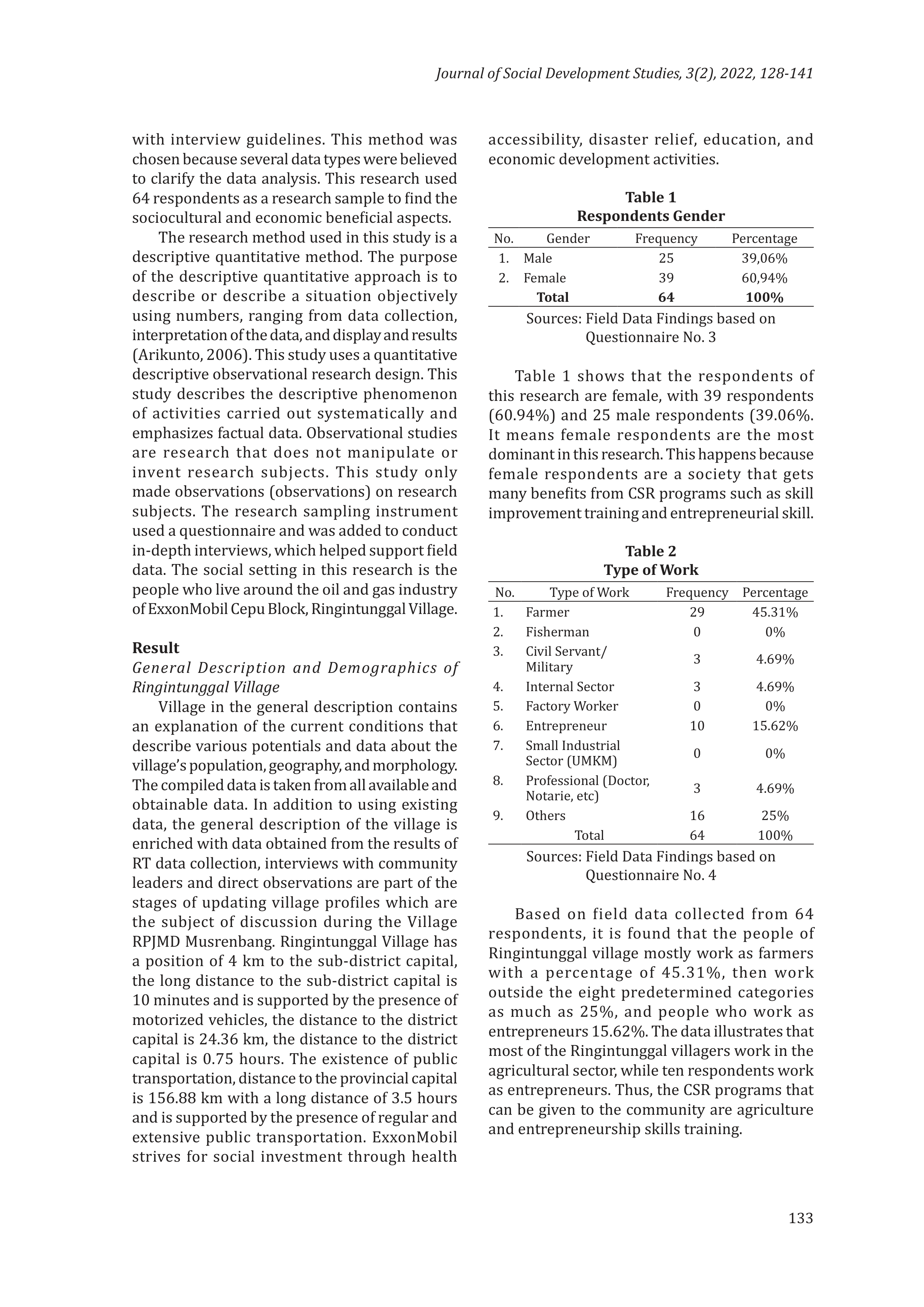
Three dimensions in the concept of
sustainability include social, economic, and
environmental, and the three dimensions have
the following explanation: (Mensah, 2019)
1.
Social Dimension
a.
Quality of Life
b.
Education
132
Mochamad Kevin Romadhona Bambang Sugeng Ariadi Subagyono Dwi Agustin - Examining Sustainability
Dimension in Corporate Social Responsibility of ExxonMobil Cepu: An Overview of Socio-Cultural ....
c.
Community Development
d.
Equal Opportunity
e.
Law and Ethics
2.
Economic Dimension
a.
Smart Growth
b.
Long Range Planning
c.
Cost Saving
d.
R n D Spending
e.
Cost of Living
3.
Environmental Dimension
a.
Resource Management
b.
Environmental Protection
c.
Habitat Restoration & Preserving
The meaning of sustainability is taken
from English. Namely, the words sustain and
ability (Glavič & Lukman, 2007). In the context
of ecology, sustainability can be defined as
a biological system capable of supporting
unlimited biodiversity and productivity (Farley,
2012). In other words, sustainability is a socio-
ecological process characterized by achieving
the same goals (Purvis, Mao, & Robinson,
2019). The concept of sustainability has a
three-dimensional framework based on time,
namely, correcting past mistakes, minimizing
or eliminating current problems, and building
a legacy for the next generation (Kuhlman
& Farrington, 2010). The paradigms used in
sustainability are profit, people, and the planet
when these pillars become important in the
sustainability process (Murray & Boron, 2019).
Methods
In this study, researchers used quantitative
research methods by borrowing one of the
qualitative methods. Quantitative methods are
used to measure and determine the distribution
of information from the respondents we selected
through a questionnaire. Meanwhile, we use
qualitative methods for in-depth interviews to
obtain information from certain parties who
know about Exxon Mobil’s CSR. The data needed
is information distribution obtained from
several respondents from structured interviews
using questionnaires and in-depth interviews
Figure 1
Sustainable development: Meaning, history, principle, pillars, and implication for human action
Source: (Mensah, 2019)
133
Journal of Social Development Studies, 3(2), 2022, 128-141
with interview guidelines. This method was
chosen because several data types were believed
to clarify the data analysis. This research used
64 respondents as a research sample to find the
sociocultural and economic beneficial aspects.
The research method used in this study is a
descriptive quantitative method. The purpose
of the descriptive quantitative approach is to
describe or describe a situation objectively
using numbers, ranging from data collection,
interpretation of the data, and display and results
(Arikunto, 2006). This study uses a quantitative
descriptive observational research design. This
study describes the descriptive phenomenon
of activities carried out systematically and
emphasizes factual data. Observational studies
are research that does not manipulate or
invent research subjects. This study only
made observations (observations) on research
subjects. The research sampling instrument
used a questionnaire and was added to conduct
in-depth interviews, which helped support field
data. The social setting in this research is the
people who live around the oil and gas industry
of ExxonMobil Cepu Block, Ringintunggal Village.
Result
General Description and Demographics of
Ringintunggal Village
Village in the general description contains
an explanation of the current conditions that
describe various potentials and data about the
village’s population, geography, and morphology.
The compiled data is taken from all available and
obtainable data. In addition to using existing
data, the general description of the village is
enriched with data obtained from the results of
RT data collection, interviews with community
leaders and direct observations are part of the
stages of updating village profiles which are
the subject of discussion during the Village
RPJMD Musrenbang. Ringintunggal Village has
a position of 4 km to the sub-district capital,
the long distance to the sub-district capital is
10 minutes and is supported by the presence of
motorized vehicles, the distance to the district
capital is 24.36 km, the distance to the district
capital is 0.75 hours. The existence of public
transportation, distance to the provincial capital
is 156.88 km with a long distance of 3.5 hours
and is supported by the presence of regular and
extensive public transportation. ExxonMobil
strives for social investment through health
accessibility, disaster relief, education, and
economic development activities.
Table 1
Respondents Gender
No.
Gender
Frequency
Percentage
1.
Male
25
39,06%
2.
Female
39
60,94%
Total
64
100%
Sources: Field Data Findings based on
Questionnaire No. 3
Table 1 shows that the respondents of
this research are female, with 39 respondents
(60.94%) and 25 male respondents (39.06%.
It means female respondents are the most
dominant in this research. This happens because
female respondents are a society that gets
many benefits from CSR programs such as skill
improvement training and entrepreneurial skill.
Table 2
Type of Work
No.
Type of Work
Frequency
Percentage
1.
Farmer
29
45.31%
2.
Fisherman
0
0%
3.
Civil Servant/
Military
3
4.69%
4.
Internal Sector
3
4.69%
5.
Factory Worker
0
0%
6.
Entrepreneur
10
15.62%
7.
Small Industrial
Sector (UMKM)
0
0%
8.
Professional (Doctor,
Notarie, etc)
3
4.69%
9.
Others
16
25%
Total
64
100%
Sources: Field Data Findings based on
Questionnaire No. 4
Based on field data collected from 64
respondents, it is found that the people of
Ringintunggal village mostly work as farmers
with a percentage of 45.31%, then work
outside the eight predetermined categories
as much as 25%, and people who work as
entrepreneurs 15.62%. The data illustrates that
most of the Ringintunggal villagers work in the
agricultural sector, while ten respondents work
as entrepreneurs. Thus, the CSR programs that
can be given to the community are agriculture
and entrepreneurship skills training.
134
Mochamad Kevin Romadhona Bambang Sugeng Ariadi Subagyono Dwi Agustin - Examining Sustainability
Dimension in Corporate Social Responsibility of ExxonMobil Cepu: An Overview of Socio-Cultural ....
Implementation of ExxonMobil’s Corporate Social
Responsibility Program Block Cepu
Table 3
Respondents’ Knowledge of the
Implementation of ExxonMobil’s CSR
Program
No.
Information
Frequency
Percentage
1.
Yes
33
51.56%
2.
Lack of Understanding
24
37.5%
3.
No
7
10.93
Total
64
100%
Sources: Field Data Findings based on
Questionnaire No. 7
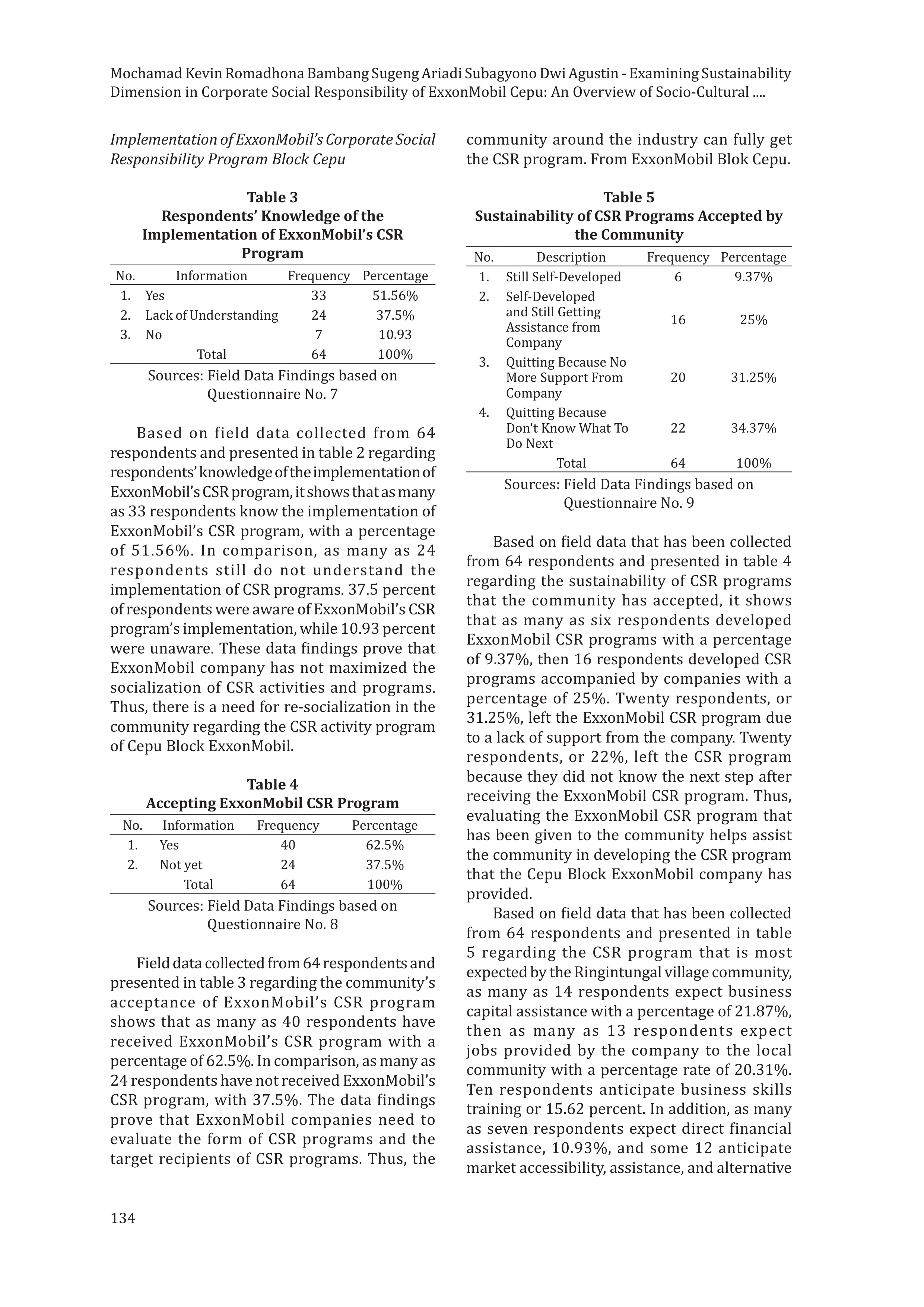
Based on field data collected from 64
respondents and presented in table 2 regarding
respondents’ knowledge of the implementation of
ExxonMobil’s CSR program, it shows that as many
as 33 respondents know the implementation of
ExxonMobil’s CSR program, with a percentage
of 51.56%. In comparison, as many as 24
respondents still do not understand the
implementation of CSR programs. 37.5 percent
of respondents were aware of ExxonMobil’s CSR
program’s implementation, while 10.93 percent
were unaware. These data findings prove that
ExxonMobil company has not maximized the
socialization of CSR activities and programs.
Thus, there is a need for re-socialization in the
community regarding the CSR activity program
of Cepu Block ExxonMobil.
Table 4
Accepting ExxonMobil CSR Program
No.
Information
Frequency
Percentage
1.
Yes
40
62.5%
2.
Not yet
24
37.5%
Total
64
100%
Sources: Field Data Findings based on
Questionnaire No. 8
Field data collected from 64 respondents and
presented in table 3 regarding the community’s
acceptance of ExxonMobil’s CSR program
shows that as many as 40 respondents have
received ExxonMobil’s CSR program with a
percentage of 62.5%. In comparison, as many as
24 respondents have not received ExxonMobil’s
CSR program, with 37.5%. The data findings
prove that ExxonMobil companies need to
evaluate the form of CSR programs and the
target recipients of CSR programs. Thus, the
community around the industry can fully get
the CSR program. From ExxonMobil Blok Cepu.
Table 5
Sustainability of CSR Programs Accepted by
the Community
No.
Description
Frequency
Percentage
1.
Still Self-Developed
6
9.37%
2.
Self-Developed
and Still Getting
Assistance from
Company
16
25%
3.
Quitting Because No
More Support From
Company
20
31.25%
4.
Quitting Because
Don't Know What To
Do Next
22
34.37%
Total
64
100%
Sources: Field Data Findings based on
Questionnaire No. 9
Based on field data that has been collected
from 64 respondents and presented in table 4
regarding the sustainability of CSR programs
that the community has accepted, it shows
that as many as six respondents developed
ExxonMobil CSR programs with a percentage
of 9.37%, then 16 respondents developed CSR
programs accompanied by companies with a
percentage of 25%. Twenty respondents, or
31.25%, left the ExxonMobil CSR program due
to a lack of support from the company. Twenty
respondents, or 22%, left the CSR program
because they did not know the next step after
receiving the ExxonMobil CSR program. Thus,
evaluating the ExxonMobil CSR program that
has been given to the community helps assist
the community in developing the CSR program
that the Cepu Block ExxonMobil company has
provided.
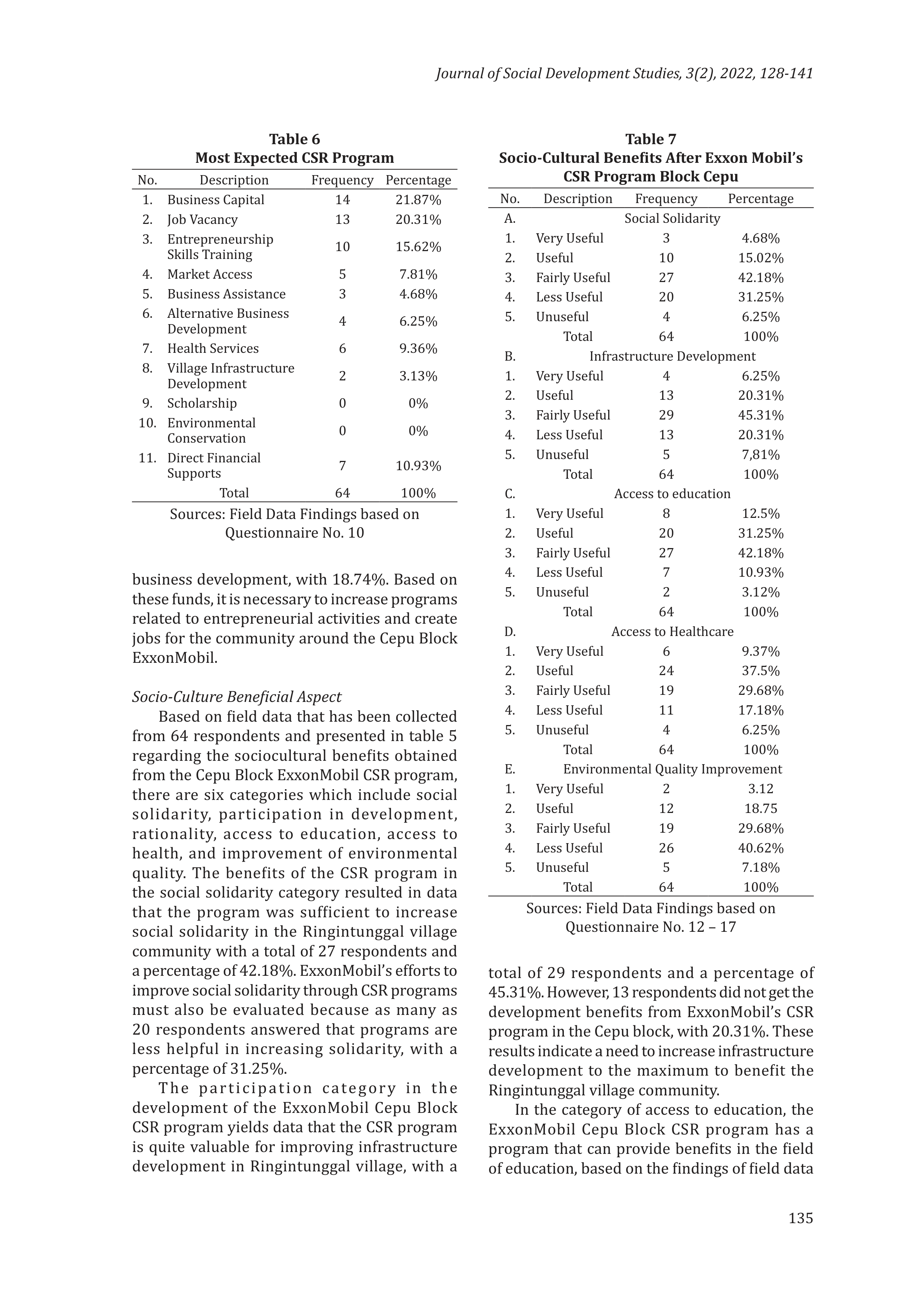
Based on field data that has been collected
from 64 respondents and presented in table
5 regarding the CSR program that is most
expected by the Ringintungal village community,
as many as 14 respondents expect business
capital assistance with a percentage of 21.87%,
then as many as 13 respondents expect
jobs provided by the company to the local
community with a percentage rate of 20.31%.
Ten respondents anticipate business skills
training or 15.62 percent. In addition, as many
as seven respondents expect direct financial
assistance, 10.93%, and some 12 anticipate
market accessibility, assistance, and alternative
135
Journal of Social Development Studies, 3(2), 2022, 128-141
business development, with 18.74%. Based on
these funds, it is necessary to increase programs
related to entrepreneurial activities and create
jobs for the community around the Cepu Block
ExxonMobil.
Socio-Culture Beneficial Aspect
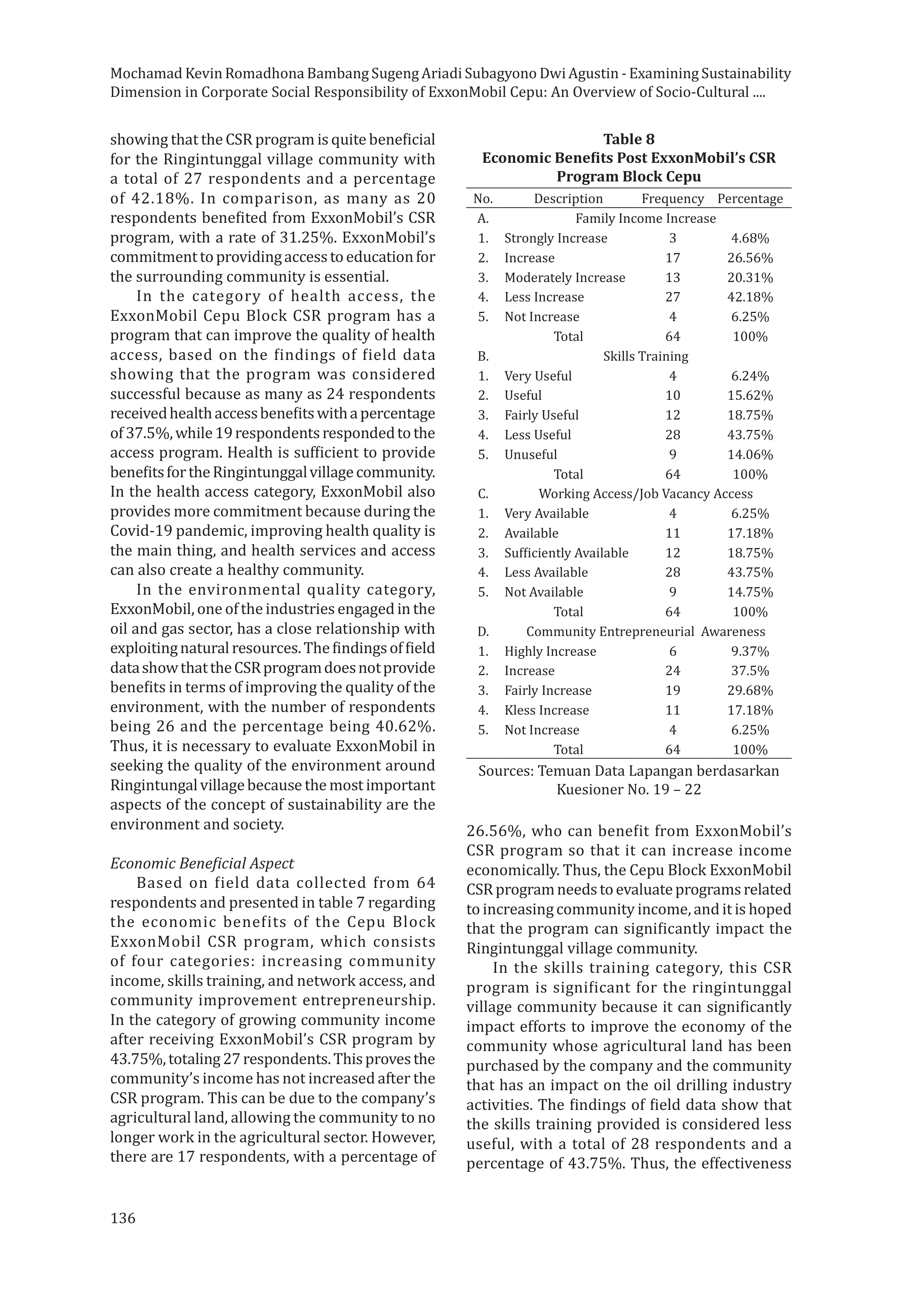
Based on field data that has been collected
from 64 respondents and presented in table 5
regarding the sociocultural benefits obtained
from the Cepu Block ExxonMobil CSR program,
there are six categories which include social
solidarity, participation in development,
rationality, access to education, access to
health, and improvement of environmental
quality. The benefits of the CSR program in
the social solidarity category resulted in data
that the program was sufficient to increase
social solidarity in the Ringintunggal village
community with a total of 27 respondents and
a percentage of 42.18%. ExxonMobil’s efforts to
improve social solidarity through CSR programs
must also be evaluated because as many as
20 respondents answered that programs are
less helpful in increasing solidarity, with a
percentage of 31.25%.
The participation category in the
development of the ExxonMobil Cepu Block
CSR program yields data that the CSR program
is quite valuable for improving infrastructure
development in Ringintunggal village, with a
total of 29 respondents and a percentage of
45.31%. However, 13 respondents did not get the
development benefits from ExxonMobil’s CSR
program in the Cepu block, with 20.31%. These
results indicate a need to increase infrastructure
development to the maximum to benefit the
Ringintunggal village community.
In the category of access to education, the
ExxonMobil Cepu Block CSR program has a
program that can provide benefits in the field
of education, based on the findings of field data
Table 6
Most Expected CSR Program
No.
Description
Frequency
Percentage
1.
Business Capital
14
21.87%
2.
Job Vacancy
13
20.31%
3.
Entrepreneurship
Skills Training
10
15.62%
4.
Market Access
5
7.81%
5.
Business Assistance
3
4.68%
6.
Alternative Business
Development
4
6.25%
7.
Health Services
6
9.36%
8.
Village Infrastructure
Development
2
3.13%
9.
Scholarship
0
0%
10.
Environmental
Conservation
0
0%
11.
Direct Financial
Supports
7
10.93%
Total
64
100%
Sources: Field Data Findings based on
Questionnaire No. 10
Table 7
Socio-Cultural Benefits After Exxon Mobil’s
CSR Program Block Cepu
No.
Description
Frequency
Percentage
A.
Social Solidarity
1.
Very Useful
3
4.68%
2.
Useful
10
15.02%
3.
Fairly Useful
27
42.18%
4.
Less Useful
20
31.25%
5.
Unuseful
4
6.25%
Total
64
100%
B.
Infrastructure Development
1.
Very Useful
4
6.25%
2.
Useful
13
20.31%
3.
Fairly Useful
29
45.31%
4.
Less Useful
13
20.31%
5.
Unuseful
5
7,81%
Total
64
100%
C.
Access to education
1.
Very Useful
8
12.5%
2.
Useful
20
31.25%
3.
Fairly Useful
27
42.18%
4.
Less Useful
7
10.93%
5.
Unuseful
2
3.12%
Total
64
100%
D.
Access to Healthcare
1.
Very Useful
6
9.37%
2.
Useful
24
37.5%
3.
Fairly Useful
19
29.68%
4.
Less Useful
11
17.18%
5.
Unuseful
4
6.25%
Total
64
100%
E.
Environmental Quality Improvement
1.
Very Useful
2
3.12
2.
Useful
12
18.75
3.
Fairly Useful
19
29.68%
4.
Less Useful
26
40.62%
5.
Unuseful
5
7.18%
Total
64
100%
Sources: Field Data Findings based on
Questionnaire No. 12 – 17
136
Mochamad Kevin Romadhona Bambang Sugeng Ariadi Subagyono Dwi Agustin - Examining Sustainability
Dimension in Corporate Social Responsibility of ExxonMobil Cepu: An Overview of Socio-Cultural ....
showing that the CSR program is quite beneficial
for the Ringintunggal village community with
a total of 27 respondents and a percentage
of 42.18%. In comparison, as many as 20
respondents benefited from ExxonMobil’s CSR
program, with a rate of 31.25%. ExxonMobil’s
commitment to providing access to education for
the surrounding community is essential.
In the category of health access, the
ExxonMobil Cepu Block CSR program has a
program that can improve the quality of health
access, based on the findings of field data
showing that the program was considered
successful because as many as 24 respondents
received health access benefits with a percentage
of 37.5%, while 19 respondents responded to the
access program. Health is sufficient to provide
benefits for the Ringintunggal village community.
In the health access category, ExxonMobil also
provides more commitment because during the
Covid-19 pandemic, improving health quality is
the main thing, and health services and access
can also create a healthy community.
In the environmental quality category,
ExxonMobil, one of the industries engaged in the
oil and gas sector, has a close relationship with
exploiting natural resources. The findings of field
data show that the CSR program does not provide
benefits in terms of improving the quality of the
environment, with the number of respondents
being 26 and the percentage being 40.62%.
Thus, it is necessary to evaluate ExxonMobil in
seeking the quality of the environment around
Ringintungal village because the most important
aspects of the concept of sustainability are the
environment and society.
Economic Beneficial Aspect
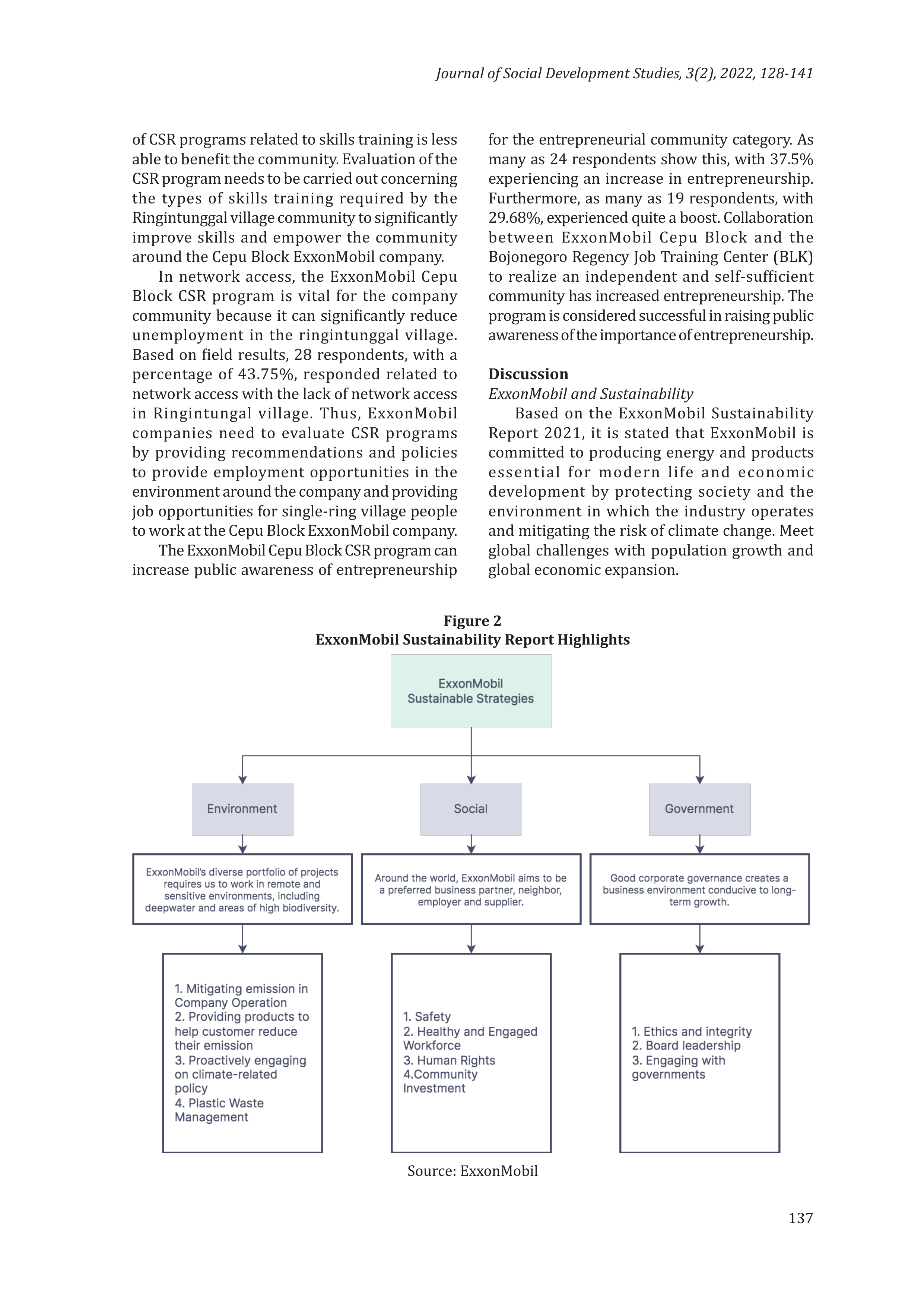
Based on field data collected from 64
respondents and presented in table 7 regarding
the economic benefits of the Cepu Block
ExxonMobil CSR program, which consists
of four categories: increasing community
income, skills training, and network access, and
community improvement entrepreneurship.
In the category of growing community income
after receiving ExxonMobil’s CSR program by
43.75%, totaling 27 respondents. This proves the
community’s income has not increased after the
CSR program. This can be due to the company’s
agricultural land, allowing the community to no
longer work in the agricultural sector. However,
there are 17 respondents, with a percentage of
26.56%, who can benefit from ExxonMobil’s
CSR program so that it can increase income
economically. Thus, the Cepu Block ExxonMobil
CSR program needs to evaluate programs related
to increasing community income, and it is hoped
that the program can significantly impact the
Ringintunggal village community.
In the skills training category, this CSR
program is significant for the ringintunggal
village community because it can significantly
impact efforts to improve the economy of the
community whose agricultural land has been
purchased by the company and the community
that has an impact on the oil drilling industry
activities. The findings of field data show that
the skills training provided is considered less
useful, with a total of 28 respondents and a
percentage of 43.75%. Thus, the effectiveness
Table 8
Economic Benefits Post ExxonMobil’s CSR
Program Block Cepu
No.
Description
Frequency
Percentage
A.
Family Income Increase
1.
Strongly Increase
3
4.68%
2.
Increase
17
26.56%
3.
Moderately Increase
13
20.31%
4.
Less Increase
27
42.18%
5.
Not Increase
4
6.25%
Total
64
100%
B.
Skills Training
1.
Very Useful
4
6.24%
2.
Useful
10
15.62%
3.
Fairly Useful
12
18.75%
4.
Less Useful
28
43.75%
5.
Unuseful
9
14.06%
Total
64
100%
C.
Working Access/Job Vacancy Access
1.
Very Available
4
6.25%
2.
Available
11
17.18%
3.
Sufficiently Available
12
18.75%
4.
Less Available
28
43.75%
5.
Not Available
9
14.75%
Total
64
100%
D.
Community Entrepreneurial Awareness
1.
Highly Increase
6
9.37%
2.
Increase
24
37.5%
3.
Fairly Increase
19
29.68%
4.
Kless Increase
11
17.18%
5.
Not Increase
4
6.25%
Total
64
100%
Sources: Temuan Data Lapangan berdasarkan
Kuesioner No. 19 – 22
137
Journal of Social Development Studies, 3(2), 2022, 128-141
of CSR programs related to skills training is less
able to benefit the community. Evaluation of the
CSR program needs to be carried out concerning
the types of skills training required by the
Ringintunggal village community to significantly
improve skills and empower the community
around the Cepu Block ExxonMobil company.
In network access, the ExxonMobil Cepu
Block CSR program is vital for the company
community because it can significantly reduce
unemployment in the ringintunggal village.
Based on field results, 28 respondents, with a
percentage of 43.75%, responded related to
network access with the lack of network access
in Ringintungal village. Thus, ExxonMobil
companies need to evaluate CSR programs
by providing recommendations and policies
to provide employment opportunities in the
environment around the company and providing
job opportunities for single-ring village people
to work at the Cepu Block ExxonMobil company.
The ExxonMobil Cepu Block CSR program can
increase public awareness of entrepreneurship
for the entrepreneurial community category. As
many as 24 respondents show this, with 37.5%
experiencing an increase in entrepreneurship.
Furthermore, as many as 19 respondents, with
29.68%, experienced quite a boost. Collaboration
between ExxonMobil Cepu Block and the
Bojonegoro Regency Job Training Center (BLK)
to realize an independent and self-sufficient
community has increased entrepreneurship. The
program is considered successful in raising public
awareness of the importance of entrepreneurship.
Discussion
ExxonMobil and Sustainability
Based on the ExxonMobil Sustainability
Report 2021, it is stated that ExxonMobil is
committed to producing energy and products
essential for modern life and economic
development by protecting society and the
environment in which the industry operates
and mitigating the risk of climate change. Meet
global challenges with population growth and
global economic expansion.
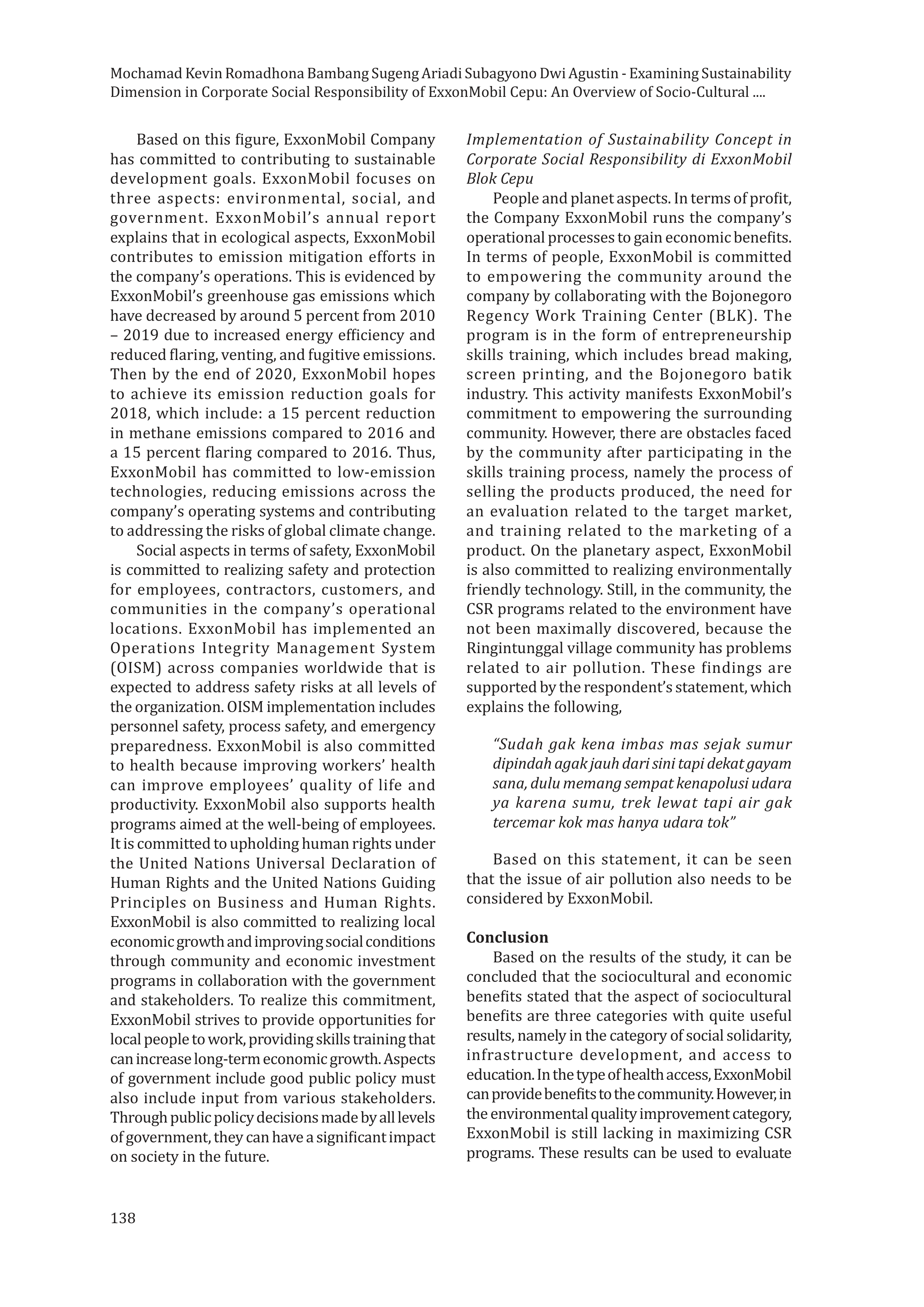
Figure 2
ExxonMobil Sustainability Report Highlights
Source: ExxonMobil
138
Mochamad Kevin Romadhona Bambang Sugeng Ariadi Subagyono Dwi Agustin - Examining Sustainability
Dimension in Corporate Social Responsibility of ExxonMobil Cepu: An Overview of Socio-Cultural ....
Based on this figure, ExxonMobil Company
has committed to contributing to sustainable
development goals. ExxonMobil focuses on
three aspects: environmental, social, and
government. ExxonMobil’s annual report
explains that in ecological aspects, ExxonMobil
contributes to emission mitigation efforts in
the company’s operations. This is evidenced by
ExxonMobil’s greenhouse gas emissions which
have decreased by around 5 percent from 2010
– 2019 due to increased energy efficiency and
reduced flaring, venting, and fugitive emissions.
Then by the end of 2020, ExxonMobil hopes
to achieve its emission reduction goals for
2018, which include: a 15 percent reduction
in methane emissions compared to 2016 and
a 15 percent flaring compared to 2016. Thus,
ExxonMobil has committed to low-emission
technologies, reducing emissions across the
company’s operating systems and contributing
to addressing the risks of global climate change.
Social aspects in terms of safety, ExxonMobil
is committed to realizing safety and protection
for employees, contractors, customers, and
communities in the company’s operational
locations. ExxonMobil has implemented an
Operations Integrity Management System
(OISM) across companies worldwide that is
expected to address safety risks at all levels of
the organization. OISM implementation includes
personnel safety, process safety, and emergency
preparedness. ExxonMobil is also committed
to health because improving workers’ health
can improve employees’ quality of life and
productivity. ExxonMobil also supports health
programs aimed at the well-being of employees.
It is committed to upholding human rights under
the United Nations Universal Declaration of
Human Rights and the United Nations Guiding
Principles on Business and Human Rights.
ExxonMobil is also committed to realizing local
economic growth and improving social conditions
through community and economic investment
programs in collaboration with the government
and stakeholders. To realize this commitment,
ExxonMobil strives to provide opportunities for
local people to work, providing skills training that
can increase long-term economic growth. Aspects
of government include good public policy must
also include input from various stakeholders.
Through public policy decisions made by all levels
of government, they can have a significant impact
on society in the future.
Implementation of Sustainability Concept in
Corporate Social Responsibility di ExxonMobil
Blok Cepu
People and planet aspects. In terms of profit,
the Company ExxonMobil runs the company’s
operational processes to gain economic benefits.
In terms of people, ExxonMobil is committed
to empowering the community around the
company by collaborating with the Bojonegoro
Regency Work Training Center (BLK). The
program is in the form of entrepreneurship
skills training, which includes bread making,
screen printing, and the Bojonegoro batik
industry. This activity manifests ExxonMobil’s
commitment to empowering the surrounding
community. However, there are obstacles faced
by the community after participating in the
skills training process, namely the process of
selling the products produced, the need for
an evaluation related to the target market,
and training related to the marketing of a
product. On the planetary aspect, ExxonMobil
is also committed to realizing environmentally
friendly technology. Still, in the community, the
CSR programs related to the environment have
not been maximally discovered, because the
Ringintunggal village community has problems
related to air pollution. These findings are
supported by the respondent’s statement, which
explains the following,
“Sudah gak kena imbas mas sejak sumur
dipindah agak jauh dari sini tapi dekat gayam
sana, dulu memang sempat kenapolusi udara
ya karena sumu, trek lewat tapi air gak
tercemar kok mas hanya udara tok”
Based on this statement, it can be seen
that the issue of air pollution also needs to be
considered by ExxonMobil.
Conclusion
Based on the results of the study, it can be
concluded that the sociocultural and economic
benefits stated that the aspect of sociocultural
benefits are three categories with quite useful
results, namely in the category of social solidarity,
infrastructure development, and access to
education. In the type of health access, ExxonMobil
can provide benefits to the community. However, in
the environmental quality improvement category,
ExxonMobil is still lacking in maximizing CSR
programs. These results can be used to evaluate
139
Journal of Social Development Studies, 3(2), 2022, 128-141
the CSR program for the Cepu Block ExxonMobil
company to improve the quality of CSR programs
that can realize Sustainability in Corporate Social
Responsibility.
In terms of economic benefits, this study
resulted in four main categories: increased
income, skills training, network access, and
entrepreneurship awareness. Based on the results,
it can be concluded that in the family income
category, ExxonMobil’s CSR program does not have
a significant impact on increasing income. In the
skills training category, ExxonMobil’s CSR program
is deemed less useful. At the same time, access to
networks for ExxonMobil’s CSR program also does
not have a significant impact because the program
does not accommodate network access. However,
in the category of entrepreneurship awareness, it
has increased because the training and support
provided by ExxonMobil in collaboration with
the Bojonegoro Regency BLK increased public
awareness of the importance of entrepreneurship.
The results of this study show that
ExxonMobil’s commitment to achieving
sustainability has significantly impacted
community empowerment, local economic
growth, and the environment. ExxonMobil’s
contribution is a form of corporate social
responsibility, with efforts to provide services to
improve the quality of access to health, increase
education levels and provide valuable skills
training for the ringintunggal village community.
ExxonMobil company has not fully implemented
the concept of Sustainability in Corporate Social
Responsibility because there are still problems
related to environmental aspects (
planet)
. The
realization of the concept of sustainability
in CSR must be maximally able to meet the
3P criteria (Profit, People, and Planet). It is
necessary to evaluate the CSR activity program
determined by the company and support from
various stakeholders and shareholders to realize
sustainability in corporate social responsibility.
References
Andrini, L. (2016). Mandatory Corporate Social
Responsibility in Indonesia.
Mimbar Hukum
- Fakultas Hukum Universitas Gadjah Mada
,
28
(3), 512. https://doi.org/10.22146/
jmh.16669
Arikunto, S. (2006).
Prosedur Penelitian: Suatu
pendekatan Praktik
(revisi VI). Jakarta:
Rineka Cipta.
Aristeus, S. (2019). Globalisasi, Perdagangan
Bebas, Penanaman Modal Dan Pelayanan
Terpadu Satu Pintu.
Jurnal Penelitian Hukum
,
19
(3), pp. 339–348.
Aryawan, M., Rahyuda, IK, & Ekawati, NW
(2017). Pengaruh Faktor CSR (Aspek Sosial,
Ekonomi, dan Lingkungan) terhadap Citra
Perusahaan.
E-Jurnal Manajemen Unud
,
Vo.
6
(2), pp. 604–633.
Avesani, M. (2020). Sustainability, sustainable
development, and business sustainability.
In J. Ren & SBT-LCSA for D.-M. Toniolo
(Eds.),
Life Cycle Sustainability Assessment
for Decision-Making
(pp. 21–38). Elsevier.
https://doi.org/https://doi.org/10.1016/
B978-0-12-818355-7.00002-6
Bina, O. (2013). The green economy and
sustainable development: An uneasy
balance?
Environment and Planning C:
Government and Policy
,
31
(6), pp. 1023–
1047. https://doi.org/10.1068/c1310j
Bocken, NMP, Short, SW, Rana, P., & Evans, S.
(2014). A literature and practice review
to develop sustainable business model
archetypes.
Journal of Cleaner Production
,
65
, pp. 42–56. https://doi.org/https://doi.
org/10.1016/j.jclepro.2013.11.039
Bowen, HR (1953).
Social Responsibilities of the
Businessman
. University of Iowa Press.
BPS Jawa Timur. (2019).
Number of Companies,
Employees, Investment, and Production
Value in Large and Medium Industries
by Regency/Municipality in Jawa Timur
Province
. Surabaya.
Bunawan, P. (2017). Foreign investment in
Indonesia The Legal Aspects under the
New Indonesian Investment Law.
Dialogia
Iuridica: Jurnal Hukum Bisnis Dan Investasi
,
8
, 1. https://doi.org/10.28932/di.v8i2.719
Carroll, A. (2008). A History of Corporate
Social Responsibility: Concepts and
Practices. In
The Oxford Handbook
of Corporate Social Responsibility
(pp.
19–46). https://doi.org/10.1093/
oxfordhb/9780199211593.003.0002
Carroll, AB (1999). Corporate Social
R e s p o n s i b i l i t y : E v o l u t i o n o f a
Definitional Construct.
Business &
Society
,
38
(3), 268–295. https://doi.
org/10.1177/000765039903800303
Carroll, AB (2016). Carroll’s pyramid of CSR:
taking another look.
International Journal
140
Mochamad Kevin Romadhona Bambang Sugeng Ariadi Subagyono Dwi Agustin - Examining Sustainability
Dimension in Corporate Social Responsibility of ExxonMobil Cepu: An Overview of Socio-Cultural ....
of Corporate Social Responsibility
,
1
(1), pp.
3. https://doi.org/10.1186/s40991-016-
0004-6
Chanafi, A., Fauzi, A., & Sunarti. (2015). Pengaruh
Persepsi Masyarakat Terhadap Implementasi
Corporate Social Responsibility (CSR) Dan
Dampaknya Pada Citra Perusahaan (Survei
Pada Masyarakat Sekitar PT. Greenfields
Indonesia Yang Bertempat Tinggal Di Rw. 02
Dusun Maduarjo Desa Babadan Kecamatan
N.
Jurnal Administrasi Bisnis
,
3
(1), pp. 1–7.
Chen, Y.-C., Hung, M., & Wang, Y. (2018). The
effect of mandatory CSR disclosure on
firm profitability and social externalities:
Evidence from China.
Journal of Accounting
and Economics
,
65
(1), pp. 169–190.
https://doi.org/https://doi.org/10.1016/j.
jacceco.2017.11.009
Clement K. S. (2002).
Corporate Responsibility
Economic Development Course
. Netherlands:
Msm.
Ekins, P., & Zenghelis, D. (2021). The costs and
benefits of environmental sustainability.
Sustainability Science
,
16
(3), pp. 949–965.
https://doi.org/10.1007/s11625-021-
00910-5
Elkington, J. (1998).
Cannibals with Forks: The
Triple Bottom Line of 21st Century Business
.
New Society Publishers.
Erni R. E. (2014). Tanggung Jawab Sosial
P e r u s a h a a n ( C o r p o r a t e S o c i a l
Responsibility).
Jurnal Manajemen Dan Bisnis
(Performa)
,
11
(2). https://doi.org/https://
doi.org/10.29313/performa.v0i2.3026
ExxonMobil. (2005). Sejarah kami di Indonesia.
Retrieved June 24, 2022, from ExxonMobil
Website website: https://www.exxonmobil.
co.id/id-ID/Company/Overview/Who-we-
are/Our-history-in-Indonesia
ExxonMobil. (2020).
ExxonMobil Sustainability
Report Highlights
.
Fahham, A. M. (2011). Tanggung Jawab Sosial
Perusahaan Dan Penerapannya Pada
Perusahaan Di Indonesia.
Aspirasi
,
2
(1), pp.
111–119.
Farley, J. (2012). Ecosystem services: The
economics debate.
Ecosystem Services
,
1
(1),
pp. 40–49. https://doi.org/https://doi.
org/10.1016/j.ecoser.2012.07.002
Fonseca, LM, Domingues, JP, & Dima, AM (2020).
Mapping the sustainable development goals
relationships.
Sustainability
,
12
(8), pp. 1–15.
https://doi.org/10.3390/SU12083359
Fordham, AE, & Robinson, GM (2018). Mapping
meanings of corporate social responsibility
– an Australian case study.
International
Journal of Corporate Social Responsibility
,
3
(1), pp. 14. https://doi.org/10.1186/
s40991-018-0036-1
Gladwin, TN, Kennelly, JJ, & Krause, T.-S.
(1995). Shifting Paradigms for Sustainable
Development: Implications for Management
Theory and Research.
The Academy of
Management Review
,
20
(4), 874–907.
https://doi.org/10.2307/258959
Glavič, P., & Lukman, R. (2007). Review of
sustainability terms and their definitions.
Journal of Cleaner Production
,
15
,
1875–1885. https://doi.org/10.1016/j.
jclepro.2006.12.006
Hartman, L., Rubin, R., & Dhanda, K. (2007).
The Communication of Corporate Social
Responsibility: the United States and
European Union Multinational Corporations.
Journal of Business Ethics
,
74
. https://doi.
org/10.1007/s10551-007-9513-2
Hilmi, H., Zarkasyi, W., Sueb, M., & Tanzil, N.
(2021). Implementation of Corporate
Social Responsibility Based on Triple
Bottom Line Concepts on the Company’s
Financial Performance: Empirical Studies
in Manufacturing and Mining Companies.
International Journal of Economics and
Financial Issues
,
11
, 12–18. https://doi.
org/10.32479/ijefi.11190
Hys, K., & Hawrysz, L. (2012). Corporate Social
Responsibility Reporting.
China-USA Business
Review
,
11
.
Jang, S., & Ardichvili, A. (2020). Examining
the Link Between Corporate Social
Responsibility and Human Resources:
Implications for HRD Research and
Practice.
Human Resource Development
Review
,
19
(2), 183–211. https://doi.
org/10.1177/1534484320912044
Kakabadse, N., Rozuel, C., & Lee-Davies, L.
(2005). Corporate social responsibility and
stakeholder approach: A conceptual review.
International Journal of Business Governance
and Ethics
,
1
. https://doi.org/10.1504/
IJBGE.2005.006733
Kuhlman, T., & Farrington, J. (2010). What is
Sustainability?
Sustainability
, Vol. 2. https://
doi.org/10.3390/su2113436
Lindman, Å., Ranängen, H., & Kauppila, O. (2020).
Guiding corporate social responsibility
141
Journal of Social Development Studies, 3(2), 2022, 128-141
practice for social license to operate: A
Nordic mining perspective.
The Extractive
Industries and Society
,
7
(3), pp. 892–907.
https://doi.org/https://doi.org/10.1016/j.
exis.2020.07.013
Marcelo, González III, JL, Tongzon, JL, Nakamaru,
S., Frank, W., Rey de Marulanda, N., …
Contreras, ME (2004).
Corporate social
responsibility in the promotion of social
development: experiences from Asia and Latin
America
(M. Contreras, Ed.). Washington, DC:
Inter-American Development Bank Felipe
Herrera Library.
Mensah, J. (2019). Sustainable development:
Meaning, history, principles, pillars, and
implications for human action: A literature
review.
Cogent Social Sciences
,
5
(1), 1653531.
https://doi.org/10.1080/23311886.2019.1
653531
Muhajir Haris, A., & Priyo Purnomo, E. (2016).
Implementasi Csr (Corporate Social
Responsibility) Pt. Agung Perdana Dalam
Mengurangi Dampak Kerusakan Lingkungan.
Journal of Governance and Public Policy
,
3
(2),
pp. 203–225. https://doi.org/10.18196/
jgpp.2016.0056
Murray, K., & Boron, S. (2019). The Necessary
Paradigm Shift in Sustainable Business
Practice Part 2: Beyond the Triple
Bottom Line.
Journal of Management
and Sustainability
,
9
, 111. https://doi.
org/10.5539/jms.v9n1p111
Nadapdap, B., & Hutabarat, SMD (2017).
Tanggung Jawab Sosial Perusahaan: Antara
Kewajiban Dan Kesukarelaan.
Jurnal Yuridis
,
2
(1), pp. 111–134.
Nayenggita1, GB (2019). Praktik Corporate
Social Responsibility (Csr) Di Indonesia.
Jurnal Pekerjaan Sosia
,
2
(1), pp. 61–66.
https://doi.org/10.28918/jupe.v14i1.813
Neely, A., Gregory, M., & Platts, K. (2005).
Performance measurement system
design: A literature review and research
agenda.
International Journal of
Operations & Production Management
,
25
, pp. 1228–1263. https://doi.
org/10.1108/01443570510633639
Perrini, F. (2006). Review of Corporate Social
Responsibility: Doing the Most Good for Your
Company and Your Cause, by P. Kotler & N.
Lee.
Academy of Management Perspectives
,
20
(2), pp. 90–93. Retrieved from http://
www.jstor.org/stable/4166242
Philipova, C. (2020). Corporate Social
Responsibility: A Business Contribution
to Sustainable Development. In A. Kuna-
Marszałek (Ed.),
CSR and Socially Responsible
Investing Strategies in Transitioning and
Emerging Economies
(pp. 1–22). Hershey:
IGI Global. https://doi.org/10.4018/978-1-
7998-2193-9.ch001
Prastowo, T., Amin, M., & Susetyo, B. (2021). Cost
Efficiency During Construction.
International
Journal of Innovation, Creativity, and Change
,
15
(4), 507.
Pratikto, R., Yazid, S., & Dewi, E. (2020).
Enhancing the role of remittances through
social capital: Evidence from Indonesian
household data.
Asian and Pacific Migration
Journal
,
29
(1), pp. 30–54. https://doi.
org/10.1177/0117196820920401
Preuss, L. (2013).
Corporate Social Responsibility
BT - Encyclopedia of Corporate Social
Responsibility
(SO Idowu, N. Capaldi, L. Zu,
& A. Das Gupta, Eds.). Berlin, Heidelberg:
Springer Berlin Heidelberg. https://doi.
org/10.1007/978-3-642-28036-8_127
Purvis, B., Mao, Y., & Robinson, D. (2019).
Three pillars of sustainability: in search
of conceptual origins.
Sustainability
Science
,
14
(3), pp. 681–695. https://doi.
org/10.1007/s11625-018-0627-5
Rampling, P. (2013). From Agency to Stakeholder
Theory: Realigning Executives Focus.
SSRN
Electronic Journal
. https://doi.org/10.2139/
ssrn.2131096
Romadhona, MK, Kurniawan, F., Sabrie, HY, &
Agustin, E. (2022). Pengembangan Objek
Wisata Potensial “Kampong Tenggher”:
Tantangan dan Strategi.
Jurnal Dedikasi
Hukum
,
2
(1 SE-Articles), 38–50. https://doi.
org/10.22219/jdh.v2i1.20217
Rosita. (2010). Corporate Social Responsibility.
Universitas Sebelas Maret
.
Wijantini, W. (2006). Voluntary Disclosure in
the Annual Reports of Financially Distressed
Companies in Indonesia.
Gadjah Mada
International Journal of Business
,
8
, 343.
https://doi.org/10.22146/gamaijb.5615
Zainuddin Rela, I., Awang, AH, Ramli, Z., Taufik,
Y., Md Sum, S., & Muhammad, M. (2020).
Effect of Corporate Social Responsibility on
Community Resilience: Empirical Evidence
in the Nickel Mining Industry in Southeast
Sulawesi, Indonesia.
Sustainability
, Vol. 12.
https://doi.org/10.3390/su12041395