






AP® Calculus AB Cheat Sheet

This AP Calculus AB Cheat Sheet provides a concise overview of essential formulas, key concepts, and critical information from the AP Calculus AB curriculum. Covering all major topics, it simplifies complex ideas into easy-to-understand points, helping students quickly review and solidify their understanding. With important calculus formulas, theorems, and example problems, students can effectively apply these concepts to both multiple-choice and free-response questions. Organized into clear sections with step-by-step explanations, this cheat sheet is a valuable tool for mastering the exam and achieving top scores in AP Calculus AB.
Free AP Calculus AB Practice Test
Download AP Calculus AB Cheatsheet – Pdf
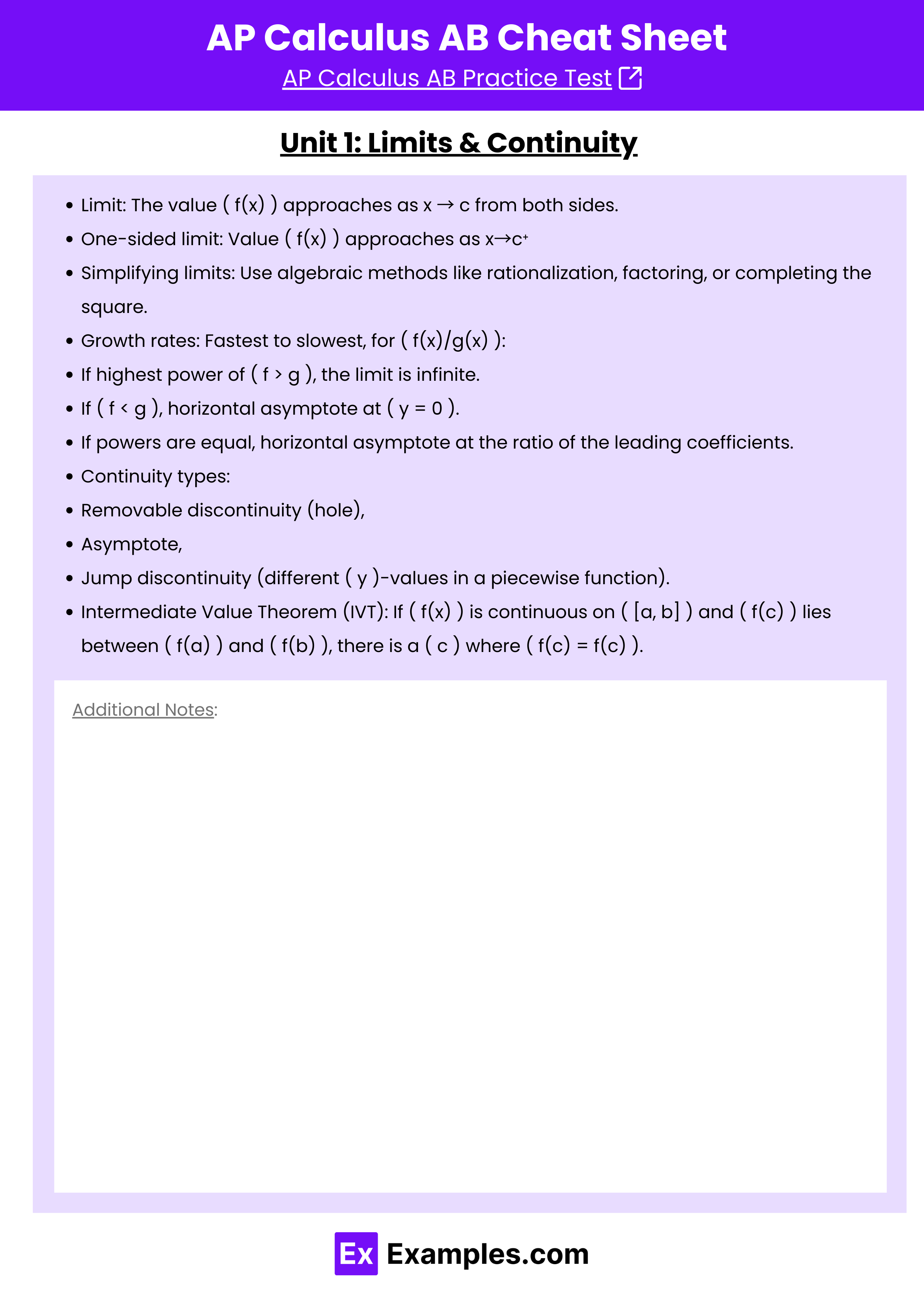
Unit 1: Limits & Continuity
- Limit: The value ( f(x) ) approaches as x → c from both sides.
- One-sided limit: Value ( f(x) ) approaches as x→c⁺
- Simplifying limits: Use algebraic methods like rationalization, factoring, or completing the square.
- Growth rates: Fastest to slowest, for ( f(x)/g(x) ):
- If highest power of ( f > g ), the limit is infinite.
- If ( f < g ), horizontal asymptote at ( y = 0 ).
- If powers are equal, horizontal asymptote at the ratio of the leading coefficients.
- Continuity types:
- Removable discontinuity (hole),
- Asymptote,
- Jump discontinuity (different ( y )-values in a piecewise function).
- Intermediate Value Theorem (IVT): If ( f(x) ) is continuous on ( [a, b] ) and ( f(c) ) lies between ( f(a) ) and ( f(b) ), there is a ( c ) where ( f(c) = f(c) ).
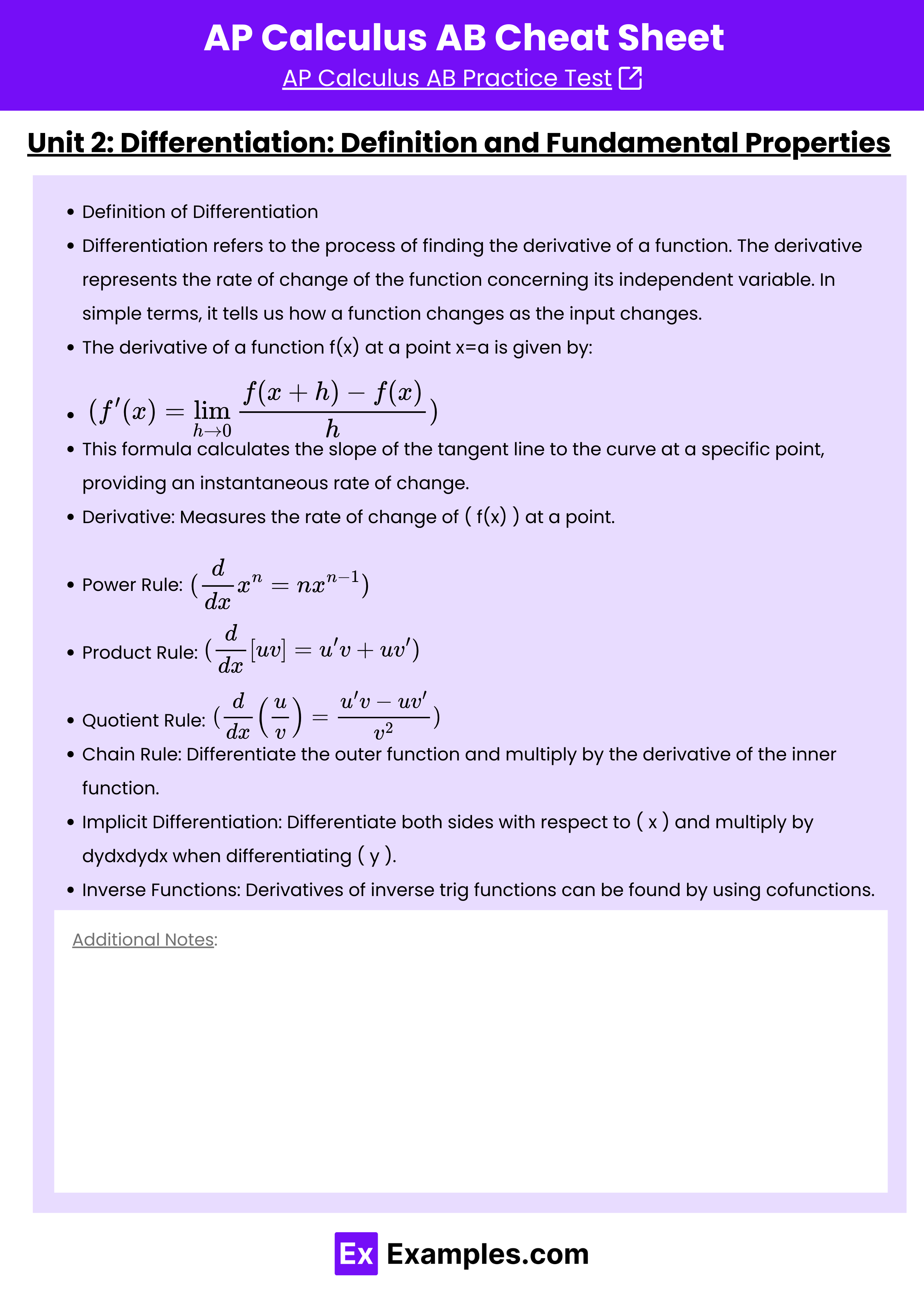
Unit 2: Differentiation: Definition and Fundamental Properties
Definition of Differentiation
Differentiation refers to the process of finding the derivative of a function. The derivative represents the rate of change of the function concerning its independent variable. In simple terms, it tells us how a function changes as the input changes.
The derivative of a function f(x) at a point x=a is given by:

This formula calculates the slope of the tangent line to the curve at a specific point, providing an instantaneous rate of change.
- Derivative: Measures the rate of change of ( f(x) ) at a point.
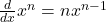
- Power Rule:
- Product Rule:
![\frac{d}{dx} [uv] = u'v + uv'](https://www.examples.com/wp-content/ql-cache/quicklatex.com-3816cfd3d8aa610428616fada57fba43_l3.png "Rendered by QuickLaTeX.com")
- Quotient Rule:
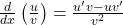
- Chain Rule: Differentiate the outer function and multiply by the derivative of the inner function.
- Implicit Differentiation: Differentiate both sides with respect to ( x ) and multiply by
 when differentiating ( y ).
 - Inverse Functions: Derivatives of inverse trig functions can be found by using cofunctions.
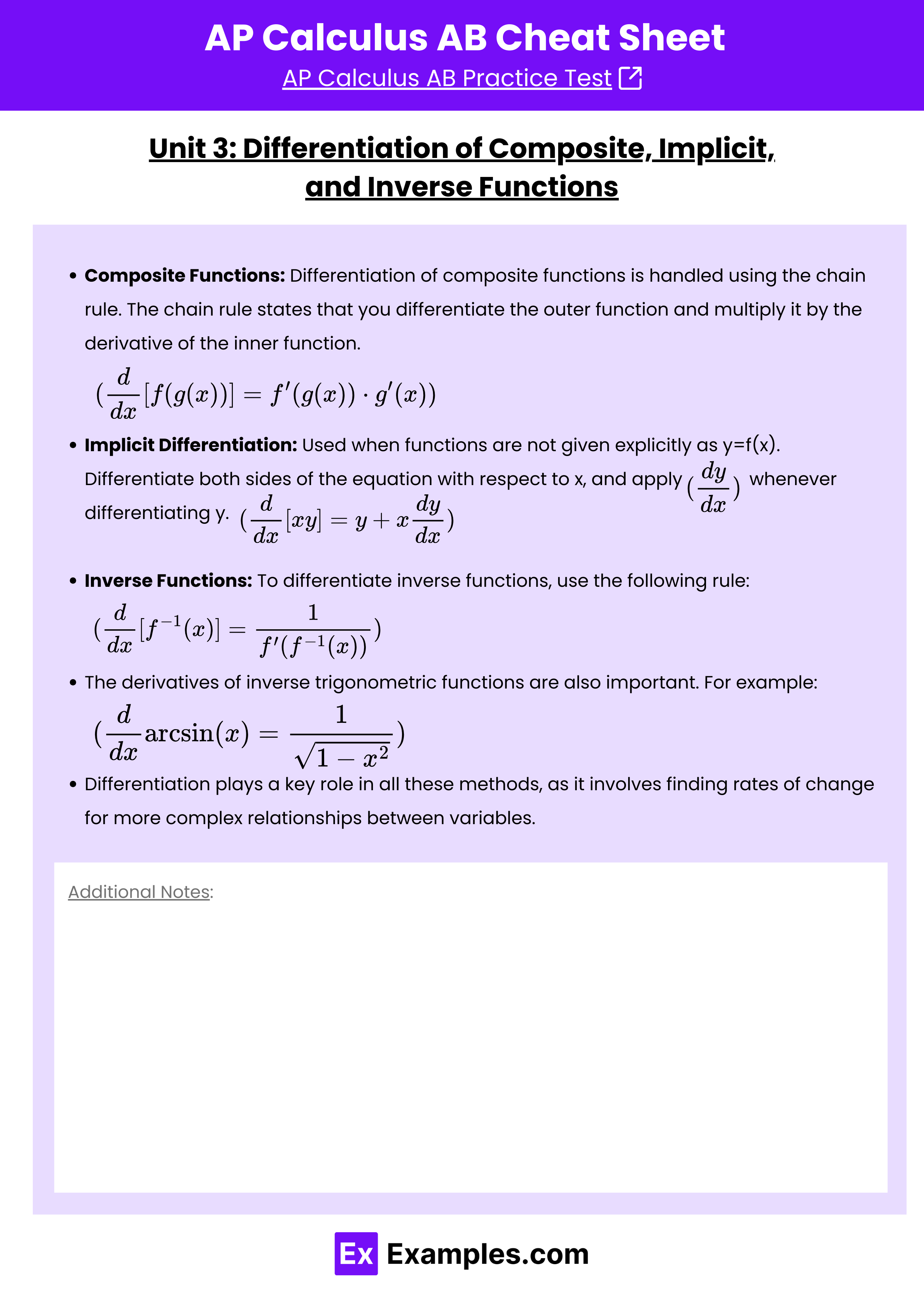
Unit 3: Differentiation of Composite, Implicit, and Inverse Functions
Composite Functions: Differentiation of composite functions is handled using the chain rule. The chain rule states that you differentiate the outer function and multiply it by the derivative of the inner function.
![\frac{d}{dx} [f(g(x))] = f'(g(x)) \cdot g'(x)](https://www.examples.com/wp-content/ql-cache/quicklatex.com-c9a20fb2283bce15b93ffd2491ad239e_l3.png "Rendered by QuickLaTeX.com")
Implicit Differentiation: Used when functions are not given explicitly as y=f(x). Differentiate both sides of the equation with respect to x, and apply whenever differentiating y.
![\frac{d}{dx} [xy] = y + x \frac{dy}{dx}](https://www.examples.com/wp-content/ql-cache/quicklatex.com-321c25a904678adeab0a4e4dfc42f630_l3.png "Rendered by QuickLaTeX.com")
Inverse Functions: To differentiate inverse functions, use the following rule:
![\frac{d}{dx} [f^{-1}(x)] = \frac{1}{f'(f^{-1}(x))}](https://www.examples.com/wp-content/ql-cache/quicklatex.com-25c618622c5a97e8c2679b970282727f_l3.png "Rendered by QuickLaTeX.com")
The derivatives of inverse trigonometric functions are also important. For example:

Differentiation plays a key role in all these methods, as it involves finding rates of change for more complex relationships between variables.
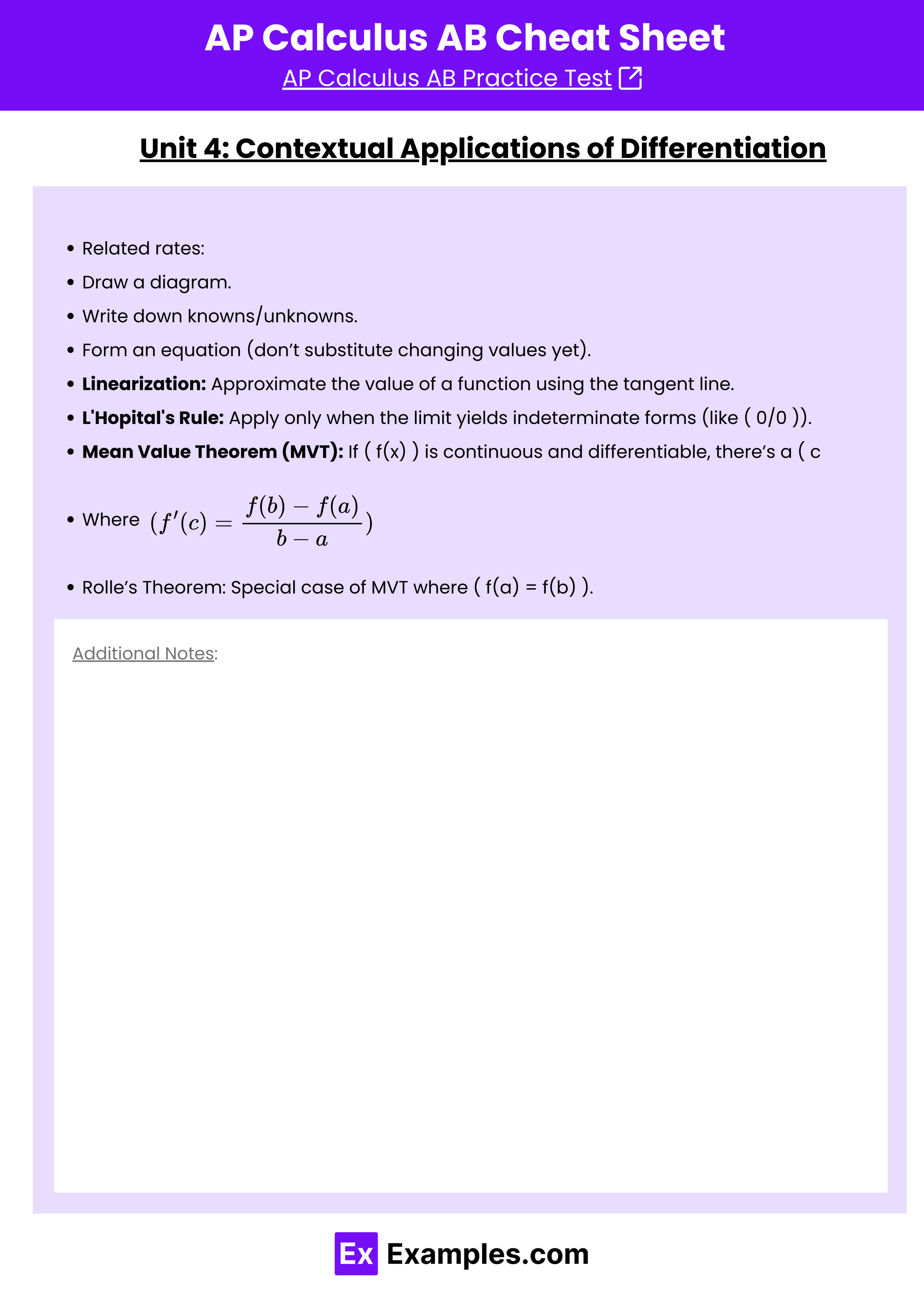
Unit 4: Contextual Applications of Differentiation
- Related rates:
- Draw a diagram.
- Write down knowns/unknowns.
- Form an equation (don’t substitute changing values yet).
- Linearization: Approximate the value of a function using the tangent line.
- L’Hopital’s Rule: Apply only when the limit yields indeterminate forms (like ( 0/0 )).
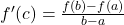
- Mean Value Theorem (MVT): If ( f(x) ) is continuous and differentiable, there’s a ( c ) Where
- Rolle’s Theorem: Special case of MVT where ( f(a) = f(b) ).
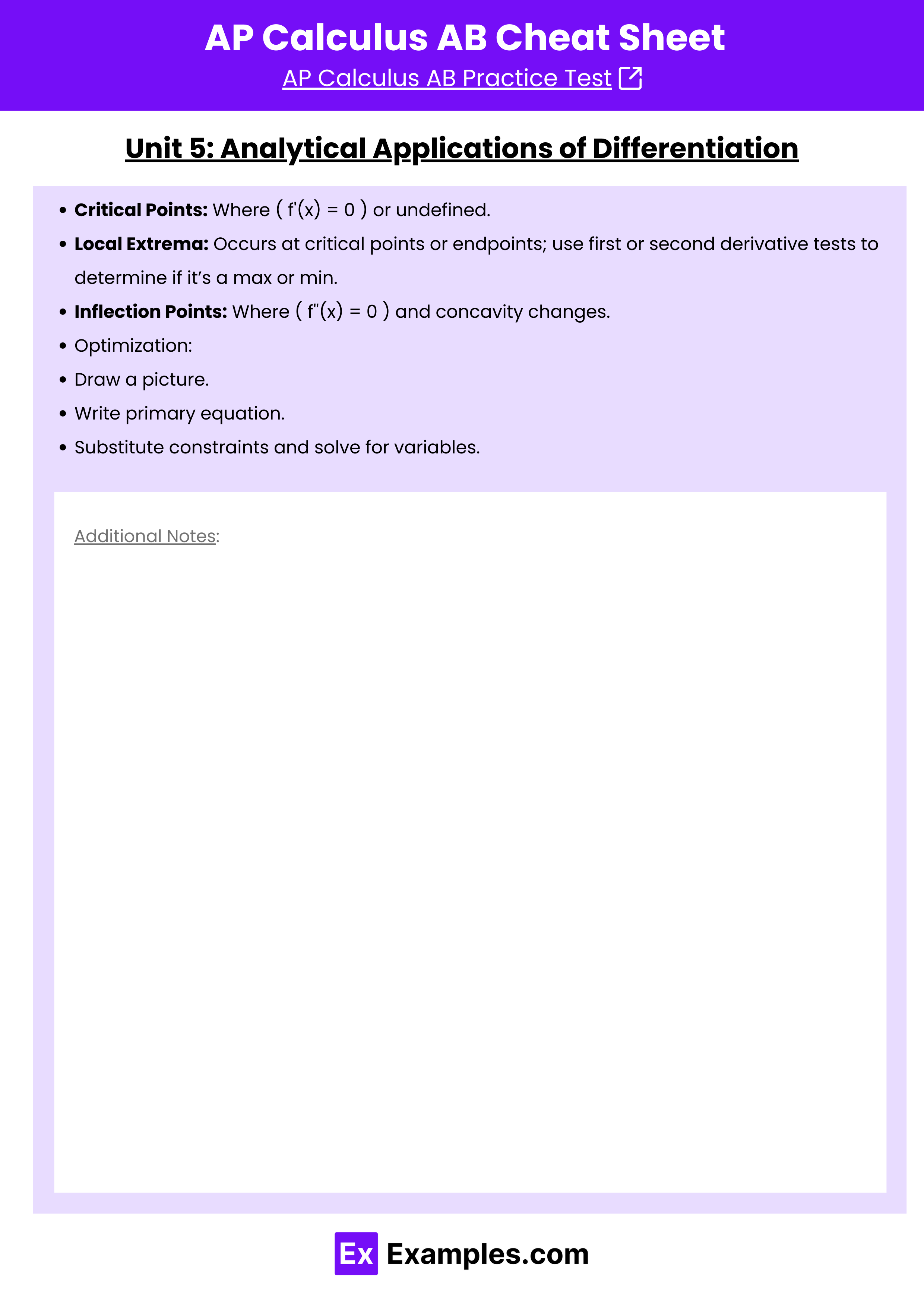
Unit 5: Analytical Applications of Differentiation
- Critical Points: Where ( f'(x) = 0 ) or undefined.
- Local Extrema: Occurs at critical points or endpoints; use first or second derivative tests to determine if it’s a max or min.
- Inflection Points: Where ( f”(x) = 0 ) and concavity changes.
- Optimization:
- Draw a picture.
- Write primary equation.
- Substitute constraints and solve for variables.
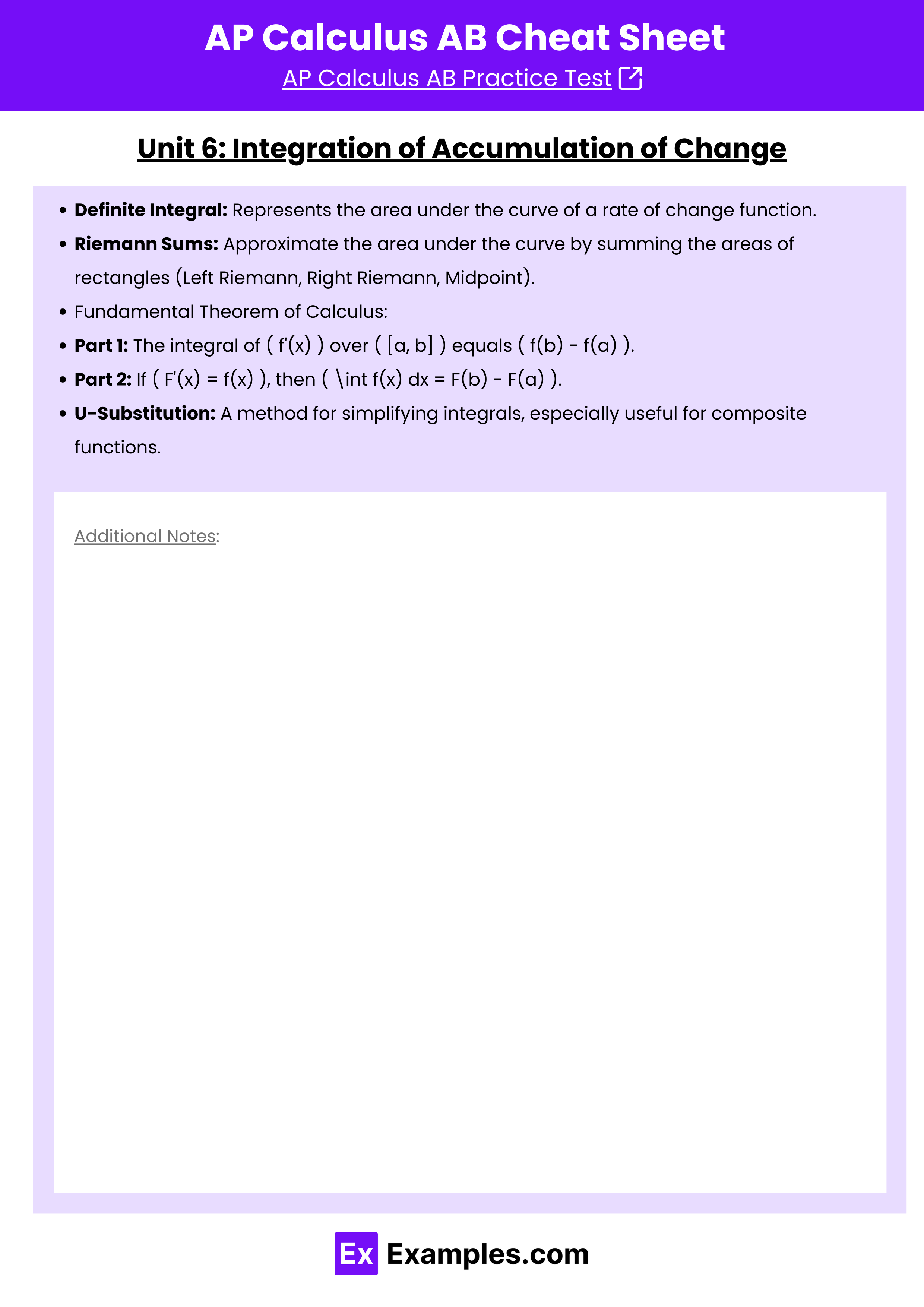
Unit 6: Integration of Accumulation of Change
- Definite Integral: Represents the area under the curve of a rate of change function.
- Riemann Sums: Approximate the area under the curve by summing the areas of rectangles (Left Riemann, Right Riemann, Midpoint).
- Fundamental Theorem of Calculus:
- Part 1: The integral of ( f'(x) ) over ( [a, b] ) equals ( f(b) – f(a) ).
- Part 2: If ( F'(x) = f(x) ), then ( \int f(x) dx = F(b) – F(a) ).
- U-Substitution: A method for simplifying integrals, especially useful for composite functions.
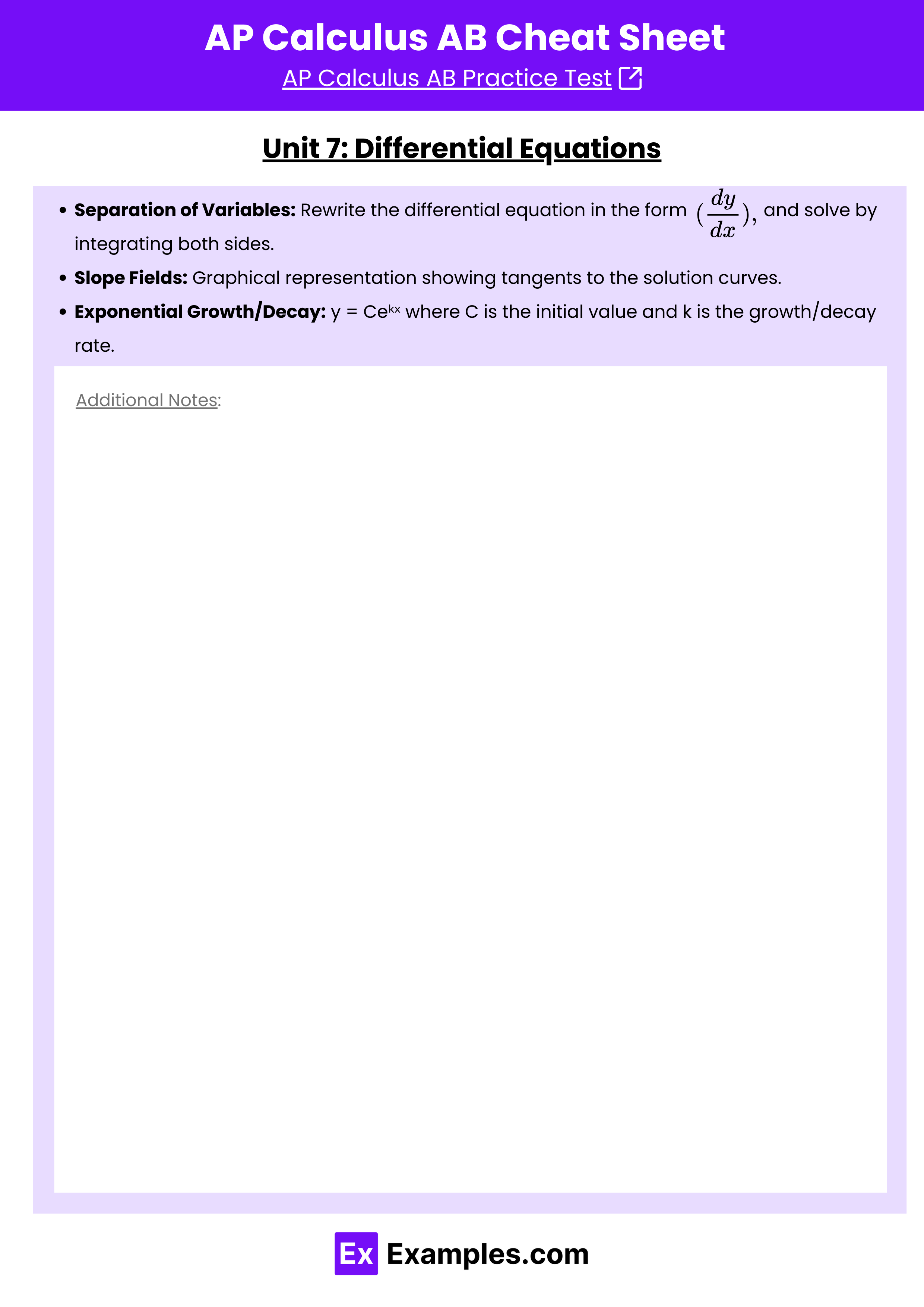
Unit 7: Differential Equations
- Separation of Variables: Rewrite the differential equation in the form , and solve by integrating both sides.
- Slope Fields: Graphical representation showing tangents to the solution curves.
- Exponential Growth/Decay: y = Ceᵏˣ where C is the initial value and k is the growth/decay rate.
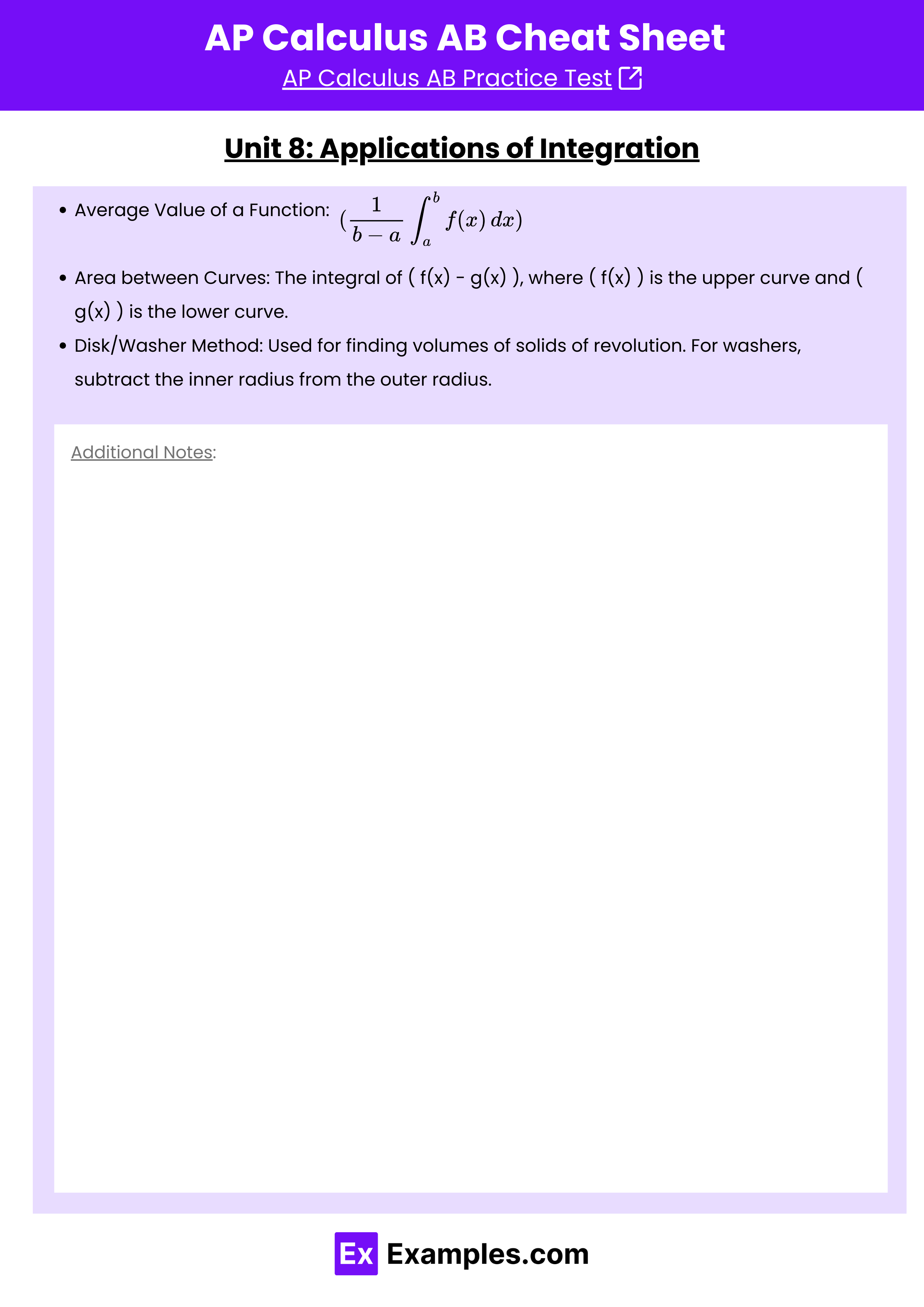
Unit 8: Applications of Integration
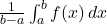
- Average Value of a Function:
- Area between Curves: The integral of ( f(x) – g(x) ), where ( f(x) ) is the upper curve and ( g(x) ) is the lower curve.
- Disk/Washer Method: Used for finding volumes of solids of revolution. For washers, subtract the inner radius from the outer radius.