
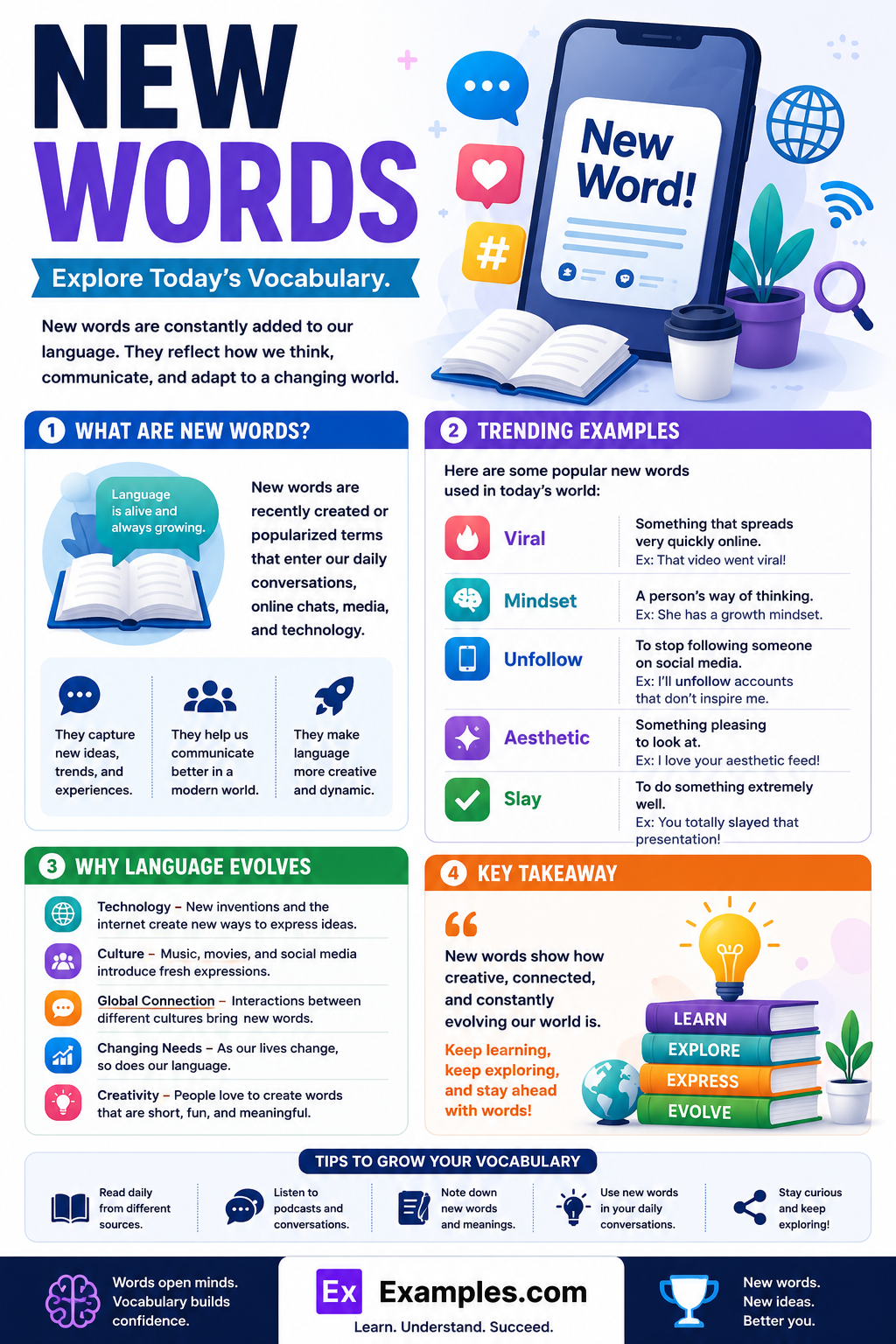
New words are recently created or newly popularized terms in a language. They reflect changes in culture, technology, and communication.
Download Most Commonly used New Words - PDF
Most Commonly used New Words
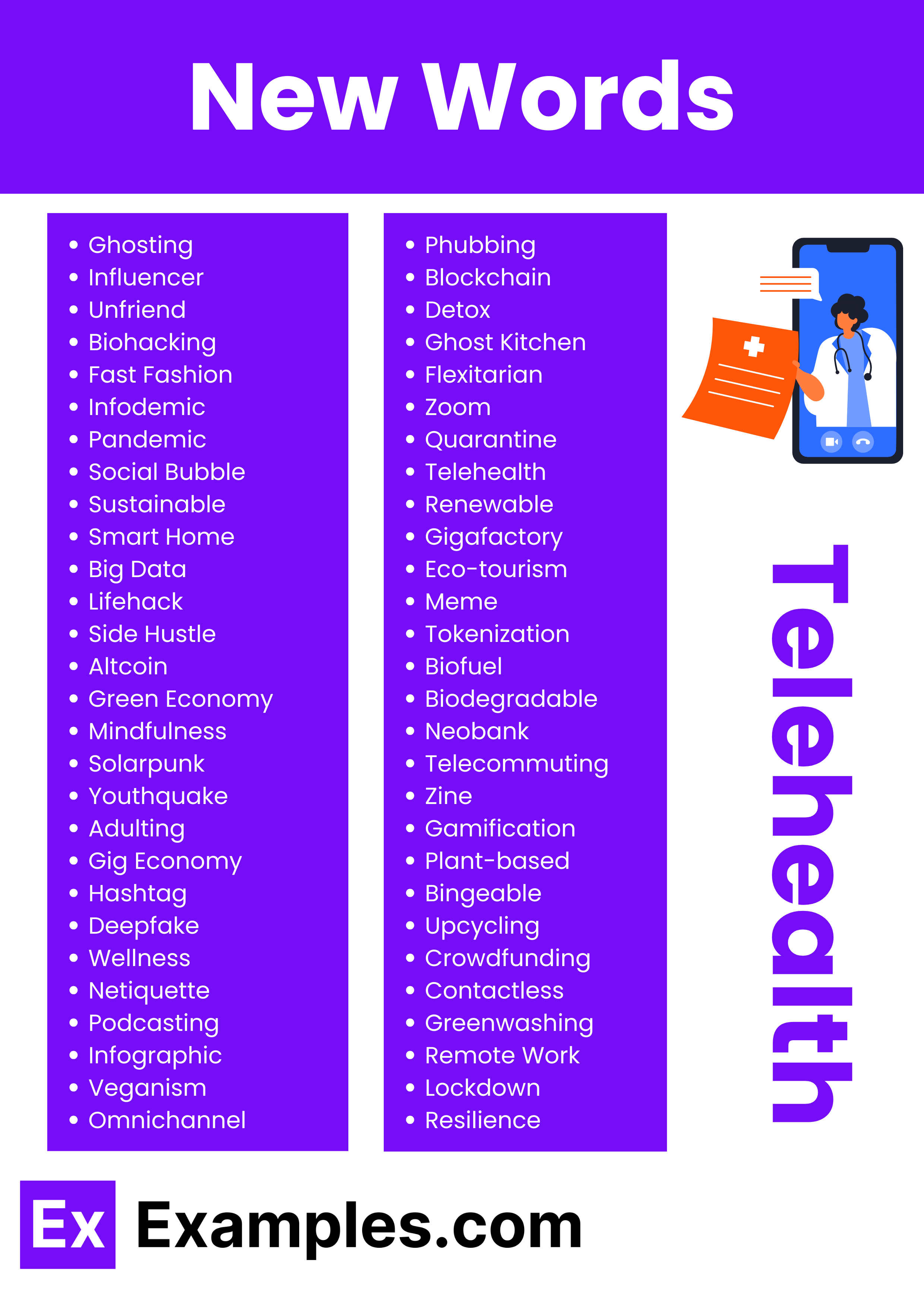
| Ghosting | Phubbing | Bingeable | Adulting |
| Influencer | Blockchain | Upcycling | Gig Economy |
| Unfriend | Detox | Crowdfunding | Hashtag |
| Biohacking | Ghost Kitchen | Contactless | Deepfake |
| Fast Fashion | Flexitarian | Greenwashing | Wellness |
| Infodemic | Zoom | Remote Work | Social Distancing |
| Pandemic | Quarantine | Lockdown | Job Automation |
| Social Bubble | Telehealth | mRNA Vaccine | Immunity Passport |
| Sustainable | Renewable | Biodegradable | Carbon Footprint |
| Smart Home | Gigafactory | Machine Learning | Augmented Reality |
| Big Data | Eco-tourism | FinTech | Gamification |
| Lifehack | Meme | Netiquette | Plant-based |
| Side Hustle | Tokenization | User Experience | Voice Assistant |
| Altcoin | Biofuel | Cord-cutting | Digital Detox |
| Green Economy | Influencer Marketing | Infographic | Language Modeling |
| Mindfulness | Neobank | Omnichannel | Podcasting |
| Solarpunk | Telecommuting | Urban Farming | Veganism |
| Youthquake | Zine | Circular Economy | Decarbonization |
Unique New Words
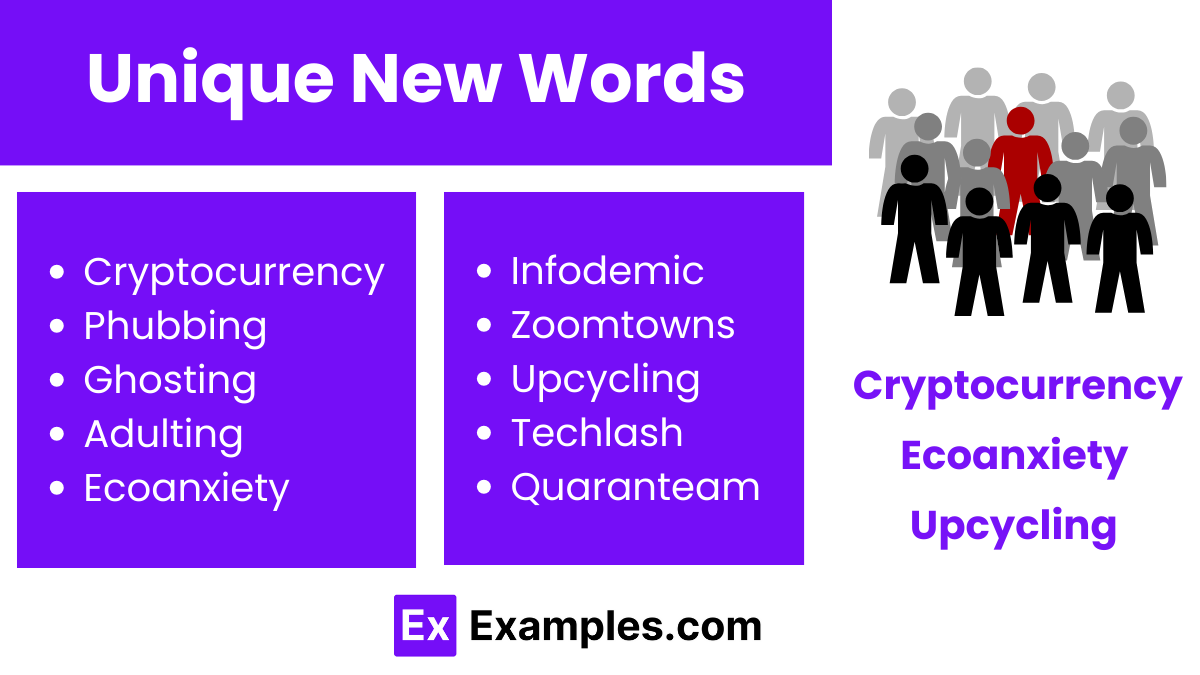
In the vibrant landscape of the English language, the evolution of vocabulary is a testament to its dynamic nature. As we navigate through various cultural, technological, and social developments, the English lexicon continually expands, embracing new words that reflect these changes. This enriching process not only broadens our means of expression but also enhances our communication, making it more nuanced and precise. By exploring unique new words, we delve into the heart of contemporary discourse, uncovering terms that capture the essence of modern experiences and innovations. These additions to our vocabulary are not just linguistic curiosities; they are mirrors of our evolving world, offering fresh perspectives and ways to articulate complex ideas. Learning new vocabulary becomes more effective when you actively use the words in complete sentences and short essays. A Paragraph Writer helps learners practice modern vocabulary naturally while improving grammar, sentence flow, and writing confidence.
- Cryptocurrency – Digital or virtual currency using cryptography for security.
- Phubbing – The act of snubbing someone in favor of a mobile phone.
- Ghosting – Ending a relationship by suddenly withdrawing from all communication.
- Adulting – Behaving in an adult manner, undertaking adult responsibilities.
- Ecoanxiety – A feeling of worry or unease about the environmental crisis.
- Infodemic – A massive spread of misinformation, especially online.
- Zoomtowns – Areas experiencing a population boom due to the popularity of remote work.
- Upcycling – Reusing discarded objects or material in such a way as to create a product of higher quality or value.
- Techlash – A strong negative reaction or backlash against the major tech companies.
- Quaranteam – A group of individuals or families that agree to restrict outside social contacts and exclusively interact with each other during a quarantine period.
Difficult New Words

The English language is a treasure trove of complexity, offering words that challenge even the most seasoned linguists and vocabulary enthusiasts. Difficult new words often come loaded with nuanced meanings, intricate spellings, and sophisticated usage contexts, reflecting the depth and richness of the language. These words serve as tools for precise communication, allowing us to articulate complex ideas and emotions with specificity. Learning these terms not only enhances our linguistic repertoire but also sharpens our cognitive skills, encouraging us to engage more deeply with the written and spoken word. Below is a list of ten difficult new words, each bolded for emphasis, showcasing the linguistic diversity and intellectual challenge they present.
- Antediluvian – Extremely old and antiquated, literally before the biblical flood.
- Bibliopole – A person who buys and sells books, especially rare ones.
- Cacophony – A harsh, discordant mixture of sounds.
- Diacritical – Concerning a mark added to a letter to indicate a different pronunciation.
- Ephemeral – Lasting for a very short time.
- Flibbertigibbet – A frivolous, flighty, or excessively talkative person.
- Gerrymander – Manipulate the boundaries of (an electoral constituency) to favor one party or class.
- Hippopotamus – Fear of long words.
- Ineffable – Too great or extreme to be expressed or described in words.
- Jurisprudence – The theory or philosophy of law.
Trending New Words
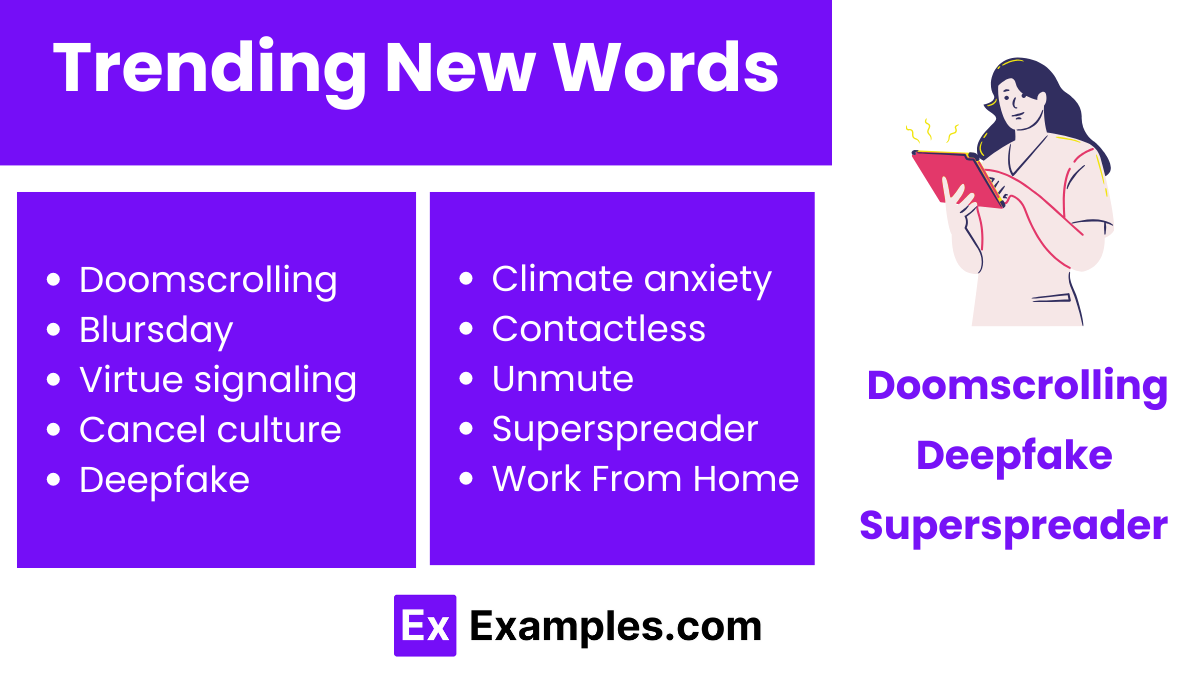
As our society evolves, so does our language, adapting to new trends, technologies, and societal norms. Trending new words capture the zeitgeist, offering insights into current interests, issues, and innovations. These words reflect the dynamic nature of English, showcasing how quickly it can incorporate and normalize new concepts. Engaging with these terms not only helps us stay current but also enriches our understanding of the world around us. Below is a list of ten trending new words, each bolded for emphasis, that have captured the public’s imagination and found a place in our collective vocabulary. Trending words are widely used in blogs, articles, and social media content. An AI Content Generator can help you create engaging content that naturally incorporates today’s most popular vocabulary.
- Doomscrolling – Obsessively reading social media posts about how terrible the world is.
- Blursday – The indistinguishable feeling of all days merging together, especially during lockdowns.
- Virtue signaling – Conveying one’s moral values, especially on social media, in a way that is intended more to show good character than to effect any substantive change.
- Cancel culture – The practice of withdrawing support for (cancelling) public figures and companies after they have done or said something considered objectionable or offensive.
- Deepfake – Synthetic media in which a person’s likeness has been altered or replaced with someone else’s.
- Climate anxiety – Distress or unease about the effects of climate change.
- Contactless – Referring to payments, deliveries, or other transactions conducted without physical contact.
- Unmute – The action of turning on one’s audio during a video call, now commonly used in virtual meetings.
- Superspreader – An individual who is highly contagious and capable of spreading a disease to an unusually large number of people.
- WFH (Work From Home) – The practice of working from a residence rather than in an office.
New Words for Kids

In the realm of learning and development, introducing new words to children is a vital step in expanding their vocabulary and enhancing their linguistic skills. New words for kids are chosen to be engaging, understandable, and relevant to their experiences, fostering a love for language and learning. These words help children articulate their thoughts, feelings, and observations, aiding in their overall cognitive development. Below is a list of ten new words for kids, each bolded for emphasis, that are both educational and fun, encouraging young learners to explore the richness of language. To make vocabulary practice more enjoyable, students can explore additional words using a Random Word Generator, which introduces fresh vocabulary for spelling, reading, and classroom activities.
- Buddy – A friend.
- Giggle – To laugh in a light, silly way.
- Brave – Having or showing courage.
- Dream – A series of thoughts, images, or emotions occurring during sleep.
- Sparkle – To shine brightly with flashes of light.
- Explore – To travel over (new territory) for adventure or discovery.
- Gift – Something given voluntarily without payment in return.
- Jump – To spring into the air.
- Kind – Having or showing a friendly, generous, and considerate nature.
- Magic – The power of apparently influencing events by using mysterious or supernatural forces.
New Words in Kindergarten

Kindergarten is a crucial stage for language acquisition, where young learners are introduced to foundational words that form the bedrock of their vocabulary. New words in kindergarten are carefully selected to be simple, memorable, and directly applicable to the children’s everyday experiences and interactions. These words lay the groundwork for effective communication, reading, and writing skills, setting the stage for lifelong learning. Below is a list of ten new words in kindergarten, each bolded for emphasis, that are essential for early childhood education, fostering both linguistic and cognitive development. As children become familiar with basic vocabulary, they can gradually build longer sentences using a Paragraph Expander, making it easier to strengthen both writing and comprehension skills.
- Share – To divide and distribute.
- Friend – A person whom one knows and with whom one has a bond of mutual affection.
- Read – To look at and comprehend the meaning of written or printed matter.
- Write – To mark (letters, words, or other symbols) on a surface, typically paper, with a pen, pencil, or similar implement.
- Count – To determine the total number of.
- Play – Engage in activity for enjoyment and recreation.
- Help – To make it easier or possible for (someone) to do something by offering one’s services or resources.
- Learn – To acquire knowledge of or skill in (something) by study, experience, or being taught.
- Sing – To make musical sounds with the voice.
- Draw – To produce (a picture or diagram) by making lines and marks on paper with a pencil, pen, etc.
Short New Words
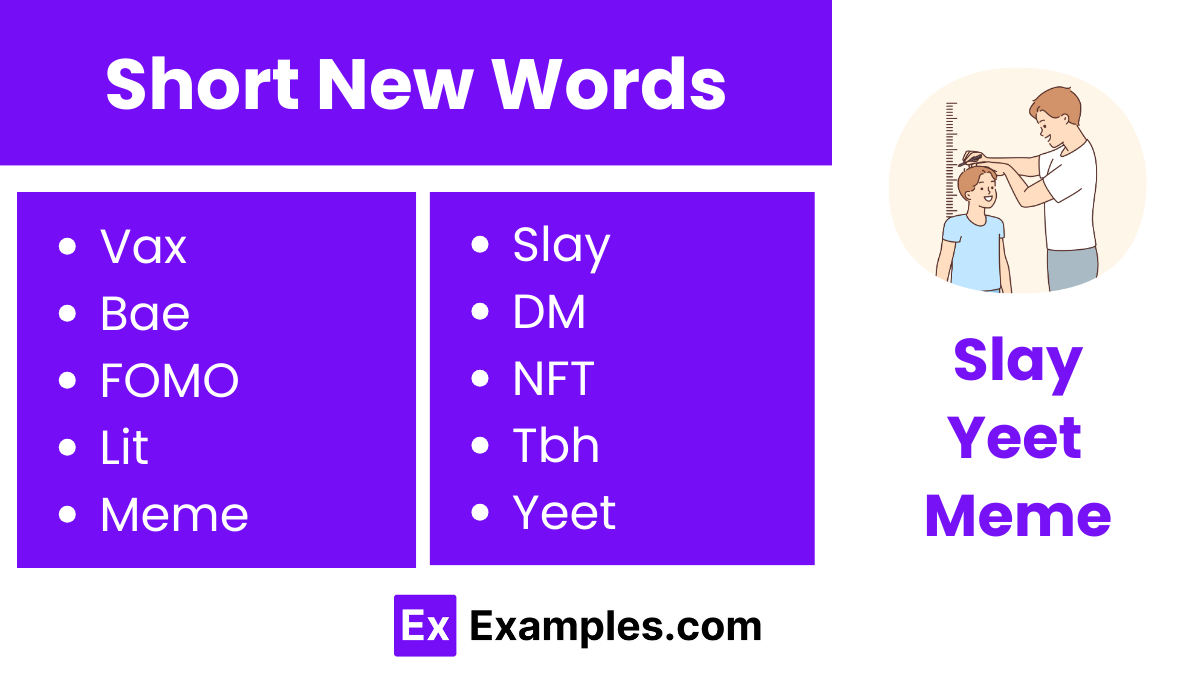
In the ever-evolving landscape of the English language, short new words play a pivotal role in reflecting societal trends, technological advancements, and cultural shifts. These concise terms, often derived from abbreviations, slang, or blends of existing words, pack significant meaning into just a few letters, making them easy to remember and use in everyday communication. Their brevity and punchiness cater to the fast-paced, digital-driven world we live in, where quick and efficient communication is prized. By incorporating these short new words into our vocabulary, we not only stay abreast of linguistic developments but also enrich our expressions, making them more vibrant and contemporary. Below is a list of ten short new words, each bolded for emphasis, showcasing the ingenuity of English in adapting to the modern world. One enjoyable way to remember modern vocabulary is by using it in creative storytelling. An AI Story Generator can help learners create short stories featuring newly learned words in meaningful contexts.
- Vax – Short for vaccine or vaccination.
- Bae – A term of endearment for one’s romantic partner.
- FOMO – Fear of missing out; anxiety that an exciting event may currently be happening elsewhere.
- Lit – Amazing, exciting, or fun.
- Meme – A humorous image, video, piece of text, etc., that is copied and spread rapidly by internet users.
- Slay – To greatly impress or amuse.
- DM – Direct message; a private message sent on social media.
- NFT – Non-fungible token; a digital certificate of ownership for a unique asset.
- Tbh – To be honest; expressing candidness or transparency.
- Yeet – An exclamation of excitement, approval, surprise, or all-around energy, often as issued when throwing something.
Revisiting new vocabulary through rewritten sentences improves understanding and retention. A Paraphraser helps learners explore different ways to express the same ideas while naturally reinforcing newly learned words. Editing your own writing is another excellent way to master new vocabulary. A Paragraph Rewriter can improve clarity and readability while encouraging the use of modern English words in different contexts.
The exploration of new words across various contexts be it difficult, trending, tailored for kids, or essential for kindergarten highlights the dynamic nature of the English language. These terms enrich our vocabulary, reflect evolving societal trends, and foster clearer communication. Embracing these words not only enhances our linguistic arsenal but also connects us more deeply to the world around us. After studying a large collection of vocabulary, using a Paragraph Summarizer helps review the key ideas quickly and reinforces important new words for long-term retention. If you’re looking for more opportunities to practice recently learned vocabulary, an AI Content Idea Generator can suggest writing topics that encourage you to use new words naturally in essays, journals, and creative assignments. As you begin using new words in sentences, checking grammar ensures your writing remains accurate and easy to understand. An AI Grammar Checker helps polish your work while reinforcing correct word usage.