


Contents
lists
available
at
ScienceDirect
ICT Express
journal
homepage:
www.elsevier.com/locate/icte
AI-enhanced Digital Twin systems for warehouse logistics optimization: A
review of challenges with solutions and future directions
Md Mahinur Alam
b
, Reimbaev Azizbek Nurkat Ugli
a
, Kanita Jerin Tanha
a
, Taesoo Jun
a
,
∗
a
Department
of
IT
Convergence
Engineering,
Kumoh
National
Institute
of
Technology,
Gumi
39177,
South
Korea
b
Department
of
Electrical
and
Computer
Engineering,
Georgia
Southern
University,
Statesboro,
GA,
USA
A
R
T
I
C
L
E
I
N
F
O
Keywords:
Artificial Intelligence (AI)
Automated Guided Vehicles (AGVs)
Digital Twin (DT)
Internet of Things (IoT)
Warehouse logistics
A
B
S
T
R
A
C
T
Digital
transformation
is
revolutionizing
warehousing
by
integrating
advanced
technologies
like
Digital
Twins,
AI,
and
IoT.
Digital
Twins
create
virtual
warehouse
replicas
for
simulation
and
optimization,
enhancing
resource
allocation
and
proactive
problem-solving.
AI-driven
systems
predict
and
optimize
processes,
while
Automated
Guided
Vehicles
(AGVs)
streamline
the
movement
of
goods.
IoT
improves
connectivity
and
data
collection,
supporting
decision-making
through
machine
learning
and
deep
learning.
Robots,
utilizing
reinforcement
learning
and
computer
vision,
automate
tasks
like
picking
and
packing,
boosting
efficiency
and
reducing
errors.
Additionally,
anomaly
and
intrusion
detection
enhance
security.
This
review
highlights
key
advancements
in
path
planning,
task
allocation,
inventory
management,
and
storage
assignment,
which
improve
operational
effectiveness.
It
also
addresses
the
lack
of
analysis
on
the
economic
impacts
of
digital
transformation,
particularly
in
cost
reduction,
return
on
investment
(ROI),
and
customer
satisfaction.
The
paper identifies research gaps, including the integration of sustainability, adaptation to dynamic environments,
collaborative robots, and optimization of reverse logistics. This review provides a foundation for future research
on
the
potential
of
digitalization
to
transform
warehousing
practices.
1.
Introduction
The
digital
transformation
of
warehouse
logistics
is
fundamentally
reshaping
the
way
goods
are
managed,
stored,
and
distributed.
As
the
logistics
industry
faces
increasing
demands
for
efficiency,
speed,
and
flexibility,
technologies
such
as
Digital
Twin
(DT),
Artificial
Intelligence
(AI),
and
the
Internet
of
Things
(IoT)
are
emerging
as
key
enablers
of
this
transformation
[
1
,
2
].
DT
technology
creates
high-fidelity
virtual
replicas
of
physical
systems,
enabling
real-time
simulations,
monitor-
ing,
and
optimization
[
3
,
4
].
These
virtual
models
allow
warehouse
operators
to
predict
potential
issues,
test
new
strategies
without
dis-
rupting
ongoing
operations,
and
make
data-driven
decisions
to
enhance
performance.
In
modern
warehouses,
the
integration
of
AI
with
DT
systems
is
particularly
valuable.
AI
algorithms,
including
machine
learning
(ML),
deep
learning
(DL),
and
reinforcement
learning
(RL),
augment
the
capabilities
of
DT
by
analyzing
large
volumes
of
real-time
data,
pro-
viding
predictive
insights,
and
automating
complex
tasks
[
5
–
7
].
For
instance,
AGVs
and
robots,
powered
by
AI,
can
autonomously
navigate
and
perform
tasks
such
as
picking,
packing,
and
sorting
[
8
].
These
systems
not
only
increase
operational
efficiency
but
also
reduce
hu-
man
error,
enhance
throughput,
and
enable
more
flexible
and
scalable
∗
Corresponding
author.
E-mail
address:
taesoo.jun@kumoh.ac.kr
(T.
Jun).
warehouse
operations.
Alongside
automation,
IoT
devices
play
a
crucial
role
in
enabling
these
technologies
by
providing
real-time
data
and
connectivity
[
9
].
With
sensors,
RFID
tags,
and
smart
devices
embedded
throughout
the
warehouse,
IoT
systems
continuously
collect
data
on
inventory
levels,
warehouse
conditions,
and
equipment
performance.
This
information
is
fed
into
DT
models,
allowing
for
dynamic
ad-
justments
to
operations,
such
as
optimizing
storage
layouts,
adjusting
inventory
levels,
and
fine-tuning
supply
chain
operations
[
10
,
11
].
As
a
result,
warehouses
can
operate
more
efficiently,
respond
to
changing
demands
faster,
and
make
better-informed
decisions.
The
invention
of
DT
technology
marked
the
beginning
of
a
new
era
in
warehouse
logistics,
evolving
through
several
distinct
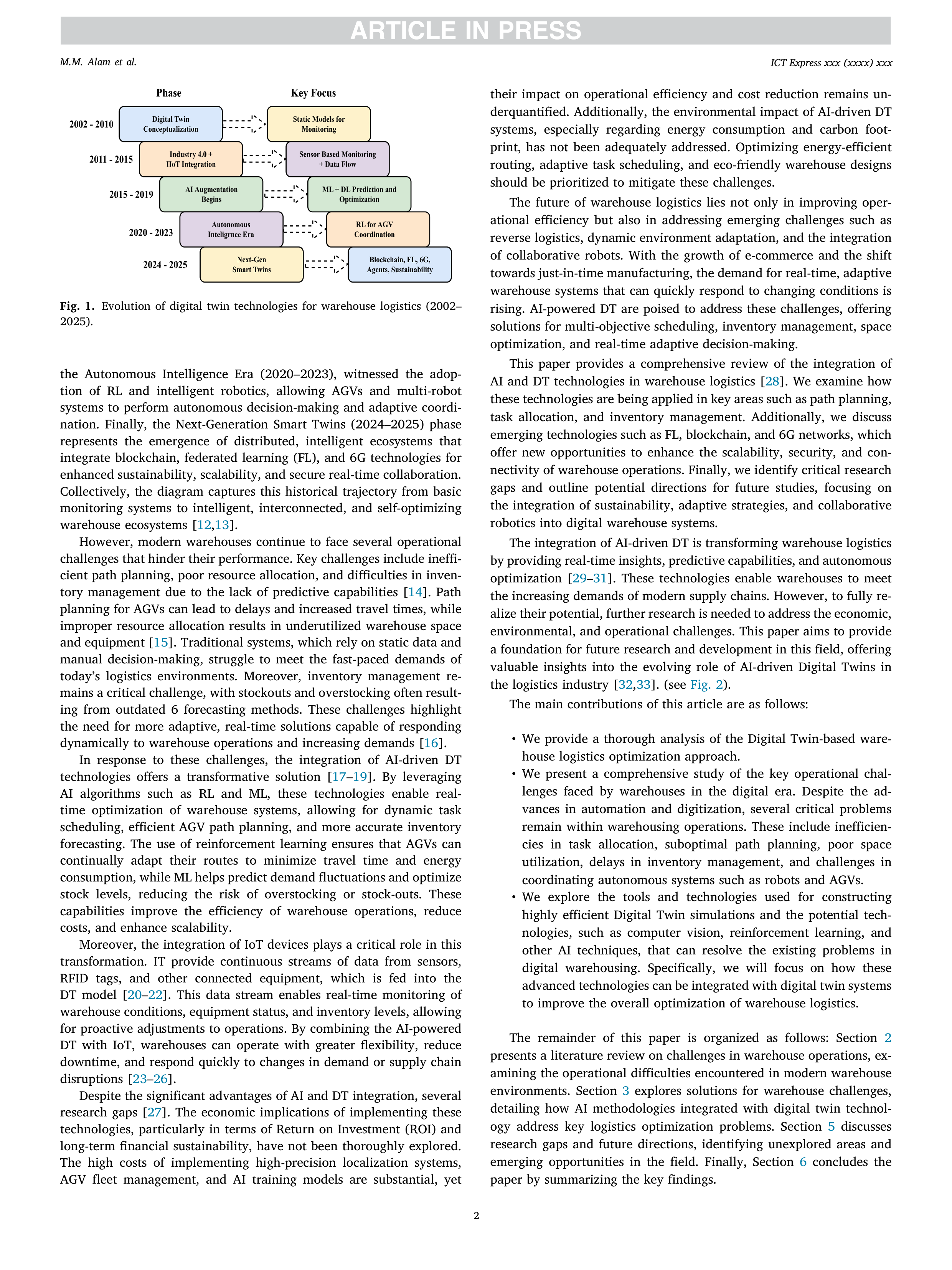
phases
as
illustrated
in
Fig.
1
.
Initially,
during
the
DT
Conceptualization
(2002–
2010)
phase,
DTs
were
introduced
as
static
digital
models
primarily
designed
for
system
visualization
and
basic
monitoring.
With
the
rise
of
Industry
4.0
and
the
Industrial
Internet
of
Things
(IIoT)
(2011–
2015),
these
models
advanced
into
interactive,
data-driven
systems
capable
of
real-time
data
collection
and
communication
between
physi-
cal
and
digital
environments.
The
AI
Augmentation
phase
(2015–2019)
brought
the
integration
of
ML
and
DL,
enabling
predictive
analytics
and
process
optimization
in
warehouse
operations.
The
next
stage,
https://doi.org/10.1016/j.icte.2026.01.009
Received
13
August
2025;
Received
in
revised
form
2
November
2025;
Accepted
14
January
2026
ICT Express xxx (xxxx) xxx
Available online 20 January 2026
2405-9595/© 2026 The Authors. Published by Elsevier B.V. on behalf of The Korean Institute of Communications and Information Sciences. This is an open access
article under the CC BY-NC-ND license (
http://creativecommons.org/licenses/by-nc-nd/4.0/
).
Please cite this article as: Md Mahinur Alam et al.,
ICT
Express,
https://doi.org/10.1016/j.icte.2026.01.009
M.M.
Alam
et
al.
Fig.
1.
Evolution
of
digital
twin
technologies
for
warehouse
logistics
(2002–
2025).
the
Autonomous
Intelligence
Era
(2020–2023),
witnessed
the
adop-
tion
of
RL
and
intelligent
robotics,
allowing
AGVs
and
multi-robot
systems
to
perform
autonomous
decision-making
and
adaptive
coordi-
nation.
Finally,
the
Next-Generation
Smart
Twins
(2024–2025)
phase
represents
the
emergence
of
distributed,
intelligent
ecosystems
that
integrate
blockchain,
federated
learning
(FL),
and
6G
technologies
for
enhanced
sustainability,
scalability,
and
secure
real-time
collaboration.
Collectively,
the
diagram
captures
this
historical
trajectory
from
basic
monitoring
systems
to
intelligent,
interconnected,
and
self-optimizing
warehouse
ecosystems
[
12
,
13
].
However,
modern
warehouses
continue
to
face
several
operational
challenges
that
hinder
their
performance.
Key
challenges
include
ineffi-
cient
path
planning,
poor
resource
allocation,
and
difficulties
in
inven-
tory
management
due
to
the
lack
of
predictive
capabilities
[
14
].
Path
planning
for
AGVs
can
lead
to
delays
and
increased
travel
times,
while
improper
resource
allocation
results
in
underutilized
warehouse
space
and
equipment
[
15
].
Traditional
systems,
which
rely
on
static
data
and
manual
decision-making,
struggle
to
meet
the
fast-paced
demands
of
today’s
logistics
environments.
Moreover,
inventory
management
re-
mains
a
critical
challenge,
with
stockouts
and
overstocking
often
result-
ing
from
outdated
6
forecasting
methods.
These
challenges
highlight
the
need
for
more
adaptive,
real-time
solutions
capable
of
responding
dynamically
to
warehouse
operations
and
increasing
demands
[
16
].
In
response
to
these
challenges,
the
integration
of
AI-driven
DT
technologies
offers
a
transformative
solution
[
17
–
19
].
By
leveraging
AI
algorithms
such
as
RL
and
ML,
these
technologies
enable
real-
time
optimization
of
warehouse
systems,
allowing
for
dynamic
task
scheduling,
efficient
AGV
path
planning,
and
more
accurate
inventory
forecasting.
The
use
of
reinforcement
learning
ensures
that
AGVs
can
continually
adapt
their
routes
to
minimize
travel
time
and
energy
consumption,
while
ML
helps
predict
demand
fluctuations
and
optimize
stock
levels,
reducing
the
risk
of
overstocking
or
stock-outs.
These
capabilities
improve
the
efficiency
of
warehouse
operations,
reduce
costs,
and
enhance
scalability.
Moreover,
the
integration
of
IoT
devices
plays
a
critical
role
in
this
transformation.
IT
provide
continuous
streams
of
data
from
sensors,
RFID
tags,
and
other
connected
equipment,
which
is
fed
into
the
DT
model
[
20
–
22
].
This
data
stream
enables
real-time
monitoring
of
warehouse
conditions,
equipment
status,
and
inventory
levels,
allowing
for
proactive
adjustments
to
operations.
By
combining
the
AI-powered
DT
with
IoT,
warehouses
can
operate
with
greater
flexibility,
reduce
downtime,
and
respond
quickly
to
changes
in
demand
or
supply
chain
disruptions
[
23
–
26
].
Despite
the
significant
advantages
of
AI
and
DT
integration,
several
research
gaps
[
27
].
The
economic
implications
of
implementing
these
technologies,
particularly
in
terms
of
Return
on
Investment
(ROI)
and
long-term
financial
sustainability,
have
not
been
thoroughly
explored.
The
high
costs
of
implementing
high-precision
localization
systems,
AGV
fleet
management,
and
AI
training
models
are
substantial,
yet
their
impact
on
operational
efficiency
and
cost
reduction
remains
un-
derquantified.
Additionally,
the
environmental
impact
of
AI-driven
DT
systems,
especially
regarding
energy
consumption
and
carbon
foot-
print,
has
not
been
adequately
addressed.
Optimizing
energy-efficient
routing,
adaptive
task
scheduling,
and
eco-friendly
warehouse
designs
should
be
prioritized
to
mitigate
these
challenges.
The
future
of
warehouse
logistics
lies
not
only
in
improving
oper-
ational
efficiency
but
also
in
addressing
emerging
challenges
such
as
reverse
logistics,
dynamic
environment
adaptation,
and
the
integration
of
collaborative
robots.
With
the
growth
of
e-commerce
and
the
shift
towards
just-in-time
manufacturing,
the
demand
for
real-time,
adaptive
warehouse
systems
that
can
quickly
respond
to
changing
conditions
is
rising.
AI-powered
DT
are
poised
to
address
these
challenges,
offering
solutions
for
multi-objective
scheduling,
inventory
management,
space
optimization,
and
real-time
adaptive
decision-making.
This
paper
provides
a
comprehensive
review
of
the
integration
of
AI
and
DT
technologies
in
warehouse
logistics
[
28
].
We
examine
how
these
technologies
are
being
applied
in
key
areas
such
as
path
planning,
task
allocation,
and
inventory
management.
Additionally,
we
discuss
emerging
technologies
such
as
FL,
blockchain,
and
6G
networks,
which
offer
new
opportunities
to
enhance
the
scalability,
security,
and
con-
nectivity
of
warehouse
operations.
Finally,
we
identify
critical
research
gaps
and
outline
potential
directions
for
future
studies,
focusing
on
the
integration
of
sustainability,
adaptive
strategies,
and
collaborative
robotics
into
digital
warehouse
systems.
The
integration
of
AI-driven
DT
is
transforming
warehouse
logistics
by
providing
real-time
insights,
predictive
capabilities,
and
autonomous
optimization
[
29
–
31
].
These
technologies
enable
warehouses
to
meet
the
increasing
demands
of
modern
supply
chains.
However,
to
fully
re-
alize
their
potential,
further
research
is
needed
to
address
the
economic,
environmental,
and
operational
challenges.
This
paper
aims
to
provide
a
foundation
for
future
research
and
development
in
this
field,
offering
valuable
insights
into
the
evolving
role
of
AI-driven
Digital
Twins
in
the
logistics
industry
[
32
,
33
].
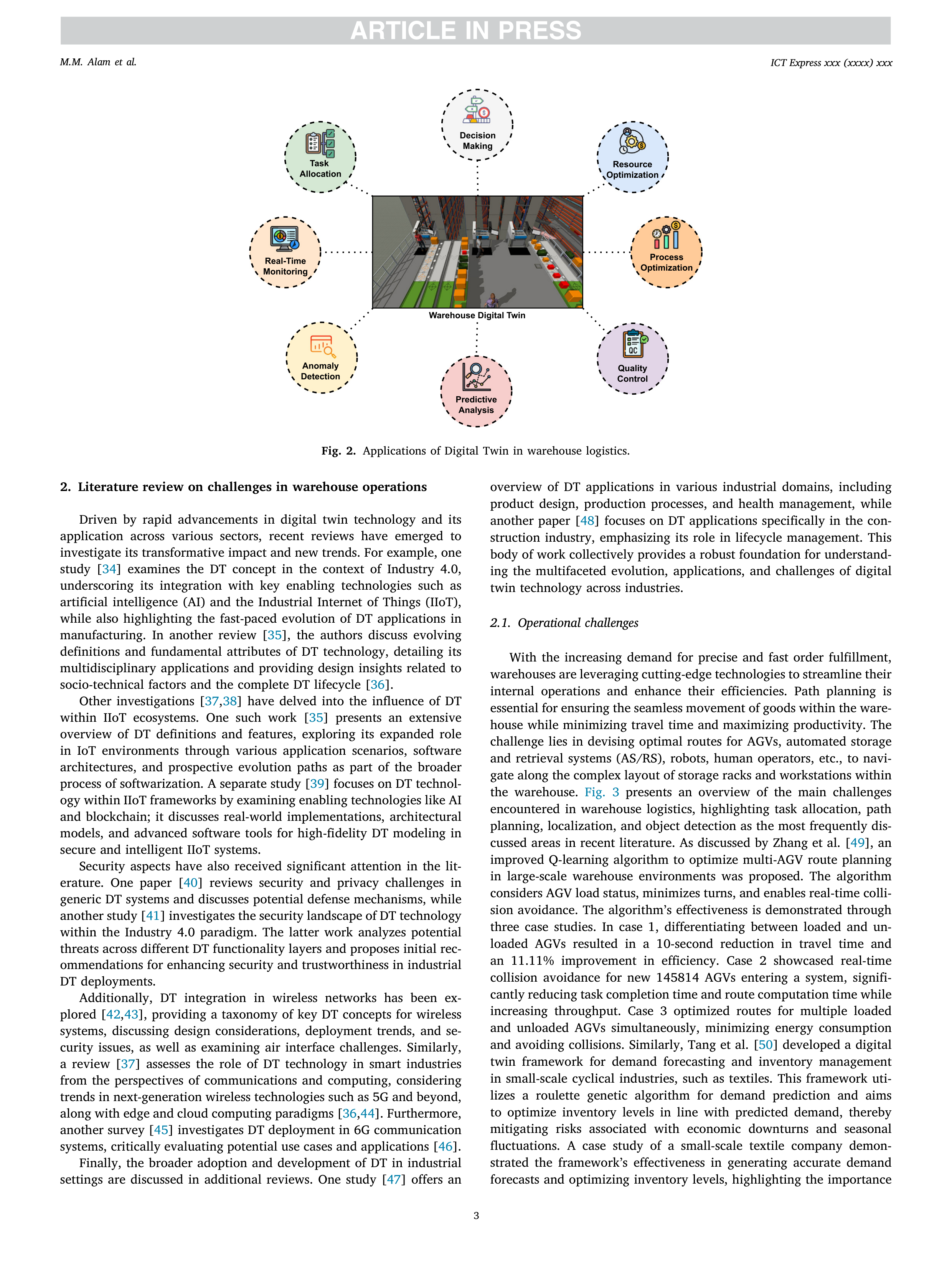
(see
Fig.
2
).
The
main
contributions
of
this
article
are
as
follows:
•
We
provide
a
thorough
analysis
of
the
Digital
Twin-based
ware-
house
logistics
optimization
approach.
•
We
present
a
comprehensive
study
of
the
key
operational
chal-
lenges
faced
by
warehouses
in
the
digital
era.
Despite
the
ad-
vances
in
automation
and
digitization,
several
critical
problems
remain
within
warehousing
operations.
These
include
inefficien-
cies
in
task
allocation,
suboptimal
path
planning,
poor
space
utilization,
delays
in
inventory
management,
and
challenges
in
coordinating
autonomous
systems
such
as
robots
and
AGVs.
•
We
explore
the
tools
and
technologies
used
for
constructing
highly
efficient
Digital
Twin
simulations
and
the
potential
tech-
nologies,
such
as
computer
vision,
reinforcement
learning,
and
other
AI
techniques,
that
can
resolve
the
existing
problems
in
digital
warehousing.
Specifically,
we
will
focus
on
how
these
advanced
technologies
can
be
integrated
with
digital
twin
systems
to
improve
the
overall
optimization
of
warehouse
logistics.
The
remainder
of
this
paper
is
organized
as
follows:
Section
2
presents
a
literature
review
on
challenges
in
warehouse
operations,
ex-
amining
the
operational
difficulties
encountered
in
modern
warehouse
environments.
Section
3
explores
solutions
for
warehouse
challenges,
detailing
how
AI
methodologies
integrated
with
digital
twin
technol-
ogy
address
key
logistics
optimization
problems.
Section
5
discusses
research
gaps
and
future
directions,
identifying
unexplored
areas
and
emerging
opportunities
in
the
field.
Finally,
Section
6
concludes
the
paper
by
summarizing
the
key
findings.
ICT
Express
xxx
(xxxx)
xxx
2








M.M.
Alam
et
al.
Fig.
2.
Applications
of
Digital
Twin
in
warehouse
logistics.
2.
Literature
review
on
challenges
in
warehouse
operations
Driven
by
rapid
advancements
in
digital
twin
technology
and
its
application
across
various
sectors,
recent
reviews
have
emerged
to
investigate
its
transformative
impact
and
new
trends.
For
example,
one
study
[
34
]
examines
the
DT
concept
in
the
context
of
Industry
4.0,
underscoring
its
integration
with
key
enabling
technologies
such
as
artificial
intelligence
(AI)
and
the
Industrial
Internet
of
Things
(IIoT),
while
also
highlighting
the
fast-paced
evolution
of
DT
applications
in
manufacturing.
In
another
review
[
35
],
the
authors
discuss
evolving
definitions
and
fundamental
attributes
of
DT
technology,
detailing
its
multidisciplinary
applications
and
providing
design
insights
related
to
socio-technical
factors
and
the
complete
DT
lifecycle
[
36
].
Other
investigations
[
37
,
38
]
have
delved
into
the
influence
of
DT
within
IIoT
ecosystems.
One
such
work
[
35
]
presents
an
extensive
overview
of
DT
definitions
and
features,
exploring
its
expanded
role
in
IoT
environments
through
various
application
scenarios,
software
architectures,
and
prospective
evolution
paths
as
part
of
the
broader
process
of
softwarization.
A
separate
study
[
39
]
focuses
on
DT
technol-
ogy
within
IIoT
frameworks
by
examining
enabling
technologies
like
AI
and
blockchain;
it
discusses
real-world
implementations,
architectural
models,
and
advanced
software
tools
for
high-fidelity
DT
modeling
in
secure
and
intelligent
IIoT
systems.
Security
aspects
have
also
received
significant
attention
in
the
lit-
erature.
One
paper
[
40
]
reviews
security
and
privacy
challenges
in
generic
DT
systems
and
discusses
potential
defense
mechanisms,
while
another
study
[
41
]
investigates
the
security
landscape
of
DT
technology
within
the
Industry
4.0
paradigm.
The
latter
work
analyzes
potential
threats
across
different
DT
functionality
layers
and
proposes
initial
rec-
ommendations
for
enhancing
security
and
trustworthiness
in
industrial
DT
deployments.
Additionally,
DT
integration
in
wireless
networks
has
been
ex-
plored
[
42
,
43
],
providing
a
taxonomy
of
key
DT
concepts
for
wireless
systems,
discussing
design
considerations,
deployment
trends,
and
se-
curity
issues,
as
well
as
examining
air
interface
challenges.
Similarly,
a
review
[
37
]
assesses
the
role
of
DT
technology
in
smart
industries
from
the
perspectives
of
communications
and
computing,
considering
trends
in
next-generation
wireless
technologies
such
as
5G
and
beyond,
along
with
edge
and
cloud
computing
paradigms
[
36
,
44
].
Furthermore,
another
survey
[
45
]
investigates
DT
deployment
in
6G
communication
systems,
critically
evaluating
potential
use
cases
and
applications
[
46
].
Finally,
the
broader
adoption
and
development
of
DT
in
industrial
settings
are
discussed
in
additional
reviews.
One
study
[
47
]
offers
an
overview
of
DT
applications
in
various
industrial
domains,
including
product
design,
production
processes,
and
health
management,
while
another
paper
[
48
]
focuses
on
DT
applications
specifically
in
the
con-
struction
industry,
emphasizing
its
role
in
lifecycle
management.
This
body
of
work
collectively
provides
a
robust
foundation
for
understand-
ing
the
multifaceted
evolution,
applications,
and
challenges
of
digital
twin
technology
across
industries.
2.1.
Operational
challenges
With
the
increasing
demand
for
precise
and
fast
order
fulfillment,
warehouses
are
leveraging
cutting-edge
technologies
to
streamline
their
internal
operations
and
enhance
their
efficiencies.
Path
planning
is
essential
for
ensuring
the
seamless
movement
of
goods
within
the
ware-
house
while
minimizing
travel
time
and
maximizing
productivity.
The
challenge
lies
in
devising
optimal
routes
for
AGVs,
automated
storage
and
retrieval
systems
(AS/RS),
robots,
human
operators,
etc.,
to
navi-
gate
along
the
complex
layout
of
storage
racks
and
workstations
within
the
warehouse.
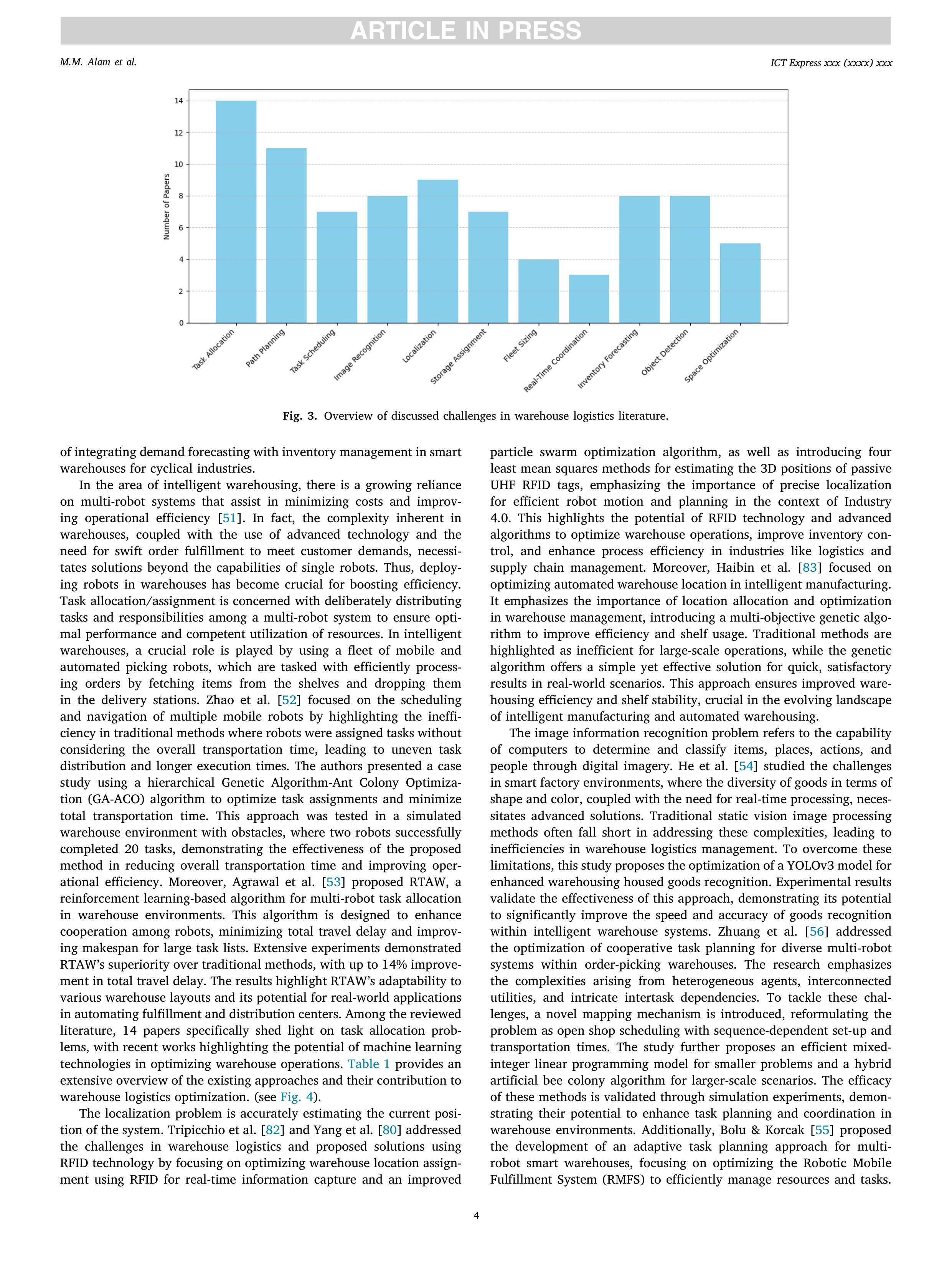
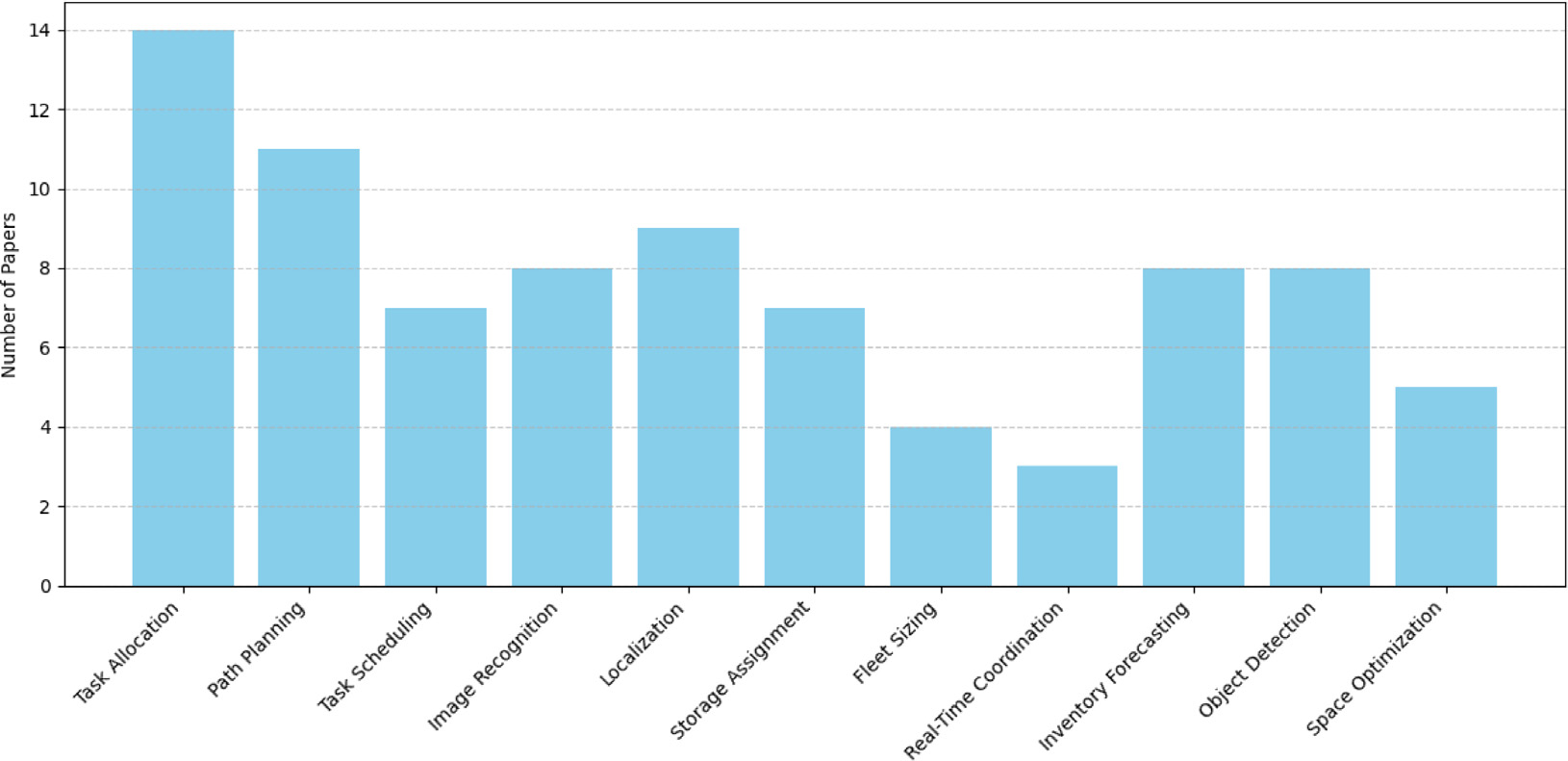
Fig.
3
presents
an
overview
of
the
main
challenges
encountered
in
warehouse
logistics,
highlighting
task
allocation,
path
planning,
localization,
and
object
detection
as
the
most
frequently
dis-
cussed
areas
in
recent
literature.
As
discussed
by
Zhang
et
al.
[
49
],
an
improved
Q-learning
algorithm
to
optimize
multi-AGV
route
planning
in
large-scale
warehouse
environments
was
proposed.
The
algorithm
considers
AGV
load
status,
minimizes
turns,
and
enables
real-time
colli-
sion
avoidance.
The
algorithm’s
effectiveness
is
demonstrated
through
three
case
studies.
In
case
1,
differentiating
between
loaded
and
un-
loaded
AGVs
resulted
in
a
10-second
reduction
in
travel
time
and
an
11.11%
improvement
in
efficiency.
Case
2
showcased
real-time
collision
avoidance
for
new
145814
AGVs
entering
a
system,
signifi-
cantly
reducing
task
completion
time
and
route
computation
time
while
increasing
throughput.
Case
3
optimized
routes
for
multiple
loaded
and
unloaded
AGVs
simultaneously,
minimizing
energy
consumption
and
avoiding
collisions.
Similarly,
Tang
et
al.
[
50
]
developed
a
digital
twin
framework
for
demand
forecasting
and
inventory
management
in
small-scale
cyclical
industries,
such
as
textiles.
This
framework
uti-
lizes
a
roulette
genetic
algorithm
for
demand
prediction
and
aims
to
optimize
inventory
levels
in
line
with
predicted
demand,
thereby
mitigating
risks
associated
with
economic
downturns
and
seasonal
fluctuations.
A
case
study
of
a
small-scale
textile
company
demon-
strated
the
framework’s
effectiveness
in
generating
accurate
demand
forecasts
and
optimizing
inventory
levels,
highlighting
the
importance
ICT
Express
xxx
(xxxx)
xxx
3
M.M.
Alam
et
al.
Fig.
3.
Overview
of
discussed
challenges
in
warehouse
logistics
literature.
of
integrating
demand
forecasting
with
inventory
management
in
smart
warehouses
for
cyclical
industries.
In
the
area
of
intelligent
warehousing,
there
is
a
growing
reliance
on
multi-robot
systems
that
assist
in
minimizing
costs
and
improv-
ing
operational
efficiency
[
51
].
In
fact,
the
complexity
inherent
in
warehouses,
coupled
with
the
use
of
advanced
technology
and
the
need
for
swift
order
fulfillment
to
meet
customer
demands,
necessi-
tates
solutions
beyond
the
capabilities
of
single
robots.
Thus,
deploy-
ing
robots
in
warehouses
has
become
crucial
for
boosting
efficiency.
Task
allocation/assignment
is
concerned
with
deliberately
distributing
tasks
and
responsibilities
among
a
multi-robot
system
to
ensure
opti-
mal
performance
and
competent
utilization
of
resources.
In
intelligent
warehouses,
a
crucial
role
is
played
by
using
a
fleet
of
mobile
and
automated
picking
robots,
which
are
tasked
with
efficiently
process-
ing
orders
by
fetching
items
from
the
shelves
and
dropping
them
in
the
delivery
stations.
Zhao
et
al.
[
52
]
focused
on
the
scheduling
and
navigation
of
multiple
mobile
robots
by
highlighting
the
ineffi-
ciency
in
traditional
methods
where
robots
were
assigned
tasks
without
considering
the
overall
transportation
time,
leading
to
uneven
task
distribution
and
longer
execution
times.
The
authors
presented
a
case
study
using
a
hierarchical
Genetic
Algorithm-Ant
Colony
Optimiza-
tion
(GA-ACO)
algorithm
to
optimize
task
assignments
and
minimize
total
transportation
time.
This
approach
was
tested
in
a
simulated
warehouse
environment
with
obstacles,
where
two
robots
successfully
completed
20
tasks,
demonstrating
the
effectiveness
of
the
proposed
method
in
reducing
overall
transportation
time
and
improving
oper-
ational
efficiency.
Moreover,
Agrawal
et
al.
[
53
]
proposed
RTAW,
a
reinforcement
learning-based
algorithm
for
multi-robot
task
allocation
in
warehouse
environments.
This
algorithm
is
designed
to
enhance
cooperation
among
robots,
minimizing
total
travel
delay
and
improv-
ing
makespan
for
large
task
lists.
Extensive
experiments
demonstrated
RTAW’s
superiority
over
traditional
methods,
with
up
to
14%
improve-
ment
in
total
travel
delay.
The
results
highlight
RTAW’s
adaptability
to
various
warehouse
layouts
and
its
potential
for
real-world
applications
in
automating
fulfillment
and
distribution
centers.
Among
the
reviewed
literature,
14
papers
specifically
shed
light
on
task
allocation
prob-
lems,
with
recent
works
highlighting
the
potential
of
machine
learning
technologies
in
optimizing
warehouse
operations.
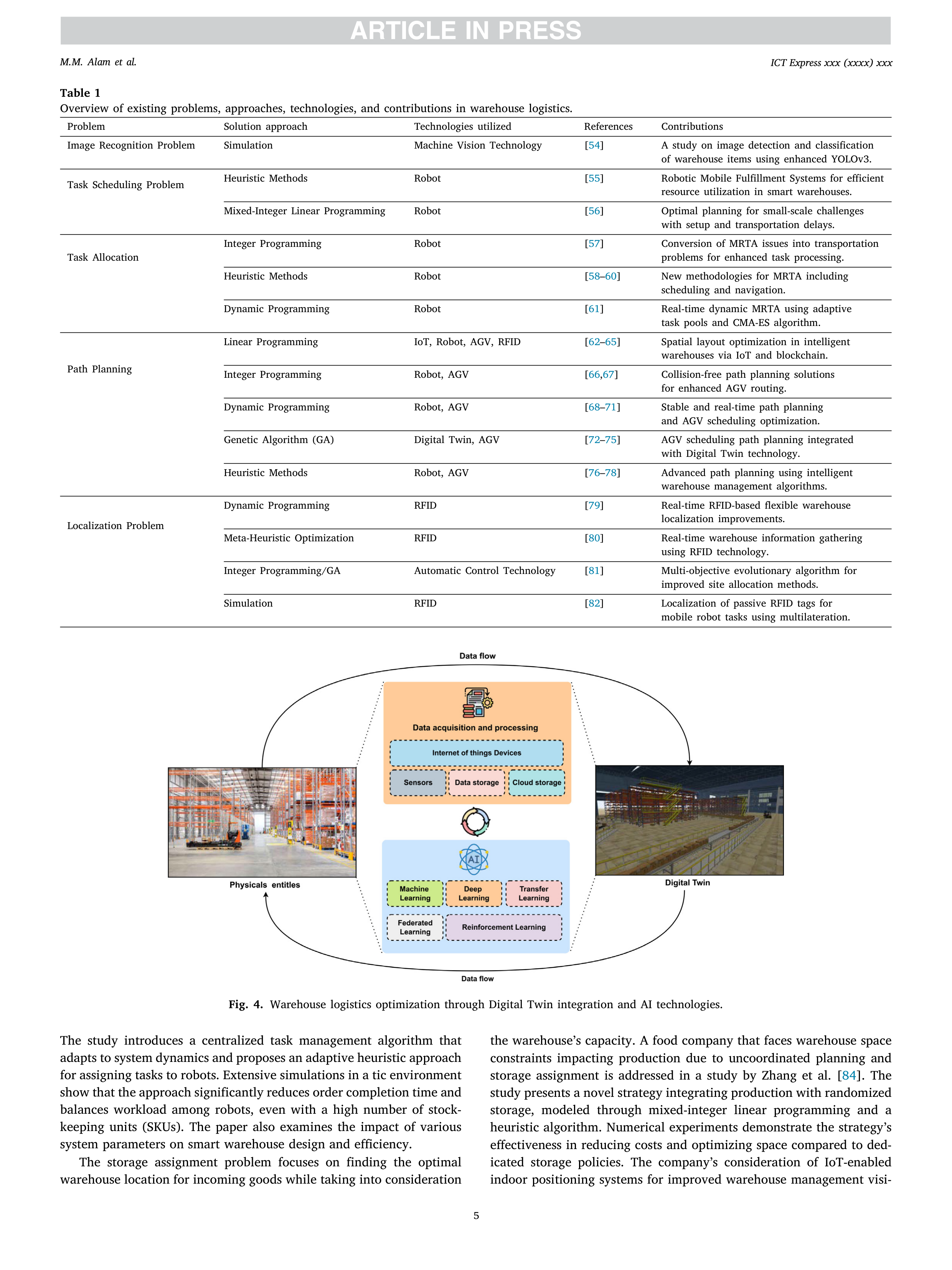
Table
1
provides
an
extensive
overview
of
the
existing
approaches
and
their
contribution
to
warehouse
logistics
optimization.
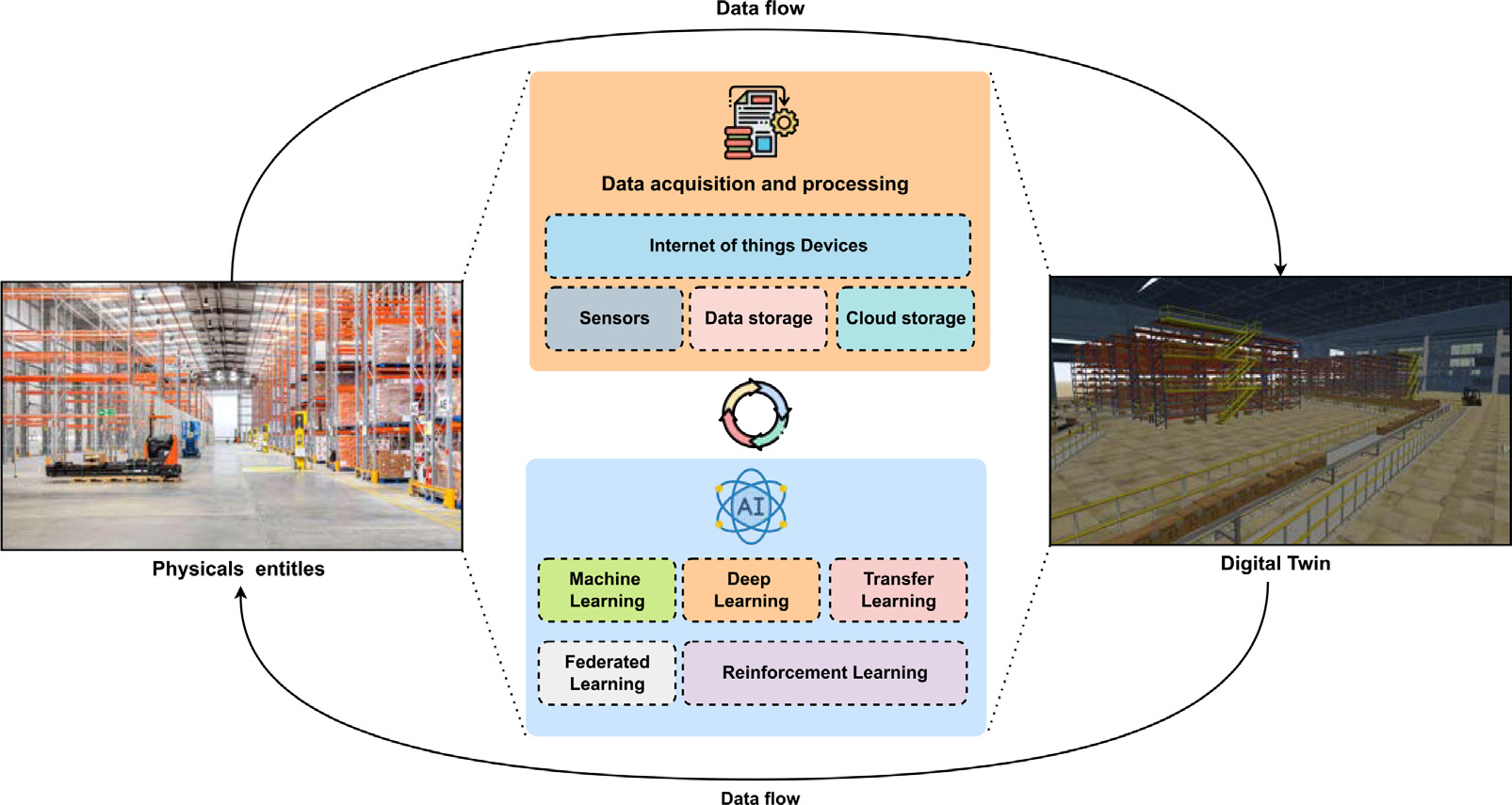
(see
Fig.
4
).
The
localization
problem
is
accurately
estimating
the
current
posi-
tion
of
the
system.
Tripicchio
et
al.
[
82
]
and
Yang
et
al.
[
80
]
addressed
the
challenges
in
warehouse
logistics
and
proposed
solutions
using
RFID
technology
by
focusing
on
optimizing
warehouse
location
assign-
ment
using
RFID
for
real-time
information
capture
and
an
improved
particle
swarm
optimization
algorithm,
as
well
as
introducing
four
least
mean
squares
methods
for
estimating
the
3D
positions
of
passive
UHF
RFID
tags,
emphasizing
the
importance
of
precise
localization
for
efficient
robot
motion
and
planning
in
the
context
of
Industry
4.0.
This
highlights
the
potential
of
RFID
technology
and
advanced
algorithms
to
optimize
warehouse
operations,
improve
inventory
con-
trol,
and
enhance
process
efficiency
in
industries
like
logistics
and
supply
chain
management.
Moreover,
Haibin
et
al.
[
83
]
focused
on
optimizing
automated
warehouse
location
in
intelligent
manufacturing.
It
emphasizes
the
importance
of
location
allocation
and
optimization
in
warehouse
management,
introducing
a
multi-objective
genetic
algo-
rithm
to
improve
efficiency
and
shelf
usage.
Traditional
methods
are
highlighted
as
inefficient
for
large-scale
operations,
while
the
genetic
algorithm
offers
a
simple
yet
effective
solution
for
quick,
satisfactory
results
in
real-world
scenarios.
This
approach
ensures
improved
ware-
housing
efficiency
and
shelf
stability,
crucial
in
the
evolving
landscape
of
intelligent
manufacturing
and
automated
warehousing.
The
image
information
recognition
problem
refers
to
the
capability
of
computers
to
determine
and
classify
items,
places,
actions,
and
people
through
digital
imagery.
He
et
al.
[
54
]
studied
the
challenges
in
smart
factory
environments,
where
the
diversity
of
goods
in
terms
of
shape
and
color,
coupled
with
the
need
for
real-time
processing,
neces-
sitates
advanced
solutions.
Traditional
static
vision
image
processing
methods
often
fall
short
in
addressing
these
complexities,
leading
to
inefficiencies
in
warehouse
logistics
management.
To
overcome
these
limitations,
this
study
proposes
the
optimization
of
a
YOLOv3
model
for
enhanced
warehousing
housed
goods
recognition.
Experimental
results
validate
the
effectiveness
of
this
approach,
demonstrating
its
potential
to
significantly
improve
the
speed
and
accuracy
of
goods
recognition
within
intelligent
warehouse
systems.
Zhuang
et
al.
[
56
]
addressed
the
optimization
of
cooperative
task
planning
for
diverse
multi-robot
systems
within
order-picking
warehouses.
The
research
emphasizes
the
complexities
arising
from
heterogeneous
agents,
interconnected
utilities,
and
intricate
intertask
dependencies.
To
tackle
these
chal-
lenges,
a
novel
mapping
mechanism
is
introduced,
reformulating
the
problem
as
open
shop
scheduling
with
sequence-dependent
set-up
and
transportation
times.
The
study
further
proposes
an
efficient
mixed-
integer
linear
programming
model
for
smaller
problems
and
a
hybrid
artificial
bee
colony
algorithm
for
larger-scale
scenarios.
The
efficacy
of
these
methods
is
validated
through
simulation
experiments,
demon-
strating
their
potential
to
enhance
task
planning
and
coordination
in
warehouse
environments.
Additionally,
Bolu
&
Korcak
[
55
]
proposed
the
development
of
an
adaptive
task
planning
approach
for
multi-
robot
smart
warehouses,
focusing
on
optimizing
the
Robotic
Mobile
Fulfillment
System
(RMFS)
to
efficiently
manage
resources
and
tasks.
ICT
Express
xxx
(xxxx)
xxx
4
M.M.
Alam
et
al.
Table
1
Overview
of
existing
problems,
approaches,
technologies,
and
contributions
in
warehouse
logistics.
Problem
Solution
approach
Technologies
utilized
References
Contributions
Image
Recognition
Problem
Simulation
Machine
Vision
Technology
[
54
]
A
study
on
image
detection
and
classification
of
warehouse
items
using
enhanced
YOLOv3.
Task
Scheduling
Problem
Heuristic
Methods
Robot
[
55
]
Robotic
Mobile
Fulfillment
Systems
for
efficient
resource
utilization
in
smart
warehouses.
Mixed-Integer
Linear
Programming
Robot
[
56
]
Optimal
planning
for
small-scale
challenges
with
setup
and
transportation
delays.
Task
Allocation
Integer
Programming
Robot
[
57
]
Conversion
of
MRTA
issues
into
transportation
problems
for
enhanced
task
processing.
Heuristic
Methods
Robot
[
58
–
60
]
New
methodologies
for
MRTA
including
scheduling
and
navigation.
Dynamic
Programming
Robot
[
61
]
Real-time
dynamic
MRTA
using
adaptive
task
pools
and
CMA-ES
algorithm.
Path
Planning
Linear
Programming
IoT,
Robot,
AGV,
RFID
[
62
–
65
]
Spatial
layout
optimization
in
intelligent
warehouses
via
IoT
and
blockchain.
Integer
Programming
Robot,
AGV
[
66
,
67
]
Collision-free
path
planning
solutions
for
enhanced
AGV
routing.
Dynamic
Programming
Robot,
AGV
[
68
–
71
]
Stable
and
real-time
path
planning
and
AGV
scheduling
optimization.
Genetic
Algorithm
(GA)
Digital
Twin,
AGV
[
72
–
75
]
AGV
scheduling
path
planning
integrated
with
Digital
Twin
technology.
Heuristic
Methods
Robot,
AGV
[
76
–
78
]
Advanced
path
planning
using
intelligent
warehouse
management
algorithms.
Localization
Problem
Dynamic
Programming
RFID
[
79
]
Real-time
RFID-based
flexible
warehouse
localization
improvements.
Meta-Heuristic
Optimization
RFID
[
80
]
Real-time
warehouse
information
gathering
using
RFID
technology.
Integer
Programming/GA
Automatic
Control
Technology
[
81
]
Multi-objective
evolutionary
algorithm
for
improved
site
allocation
methods.
Simulation
RFID
[
82
]
Localization
of
passive
RFID
tags
for
mobile
robot
tasks
using
multilateration.
Fig.
4.
Warehouse
logistics
optimization
through
Digital
Twin
integration
and
AI
technologies.
The
study
introduces
a
centralized
task
management
algorithm
that
adapts
to
system
dynamics
and
proposes
an
adaptive
heuristic
approach
for
assigning
tasks
to
robots.
Extensive
simulations
in
a
tic
environment
show
that
the
approach
significantly
reduces
order
completion
time
and
balances
workload
among
robots,
even
with
a
high
number
of
stock-
keeping
units
(SKUs).
The
paper
also
examines
the
impact
of
various
system
parameters
on
smart
warehouse
design
and
efficiency.
The
storage
assignment
problem
focuses
on
finding
the
optimal
warehouse
location
for
incoming
goods
while
taking
into
consideration
the
warehouse’s
capacity.
A
food
company
that
faces
warehouse
space
constraints
impacting
production
due
to
uncoordinated
planning
and
storage
assignment
is
addressed
in
a
study
by
Zhang
et
al.
[
84
].
The
study
presents
a
novel
strategy
integrating
production
with
randomized
storage,
modeled
through
mixed-integer
linear
programming
and
a
heuristic
algorithm.
Numerical
experiments
demonstrate
the
strategy’s
effectiveness
in
reducing
costs
and
optimizing
space
compared
to
ded-
icated
storage
policies.
The
company’s
consideration
of
IoT-enabled
indoor
positioning
systems
for
improved
warehouse
management
visi-
ICT
Express
xxx
(xxxx)
xxx
5
M.M.
Alam
et
al.
bility
prompts
the
development
of
an
innovative
strategy
integrating
production
planning
with
randomized
storage
assignment.
This
ap-
proach,
leveraging
IoT
capabilities,
aims
to
optimize
space
utilization
and
reduce
costs
in
scenarios
with
fluctuating
demands.
Rjeb
et
al.
[
85
]
addressed
the
load-sizing
problem
of
robots
through
a
simple
mixed-
integer
linear
programming
model
of
transporting
homogeneous
loads
between
two
storage
areas
in
the
warehouse,
which
takes
into
account
the
number
of
pickup
and
delivery
stations
in
the
system.
The
packing
and
storage
assignment
problem
seeks
to
optimize
the
organization
and
allocation
of
packed
goods.
Leng
et
al.
[
86
]
approached
this
problem
by
proposing
a
new
digital
twin-driven
approach
to
optimize
packing
and
storage
in
large-scale
automated
high-rise
warehouses.
The
system
integrates
real-time
data
with
a
cyber
model,
enabling
periodic
optimization
through
a
joint
optimization
model.
A
case
study
in
a
tobacco
warehouse
validates
the
model’s
effectiveness
in
improving
utilization
and
efficiency.
The
research
fills
a
gap
in
the
existing
lit-
erature
by
focusing
on
the
joint
optimization
of
packing
and
storage
management,
addressing
the
challenges
of
managing
large-scale
ware-
house
operations
with
unpredictable
demands
and
interactions.
Finally,
the
production–inventory
problem
deals
with
resource
shortages
and
cost
inaccuracies,
which
are
addressed
by
Maity
[
87
]
through
case
studies
illustrating
real-world
applications,
such
as
a
two-warehouse
production–inventory
model
with
fuzzy
budget
and
space
constraints,
solved
using
optimal
control
theory
to
manage
defective
items
and
space
scarcity.
Within
the
same
work,
another
case
study
presents
a
three-layer
supply
chain
model
under
conditionally
permissible
delay
in
payments,
formulated
in
fuzzy-rough
and
Liu
uncertain
environments,
addressing
supplier–manufacturer–retailer
dynamics
and
incorporating
factors
like
ideal
costs
and
delay
in
payments.
These
examples
showcase
the
effectiveness
of
intelligent
techniques
in
optimizing
warehouse
performance
amidst
practical
challenges
like
defective
products,
space
limitations,
and
supply
chain
coordination.
2.2.
Comparative
analysis
of
approaches
The
analysis
of
recent
research
on
intelligent
warehouse
systems
reveals
clear
trends,
trade-offs,
and
emerging
gaps
across
AGV
schedul-
ing,
RFID-enabled
tracking,
and
flexible
warehousing
approaches.
A
major
trend
is
the
shift
toward
fully
autonomous
and
data-driven
warehouses,
integrating
automated
guided
vehicles
(AGVs),
mobile
robots,
and
sensor-based
technologies
under
the
Industry
4.0
paradigm.
These
systems
aim
to
optimize
task
allocation,
reduce
human
inter-
vention,
and
improve
operational
efficiency.
The
adoption
of
RFID
and
IoT-enabled
technologies
further
enables
real-time
monitoring
of
both
inventory
items
and
movable
storage
equipment,
supporting
dy-
namic
adjustments
in
storage
locations
and
capacities,
as
exemplified
in
flexible
and
fluid
warehousing
models.
A
particularly
notable
trend
is
the
increasing
use
of
AI-based
meth-
ods,
including
deep
reinforcement
learning
(DRL),
for
multi-agent
task
allocation.
Li
et
al.
[
89
]
introduced
a
DRL
framework
for
efficient
task
assignment
among
heterogeneous
AGVs,
modeling
the
problem
as
a
capacitated
multiagent
open
pickup
and
delivery
problem
(CMOPDP).
By
incorporating
heterogeneous
attention,
dual
decoders,
and
entropy
rewards,
their
approach
achieves
improved
solution
quality
(
⩾
1.76%
over
benchmarks),
real-time
task
allocation,
and
robust
generaliza-
tion
across
diverse
warehouse
layouts.
This
demonstrates
the
grow-
ing
maturity
of
AI-driven
task
allocation
methods
compared
to
tradi-
tional
heuristics,
offering
adaptive,
constraint-aware,
and
cooperative
decision-making
capabilities.
The
comparative
evaluation
of
different
approaches
highlights
sev-
eral
trade-offs.
High
flexibility
and
adaptability,
such
as
free
pick-and-
drop
mechanisms
or
DRL-based
task
allocation,
reduce
lead
times
and
operational
costs
but
increase
system
complexity
and
training
require-
ments.
High-accuracy
localization
techniques,
particularly
RFID-based
3D
multilateration
with
phase
unwrapping,
significantly
improve
item
tracking
and
robot
navigation
but
demand
precise
motion
control,
careful
calibration,
and
sophisticated
hardware.
AGV
scheduling
al-
gorithms,
including
heuristic,
hybrid,
metaheuristic,
and
DRL-based
methods,
optimize
throughput,
energy
usage,
and
travel
time,
yet
they
may
struggle
with
scalability,
congestion,
and
real-time
responsiveness
in
large,
dynamic
warehouses.
Specifically,
DRL-based
approaches
offer
fast
inference
at
runtime
but
require
substantial
offline
training
and
careful
hyperparameter
tuning.
The
tables
presented
across
the
reviewed
studies
indicate
the
matu-
rity
and
limitations
of
these
technologies.
AGV
scheduling
is
relatively
mature,
performing
robustly
in
small-
to
medium-scale
systems
but
exhibiting
limited
scalability
for
high-density
fleets.
DRL-based
task
allocation,
as
shown
by
Li
et
al.
provides
high-quality
adaptive
so-
lutions
under
complex
constraints
but
faces
challenges
in
training
time,
convergence
in
dense
environments,
and
handling
multiobjective
optimization.
RFID-based
3D
localization
achieves
excellent
accuracy
in
experimental
setups
(mean
2D
error
0.21
cm;
3D
error
13
cm)
but
remains
largely
untested
in
large-scale
real-world
warehouses.
Flexible
RFID-enabled
warehousing
is
emerging,
demonstrating
potential
for
efficiency
gains
and
reduced
operational
errors,
yet
relies
heavily
on
continuous
real-time
monitoring
and
a
supportive
IoT
infrastructure.
Several
research
gaps
remain.
Current
systems
rarely
integrate
task
scheduling,
multiobjective
routing,
storage
allocation,
and
precise
lo-
calization
into
a
unified
framework.
Scalability
and
robustness
under
real-world
uncertainties,
such
as
sensor
noise,
multipath
effects,
read
errors,
dynamic
demand
patterns,
or
high-density
AGV
fleets,
require
further
investigation.
Moreover,
real-time
adaptive
strategies
for
AGV
task
assignment,
energy
management,
and
storage
reconfiguration
are
underexplored.
Hybrid
approaches
that
combine
DRL
with
heuristics
or
optimization-based
methods
may
balance
solution
quality,
infer-
ence
speed,
and
robustness.
Future
research
should
aim
to
develop
holistic,
scalable,
and
resilient
smart
warehouse
systems
that
com-
bine
the
strengths
of
high-accuracy
localization,
flexible
storage,
and
optimized
task
allocation
while
mitigating
the
associated
complexity
and
operational
costs.
The
reviewed
studies
collectively
suggest
that
while
individual
components
of
intelligent
warehousing
are
approach-
ing
maturity,
a
fully
integrated
and
robust
smart
warehouse
system
is
yet
to
be
realized.
The
interplay
between
flexibility,
accuracy,
opera-
tional
efficiency,
and
AI-driven
adaptability
represents
both
a
challenge
and
an
opportunity
for
future
research
in
the
field.
Li
et
al.’s
work
demonstrates
the
potential
for
DRL
to
elevate
task
allocation
practices,
indicating
that
AI-based
coordination
methods
are
likely
to
play
a
central
role
in
next-generation
smart
warehouses.
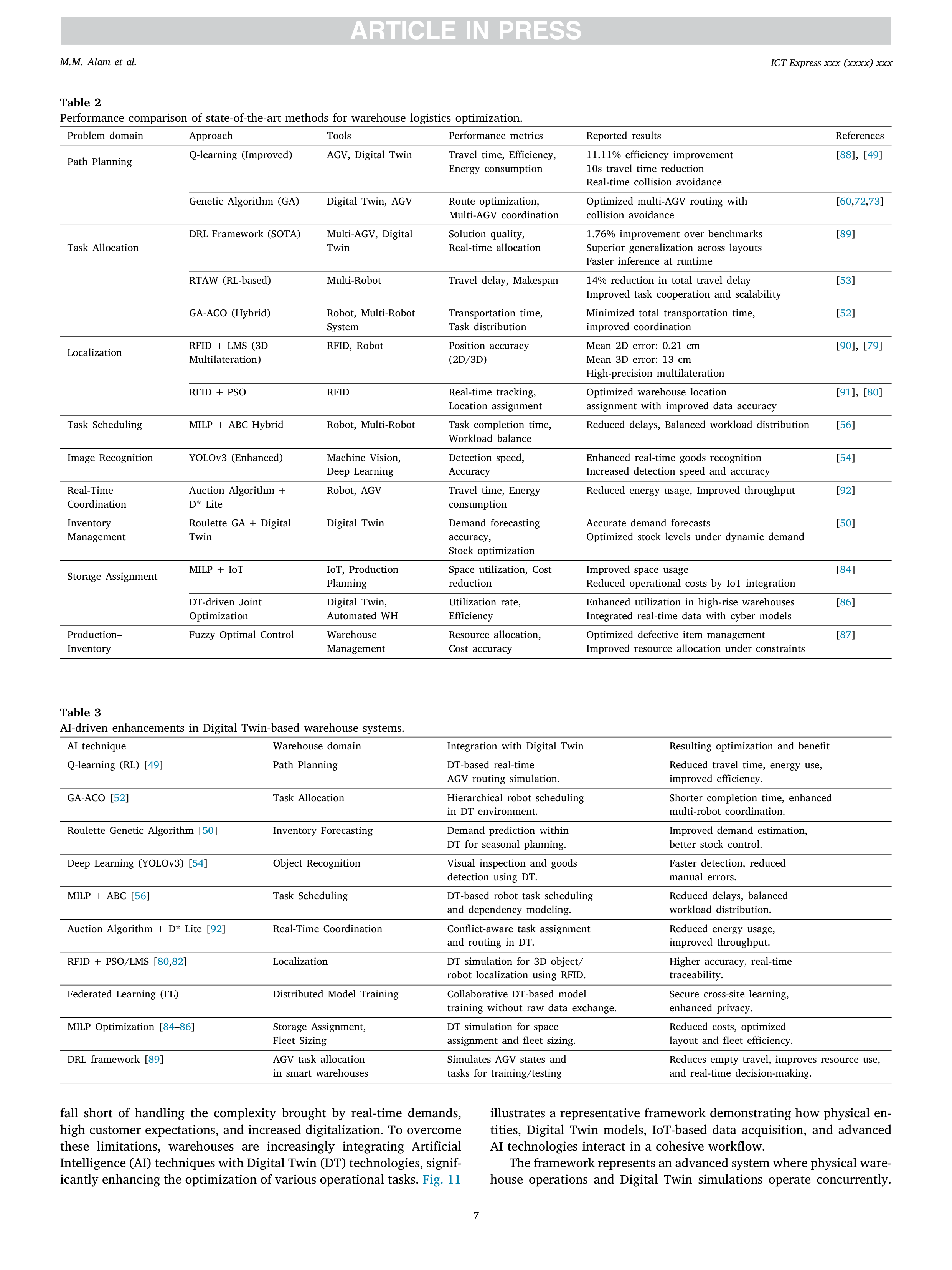
Table
2
summarizes
the
state-of-the-art
and
commonly
used
baseline
methods
across
key
problem
domains
in
warehouse
logistics
(path
planning,
task
allocation,
localization,
scheduling,
perception,
real-
time
coordination,
inventory
and
storage
assignment).
The
table
maps
each
approach
to
the
principal
tools
and
system
contexts
(e.g.,
Digital
Twin,
AGV,
RFID,
IoT),
the
evaluation
metrics
employed
(travel
time,
makespan,
localization
error,
mAP,
energy
consumption,
etc.),
and
the
representative
performance
claims
reported
in
the
literature.
By
consol-
idating
Q-learning
and
GA
variants
for
path
planning,
DRL
and
hybrid
GA/ACO
schemes
for
task
allocation,
RFID+LMS/PSO
for
localization,
MILP
hybrids
for
scheduling
and
storage,
and
enhanced
YOLO
for
vision
tasks,
the
table
provides
a
compact
reference
that
both
identi-
fies
suitable
baselines
and
highlights
which
metrics
authors
typically
report
for
each
domain.
We
note
that
numerical
results
originate
from
heterogeneous
experimental
setups
and
are
therefore
indicative
rather
than
directly
comparable;
nevertheless,
the
table
directly
addresses
the
reviewer’s
concern
by
cataloguing
contemporary
methods,
their
reported
outcomes,
and
the
evaluation
criteria
that
should
be
used
when
selecting
baselines
for
future
comparative
experiments.
3.
Solutions
for
warehouse
challenges
As
the
demand
for
faster,
more
efficient
order
fulfillment
in
ware-
house
operations
intensifies,
the
logistics
sector
faces
significant
oper-
ational
challenges.
Traditional
warehouse
management
systems
often
ICT
Express
xxx
(xxxx)
xxx
6
M.M.
Alam
et
al.
Table
2
Performance
comparison
of
state-of-the-art
methods
for
warehouse
logistics
optimization.
Problem
domain
Approach
Tools
Performance
metrics
Reported
results
References
Path
Planning
Q-learning
(Improved)
AGV,
Digital
Twin
Travel
time,
Efficiency,
Energy
consumption
11.11%
efficiency
improvement
10s
travel
time
reduction
Real-time
collision
avoidance
[
88
],
[
49
]
Genetic
Algorithm
(GA)
Digital
Twin,
AGV
Route
optimization,
Multi-AGV
coordination
Optimized
multi-AGV
routing
with
collision
avoidance
[
60
,
72
,
73
]
Task
Allocation
DRL
Framework
(SOTA)
Multi-AGV,
Digital
Twin
Solution
quality,
Real-time
allocation
1.76%
improvement
over
benchmarks
Superior
generalization
across
layouts
Faster
inference
at
runtime
[
89
]
RTAW
(RL-based)
Multi-Robot
Travel
delay,
Makespan
14%
reduction
in
total
travel
delay
Improved
task
cooperation
and
scalability
[
53
]
GA-ACO
(Hybrid)
Robot,
Multi-Robot
System
Transportation
time,
Task
distribution
Minimized
total
transportation
time,
improved
coordination
[
52
]
Localization
RFID
+
LMS
(3D
Multilateration)
RFID,
Robot
Position
accuracy
(2D/3D)
Mean
2D
error:
0.21
cm
Mean
3D
error:
13
cm
High-precision
multilateration
[
90
],
[
79
]
RFID
+
PSO
RFID
Real-time
tracking,
Location
assignment
Optimized
warehouse
location
assignment
with
improved
data
accuracy
[
91
],
[
80
]
Task
Scheduling
MILP
+
ABC
Hybrid
Robot,
Multi-Robot
Task
completion
time,
Workload
balance
Reduced
delays,
Balanced
workload
distribution
[
56
]
Image
Recognition
YOLOv3
(Enhanced)
Machine
Vision,
Deep
Learning
Detection
speed,
Accuracy
Enhanced
real-time
goods
recognition
Increased
detection
speed
and
accuracy
[
54
]
Real-Time
Coordination
Auction
Algorithm
+
D*
Lite
Robot,
AGV
Travel
time,
Energy
consumption
Reduced
energy
usage,
Improved
throughput
[
92
]
Inventory
Management
Roulette
GA
+
Digital
Twin
Digital
Twin
Demand
forecasting
accuracy,
Stock
optimization
Accurate
demand
forecasts
Optimized
stock
levels
under
dynamic
demand
[
50
]
Storage
Assignment
MILP
+
IoT
IoT,
Production
Planning
Space
utilization,
Cost
reduction
Improved
space
usage
Reduced
operational
costs
by
IoT
integration
[
84
]
DT-driven
Joint
Optimization
Digital
Twin,
Automated
WH
Utilization
rate,
Efficiency
Enhanced
utilization
in
high-rise
warehouses
Integrated
real-time
data
with
cyber
models
[
86
]
Production–
Inventory
Fuzzy
Optimal
Control
Warehouse
Management
Resource
allocation,
Cost
accuracy
Optimized
defective
item
management
Improved
resource
allocation
under
constraints
[
87
]
Table
3
AI-driven
enhancements
in
Digital
Twin-based
warehouse
systems.
AI
technique
Warehouse
domain
Integration
with
Digital
Twin
Resulting
optimization
and
benefit
Q-learning
(RL)
[
49
]
Path
Planning
DT-based
real-time
AGV
routing
simulation.
Reduced
travel
time,
energy
use,
improved
efficiency.
GA-ACO
[
52
]
Task
Allocation
Hierarchical
robot
scheduling
in
DT
environment.
Shorter
completion
time,
enhanced
multi-robot
coordination.
Roulette
Genetic
Algorithm
[
50
]
Inventory
Forecasting
Demand
prediction
within
DT
for
seasonal
planning.
Improved
demand
estimation,
better
stock
control.
Deep
Learning
(YOLOv3)
[
54
]
Object
Recognition
Visual
inspection
and
goods
detection
using
DT.
Faster
detection,
reduced
manual
errors.
MILP
+
ABC
[
56
]
Task
Scheduling
DT-based
robot
task
scheduling
and
dependency
modeling.
Reduced
delays,
balanced
workload
distribution.
Auction
Algorithm
+
D*
Lite
[
92
]
Real-Time
Coordination
Conflict-aware
task
assignment
and
routing
in
DT.
Reduced
energy
usage,
improved
throughput.
RFID
+
PSO/LMS
[
80
,
82
]
Localization
DT
simulation
for
3D
object/
robot
localization
using
RFID.
Higher
accuracy,
real-time
traceability.
Federated
Learning
(FL)
Distributed
Model
Training
Collaborative
DT-based
model
training
without
raw
data
exchange.
Secure
cross-site
learning,
enhanced
privacy.
MILP
Optimization
[
84
–
86
]
Storage
Assignment,
Fleet
Sizing
DT
simulation
for
space
assignment
and
fleet
sizing.
Reduced
costs,
optimized
layout
and
fleet
efficiency.
DRL
framework
[
89
]
AGV
task
allocation
in
smart
warehouses
Simulates
AGV
states
and
tasks
for
training/testing
Reduces
empty
travel,
improves
resource
use,
and
real-time
decision-making.
fall
short
of
handling
the
complexity
brought
by
real-time
demands,
high
customer
expectations,
and
increased
digitalization.
To
overcome
these
limitations,
warehouses
are
increasingly
integrating
Artificial
Intelligence
(AI)
techniques
with
Digital
Twin
(DT)
technologies,
signif-
icantly
enhancing
the
optimization
of
various
operational
tasks.
Fig.
11
illustrates
a
representative
framework
demonstrating
how
physical
en-
tities,
Digital
Twin
models,
IoT-based
data
acquisition,
and
advanced
AI
technologies
interact
in
a
cohesive
workflow.
The
framework
represents
an
advanced
system
where
physical
ware-
house
operations
and
Digital
Twin
simulations
operate
concurrently.
ICT
Express
xxx
(xxxx)
xxx
7
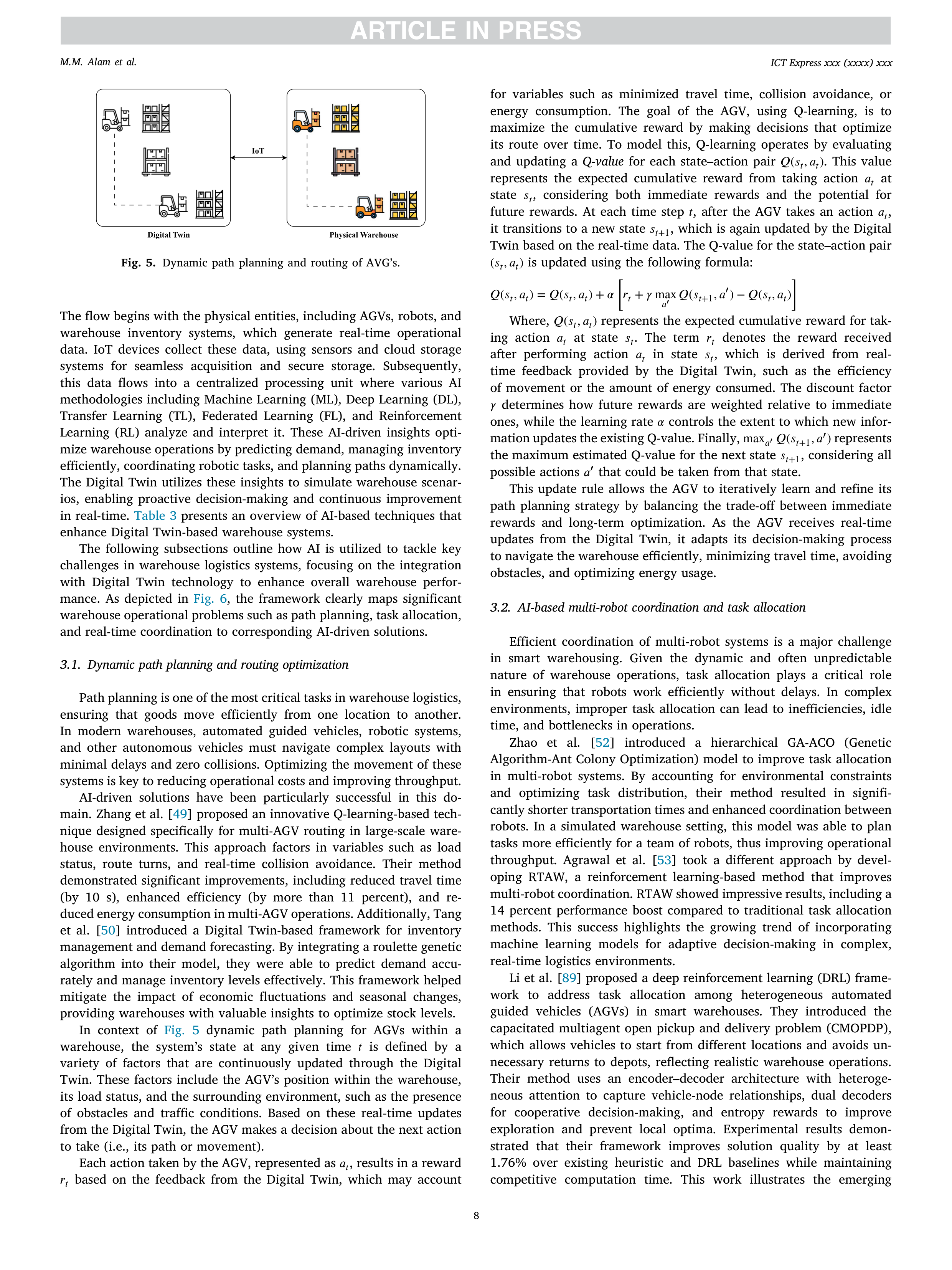

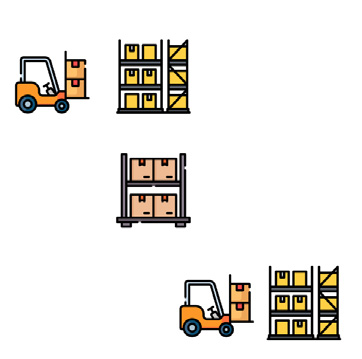
M.M.
Alam
et
al.
Fig.
5.
Dynamic
path
planning
and
routing
of
AVG’s.
The
flow
begins
with
the
physical
entities,
including
AGVs,
robots,
and
warehouse
inventory
systems,
which
generate
real-time
operational
data.
IoT
devices
collect
these
data,
using
sensors
and
cloud
storage
systems
for
seamless
acquisition
and
secure
storage.
Subsequently,
this
data
flows
into
a
centralized
processing
unit
where
various
AI
methodologies
including
Machine
Learning
(ML),
Deep
Learning
(DL),
Transfer
Learning
(TL),
Federated
Learning
(FL),
and
Reinforcement
Learning
(RL)
analyze
and
interpret
it.
These
AI-driven
insights
opti-
mize
warehouse
operations
by
predicting
demand,
managing
inventory
efficiently,
coordinating
robotic
tasks,
and
planning
paths
dynamically.
The
Digital
Twin
utilizes
these
insights
to
simulate
warehouse
scenar-
ios,
enabling
proactive
decision-making
and
continuous
improvement
in
real-time.
Table
3
presents
an
overview
of
AI-based
techniques
that
enhance
Digital
Twin-based
warehouse
systems.
The
following
subsections
outline
how
AI
is
utilized
to
tackle
key
challenges
in
warehouse
logistics
systems,
focusing
on
the
integration
with
Digital
Twin
technology
to
enhance
overall
warehouse
perfor-
mance.
As
depicted
in
Fig.
6
,
the
framework
clearly
maps
significant
warehouse
operational
problems
such
as
path
planning,
task
allocation,
and
real-time
coordination
to
corresponding
AI-driven
solutions.
3.1.
Dynamic
path
planning
and
routing
optimization
Path
planning
is
one
of
the
most
critical
tasks
in
warehouse
logistics,
ensuring
that
goods
move
efficiently
from
one
location
to
another.
In
modern
warehouses,
automated
guided
vehicles,
robotic
systems,
and
other
autonomous
vehicles
must
navigate
complex
layouts
with
minimal
delays
and
zero
collisions.
Optimizing
the
movement
of
these
systems
is
key
to
reducing
operational
costs
and
improving
throughput.
AI-driven
solutions
have
been
particularly
successful
in
this
do-
main.
Zhang
et
al.
[
49
]
proposed
an
innovative
Q-learning-based
tech-
nique
designed
specifically
for
multi-AGV
routing
in
large-scale
ware-
house
environments.
This
approach
factors
in
variables
such
as
load
status,
route
turns,
and
real-time
collision
avoidance.
Their
method
demonstrated
significant
improvements,
including
reduced
travel
time
(by
10
s),
enhanced
efficiency
(by
more
than
11
percent),
and
re-
duced
energy
consumption
in
multi-AGV
operations.
Additionally,
Tang
et
al.
[
50
]
introduced
a
Digital
Twin-based
framework
for
inventory
management
and
demand
forecasting.
By
integrating
a
roulette
genetic
algorithm
into
their
model,
they
were
able
to
predict
demand
accu-
rately
and
manage
inventory
levels
effectively.
This
framework
helped
mitigate
the
impact
of
economic
fluctuations
and
seasonal
changes,
providing
warehouses
with
valuable
insights
to
optimize
stock
levels.
In
context
of
Fig.
5
dynamic
path
planning
for
AGVs
within
a
warehouse,
the
system’s
state
at
any
given
time
𝑡
is
defined
by
a
variety
of
factors
that
are
continuously
updated
through
the
Digital
Twin.
These
factors
include
the
AGV’s
position
within
the
warehouse,
its
load
status,
and
the
surrounding
environment,
such
as
the
presence
of
obstacles
and
traffic
conditions.
Based
on
these
real-time
updates
from
the
Digital
Twin,
the
AGV
makes
a
decision
about
the
next
action
to
take
(i.e.,
its
path
or
movement).
Each
action
taken
by
the
AGV,
represented
as
𝑎
𝑡
,
results
in
a
reward
𝑟
𝑡
based
on
the
feedback
from
the
Digital
Twin,
which
may
account
for
variables
such
as
minimized
travel
time,
collision
avoidance,
or
energy
consumption.
The
goal
of
the
AGV,
using
Q-learning,
is
to
maximize
the
cumulative
reward
by
making
decisions
that
optimize
its
route
over
time.
To
model
this,
Q-learning
operates
by
evaluating
and
updating
a
Q-value
for
each
state–action
pair
𝑄
(
𝑠
𝑡
,
𝑎
𝑡
)
.
This
value
represents
the
expected
cumulative
reward
from
taking
action
𝑎
𝑡
at
state
𝑠
𝑡
,
considering
both
immediate
rewards
and
the
potential
for
future
rewards.
At
each
time
step
𝑡
,
after
the
AGV
takes
an
action
𝑎
𝑡
,
it
transitions
to
a
new
state
𝑠
𝑡
+1
,
which
is
again
updated
by
the
Digital
Twin
based
on
the
real-time
data.
The
Q-value
for
the
state–action
pair
(
𝑠
𝑡
,
𝑎
𝑡
)
is
updated
using
the
following
formula:
𝑄
(
𝑠
𝑡
,
𝑎
𝑡
)
=
𝑄
(
𝑠
𝑡
,
𝑎
𝑡
)
+
𝛼
[
𝑟
𝑡
+
𝛾
max
𝑎
′
𝑄
(
𝑠
𝑡
+1
,
𝑎
′
)
−
𝑄
(
𝑠
𝑡
,
𝑎
𝑡
)
]
Where,
𝑄
(
𝑠
𝑡
,
𝑎
𝑡
)
represents
the
expected
cumulative
reward
for
tak-
ing
action
𝑎
𝑡
at
state
𝑠
𝑡
.
The
term
𝑟
𝑡
denotes
the
reward
received
after
performing
action
𝑎
𝑡
in
state
𝑠
𝑡
,
which
is
derived
from
real-
time
feedback
provided
by
the
Digital
Twin,
such
as
the
efficiency
of
movement
or
the
amount
of
energy
consumed.
The
discount
factor
𝛾
determines
how
future
rewards
are
weighted
relative
to
immediate
ones,
while
the
learning
rate
𝛼
controls
the
extent
to
which
new
infor-
mation
updates
the
existing
Q-value.
Finally,
max
𝑎
′
𝑄
(
𝑠
𝑡
+1
,
𝑎
′
)
represents
the
maximum
estimated
Q-value
for
the
next
state
𝑠
𝑡
+1
,
considering
all
possible
actions
𝑎
′
that
could
be
taken
from
that
state.
This
update
rule
allows
the
AGV
to
iteratively
learn
and
refine
its
path
planning
strategy
by
balancing
the
trade-off
between
immediate
rewards
and
long-term
optimization.
As
the
AGV
receives
real-time
updates
from
the
Digital
Twin,
it
adapts
its
decision-making
process
to
navigate
the
warehouse
efficiently,
minimizing
travel
time,
avoiding
obstacles,
and
optimizing
energy
usage.
3.2.
AI-based
multi-robot
coordination
and
task
allocation
Efficient
coordination
of
multi-robot
systems
is
a
major
challenge
in
smart
warehousing.
Given
the
dynamic
and
often
unpredictable
nature
of
warehouse
operations,
task
allocation
plays
a
critical
role
in
ensuring
that
robots
work
efficiently
without
delays.
In
complex
environments,
improper
task
allocation
can
lead
to
inefficiencies,
idle
time,
and
bottlenecks
in
operations.
Zhao
et
al.
[
52
]
introduced
a
hierarchical
GA-ACO
(Genetic
Algorithm-Ant
Colony
Optimization)
model
to
improve
task
allocation
in
multi-robot
systems.
By
accounting
for
environmental
constraints
and
optimizing
task
distribution,
their
method
resulted
in
signifi-
cantly
shorter
transportation
times
and
enhanced
coordination
between
robots.
In
a
simulated
warehouse
setting,
this
model
was
able
to
plan
tasks
more
efficiently
for
a
team
of
robots,
thus
improving
operational
throughput.
Agrawal
et
al.
[
53
]
took
a
different
approach
by
devel-
oping
RTAW,
a
reinforcement
learning-based
method
that
improves
multi-robot
coordination.
RTAW
showed
impressive
results,
including
a
14
percent
performance
boost
compared
to
traditional
task
allocation
methods.
This
success
highlights
the
growing
trend
of
incorporating
machine
learning
models
for
adaptive
decision-making
in
complex,
real-time
logistics
environments.
Li
et
al.
[
89
]
proposed
a
deep
reinforcement
learning
(DRL)
frame-
work
to
address
task
allocation
among
heterogeneous
automated
guided
vehicles
(AGVs)
in
smart
warehouses.
They
introduced
the
capacitated
multiagent
open
pickup
and
delivery
problem
(CMOPDP),
which
allows
vehicles
to
start
from
different
locations
and
avoids
un-
necessary
returns
to
depots,
reflecting
realistic
warehouse
operations.
Their
method
uses
an
encoder–decoder
architecture
with
heteroge-
neous
attention
to
capture
vehicle-node
relationships,
dual
decoders
for
cooperative
decision-making,
and
entropy
rewards
to
improve
exploration
and
prevent
local
optima.
Experimental
results
demon-
strated
that
their
framework
improves
solution
quality
by
at
least
1.76%
over
existing
heuristic
and
DRL
baselines
while
maintaining
competitive
computation
time.
This
work
illustrates
the
emerging
ICT
Express
xxx
(xxxx)
xxx
8
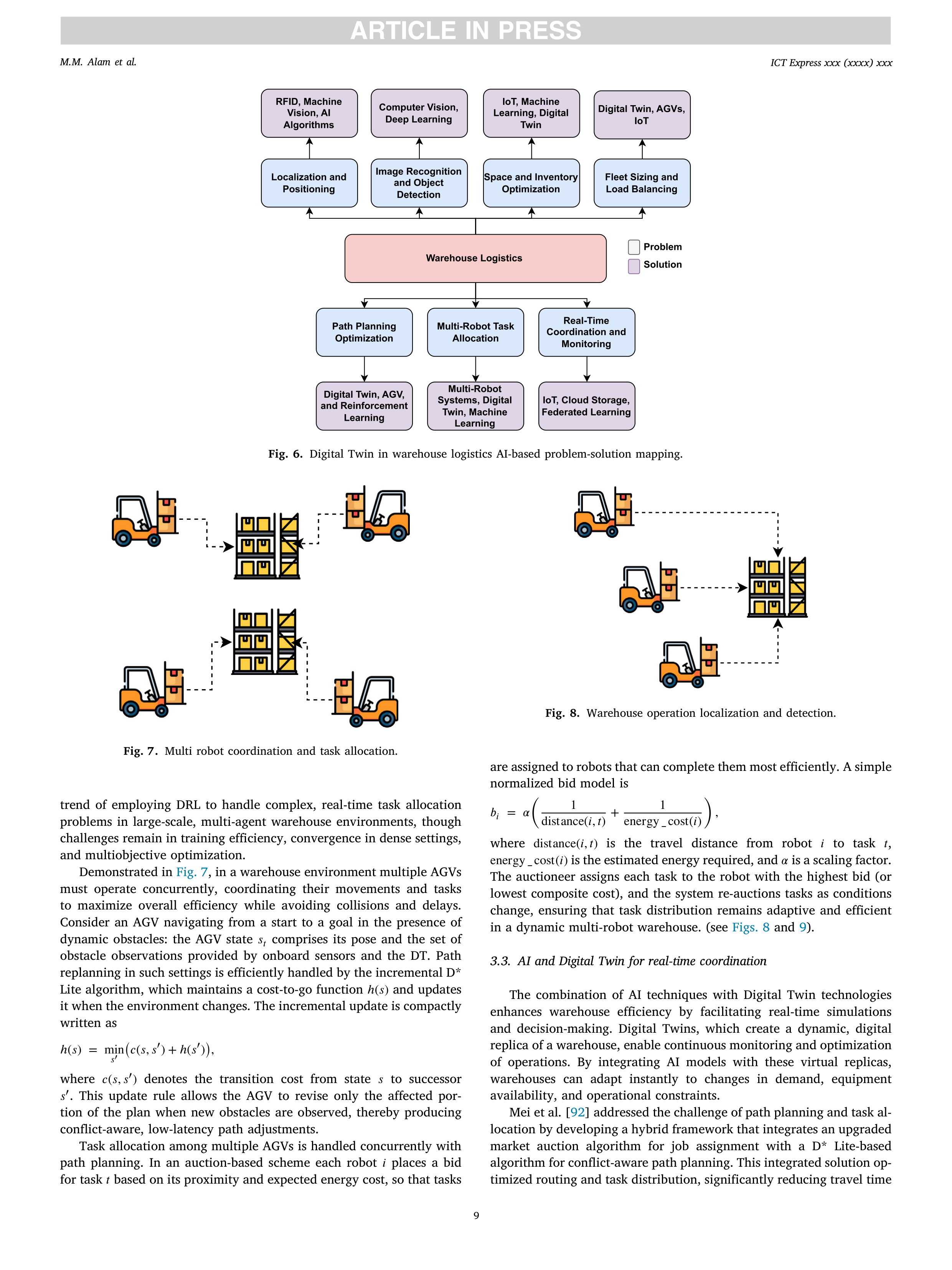








M.M.
Alam
et
al.
Fig.
6.
Digital
Twin
in
warehouse
logistics
AI-based
problem-solution
mapping.
Fig.
7.
Multi
robot
coordination
and
task
allocation.
trend
of
employing
DRL
to
handle
complex,
real-time
task
allocation
problems
in
large-scale,
multi-agent
warehouse
environments,
though
challenges
remain
in
training
efficiency,
convergence
in
dense
settings,
and
multiobjective
optimization.
Demonstrated
in
Fig.
7
,
in
a
warehouse
environment
multiple
AGVs
must
operate
concurrently,
coordinating
their
movements
and
tasks
to
maximize
overall
efficiency
while
avoiding
collisions
and
delays.
Consider
an
AGV
navigating
from
a
start
to
a
goal
in
the
presence
of
dynamic
obstacles:
the
AGV
state
𝑠
𝑡
comprises
its
pose
and
the
set
of
obstacle
observations
provided
by
onboard
sensors
and
the
DT.
Path
replanning
in
such
settings
is
efficiently
handled
by
the
incremental
D*
Lite
algorithm,
which
maintains
a
cost-to-go
function
ℎ
(
𝑠
)
and
updates
it
when
the
environment
changes.
The
incremental
update
is
compactly
written
as
ℎ
(
𝑠
)
=
min
𝑠
′
(
𝑐
(
𝑠,
𝑠
′
)
+
ℎ
(
𝑠
′
)
)
,
where
𝑐
(
𝑠,
𝑠
′
)
denotes
the
transition
cost
from
state
𝑠
to
successor
𝑠
′
.
This
update
rule
allows
the
AGV
to
revise
only
the
affected
por-
tion
of
the
plan
when
new
obstacles
are
observed,
thereby
producing
conflict-aware,
low-latency
path
adjustments.
Task
allocation
among
multiple
AGVs
is
handled
concurrently
with
path
planning.
In
an
auction-based
scheme
each
robot
𝑖
places
a
bid
for
task
𝑡
based
on
its
proximity
and
expected
energy
cost,
so
that
tasks
Fig.
8.
Warehouse
operation
localization
and
detection.
are
assigned
to
robots
that
can
complete
them
most
efficiently.
A
simple
normalized
bid
model
is
𝑏
𝑖
=
𝛼
(
1
dist
ance(
𝑖,
𝑡
)
+
1
ener
gy
_
cost
(
𝑖
)
)
,
where
dist
ance(
𝑖,
𝑡
)
is
the
travel
distance
from
robot
𝑖
to
task
𝑡
,
ener
gy
_
cost
(
𝑖
)
is
the
estimated
energy
required,
and
𝛼
is
a
scaling
factor.
The
auctioneer
assigns
each
task
to
the
robot
with
the
highest
bid
(or
lowest
composite
cost),
and
the
system
re-auctions
tasks
as
conditions
change,
ensuring
that
task
distribution
remains
adaptive
and
efficient
in
a
dynamic
multi-robot
warehouse.
(see
Figs.
8
and
9
).
3.3.
AI
and
Digital
Twin
for
real-time
coordination
The
combination
of
AI
techniques
with
Digital
Twin
technologies
enhances
warehouse
efficiency
by
facilitating
real-time
simulations
and
decision-making.
Digital
Twins,
which
create
a
dynamic,
digital
replica
of
a
warehouse,
enable
continuous
monitoring
and
optimization
of
operations.
By
integrating
AI
models
with
these
virtual
replicas,
warehouses
can
adapt
instantly
to
changes
in
demand,
equipment
availability,
and
operational
constraints.
Mei
et
al.
[
92
]
addressed
the
challenge
of
path
planning
and
task
al-
location
by
developing
a
hybrid
framework
that
integrates
an
upgraded
market
auction
algorithm
for
job
assignment
with
a
D*
Lite-based
algorithm
for
conflict-aware
path
planning.
This
integrated
solution
op-
timized
routing
and
task
distribution,
significantly
reducing
travel
time
ICT
Express
xxx
(xxxx)
xxx
9
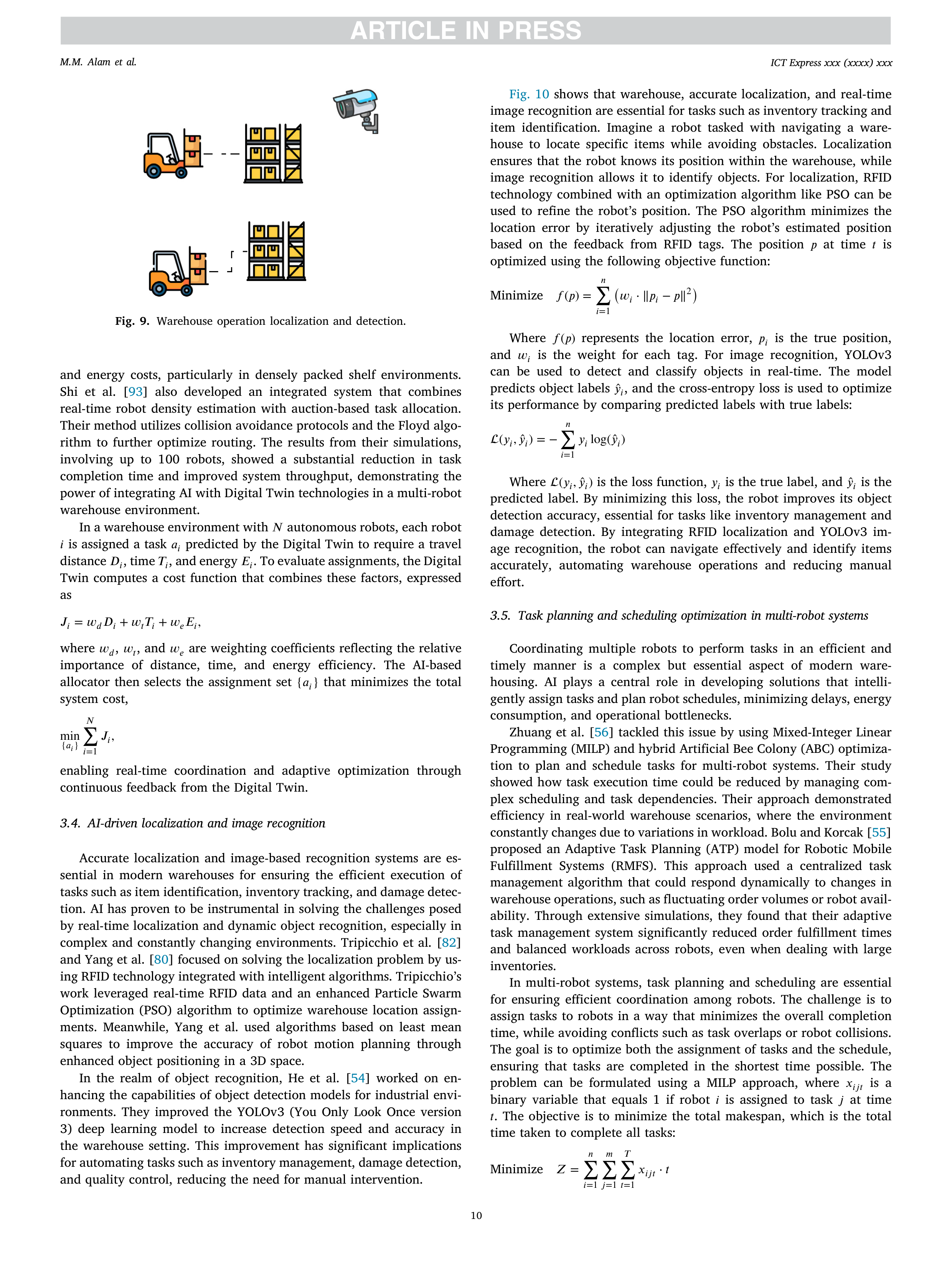





M.M.
Alam
et
al.
Fig.
9.
Warehouse
operation
localization
and
detection.
and
energy
costs,
particularly
in
densely
packed
shelf
environments.
Shi
et
al.
[
93
]
also
developed
an
integrated
system
that
combines
real-time
robot
density
estimation
with
auction-based
task
allocation.
Their
method
utilizes
collision
avoidance
protocols
and
the
Floyd
algo-
rithm
to
further
optimize
routing.
The
results
from
their
simulations,
involving
up
to
100
robots,
showed
a
substantial
reduction
in
task
completion
time
and
improved
system
throughput,
demonstrating
the
power
of
integrating
AI
with
Digital
Twin
technologies
in
a
multi-robot
warehouse
environment.
In
a
warehouse
environment
with
𝑁
autonomous
robots,
each
robot
𝑖
is
assigned
a
task
𝑎
𝑖
predicted
by
the
Digital
Twin
to
require
a
travel
distance
𝐷
𝑖
,
time
𝑇
𝑖
,
and
energy
𝐸
𝑖
.
To
evaluate
assignments,
the
Digital
Twin
computes
a
cost
function
that
combines
these
factors,
expressed
as
𝐽
𝑖
=
𝑤
𝑑
𝐷
𝑖
+
𝑤
𝑡
𝑇
𝑖
+
𝑤
𝑒
𝐸
𝑖
,
where
𝑤
𝑑
,
𝑤
𝑡
,
and
𝑤
𝑒
are
weighting
coefficients
reflecting
the
relative
importance
of
distance,
time,
and
energy
efficiency.
The
AI-based
allocator
then
selects
the
assignment
set
{
𝑎
𝑖
}
that
minimizes
the
total
system
cost,
min
{
𝑎
𝑖
}
𝑁
∑
𝑖
=1
𝐽
𝑖
,
enabling
real-time
coordination
and
adaptive
optimization
through
continuous
feedback
from
the
Digital
Twin.
3.4.
AI-driven
localization
and
image
recognition
Accurate
localization
and
image-based
recognition
systems
are
es-
sential
in
modern
warehouses
for
ensuring
the
efficient
execution
of
tasks
such
as
item
identification,
inventory
tracking,
and
damage
detec-
tion.
AI
has
proven
to
be
instrumental
in
solving
the
challenges
posed
by
real-time
localization
and
dynamic
object
recognition,
especially
in
complex
and
constantly
changing
environments.
Tripicchio
et
al.
[
82
]
and
Yang
et
al.
[
80
]
focused
on
solving
the
localization
problem
by
us-
ing
RFID
technology
integrated
with
intelligent
algorithms.
Tripicchio’s
work
leveraged
real-time
RFID
data
and
an
enhanced
Particle
Swarm
Optimization
(PSO)
algorithm
to
optimize
warehouse
location
assign-
ments.
Meanwhile,
Yang
et
al.
used
algorithms
based
on
least
mean
squares
to
improve
the
accuracy
of
robot
motion
planning
through
enhanced
object
positioning
in
a
3D
space.
In
the
realm
of
object
recognition,
He
et
al.
[
54
]
worked
on
en-
hancing
the
capabilities
of
object
detection
models
for
industrial
envi-
ronments.
They
improved
the
YOLOv3
(You
Only
Look
Once
version
3)
deep
learning
model
to
increase
detection
speed
and
accuracy
in
the
warehouse
setting.
This
improvement
has
significant
implications
for
automating
tasks
such
as
inventory
management,
damage
detection,
and
quality
control,
reducing
the
need
for
manual
intervention.
Fig.
10
shows
that
warehouse,
accurate
localization,
and
real-time
image
recognition
are
essential
for
tasks
such
as
inventory
tracking
and
item
identification.
Imagine
a
robot
tasked
with
navigating
a
ware-
house
to
locate
specific
items
while
avoiding
obstacles.
Localization
ensures
that
the
robot
knows
its
position
within
the
warehouse,
while
image
recognition
allows
it
to
identify
objects.
For
localization,
RFID
technology
combined
with
an
optimization
algorithm
like
PSO
can
be
used
to
refine
the
robot’s
position.
The
PSO
algorithm
minimizes
the
location
error
by
iteratively
adjusting
the
robot’s
estimated
position
based
on
the
feedback
from
RFID
tags.
The
position
𝑝
at
time
𝑡
is
optimized
using
the
following
objective
function:
Minimize
𝑓
(
𝑝
)
=
𝑛
∑
𝑖
=1
(
𝑤
𝑖
⋅
‖
𝑝
𝑖
−
𝑝
‖
2
)
Where
𝑓
(
𝑝
)
represents
the
location
error,
𝑝
𝑖
is
the
true
position,
and
𝑤
𝑖
is
the
weight
for
each
tag.
For
image
recognition,
YOLOv3
can
be
used
to
detect
and
classify
objects
in
real-time.
The
model
predicts
object
labels
̂
𝑦
𝑖
,
and
the
cross-entropy
loss
is
used
to
optimize
its
performance
by
comparing
predicted
labels
with
true
labels:
(
𝑦
𝑖
,
̂𝑦
𝑖
)
=
−
𝑛
∑
𝑖
=1
𝑦
𝑖
log(
̂𝑦
𝑖
)
Where
(
𝑦
𝑖
,
̂𝑦
𝑖
)
is
the
loss
function,
𝑦
𝑖
is
the
true
label,
and
̂
𝑦
𝑖
is
the
predicted
label.
By
minimizing
this
loss,
the
robot
improves
its
object
detection
accuracy,
essential
for
tasks
like
inventory
management
and
damage
detection.
By
integrating
RFID
localization
and
YOLOv3
im-
age
recognition,
the
robot
can
navigate
effectively
and
identify
items
accurately,
automating
warehouse
operations
and
reducing
manual
effort.
3.5.
Task
planning
and
scheduling
optimization
in
multi-robot
systems
Coordinating
multiple
robots
to
perform
tasks
in
an
efficient
and
timely
manner
is
a
complex
but
essential
aspect
of
modern
ware-
housing.
AI
plays
a
central
role
in
developing
solutions
that
intelli-
gently
assign
tasks
and
plan
robot
schedules,
minimizing
delays,
energy
consumption,
and
operational
bottlenecks.
Zhuang
et
al.
[
56
]
tackled
this
issue
by
using
Mixed-Integer
Linear
Programming
(MILP)
and
hybrid
Artificial
Bee
Colony
(ABC)
optimiza-
tion
to
plan
and
schedule
tasks
for
multi-robot
systems.
Their
study
showed
how
task
execution
time
could
be
reduced
by
managing
com-
plex
scheduling
and
task
dependencies.
Their
approach
demonstrated
efficiency
in
real-world
warehouse
scenarios,
where
the
environment
constantly
changes
due
to
variations
in
workload.
Bolu
and
Korcak
[
55
]
proposed
an
Adaptive
Task
Planning
(ATP)
model
for
Robotic
Mobile
Fulfillment
Systems
(RMFS).
This
approach
used
a
centralized
task
management
algorithm
that
could
respond
dynamically
to
changes
in
warehouse
operations,
such
as
fluctuating
order
volumes
or
robot
avail-
ability.
Through
extensive
simulations,
they
found
that
their
adaptive
task
management
system
significantly
reduced
order
fulfillment
times
and
balanced
workloads
across
robots,
even
when
dealing
with
large
inventories.
In
multi-robot
systems,
task
planning
and
scheduling
are
essential
for
ensuring
efficient
coordination
among
robots.
The
challenge
is
to
assign
tasks
to
robots
in
a
way
that
minimizes
the
overall
completion
time,
while
avoiding
conflicts
such
as
task
overlaps
or
robot
collisions.
The
goal
is
to
optimize
both
the
assignment
of
tasks
and
the
schedule,
ensuring
that
tasks
are
completed
in
the
shortest
time
possible.
The
problem
can
be
formulated
using
a
MILP
approach,
where
𝑥
𝑖𝑗
𝑡
is
a
binary
variable
that
equals
1
if
robot
𝑖
is
assigned
to
task
𝑗
at
time
𝑡
.
The
objective
is
to
minimize
the
total
makespan,
which
is
the
total
time
taken
to
complete
all
tasks:
Minimize
𝑍
=
𝑛
∑
𝑖
=1
𝑚
∑
𝑗
=1
𝑇
∑
𝑡
=1
𝑥
𝑖𝑗
𝑡
⋅
𝑡
ICT
Express
xxx
(xxxx)
xxx
10
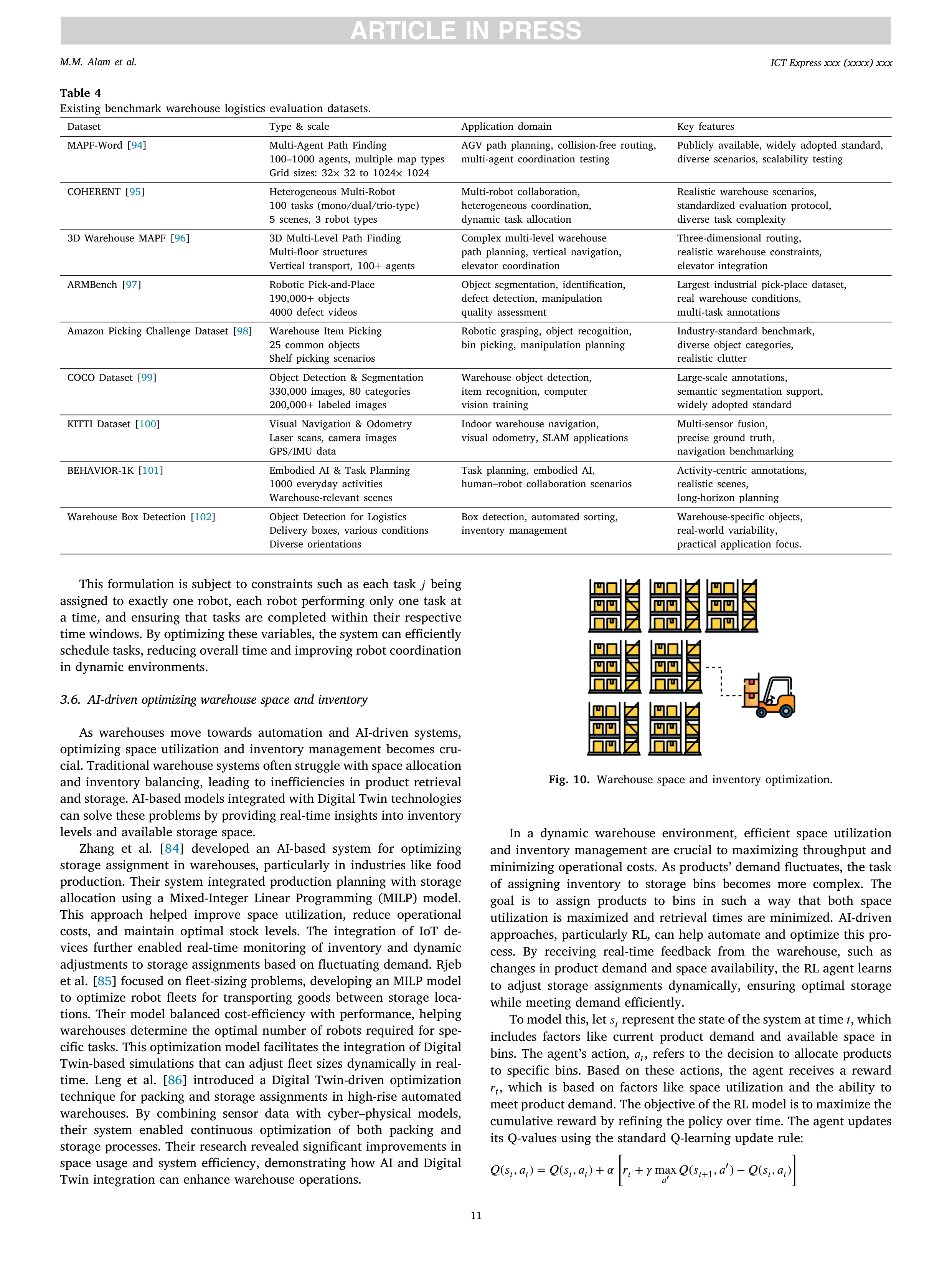
M.M.
Alam
et
al.
Table
4
Existing
benchmark
warehouse
logistics
evaluation
datasets.
Dataset
Type
&
scale
Application
domain
Key
features
MAPF-Word
[
94
]
Multi-Agent
Path
Finding
100–1000
agents,
multiple
map
types
Grid
sizes:
32
×
32
to
1024
×
1024
AGV
path
planning,
collision-free
routing,
multi-agent
coordination
testing
Publicly
available,
widely
adopted
standard,
diverse
scenarios,
scalability
testing
COHERENT
[
95
]
Heterogeneous
Multi-Robot
100
tasks
(mono/dual/trio-type)
5
scenes,
3
robot
types
Multi-robot
collaboration,
heterogeneous
coordination,
dynamic
task
allocation
Realistic
warehouse
scenarios,
standardized
evaluation
protocol,
diverse
task
complexity
3D
Warehouse
MAPF
[
96
]
3D
Multi-Level
Path
Finding
Multi-floor
structures
Vertical
transport,
100+
agents
Complex
multi-level
warehouse
path
planning,
vertical
navigation,
elevator
coordination
Three-dimensional
routing,
realistic
warehouse
constraints,
elevator
integration
ARMBench
[
97
]
Robotic
Pick-and-Place
190,000+
objects
4000
defect
videos
Object
segmentation,
identification,
defect
detection,
manipulation
quality
assessment
Largest
industrial
pick-place
dataset,
real
warehouse
conditions,
multi-task
annotations
Amazon
Picking
Challenge
Dataset
[
98
]
Warehouse
Item
Picking
25
common
objects
Shelf
picking
scenarios
Robotic
grasping,
object
recognition,
bin
picking,
manipulation
planning
Industry-standard
benchmark,
diverse
object
categories,
realistic
clutter
COCO
Dataset
[
99
]
Object
Detection
&
Segmentation
330,000
images,
80
categories
200,000+
labeled
images
Warehouse
object
detection,
item
recognition,
computer
vision
training
Large-scale
annotations,
semantic
segmentation
support,
widely
adopted
standard
KITTI
Dataset
[
100
]
Visual
Navigation
&
Odometry
Laser
scans,
camera
images
GPS/IMU
data
Indoor
warehouse
navigation,
visual
odometry,
SLAM
applications
Multi-sensor
fusion,
precise
ground
truth,
navigation
benchmarking
BEHAVIOR-1K
[
101
]
Embodied
AI
&
Task
Planning
1000
everyday
activities
Warehouse-relevant
scenes
Task
planning,
embodied
AI,
human–robot
collaboration
scenarios
Activity-centric
annotations,
realistic
scenes,
long-horizon
planning
Warehouse
Box
Detection
[
102
]
Object
Detection
for
Logistics
Delivery
boxes,
various
conditions
Diverse
orientations
Box
detection,
automated
sorting,
inventory
management
Warehouse-specific
objects,
real-world
variability,
practical
application
focus.
This
formulation
is
subject
to
constraints
such
as
each
task
𝑗
being
assigned
to
exactly
one
robot,
each
robot
performing
only
one
task
at
a
time,
and
ensuring
that
tasks
are
completed
within
their
respective
time
windows.
By
optimizing
these
variables,
the
system
can
efficiently
schedule
tasks,
reducing
overall
time
and
improving
robot
coordination
in
dynamic
environments.
3.6.
AI-driven
optimizing
warehouse
space
and
inventory
As
warehouses
move
towards
automation
and
AI-driven
systems,
optimizing
space
utilization
and
inventory
management
becomes
cru-
cial.
Traditional
warehouse
systems
often
struggle
with
space
allocation
and
inventory
balancing,
leading
to
inefficiencies
in
product
retrieval
and
storage.
AI-based
models
integrated
with
Digital
Twin
technologies
can
solve
these
problems
by
providing
real-time
insights
into
inventory
levels
and
available
storage
space.
Zhang
et
al.
[
84
]
developed
an
AI-based
system
for
optimizing
storage
assignment
in
warehouses,
particularly
in
industries
like
food
production.
Their
system
integrated
production
planning
with
storage
allocation
using
a
Mixed-Integer
Linear
Programming
(MILP)
model.
This
approach
helped
improve
space
utilization,
reduce
operational
costs,
and
maintain
optimal
stock
levels.
The
integration
of
IoT
de-
vices
further
enabled
real-time
monitoring
of
inventory
and
dynamic
adjustments
to
storage
assignments
based
on
fluctuating
demand.
Rjeb
et
al.
[
85
]
focused
on
fleet-sizing
problems,
developing
an
MILP
model
to
optimize
robot
fleets
for
transporting
goods
between
storage
loca-
tions.
Their
model
balanced
cost-efficiency
with
performance,
helping
warehouses
determine
the
optimal
number
of
robots
required
for
spe-
cific
tasks.
This
optimization
model
facilitates
the
integration
of
Digital
Twin-based
simulations
that
can
adjust
fleet
sizes
dynamically
in
real-
time.
Leng
et
al.
[
86
]
introduced
a
Digital
Twin-driven
optimization
technique
for
packing
and
storage
assignments
in
high-rise
automated
warehouses.
By
combining
sensor
data
with
cyber–physical
models,
their
system
enabled
continuous
optimization
of
both
packing
and
storage
processes.
Their
research
revealed
significant
improvements
in
space
usage
and
system
efficiency,
demonstrating
how
AI
and
Digital
Twin
integration
can
enhance
warehouse
operations.
Fig.
10.
Warehouse
space
and
inventory
optimization.
In
a
dynamic
warehouse
environment,
efficient
space
utilization
and
inventory
management
are
crucial
to
maximizing
throughput
and
minimizing
operational
costs.
As
products’
demand
fluctuates,
the
task
of
assigning
inventory
to
storage
bins
becomes
more
complex.
The
goal
is
to
assign
products
to
bins
in
such
a
way
that
both
space
utilization
is
maximized
and
retrieval
times
are
minimized.
AI-driven
approaches,
particularly
RL,
can
help
automate
and
optimize
this
pro-
cess.
By
receiving
real-time
feedback
from
the
warehouse,
such
as
changes
in
product
demand
and
space
availability,
the
RL
agent
learns
to
adjust
storage
assignments
dynamically,
ensuring
optimal
storage
while
meeting
demand
efficiently.
To
model
this,
let
𝑠
𝑡
represent
the
state
of
the
system
at
time
𝑡
,
which
includes
factors
like
current
product
demand
and
available
space
in
bins.
The
agent’s
action,
𝑎
𝑡
,
refers
to
the
decision
to
allocate
products
to
specific
bins.
Based
on
these
actions,
the
agent
receives
a
reward
𝑟
𝑡
,
which
is
based
on
factors
like
space
utilization
and
the
ability
to
meet
product
demand.
The
objective
of
the
RL
model
is
to
maximize
the
cumulative
reward
by
refining
the
policy
over
time.
The
agent
updates
its
Q-values
using
the
standard
Q-learning
update
rule:
𝑄
(
𝑠
𝑡
,
𝑎
𝑡
)
=
𝑄
(
𝑠
𝑡
,
𝑎
𝑡
)
+
𝛼
[
𝑟
𝑡
+
𝛾
max
𝑎
′
𝑄
(
𝑠
𝑡
+1
,
𝑎
′
)
−
𝑄
(
𝑠
𝑡
,
𝑎
𝑡
)
]
ICT
Express
xxx
(xxxx)
xxx
11
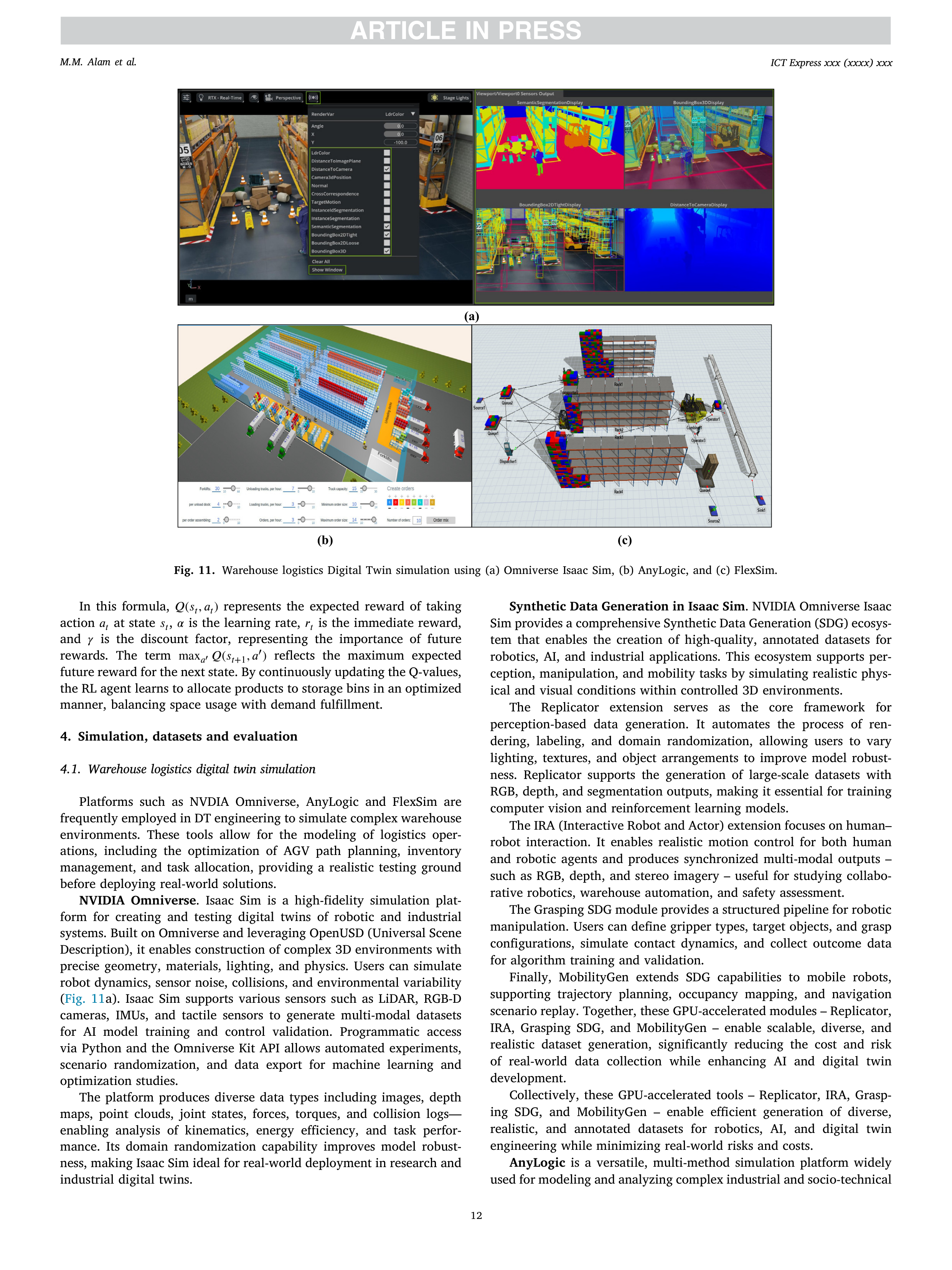
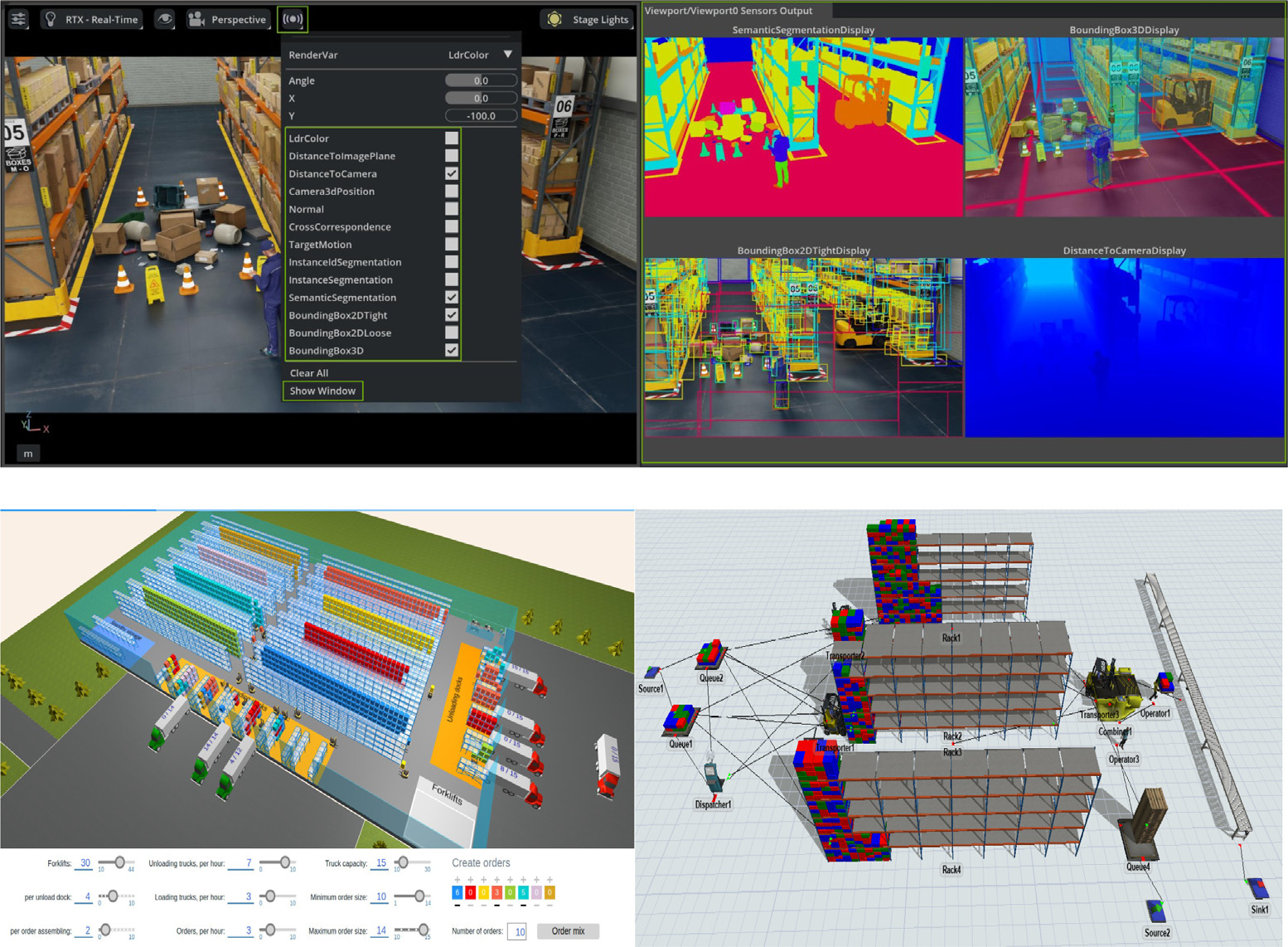
M.M.
Alam
et
al.
Fig.
11.
Warehouse
logistics
Digital
Twin
simulation
using
(a)
Omniverse
Isaac
Sim,
(b)
AnyLogic,
and
(c)
FlexSim.
In
this
formula,
𝑄
(
𝑠
𝑡
,
𝑎
𝑡
)
represents
the
expected
reward
of
taking
action
𝑎
𝑡
at
state
𝑠
𝑡
,
𝛼
is
the
learning
rate,
𝑟
𝑡
is
the
immediate
reward,
and
𝛾
is
the
discount
factor,
representing
the
importance
of
future
rewards.
The
term
max
𝑎
′
𝑄
(
𝑠
𝑡
+1
,
𝑎
′
)
reflects
the
maximum
expected
future
reward
for
the
next
state.
By
continuously
updating
the
Q-values,
the
RL
agent
learns
to
allocate
products
to
storage
bins
in
an
optimized
manner,
balancing
space
usage
with
demand
fulfillment.
4.
Simulation,
datasets
and
evaluation
4.1.
Warehouse
logistics
digital
twin
simulation
Platforms
such
as
NVDIA
Omniverse,
AnyLogic
and
FlexSim
are
frequently
employed
in
DT
engineering
to
simulate
complex
warehouse
environments.
These
tools
allow
for
the
modeling
of
logistics
oper-
ations,
including
the
optimization
of
AGV
path
planning,
inventory
management,
and
task
allocation,
providing
a
realistic
testing
ground
before
deploying
real-world
solutions.
NVIDIA
Omniverse
.
Isaac
Sim
is
a
high-fidelity
simulation
plat-
form
for
creating
and
testing
digital
twins
of
robotic
and
industrial
systems.
Built
on
Omniverse
and
leveraging
OpenUSD
(Universal
Scene
Description),
it
enables
construction
of
complex
3D
environments
with
precise
geometry,
materials,
lighting,
and
physics.
Users
can
simulate
robot
dynamics,
sensor
noise,
collisions,
and
environmental
variability
(
Fig.
11
a).
Isaac
Sim
supports
various
sensors
such
as
LiDAR,
RGB-D
cameras,
IMUs,
and
tactile
sensors
to
generate
multi-modal
datasets
for
AI
model
training
and
control
validation.
Programmatic
access
via
Python
and
the
Omniverse
Kit
API
allows
automated
experiments,
scenario
randomization,
and
data
export
for
machine
learning
and
optimization
studies.
The
platform
produces
diverse
data
types
including
images,
depth
maps,
point
clouds,
joint
states,
forces,
torques,
and
collision
logs—
enabling
analysis
of
kinematics,
energy
efficiency,
and
task
perfor-
mance.
Its
domain
randomization
capability
improves
model
robust-
ness,
making
Isaac
Sim
ideal
for
real-world
deployment
in
research
and
industrial
digital
twins.
Synthetic
Data
Generation
in
Isaac
Sim
.
NVIDIA
Omniverse
Isaac
Sim
provides
a
comprehensive
Synthetic
Data
Generation
(SDG)
ecosys-
tem
that
enables
the
creation
of
high-quality,
annotated
datasets
for
robotics,
AI,
and
industrial
applications.
This
ecosystem
supports
per-
ception,
manipulation,
and
mobility
tasks
by
simulating
realistic
phys-
ical
and
visual
conditions
within
controlled
3D
environments.
The
Replicator
extension
serves
as
the
core
framework
for
perception-based
data
generation.
It
automates
the
process
of
ren-
dering,
labeling,
and
domain
randomization,
allowing
users
to
vary
lighting,
textures,
and
object
arrangements
to
improve
model
robust-
ness.
Replicator
supports
the
generation
of
large-scale
datasets
with
RGB,
depth,
and
segmentation
outputs,
making
it
essential
for
training
computer
vision
and
reinforcement
learning
models.
The
IRA
(Interactive
Robot
and
Actor)
extension
focuses
on
human–
robot
interaction.
It
enables
realistic
motion
control
for
both
human
and
robotic
agents
and
produces
synchronized
multi-modal
outputs
–
such
as
RGB,
depth,
and
stereo
imagery
–
useful
for
studying
collabo-
rative
robotics,
warehouse
automation,
and
safety
assessment.
The
Grasping
SDG
module
provides
a
structured
pipeline
for
robotic
manipulation.
Users
can
define
gripper
types,
target
objects,
and
grasp
configurations,
simulate
contact
dynamics,
and
collect
outcome
data
for
algorithm
training
and
validation.
Finally,
MobilityGen
extends
SDG
capabilities
to
mobile
robots,
supporting
trajectory
planning,
occupancy
mapping,
and
navigation
scenario
replay.
Together,
these
GPU-accelerated
modules
–
Replicator,
IRA,
Grasping
SDG,
and
MobilityGen
–
enable
scalable,
diverse,
and
realistic
dataset
generation,
significantly
reducing
the
cost
and
risk
of
real-world
data
collection
while
enhancing
AI
and
digital
twin
development.
Collectively,
these
GPU-accelerated
tools
–
Replicator,
IRA,
Grasp-
ing
SDG,
and
MobilityGen
–
enable
efficient
generation
of
diverse,
realistic,
and
annotated
datasets
for
robotics,
AI,
and
digital
twin
engineering
while
minimizing
real-world
risks
and
costs.
AnyLogic
is
a
versatile,
multi-method
simulation
platform
widely
used
for
modeling
and
analyzing
complex
industrial
and
socio-technical
ICT
Express
xxx
(xxxx)
xxx
12
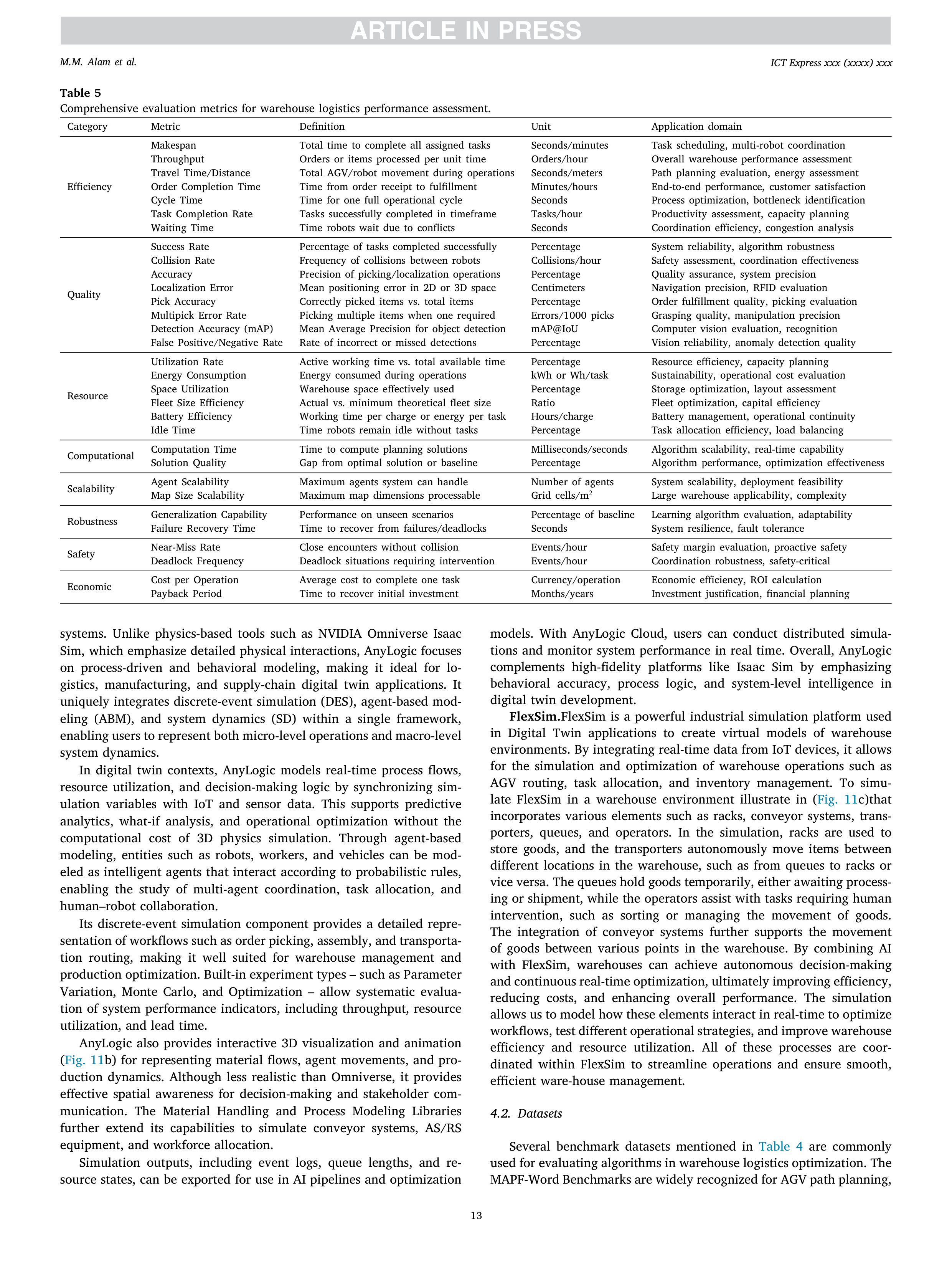
M.M.
Alam
et
al.
Table
5
Comprehensive
evaluation
metrics
for
warehouse
logistics
performance
assessment.
Category
Metric
Definition
Unit
Application
domain
Efficiency
Makespan
Total
time
to
complete
all
assigned
tasks
Seconds/minutes
Task
scheduling,
multi-robot
coordination
Throughput
Orders
or
items
processed
per
unit
time
Orders/hour
Overall
warehouse
performance
assessment
Travel
Time/Distance
Total
AGV/robot
movement
during
operations
Seconds/meters
Path
planning
evaluation,
energy
assessment
Order
Completion
Time
Time
from
order
receipt
to
fulfillment
Minutes/hours
End-to-end
performance,
customer
satisfaction
Cycle
Time
Time
for
one
full
operational
cycle
Seconds
Process
optimization,
bottleneck
identification
Task
Completion
Rate
Tasks
successfully
completed
in
timeframe
Tasks/hour
Productivity
assessment,
capacity
planning
Waiting
Time
Time
robots
wait
due
to
conflicts
Seconds
Coordination
efficiency,
congestion
analysis
Quality
Success
Rate
Percentage
of
tasks
completed
successfully
Percentage
System
reliability,
algorithm
robustness
Collision
Rate
Frequency
of
collisions
between
robots
Collisions/hour
Safety
assessment,
coordination
effectiveness
Accuracy
Precision
of
picking/localization
operations
Percentage
Quality
assurance,
system
precision
Localization
Error
Mean
positioning
error
in
2D
or
3D
space
Centimeters
Navigation
precision,
RFID
evaluation
Pick
Accuracy
Correctly
picked
items
vs.
total
items
Percentage
Order
fulfillment
quality,
picking
evaluation
Multipick
Error
Rate
Picking
multiple
items
when
one
required
Errors/1000
picks
Grasping
quality,
manipulation
precision
Detection
Accuracy
(mAP)
Mean
Average
Precision
for
object
detection
mAP@IoU
Computer
vision
evaluation,
recognition
False
Positive/Negative
Rate
Rate
of
incorrect
or
missed
detections
Percentage
Vision
reliability,
anomaly
detection
quality
Resource
Utilization
Rate
Active
working
time
vs.
total
available
time
Percentage
Resource
efficiency,
capacity
planning
Energy
Consumption
Energy
consumed
during
operations
kWh
or
Wh/task
Sustainability,
operational
cost
evaluation
Space
Utilization
Warehouse
space
effectively
used
Percentage
Storage
optimization,
layout
assessment
Fleet
Size
Efficiency
Actual
vs.
minimum
theoretical
fleet
size
Ratio
Fleet
optimization,
capital
efficiency
Battery
Efficiency
Working
time
per
charge
or
energy
per
task
Hours/charge
Battery
management,
operational
continuity
Idle
Time
Time
robots
remain
idle
without
tasks
Percentage
Task
allocation
efficiency,
load
balancing
Computational
Computation
Time
Time
to
compute
planning
solutions
Milliseconds/seconds
Algorithm
scalability,
real-time
capability
Solution
Quality
Gap
from
optimal
solution
or
baseline
Percentage
Algorithm
performance,
optimization
effectiveness
Scalability
Agent
Scalability
Maximum
agents
system
can
handle
Number
of
agents
System
scalability,
deployment
feasibility
Map
Size
Scalability
Maximum
map
dimensions
processable
Grid
cells/m
2
Large
warehouse
applicability,
complexity
Robustness
Generalization
Capability
Performance
on
unseen
scenarios
Percentage
of
baseline
Learning
algorithm
evaluation,
adaptability
Failure
Recovery
Time
Time
to
recover
from
failures/deadlocks
Seconds
System
resilience,
fault
tolerance
Safety
Near-Miss
Rate
Close
encounters
without
collision
Events/hour
Safety
margin
evaluation,
proactive
safety
Deadlock
Frequency
Deadlock
situations
requiring
intervention
Events/hour
Coordination
robustness,
safety-critical
Economic
Cost
per
Operation
Average
cost
to
complete
one
task
Currency/operation
Economic
efficiency,
ROI
calculation
Payback
Period
Time
to
recover
initial
investment
Months/years
Investment
justification,
financial
planning
systems.
Unlike
physics-based
tools
such
as
NVIDIA
Omniverse
Isaac
Sim,
which
emphasize
detailed
physical
interactions,
AnyLogic
focuses
on
process-driven
and
behavioral
modeling,
making
it
ideal
for
lo-
gistics,
manufacturing,
and
supply-chain
digital
twin
applications.
It
uniquely
integrates
discrete-event
simulation
(DES),
agent-based
mod-
eling
(ABM),
and
system
dynamics
(SD)
within
a
single
framework,
enabling
users
to
represent
both
micro-level
operations
and
macro-level
system
dynamics.
In
digital
twin
contexts,
AnyLogic
models
real-time
process
flows,
resource
utilization,
and
decision-making
logic
by
synchronizing
sim-
ulation
variables
with
IoT
and
sensor
data.
This
supports
predictive
analytics,
what-if
analysis,
and
operational
optimization
without
the
computational
cost
of
3D
physics
simulation.
Through
agent-based
modeling,
entities
such
as
robots,
workers,
and
vehicles
can
be
mod-
eled
as
intelligent
agents
that
interact
according
to
probabilistic
rules,
enabling
the
study
of
multi-agent
coordination,
task
allocation,
and
human–robot
collaboration.
Its
discrete-event
simulation
component
provides
a
detailed
repre-
sentation
of
workflows
such
as
order
picking,
assembly,
and
transporta-
tion
routing,
making
it
well
suited
for
warehouse
management
and
production
optimization.
Built-in
experiment
types
–
such
as
Parameter
Variation,
Monte
Carlo,
and
Optimization
–
allow
systematic
evalua-
tion
of
system
performance
indicators,
including
throughput,
resource
utilization,
and
lead
time.
AnyLogic
also
provides
interactive
3D
visualization
and
animation
(
Fig.
11
b)
for
representing
material
flows,
agent
movements,
and
pro-
duction
dynamics.
Although
less
realistic
than
Omniverse,
it
provides
effective
spatial
awareness
for
decision-making
and
stakeholder
com-
munication.
The
Material
Handling
and
Process
Modeling
Libraries
further
extend
its
capabilities
to
simulate
conveyor
systems,
AS/RS
equipment,
and
workforce
allocation.
Simulation
outputs,
including
event
logs,
queue
lengths,
and
re-
source
states,
can
be
exported
for
use
in
AI
pipelines
and
optimization
models.
With
AnyLogic
Cloud,
users
can
conduct
distributed
simula-
tions
and
monitor
system
performance
in
real
time.
Overall,
AnyLogic
complements
high-fidelity
platforms
like
Isaac
Sim
by
emphasizing
behavioral
accuracy,
process
logic,
and
system-level
intelligence
in
digital
twin
development.
FlexSim.
FlexSim
is
a
powerful
industrial
simulation
platform
used
in
Digital
Twin
applications
to
create
virtual
models
of
warehouse
environments.
By
integrating
real-time
data
from
IoT
devices,
it
allows
for
the
simulation
and
optimization
of
warehouse
operations
such
as
AGV
routing,
task
allocation,
and
inventory
management.
To
simu-
late
FlexSim
in
a
warehouse
environment
illustrate
in
(
Fig.
11
c)that
incorporates
various
elements
such
as
racks,
conveyor
systems,
trans-
porters,
queues,
and
operators.
In
the
simulation,
racks
are
used
to
store
goods,
and
the
transporters
autonomously
move
items
between
different
locations
in
the
warehouse,
such
as
from
queues
to
racks
or
vice
versa.
The
queues
hold
goods
temporarily,
either
awaiting
process-
ing
or
shipment,
while
the
operators
assist
with
tasks
requiring
human
intervention,
such
as
sorting
or
managing
the
movement
of
goods.
The
integration
of
conveyor
systems
further
supports
the
movement
of
goods
between
various
points
in
the
warehouse.
By
combining
AI
with
FlexSim,
warehouses
can
achieve
autonomous
decision-making
and
continuous
real-time
optimization,
ultimately
improving
efficiency,
reducing
costs,
and
enhancing
overall
performance.
The
simulation
allows
us
to
model
how
these
elements
interact
in
real-time
to
optimize
workflows,
test
different
operational
strategies,
and
improve
warehouse
efficiency
and
resource
utilization.
All
of
these
processes
are
coor-
dinated
within
FlexSim
to
streamline
operations
and
ensure
smooth,
efficient
ware-house
management.
4.2.
Datasets
Several
benchmark
datasets
mentioned
in
Table
4
are
commonly
used
for
evaluating
algorithms
in
warehouse
logistics
optimization.
The
MAPF-Word
Benchmarks
are
widely
recognized
for
AGV
path
planning,
ICT
Express
xxx
(xxxx)
xxx
13
M.M.
Alam
et
al.
supporting
scalability
testing
with
100–1000
agents
and
varying
grid
sizes.
For
multi-robot
task
allocation,
the
COHERENT
Benchmark
offers
scenarios
with
heterogeneous
robots
and
dynamic
task
assignments,
while
the
3D
Warehouse
MAPF
Dataset
introduces
the
complexity
of
multi-level
warehouse
layouts
with
vertical
transport.
The
MAPF-
World
dataset
provides
large-scale
training
data
with
real-world
urban
layouts,
ideal
for
learnable
MAPF
solvers.
In
terms
of
object
detection
and
manipulation,
the
ARMBench
(Ama-
zon)
dataset,
which
includes
over
190,000
objects
and
4000
defect
videos,
is
critical
for
robotic
pick-and-place
tasks.
Similarly,
the
Ama-
zon
Picking
Challenge
Dataset
is
used
for
testing
robotic
grasping
and
bin
picking.
The
COCO
Dataset
is
commonly
adapted
for
warehouse
object
recognition
tasks
due
to
its
large-scale
annotations
and
support
for
segmentation.
Additionally,
datasets
like
SafeLog
MAPF
focus
on
in-
dustrial
AGV
path
planning
and
safety-critical
environments,
while
Real
Industry
Warehouse
Data
from
companies
like
Amazon
and
DHL
pro-
vide
real-world
validation
with
actual
warehouse
layouts
and
historical
operational
data.
These
datasets
provide
comprehensive
resources
for
testing
warehouse
operations
environments
in
both
simulated
and
real-
world
warehouse
environments,
enabling
performance
benchmarking
across
various
logistics
tasks.
4.3.
Evaluation
criteria
Table
5
summarizes
the
primary
evaluation
metrics
used
to
assess
warehouse
logistics
algorithms
and
systems.
The
metrics
are
organized
into
thematic
categories
Efficiency
(e.g.,
makespan,
throughput,
travel
distance),
Quality
(e.g.,
success
rate,
collision
rate,
localization
er-
ror),
Resource
(e.g.,
utilization,
energy
consumption,
space
utilization),
Computational
(e.g.,
computation
time,
solution
quality),
Scalability,
Robustness,
Safety,
and
Economic
measures
each
targeting
a
distinct
as-
pect
of
system
performance.
Together
these
indicators
enable
compre-
hensive
benchmarking
of
path
planning,
task
allocation,
perception
and
resource-management
methods:
efficiency
and
quality
metrics
measure
operational
effectiveness
and
reliability;
resource
and
economic
met-
rics
capture
cost
and
sustainability
implications;
and
computational,
scalability
and
robustness
metrics
evaluate
algorithmic
feasibility
for
real-time,
large-scale
deployment.
5.
Research
gaps
and
future
directions
The
previous
sections
have
critically
analyzed
the
existing
literature
on
the
application
of
optimization
approaches
to
solve
operational
warehouse
problems
in
the
era
of
digital
transformation.
These
reviews
explored
the
present
application
of
Artificial
Intelligence
in
digital
twin
systems
for
warehouse
logistics.
It
featured
cutting-edge
models
for
real-time
tracking,
path
optimization,
robots,
demand
forecasting,
and
predictive
maintenance.
However,
most
current
research
focuses
on
single-warehouse
situations
and
does
not
investigate
how
AI-powered
digital
twins
behave
in
complicated,
multi-node
supply
networks.
Few
studies
investigate
how
real-time
AI
decisions
in
DTs
impact
long-term
warehouse
efficiency.
Furthermore,
most
DT
models
employ
predefined
rules
rather
than
learning
from
continual
feedback.
To
implement
the
conceptual
AI–Digital
Twin
(AI–DT)
warehouse
framework,
we
summarize
seven
high-impact
research
directions
in
Table
6
.
Each
direction
is
characterized
by
a
clearly
defined
prob-
lem,
the
corresponding
technical
mechanism,
implementation
stack,
and
supporting
empirical
evidence.
The
directions
are
organized
ac-
cording
to
maturity
and
potential
impact,
ranging
from
immediately
deployable
approaches
(e.g.,
Edge
AI
with
Federated
Learning)
to
more
transformative
but
currently
constrained
technologies
(e.g.,
Quantum
Computing
integrated
with
6G).
In
particular,
all
directions
incorporate
real-world
validation,
from
simulation
benchmarks
to
industry
pilot
studies,
ensuring
that
the
table
reflects
practical
feasibility
rather
than
speculative
proposals.
5.1.
Real-time
implementation
While
digital
twins
provide
real-time
monitoring
capabilities,
their
integration
with
AI
in
warehouse
logistics
is
frequently
hampered
by
computational
complexity
and
data
latency.
Future
research
should
look
toward
edge
AI
frameworks
that
enable
on-device
processing
for
real-time
optimization
while
lowering
reliance
on
cloud
infrastructure.
This
is
especially
important
for
small
to
medium-sized
warehouses
with
limited
computational
resources
[
107
].
For
example,
edge
AI
could
improve
robotic
picking
routes
in
real
time,
reducing
energy
usage
and
operating
delays.
Furthermore,
the
lack
of
established
protocols
for
AI-DT
integration
limits
scalability.
Researchers
should
concentrate
on
creating
interop-
erable
frameworks
that
enable
seamless
data
interchange
between
AI
algorithms,
digital
twins,
and
warehouse
management
systems.
One
potential
path
is
to
employ
federated
learning
to
train
AI
models
across
remote
warehouse
networks
while
ensuring
data
privacy
and
addressing
regulatory
constraints
in
global
supply
chains.
5.2.
Sustainability
and
human-centric
optimization
Sustainability
is
an
important
but
underexplored
component
of
AI-powered
digital
twin
applications
in
warehouse
logistics.
Existing
research
focuses
exclusively
on
operational
efficiency,
frequently
ig-
noring
environmental
implications
[
108
].
Future
study
could
look
into
AI-optimized
digital
twins
for
green
logistics,
such
as
reducing
carbon
emissions
via
energy-efficient
routing
or
predictive
maintenance
of
electric
warehouse
cars.
Reinforcement
learning,
for
example,
could
be
used
to
balance
delivery
speed
versus
energy
usage
in
autonomous
guided
vehicles.
In
addition,
human–AI
collaboration
in
warehouse
logistics
is
still
in
its
early
stages.
Digital
twins
might
serve
as
inter-
active
training
platforms
for
human
operators,
with
augmented
reality
(AR)
interfaces
driven
by
AI
providing
real-time
assistance.
Research
should
look
into
how
AR-enhanced
digital
twins
can
increase
worker
safety
and
efficiency,
especially
while
handling
dangerous
or
perishable
commodities
[
109
].
Goods-to-person
(GTP)
automation
systems,
which
streamline
order
fulfillment
and
warehouse
navigation,
have
received
limited
attention
in
the
context
of
AI
and
digital
twins
[
110
].
Digital
twins
can
simulate
GTP
workflows,
while
AI
can
optimize
picking
routes
and
resource
allocation.
Future
studies
should
investigate
AI-driven
digital
twins
for
GTP
optimization,
focusing
on
reducing
picking
errors
and
improving
navigation
efficiency
in
large-scale
warehouses.
For
instance,
deep
learning
models
could
predict
optimal
GTP
configurations
within
a
digital
twin,
enhancing
order
fulfillment
speed.
This
direction
addresses
the
gap
in
exploring
GTP
systems
and
their
impact
on
warehouse
performance
[
111
,
112
].
5.3.
Transparency
and
efficiency
The
integration
of
blockchain
technology
with
AI
and
digital
twins
for
warehouse
logistics
is
a
somewhat
unexplored
topic.
Blockchain
technology
can
improve
the
transparency
and
security
of
the
data
used
by
digital
twins,
especially
for
inventory
management
and
supply
chain
tracking
[
113
].
Future
studies
should
look
at
AI
blockchain-DT
frame-
works
to
boost
efficiency,
reduce
costs,
and
maintain
data
integrity
in
warehouse
operations.
For
example,
AI
may
examine
blockchain-
secured
data
within
a
digital
twin
to
optimize
inventory
replenishment
cycles,
bridging
the
transparency-driven
optimization
gap.
To
address
the
need
for
more
concrete
applications,
the
integration
of
blockchain,
artificial
intelligence,
and
digital
twins
(DT)
can
be
implemented
through
targeted
frameworks
that
enhance
warehouse
logistics.
In
the
following,
we
outline
specific
use
cases,
implemen-
tation
strategies,
and
potential
benefits
to
provide
actionable
infor-
mation
for
future
research
and
deployment.
Practical
Applications
of
AI-Blockchain-DT
Frameworks
ICT
Express
xxx
(xxxx)
xxx
14
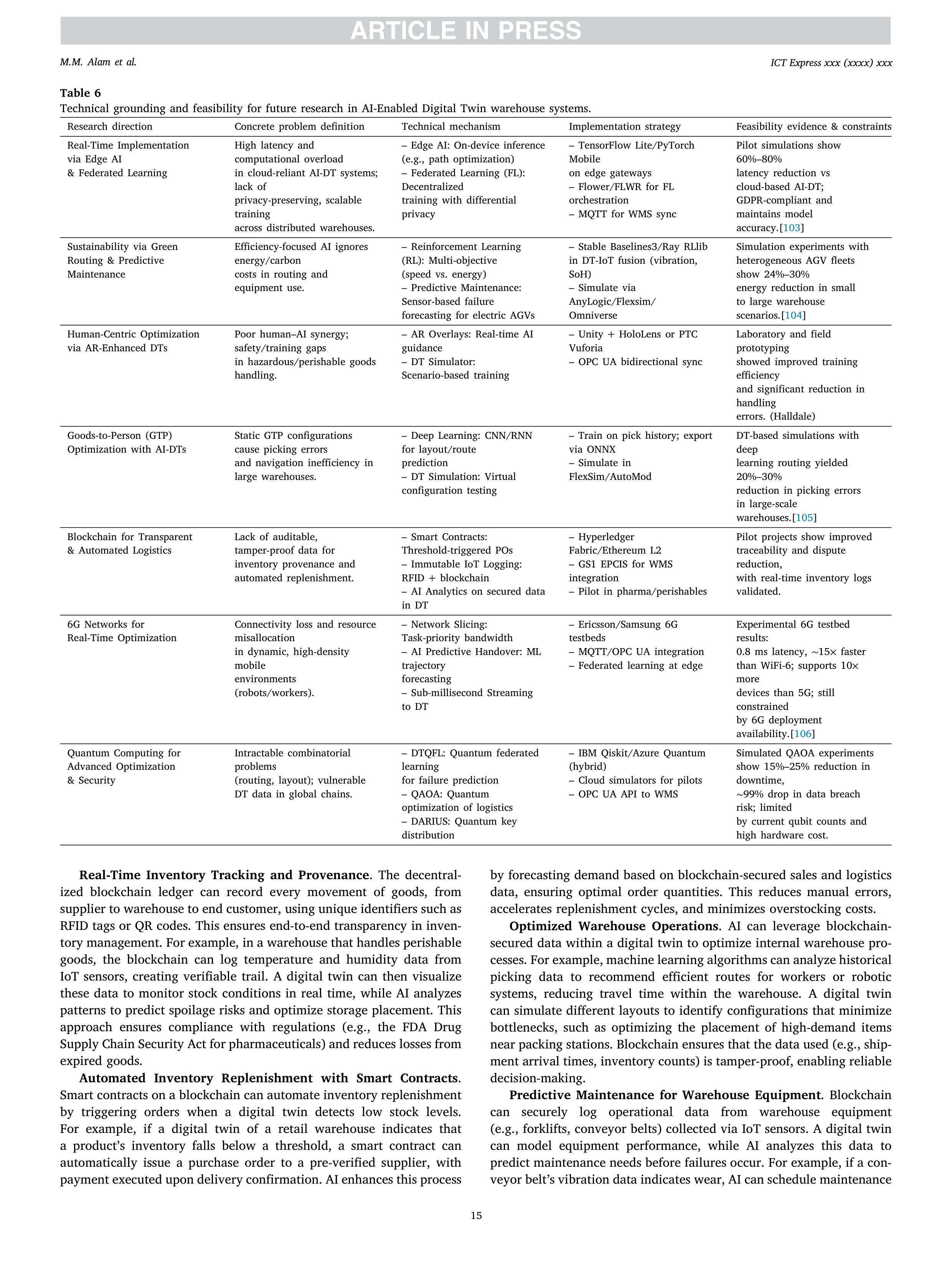
M.M.
Alam
et
al.
Table
6
Technical
grounding
and
feasibility
for
future
research
in
AI-Enabled
Digital
Twin
warehouse
systems.
Research
direction
Concrete
problem
definition
Technical
mechanism
Implementation
strategy
Feasibility
evidence
&
constraints
Real-Time
Implementation
via
Edge
AI
&
Federated
Learning
High
latency
and
computational
overload
in
cloud-reliant
AI-DT
systems;
lack
of
privacy-preserving,
scalable
training
across
distributed
warehouses.
–
Edge
AI:
On-device
inference
(e.g.,
path
optimization)
–
Federated
Learning
(FL):
Decentralized
training
with
differential
privacy
–
TensorFlow
Lite/PyTorch
Mobile
on
edge
gateways
–
Flower/FLWR
for
FL
orchestration
–
MQTT
for
WMS
sync
Pilot
simulations
show
60%–80%
latency
reduction
vs
cloud-based
AI-DT;
GDPR-compliant
and
maintains
model
accuracy.[
103
]
Sustainability
via
Green
Routing
&
Predictive
Maintenance
Efficiency-focused
AI
ignores
energy/carbon
costs
in
routing
and
equipment
use.
–
Reinforcement
Learning
(RL):
Multi-objective
(speed
vs.
energy)
–
Predictive
Maintenance:
Sensor-based
failure
forecasting
for
electric
AGVs
–
Stable
Baselines3/Ray
RLlib
in
DT-IoT
fusion
(vibration,
SoH)
–
Simulate
via
AnyLogic/Flexsim/
Omniverse
Simulation
experiments
with
heterogeneous
AGV
fleets
show
24%–30%
energy
reduction
in
small
to
large
warehouse
scenarios.[
104
]
Human-Centric
Optimization
via
AR-Enhanced
DTs
Poor
human–AI
synergy;
safety/training
gaps
in
hazardous/perishable
goods
handling.
–
AR
Overlays:
Real-time
AI
guidance
–
DT
Simulator:
Scenario-based
training
–
Unity
+
HoloLens
or
PTC
Vuforia
–
OPC
UA
bidirectional
sync
Laboratory
and
field
prototyping
showed
improved
training
efficiency
and
significant
reduction
in
handling
errors.
(Halldale)
Goods-to-Person
(GTP)
Optimization
with
AI-DTs
Static
GTP
configurations
cause
picking
errors
and
navigation
inefficiency
in
large
warehouses.
–
Deep
Learning:
CNN/RNN
for
layout/route
prediction
–
DT
Simulation:
Virtual
configuration
testing
–
Train
on
pick
history;
export
via
ONNX
–
Simulate
in
FlexSim/AutoMod
DT-based
simulations
with
deep
learning
routing
yielded
20%–30%
reduction
in
picking
errors
in
large-scale
warehouses.[
105
]
Blockchain
for
Transparent
&
Automated
Logistics
Lack
of
auditable,
tamper-proof
data
for
inventory
provenance
and
automated
replenishment.
–
Smart
Contracts:
Threshold-triggered
POs
–
Immutable
IoT
Logging:
RFID
+
blockchain
–
AI
Analytics
on
secured
data
in
DT
–
Hyperledger
Fabric/Ethereum
L2
–
GS1
EPCIS
for
WMS
integration
–
Pilot
in
pharma/perishables
Pilot
projects
show
improved
traceability
and
dispute
reduction,
with
real-time
inventory
logs
validated.
6G
Networks
for
Real-Time
Optimization
Connectivity
loss
and
resource
misallocation
in
dynamic,
high-density
mobile
environments
(robots/workers).
–
Network
Slicing:
Task-priority
bandwidth
–
AI
Predictive
Handover:
ML
trajectory
forecasting
–
Sub-millisecond
Streaming
to
DT
–
Ericsson/Samsung
6G
testbeds
–
MQTT/OPC
UA
integration
–
Federated
learning
at
edge
Experimental
6G
testbed
results:
0.8
ms
latency,
∼
15
×
faster
than
WiFi-6;
supports
10
×
more
devices
than
5G;
still
constrained
by
6G
deployment
availability.[
106
]
Quantum
Computing
for
Advanced
Optimization
&
Security
Intractable
combinatorial
problems
(routing,
layout);
vulnerable
DT
data
in
global
chains.
–
DTQFL:
Quantum
federated
learning
for
failure
prediction
–
QAOA:
Quantum
optimization
of
logistics
–
DARIUS:
Quantum
key
distribution
–
IBM
Qiskit/Azure
Quantum
(hybrid)
–
Cloud
simulators
for
pilots
–
OPC
UA
API
to
WMS
Simulated
QAOA
experiments
show
15%–25%
reduction
in
downtime,
∼
99%
drop
in
data
breach
risk;
limited
by
current
qubit
counts
and
high
hardware
cost.
Real-Time
Inventory
Tracking
and
Provenance
.
The
decentral-
ized
blockchain
ledger
can
record
every
movement
of
goods,
from
supplier
to
warehouse
to
end
customer,
using
unique
identifiers
such
as
RFID
tags
or
QR
codes.
This
ensures
end-to-end
transparency
in
inven-
tory
management.
For
example,
in
a
warehouse
that
handles
perishable
goods,
the
blockchain
can
log
temperature
and
humidity
data
from
IoT
sensors,
creating
verifiable
trail.
A
digital
twin
can
then
visualize
these
data
to
monitor
stock
conditions
in
real
time,
while
AI
analyzes
patterns
to
predict
spoilage
risks
and
optimize
storage
placement.
This
approach
ensures
compliance
with
regulations
(e.g.,
the
FDA
Drug
Supply
Chain
Security
Act
for
pharmaceuticals)
and
reduces
losses
from
expired
goods.
Automated
Inventory
Replenishment
with
Smart
Contracts
.
Smart
contracts
on
a
blockchain
can
automate
inventory
replenishment
by
triggering
orders
when
a
digital
twin
detects
low
stock
levels.
For
example,
if
a
digital
twin
of
a
retail
warehouse
indicates
that
a
product’s
inventory
falls
below
a
threshold,
a
smart
contract
can
automatically
issue
a
purchase
order
to
a
pre-verified
supplier,
with
payment
executed
upon
delivery
confirmation.
AI
enhances
this
process
by
forecasting
demand
based
on
blockchain-secured
sales
and
logistics
data,
ensuring
optimal
order
quantities.
This
reduces
manual
errors,
accelerates
replenishment
cycles,
and
minimizes
overstocking
costs.
Optimized
Warehouse
Operations
.
AI
can
leverage
blockchain-
secured
data
within
a
digital
twin
to
optimize
internal
warehouse
pro-
cesses.
For
example,
machine
learning
algorithms
can
analyze
historical
picking
data
to
recommend
efficient
routes
for
workers
or
robotic
systems,
reducing
travel
time
within
the
warehouse.
A
digital
twin
can
simulate
different
layouts
to
identify
configurations
that
minimize
bottlenecks,
such
as
optimizing
the
placement
of
high-demand
items
near
packing
stations.
Blockchain
ensures
that
the
data
used
(e.g.,
ship-
ment
arrival
times,
inventory
counts)
is
tamper-proof,
enabling
reliable
decision-making.
Predictive
Maintenance
for
Warehouse
Equipment
.
Blockchain
can
securely
log
operational
data
from
warehouse
equipment
(e.g.,
forklifts,
conveyor
belts)
collected
via
IoT
sensors.
A
digital
twin
can
model
equipment
performance,
while
AI
analyzes
this
data
to
predict
maintenance
needs
before
failures
occur.
For
example,
if
a
con-
veyor
belt’s
vibration
data
indicates
wear,
AI
can
schedule
maintenance
ICT
Express
xxx
(xxxx)
xxx
15
M.M.
Alam
et
al.
during
low-activity
periods,
minimizing
downtime.
This
approach,
inspired
by
Amazon’s
predictive
maintenance
strategies,
can
reduce
operational
costs
and
improve
efficiency.
Implementation
Strategies
.
To
operationalize
AI-blockchain-DT
frameworks,
small-scale
pilot
projects
in
high-value
sectors
such
as
pharmaceuticals
or
perishable
goods
are
recommended,
integrating
blockchain
platforms
like
IBM’s
Hyperledger
Fabric,
digital
twin
solu-
tions
such
as
Siemens’
MindSphere,
and
AI-based
demand
forecasting
tools.
Adoption
of
interoperability
standards
like
GS1’s
EPCIS
ensures
that
blockchain
data
is
compatible
with
existing
warehouse
manage-
ment
systems
(WMS)
and
AI
tools,
enabling
seamless
integration.
Scal-
able
and
lightweight
blockchain
protocols,
including
Ethereum
layer-
2
solutions
or
Hyperledger,
can
reduce
computational
overhead
and
support
real-time
performance
in
large
warehouses.
Expected
Benefits
.
The
integration
of
AI,
blockchain,
and
digital
twins
can
deliver
significant
benefits
to
warehouse
operations.
Auto-
mated
replenishment
and
predictive
maintenance
reduce
overstocking
costs
and
equipment
downtime,
while
AI-driven
optimization
of
picking
routes
and
warehouse
layouts
can
improve
throughput
and
opera-
tional
efficiency.
Blockchain
ensures
data
integrity
and
full
traceability,
fostering
trust
among
supply
chain
partners
and
minimizing
disputes
over
inventory
discrepancies.
Furthermore,
transparent
and
auditable
records
simplify
compliance
with
industry
regulations,
lowering
audit
times
and
the
risk
of
penalties,
thereby
creating
a
more
secure
and
cost-effective
logistics
ecosystem.
5.4.
6G
networks
for
real-time
optimization
The
integration
of
DTs
with
6G
networks
promises
to
improve
real-time
monitoring
and
resource
management
in
warehouse
logistics.
However,
issues
like
as
efficient
resource
allocation
across
twin-based
IoT
applications
and
ensuring
connectivity
during
dynamic
operations
(e.g.,
mobile
robots
or
workers)
remain
unexplored
[
23
,
114
,
115
].
Fu-
ture
research
should
focus
on
developing
AI-driven
DT
models
for
6G-enabled
warehouses,
which
will
optimize
inventory
tracking
and
robotic
navigation.
For
example,
machine
learning
algorithms
could
forecast
and
reduce
service
disruptions
by
dynamically
shifting
DT
services
to
new
access
points
in
response
to
worker
or
robot
mobility.
To
fully
realize
the
potential
of
6G-enabled
AI-driven
digital
twin
(DT)
frameworks,
specific
applications
and
implementation
strategies
must
be
developed
to
address
the
challenges
of
resource
allocation
and
connectivity
in
dynamic
warehouse
environments.
The
following
sections
outline
practical
use
cases,
deployment
approaches,
and
future
research
directions
to
enhance
real-time
optimization,
efficiency,
and
scalability
in
warehouse
logistics.
Practical
Applications
of
6G-Enabled
AI-DT
Frameworks:
High-Precision
Real-Time
Inventory
Management
.
6G
networks,
with
their
ultra-low
latency
(sub-millisecond)
and
high
bandwidth
(up
to
1
Tbps),
enable
continuous
data
streaming
from
IoT
devices
such
as
RFID
tags,
cameras,
and
ultra-wideband
(UWB)
sensors
to
a
digital
twin.
This
creates
a
highly
accurate,
real-time
model
of
in-
ventory
status.
For
example,
in
a
large-scale
e-commerce
warehouse,
6G
can
support
simultaneous
tracking
of
thousands
of
items
with
centimeter-level
precision,
enabling
AI
algorithms
(e.g.,
convolutional
neural
networks)
to
detect
misplaced
inventory
or
stock
discrepancies
within
the
DT.
This
can
reduce
inventory
errors
by
up
to
25%
com-
pared
to
5G-based
systems,
improving
order
accuracy
and
customer
satisfaction.
Optimized
Robotic
Navigation
and
Fleet
Coordination
.
6G’s
massive
device
connectivity
and
edge
computing
capabilities
allow
DTs
to
coordinate
fleets
of
autonomous
mobile
robots
(AMRs)
in
real
time.
A
DT
can
integrate
6G-transmitted
data
on
robot
positions,
warehouse
layouts,
and
task
priorities,
while
AI
(e.g.,
reinforcement
learning)
optimizes
navigation
paths
to
avoid
congestion
or
obstacles.
For
instance,
in
a
high-throughput
warehouse,
if
an
AMR
approaches
a
busy
picking
area,
AI
can
reroute
it
instantly
using
6G’s
low
latency,
improving
task
completion
rates.
Seamless
Connectivity
for
Dynamic
Operations
.
6G’s
network
slicing
and
AI-driven
resource
allocation
ensure
uninterrupted
connec-
tivity
for
mobile
workers
and
robots.
For
example,
a
DT
can
monitor
worker
movements
via
6G-connected
wearables
or
robot
positions
via
onboard
sensors.
If
a
worker
or
robot
moves
out
of
an
access
point’s
range,
AI
can
predict
their
trajectory
using
machine
learning
models
and
dynamically
reallocate
network
resources
(e.g.,
shift
DT
services
to
a
nearby
6G
access
point).
This
reduces
service
disruptions,
ensuring
continuous
operation
for
critical
tasks
like
real-time
inventory
updates
or
order
picking.
Implementation
Strategies
.
To
deploy
6G-enabled
AI-DT
frame-
works
effectively,
several
strategies
can
be
adopted.
Pilot
deployments
in
6G
testbeds,
such
as
those
developed
by
Ericsson
or
Samsung
for
industrial
IoT,
can
serve
as
controlled
environments
to
validate
the
performance
of
AI-driven
digital
twins
in
real-time
inventory
tracking
and
robotic
coordination.
Network
slicing
should
be
utilized
to
allocate
dedicated
bandwidth
for
high-priority
tasks
like
autonomous
mobile
robot
(AMR)
navigation,
while
reserving
lower-priority
slices
for
tasks
such
as
reporting,
thereby
ensuring
scalability
and
efficient
resource
utilization
in
large
warehouse
environments.
Lightweight
AI
models,
particularly
those
based
on
federated
learning,
can
be
optimized
for
6G
edge
nodes
to
enable
real-time
analytics
without
overloading
net-
work
resources.
For
instance,
adapting
Google’s
federated
learning
framework
could
support
distributed
digital
twin
updates
across
edge
devices.
Additionally,
6G
infrastructure
must
be
designed
to
integrate
seamlessly
with
existing
warehouse
management
systems
(WMS)
using
protocols
such
as
MQTT
or
OPC
UA,
ensuring
compatibility
with
legacy
IoT
setups
and
facilitating
gradual
adoption.
Expected
Benefits
.
Integrating
6G
technology
with
AI-driven
dig-
ital
twins
offers
substantial
benefits
in
warehouse
logistics.
Real-time
DT
updates
powered
by
6G
can
reduce
order
fulfillment
times
by
20%–30%,
as
demonstrated
in
early
simulations
of
6G-enabled
logistics
systems.
The
enhanced
scalability
of
6G,
capable
of
supporting
up
to
ten
times
more
connected
devices
than
5G,
enables
large-scale
IoT
deployments
without
performance
degradation.
Furthermore,
AI-based
optimization
of
navigation
and
predictive
maintenance
can
lower
op-
erational
costs,
aligning
with
benchmarks
from
automated
warehouse
deployments.
AI-driven
connectivity
management
in
6G
environments
minimizes
communication
latency
and
ensures
near-zero
downtime,
thereby
improving
throughput,
reliability,
and
the
overall
efficiency
of
warehouse
operations.
5.5.
Big
data
for
predictive
analytics
in
warehouses
The
combination
of
DTs
and
big
data
has
considerable
potential
for
predictive
analytics
in
warehouse
logistics,
as
it
uses
enormous
IIoT
data
from
sensors
and
equipment.
A
key
gap
is
the
low
scalability
of
current
DT
systems
to
manage
the
growing
volumes
of
data
gener-
ated
in
warehouses,
which
prevents
real-time
insights
for
predictive
maintenance
and
resource
optimization
[
116
,
117
].
Future
research
should
focus
on
scalable
AI-DT
architectures
that
can
efficiently
handle
and
evaluate
massive
amounts
of
IIoT
data.
For
example,
distributed
deep
learning
models
might
be
used
with
DTs
to
forecast
equipment
breakdowns
in
real
time,
allowing
proactive
maintenance
scheduling.
A
crucial
challenge
is
how
AI-driven
DTs
can
scale
to
handle
increasing
IIoT
data
volumes
for
predictive
analytics
in
warehouse
logistics.
Data
Quality
and
Noise:
Inconsistent
or
noisy
IIoT
data
can
reduce
predictive
accuracy.
Studies
should
develop
AI-driven
data
cleaning
techniques,
such
as
automated
outlier
detection,
to
ensure
reliable
in-
sights.
Energy
Efficiency:
High-volume
data
processing
increases
energy
consumption.
Research
should
investigate
energy-efficient
algorithms
and
hardware,
such
as
low-power
edge
devices,
for
sustainable
opera-
tions.
Data
Security
and
Privacy:
Sharing
big
data
across
supply
chain
partners
raises
security
concerns.
Future
work
should
explore
advanced
ICT
Express
xxx
(xxxx)
xxx
16
M.M.
Alam
et
al.
encryption
methods,
such
as
fully
privacy-preserving
encryption,
to
secure
DT
data
while
enabling
collaborative
analytics.
To
address
the
scalability
gap
and
unlock
the
full
potential
of
big
data-driven
predictive
analytics,
AI-integrated
digital
twin
(DT)
frame-
works
must
be
designed
to
efficiently
process
and
analyze
the
massive
volumes
of
Industrial
Internet
of
Things
(IIoT)
data
generated
in
ware-
house
logistics.
In
the
following
sections,
we
outline
specific
applica-
tions,
implementation
strategies,
and
research
directions
to
enhance
predictive
maintenance,
resource
optimization,
and
operational
effi-
ciency,
providing
actionable
insights
for
practical
deployment.
Practical
Applications
of
Big
Data-AI-DT
Frameworks
Proactive
Equipment
Maintenance
.
Big
data
from
IIoT
sensors
(e.g.,
vibration,
temperature,
and
wear
sensors
on
robotic
arms
or
conveyor
systems)
can
be
streamed
into
a
DT
to
create
a
real-time
model
of
equipment
health.
AI,
such
as
distributed
recurrent
neural
networks
(RNNs),
can
analyze
these
data
to
predict
failures
with
high
accuracy.
For
example,
in
an
automated
warehouse,
a
DT
could
detect
early
signs
of
bearing
failure
in
a
sorting
machine,
and
AI
could
schedule
maintenance
during
low-demand
periods,
reducing
downtime
and
maintenance
costs,
as
evidenced
by
predictive
maintenance
trials
in
logistics
hubs
like
DHL.
Real-Time
Resource
Allocation
Optimization
.
Big
data
enables
DTs
to
model
warehouse
operations,
including
worker
movements,
robotic
tasks,
and
storage
utilization.
AI
algorithms,
such
as
reinforce-
ment
learning,
can
process
IIoT
data
on
order
volumes,
picking
rates,
and
space
constraints
to
dynamically
optimize
resource
allocation.
For
instance,
in
a
high-volume
retail
warehouse,
a
DT
could
identify
bottlenecks
in
the
picking
process,
and
AI
could
recommend
reassign-
ing
workers
or
robots
to
specific
zones,
improving
throughput.
This
approach
builds
on
strategies
used
by
companies
like
Ocado,
which
leverage
real-time
analytics
for
warehouse
efficiency.
Accurate
Demand
Forecasting
for
Inventory
Management
.
By
integrating
IIoT
data
(e.g.,
inventory
levels,
spoilage
rates)
with
exter-
nal
datasets
(e.g.,
market
trends,
seasonal
demand),
DTs
can
enable
precise
demand
forecasting.
AI
models,
such
as
ensemble
methods
combining
gradient
boosting
and
neural
networks,
can
predict
inven-
tory
needs
with
minimal
error.
For
example,
in
a
warehouse
handling
perishable
goods,
a
DT
could
use
big
data
to
track
stock
turnover
and
spoilage,
while
AI
optimizes
reorder
quantities,
reducing
waste
Anomaly
Detection
for
Operational
Resilience
.
Big
data-driven
DTs
can
monitor
IIoT
data
streams
to
detect
anomalies,
such
as
unex-
pected
delays
or
equipment
malfunctions.
AI
algorithms,
like
isolation
forests
or
autoencoders,
can
identify
irregularities
in
real
time,
such
as
a
sudden
drop
in
picking
efficiency
due
to
a
jammed
conveyor.
For
instance,
in
a
distribution
center,
a
DT
could
flag
an
anomaly,
and
AI
could
suggest
immediate
corrective
actions
(e.g.,
rerouting
tasks),
reducing
operational
disruptions.
This
enhances
resilience
and
ensures
consistent
service
levels.
Implementation
Strategies
.
To
deploy
big
data-driven
digital
twin
(DT)
frameworks
effectively,
distributed
data
processing
and
hybrid
architectures
should
be
prioritized.
Distributed
computing
frameworks
such
as
Apache
Spark
or
Flink
can
handle
terabytes
of
industrial
IoT
(IIoT)
data
in
real
time,
enabling
DTs
to
scale
efficiently
across
large
warehouse
environments
by
partitioning
data
between
edge
and
cloud
nodes.
Implementing
edge–cloud
hybrid
architectures
allows
low-latency
analytics
at
the
edge
–
such
as
at
sensor
gateways
–
while
leveraging
cloud
platforms
for
computationally
intensive
AI
model
training.
For
example,
AWS
IoT
Greengrass
can
be
adapted
to
support
real-time
data
synchronization
between
physical
assets
and
their
digital
twins.
Additionally,
scalable
AI
models,
including
federated
learning
approaches
inspired
by
Google’s
framework,
enable
predictive
algo-
rithms
to
be
trained
collaboratively
across
multiple
warehouse
nodes
without
centralizing
sensitive
data,
thus
enhancing
both
scalability
and
privacy.
Finally,
ensuring
compatibility
between
big
data
pipelines
and
existing
warehouse
management
systems
(WMS)
through
standards
like
MQTT
or
REST
APIs
facilitates
smooth
integration
with
legacy
infrastructure,
promoting
gradual
and
cost-effective
adoption.
Expected
Benefits
.
The
integration
of
big
data
analytics,
edge
computing,
and
AI
within
digital
twin
frameworks
can
significantly
en-
hance
warehouse
operations.
Real-time
predictive
analytics
powered
by
distributed
data
processing
can
reduce
order
processing
times
by
15%–
25%,
aligning
with
benchmarks
from
data-driven
logistics
systems.
Predictive
maintenance
and
intelligent
resource
allocation
further
con-
tribute
to
a
10%–20%
reduction
in
operational
costs,
consistent
with
performance
gains
observed
in
automated
warehouse
deployments.
Enhanced
demand
forecasting
minimizes
inventory
waste
by
10%–15%,
particularly
for
perishable
goods,
thereby
improving
sustainability
and
profitability.
Moreover,
distributed
and
scalable
system
architectures
enable
DTs
to
process
data
volumes
up
to
ten
times
larger
than
current
centralized
systems,
ensuring
long-term
scalability
and
maintaining
performance
even
as
warehouse
operations
expand.
5.6.
Quantum
computing
for
advanced
optimization
The
emerging
integration
of
DTs
with
quantum
computing
opens
up
possibilities
for
complicated
data
analysis
and
safe
logistics
man-
agement
[
118
].
In
warehouse
settings,
quantum-enhanced
DTs
could
improve
supply
chain
security
and
large-scale
inventory
simulations,
but
practical
applications
are
limited.
Future
study
should
look
at
DT-assisted
quantum
federated
learning
(DTQFL)
for
better
predictive
maintenance
and
network
optimization
in
warehouses.
Additionally,
DT-assisted
robust
quantum
key
distribution
(DARIUS)
may
improve
the
security
of
DT-driven
logistical
data.
To
harness
the
transformative
potential
of
quantum
computing
in
warehouse
logistics,
digital
twin
(DT)-assisted
quantum
frameworks
must
be
developed
to
address
complex
optimization
challenges
and
enhance
data
security.
While
current
applications
are
limited
due
to
the
nascent
state
of
quantum
technology,
targeted
use
cases
like
DT-assisted
quantum
federated
learning
(DTQFL)
and
DT-assisted
robust
quantum
key
distribution
(DARIUS)
can
pave
the
way
for
advanced
predictive
maintenance,
network
optimization,
and
secure
logistics
management.
Below,
we
outline
specific
applications,
implementation
strategies,
and
research
directions
to
bridge
the
gap
between
theoretical
promise
and
practical
deployment
in
warehouse
operations.
Quantum-Enhanced
Predictive
Maintenance
.
Quantum
comput-
ing’s
ability
to
process
vast
datasets
exponentially
faster
than
classical
systems
can
enhance
predictive
maintenance
within
DTs.
DTQFL,
which
combines
quantum
machine
learning
with
federated
learning,
can
an-
alyze
distributed
Industrial
Internet
of
Things
(IIoT)
data
(e.g.,
sensor
readings
from
conveyors
or
robotic
arms)
to
predict
equipment
failures
with
unprecedented
accuracy.
For
example,
in
a
high-throughput
ware-
house,
a
DT
could
model
equipment
health,
and
a
quantum
neural
net-
work
could
identify
subtle
failure
patterns
in
vibration
data,
predicting
breakdowns
earlier
than
classical
models.
This
reduces
downtime,
as
projected
in
early
quantum
computing
trials
for
industrial
maintenance.
Large-Scale
Inventory
and
Supply
Chain
Optimization
Quantum
algorithms,
such
as
the
Quantum
Approximate
Optimization
Algorithm
(QAOA),
can
solve
complex
combinatorial
problems,
like
optimizing
inventory
placement
or
supply
chain
routing,
far
more
efficiently
than
classical
methods.
A
DT
can
simulate
warehouse
layouts
and
supply
chain
networks,
while
quantum
computing
optimizes
variables
like
storage
allocation
or
delivery
schedules.
For
instance,
in
a
global
distri-
bution
center,
a
quantum-enhanced
DT
could
minimize
cross-docking
times
by
solving
multi-variable
optimization
problems,
reducing
logis-
tics
costs
and
improving
order
fulfillment
speed,
based
on
simulations
from
quantum
logistics
research.
Implementation
Strategies
.
To
execute
quantum-DT
frameworks
effectively,
hybrid
quantum–classical
architectures
should
be
adopted
to
leverage
the
strengths
of
both
computing
paradigms.
Quantum
pro-
cessors
such
as
IBM’s
Qiskit
or
Google’s
Sycamore
can
be
used
for
com-
plex
optimization
and
simulation
tasks,
while
classical
systems
handle
ICT
Express
xxx
(xxxx)
xxx
17
M.M.
Alam
et
al.
DT
visualization,
control,
and
data
pre-processing.
Pilot
projects
using
quantum
simulators,
such
as
those
offered
by
Microsoft’s
Azure
Quan-
tum,
can
serve
as
experimental
testbeds
to
evaluate
frameworks
like
DTQFL
and
DARIUS
within
controlled
warehouse
environments
before
deploying
full-scale
quantum
hardware.
These
pilots
enable
the
valida-
tion
of
performance
metrics,
scalability,
and
reliability
under
realistic
operational
conditions.
Furthermore,
integrating
quantum-DT
systems
with
existing
warehouse
management
systems
(WMS)
through
APIs
or
standards
like
OPC
UA
ensures
compatibility
with
legacy
IIoT
infras-
tructure.
Establishing
collaborative
research
ecosystems
between
quan-
tum
computing
providers
(e.g.,
D-Wave,
IonQ)
and
logistics
firms
is
also
essential
to
accelerate
the
development
of
domain-specific
quantum
algorithms
tailored
to
warehouse
optimization
and
predictive
mainte-
nance.
Expected
Benefits
.
The
integration
of
quantum
computing
with
digital
twin
frameworks
offers
transformative
potential
for
warehouse
logistics.
Quantum-enhanced
DTs
can
improve
predictive
maintenance
accuracy
by
20%–30%,
leading
to
a
15%–25%
reduction
in
equipment
downtime
and
maintenance
costs.
Quantum
optimization
techniques
enable
faster
and
more
efficient
logistics
planning,
reducing
operational
costs
by
10%–20%
and
increasing
order
fulfillment
speed
by
15%–20%,
as
demonstrated
in
early
quantum
logistics
simulations.
Additionally,
frameworks
like
DARIUS
strengthen
data
security
through
quantum-
safe
encryption,
achieving
near-unhackable
communication
channels
and
reducing
data
breach
risks
by
up
to
99%—a
critical
advantage
in
sensitive
supply
chain
environments.
Beyond
efficiency
and
secu-
rity,
quantum
computing
provides
exponential
scalability
for
solving
large
and
complex
optimization
problems,
allowing
digital
twins
to
process
vast
datasets
and
model
highly
dynamic
warehouse
systems
with
unprecedented
precision.
Despite
its
promise,
several
challenges
must
be
addressed
to
fully
realize
quantum-DT
frameworks.
Current
quantum
hardware
remains
constrained
by
limited
qubit
counts
and
high
error
rates,
requiring
continued
research
into
error-corrected
quantum
systems
and
hybrid
quantum–classical
algorithms
to
bridge
the
gap
until
scalable
quan-
tum
devices
become
available.
The
high
implementation
costs
asso-
ciated
with
quantum
infrastructure
also
pose
barriers
to
adoption;
future
research
should
explore
cost-effective
models
such
as
cloud-
based
quantum
computing
services
to
democratize
access.
Algorithm
development
remains
another
key
challenge,
as
logistics-specific
quan-
tum
algorithms
–
including
DTQFL
for
predictive
analytics
–
are
still
underexplored.
Future
studies
should
prioritize
designing
and
bench-
marking
domain-specific
quantum
machine
learning
models
tailored
to
warehouse
optimization
and
decision-making.
Finally,
ensuring
data
privacy
in
federated
quantum
learning
environments
is
critical;
devel-
oping
quantum-safe
cryptographic
protocols
and
secure
data-sharing
mechanisms
will
be
essential
to
protect
sensitive
logistics
data
across
distributed
DT
nodes.
6.
Conclusion
This
review
explores
the
integration
of
Artificial
Intelligence
and
Digital
Twin
technologies
to
optimize
warehouse
logistics,
highlighting
current
advancements,
frameworks,
and
operational
challenges.
The
convergence
of
AI
methods,
including
machine
learning,
deep
learning,
reinforcement
learning,
and
federated
learning,
with
real-time
digital
twin
simulations
enables
adaptive
warehouse
environments
capable
of
dynamic
decision-making
and
continuous
process
optimization.
Key
lo-
gistics
domains
such
as
path
planning,
multi-robot
coordination,
system
monitoring,
and
inventory
optimization
are
reshaped
by
AI-enhanced
DT
frameworks.
Approaches
like
Q-learning-based
AGV
routing,
GA-
ACO
hybrid
task
scheduling,
RFID
localization,
and
YOLOv3-enhanced
vision
systems
have
improved
efficiency,
accuracy,
and
throughput.
These
innovations
reduce
travel
time,
optimize
resource
allocation,
and
enhance
coordination
in
complex
environments.
However,
chal-
lenges
remain,
including
limited
system
integration
across
distributed
networks
and
insufficient
focus
on
economic
factors
like
ROI
and
sustainability.
The
review
also
highlights
the
potential
of
incorporating
blockchain,
6G
infrastructure,
and
human–AI
collaboration
into
ware-
house
optimization.
The
findings
underscore
the
transformative
impact
of
AI-powered
digital
twins
in
revolutionizing
logistics
and
aligning
with
Industry
4.0
demands.
CRediT
authorship
contribution
statement
Md
Mahinur
Alam:
Writing
–
review
&
editing,
Writing
–
original
draft,
Visualization,
Validation,
Resources,
Methodology,
Investigation,
Formal
analysis,
Data
curation,
Conceptualization.
Reimbaev
Azizbek
Nurkat
Ugli:
Writing
–
review
&
editing,
Writing
–
original
draft,
Vi-
sualization,
Validation,
Resources,
Methodology,
Investigation,
Formal
analysis.
Kanita
Jerin
Tanha:
Writing
–
review
&
editing,
Writing
–
original
draft,
Visualization,
Validation,
Resources,
Methodology,
Investigation,
Formal
analysis,
Data
curation.
Taesoo
Jun:
Writing
–
review
&
editing,
Supervision,
Funding
acquisition,
Conceptualization.
Declaration
of
competing
interest
The
authors
declare
that
they
have
no
known
competing
finan-
cial
interests
or
personal
relationships
that
could
have
appeared
to
influence
the
work
reported
in
this
paper.
Acknowledgments
This
work
was
partly
supported
by
the
Institute
of
Information
&
Communications
Technology
Planning
&
Evaluation
(IITP)
through
the
Innovative
Human
Resource
Development
for
Local
Intellectualization
program,
funded
by
the
Korea
government
(MSIT)
(IITP-2025-RS-2020-
II201612,
40%),
the
Information
Technology
Research
Center
(ITRC)
grant
funded
by
the
Korea
government
(MSIT)
(IITP-2025-RS-2024-
00438430,
30%),
the
Basic
Science
Research
Program
through
the
National
Research
Foundation
of
Korea
(NRF),
funded
by
the
Min-
istry
of
Education
(2018R1A6A1A03024003,
30%),
and
the
Regional
Innovation
System
&
Education
(RISE)
(Regional
Growth
Innovation
LAB)
program
through
the
Gyeongbuk
RISE
Center,
funded
by
the
Min-
istry
of
Education
(MOE)
and
Gyeongsangbuk-do,
Republic
of
Korea
(2025-rise-15-105).
References
[1]
A.
Ranpariya,
S.
Sharma,
A
digital
twin
solution
for
fault
detection
in
time-critical
IIoT
applications,
J.
Simul.
(2025)
1–14.
[2]
C.
Alcaraz,
J.
Lopez,
Protecting
digital
twin
networks
for
6G-enabled
industry
5.0
ecosystems,
IEEE
Netw.
37
(2)
(2023)
302–308.
[3]
M.
Javaid,
A.
Haleem,
R.
Suman,
Digital
twin
applications
toward
industry
4.0:
A
review,
Cogn.
Robot.
3
(2023)
71–92.
[4]
S.
Mihai,
M.
Yaqoob,
D.V.
Hung,
W.
Davis,
P.
Towakel,
M.
Raza,
M.
Kara-
manoglu,
B.
Barn,
D.
Shetve,
R.V.
Prasad,
et
al.,
Digital
twins:
A
survey
on
enabling
technologies,
challenges,
trends
and
future
prospects,
IEEE
Commun.
Surv.
&
Tutorials
24
(4)
(2022)
2255–2291.
[5]
L.U.
Khan,
W.
Saad,
D.
Niyato,
Z.
Han,
C.S.
Hong,
Digital-twin-enabled
6G:
Vision,
architectural
trends,
and
future
directions,
IEEE
Commun.
Mag.
60
(1)
(2022)
74–80.
[6]
N.H.
Abd
Wahab,
K.
Hasikin,
K.W.
Lai,
K.
Xia,
L.
Bei,
K.
Huang,
X.
Wu,
Systematic
review
of
predictive
maintenance
and
digital
twin
technologies
challenges,
opportunities,
and
best
practices,
PeerJ
Comput.
Sci.
10
(2024)
e1943.
[7]
B.
Farahani,
A.K.
Monsefi,
Smart
and
collaborative
industrial
IoT:
A
federated
learning
and
data
space
approach,
Digit.
Commun.
Netw.
9
(2)
(2023)
436–447.
[8]
E.O.
Sodiya,
U.J.
Umoga,
O.O.
Amoo,
A.
Atadoga,
AI-driven
warehouse
automa-
tion:
A
comprehensive
review
of
systems,
GSC
Adv.
Res.
Rev.
18
(2)
(2024)
272–282.
[9]
P.
Radanliev,
D.
De
Roure,
R.
Nicolescu,
M.
Huth,
O.
Santos,
Digital
twins:
artificial
intelligence
and
the
IoT
cyber-physical
systems
in
Industry
4.0,
Int.
J.
Intell.
Robot.
Appl.
6
(1)
(2022)
171–185.
[10]
M.
Soori,
B.
Arezoo,
R.
Dastres,
Digital
twin
for
smart
manufacturing,
A
review,
Sustain.
Manuf.
Serv.
Econ.
2
(2023)
100017.
ICT
Express
xxx
(xxxx)
xxx
18
M.M.
Alam
et
al.
[11]
R.
Sharma,
H.
Gupta,
Leveraging
cognitive
digital
twins
in
industry
5.0
for
achieving
sustainable
development
goal
9:
An
exploration
of
inclusive
and
sustainable
industrialization
strategies,
J.
Clean.
Prod.
448
(2024)
141364.
[12]
F.
Qiu,
M.
Chen,
L.
Wang,
Y.
Ying,
T.
Tang,
The
architecture
evolution
of
intelligent
factory
logistics
based
on
digital
twin,
Int.
J.
Adv.
Manuf.
Technol.
121
(2023)
5012–5035,
http://dx.doi.org/10.1177/16878132231198339
,
URL
https://journals.sagepub.com/doi/10.1177/16878132231198339
.
[13]
S.
Ghosh,
et
al.,
Leveraging
digital
twin
technology
for
end-to-end
supply
chain
optimization,
World
J.
Adv.
Res.
Rev.
25
(1)
(2025)
2274–2282,
URL
https:
//journalwjarr.com/sites/default/files/fulltext_pdf/WJARR-2025-0314.pdf
.
[14]
A.
Dolgui,
D.
Ivanov,
5G
in
digital
supply
chain
and
operations
management:
fostering
flexibility,
end-to-end
connectivity
and
real-time
visibility
through
internet-of-everything,
Int.
J.
Prod.
Res.
60
(2)
(2022)
442–451.
[15]
A.
Pracucci,
Designing
digital
twin
with
IoT
and
AI
in
warehouse
to
sup-
port
optimization
and
safety
in
Engineer-to-Order
manufacturing
process
for
prefabricated
building
products,
Appl.
Sci.
14
(15)
(2024)
6835.
[16]
P.
Bhambri,
S.
Rani,
A.
Khang,
AI-driven
digital
twin
and
resource
optimization
in
Industry
4.0
ecosystem,
Intell.
Tech.
Predict.
Data
Anal.
(2024)
47–69.
[17]
S.M.M.
Sajadieh,
S.D.
Noh,
From
simulation
to
autonomy:
Reviews
of
the
integration
of
artificial
intelligence
and
digital
twins,
Int.
J.
Precis.
Eng.
Manufacturing-Green
Technol.
(2025)
1–32.
[18]
A.
De
Benedictis,
N.
Mazzocca,
A.
Somma,
C.
Strigaro,
Digital
twins
in
healthcare:
an
architectural
proposal
and
its
application
in
a
social
distancing
case
study,
IEEE
J.
Biomed.
Health
Inform.
27
(10)
(2022)
5143–5154.
[19]
A.
Paul,
K.
Singh,
M.-H.T.
Nguyen,
C.
Pan,
C.-P.
Li,
Digital
twin-assisted
space-
air-ground
integrated
networks
for
vehicular
edge
computing,
IEEE
J.
Sel.
Top.
Signal
Process.
18
(1)
(2023)
66–82.
[20]
B.
Gaffinet,
J.A.H.
Ali,
Y.
Naudet,
H.
Panetto,
Human
digital
twins:
A
systematic
literature
review
and
concept
disambiguation
for
industry
5.0,
Comput.
Ind.
166
(2025)
104230.
[21]
Y.
Wang,
X.
Zhao,
A
digital
twin
dynamic
migration
method
for
industrial
mobile
robots,
Robot.
Comput.-Integr.
Manuf.
92
(2025)
102864.
[22]
A.
Hakiri,
A.
Gokhale,
S.B.
Yahia,
N.
Mellouli,
A
comprehensive
survey
on
digital
twin
for
future
networks
and
emerging
Internet
of
Things
industry,
Comput.
Netw.
(2024)
110350.
[23]
M.
Sheraz,
T.C.
Chuah,
Y.L.
Lee,
M.M.
Alam,
A.
Al-Habashna,
Z.
Han,
A
comprehensive
survey
on
revolutionizing
connectivity
through
artificial
intelligence-enabled
digital
twin
network
in
6g,
IEEE
Access
12
(2024)
49184–49215.
[24]
B.
Abbasnejad,
S.
Soltani,
A.
Karamoozian,
N.
Gu,
A
systematic
literature
review
on
the
integration
of
Industry
4.0
technologies
in
sustainability
improvement
of
transportation
construction
projects:
state-of-the-art
and
future
directions,
Smart
Sustain.
Built
Environ.
(2024).
[25]
M.
Moencks,
E.
Roth,
T.
Bohné,
D.
Romero,
J.
Stahre,
Augmented
Work-
force
Canvas:
A
management
tool
for
guiding
human-centric,
value-driven
human-technology
integration
in
industry,
Comput.
Ind.
Eng.
163
(2022)
107803.
[26]
P.
Maheshwari,
S.
Kamble,
S.
Kumar,
A.
Belhadi,
S.
Gupta,
Digital
twin-based
warehouse
management
system:
a
theoretical
toolbox
for
future
research
and
applications,
Int.
J.
Logist.
Manag.
35
(4)
(2024)
1073–1106.
[27]
R.
Rahmani,
C.
Jesus,
S.I.
Lopes,
Implementations
of
digital
transformation
and
digital
twins:
Exploring
the
factory
of
the
future,
Processes
12
(4)
(2024)
787.
[28]
Y.
Liu,
J.
Feng,
J.
Lu,
S.
Zhou,
A
review
of
digital
twin
capabilities,
technologies,
and
applications
based
on
the
maturity
model,
Adv.
Eng.
Inform.
62
(2024)
102592.
[29]
S.E.
Bibri,
J.
Huang,
S.K.
Jagatheesaperumal,
J.
Krogstie,
The
synergistic
interplay
of
artificial
intelligence
and
digital
twin
in
environmentally
planning
sustainable
smart
cities:
A
comprehensive
systematic
review,
Environ.
Sci.
Ecotechnology
(2024)
100433.
[30]
A.
Chaudhary,
S.K.
Gill,
The
AI-enhanced
transformation:
Unveiling
the
synergy
of
digital
twins
and
artificial
intelligence,
in:
Harnessing
AI
and
Digital
Twin
Technologies
in
Businesses,
IGI
Global,
2024,
pp.
400–410.
[31]
A.
Ferrari,
G.
Zenezini,
C.
Rafele,
A.
Carlin,
A
roadmap
towards
an
automated
warehouse
digital
twin:
current
implementations
and
future
developments,
IFAC-PapersOnLine
55
(10)
(2022)
1899–1905.
[32]
M.
Moencks,
E.
Roth,
T.
Bohné,
D.
Romero,
J.
Stahre,
Augmented
Workforce
Canvas:
a
management
tool
for
guiding
human-centric,
value-driven
human-
technology
integration
in
industry,
Comput.
Ind.
Eng.
(ISSN:
0360-8352)
163
(2022)
107803,
http://dx.doi.org/10.1016/j.cie.2021.107803
,
URL
https:
//www.sciencedirect.com/science/article/pii/S0360835221007075
.
[33]
M.M.
Rathore,
S.A.
Shah,
D.
Shukla,
E.
Bentafat,
S.
Bakiras,
The
role
of
AI,
machine
learning,
and
big
data
in
digital
twinning:
A
systematic
literature
review,
challenges,
and
opportunities,
IEEE
Access
9
(2021)
32030–32052,
http://dx.doi.org/10.1109/ACCESS.2021.3060863
.
[34]
B.
Małysiak-Mrozek,
J.
Wieszok,
W.
Pedrycz,
W.
Ding,
D.
Mrozek,
High-efficient
fuzzy
querying
with
hiveql
for
big
data
warehousing,
IEEE
Trans.
Fuzzy
Syst.
30
(6)
(2021)
1823–1837.
[35]
H.
Marah,
M.
Challenger,
Madtwin:
a
framework
for
multi-agent
digital
twin
development:
smart
warehouse
case
study,
Ann.
Math.
Artif.
Intell.
92
(4)
(2024)
975–1005.
[36]
H.
Tran-Dang,
D.-S.
Kim,
Digital
twin-empowered
intelligent
computation
offloading
for
edge
computing
in
the
era
of
5G
and
beyond:
A
state-of-the-art
survey,
ICT
Express
(2025).
[37]
A.A.
Tubis,
J.
Rohman,
Intelligent
warehouse
in
industry
4.0—systematic
literature
review,
Sensors
23
(8)
(2023)
4105.
[38]
J.
Lydia,
R.
Monisha,
R.
Murugan,
et
al.,
Automated
food
grain
monitoring
system
for
warehouse
using
IOT,
Meas.:
Sensors
24
(2022)
100472.
[39]
D.
Tranfield,
D.
Denyer,
P.
Smart,
Towards
a
methodology
for
developing
evidence-informed
management
knowledge
by
means
of
systematic
review,
Br.
J.
Manag.
14
(3)
(2003)
207–222.
[40]
J.
Kretschmer,
P.
Winkler,
Prospects
and
risks
of
digitalization
in
public
relations
research:
mapping
recurrent
narratives
of
a
debate
in
fragmentation
(2010–2022),
J.
Commun.
Manag.
28
(2)
(2024)
193–210.
[41]
V.
Borisova,
K.
Taymashanov,
T.
Tasueva,
Digital
warehousing
as
a
leading
logistics
potential,
in:
Sustainable
Leadership
for
Entrepreneurs
and
Academics:
2018
Prague
Institute
for
Qualification
Enhancement
(PRIZK)
International
Conference
‘‘Entrepreneurial
and
Sustainable
Academic
Leadership’’,
ESAL2018,
Springer,
2019,
pp.
279–287.
[42]
L.N.
Tikwayo,
T.N.
Mathaba,
Applications
of
industry
4.0
technologies
in
warehouse
management:
A
systematic
literature
review,
Logistics
7
(2)
(2023)
24.
[43]
N.U.
Saqib,
S.
Song,
H.
Xie,
Z.
Cao,
G.-J.
Hahm,
K.-Y.
Cheon,
H.
Kwon,
S.
Park,
S.-W.
Jeon,
H.
Jin,
Digital
twin
enabled
cellular
network
management
and
prediction,
ICT
Express
10
(3)
(2024)
479–484.
[44]
D.
An,
H.
Joo,
H.
Kim,
Enabling
low-latency
digital
twins
for
large-scale
UAV
networks
using
MQTT-based
communication
framework,
ICT
Express
11
(2)
(2025)
264–269.
[45]
S.N.
Wahab,
M.I.
Hamzah,
N.M.
Sayuti,
W.C.
Lee,
S.Y.
Tan,
Big
data
analytics
adoption:
an
empirical
study
in
the
Malaysian
warehousing
sector,
Int.
J.
Logist.
Syst.
Manag.
40
(1)
(2021)
121–144.
[46]
H.
Nguyen,
Y.M.
Jang,
et
al.,
Survey
of
next-generation
optical
wireless
communication
technologies
for
6G
and
beyond
6G,
ICT
Express
(2025).
[47]
A.
Park,
H.
Li,
The
effect
of
blockchain
technology
on
supply
chain
sustainability
performances,
Sustainability
13
(4)
(2021)
1726.
[48]
H.
Xiao,
Research
on
the
influencing
factors
of
digital
transformation
of
logistics
enterprises
on
supply
chain
management
based
on
regression
model,
in:
2023
IEEE
3rd
International
Conference
on
Social
Sciences
and
Intelligence
Management,
SSIM,
IEEE,
2023,
pp.
291–293.
[49]
Z.
Zhang,
J.
Chen,
W.
Zhao,
Multi-AGV
route
planning
in
automated
warehouse
system
based
on
shortest-time
Q-learning
algorithm,
Asian
J.
Control
26
(2)
(2024)
683–702,
http://dx.doi.org/10.1002/asjc.3075
.
[50]
Y.-M.
Tang,
G.T.S.
Ho,
Y.-Y.
Lau,
S.-Y.
Tsui,
Integrated
smart
warehouse
and
manufacturing
management
with
demand
forecasting
in
small-scale
cyclical
industries,
Machines
10
(6)
(2022)
472,
http://dx.doi.org/10.3390/
machines10060472
.
[51]
A.
Farinelli,
N.
Boscolo,
E.
Zanotto,
E.
Pagello,
Advanced
approaches
for
multi-
robot
coordination
in
logistic
scenarios,
Robot.
Auton.
Syst.
90
(2017)
34–44,
http://dx.doi.org/10.1016/j.robot.2016.08.010
.
[52]
K.
Zhao,
B.
Xu,
M.
Lu,
J.
Shi,
Z.
Li,
An
efficient
scheduling
and
navigation
ap-
proach
for
warehouse
multi-mobile
robots,
in:
Advances
in
Swarm
Intelligence
(Lecture
Notes
in
Artificial
Intelligence
and
Lecture
Notes
in
Bioinformatics),
Springer,
Cham,
Switzerland,
2022,
pp.
45–55,
http://dx.doi.org/10.1007/978-
3-031-09726-3_5
.
[53]
A.
Agrawal,
A.S.
Bedi,
D.
Manocha,
RTAW:
An
attention
inspired
reinforcement
learning
method
for
multi-robot
task
allocation
in
warehouse
environments,
in:
Proceedings
of
the
IEEE
International
Conference
on
Robotics
and
Automa-
tion,
ICRA,
2023,
pp.
1393–1399,
http://dx.doi.org/10.1109/ICRA48891.2023.
10161310
.
[54]
S.
He,
Y.
Wang,
H.
Liu,
Image
information
recognition
and
classification
of
warehoused
goods
in
intelligent
logistics
based
on
machine
vision
technology,
Trait.
Du
Signal
39
(4)
(2022)
1275–1282,
http://dx.doi.org/10.18280/ts.
390420
.
[55]
A.
Bolu,
Ö.
Korçak,
Adaptive
task
planning
for
multi-robot
smart
warehouse,
IEEE
Access
9
(2021)
27346–27358,
http://dx.doi.org/10.1109/ACCESS.2021.
3058190
.
[56]
Z.
Zhuang,
Z.
Huang,
Y.
Sun,
W.
Qin,
Optimization
for
cooperative
task
planning
of
heterogeneous
multi-robot
systems
in
an
order
picking
warehouse,
Eng.
Optim.
53
(10)
(2021)
1715–1732.
[57]
F.
Xue,
H.
Tang,
Q.
Su,
T.
Li,
Task
allocation
of
intelligent
warehouse
picking
system
based
on
multi-robot
coalition,
KSII
Trans.
Internet
Inf.
Syst.
13
(7)
(2019)
3566–3582,
http://dx.doi.org/10.3837/tiis.2019.07.013
.
[58]
X.
Jing,
Z.
Cui,
An
optimization
task
scheduling
model
for
multi-robot
systems
in
intelligent
warehouses,
in:
Communications
in
Computer
and
Information
Science,
Springer,
Cham,
Switzerland,
2022,
pp.
3–17,
http://dx.doi.org/10.
1007/978-981-19-1256-6_1
.
[59]
L.
Zhou,
Y.
Shi,
J.
Wang,
P.
Yang,
A
balanced
heuristic
mechanism
for
multirobot
task
allocation
of
intelligent
warehouses,
Math.
Probl.
Eng.
2014,
1–10,
http://dx.doi.org/10.1155/2014/380480
.
[60]
H.
Luo,
L.
Wang,
X.
Yan,
S.
Bi,
Z.
Li,
Seeker
optimization
algorithm
based
path
planning
of
warehouse
robot,
in:
Proc.
China
Autom.
Congr.,
CAC,
2022,
pp.
3522–3527,
http://dx.doi.org/10.1109/CAC57257.2022.10055742
.
ICT
Express
xxx
(xxxx)
xxx
19
M.M.
Alam
et
al.
[61]
E.
Hu,
J.
He,
S.
Shen,
A
dynamic
integrated
scheduling
method
based
on
hierarchical
planning
for
heterogeneous
AGV
fleets
in
warehouses,
Front.
Neurorobotics
16
(2023)
http://dx.doi.org/10.3389/fnbot.2022.1053067
.
[62]
J.
Chen,
S.
Xu,
K.
Liu,
S.
Yao,
X.
Luo,
H.
Wu,
Intelligent
transportation
logistics
optimal
warehouse
location
method
based
on
Internet
of
Things
and
blockchain
technology,
Sensors
22
(4)
(2022)
1544,
http://dx.doi.org/10.3390/s22041544
.
[63]
G.
Pugliese,
X.
Chou,
D.
Loske,
M.
Klumpp,
R.
Montemanni,
AMR-assisted
order
picking:
Models
for
picker-to-parts
systems
in
a
two-blocks
warehouse,
Algorithms
15
(11)
(2022)
413,
http://dx.doi.org/10.3390/a15110413
.
[64]
K.
Sharma,
R.
Doriya,
Coordination
of
multi-robot
path
planning
for
warehouse
application
using
smart
approach
for
identifying
destinations,
Intell.
Serv.
Robot.
14
(2)
(2021)
313–325,
http://dx.doi.org/10.1007/s11370-021-00363-
w
.
[65]
H.
Ma,
J.
Yang,
K.
Wang,
A
RFID
based
solution
for
managing
the
order-
picking
operation
in
warehouse,
in:
International
Workshop
on
Advanced
Manufacturing
Automation,
in:
Lecture
Notes
in
Electrical
Engineering,
2018,
pp.
413–419,
http://dx.doi.org/10.1007/978-981-10-5768-7_44
.
[66]
J.
Huo,
R.
Zheng,
S.
Zhang,
M.
Liu,
Multi-robot
path
planning
in
narrow
warehouse
environments
with
fast
feasibility
heuristics,
in:
Z.
Li,
J.
Sun
(Eds.),
Chinese
Control
Conference,
CCC,
IEEE
Computer
Society,
Washington,
DC,
USA,
2022,
pp.
1840–1845,
http://dx.doi.org/10.23919/CCC55666.2022.
9902480
.
[67]
Y.
Xi,
N.B.
Ahmad,
A.A.
Mamun,
Research
on
improving
e-commerce
logis-
tics
service
customer
satisfaction
through
application
of
AGV
in
intelligent
warehouse,
in:
Proceedings
of
the
International
Conference
on
Emerging
Tech-
nologies
and
Intelligent
Systems,
in:
Lecture
Notes
in
Networks
and
Systems,
Springer,
Berlin,
Germany,
2022,
pp.
61–73,
http://dx.doi.org/10.1007/978-3-
030-85990-9_6
.
[68]
R.
Prakash,
J.K.
Mohanta,
L.
Behera,
Closed
form
HJB
solution
for
path
planning
of
a
robot
manipulator
with
warehousing
applications,
in:
Proc.
IEEE
18th
Int.
Conf.
Autom.
Sci.
Eng.,
CASE,
2022,
pp.
2049–2055,
http://dx.doi.org/
10.1109/CASE49997.2022.9926505
.
[69]
Z.
Zhang,
J.
Chen,
Q.
Guo,
Application
of
automated
guided
vehicles
in
smart
automated
warehouse
systems:
A
survey,
Comput.
Model.
Eng.
Sci.
134
(3)
(2022)
1–10,
http://dx.doi.org/10.32604/cmes.2022.021451
.
[70]
S.
Fu,
J.
Li,
Z.-H.
Fu,
Cooperatively
scheduling
hundreds
of
fetch
and
freight
robots
in
an
autonomous
warehouse,
in:
Proc.
IEEE
Int.
Conf.
Real-Time
Com-
put.
Robot.,
RCAR,
2022,
pp.
469–474,
http://dx.doi.org/10.1109/RCAR54675.
2022.9872293
.
[71]
B.M.
Hung,
S.-S.
You,
H.-S.
Kim,
B.D.H.
Phuc,
Robust
operation
of
autonomous
logistics
vehicles
in
intelligent
warehouse,
in:
Proc.
6th
IEEE
Int.
Conf.
Adv.
Logistics
Transp.,
ICALT,
2017,
pp.
19–24,
http://dx.doi.org/10.1109/ICADLT.
2017.8547036
.
[72]
B.
Hu,
H.
Guo,
X.
Tao,
Y.
Zhang,
Construction
of
digital
twin
system
for
cold
chain
logistics
stereo
warehouse,
IEEE
Access
11
(2023)
73850–73862,
http://dx.doi.org/10.1109/ACCESS.2023.3295819
.
[73]
W.
Cheng,
W.
Meng,
An
efficient
genetic
algorithm
for
multi
AGV
scheduling
problem
about
intelligent
warehouse,
Robot.
Intell.
Autom.
43
(4)
(2023)
382–393,
http://dx.doi.org/10.1108/ria-10-2022-0258
.
[74]
C.
Li,
W.
Wu,
Research
on
cooperative
scheduling
of
AGV
transportation
and
charging
in
intelligent
warehouse
system
based
on
dynamic
task
chain,
in:
Proc.
IEEE
Int.
Conf.
Netw.,
Sens.
Control,
ICNSC,
2022,
pp.
1–6,
http:
//dx.doi.org/10.1109/ICNSC55942.2022.10004100
.
[75]
Y.
Liu,
S.
Ji,
Z.
Su,
D.
Guo,
Multi-objective
AGV
scheduling
in
an
automatic
sorting
system
of
an
unmanned
(intelligent)
warehouse
by
using
two
adaptive
genetic
algorithms
and
a
multi-adaptive
genetic
algorithm,
PLoS
One
14
(12)
(2019)
http://dx.doi.org/10.1371/journal.pone.0226161
.
[76]
Y.
Lian,
W.
Xie,
L.
Zhang,
A
probabilistic
time-constrained
based
heuristic
path
planning
algorithm
in
warehouse
multi-AGV
systems,
IFAC-PapersOnLine
53
(2)
(2020)
2538–2543.
[77]
Z.
Li,
A.V.
Barenji,
J.
Jiang,
R.Y.
Zhong,
G.
Xu,
A
mechanism
for
scheduling
multi
robot
intelligent
warehouse
system
face
with
dynamic
demand,
J.
Intell.
Manuf.
31
(2)
(2020)
469–480,
http://dx.doi.org/10.1007/s10845-018-1459-y
.
[78]
X.
Zhuang,
G.
Feng,
H.
Lv,
H.
Wang,
L.
Zhang,
J.
Lin,
M.
Tang,
A
collision-
free
path
planning
approach
for
multiple
robots
under
warehouse
scenarios,
in:
Communications
in
Computer
and
Information
Science,
Springer,
Cham,
Switzerland,
2019,
pp.
55–63,
http://dx.doi.org/10.1007/978-981-13-6834-9_
6
.
[79]
W.
Zhou,
S.
Piramuthu,
F.
Chu,
C.
Chu,
RFID-enabled
flexible
warehousing,
Decis.
Support
Syst.
98
(2017)
99–112,
http://dx.doi.org/10.1016/j.dss.2017.
05.002
.
[80]
L.
Yang,
Y.
Zheng,
Y.
Xu,
Y.
Bai,
Research
on
location
assignment
model
of
intelligent
warehouse
with
RFID
and
improved
particle
swarm
optimization
al-
gorithm,
in:
Proceedings
of
the
International
Conference
on
Computer
Systems,
Electronics
and
Control,
ICCSEC,
2017,
pp.
1262–1266,
http://dx.doi.org/10.
1109/ICCSEC.2017.8446952
.
[81]
W.
Haibin,
W.
Huibin,
D.
Huiguo,
L.
Xia,
Research
on
location
optimization
of
automated
warehouse
under
the
background
of
intelligent
manufacturing,
Acad.
J.
Manuf.
Eng.
18
(1)
(2020)
1–10.
[82]
P.
Tripicchio,
S.
D’Avella,
M.
Unetti,
Efficient
localization
in
warehouse
lo-
gistics:
A
comparison
of
LMS
approaches
for
3D
multilateration
of
passive
UHF
RFID
tags,
Int.
J.
Adv.
Manuf.
Technol.
120
(7–8)
(2022)
4977–4988,
http://dx.doi.org/10.1007/s00170-022-09018-1
.
[83]
W.
Haibin,
W.
Huibin,
D.
Huiguo,
L.
Xia,
Research
on
location
optimization
of
automated
warehouse
under
the
background
of
intelligent
manufacturing,
Acad.
J.
Manuf.
Eng.
18
(1)
(2020).
[84]
G.
Zhang,
X.
Shang,
F.
Alawneh,
Y.
Yang,
T.
Nishi,
Integrated
production
planning
and
warehouse
storage
assignment
problem:
An
IoT
assisted
case,
Int.
J.
Prod.
Econ.
234
(2021)
http://dx.doi.org/10.1016/j.ijpe.2021.108058
.
[85]
A.
Rjeb,
J.P.
Gayon,
S.
Norre,
Sizing
of
a
homogeneous
fleet
of
robots
in
a
logistics
warehouse,
IFAC-PapersOnLine
54
(1)
(2021)
552–557,
http://dx.doi.
org/10.1016/j.ifacol.2021.08.169
.
[86]
J.
Leng,
D.
Yan,
Q.
Liu,
H.
Zhang,
G.
Zhao,
L.
Wei,
D.
Zhang,
A.
Yu,
X.
Chen,
Digital
twin-driven
joint
optimisation
of
packing
and
storage
assignment
in
large-scale
automated
high-rise
warehouse
product-service
system,
Int.
J.
Comput.
Integr.
Manuf.
34
(7–8)
(2021)
783–800,
http://dx.doi.org/10.1080/
0951192x.2019.1667032
.
[87]
K.
Maity,
Several
intelligent
techniques
to
solve
various
warehouse
problems
in
uncertain
environment,
Intell.
Tech.
Eng.
Manag.:
Theory
Appl.
(2015)
669–722.
[88]
Z.
Zhang,
J.
Chen,
W.
Zhao,
Multi-AGV
route
planning
in
automated
warehouse
system
based
on
shortest-time
Q-learning
algorithm,
Asian
J.
Control
26
(2)
(2024)
683–702,
http://dx.doi.org/10.1002/asjc.3075
.
[89]
S.
Li,
Z.
Zhao,
D.
Wang,
K.
Li,
G.
Liu,
Q.
Wang,
A
reinforcement
learning
framework
for
efficient
task
allocation
among
AGVs
in
smart
warehouse,
IEEE
Internet
Things
J.
12
(11)
(2025)
16947–16961,
http://dx.doi.org/10.1109/
JIOT.2025.3534777
.
[90]
P.
Tripicchio,
S.
D’Avella,
M.
Unetti,
Efficient
localization
in
warehouse
lo-
gistics:
A
comparison
of
LMS
approaches
for
3D
multilateration
of
passive
UHF
RFID
tags,
Int.
J.
Adv.
Manuf.
Technol.
120
(7–8)
(2022)
4977–4988,
http://dx.doi.org/10.1007/s00170-022-09018-1
.
[91]
L.
Yang,
Y.
Zheng,
Y.
Xu,
Y.
Bai,
Research
on
location
assignment
model
of
intelligent
warehouse
with
RFID
and
improved
particle
swarm
optimization
al-
gorithm,
in:
Proceedings
of
the
International
Conference
on
Computer
Systems,
Electronics
and
Control,
ICCSEC,
2017,
pp.
1262–1266,
http://dx.doi.org/10.
1109/ICCSEC.2017.8446952
.
[92]
Y.
Mei,
S.
Li,
C.
Chen,
A.
Han,
A
multi-robot
task
allocation
and
path
planning
method
for
warehouse
system,
in:
Proceedings
of
the
40th
Chinese
Control
Conference,
CCC,
2021,
pp.
1911–1916,
http://dx.doi.org/10.23919/CCC52363.
2021.9549796
.
[93]
Y.
Shi,
B.
Hu,
R.
Huang,
Task
allocation
and
path
planning
of
many
robots
with
motion
uncertainty
in
a
warehouse
environment,
in:
Proceedings
of
the
IEEE
International
Conference
on
Real-Time
Computing
and
Robotics,
RCAR,
2021,
pp.
776–781,
http://dx.doi.org/10.1109/RCAR52367.2021.9517433
.
[94]
Z.
Yang,
Y.
Shen,
Y.
Li,
M.
Li,
L.
Sun,
MAPF-world:
Action
world
model
for
multi-agent
path
finding,
2025,
arXiv
preprint
arXiv:2508.12087
.
[95]
K.
Liu,
Z.
Tang,
D.
Wang,
Z.
Wang,
X.
Li,
B.
Zhao,
Coherent:
Collaboration
of
heterogeneous
multi-robot
system
with
large
language
models,
in:
2025
IEEE
International
Conference
on
Robotics
and
Automation,
ICRA,
IEEE,
2025,
pp.
10208–10214.
[96]
Q.
Wang,
R.
Veerapaneni,
Y.
Wu,
J.
Li,
M.
Likhachev,
MAPF
in
3D
warehouses:
dataset
and
analysis,
in:
Proceedings
of
the
International
Conference
on
Automated
Planning
and
Scheduling,
34,
2024,
pp.
623–632.
[97]
C.
Mitash,
F.
Wang,
S.
Lu,
V.
Terhuja,
T.
Garaas,
F.
Polido,
M.
Nambi,
Armbench:
An
object-centric
benchmark
dataset
for
robotic
manipulation,
2023,
arXiv
preprint
arXiv:2303.16382
.
[98]
R.
Jonschkowski,
C.
Eppner,
S.
Höfer,
R.
Martín-Martín,
O.
Brock,
Probabilistic
multi-class
segmentation
for
the
amazon
picking
challenge,
in:
2016
IEEE/RSJ
International
Conference
on
Intelligent
Robots
and
Systems,
IROS,
IEEE,
2016,
pp.
1–7.
[99]
D.
Puri,
COCO
dataset
stuff
segmentation
challenge,
in:
2019
5th
International
Conference
on
Computing,
Communication,
Control
and
Automation,
ICCUBEA,
IEEE,
2019,
pp.
1–5.
[100]
A.
Geiger,
P.
Lenz,
C.
Stiller,
R.
Urtasun,
Vision
meets
robotics:
The
kitti
dataset,
Int.
J.
Robot.
Res.
32
(11)
(2013)
1231–1237.
[101]
C.
Li,
R.
Zhang,
J.
Wong,
C.
Gokmen,
S.
Srivastava,
R.
Martín-Martín,
C.
Wang,
G.
Levine,
M.
Lingelbach,
J.
Sun,
et
al.,
Behavior-1k:
A
benchmark
for
embodied
ai
with
1,000
everyday
activities
and
realistic
simulation,
in:
Conference
on
Robot
Learning,
PMLR,
2023,
pp.
80–93.
[102]
C.
Rennie,
R.
Shome,
K.E.
Bekris,
A.F.
De
Souza,
A
dataset
for
improved
rgbd-
based
object
detection
and
pose
estimation
for
warehouse
pick-and-place,
IEEE
Robot.
Autom.
Lett.
1
(2)
(2016)
1179–1185.
[103]
L.
Micheal,
Federated
learning
at
the
edge:
Enhancing
privacy
and
reducing
latency
in
intelligent
edge
architectures,
2022.
[104]
G.
Ho,
Y.M.
Tang,
E.K.
Leung,
P.
Tong,
Integrated
reinforcement
learning
of
automated
guided
vehicles
dynamic
path
planning
for
smart
logistics
and
operations,
Transp.
Res.
Part
E:
Logist.
Transp.
Rev.
(ISSN:
1366-5545)
196
(2025)
104008,
http://dx.doi.org/10.1016/j.tre.2025.104008
,
URL
https:
//www.sciencedirect.com/science/article/pii/S1366554525000493
.
ICT
Express
xxx
(xxxx)
xxx
20
M.M.
Alam
et
al.
[105]
K.
Li,
J.
Wang,
X.
Wu,
X.
Peng,
R.
Chang,
X.
Deng,
Y.
Kang,
Y.
Yang,
F.
Ni,
B.
Hong,
Optimizing
automated
picking
systems
in
warehouse
robots
using
machine
learning,
2024,
URL
https://arxiv.org/abs/2408.16633
.
[106]
H.
Shiwen,
D.
Haolei,
W.
Liangpeng,
A.
Zhenyu,
A
real-time
data
collection
approach
for
6G
AI-native
networks,
2025,
URL
https://arxiv.org/abs/2509.
01276
.
[107]
Y.M.
Tang,
W.T.
Kuo,
C.
Lee,
Real-time
mixed
reality
(MR)
and
Artificial
Intelligence
(AI)
object
recognition
integration
for
digital
twin
in
Industry
4.0,
Internet
Things
23
(2023)
100753.
[108]
M.
Bezoui,
I.
Slama,
A.
Bounceur,
S.M.
Qaisar,
M.
Hammoudeh,
A.T.
Almak-
toom,
Integrating
human-centricity,
sustainability,
and
resilience
in
digital
twin
models
for
industry
5.0:
A
multi-objective
optimization
approach,
in:
Congrès
Annuel
de
la
Société
Française
de
Recherche
Opérationnelle
et
d’Aide
à
la
Décision,
2024.
[109]
Z.
Zhang,
F.
Wen,
Z.
Sun,
X.
Guo,
T.
He,
C.
Lee,
Artificial
intelligence-
enabled
sensing
technologies
in
the
5G/internet
of
things
era:
from
virtual
reality/augmented
reality
to
the
digital
twin,
Adv.
Intell.
Syst.
4
(7)
(2022)
2100228.
[110]
J.T.
Licardo,
M.
Domjan,
T.
Orehovački,
Intelligent
robotics—A
systematic
review
of
emerging
technologies
and
trends,
Electronics
13
(3)
(2024)
542.
[111]
A.
Mazumder,
M.F.
Sahed,
Z.
Tasneem,
P.
Das,
F.R.
Badal,
M.F.
Ali,
M.H.
Ahamed,
S.H.
Abhi,
S.K.
Sarker,
S.K.
Das,
et
al.,
Towards
next
generation
digital
twin
in
robotics:
Trends,
scopes,
challenges,
and
future,
Heliyon
9
(2)
(2023).
[112]
M.H.
Zafar,
E.F.
Langås,
F.
Sanfilippo,
Exploring
the
synergies
between
col-
laborative
robotics,
digital
twins,
augmentation,
and
industry
5.0
for
smart
manufacturing:
A
state-of-the-art
review,
Robot.
Comput.-Integr.
Manuf.
89
(2024)
102769.
[113]
Z.
Zhen,
Y.
Yao,
The
confluence
of
digital
twin
and
blockchan
technologies
in
industry
5.0:
Transforming
supply
chain
management
for
innovation
and
sustainability,
J.
Knowl.
Econ.
(2024)
1–27.
[114]
D.
Xia,
J.
Shi,
K.
Wan,
J.
Wan,
M.
Martínez-García,
X.
Guan,
Digital
twin
and
artificial
intelligence
for
intelligent
planning
and
energy-efficient
deployment
of
6G
networks
in
smart
factories,
IEEE
Wirel.
Commun.
30
(3)
(2023)
171–179.
[115]
H.B.
Eldeeb,
S.
Naser,
L.
Bariah,
S.
Muhaidat,
M.
Uysal,
Digital
twin-assisted
OWC:
towards
smart
and
autonomous
6G
networks,
IEEE
Netw.
(2024).
[116]
S.
Ma,
W.
Ding,
Y.
Liu,
S.
Ren,
H.
Yang,
Digital
twin
and
big
data-driven
sustainable
smart
manufacturing
based
on
information
management
systems
for
energy-intensive
industries,
Appl.
Energy
326
(2022)
119986.
[117]
P.
Maheshwari,
S.
Kamble,
S.
Kumar,
A.
Belhadi,
S.
Gupta,
Digital
twin-based
warehouse
management
system:
a
theoretical
toolbox
for
future
research
and
applications,
Int.
J.
Logist.
Manag.
(2023)
(ahead-of-print).
[118]
A.
Paul,
K.
Singh,
C.-P.
Li,
O.A.
Dobre,
T.Q.
Duong,
Digital
twin-aided
vehicular
edge
network:
A
large-scale
model
optimization
by
quantum-DRL,
IEEE
Trans.
Veh.
Technol.
(2024).
ICT
Express
xxx
(xxxx)
xxx
21