Apple's Marketing Strategy: Comprehensive Application and
Strategic Analysis of the 4P Model
Jiayi Wang
1,a,*
1
Business School, University of Nottingham Ningbo China, Ningbo, China
a. biyjw49@nottingham.edu.cn
*corresponding author
Abstract:
As a world-leading technology company, Apple not only excels in technological
innovation, but also has clever marketing strategies behind its success. Marketing is the most
important way for Apple to promote its products. In order to explore one of the secrets of
Apple's success, this paper first uses Porter's Five Forces Model to analyze Apple's current
situation; then, with the 4P theory as the guiding framework, taking Apple as the research
object, explores its marketing strategies in the four aspects of product, price, channel, and
promotion to explore the logic behind its current achievements; then analyzes the competition
in the industry that Apple is currently facing; finally, with the changes in the market
environment and the rapid development of the technology industry, it proposes how Apple
can continuously adjust its strategy. This study aims to analyze how Apple can maintain its
market competitiveness from the perspective of marketing methods, and provide reference
and reference for other corporate marketing.
Keywords:
Apple, Product Strategy, Pricing strategy, Channel strategy, Promotion strategy.
1.
Introduction
Apple was founded in 1976 and quickly became one of the largest companies in the world. Over the
years, Apple has been an integral part of the technology market. As a leading global technology
company, Apple not only excels in technological innovation, but also attributes its success to clever
marketing strategies. Since its founding in 1976, Apple has firmly established its leadership in the
global technology industry with a series of innovative products such as Mac, iPhone, iPad, and Apple
Watch. This article will first use Porter's Five Forces Model to analyze Apple's business status; then
focus on the 4P marketing model (product, price, channel, promotion) framework to explore how
Apple can maintain its market competitiveness and analyze the effectiveness of its specific strategic
implementation; finally, suggestions are put forward for Apple to cope with future changes in the
market environment and the rapid development of the technology industry.
2.
Analysis of Apple's Business Status Based on Porter's Five Forces
Before discussing Apple's marketing strategy, it is necessary to analyze the market competition
pressure faced by Apple through Porter's Five Forces Model. Porter's Five Forces Model includes
competition within the industry, threat of potential entrants, threat of substitutes, bargaining power
Proceedings of ICFTBA 2024 Workshop: Human Capital Management in a Post-Covid World: Emerging Trends and Workplace Strategies
DOI: 10.54254/2754-1169/148/2024.LD19179
© 2024 The Authors. This is an open access article distributed under the terms of the Creative Commons Attribution License 4.0
(https://creativecommons.org/licenses/by/4.0/).
118
of suppliers and bargaining power of buyers. Through this analysis, we can better understand why
Apple implements its specific marketing strategy.
2.1.
Competition Within the Industry
In terms of competition within the industry, Apple faces pressure from multiple powerful competitors,
such as technology giants such as Samsung, Huawei, and Xiaomi. These companies have seized
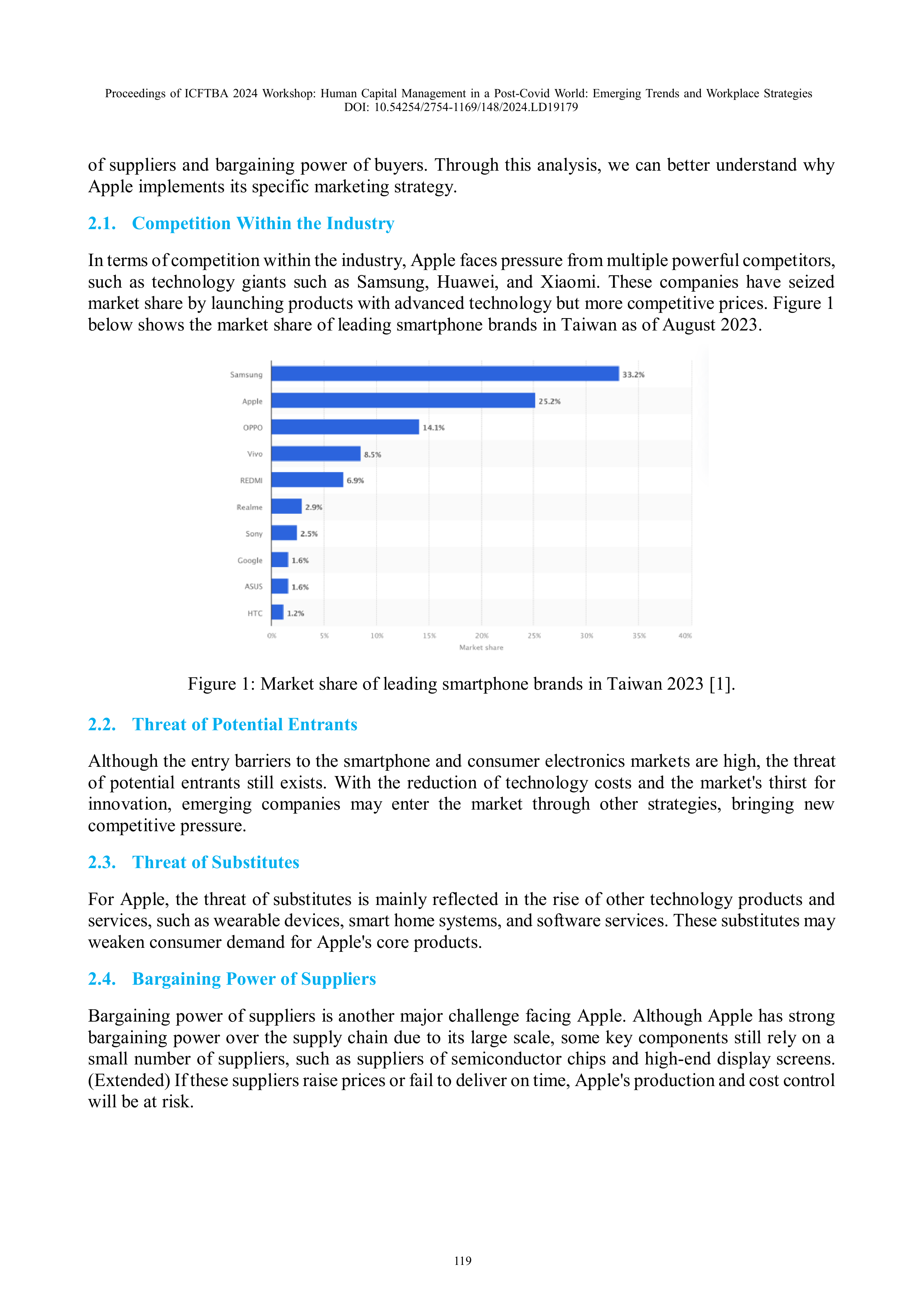
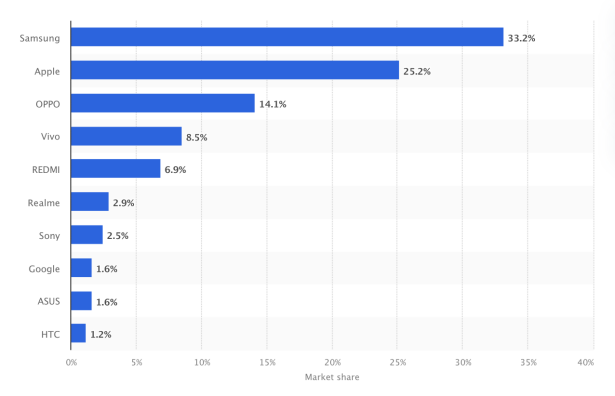
market share by launching products with advanced technology but more competitive prices. Figure 1
below shows the market share of leading smartphone brands in Taiwan as of August 2023.
Figure 1: Market share of leading smartphone brands in Taiwan 2023 [1].
2.2.
Threat of Potential Entrants
Although the entry barriers to the smartphone and consumer electronics markets are high, the threat
of potential entrants still exists. With the reduction of technology costs and the market's thirst for
innovation, emerging companies may enter the market through other strategies, bringing new
competitive pressure.
2.3.
Threat of Substitutes
For Apple, the threat of substitutes is mainly reflected in the rise of other technology products and
services, such as wearable devices, smart home systems, and software services. These substitutes may
weaken consumer demand for Apple's core products.
2.4.
Bargaining Power of Suppliers
Bargaining power of suppliers is another major challenge facing Apple. Although Apple has strong
bargaining power over the supply chain due to its large scale, some key components still rely on a
small number of suppliers, such as suppliers of semiconductor chips and high-end display screens.
(Extended) If these suppliers raise prices or fail to deliver on time, Apple's production and cost control
will be at risk.
Proceedings of ICFTBA 2024 Workshop: Human Capital Management in a Post-Covid World: Emerging Trends and Workplace Strategies
DOI: 10.54254/2754-1169/148/2024.LD19179
119
2.5.
Buyer Bargaining Power
As market competition intensifies, buyer bargaining power is also rising. Consumers pay more and
more attention to cost-effectiveness when purchasing smartphones, tablets and other technology
products, and have more choices between multiple brands.
Through the analysis of Porter's Five Forces Model, it can be seen that when facing multiple market
pressures, Apple must maintain its competitive advantage through innovative product strategies,
flexible pricing strategies, perfect channel management and efficient promotion methods. It is based
on these pressures that Apple has formulated and implemented its sophisticated 4P marketing strategy
to meet market challenges and consolidate its leadership in the global technology market.
3.
Apple's Marketing Strategy Based on the 4Ps Model
3.1.
Product Strategy: Innovation Driven and Ecosystem Construction
Since its establishment, Apple has always regarded product innovation as its core competitiveness.
Not only is it unique in hardware innovation, but Apple also provides a unique user experience
through product design optimization and ecosystem integration. Its product strategy is reflected in a
diversified product portfolio and high-end market positioning, as well as a closed software and
hardware ecosystem.
3.1.1.
Product Innovation and Diversification
Apple takes technological innovation as its core and creates unique value for users through leading
technology. The release of the M1 chip marks a breakthrough in Apple's hardware design. For
example, the M1 chip integrates CPU, GPU and neural network engine, greatly improving the
performance and energy efficiency of the Mac series and redefining the standard of high-end
computers. Apple's product diversification strategy is also worthy of attention. Taking the iPhone as
an example, Apple covers the mid-to-high-end market through a variety of products such as basic
models and Pro models. The iPhone SE shows Apple's successful attempt in the price-sensitive
market. The model has attracted a large number of consumers with its core technology and lower
prices. Gupta and Singhe states that Apple iPhone's unique advantages in innovation and ecosystem
make it still highly competitive in the fierce market competition [2].
3.1.2.
High-End Positioning
Apple's high-end positioning runs through its product design and marketing strategy. According to
table 1, comparing prices with other well-known brands like Samsung and Huawei shows that Apple
is targeting the upper/middle class, not the middle class.
Table 1: Compare Apple iPhone X VS Huawei P20 Pro VS Samsung Galaxy S9 [3].
Brand/Phone
Apple iphone X
Huawei P20 Pro
Samsung Galaxy S9
Storage
64 GB
128 GB
64 GB
Ram
3 GB
6 GB
4 GB
Display size
5.8 In (14.73cm)
6.1 In (15.49cm)
5.8 In (14.73cm)
PCAD
Approx. $1560
Approx. $1140
Approx. $1015
Through premium pricing, Apple has successfully positioned itself as a symbol of high-end
consumer goods. Although the high price of iPhone X exceeds the market average, its global sales
have proved the effectiveness of this strategy. While launching high-end products, Apple also
Proceedings of ICFTBA 2024 Workshop: Human Capital Management in a Post-Covid World: Emerging Trends and Workplace Strategies
DOI: 10.54254/2754-1169/148/2024.LD19179
120
provides products at different prices through a price stratification strategy to meet the needs of
different consumers. The success of the iPhone SE once again verifies the effectiveness of this
strategy, attracting consumers with limited budgets with its powerful functions and reasonable prices.
3.1.3.
Ecosystem and User Stickiness
Apple's ecosystem strategy is the core of its product strategy. By building a closed and highly
integrated ecosystem, Apple not only improves user experience, but also enhances user brand loyalty.
Survey data shows that Apple user loyalty is as high as over 90%, significantly higher than its
competitors. This achievement is attributed to Apple's long-term investment in the combination of
software and hardware and user experience optimization.
3.2.
Pricing Strategy
3.2.1.
Market Impact of Premium Pricing Strategy
Apple's premium pricing strategy aims to highlight its brand's high-end positioning through high-
priced products and maximize the profit per unit of product. Take the iPhone X as an example. Its
$999 price was widely regarded as a challenge to the market price ceiling when it was released.
However, it turned out that the market's acceptance of this pricing strategy was much higher than
expected. In the first quarter after its release, the iPhone X contributed 35% of Apple's global
smartphone market profits. This data shows the success and market influence of the premium pricing
strategy.
3.2.2.
Price Tiering Strategy (Price Differentiation/Segemented)
In addition to premium pricing, Apple also responds to different market demands through price tiering
strategies. The success of the iPhone SE is a typical case of price tiering strategy. While maintaining
its high-end product line, Apple has entered the mid-range market by launching more affordable
products, satisfying people with different demand elasticity and thus expanding its market coverage.
This strategy not only helps Apple attract more users in the global market (as shown in the figure,
Apple has the largest loyal fixed user group), but also alleviates the market's dependence on high-end
product sales to a certain extent, reducing market risks.
Price discrimination can be seen in Apple’s pricing strategy. According to Cheng, D., Lack of
competition encourages price discrimination, so, according to the survey, iPhones are usually more
expensive in countries with less wealth inequality [4].
In addition, Apple also adopts differentiated pricing strategies in different product lines. For
example, when Apple launches a new product, it usually retains the previous generation of products
and lowers their prices, thus forming a product price system of "new and old alternation". This
strategy not only extends the market life of old products, but also further meets the needs of different
consumers through a multi-level price layout.
3.2.3.
Psychological Pricing Strategy
Apple's pricing strategy also includes a deep understanding of consumer psychology. For example,
when Apple sets prices, it often uses psychological price points such as US$99 or US$999, using
people's psychological characteristics of price sensitivity to induce consumers to think that these
prices are much lower than integer prices, making them easier to accept. In addition, Apple also uses
the "bait pricing" strategy to launch multiple models with different configurations and prices at the
same time when the product is released, using the highest configuration and high-priced products as
Proceedings of ICFTBA 2024 Workshop: Human Capital Management in a Post-Covid World: Emerging Trends and Workplace Strategies
DOI: 10.54254/2754-1169/148/2024.LD19179
121
"bait" to highlight the cost-effectiveness of the middle configuration products, thereby promoting the
sales of the middle models.
In addition, Apple also uses skimming pricing, product differentiation, trade-in and other strategies.
The success of these pricing strategies is not only reflected in sales, but also in consumers' brand
loyalty and willingness to buy. According to market research data, Apple's pricing strategy has greatly
improved consumers' purchase decision-making speed and reduced the purchase resistance caused by
price sensitivity to a certain extent.
3.3.
Channel Strategy
Apple's channel strategy not only involves the sales channels of products, but also covers supply chain
management, inventory control and the construction of brand experience. Through refined channel
management, Apple ensures that every link of the product from production to the hands of consumers
is efficient and stable.
3.3.1.
Supply Chain Management and Global Layout
Apple's supply chain management strategy is one of the cores of its channel strategy. Through the
global supply chain layout, Apple ensures that its products can be supplied to the global market at the
fastest speed and with high quality. Apple's supply chain partners are spread all over the world.
Through strict quality control and meticulous production management, Apple can effectively reduce
production costs while ensuring the high quality of its products.
Apple's success in supply chain management is not only reflected in the scale of its supply chain,
but also in its flexible management of the supply chain. For example, when different market demands
fluctuate, Apple can quickly adjust its production plan to ensure the timely supply of products and
the balance of market demand. This flexibility management is particularly important during the global
epidemic. Apple has ensured that the supply chain of its products is not interrupted and maintained a
stable supply in the market by quickly adjusting its supply chain structure.
3.3.2.
Brand Experience and Retail Network
Apple has established a unique retail network around the world, which is not only a channel for its
product sales, but also an important part of the brand experience. The design and layout of the Apple
Store not only provides the ultimate customer experience, but also enhances consumers' recognition
and loyalty to the Apple brand through the display of brand culture.
The success of the Apple Store is largely due to its high attention to customer service and brand
experience. Ashby, David, Khasawneh and Rami states that Apple, Sony, and Dell have the best
customer service [5]. According to J.D. Power's customer satisfaction survey, Apple's retail stores
have been among the best for many years. Apple has successfully made each Apple Store an important
window for brand promotion by providing excellent customer service and unique brand experience.
The design style of Apple's retail stores not only emphasizes product display, but also focuses on
creating an atmosphere that integrates technology and art, so that consumers can feel the core values
of the Apple brand when entering the Apple Store.
Apple also actively uses online channels to expand its market coverage. Apple's online store
provides a seamless shopping experience, and users can easily purchase products and services through
the website or App Store. Online channels not only expand Apple's market coverage, but also provide
users with more convenience and choices. In addition, Apple also uses digital marketing methods to
accurately convey product information to potential customers, further improving the conversion rate
of online sales.
Proceedings of ICFTBA 2024 Workshop: Human Capital Management in a Post-Covid World: Emerging Trends and Workplace Strategies
DOI: 10.54254/2754-1169/148/2024.LD19179
122
Apple's channel strategy is not only reflected in the reach of end consumers, but also through strict
supply chain management to ensure efficient production of products and timely delivery worldwide.
Apple's global distribution network covers almost all major markets, and its supply chain
management system enables Apple to respond quickly to market demand worldwide through
sophisticated inventory control and efficient logistics arrangements. This efficient supply chain
management not only improves Apple's market competitiveness, but also reduces the risks caused by
inventory backlogs or supply shortages.
3.4.
Promotion Strategy
3.4.1.
Integration of Advertising and Promotion Strategies
Apple's promotion strategy occupies an important position in the entire marketing strategy. Apple's
investment in advertising and brand promotion is not only reflected in advertising in traditional media,
but also in achieving wider brand communication through digital platforms and social media. Apple's
advertising style is usually concise and impactful and conveys the brand's sense of technology and
foresight through high-quality visual and music design. For example, Apple's advertisements during
major sporting events such as the Super Bowl often attract widespread attention. These
advertisements show the innovation of Apple products and strengthen the brand's high-end image in
the minds of consumers through unique narrative methods. Apple has also further enhanced the
brand's market influence through social media and digital marketing methods. For another example,
Apple's "Shot on iPhone" marketing campaign successfully stimulated users' creative enthusiasm by
displaying photos and videos taken by users through social media platforms and achieved widespread
brand communication through user-generated content (UGC). This marketing campaign not only
demonstrated the powerful shooting function of the iPhone, but also enhanced the brand's interactivity
and user loyalty through user participation.
3.4.2.
Maintenance of Public Relations and Word-of-Mouth
Apple attaches great importance to maintaining and enhancing its brand image through public
relations strategies and word-of-mouth effects. Apple's product launch is not only a display of new
products, but also a global brand promotion event. These launches attract the attention of global media
and consumers through carefully planned demonstrations and communication strategies.
In addition to product launches, Apple also actively maintains developer communities and user
groups. Apple holds the Worldwide Developers Conference (WWDC) every year to showcase the
latest software and technologies and has established close ties with global developers. This interaction
not only promotes the innovative development of the Apple ecosystem, but also enhances developers'
dependence on the Apple platform, thereby consolidating Apple's leadership in the global technology
ecosystem. In addition, Apple has cultivated a large number of loyal users and developer groups by
supporting education and training programs. Apple's developer community provides rich resources
and support for developers around the world, making more developers willing to develop applications
for the Apple platform.
4.
Competitor Analysis and Strategy Comparison
Apple's marketing strategy is significantly different from that of its main competitors, such as
Samsung and Google. Lopez points out that although Samsung and Google have technological
advantages in some areas, Apple still maintains a clear lead in overall market performance and user
loyalty [6].
Proceedings of ICFTBA 2024 Workshop: Human Capital Management in a Post-Covid World: Emerging Trends and Workplace Strategies
DOI: 10.54254/2754-1169/148/2024.LD19179
123
4.1.
Comparison with Samsung
Samsung's competitive advantage is mainly reflected in its extensive product line and technological
innovation. Samsung has attracted consumers with different demand elasticity by covering the
smartphone market from low-end to high-end. At the same time, Samsung's innovations in display
technology and camera technology have increased its competitiveness. However, Samsung still lacks
in brand loyalty and consistency of user experience compared to Apple. Apple has successfully built
a highly loyal user group through its closed ecosystem and high-quality user experience, which has
enabled it to maintain a strong market influence in the global smartphone market.
4.2.
Comparison with Google
Google has strong competitiveness in artificial intelligence and cloud computing technology, and its
Android operating system occupies most of the global smartphone market. However, Google is
relatively limited in the expansion of its hardware product line. Although its Pixel series of mobile
phones are technologically advanced, their market share is low. In contrast, Apple has created a closed
and efficient ecosystem by integrating hardware, software and services. This all-round integration
advantage has enabled Apple to maintain significant competitiveness in user experience and brand
loyalty.
5.
Future Development Suggestions and Strategic Adjustments
With the changes in the market environment and the rapid development of the technology industry,
Apple needs to continue to adjust its strategy to meet future challenges. The following are some
suggestions for Apple's future development:
1) Consolidate the mid-range market: Although Apple dominates the high-end market, the mid-
range market still has great potential. Apple can further enhance market coverage and increase the
profit margin of mid-range products by expanding its mid-range product line; 2) Strengthen
information technology and digital transformation: Apple can further increase its investment in
artificial intelligence and big data analysis, deeply understand consumer needs, and provide more
personalized products and services. At the same time, explore the application of AR and VR
technologies in online shopping platforms to enhance user interactivity and online sales attractiveness;
3) Flexible pricing strategies to cope with economic fluctuations: The uncertainty of the global
economy requires companies to have stronger adaptability. Apple can maintain its market
competitiveness by launching products at different price points and regular promotions, especially in
times of economic fluctuations, to attract price-sensitive consumers; 4) Increase investment in
emerging markets: Emerging markets have huge growth potential. Apple can increase its investment
in these markets, launch products that meet local needs, and strengthen targeted marketing to enhance
brand influence.
6.
Conclusion
Apple's success stems from its careful layout in product design, pricing strategy, channel expansion
and promotional means. Through the flexible application of the 4P marketing model, Apple has not
only established a strong brand image in the global market, but also maintained its leading position
in the global technology industry through technological innovation and excellent user experience.
This article is narrow in scope and is limited to Apple. Therefore, the research on other competing
companies is shallow, and the arguments used may be outdated. Future research can further explore
how other companies that compete with Apple use the 4P model to formulate marketing strategies,
and through horizontal comparison of strategies, link market share and development prospects, and
Proceedings of ICFTBA 2024 Workshop: Human Capital Management in a Post-Covid World: Emerging Trends and Workplace Strategies
DOI: 10.54254/2754-1169/148/2024.LD19179
124
study the dynamic effects. The research limited to one company introduced in this article hopes to
inspire further research on this topic.
References
[1]
Slotta, D. (2023) Market share of leading smartphone brands in Taiwan 2023. https://www.statista.com/statistics/
883219/taiwan-leading-smartphone-brands-market-share/
[2]
Gupta, H., & Singhe, A. (2023). Prediction and Analysis of Smartphone Among Customers. In Proceedings of the
New Frontiers in Science and Technology Conference. IEEE. https://doi.org/10.1109/NFST.2023.10525754.
[3]
Gadgets Now (2021) Compare Apple iPhone X VS Huawei P20 Pro VS Samsung Galaxy S9. https://www.
gadgetsnow.com/compare-mobile-phones/Apple-iPhone-X-vs-Huawei-P20-Pro-vs-Samsung-Galaxy-S9
[4]
Cheng, D. (2022) Identification of Direct Socio-Geographical Price Discrimination: An Empirical Study on iPhones.
https://arxiv.org/abs/2201.07903
[5]
David, Khasawneh and Rami (2008) An Analysis of Home Computer Customer Service Hotlines. Marietta Vol. 4,
Iss. 2, (2008): 48-58, 78
[6]
Hernandez Lopez, Y. (2024). Effect of brand value on customer loyalty: The Apple case. Retrieved from Universidad
Rey Juan Carlos Digital Repository: https://burjcdigital.urjc.es/bitstream/handle/10115/32888/2023-24-FCEE-J-
2110-2110038-y.hernandez.2020-MEMORIA.pdf?sequence=-1&isAllowed=y
Proceedings of ICFTBA 2024 Workshop: Human Capital Management in a Post-Covid World: Emerging Trends and Workplace Strategies
DOI: 10.54254/2754-1169/148/2024.LD19179
125