
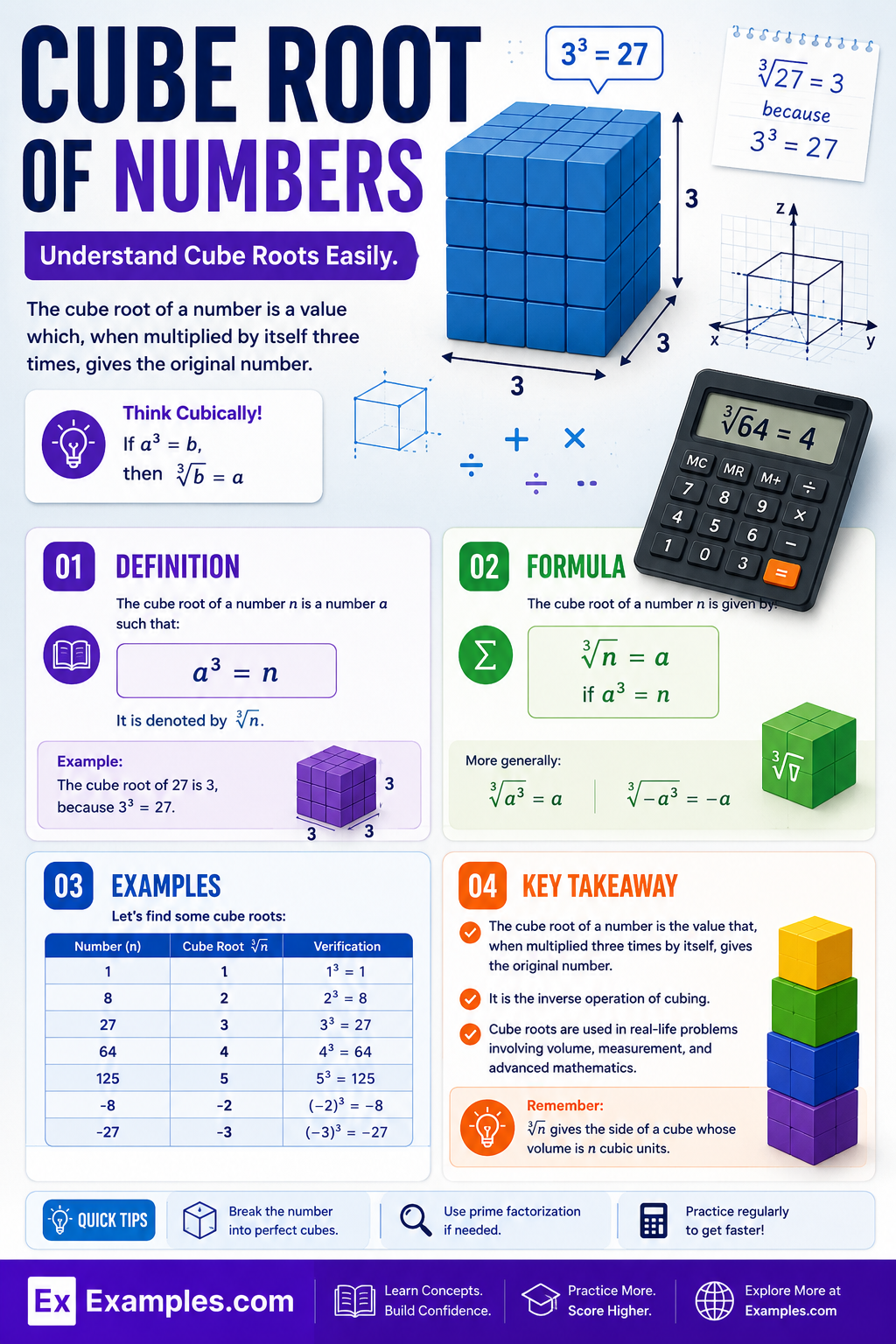
A cube root is a number that, when multiplied by itself three times, equals the original number. Cube roots are the inverse operation of cubing a number. They are widely used in mathematics, algebra, and engineering.
What is Cube Root?
Cube Root Symbol
The cube root symbol is denoted as ³√. This notation is used to represent the cube root of a number, which is placed inside the bracket. For example, ³√27 signifies the cube root of 27.
Cube Root Formula
The cube root formula is a way to find out which number was multiplied by itself three times to get a certain number, and it’s written with a special symbol, ³√. To find the cube root, you can start by breaking down the number into its prime factors. Then, use the cube root formula. If we have a number x, and x=y×y×y, then the cube root of x is simply ³√x=y. This means y is the cube root of x. If y turns out to be a whole number, then x is called a perfect cube.
Cube Root List 1 to 50
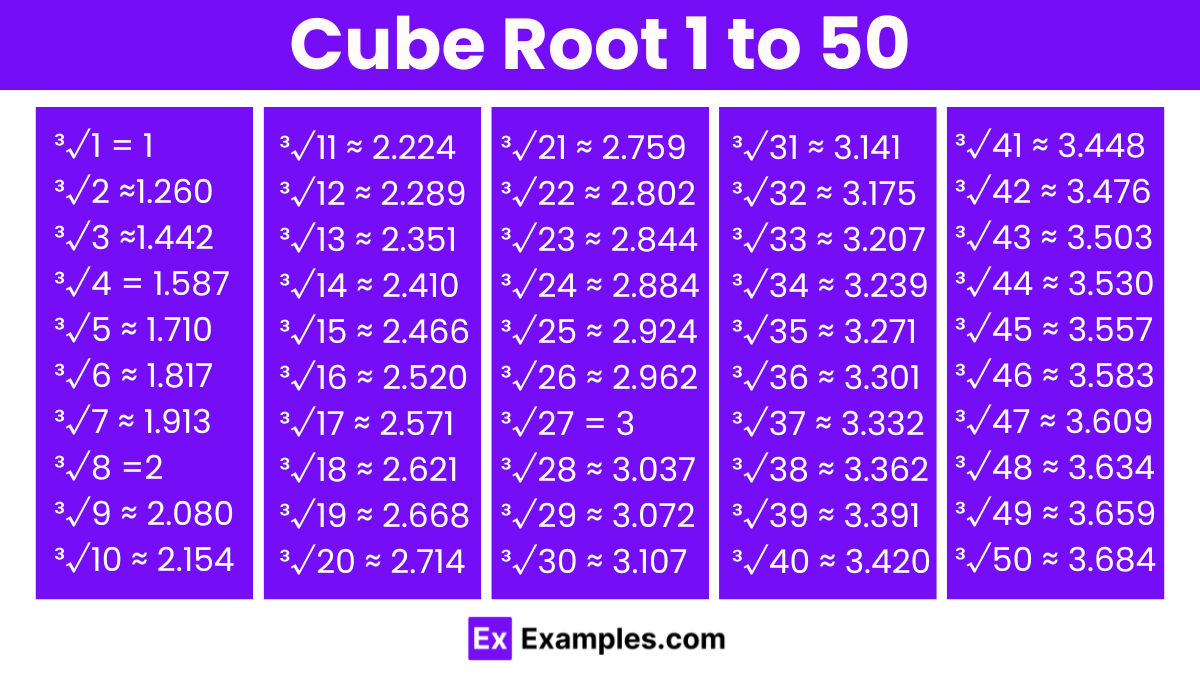
| Number | Cube Root | Number | Cube Root | Number | Cube Root |
|---|---|---|---|---|---|
| ³√1 | 1.000 | ³√18 | 2.621 | ³√35 | 3.271 |
| ³√2 | 1.260 | ³√19 | 2.668 | ³√36 | 3.302 |
| ³√3 | 1.442 | ³√20 | 2.714 | ³√37 | 3.332 |
| ³√4 | 1.587 | ³√21 | 2.759 | ³√38 | 3.362 |
| ³√5 | 1.710 | ³√22 | 2.802 | ³√39 | 3.391 |
| ³√6 | 1.817 | ³√23 | 2.844 | ³√40 | 3.420 |
| ³√7 | 1.913 | ³√24 | 2.884 | ³√41 | 3.448 |
| ³√8 | 2.000 | ³√25 | 2.924 | ³√42 | 3.476 |
| ³√9 | 2.080 | ³√26 | 2.962 | ³√43 | 3.503 |
| ³√10 | 2.154 | ³√27 | 3.000 | ³√44 | 3.530 |
| ³√11 | 2.224 | ³√28 | 3.037 | ³√45 | 3.557 |
| ³√12 | 2.289 | ³√29 | 3.072 | ³√46 | 3.583 |
| ³√13 | 2.351 | ³√30 | 3.107 | ³√47 | 3.609 |
| ³√14 | 2.410 | ³√31 | 3.141 | ³√48 | 3.634 |
| ³√15 | 2.466 | ³√32 | 3.175 | ³√49 | 3.659 |
| ³√16 | 2.520 | ³√33 | 3.207 | ³√50 | 3.684 |
| ³√17 | 2.571 | ³√34 | 3.239 |
How to Find Cube Root of a Number?
Method 1: Prime Factorization
- Break Down into Prime Factors: Start by breaking the number down into its prime factors. Prime factorization involves dividing the number into its basic building blocks—prime numbers that, when multiplied together, give the original number.
- Group the Factors: Group these prime factors into sets of three identical numbers. Each set represents the cubed factor.
- Multiply One from Each Group: Take one number from each group and multiply them together. This product is the cube root of the original number.
Method 2: Using the Cube Root Symbol
- Apply the Cube Root Symbol: For simpler calculations or with the help of a calculator, you can directly apply the cube root symbol (³√x) to the number. This directly gives you the cube root without the need for factorization.
Example
To find the cube root of 27:
- Prime Factorize 27: 27=3×3×3
- Group the Factors: There is one group of three 3s.
- Take the Cube Root: The cube root of 27 is 3, because 3×3×3=27.
Method 3: Estimation
- Estimate: For numbers that are not perfect cubes or when you’re without a calculator, estimate by finding the two closest perfect cube numbers it falls between. The cube root of your number will be between the cube roots of these two perfect cubes.
Tips
- Perfect cubes are numbers like 8, 27, 64, etc., where the cube roots are whole numbers (2, 3, 4, respectively).
- For non-perfect cubes, the result may be a decimal or irrational number, which often requires a calculator for precise calculation.
FAQs
What is the cube root of 64?
The cube root of 64 is 4. This is because multiplying 4 by itself three times (4x4x4) equals 64.
What is a cube root of 27?
The cube root of 27 is 3. This is determined by the fact that 3 multiplied by itself three times (3x3x3) equals 27.