
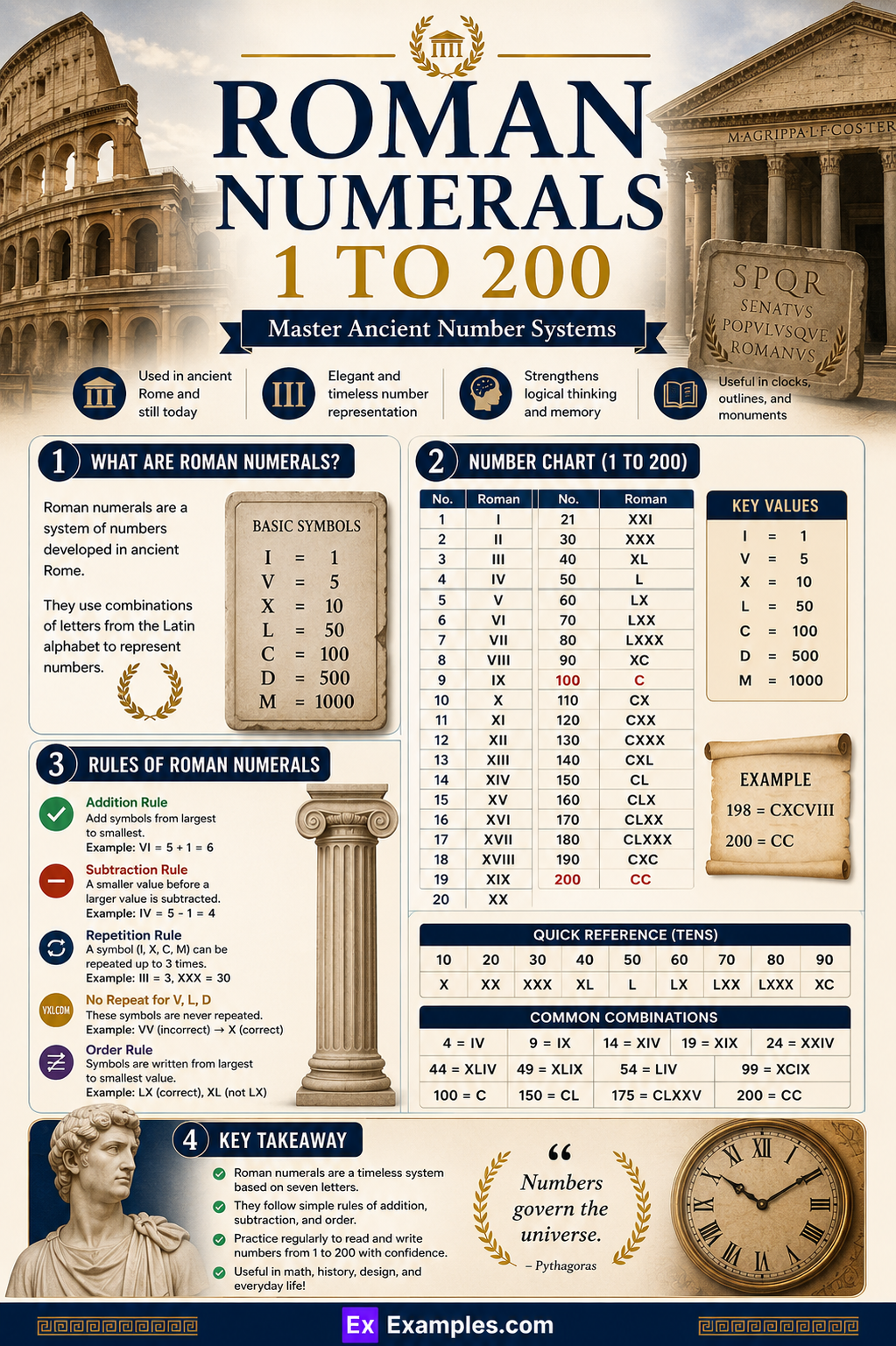
Roman numerals use letters from the Roman alphabet to represent numbers. Learning them improves number recognition and historical understanding.
Roman numerals can be easier to understand when you compare them with modern decimal notation. If you want to practice converting between the two systems, a decimal to Roman converter can help you check the corresponding Roman numeral.
Download Roman Numerals 1 to 200 in PDF
Roman Numerals 1 to 200

Download Roman Numerals 1 to 200 in PDF
| 1-I | 2-II | 3-III |
| 4-IV | 5-V | 6-VI |
| 7-VII | 8-VIII | 9-IX |
| 10-X | 11-XI | 12-XII |
| 13-XIII | 14-XIV | 15-XV |
| 16-XVI | 17-XVII | 18-XVIII |
| 19-XIX | 20-XX | 21-XXI |
| 22-XXII | 23-XXIII | 24-XXIV |
| 25-XXV | 26-XXVI | 27-XXVII |
| 28-XXVIII | 29-XXIX | 30-XXX |
| 31-XXXI | 32-XXXII | 33-XXXIII |
| 34-XXXIV | 35-XXXV | 36-XXXVI |
| 37-XXXVII | 38-XXXVIII | 39-XXXIX |
| 40-XL | 41-XLI | 42-XLII |
| 43-XLIII | 44-XLIV | 45-XLV |
| 46-XLVI | 47-XLVII | 48-XLVIII |
| 49-XLIX | 50-L | 51-LI |
| 52-LII | 53-LIII | 54-LIV |
| 55-LV | 56-LVI | 57-LVII |
| 58-LVIII | 59-LIX | 60-LX |
| 61-LXI | 62-LXII | 63-LXIII |
| 64-LXIV | 65-LXV | 66-LXVI |
| 67-LXVII | 68-LXVIII | 69-LXIX |
| 70-LXX | 71-LXXI | 72-LXXII |
| 73-LXXIII | 74-LXXIV | 75-LXXV |
| 76-LXXVI | 77-LXXVII | 78-LXXVIII |
| 79-LXXIX | 80-LXXX | 81-LXXXI |
| 82-LXXXII | 83-LXXXIII | 84-LXXXIV |
| 85-LXXXV | 86-LXXXVI | 87-LXXXVII |
| 88-LXXXVIII | 89-LXXXIX | 90-XC |
| 91-XCI | 92-XCII | 93-XCIII |
| 94-XCIV | 95-XCV | 96-XCVI |
| 97-XCVII | 98-XCVIII | 99-XCIX |
| 100-C | 101-CI | 102-CII |
| 103-CIII | 104-CIV | 105-CV |
| 106-CVI | 107-CVII | 108-CVIII |
| 109-CIX | 110-CX | 111-CXI |
| 112-CXII | 113-CXIII | 114-CXIV |
| 115-CXV | 116-CXVI | 117-CXVII |
| 118-CXVIII | 119-CXIX | 120-CXX |
| 121-CXXI | 122-CXXII | 123-CXXIII |
| 124-CXXIV | 125-CXXV | 126-CXXVI |
| 127-CXXVII | 128-CXXVIII | 129-CXXIX |
| 130-CXXX | 131-CXXXI | 132-CXXXII |
| 133-CXXXIII | 134-CXXXIV | 135-CXXXV |
| 136-CXXXVI | 137-CXXXVII | 138-CXXXVIII |
| 139-CXXXIX | 140-CXL | 141-CXLI |
| 142-CXLII | 143-CXLIII | 144-CXLIV |
| 145-CXLV | 146-CXLVI | 147-CXLVII |
| 148-CXLVIII | 149-CXLIX | 150-CL |
| 151-CLI | 152-CLII | 153-CLIII |
| 154-CLIV | 155-CLV | 156-CLVI |
| 157-CLVII | 158-CLVIII | 159-CLIX |
| 160-CLX | 161-CLXI | 162-CLXII |
| 163-CLXIII | 164-CLXIV | 165-CLXV |
| 166-CLXVI | 167-CLXVII | 168-CLXVIII |
| 169-CLXIX | 170-CLXX | 171-CLXXI |
| 172-CLXXII | 173-CLXXIII | 174-CLXXIV |
| 175-CLXXV | 176-CLXXVI | 177-CLXXVII |
| 178-CLXXVIII | 179-CLXXIX | 180-CLXXX |
| 181-CLXXXI | 182-CLXXXII | 183-CLXXXIII |
| 184-CLXXXIV | 185-CLXXXV | 186-CLXXXVI |
| 187-CLXXXVII | 188-CLXXXVIII | 189-CLXXXIX |
| 190-CXC | 191-CXCI | 192-CXCII |
| 193-CXCIII | 194-CXCIV | 195-CXCV |
| 196-CXCVI | 197-CXCVII | 198-CXCVIII |
| 199-CXCIX | 200-CC |
Rules to Write Roman Numerals 1 to 200
- Basic Symbols:
- I = 1
- V = 5
- X = 10
- L = 50
- C = 100
- D = 500
- M = 1000
- Repeating Symbols:
- A symbol can be repeated up to three times to add values. For example:
- III = 3 (I + I + I)
- XXX = 30 (X + X + X)
- CCC = 300 (C + C + C)
- A symbol can be repeated up to three times to add values. For example:
- Subtractive Notation:
- Place a smaller numeral before a larger numeral to subtract its value. For example:
- IV = 4 (5 – 1)
- IX = 9 (10 – 1)
- XL = 40 (50 – 10)
- XC = 90 (100 – 10)
- Place a smaller numeral before a larger numeral to subtract its value. For example:
- Additive Notation:
- Place a smaller numeral after a larger numeral to add its value. For example:
- VI = 6 (5 + 1)
- XI = 11 (10 + 1)
- LX = 60 (50 + 10)
- CL = 150 (100 + 50)
- Place a smaller numeral after a larger numeral to add its value. For example:
Breaking a number into smaller parts can make Roman numeral conversion easier to understand. Learning about factors can also help students become more familiar with how numbers can be separated and analyzed mathematically.
Understanding the basic values of Roman numeral symbols also involves working with simple mathematical operations. A math calculator can help verify calculations when breaking numbers into values such as 100 + 50 + 6 before converting them into Roman numerals.
Solved Problems
- Convert 27 to Roman Numerals:
- 20 + 7 = XX + VII = XXVII
- Convert 48 to Roman Numerals:
- 40 + 8 = XL + VIII = XLVIII
- Convert 93 to Roman Numerals:
- 90 + 3 = XC + III = XCIII
- Convert 156 to Roman Numerals:
- 100 + 50 + 6 = C + L + VI = CLVI
- Convert 198 to Roman Numerals:
- 100 + 90 + 8 = C + XC + VIII = CXCVIII
- Convert 74 to Roman Numerals:
- 70 + 4 = LXX + IV = LXXIV
Writing Roman numerals from 1 to 200 involves using combinations like I, V, X, L, C, and their additive and subtractive forms, with each numeral signifying a specific value. From I (1) to C (100), and beyond to 200, the system maintains a consistent structure where values either add or subtract based on placement and repetition, ensuring clarity and readability in numeration across various contexts and historical periods. Roman numerals are one way of representing numerical values, while modern computing uses other number systems. Students interested in comparing different ways of representing numbers can also explore a decimal to binary converter.