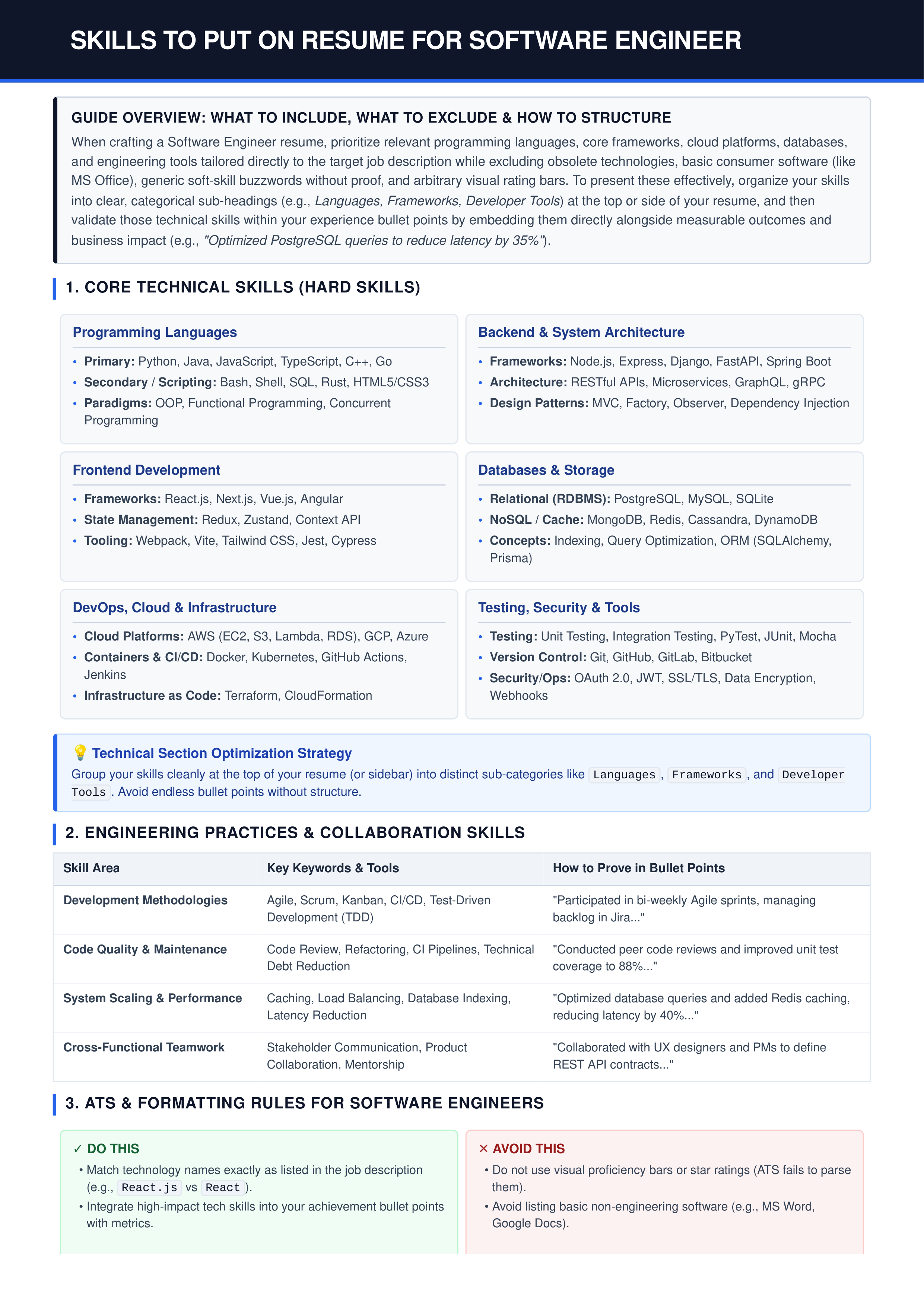
SKILLS TO PUT ON RESUME FOR SOFTWARE ENGINEER
GUIDE OVERVIEW: WHAT TO INCLUDE, WHAT TO EXCLUDE & HOW TO STRUCTURE
When crafting a Software Engineer resume, prioritize relevant programming languages, core frameworks, cloud platforms, databases,
and engineering tools tailored directly to the target job description while excluding obsolete technologies, basic consumer software (like
MS Office), generic soft-skill buzzwords without proof, and arbitrary visual rating bars. To present these effectively, organize your skills
into clear, categorical sub-headings (e.g.,
Languages, Frameworks, Developer Tools
) at the top or side of your resume, and then
validate those technical skills within your experience bullet points by embedding them directly alongside measurable outcomes and
business impact (e.g.,
"Optimized PostgreSQL queries to reduce latency by 35%"
).
1. CORE TECHNICAL SKILLS (HARD SKILLS)
Programming Languages
Backend & System Architecture
Frontend Development
Databases & Storage
DevOps, Cloud & Infrastructure
Testing, Security & Tools
💡
Technical Section Optimization Strategy
Group your skills cleanly at the top of your resume (or sidebar) into distinct sub-categories like
Languages
,
Frameworks
, and
Developer
Tools
. Avoid endless bullet points without structure.
2. ENGINEERING PRACTICES & COLLABORATION SKILLS
Skill Area
Key Keywords & Tools
How to Prove in Bullet Points
Development Methodologies
Agile, Scrum, Kanban, CI/CD, Test-Driven
Development (TDD)
"Participated in bi-weekly Agile sprints, managing
backlog in Jira..."
Code Quality & Maintenance
Code Review, Refactoring, CI Pipelines, Technical
Debt Reduction
"Conducted peer code reviews and improved unit test
coverage to 88%..."
System Scaling & Performance
Caching, Load Balancing, Database Indexing,
Latency Reduction
"Optimized database queries and added Redis caching,
reducing latency by 40%..."
Cross-Functional Teamwork
Stakeholder Communication, Product
Collaboration, Mentorship
"Collaborated with UX designers and PMs to define
REST API contracts..."
3. ATS & FORMATTING RULES FOR SOFTWARE ENGINEERS
✓
DO THIS
Match technology names exactly as listed in the job description
(e.g.,
React.js
vs
React
).
Integrate high-impact tech skills into your achievement bullet points
with metrics.
✕
AVOID THIS
Do not use visual proficiency bars or star ratings (ATS fails to parse
them).
Avoid listing basic non-engineering software (e.g., MS Word,
Google Docs).
Primary:
Python, Java, JavaScript, TypeScript, C++, Go
•
Secondary / Scripting:
Bash, Shell, SQL, Rust, HTML5/CSS3
•
Paradigms:
OOP, Functional Programming, Concurrent
Programming
•
Frameworks:
Node.js, Express, Django, FastAPI, Spring Boot
•
Architecture:
RESTful APIs, Microservices, GraphQL, gRPC
•
Design Patterns:
MVC, Factory, Observer, Dependency Injection
•
Frameworks:
React.js, Next.js, Vue.js, Angular
•
State Management:
Redux, Zustand, Context API
•
Tooling:
Webpack, Vite, Tailwind CSS, Jest, Cypress
•
Relational (RDBMS):
PostgreSQL, MySQL, SQLite
•
NoSQL / Cache:
MongoDB, Redis, Cassandra, DynamoDB
•
Concepts:
Indexing, Query Optimization, ORM (SQLAlchemy,
Prisma)
•
Cloud Platforms:
AWS (EC2, S3, Lambda, RDS), GCP, Azure
•
Containers & CI/CD:
Docker, Kubernetes, GitHub Actions,
Jenkins
•
Infrastructure as Code:
Terraform, CloudFormation
•
Testing:
Unit Testing, Integration Testing, PyTest, JUnit, Mocha
•
Version Control:
Git, GitHub, GitLab, Bitbucket
•
Security/Ops:
OAuth 2.0, JWT, SSL/TLS, Data Encryption,
Webhooks
•
•
•
•
•