A Losing Experience That Taught Me a Lesson Narrative
Essay
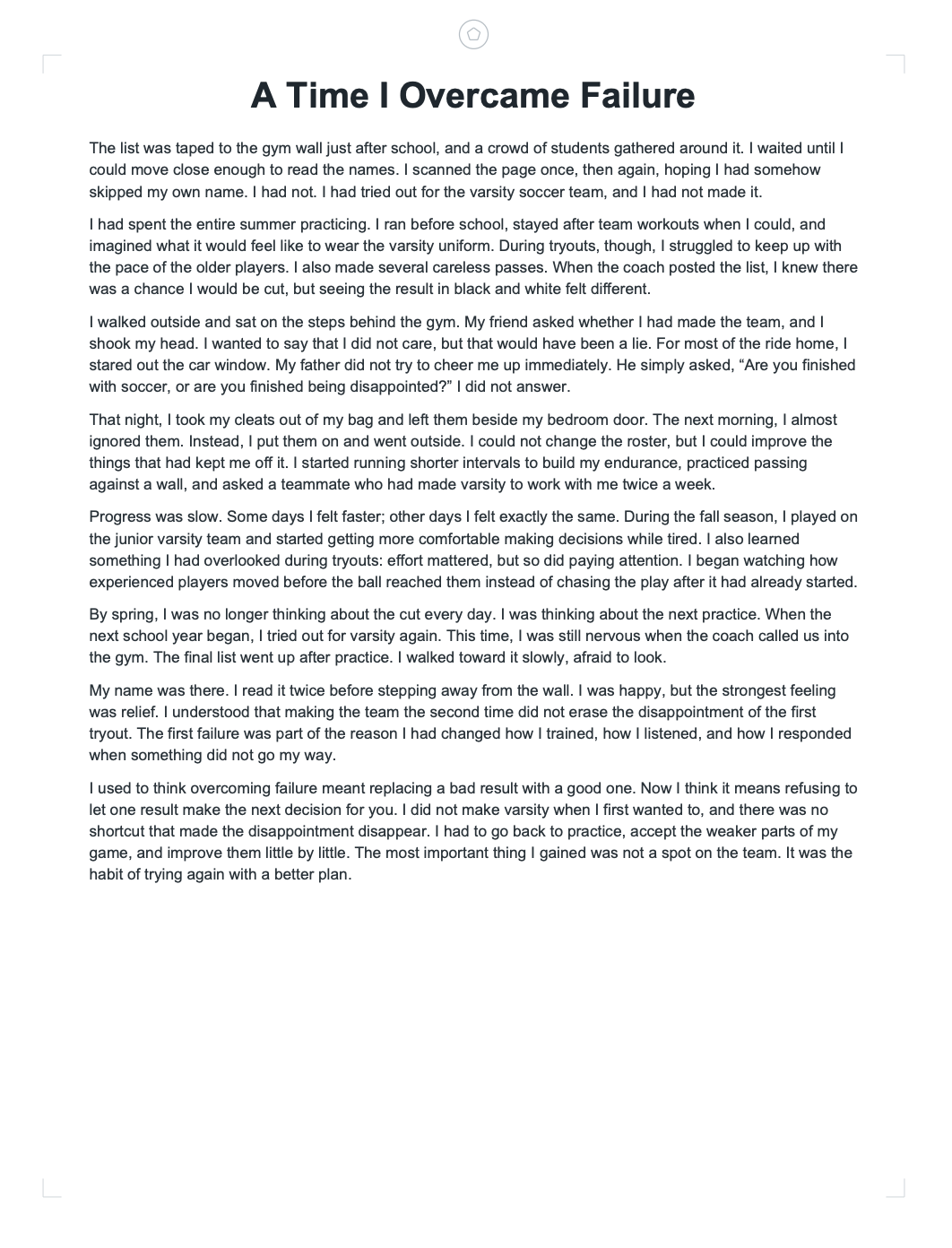
The final buzzer sounded before I had even looked at the scoreboard. For a second, everyone in our high school gym
seemed to freeze. Then the other team's bench erupted, while my teammates stood around the court with their hands on
their hips. I knew we had lost, but I was not ready to see by how much.
It was a Friday night in November, and our varsity soccer team was playing in the district semifinal in a town about an
hour from our school. I was a junior midfielder and had spent most of the season thinking about this game. We had
beaten the same team earlier in the year, and I had convinced myself that we were supposed to win again. Our coach
had warned us not to think about the previous score. I nodded when he said it, but I did not really listen.
The first half went almost exactly as I expected. We moved the ball well and scored once before halftime. I felt
confident every time I touched the ball. At the break, we were still ahead, and I remember joking with a teammate about
how long the ride home would feel if we advanced to the final.
The second half was different.
The other team scored early, and instead of staying patient, we started rushing. I became part of the problem. I tried
to make difficult passes through crowded spaces because I wanted to create another scoring chance. Twice, I lost
possession near midfield. On the second mistake, the other team counterattacked and scored again.
We were suddenly behind 2-1 with less than ten minutes left.
I kept looking at the clock, thinking we needed a perfect attack. That made me play even faster. With three minutes
remaining, I received the ball near the sideline and tried to dribble past two defenders. I lost it. They carried the ball into
our half, earned a corner, and scored from the rebound.
When the clock reached zero, the scoreboard showed 3-1.
I walked toward the sideline without speaking. I wanted to blame the referee for a foul that had not been called, the
wet field for making passes harder, or our unlucky bounce on the third goal. The excuses kept appearing in my head
because admitting that I had helped the other team take control was uncomfortable.
Our coach did not yell in the locker room. He waited until everyone had changed and then asked us to sit down. The
room was quiet except for the sound of water running in the showers down the hall.
“What happened?” he asked.
Several teammates mentioned small things: missed opportunities, bad passes, poor communication. When it was my
turn, I said, “We panicked.”
He nodded. “We did. But the question is why.”
I looked at the floor. I knew part of the answer. I had spent the entire game trying to force something because I was
afraid that one mistake would decide the result. Instead of trusting the team and playing the simple pass, I had started
trying to rescue the game by myself.
No one in the room blamed me for the entire loss. That almost made it harder. Our coach asked us to think about what
we could control in the next game, even though our season was over. We watched the recording the following Monday.
Seeing my decisions on the screen was uncomfortable, but it also made the lesson clearer. The moments I had felt most
confident were often the moments when I stopped paying attention to the game in front of me.
After that loss, I changed the way I practiced. I worked on making quicker simple passes instead of always looking for
the impressive one. During scrimmages, I started paying more attention to positioning and communication. When I made
a mistake, I tried to correct the next play instead of spending the next five minutes thinking about it.
The following spring, I played in another close game that ended in a loss. This time, I walked off the field disappointed,
but I did not feel the same need to find someone or something to blame. I knew there were things I could improve, and I
knew a loss did not erase everything our team had worked for.
The district semifinal was one of the hardest games I had played, but losing taught me something that winning
probably could not have. I learned that pressure can make you abandon the habits that got you there in the first place. I
also learned that taking responsibility is not the same as taking all the blame. It means being honest about your part,
learning from it, and using that knowledge the next time you step onto the field.