
A narrative essay is a structured piece of writing that tells a story about an experience, event, or series of events. It uses storytelling elements such as characters, setting, sequence, conflict, details, and reflection to communicate a meaningful experience or idea. Unlike an expository or argumentative essay, which primarily explains or argues a point, a narrative essay focuses on telling a story while helping the reader understand its significance.
What Is a Narrative Essay?
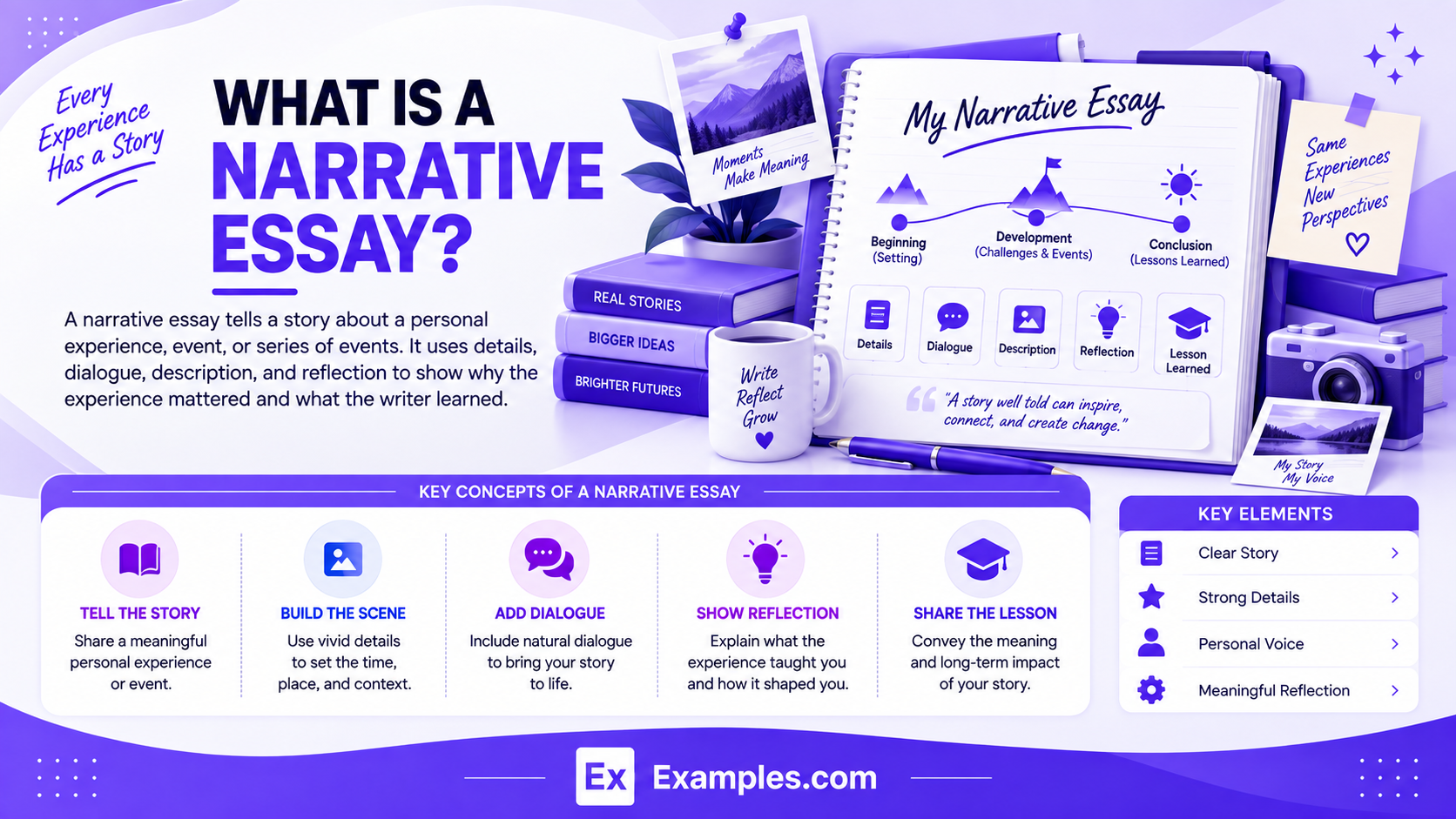
A narrative essay is a form of writing that tells a story about a personal experience, event, or sequence of events. It usually includes a clear beginning, development, and conclusion while using details, dialogue, description, and reflection to make the experience meaningful to the reader. A strong narrative essay does more than describe what happened; it communicates why the experience mattered and what the writer learned, realized, or understood from it.
What Are the Different Types of Narrative Essays?
Personal Narrative
A Personal Narrative essay tells a story about an experience from the writer’s own life and often focuses on a meaningful event, challenge, decision, relationship, or moment of change.
Autobiographical Narrative
An Autobiographical Narrative focuses on experiences from the writer’s life and uses selected events to communicate personal development, identity, perspective, or important life lessons.
Reflective Narrative
A Reflective Narrative combines storytelling with reflection by explaining not only what happened but also how the experience affected the writer’s thoughts, feelings, beliefs, or understanding.
College Application Narrative
A College Application Narrative uses a meaningful personal experience to demonstrate qualities, growth, motivation, values, or perspective relevant to an educational application.
Growth and Change Narrative
A Growth and Change Narrative focuses on an experience that influenced the writer’s development, changed their perspective, or helped them become more confident, responsible, or self-aware.
Overcoming Challenges Narrative
An Overcoming Challenges Narrative tells the story of a difficult situation and explains how the writer responded, adapted, learned, or changed through the experience.
Achievement Narrative
An Achievement Narrative describes a significant accomplishment while focusing on the process, obstacles, decisions, effort, and lessons behind the achievement rather than simply presenting the result.
Relationship Narrative
A Relationship Narrative explores an important interaction or relationship and shows how the experience affected the writer’s understanding of another person or themselves.
Cultural Narrative
A Cultural Narrative describes experiences connected to culture, community, traditions, language, identity, or belonging and explores how those experiences shaped the writer’s perspective.
Fictional Narrative
A Fictional Narrative tells an imagined story using characters, setting, conflict, events, and other storytelling elements to communicate an experience, idea, or theme.
How Do I Generate Narrative Essays Using Real Examples?
Explore Real Narrative Essay Examples
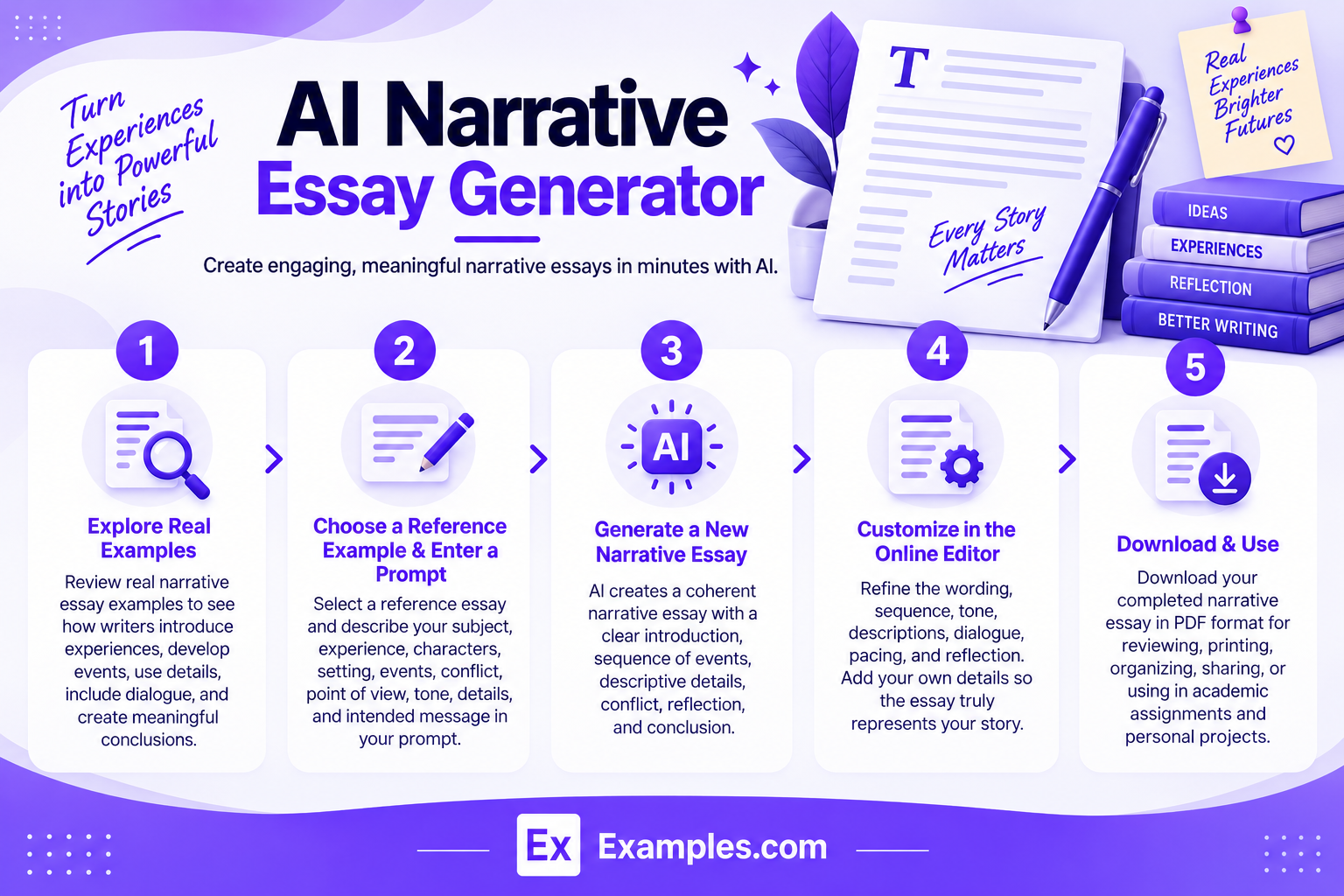
Review real narrative essay examples to understand how writers introduce experiences, organize events, develop scenes, use descriptive details, include dialogue, and reflect on the meaning of an experience. Examples can help you recognize how effective narratives move from an event or situation to a meaningful conclusion.
Choose A Reference Example And Enter An AI Prompt
Choose a reference narrative essay and describe what you need in your prompt, including the subject, experience, characters, setting, sequence of events, conflict, point of view, tone, descriptive details, and intended message. A specific prompt helps produce a focused narrative with a clear story structure.
Generate A New AI Narrative Essay
Generate a new narrative essay from your prompt. The AI can organize the experience into a coherent story with an introduction, sequence of events, descriptive details, conflict, reflection, and conclusion.
Customize The Narrative Essay In The Online Editor
Refine the wording, sequence, tone, descriptions, dialogue, pacing, and reflection of the generated narrative essay in the online editor. Add your own details and experiences so the final essay accurately represents the story you want to tell.
Download And Use Your Narrative Essay
Download your completed narrative essay in PDF format for reviewing, printing, organizing, sharing, or using as a reference while preparing an academic assignment or personal writing project.
What Makes a Good Narrative Essay?
A good narrative essay tells a clear and engaging story while communicating why the experience or events matter. It should have a focused topic, logical sequence, appropriate pacing, specific details, and a clear point of view. Strong narrative essays use description, dialogue, reflection, and other storytelling techniques to help readers understand the experience rather than simply listing what happened. The conclusion should provide a sense of meaning, reflection, or resolution.
AI Narrative Essay Editing Features
AI Narrative Essay Generation
Generate a complete narrative essay based on an experience, event, topic, story idea, characters, setting, and other details you provide.
Smart Narrative Editing
Rewrite, shorten, expand, or refine a narrative essay to improve its clarity, flow, descriptions, pacing, grammar, and organization.
Story Structure Development
Organize events into a clear narrative structure with an introduction, development, climax or turning point, and conclusion.
Narrative Detail Customization
Adjust descriptions, dialogue, point of view, tone, pacing, and storytelling details to create a narrative that matches the intended experience or audience.
Reflection and Meaning Refinement
Strengthen the reflection and conclusion so the essay communicates what the experience meant, what was learned, or how the writer’s perspective changed.
Instant PDF Download
Download your completed narrative essay in PDF format for reviewing, printing, organizing, sharing, or using as a reference.
What Are the Essential Elements of a Narrative Essay?
- Clear Topic: Focus on a specific experience, event, story, or sequence of events rather than trying to tell an overly broad story.
- Introduction: Establish the situation, characters, setting, or context and give the reader a reason to continue.
- Characters: Introduce the people involved and provide enough information to help readers understand their role in the story.
- Setting: Describe where and when the events take place when those details contribute to the story.
- Sequence of Events: Organize events in a logical or intentional order so the reader can follow what happened.
- Conflict or Challenge: Include a problem, decision, obstacle, uncertainty, or tension that gives the narrative direction.
- Descriptive Details: Use specific sensory and descriptive details to help readers understand and visualize the experience.
- Point of View: Maintain a consistent perspective, such as first person or third person, appropriate to the narrative.
- Reflection: Explain the meaning of the experience, what was learned, or how the writer’s perspective changed.
- Conclusion: Bring the story to a meaningful close by providing resolution, reflection, or a clear sense of significance.
How Do I Write a Narrative Essay?
- Choose the Experience or Story: Select a specific event, experience, or story that has enough significance or detail to develop into a narrative.
- Identify the Main Point: Decide why the story matters and what you want the reader to understand by the end.
- Choose the Point of View: Select a perspective that fits the story, such as first person for a personal experience.
- Identify the Setting: Establish where and when the events take place when those details help the reader understand the experience.
- Plan the Events: Organize the important events in a logical sequence and identify the turning point or most significant moment.
- Introduce the Story: Begin with an engaging situation, detail, moment, or observation that introduces the experience.
- Develop the Scenes: Use specific details, actions, descriptions, and dialogue to show what happened rather than simply summarizing everything.
- Build the Conflict or Turning Point: Explain the challenge, decision, discovery, or moment that gives the story its central direction.
- Add Reflection: Show what you learned, realized, felt, or understood as a result of the experience.
- Review and Refine: Make sure the narrative is focused, coherent, descriptive, engaging, grammatically correct, and connected to its central message.
Why Should I Use Real Narrative Essay Examples to Create My Own Narrative Essay?
- Real examples show how writers turn experiences and events into structured narratives.
- They help you understand how introductions establish situations and capture the reader’s attention.
- They provide useful examples of chronological organization, transitions, dialogue, and description.
- They show how writers balance storytelling with reflection and meaning.
- They help you understand how specific details can make a narrative more engaging and believable.
- They make it easier to develop your own original narrative without copying another writer’s experiences or language.
What Common Narrative Essay Mistakes Should I Avoid?
- Choosing Too Broad a Topic: Avoid trying to tell an entire life story when a focused experience would create a stronger narrative.
- Simply Summarizing Events: Do not only list what happened; use details, actions, dialogue, and reflection to bring the experience to life.
- Lacking a Clear Point: Make sure the reader can understand why the story matters and what you want to communicate.
- Using Too Many Unnecessary Details: Include details that develop the story, setting, characters, emotions, or meaning rather than information that does not contribute to the narrative.
- Ignoring the Sequence: Organize events clearly so readers can understand when and why things happened.
- Weak Introduction: Avoid beginning with unnecessary background information that delays the actual story.
- Overusing Dialogue: Dialogue should support characterization, conflict, or action rather than filling space without contributing to the narrative.
- Telling Instead of Showing: Replace vague statements with specific actions, descriptions, experiences, and observations when appropriate.
- Missing Reflection: A narrative essay can become a simple story summary when it does not explain the significance of the experience.
- Weak Conclusion: End by providing a meaningful reflection, resolution, or understanding rather than stopping immediately after the final event.
What Is the Difference Between a Narrative Essay and a Descriptive Essay?
| Narrative Essay | Descriptive Essay |
|---|---|
| Tells a story about an experience, event, or sequence of events. | Focuses on describing a person, place, object, experience, or scene. |
| Usually has a sequence of events and some form of story development. | Primarily develops the subject through detailed description. |
| Can include characters, setting, conflict, dialogue, and reflection. | Commonly emphasizes sensory details, imagery, and observations. |
| Focuses on what happened and why the experience matters. | Focuses on what something looks, sounds, feels, smells, or seems like. |
| Often has a beginning, development, turning point, and conclusion. | May be organized around different features, impressions, or aspects of the subject. |
| Uses storytelling to communicate an experience, message, or insight. | Uses description to create a vivid understanding of the subject. |
Narrative Essay Ideas for Different Topics
- A Life-Changing Experience: Tell the story of an event that changed your perspective, priorities, beliefs, or understanding of yourself.
- Overcoming a Challenge: Describe a difficult situation, how you responded, and what the experience taught you.
- A Memorable School Experience: Narrate an important classroom, school, teacher, academic, or extracurricular experience and explain its significance.
- A Family Experience: Tell a meaningful family story that reveals a relationship, lesson, tradition, or personal change.
- A Friendship Experience: Describe an important friendship experience and explain how it influenced your understanding of trust, communication, or relationships.
- A First Experience: Tell the story of an important first experience and explain the emotions, challenges, and lessons connected to it.
- A Mistake and Lesson: Describe a mistake or poor decision and explain what happened afterward and what you learned.
- An Achievement: Tell the story behind an important accomplishment, including the effort, obstacles, decisions, and lessons involved.
- A Cultural Experience: Describe an experience involving culture, traditions, language, community, or identity and reflect on its significance.
- A Moment of Change: Narrate a specific moment when you changed your thinking, made an important decision, or gained a new understanding.
FAQs
What Is a Narrative Essay?
A narrative essay is a piece of writing that tells a story about an experience, event, or series of events while communicating a meaningful idea, reflection, or insight.
How Long Should a Narrative Essay Be?
The length of a narrative essay depends on the assignment or purpose. Follow the required word count or length guidelines provided by your instructor, school, or application.
What Should I Write About in a Narrative Essay?
You can write about a meaningful personal experience, challenge, achievement, relationship, turning point, cultural experience, school event, or another story that has enough detail and significance to explore.
How Do I Start a Narrative Essay?
Start with a specific moment, action, observation, piece of dialogue, or situation that introduces the story and gives the reader a reason to continue.
Should a Narrative Essay Be Written in First Person?
A personal narrative is often written in first person because the writer is telling their own experience, although the appropriate point of view depends on the assignment and type of narrative.
Does a Narrative Essay Need a Thesis?
A narrative essay does not always use a traditional argumentative thesis. Instead, it can have a central idea, purpose, or message that becomes clear through the experience and reflection.
What Makes a Narrative Essay Effective?
An effective narrative essay has a focused story, clear organization, specific details, engaging storytelling, meaningful reflection, and a conclusion that communicates the significance of the experience.
Should a Narrative Essay Include Dialogue?
Dialogue can be included when it helps develop characters, reveal information, create conflict, or make an important moment more vivid.
What Is the Difference Between a Narrative Essay and a Personal Essay?
A narrative essay primarily tells a story through events, scenes, descriptions, and reflection, while a personal essay may focus more broadly on the writer’s ideas, experiences, opinions, or perspective without relying as heavily on a developed narrative.
Can AI Help Me Write a Narrative Essay?
Yes, AI can help brainstorm story ideas, organize events, develop an outline, improve descriptions, refine language, and strengthen reflection when you provide accurate details about your own experience or story.