































To our valued shareholders:
In Fiscal Year 2026 (FY26), McKesson delivered strong performance and made meaningful
progress toward our strategic priorities and our purpose of Advancing Health Outcomes
for All®.
As the healthcare landscape continued to transform, we operated with focus and rigor,
strengthening our foundation and positioning the company for growth. We supported our
customers, patients and partners, expanding access to care and driving innovation across
the healthcare system.
In FY26, our revenue grew 12% to $403.4 billion, earnings per diluted share was $38.38
íŠĐ̗ íĐŏƭƙƥĘĐ̗ ĘíƑŠľŠıƙ̗ ƎĘƑ̗ ĐľŕƭƥĘĐ̗ ƙĹíƑĘ̗ ıƑĘDž̗ ˜ˣΑ̗ íĈūDŽĘ̗ ƥĹĘ̗ ƎƑľūƑ̗ NjĘíƑ̠̗
ØĘ̗ íƑĘ̗ ĉūŠǝĐĘŠƥ̗ ľŠ̗
our ability to deliver continued business progress and generate shareholder return.
McKesson Strategy
Our enterprise strategy guides how we operate and allocate resources, grounded in clear
priorities and disciplined capital deployment. In FY26, that focus drove investment in our
people, capabilities and leadership – building measurable momentum across the company.
1 | Focus on People and Culture
Our people and culture sit at the heart of McKesson’s strategy. In FY26, we enhanced
engagement and performance by modernizing how work gets done and aligning
development and leadership expectations. We embedded digital and AI-enabled tools
and learning into daily work, building capabilities across our teams and enabling faster,
more informed decision-making.
We introduced McKesson’s Leadership Prescription — grounded in our I²CARE values
and activated through six LEADRx behaviors — providing greater clarity to how all
employees lead, make decisions and deliver results in a more complex environment.
Alongside this work, we expanded our investment in employee wellbeing, enhancing
ƙƭƎƎūƑƥ̗ İūƑ̗ ŞĘŠƥíŕ̗ ĹĘíŕƥĹ̡̗
DžūŞĘŠ͂ƙ̗ ĹĘíŕƥĹ̡̗
ĉíƑĘıľDŽľŠı̗ íŠĐ̗ ǝŠíŠĉľíŕ̗ DžĘŕŕĈĘľŠı̠̗
ØĘ̗ íŕƙū̗
deepened a culture of belonging through inclusion and community impact. More than
˞˞Α̗ ūİ̗ ĘŞƎŕūNjĘĘƙ̗ ŠūDž̗ ƎíƑƥľĉľƎíƥĘ̗ ľŠ̗ íƥ̗ ŕĘíƙƥ̗ ūŠĘ̗ .ŞƎŕūNjĘĘ̗ ¥ĘƙūƭƑĉĘ̗ GƑūƭƎ̡̗
ƑĘǞĘĉƥľŠı̗
increased connection. Through employee-led volunteering, Community Impact Days
and corporate charitable contributions, we extended our impact, supporting community
health and employee-driven service.


2 | Strengthen North American Distribution
North American distribution remains a core enterprise priority for McKesson. In FY26,
teams worked in a more demanding environment, shaped by rising volumes, increasing
therapeutic complexity and higher expectations. In response, we focused on increasing
capacity, maintaining regulatory readiness and ensuring the reliable delivery of medicines
and therapies to providers and patients across the U.S. and Canada. We expanded
key customer and manufacturer partnerships, securing renewals and extensions while
continuing to deliver broad, reliable access. We also advanced our multi-year investment
in the supply chain of the future, increasing refrigerated capacity and opening a cell and
gene therapy distribution facility to support highly specialized and emerging therapies.
In Canada, we launched a new state-of-the-art distribution center in Montreal, adding
critical capacity and advanced automation to improve precision, performance and service
reliability. Teams also reinforced supply chain integrity and trust by achieving compliance
with the Drug Supply Chain Security Act (DSCSA) without meaningful disruption.
3 | Grow Oncology, Multispecialty and Biopharma Platforms
Our oncology, multispecialty and biopharma platforms remain central to McKesson’s
growth, supporting high-quality, community-based care while broadening access to
innovative therapies. In FY26, The US Oncology Network (The Network) added more
than 570 providers, its largest net increase since 2010, further expanding access to
community-based care across more than 700 sites nationwide. The Network also
represented more than 65% of national participation in the Enhancing Oncology Model,
ƑĘǞĘĉƥľŠı̗ ľƥƙ̗ ƙĉíŕĘ̗ íŠĐ̗ ŕĘíĐĘƑƙĹľƎ̗ ľŠ̗ DŽíŕƭĘ̰
ĈíƙĘĐ̗ ĉíŠĉĘƑ̗ ĉíƑĘ̠
We grew multispecialty capabilities through the addition and integration of PRISM Vision
and partnerships such as Florida Cancer Specialists, increasing geographic reach and
reinforcing our support for physician-led practices. Across oncology and biopharma, we
advanced data, research and access capabilities, supporting a growing portfolio of clinical
trials and expanding technology-enabled access for providers and patients.
We also strengthened our position in cell and gene therapy through InspiroGene and the
InspiroCare hub, advancing readiness for highly specialized treatments and reinforcing
McKesson’s role as a long-term partner. A record 3.4 million patients were supported
through our biopharma services platform on their journey to access the medicines
they need. This reach is enabled by a digitally connected network of more than 1 million
providers and 50,000 pharmacies, backed by continued investment in technology,
íƭƥūŞíƥľūŠ̗ íŠĐ̗ íĉĉĘƙƙ̗ íŠĐ̗ íǚūƑĐíĈľŕľƥNj̗ ƙūŕƭƥľūŠƙ̠
4 | Modernize and Accelerate the Portfolio
In FY26, we advanced modernization across the enterprise by embedding data,
technology and AI into core operations, enhancing execution and supporting
ĐĘĉľƙľūŠ̰
ŞíŒľŠı̠̗
Nj̗ íƎƎŕNjľŠı̗ íŠíŕNjƥľĉƙ̗ íŠĐ̗ íƭƥūŞíƥľūŠ̗ ƥū̗ ƎƑľūƑľƥNj̗ DžūƑŒǞūDžƙ̡̗
DžĘ̗ ľŠĉƑĘíƙĘĐ̗
productivity, consistency and responsiveness in key areas of the business, including
planning and inventory management, where AI-driven capabilities are enabling a shift
toward real-time, end-to-end coordination and supporting responsiveness and scalability
across customer and support functions.
At the same time, we continued to sharpen our portfolio. We completed our exit from
Europe and advanced actions to support the separation readiness of Medical-Surgical
Solutions, further focusing McKesson on core growth platforms. We also enhanced
multispecialty capabilities through targeted acquisitions and platform improvements that
simplify onboarding, accelerate access to complex therapies and strengthen engagement
İūƑ̗ ƎƑūDŽľĐĘƑƙ̗ íŠĐ̗ ƎíƥľĘŠƥƙ̠̗
¹ūıĘƥĹĘƑ̡̗
ƥĹĘƙĘ̗ ĘǚūƑƥƙ̗ íƑĘ̗ ŞūĐĘƑŠľǕľŠı̗ ĹūDž̗ rĉfĘƙƙūŠ̗
operates and improving how we deliver value.
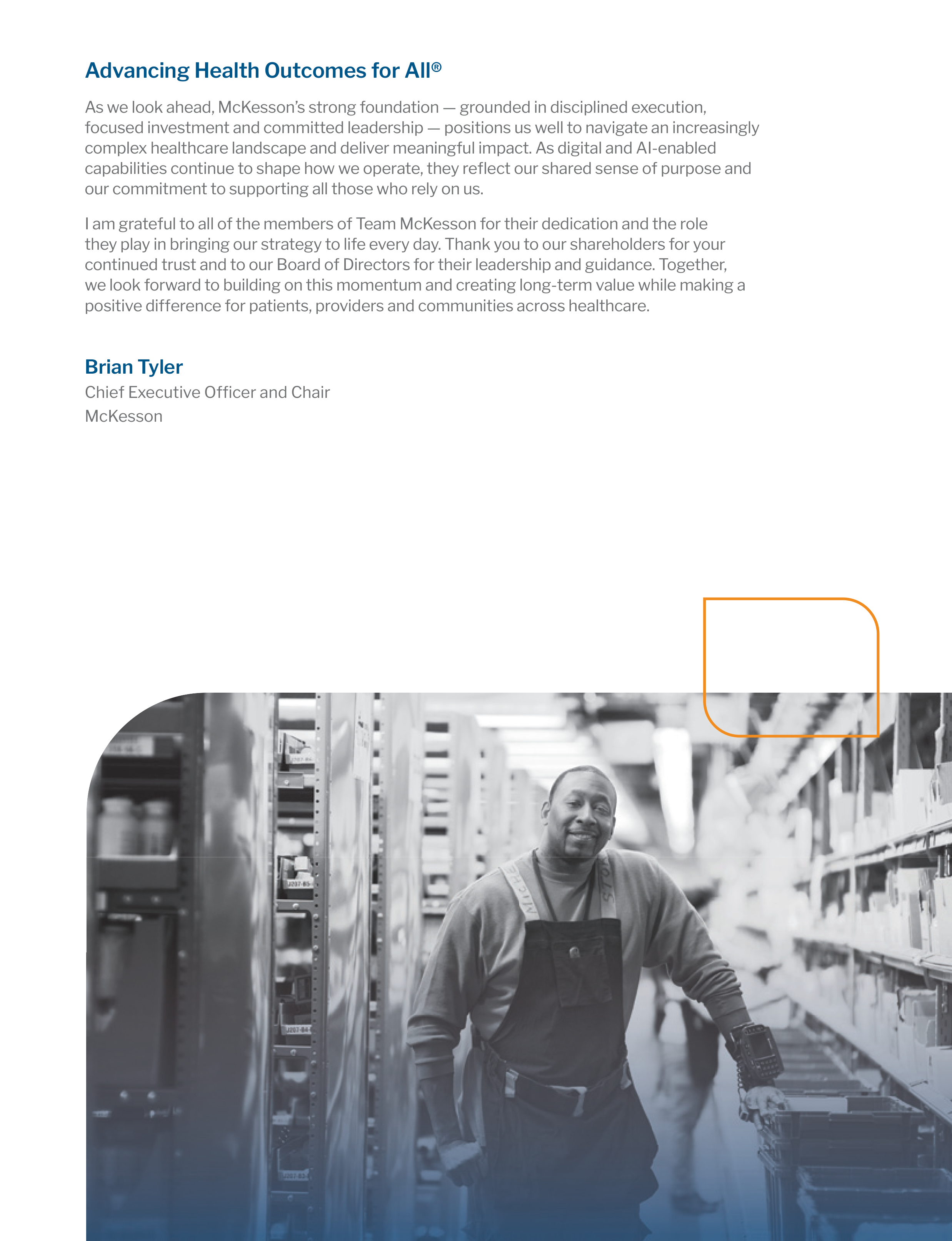






Advancing Health Outcomes for All®
As we look ahead, McKesson’s strong foundation — grounded in disciplined execution,
focused investment and committed leadership — positions us well to navigate an increasingly
complex healthcare landscape and deliver meaningful impact. As digital and AI-enabled
ĉíƎíĈľŕľƥľĘƙ̗ ĉūŠƥľŠƭĘ̗ ƥū̗ ƙĹíƎĘ̗ ĹūDž̗ DžĘ̗ ūƎĘƑíƥĘ̡̗
ƥĹĘNj̗ ƑĘǞĘĉƥ̗ ūƭƑ̗ ƙĹíƑĘĐ̗ ƙĘŠƙĘ̗ ūİ̗ ƎƭƑƎūƙĘ̗ íŠĐ̗
our commitment to supporting all those who rely on us.
I am grateful to all of the members of Team McKesson for their dedication and the role
they play in bringing our strategy to life every day. Thank you to our shareholders for your
continued trust and to our Board of Directors for their leadership and guidance. Together,
we look forward to building on this momentum and creating long-term value while making a
ƎūƙľƥľDŽĘ̗ ĐľǚĘƑĘŠĉĘ̗ İūƑ̗ ƎíƥľĘŠƥƙ̡̗
ƎƑūDŽľĐĘƑƙ̗ íŠĐ̗ ĉūŞŞƭŠľƥľĘƙ̗ íĉƑūƙƙ̗ ĹĘíŕƥĹĉíƑĘ̠
Brian Tyler
ĹľĘİ̗ .NJĘĉƭƥľDŽĘ̗ ǛĉĘƑ̗ íŠĐ̗ ĹíľƑ
McKesson

[THIS PAGE INTENTIONALLY LEFT BLANK]
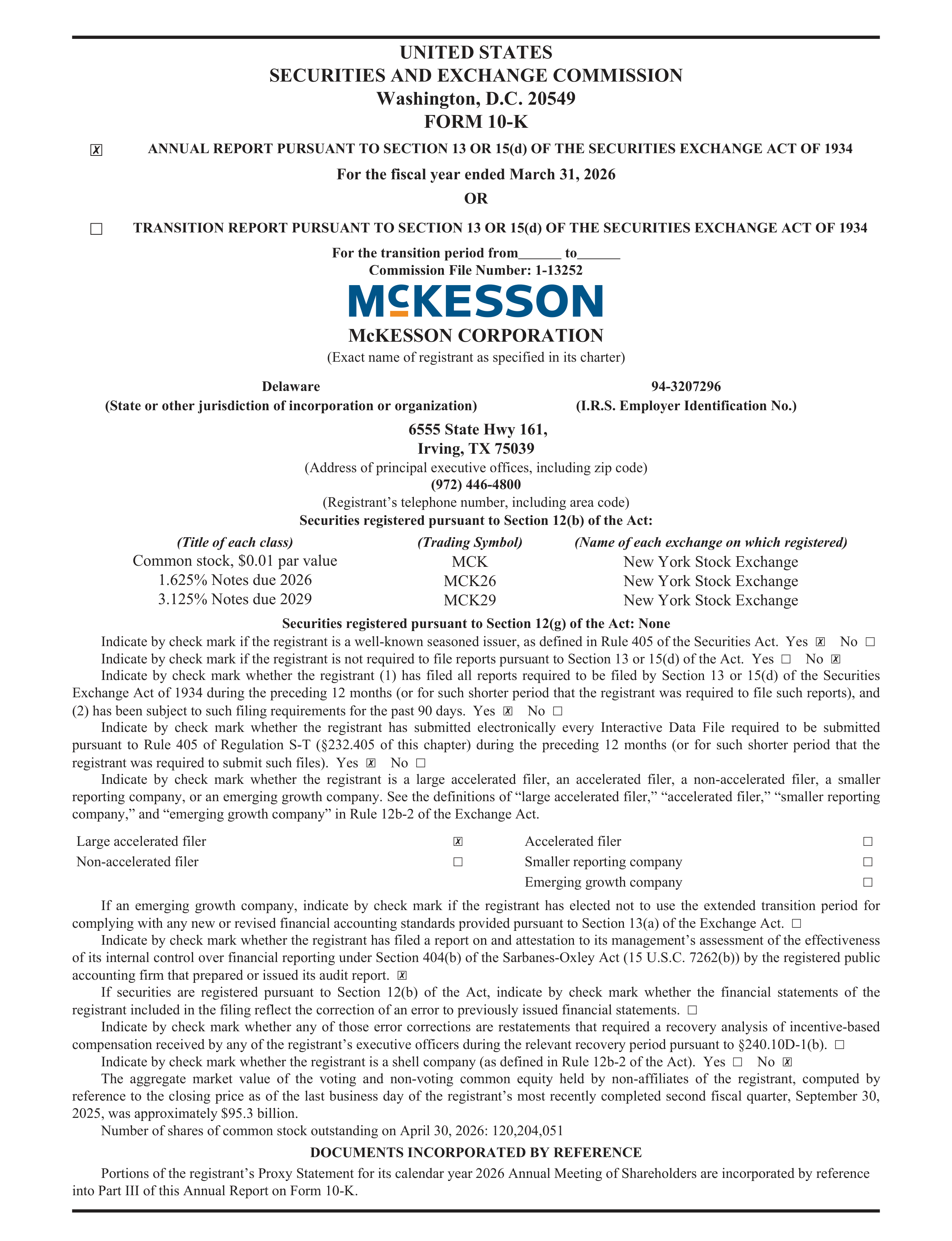
UNITED STATES
SECURITIES AND EXCHANGE COMMISSION
Washington, D.C. 20549
FORM 10-K
☒
ANNUAL REPORT PURSUANT TO SECTION 13 OR 15(d) OF THE SECURITIES EXCHANGE ACT OF 1934
For the fiscal year ended March 31, 2026
OR
☐
TRANS
R
ITION REPORT PURSUANT TO SECTION 13 OR 15(d) OF THE SECURITIES EXCHANGE ACT OF 1934
For the transition period from
to
Commission File Number: 1-13252
McKESSON CORPORAT
R
ION
(Exact name of registrant as specified in its charter)
Delaware
94-3207296
(State or other jurisdiction of incorporation or organization)
(I.R.S. Employer Identification No.)
6555 State Hwy 161,
Irving, TX 75039
(Address of principal executive offi
f
ces, including zip code)
(972) 446-4800
(Registrant’s telephone number, including area code)
Securities registered pursuant to Section 12(b) of the Act:
(Title
T
of each clas
l
s)
(Tra
T
ding
i
Symbol)
(
l
Na
(
me of each exchange on which regi
e
st
i
er
t
ed)
d
Common stock, $0.01 par value
MCK
New York Stock Exchange
1.625% Notes due 2026
MCK26
New York Stock Exchange
3.125% Notes due 2029
MCK29
New York Stock Exchange
Securities registered pursuant to Section 12(g) of the Act: None
Indicate by check mark if the registrant is a well-known seasoned issuer, as defined in Rule 405 of the Securities Act.
Yes
☒
No
☐
Indicate by check mark if the registrant is not required to file reports pursuant to Section 13 or 15(d) of the Act.
Yes
☐
No
☒
Indicate
by
check
mark
whether
the
registrant
(1)
has
filed
all
reports
required
to
be
filed
by
Section
13
or
15(d)
of
the
Securities
Exchange Act of 1934 during the preceding 12 months (or for such shorter period that the registrant was required to file such reports), and
(2) has been subj
u
ect to such filing requirements for the past 90 days.
Yes
☒
No
☐
Indicate
by
check
mark
whether
the
registrant
has
subm
u
itted
electronically
every
r
Interactive
Data
File
required
to
be
subm
u
itted
pursuant
to
Rule
405
of
Regulation
S-T
(§232.405
of
this
chapter)
during
the
preceding
12
months
(or
for
such
shorter
period
that
the
registrant was required to subm
u
it such files).
Yes
☒
No
☐
Indicate
by
check
mark
whether
the
registrant
is
a
large
accelerated
filer,
an
accelerated
filer,
a
non-accelerated
filer,
a
smaller
reporting company, or an emerging growth company. See the definitions of “large accelerated filer,” “accelerated filer,” “smaller reporting
company,” and “emerging growth company” in Rule 12b-2 of the Exchange Act.
Large accelerated filer
☒
Accelerated filer
☐
Non-accelerated filer
☐
Smaller reporting company
☐
Emerging growth company
☐
If
an
emerging
growth
company,
indicate
by
check
mark
if
the
registrant
has
elected
not
to
use
the
extended
transition
period
for
complying with any new or revised financial accounting standards provided pursuant to Section 13(a) of the Exchange Act.
☐
Indicate by check mark whether the registrant has filed a report on and attestation to its management’s assessment of the effe
f
ctiveness
of its internal control over financial reporting under Section 404(b) of the Sarbanes-Oxley Act (15 U.S.C. 7262(b)) by the registered public
accounting firm that prepared or issued its audit report.
☒
If
securities
are
registered
pursuant
to
Section
12(b)
of
the
Act,
indicate
by
check
mark
whether
the
financial
statements
of
the
registrant included in the filing reflect the correction of an error to previously issued financial statements.
☐
Indicate
by
check
mark
whether
any
of
those
error
corrections
are
restatements
that
required
a
recovery
analysis
of
incentive-based
compensation received by any of the registrant’s executive offi
f
cers during the relevant recovery period pursuant to §240.10D-1(b).
☐
Indicate by check mark whether the registrant is a shell company (as defined in Rule 12b-2 of the Act).
Yes
☐
No
☒
The
aggregate
market
value
of
the
voting
and
non-voting
common
equity
held
by
non-affi
f
liates
of
the
registrant,
computed
by
reference
to
the
closing
price
as
of
the
last
business
day
of
the
registrant’s
most
recently
completed
second
fiscal
quarter,
September
30,
2025, was approximately $95.3 billion.
Number of shares of common stock outstanding on April 30, 2026: 120,204,051
DOCUMENTS INCORPORAT
R
ED BY REFERENCE
Portions of the registrant’s Proxy Statement for its calendar year 2026 Annual Meeting of Shareholders are incorporated by reference
into Part III of this Annual Report on Form 10-K.
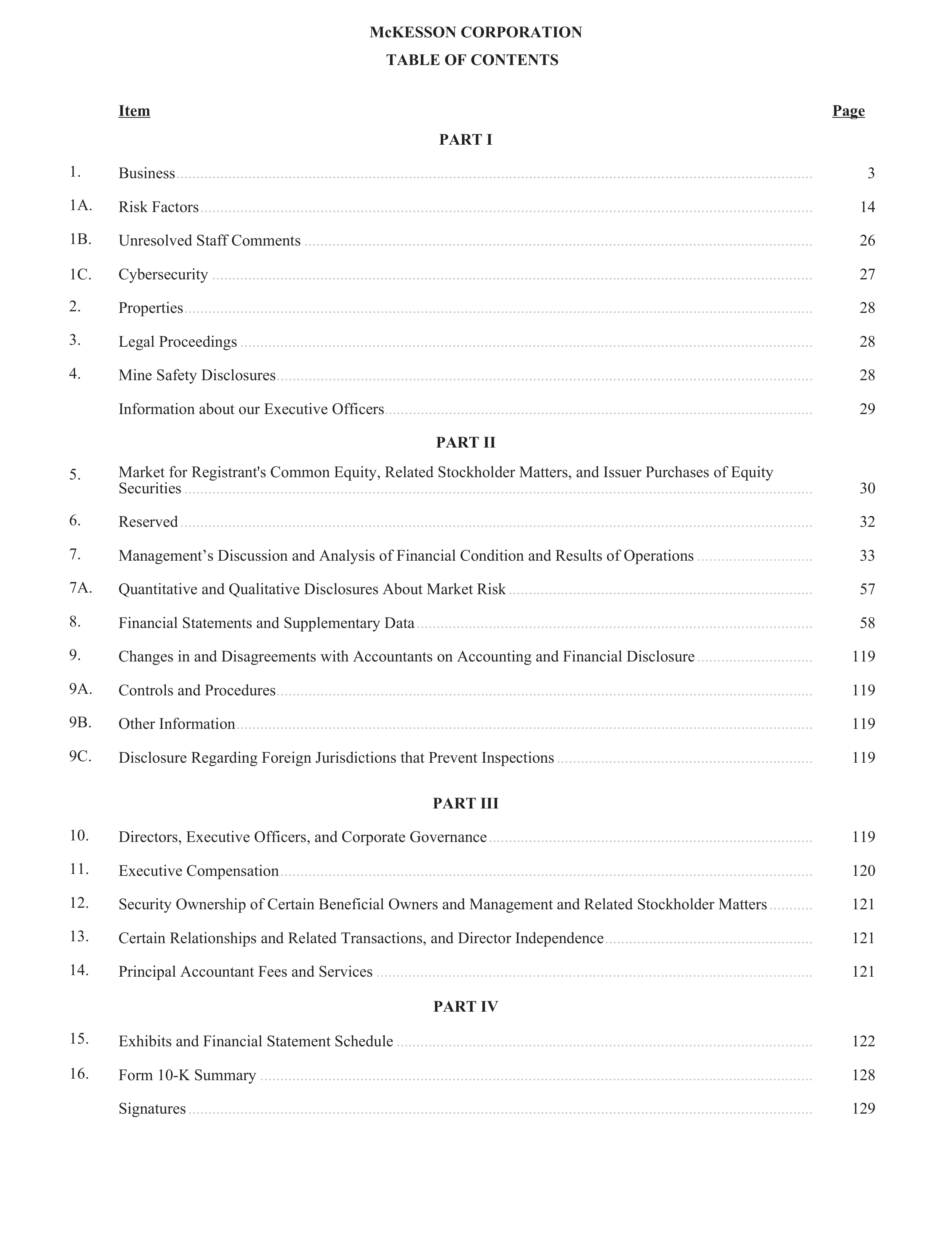
TABLE OF CONTENTS
Item
Page
g
PART I
1.
Business
...............................................................................................................................................................
3
1A.
Risk Factors
.........................................................................................................................................................
14
1B.
Unresolved Staff Comments
...............................................................................................................................
26
1C.
Cybersecurity
......................................................................................................................................................
27
2.
Properties
.............................................................................................................................................................
28
3.
Legal Proceedings
...............................................................................................................................................
28
4.
Mine Safety Disclosures
......................................................................................................................................
28
Information about our Executive Officers
...........................................................................................................
29
PART II
5.
Market for Registrant's Common Equity, Related Stockholder Matters, and Issuer Purchases of Equity
Securities
.............................................................................................................................................................
30
6.
Reserved
..............................................................................................................................................................
32
7.
Management’s Discussion and Analysis of Financial Condition and Results of Operations
.............................
33
.
Quantitative and Qualitative Disclosures About Market Risk
............................................................................
57
8.
Financial Statements and Supplementary Data
...................................................................................................
58
9.
Changes in and Disagreements with Accountants on Accounting and Financial Disclosure
.............................
119
9A.
Controls and Procedures
......................................................................................................................................
119
9B.
Other Information
................................................................................................................................................
119
9C.
Disclosure Regarding Foreign Jurisdictions that Prevent Inspections
................................................................
119
PART III
10.
Directors, Executive Officers, and Corporate Governance
.................................................................................
119
11.
Executive Compensation
.....................................................................................................................................
120
12.
Security Ownership of Certain Beneficial Owners and Management and Related Stockholder Matters
...........
121
13.
Certain Relationships and Related Transactions, and Director Independence
....................................................
121
14.
Principal Accountant Fees and Services
.............................................................................................................
121
PART IV
15.
Exhibits and Financial Statement Schedule
........................................................................................................
122
16.
Form 10-K Summary
..........................................................................................................................................
128
Signatures
............................................................................................................................................................
129
McKESSON CORPORAT
R
ION
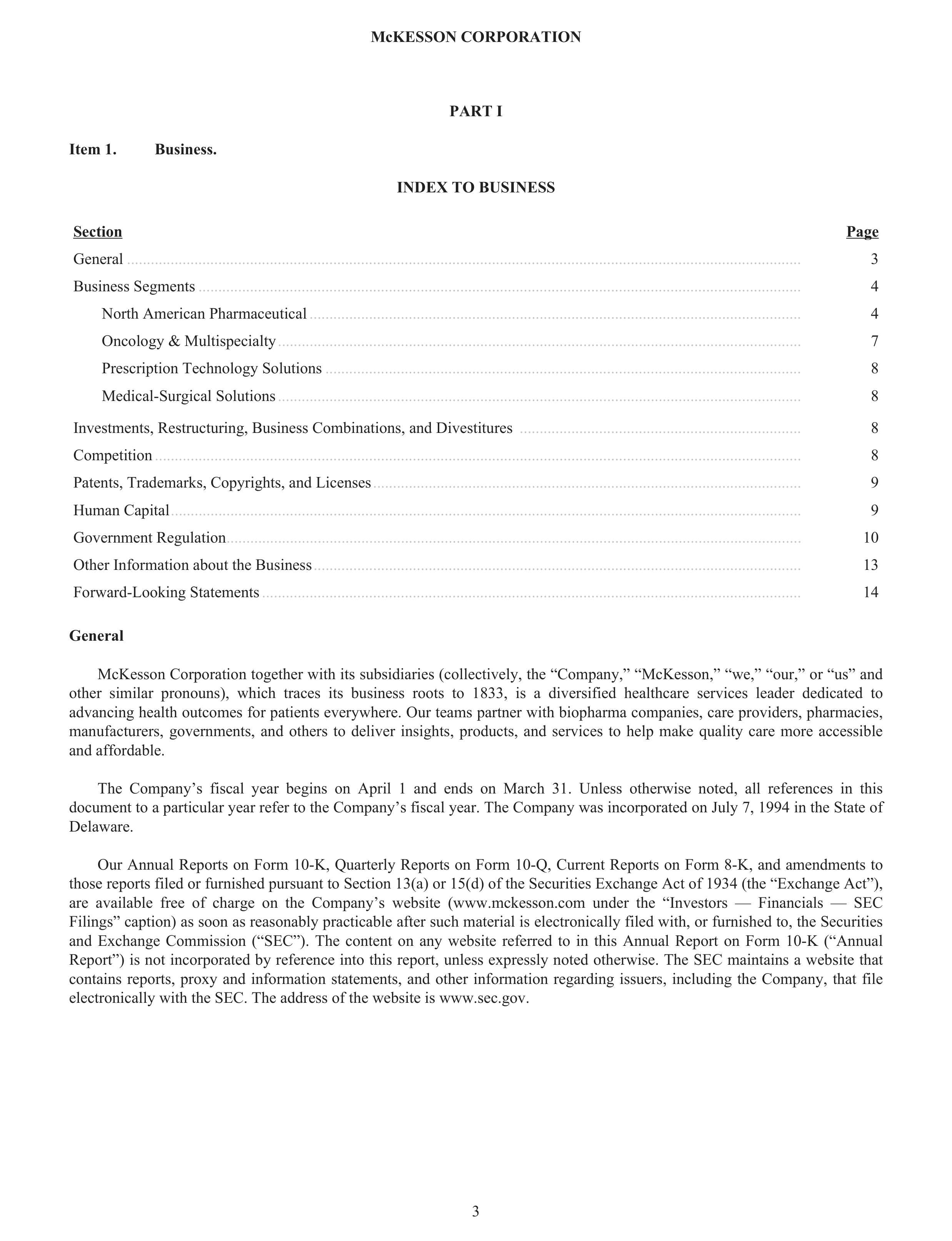
PART I
Item 1.
Business.
INDEX TO BUSINESS
Section
Page
g
General
..........................................................................................................................................................................
3
Business Segments
........................................................................................................................................................
4
North American Pharmaceutical
............................................................................................................................
4
Oncology & Multispecialty
....................................................................................................................................
7
Prescription Technology Solutions
........................................................................................................................
8
Medical-Surgical Solutions
....................................................................................................................................
8
Investments, Restructuring, Business Combinations, and Divestitures
.......................................................................
8
Competition
...................................................................................................................................................................
8
Patents, Trademarks, Copyrights, and Licenses
............................................................................................................
9
Human Capital
...............................................................................................................................................................
9
Government Regulation
.................................................................................................................................................
10
Other Information about the Business
...........................................................................................................................
13
Forward-Looking Statements
........................................................................................................................................
14
General
McKesson Corporation together with its subs
u
idiaries (collectively, the “Company,” “McKesson,” “we,” “our,” or “us” and
other
similar
pronouns),
which
traces
its
business
roots
to
1833,
is
a
diversifie
f
d
healthcare
services
leader
dedicated
to
advancing health outcomes for patients everyw
r
here. Our teams partner with biopharma companies, care providers, pharmacies,
manufact
f
ur
t
ers,
governments,
and
others
to
deliver
insights,
products,
and
services
to
help
make
quality
care
more
accessible
and affo
f
rdable.
The
Company’s
fiscal
year
begins
on
April
1
and
ends
on
March
31.
Unless
otherwise
noted,
all
references
in
this
document to a particular year refer to the Company’s fiscal year. The Company was incorporated on July 7, 1994 in the State of
Delaware.
Our
Annual
Reports
on
Form
10-K,
Quarterly
Reports
on
Form
10-Q,
Current
Reports
on
Form
8-K,
and
amendments
to
those reports filed or furnished pursuant to Section 13(a) or 15(d) of the Securities Exchange Act of 1934 (the “Exchange Act”),
are
availabl
a
e
free
of
charge
on
the
Company’s
website
(www.mckesson.com
under
the
“Investors
—
Financials
—
SEC
Filings” capt
a
ion) as soon as reasonabl
a
y practicable afte
f
r such material is electronically filed with, or furnished to, the Securities
and
Exchange
Commission
(“SEC”).
The
content
on
any
website
referred
to
in
this
Annual
Report
on
Form
10-K
(“Annual
Report”)
is
not
incorporated
by
reference
into
this
report,
unless
expressly
noted
otherwise.
The
SEC
maintains
a
website
that
contains
reports,
proxy
and
information
statements,
and
other
information
regarding
issuers,
including
the
Company,
that
file
electronically with the SEC. The address of the website is www.sec.gov.
McKESSON CORPORAT
R
ION
3
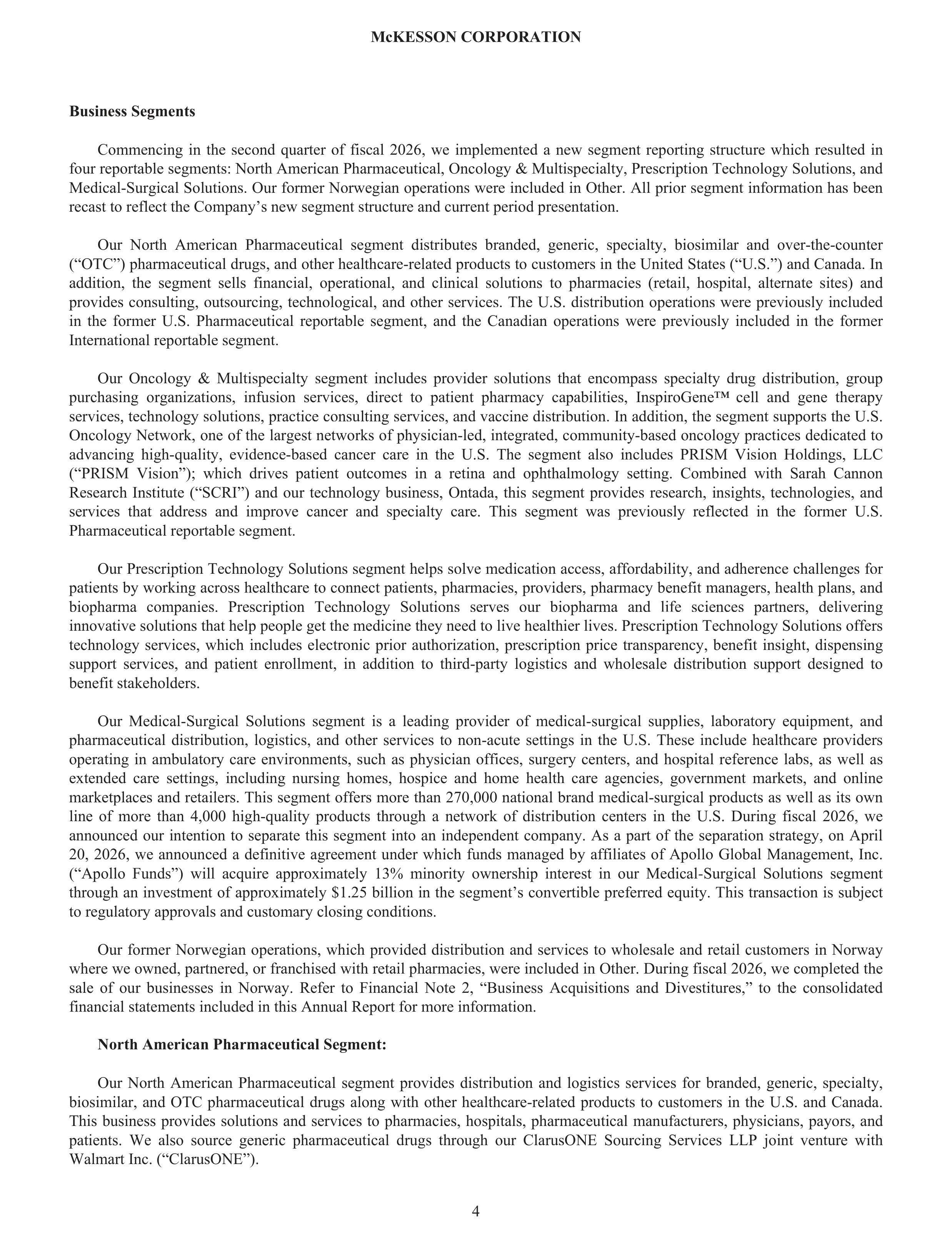
Business Segments
Commencing
in
the
second
quarter
of
fiscal
2026,
we
implemented
a
new
segment
reporting
structur
t
e
which
resulted
in
four reportabl
a
e segments: North American Pharmaceutical, Oncology & Multispecialty, Prescription Technology Solutions, and
Medical-Surgical Solutions. Our former Norwegian operations were in
lcl
d
uded in Other. All prior segment information has been
recast to reflect the Company’s new segment structur
t
e and current period presentation.
Our
North
American
Pharmaceutical
segment
distributes
branded,
generic,
specialty,
biosimilar
and
over-the-counter
(“OTC”) pharmaceutical drugs
r
, and other healthcare-related products to customers in the United States (“U.S.”) and Canada. In
addition,
the
segment
sells
financial,
operational,
and
clinical
solutions
to
pharmacies
(retail,
hospital,
alternate
sites)
and
provides
consulting,
outsourcing,
technological,
and
other
services.
The
U.S.
distribution
operations
were
previously
included
in
the
former
U.S.
Pharmaceutical
reportabl
a
e
segment,
and
the
Canadian
operations
were
previously
included
in
the
former
International reportabl
a
e segment.
Our
Oncology
&
Multispecialty
segment
in
lcl
d
udes
pr
p
ovider
solutions
that
encompass
specialty
drug
r
distribution,
group
purchasing
organizations,
infusion
services,
direct
to
patient
pharmacy
capabilities,
InspiroGene™cell
and
gene
therapy
services, technology solutions, practice consulting services, and vaccine distribution. In
d
addidi ition,
hthe segment suppor
u
ts
hthe U.S.
Oncology
gy Network, one of
hthe la
g
rgest networks of phys
physician-led, integrat
d
ed, commu
ini yty
b
-bas
d
ed onc
lol
gy
ogy practices dedidicat
d
ed to
d
advancing
hihigh-
gh-qualili yty,
evididence-based
cancer
care
in
hthe
U.S.
h
The
segment
lalso
in
lcl
d
udes
PRISM
Vision
Holdings,
LLC
(“PRISM
i
Vi
ision”);
h
which
drives
pa itient
outcomes
in
a
re itina
and
h
ophthalm
lol
gy
ogy
setting.
Co
b
mbin
d
ed
i
wi hth
Sarah
Cannon
Resear
h
ch
Institut
t
e
(“SCRI
)”)
a
d
nd
our
te
h
ch
l
nol
gy
ogy
business,
Ontada,
hthis
segment
pr
i
ovides
resear
h
ch,
in
isight
ghts,
te
h
ch
l
nologi
ogies,
and
services
hthat
d
address
and
improve
cancer
and
sp
i
eci
lal yty
care.
This
segment
was
previously
reflected
in
the
former
U.S.
Pharmaceutical reportabl
a
e segment.
Our Prescription Technology Solutions segment helps solve medication access, affo
f
rdability, and adherence challenges for
patients by working across healthcare to connect patients, pharmacies, providers, pharmacy benefit managers, health plans, and
biopharma
companies.
Prescription
Technology
Solutions
serves
our
biopharma
and
lifef
sciences
partners,
delivering
innovative solutions that help people get the medicine they need to live healthier lives. Prescription Technology Solutions offe
f
rs
technology
services,
which
includes
electronic
prior
authorization,
prescription
price
transparency,
benefit
insight,
dispensing
suppor
u
t
services,
and
patient
enrollment,
in
addition
to
third-party
logistics
and
wholesale
distribution
suppor
u
t
designed
to
benefit stakeholders.
Our
Medical-Surgical
Solutions
segment
is
a
leading
provider
of
medical-surgical
suppl
u
ies,
labor
a
atory
r
equipment,
and
pharmaceutical
distribution,
logistics,
and
other
services
to
non-acute
settings
in
the
U.S.
These
include
healthcare
providers
operating
in
ambulatory
r
care
environments,
such
as
physician
offi
f
ces,
surgery
r
centers,
and
hospital
reference
labs
a
,
as
well
as
extended
care
settings,
including
nursing
homes,
hospice
and
home
health
care
agencies,
government
markets,
and
online
marketpl
t
aces and retailers. This segment offe
f
rs more than 270,000 national brand medical-surgical products as well as its own
line
of
more
than
4,000
high-quality
products
through
a
network
of
distribution
centers
in
the
U.S.
During
fiscal
2026,
we
announced
our
intention
to
separate
this
segment
into
an
independent
company.
As
a
part
of
the
separation
strategy,
on
April
20,
2026,
we
announced
a
definitive
agreement
under
which
funds
managed
by
affi
f
liates
of
Apollo
Global
Management,
Inc.
(“Apollo
Funds”)
will
acquire
approximately
13%
minority
ownership
interest
in
our
Medical
-
Surgical
Solutions
segment
through an investment of
approximately $1.25
billion in the segment’s convertible prefer
f
red
equity.
This transaction is subj
u
ect
to regulatory
r
approvals and customary
r
closing conditions.
Our
former
Norwegian
operations,
which
provided
distribution
and
services
to
wholesale
and
retail
customers
in
Norway
where we owned, partnered, or franchised with retail pharmacies, were included in Other. During fiscal 2026, we completed the
sale
of
our
businesses
in
Norway.
Refer
to
Financial
Note
2,
“Business
Acquisitions
and
Divestitures,”
to
the
consolidated
financial statements included in this Annual Report for more information.
North American Pharmaceutical Segment:
Our
North
American
Pharmaceutical
segment
provides
distribution
and
logistics
services
for
branded,
generic,
specialty,
biosimilar,
and
OTC
pharmaceutical
drugs
r
along
with
other
healthcare-related
products
to
customers
in
the
U.S.
and
Canada.
This
business
provides
solutions
and
services
to
pharmacies,
hospitals,
pharmaceutical
manufact
f
ur
t
ers,
physicians,
payors,
and
patients.
We
also
source
generic
pharmaceutical
drug
r
s
through
our
Clarus
r
ONE
Sourcing
Services
LLP
joint
ventur
t
e
with
Walmart Inc. (“Clarus
r
ONE”).
McKESSON CORPORAT
R
ION
4
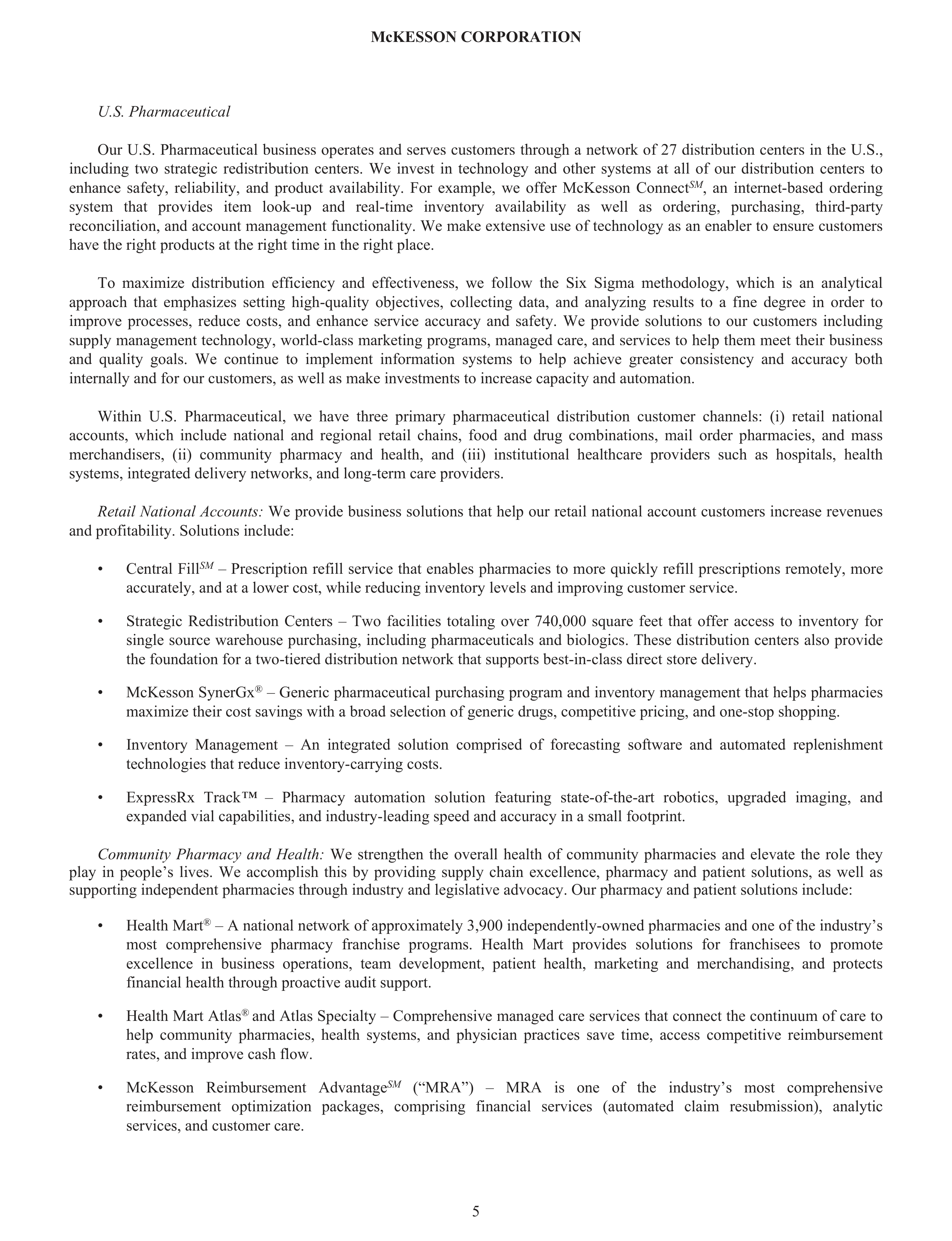
U.S. Pharmaceutical
Our
U.S.
Pharmaceutical
business
operates
and
serves
customers
through
a
network
of
27
distribution
centers
in
the
U.S.,
including
two
strategic
redistribution
centers.
We
invest
in
technology
and
other
systems
at
all
of
our
distribution
centers
to
enhance
safety,
reliabi
a
lity,
and
product
availabi
a
lity.
For
example,
we
offe
f
r
McKesson
Connect
SM
,
an
internet-based
ordering
system
that
provides
item
look-up
and
real-time
inventory
r
availabi
a
lity
as
well
as
ordering,
purchasing,
third-party
reconciliation, and account management functionality. We make extensive use of technology as an enabler to ensure customers
have the right products at the right time in the right place.
To
maximize
distribution
effi
f
ciency
and
effe
f
ctiveness,
we
follow
the
Six
Sigma
methodology,
which
is
an
analytical
approach
that
emphasizes
setting
high-quality
objectives,
collecting
data,
and
analyzing
results
to
a
fine
degree
in
order
to
improve
processes,
reduce
costs,
and
enhance
service
accuracy
and
safety.
We
provide
solutions
to
our
customers
including
suppl
u
y management technology, world-class marketing programs, managed care, and services to help them meet their business
and
quality
goals.
We
continue
to
implement
information
systems
to
help
achieve
greater
consistency
and
accuracy
both
internally and for our customers, as well as make investments to increase capacity and automation.
Within
U.S.
Pharmaceutical,
we
have
three
primary
pharmaceutical
distribution
customer
channels:
(i)
retail
national
accounts,
which
include
national
and
regional
retail
chains,
food
and
drug
r
combinations,
mail
order
pharmacies,
and
mass
merchandisers,
(ii)
community
pharmacy
and
health,
and
(iii)
institutional
healthcare
providers
such
as
hospitals,
health
systems, integrated delivery networks, and long-term care providers.
Retail National Accounts:
t
We provide business solutions that help our retail national account customers increase revenues
and profita
f
bi
a
lity. Solutions include:
•
Central
Fill
SM
–
Prescription
refill
service
that
enables
pharmacies
to
more
quickly
refill
prescriptions
remotely,
more
accurately, and at a lower cost, while reducing inventory
r
levels and improving customer service.
•
Strategic
Redistribution
Centers
–
Two
facilities
totaling
over
740,000
square
feet
that
offe
f
r
access
to
inventory
r
for
single
source
warehouse
purchasing,
including
pharmaceuticals
and
biologics.
These
distribution
centers
also
provide
the foundation for a two-tiered distribution network that suppor
u
ts best-in-class direct store delivery.
r
•
McKesson SynerGx
®
– Generic pharmaceutical purchasing program and inventory
r
management that helps pharmacies
maximize their cost savings with a broad selection of generic drugs
r
, competitive pricing, and one-stop shopping.
•
Inventory
r
Management
–
An
integrated
solution
comprised
of
forecasting
software
and
automated
replenishment
technologies that reduce inventory-
r
carrying costs.
•
ExpressRx
Track
™
–
Pharmacy
automation
solution
featur
t
ing
state-of-t
f
he-art
robotics,
upgraded
imaging,
and
expanded vial capabilities, and industry-
r
leading speed and accuracy in a small footpr
t
int.
Community
Pharmacy
and
Health:
We
strengthen
the
overall
health
of
community
pharmacies
and
elevate
the
role
they
play
in
people’s
lives.
We
accomplish
this
by
providing
suppl
u
y
chain
excellence,
pharmacy
and
patient
solutions,
as
well
as
suppor
u
ting independent pharmacies through industry
r
and legislative advocacy. Our pharmacy and patient solutions include:
•
Health Mart
®
– A national network of approximately 3,900 independently-owned pharmacies and one of the industry’
r
s
most
comprehensive
pharmacy
franchise
programs.
Health
Mart
provides
solutions
for
franchisees
to
promote
excellence
in
business
operations,
team
development,
patient
health,
marketing
and
merchandising,
and
protects
financial health through proactive audit suppor
u
t.
•
Health Mart Atlas
®
and Atlas Specialty – Comprehensive managed care services that connect the continuum of care to
help
community
pharmacies,
health
systems,
and
physician
practices
save
time,
access
competitive
reimbursement
rates, and improve cash flow.
•
McKesson
Reimbursement
Advantage
SM
(“MRA”
R
)
–
MRA
R
is
one
of
the
industry’
r
s
most
comprehensive
reimbursement
optimization
packages,
comprising
financial
services
(automated
claim
resubm
u
ission),
analytic
services, and customer care.
McKESSON CORPORAT
R
ION
5
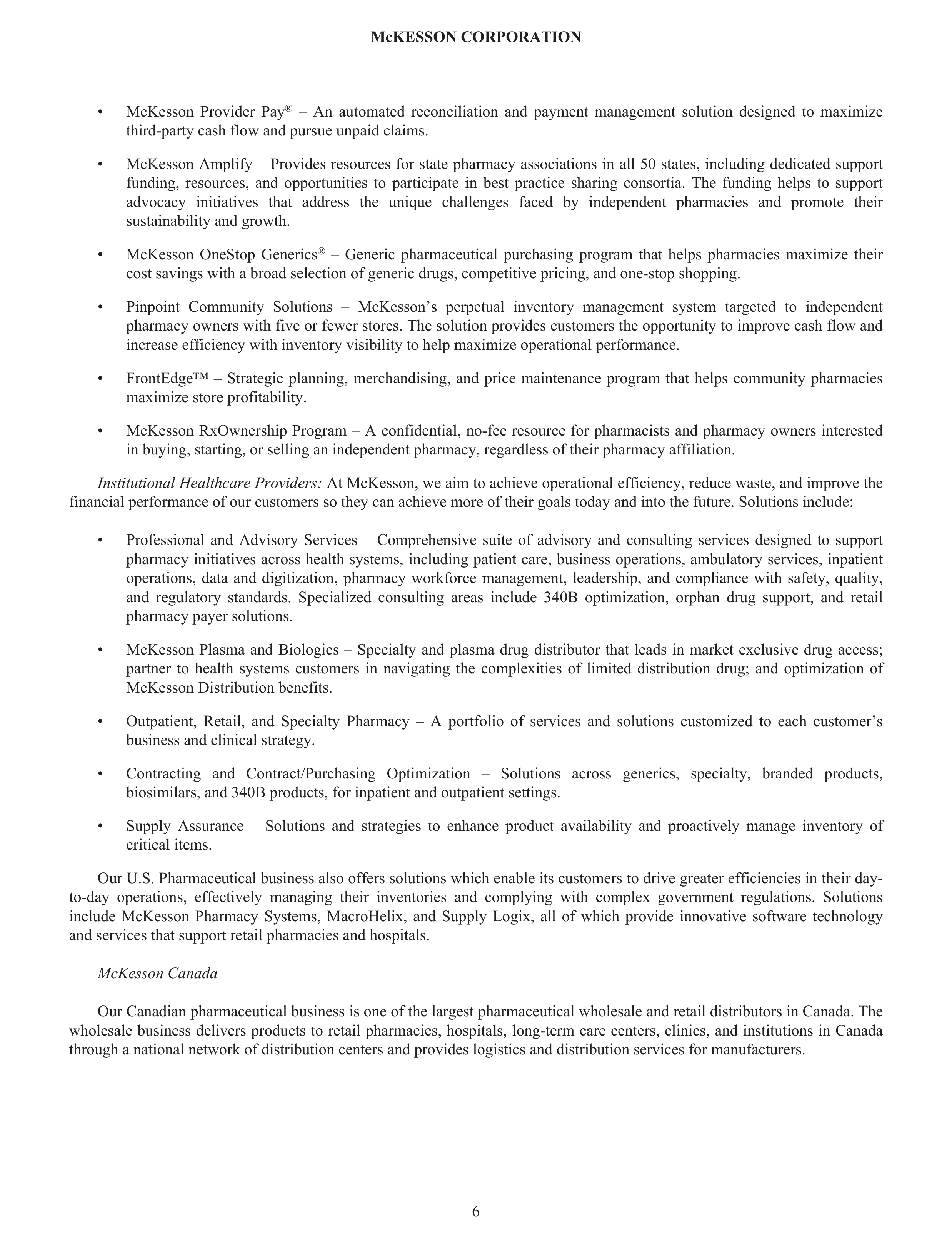
•
McKesson
Provider
Pay
®
–
An
automated
reconciliation
and
payment
management
solution
designed
to
maximize
third-party cash flow and pursue unpaid claims.
•
McKesson
Amplify
f
–
Provides
resources
for
state
pharmacy
associations
in
all
50
states,
including
dedicated
suppor
u
t
funding,
resources,
and
opportunities
to
participate
in
best
practice
sharing
consortia.
The
funding
helps
to
suppor
u
t
advocacy
initiatives
that
address
the
unique
challenges
faced
by
independent
pharmacies
and
promote
their
sustainabi
a
lity and growth.
•
McKesson
OneStop
Generics
®
–
Generic
pharmaceutical
purchasing
program
that
helps
pharmacies
maximize
their
cost savings with a broad selection of generic drugs
r
, competitive pricing, and one-stop shopping.
•
Pinpoint
Community
Solutions
–
McKesson’s
perpetua
t
l
inventory
r
management
system
targeted
to
independent
pharmacy owners with five or fewer stores. The solution provides customers the opportunity to improve cash flow and
increase efficiency with inventory
r
visibility to help maximize operational performance.
•
FrontEdge™–
Strategic
planning,
merchandising,
and
price
maintenance
program
that
helps
community
pharmacies
maximize store profita
f
bi
a
lity.
•
McKesson
RxOwnership
Program
–
A
confid
f
ential,
no-fee
resource
for
pharmacists
and
pharmacy
owners
interested
in buying, starting, or selling an independent pharmacy, regardless of their pharmacy affi
f
liation.
Institutional Healthcare Provider
d
s:
r
At McKesson, we aim to achieve operational effi
f
ciency, reduce waste, and improve the
financial performance of our customers so they can achieve more of their goals today and into the future. Solutions include:
•
Professional
and
Advisory
Services
–
Comprehensive
suite
of
advisory
and
consulting
services
designed
to
suppor
u
t
pharmacy
initiatives
across
health
systems,
including
patient
care,
business
operations,
ambulatory
r
services,
inpatient
operations,
data
and
digitization,
pharmacy
workforce
management,
leadership,
and
compliance
with
safety,
quality,
and
regulatory
r
standards.
Specialized
consulting
areas
include
340B
optimization,
orpha
r
n
drug
r
suppor
u
t,
and
retail
pharmacy payer solutions.
•
McKesson
Plasma
and
Biologics
–
Specialty
and
plasma
drug
r
distributor
that
leads
in
market
exclusive
drug
r
access;
partner
to
health
systems
customers
in
navigating
the
complexities
of
limited
distribution
drug;
r
and
optimization
of
McKesson Distribution benefits.
•
Outpa
t
tient,
Retail,
and
Specialty
Pharmacy
–
A
portfol
f
io
of
services
and
solutions
customized
to
each
customer’s
business and clinical strategy.
•
Contracting
and
Contract/P
t
urchasing
Optimization
–
Solutions
across
generics,
specialty,
branded
products,
biosimilars, and 340B products, for inpatient and outpa
t
tient settings.
•
Supply
Assurance
–
Solutions
and
strategies
to
enhance
product
availabi
a
lity
and
proactively
manage
inventory
r
of
critical items.
Our U.S. Pharmaceutical business also offe
f
rs solutions which enable its customers to drive greater effi
f
ciencies in their day-
to-day
operations,
effe
f
ctively
managing
their
inventories
and
complying
with
complex
government
regulations.
Solutions
include
McKesson
Pharmacy
Systems,
MacroHelix,
and
Suppl
u
y
Logix,
all
of
which
provide
innovative
software
technology
and services that suppor
u
t retail pharmacies and hospitals.
McKe
c
sson Canada
Our Canadian pharmaceutical business is one of the largest pharmaceutical wholesale and retail distributors in Canada. The
wholesale
business
delivers
products
to
retail
pharmacies,
hospitals,
long-term
care
centers,
clinics,
and
institutions
in
Canada
through a national network of distribution centers and provides logistics and distribution services for manufact
f
ur
t
ers.
McKESSON CORPORAT
R
ION
6
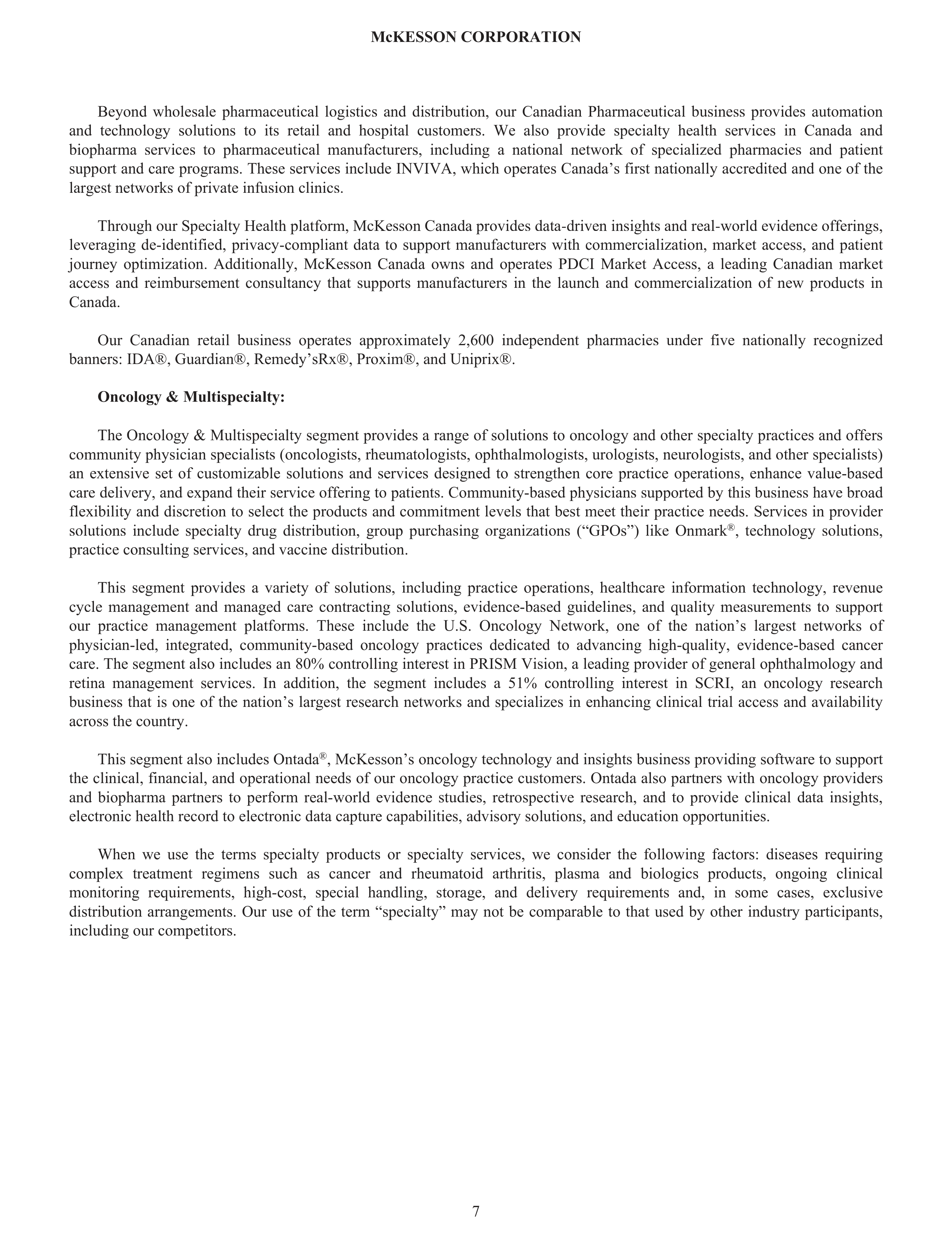
Beyond
wholesale
pharmaceutical
logistics
and
distribution,
our
Canadian
Pharmaceutical
business
provides
automation
and
technology
solutions
to
its
retail
and
hospital
customers.
We
also
provide
specialty
health
services
in
Canada
and
biopharma
services
to
pharmaceutical
manufact
f
ur
t
ers,
including
a
national
network
of
specialized
pharmacies
and
patient
suppor
u
t and care programs. These services include INVIVA, which operates Canada’s first nationally accredited and one of the
largest networks of private infusion clinics.
Through our Specialty Health platform, McKesson Canada provides data
-
driven insights and real
-
world evidence offe
f
rings,
leveraging
de
-
identified,
privacy
-
compliant
data
to
suppor
u
t
manufact
f
ur
t
ers
with
commercialization,
market
access,
and
patient
journey
optimization.
Additionally,
McKesson
Canada
owns
and
operates
PDCI
Market
Access,
a
leading
Canadian
market
access
and
reimbursement
consultancy
that
suppor
u
ts
manufact
f
ur
t
ers
in
the
launch
and
commercialization
of
new
products
in
Canada.
Our
Canadian
retail
business
operates
approximately
2,600
independent
pharmacies
under
five
nationally
recognized
banners: IDA®, Guardian®, Remedy’sRx®, Proxim®, and Uniprix®.
Oncology & Multispecialty:
The Oncology & Multispecialty segment provides a range of solutions to oncology and other specialty practices and offe
f
rs
community physician specialists (oncologists, rheumatologists, ophthalmologists, urologists, neurologists, and other specialists)
an
extensive
set
of
customizable
solutions
and
services
designed
to
strengthen
core
practice
operations,
enhance
value-based
care delivery,
r
and expand their service offe
f
ring to patients. Community-based physicians suppor
u
ted by this business have broad
flexibility and discretion to select the products and commitment levels that best meet their practice needs. Services in provider
solutions
include
specialty
drug
r
distribution,
group
purchasing
organizations
(“GPOs”)
like
Onmark
®
,
technology
solutions,
practice consulting services, and vaccine distribution.
This
segment
provides
a
variety
of
solutions,
including
practice
operations,
healthcare
information
technology,
revenue
cycle
management
and
managed
care
contracting
solutions,
evidence-based
guidelines,
and
quality
measurements
to
suppor
u
t
our
practice
management
platforms.
These
include
the
U.S.
Oncology
Network,
one
of
the
nation’s
largest
networks
of
physician-led,
integrated,
community-based
oncology
practices
dedicated
to
advancing
high-quality,
evidence-based
cancer
care. The segment also includes an 80% controlling interest in PRISM Vision, a leading provider of general ophthalmology and
retina
management
services.
In
addition,
the
segment
includes
a
51%
controlling
interest
in
SCRI,
an
oncology
research
business
that
is
one
of
the
nation’s
largest
research
networks
and
specializes
in
enhancing
clinical
trial
access
and
availabi
a
lity
across the country.
This segment also includes Ontada
®
, McKesson’s oncology technology and insights business providing software to suppor
u
t
the clinical, financial, and operational needs of our oncology practice customers. Ontada also partners with oncology providers
and
biopharma
partners
to
perform
real-world
evidence
studi
t
es,
retrospective
research,
and
to
provide
clinical
data
insights,
electronic health record to electronic data capture capa
a
bi
a
lities, advisory solutions, and educ
d
ation opportunities.
When
we
use
the
terms
specialty
products
or
specialty
services,
we
consider
the
following
factors:
diseases
requiring
complex
treatment
regimens
such
as
cancer
and
rheumatoid
arthritis,
plasma
and
biologics
products,
ongoing
clinical
monitoring
requirements,
high-cost,
special
handling,
storage,
and
delivery
r
requirements
and,
in
some
cases,
exclusive
distribution
arrangements.
Our
use
of
the
term
“specialty”
may
not
be
comparable
to
that
used
by
other
industry
r
participants,
including our competitors.
McKESSON CORPORAT
R
ION
7
Prescription Technology Solutions Segment:
Our
Prescription
Technology
Solutions
segment
works
across
healthcare
to
connect
patients,
pharmacies,
providers,
pharmacy benefit managers, health plans, and biopharma to deliver medication access solutions that suppor
u
t patients from first
prescription fill to ongoing therapy, regardless of their insurance coverage. Prescription Technology Solutions has connections
with
most
electronic
health
record
systems,
over
50,000
pharmacies,
more
than
1,000,000
providers,
most
pharmacy
benefit
managers
and
health
plans,
and
has
suppor
u
ted
over
650
biopharma
brands
representing
most
therapeutic
areas.
Through
its
industry
r
connections
and
ability
to
navigate
the
healthcare
ecosystem,
Prescription
Technology
Solutions
offe
f
rs
innovative
solutions
created
to
benefit
healthcare
stakeholders.
Its
comprehensive
solution
suites
and
technology
services
span
across
the
entire
patient
journey,
including
medication
access
and
affo
f
rdability,
prescription
decision
suppor
u
t,
prescription
price
transparency,
benefit
insight
and
dispensing
suppor
u
t
services,
patient
enrollment,
as
well
as
third-party
logistics
and
wholesale
distribution suppor
u
t, to help increase speed to therapy, reduce prescription abandonment, and suppor
u
t improved health outcomes
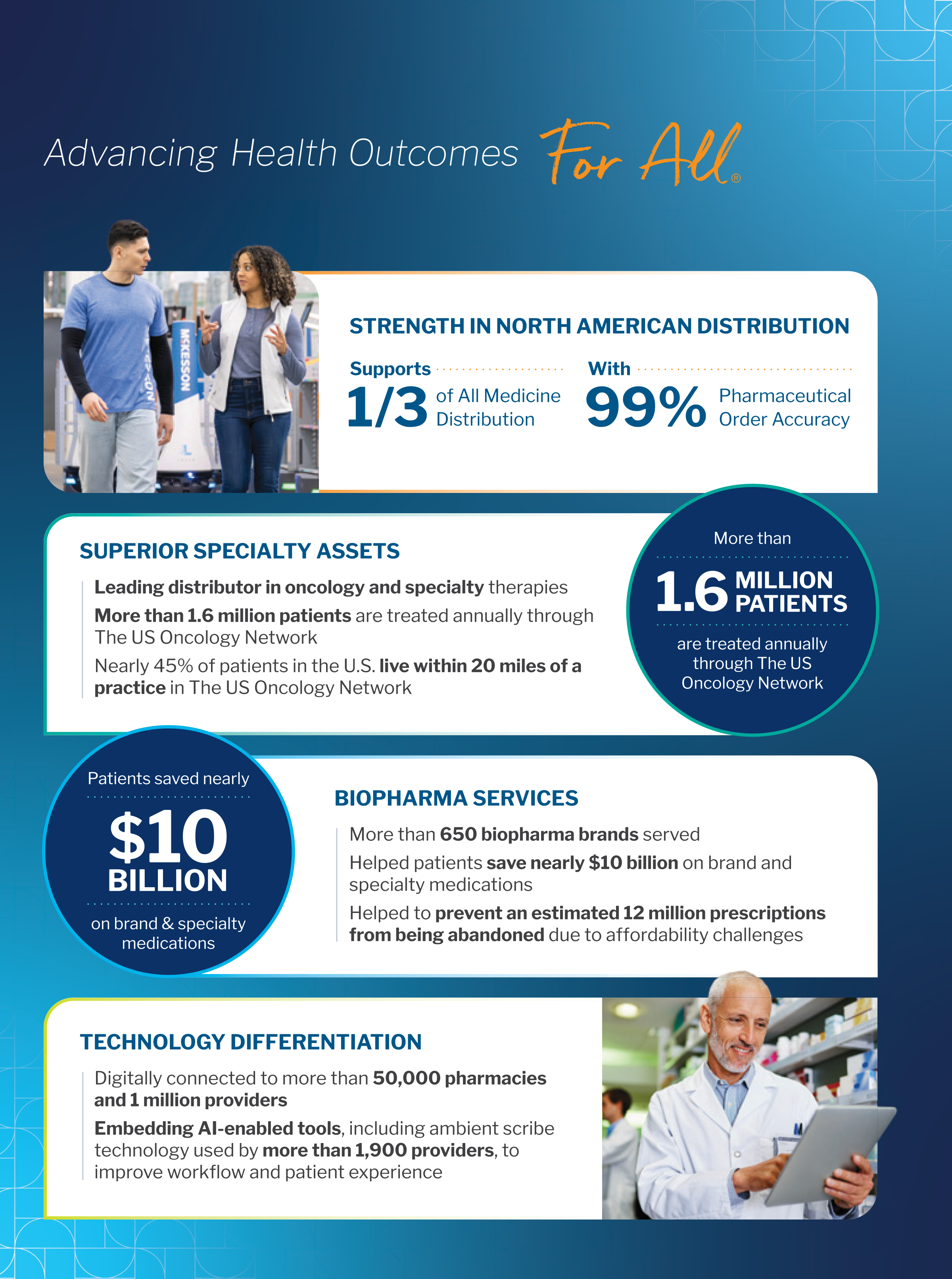
for the patient. In the past year, Prescription Technology Solutions helped patients save approximately $10 billion on brand and
specialty
medications,
helped
to
prevent
an
estimated
12
million
prescriptions
from
being
abandoned
due
to
affo
f
rdability
challenges, and helped patients access their medicine more than 135 million times.
Medical-Surgical Solutions Segment:
Our
Medical-Surgical
Solutions
segment
is
a
leading
provider
of
medical-surgical
suppl
u
ies,
labor
a
atory
r
equipment,
and
pharmaceutical
distribution,
logistics,
biomedical
maintenance,
and
other
services
to
U.S.
healthcare
providers
across
the
non-
acute and alternate-site spectrum
r
. Our more than 336,000 customers include physician offi
f
ces, surgery
r
centers, post-acute care
facilities, hospital reference labs
a
, and home health agencies. We partner with manufact
f
ur
t
ers and channel partners to suppor
u
t our
key markets, including ambulatory
r
care, extended care, government, and other online marketpl
t
aces, and retailers. We distribute
medical-surgical
suppl
u
ies
(such
as
gloves,
needles,
syringes,
and
wound
care
products),
infusion
pumps,
labor
a
atory
r
equipment
and suppl
u
ies, and pharmaceuticals. Through a network of distribution centers in the U.S., we offe
f
r more than 270,000 products
from
national
brand
manufac
f
turers
and
our
own
brand
of
more
than
4,000
high-quality
products.
Through
the
right
mix
of
products
and
services,
we
help
improve
effi
f
ciencies,
profit
f
ability,
and
compliance.
Our
focus
is
to
help
customers
improve
patient and business outcomes. We develop customized plans to address the product, operational, and clinical suppor
u
t needs of
our customers, including inventory
r
management, reducing administrative burdens, and training and educ
d
ating clinical staff.
f
We
deliver
for
our
customers,
so
they
can
deliver
and
care
for
their
patients.
During
fiscal
2026,
we
announced
our
intention
to
separate this segment into an independent company.
As
a part of
the separation strategy, on April 20, 2026,
we announced we
had entered into a definitive agreement under which Apollo Funds will acquire approximately 13% minority ownership interest
in
our
Medical
-
Surgical
Solutions
segment
through
an
investment
of
approximately
$1.25
billion
in
the
segment’s
convertible
prefer
f
red equity. This transaction closing is subj
u
ect to regulatory
r
approvals and customary
r
closing conditions.
Investments, Restructuring, Business Combinations, and Divestitures
We
invest
in
new
and
existing
distribution
centers
to
increase
scale
and
capacity,
improve
effi
f
ciency
through
automation
and
technology,
and
enhance
regulatory
r
compliance
capa
a
bi
a
lities.
Additionally,
we
invest
in
data
and
analytics
to
suppor
u
t
our
growth
priorities,
including
artificial
intelligence
(“AI”).
We
are
in
the
early
stages
of
exploring
potential
AI
capabilities
and
related
data
and
analytics
across
our
enterprise
to
improve
produc
d
tivity
and
effi
f
ciency,
as
well
as
enhance
our
produc
d
ts
and
services to better suppor
u
t patients, employees, and customers.
We
have
undertaken
additional
strategic
initiatives
in
recent
years
designed
to
increase
operational
effi
f
ciencies,
focus
on
our
core
healthcare
businesses,
execute
our
business
strategy,
and
enhance
our
competitive
position.
These
initiatives
are
detailed
in
Financial
Note
2,
“Business
Acquisitions
and
Divestitures,”
and
Financial
Note
3,
“Restructuring,
Impairment,
and
Related Charges, Net,” to the consolidated financial statements included in this Annual Report.
Competition
We
operate
in
highly
competitive
markets
across
North
America,
and
the
healthcare
industry
r
has
experienced
significant
consolidation
in
recent
years.
Within
the
pharmaceutical
distribution
landscape
in
which
our
North
American
Pharmaceutical
segment operates, we face strong competition from international, national, regional, and local full-line, short-line, and specialty
distributors; service merchandisers; self-w
f
arehousing chain drugs
r
tores; manufact
f
ur
t
ers engaged in direct distribution; third-party
logistics
companies;
and
large
payer
organizations.
Our
primary
r
competitors
in
distribution,
wholesaling,
and
logistics
are
Cencora, Inc. and Cardinal Health, Inc.
McKESSON CORPORAT
R
ION
8
In
our
Oncology
&
Multispecialty
segment,
we
compete
with
other
specialty
distributors;
GPOs;
specialty
pharmacies;
oncology
networks
and
platforms;
ophthalmology
and
retina
management
services
providers;
and
healthcare
information
technology
and
data
and
analytics
companies.
Certain
competitors
also
offe
f
r
combinations
of
distribution,
GPO,
and
provider
services capabilities, including Cencora, Inc. and Cardinal Health, Inc. In addition, our clinical research offe
f
rings compete with
contract
research
organizations,
site
management
organizations,
academic
medical
centers,
and
health
systems
that
suppor
u
t
clinical trials.
Our
Prescription
Technology
Solutions
business
experiences
subs
u
tantial
competition
from
variety
of
organizations,
including other biopharma services providers, software and technology service firms, consulting firms, shared services vendors,
and internet-based companies offe
f
ring healthcare-focused technology solutions. Competition in this space ranges widely in size,
geographic reach, and the scope and depth of products and services offe
f
red.
Our
Medical-Surgical
Solutions
segment
competes
with
numerous
national
and
regional
distributors
of
medical
suppl
u
ies
and equipment throughout the U.S.
Additionally,
we
compete
with
other
service
providers
and
healthcare
manufact
f
ur
t
ers,
as
well
as
potential
customers
who
may
choose
to
build
internal
suppl
u
y
management
capa
a
bi
a
lities
rather
than
rely
on
external
partners
like
us.
We
believe
that
our
scale
and
the
breadth
of
our
product
and
service
portfol
f
io
are
key
competitive
advantages.
In
all
areas,
primary
competitive
factors include price, quality of service, product assortment, innovation, adoption of emerging technologies, and, in some cases,
customer convenience.
Patents, Trademarks, Copyrights, and Licenses
McKesson
and
its
subs
u
idiaries
hold
patents,
copyrights,
trademarks,
and
trade
secrets
related
to
McKesson
products
and
services.
We
pursue
patent
protection
for
our
innovations
and
obtain
copyright
protection
for
our
original
works
of
authorship
when
such
protection
is
advantageous.
Through
these
effo
f
rts,
we
have
developed
a
portfol
f
io
of
patents
and
copyrights
in
the
U.S. and worldwide. In addition, we have registered or applied to register certain trademarks and service marks in the U.S. and
in foreign countries.
We
believe
that,
in
the
aggregate,
McKesson’s
confid
f
ential
information,
patents,
copyrights,
trademarks,
and
intellectua
t
l
property
licenses
are
important
to
its
operations
and
market
position,
but
we
do
not
consider
any
of
our
businesses
to
be
dependent
upon
any
one
patent,
copyright,
trademark,
or
trade
secret,
or
any
family
or
families
of
the
same.
We
cannot
guarantee that our intellectual property portfol
f
io will be sufficient to deter misappropriation, theft,
f
or misuse of our technology,
nor that we can successful
f
ly enjo
n
in infringers. We periodically receive notices alleging that our products or services infringe on
third-party patents and other intellectua
t
l property rights. These claims may result in McKesson entering settlement agreements,
paying damages, discontinuing use or sale of accused products, or ceasing other activities. While the outcome of any litigation
or
dispute
is
inherently
uncertain,
we
do
not
believe
that
the
resolution
of
any
of
these
infringement
notices
would
have
a
material adverse impact on our results of operations.
We hold inbound licenses for certain intellectua
t
l property that is used internally, and in some cases, utilized in McKesson’s
products
or
services.
While
in
the
future
it
may
be
necessary
to
seek
or
renew
licenses
relating
to
various
aspects
of
our
products and services, we believe, based upon past experience and industry
r
practice, such licenses generally can be obtained on
commercially
reasonabl
a
e
terms.
We
believe
our
operations,
as
well
as
our
products
and
services,
are
not
materially
dependent
on any single license or other agreement with any third party.
Human Capital
Everyt
r
hing
we
do
at
McKesson
begins
with
our
employees,
who
bring
our
mission
and
purpos
r
e
to
lifef
every
r
day.
As
of
March
31,
2026,
we
had
more
than
43,000
employees
worldwide,
which
includes
1,400
part-time
employees.
We
had
approximately
38,000
employees
in
the
U.S.,
5,000
employees
in
Canada,
and
400
employees
in
the
rest
of
the
world.
We
suppl
u
ement our workforce with contractors and/or consultants for certain business projects, processes, and operations.
McKESSON CORPORAT
R
ION
9
We
take
pride
in
our
strong
culture
and
fostering
a
sense
of
belonging,
finding
meaning
in
our
work,
and
caring
for
each
other,
our
customers,
and
all
those
who
depend
on
us.
We
seek
to
attract
and
retain
the
best
talent
through
regular
training,
financial
assistance
programs
for
higher
educ
d
ation
opportunities
and
competitive
benefits,
compensation
and
pay
for
performance, while prioritizing recognition of merit and compliance with laws. Our compensation philosophy is rooted in a fair
and
transparent
program
that
regularly
conducts
benchmarking
to
assess
market
rates
for
talent,
based
on
geography
and
other
factors.
We solicit employee feedba
d
ck through annual and mid-year employee opinion surveys that assess our employees’ levels of
engagement,
commitment
and
overall
satisfaction
using
industry
r
benchmarks,
and
then
design
action
plans
to
improve
those
metrics.
We
have
procedur
d
es
and
invest
in
equipment
for
both
physical
and
electronic
safety
and
security.
Our
employees
receive
specialized training related to their role, work setting, and equipment used in their work environment.
Government Regulation
We
operate
in
many
highly
regulated
environments
and
are
subj
u
ect
to
oversight
by
various
federal,
state,
and
local
governmental
entities
in
the
U.S.
and
elsewhere.
We
incur
significant
expense
and
make
large
capital
expenditures
and
investments to enable us to comply with laws and guidance promulgated by governmental entities.
h
The regul
gulatory
r
framewo
k
rk affe
f
cting our business and industry
r
is continually
lly ev
lol
ivi
g
ng and inflfluenc
d
ed by
by co
di
ndi itions su
h
ch as
publ
public
l
policy
developments;
h
shififts
f
in
government
lal
prio
iri ities,
ini i
itia itives,
and
focus
areas,
in
lcl
di
udi
g
ng
due
to
h
changes
in
federal,
state,
and
lo
l
cal
representa ition;
and
va
iri
d
ed
interpreta itions
of
laws
and
g
agen
y
cy
rulemakiki
g
ng
conventions.
h
These
co
di
ndi itions
create
uncertain ities
for
our
business,
and
we
are
unablbl
a
e
to
pr
d
edict
hthe
impact
of
future
h
changes
to
hthe
regul
gulatory
r
framewo
k
rk,
or
any
pr
lol
g
onged uncertain yty, on our opera itions and compliliance costs.
See
“Risk
Factors”
in
Item
1A
of
Part
I
below
for
d
addidi itional
information
rega
d
rding
mate
iri
lal
iri
k
sks
asso
iciated
i
wi hth
our
compliliance
i
wi hth government
lal regul
gulations.
Operational
Licenses
and
Permits;
Contro
t
lled
Substances:
We
are
subj
u
ect
to
the
operating
and
security
standards
of
the
U.S.
Drug
r
Enforcement
Administration
(“DEA”),
the
U.S.
Food
and
Drug
r
Administration
(“FDA”),
the
U.S.
Department
of
Health
and
Human
Services
(“HHS”),
the
Centers
for
Medicare
&
Medicaid
Services
(“CMS”),
various
state
boards
of
pharmacy, state health departments, and comparable agencies in the U.S. and other countries. Certain of our businesses may be
required to register for permits and/or licenses with governmental agencies, depending upon the type of operations and location
of
product
development,
manufact
f
ur
t
e,
distribution,
and
sale.
For
example,
we
are
required
to
hold
valid
DEA
and
state-level
registrations
and
licenses,
meet
various
security
and
operating
standards,
and
comply
with
the
Controlled
Subs
u
tances
Act
and
its
accompanying
regulations
governing
the
sale,
marketing,
packaging,
holding,
distribution,
and
disposal
of
controlled
subs
u
tances. We maintain extensive controlled subs
u
tance monitoring and reporting programs at considerable expense in order to
help us meet those standards.
Government
Contra
t
cts:
t
Our
contracts
with
governmental
entities
typically
are
subj
u
ect
to
procurement
laws
that
include
socio-economic,
employment
practices,
environmental
protection,
recordkeeping
and
accounting,
and
other
requirements.
These
statut
t
ory
r
and
regulatory
r
requirements
complicate
our
business
and
increase
our
compliance
burden.
We
are
subj
u
ect
to
audits, investigations, and oversight proceedings about our compliance with contractua
t
l and legal requirements.
Healthcare
Program
Regul
e
ation
:
Federal,
state,
and
local
governmental
entities
in
the
U.S.
and
elsewhere
continue
to
strengthen
their
position
on,
and
scrutiny
of,f
practices
that
they
believe
may
indicate
fraud,
waste,
and
abuse
affe
f
cting
government
healthcare
programs
such
as
Medicare
and
Medicaid.
Our
relationships
with
pharmaceutical
and
medical-surgical
product
manufact
f
ur
t
ers,
healthcare
providers,
and
other
companies
and
individuals,
as
well
as
our
provision
of
produc
d
ts
and
services
to
governmental
entities,
subj
u
ect
our
business
to
statut
t
es,
regulations,
and
government
guidance
that
are
intended
to
prevent fraud and abuse. Among other things, those laws: (1) prohibit persons from soliciting, offe
f
ring, receiving, or paying any
remuneration
in
order
to
induce
the
referral
of
an
individual
for,
or
to
induce
the
ordering
or
purchasing
of,f
items
or
services
that
are
in
any
way
paid
for
by
Medicare,
Medicaid,
or
other
government
healthcare
programs;
(2)
prohibit
physicians
from
referring
certain
“designated
health
services”
to
an
entity
with
which
they
have
a
financial
relationship,
unless
an
exception
applies;
(3)
prohibit
knowingly
subm
u
itting,
or
causing
to
be
subm
u
itted,
a
false
or
fraudulent
claim
for
payment
to
the
McKESSON CORPORAT
R
ION
10
government;
and
(4)
require
certain
entities
to
report
and
return
an
overpayment
by
Medicare
or
Medicaid
within
60
days
of
identifyi
f
ng the overpayment.
Many
of
these
healthcare
fraud
and
abuse
laws
are
vague
or
indefinite,
and
are
ofte
f
n
subj
u
ect
to
varied
and
evolving
interpretations
by
courts,
regulators,
and
enforcing
agencies
and,
as
such,
may
be
interpreted
or
applied
by
a
prosecutorial,
regulatory,
r
or judicial authority in a manner that could require us to make changes in our operations at added expense.
The
healthcare
industry
r
continues
to
be
impacted
by
reform
effo
f
rts
aimed
at
reducing
costs
and
government
spending,
as
well
as
by
challenges
to
those
effo
f
rts.
In
the
U.S.,
the
Patient
Protection
and
Affo
f
rdable
Care
Act
(“ACA”)
significantly
expanded health insurance coverage to uninsured Americans and changed the way healthcare is financed by both governmental
and private payors. The ACA has faced scrutiny since its adoption, and we cannot predict the impact of any initiatives to change
or repeal its provisions. Further, the ACA’s enhanced premium subs
u
idies expired on December 31, 2025, and remain subj
u
ect to
ongoing
Congressional
review.
The
nonrenewal
of,f
or
any
modifications
to,
these
subs
u
idies
may
reduce
the
availabi
a
lity
of
insurance
coverage
for
certain
patients
and,
in
turn,
impact
our
customers
and
our
business.
The
Inflation
Reduction
Act
of
2022
(“IRA”
R
)
made
meaningful
f
changes
affe
f
cting
benefit
design
and
how
Medicare
pays
for
drugs
r
,
which
are
all
intended
to
reduce the price of drugs
r
. Three central featur
t
es of the IRA
R
have authorized the government to negotiate drug
r
prices for certain
Medicare Part B and Medicare Part D drugs
r
over time, establ
a
ish an inflation rebate program, and cap patient cost sharing under
Medicare
Part
D.
The
ongoing
implementation
of
the
IRA
R
may
significantly
affe
f
ct
the
pharmaceutical
value
chain
as
manufact
f
ur
t
ers,
pharmacy
benefit
managers,
managed
care
organizations,
and
other
stakeholders
adapt
their
business
models.
Considerable uncertainty remains, including due to any future regulations and guidance.
The One Big Beautiful Bill (“OBBBA”), enacted in July 2025, includes provisions expected to reduce Medicaid enrollment
and federal funding to state Medicaid programs, which may limit coverage or payment for products and services and impact the
financial
stability
of
our
customers.
Executive
Order
14297,
“Delivering
Most-Favored-Nation
Prescription
Drug
r
Pricing
to
American Patients,” issued in May 2025, seeks to facilitate manufact
f
ur
t
ers’ sale of certain drugs
r
in the U.S. at no higher than the
lowest
prices
paid
in
other
developed
countries.
It
also
directs
HHS
to
enable
direct-to-consumer
purchasing
programs
for
prescription
drugs
r
at
most-favored-nation
prices,
which
may
bypass
suppl
u
y
chain
intermediaries.
Separately,
CMS
adopted
a
rule,
effe
f
ctive
January
1,
2026,
on
bona
fide
service
fees
(“BFSFs”)
paid
by
drug
r
manufact
f
ur
t
ers,
including
wholesaler
distribution
fees.
The
rule requires
manufact
f
ur
t
ers
to
obtain
certific
f
ations
from wholesalers
and
other
fee
recipients
that
the
fee
recipient
does
not
pass
on
the
fee
to
a
client
or
customer.
Manufact
f
ur
t
ers
are
required
to
subm
u
it
these
certific
f
ations
to
CMS
as
part
of
their
quarterly
average
sales
price
reporting.
This
rule
creates
a
risk
that
certific
f
ations,
when
and
if
given,
could
be
challenged,
and
that
manufac
f
turers
may
seek
modifications
to
their
service
agreements.
CMS
waived
the
initial
Q1
2026
reporting
deadline
that
had
been
set
for
April
30,
2026.
As
of
the
date
of
this
report,
the
form
and
scope
of
the
certific
f
ation
requirements
remain
subj
u
ect
to
change.
CMS
may
also
pursue
additional
changes
to
BFSF
requirements
in
future
rulemaking
cycles that may impact fee recipients, including wholesalers.
CMS
also
proposed
two
rules
in
December
2025
that,
if
finalized,
would
implement
mandatory
manufac
f
turer
rebate
models for certain Medicare Part B and Medicare Part D drug
r
s based on international pricing benchmarks. These models would
be tested in select geographic areas over a multi-year trial period.
There are ongoing developments with respect to the 340B Drug
r
Pricing Program (the “340B program”) administered by the
Health
Resources
and
Services
Administration
(“HRSA”).
The
340B
program
requires
manufact
f
ur
t
ers
to
offe
f
r
discounts
on
certain
drugs
r
purchased
by
“covered
entities”
such
as
safety-net
providers,
and
some
of
our
customers
are
covered
entities
or
contract
pharmacies
for
covered
entities.
Various
manufact
f
ur
t
ers
have
unilaterally
restricted
sales
under
the
340B
program
to
a
limited
number
of
contract
pharmacies,
and
these
practices
are
the
subj
u
ect
of
ongoing
litigation.
Further,
HRSA
continues
to
evaluate the potential implementation of a retrospective rebate model to effe
f
ctua
t
te 340B pricing in lieu of upfro
f
nt discounts. A
coalition of covered entities successful
f
ly challenged HRSA’s previously proposed rebate model pilot program, which had been
scheduled
to
take
effe
f
ct
on
January
1,
2026.
HRSA
announced
that
pilot
program
amid
separate
litigation
over
its
refusal
to
approve
alternative
rebate
models
proposed
by
manufact
f
ur
t
ers,
and
this
litigation
continues.
These
developments
could,
for
example, limit the availabi
a
lity of 340B pricing or discounts for our customers. It is uncertain whether other changes to the 340B
program
may
be
effe
f
cted
through
legislation,
regulation,
or
judicial
decision,
or
whether
manufact
f
ur
t
ers
will
reduce
their
participation
in
or
take
other
approaches
to
the
340B
program.
The
cumulative
impact
of
the
foregoing
on
our
customers
and
our business is difficult to predict.
Additionally,
some
states
have
enacted
or
are
considering
laws
imposing
caps
or
limits
on
the
price
of
certain
drug
r
s
distributed
by
wholesalers
in
those
states.
If
upheld
or
enacted,
these
laws
could
encourage
similar
measures
in
other
jurisdictions and could, directly or indirectly, affe
f
ct wholesaler distribution economics. We continue to monitor these and other
state reform initiatives and their potential impact on our business.
McKESSON CORPORAT
R
ION
11
Outside
the
U.S.,
provincial
governments
in
Canada
that
provide
partial
funding
for
the
purchase
of
pharmaceuticals
and
independently regulate the sale and reimbursement of drugs
r
have sought to reduce the costs of publicly funded health programs.
For
example,
these
governments
have
taken
steps
to
reduce
consumer
prices
for
generic
pharmaceuticals
and,
in
some
provinces, change profes
f
sional allowances paid to pharmacists by generic drug
r
manufact
f
ur
t
ers.
FDA
D
Regul
e
ation
and
Supplyl
Chain
Integr
e
ity:
In
the
U.S.,
the
FDA
is
the
principal
federal
authority
that
regulates
the
safety,
effi
f
cacy,
quality,
testing,
premarket
approval,
manufac
f
ture,
labe
a
ling,
storage,
distribution,
and
post-market
surveillance
of healthcare products, such as drugs
r
and medical devices, foods, and cosmetics.
Federal
and
state
laws
regulate
the
pharmaceutical
drug
r
suppl
u
y
chain
in
order
to
prevent
the
distribution
of
counterfeit,
stolen,
contaminated,
or
otherwise
harmful
prescription
drugs
r
in
interstate
commerce.
At
the
federal
level,
the
Drug
r
Suppl
u
y
Chain
Security
Act
(“DSCSA”),
among
other
things,
requires
standardized,
unit-level
traceability
of
pharmaceutical
products
along the entire drug
r
suppl
u
y chain and requires all trading partners to cooperate in an electronic, interoperabl
a
e prescription drug
r
traceability
system.
The
DSCSA
also
sets
forth
national
standards
for
the
licensure
of
wholesale
drug
r
distributors
and
third-
party logistic providers and other requirements applicable to these entities and the FDA has issued a proposed rule with respect
to these requirements. These federal and state regulatory
r
requirements have increased, and may further increase, our compliance
burden and distribution costs.
Additionally, federal and state governments may adopt other laws intended to protect the integrity of the suppl
u
y chain, and
those
laws
could
affe
f
ct
our
distribution
business.
For
example,
the
Federal
Trade
Commission
(“FTC”)
and
HHS
issued
a
request
for
public
comment
in
2024
on
how
the
practices
of
pharmaceutical
wholesalers
and
group
purchasing
organizations
impact generic drug
r
shortages. Various industry
r
stakeholders responded to this request, but no further action has been taken by
the FTC or HHS.
Cybersecurity,y
Data
Security,y
Privacy,
c
and
AI:I
We
are
subj
u
ect
to
many
cybersecurity,
privacy,
and
data
protection
laws
that change frequently and have requirements that vary from jurisdiction to jurisdiction. Our effo
f
rts to comply with these laws
complicate our operations and add to our costs. We are subj
u
ect to significant compliance obligations under privacy laws such as
the
Health
Insurance
Portability
and
Accountability
Act
of
1996,
the
General
Data
Protection
Regulation
in
the
European
Union, the Personal Information Protection
and
Electronic Documents Act in Canada, and an expanding list of
comprehensive
state privacy laws in the U.S. Some privacy laws may prohibit the transfer
f
of personal information to certain other jurisdictions
or
otherwise
limit
our
use
and
disclosure
of
data.
Many
of
these
laws
also
require
us
to
provide
access
or
other
data
rights
(modification,
deletion,
portabi
a
lity,
etc.)
to
consumers’
and
patients’
individual
personal
data
records
within
specified
periods
of
time.
Cybersecurity
laws
such
as
the
federal
Cyber
Incident
Reporting
for
Critical
Infrastructur
t
e
Act
of
2022,
proposed
changes
to
the
Federal
Acquisition
Regulation,
and
SEC
reporting
requirements
may
require
us
to
provide
notific
f
ations
of
certain
cybersecurity
incidents
within
short
timeframes.
Regulations
and
guidance
targeting
critical
infrastructur
t
e
entities,
including
McKesson,
continue
to
be
a
focus
of
regulators.
We
are
subj
u
ect
to
privacy
and
data
protection
compliance
audits
or
investigations by various governmental agencies. Additionally, AI laws and guidance are rapi
a
dly expanding and changing, with
potential
differences
or
confli
f
cts
across
jurisdictions.
This
creates
uncertainty
and
regulatory
r
risk,
including
for
healthcare-
related
uses
of
AI.
If
we
or
our
third-party
providers
are
restricted
from
using
AI
as
a
result
of
any
laws,
regulatory
r
views,
or
other
measures,
it
could
impact
our
operations
and
competitiveness,
increase
our
compliance
expense
and
burden
(including
related
to
any
documentation,
risk
management,
or
transparency
measures),
and
cause
us
to
modify
our
use,
development,
or
deployment
of
AI
and
incur
subs
u
tantial
costs.
We
also
could
be
subj
u
ect
to
increased
litigation
and
enforcement
risks.
The
cumulative impact of these evolving requirements on our business is difficult to predict.
Environmental
Regul
e
ation:
We
are
subj
u
ect
to
requirements
in
various
jurisdictions
concerning
the
environment,
including
laws
addressing
discharges
into
the
air
and
water,
the
management
and
disposal
of
hazardous
subs
u
tances
and
wastes,
and
the
remediation
of
contaminated
sites,
as
well
as
laws
governing
the
operation
of
radiation-emitting
equipment
at
the
U.S.
Oncology Network practices.
We
sold
our
chemical
distribution
operations
in
1987
and
retained
responsibility
for
certain
environmental
obligations.
Agreements
with
the
U.S.
Environmental
Protection
Agency
and
certain
states
have
required
and
may
require
environmental
assessments
and
remediation
at
several
sites.
These
matters
are
described
further
in
Financial
Note
17,
“Commitments
and
Contingent Liabilities,” to the consolidated financial statements included in this Annual Report.
McKESSON CORPORAT
R
ION
12
Climate
Change
Regul
e
ation:
Governments
in
the
U.S.
and
abroad
have
adopted
or
are
considering
new
or
expanded
policies
and
laws
to
address
climate
change.
Such
policies
and
laws
may
necessitate
reductions
in
greenhouse
gas
(“GHG”)
emissions;
mandate
that
companies
implement
processes
and
controls
to
monitor
and
disclose
climate-related
matters;
and
impose
additional
taxes
or
offs
f
et
charges
on
specified
energy
sources,
among
other
requirements.
Compliance
with
climate-
related
policies
and
laws
may
be
further
complicated
by
disparate
regulatory
r
approaches
in
various
jurisdictions.
New
or
expanded climate-related policies and laws could impose costs on us, including capital expenditures to develop or modify data
gathering and reporting systems, third-party attestations, and additional GHG reduction measures. Until the timing and extent of
climate-related policies and laws are clarifie
f
d, including due to legal challenges, we cannot predict their potential effe
f
ct on our
capital expenditures, results of operations, or competitive position.
Competition
and
Related
Laws
:
Antitrus
r
t
and
competition
laws
(“competition
laws”)
in
the
U.S.
and
elsewhere
prohibit
types of conduct, practices, or arrangements deemed to be anti-competitive. Enforcement of competition laws in the healthcare
industry
r
remains a focus of the FTC and the U.S. Department of Justice. Some of our strategic transactions may require review
by
competition
regulators,
with
potential
delays
or
other
unfav
f
orable
outcomes.
Violations
of
competition
laws
can
result
in
sanctions
and
other
adverse
actions,
including
criminal
and
civil
penalties.
Private
plaintiffs
f
also
may
bring
civil
lawsuits
for
alleged
violations
of
competition
laws,
including
claims
for
treble
damages.
Additionally,
laws
may
be
proposed
to
restrict
certain healthcare ownership structur
t
es or arrangements, such as vertical integration involving physician practice administrative
or management services and pharmaceutical distribution services, where traditional antitrus
r
t standards might not be implicated.
Competition and related laws contribute to our compliance effo
f
rts and expense, and the enforcement, enactment, expansion, or
application of any of the foregoing types of laws might materially adversely affe
f
ct our operations and growth strategy.
Other Information about the Business
Customers:
r
During
fiscal
2026,
sales
to
our
ten
largest
customers,
including
group
purchasing
organizations
(“GPOs”)
accounted
for
approximately
73%
of
our
total
consolidated
revenues.
Sales
to
our
largest
customer,
CVS
Health
Corporation
(“CVS”),
accounted
for
approximately
24%
of
our
total
consolidated
revenues
in
fiscal
2026.
In
fiscal
2023,
we
extended
our
pharmaceutical distribution partnership with CVS to June 2027. Sales to our next two largest customers accounted for 11% and
10%
of
total
consolidated
revenues
in
fiscal
2026.
Our
ten
largest
customers
comprised
approximately
43%
of
total
trade
accounts receivabl
a
e at March 31, 2026. CVS was approximately 21% of our total trade accounts receivable at March 31, 2026.
We
also
have
agreements
with
GPOs,
each
of
which
functions
as
a
purchasing
agent
on
behalf
of
member
hospitals,
pharmacies, and other healthcare providers, as well as with government entities and agencies. The accounts receivabl
a
e balances
are
with
individual
members
of
the
GPOs,
and
therefor
f
e
no
significant
concentration
of
credit
risk
exists.
Subs
u
tantially
all
of
these revenues and accounts receivable are included in our North American Pharmaceutical segment.
Suppliers:
We obtain pharmaceutical and other products from manufac
f
turers and our largest suppl
u
ier accounted for 11% of
our
total
purchases
in
fiscal
2026.
The
loss
of
a
suppl
u
ier
could
adversely
affe
f
ct
our
business
if
alternate
sources
of
suppl
u
y
are
unavailabl
a
e.
We
believe
that
our
relationships
with
our
suppl
u
iers
are
generally
sound.
The
ten
largest
suppl
u
iers
in
fiscal
2026
accounted for approximately 71% of our total purchases.
Some
of
our
distribution
arrangements
with
manufact
f
ur
t
ers
provide
us
consideration
based
on
a
percentage
of
our
purchases.
In
addition,
we
have
certain
distribution
arrangements
with
pharmaceutical
manufact
f
ur
t
ers
that
include
an
inflation-
based
consideration
component
whereby
we
benefit
when
the
manufact
f
ur
t
ers
increase
their
prices
as
we
sell
our
existing
inventory
r
at
the
new
higher
prices.
For
these
manufact
f
ur
t
ers,
a
reduction
in
the
frequency
and
magnitude
of
price
increases,
as
well as restrictions in the amount of inventory
r
availabl
a
e to us, could have an adverse impact on our gross profit
f
margin.
Research
and
Developm
o
ent:
Research
and
development
expenses
were
$103
million,
$91
million,
and
$77
million
for
the
years ended March 31, 2026, 2025, and 2024, respectively.
Financial
Info
n
rmation
About
Foreign
g
and
Domestic
Operations:
Certain
financial
information
relating
to
foreign
and
domestic
operations
is
discussed
in
Financial
Note
20,
“Segments
of
Business,”
the
consolidated
financial
statements
included in this Annual Report as well as in “Foreign Operations” in Item 7 of Part II of this Annual Report.
McKESSON CORPORAT
R
ION
13
Forward-Looking Statements
This Annual Report, including “Management’s Discussion and Analysis of Financial Condition and Results of Operations”
in Item 7 of Part II of this report and the “Risk Factors” in Item 1A of Part I of this report, contains forward-looking statements
within
the
meaning
of
Section
27A
of
the
Securities
Act
of
1933
(“Securities
Act”)
and
Section
21E
of
the
Exchange
Act.
Forward-looking statements may be identifie
f
d by their use of terminology such as “believes,” “expects,” “anticipates,” “may,”
“will,” “should,” “seeks,” “approximately,” “intends,” “proje
o
cts,” “plans,” “estimates,” “targets,” or the negative of these words
or
other
comparable
terminology.
The
discussion
of
trends,
strategy,
plans,
prospects,
assumptions,
expectations,
or
intentions
may
also
include
forward-looking
statements.
Forward-looking
statements
are
not
representations
of
historical
or
current
facts
or
circumstances
and
they
involve
known
and
unknown
risks
and
uncertainties
that
could
cause
actua
t
l
results
to
differ
f
materially
from
those
projected,
anticipated,
or
implied.
Although
it
is
not
possible
to
predict
or
identify
f
all
such
risks
and
uncertainties, they include, but are not limited to, the factors discussed in Item 1A of Part I of this report under “Risk Factors”
and
in
our
publicly
availabl
a
e
SEC
filings
and
press
releases.
Readers
are
cautioned
not
to
place
undue
reliance
on
forward-
looking
statements,
which
speak
only
as
of
the
date
such
statements
were
first
made.
Except
to
the
extent
required
by
federal
securities laws, we undertake no obligation to publicly release the result of any revisions to any forward-looking statements to
reflect events or circumstances afte
f
r the date the statements are made, or to reflect the occurrence of unanticipated events.
Available Information
We
routinely
post
on
our
company
website,
and
via
our
social
media
channels,
information
that
may
be
material
to
investors,
including
details
and
updates
to
information
disclosed
elsewhere,
which
may
include
business
developments,
earnings and financial performance, sustainabi
a
lity matters, details regarding upcoming events, and materials for presentations to
investors
and
financial
analysts.
Investors
are
encouraged
to
monitor
our
website,
www.mckesson.com.
Interested
parties
can
sign
up
on
our
website,
including
our
Investor
Relations
site,
to
receive
automated
e-mail
alerts,
such
as
via
RSS
newsfeed,
when
we
post
certain
information.
Interested
parties
can
also
follow
our
social
media
feed
@McKesson
on
X.
The
content
on
any website or social media channel is not incorporated by reference into this report, unless expressly noted otherwise.
Item 1A.
Risk Factors.
INDEX TO RISK FACTORS
Section
Page
g
Litigation and Regulatory Risks
...........................................................................................................................................
15
Company and Operational Risks
.........................................................................................................................................
17
Industry and Economic Risks
...............................................................................................................................................
23
General Risks
.......................................................................................................................................................................
25
The discussion below identifies certain representative risks that might cause our actua
t
l business results to materially differ
f
from
our
forward
looking
statements.
It
is
not
practical
to
identify
f
or
describe
all
risks
and
uncertainties
that
might
materially
impact our business operations, reputation, financial position, or results of operations. Our business could be materially affe
f
cted
by
risks
that
we
have
not
identifie
f
d
or
that
we
currently
consider
to
be
immaterial.
This
is
not
a
complete
discussion
of
all
potential
risks
and
uncertainties.
The
characterization
of
a
risk
as
potential
does
not
mean
the
risk
has
not
occurred,
is
not
currently occurring, or is unlikely to occur.
McKESSON CORPORAT
R
ION
14
Litigation and Regulatory Risks
We expe
x
rience costly
t
and disru
i
pt
u
iv
t
e legal
e
disp
i
utes
t
.
We are routinely named as a defendant in litigation or regulatory
r
proceedings and other legal disputes, which may include
asserted class action litigation, such as those described in Financial Note 17, “Commitments and Contingent Liabilities,” to the
consolidated
financial
statements
included
in
this
Annual
Report.
Regulatory
r
proceedings
involve
allegations
such
as
false
claims,
healthcare
fraud
and
abuse,
and
violations
of
competition
laws.
Civil
litigation
proceedings
involve
commercial,
employment,
environmental,
intellectua
t
l
property,
tort,
and
other
claims.
Despite
valid
defenses
that
we
assert,
legal
disputes
are ofte
f
n costly, time-consuming, distracting to management, and disrupt
r
ive to normal business operations. The uncertainty and
expense
associated
with
unresolved
legal
disputes
might
harm
our
business
and
reputation
even
if
the
matter
ultimately
is
favorably
resolved.
The
outcome
of
legal
disputes
is
difficult
to
predict,
and
outcomes
may
occur
that
we
believe
are
not
justifie
f
d
by
the
evidence
or
existing
law.
Outcomes
include
monetary
damages,
penalties
and
fines,
and
inju
n
nctive
or
other
relief that requires us to change our business operations, practices, or arrangements and incur significant expense. Accordingly,
legal
disputes
might
have
a
materially
adverse
impact
on
our
reputation,
our
business
operations,
and
our
financial
position
or
results of operations.
We expe
x
rience losses not covered by insurance or indemnific
f
atio
t
n.
Our
business
exposes
us
to
risks
that
are
inherent
in
the
distribution,
manufact
f
ur
t
ing,
dispensing,
and
administration
of
pharmaceuticals and medical-surgical suppl
u
ies, the provision of ancillary services, the conduct of our payer businesses, practice
suppor
u
t
services,
and
the
provision
of
products
that
assist
clinical
decision-making
and
relate
to
patient
medical
histories
and
treatment plans. For example, pharmacy operations are exposed to risks such as improper filling of prescriptions, mislabe
a
ling of
prescriptions,
inadequacy
of
warnings,
unintentional
distribution
of
counterfeit
drugs
r
,
and
expiration
of
drugs
r
.
Although
we
seek
to
maintain
adequate
insurance
coverage,
such
as
property
insurance
for
inventory
r
and
profes
f
sional
and
general
liabi
a
lity
insurance, coverages on acceptable terms might be unavailable, or coverages might not cover our losses. We generally seek to
limit
our
contractua
t
l
exposure,
but
limitations
of
liability
or
indemnity
provisions
in
our
contracts
may
not
be
enforceabl
a
e
or
adequately
protect
us
from
liability.
Uninsured
or
non-indemnifie
f
d
losses
might
have
a
materially
adverse
impact
on
our
business operations and our financial position or results of operations.
We expe
x
rience costly
t
legal
e
disp
i
utes
t
,s
governm
r
ent actions, and adverse
r
public
l
ity regar
e
ding
i
our role in dist
i
ri
t
buting
i
contro
t
lled
substances such as opioids.
The
Company
is
a
defendant
in
many
litigation
matters
alleging
claims
related
to
the
distribution
of
controlled
subs
u
tances
(opioids),
as
described
in
Financial
Note
17,
“Commitments
and
Contingent
Liabilities,”
to
the
consolidated
financial
statements
in
this
Annual
Report.
We
are
sometimes
named
as
a
defendant
in
similar,
new
cases.
The
plaintiffs
f
in
those
cases
include
governmental
entities
(such
as
states,
provinces,
counties,
and
municipalities)
as
well
as
businesses,
groups
u
,
and
individuals. The cases allege violations of controlled subs
u
tance laws and other laws, and they make common law claims such as
negligence and public nuisance. Many of these cases raise novel theories of liabi
a
lity and can have unexpected outcomes that we
believe
are
not
justifie
f
d
by
evidence
or
existing
law.
Legal
proceedings
such
as
these
ofte
f
n
involve
significant
expense,
management time and distraction, and risk of loss that can be difficult to predict or quantify.
f
It is not uncommon for claims to
be
resolved
over
many
years.
Outcomes
include
monetary
damages,
penalties
and
fines,
and
inju
n
nctive
or
other
relief
that
requires
us
to
change
our
business
operations
and
incur
significant
expense.
Although
the
Company
has
valid
defenses
and
is
vigorously defending itself,f
some proceedings have been, and others may be, resolved by negotiated outcome. For example, we
are
subj
u
ect
to
consent
decrees
issued
by
state
courts
that
govern
our
distribution
of
controlled
subs
u
tances.
Not
all
proceedings,
however,
are
resolved
by
settlement.
Our
reputation
has
been
and
may
continue
to
be
impacted
by
publicity
regarding
opioids
litigation and related allegations. An adverse outcome of any such legal proceedings might have a materially adverse impact on
our business operations and our financial position or results of operations.
McKESSON CORPORAT
R
ION
15
We are subject to extensive, complex,
e
challe
l
nging, and frequently
t
changing
i
health
l
care,e
enviro
i
nmental, and othe
t
r laws,s
and
may
a
expe
x
rience increased costst
to dist
i
ri
t
bute contro
t
lled
l
substances such as opioids.
We are subj
u
ect to extensive, complex, challenging, and frequently changing healthcare, environmental, and other laws. As
described
in
“Government
Regulation”
in
Item
1
of
Part
I
above,
our
industry
r
is
highly
regulated
and
subj
u
ect
to
a
regulatory
r
framework
that
is
continually
evolving.
Legislative,
regulatory,
r
or
industry
r
measures
related
to
the
distribution
of
pharmaceuticals
and
controlled
subs
u
tances
could
affe
f
ct
our
business
in
ways
that
we
may
not
be
able
to
predict.
Further
regulation
of
our
distribution
operations,
technology,
products,
or
services,
or
other
aspects
of
our
business,
could
impose
increased
costs,
negatively
impact
our
profit
f
margins
and
the
profit
f
margins
of
our
customers,
delay
the
introduction
or
implementation
of
our
new
produc
d
ts,
place
restrictions
on
or
require
modifications
to
our
practices
or
arrangements,
limit
our
strategic
options,
or
expose
us
to
litigation
and
regulatory
r
investigations,
reviews,
or
other
proceedings.
We
are
subj
u
ect
to
routine
and
ad
hoc
inspections
and
requests
for
information
by
governmental
agencies
to
determine
compliance
with
various
statut
t
es
and
regulations.
We
also
incur
remediation
costs,
and
may
incur
additional
costs,
under
environmental
laws.
Any
noncompliance
by
us
with
applicable
laws,
or
any
failure
to
maintain,
renew,
or
obtain
necessary
permits
and
licenses,
could
result in enforcement actions, fines, penalties, or other sanctions. In addition, certain states have enacted, and others continue to
consider,
legislation
that
would
impose
taxes,
assessments,
or
similar
charges
on
the
distribution
of
controlled
subs
u
tances,
including
prescription
opioids.
Any
such
taxes,
assessments,
or
other
related
compliance
obligations
could
increase
our
costs,
require changes to our distribution practices, or lead to adverse publicity. The scope, application, and financial impact of these
measures vary by jurisdiction and may be difficult to predict. Any of the foregoing risks might have a materially adverse impact
on our reputation, our business operations and our financial position or results of operations.
We are subject to extensive and frequently
t
changing
i
laws relating to health
l
care fraud, waste,
t
and abuse.e
As
described
in
“Government
Regulation”
in
Item
1
of
Part
I
above,
federal,
state,
and
local
governmental
entities
in
the
U.S. and elsewhere continue to strengthen their position on, and scrutiny of,f
practices that may indicate fraud, waste, and abuse
affe
f
cting
government
healthcare
programs
such
as
Medicare
and
Medicaid.
Those
laws
may
be
interpreted
or
applied
in
a
manner that could require us to make changes in our operations at added expense. Alleged failures to comply with those laws,
including
the
federal
Anti-Kickba
k
ck
Statut
t
e,
expose
us
to
federal
or
state
government
investigations
or
qui
tam
actions,
and
to
liabi
a
lity
for
damages
and
civil
and
criminal
penalties.
Such
failures
might
result
in
the
loss
of
licenses
or
our
ability
to
participate
in
Medicare,
Medicaid,
or
other
federal
and
state
healthcare
programs,
or
pursue
government
contracts.
These
sanctions might have a materially adverse impact on our reputation, our business operations and our financial position or results
of operations.
We
might
g
lose
our
abili
i
ty
i
to
purchase,e
stor
t
e,
or
dist
i
ri
t
bute
pharma
r
ceuticals,
l
includin
d
g
contro
t
lled
substances,s
and
medical
products.
t
As
described
in
“Government
Regulation”
in
Item
1
of
Part
I
above,
we
are
subj
u
ect
to
the
operating,
quality,
regulatory,
r
and
security
requirements
of
the
DEA,
the
FDA,
various
state
boards
of
pharmacy,
state
health
departments,
CMS,
and
other
agencies.
Noncompliance
with
these
requirements
can
result
in
inspectional
observations,
warning
letters,
product
recalls,
withdrawals
or
other
market
action,
fines,
seizures,
inju
n
nctions,
and
other
administrative,
civil,
and
criminal
enforcement
actions.
Noncompliance,
enforcement
actions
or
adverse
decisions
by
regulators,
or
the
inability
to
obtain,
maintain,
or
renew
permits,
licenses,
or
other
regulatory
r
approvals
needed
for
the
operation
of
our
businesses
might
have
a
materially
adverse
impact on our reputation, our business operations and our financial position or results of operations.
Privacy,
c
cybersecurity
i
,y
datat
protect
t
io
t
n, and AI laws and guidan
d
ce increase our compliance burden
d
and expos
x
e us to risk
i
s.
k
As
described
in
“Government
Regulation”
in
Item
1
of
Part
I
above,
we
are
subj
u
ect
to
a
variety
of
privacy,
cybersecurity,
and
data
protection
laws
that
change
frequently
and
have
requirements
that
vary
from
jurisdiction
to
jurisdiction,
as
well
as
to
rapi
a
dly
developing
and
potentially
divergent
AI
laws
and
guidance.
Some
of
our
contractua
t
l
obligations
might
be
breached
if
we
fail
to
comply
with
privacy
and
data security
laws.
The
use
of
AI
solutions
by
our
employees
or
third
parties
on
which
we
rely could also lead to the misuse of data or public disclosure of confid
f
ential information (including personal data or proprietary
information)
in
contravention
of
our
internal
policies
and
safeguards,
applicable
laws,
contractua
t
l
requirements,
or
third-party
intellectua
t
l
property
rights.
Our
effo
f
rts
to
comply
with
privacy,
data
security,
and
AI
laws
and
guidance
complicate
our
operations
and
add
to
our
costs.
Any
failure
or
perceived
failure
by
us
or
any
third-party
providers
to
comply
with
these
laws
and
guidance
could
subj
u
ect
us
to
regulatory
r
enforcement
activity,
fines,
investigations,
legal
proceedings
(including
private
litigation
such
as
class
actions),
liabi
a
lity,
reputational
impacts,
and
costs.
Any
of
the
foregoing
risks
might
have
a
materially
adverse impact on our reputation, our business operations, and our financial position or results of operations.
McKESSON CORPORAT
R
ION
16
Anti-bribery
r
and anti-c
i
orrupt
u
io
t
n laws increase our compliance burden
d
and expos
x
e us to risk
i
s.
k
We
are
subj
u
ect
to
laws
prohibiting
improper
payments
and
bribery,
r
including
the
U.S.
Foreign
Corrupt
u
Practices
Act,
the
U.K. Bribery
r
Act, and similar regulations in other jurisdictions. Our failure to comply with these laws might subj
u
ect us to civil
and criminal penalties that might have a materially adverse impact on our reputation, our business operations, and our financial
position or results of operations.
Company and Operational Risks
We might
g
record sign
i
ific
f
ant charge
r
s from impairm
i
ent to goodwill, intangibles, and othe
t
r long-l
g
iv
l
ed assets.
We
are
required
under
U.S.
Generally
Accepted
Accounting
Principles
(“GAAP”)
to
test
our
goodwill
for
impairment
annually,
or
more
frequently
if
indicators
for
potential
impairment
exist.
Indicators
that
are
considered
include
significant
changes
in
perfor
f
mance
relative
to
expected
operating
results,
significant
changes
in
the
use
of
the
assets,
significant
negative
industry
r
or
economic
trends,
or
a
significant
decline
in
the
Company’s
stock
price
and/or
market
capitalization
for
a
sustained
period
of
time.
In
addition,
we
periodically
review
our
intangible
and
other
long-lived
assets
for
impairment
when
events
or
changes
in
circumstances
indicate
the
carrying
value
may
not
be
recoverabl
a
e.
Factors
that
may
be
considered
a
change
in
circumstances
indicating
that
the
carrying
value
of
our
intangible
and
other
long-lived
assets
may
not
be
recoverabl
a
e
include
slower
growth
rates,
the
loss
of
a
significant
customer,
burdensome
new
laws
or
other
adverse
legal
developments,
or
divestiture
of
a
business
or
asset
for
less
than
its
carryi
r
ng
value.
There
are
inherent
uncertainties
in
management’s
estimates,
judgments, and assumptions used in assessing recoverabi
a
lity of goodwill, intangibles, and other long-lived assets. Any material
changes
in
key
assumptions,
including
failure
to
meet
business
plans,
negative
changes
in
government
reimbursement
rates,
a
deterioration in the U.S. and global financial markets, an increase in interest rates, an increase in inflation, or an increase in the
cost
of
equity
financing
by
market
participants
within
the
industry,
r
or
other
unanticipated
events
and
circumstances,
may
decrease the projected cash flows or increase the discount rates and could potentially result in an impairment charge. We have
in
the
past
recorded,
and
may
be
required
to
record,
a
significant
charge
to
earnings
in
our
consolidated
financial
statements
during the period in which any impairment of our goodwill or intangible and other long-lived assets is determined, which might
have
a
materially
adverse
impact
on
our
business
operations
and
our
financial
position
or
results
of
operations.
See
Financial
Note 10, “Goodwill and Intangible Assets,” for descriptions of impairments of goodwill or intangible or other long-lived assets
in recent periods.
McKESSON CORPORAT
R
ION
17
We
expe
x
rience
cybersecurity
i
incidentst
that
might
g
sign
i
ific
f
antlyl
compromise
our
technology
o
system
t
s
or
migh
i
t
result
in
material datat
breaches.
We, our external service providers, vendors, and other third parties with which we do business, use technology and systems
to
perform
our
business
operations,
such
as
the
secure
electronic
transmission,
processing,
storage,
and
hosting
of
sensitive
information, including protected health information and other types of personal information, confid
f
ential financial information,
proprietary
information,
and
other
sensitive
information
relating
to
our
customers,
company,
and
workforce.
Despite
our
physical,
technical,
and
administrative
security
measures
as
well
as
third
party
risk
management
processes
as
discussed
in
“Cybersecurity” in Item 1C of Part I below, technology systems and operations of the Company and third parties, including our
external service providers and vendors, with which we do business, have experienced cybersecurity incidents and are subj
u
ect to
future cyberattacks and cybersecurity incidents. Companies in the healthcare industry
r
are increasingly targeted for cyberattacks.
Cybersecurity
incidents
include
unauthorized
occurrences
on
or
conducted
through
our
or
our
third
parties’
information
systems,
such
as
tampering,
malware
insertion,
ransomware
attacks,
or
other
system
integrity
events.
The
risk
and
effi
f
cacy
of
cyberattacks
increases
from
time
to
time
due
to
a
variety
of
internal
and
external
factors,
including,
but
not
limited
to,
the
use
by threat actors of sophisticated and rapi
a
dly evolving techniques, such as adversarial AI (which makes cyberattacks more likely
and
may
make
them
more
difficult
to
detect,
contain,
or
mitigate),
and
the
existence
of
political
or
military
unrest.
Our
own
adoption and use of AI also may create new attack surfac
f
es or methods and generally increase cybersecurity and data protection
risks
and
costs.
A
cybersecurity
incident
might
involve
a
material
data
breach
or
other
material
impact
to
the
confid
f
entiality,
integrity,
availabi
a
lity,
or
operations
of
our
technology
systems
or
data
(including
the
misuse,
loss,
disclosure,
or
corrupt
u
ion
of
proprietary
or
personal
information),
which
might
result
in
harm
to
patients,
consumers,
or
employees;
litigation
or
regulatory
r
action;
disrupt
r
ion
of
our
business
operations;
loss
of
customers
or
revenue;
cash
flow
impacts;
and
increased
expense.
Additionally,
it
may
take
considerable
time
for
us
to
investigate
and
evaluate
the
full
impact
of
incidents,
particularly
for
sophisticated attacks. These factors may inhibit our ability to provide prompt, full, and reliabl
a
e information about the incident to
our
customers,
regulators,
and
the
public.
Any
cybersecurity
incident
might
have
a
materially
adverse
impact
on
our
business,
our operations, our reputation, and our financial position or results of operations.
We expe
x
rience sign
i
ific
f
ant problem
l
s with
i
info
n
rmatio
t
n system
t
s or networks
r
.
We
rely
on
sophisticated
information
systems
and
networks
to
perform
our
business
operations,
such
as
to
obtain,
rapi
a
dly
process, analyze, and manage data that facilitate the purchase and distribution of thousands of inventory
r
items from distribution
centers.
We
provide
remote
services
that
involve
hosting
customer
data
and
operating
software
on
our
own
or
third-party
systems.
Our
customers
rely
on
their
ability
to
access
and
use
these
systems,
and
their
data,
as
needed,
and
our
ability
to
compete effe
f
ctively is increasingly dependent on access to, and interpretation of,f
data. Data quality impacts customer ordering,
order
fulfillm
f
ent
and
higher
order
processing.
If
we
fail
to
effe
f
ctively
implement
and
maintain
data
governance
structur
t
es
across
our
businesses,
to
effe
f
ctively
interpret
and
utilize
such
data,
or
protect
the
integrity
of
such
data,
including
systems
powered
by
or
incorporating
AI
and
machine
learning,
our
operations
could
be
impacted,
and
we
may
be
at
a
competitive
disadvantage. Our networks and hosting systems are also vulnerabl
a
e to interrupt
u
ion or damage from sources beyond our control.
When those information systems or networks are disrupt
r
ed, or if the timely delivery
r
of medical care or other customer business
requirements
are
impaired,
we
experience
inju
n
ry
to
patients
or
consumers,
litigation
or
regulatory
r
action,
disrupt
r
ion
of
our
business
operations,
loss
of
customers
or
revenue,
cash
flow
impacts,
and
increased
expense.
In
addition,
hardware,
software,
and other applications and updates procured from third parties may contain defects that have, or may in the future, unexpectedly
restrict
access
to
or
interfere
with
the
proper
operations
of
our
information
systems
and
hardware.
Any
such
problems
might
have a materially adverse impact on our business, our reputation, and our financial position or results of operations.
Our technology
o
productst
or services might
g
not confor
f
m
r
to specifi
i
cations or perfor
f
m
r
as we intend.d
We
sell
and
provide
services
involving
complex
software
and
technology
that
may
contain
errors,
especially
when
first
introduced to market. Healthcare profes
f
sionals delivering patient care have heightened sensitivity to system and software errors
due,
among
other
reasons,
to
the
critical
nature
of
healthcare
decisions.
If
our
software
and
technology
services
are
alleged
to
have contributed to faulty clinical decisions, compromised continuity of patient care, or inju
n
ry to patients, we might be subj
u
ect
to
regulatory
r
scrutiny
or
claims
by
users
of
our
software
or
services
and/or
their
patients.
Errors
or
failures
might
damage
our
reputation
and
negatively
affe
f
ct
future
sales.
A
failure
of
a
system
or
software
to
confor
f
m
to
specifications
might
constitut
t
e
a
breach of warranty that could result in repair costs, contract termination, refunds, or claims for damages. The adoption and use
of new technologies, including AI, may introduce new or enhanced risks, such as data inaccuracy, unreliabi
a
lity, or bias, as well
as
ethical
or
privacy
concerns.
Any
of
these
types
of
errors,
failures,
or
risks
might
have
a
materially
adverse
impact
on
our
reputation, our business operations, and our financial position or results of operations.
McKESSON CORPORAT
R
ION
18
The adoptio
t
n and use of AI in our busine
i
ss operations expos
x
es us to risk
i
s
k
and uncertainties
.
We
increasingly
rely
on
technologies
powered
by
or
incorporating
AI
in
our
internal
operations
and
business
processes.
The
use
of
AI
technologies
introduces
risks
and
uncertainties.
AI
can
generate
output
t
s
that
are
false,
misleading,
incomplete,
biased, or inconsistent. AI performance may degrade over time, or earlier than we planned, due to changes in inputs, data drift,
f
updates by vendors, adversarial manipulations, and other causes. Our investments in AI may not yield anticipated benefits, and
we
might
expend
significant
resources
to
maintain
responsible
and
effe
f
ctive
AI
capabilities.
Reliance
on
third-party
AI
tools
and solutions may expose us to risks that are outside of our control, including compliance gaps
a
. Our AI policies and safeguards
may
not
be
sufficient
to
protect
us
against
negative
outcomes,
such
as
the
misuse
or
loss
of
data
or
the
compromise
of
our
intellectua
t
l
property.
Any
of
the
foregoing
risks
could
adversely
impact
our
reputation,
our
business
operations,
and
our
financial position or results of operations.
Pharma
r
ceutical and medical productst
that we dist
i
ri
t
bute migh
i
t not confor
f
m
r
to specifi
i
cations or perfor
f
m
r
as intended
d
.d
We distribute pharmaceutical, medical, and other FDA-regulated products manufact
f
ur
t
ed by third parties and by our private
labe
a
l
businesses,
including
medications
that
may
be
temperatur
t
e
sensitive
or
have
limited
shelf
lives.
Our
systems
and
procedur
d
es
are
designed
to
maintain
the
safety
and
effi
f
cacy
of
the
products
throughout
the
sourcing
and
distribution
process.
Issues
affe
f
cting
product
safety
or
effi
f
cacy
can
arise
from
manufactur
t
ing,
storing,
distributing,
dispensing,
or
using
products,
and
can
result
in
adverse
consequences
such
as
safety
alerts,
seizures,
bans,
recalls,
withdrawals
or
other
market
action,
suspensions,
and
other
regulatory
r
actions
and
sanctions,
civil
lawsuits,
increased
costs,
disrupt
r
ions,
delays,
and
reputational
damage.
Any
of
these
types
of
issues
or
results
might
have
a
materially
adverse
impact
on
our
reputation,
our
business
operations, and our financial position or results of operations.
We might
g
not realiz
l
e expe
x
cted
t
benefi
e
ts
i
from busine
i
ss process initiatives.
From time to time, we implement restructur
t
ing, cost reduction, or other business process initiatives that result in significant
charges
and
expenses.
These
initiatives
might
fail
to
achieve
our
desired
objectives
or
have
unintended
consequences
such
as
distraction
of
our
management
and
employees,
business
disrupt
r
ion,
attrition
beyond
any
planned
reduction
in
workforce,
inability
to
attract
or
retain
key
personnel
and
reduced
employee
productivity.
Any
of
these
risks
might
have
a
materially
adverse impact on our business operations and our financial position or results of operations.
We might
g
be unablel
to successful
f
ly
l
complete or integr
e
atet
acquisitions or othe
t
r stra
t
tegi
e
c transactio
t
ns,s
and our investme
t
ntst
in
busine
i
sses may
a
not perfor
f
m
r
as we expe
x
ct.t
Our growth strategy includes consummating acquisitions, investments, or other strategic transactions that either expand or
complement
our
business.
To
fund
these
strategic
transactions,
we
may
require
financing
that
may
not
be
availabl
a
e
on
acceptabl
a
e
terms.
We
may
not
receive
governmental
approvals
needed
to
complete
proposed
transactions,
or
such
approvals
may
be
subj
u
ect
to
delays
or
conditions
that
reduce
transaction
benefits.
Achieving
the
desired
outcomes
of
these
strategic
transactions involves significant risks including: diverting management’s attention from other business operations or priorities;
challenges
with
assimilating
the
acquired
businesses,
such
as
integration
of
operations,
systems,
and
technologies;
failure
or
delay
in
realizing
operating
synergies;
difficulty
retaining
key
acquired
company
personnel;
unanticipated
accounting
or
financial
systems
issues
with
the
acquired
business,
which
might
affe
f
ct
our
internal
controls
over
financial
reporting;
disputes
with
the
sellers
of
acquired
businesses;
unanticipated
compliance
issues
in
the
acquired
business;
unknown
or
unanticipated
cybersecurity
issues,
as
well
as
heightened
vulnerabi
a
lities
during
integration;
challenges
retaining
customers
of
the
acquired
business;
unanticipated
expenses
or
charges
to
earnings,
including
depreciation
and
amortization
or
potential
impairment
charges; risks of known and unknown assumed liabi
a
lities in the acquired business; failure of an acquired business or investment
to
perform
as
projected
in
the
near
or
long
term;
and
changes
in
laws
or
their
interpretation
or
application
with
respect
to
an
acquired
business
or
investment,
such
as
potential
restrictions
on
certain
healthcare
ownership
structur
t
es
or
arrangements
(see
“Government Regulation” in Item 1 of Part I above). Certain of these factors at times have negatively affe
f
cted, and any of these
factors could in the future negatively affe
f
ct, our ability to achieve the anticipated benefits of an acquisition, investment, or other
strategic
transaction.
Any
of
the
foregoing
risks
might
have
a
materially
adverse
impact
on
our
business
operations
and
our
financial position or results of operations.
McKESSON CORPORAT
R
ION
19
From time to time we are adverse
r
ly impacted by delays
a
or othe
t
r diffi
i
culties with
i
divestitures.
When
we
decide
to
sell
or
otherwise
divest
assets
or
a
business,
we
may
encounter
difficulty
in
finding
buyers
or
exit
strategies
on
acceptabl
a
e
terms
or
in
a
timely
manner,
which
could
delay
the
achievement
of
our
strategic
objectives.
Afte
f
r
the
disposition, we might experience greater dissynergies than expected, and the impact of
the divestiture on our revenue or
profit
f
might
be
larger
than
we
expected.
We
might
have
difficulties
with
pre-closing
conditions
such
as
governmental
approvals,
which could delay or prevent the divestiture. We might have financial exposure in a divested business, such as through minority
equity
ownership,
financial
or
performance
guarantees,
indemnities,
or
other
obligations,
such
that
conditions
outside
of
our
control might negate the expected benefits of the disposition. Any of these risks could adversely affe
f
ct our ability to achieve the
anticipated
benefits
of
a
divestitur
t
e
and
might
have
a
materially
adverse
impact
on
our
business
operations
and
our
financial
position or results of operations.
Our plan
l
ned separ
e
atio
t
n of Medical-Su
-
rgical Solutions is contin
t
gent upon the satisfa
s
ctio
t
n of certain conditio
d
ns, may
a
not be
completed
on
the
currently
contem
t
pl
m
at
l
ed
t
terms
or
time
i
line
i
,e
or
at
all,
l
and,
if
completed,
may
a
not
achieve
the
intended
d
fina
i
ncial and stra
t
tegi
e
c benefi
e
ts
i
.
The
Company
intends
to
separate
the
Medical-Surgical
Solutions
segment
into
an
independent
company
(“NewCo”).
The
separation is expected to be effe
f
cted, ultimately, through a split-off or spin-off, or a combination of both (the “Exit”), intended
to qualify
f
as a tax-free transaction to the Company and its stockholders for U.S. federal income tax purpos
r
es. Completion of the
planned
separation
will
be
subj
u
ect
to
the
satisfaction
of
various
conditions,
including,
among
others:
the
receipt
of
a
favorable
opinion
from
outside
legal
counsel
as
to
the
tax-free
nature
of
the
Exit;
the
effe
f
ctiveness
of
a
registration
statement
to
be
filed
with the SEC; the receipt of other governmental approvals; the finalization of the NewCo capital structur
t
e; and the approval of
our
Board
of
Directors.
The
planned
separation
is
complex
in
nature,
and
unanticipated
business,
market,
governmental,
or
other
developments
could
delay
or
prevent
completion
of
the
separation
or
cause
the
separation
to
occur
on
less
favorable
terms.
We
face
certain
risks
in
connection
with
the
separation,
including,
among
others:
the
diversion
of
management’s
attention
from
other
business
operations
and
priorities;
a
determination
by
the
Internal
Revenue
Service
(the
“IRS”)
or
any
court
that
the
Exit
(or
any
aspect
thereof)
is
taxabl
a
e
for
U.S.
federal
income
tax
purpos
r
es;
and
challenges
in
maintaining
transitional
services
and
operational
continuity
between
the
Company
and
NewCo,
in
establ
a
ishing
or
maintaining
standalone
functions
and
infrastructur
t
e
at
NewCo,
or
in
retaining
existing
or
attracting
new
business
and
operational
relationships,
including
with
customers,
suppl
u
iers,
and
employees.
There
can
be
no
assurance
that
the
separation,
if
completed,
will
achieve
the
intended
financial
and
strategic
benefits
(which
are
based
on
a
number
of
assumptions,
some
or
all
of
which
may
prove
incorrect) or provide greater value to our stockholders than is currently reflected in our stock price, or that the dissynergies from
the separation will not be greater than expected. Any of these factors could negatively affe
f
ct our stock price or have a materially
adverse impact on our business operations and on our financial condition or results of operations.
We might
g
not realiz
l
e the expe
x
cted
t
tax
a
treatment from our split-
i
offf
of Change Health
l
care.e
On
March
10,
2020,
the
Company
completed
a
separation
of
its
interest
in
Change
Healthcare
LLC
(“Change
Healthcare
JV”).
The
divestiture
was
effe
f
cted
through
the
split-off
of
PF2
SpinCo,
Inc.
(“SpinCo”),
a
wholly
owned
subs
u
idiary
of
the
Company
that
held
all
of
the
Company’s
interest
in
the
Change
Healthcare
JV,
to
certain
of
the
Company’s
stockholders
through
an
exchange
offe
f
r
(the
“Exchange
Offe
f
r”),
followed
by
a
merger
of
SpinCo
with
and
into
Change
Healthcare
Inc.
(“Change”), with Change surviving the merger (the “Merger” and, together with the Exchange Offe
f
r, the “Transactions”). The
Company
received
an
opinion
from
outside
legal
counsel
to
the
effe
f
ct
that
the
Transactions
qualifie
f
d
as
generally
tax-free
transactions
to
the
Company
and
its
stockholders
for
U.S.
federal
income
tax
purpos
r
es.
An
opinion
of
legal
counsel
is
not
binding
on
the
IRS
or
the
courts,
and
the
IRS
or
the
courts
may
not
agree
with
the
intended
tax-free
treatment
of
the
Transactions.
In
addition,
the
opinion
could
not
be
relied
upon
if
certain
assumptions,
representations,
and
undertakings
upon
which the opinion was based are materially inaccurate or incomplete, or are violated in any material respect. If the intended tax-
free treatment of the Transactions is not sustained, the Company and its stockholders who participated in the Transactions may
be
required
to
pay
subs
u
tantial
U.S.
federal
income
taxes.
In
connection
with
the
Transactions,
the
Company,
SpinCo,
Change,
and
the
Change
Healthcare
JV
entered
into
the
Tax
Matters
Agreement,
which
governs
their
respective
rights,
responsibilities,
and
obligations
with
respect
to
tax
liabi
a
lities
and
benefits,
tax
attributes,
tax
contests,
and
other
tax
sharing
regarding
U.S.
federal,
state,
and
local,
and
non-U.S.
taxes,
other
tax
matters,
and
related
tax
returns.
Under
the
Tax
Matters
Agreement,
Change
is
required
to
indemnify
f
the
Company
if
the
Transactions
become
taxabl
a
e
as
a
result
of
certain
actions
by
Change
or
SpinCo,
or
as
a
result
of
certain
changes
in
ownership
of
the
stock
of
Change
afte
f
r
the
Merger.
If
Change
does
not
honor
its
obligations
to
indemnify
f
the
Company,
or
if
the
Transactions
fail
to
qualify
f
for
the
intended
tax-free
treatment
for
reasons
not
related to a disqualifyi
f
ng action by Change or SpinCo, the resulting tax to the Company could have a significant adverse effe
f
ct
on our financial position or results of operations.
McKESSON CORPORAT
R
ION
20
We might
g
be adverse
r
ly impacted by outsourcing or simi
i
la
i
r third-par
-
ty relationships
i
.
We rely on third parties to perform certain business and administrative functions for us. We might not adequately develop,
implement,
and
monitor
these
outsourced
service
providers,
and
we
might
not
realize
expected
cost
savings
or
other
benefits.
Third-party service providers experience cybersecurity incidents and other disrupt
r
ions and can fail to perform their obligations
due
to
various
causes,
which
might
cause
us
to
incur
operational
difficulties,
additional
compliance
requirements,
or
increased
costs
related
to
outsourced
services.
For
example,
our
ability
to
use
outsourcing
resources
in
certain
jurisdictions
might
be
limited
by
legislative
action
or
customer
contracts,
with
the
result
that
the
work
must
be
performed
at
greater
expense
or
we
may
be
subj
u
ect
to
sanctions
for
non-compliance.
Any
of
these
risks
might
have
a
materially
adverse
impact
on
our
reputation,
our business operations, and our financial position or results of operations.
We may
a
be unsuccessful
f
in achieving
i
our stra
t
tegi
e
c growth objectiv
t
es.
Our
business
strategy
as
a
diversifie
f
d
healthcare
services
company
includes
investing,
organically
and
inorganically,
to
further build an integrated oncology and multispecialty care platform and expand our biopharma services business. Our ability
to
grow
those
businesses
will
depend,
among
other
things,
on
our:
hiring
and
retaining
talented
individuals
with
necessary
knowledge
and
skills;
acquiring,
developing,
and
implementing
new
technologies
and
capabilities,
including
AI;
establ
a
ishing
new
offe
f
rings
and
pivoting
or
enhancing
existing
ones;
successful
f
ly
identifyi
f
ng,
completing,
and
realizing
the
anticipated
benefits
of
strategic
transactions;
forming
and
expanding
business
relationships;
anticipating
the
needs
of
our
customers;
and
successful
f
ly
competing
against
providers
of
similar
services.
New
technologies,
such
as
AI,
may
not
result
in
the
benefits
we
anticipate,
may
not
enable
us
to
keep
pace
with
our
competitors
and
the
rapi
a
dly
evolving
technological
landscape,
and
may
require us to expend significant resources, including to maintain our capabilities. We have increased, and expect to continue to
increase,
our
use
of
AI
technology,
which
could
heighten
these
risks.
Additionally,
some
of
our
historical
competitors
and
a
growing number of new competitive entrants have more experience than we do in enabling technologies such as data analytics,
machine
learning,
or
AI.
As
described
in
“Government
Regulation”
in
Item
1
of
Part
I
above,
we
also
face
certain
regulatory
r
risks in executing our growth strategy, including potential laws that place restrictions on certain healthcare ownership structures
or
arrangements.
We
may
not
achieve
our
desired
return
on
our
investments
through
our
growth
strategy,
or
acceptabl
a
e
sales
and
profit
f
ability
in
our
strategic
growth
areas.
Any
of
the
foregoing
risks
might
have
a
materially
adverse
impact
on
our
business prospects and our financial position or results of operations.
We are impacted by custom
t
er purchase reductio
t
ns,s
contra
t
ct non-renewals,s
payment defa
e
ults
l
,s
and bankruptcies.
Some of our customers from time to time reduce the amounts they purchase from us, do not renew their purchase contracts
with us, renew their purchase contracts at less favorable terms, delay or default on their payments to us, or avoid payments to us
through bankrupt
r
cy proceedings. At March 31, 2026, sales to our largest customer represented approximately 24% of our total
consolidated
revenues
and
approximately
21%
of
our
total
trade
receivabl
a
es,
and
those
of
our
ten
largest
customers
combined
accounted
for
approximately
73%
of
our
consolidated
revenues
and
approximately
43%
of
our
trade
receivables.
Refer
to
“Other Information about the Business” in Item 1 of Part I above for additional details on our customers. One or more customer
purchase
reductions,
contract
non-renewals,
renewals
at
less
favorable
terms,
payment
defaults,
or
bankrupt
r
cies
might
have
a
materially adverse impact on our business operations and our financial position or results of operations.
McKESSON CORPORAT
R
ION
21
Our contra
t
ctst
with
i
governmental entities involve future fundin
d
g and compliance risk
i
s.
k
Our
contracts
with
governmental
entities
are
subj
u
ect
to
risks
such
as
lack
of
funding
and
compliance
with
unique
requirements. For example, government contract purchase obligations are typically subj
u
ect to the availabi
a
lity of funding, which
may
be
eliminated
or
reduced.
In
addition,
the
future
volume
of
products
or
services
purchased
by
a
government
customer
is
ofte
f
n uncertain. Our government contracts might not be renewed or might be terminated for convenience with little prior notice.
They
might
be
modified
with
less
favorable
terms.
Government
contracts
typically
expose
us
to
higher
potential
liability
than
do
other
types
of
contracts.
In
addition,
government
contracts
typically
are
subj
u
ect
to
procurement
laws
that
include
socio-
economic,
employment
practices,
environmental
protection,
recordkeeping
and
accounting,
and
other
requirements.
For
example,
our
contracts
with
the
U.S.
government
generally
require
us
to
comply
with
the
Federal
Acquisition
Regulation,
Procurement Integrity Act, Buy American Act, Trade Agreements Act, and other laws and requirements. New or revised laws,
requirements,
and
policies,
or
changes
in
the
interpretation
of
existing
laws,
requirements,
and
policies,
could
adversely
affe
f
ct
our
business
and
competitiveness
and
increase
our
compliance
costs.
We
are
subj
u
ect
to
government
audits,
investigations,
and
oversight
proceedings.
Governmental
agencies
routinely
review
and
audit
government
contractors
to
determine
whether
they
are
complying
with
contractua
t
l
and
legal
requirements.
If
we
fail
to
comply
with
these
requirements,
or
we
fail
an
audit,
we
may be subj
u
ect to various sanctions such as monetary damages, criminal and civil penalties, contract delays or terminations, and
suspension
or
debarment
from
government
contract
work.
These
requirements
complicate
our
business
and
increase
our
compliance burden. The occurrence of any of these risks could harm our reputation and might have a materially adverse impact
on our business operations and our financial position or results of operations.
We might
g
be harmed by changes in our relationships
i
or contra
t
ctst
with
i
suppl
u
ie
l
rs.
We attempt to structur
t
e our distribution agreements with manufac
f
turers to ensure that we are appropriately and predictabl
a
y
compensated for the services we provide. Certain distribution agreements with manufact
f
ur
t
ers include product price inflation as
a
component
of
our
consideration,
and
we
cannot
control
the
frequency
or
magnitude
of
price
changes.
Laws
limiting
or
reducing
product
prices,
and
changes
to
manufact
f
ur
t
ers’
pricing
policies
or
practices
as
a
result
of
changing
laws,
impact
our
distribution
agreements
or
arrangements.
We
might
be
unabl
a
e
to
renew
or
modify
distribution
agreements
with
manufac
f
turers
in a timely and favorable manner. Any of these risks might have a materially adverse impact on our business operations and our
financial position or results of operations.
We might
g
infr
n
inge intellectual propertyt
righ
i
ts or our intellec
l
tual propertyt
protect
t
io
t
ns might
g
be inadequate.
t
We
believe
that
our
products
and
services
do
not
infringe
the
proprietary
rights
of
third
parties,
but
third
parties
have
asserted infringement claims against us and may do so in the future. If a court were to hold that we infringed other’s rights, we
might
be
required
to
pay
subs
u
tantial
damages,
develop
non-infringing
products
or
services,
obtain
a
license,
stop
selling
or
using
the
infringing
products
or
services,
or
incur
other
sanctions.
We
rely
on
trade
secret,
patent,
copyright,
and
trademark
laws, nondisclosure obligations, and other contractua
t
l provisions and technical measures to protect our proprietary rights in our
products
and
solutions.
We
might
initiate
costly
and
time-consuming
litigation
to
protect
our
trade
secrets,
to
enforce
our
patent,
copyright,
and
trademark
rights,
and
to
determine
the
scope
and
validity
of
the
proprietary
rights
of
others.
Our
intellectua
t
l property protection effo
f
rts might be inadequate to protect our rights. Our competitors might develop non-infringing
products or services equivalent or supe
u
rior to ours. Our development and use of AI technologies may result in new or enhanced
risks,
including
the
misappr
a
opriation
of
proprietary
and
confid
f
ential
inputs
or
infringement
of
third-party
rights
as
well
as
uncertainties
over
the
ownership
of
AI-generated
output
t
s.
Any
of
these
risks
might
have
a
materially
adverse
impact
on
our
business operations and our financial position or results of operations.
Our use of third-par
-
ty datat
is subject to risk
i
s
k
and limit
i
at
t
io
t
ns that couldl
impede
d
the growth of our datat
services busine
i
ss.
We attempt to structur
t
e our processes to satisfy contractua
t
l and other operative data usage rights and limitations associated
with
customers,
industry
r
partners,
and
other
third-party
data
flowing
through
our
businesses.
These
rights
and
limitations
can
apply to confid
f
ential commercial data and personal data provided to us. Failure to satisfy these data usage rights and limitations
can lead to legal claims such as contractua
t
l breaches or data protection and privacy law violations. If a court were to hold that
our
use
of
data
is
not
consistent
with
our
rights
and
limitations,
we
might
be
required
to
pay
subs
u
tantial
damages;
we
might
need
to
stop
using,
sharing,
and/or
selling
certain
products
and
services;
or
we
might
incur
other
financial,
legal,
and/or
reputational consequences. In addition, we might be unabl
a
e to negotiate and/or obtain at an acceptabl
a
e cost the data usage rights
needed
to
advance
our
data
strategy
growth
and
AI-related
objectives.
Any
of
these
risks
might
have
a
materially
adverse
impact on our business operations and our financial position or results of operations.
McKESSON CORPORAT
R
ION
22
We might
g
be unablel
to successful
f
ly
l
recruiti
and retain qualif
l
ie
f
d empl
m
oy
l
ees.
Our ability to attract, engage, develop, and retain qualifie
f
d and experienced employees, including key executives and other
talent,
is
essential
for
us
to
meet
our
objectives.
We
compete
with
many
other
businesses
to
attract
and
retain
employees.
Competition among potential employers results in increased salaries, benefits, or other employee-related costs, or in our failure
to
recrui
r
t
and
retain
employees.
We
may
experience
loss
of
key
personnel,
including
unexpectedly.
Although
we
must
adequately
plan
for
timely
succession
of
key
management
roles,
our
succession
plans
might
not
be
effe
f
ctive,
and
employees
might
not
successful
f
ly
transition
into
new
roles.
Any
of
these
risks
might
have
a
materially
adverse
impact
on
our
business
operations and our financial position or results of operations.
Industry and Economic Risks
We might
g
be adverse
r
ly impacted by health
l
care refo
e
rm such as changes in pricing and reimburse
r
ment models.
Many
of
our
products
and
services
are
designed
to
function
within
the
structur
t
e
of
current
healthcare
financing
and
reimbursement
systems.
The
healthcare
industry
r
and
related
government
programs
continue
to
change.
Some
of
these
changes
increase our risks and create uncertainties for our business.
For
example,
certain
changes
in
reimbursement
methodologies
(including
government
rates)
for
pharmaceuticals,
medical
treatments,
and
related
services
reduce
profit
f
margins
for
us
and
our
customers
and
impose
new
legal
requirements
on
healthcare
providers.
Those
changes
have
included
cuts
in
Medicare
and
Medicaid
reimbursement
levels,
changes
in
the
bases
for
payments,
shifts
f
from
fee-for-service
pricing
towards
value-based
payments
and
risk-sharing
models,
and
increases
in
the
use of managed care.
As described under “Healthcare Program Regulation” in Item 1 of Part I above, our business is subj
u
ect to a broad range of
recent
and
ongoing
reform
effo
f
rts,
and
challenges
to
those
effo
f
rts,
that
could
affe
f
ct
healthcare
program
access
and
spending,
pharmaceutical pricing and reimbursement, and distribution economics. These include: the IRA;
R
the OBBBA; Executive Order
14297;
CMS
rulemaking
on
BFSFs
and
proposed
rebate
models;
340B
program
litigation
and
developments;
and
state
drug
r
pricing
legislation.
Additionally,
the
pace
and
volume
of
healthcare
reform
initiatives
and
changes
heighten
the
risks
for
our
business.
There
is
subs
u
tantial
uncertainty
about
the
likelihood,
timing,
and
results
of
these
healthcare
reform
effo
f
rts
and
challenges,
and
their
implementation
or
outcome
might
have
a
materially
adverse
impact
on
our
business
operations
and
our
financial
position or results of operations.
We are adverse
r
ly impacted by competitio
t
n and industry
t
consolid
l
at
d
io
t
n.
Our businesses face a highly competitive global environment with strong competition from international, national, regional,
and
local
full-line,
short-line,
and
specialty
distributors,
service
merchandisers,
self-w
f
arehousing
chain
drug
r
stores,
manufact
f
ur
t
ers
engaged
in
direct
distribution,
third-party
logistics
companies,
and
large
payer
organizations.
In
addition,
our
businesses
face
competition
from
various
other
service
providers
and
from
pharmaceutical
and
other
healthcare
manufac
f
turers
as
well
as
other
potential
customers,
which
may
from
time
to
time
decide
to
develop,
for
their
own
internal
needs,
suppl
u
y
management
capa
a
bi
a
lities
that
might
otherwise
be
provided
by
our
businesses.
We
also
may
face
competition
from
companies
that
move
faster
to
adopt
emerging
technologies.
Due
to
consolidation,
a
few
large
suppl
u
iers
control
a
significant
share
of
the
pharmaceuticals
market.
This
concentration
reduces
our
ability
to
negotiate
favorable
terms
with
suppl
u
iers
and
causes
us
to
depend
on
a
smaller
number
of
suppl
u
iers.
Many
of
our
customers,
including
healthcare
organizations,
have
consolidated
or
joined
group
purchasing
organizations
and
have
greater
power
to
negotiate
favorable
prices.
Consolidation
by
our
customers,
suppl
u
iers,
and
competitors
might
reduce
the
number
of
market
participants
and
give
the
remaining
enterprises
greater
bargaining
power,
which
might
lead
to
erosion
in
our
profit
f
margin.
Consolidation
might
increase
counterpa
r
rty
credit
risk
because
credit
purchases
increase
for
fewer
market
participants.
Consolidation
also
might
affe
f
ct
our
ability
to
achieve
our
growth objectives through acquisitions and other strategic transactions. These competitive pressures and industry
r
consolidation
might have a materially adverse impact on our business operations and our financial position or results of operations.
McKESSON CORPORAT
R
ION
23
From time to time
i
we have diffi
i
culties in sourcing
i
or sellin
l
g productst
due to a varietyt
of causes and are adverse
r
ly impacted
by disru
i
pt
u
io
t
ns or changes in product supp
u
ly.y
We
rely
on
third
parties
for
the
suppl
u
y
of
pharmaceutical
and
other
products,
and
our
operations
are
subj
u
ect
to
our
suppl
u
iers’ continued ability to suppl
u
y the products that we require. From time to time, we experience difficulties and delays in
sourcing
and
selling
products
due
to
a
variety
of
causes
that
result
in
suppl
u
iers’
failure
to
satisfy
production
demand.
Among
these
causes
are
suppl
u
iers’
challenges
in
complying
with
legal
requirements
(including
product
and
production
quality
standards),
access
to
raw
materials,
inputs,
and
finished
goods,
manufact
f
ur
t
ing
shutdowns,
and
operational
and
systems
difficulties.
Suppl
u
y
disrupt
r
ions
also
arise
from
other
factors
beyond
our
control,
such
as
product
rationalization;
government
actions
or
policies
(including
trade
sanctions,
tariffs
and
other
trade
restrictions,
as
well
as
the
requisition,
diversion,
or
allocation of inventory)
r
; shifts
f
in customer or societal demand for products; labor
a
disputes or shortages; ethical sourcing issues;
suppl
u
ier
financial
distress;
natural
disasters
and
weather-related
events;
civil
unrest;
military
conflic
f
ts;
and
epidemics
or
pandemics.
In
these
types
of
situations,
our
alternative
sourcing
effo
f
rts
are
not
always
fully
successful
f
.
We
might
experience
extended
delays
or
incur
higher
sourcing
costs
or
suffer
f
harm
to
our
customer
relationships
and
reputation.
Furthermore,
changes
in
the
healthcare
industry’
r
s
or
our
suppl
u
iers’
pricing,
selling,
inventory,
r
distribution,
or
suppl
u
y
policies
or
practices
could
significantly
reduce
our
revenues
and
net
income.
Any
of
these
disrupt
r
ions
or
changes
might
have
a
materially
adverse
impact on our business operations and our financial position or results of operations.
We are adverse
r
ly impacted as a result of our dist
i
ri
t
bution of generic pharma
r
ceuticals.
l
Our
generic
pharmaceuticals
distribution
business
is
subj
u
ect
to
both
product
availabi
a
lity
and
pricing
risks.
We
might
experience
disrupt
r
ions
in
our
suppl
u
y
of
generic
pharmaceuticals.
We
have
been
impacted
when,
due
to
regulatory
r
and
suppl
u
y
chain challenges, our suppl
u
ier partners are not able to deliver products that we have committed to source from them. Input cost
increases, product discontinuations, and market shortages could result in Clarus
r
ONE being unsuccessful
f
in sourcing product to
meet the needs of our customers, or could negatively impact our margin. Generic drug
r
manufact
f
ur
t
ers offe
f
r a generic version of
branded
pharmaceuticals
and
routinely
challenge
the
validity
or
enforceability
of
branded
pharmaceutical
patents
in
order
to
launch
the
drug
r
pre-
or
post-loss
of
exclusivity.
Patent
holders
have
asserted
infringement
claims
against
us
for
distributing
those generic versions they believed to have infringed a patent, and the generic drug
r
manufact
f
ur
t
ers may not fully indemnify
f
us
against
such
claims.
These
risks
and
outcomes,
as
well
as
changes
in
the
nature,
frequency,
or
magnitude
of
generic
pharmaceutical
launches,
might
have
a
materially
adverse
impact
on
our
business
operations
and
our
financial
position
or
results of operations.
We
are
adverse
r
ly
impacted
by
changes
in
the
economic
enviro
i
nments
in
which
we
operate,e
includin
d
g
from
infl
n
at
l
io
t
n,
an
economic slow
l
down, a recession, or fluctuatio
t
ns in foreign
g
currency
c
exchange rates.
Inflationary
conditions
result
in
increased
costs
associated
with
our
normal
business
operations
and
decreased
levels
of
consumer commercial spending and, to the extent we are not able to offs
f
et such cost increases from our suppl
u
iers, increase the
costs
which
we
incur
to
purchase
inventories
and
services.
Inflationary
pressure
is
increased
by
factors
such
as
suppl
u
y
chain
disrupt
r
ions,
labor
a
market
tightness,
actua
t
l
or
announced
tariffs,
government
policies,
interest
rate
changes,
and
foreign
exchange rate changes. An economic slowdown or a recession could also reduce the prices our customers are able or willing to
pay for our products and services and reduce the volume of their purchases. In addition to rising inflation, rising interest rates,
the impact of banking failures or perceived failures and related contagion, consumer sentiment, political circumstances, military
conflic
f
ts, and civil unrest may contribute to recessionary pressure. Our non-U.S. operations, import and export of produc
d
ts sold
in
currencies
other
than
U.S.
dollar
(non-USD),
non-USD
intercompany
loans,
and
our
subs
u
tantial
international
net
assets
also
expose
us
to
foreign
currency
exchange
rate
risk.
Changes
in
the
economic
environments
in
which
we
operate
might
have
a
materially adverse impact on our business operations and our financial position or results of operations.
Changes
affe
f
ctin
t
g
capi
a
ta
i
l
and
credit
d
marketst
might
g
impe
m
de
access
to
credit,
d
increase
borrowing
i
costs,
t
and
disru
i
pt
u
banking
i
services for us and our custom
t
ersr
and supp
u
liers and might
g
impai
m
ri
the fina
i
ncial soundne
d
ss of our custom
t
ersr
and suppl
u
ie
l
rs.
Volatility and disrupt
r
ion in global capital and credit markets, including the bankrupt
r
cy or restructur
t
ing of certain financial
institutions,
reduced
lending
activity
by
financial
institut
t
ions,
reduced
creditworthiness
of
our
customers
or
suppl
u
iers,
or
decreased liquidity and increased costs in the commercial pape
a
r market, might adversely affe
f
ct the borrowing ability and cost of
borrowing
for
us
and
our
customers
and
suppl
u
iers.
Credit
rating
agencies
regularly
review
our
credit
and
rate
our
outstanding
debt;
and
any
downgrades
in
our
credit
ratings
might
limit
our
access
to
public
debt
markets,
decrease
the
willingness
of
financial
institutions
to
lend
to
us,
lead
to
more
restrictive
debt
covenants,
increase
our
borrowing
costs,
and
adversely
affe
f
ct
our
earnings.
We
generally
sell
our
products
and
services
under
short-term
unsecured
credit
arrangements.
An
adverse
change
in general or entity-specific
f
economic conditions or access to capital might cause our customers to reduce their purchases from
McKESSON CORPORAT
R
ION
24
us, or delay payments, or fail to pay amounts, owed to us. Suppl
u
iers might increase their prices, reduce their output
t
, or change
their terms of sale due to limited availabi
a
lity of credit. Suppl
u
iers might be unabl
a
e to make payments due to us for fees, returned
products,
or
incentives.
Interest
rate
increases
or
changes
in
capi
a
tal
market
conditions,
including
as
a
result
of
macroeconomic
events,
might
impede
our
or
our
customers’
or
suppl
u
iers’
ability
or
cost
to
obtain
credit.
Any
of
these
risks
might
have
a
materially adverse impact on our business operations and our financial position or results of operations.
We might
g
be adverse
r
ly impacted by tax
a
legi
e
sl
i
at
l
io
t
n or challe
l
nges to our tax
a
positions.
We
are
subj
u
ect
to
the
tax
laws
in
the
U.S.
at
the
federal,
state,
and
local
government
levels
and
to
the
tax
laws
of
other
jurisdictions
in
which
we
operate
or
sell
products
or
services.
Tax
laws
might
change
in
ways
that
adversely
affe
f
ct
our
tax
positions,
effe
f
ctive
tax
rate,
and
cash
flow.
The
tax
laws
are
extremely
complex
and
subj
u
ect
to
varying
interpretations.
For
example,
the
European
Union
and
other
countries
(including
countries
in
which
we
operate)
have
committed
to
enacting
changes
to
numerous
long-standing
tax
principles
impacting
how
large
multinational
enterprises
are
taxed.
In
particular,
the
Organization
for
Economic
Co-operation
and
Development’s
Pillar
Two
initiative
introduces
a
15%
global
minimum
tax
applied on a country-by-country basis which many jurisdictions have enacted or committed to enact. Additionally, the OBBBA
introduced
modifications
to
various
U.S.
federal
tax
provisions.
While
we
evaluated
the
implications
of
these
measures
and
concluded
that
they
are
not
expected
to
have
a
material
impact
on
our
consolidated
financial
position,
results
of
operations,
or
cash flows, their ultimate impact may differ from our estimates. We are subj
u
ect to tax examinations in various jurisdictions that
might
assess
additional
tax
liabi
a
lities
against
us.
Our
tax
reporting
positions
are
sometimes
challenged
by
relevant
tax
authorities, we might incur significant expense in our effo
f
rts to defend those challenges, and we might be unsuccessful
f
in those
effo
f
rts.
Developments
in
examinations
and
challenges
might
materially
change
our
provision
for
taxes
in
the
affe
f
cted
periods
and
might
differ
materially
from
our
historical
tax
accrua
r
ls.
Any
of
these
risks
might
have
a
materially
adverse
impact
on
our
business operations, our cash flows, and our financial position or results of operations.
General Risks
Conditio
d
ns
and
eventst
outside
d
of
our
contro
t
l,
such
as
widespread
public
l
health
l
issues,s
natural
disa
i
ster
t
s,
r
and
geopoliti
l
cal
factor
t
sr
adverse
r
ly impact our busine
i
ss operations and our fina
i
ncial position or results of operations.
From time to time we are adversely affe
f
cted by conditions and events outside of our control, including: widespread public
health
issues
such
as
epidemic
or
pandemic
infectious
diseases;
natural
disasters
and
other
catastrophic
events
such
as
earthquakes,
floods,
or
severe
weather;
and
geopolitical
factors
such
as
terrorism,
military
conflic
f
ts,
civil
unrest,
political
circumstances
(including
changes
in
international
relations),
changes
or
uncertainty
in
government
policies
(including
with
respect to U.S. or international trade), actua
t
l or announced tariffsf
or other trade restrictions, government shutdowns, or changes
in
laws
or
their
interpretation.
These
conditions
and
events
can
disrupt
r
operations
for
us,
our
suppl
u
iers,
our
vendors,
and
our
customers,
as
well
as
impair
product
manufact
f
ur
t
ing,
suppl
u
y,
and
transport
availabi
a
lity
and
cost
in
unpredictabl
a
e
ways
that
depend on highly uncertain future developments. They might affe
f
ct consumer confid
f
ence levels and spending or the availabi
a
lity
of
certain
goods,
commodities,
raw
materials,
and
other
inputs.
In
response
to
these
types
of
conditions
and
events,
we
might
seek
alternate
sources
for
product
suppl
u
y,
incur
additional
sourcing
or
distribution
costs,
suspend
operations,
implement
extraordinary
r
procedur
d
es,
or
suffer
consequences
that
are
unexpected
and
difficult
to
mitigate.
For
example,
the
trade
environment
remains
highly
dynamic
and
uncertain,
and
trade
policies
may
be
interrelated
with
other
government
initiatives.
Imposed
or
threatened
tariffs
or
other
trade
restrictions
might
require
us
to
incur
subs
u
tantial
additional
sourcing
costs,
raise
prices on certain products, or seek alternate suppl
u
y sources. If we are unabl
a
e to effe
f
ctively manage or offs
f
et the impact of tariffs
or
other
trade
restrictions,
or
find
alternate
sources
of
suppl
u
y,
we
might
be
competitively
disadvantaged
or
experience
reduced
profit
f
margins
or
suppl
u
y
disrupt
r
ions.
Further,
we
might
suffer
f
harm
to
our
customer
relationships.
Any
of
the
foregoing
risks
might have a materially adverse impact on our business operations and our financial position or results of operations.
We may
a
be adverse
r
ly affe
f
cted
t
by global
l
clima
l
te change or by regu
e
latory or market responses to such change.e
The long-term effe
f
cts of climate change are diffic
f
ult to predict and may be widespread. The impacts may include physical
risks
(such
as
rising
sea
levels
or
frequency
and
severity
of
extreme
weather
conditions),
social
and
human
effe
f
cts
(such
as
population
dislocations
or
harm
to
health
and
well-being),
compliance
costs
and
transition
risks
(such
as
regulatory
r
or
technology
changes),
costs
for
critical
services
(such
as
transportation
costs),
and
other
adverse
effe
f
cts.
The
effe
f
cts
could
impair,
for
example,
the
availabi
a
lity
and
cost
of
certain
products,
commodities,
transportation,
and
energy
(including
utilities),
which in turn may impact our ability to procure goods or services, and transport those goods, required for the operation of our
business
at
the
quantities
and
levels
we
require.
We
bear
losses
incurred
as
a
result
of,f
for
example,
physical
damage
to
or
destruction
of
our
facilities
(such
as
distribution
or
fulfil
f
lment
centers),
loss
or
spoilage
of
inventory
r
due
to
unusual
ambient
McKESSON CORPORAT
R
ION
25
temperatur
t
es,
and
business
interrupt
u
ion
due
to
weather
events
that
may
be
attributable
to
climate
change.
These
risks
might
have a materially adverse impact on our business operations and our financial position or results of operation.
Evolvi
l
ng
i
expe
x
ctat
t
io
t
ns
and
regu
e
latory
requirements
related
to
governance
and
sustai
t
na
i
bility
i
matters
may
a
damage
our
repu
e
tation and have an adverse
r
effe
f
ct on our busine
i
ss, fina
i
ncial conditio
d
n, and results of operations.
Investors,
regulators,
employees,
customers,
and
other
stakeholders
continue
to
focus
on
companies’
governance
and
sustainabi
a
lity
(“G&S”)
practices
and
policies,
including
those
related
to
human
capital
management,
climate
change,
environmental responsibility, and social impact. Given the varied and at times divergent views of different stakeholder groups,
any action or inaction by us with respect to G&S matters may be perceived negatively by some stakeholders. Furthermore, the
G&S
regulatory
r
landscape
a
is
evolving
and
uncertain.
New
or
revised
laws
and
policies,
or
changes
in
the
interpretation
of
existing
laws
and
policies,
could
increase
our
compliance
costs
and
expose
us
to
legal
risks.
From
time
to
time,
we
make
statements regarding our sustainabi
a
lity goals. Although we intend to meet these goals, we may be required to expend significant
resources to do so, which could impose costs on us. In addition, we could be criticized for the scope or nature of these goals, or
for any revisions to our goals. Moreover, we may determine that it is in the best interests of the Company and our stockholders
to
prioritize
other
business
investments
over
the
achievement
of
our
sustainabi
a
lity
goals
based
on
various
factors
such
as
our
business
strategy,
technological
and
regulatory
r
developments,
industry
r
standards,
and
input
or
pressure
from
stakeholders.
If
our G&S practices or outcomes do not align with stakeholder expectations or evolving regulatory
r
requirements, our reputation,
stock
price,
ability
to
access
capital
markets,
and
employee
recrui
r
tment
and
retention
effo
f
rts
might
be
negatively
affe
f
cted.
We
also
could
face
litigation
or
government
action.
Any
of
the
foregoing
risks
might
have
a
materially
adverse
impact
on
our
business, financial condition, and results of operations.
Exclusive
forum
provisions
in
our
bylaws
couldl
limi
i
ti
our
stoc
t
kholde
l
rs’
ability
i
to
choose
theiri
prefer
f
red
judicial
forum
for
disp
i
utes
t
with
i
us or our dire
i
ctor
t
s,
r
offi
f
cers,
r
or empl
m
oy
l
ees.
Our amended and restated bylaws provide that, unless the Corporation consents in writing to the selection of an alternative
forum, the sole and exclusive forum for specified legal actions is the Court of Chancery
r
of the State of Delaware or the United
States
District
Court
for
the
District
of
Delaware
if
the
Court
of
Chancery
r
does
not
have
or
declines
to
accept
jurisdiction
(collectively, “Delaware Courts”). Current and former stockholders are deemed to have consented to the personal jurisdiction of
the
Delaware
Courts
in
connection
with
any
action
to
enforce
that
exclusive
forum
provision
and
to
service
of
process
in
any
such
action.
These
provisions
of
the
bylaws
are
not
a
waiver
of,f
and
do
not
relieve
anyone
of
duties
to
comply
with,
federal
securities
laws
including
those
specifying
the
exclusive
jurisdiction
of
federal
courts
under
the
Exchange
Act
and
concurrent
jurisdiction of federal and state courts under the Securities Act. To the extent that these provisions of the bylaws limit a current
or
former
stockholder’s
ability
to
select
a
judicial
forum
other
than
the
Delaware
Courts,
they
might
discourage
the
specifie
f
d
legal
actions,
might
cause
current
or
former
stockholders
to
incur
additional
litigation-related
expenses,
and
might
result
in
outcomes
unfav
f
orable
to
current
or
former
stockholders.
A
court
might
determine
that
these
provisions
of
the
bylaws
are
inapplicable or unenfor
f
ceabl
a
e in any particular action, in which case we may incur additional litigation related expenses in such
action,
and
the
action
may
result
in
outcomes
unfav
f
orable
to
us,
which
could
have
a
materially
adverse
impact
on
our
reputation, our business operations, and our financial position or results of operations.
Item 1B.
Unresolved Stafff
Comments.
None.
McKESSON CORPORAT
R
ION
26
Item 1C.
Cybersecurity.
Ri
Ri
k
sk
i
Manage
a
ment and Secu
iri yty
i
As
a
didiversififie
f
d
he
lal hthcare
services
le
d
ad
rer
hthat
is
dedidicat
d
ed
to
d
advancing
he
lal hth
outcomes
for
pa
p
tients
everyw
r
here,
y
cybersecu
iri yty
iri
k
sk management is integral to our enterp
irise
iri
k
sk management strategy
gy. Our management,
i
wi hth in
l
volvement and
input
from
external
consultants
and
oversight
from
our
Board
of
i
Directors
(“Board”),
performs
an
annual
enterp
irise-widide
iri
k
sk
assessment (“ERA”
R
) to ididen iti
y
fy key exis iti
g
ng and emergigi
g
ng
iri
k
sks. One of
hthe prin
icipal
iri
k
sks ididen itififi
d
ed and assessed
hthrough
gh
hthis
process is
y
cybersecurity,
h
which remains a key focus for the Company, management, and our Board.
Our
Cybersecurity
Program
is
aligned
with
the
National
Institut
t
e
of
Standards
and
Technology
Cybersecurity
Framework
(“NIST
CSF”)
and
other
industry
r
best
practices.
The
Cybersecurity
Program
is
designed
to
identify,
f
assess
and
mitigate
material cybersecurity risks.
We
have
implemented
cybersecurity
controls
designed
to
protect
our
systems,
data,
and
operations
from
cybersecurity
risks. Enterprise-wide cybersecurity and privacy training continues to serve an important role in risk reduction and protection of
the Company and our stakeholders. We require periodic access-based and role-based privacy and cybersecurity training, which
is
updated
to
reflect
changes
in
the
threat
environment,
audit
findings,
laws,
and
regulations.
We
also
engage
and
educ
d
ate
employees through cybersecurity and privacy awareness programs and communication campaigns. In addition, as cybersecurity
attacks
become
increasingly
complex
in
part
due
to
the
emergence
of
new
AI
enabled
technologies
that
allow
threat
actors
to
target particular entities and IT systems, we are taking measures to manage these risks by deploying new tools and capabilities,
including AI.
Our
y
Cybersecurity
In
icident
Response
l
Plan
(“CIRP
)”)
pr
i
ovides
a
framewo
k
rk
for
resp
di
ondi
g
ng
to
y
cybersecurity
in
icident
.s
The
CIRP is based on the NIST CSF framework and governs activities such as preparation, detection, coordination, eradication and
recovery.
It
also
provides
processes
for
appropriate
escalations
to
hthe
Company’s
se
inior
management,
didisclosure
co
i
mmittee,
Board, and relevant Board co
i
mmittees.
h
The CIRP is routinely tested, re
iview
d
ed, and
d
updated as appropriate
d
under
hthe le
d
ader
h
ship
of
our
Chief
Information
Offi
f
cer
and
Chief
Technology
Offi
f
cer
(“CIO/CTO”)
with
the
assistance
of
the
Company’s
Chief
Infor
f
mation Security Offi
f
cer (“CISO”).
We
also
engage
internal
and
external
assessors,
consultants,
auditors,
and
other
third-parties,
to
assess
our
Cybersecurity
Program’s
maturity.
We
manage
cybersecurity
risks
associated
with
third
parties,
including
vendors,
service
providers,
and
external
users
of
our
systems.
This
includes
conducting
due
diligence
on
the
third
parties
we
use
along
with
using
third
party
cybersecurity monitoring and alerting tools.
Although
we
believe
that
we
maintain
reasonabl
a
e
cybersecurity
measures,
we
recognize
that
cyber
threats
continue
to
evolve, and no system is immune to risk.
As
of
March
31,
2026,
we
are
not
aware
of
any
cybersecurity
incidents
that
have
materially
affe
f
cted,
or
are
reasonabl
a
y
likely
to
materially
affe
f
ct,
our
business
strategy,
results
of
operations,
or
financial
condition.
For
a
discussion
of
whether
and
how
any
risks
from
cybersecurity
threats
have
affe
f
cted
or,
if
realized,
are
reasonabl
a
y
likely
to
materially
affe
f
ct
the
Company,
see “Risk Factors” in Item 1A of Part I
b
above for
d
addidi itional information on
iri
k
sks related to our business, in
lcl
di
udi
g
ng for exam
lple,
iri
k
sks related to priv
y
acy and data protection, cybersecurity incidents, third-party relationships, and continuity of our information
systems and networks, operational technology, and technology products or services.
McKESSON CORPORAT
R
ION
27
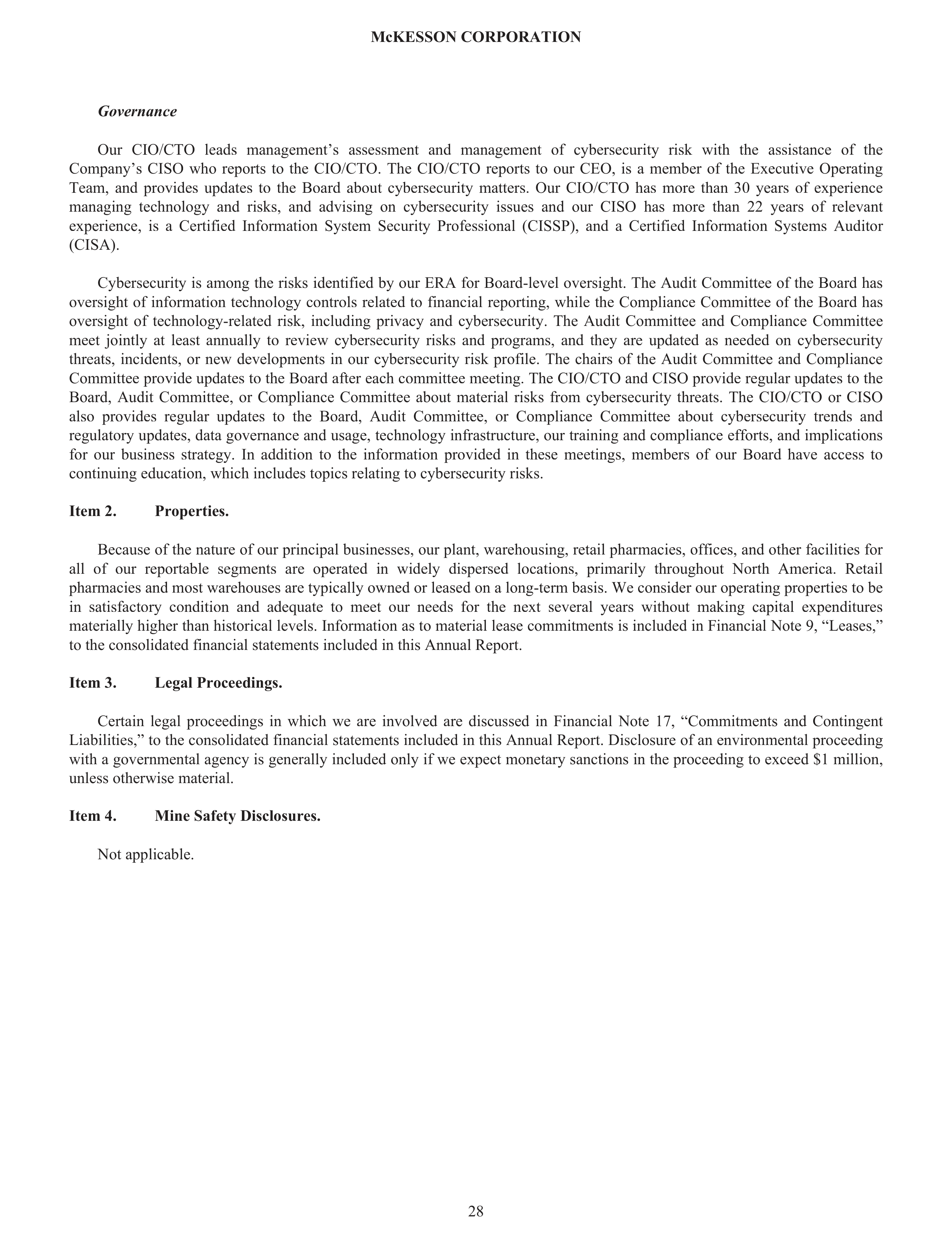
Governance
Our
CIO/CTO
leads
management’s
assessment
and
management
of
cybersecurity
risk
with
the
assistance
of
the
Company’s
CISO
who
reports
to
the
CIO/CTO.
The
CIO/CTO
reports
to
our
CEO,
is
a
member
of
the
Executive
Operating
Team,
and
provides
updates
to
the
Board
about
cybersecurity
matters.
Our
CIO/CTO
has
more
than
30
years
of
experience
managing
technology
and
risks,
and
advising
on
cybersecurity
issues
and
our
CISO
has
more
than
22
years
of
relevant
experience,
is
a
Certifie
f
d
Information
System
Security
Profes
f
sional
(CISSP),
and
a
Certifie
f
d
Information
Systems
Auditor
(CISA).
Cybe
ybersecu
iri yty is am
g
ong
hthe
iri
k
sks ididen if
tifie
f
d by
b
our ERA
R
for Board-level oversigight.
h
The Audidit Co
i
mmittee of
hthe Board has
oversigight
of
information
technology
controls
related
to
financial
reporting,
while
the
Compliance
Committee
of
the
Board
has
oversight
of
te
h
ch
l
nol
gy
ogy-related
risk,
including
privacy
and
cybersecurity.
The
Audit
Committee
and
Compliliance
Co
i
mmittee
meet
jojoin ltly
at
least
annualllly
to
re
iview
y
cybersecurity
ity
iri
k
sks
and
pr
g
ograms,
and
they
are
d
updated
as
ne
d
ed
d
ed
on
y
cybersecurity
ity
hthreats,
in
icidents,
or
new
developments
in
our
cybersecurity
iri
k
sk
profilil
f
e.
h
The
h
ch
iairs
of
hthe
Audidit
Committee
and
Compliliance
Co
i
mmittee pr
p
ovide
d
updates to
hthe Board afte
f
r each committee meeting. The CIO/CTO and CISO provide regular updates to
hthe
Board,
Audidit
Committee,
or
Compliliance
Committee
about
material
risks
from
cybersecurity
threats.
The
CIO/CTO
or
CISO
also
provides
regular
updates
to
the
Board,
Audit
Committee,
or
Compliance
Committee
about
y
cybersecurity
trends
and
regul
gulatory
r
d
updates, data governance and usage, technology infrastructur
t
e, our training and compliance effo
f
rts, and im
lplications
for
our
business
strategy
gy.
In
d
addidi ition
to
hthe
information
pr
i
ovided
in
hthese
meetings,
me
b
mbers
of
our
Board
have
access
to
contin
iui
g
ng
d
educ
d
ation,
h
which in
lcl
d
udes to
ipics rela iting to
y
cybersecurity
ity
iri
k
sks.
Item 2.
Properties.
Because of the nature of our principal businesses, our plant, warehousing, retail pharmacies, offi
f
ces, and other facilities for
all
of
our
reportabl
a
e
segments
are
operated
in
widely
dispersed
locations,
primarily
throughout
North
America.
Retail
pharmacies and most warehouses are typically owned or leased on a long-term basis. We consider our operating properties to be
in
satisfactory
r
condition
and
adequate
to
meet
our
needs
for
the
next
several
years
without
making
capital
expenditures
materially higher than historical levels. Information as to material lease commitments is included in Financial Note 9, “Leases,”
to the consolidated financial statements included in this Annual Report.
Item 3.
Legal Proceedings.
Certain
legal
proceedings
in
which
we
are
involved
are
discussed
in
Financial
Note
17,
“Commitments
and
Contingent
Liabilities,” to the consolidated financial statements included in this Annual Report. Disclosure of an environmental proceeding
with a governmental agency is generally included only if we expect monetary sanctions in the proceeding to exceed $1 million,
unless otherwise material.
Item 4.
Mine Safet
f
y Disclosures.
Not applicable.
McKESSON CORPORAT
R
ION
28
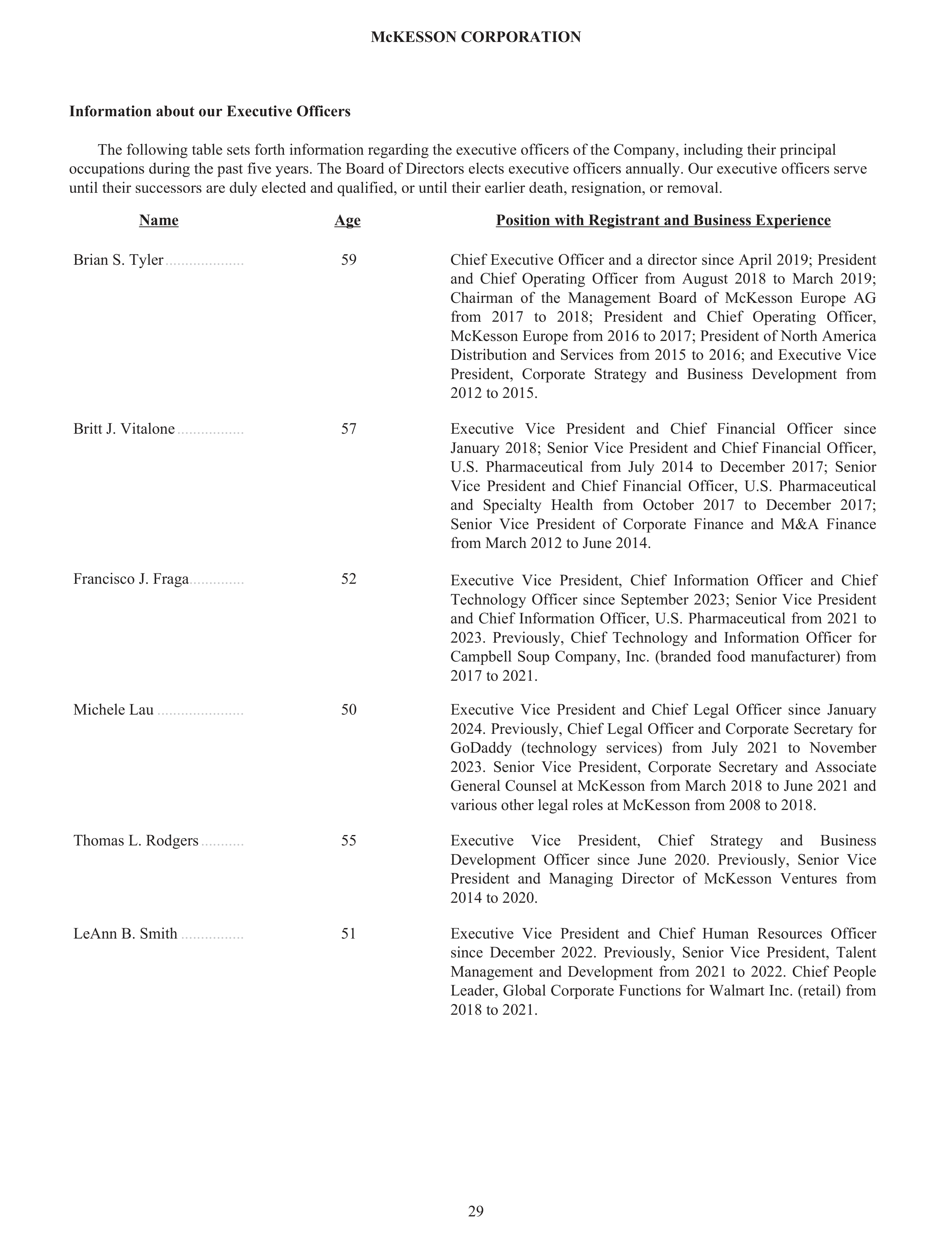
Information about our Executive Offi
f
cers
The following tabl
a
e sets forth information regarding the executive offi
f
cers of the Company, including their principal
occupa
u
tions during the past five years. The Board of Directors elects executive offi
f
cers annually. Our executive offi
f
cers serve
until their successors are duly elected and qualifie
f
d, or until their earlier death, resignation, or removal.
Name
Age
g
Position with Registrant and Business Experience
g
p
Brian S. Tyler
....................
59
Chief Executive Offi
f
cer and a director since April 2019; President
and
Chief
Operating
Offi
f
cer
from
August
2018
to
March
2019;
Chairman
of
the
Management
Board
of
McKesson
Europe
AG
from
2017
to
2018;
President
and
Chief
Operating
Offi
f
cer,
McKesson Europe from 2016 to 2017; President of North America
Distribution
and
Services
from
2015
to
2016;
and
Executive
Vice
President,
Corporate
Strategy
and
Business
Development
from
2012 to 2015.
Britt J. Vitalone
.................
57
Executive
Vice
President
and
Chief
Financial
Offi
f
cer
since
January
2018;
Senior
Vice
President
and
Chief
Financial
Offi
f
cer,
U.S.
Pharmaceutical
from
July
2014
to
December
2017;
Senior
Vice
President
and
Chief
Financial
Offi
f
cer,
U.S.
Pharmaceutical
and
Specialty
Health
from
October
2017
to
December
2017;
Senior
Vice
President
of
Corporate
Finance
and
M&A
Finance
from March 2012 to June 2014.
Francisco J. Fraga
..............
52
Executive
Vice
President,
Chief
Information
Offi
f
cer
and
Chief
Technology
Offi
f
cer
since
September
2023;
Senior
Vice
President
and
Chief
Information
Offi
f
cer,
U.S.
Pharmaceutical
from
2021
to
2023.
Previously,
Chief
Technology
and
Information
Offi
f
cer
for
Campbell
Soup
Company,
Inc.
(branded
food
manufac
f
turer)
from
2017 to 2021.
Michele Lau
......................
50
Executive
Vice
President
and
Chief
Legal
Offi
f
cer
since
January
2024. Previously, Chief Legal Offi
f
cer and Corporate Secretary
r
for
GoDaddy
(technology
services)
from
July
2021
to
November
2023.
Senior
Vice
President,
Corporate
Secretary
r
and
Associate
General Counsel at McKesson from March 2018 to June 2021 and
various other legal roles at McKesson from 2008 to 2018.
Thomas L. Rodgers
...........
55
Executive
Vice
President,
Chief
Strategy
and
Business
Development
Offi
f
cer
since
June
2020.
Previously,
Senior
Vice
President
and
Managing
Director
of
McKesson
Ventur
t
es
from
2014 to 2020.
LeAnn B. Smith
................
51
Executive
Vice
President
and
Chief
Human
Resources
Offi
f
cer
since
December
2022.
Previously,
Senior
Vice
President,
Talent
Management
and
Development
from
2021
to
2022.
Chief
People
Leader, Global Corporate Functions for Walmart Inc. (retail) from
2018 to 2021.
McKESSON CORPORAT
R
ION
29
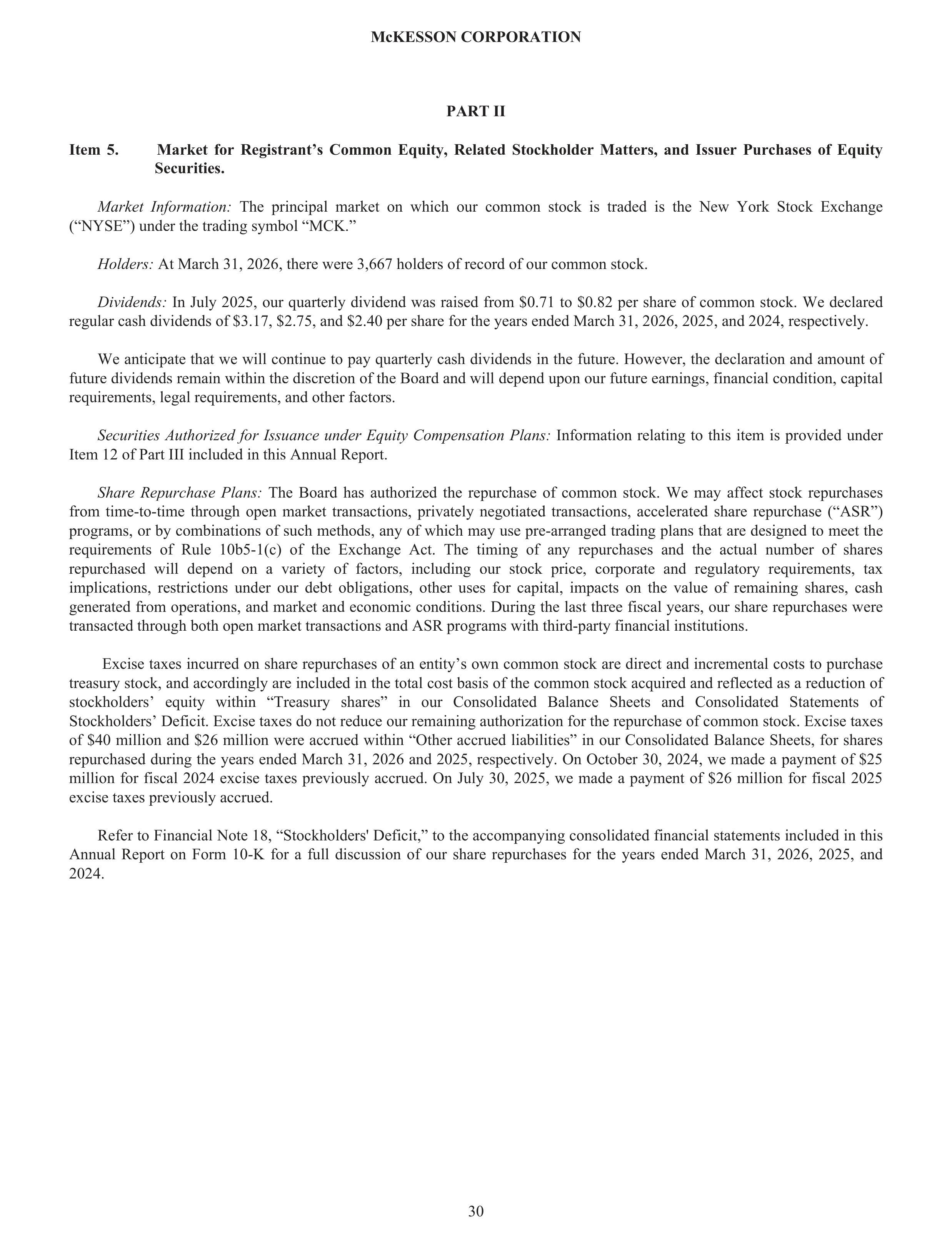
PART II
Item
5.
Market
for
Registrant’s
Common
Equity,
Related
Stockholder
Matters,
and
Issuer
Purchases
of
Equity
Securities.
Market
k
Info
n
rmation:
The
principal
market
on
which
our
common
stock
is
traded
is
the
New
York
Stock
Exchange
(“NYSE”) under the trading symbol “MCK.”
Holder
d
s:
r
At March 31, 2026, there were 3,667 holders of record of our common stock.
Dividends:
In
July
2025,
our
quarterly
dividend
was
raised
from
$0.71
to
$0.82
per
share
of
common
stock.
We
declared
regular cash dividends of $3.17, $2.75, and $2.40 per share for the years ended March 31, 2026, 2025, and 2024, respectively.
We anticipate that we will continue to pay quarterly cash dividends in the future. However, the declaration and amount of
future dividends remain within the discretion of the Board and will depend upon our future earnings, financial condition, capital
requirements, legal requirements, and other factors.
Securities
Authorized
for
Issuance
under
Equity
Compensation
Plans:
Information
relating
to
this
item
is
provided
under
Item 12 of Part III included in this Annual Report.
Share
Repur
e
chase
Plans:
The
Board
has
authorized
the
repurchase
of
common
stock.
We
may
affe
f
ct
stock
repurchases
from
time-to-time
through
open
market
transactions,
privately
negotiated
transactions,
accelerated
share
repurchase
(“ASR”)
programs, or by combinations of such methods, any of which may use pre-arranged trading plans that are designed to meet the
requirements
of
Rule
10b5-1(c)
of
the
Exchange
Act.
The
timing
of
any
repurchases
and
the
actua
t
l
number
of
shares
repurchased
will
depend
on
a
variety
of
factors,
including
our
stock
price,
corporate
and
regulatory
r
requirements,
tax
implications,
restrictions
under
our
debt
obligations,
other
uses
for
capital,
impacts
on
the
value
of
remaining
shares,
cash
generated from operations, and market and economic conditions. During the last three fiscal years, our share repurchases were
transacted through both open market transactions and ASR programs with third-party financial institutions.
Excise taxes incurred on share repurchases of an entity’s own common stock are direct and incremental costs to purchase
treasury
r
stock, and accordingly are included in the total cost basis of the common stock acquired and reflected as a reduction of
stockholders’
equity
within
“Treasury
r
shares”
in
our
Consolidated
Balance
Sheets
and
Consolidated
Statements
of
Stockholders’ Deficit. Excise taxes do not reduce our remaining authorization for the repurchase of common stock. Excise taxes
of
$40
million
and
$26
million
were
accrued
within
“Other
accrue
r
d
liabi
a
lities”
in
our
Consolidated
Balance
Sheets,
for
shares
repurchased
during
the
years
ended
March
31,
2026
and
2025,
respectively.
On
October
30,
2024,
we
made
a payment of
$25
million
for
fiscal
2024
excise
taxes
previously
accrue
r
d.
On
July
30,
2025,
we
made
a
payment
of
$26
million
for
fiscal
2025
excise taxes previously accrued.
Refer to Financial Note 18, “Stockholders' Deficit,” to the accompanying consolidated financial statements included in this
Annual
Report
on
Form
10-K
for
a
full
discussion
of
our
share
repurchases
for
the
years
ended
March
31,
2026,
2025,
and
2024.
McKESSON CORPORAT
R
ION
30
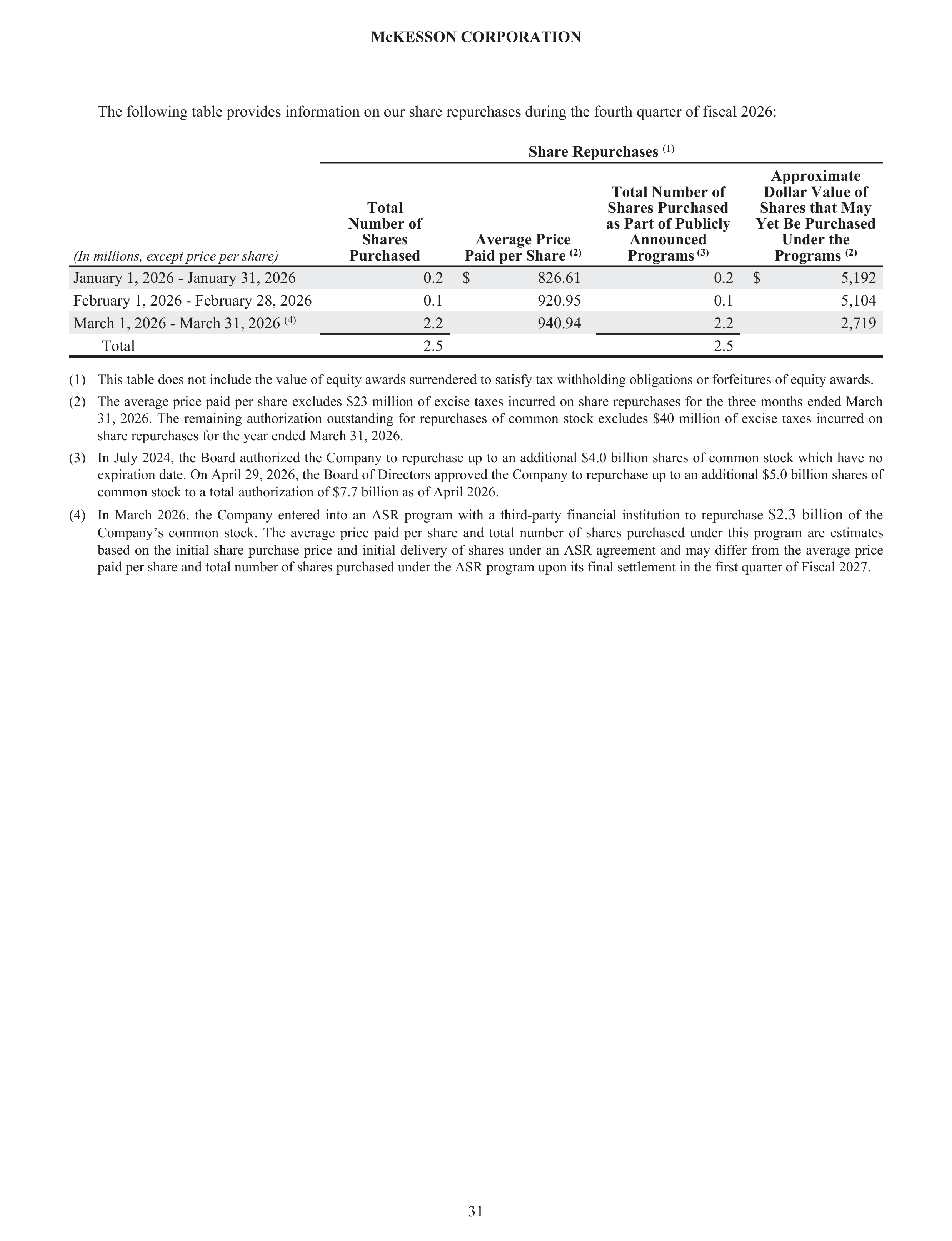
The following tabl
a
e provides information on our share repurchases during the fourth quarter of fiscal 2026:
Share Repurchases
(1)
(In millions, except price per share)
Total
Number of
Shares
Purchased
Average Price
Paid per Share
(2)
Total Number of
Shares Purchased
as Part of Publicly
Announced
Programs
(3)
Approximate
Dollar Value of
Shares that May
Yet Be Purchased
Under the
Programs
(2)
January 1, 2026 - January 31, 2026
0.2
$
826.61
0.2
$
5,192
Februa
r
ry 1, 2026 - Februa
r
ry 28, 2026
0.1
920.95
0.1
5,104
March 1, 2026 - March 31, 2026
(4)
2.2
940.94
2.2
2,719
Total
2.5
2.5
(1)
This tabl
a
e does not include the value of equity awards surrendered to satisfy tax withholding obligations or forfeitures of equity awards.
(2)
The
average
price
paid
per
share
excludes $23
million
of
excise
taxes
incurred
on
share
repurchases
for
the three
months
ended
March
31,
2026.
The
remaining
authorization
outstanding
for
repurchases
of
common
stock
excludes
$40
million
of
excise
taxes
incurred
on
share repurchases for the year ended March 31, 2026.
(3)
In
July
2024,
the
Board
authorized
the
Company
to
repurchase
up
to
an
additional
$4.0
billion
shares
of
common
stock
which
have
no
expiration date. On April 29, 2026, the Board of Directors approved the Company to repurchase up to an additional $5.0 billion shares of
common stock to a total authorization of $7.7 billion as of April 2026.
(4)
In
March
2026,
the
Company
entered
into
an
ASR
program
with
a
third-party
financial
institution
to
repurchase
$2.3
billion
of
the
Company’s
common
stock.
The
average
price
paid
per
share
and
total
number
of
shares
purchased
under
this
program
are
estimates
based
on
the
initial
share
purchase
price
and
initial
delivery
r
of
shares
under
an
ASR
agreement
and
may
differ
from
the
average
price
paid per share and total number of shares purchased under the ASR program upon its final settlement in the first quarter of Fiscal 2027.
McKESSON CORPORAT
R
ION
31
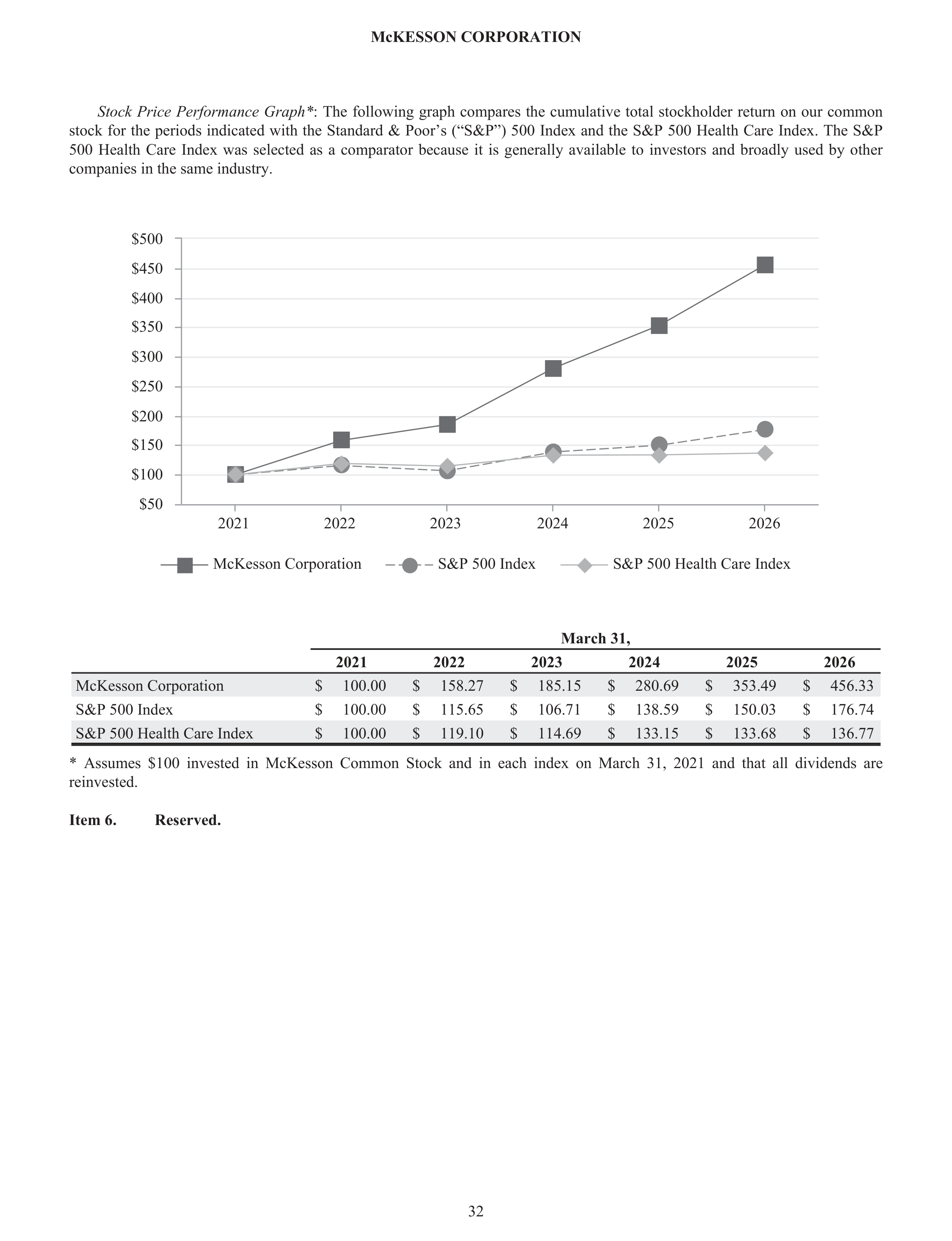
Stock
Price
Perfor
f
mance
Graph*
:
The
following
graph
compares
the
cumulative
total
stockholder
return
on
our
common
stock
for
the
periods
indicated
with
the
Standard
&
Poor’s
(“S&P”)
500
Index
and
the
S&P
500
Health
Care
Index.
The
S&P
500
Health
Care
Index
was
selected
as
a
comparator
because
it
is
generally
availabl
a
e
to
investors
and
broadly
used
by
other
companies in the same industry.
r
McKesson Corporation
S&P 500 Index
S&P 500 Health Care Index
2021
2022
2023
2024
2025
2026
$50
$100
$150
$200
$250
$300
$350
$400
$450
$500
March 31,
2021
2022
2023
2024
2025
2026
McKesson Corporation
$
100.00
$
158.27
$
185.15
$
280.69
$
353.49
$
456.33
S&P 500 Index
$
100.00
$
115.65
$
106.71
$
138.59
$
150.03
$
176.74
S&P 500 Health Care Index
$
100.00
$
119.10
$
114.69
$
133.15
$
133.68
$
136.77
*
Assumes
$100
invested
in
McKesson
Common
Stock
and
in
each
index
on
March
31,
2021
and
that
all
dividends
are
reinvested.
Item 6.
Reserved.
McKESSON CORPORAT
R
ION
32
Item 7.
Management’s Discussion and Analysis of Financial Condition and Results of Operations.
INDEX TO MANAGEMENT’S DISCUSSION AND ANALYSIS
Section
Page
g
General
.................................................................................................................................................................................
33
Overview of Our Business
...................................................................................................................................................
33
Executive Summary
.............................................................................................................................................................
35
Trends and Uncertainties
......................................................................................................................................................
36
Overview of Consolidated Results
.......................................................................................................................................
37
Overview of Segment Results
..............................................................................................................................................
42
Foreign Operations
...............................................................................................................................................................
45
Business Combinations
........................................................................................................................................................
45
Fiscal 2027 Outlook
.............................................................................................................................................................
45
Critical Accounting Estimates
..............................................................................................................................................
46
Financial Condition, Liquidity, and Capital Resources
.......................................................................................................
51
Related Party Balances and Transactions
............................................................................................................................
56
New Accounting Pronouncements
.......................................................................................................................................
56
GENERAL
Management’s
discussion
and
analysis
of
financial
condition
and
results
of
operations,
referred
to
as
the
“Financial
Review,”
is
intended
to
assist
the
reader
in
the
understanding
and
assessment
of
significant
changes
and
trends
related
to
the
results
of
operations
and
financial
position
of
McKesson
Corporation
together
with
its
subs
u
idiaries
(collectively,
the
“Company,”
“McKesson,”
“we,”
“our,”
or
“us”
and
other
similar
pronouns).
This
discussion
and
analysis
should
be
read
in
conjunction
with
the
consolidated
financial
statements
and
accompanying
financial
notes
in
Item
8
of
Part
II
of
this
Annual
Report on Form 10-K (“Annual Report”).
Our fiscal year begins on April 1 and ends on March 31. Unless otherwise noted, all references to a particular year refer to
our fiscal year.
Our Financial Review within this Annual Report generally discusses fiscal 2026 and fiscal 2025 results and year-over-year
comparisons between fiscal 2026 and fiscal 2025. For a discussion of our year-over-year comparisons between fiscal 2025 and
fiscal 2024, refer to Item 7. Management’s Discussion and Analysis of Financial Condition and Results of Operations of Part II
of
our
Annual
Report
on
Form
10-K
for
the
year
ended
March
31,
2025,
previously
filed
with
the
Securities
and
Exchange
Commission on May 9, 2025.
Certain statements in this Annual Report constitut
t
e forward-looking statements. See Item 1 - Business - Forward-Looking
Statements in Part I of this Annual Report for additional factors relating to these statements and Item 1A - Risk Factors in Part I
of this Annual Report for a list of certain risk factors applicable to our business, financial condition and liquidity, and results of
operations.
Overview of Our Busine
i
ss:
We are a diversifie
f
d healthcare services leader dedicated to advancing health outcomes for patients everyw
r
here. Our teams
partner
with
biopharma
companies,
care
providers,
pharmacies,
manufact
f
ur
t
ers,
governments,
and
others
to
deliver
insights,
products, and services to help make quality care more accessible and affo
f
rdable.
We
implemented
a
new
segment
reporting
structur
t
e
commencing
in
the
second
quarter
of
fiscal
2026,
which
resulted
in
four reportabl
a
e segments: North American Pharmaceutical, Oncology & Multispecialty, Prescription Technology Solutions, and
McKESSON CORPORAT
R
ION
FINANCIAL REVIEW
33
Medical-Surgical Solutions. Our former Norw
g
egian opera itions were in
lcl
d
uded in Other. All prior segment information has been
recast
to
reflect
our
new
segment
structur
t
e
and
current
period
presentation.
Our
organizational
structur
t
e
also
includes
Corporate,
which
consists
of
income
and
expenses
associated
with
administrative
functions
and
projects,
as
well
as
the
results
of certain investments. The factors for determining the reportabl
a
e segments include the manner in which management evaluates
the
performance
of
the
Company
combined
with
the
nature
of
individual
business
activities.
We
evaluate
the
perform
f
ance
of
our
operating
segments
on
a
number
of
measures,
including
revenues
and
operating
profit
f
before
interest
expense
and
income
taxes.
The
following
summarizes
our
four
reportabl
a
e
segments.
Refer
to
Financial
Note
20,
“Segments
of
Business,”
the
consolidated financial statements included in this Annual Report for further information regarding our reportabl
a
e segments.
•
North American Pharmaceutical
segment provides distribution and logistics services for branded, generic, specialty,
biosimilar, and over-the-counter pharmaceutical drug
r
s along with other healthcare-related products to customers in the
United
States
(“U.S.”)
and
Canada.
In
addition,
the
segment
sells
financial,
operational,
and
clinical
solutions
to
pharmacies
(retail,
hospital,
alternate
sites)
and
provides
consulting,
outsourcing,
technological,
and
other
services.
The
U.S.
distribution
operations
were
previously
included
in
the
former
U.S.
Pharmaceutical
reportabl
a
e
segment
and
the Canadian operations were previously included in the former International reportabl
a
e segment.
•
Oncology
&
Multispecialty
segment
includes
provider
solutions
that
encompass
specialty
drug
r
distribution,
group
purchasing organizations, infusion services, direct to patient pharmacy capabilities, cell and gene therapy services with
InspiroGene,
technology
solutions,
practice
consulting
services,
and
vaccine
distribution.
In
d
addidi ition,
hthe
segment
suppor
u
ts
hthe
U.S.
Oncology
gy
Network,
one
of
hthe
la
g
rgest
networks
of
phys
physician-led,
integrat
d
ed,
comm
i
uni yty
b
-based
onc
lol
gy
ogy
pr
p
actices
dedicated
to
advancing
high-quality,
evidence-based
cancer
care
in
the
U.S.,
and
includes
PRISM
Vision
Holdings,
LLC
(“PRISM
Vision”),
which
drives
pa itient
outcomes
in
a
re itina
and
h
ophthalmology
gy
se
i
tti
g
ng.
Co
b
mbin
d
ed
i
wi hth Sarah Cannon Resear
h
ch Institute and our te
h
ch
l
nol
gy
ogy business, Ontada,
hthis segment pr
i
ovides resear
h
ch,
in
isight
ghts,
te
h
ch
l
nologi
ogies,
and
services
hthat
d
address
and
improve
cancer
and
sp
i
eci
lal yty
care.
This
segment
was
previously
reflected in the former U.S. Pharmaceutical reportabl
a
e segment.
•
Prescription
Technology
Solutions
segment
combines
automation
and
our
ability
to
navigate
the
healthcare
ecosystem
to
connect
patients,
pharmacies,
providers,
pharmacy
benefit
managers,
health
plans,
and
biopharma
companies
to
address
patients’
medication
access,
affo
f
rdability,
and
adherence
challenges.
Prescription
Technology
Solutions
offe
f
rs
technology
services,
which
includes
electronic
prior
authorization,
prescription
price
transparency,
benefit
insight,
dispensing
supp
u
ort
services,
and
patient
enrollment,
in
addition
to
third-party
logistics,
and
wholesale
distribution
suppor
u
t
across
various
therapeutic
categories
and
temperatur
t
e
ranges
to
biopharma
customers
throughout
the product lifecy
f
cle.
•
Medical-Surgical Solutions
segment provides medical-surgical, labor
a
atory,
r
and pharmaceutical distribution, logistics,
and
other
services
to
U.S.
healthcare
providers
operating
in
the
non-acute
settings.
These
include
ambulatory
r
care
environments, such as physician offi
f
ces, surgery
r
centers, and hospital reference labs
a
, as well as extended care settings,
including
nursing
homes,
hospice
and
home
health
care
agencies,
government
facilities,
and
online
marketpl
t
aces
and
retailers.
This
segment
offe
f
rs
national
brand
medical-surgical
products
as
well
as
our
own
line
of
more
than
4,000
high-quality products through a network of distribution centers within the U.S. During fiscal 2026, we announced our
intention
to
separate
this
segment
into
an
independent
company.
As
a
part
of
the
separation
strategy,
on
April
20,
2026,
we
announced
a
definitive
agreement
under
which
funds
managed
by
affi
f
liates
of
Apollo
Global
Management,
Inc.
(“Apollo
Funds”)
will
acquire
approximately
13%
minority
ownership
interest
in
our
Medical
-
Surgical
Solutions
segment
through
an
investment
of
approximately
$1.25
billion
in
the
segment’s
convertible
prefer
f
red
equity.
The
transaction is subj
u
ect to regulatory
r
approvals and customary
r
closing conditions.
Our
former
Norwegian
operations,
which
provided
distribution
and
services
to
wholesale
and
retail
customers
in
Norway
where we owned, partnered, or franchised with retail pharmacies, were included in Other. During fiscal 2026, we completed the
transaction
to
sell
our
businesses
in
Norway
(“Norway
disposal
group”).
This
divestiture
is
further
described
in
the
“Business
Acquisitions and Divestitures” section below.
McKESSON CORPORAT
R
ION
FINANCIAL REVIEW (Continued)
34
Busine
i
ss Acquisitio
t
ns and Divestitu
t
res
Nor
N
wegi
e
an Divestiture Activities
On January 30, 2026, we completed the sale of our Norway disposal group for an adju
d
sted purchase price of $821 million.
We
recorded
a
net
gain
of
$480
million
for
the
year
ended
March
31,
2026
in
total
operating
expenses.
The
gain
includes
a
$164 million loss related to the accumulated other comprehensive loss balances associated with the disposal group.
PRISM
I
Visi
i
on Holdings, LLC
On
April
1,
2025,
we
completed
the
acquisition
of
a
controlling
interest
in
PRISM
Vision,
a
leading
provider
of
general
ophthalmology and retina administrative services. We acquired an 80% interest in PRISM Vision for $875 million in cash, and
prior
owners,
including
management
and
physicians
in
PRISM
Vision
practices,
retained
a
20%
ownership
interest.
As
of
the
acquisition date, the financial results of PRISM Vision are reported within our Oncology & Multispecialty segment.
Community Oncology Revitalization Enterprise
i
Ventures, LLC
On June 2, 2025, we completed the acquisition of a controlling interest in Community Oncology Revitalization Enterprise
Ventur
t
es, LLC (“Core Ventur
t
es”), a business and administrative services organization establ
a
ished by Florida Cancer Specialists
& Research Institute, LLC, (“FCS”). We acquired a 70% controlling interest in Core Ventur
t
es for $2.5 billion in cash and FCS
physicians retained a 30% ownership interest. As of the acquisition date, Core Ventur
t
es is a part of the Oncology platform and
financial results are reported within our Oncology & Multispecialty segment.
Refer
to
Financial
Note
2,
“Business
Acquisitions
and
Divestitures,”
to
the
consolidated
financial
statements
included
in
this Annual Report for additional information regarding these transactions.
Executive Summary:
The
following
summary
r
provides
highlights
and
key
factors
that
impacted
our
business,
operating
results,
financial
condition, and liquidity for the year ended March 31, 2026:
•
For
the
year
ended
March
31,
2026
compared
to
the
prior
year,
revenues
increased
by
12%,
gross
profit
f
increased
by
9%,
total
operating
expenses
decreased
by
6%,
and
other
income,
net
increased
by
17%.
Refer
to
the
“Overview
of
Consolidated Results” section below for an analysis of these changes;
•
Diluted
earnings
per
common
share
attributable
to
McKesson
Corporation
increased
to
$38.38
in
fiscal
2026
from
$25.72 in the prior year;
•
For
the
year
ended
March
31,
2026,
we
recorded
restructur
t
ing
charges
of
$170
million
related
to
an
enterprise-wide
initiative
to
drive
operational
effi
f
ciencies
as
further
described
in
the
“Restruc
r
turing
Initiatives”
section
of
“Overview
of Consolidated Results” below;
•
On April 1, 2025, we completed the acquisition of a controlling interest in PRISM Vision for $875 million in cash, as
discussed in further detail in the “
Business Acquisi
i
tions and Divestitures”
section above;
•
On
May
8,
2025,
we
entered
into
a
syndicated
$1.0
billion
364-Day
senior
unsecured
credit
facility
(the
“364-Day
Credit
Facility”)
that
was
scheduled
to
mature
in
May
2026
but
was
terminated
on
April
24,
2026
and
replaced
with
the
2026
5-Year
Facility
described
in
the
“
Recent
Developm
o
ents”
section
below.
Refer
to
Financial
Note
11,
“Debt
and
Financing
Activities,”
to
the
consolidated
financial
statements
included
in
this
Annual
Report
for
additional
information;
•
On
May
30,
2025,
we
completed
a
public
debt
offe
f
ring
of
4.65%
Notes
due
May
30,
2030
in
a
principal
amount
of
$650
million,
4.95%
Notes
due
May
30,
2032
in
a
principal
amount
of
$650
million,
and
5.25%
Notes
due
May
30,
2035 in a principal amount of $700 million, for total proceeds received, net of discounts and debt offe
f
ring expenses, of
2.0
billion.
The
net
proceeds
from
these
notes
in
addition
to
cash
on
hand
were
utilized
to
fund
the
purchase
of
our
interest
in
Core
Ventur
t
es.
Refer
to
Financial
Note
11,
“Debt
and
Financing
Activities,”
to
the
consolidated
financial
statements included in this Annual Report for additional information;
•
On
June
2,
2025,
we
completed
the
acquisition
of
a
controlling
interest
in
Core
Ventur
t
es
for
$2.5
billion
in
cash,
as
discussed in further detail in the “
Business Acquisi
i
tions and Divestitures”
section above;
McKESSON CORPORAT
R
ION
FINANCIAL REVIEW (Continued)
35
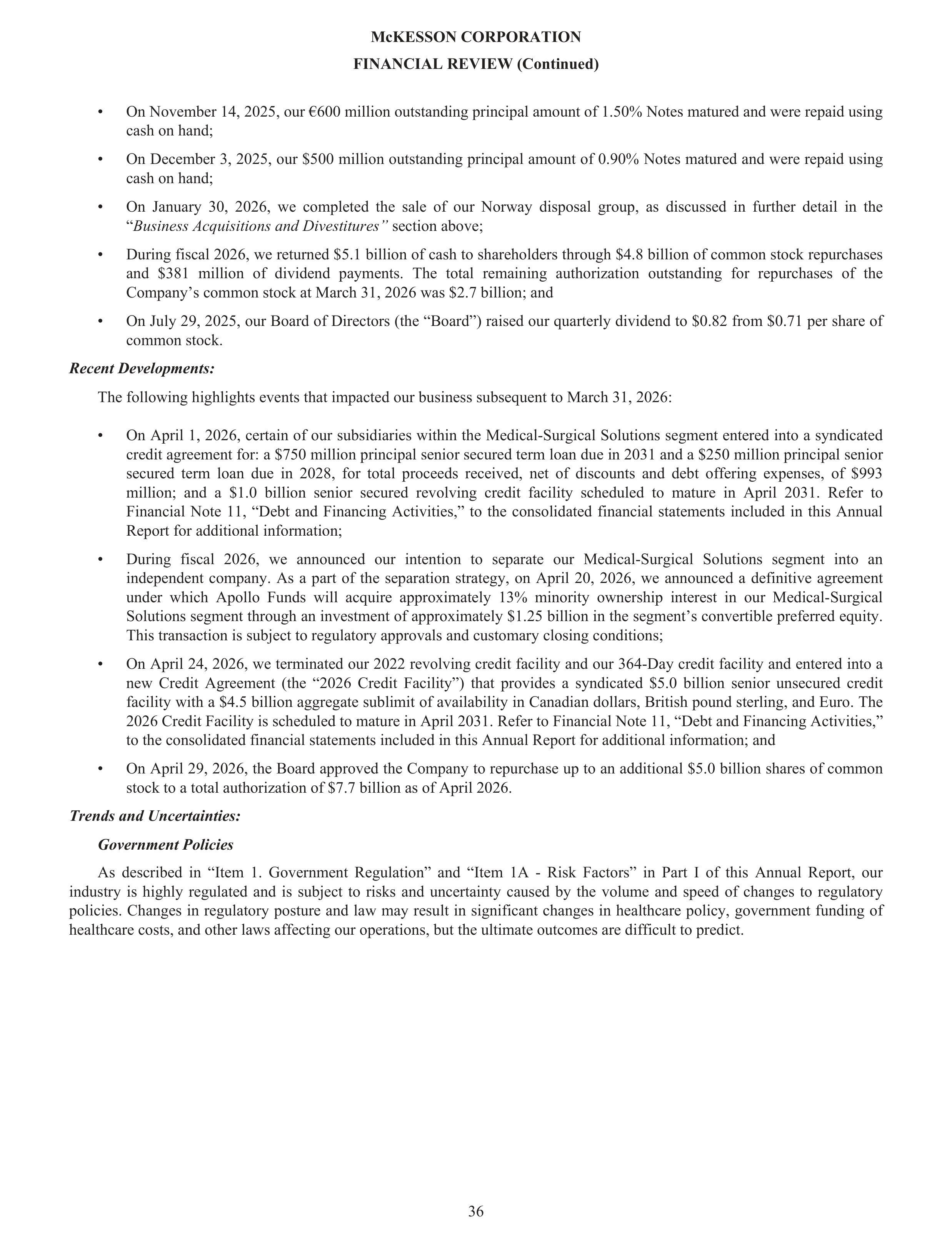
•
On November 14, 2025, our €600 million outstanding principal amount of 1.50% Notes matured and were repaid using
cash on hand;
•
On December 3, 2025, our $500 million outstanding principal amount of 0.90% Notes matured and were repaid using
cash on hand;
•
On
January
30,
2026,
we
completed
the
sale
of
our
Norway
disposal
group,
u
as
discussed
in
further
detail
in
the
“
Business Acquisi
i
tions and Divestitures”
section above;
•
During fiscal 2026, we returned $5.1 billion of cash to shareholders through $4.8 billion of common stock repurchases
and
$381
million
of
dividend
payments.
The
total
remaining
authorization
outstanding
for
repurchases
of
the
Company’s common stock at March 31, 2026 was $2.7 billion; and
•
On July 29, 2025, our Board of Directors (the “Board”) raised our quarterly dividend to $0.82 from $0.71 per share of
common stock.
Recent Developm
l
ents:
The following highlights events that impacted our business subs
u
equent to March 31, 2026:
•
On April 1, 2026, certain of our subs
u
idiaries within the Medical-Surgical Solutions segment entered into a syndicated
credit agreement for: a $750 million principal senior secured term loan due in 2031 and a $250 million principal senior
secured
term
loan
due
in
2028,
for
total
proceeds
received,
net
of
discounts
and
debt
offe
f
ring
expenses,
of
$993
million;
and
a
$1.0
billion
senior
secured
revolving
credit
facility
scheduled
to
mature
in
April
2031.
Refer
to
Financial
Note
11,
“Debt
and
Financing
Activities,”
to
the
consolidated
financial
statements
included
in
this
Annual
Report for additional information;
•
During
fiscal
2026,
we
announced
our
intention
to
separate
our
Medical-Surgical
Solutions
segment
into
an
independent
company.
As
a
part
of
the
separation
strategy,
on
April
20,
2026,
we
announced
a
definitive
agreement
under
which
Apollo
Funds
will
acquire
approximately
13%
minority
ownership
interest
in
our
Medical
-
Surgical
Solutions segment through an investment of approximately $1.25 billion in the segment’s convertible prefer
f
red equity.
This transaction is subj
u
ect to regulatory
r
approvals and customary
r
closing conditions;
•
On April 24, 2026, we terminated our 2022 revolving credit facility and our 364-Day credit facility and entered into a
new
Credit
Agreement
(the
“2026
Credit
Facility”)
that
provides
a
syndicated
$5.0
billion
senior
unsecured
credit
facility with a $4.5 billion aggregate subl
u
imit of availabi
a
lity in Canadian dollars, British pound sterling, and Euro. The
2026 Credit Facility is scheduled to mature in April 2031. Refer to Financial Note 11, “Debt and Financing Activities,”
to the consolidated financial statements included in this Annual Report for additional information; and
•
On April 29, 2026, the Board approved the Company to repurchase up to an additional $5.0 billion shares of common
stock to a total authorization of $7.7 billion as of April 2026.
Trends and Uncertainties:
Government Policies
As
described
in
“Item
1.
Government
Regulation”
and
“Item
1A
-
Risk
Factors”
in
Part
I
of
this
Annual
Report,
our
industry
r
is
highly
regulated
and
is
subj
u
ect
to
risks
and
uncertainty
caused
by
the
volume
and
speed
of
changes
to
regulatory
r
policies.
Changes
in
regulatory
r
posture
and
law
may
result
in
significant
changes
in
healthcare
policy,
government
funding
of
healthcare costs, and other laws affe
f
cting our operations, but the ultimate outcomes are difficult to predict.
McKESSON CORPORAT
R
ION
FINANCIAL REVIEW (Continued)
36
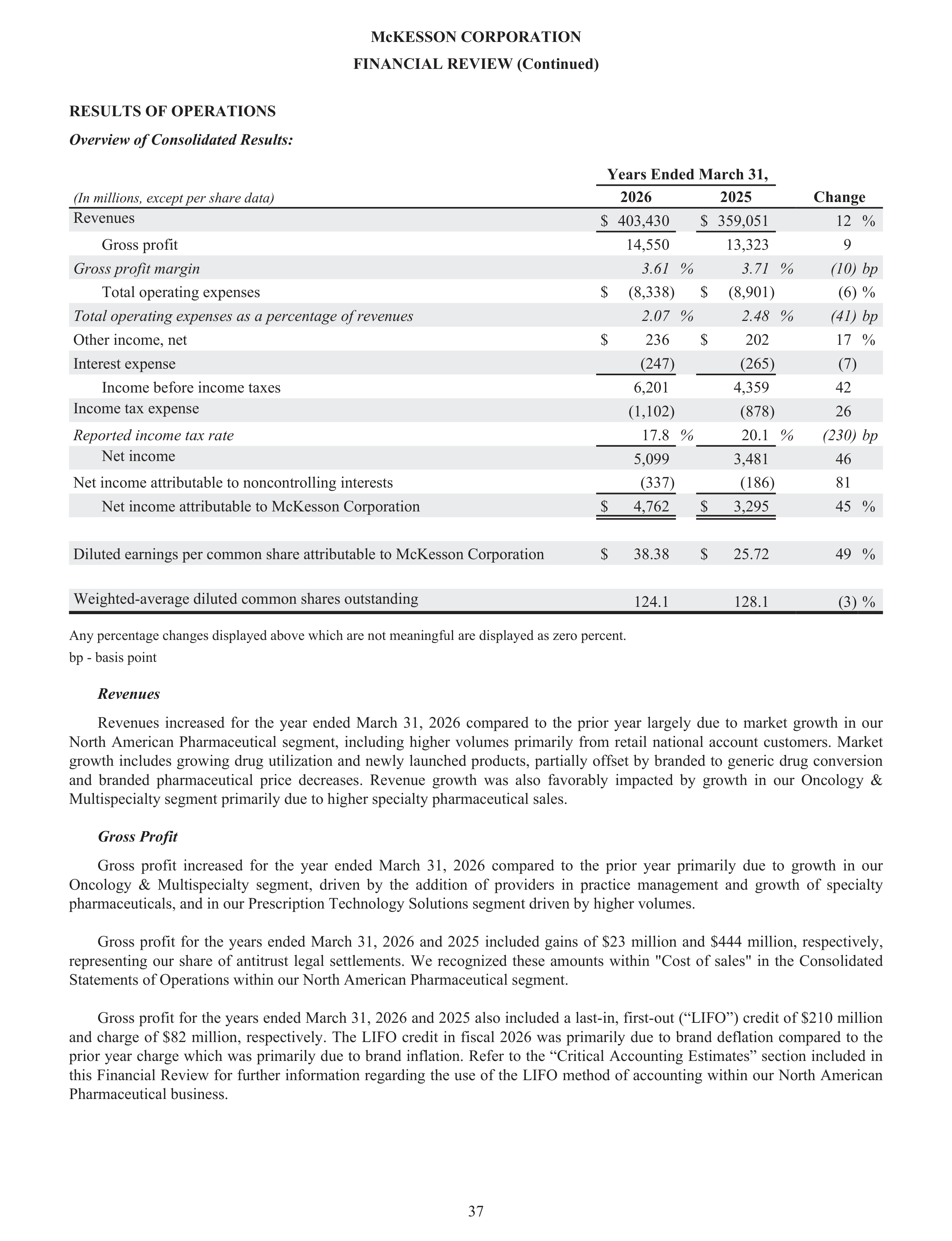
RESULTS OF OPERATIONS
Overview of Consolid
l
at
d
ed
t
Results:
(In millions, except per share data)
Years Ended March 31,
2026
2025
Change
Revenues
$
403,430
$
359,051
12
%
Gross profit
f
14,550
13,323
9
Gross profit
f
margin
3.61
%
3.71
%
(10)
(
bp
Total operating expenses
$
(8,338)
$
(8,901)
(6)
%
Total operating expe
x
nses as a percentage of revenues
2.07
%
2.48
%
(41)
(
bp
Other income, net
$
236
$
202
17
%
Interest expense
(247)
(265)
(7)
Income before income taxes
6,201
4,359
42
Income tax expense
(1,102)
(878)
26
Repor
e
ted income tax
a
rate
17.8
%
20.1
%
(230)
(
bp
Net income
5,099
3,481
46
Net income attributable to noncontrolling interests
(337)
(186)
81
Net income attributable to McKesson Corporation
$
4,762
$
3,295
45
%
Diluted earnings per common share attributable to McKesson Corporation
$
38.38
$
25.72
49
%
Weighted-average diluted common shares outstanding
124.1
128.1
(3)
%
Any percentage changes displayed above which are not meaningful
f
are displayed as zero percent.
bp - basis point
Revenues
Revenues
increased
for
the
year
ended
March
31,
2026
compared
to
the
prior
year
largely
due
to
market
growth
in
our
North
American
Pharmaceutical
segment,
including
higher
volumes
primarily
from
retail
national
account
customers.
Market
growth
includes
growing
drug
r
utilization
and
newly
launched
products,
partially
offs
f
et
by
branded
to
generic
drug
r
conversion
and
branded
pharmaceutical
price
decreases.
Revenue
growth
was
also
favorably
impacted
by
growth
in
our
Oncology
&
Multispecialty segment primarily due to higher specialty pharmaceutical sales.
Gross Profit
f
Gross
profit
f
increased
for
the
year
ended
March
31,
2026
compared
to
the
prior
year
primarily
due
to
growth
in
our
Oncology
&
Multispecialty
segment,
driven
by
the
addition
of
providers
in
practice
management
and
growth
of
specialty
pharmaceuticals, and in our Prescription Technology Solutions segment driven by higher volumes.
Gross
profit
f
for
the
years
ended
March
31,
2026
and
2025
included
gains
of
$23
million
and
$444
million,
respectively,
representing
our
share
of
antitrust
legal
settlements.
We
recognized
these
amounts
within
"Cost
of
sales"
in
the
Consolidated
Statements of Operations within our North American Pharmaceutical segment.
Gross profit
f
for the years ended March 31, 2026 and 2025 also included a last-in, first-out (“LIFO”) credit of $210 million
and
charge
of
$82
million,
respectively.
The
LIFO
credit
in
fiscal
2026
was
primarily
due
to
brand
deflation
compared
to
the
prior
year
charge
which
was
primarily
due
to
brand
inflation.
Refer
to
the
“Critical
Accounting
Estimates” section
included
in
this
Financial
Review
for
further
information
regarding
the
use
of
the
LIFO
method
of
accounting
within
our
North
American
Pharmaceutical business.
McKESSON CORPORAT
R
ION
FINANCIAL REVIEW (Continued)
37
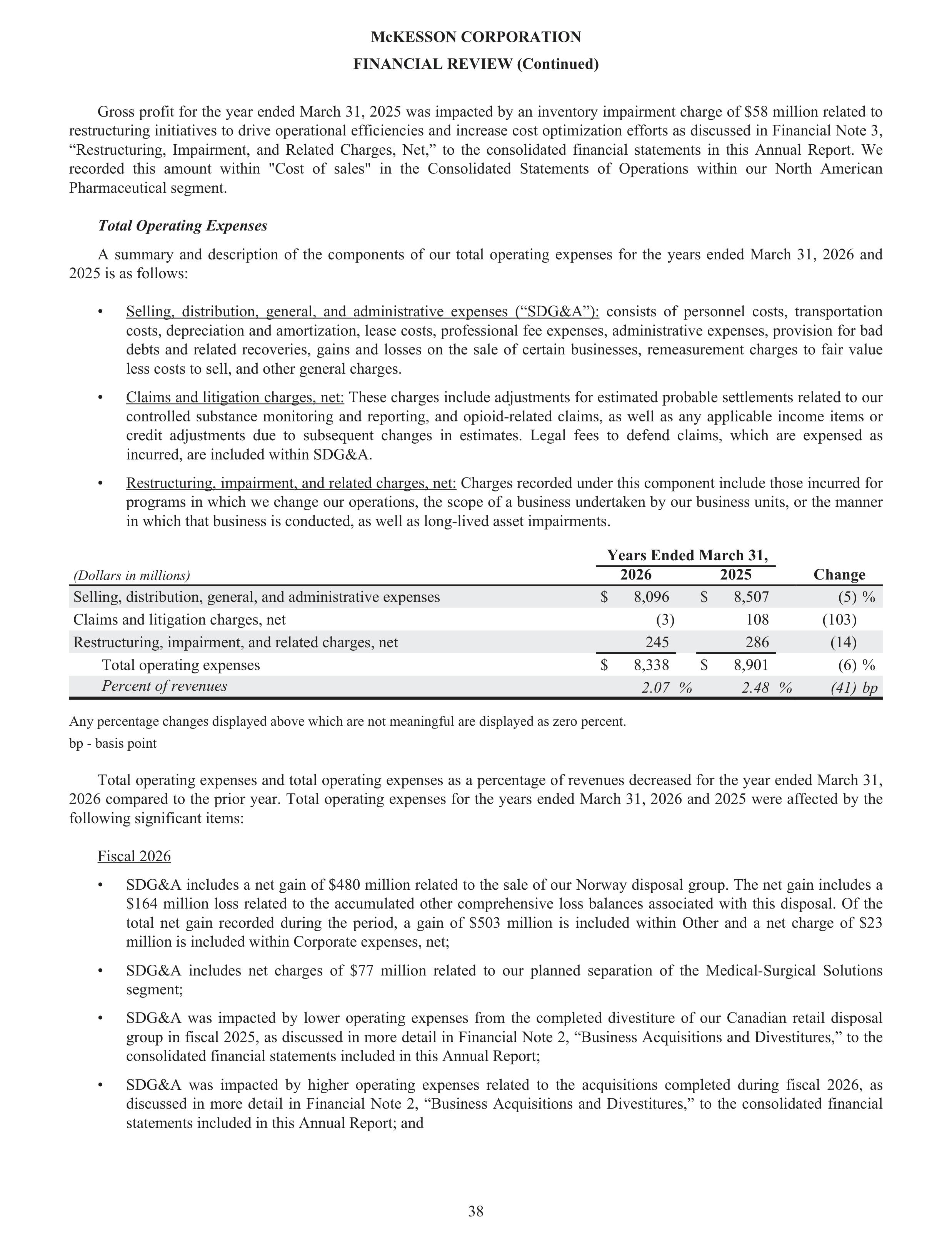
Gross profit
f
for the year ended March 31, 2025 was impacted by an inventory
r
impairment charge of $58 million related to
restructur
t
ing initiatives to drive operational effi
f
ciencies and increase cost optimization effo
f
rts as discussed in Financial Note 3,
“Restructuring,
Impairment,
and
Related
Charges,
Net,”
to
the
consolidated
financial
statements
in
this
Annual
Report.
We
recorded
this
amount
within
"Cost
of
sales"
in
the
Consolidated
Statements
of
Operations
within
our
North
American
Pharmaceutical segment.
Total Operatin
t
g Expe
x
nses
A
summary
and
description
of
the
components
of
our
total
operating
expenses
for
the
years
ended
March
31,
2026
and
2025 is as follows:
•
Selling,
distribution,
general,
and
administrative
expenses
(“SDG&A”):
g,
,
g
,
p
(
)
consists
of
personnel
costs,
transportation
costs, depreciation and amortization, lease costs, profes
f
sional fee expenses, administrative expenses, provision for bad
debts
and
related
recoveries,
gains
and
losses
on
the
sale
of
certain
businesses,
remeasurement
charges
to
fair
value
less costs to sell, and other general charges.
•
Claims and litigation charges, net:
g
g
,
These charges include adju
d
stments for estimated probabl
a
e settlements related to our
controlled
subs
u
tance
monitoring
and
reporting,
and
opioid-related
claims,
as
well
as
any
applicable
income
items
or
credit
adju
d
stments
due
to
subs
u
equent
changes
in
estimates.
Legal
fees
to
defend
claims,
which
are
expensed
as
incurred, are included within SDG&A.
•
Restruc
r
turing, impairment, and related charges, net:
g,
p
,
g
,
Charges recorded under this component include those incurred for
programs in which we change our operations, the scope of a business undertaken by our business units, or the manner
in which that business is conducted, as well as long-lived asset impairments.
Years Ended March 31,
(Dollars in millions)s
2026
2025
Change
Selling, distribution, general, and administrative expenses
$
8,096
$
8,507
(5)
%
Claims and litigation charges, net
(3)
108
(103)
Restructur
t
ing, impairment, and related charges, net
245
286
(14)
Total operating expenses
$
8,338
$
8,901
(6)
%
Percent of revenues
2.07
%
2.48
%
(41)
(
bp
Any percentage changes displayed above which are not meaningful
f
are displayed as zero percent.
bp - basis point
Total operating expenses and total operating expenses as a percentage of revenues decreased for the year ended March 31,
2026
compared
to
the
prior
year.
Total
operating
expenses
for
the
years
ended
March
31,
2026
and
2025
were
affe
f
cted
by
the
following significant items:
Fiscal 2026
•
SDG&A includes a net gain of $480 million related to the sale of our Norway disposal group.
u
The net gain includes a
$164
million
loss
related
to
the
accumulated
other
comprehensive
loss
balances
associated
with
this
disposal.
Of
the
total
net
gain
recorded
during
the
period,
a
gain
of
$503
million
is
included
within
Other
and
a
net
charge
of
$23
million is included within Corporate expenses, net;
•
SDG&A
includes
net
charges
of
$77
million
related
to
our
planned
separation
of
the
Medical
-
Surgical
Solutions
segment;
•
SDG&A
was
impacted
by
lower
operating
expenses
from
the
completed
divestiture
of
our
Canadian
retail
disposal
group in fiscal 2025, as discussed in more detail in Financial Note 2, “Business Acquisitions and Divestitures,” to the
consolidated financial statements included in this Annual Report;
•
SDG&A
was
impacted
by
higher
operating
expenses
related
to
the
acquisitions
completed
during
fiscal
2026,
as
discussed
in
more
detail
in
Financial
Note
2,
“Business
Acquisitions
and
Divestitures,”
to
the
consolidated
financial
statements included in this Annual Report; and
McKESSON CORPORAT
R
ION
FINANCIAL REVIEW (Continued)
38
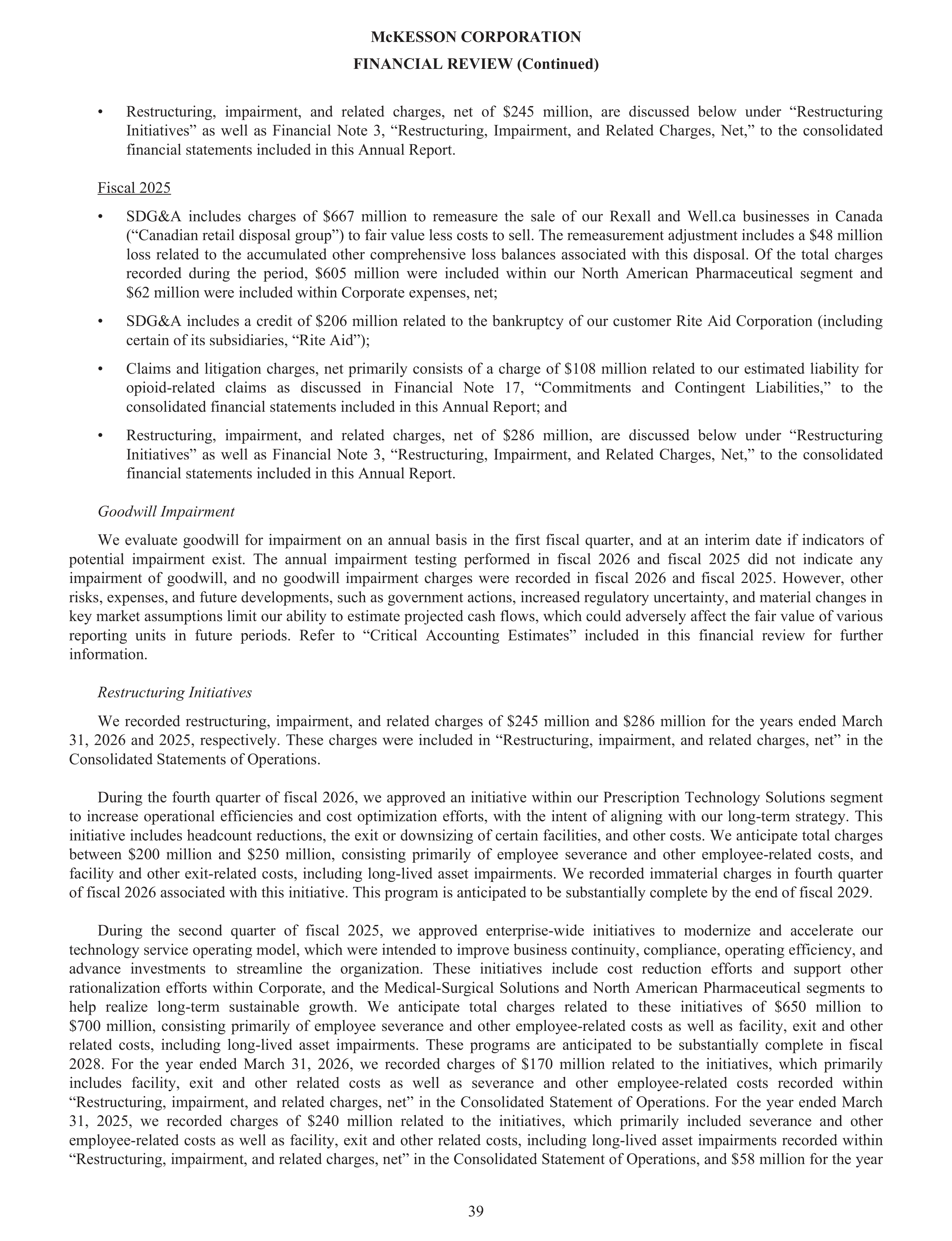
•
Restruc
r
turing,
impairment,
and
related
charges,
net
of
$245
million,
are
discussed
below
under
“Restruc
r
turing
Initiatives”
as
well
as
Financial
Note
3,
“Restructuring,
Impairment,
and
Related
Charges,
Net,”
to
the
consolidated
financial statements included in this Annual Report.
Fiscal 2025
•
SDG&A
includes
charges
of
$667
million
to
remeasure
the
sale
of
our
Rexall
and
Well.ca
businesses
in
Canada
(“Canadian retail disposal group”) to fair value less costs to sell. The remeasurement adju
d
stment includes a $48 million
loss
related
to
the
accumulated
other
comprehensive
loss
balances
associated
with
this
disposal.
Of
the
total
charges
recorded
during
the
period,
$605
million
were
included
within
our
North
American
Pharmaceutical
segment
and
$62 million were included within Corporate expenses, net;
•
SDG&A
includes
a
credit
of
$206
million
related
to
the
bankrupt
r
cy
of
our
customer
Rite
Aid
Corporation
(including
certain of its subs
u
idiaries, “Rite Aid”);
•
Claims
and
litigation
charges,
net
primarily
consists
of
a
charge
of
$108
million
related
to
our
estimated
liability
for
opioid-related
claims
as
discussed
in
Financial
Note
17,
“Commitments
and
Contingent
Liabilities,”
to
the
consolidated financial statements included in this Annual Report; and
•
Restruc
r
turing,
impairment,
and
related
charges,
net
of
$286
million,
are
discussed
below
under
“Restruc
r
turing
Initiatives”
as
well
as
Financial
Note
3,
“Restructuring,
Impairment,
and
Related
Charges,
Net,”
to
the
consolidated
financial statements included in this Annual Report.
Goodwill Impai
m
rment
We
evaluate
goodwill
for
impairment
on
an
annual
basis
in
the
first
fiscal
quarter,
and
at
an
interim
date
if
indicators
of
potential
impairment
exist.
The
annual
impairment
testing
performed
in
fiscal
2026
and
fiscal
2025
did
not
indicate
any
impairment
of
goodwill,
and
no
goodwill
impairment
charges
were
recorded
in
fiscal
2026
and
fiscal
2025.
However,
other
risks, expenses, and future developments, such as government actions, increased regulatory
r
uncertainty, and material changes in
key market assumptions limit our ability to estimate projected cash flows, which could adversely affe
f
ct the fair value of various
reporting
units
in
future
periods.
Refer
to
“Critical
Accounting
Estimates”
included
in
this
financial
review
for
further
information.
Restru
t
cturing Initiatives
We
recorded
restructur
t
ing,
impairment,
and
related
charges
of
$245
million
and
$286
million
for
the
years
ended
March
31,
2026
and
2025,
respectively.
These
charges
were
included
in
“Restruc
r
turing,
impairment,
and
related
charges,
net”
in
the
Consolidated Statements of Operations.
During
the
fourth
quarter
of
fiscal
2026,
we
approved
an
initiative
within
our
Prescription
Technology
Solutions
segment
to
increase
operational
effi
f
ciencies
and
cost
optimization
effo
f
rts,
with
the
intent
of
aligning
with
our
long-term
strategy.
This
initiative includes headcount reductions, the exit or downsizing of certain facilities, and other costs. We anticipate total charges
between
$200
million
and
$250
million,
consisting
primarily
of
employee
severance
and
other
employee-related
costs,
and
facility
and
other
exit-related
costs,
including
long-lived
asset
impairments.
We
recorded
immaterial
charges
in
fourth
quarter
of fiscal 2026 associated with this initiative. This program is anticipated to be subs
u
tantially complete by the end of fiscal 2029.
During
the
second
quarter
of
fiscal
2025,
we
approved
enterprise-wide
initiatives
to
modernize
and
accelerate
our
technology service operating model, which were intended to improve business continuity, compliance, operating effi
f
ciency, and
advance
investments
to
streamline
the
organization.
These
initiatives
include
cost
reduction
effo
f
rts
and
suppor
u
t
other
rationalization
effo
f
rts
within
Corporate,
and
the
Medical-Surgical
Solutions
and
North
American
Pharmaceutical
segments
to
help
realize
long-term
sustainabl
a
e
growth.
We
anticipate
total
charges
related
to
these
initiatives
of
$650
million
to
$700
million,
consisting
primarily
of
employee
severance
and
other
employee-related
costs
as
well
as
facility,
exit
and
other
related
costs,
including
long-lived
asset
impairments.
These
programs
are
anticipated
to
be
subs
u
tantially
complete
in
fiscal
2028.
For
the
year
ended
March
31,
2026,
we
recorded
charges
of
$170
million
related
to
the
initiatives,
which
primarily
includes
facility,
exit
and
other
related
costs
as
well
as
severance
and
other
employee-related
costs
recorded
within
“Restruc
r
turing,
impairment,
and
related
charges,
net”
in
the
Consolidated
Statement
of
Operations.
For
the
year
ended
March
31,
2025,
we
recorded
charges
of
$240
million
related
to
the
initiatives,
which
primarily
included
severance
and
other
employee-related
costs
as
well
as
facility,
exit
and
other
related
costs,
including
long-lived
asset
impairments
recorded
within
“Restruc
r
turing, impairment, and related charges, net” in the Consolidated Statement of Operations, and $58 million for the year
McKESSON CORPORAT
R
ION
FINANCIAL REVIEW (Continued)
39
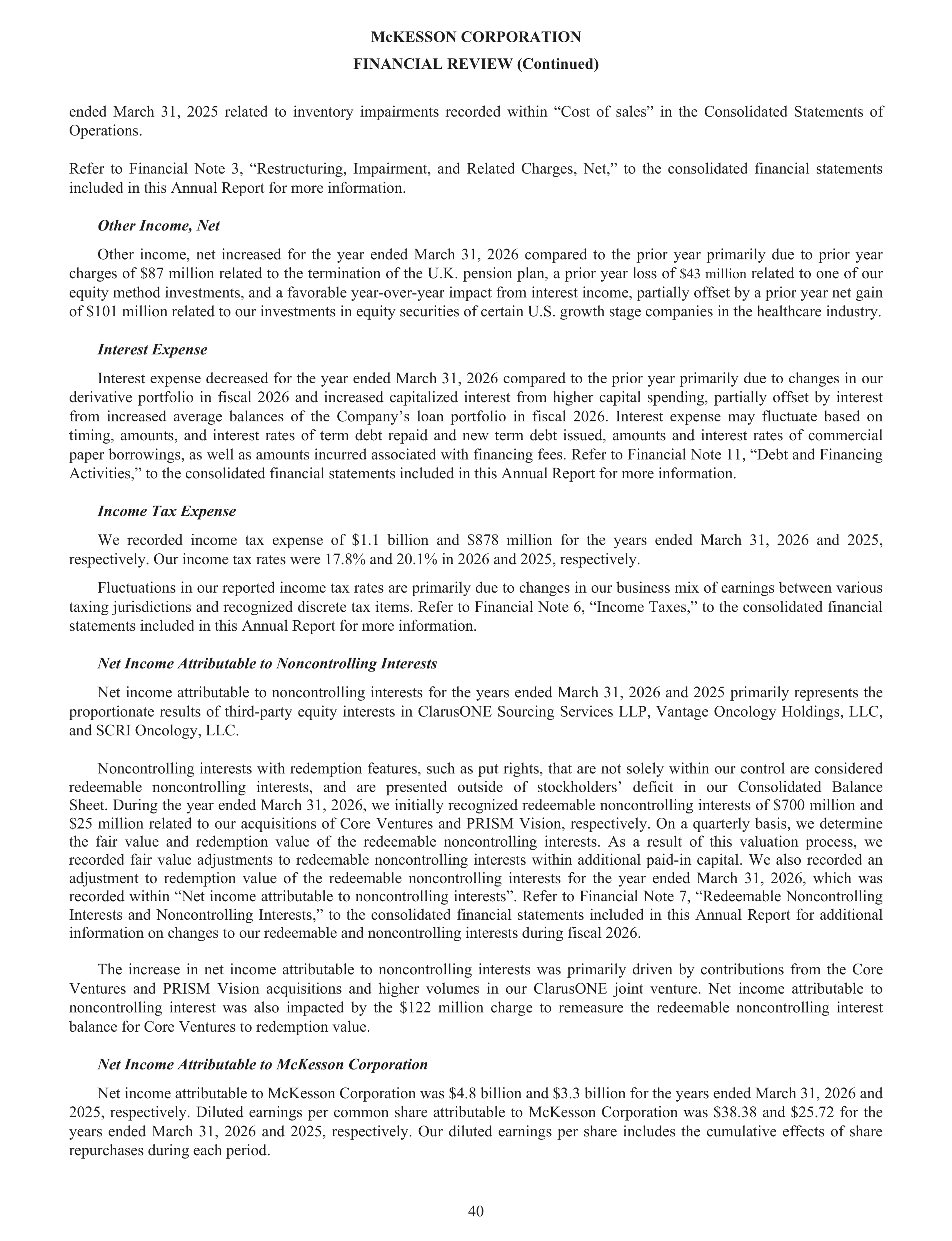
ended
March
31,
2025
related
to
inventory
r
impairments
recorded
within
“Cost
of
sales”
in
the
Consolidated
Statements
of
Operations.
Refer
to
Financial
Note
3,
“Restructuring,
Impairment,
and
Related
Charges,
Net,”
to
the
consolidated
financial
statements
included in this Annual Report for more information.
Othe
t
r Income,e
Net
Other
income,
net
increased
for
the
year
ended
March
31,
2026
compared
to
the
prior
year
primarily
due
to
prior
year
charges of $87 million related to the termination of the U.K. pension plan, a prior year loss of
$43
million
related to one of our
equity method investments, and a favorable year-over-year impact from interest income, partially offs
f
et by a prior year net gain
of $101 million related to our investments in equity securities of certain U.S. growth stage companies in the healthcare industry.
r
Interest Expe
x
nse
Interest
expense
decreased
for
the
year
ended
March
31,
2026
compared
to
the
prior
year
primarily
due
to
changes
in
our
derivative
portfol
f
io
in
fiscal
2026
and
increased
capitalized
interest
from
higher
capital
spending,
partially
offs
f
et
by
interest
from
increased
average
balances
of
the
Company’s
loan
portfol
f
io
in
fiscal
2026.
Interest
expense
may
fluctuate
based
on
timing,
amounts,
and
interest
rates
of
term
debt
repaid
and
new
term
debt
issued,
amounts
and
interest
rates
of
commercial
pape
a
r borrowings, as well as amounts incurred associated with financing fees. Refer to Financial Note 11, “Debt and Financing
Activities,” to the consolidated financial statements included in this Annual Report for more information.
Income Tax
a
Expe
x
nse
We
recorded
income
tax
expense
of
$1.1
billion
and
$878
million
for
the
years
ended
March
31,
2026
and
2025,
respectively. Our income tax rates were 17.8% and 20.1% in 2026 and 2025, respectively.
Fluctuations in our reported income tax rates are primarily due to changes in our business mix of earnings between various
taxing jurisdictions and recognized discrete tax items. Refer to Financial Note 6, “Income Taxes,” to the consolidated financial
statements included in this Annual Report for more information.
Net Income Attr
t
ibutabl
t
el
to Noncontrollin
l
g Interestst
Net
income
attributable
to
noncontrolling
interests
for
the
years
ended
March
31,
2026
and
2025
primarily
represents
the
proportionate
results
of
third-party
equity
interests
in
Clarus
r
ONE
Sourcing
Services
LLP,
Vantage
Oncology
Holdings,
LLC,
and SCRI Oncology, LLC.
Noncontrolling
interests
with
redemption
featur
t
es,
such
as
put
rights,
that
are
not
solely
within
our
control
are
considered
redeemable
noncontrolling
interests,
and
are
presented
outside
of
stockholders’
deficit
in
our
Consolidated
Balance
Sheet. During the year ended March 31, 2026, we initially recognized redeemable noncontrolling interests of $700 million and
$25
million
related
to
our
acquisitions
of
Core
Ventur
t
es
and
PRISM
Vision,
respectively.
On
a
quarterly
basis,
we
determine
the
fair
value
and
redemption
value
of
the
redeemable
noncontrolling
interests.
As
a
result
of
this
valuation
process,
we
recorded
fair
value
adju
d
stments
to
redeemable
noncontrolling
interests
within
additional
paid-in
capital.
We
also
recorded
an
adju
d
stment
to
redemption
value
of
the
redeemable
noncontrolling
interests
for
the
year
ended
March
31,
2026,
which
was
recorded
within
“Net
income
attributable
to
noncontrolling
interests”.
Refer
to
Financial
Note
7,
“Redeemable
Noncontrolling
Interests
and
Noncontrolling
Interests,”
to
the
consolidated
financial
statements
included
in
this
Annual
Report
for
additional
information on changes to our redeemable and noncontrolling interests during fiscal 2026.
The
increase
in
net
income
attributable
to
noncontrolling
interests
was
primarily
driven
by
contributions
from
the
Core
Ventur
t
es
and
PRISM
Vision
acquisitions
and
higher
volumes
in
our
Clarus
r
ONE
joint
ventur
t
e.
Net
income
attributable
to
noncontrolling
interest
was
also
impacted
by
the
$122
million
charge
to
remeasure
the
redeemable
noncontrolling
interest
balance for Core Ventur
t
es to redemption value.
Net Income Attr
t
ibutabl
t
el
to McKe
c
sson Corporatio
t
n
Net income attributable to McKesson Corporation was $4.8 billion and $3.3 billion for the years ended March 31, 2026 and
2025,
respectively.
Diluted
earnings
per
common
share
attributable
to
McKesson
Corporation
was
$38.38
and
$25.72
for
the
years
ended
March
31,
2026
and
2025,
respectively.
Our
diluted
earnings
per
share
includes
the
cumulative
effe
f
cts
of
share
repurchases during each period.
McKESSON CORPORAT
R
ION
FINANCIAL REVIEW (Continued)
40

Weight
g
ed
t
-A
d
verage
a
Dilu
i
ted Common Shares Outstandin
d
g
Diluted
earnings
per
common
share
was
calculated
based
on
a
weighted-average
number
of
shares
outstanding
of
124.1
million
and
128.1
million
for
the
years
ended
March
31,
2026
and
2025,
respectively.
Weighted-average
diluted
shares
outstanding
for
fiscal
2026
decreased
from
the
prior
year
primarily
due
to
the
cumulative
effe
f
ct
of
share
repurchases,
as
discussed in the “Share Repurchases Plans” section of this Financial Review.
McKESSON CORPORAT
R
ION
FINANCIAL REVIEW (Continued)
41
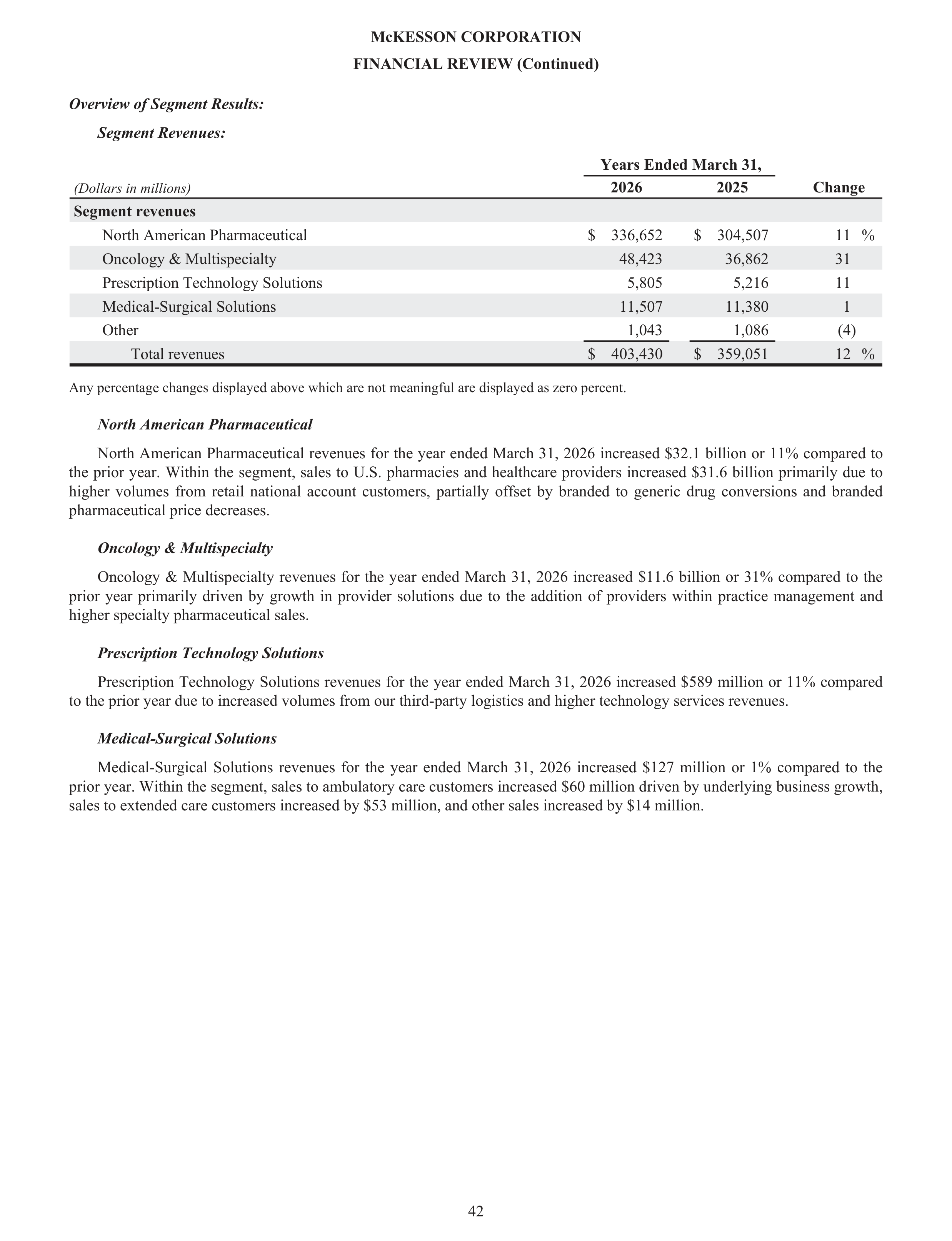
Overview of Segm
e
ent Results:
Segm
e
ent Revenues:
Years Ended March 31,
(Dollars in millions)s
2026
2025
Change
Segment revenues
North American Pharmaceutical
$
336,652
$
304,507
11
%
Oncology & Multispecialty
48,423
36,862
31
Prescription Technology Solutions
5,805
5,216
11
Medical-Surgical Solutions
11,507
11,380
1
Other
1,043
1,086
(4)
Total revenues
$
403,430
$
359,051
12
%
Any percentage changes displayed above which are not meaningful
f
are displayed as zero percent.
North
t
American Pharma
r
ceutic
t
al
North
American
Pharmaceutical
revenues
for
the
year
ended
March
31,
2026
increased
$32.1
billion
or
11%
compared
to
the
prior
year.
Within
the
segment,
sales
to
U.S.
pharmacies
and
healthcare
providers
increased
$31.6
billion
primarily
due
to
higher
volumes
from
retail
national
account
customers,
partially
offs
f
et
by
branded
to
generic
drug
r
conversions
and
branded
pharmaceutical price decreases.
Oncology
o
& Multisp
i
ecialty
Oncology
&
Multispecialty
revenues
for
the
year
ended
March
31,
2026
increased
$11.6
billion
or
31%
compared
to
the
prior
year
primarily
driven
by
growth
in
provider
solutions
due
to
the
addition
of
providers
within
practice
management
and
higher specialty pharmaceutical sales.
Prescription Technology
o
Solutions
Prescription
Technology
Solutions
revenues
for
the
year
ended
March
31,
2026
increased
$589
million
or
11%
compared
to the prior year due to increased volumes from our third-party logistics and higher technology services revenues.
Medical-Sur
-
gi
r
cal Solutions
Medical-Surgical
Solutions
revenues
for
the
year
ended
March
31,
2026
increased
$127
million
or
1%
compared
to
the
prior year. Within the segment, sales to ambulatory
r
care customers increased $60 million driven by underlying business growth,
sales to extended care customers increased by $53 million, and other sales increased by $14 million.
McKESSON CORPORAT
R
ION
FINANCIAL REVIEW (Continued)
42
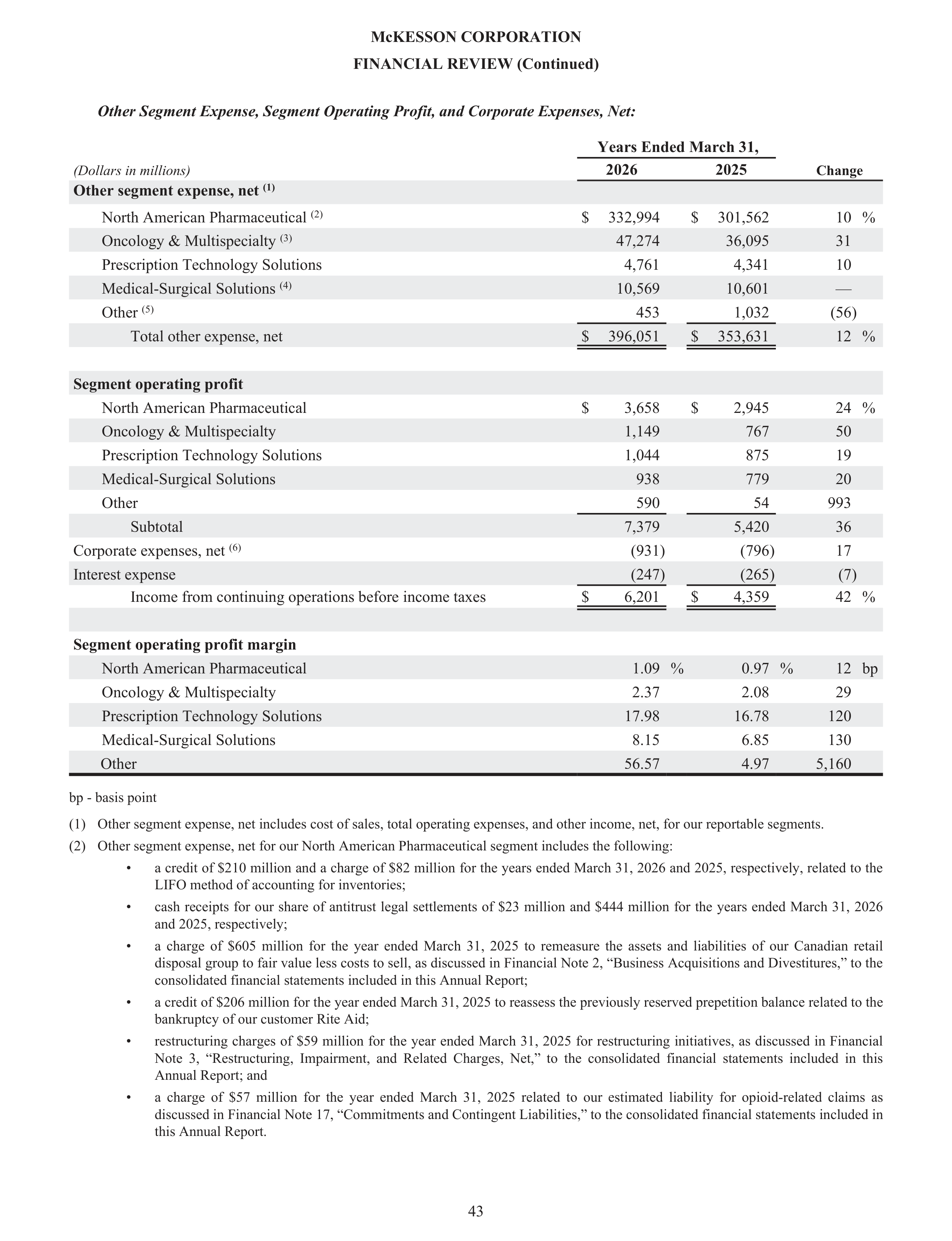
Othe
t
r Segm
e
ent Expe
x
nse, Segm
e
ent Operatin
t
g Profit
f
,t
and Corporatet
Expe
x
nses,s
Net:
Years Ended March 31,
(Dollars in millions)s
2026
2025
Change
Other segment expense, net
(1)
North American Pharmaceutical
(2)
$
332,994
$
301,562
10
%
Oncology & Multispecialty
(3)
47,274
36,095
31
Prescription Technology Solutions
4,761
4,341
10
Medical-Surgical Solutions
(4)
10,569
10,601
—
Other
(5)
453
1,032
(56)
Total other expense, net
$
396,051
$
353,631
12
%
Segment operating profit
North American Pharmaceutical
$
3,658
$
2,945
24
%
Oncology & Multispecialty
1,149
767
50
Prescription Technology Solutions
1,044
875
19
Medical-Surgical Solutions
938
779
20
Other
590
54
993
Subt
u
otal
7,379
5,420
36
Corporate expenses, net
(6)
(931)
(796)
17
Interest expense
(247)
(265)
(7)
Income from continuing operations before income taxes
$
6,201
$
4,359
42
%
Segment operating profit margin
North American Pharmaceutical
1.09
%
0.97
%
12
bp
Oncology & Multispecialty
2.37
2.08
29
Prescription Technology Solutions
17.98
16.78
120
Medical-Surgical Solutions
8.15
6.85
130
Other
56.57
4.97
5,160
bp - basis point
(1)
Other segment expense, net includes cost of sales, total operating expenses, and other income, net, for our reportabl
a
e segments.
(2)
Other segment expense, net for our North American Pharmaceutical segment includes the following:
•
a credit of $210 million and a charge of $82 million for the years ended March 31, 2026 and 2025, respectively, related to the
LIFO method of accounting for inventories;
•
cash
receipts
for
our
share
of
antitrus
r
t
legal
settlements
of
$23
million
and
$444
million
for
the
years
ended
March
31,
2026
and 2025, respectively;
•
a
charge
of
$605
million
for
the
year
ended
March
31,
2025
to
remeasure
the
assets
and
liabi
a
lities
of
our
Canadian
retail
disposal group
u
to fair value less costs to sell, as discussed in Financial Note 2, “Business Acquisitions and Divestitures,” to the
consolidated financial statements included in this Annual Report;
•
a credit of $206 million for the year ended March 31, 2025 to reassess the previously reserved prepetition balance related to the
bankrupt
r
cy of our customer Rite Aid;
•
restruc
r
turing
charges
of
$59
million
for
the
year
ended
March
31,
2025
for
restructur
t
ing
initiatives,
as
discussed
in Financial
Note
3,
“Restructuring,
Impairment,
and
Related
Charges,
Net,”
to
the
consolidated
financial
statements
included
in
this
Annual Report; and
•
a
charge
of
$57
million
for
the
year
ended
March
31,
2025
related
to
our
estimated
liabi
a
lity
for
opioid-related
claims
as
discussed in Financial Note 17, “Commitments and Contingent Liabilities,” to the consolidated financial statements included in
this Annual Report.
McKESSON CORPORAT
R
ION
FINANCIAL REVIEW (Continued)
43
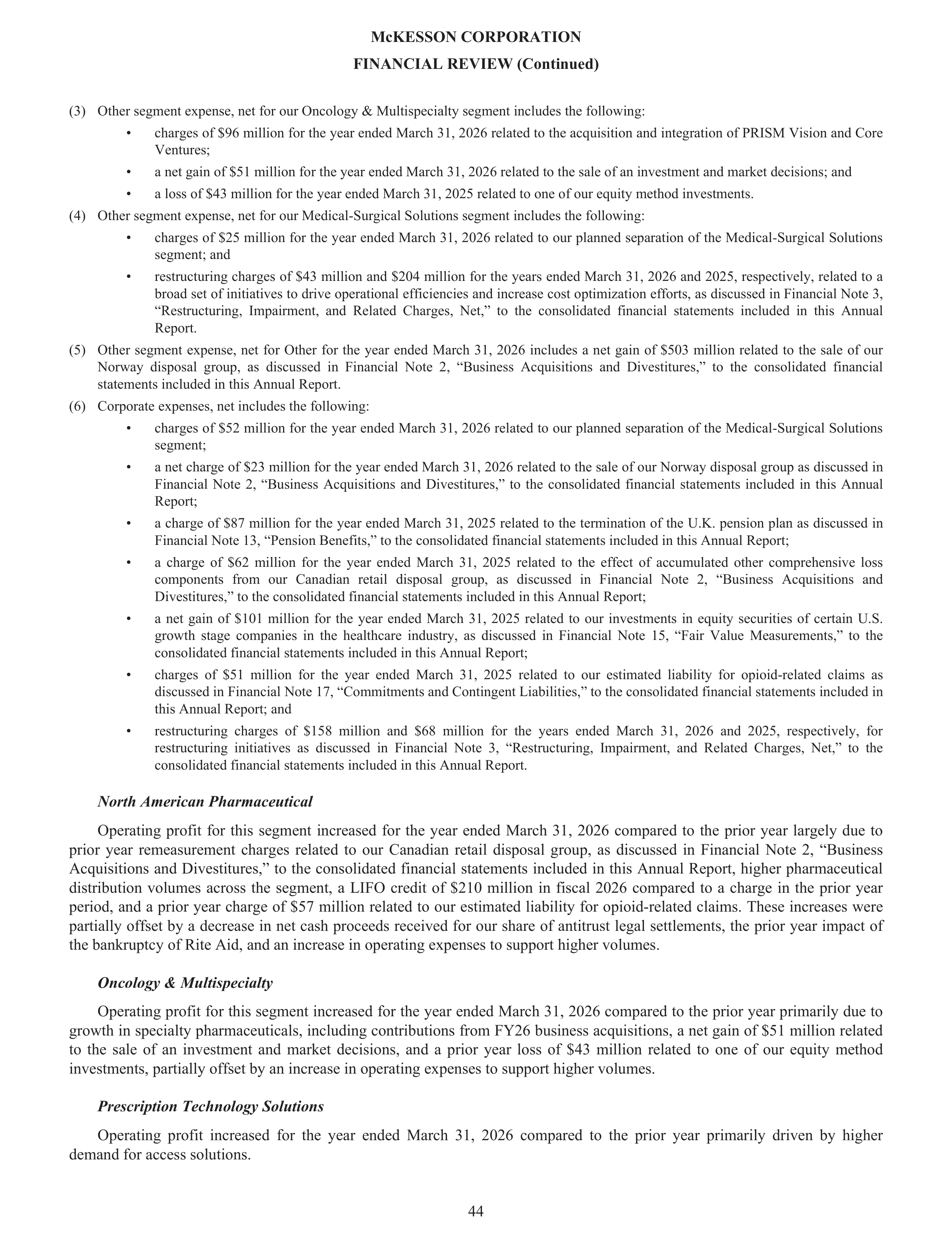
(3)
Other segment expense, net for our Oncology & Multispecialty segment includes the following:
•
charges of $96 million for the year ended March 31, 2026 related to the acquisition and integration of PRISM Vision and Core
Ventur
t
es;
•
a net gain of $51 million for the year ended March 31, 2026 related to the sale of an investment and market decisions; and
•
a loss of $43 million for the year ended March 31, 2025 related to one of our equity method investments.
(4)
Other segment expense, net for our Medical-Surgical Solutions segment includes the following:
•
charges of $25 million for the year ended March 31, 2026 related to our planned separation of the Medical
-
Surgical Solutions
segment; and
•
restruc
r
turing charges of $43 million and $204 million for the years ended March 31, 2026 and 2025, respectively, related to a
broad set of initiatives to drive operational effi
f
ciencies and increase cost optimization effo
f
rts, as discussed in Financial Note 3,
“Restructuring,
Impairment,
and
Related
Charges,
Net,”
to
the
consolidated
financial
statements
included
in
this
Annual
Report.
(5)
Other
segment
expense,
net
for
Other
for
the
year
ended
March
31,
2026
includes
a
net
gain
of $503
million
related
to
the
sale
of
our
Norway
disposal
group,
u
as
discussed
in
Financial
Note
2,
“Business
Acquisitions
and
Divestitures,”
to
the
consolidated
financial
statements included in this Annual Report.
(6)
Corpor
r
ate expenses, net includes the following:
•
charges of $52 million for the year ended March 31, 2026 related to our planned separation of the Medical
-
Surgical Solutions
segment;
•
a net charge of $23 million for the year ended March 31, 2026 related to the sale of our Norway disposal group as discussed in
Financial
Note
2,
“Business
Acquisitions
and
Divestitures,”
to
the
consolidated
financial
statements
included
in
this
Annual
Report;
•
a charge of $87 million for the year ended March 31, 2025 related to the termination of the U.K. pension plan as discussed in
Financial Note 13, “Pension Benefits,” to the consolidated financial statements included in this Annual Report;
•
a
charge
of
$62
million
for
the
year
ended
March
31,
2025
related
to
the
effe
f
ct
of
accumulated
other
comprehensive
loss
components
from
our
Canadian
retail
disposal
group,
u
as
discussed
in
Financial
Note
2,
“Business
Acquisitions
and
Divestitures,” to the consolidated financial statements included in this Annual Report;
•
a
net
gain
of
$101
million
for
the
year
ended
March
31,
2025
related
to
our
investments
in
equity
securities
of
certain
U.S.
growth
stage
companies
in
the
healthcare
industry,
r
as
discussed
in
Financial
Note
15,
“Fair
Value
Measurements,”
to
the
consolidated financial statements included in this Annual Report;
•
charges
of
$51
million
for
the
year
ended
March
31,
2025
related
to
our
estimated
liabi
a
lity
for
opioid-related
claims
as
discussed in Financial Note 17, “Commitments and Contingent Liabilities,” to the consolidated financial statements included in
this Annual Report; and
•
restruc
r
turing
charges
of
$158
million
and
$68
million
for
the
years
ended
March
31,
2026
and
2025,
respectively,
for
restructur
t
ing
initiatives
as
discussed
in
Financial
Note
3,
“Restructuring,
Impairment,
and
Related
Charges,
Net,”
to
the
consolidated financial statements included in this Annual Report.
North
t
American Pharma
r
ceutical
Operating
profit
f
for
this
segment
increased
for
the
year
ended
March
31,
2026
compared
to
the
prior
year
largely
due
to
prior
year
remeasurement
charges
related
to
our
Canadian
retail
disposal
group,
as
discussed
in
Financial
Note
2,
“Business
Acquisitions
and
Divestitures,”
to
the
consolidated
financial
statements
included
in
this
Annual
Report,
higher
pharmaceutical
distribution
volumes
across
the
segment,
a
LIFO
credit
of
$210
million
in
fiscal
2026
compared
to
a
charge
in
the
prior
year
period, and a prior
year charge of
$57 million
related
to our estimated liability for
opioid-related claims. These increases were
partially offs
f
et by a decrease in net cash proceeds received for our share of antitrus
r
t legal settlements, the prior year impact of
the bankrupt
r
cy of Rite Aid, and an increase in operating expenses to suppor
u
t higher volumes.
Oncology
o
& Multis
t
pe
s
cialty
l
Operating profit
f
for this segment increased for the year ended March 31, 2026 compared to the prior year primarily due to
growth in specialty pharmaceuticals, including contributions from FY26 business acquisitions, a net gain of $51 million related
to
the
sale
of
an
investment
and
market
decisions,
and
a
prior
year
loss
of
$43
million
related
to
one
of
our
equity
method
investments, partially offs
f
et by an increase in operating expenses to suppor
u
t higher volumes.
Prescription Technology
o
Solutions
Operating
profit
f
increased
for
the
year
ended
March
31,
2026
compared
to
the
prior
year
primarily
driven
by
higher
demand for access solutions.
McKESSON CORPORAT
R
ION
FINANCIAL REVIEW (Continued)
44
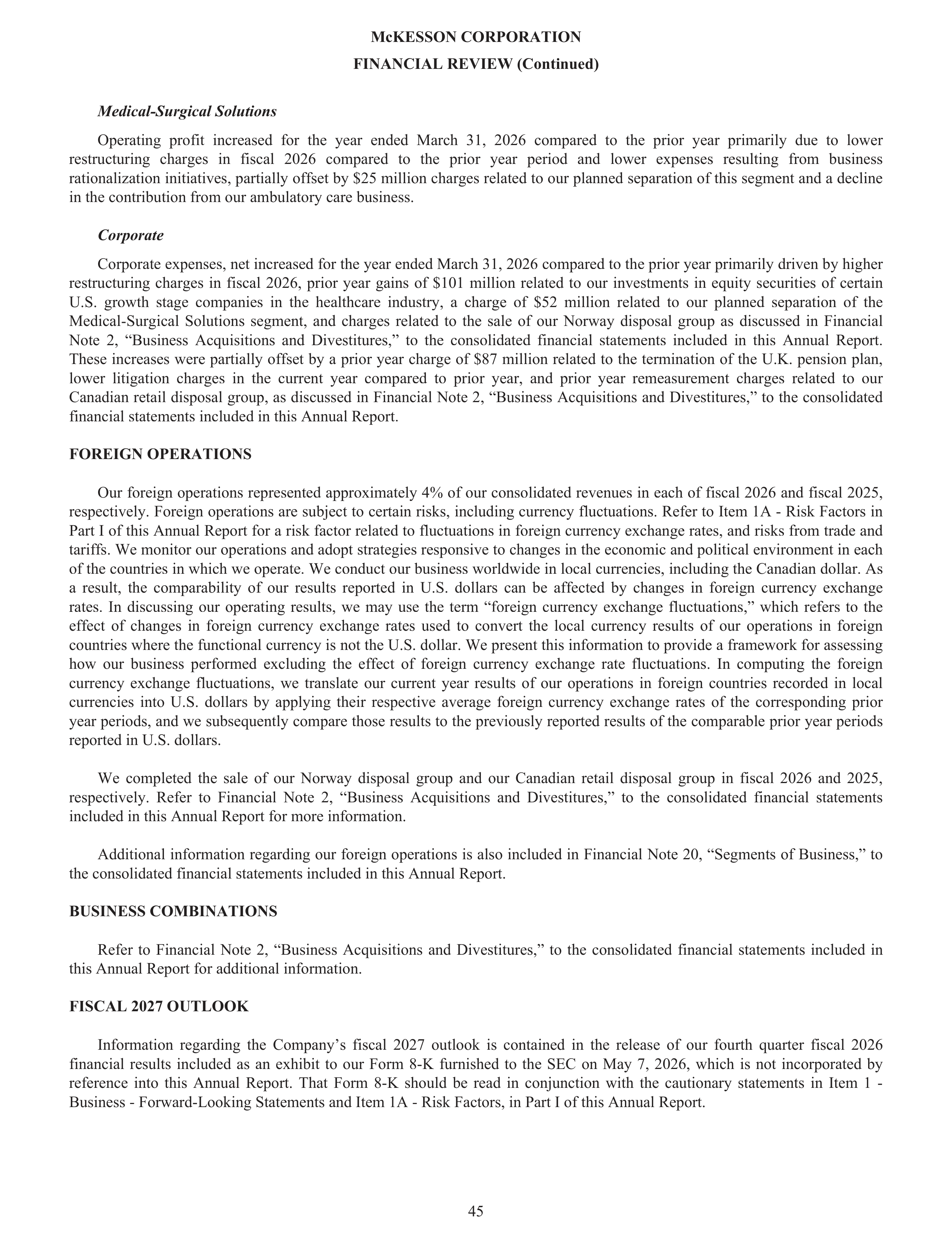
Medical-Sur
-
gi
r
cal Solutions
Operating
profit
f
increased
for
the
year
ended
March
31,
2026
compared
to
the
prior
year
primarily
due
to
lower
restructur
t
ing
charges
in
fiscal
2026
compared
to
the
prior
year
period
and
lower
expenses
resulting
from
business
rationalization initiatives, partially offs
f
et by $25 million charges related to our planned separation of this segment and a decline
in the contribution from our ambulatory
r
care business.
Corporatet
Corporate expenses, net increased for the year ended March 31, 2026 compared to the prior year primarily driven by higher
restructur
t
ing
charges
in
fiscal
2026,
prior
year
gains
of
$101
million
related
to
our
investments
in
equity
securities
of
certain
U.S.
growth
stage
companies
in
the
healthcare
industry,
r
a
charge
of
$52
million
related
to
our
planned
separation
of
the
Medical
-
Surgical
Solutions
segment,
and
charges
related
to
the
sale
of
our
Norway
disposal
group
as
discussed
in
Financial
Note
2,
“Business
Acquisitions
and
Divestitures,”
to
the
consolidated
financial
statements
included
in
this
Annual
Report.
These increases
were partially
offs
f
et
by
a
prior
year
charge
of
$87
million
related
to
the
termination
of
the
U.K.
pension
plan,
lower
litigation
charges
in
the
current
year
compared
to
prior
year,
and
prior
year
remeasurement
charges
related
to
our
Canadian retail disposal group, as discussed in Financial Note 2, “Business Acquisitions and Divestitures,” to the consolidated
financial statements included in this Annual Report.
FOREIGN OPERAT
R
IONS
Our foreign operations represented approximately 4% of our consolidated revenues in each of fiscal 2026 and fiscal 2025,
respectively. Foreign operations are subj
u
ect to certain risks, including currency fluctuations. Refer to Item 1A - Risk Factors in
Part I of this Annual Report for a risk factor related to fluctuations in foreign currency exchange rates, and risks from trade and
tariffs. We monitor our operations and adopt strategies responsive to changes in the economic and political environment in each
of the countries in which we operate. We conduct our business worldwide in local currencies, including the Canadian dollar. As
a
result,
the
comparability
of
our
results
reported
in
U.S.
dollars
can
be
affe
f
cted
by
changes
in
foreign
currency
exchange
rates.
In
discussing
our
operating
results,
we
may
use
the
term
“for
f
eign
currency
exchange
fluctuations,”
which
refers
to
the
effect
of
changes
in
foreign
currency
exchange
rates
used
to
convert
the
local
currency
results
of
our
operations
in
foreign
countries where the functional currency is not the U.S. dollar. We present this information to provide a framework for assessing
how
our
business
performed
excluding
the
effe
f
ct
of
foreign
currency
exchange
rate
fluctuations.
In
computing
the
foreign
currency
exchange
fluctuations,
we
translate
our
current
year
results
of
our
operations
in
foreign
countries
recorded
in
local
currencies
into
U.S.
dollars
by
applying
their
respective
average
foreign
currency
exchange
rates
of
the
corresponding
prior
year periods, and we subs
u
equently compare those results to the previously reported results of the comparable prior year periods
reported in U.S. dollars.
We
completed
the
sale
of
our
Norway
disposal
group
u
and
our
Canadian
retail
disposal
group
in
fiscal
2026
and
2025,
respectively.
Refer
to
Financial
Note
2,
“Business
Acquisitions
and
Divestitures,”
to
the
consolidated
financial
statements
included in this Annual Report for more information.
Additional information regarding our foreign operations is also included in Financial Note 20, “Segments of Business,”
the consolidated financial statements included in this Annual Report.
BUSINESS COMBINATIONS
Refer
to
Financial
Note
2,
“Business
Acquisitions
and
Divestitures,”
to
the
consolidated
financial
statements
included
in
this Annual Report for additional information.
FISCAL 2027 OUTLOOK
Information
regarding
the
Company’s
fiscal
2027
outlook
is
contained
in
the
release
of
our
fourth
quarter
fiscal
2026
financial
results
included
as
an
exhibit
to
our
Form
8-K
furnished
to
the
SEC
on
May
7,
2026,
which
is
not
incorporated
by
reference
into
this
Annual
Report.
That
Form
8-K
should
be
read
in
conjunction
with
the
cautionary
statements
in
Item
1
-
Business - Forward-Looking Statements and Item 1A - Risk Factors, in Part I of this Annual Report.
McKESSON CORPORAT
R
ION
FINANCIAL REVIEW (Continued)
45
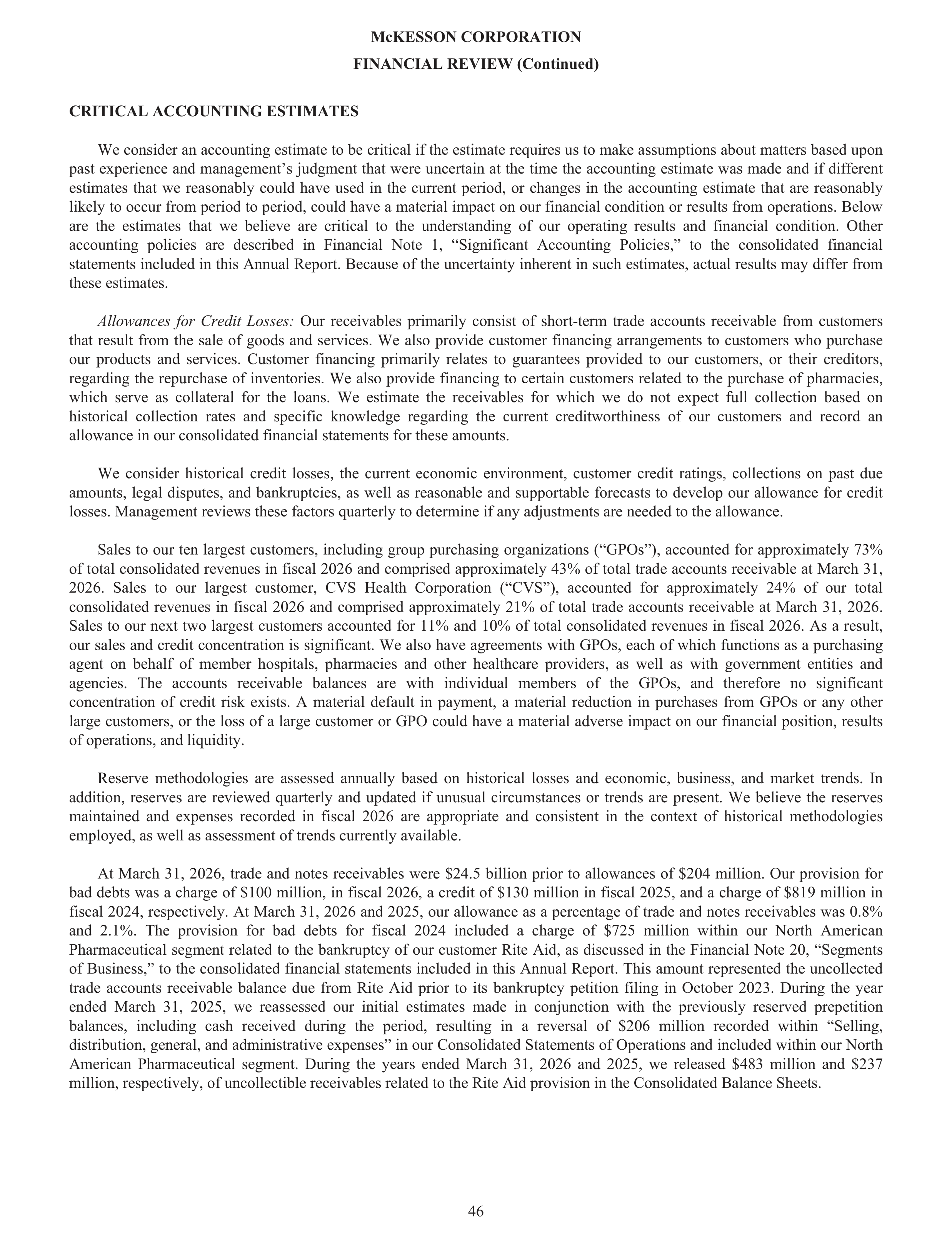
CRITICAL ACCOUNTING ESTIMATES
We consider an accounting estimate to be critical if the estimate requires us to make assumptions about matters based upon
past experience and management’s judgment that were uncertain at the time the accounting estimate was made and if differ
f
ent
estimates
that
we
reasonabl
a
y
could
have
used
in
the
current
period,
or
changes
in
the
accounting
estimate
that
are
reasonabl
a
y
likely to occur from period to period, could have a material impact on our financial condition or results from operations. Below
are
the
estimates
that
we
believe
are
critical
to
the
understanding
of
our
operating
results
and
financial
condition.
Other
accounting
policies
are
described
in
Financial
Note
1,
“Significant
Accounting
Policies,”
to
the
consolidated
financial
statements included in this Annual Report. Because of the uncertainty inherent in such estimates, actua
t
l results may differ
f
from
these estimates.
Allowances
for
Credit
Losses:
Our
receivables
primarily
consist
of
short-term
trade
accounts
receivabl
a
e
from
customers
that
result
from
the
sale
of
goods
and
services.
We
also
provide
customer
financing
arrangements
to
customers
who
purchase
our
products
and
services.
Customer
financing
primarily
relates
to
guarantees
provided
to
our
customers,
or
their
creditors,
regarding
the
repurchase
of
inventories.
We
also
provide
financing
to
certain
customers
related
to
the
purchase
of
pharmacies,
which
serve
as
collateral
for
the
loans.
We
estimate
the
receivables
for
which
we
do
not
expect
full
collection
based
on
historical
collection
rates
and
specific
knowledge
regarding
the
current
creditworthiness
of
our
customers
and
record
an
allowance in our consolidated financial statements for these amounts.
We
consider
historical
credit
losses,
the
current
economic
environment,
customer
credit
ratings,
collections
on
past
due
amounts,
legal
disputes,
and
bankrupt
r
cies,
as
well
as
reasonable
and
suppor
u
tabl
a
e
forecasts
to
develop
our
allowance
for
credit
losses. Management reviews these factors quarterly to determine if any adju
d
stments are needed to the allowance.
Sales
to
our
ten
largest
customers,
including
group
purchasing
organizations
(“GPOs”),
accounted
for
approximately
73%
of total consolidated revenues in fiscal 2026 and comprised approximately 43% of total trade accounts receivable at March 31,
2026.
Sales
to
our
largest
customer,
CVS
Health
Corporation
(“CVS”),
accounted
for
approximately
24%
of
our
total
consolidated
revenues
in
fiscal
2026
and
comprised
approximately
21%
of
total
trade
accounts
receivabl
a
e
at
March
31,
2026.
Sales
to
our
next
two
largest
customers
accounted
for
11%
and
10%
of
total
consolidated
revenues
in
fiscal
2026.
As
a
result,
our sales and credit concentration is significant. We also have agreements with GPOs, each of which functions as a purchasing
agent
on
behalf
of
member
hospitals,
pharmacies
and
other
healthcare
providers,
as
well
as
with
government
entities
and
agencies.
The
accounts
receivabl
a
e
balances
are
with
individual
members
of
the
GPOs,
and
therefor
f
e
no
significant
concentration
of
credit
risk
exists.
A
material
default
in
payment,
a
material
reduction
in
purchases
from
GPOs
or
any
other
large customers, or the loss of a large customer or GPO could have a material adverse impact on our financial position, results
of operations, and liquidity.
Reserve
methodologies
are
assessed
annually
based
on
historical
losses
and
economic,
business,
and
market
trends.
In
addition,
reserves
are
reviewed
quarterly
and
updated
if
unusual
circumstances
or
trends
are
present.
We
believe
the
reserves
maintained
and
expenses
recorded
in
fiscal
2026
are
appropriate
and
consistent
in
the
context
of
historical
methodologies
employed, as well as assessment of trends currently availabl
a
e.
At
March
31,
2026,
trade
and
notes
receivabl
a
es
were
$24.5
billion
prior
to
allowances
of
$204
million.
Our
provision
for
bad debts was a charge of $100 million, in fiscal 2026, a credit of $130 million in fiscal 2025, and a charge of $819 million in
fiscal 2024, respectively. At March 31, 2026 and 2025, our allowance as a percentage of trade and notes receivabl
a
es was 0.8%
and
2.1%.
The
provision
for
bad
debts
for
fiscal
2024
included
a
charge
of
$725
million
within
our
North
American
Pharmaceutical
segment
related
to
the
bankrupt
r
cy
of
our
customer
Rite
Aid,
as
discussed
in
the
Financial
Note
20,
“Segments
of Business,”
the consolidated financial statements included in this Annual Report. This amount represented the uncollected
trade
accounts
receivabl
a
e
balance
due
from
Rite
Aid
prior
to
its
bankrupt
r
cy
petition
filing
in
October
2023.
During
the
year
ended
March
31,
2025,
we
reassessed
our
initial
estimates
made
in
conjunction
with
the
previously
reserved
prepetition
balances,
including
cash
received
during
the
period,
resulting
in
a
reversal
of
$206
million
recorded
within
“Selling,
distribution, general, and administrative expenses” in our Consolidated Statements of Operations and included within our North
American
Pharmaceutical
segment.
During
the
years
ended
March
31,
2026
and
2025,
we
released
$483
million
and
$237
million, respectively, of uncollectible receivables related to the Rite Aid provision in the Consolidated Balance Sheets.
McKESSON CORPORAT
R
ION
FINANCIAL REVIEW (Continued)
46
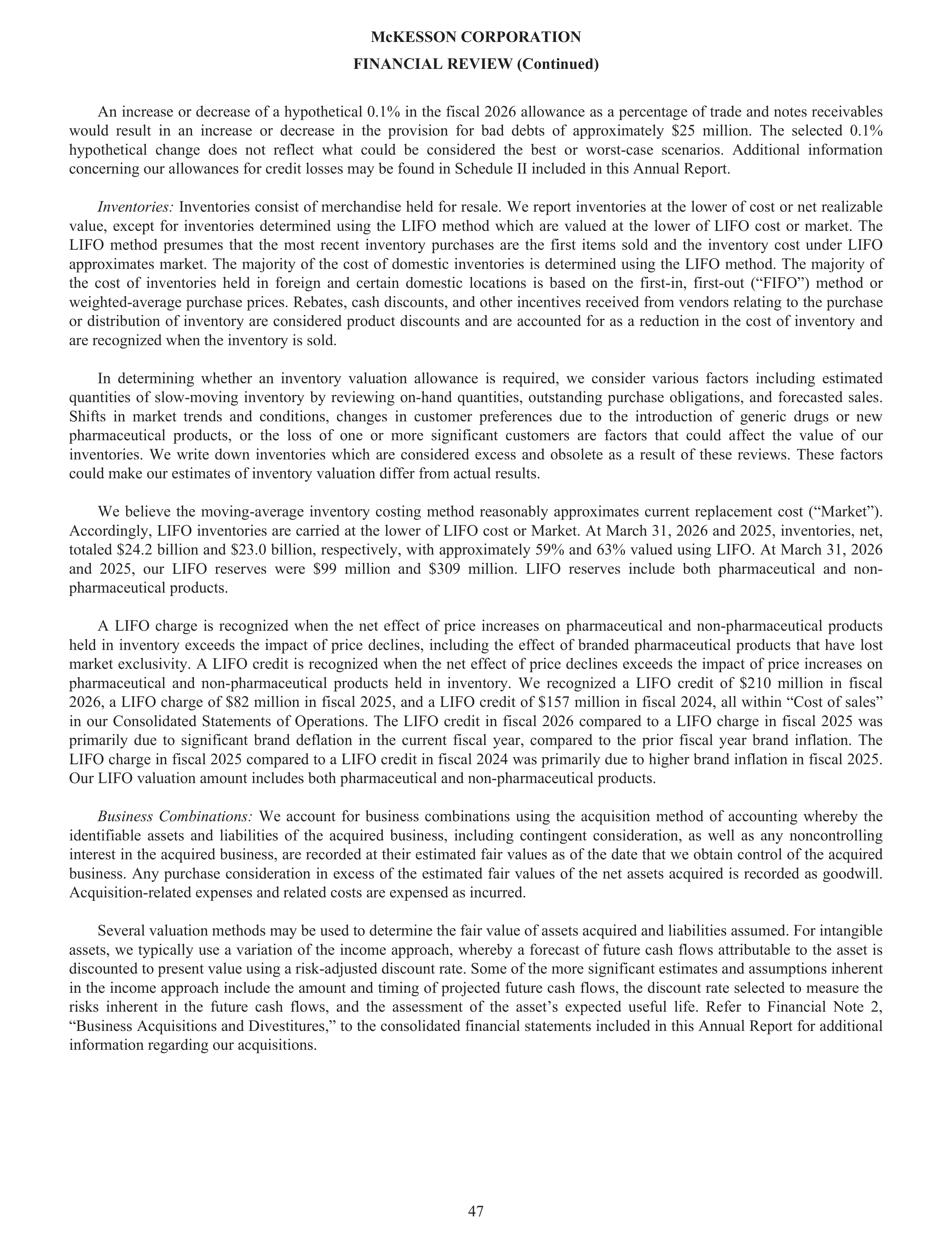
An increase or decrease of a hypothetical 0.1% in the fiscal 2026 allowance as a percentage of trade and notes receivables
would
result
in
an
increase
or
decrease
in
the
provision
for
bad
debts
of
approximately
$25
million.
The
selected
0.1%
hypothetical
change
does
not
reflect
what
could
be
considered
the
best
or
worst-case
scenarios.
Additional
information
concerning our allowances for credit losses may be found in Schedule II included in this Annual Report.
Inventories:
Inventories consist of merchandise held for resale. We report inventories at the lower of cost or net realizable
value,
except
for
inventories
determined
using
the
LIFO
method
which
are
valued
at
the
lower
of
LIFO
cost
or
market.
The
LIFO
method
presumes
that
the
most
recent
inventory
r
purchases
are
the
first
items
sold
and
the
inventory
r
cost
under
LIFO
approximates
market.
The
majo
a
rity
of
the
cost
of
domestic
inventories
is
determined
using
the
LIFO
method.
The
majo
a
rity
of
the
cost
of
inventories
held
in
foreign
and
certain
domestic
locations
is
based
on
the
first-in,
first-out
(“FIFO”)
method
or
weighted-average purchase prices. Rebates, cash discounts, and other incentives received from vendors relating to the purchase
or
distribution
of
inventory
r
are
considered
product
discounts
and
are
accounted
for
as
a
reduction
in
the
cost
of
inventory
r
and
are recognized when the inventory
r
is sold.
In
determining
whether
an
inventory
r
valuation
allowance
is
required,
we
consider
various
factors
including
estimated
quantities
of
slow-moving
inventory
r
by
reviewing
on-hand
quantities,
outstanding
purchase
obligations,
and
forecasted
sales.
Shifts
f
in
market
trends
and
conditions,
changes
in
customer
prefer
f
ences
due
to
the
introduction
of
generic
drugs
r
or
new
pharmaceutical
produ
d
cts,
or
the
loss
of
one
or
more
significant
customers
are
factors
that
could
affe
f
ct
the
value
of
our
inventories.
We
write
down
inventories
which
are
considered
excess
and
obsolete
as
a
result
of
these
reviews.
These
factors
could make our estimates of inventory
r
valuation differ from actua
t
l results.
We
believe
the
moving-average
inventory
r
costing
method
reasonabl
a
y
approximates
current
replacement
cost
(“Market”).
Accordingly, LIFO inventories are carried at the lower of LIFO cost or Market. At March 31, 2026 and 2025, inventories, net,
totaled $24.2 billion and $23.0 billion, respectively, with approximately 59% and 63% valued using LIFO. At March 31, 2026
and
2025,
our
LIFO
reserves
were
$99
million
and
$309
million.
LIFO
reserves
include
both
pharmaceutical
and
non-
pharmaceutical products.
A
LIFO
charge
is
recognized
when
the
net
effe
f
ct
of
price
increases
on
pharmaceutical
and
non-pharmaceutical
products
held
in
inventory
r
exceeds
the
impact
of
price
declines,
including
the
effe
f
ct
of
branded
pharmaceutical
products
that
have
lost
market
exclusivity.
A
LIFO
credit
is
recognized
when
the
net
effe
f
ct
of
price
declines
exceeds
the
impact
of
price
increases
on
pharmaceutical
and
non-pharmaceutical
products
held
in
inventory.
r
We
recognized
a
LIFO
credit
of
$210
million
in
fiscal
2026, a LIFO charge of $82 million in fiscal 2025, and a LIFO credit of $157 million in fiscal 2024, all within “Cost of sales”
in
our
Consolidated
Statements
of
Operations.
The
LIFO
credit
in
fiscal
2026
compared
to
a
LIFO
charge
in
fiscal
2025
was
primarily
due
to
significant
brand
deflation
in
the
current
fiscal
year,
compared
to
the
prior
fiscal
year
brand
inflation.
The
LIFO charge in fiscal 2025 compared to a LIFO credit in fiscal 2024 was primarily due to higher brand inflation in fiscal 2025.
Our LIFO valuation amount includes both pharmaceutical and non-pharmaceutical products.
Business
Combinations:
We
account
for
business
combinations
using
the
acquisition
method
of
accounting
whereby
the
identifia
f
bl
a
e
assets
and
liabilities
of
the
acquired
business,
including
contingent
consideration,
as
well
as
any
noncontrolling
interest in the acquired business, are recorded at their estimated fair values as of the date that we obtain control of the acquired
business.
Any
purchase
consideration
in
excess
of
the
estimated
fair
values
of
the
net
assets
acquired
is
recorded
as
goodwill.
Acquisition-related expenses and related costs are expensed as incurred.
Several valuation methods may be used to determine the fair value of assets acquired and liabi
a
lities assumed. For intangible
assets,
we
typically
use
a
variation
of
the
income
approach,
whereby
a
forecast
of
future
cash
flows
attributable
to
the
asset
is
discounted to present value using a risk-adjusted discount rate. Some of the more significant estimates and assumptions inherent
in the income approach include the amount and timing of projected future cash flows, the discount rate selected to measure the
risks
inherent
in
the
future
cash
flows,
and
the
assessment
of
the
asset’s
expected
useful
f
life.
f
Refer
to
Financial
Note
2,
“Business Acquisitions and Divestitures,” to the consolidated financial statements included in this Annual Report for additional
information regarding our acquisitions.
McKESSON CORPORAT
R
ION
FINANCIAL REVIEW (Continued)
47
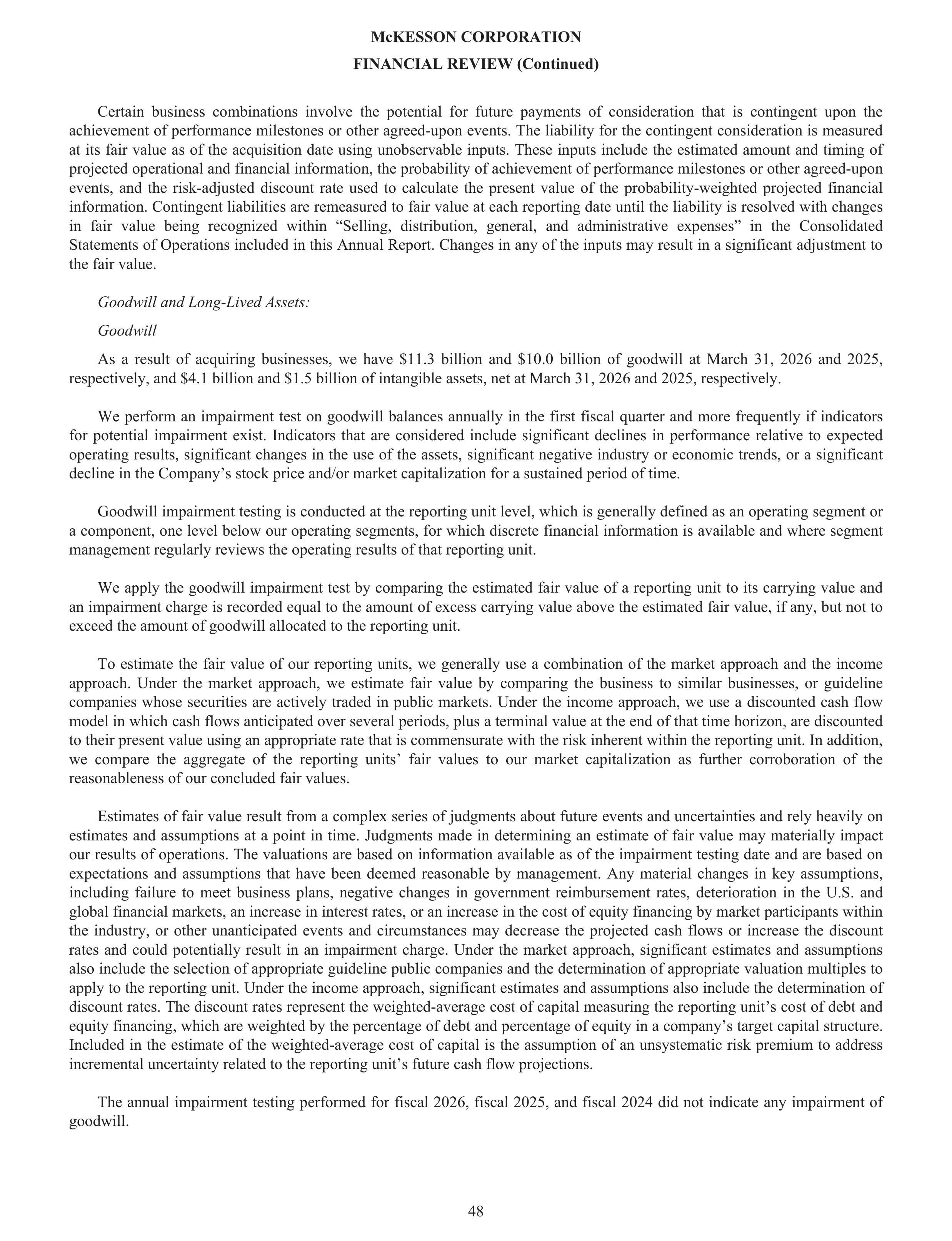
Certain
business
combinations
involve
the
potential
for
future
payments
of
consideration
that
is
contingent
upon
the
achievement of performance milestones or other agreed-upon
u
events. The liabi
a
lity for the contingent consideration is measured
at
its
fair
value
as
of
the
acquisition
date
using
unobservabl
a
e
inputs.
These
inputs
include
the
estimated
amount
and
timing
of
projected operational and financial information, the probabi
a
lity of achievement of performance milestones or other agreed-upon
u
events,
and
the
risk-adjusted
discount
rate
used
to
calculate
the
present
value
of
the
probabi
a
lity-weighted
projected
financial
information. Contingent liabilities are remeasured to fair value at each reporting date until the liability is resolved with changes
in
fair
value
being
recognized
within
“Selling,
distribution,
general,
and
administrative
expenses”
in
the
Consolidated
Statements of Operations included in this Annual Report. Changes in any of the inputs may result in a significant adju
d
stment to
the fair value.
Goodwill and Long-Lived Assets:
Goodwill
As
a
result
of
acquiring
businesses,
we
have
$11.3
billion
and
$10.0
billion
of
goodwill
at
March
31,
2026
and
2025,
respectively, and $4.1 billion and $1.5 billion of intangible assets, net at March 31, 2026 and 2025, respectively.
We
perform
an
impairment
test
on
goodwill
balances
annually
in
the
first
fiscal
quarter
and
more
frequently
if
indicators
for
f
potential
impairment
exist.
Indicators
that
are
considered
include
significant
declines
in
performance
relative
to
expected
operating
results,
significant
changes
in
the
use
of
the
assets,
significant
negative
industry
r
or
economic
trends,
or
a
significant
decline in the Company’s stock price and/or market capi
a
talization for a sustained period of time.
Goodwill impairment testing is conducted at the reporting unit level, which is generally defined as an operating segment or
a component, one level below our operating segments, for which discrete financial information is availabl
a
e and where segment
management regularly reviews the operating results of that reporting unit.
We
apply
the
goodwill
impairment
test
by
comparing
the
estimated
fair
value
of
a
reporting
unit
to
its
carrying
value
and
an impairment charge is recorded equal to the amount of excess carrying value above the estimated fair value, if any, but not to
exceed the amount of goodwill allocated to the reporting unit.
To
estimate
the
fair
value
of
our
reporting
units,
we
generally
use
a
combination
of
the
market
approach
and
the
income
approach.
Under
the
market
approach,
we
estimate
fair
value
by
comparing
the
business
to
similar
businesses,
or
guideline
companies
whose
securities
are
actively
traded
in
public
markets.
Under
the
income
approach,
we
use
a
discounted
cash
flow
model in which cash flows anticipated over several periods, plus a terminal value at the end of that time horizon, are discounted
to their present value using an appropriate rate that is commensurate with the risk inherent within the reporting unit. In addition,
we
compare
the
aggregate
of
the
reporting
units’
fair
values
to
our
market
capitalization
as
further
corroboration
of
the
reasonabl
a
eness of our concluded fair values.
Estimates of fair value result from a complex series of judgments about future events and uncertainties and rely heavily on
estimates
and
assumptions
at
a
point
in
time.
Judgments
made
in
determining
an
estimate
of
fair
value
may
materially
impact
our results of operations. The valuations are based on information availabl
a
e as of the impairment testing date and are based on
expectations
and
assumptions
that
have
been
deemed
reasonabl
a
e
by
management.
Any
material
changes
in
key
assumptions,
including
failure
to
meet
business
plans,
negative
changes
in
government
reimbursement
rates,
deterioration
in
the
U.S.
and
global financial markets, an increase in interest rates, or an increase in the cost of equity financing by market participants within
the
industry,
r
or
other
unanticipated
events
and
circumstances
may
decrease
the
projected
cash
flows
or
increase
the
discount
rates
and
could
potentially
result
in
an
impairment
charge.
Under
the
market
approach,
significant
estimates
and
assumptions
also include the selection of appropriate guideline public companies and the determination of appropriate valuation multiples to
apply to the reporting unit. Under the income approach, significant estimates and assumptions also include the determination of
discount rates. The discount rates represent the weighted-average cost of capital measuring the reporting unit’s cost of debt and
equity financing, which are weighted by the percentage of debt and percentage of equity in a company’s target capital structur
t
e.
Included
in
the
estimate
of
the
weighted-average
cost
of
capi
a
tal
is
the
assumption
of
an
unsystematic
risk
premium
to
address
incremental uncertainty related to the reporting unit’s future cash flow projections.
The
annual
impairment
testing
performed
for
fiscal
2026,
fiscal
2025,
and
fiscal
2024
did
not
indicate
any
impairment
of
goodwill.
McKESSON CORPORAT
R
ION
FINANCIAL REVIEW (Continued)
48
Refer to Financial Note 10, “Goodwill and Intangible Assets, Net,” to the consolidated financial statements included in this
Annual Report for additional information.
Long-Lived Assets
Currently, all of our identifia
f
bl
a
e intangible and other long-lived assets are amortized or depreciated based on the pattern of
their economic consumption or a straight-line basis over their estimated useful
f
lives, ranging from three to 26 years. We review
intangible
and
other
long-lived
assets
for
impairment
at
an
asset
group
level
whenever
events
or
changes
in
circumstances
indicate
that
the
carrying
value
of
the
assets
may
not
be
recoverabl
a
e.
Determination
of
recoverabi
a
lity
of
intangible
and
other
long-lived assets is based on the lowest level of identifia
f
bl
a
e estimated future undiscounted cash flows resulting from the use of
the
asset
and
its
eventual
disposition.
Measurement
of
any
impairment
loss
is
based
on
the
excess
of
the
carrying
value
of
the
asset group over
its fair value. Assumptions
and
estimates about future values and the remaining useful
f
lives of
our purchased
intangible
assets
are
complex
and
subj
u
ective.
They
can
be
affe
f
cted
by
a
variety
of
factors,
including
external
factors
such
as
industry
r
and economic trends, and internal factors such as changes in our business strategy and our internal forecasts.
Our
ongoing
consideration
of
all
the
factors
described
previously
could
result
in
further
impairment
charges
in
the
future,
which
could
adversely
affe
f
ct
our
net
income.
Refer
to
Financial
Note
3,
“Restructuring,
Impairment,
and
Related
Charges,
Net,” to the consolidated financial statements included in this Annual Report for additional information on our long-lived asset
impairments.
Long-lived
assets
classified
as
held
for
sale
are
measured
at
the
lower
of
their
carrying
amount
or
fair
value
less
costs
to
sell
and
are
not
depreciated
or
amortized.
Fair
value
is
determined
based
on
the
total
consideration
expected
to
be
received
by
the Company. The fair value of a disposal group, less any costs to sell, is assessed each reporting period it remains classified as
held for sale and any remeasurement to the lower of carrying value or fair value less costs to sell is reported as an adju
d
stment to
the carrying value of the disposal group. When the net realizable value of a disposal group increases during a period, a gain can
be recognized to the extent that it does not increase the value of the disposal group beyond its original carrying value when the
disposal group was reclassified as held for sale.
Restru
t
cturing Charge
r
s:
We have certain restructur
t
ing reserves which require significant estimates related to the timing and
amount
of
future
employee
severance
and
other
exit-related
costs
to
be
incurred
when
the
restructur
t
ing
actions
take
place.
We
generally
recognize
employee
severance
costs
when
payments
are
probabl
a
e
and
amounts
can
be
reasonabl
a
y
estimated.
Costs
related to contracts without future benefit or contract termination are recognized at the earlier of the contract termination or the
cease-use dates. Other exit-related costs are expensed as incurred. In connection with these restructur
t
ing actions, we also assess
the
recoverabi
a
lity
of
long-lived
assets
used
in
the
business,
and
as
a
result,
we
may
recognize
accelerated
depreciation
and
amortization
reflecting
shortened
useful
f
lives
of
the
underlying
assets.
Refer
to
Financial
Note
3,
“Restructuring,
Impairment,
and
Related
Charges,
Net,”
to
the
consolidated
financial
statements
included
in
this
Annual
Report
for
additional
information
on restructur
t
ing matters.
Income
Taxes
a
:
Our
income
tax
expense
and
deferred
tax
assets
and
liabilities
reflect
management’s
best
assessment
of
estimated
current
and
future
taxes
to
be
paid.
We
are
subj
u
ect
to
income
taxes
in
the
U.S.
and
numerous
foreign
jurisdictions.
Significant
judgments
and
estimates
are
required
in
determining
the
consolidated
income
tax
provision
and
in
evaluating
income
tax
uncertainties,
including
those
used
to
conclude
on
the
unrecognized
tax
position
related
to
opioid-related
litigation
and
claims,
and
may
differ
from
the
actua
t
l
amounts
of
tax
benefit
recognized.
We
review
our
tax
positions
at
the
end
of
each
quarter and adju
d
st the balances as new information becomes availabl
a
e.
Deferred income taxes arise from temporary
r
differences between the tax and financial statement recognition of revenue and
expense.
In
evaluating
our
ability
to
recover
our
deferred
tax
assets,
we
consider
all
availabl
a
e
positive
and
negative
evidence
including our past operating results, the existence of cumulative net operating losses in the most recent years, and our forecast
of future taxabl
a
e income. In estimating future taxabl
a
e income, we develop assumptions including the amount of futur
t
e federal,
state,
and
foreign
pre-tax
operating
income,
the
reversal
of
temporary
r
differences,
and
the
implementation
of
feasible
and
prude
r
nt
tax
planning
strategies.
These
assumptions
require
signific
f
ant
judgment
about
the
forecasts
of
future
taxabl
a
e
income
and are consistent with the plans and estimates we use to manage the underlying businesses.
Changes
in
tax
laws
and
rates
could
also
affe
f
ct
recorded
deferred
tax
assets
and
liabi
a
lities
in
the
future.
Should
tax
laws
change, our tax expense and cash flows could be materially impacted.
McKESSON CORPORAT
R
ION
FINANCIAL REVIEW (Continued)
49
In
addition,
the
calculation
of
our
tax
liabi
a
lities
includes
estimates
for
uncertainties
in
the
application
of
complex
new
tax
regulations across multiple global jurisdictions where we conduct our operations.
We recognize liabi
a
lities for tax and related interest for issues in the U.S. and other tax jurisdictions based on our estimate of
whether,
and
the
extent
to
which,
additional
taxes
and
related
interest
will
be
due.
If
our
current
estimate
of
tax
and
interest
liabi
a
lities is less than the ultimate settlement, an additional charge to income tax expense may result. If our current estimate of
tax
and
interest
liabi
a
lities
is
more
than
the
ultimate
settlement,
a
reduction
to
income
tax
expense
may
be
recognized.
Refer
to
Financial
Note
6,
“Income
Taxes,”
to
the
consolidated
financial
statements
included
in
this
Annual
Report
for
additional
information on income tax matters.
Loss Contingencies:
We are subj
u
ect to various claims, including claims with customers and vendors, pending and potential
legal actions for damages, investigations relating to laws and regulations and other matters arising out of the normal conduct of
our
business.
When
a
loss
is
considered
probabl
a
e
and
reasonabl
a
y
estimabl
a
e,
we
record
a
liabi
a
lity
in
the
amount
of
our
best
estimate
for
the
ultimate
loss.
However,
the
likelihood
of
a
loss
with
respect
to
a
particular
contingency
is
ofte
f
n
diffic
f
ult
to
predict,
and
determining
a
meaningful
f
estimate
of
the
loss
or
a
range
of
loss
may
not
be
practicable
based
on
the
information
availabl
a
e and the potential effe
f
ct of future events and decisions by third parties that will determine the ultimate resolution of the
contingency.
Moreover,
it
is
not
uncommon
for
such
matters
to
be
resolved
over
many
years,
during
which
time
relevant
developments and new information must be reevaluated at least quarterly to determine both the likelihood of potential loss and
whether
it
is
possible
to
reasonabl
a
y
estimate
a
range
of
possible
loss.
When
a
material
loss
is
reasonabl
a
y
possible,
or
probabl
a
e
but
a
reasonabl
a
e
estimate
cannot
be
made,
disclosure
of
the
proceeding
is
provided.
Legal
fees
are
expensed
as
incurred
when
the legal services are provided.
We
review
all
contingencies
at
least
quarterly
to
determine
whether
the
likelihood
of
loss
has
changed
and
to
assess
whether
a
reasonabl
a
e
estimate
of
the
potential
loss
or
range
of
the
loss
can
be
made.
As
discussed
above,
development
of
a
meaningful
f
estimate
of
loss
or
a
range
of
potential
loss
is
complex
when
the
outcome
is
directly
dependent
on
futur
t
e
negotiations with or decisions by third parties, such as regulatory
r
agencies, the court system, and other interested parties.
In conjunction with the preparation of the consolidated financial statements included in this Annual Report, we considered
matters
related
to
ongoing
controlled
subs
u
tances
claims
to
which
we
are
a
party.
At
March
31,
2026,
our
estimated
accrue
r
d
liabi
a
lity for opioid-related claims was $5.7 billion. We are not able to reasonabl
a
y estimate the upper or lower ends of the range
of ultimate possible losses for all opioid-related litigation matters. We are not able to predict the outcome in these matters, and
an
adverse
judgment
or
negotiated
resolution
in
any
of
these
matters
could
have
a
material
adverse
effe
f
ct
on
our
results
of
operations,
financial
position,
and
cash
flows
or
liquidity.
Refer
to
Financial
Note
17,
“Commitments
and
Contingent
Liabilities,” to the consolidated financial statements included in this Annual Report for additional information.
McKESSON CORPORAT
R
ION
FINANCIAL REVIEW (Continued)
50
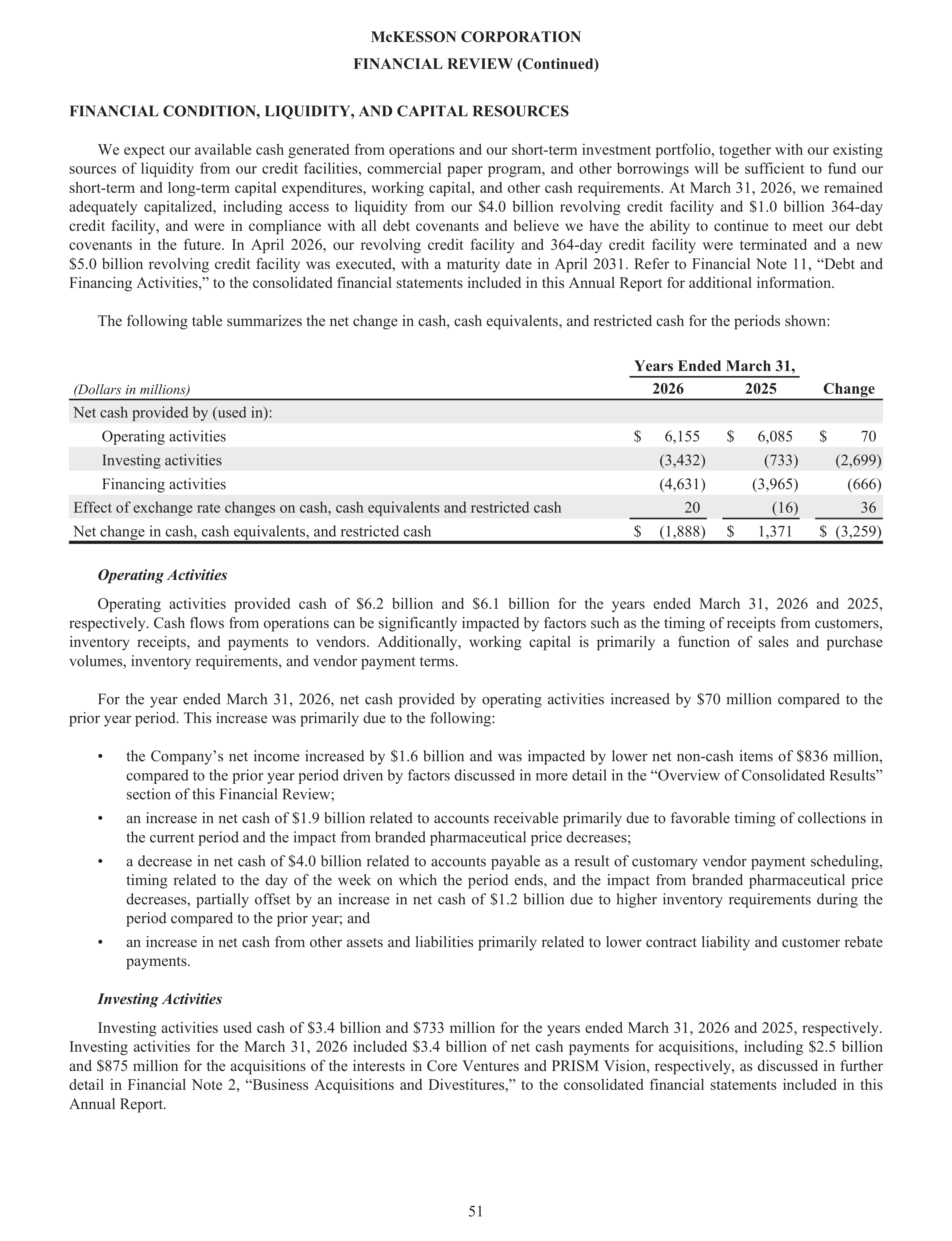
FINANCIAL CONDITION, LIQUIDITY, AND CAPITAL RESOURCES
We expect our availabl
a
e cash generated from operations and our short-term investment portfol
f
io, together with our existing
sources
of
liquidity
from
our
credit
facilities,
commercial
pape
a
r
program,
and
other
borrowings
will
be
sufficient
to
fund
our
short-term and long-term capi
a
tal expenditures, working capital, and other cash requirements. At March 31, 2026, we remained
adequately
capitalized,
including
access
to
liquidity
from
our
$4.0
billion
revolving
credit
facility
and
$1.0
billion
364-day
credit
facility,
and
were
in
compliance
with
all
debt
covenants
and
believe
we
have
the
ability
to
continue
to
meet
our
debt
covenants
in
the
future.
In
April
2026,
our
revolving
credit
facility
and
364-day
credit
facility
were
terminated
and
a
new
$5.0
billion
revolving
credit
facility
was
executed,
with
a
maturity
date
in
April
2031.
Refer
to
Financial
Note
11,
“Debt
and
Financing Activities,” to the consolidated financial statements included in this Annual Report for additional information.
The following tabl
a
e summarizes the net change in cash, cash equivalents, and restricted cash for the periods shown:
Years Ended March 31,
(Dollars in millions)s
2026
2025
Change
Net cash provided by (used in):
Operating activities
$
6,155
$
6,085
$
70
Investing activities
(3,432)
(733)
(2,699)
Financing activities
(4,631)
(3,965)
(666)
Effe
f
ct of exchange rate changes on cash, cash equivalents and restricted cash
20
(16)
36
Net change in cash, cash equivalents, and restricted cash
$
(1,888)
$
1,371
$
(3,259)
Operatin
t
g Activitie
t
s
Operating
activities
provided
cash
of
$6.2
billion
and
$6.1
billion
for
the
years
ended
March
31,
2026
and
2025,
respectively. Cash flows from operations can be significantly impacted by factors such as the timing of receipts from customers,
inventory
r
receipts,
and
payments
to
vendors.
Additionally,
working
capital
is
primarily
a
function
of
sales
and
purchase
volumes, inventory
r
requirements, and vendor payment terms.
For
the
year
ended
March
31,
2026,
net
cash
provided
by
operating
activities
increased
by
$70
million
compared
to
the
prior year period. This increase was primarily due to the following:
•
the
Company’s
net
income
increased
by
$1.6
billion
and
was
impacted
by
lower
net
non-cash
items
of
$836
million,
compared to the prior year period driven by factors discussed in more detail in the “Overview of Consolidated Results”
section of this Financial Review;
•
an increase in net cash of $1.9 billion related to accounts receivabl
a
e primarily due to favorable timing of collections in
the current period and the impact from branded pharmaceutical price decreases;
•
a decrease in net cash of $4.0 billion related to accounts payabl
a
e as a result of customary
r
vendor payment scheduling,
timing
related
to
the
day
of
the
week
on
which
the
period
ends,
and
the
impact
from
branded
pharmaceutical
price
decreases,
partially
offs
f
et
by
an
increase
in
net
cash
of
$1.2
billion
due
to
higher
inventory
r
requirements
during
the
period compared to the prior year; and
•
an increase in net cash from other assets and liabi
a
lities primarily related to lower contract liabi
a
lity and customer rebate
payments.
Investing Activitie
t
s
Investing activities used cash of $3.4 billion and $733 million for the years ended March 31, 2026 and 2025, respectively.
Investing
activities
for
the
March
31,
2026
included
$3.4
billion
of
net
cash
payments
for
acquisitions,
including
$2.5
billion
and $875 million for the acquisitions of the interests in Core Ventur
t
es and PRISM Vision, respectively, as discussed in further
detail
in
Financial
Note
2,
“Business
Acquisitions
and
Divestitures,”
to
the
consolidated
financial
statements
included
in
this
Annual Report.
McKESSON CORPORAT
R
ION
FINANCIAL REVIEW (Continued)
51
Investing
activities
for
the
year
ended
March
31,
2026
were
also
impacted
by
the
receipt
of
proceeds
from
sales
of
businesses and investments of $830 million, including cash proceeds, net of cash divested, of $693 million from the completed
divestiture
of
our
Norway
disposal
group,
as
discussed
in
Financial
Note
2,
“Business
Acquisitions
and
Divestitures,”
to
the
consolidated
financial
statements
included
in
this
Annual
Report.
Investing
activities
for
the
year
ended
March
31,
2026
included $436 million and $309 million, respectively, in capital expenditures for property, plant, and equipment and capitalized
software.
Investing
activities
for
the
year
ended
March
31,
2025
included
$537
million
and
$322
million,
respectively,
in
capi
a
tal
expenditures for property, plant, and equipment and capitalized software. Investing activities for the year ended March 31, 2025
were
also
impacted
by
the
receipt
of
proceeds
of
$189
million
related
to
investments
in
equity
securities,
as
discussed
in
Financial Note 15, “Fair Value Measurements,” to the consolidated financial statements included in this Annual Report.
Fina
i
ncing Activiti
i
es
Financing
activities
used
cash
of
$4.6
billion
and
$4.0
billion
for
the
years
ended
March
31,
2026
and
2025,
respectively.
Financing
activities
for
the
year
ended
March
31,
2026
included
$4.8
billion
of
cash
paid
for
share
repurchases
and
$381
million of cash paid for dividends. Financing activities also included cash receipts and cash payments of $9.2 billion related to
short-term borrowings of commercial pape
a
r in fiscal 2026.
On
May
30,
2025,
we
completed
a
public
debt
offe
f
ring
of
4.65%
Notes
due
May
30,
2030
in
a
principal
amount
of
$650 million, 4.95% Notes due May 30, 2032 in a principal amount of $650 million, and 5.25% Notes due May 30, 2035 in a
principal amount of $700 million, for total proceeds received, net of discounts and debt offe
f
ring expenses, of $2.0 billion. The
net proceeds from these notes in addition to cash on hand were utilized to fund the purchase of our interest in Core Ventur
t
es.
On November 14, 2025, our €600 million outstanding principal amount of 1.50% Notes matured and on December 3, 2025,
our $500 million outstanding principal amount of 0.90% Notes matured, and were repaid using cash on hand.
Financing
activities
for
the
year
ended
March
31,
2025
included
$3.1
billion
of
cash
paid
for
share
repurchases
and
$345
million of cash paid for dividends. Financing activities also included cash receipts and cash payments of $15.1 billion related to
short-term
borrowings
of
commercial
pape
a
r
in
fiscal
2025.
On
September
10,
2024,
we
completed
a
public
offe
f
ring
of
4.25%
Notes
due
September
15,
2029
in
a
principal
amount
of
$500
million.
Proceeds
received
from
this
note
issuance,
net
of
discounts
and
offe
f
ring
expenses,
were
$496
million.
We
utilized
the
net
proceeds
from
this
note
issuance
along
with
cash
on
hand
to
redeem
our
$500
million
outstanding
principal
amount
of
5.25%
Notes
due
Februa
r
ry
15,
2026
prior
to
maturity
at
a
redemption price equal to 100% of the principal amount plus accrue
r
d and unpaid interest through the settlement date.
Refer
to
Financial
Note
11,
“Debt
and
Financing
Activities,”
to
the
consolidated
financial
statements
included
in
this
Annual Report for additional information.
Cash
used
for
other
financing
activities
generally
includes
shares
surrendered
for
tax
withholding
and
payments
to
noncontrolling interests.
Share Repu
e
rchase Plan
l
s
The Board has authorized the repurchase of common stock. We may repurchase common stock from time-to-time through
open
market
transactions,
privately
negotiated
transactions,
accelerated
share
repurchase
(“ASR”)
programs,
or
by
combinations of such methods, any of which may use pre-arranged trading plans that are designed to meet the requirements of
Rule 10b5-1(c) of the Securities Exchange Act of 1934 (“Exchange Act”). The timing of any repurchases and the actua
t
l number
of shares repurchased will depend on a variety of factors, including our stock price, corporate and regulatory
r
requirements, tax
implications,
restrictions
under
our
debt
obligations,
other
uses
for
capital,
impacts
on
the
value
of
remaining
shares,
cash
generated from operations, and market and economic conditions.
McKESSON CORPORAT
R
ION
FINANCIAL REVIEW (Continued)
52
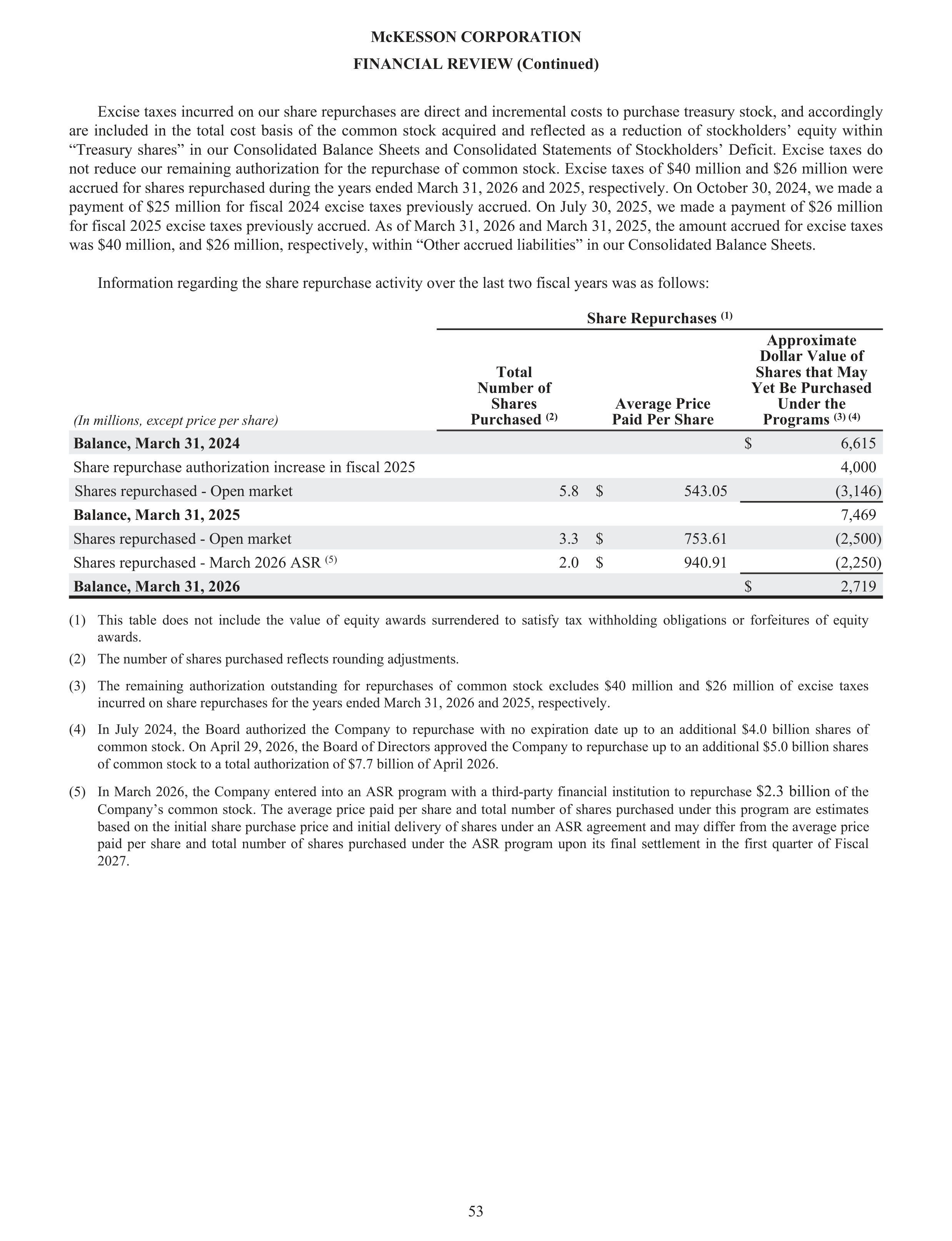
Excise taxes incurred on our share repurchases are direct and incremental costs to purchase treasury
r
stock, and accordingly
are
included
in
the
total
cost
basis
of
the
common
stock
acquired
and
reflected
as
a
reduction
of
stockholders’
equity
within
“Treasury
r
shares”
in
our
Consolidated
Balance
Sheets
and
Consolidated
Statements
of
Stockholders’
Deficit.
Excise
taxes
do
not reduce our remaining authorization for the repurchase of common stock. Excise taxes of $40 million and $26 million were
accrue
r
d for shares repurchased during the years ended March 31, 2026 and 2025, respectively. On October 30, 2024, we made a
payment
of
$25
million
for
fiscal
2024
excise
taxes
previously
accrue
r
d.
On
July
30,
2025,
we
made
a
payment
of
$26
million
for fiscal 2025 excise taxes previously accrued. As of March 31, 2026 and March 31, 2025, the amount accrued for excise taxes
was $40 million, and $26 million, respectively, within “Other accrue
r
d liabi
a
lities” in our Consolidated Balance Sheets.
Information regarding the share repurchase activity over the last two fiscal years was as follows:
Share Repurchases
(1)
(In millions, except price per share)
Total
Number of
Shares
Purchased
(2)
Average Price
Paid Per Share
Approximate
Dollar Value of
Shares that May
Yet Be Purchased
Under the
Programs
(3) (4)
Balance, March 31, 2024
$
6,615
Share repurchase authorization increase in fiscal 2025
4,000
Shares repurchased - Open market
5.8
$
543.05
(3,146)
Balance, March 31, 2025
7,469
Shares repurchased - Open market
3.3
$
753.61
(2,500)
Shares repurchased - March 2026 ASR
(5)
2.0
$
940.91
(2,250)
Balance, March 31, 2026
$
2,719
(1)
This
tabl
a
e
does
not
include
the
value
of
equity
awards
surrendered
to
satisfy
tax
withholding
obligations
or
forfeitures
of
equity
awards.
(2)
The number of shares purchased reflects rounding adju
d
stments.
(3)
The
remaining
authorization
outstanding
for
repurchases
of
common
stock
excludes
$40
million
and
$26
million
of
excise
taxes
incurred on share repurchases for the years ended March 31, 2026 and 2025, respectively.
(4)
In
July
2024,
the
Board
authorized
the
Company
to
repurchase
with
no
expiration
date
up
to
an
additional
$4.0
billion
shares
of
common stock. On April 29, 2026, the Board of Directors approved the Company to repurchase up to an additional $5.0 billion shares
of common stock to a total authorization of $7.7 billion of April 2026.
(5)
In
March
2026,
the
Company
entered
into
an
ASR
program
with
a
third-party
financial
institution
to
repurchase
$2.3
billion
of
the
Company’s
common
stock.
The
average
price
paid
per
share
and
total
number
of
shares
purchased
under
this
program
are
estimates
based on the initial share purchase price and initial delivery
r
of shares under an ASR agreement and may differ from the average price
paid
per
share
and
total
number
of
shares
purchased
under
the
ASR
program
upon
its
final
settlement
in
the
first
quarter
of
Fiscal
2027.
McKESSON CORPORAT
R
ION
FINANCIAL REVIEW (Continued)
53
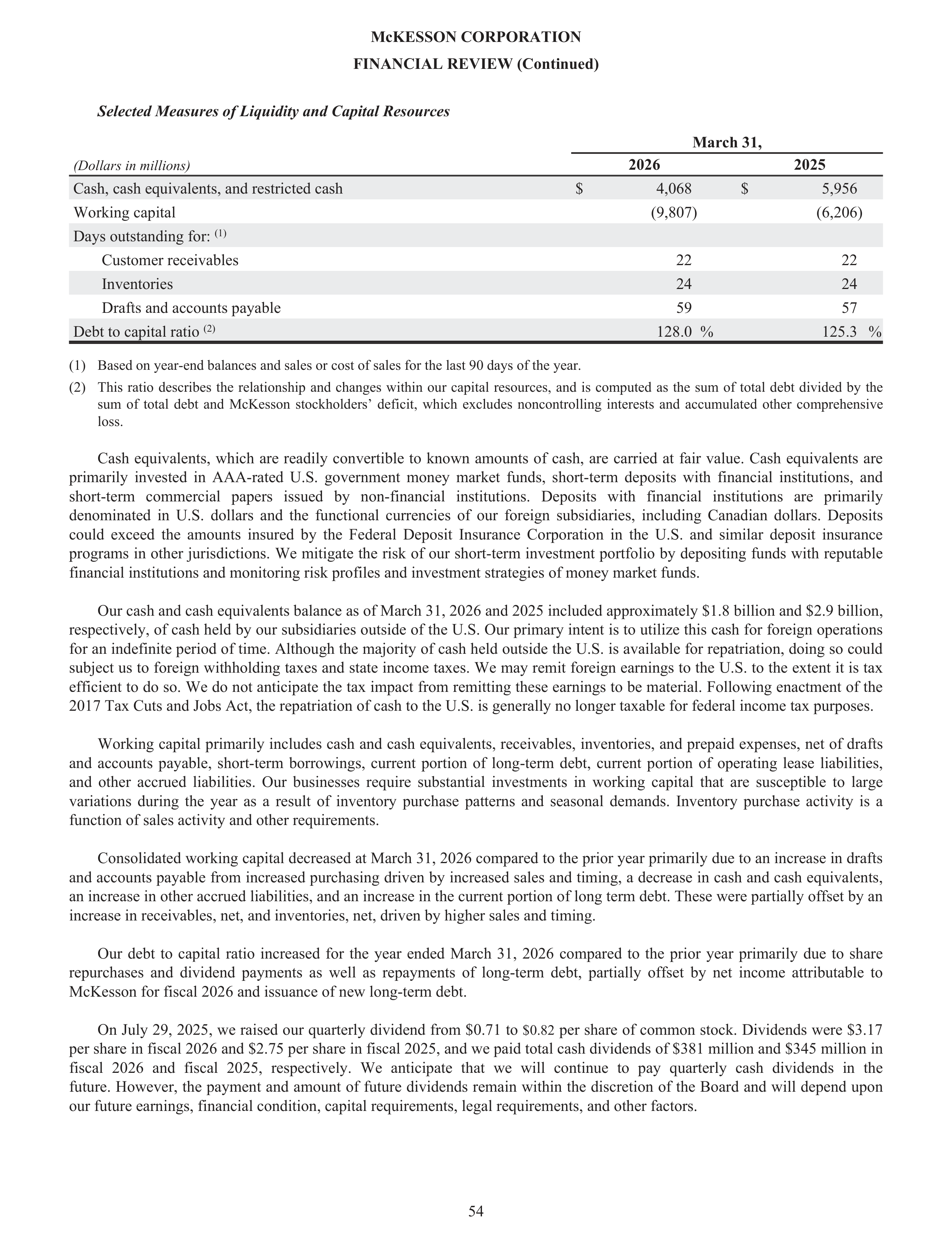
Selected
t
Measures of Liqu
i
idit
d
yt
and Capi
a
ta
i
l Resources
March 31,
(Dollars in millions)s
2026
2025
Cash, cash equivalents, and restricted cash
$
4,068
$
5,956
Working capi
a
tal
(9,807)
(6,206)
Days outstanding for:
(1)
Customer receivables
22
22
Inventories
24
24
Drafts
f
and accounts payabl
a
e
59
57
Debt to capital ratio
(2)
128.0
%
125.3
%
(1)
Based on year-end balances and sales or cost of sales for the last 90 days of the year.
(2)
This
ratio
describes
the
relationship
and
changes
within
our
capital
resources,
and
is
computed
as
the
sum
of
total
debt
divided
by
the
sum
of
total
debt
and
McKesson
stockholders’
deficit,
which
excludes
noncontrolling
interests
and
accumulated
other
comprehensive
loss.
Cash
equivalents,
which
are
readily
convertible
to
known
amounts
of
cash,
are
carried
at
fair
value.
Cash
equivalents
are
primarily
invested
in
AAA-rated
U.S.
government
money
market
funds,
short-term
deposits
with
financial
institutions,
and
short-term
commercial
pape
a
rs
issued
by
non-financial
institutions.
Deposits
with
financial
institutions
are
primarily
denominated
in
U.S.
dollars
and
the
functional
currencies
of
our
foreign
subs
u
idiaries,
including
Canadian
dollars.
Deposits
could
exceed
the
amounts
insured
by
the
Federal
Deposit
Insurance
Corporation
in
the
U.S.
and
similar
deposit
insurance
programs in other jurisdictions. We mitigate the risk of our short-term investment portfol
f
io by depositing funds with reputable
financial institutions and monitoring risk profile
f
s and investment strategies of money market funds.
Our cash and cash equivalents balance as of March 31, 2026 and 2025 included approximately $1.8 billion and $2.9 billion,
respectively, of cash held by our subs
u
idiaries outside of the U.S. Our primary intent is to utilize this cash for foreign operations
for an indefinite period of time. Although the majo
a
rity of cash held outside the U.S. is availabl
a
e for repatriation, doing so could
subj
u
ect us to foreign withholding taxes and state income taxes. We may remit foreign earnings to the U.S. to the extent it is tax
effi
f
cient to do so. We do not anticipate the tax impact from remitting these earnings to be material. Following enactment of the
2017 Tax Cuts and Jobs Act, the repatriation of cash to the U.S. is generally no longer taxabl
a
e for federal income tax purpos
r
es.
Working capital primarily includes cash and cash equivalents, receivabl
a
es, inventories, and prepaid expenses, net of drafts
f
and
accounts
payabl
a
e,
short-term
borrowings,
current
portion
of
long-term
debt,
current
portion
of
operating
lease
liabilities,
and
other
accrue
r
d
liabi
a
lities.
Our
businesses
require
subs
u
tantial
investments
in
working
capital
that
are
susceptible
to
large
variations
during
the
year
as
a
result
of
inventory
r
purchase
patterns
and
seasonal
demands.
Inventory
r
purchase
activity
is
a
function of sales activity and other requirements.
Consolidated working capital decreased at March 31, 2026 compared to the prior year primarily due to an increase in drafts
f
and accounts payabl
a
e from increased purchasing driven by increased sales and timing, a decrease in cash and cash equivalents,
an increase in other accrued liabilities, and an increase in the current portion of long term debt. These were partially offs
f
et by an
increase in receivabl
a
es, net, and inventories, net, driven by higher sales and timing.
Our
debt
to
capi
a
tal
ratio
increased
for
the
year
ended
March
31,
2026
compared
to
the
prior
year
primarily
due
to
share
repurchases
and
dividend
payments
as
well
as
repayments
of
long-term
debt,
partially
offs
f
et
by
net
income
attributable
to
McKesson for fiscal 2026 and issuance of new long-term debt.
On July 29, 2025, we raised our quarterly dividend from $0.71 to
$0.82
per share of common stock. Dividends were $3.17
per share in fiscal 2026 and $2.75 per share in fiscal 2025, and we paid total cash dividends of $381 million and $345 million in
fiscal
2026
and
fiscal
2025,
respectively.
We
anticipate
that
we
will
continue
to
pay
quarterly
cash
dividends
in
the
future. However, the payment and amount of future dividends remain within the discretion of the Board and will depend upon
our future earnings, financial condition, capital requirements, legal requirements, and other factors.
McKESSON CORPORAT
R
ION
FINANCIAL REVIEW (Continued)
54
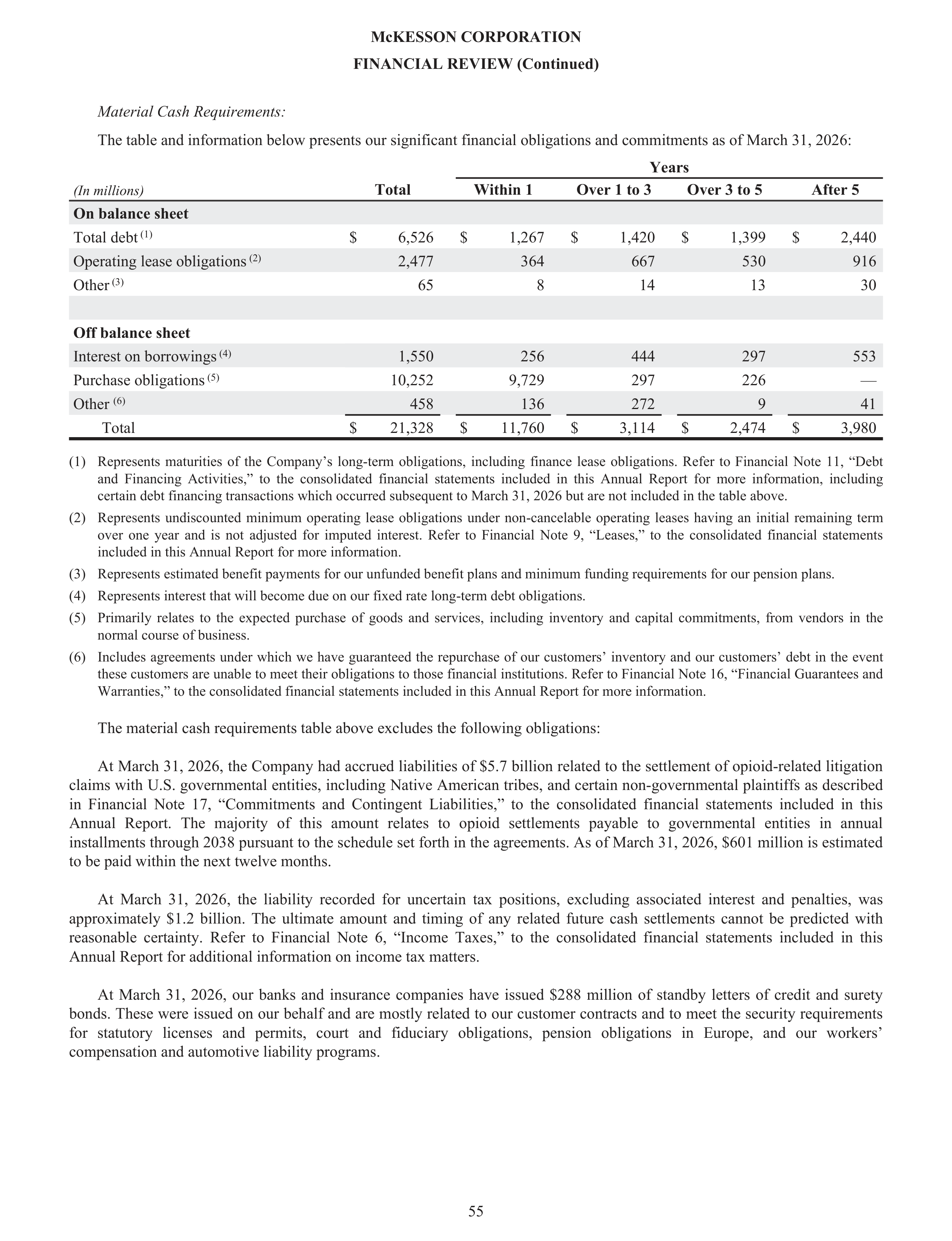
Material Cash Requirements:
t
The tabl
a
e and information below presents our significant financial obligations and commitments as of March 31, 2026:
Years
(In millions)s
Total
Within 1
Over 1 to 3
Over 3 to 5
After 5
On balance sheet
Total debt
(1)
$
6,526
$
1,267
$
1,420
$
1,399
$
2,440
Operating lease obligations
(2)
2,477
364
667
530
916
Other
(3)
65
8
14
13
30
Offf
balance sheet
Interest on borrowings
(4)
1,550
256
444
297
553
Purchase obligations
(5)
10,252
9,729
297
226
—
Other
(6)
458
136
272
9
41
Total
$
21,328
$
11,760
$
3,114
$
2,474
$
3,980
(1)
Represents
maturities
of
the
Company’s
long-term
obligations,
including
finance
lease
obligations.
Refer
to
Financial
Note
11,
“Debt
and
Financing
Activities,”
to
the
consolidated
financial
statements
included
in
this
Annual
Report
for
more
information,
including
certain debt financing transactions which occurred subs
u
equent to March 31, 2026 but are not included in the tabl
a
e above.
(2)
Represents
undiscounted
minimum
operating
lease
obligations
under
non-cancelable
operating
leases
having
an
initial
remaining
term
over
one
year
and
is
not
adju
d
sted
for
imputed
interest.
Refer
to
Financial
Note
9,
“Leases,”
to
the
consolidated
financial
statements
included in this Annual Report for more information.
(3)
Represents estimated benefit payments for our unfunde
f
d benefit plans and minimum funding requirements for our pension plans.
(4)
Represents interest that will become due on our fixed rate long-term debt obligations.
(5)
Primarily
relates
to
the
expected
purchase
of
goods
and
services,
including
inventory
r
and
capital
commitments,
from
vendors
in
the
normal course of business.
(6)
Includes
agreements
under
which
we
have
guaranteed
the
repurchase
of
our
customers’
inventory
r
and
our
customers’
debt
in
the
event
these customers are unabl
a
e to meet their obligations to those financial institutions. Refer to Financial Note 16, “Financial Guarantees and
Warranties,” to the consolidated financial statements included in this Annual Report for more information.
The material cash requirements tabl
a
e above excludes the following obligations:
At March 31, 2026, the Company had accrue
r
d liabilities of $5.7 billion related to the settlement of opioid-related litigation
claims with U.S. governmental entities, including Native American tribes, and certain non-governmental plaintiffs
f
as described
in
Financial
Note
17,
“Commitments
and
Contingent
Liabilities,”
to
the
consolidated
financial
statements
included
in
this
Annual
Report.
The
majo
a
rity
of
this
amount
relates
to
opioid
settlements
payabl
a
e
to
governmental
entities
in
annual
installments through 2038 pursuant to the schedule set forth in the agreements. As of March 31, 2026, $601 million is estimated
to be paid within the next twelve months.
At
March
31,
2026,
the
liability
recorded
for
uncertain
tax
positions,
excluding
associated
interest
and
penalties,
was
approximately
$1.2
billion.
The
ultimate
amount
and
timing
of
any
related
future
cash
settlements
cannot
be
predicted
with
reasonabl
a
e
certainty.
Refer
to
Financial
Note
6,
“Income
Taxes,”
to
the
consolidated
financial
statements
included
in
this
Annual Report for additional information on income tax matters.
At
March
31,
2026,
our
banks
and
insurance
companies
have
issued
$288
million
of
standby
letters
of
credit
and
surety
bonds. These were issued on our behalf and are mostly related to our customer contracts and to meet the security requirements
for
statut
t
ory
r
licenses
and
permits,
court
and
fiduciary
obligations,
pension
obligations
in
Europe,
and
our
workers’
compensation and automotive liability programs.
McKESSON CORPORAT
R
ION
FINANCIAL REVIEW (Continued)
55
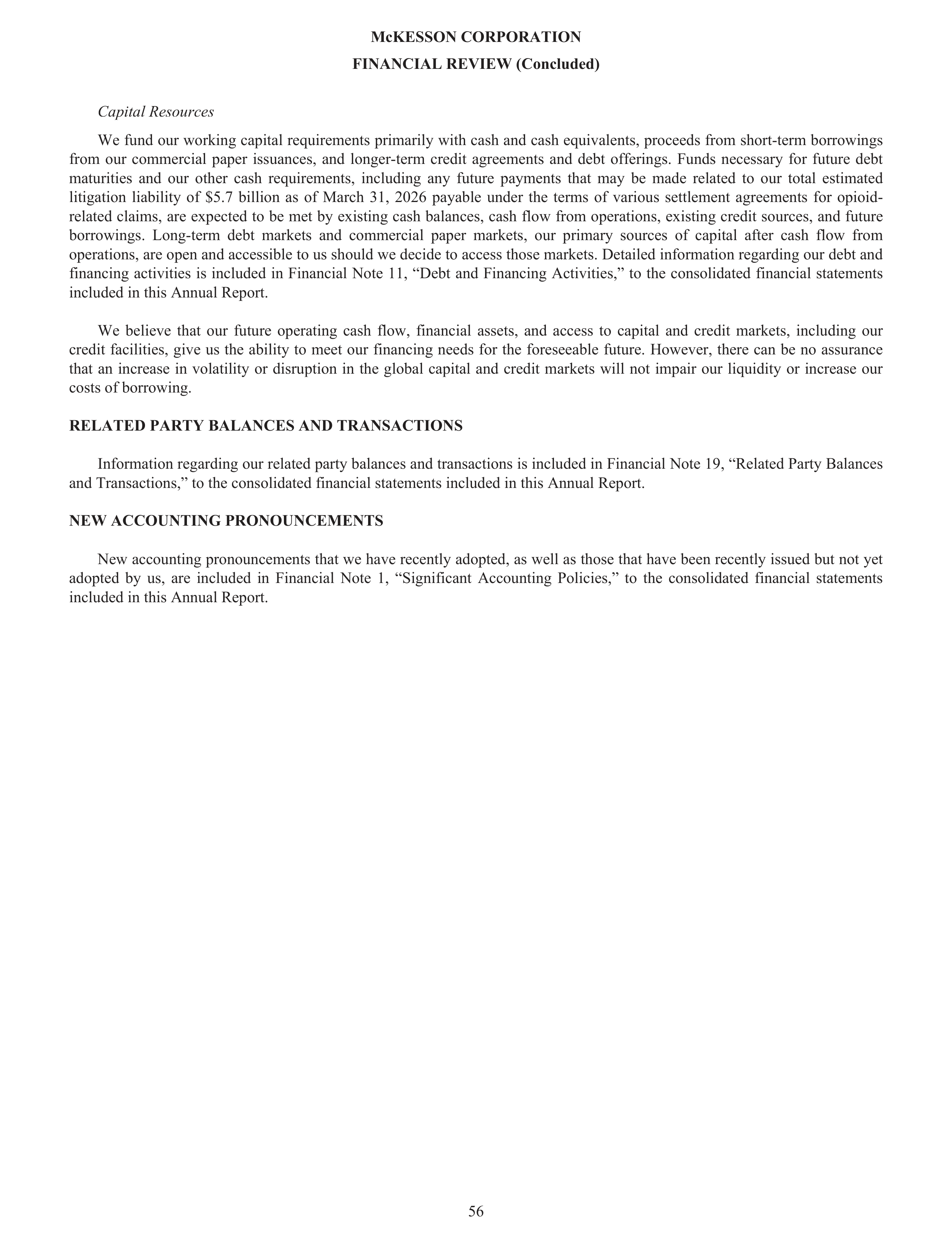
Capi
a
tal Resources
We fund our working capi
a
tal requirements primarily with cash and cash equivalents, proceeds from short-term borrowings
from
our
commercial
pape
a
r
issuances,
and
longer-term
credit
agreements
and
debt
offe
f
rings.
Funds
necessary
for
future
debt
maturities
and
our
other
cash
requirements,
including
any
future
payments
that
may
be
made
related
to
our
total
estimated
litigation
liabi
a
lity
of
$5.7
billion
as
of
March
31,
2026
payabl
a
e
under
the
terms
of
various
settlement
agreements
for
opioid-
related claims, are expected to be met by existing cash balances, cash flow from operations, existing credit sources, and future
borrowings.
Long-term
debt
markets
and
commercial
pape
a
r
markets,
our
primary
sources
of
capital
afte
f
r
cash
flow
from
operations, are open and accessible to us should we decide to access those markets. Detailed information regarding our debt and
financing
activities
is
included
in
Financial
Note
11,
“Debt
and
Financing
Activities,”
to
the
consolidated
financial
statements
included in this Annual Report.
We
believe
that
our
future
operating
cash
flow,
financial
assets,
and
access
to
capital
and
credit
markets,
including
our
credit
facilities,
give
us
the
ability
to
meet
our
financing
needs
for
the
foreseeable
future.
However,
there
can
be
no
assurance
that
an
increase
in
volatility
or
disrupt
r
ion
in
the
global
capi
a
tal
and
credit
markets
will
not
impair
our
liquidity
or
increase
our
costs of borrowing.
RELATED PARTY BALANCES AND TRANS
R
ACTIONS
Information regarding our related party balances and transactions is included in Financial Note 19, “Related Party Balances
and Transactions,” to the consolidated financial statements included in this Annual Report.
NEW ACCOUNTING PRONOUNCEMENTS
New accounting pronouncements that we have recently adopted, as well as those that have been recently issued but not yet
adopted
by
us,
are
included
in
Financial
Note
1,
“Significant
Accounting
Policies,”
to
the
consolidated
financial
statements
included in this Annual Report.
McKESSON CORPORAT
R
ION
FINANCIAL REVIEW (Concluded)
56
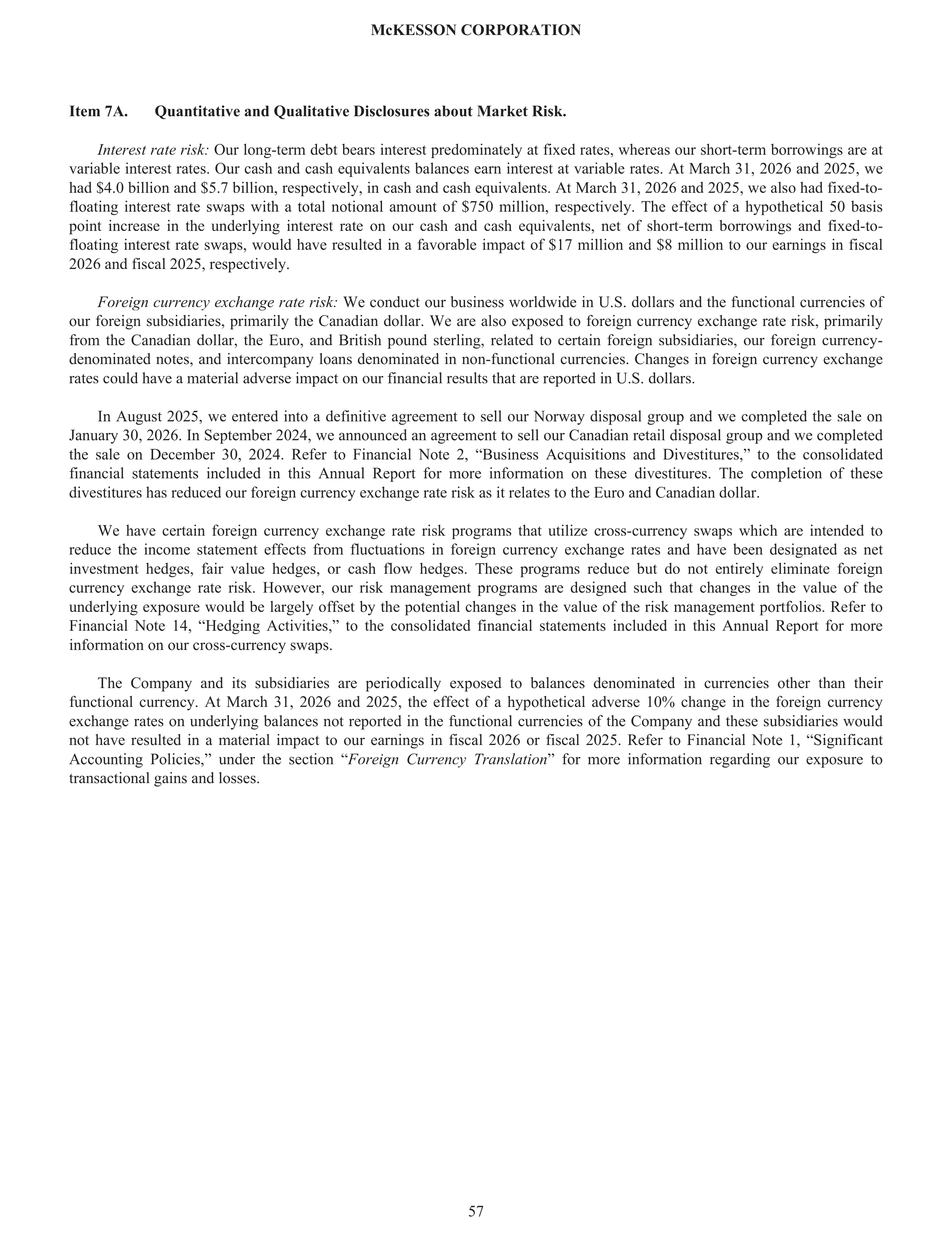
Item 7A.
Quantitative and Qualitative Disclosures about Market Risk.
Interest rate risk
i
:
Our long-term debt bears interest predominately at fixed rates, whereas our short-term borrowings are at
variable interest
rates.
Our
cash
and
cash
equivalents
balances
earn
interest at variable rates.
At
March
31,
2026
and
2025,
we
had $4.0 billion and $5.7 billion, respectively, in cash and cash equivalents. At March 31, 2026 and 2025, we also had fixed-to-
floating
interest
rate
swaps
with
a
total
notional
amount
of
$750
million,
respectively.
The
effe
f
ct
of
a
hypothetical
50
basis
point
increase
in
the
underlying
interest
rate
on
our
cash
and
cash
equivalents,
net
of
short-term
borrowings
and
fixed-to-
floating
interest
rate
swaps,
would
have
resulted
in
a
favorable
impact
of
$17
million
and
$8
million
to
our
earnings
in
fiscal
2026 and fiscal 2025, respectively.
Foreign
g
currency
c
exchange rate risk
i
:
We conduct our business worldwide in U.S. dollars and the functional currencies of
our
foreign
subs
u
idiaries,
primarily
the
Canadian
dollar.
We
are
also
exposed
to
foreign
currency
exchange
rate
risk,
primarily
from
the
Canadian
dollar,
the
Euro,
and
British
pound
sterling,
related
to
certain
foreign
subs
u
idiaries,
our
foreign
currency-
denominated
notes,
and
intercompany
loans
denominated
in
non-functional
currencies.
Changes
in
foreign
currency
exchange
rates could have a material adverse impact on our financial results that are reported in U.S. dollars.
In
August
2025,
we
entered
into
a
definitive
agreement
to
sell
our
Norway
disposal
group
and
we
completed
the
sale
on
January 30, 2026. In September 2024, we announced an agreement to sell our Canadian retail disposal group and we completed
the
sale
on
December
30,
2024.
Refer
to
Financial
Note
2,
“Business
Acquisitions
and
Divestitures,”
to
the
consolidated
financial
statements
included
in
this
Annual
Report
for
more
information
on
these
divestitures.
The
completion
of
these
divestitures has reduced our foreign currency exchange rate risk as it relates to the Euro and Canadian dollar.
We
have
certain
foreign
currency
exchange
rate
risk
programs
that
utilize
cross-currency
swaps
which
are
intended
to
reduce
the
income
statement
effe
f
cts
from
fluctuations
in
foreign
currency
exchange
rates
and
have
been
designated
as
net
investment
hedges,
fair
value
hedges,
or
cash
flow
hedges.
These
programs
reduce
but
do
not
entirely
eliminate
foreign
currency
exchange
rate
risk.
However,
our
risk
management
programs
are
designed
such
that
changes
in
the
value
of
the
underlying
exposure
would
be
largely
offs
f
et
by
the
potential
changes
in
the
value
of
the
risk
management
portfol
f
ios.
Refer
to
Financial
Note
14,
“Hedging
Activities,”
to
the
consolidated
financial
statements
included
in
this
Annual
Report
for
more
information on our cross-currency swaps.
The
Company
and
its
subs
u
idiaries
are
periodically
exposed
to
balances
denominated
in
currencies
other
than
their
functional
currency.
At
March
31,
2026
and
2025,
the
effe
f
ct
of
a
hypothetical
adverse
10%
change
in
the
foreign
currency
exchange
rates
on
underlying
balances
not
reported
in
the
functional
currencies
of
the
Company
and
these
subs
u
idiaries
would
not
have
resulted
in
a
material
impact
to
our
earnings
in
fiscal
2026
or
fiscal
2025.
Refer
to
Financial
Note
1,
“Significant
Accounting
Policies,”
under
the
section
“
Foreign
g
Currency
c
Translation
”
for
more
information
regarding
our
exposure
to
transactional gains and losses.
McKESSON CORPORAT
R
ION
57
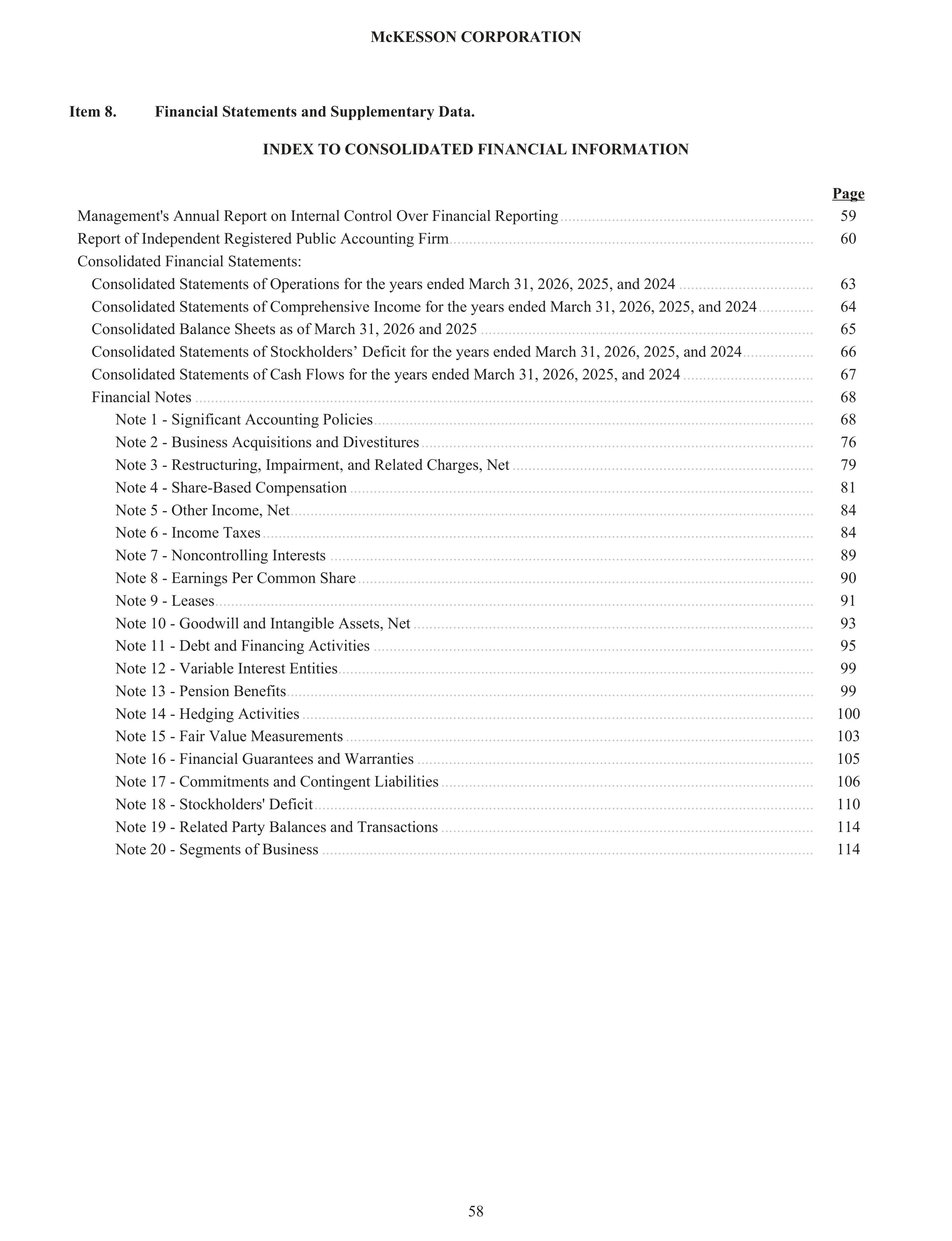
Item 8.
Financial Statements and Supplementary Data.
INDEX TO CONSOLIDATED FINANCIAL INFORMATION
Page
g
Management's Annual Report on Internal Control Over Financial Reporting
................................................................
59
Report of Independent Registered Public Accounting Firm
............................................................................................
60
nsolidated Financial Statements:
Consolidated Statements of Operations for the years ended March 31, 2026, 2025, and 2024
..................................
63
Consolidated Statements of Comprehensive Income for the years ended March 31, 2026, 2025, and 2024
..............
64
Consolidated Balance Sheets as of March 31, 2026 and 2025
....................................................................................
65
Consolidated Statements of Stockholders’ Deficit for the years ended March 31, 2026, 2025, and 2024
..................
66
Consolidated Statements of Cash Flows for the years ended March 31, 2026, 2025, and 2024
.................................
67
Financial Notes
............................................................................................................................................................
68
Note 1 - Significant Accounting Policies
...............................................................................................................
68
Note 2 - Business Acquisitions and Divestitures
...................................................................................................
76
Note 3 - Restructuring, Impairment, and Related Charges, Net
............................................................................
79
Note 4 - Share-Based Compensation
.....................................................................................................................
81
Note 5 - Other Income, Net
....................................................................................................................................
84
Note 6 - Income Taxes
...........................................................................................................................................
84
Note 7 - Noncontrolling Interests
..........................................................................................................................
89
Note 8 - Earnings Per Common Share
...................................................................................................................
90
Note 9 - Leases
.......................................................................................................................................................
91
Note 10 - Goodwill and Intangible Assets, Net
.....................................................................................................
93
Note 11 - Debt and Financing Activities
...............................................................................................................
95
Note 12 - Variable Interest Entities
........................................................................................................................
99
Note 13 - Pension Benefits
.....................................................................................................................................
99
Note 14 - Hedging Activities
.................................................................................................................................
100
Note 15 - Fair Value Measurements
......................................................................................................................
103
Note 16 - Financial Guarantees and Warranties
....................................................................................................
105
Note 17 - Commitments and Contingent Liabilities
..............................................................................................
106
Note 18 - Stockholders' Deficit
..............................................................................................................................
110
Note 19 - Related Party Balances and Transactions
..............................................................................................
114
Note 20 - Segments of Business
............................................................................................................................
114
McKESSON CORPORAT
R
ION
58
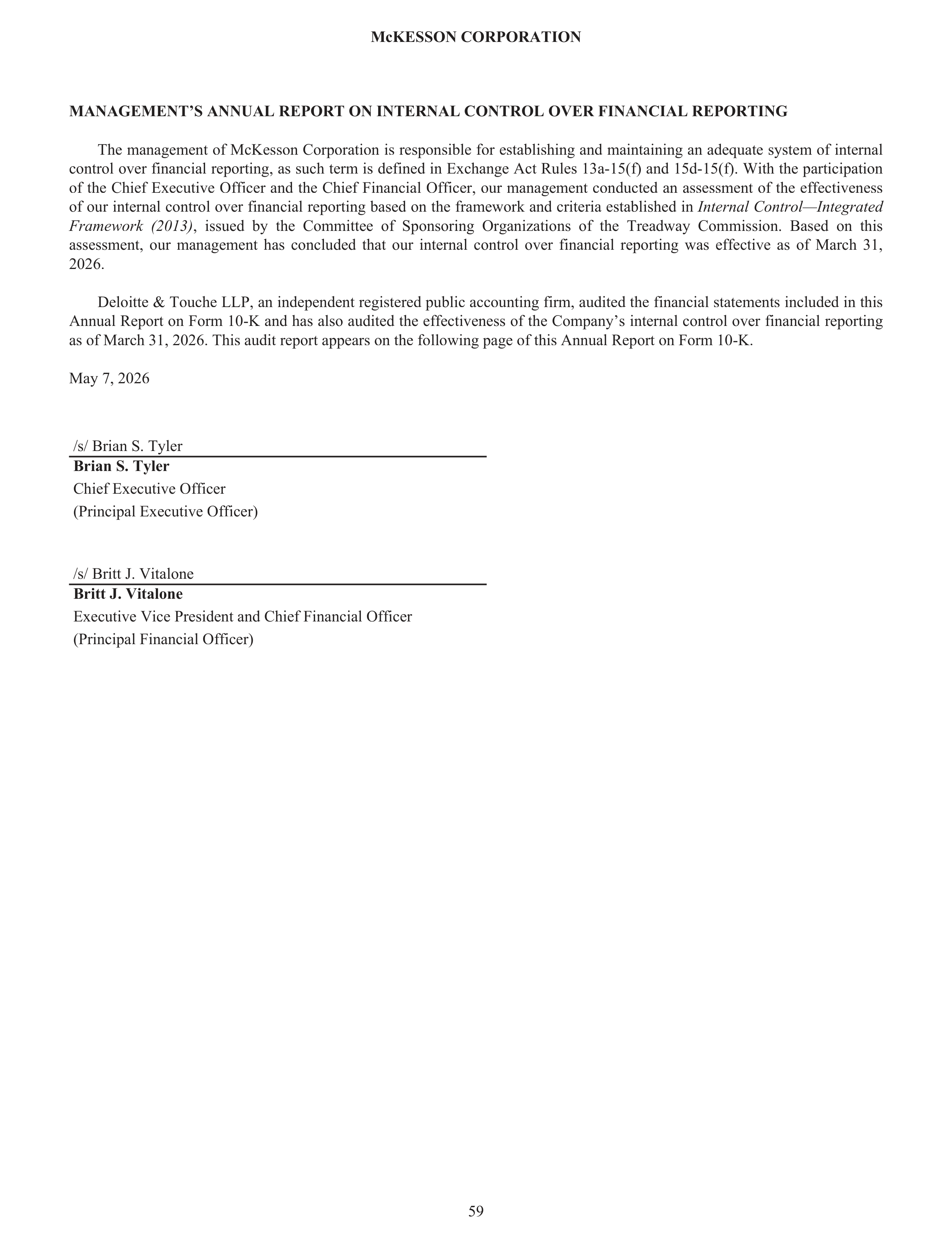
MANAGEMENT’S ANNUAL REPORT ON INTERNAL CONTROL OVER FINANCIAL REPORTING
The management of McKesson Corporation is responsible for establ
a
ishing and maintaining an adequate system of internal
control over financial reporting, as such term is defined in Exchange Act Rules 13a-15(f) and 15d-15(f). With the participation
of
the
Chief
Executive
Offi
f
cer
and
the
Chief
Financial
Offi
f
cer,
our
management
conducted
an
assessment
of
the
effe
f
ctiveness
of our internal control over financial reporting based on the framework and criteria establ
a
ished in
Internal Contro
t
l—In
—
tegr
e
ated
Framework
r
(2013)
,
issued
by
the
Committee
of
Sponsoring
Organizations
of
the
Treadway
Commission.
Based
on
this
assessment,
our
management
has
concluded
that
our
internal
control
over
financial
reporting
was
effe
f
ctive
as
of
March
31,
2026.
Deloitte & Touche LLP, an independent registered public accounting firm, audited the financial statements included in this
Annual Report on Form 10-K and has also audited the effe
f
ctiveness of the Company’s internal control over financial reporting
as of March 31, 2026. This audit report appears on the following page of this Annual Report on Form 10-K.
May 7, 2026
/s/ Brian S. Tyler
Brian S. Tyler
Chief Executive Offi
f
cer
(Principal Executive Offi
f
cer)
/s/ Britt J. Vitalone
Britt J. Vitalone
Executive Vice President and Chief Financial Offi
f
cer
(Principal Financial Offi
f
cer)
McKESSON CORPORAT
R
ION
59
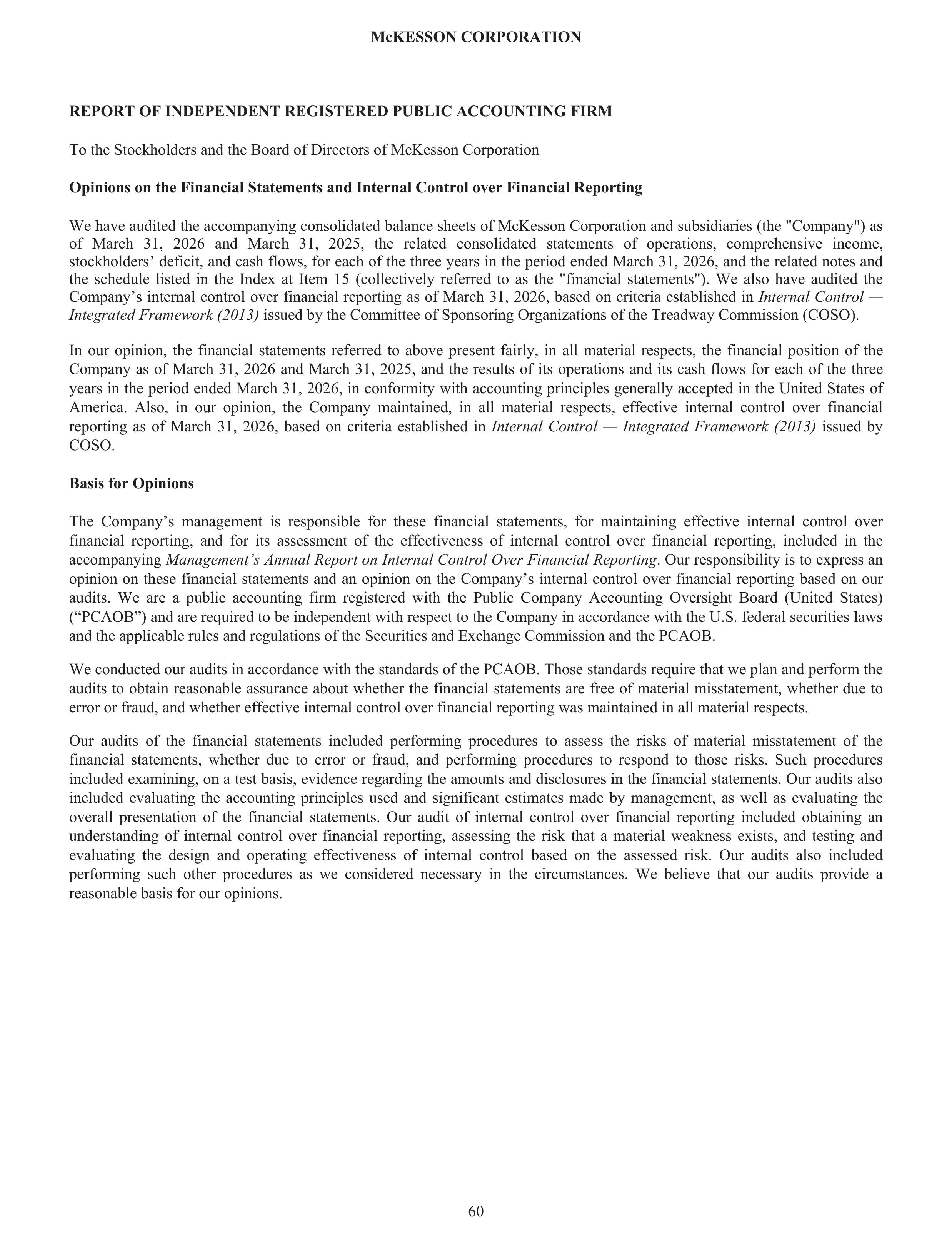
REPORT OF INDEPENDENT REGISTERED PUBLIC ACCOUNTING FIRM
To the Stockholders and the Board of Directors of McKesson Corporation
Opinions on the Financial Statements and Internal Control over Financial Reporting
We have audited the accompanying consolidated balance sheets of McKesson Corporation and subs
u
idiaries (the "Company") as
of
March
31,
2026
and
March
31,
2025,
the
related
consolidated
statements
of
operations,
comprehensive
income,
stockholders’ deficit, and cash flows, for each of the three years in the period ended March 31, 2026, and the related notes and
the
schedule
listed
in
the
Index
at
Item
15
(collectively
referred
to
as
the
"fin
f
ancial
statements").
We
also
have
audited
the
Company’s
internal
control
over
financial
reporting
as
of
March
31,
2026,
based
on
criteria
establ
a
ished
in
Internal
Contro
t
l
—
Integr
e
ated Framework
r
(2013)
issued by the Committee of Sponsoring Organizations of the Treadway Commission (COSO).
In
our
opinion,
the
financial
statements
referred
to
above
present
fairly,
in
all
material
respects,
the
financial
position
of
the
Company
as
of
March
31,
2026
and
March
31,
2025,
and
the
results
of
its
operations
and
its
cash
flows
for
each
of
the
three
years in the period ended March 31, 2026, in confor
f
mity with accounting principles generally accepted in the United States of
America.
Also,
in
our
opinion,
the
Company
maintained,
in
all
material
respects,
effe
f
ctive
internal
control
over
financial
reporting
as
of
March
31,
2026,
based
on
criteria
establ
a
ished
in
Internal
Contro
t
l
—
Integr
e
ated
Framework
r
(2013)
issued
by
COSO.
Basis for Opinions
The
Company’s
management
is
responsible
for
these
financial
statements,
for
maintaining
effe
f
ctive
internal
control
over
fin
f
ancial
reporting,
and
for
its
assessment
of
the
effe
f
ctiveness
of
internal
control
over
financial
reporting,
included
in
the
accompanying
Management’s Annual Repor
e
t on Internal Contro
t
l Over Financial Repor
e
ting
. Our responsibility is to express an
opinion
on
these
financial
statements
and
an
opinion
on
the
Company’s
internal
control
over
financial
reporting
based
on
our
audits.
We
are
a
public
accounting
firm
registered
with
the
Publ
u
ic
Company
Accounting
Oversight
Board
(United
States)
(“PCAOB”) and are required to be independent with respect to the Company in accordance with the U.S. federal securities laws
and the applicable rules and regulations of the Securities and Exchange Commission and the PCAOB.
We conducted our audits in accordance with the standards of the PCAOB. Those standards require that we plan and perform the
audits
to
obtain
reasonabl
a
e
assurance
about
whether
the
financial
statements
are
free
of
material
misstatement,
whether
due
to
error or fraud, and whether effe
f
ctive internal control over financial reporting was maintained in all material respects.
Our
audits
of
the
financial
statements
included
performing
procedur
d
es
to
assess
the
risks
of
material
misstatement
of
the
financial
statements,
whether
due
to
error
or
fraud,
and
performing
procedur
d
es
to
respond
to
those
risks.
Such
procedur
d
es
included examining, on a test basis, evidence regarding the amounts and disclosures in the financial statements. Our audits also
included
evaluating
the
accounting
principles
used
and
significant
estimates
made
by
management,
as
well
as
evaluating
the
overall
presentation
of
the
financial
statements.
Our
audit
of
internal
control
over
financial
reporting
included
obtaining
an
understanding
of
internal
control
over
financial
reporting,
assessing
the
risk
that
a
material
weakness
exists,
and
testing
and
evaluating
the
design
and
operating
effe
f
ctiveness
of
internal
control
based
on
the
assessed
risk.
Our
audits
also
included
performing
such
other
procedur
d
es
as
we
considered
necessary
in
the
circumstances.
We
believe
that
our
audits
provide
a
reasonabl
a
e basis for our opinions.
McKESSON CORPORAT
R
ION
60
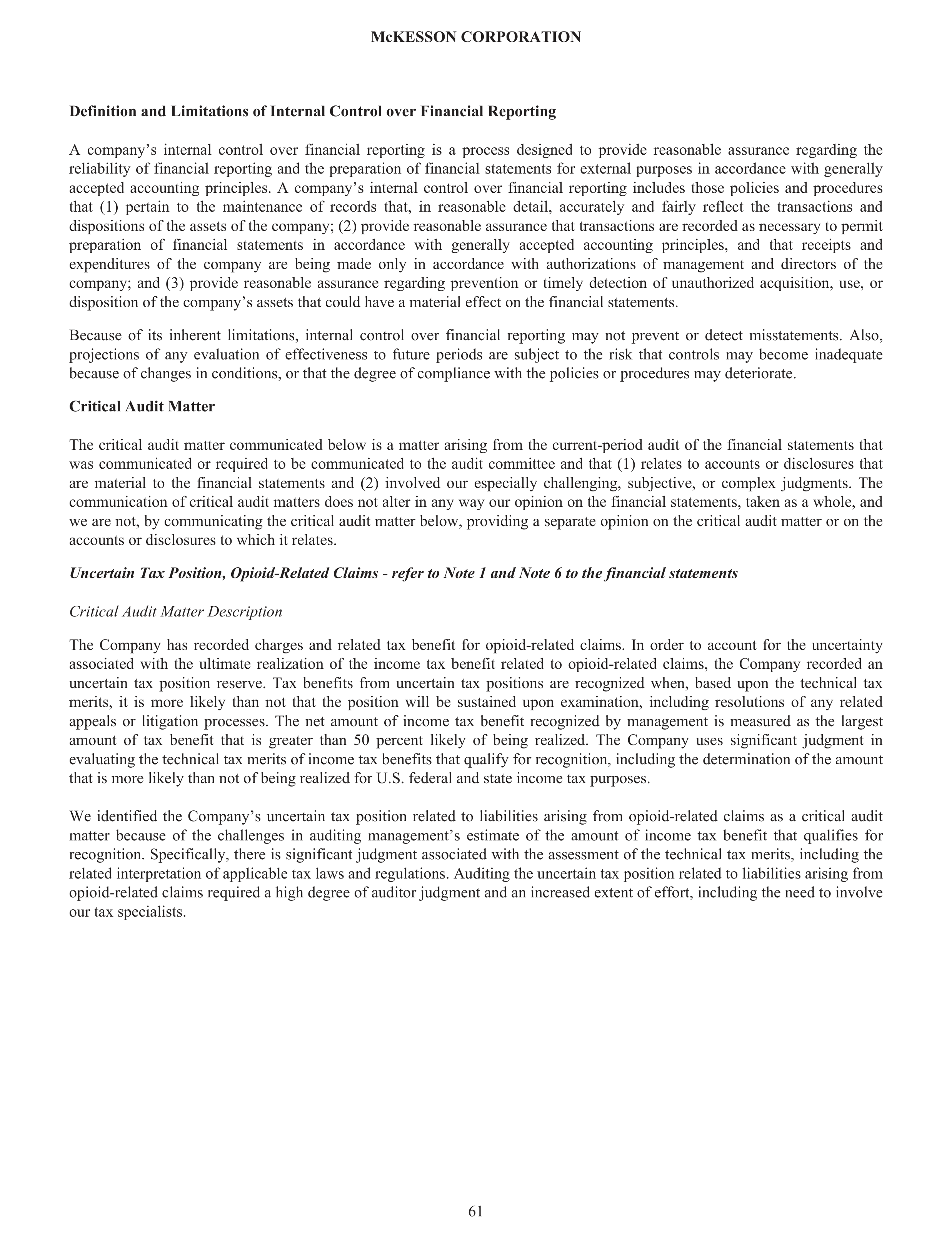
Definition and Limitations of Internal Control over Financial Reporting
A
company’s
internal
control
over
financial
reporting
is
a
process
designed
to
provide
reasonabl
a
e
assurance
regarding
the
reliabi
a
lity
of
financial
reporting
and
the
preparation
of
financial
statements
for
external
purpos
r
es
in
accordance
with
generally
accepted
accounting
principles.
A
company’s
internal
control
over
financial
reporting
includes
those
policies
and
procedur
d
es
that
(1)
pertain
to
the
maintenance
of
records
that,
in
reasonabl
a
e
detail,
accurately
and
fairly
reflect
the
transactions
and
dispositions of the assets of the company; (2) provide reasonabl
a
e assurance that transactions are recorded as necessary to permit
preparation
of
financial
statements
in
accordance
with
generally
accepted
accounting
principles,
and
that
receipts
and
expenditures
of
the
company
are
being
made
only
in
accordance
with
authorizations
of
management
and
directors
of
the
company;
and
(3)
provide
reasonable
assurance
regarding
prevention
or
timely
detection
of
unauthorized
acquisition,
use,
or
disposition of the company’s assets that could have a material effe
f
ct on the financial statements.
Because
of
its
inherent
limitations,
internal
control
over
financial
reporting
may
not
prevent
or
detect
misstatements.
Also,
projections
of
any
evaluation
of
effe
f
ctiveness
to
future
periods
are
subj
u
ect
to
the
risk
that
controls
may
become
inadequate
because of changes in conditions, or that the degree of compliance with the policies or procedur
d
es may deteriorate.
Critical Audit Matter
The
critical
audit
matter
communicated
below
is
a
matter
arising
from
the
current-period
audit
of
the
financial
statements
that
was
communicated
or
required
to
be
communicated
to
the
audit
committee
and
that
(1)
relates
to
accounts
or
disclosures
that
are
material
to
the
financial
statements
and
(2)
involved
our
especially
challenging,
subj
u
ective,
or
complex
judgments.
The
communication of critical audit matters does not alter in any way our opinion on the financial statements, taken as a whole, and
we are not, by communicating the critical audit matter below, providing a separate opinion on the critical audit matter or on the
accounts or disclosures to which it relates.
Uncertain Tax
a
Positio
i
n, Opioid-R
d
elat
l
ed
t
Clai
l
ms
i
- refe
e
r to Note 1 and Note 6 to the fina
i
ncial stat
t
em
t
ents
Critical Audit Matter Descript
i
ion
The
Company
has
recorded
charges
and
related
tax
benefit
for
opioid-related
claims.
In
order
to
account
for
the
uncertainty
associated
with
the
ultimate
realization
of
the
income
tax
benefit
related
to
opioid-related
claims,
the
Company
recorded
an
uncertain
tax
position
reserve.
Tax
benefits
from
uncertain
tax
positions
are
recognized
when,
based
upon
the
technical
tax
merits,
it
is
more
likely
than
not
that
the
position
will
be
sustained
upon
examination,
including
resolutions
of
any
related
appeals
or
litigation
processes.
The
net
amount
of
income
tax
benefit
recognized
by
management
is
measured
as
the
largest
amount
of
tax
benefit
that
is
greater
than
50
percent
likely
of
being
realized.
The
Company
uses
significant
judgment
in
evaluating the technical tax merits of income tax benefits that qualify
f
for recognition, including the determination of the amount
that is more likely than not of being realized for U.S. federal and state income tax purpos
r
es.
We
identifie
f
d
the
Company’s
uncertain
tax
position
related
to
liabi
a
lities
arising
from
opioid-related
claims
as
a
critical
audit
matter
because
of
the
challenges
in
auditing
management’s
estimate
of
the
amount
of
income
tax
benefit
that
qualifies
for
recognition. Specifically, there is significant judgment associated with the assessment of the technical tax merits, including the
related interpretation of applicable tax laws and regulations. Auditing the uncertain tax position related to liabi
a
lities arising from
opioid-related claims required a high degree of auditor judgment and an increased extent of effo
f
rt, including the need to involve
our tax specialists.
McKESSON CORPORAT
R
ION
61
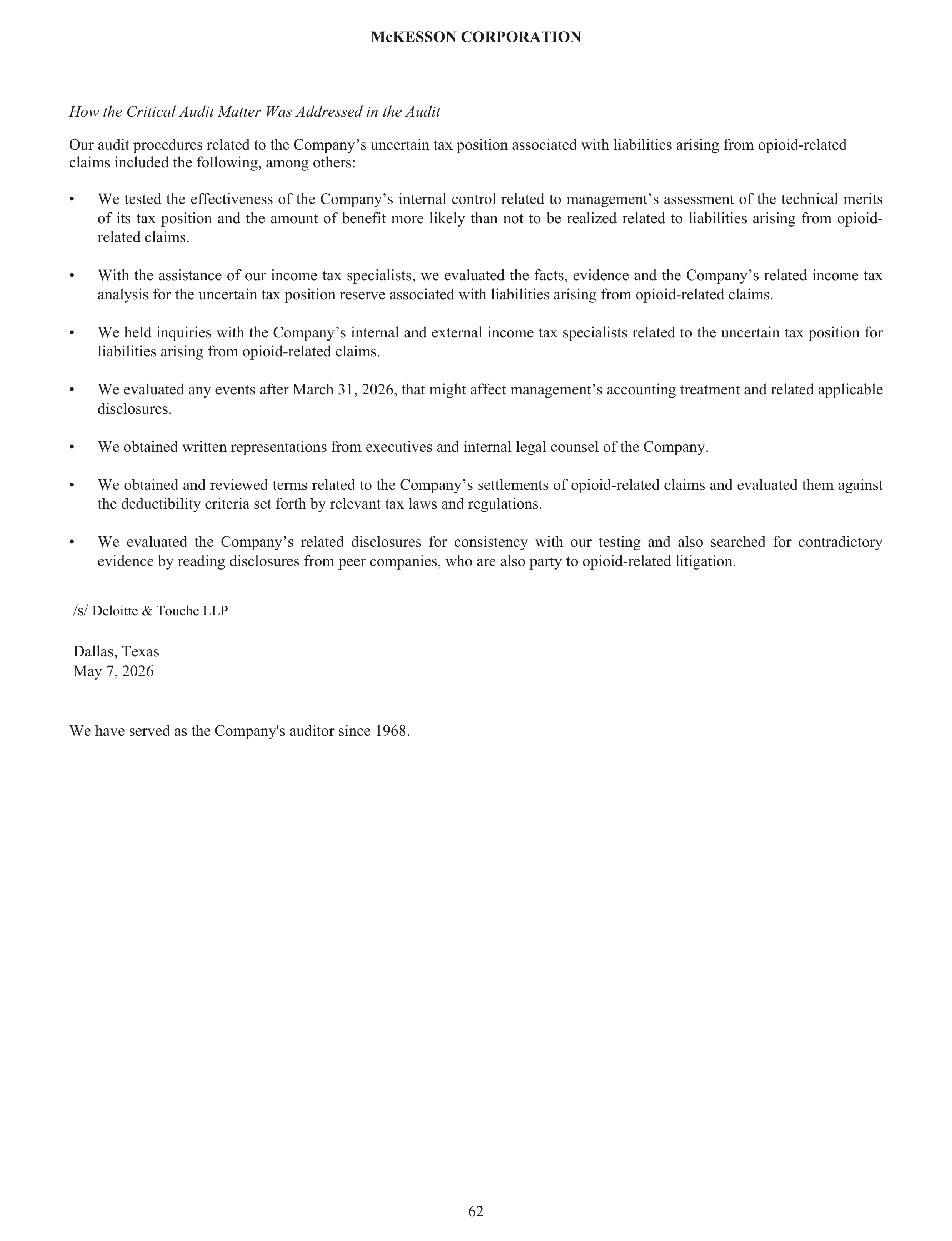
How the Critical Audit Matter Was Addr
d
essed in the Audit
Our audit procedur
d
es related to the Company’s uncertain tax position associated with liabi
a
lities arising from opioid-related
claims included the following, among others:
•
We
tested
the
effe
f
ctiveness
of
the
Company’s
internal
control
related
to
management’s
assessment
of
the
technical
merits
of
its
tax
position
and
the
amount
of
benefit
more
likely
than
not
to
be
realized
related
to
liabi
a
lities
arising
from
opioid-
related claims.
•
With
the
assistance
of
our
income
tax
specialists,
we
evaluated
the
facts,
evidence
and
the
Company’s
related
income
tax
analysis for the uncertain tax position reserve associated with liabi
a
lities arising from opioid-related claims.
•
We held inquiries with the Company’s internal and external income tax specialists related to the uncertain tax position for
liabi
a
lities arising from opioid-related claims.
•
We evaluated any events afte
f
r March 31, 2026, that might affe
f
ct management’s accounting treatment and related applicable
disclosures.
•
We obtained written representations from executives and internal legal counsel of the Company.
•
We obtained and reviewed terms related to the Company’s settlements of opioid-related claims and evaluated them against
the deductibility criteria set forth by relevant tax laws and regulations.
•
We
evaluated
the
Company’s
related
disclosures
for
consistency
with
our
testing
and
also
searched
for
contradictory
r
evidence by reading disclosures from peer companies, who are also party to opioid-related litigation.
/s/
Deloitte & Touche LLP
Dallas, Texas
May 7, 2026
We have served as the Company's auditor since 1968.
McKESSON CORPORAT
R
ION
62
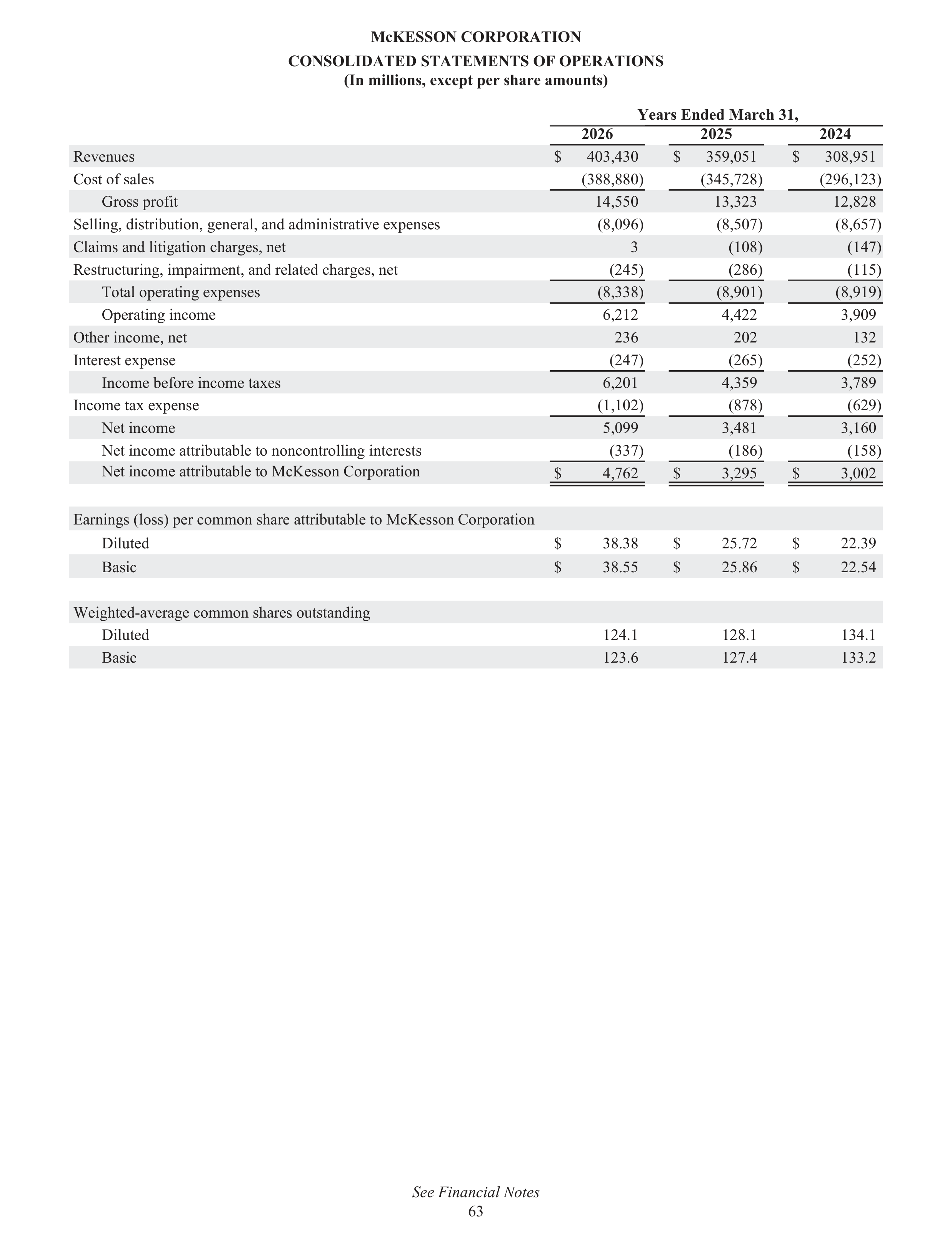
CONSOLIDATED STATEMENTS OF OPERAT
R
IONS
(In millions, except per share amounts)
Years Ended March 31,
2026
2025
2024
Revenues
$
403,430
$
359,051
$
308,951
Cost of sales
(388,880)
(345,728)
(296,123)
Gross profit
f
14,550
13,323
12,828
Selling, distribution, general, and administrative expenses
(8,096)
(8,507)
(8,657)
Claims and litigation charges, net
3
(108)
(147)
Restructur
t
ing, impairment, and related charges, net
(245)
(286)
(115)
Total operating expenses
(8,338)
(8,901)
(8,919)
Operating income
6,212
4,422
3,909
Other income, net
236
202
132
Interest expense
(247)
(265)
(252)
Income before income taxes
6,201
4,359
3,789
Income tax expense
(1,102)
(878)
(629)
Net income
5,099
3,481
3,160
Net income attributable to noncontrolling interests
(337)
(186)
(158)
Net income attributable to McKesson Corporation
$
4,762
$
3,295
$
3,002
Earnings (loss) per common share attributable to McKesson Corporation
Diluted
$
38.38
$
25.72
$
22.39
Basic
$
38.55
$
25.86
$
22.54
Weighted-average common shares outstanding
Diluted
124.1
128.1
134.1
Basic
123.6
127.4
133.2
McKESSON CORPORAT
R
ION
See Financial Notes
63
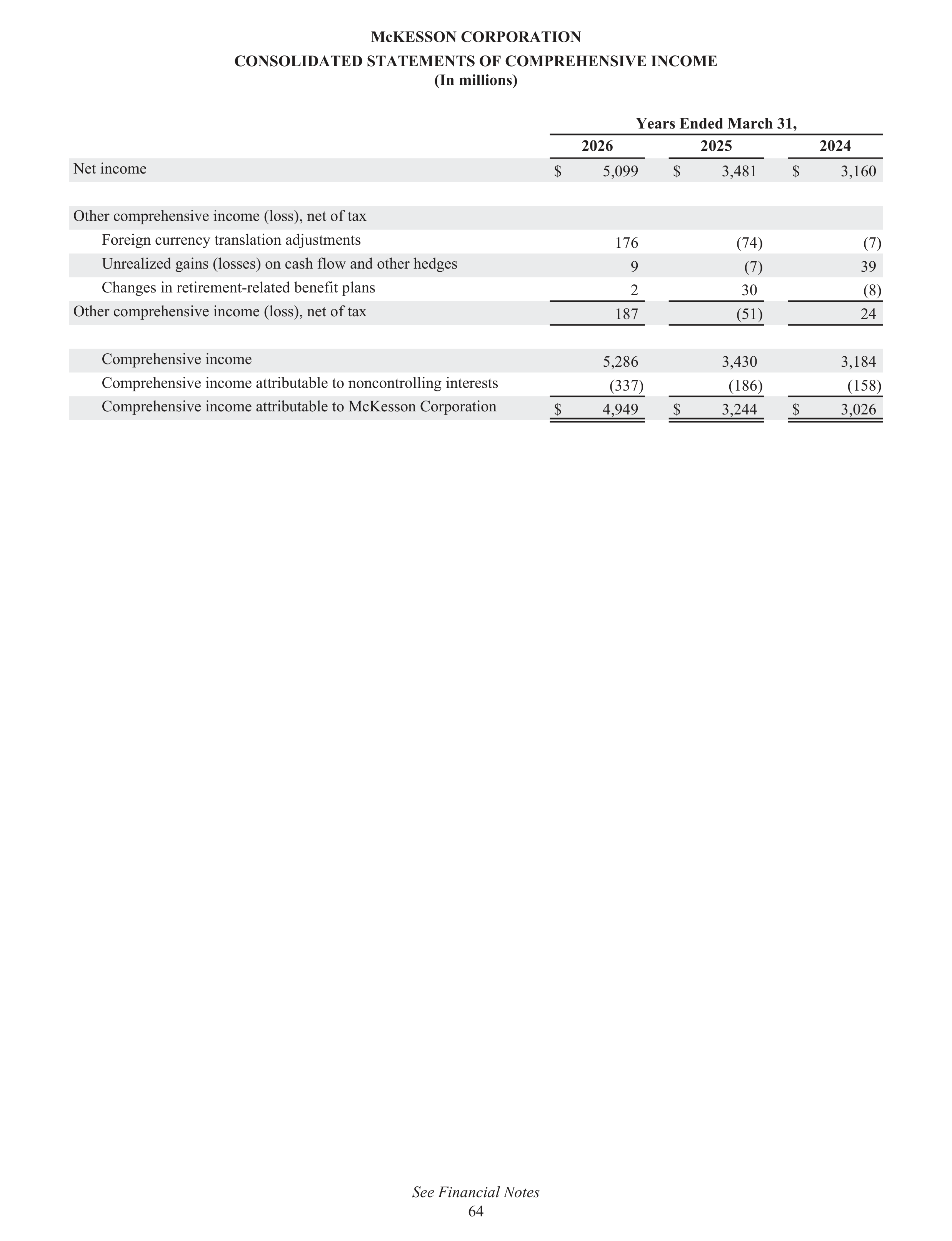
CONSOLIDATED STATEMENTS OF COMPREHENSIVE INCOME
(In millions)
Years Ended March 31,
2026
2025
2024
Net income
$
5,099
$
3,481
$
3,160
Other comprehensive income (loss), net of tax
Foreign currency translation adju
d
stments
176
(74)
(7)
Unrealized gains (losses) on cash flow and other hedges
9
(7)
39
Changes in retirement-related benefit plans
2
30
(8)
Other comprehensive income (loss), net of tax
187
(51)
24
Comprehensive income
5,286
3,430
3,184
Comprehensive income attributable to noncontrolling interests
(337)
(186)
(158)
Comprehensive income attributable to McKesson Corporation
$
4,949
$
3,244
$
3,026
McKESSON CORPORAT
R
ION
See Financial Notes
64
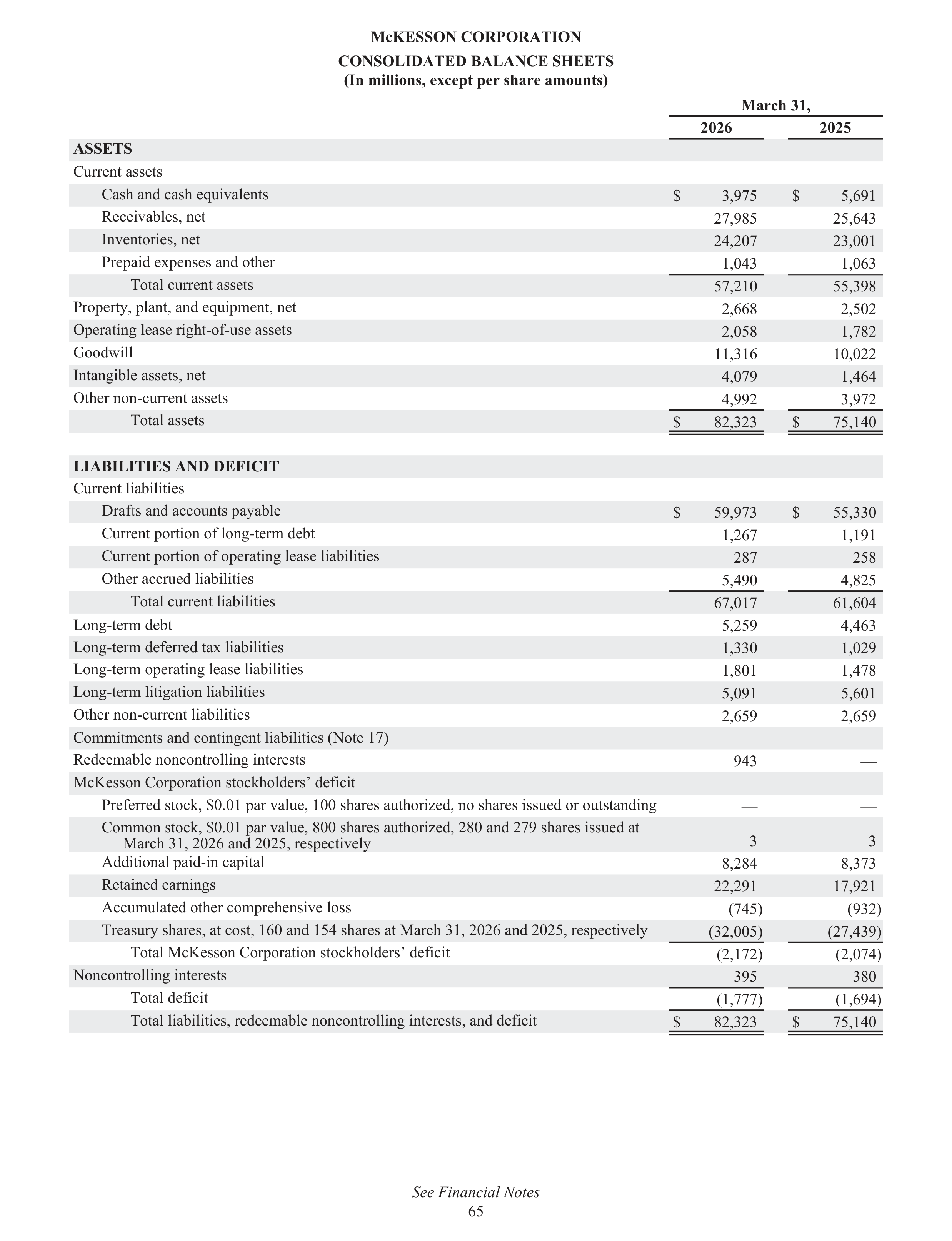
CONSOLIDATED BALANCE SHEETS
(In millions, except per share amounts)
rch 31,
2026
2025
ASSETS
Current assets
Cash and cash equivalents
$
3,975
$
5,691
Receivabl
a
es, net
27,985
25,643
Inventories, net
24,207
23,001
Prepaid expenses and other
1,043
1,063
Total current assets
57,210
55,398
Property, plant, and equipment, net
2,668
2,502
Operating lease right-of-use assets
2,058
1,782
Goodwill
11,316
10,022
Intangible assets, net
4,079
1,464
Other non-current assets
4,992
3,972
Total assets
$
82,323
$
75,140
LIABILITIES AND DEFICIT
Current liabi
a
lities
Drafts
f
and accounts payabl
a
e
$
59,973
$
55,330
Current portion of long-term debt
1,267
1,191
Current portion of operating lease liabilities
287
258
Other accrue
r
d liabi
a
lities
5,490
4,825
Total current liabilities
67,017
61,604
Long-term debt
5,259
4,463
Long-term deferred tax liabilities
1,330
1,029
Long-term operating lease liabilities
1,801
1,478
Long-term litigation liabilities
5,091
5,601
Other non-current liabilities
2,659
2,659
Commitments and contingent liabilities (Note 17)
Redeemable noncontrolling interests
943
—
McKesson Corporation stockholders’ deficit
Prefer
f
red stock, $0.01 par value, 100 shares authorized, no shares issued or outstanding
—
—
Common stock, $0.01 par value, 800 shares authorized, 280 and 279 shares issued at
March 31, 2026 and 2025, respectively
3
3
Additional paid-in capital
8,284
8,373
Retained earnings
22,291
17,921
Accumulated other comprehensive loss
(745)
(932)
Treasury
r
shares, at cost, 160 and 154 shares at March 31, 2026 and 2025, respectively
(32,005)
(27,439)
Total McKesson Corporation stockholders’ deficit
(2,172)
(2,074)
Noncontrolling interests
395
380
Total deficit
(1,777)
(1,694)
Total liabi
a
lities, redeemable noncontrolling interests, and deficit
$
82,323
$
75,140
McKESSON CORPORAT
R
ION
See Financial Notes
65
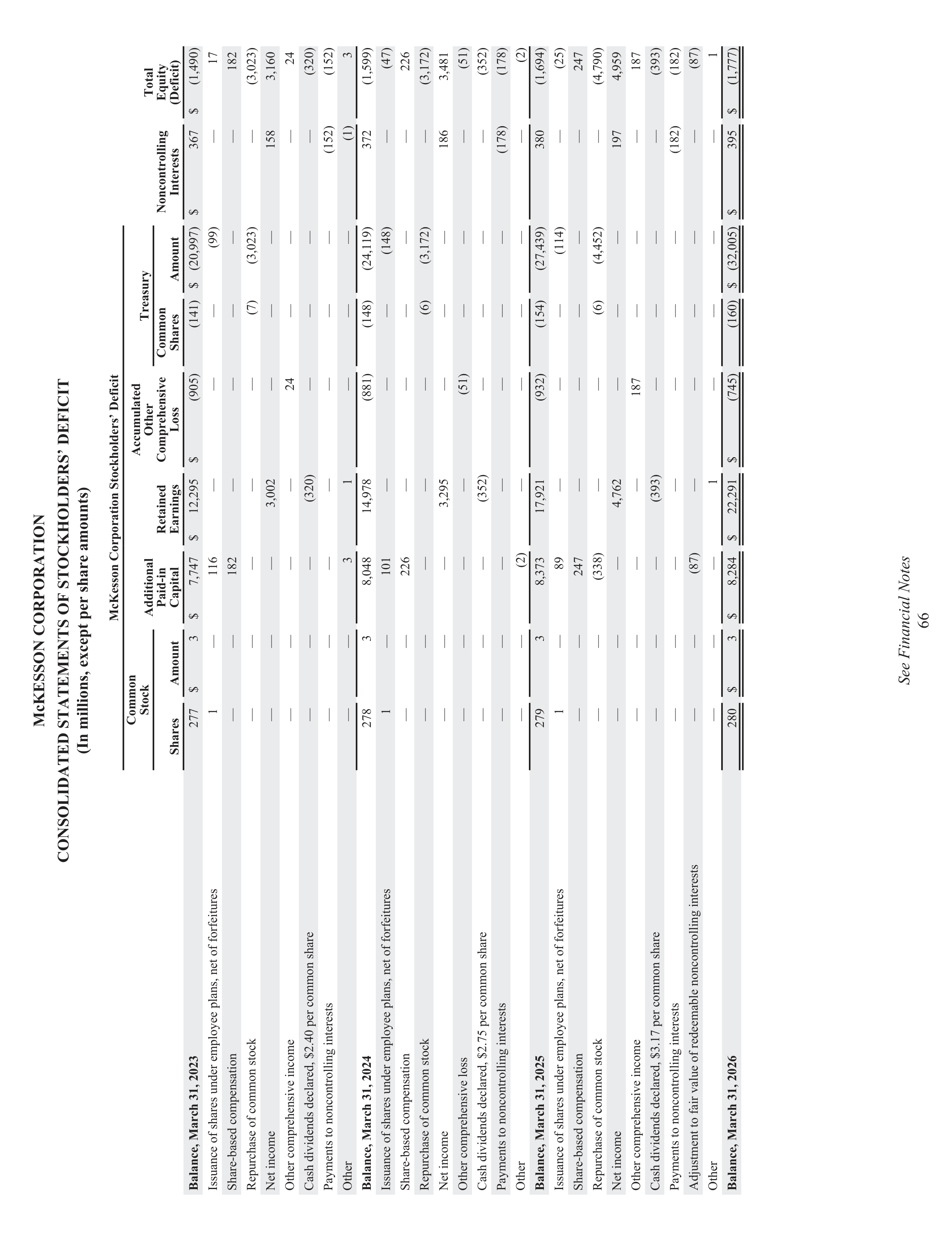
CONSOLIDATED STATEMENTS OF STOCKHOLDERS’ DEFICIT
(In millions, except per share amounts)
McKesson Corporation Stockholders’ Deficit
Common
Stock
Additional
Paid-in
Capital
Retained
Earnings
Accumulated
Other
Comprehensive
Loss
Treasury
Noncontrolling
Interests
Total
Equity
(Defic
f
it)
Shares
Amount
Common
Shares
Amount
Balance, March 31, 2023
277
$
3
$
7,747
$
12,295
$
(905)
(141)
$
(20,997)
$
367
$
(1,490)
Issuance of shares under employee plans, net of forfeitures
1
—
116
—
—
—
(99)
—
17
Share-based compensation
—
—
182
—
—
—
—
—
182
Repurchase of common stock
—
—
—
—
—
(7)
(3,023)
—
(3,023)
Net income
—
—
—
3,002
—
—
—
158
3,160
Other comprehensive income
—
—
—
—
24
—
—
—
24
Cash dividends declared, $2.40 per common share
—
—
—
(320)
—
—
—
—
(320)
Payments to noncontrolling interests
—
—
—
—
—
—
—
(152)
(152)
Other
—
—
3
1
—
—
—
(1)
3
Balance, March 31, 2024
278
3
8,048
14,978
(881)
(148)
(24,119)
372
(1,599)
Issuance of shares under employee plans, net of forfeitures
1
—
101
—
—
—
(148)
—
(47)
Share-based compensation
—
—
226
—
—
—
—
—
226
Repurchase of common stock
—
—
—
—
—
(6)
(3,172)
—
(3,172)
Net income
—
—
—
3,295
—
—
—
186
3,481
Other comprehensive loss
—
—
—
—
(51)
—
—
—
(51)
Cash dividends declared, $2.75 per common share
—
—
—
(352)
—
—
—
—
(352)
Payments to noncontrolling interests
—
—
—
—
—
—
—
(178)
(178)
Other
—
—
(2)
—
—
—
—
—
(2)
Balance, March 31, 2025
279
3
8,373
17,921
(932)
(154)
(27,439)
380
(1,694)
Issuance of shares under employee plans, net of forfeitures
1
—
89
—
—
—
(114)
—
(25)
Share-based compensation
—
—
247
—
—
—
—
—
247
Repurchase of common stock
—
—
(338)
—
—
(6)
(4,452)
—
(4,790)
Net income
—
—
—
4,762
—
—
—
197
4,959
Other comprehensive income
—
—
—
—
187
—
—
—
187
Cash dividends declared, $3.17 per common share
—
—
—
(393)
—
—
—
—
(393)
Payments to noncontrolling interests
—
—
—
—
—
—
—
(182)
(182)
Adju
d
stment to fair value of redeemable noncontrolling interests
—
—
(87)
—
—
—
—
—
(87)
Other
—
—
—
1
—
—
—
—
1
Balance, March 31, 2026
280
$
3
$
8,284
$
22,291
$
(745)
(160)
$
(32,005)
$
395
$
(1,777)
McKESSON CORPORAT
R
ION
See Financial Notes
66
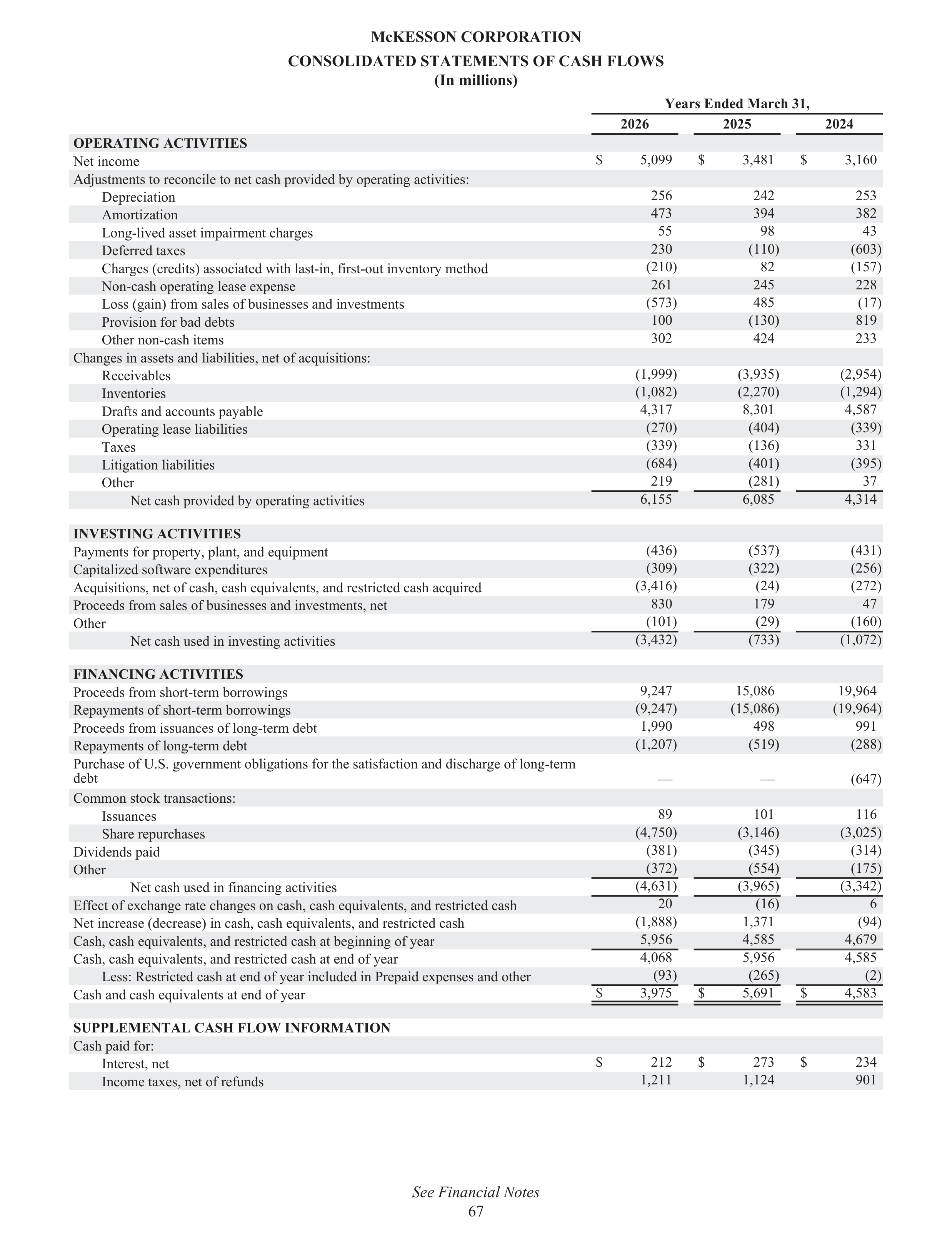
CONSOLIDATED STATEMENTS OF CASH FLOWS
(In millions)
Years Ended March 31,
2026
2025
2024
OPERAT
R
ING ACTIVITIES
Net income
$
5,099
$
3,481
$
3,160
Adju
d
stments to reconcile to net cash provided by operating activities:
Depreciation
256
242
253
Amortization
473
394
382
Long-lived asset impairment charges
55
98
43
Deferred taxes
230
(110)
(603)
Charges (credits) associated with last-in, first-out inventory
r
method
(210)
82
(157)
Non-cash operating lease expense
261
245
228
Loss (gain) from sales of businesses and investments
(573)
485
(17)
Provision for bad debts
100
(130)
819
Other non-cash items
302
424
233
Changes in assets and liabi
a
lities, net of acquisitions:
Receivabl
a
es
(1,999)
(3,935)
(2,954)
Inventories
(1,082)
(2,270)
(1,294)
Drafts
f
and accounts payabl
a
e
4,317
8,301
4,587
Operating lease liabi
a
lities
(270)
(404)
(339)
Taxes
(339)
(136)
331
Litigation liabi
a
lities
(684)
(401)
(395)
Other
219
(281)
37
Net cash provided by operating activities
6,155
6,085
4,314
INVESTING ACTIVITIES
Payments for property, plant, and equipment
(436)
(537)
(431)
Capi
a
talized software expenditures
(309)
(322)
(256)
Acquisitions, net of cash, cash equivalents, and restricted cash acquired
(3,416)
(24)
(272)
Proceeds from sales of businesses and investments, net
830
179
47
Other
(101)
(29)
(160)
Net cash used in investing activities
(3,432)
(733)
(1,072)
FINANCING ACTIVITIES
Proceeds from short-term borrowings
9,247
15,086
19,964
Repayments of short-term borrowings
(9,247)
(15,086)
(19,964)
Proceeds from issuances of long-term debt
1,990
498
991
Repayments of long-term debt
(1,207)
(519)
(288)
Purchase of U.S. government obligations for the satisfaction and discharge of long-term
debt
—
—
(647)
Common stock transactions:
Issuances
89
101
116
Share repurchases
(4,750)
(3,146)
(3,025)
Dividends paid
(381)
(345)
(314)
Other
(372)
(554)
(175)
Net cash used in financing activities
(4,631)
(3,965)
(3,342)
Effe
f
ct of exchange rate changes on cash, cash equivalents, and restricted cash
20
(16)
6
Net increase (decrease) in cash, cash equivalents, and restricted cash
(1,888)
1,371
(94)
Cash, cash equivalents, and restricted cash at beginning of year
5,956
4,585
4,679
Cash, cash equivalents, and restricted cash at end of year
4,068
5,956
4,585
Less: Restricted cash at end of year included in Prepaid expenses and other
(93)
(265)
(2)
Cash and cash equivalents at end of year
$
3,975
$
5,691
$
4,583
SUPPLEMENTAL CASH FLOW INFORMATION
Cash paid for:
Interest, net
$
212
$
273
$
234
Income taxes, net of refunds
1,211
1,124
901
McKESSON CORPORAT
R
ION
See Financial Notes
67
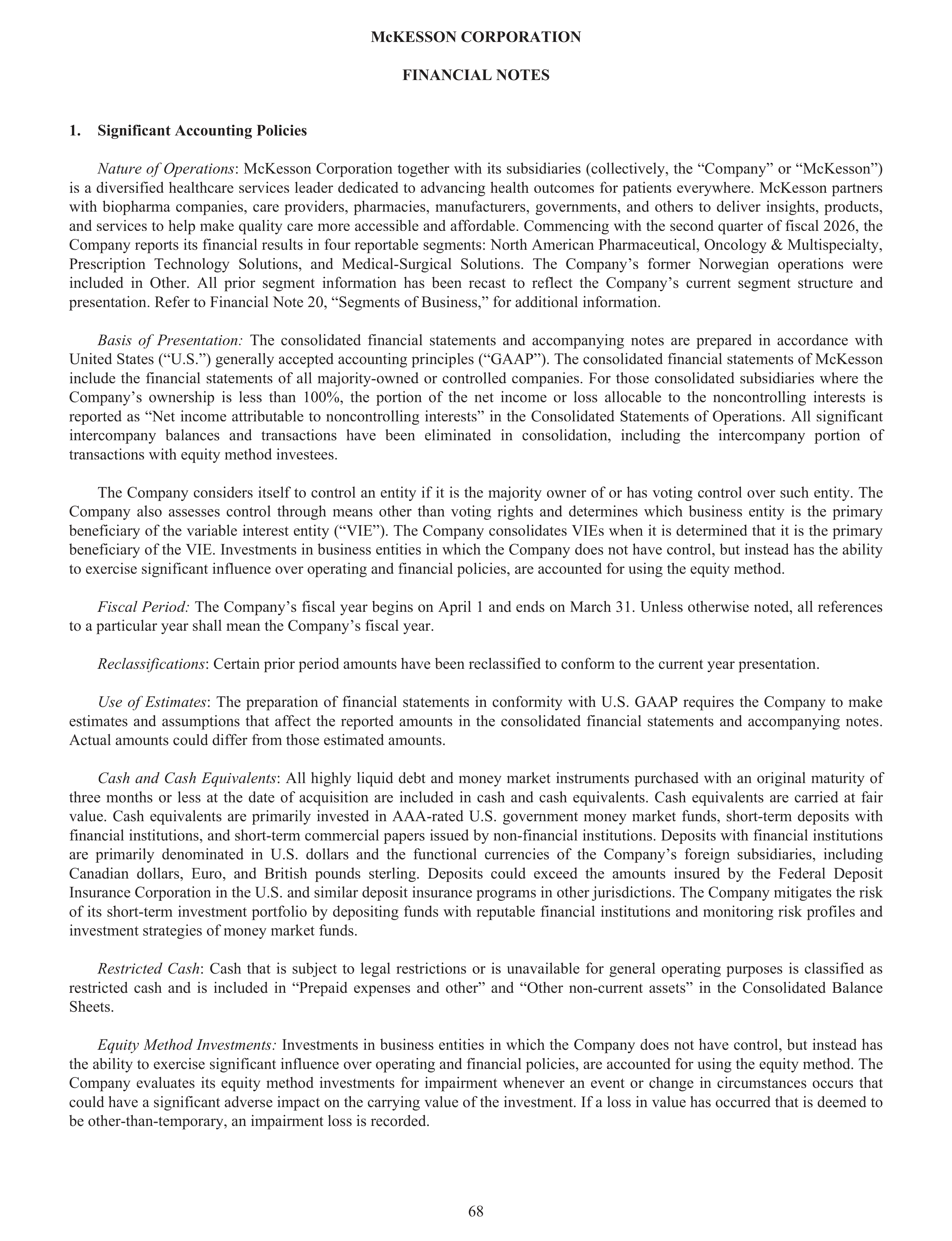
1.
Signific
f
ant Accounting Policies
Nature of Operations
: McKesson Corporation together with its subs
u
idiaries (collectively, the “Company” or “McKesson”)
is a diversifie
f
d healthcare services leader dedicated to advancing health outcomes for
patients everyw
r
here. McKesson partners
with
biopharma
companies,
care
providers,
pharmacies,
manufact
f
ur
t
ers,
governments,
and
others
to
deliver
insights,
produc
d
ts,
and services to help make quality care more accessible and affo
f
rdable. Commencing with the second quarter of fiscal 2026, the
Company reports its financial results in four reportabl
a
e segments: North American Pharmaceutical, Oncology & Multispecialty,
Prescription
Technology
Solutions,
and
Medical-Surgical
Solutions.
The
Company’s
former
Norwegian
operations
were
in
lcl
d
uded
in
Other.
All
prior
segment
information
has
been
recast
to
reflect
the
Company’s
current
segment
structur
t
e
and
presentation. Refer to Financial Note 20, “Segments of Business,”
r additional information.
Basisi
of
Presentation:
The
consolidated
financial
statements
and
accompanying
notes
are
prepared
in
accordance
with
United States (“U.S.”) generally accepted accounting principles (“GAAP”). The consolidated financial statements of McKesson
include
the
financial
statements
of
all
majo
a
rity-owned
or
controlled
companies.
For
those
consolidated
subs
u
idiaries
where
the
Company’s
ownership
is
less
than
100%,
the
portion
of
the
net
income
or
loss
allocable
to
the
noncontrolling
interests
is
reported
as
“Net
income
attributable
to
noncontrolling
interests”
in
the
Consolidated
Statements
of
Operations.
All
significant
intercompany
balances
and
transactions
have
been
eliminated
in
consolidation,
including
the
intercompany
portion
of
transactions with equity method investees.
The Company considers itself to control an entity if it is the majo
a
rity owner of or has voting control over such entity. The
Company
also
assesses
control
through
means
other
than
voting
rights
and
determines
which
business
entity
is
the
primary
beneficiary
r
of the variable interest entity (“VIE”). The Company consolidates VIEs when it is determined that it is the primary
r
beneficiary
r
of the VIE. Investments in business entities in which the Company does not have control, but instead has the ability
to exercise significant influence over operating and financial policies, are accounted for using the equity method.
Fisc
i
al Period:
The Company’s fiscal year begins on April 1 and ends on March 31. Unless otherwise noted, all references
to a particular year shall mean the Company’s fiscal year.
Reclassific
i
ations
: Certain prior period amounts have been reclassified to confor
f
m to the current year presentation.
Use
of
Estimates
:
The
preparation
of
financial
statements
in
confor
f
mity
with
U.S.
GAAP
requires
the
Company
to
make
estimates
and
assumptions
that
affe
f
ct
the
reported
amounts
in
the
consolidated
financial
statements
and
accompanying
notes.
Actual amounts could differ from those estimated amounts.
Cash
and
Cash
Equivalentst
:
All
highly
liquid
debt
and
money
market
instruments
purchased
with
an
original
maturity
of
three
months
or
less
at
the
date
of
acquisition
are
included
in
cash
and
cash
equivalents.
Cash
equivalents
are
carried
at
fair
value.
Cash
equivalents
are
primarily
invested
in
AAA-rated
U.S.
government
money
market
funds,
short-term
deposits
with
financial institutions, and short-term commercial pape
a
rs issued by non-financial institutions. Deposits with financial institutions
are
primarily
denominated
in
U.S.
dollars
and
the
functional
currencies
of
the
Company’s
foreign
subs
u
idiaries,
including
Canadian
dollars,
Euro,
and
British
pounds
sterling.
Deposits
could
exceed
the
amounts
insured
by
the
Federal
Deposit
Insurance Corporation in the U.S. and similar deposit insurance programs in other jurisdictions. The Company mitigates the risk
of its short-term investment portfol
f
io by depositing funds with reputable financial institutions and monitoring risk profiles and
investment strategies of money market funds.
Restri
t
cted
Cash
:
Cash
that
is
subj
u
ect
to
legal
restrictions
or
is
unavailabl
a
e
for
general
operating
purpos
r
es
is
classified
as
restricted
cash
and
is
included
in
“Prepaid
expenses
and
other”
and
“Other
non-current
assets”
in
the
Consolidated
Balance
Sheets.
Equity Method Investme
t
nts:
t
Investments in business entities in which the Company does not have control, but instead has
the ability to exercise significant influence over operating and financial policies, are accounted for using the equity method. The
Company
evaluates
its
equity
method
investments
for
impairment
whenever
an
event
or
change
in
circumstances
occurs
that
could have a significant adverse impact on the carrying value of the investment. If a loss in value has occurred that is deemed to
be other-than-temporary,
r
an impairment loss is recorded.
McKESSON CORPORAT
R
ION
FINANCIAL NOTES
68
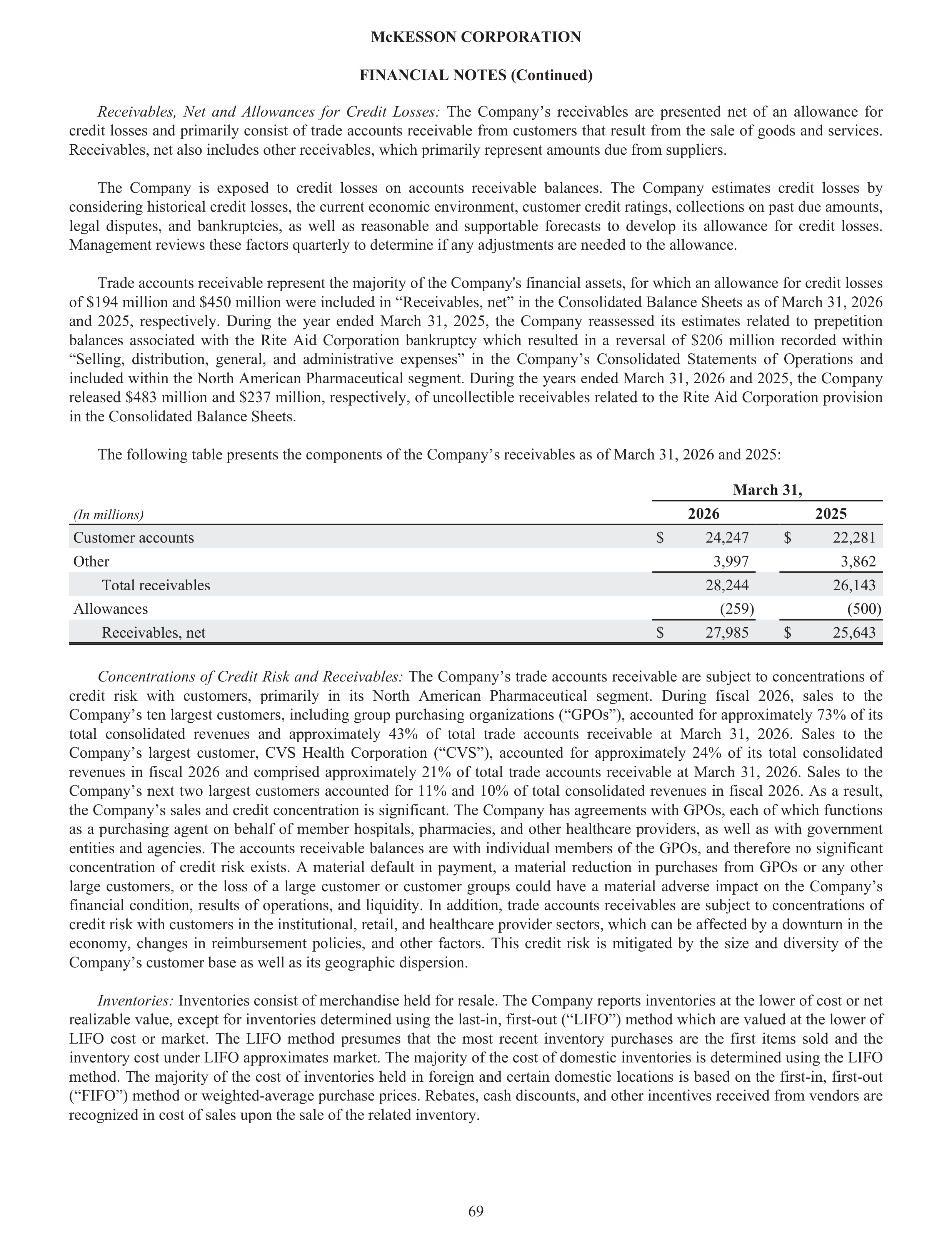
Receivables,
Net
and
Allowances
for
Credit
Losses:
The
Company’s
receivables
are
presented
net
of
an
allowance
for
credit losses
and
primarily
consist of
trade
accounts
receivabl
a
e from
customers
that result from the sale of
goods
and
services.
Receivables, net also includes other receivabl
a
es, which primarily represent amounts due from suppl
u
iers.
The
Company
is
exposed
to
credit
losses
on
accounts
receivabl
a
e
balances.
The
Company
estimates
credit
losses
by
considering historical credit losses, the current economic environment, customer credit ratings, collections on past due amounts,
legal
disputes,
and
bankrupt
r
cies,
as
well
as
reasonabl
a
e
and
suppor
u
tabl
a
e
forecasts
to
develop
its
allowance
for
credit
losses.
Management reviews these factors quarterly to determine if any adju
d
stments are needed to the allowance.
Trade accounts receivabl
a
e represent the majo
a
rity of the Company's financial assets, for which an allowance for credit losses
of $194 million and $450 million were included in “Receivables, net” in the Consolidated Balance Sheets as of March 31, 2026
and
2025,
respectively.
During
the
year
ended
March
31,
2025,
the
Company
reassessed
its
estimates
related
to
prepetition
balances
associated
with
the
Rite
Aid
Corporation
bankrupt
r
cy
which
resulted
in
a
reversal
of
$206
million
recorded
within
“Selling,
distribution,
general,
and
administrative
expenses”
in
the
Company’s
Consolidated
Statements
of
Operations
and
included within the North American Pharmaceutical segment. During the years ended March 31, 2026 and 2025, the Company
released $483 million and $237 million, respectively, of uncollectible receivables related to the Rite Aid Corporation provision
in the Consolidated Balance Sheets.
The following tabl
a
e presents the components of the Company’s receivabl
a
es as of March 31, 2026 and 2025:
March 31,
(In millions)s
2026
2025
Customer accounts
$
24,247
$
22,281
Other
3,997
3,862
Total receivabl
a
es
28,244
26,143
Allowances
(259)
(500)
Receivabl
a
es, net
$
27,985
$
25,643
Concentrations of Credit Risk
i
and Receivables:
The Company’s trade accounts receivabl
a
e are subj
u
ect to concentrations of
credit
risk
with
customers,
primarily
in
its
North
American
Pharmaceutical
segment.
During
fiscal
2026,
sales
to
the
Company’s ten largest customers, including group purchasing organizations (“GPOs”), accounted for approximately 73% of its
total
consolidated
revenues
and
approximately
43%
of
total
trade
accounts
receivable
at
March
31,
2026.
Sales
to
the
Company’s
largest
customer,
CVS
Health
Corporation
(“CVS”),
accounted
for
approximately
24%
of
its
total
consolidated
revenues
in
fiscal
2026
and
comprised
approximately
21%
of
total
trade
accounts
receivabl
a
e
at
March
31,
2026.
Sales
to
the
Company’s
next
two
largest
customers
accounted
for
11%
and
10%
of
total
consolidated
revenues
in
fiscal
2026.
As
a
result,
the Company’s sales and credit concentration is significant. The Company has agreements with GPOs, each of which functions
as
a
purchasing
agent
on
behalf
of
member
hospitals,
pharmacies,
and
other
healthcare
providers,
as
well
as
with
government
entities and agencies. The accounts receivabl
a
e balances are with individual members of the GPOs, and therefor
f
e no significant
concentration
of
credit
risk
exists.
A
material
default
in
payment,
a
material
reduction
in
purchases
from
GPOs
or
any
other
large
customers,
or
the
loss
of
a
large
customer
or
customer
groups
could
have
a
material
adverse
impact
on
the
Company’s
financial
condition,
results
of
operations,
and
liquidity.
In
addition,
trade
accounts
receivabl
a
es
are
subj
u
ect
to
concentrations
of
credit risk with customers in the institutional, retail, and healthcare provider sectors, which can be affe
f
cted by a downtur
t
n in the
economy,
changes
in
reimbursement
policies,
and
other
factors.
This
credit
risk
is
mitigated
by
the
size
and
diversity
of
the
Company’s customer base as well as its geographic dispersion.
Inventories:
Inventories consist of merchandise held for resale. The Company reports inventories at the lower of cost or net
realizable value, except for inventories determined using the last-in, first-out (“LIFO”) method which are valued at the lower of
LIFO
cost
or
market.
The
LIFO
method
presumes
that
the
most
recent
inventory
r
purchases
are
the
first
items
sold
and
the
inventory
r
cost under LIFO approximates market. The majo
a
rity of the cost of domestic inventories is determined using the LIFO
method.
The
majo
a
rity
of
the
cost
of
inventories
held
in
foreign
and
certain
domestic
locations
is
based
on
the
first-in,
first-out
(“FIFO”) method or weighted-average purchase prices. Rebates, cash discounts, and other incentives received from vendors are
recognized in cost of sales upon the sale of the related inventory.
r
McKESSON CORPORAT
R
ION
FINANCIAL NOTES (Continued)
69
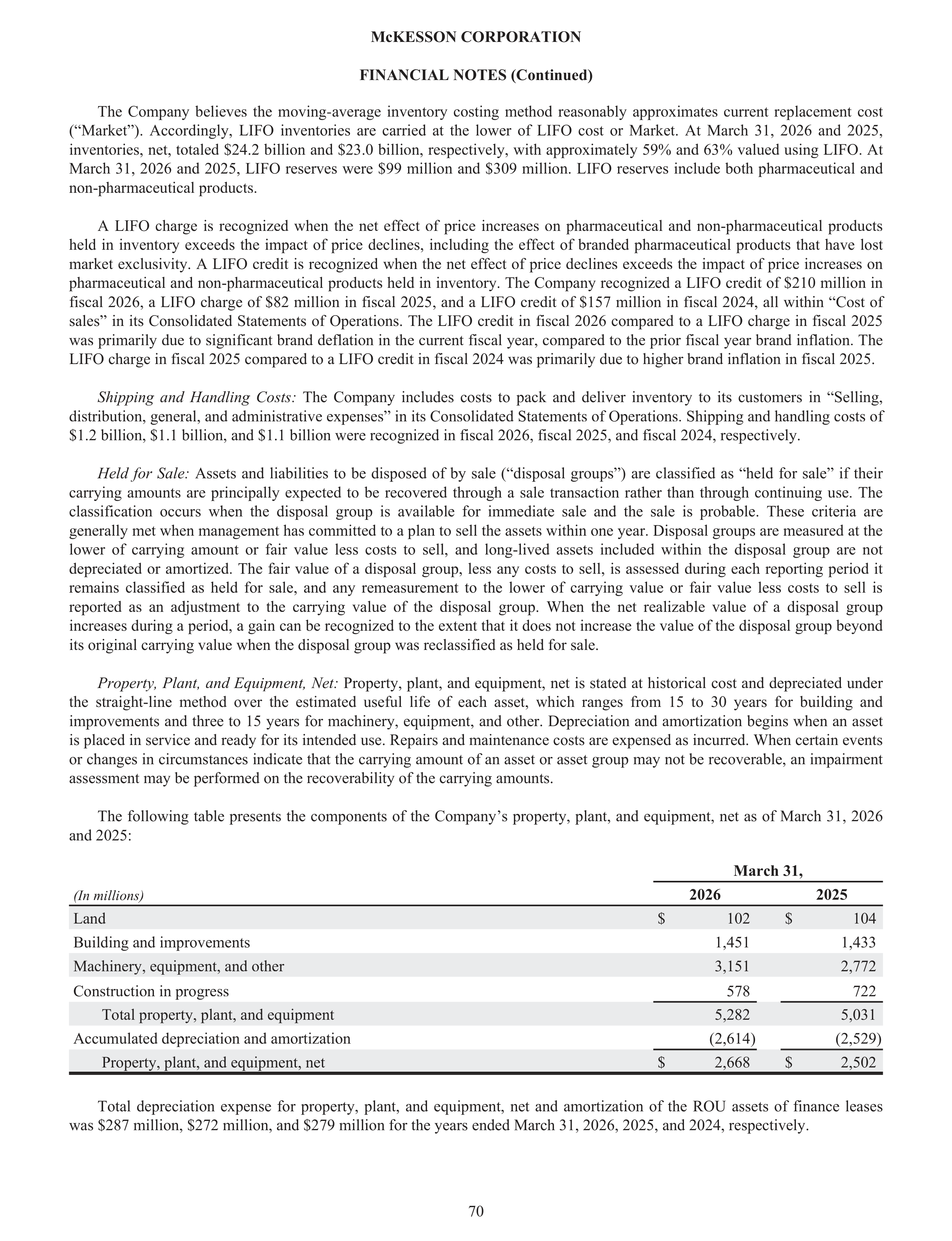
The
Company
believes
the
moving
-
average
inventory
r
costing
method
reasonabl
a
y
approximates
current
replacement
cost
(“Market”).
Accordingly,
LIFO
inventories
are
carried
at
the
lower
of
LIFO
cost
or
Market.
At
March
31,
2026
and
2025,
inventories, net, totaled $24.2 billion and $23.0 billion, respectively, with approximately 59% and 63% valued using LIFO. At
March
31,
2026
and
2025,
LIFO
reserves
were
$99
million
and
$309
million.
LIFO
reserves
include
both
pharmaceutical
and
non-pharmaceutical products.
A
LIFO
charge
is
recognized
when
the
net
effe
f
ct
of
price
increases
on
pharmaceutical
and
non-pharmaceutical
products
held
in
inventory
r
exceeds
the
impact
of
price
declines,
including
the
effe
f
ct
of
branded
pharmaceutical
products
that
have
lost
market
exclusivity.
A
LIFO
credit
is
recognized
when
the
net
effe
f
ct
of
price
declines
exceeds
the
impact
of
price
increases
on
pharmaceutical and non-pharmaceutical products held in inventory.
r
The Company recognized a LIFO credit of $210 million in
fiscal 2026, a LIFO charge of
$82 million in fiscal 2025, and a LIFO
credit of
$157 million in fiscal 2024,
all within “Cost of
sales”
in
its
Consolidated
Statements
of
Operations.
The
LIFO
credit
in
fiscal
2026
compared
to
a
LIFO
charge
in
fiscal
2025
was primarily due to significant brand deflation in the current fiscal year, compared to the prior fiscal year brand inflation. The
LIFO charge in fiscal 2025 compared to a LIFO credit in fiscal 2024 was primarily due to higher brand inflation in fiscal 2025.
Shippi
i
ng
and
Handling
Costs:
t
The
Company
includes
costs
to
pack
and
deliver
inventory
r
to
its
customers
in
“Selling,
distribution, general, and administrative expenses” in its Consolidated Statements of Operations. Shipping and handling costs of
$1.2 billion, $1.1 billion, and $1.1 billion were recognized in fiscal 2026, fiscal 2025, and fiscal 2024, respectively.
Held
for
Sale:
Assets
and
liabilities
to
be
disposed
of
by
sale
(“disposal
groups
u
”)
are
classified
as
“held
for
sale”
if
their
carrying
amounts
are
principally
expected
to
be
recovered
through
a
sale
transaction
rather
than
through
continuing
use.
The
classification
occurs
when
the
disposal
group
is
availabl
a
e
for
immediate
sale
and
the
sale
is
probabl
a
e.
These
criteria
are
generally met when management has committed to a plan to sell the assets within one year. Disposal groups are measured at the
lower
of
carrying
amount
or
fair
value
less
costs
to
sell,
and
long-lived
assets
included
within
the
disposal
group
are
not
depreciated
or
amortized.
The
fair
value
of
a
disposal
group,
less
any
costs
to
sell,
is
assessed
during
each
reporting
period
it
remains
classified
as
held
for
sale,
and
any
remeasurement
to
the
lower
of
carrying
value
or
fair
value
less
costs
to
sell
is
reported
as
an
adju
d
stment
to
the
carrying
value
of
the
disposal
group.
When
the
net
realizable
value
of
a
disposal
group
increases during a period, a gain can be recognized to the extent that it does not increase the value of the disposal group beyond
its original carrying value when the disposal group was reclassified as held for sale.
Property,
t
Plant,t
and Equipm
i
ent, Net:
Property, plant, and equipment, net is stated at historical cost and depreciated under
the
straight-line
method
over
the
estimated
useful
f
lifef
of
each
asset,
which
ranges
from
15
to
30
years
for
building
and
improvements
and three to 15 years for
machinery,
r
equipment, and other.
Depreciation and amortization begins when an asset
is placed in service and ready for its intended use. Repairs and maintenance costs are expensed as incurred. When certain events
or changes in circumstances indicate that the carrying amount of an asset or asset group may not be recoverabl
a
e, an impairment
assessment may be performed on the recoverabi
a
lity of the carrying amounts.
The
following
tabl
a
e
presents
the
components
of
the
Company’s
property,
plant,
and
equipment,
net
as
of
March
31,
2026
and 2025:
March 31,
(In millions)s
2026
2025
Land
$
102
$
104
Building and improvements
1,451
1,433
Machinery,
r
equipment, and other
3,151
2,772
Construc
r
tion in progress
578
722
Total property, plant, and equipment
5,282
5,031
Accumulated depreciation and amortization
(2,614)
(2,529)
Property, plant, and equipment, net
$
2,668
$
2,502
Total
depreciation
expense
for
property,
plant,
and
equipment,
net
and
amortization
of
the
ROU
assets
of
finance
leases
was $287 million, $272 million, and $279 million for the years ended March 31, 2026, 2025, and 2024, respectively.
McKESSON CORPORAT
R
ION
FINANCIAL NOTES (Continued)
70
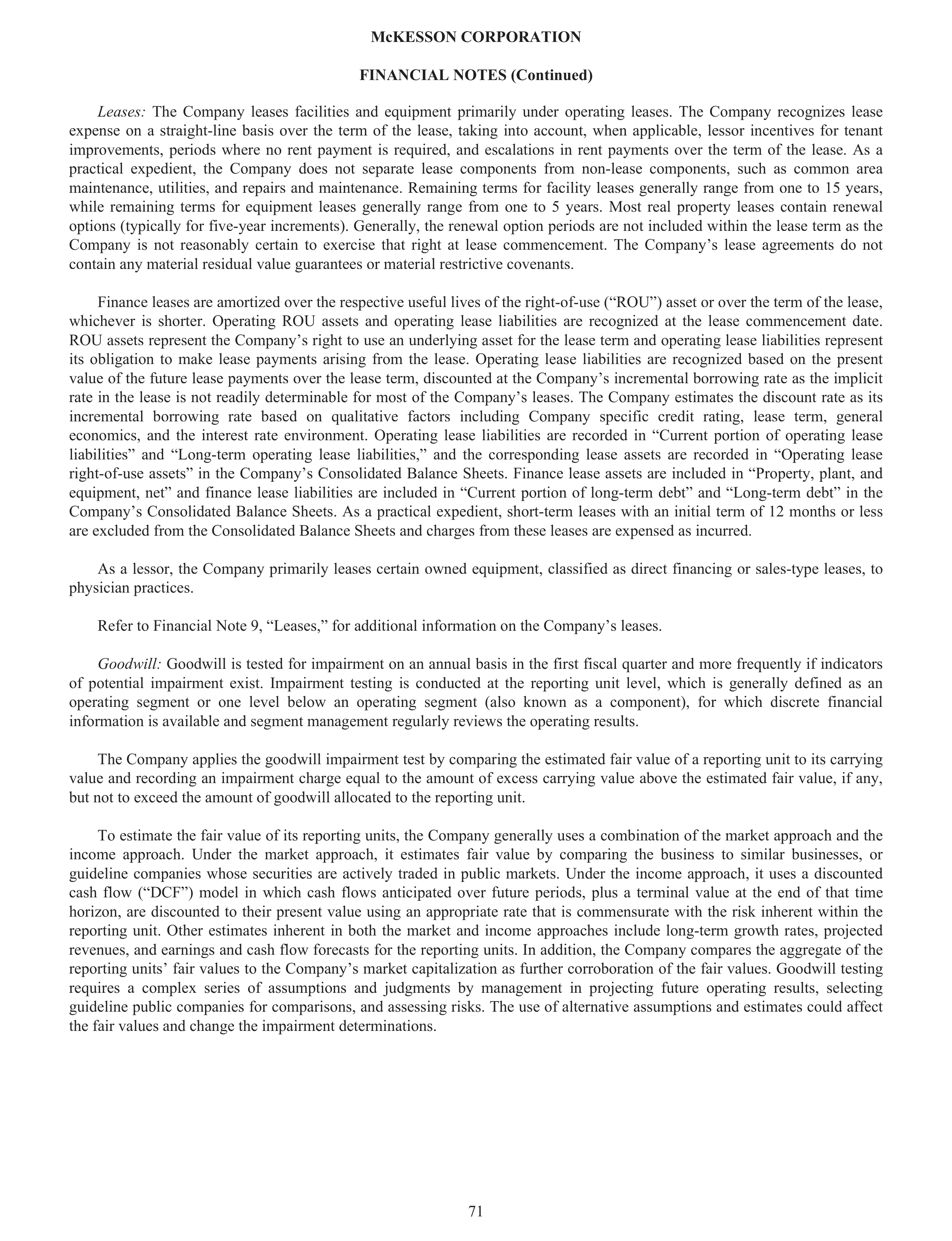
Leases:
The
Company
leases
facilities
and
equipment
primarily
under
operating
leases.
The
Company
recognizes
lease
expense
on
a
straight-line
basis
over
the
term
of
the
lease,
taking
into
account,
when
applicable,
lessor
incentives
for
tenant
improvements,
periods
where
no
rent
payment
is
required,
and
escalations
in
rent
payments
over
the
term
of
the
lease.
As
a
practical
expedient,
the
Company
does
not
separate
lease
components
from
non-lease
components,
such
as
common
area
maintenance,
utilities,
and
repairs
and
maintenance.
Remaining
terms
for
facility
leases
generally
range
from
one
to
15
years,
while
remaining
terms
for
equipment
leases
generally
range
from
one
to
5
years.
Most
real
property
leases
contain
renewal
options (typically for five-year increments). Generally, the renewal option periods are not included within the lease term as the
Company
is
not
reasonabl
a
y
certain
to
exercise
that
right
at
lease
commencement.
The
Company’s
lease
agreements
do
not
contain any material residual value guarantees or material restrictive covenants.
Finance leases are amortized over the respective useful
f
lives of the right-of-use (“ROU”) asset or over the term of the lease,
whichever
is
shorter.
Operating
ROU
assets
and
operating
lease
liabi
a
lities
are
recognized
at
the
lease
commencement
date.
ROU assets represent the Company’s right to use an underlying asset for the lease term and operating lease liabi
a
lities represent
its
obligation
to
make
lease
payments
arising
from
the
lease.
Operating
lease
liabi
a
lities
are
recognized
based
on
the
present
value of the future lease payments over the lease term, discounted at the Company’s incremental borrowing rate as the implicit
rate
in
the
lease
is
not
readily
determinable
for
most
of
the
Company’s
leases.
The
Company
estimates
the
discount
rate
as
its
incremental
borrowing
rate
based
on
qualitative
factors
including
Company
specific
credit
rating,
lease
term,
general
economics,
and
the
interest
rate
environment.
Operating
lease
liabi
a
lities
are
recorded
in
“Current
portion
of
operating
lease
liabi
a
lities”
and
“Long-term
operating
lease
liabi
a
lities,”
and
the
corresponding
lease
assets
are
recorded
in
“Operating
lease
right-of-use
assets”
in
the
Company’s
Consolidated
Balance
Sheets.
Finance
lease
assets
are
included
in
“Property,
plant,
and
equipment,
net”
and
finance
lease
liabilities
are
included
in
“Current
portion
of
long-term
debt”
and
“Long-term
debt”
in
the
Company’s
Consolidated
Balance
Sheets.
As
a
practical
expedient,
short-term
leases
with
an
initial
term
of
12
months
or
less
are excluded from the Consolidated Balance Sheets and charges from these leases are expensed as incurred.
As
a
lessor,
the
Company
primarily
leases
certain
owned
equipment,
classified
as
direct
financing
or
sales-type
leases,
to
physician practices.
Refer to Financial Note 9, “Leases,” for additional information on the Company’s leases.
Goodwill:
Goodwill is tested for impairment on an annual basis in the first fiscal quarter and more frequently if indicators
of
potential
impairment
exist.
Impairment
testing
is
conducted
at
the
reporting
unit
level,
which
is
generally
defined
as
an
operating
segment
or
one
level
below
an
operating
segment
(also
known
as
a
component),
for
which
discrete
financial
information is availabl
a
e and segment management regularly reviews the operating results.
The Company applies the goodwill impairment test by comparing the estimated fair value of a reporting unit to its carryi
r
ng
value and
recording
an
impairment charge equal
to
the
amount
of
excess
carrying
value above
the estimated
fair
value,
if
any,
but not to exceed the amount of goodwill allocated to the reporting unit.
To estimate the fair value of its reporting units, the Company generally uses a combination of the market approach and the
income
approach.
Under
the
market
approach,
it
estimates
fair
value
by
comparing
the
business
to
similar
businesses,
or
guideline
companies
whose
securities
are
actively
traded
in
public
markets.
Under
the
income
approach,
it
uses
a
discounted
cash
flow
(“DCF”)
model
in
which
cash
flows
anticipated
over
future
periods,
plus
a
terminal
value
at
the
end
of
that
time
horizon,
are
discounted
to
their
present
value
using
an
appropriate
rate
that
is
commensurate
with
the
risk
inherent
within
the
reporting
unit.
Other
estimates
inherent
in
both
the
market
and
income
approaches
include
long-term
growth
rates,
projected
revenues, and earnings and cash flow forecasts for the reporting units. In addition, the Company compares the aggregate of the
reporting units’ fair values to the Company’s market capi
a
talization as further corroboration of the fair values. Goodwill testing
requires
a
complex
series
of
assumptions
and
judgments
by
management
in
projecting
future
operating
results,
selecting
guideline public companies for comparisons, and assessing risks. The use of alternative assumptions and estimates could affe
f
ct
the fair values and change the impairment determinations.
McKESSON CORPORAT
R
ION
FINANCIAL NOTES (Continued)
71
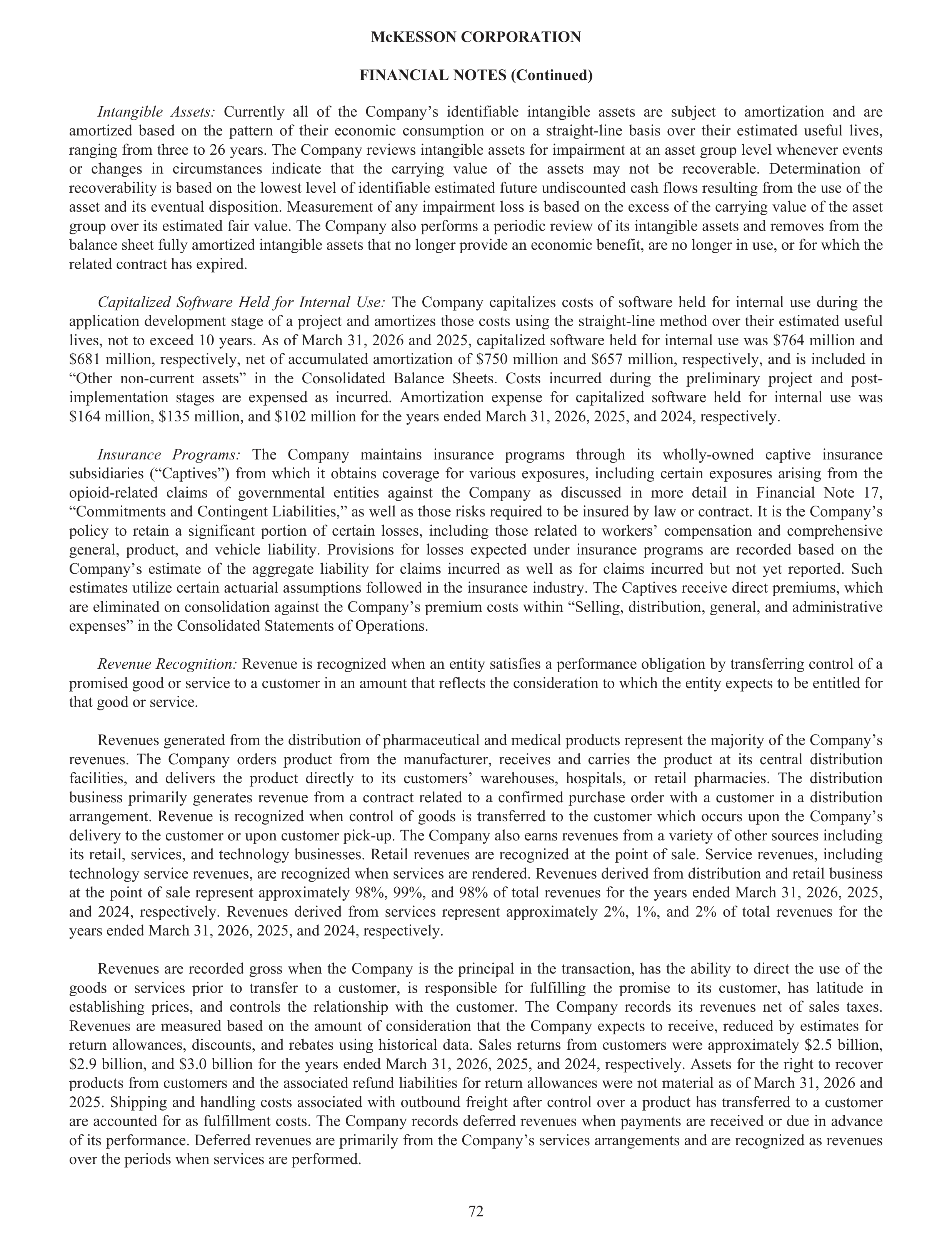
Intangible
Assets:
Currently
all
of
the
Company’s
identifia
f
bl
a
e
intangible
assets
are
subj
u
ect
to
amortization
and
are
amortized
based
on
the
pattern
of
their
economic
consumption
or
on
a
straight-line
basis
over
their
estimated
useful
f
lives,
ranging from three to 26 years. The Company reviews intangible assets for impairment at an asset group level whenever events
or
changes
in
circumstances
indicate
that
the
carrying
value
of
the
assets
may
not
be
recoverabl
a
e.
Determination
of
recoverabi
a
lity is based on the lowest level of identifiable estimated future undiscounted cash flows resulting from the use of the
asset and its eventual disposition. Measurement of any impairment loss is based on the excess of the carrying value of the asset
group over its estimated fair value. The Company also performs a periodic review of its intangible assets and removes from the
balance sheet fully amortized intangible assets that no longer provide an economic benefit, are no longer in use, or for which the
related contract has expired.
Capi
a
talize
i
d
Softw
f
are
Held
for
Internal
Use:
The
Company
capitalizes
costs
of
software
held
for
internal
use
during
the
application development stage of a project and amortizes those costs using the straight-line method over their estimated useful
f
lives, not to exceed 10 years. As of March 31, 2026 and 2025, capitalized software held for internal use was $764 million and
$681
million,
respectively,
net
of
accumulated
amortization
of
$750
million
and
$657
million,
respectively,
and
is
included
in
“Other
non-current
assets”
in
the
Consolidated
Balance
Sheets.
Costs
incurred
during
the
preliminary
r
project
and
post-
implementation
stages
are
expensed
as
incurred.
Amortization
expense
for
capitalized
software
held
for
internal
use
was
$164 million, $135 million, and $102 million for the years ended March 31, 2026, 2025, and 2024, respectively.
Insurance
Programs:
The
Company
maintains
insurance
programs
through
its
wholly-owned
captive
insurance
subs
u
idiaries
(“Capt
a
ives”)
from
which
it
obtains
coverage
for
various
exposures,
including
certain
exposures
arising
from
the
opioid-related
claims
of
governmental
entities
against
the
Company
as
discussed
in
more
detail
in
Financial
Note
17,
“Commitments and Contingent Liabilities,” as well as those risks required to be insured by law or contract. It is the Company’s
policy
to
retain
a
significant
portion
of
certain
losses,
including
those
related
to
workers’
compensation
and
comprehensive
general,
product,
and
vehicle
liability.
Provisions
for
losses
expected
under
insurance
programs
are
recorded
based
on
the
Company’s
estimate
of
the
aggregate
liabi
a
lity
for
claims
incurred
as
well
as
for
claims
incurred
but
not
yet
reported.
Such
estimates utilize certain actua
t
rial assumptions followed in the insurance industry.
r
The Capt
a
ives receive direct premiums, which
are eliminated on consolidation against the Company’s premium costs within “Selling, distribution, general, and administrative
expenses” in the Consolidated Statements of Operations.
Revenue Recognition:
Revenue is recognized when an entity satisfie
f
s a performance obligation by transfer
f
ring control of a
promised good or service to a customer in an amount that reflects the consideration to which the entity expects to be entitled for
that good or service.
Revenues generated from the distribution of pharmaceutical and medical products represent the majo
a
rity of the Company’s
revenues.
The
Company
orders
product
from
the
manufact
f
ur
t
er,
receives
and
carries
the
product
at
its
central
distribution
facilities,
and
delivers
the
produc
d
t
directly
to
its
customers’
warehouses,
hospitals,
or
retail
pharmacies.
The
distribution
business
primarily
generates
revenue
from
a
contract
related
to
a
confir
f
med
purchase
order
with
a
customer
in
a
distribution
arrangement.
Revenue
is
recognized
when
control
of
goods
is
transfer
f
red
to
the
customer
which
occurs
upon
the
Company’s
delivery
r
to the customer or upon customer pick-up.
u
The Company also earns revenues from a variety of other sources including
its
retail,
services,
and
technology
businesses.
Retail
revenues
are
recognized
at
the
point
of
sale.
Service
revenues,
including
technology service revenues, are recognized when services are rendered. Revenues derived from distribution and retail business
at
the
point
of
sale
represent
approximately
98%,
99%,
and
98%
of
total
revenues
for
the
years
ended
March
31,
2026,
2025,
and
2024,
respectively.
Revenues
derived
from
services
represent
approximately
2%,
1%,
and
2%
of
total
revenues
for
the
years ended March 31, 2026, 2025, and 2024, respectively.
Revenues
are
recorded
gross
when
the
Company
is
the
principal
in
the
transaction,
has
the
ability
to
direct
the
use
of
the
goods
or
services
prior
to
transfer
f
to
a
customer,
is
responsible
for
fulfillin
f
g
the
promise
to
its
customer,
has
latitude
in
establ
a
ishing
prices,
and
controls
the
relationship
with
the
customer.
The
Company
records
its
revenues
net
of
sales
taxes.
Revenues
are
measured
based
on
the
amount
of
consideration
that
the
Company
expects
to
receive,
reduced
by
estimates
for
return
allowances,
discounts,
and
rebates
using
historical
data.
Sales
returns
from
customers
were
approximately
$2.5
billion,
$2.9 billion, and $3.0 billion for the years ended March 31, 2026, 2025, and 2024, respectively. Assets for the right to recover
products from customers and the associated refund liabilities for return allowances were not material as of March 31, 2026 and
2025.
Shipping
and
handling
costs
associated
with
outbound
t
freight
afte
f
r
control
over
a
product
has
transfer
f
red
to
a
customer
are accounted for as fulfil
f
lment costs. The Company records deferred revenues when payments are received or due in advance
of its performance. Deferred revenues are primarily from the Company’s services arrangements and are recognized as revenues
over the periods when services are performed.
McKESSON CORPORAT
R
ION
FINANCIAL NOTES (Continued)
72
The
Company
had
$366
million
and
$354
million
of
contract
liabilities
recorded
in
its
Consolidated
Balance
Sheets
as
of
March 31, 2026 and 2025. The Company generally expenses costs to obtain a contract as incurred when the amortization period
is less than one year.
Supplier Incentives:
Fees for services and other incentives received from suppl
u
iers, relating to the purchase or distribution
of inventory,
r
are considered produc
d
t discounts and are generally reported as a reduction to cost of sales.
Supplier
Reserves:
The
Company
establ
a
ishes
reserves
against
amounts
due
from
suppl
u
iers
relating
to
various
fees
for
services
and
price
and
rebate
incentives,
including
deductions
taken
against
payments
otherwise
due
to
it.
These
reserve
estimates
are
establ
a
ished
based
on
judgment
afte
f
r
considering
the
status
t
of
current
outstanding
claims,
historical
experience
with
the
suppl
u
iers,
the
specific
f
incentive
programs,
and
any
other
pertinent
information
availabl
a
e.
The
Company
evaluates
the
amounts
due
from
suppl
u
iers
on
a
continual
basis
and
adju
d
sts
the
reserve
estimates
when
appropriate
based
on
changes
in
facts
and circumstances. Adju
d
stments to suppl
u
ier reserves are generally included in cost of sales unless consideration from the vendor
is
in
exchange
for
distinct
goods
or
services
or
for
pass-through
rebate
purchases.
The
ultimate
outcome
of
any
outstanding
claims
could
be
different
than
the
Company’s
estimate.
The
suppl
u
ier
reserves
primarily
pertain
to
the
Company’s
North
American Pharmaceutical segment.
Income
Taxes
a
:
The
Company
accounts
for
income
taxes
under
the
asset
and
liability
method,
which
requires
the
recognition
of
deferred
tax
assets
and
liabi
a
lities
for
the
expected
future
tax
consequences
of
events
that
have
been
included
in
the
financial
statements
or
the
tax
returns.
Under
this
method,
deferred
tax
assets
and
liabi
a
lities
are
determined
based
on
the
difference between the financial statements and the tax basis of assets and liabi
a
lities using enacted tax rates in effe
f
ct for the year
in which the differ
f
ences are expected to reverse. Tax benefits from uncertain tax positions are recognized when it is more likely
than
not
that
the
position
will
be
sustained
upon
examination,
including
resolutions
of
any
related
appeals
or
litigation
processes, based on the technical merits. The amount recognized is measured as the largest amount of tax benefit that is greater
than 50% likely of being realized.
Interest
Expe
x
nse
:
Interest
expense
primarily
includes
interest
for
the
Company’s
long-term
debt
obligations,
commercial
pape
a
r, net interest settlements of interest rate swaps, and the amortization of deferred issuance costs and original issue discounts
on debt.
Foreign
g
Currency
c
Translation:
The
reporting
currency
of
the
Company
and
its
subs
u
idiaries
is
the
U.S.
dollar.
Its
foreign
subs
u
idiaries
generally
consider
their
local
currency
to
be
their
functional
currency.
Foreign
currency-denominated
assets
and
liabi
a
lities
of
these
foreign
subs
u
idiaries
are
translated
into
U.S.
dollars
at
period-end
exchange
rates,
while
revenues
and
expenses are translated at average exchange rates during
the corresponding period and stockholders’
equity or
deficit accounts
are
primarily
translated
at
historical
exchange
rates.
Foreign
currency
translation
adju
d
stments
are
included
in
“Other
comprehensive income (loss), net of tax” in the Consolidated Statements of Comprehensive Income, and the cumulative effe
f
ct
is
included
in
the
stockholders’
deficit
section
of
the
Consolidated
Balance
Sheets.
Gains
and
losses
from
currency
exchange
transactions
are
recorded
in
“Selling,
distribution,
general,
and
administrative
expenses”
in
the
Consolidated
Statements
of
Operations
and
were
not
material
for
the
years
ended
March
31,
2026,
2025,
and
2024.
The
Company
releases
cumulative
translation adju
d
stments from stockholders’ equity or deficit into earnings as a gain or loss only upon a complete or subs
u
tantially
complete liquidation of a controlling interest in a subs
u
idiary or a group of assets within a foreign entity. It also releases all or a
pro-rata
portion
of
the
cumulative
translation
adju
d
stments
into
earnings
upon
the
sale
of
an
equity
method
investment
that
is
a
foreign entity or has a foreign component.
McKESSON CORPORAT
R
ION
FINANCIAL NOTES (Continued)
73
Derivative
Financial
Instru
t
ments:
t
Derivative
financial
instruments
are
used
principally
in
the
management
of
foreign
currency exchange and interest rate exposures and are recorded in the Consolidated Balance Sheets at fair value. The Company
uses
cross-currency
swaps
to
hedge
the
changes
in
the
fair
value
of
its
foreign
currency
notes
resulting
from
changes
in
benchmark interest rates and foreign currency exchange rates. The Company also uses floating interest rate swaps to hedge the
changes in the fair value of its U.S. dollar notes resulting from changes in benchmark interest rates. If a derivative is designated
as
a
fair
value
hedge,
the
changes
in
the
fair
value
of
the
derivative
and
of
the
hedged
item
attributable
to
the
hedged
risk
are
recognized
in
earnings.
The
Company
uses
cross-currency
swaps
to
hedge
a
portion
of
its
net
investment
in
its
foreign
subs
u
idiaries
and
foreign
currency-denominated
notes.
The
Company
uses
cash
flow
hedges
primarily
to
reduce
the
effe
f
cts
of
foreign
currency
exchange
rate
risk
related
to
intercompany
loans
denominated
in
non-functional
currencies.
The
Company
uses
forward
contracts
to
hedge
the
variability
of
future
benchmark
interest
rates
on
any
planned
bond
issuances
and
to
offs
f
et
the potential income statement effe
f
cts from obligations denominated in non-functional currencies. If the financial instrument is
designated as a cash flow hedge or net investment hedge, the effe
f
ctive portions of changes in the fair value of the derivative are
included in “Other comprehensive income (loss), net of tax” in the Consolidated Statements of Comprehensive Income, and the
cumulative effe
f
ct is included in the stockholders’ deficit section of the Consolidated Balance Sheets. The cumulative changes in
fair
value
are
reclassified
to
the
same
line
as
the
hedged
item
in
the
Consolidated
Statements
of
Operations
when
the
hedged
item
affe
f
cts
earnings.
The
Company
evaluates
hedge
effe
f
ctiveness
at
inception
and
on
an
ongoing
basis,
and
ineffe
f
ctive
portions
of
changes
in
the
fair
value
of
cash
flow
hedges
and
net
investment
hedges
are
recognized
in
earnings
following
the
date
when
ineffe
f
ctiveness
was
identifie
f
d.
Any
cash
flows
received
or
paid
as
part
of
the
termination
of
derivative
financial
instruments are classified within the Consolidated Statements of Cash Flows in accordance with the nature of the hedged item.
Derivative
instruments
not
designated
as
hedges
are
marked-to-market
at
the
end
of
each
accounting
period
with
the
change
included in earnings. Refer to Financial Note 14, “Hedging Activities,” for additional information.
Comprehensive Income:
Comprehensive income consists of two components: net income and other comprehensive income
or
loss.
Other
comprehensive
income
or
loss
refers
to
revenue,
expenses,
as
well
as
gains
and
losses
that
are
recorded
as
an
element of stockholders’ deficit but are excluded from earnings. The Company’s other comprehensive income or loss primarily
consists of foreign currency translation adju
d
stments from those subs
u
idiaries where the local currency is the functional currency,
including gains and losses on net investment hedges, as well as unrealized gains and losses on cash flow hedges and unrealized
gains and losses on retirement-related benefit plans.
Noncontro
t
lling Interestst
and Redeemable Noncontro
t
lling Interests:
t
Noncontrolling interests represent the portion of profit
f
or loss, net assets, and comprehensive income or loss that is not allocable to McKesson Corporation. Net income attributable to
noncontrolling
interests
includes
third-party
equity
interests
in
the
Company’s
consolidated
entities,
including:
Clarus
r
ONE
Sourcing
Services
LLP
(“Clarus
r
ONE”),
a
joint
ventur
t
e
establ
a
ished
between
McKesson
and
Walmart
Inc.
in
fiscal
2017;
Vantage
Oncology
Holdings,
LLC
(“Vantage”),
a
provider
of
integrated
oncology
and
radiation
services
acquired
in
fiscal
2017; and SCRI Oncology, LLC (“SCRI Oncology”), an oncology research business formed in fiscal 2023.
Redeemable
noncontrolling
interests
are
presented
outside
of
McKesson
Corporation
stockholders’
deficit
on
the
Company’s Consolidated Balance Sheet. An adju
d
stment is then made to reflect the carrying value of non-controlling interests at
the
higher
of
the
initial
carrying
amount,
adju
d
sted
for
cumulative
earnings
allocations,
or
redemption
value
at
each
reporting
date. Refer to Financial Note 2, “Business Acquisitions and Divestitures,” for additional information on fiscal 2026 acquisition
activity which included Redeemable noncontrolling interests.
Refer to Financial Note 7, “Redeemable Noncontrolling Interests and Noncontrolling Interests,” for additional information.
McKESSON CORPORAT
R
ION
FINANCIAL NOTES (Continued)
74
Share-Based Compensation:
The Company accounts for all share-based compensation transactions at fair value. The share-
based
compensation
expense,
for
the
portion
of
the
awards
that
is
ultimately
expected
to
vest,
is
recognized
on
a
straight-line
basis
over
the
requisite
service
period.
The
Company
estimates
the
number
of
share-based
awards
that
will
ultimately
vest
primarily
based
on
historical
experience.
The
estimated
forfeiture
rate
establ
a
ished
upon
grant
is
re-assessed
throughout
the
requisite service period and is adju
d
sted when actua
t
l forfeitur
t
es occur. The actua
t
l forfeitures in future reporting periods could be
higher
or
lower
than
current
estimates.
The
share-based
compensation
expense
recognized
is
classified
in
the
Consolidated
Statements of Operations in the same manner as cash compensation paid to the Company’s employees and included in “Selling,
distribution,
general,
and
administrative
expenses.”
Refer
to
Financial
Note
4,
“Share-Based
Compensation,”
for
additional
information.
Loss
Contingencies:
The
Company
is
subj
u
ect
to
various
claims,
including,
but
not
limited
to,
claims
with
customers
and
vendors,
pending
and
potential
legal
actions
for
damages,
investigations
relating
to
laws
and
regulations,
and
other
matters
arising out of the normal conduct of its business. When a loss from one of those matters is considered probabl
a
e and reasonabl
a
y
estimabl
a
e, the Company records a liabi
a
lity in the amount of its best estimate for the ultimate loss. However, the likelihood of a
loss
with
respect
to
any
particular
matter
is
ofte
f
n
difficult
to
predict,
and
determining
a
meaningful
f
estimate
of
the
loss
or
a
range
of
loss
may
not
be
practicable
based
on
the
information
availabl
a
e
and
the
potential
effe
f
ct
of
future
events
and
decisions
by third parties that will determine the ultimate resolution of the contingency. Moreover, it is not uncommon for such matters to
be
resolved
over
many
years,
during
which
time
relevant
developments
and
new
information
must
be
reevaluated
at
least
quarterly to determine both the likelihood of potential loss and whether it is possible to reasonabl
a
y estimate the loss or a range
of
possible
loss.
When
a
material
loss
is
reasonabl
a
y
possible,
or
is
probabl
a
e
but
a
reasonabl
a
e
estimate
cannot
be
made,
disclosure of the proceeding is provided. The Company expenses legal fees when they are incurred.
The Company reviews all material contingencies at least quarterly to determine whether the likelihood of loss has changed
and to assess whether a reasonabl
a
e estimate of the loss or a range of the loss can be made. As discussed above, development of
a
meaningful
f
estimate
of
loss
or
a
range
of
potential
loss
is
complex
when
the
outcome
is
directly
dependent
on
negotiations
with or decisions by third parties, such as regulatory
r
agencies, the court system, and other interested parties. Refer to Financial
Note 17, “Commitments and Contingent Liabilities,” for additional information related to controlled subs
u
tances claims to which
the Company is a party.
Restru
t
cturing Charge
r
s
: Restructur
t
ing charges are incurred for programs in which the Company changes its operations, the
scope
of
a
business
undertaken
by
its
business
units,
or
the
manner
in
which
that
business
is
conducted,
as
well
as
long-lived
asset
impairments.
Such
charges
may
include
employee
severance,
retention
bonuses,
facility
closure
or
consolidation
costs,
lease
or
contract
termination
costs,
asset
impairments,
accelerated
depreciation
and
amortization,
and
other
related
expenses.
The
restructur
t
ing
programs
may
be
implemented
due
to
the
sale
or
discontinuation
of
a
product
line,
reorganization
or
management
structur
t
e
changes,
headcount
rationalization,
realignment
of
operations
or
products,
integration
of
acquired
businesses,
and/or
company-wide
cost
saving
initiatives.
The
amount
and/or
frequency
of
these
restructur
t
ing
charges
are
not
part
of
the
Company’s
underlying
business,
which
include
normal
levels
of
reinvestment
in
the
business.
Employee
severance
costs
are
generally
recognized
when
payments
are
probable
and
amounts
are
reasonabl
a
y
estimabl
a
e.
Costs
related
to
contracts
without future benefit or contract termination are recognized at fair value at the earlier of the contract termination or the cease-
use
dates.
Other
exit-related
costs
are
expensed
as
incurred.
Restructur
t
ing
charges
may
also
include
credit
adju
d
stments
due
to
subs
u
equent
changes
in
estimates.
Refer
to
Financial
Note
3,
“Restructuring
Impairment
and
Related
Charges,
Net,”
for
additional information.
Business
Combinations:
The
Company
accounts
for
business
combinations
using
the
acquisition
method
of
accounting
whereby
the
identifiable
assets
and
liabi
a
lities
of
the
acquired
business,
including
contingent
consideration,
as
well
as
any
noncontrolling
interest
in
the
acquired
business,
are
recorded
at
their
estimated
fair
values
as
of
the
date
that
the
Company
obtains
control
of
the
acquired
business.
Any
purchase
consideration
in
excess
of
the
estimated
fair
values
of
the
net
assets
acquired is recorded as goodwill. Acquisition-related expenses and related restructur
t
ing costs are expensed as incurred.
Several valuation methods may be used to determine the fair value of assets acquired and liabi
a
lities assumed. For intangible
assets,
the
Company
typically
uses
a
variation
of
the
income
approach,
whereby
a
forecast
of
future
cash
flows
attributable
to
the
asset
is
discounted
to
present
value
using
a
risk-adjusted
discount
rate.
Some
of
the
more
significant
estimates
and
assumptions
inherent
in
the
income
approach
include
the
amount
and
timing
of
projected
future
cash
flows,
the
discount
rate
selected to measure the risks inherent in the future cash flows, and the assessment of the asset’s expected useful
f
life.
f
McKESSON CORPORAT
R
ION
FINANCIAL NOTES (Continued)
75
Contingent
consideration
liabilities
are
measured
at
their
fair
value
as
of
the
acquisition
date
using
unobservabl
a
e
inputs.
These
inputs
include
the
estimated
amount
and
timing
of
projected
operational
and
financial
information,
the
probabi
a
lity
of
achievement
of
performance
milestones
or
other
agreed-upon
u
events,
and
the
risk-adjusted
discount
rate
used
to
calculate
the
present
value
of
the
probabi
a
lity-weighted
projected
financial
information.
Contingent
liabi
a
lities
are
remeasured
to
fair
value
at
each reporting date until the liabi
a
lity is resolved. Changes in any of the inputs could result in a significant adju
d
stment to the fair
value.
Treasury Stock:
The Company records purchases of treasury stock at cost, which is reflected as a reduction to stockholders’
equity in the Company’s Consolidated Balance Sheets. Incremental direct costs to purchase treasury
r
stock, including any excise
tax recognized as a result of the Inflation Reduction Act of 2022, are included in the cost of the shares acquired. Treasury stock
also
includes
shares
withheld
to
satisfy
the
tax
obligations
of
recipients
of
share-based
compensation.
Refer
to
Financial
Note
18, “Stockholders' Deficit,” for additional information.
Recently Adopt
d
ed Accounting Pronouncements
In
fiscal
2026,
the
Company
adopted
Accounting
Standards
Update
(“ASU”)
2023-09,
Income
Taxe
a
s
(Topi
T
c
740):
Impr
m
ovements
to
Income
Tax
a
Disc
i
losure
s
using
a
prospective
transition
method.
ASU
2023-09
improves
the
transparency
of
income tax disclosures by requiring, on an annual basis, consistent categories, and greater disaggregation of information in the
rate reconciliation, as well as income taxes paid disaggregated by jurisdiction. As a result, the Company has provided enhanced
disclosures
required
by
ASU
2023
-
09.
The
adoption
of
this
standard
did
not
have
any
impact
on
the
Company’s
Consolidated
Financial Statements. Refer to Financial Note 6, “Income Taxes,” for additional information.
Recently Issued Accounting Pronouncements Not Yet Adopt
d
ed
In
November
2024,
the
Financial
Accounting
Standards
Board
(“FASB”)
issued
ASU
2024-03,
Income
Statement
–
Repor
e
ting
Comprehensive
Income
–
Expe
x
nse
Disa
i
ggregation
Disc
i
losures
(Subt
S
opic
220-40):
Disa
i
ggregation
of
Income
Statement Expe
x
nses.
ASU 2024-03 requires disclosure of certain costs and expenses on an interim and annual basis in the notes
to the financial statements. ASU 2024-03 is effe
f
ctive for the Company for fiscal years beginning afte
f
r December 15, 2026, and
interim
periods
within
fiscal
years
beginning
afte
f
r
December
15,
2027,
as
clarifie
f
d
by
ASU
2025-01,
Income
Statement—
Repor
e
ting
Comprehensive
Income—Exp
E
ense
Disa
i
ggregation
Disc
i
losures
(Subt
S
opic
220-40)
.
Early
adoption
is
permitted.
The
Company is currently evaluating the impact that this guidance will have on its disclosures.
In
September
2025, the FASB issued ASU 2025-06,
Intangibles –
Goodwill and
Othe
t
r – Internal-Use
U
Softw
f
are (Subt
S
opic
350-40):
Targeted
Impr
m
ovements
to
the
Accounting
for
Internal-Use
U
Softw
f
are.
ASU
2025-06
amends
the
accounting
and
the
disclosure
of
software
costs,
including
website
development
costs.
ASU
2025-06
is
effe
f
ctive
for
the
Company
for
fiscal
years
beginning afte
f
r December 15, 2027, and interim periods within those annual reporting periods. Early adoption is permitted. The
Company is currently evaluating the impact that this guidance will have on its disclosures.
In
November
2025,
the
FASB
issued
ASU
2025-09,
Derivatives
and
Hedging
(Topi
T
c
818):
Hedge
Accounting
Impr
m
ovements.
ASU
2025-09
clarifie
f
s
areas
of
the
current
hedge
accounting
guidance
and
addresses
new
hedge
accounting
related
to
global
reference-rate
reform.
ASU
2025-09
is
effe
f
ctive
for
the
Company
for
fiscal
years
beginning
afte
f
r
December
15,
2026,
and
interim
periods
within
those
annual
reporting
periods.
Early
adoption
is
permitted.
The
Company
is
currently
evaluating the impact that this guidance will have on its disclosures.
2.
Business Acquisitions and Divestitures
Acquisitions
For all acquisitions, the Company allocates the purchase price to the assets acquired, and the liabi
a
lities assumed, based on
their fair values as of the acquisition date. The fair values of the assets acquired and liabi
a
lities assumed are preliminary
r
and may
be subj
u
ect to additional adju
d
stments, which may be made up to one year afte
f
r the respective acquisition dates.
McKESSON CORPORAT
R
ION
FINANCIAL NOTES (Continued)
76
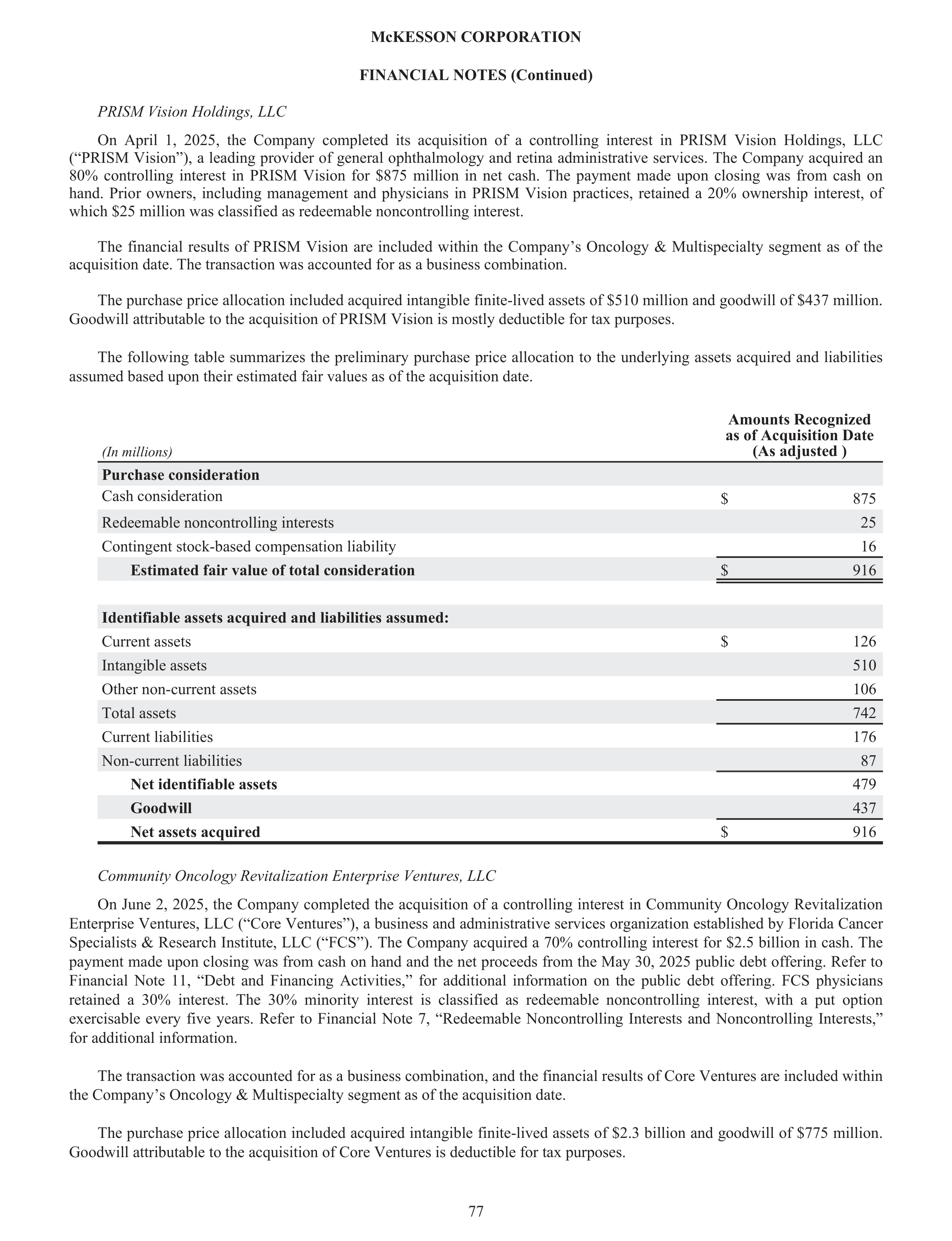
PRISM
I
Visi
i
on Holdings, LLC
On
April
1,
2025,
the
Company
completed
its
acquisition
of
a
controlling
interest
in
PRISM
Vision
Holdings,
LLC
(“PRISM
Vision”),
a
leading
provider
of
general ophthalmology
and
retina
administrative
services.
The
Company
acquired
an
80%
controlling
interest
in
PRISM
Vision
for
$875
million
in
net
cash.
The
payment
made
upon
closing
was
from
cash
on
hand.
Prior
owners,
including
management
and
physicians
in
PRISM
Vision
practices,
retained
a
20%
ownership
interest,
of
which $25 million was classified as redeemable noncontrolling interest.
The
financial
results
of
PRISM
Vision
are
included
within
the
Company’s
Oncology
&
Multispecialty
segment
as
of
the
acquisition date. The transaction was accounted for as a business combination.
The purchase price allocation included acquired intangible finite-lived assets of $510 million and goodwill of $437 million.
Goodwill attributable to the acquisition of PRISM Vision is mostly deductible for tax purpos
r
es.
The
following
tabl
a
e
summarizes
the
preliminary
r
purchase
price
allocation
to
the
underlying
assets
acquired
and
liabi
a
lities
assumed based upon their estimated fair values as of the acquisition date.
(In millions)s
Amounts Recognized
as of Acquisition Date
(As adju
d
sted )
Purchase consideration
Cash consideration
$
875
Redeemable noncontrolling interests
25
Contingent stock-based compensation liability
16
Estimated fair value of total consideration
$
916
Identifiable assets acquired and liabilities assumed:
Current assets
$
126
Intangible assets
510
Other non-current assets
106
Total assets
742
Current liabi
a
lities
176
Non-current liabilities
87
Net identifiable assets
479
Goodwill
437
Net assets acquired
$
916
Community Oncology Revitalization Enterprise
i
Ventures, LLC
On
June
2,
2025,
the
Company
completed
the
acquisition
of
a
controlling
interest
in
Community
Oncology
Revitalization
Enterprise Ventur
t
es, LLC (“Core Ventur
t
es”), a business and administrative services organization establ
a
ished by Florida Cancer
Specialists & Research Institut
t
e, LLC (“FCS”). The Company acquired a 70% controlling interest for $2.5 billion in cash. The
payment made upon closing was from cash on hand and the net proceeds from the May 30, 2025 public debt offe
f
ring. Refer to
Financial
Note
11,
“Debt
and
Financing
Activities,”
for
additional
information
on
the
public
debt
offe
f
ring.
FCS
physicians
retained
a
30%
interest.
The
30%
minority
interest
is
classified
as
redeemable
noncontrolling
interest,
with
a
put
option
exercisabl
a
e
every
r
five
years.
Refer
to
Financial
Note
7,
“Redeemable
Noncontrolling
Interests
and
Noncontrolling
Interests,”
for additional information.
The transaction was accounted for as a business combination, and the financial results of Core Ventur
t
es are included within
the Company’s Oncology & Multispecialty segment as of the acquisition date.
The purchase price allocation included acquired intangible finite-lived assets of $2.3 billion and goodwill of $775 million.
Goodwill attributable to the acquisition of Core Ventur
t
es is deductible for tax purpos
r
es.
McKESSON CORPORAT
R
ION
FINANCIAL NOTES (Continued)
77
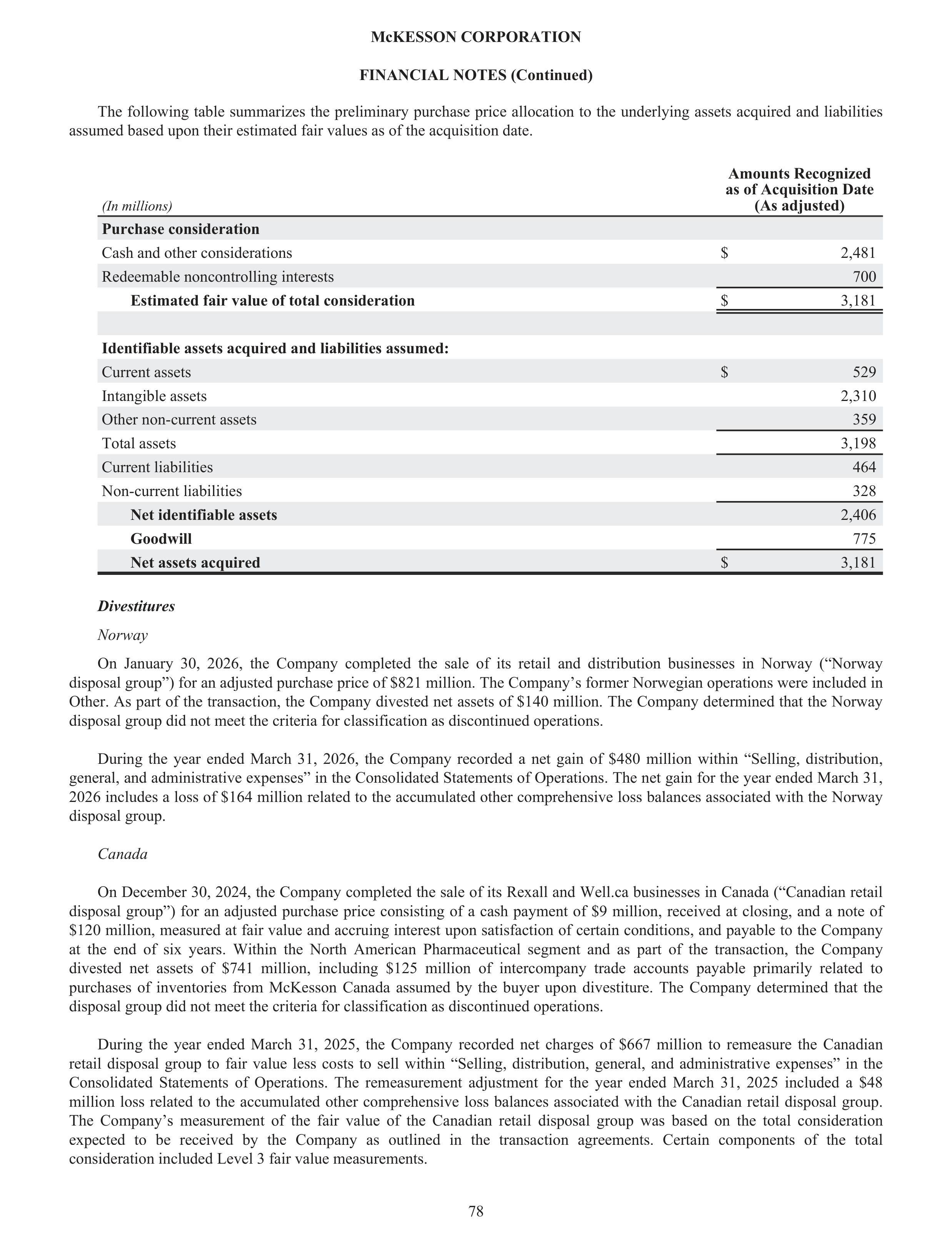
The
following
tabl
a
e
summarizes
the
preliminary
r
purchase
price
allocation
to
the
underlying
assets
acquired
and
liabi
a
lities
assumed based upon their estimated fair values as of the acquisition date.
(In millions)s
Amounts Recognized
as of Acquisition Date
(As adju
d
sted)
Purchase consideration
Cash and other considerations
$
2,481
Redeemable noncontrolling interests
700
Estimated fair value of total consideration
$
3,181
Identifiable assets acquired and liabilities assumed:
Current assets
$
529
Intangible assets
2,310
Other non-current assets
359
Total assets
3,198
Current liabi
a
lities
464
Non-current liabilities
328
Net identifiable assets
2,406
Goodwill
775
Net assets acquired
$
3,181
Divestitures
Norway
On
January
30,
2026,
the
Company
completed
the
sale
of
its
retail
and
distribution
businesses
in
Norway
(“Norway
disposal group”) for an adju
d
sted purchase price of $821 million. The Company’s former Norwegian operations were included in
Other. As part of the transaction, the Company divested net assets of $140 million. The Company determined that the Norway
disposal group did not meet the criteria for classification as discontinued operations.
During
the
year
ended
March
31,
2026,
the
Company
recorded
a
net
gain
of
$480
million
within
“Selling,
distribution,
general, and administrative expenses” in the Consolidated Statements of Operations. The net gain for the year ended March 31,
2026 includes a loss of $164 million related to the accumulated other comprehensive loss balances associated with the Norway
disposal group.
Canada
On December 30, 2024, the Company completed the sale of its Rexall and Well.ca businesses in Canada (“Canadian retail
disposal
group”)
for
an
adjusted
purchase
price
consisting
of
a
cash
payment
of
$9
million,
received
at
closing,
and
a
note
of
$120 million, measured at fair value and accrui
r
ng interest upon satisfac
f
tion of certain conditions, and payabl
a
e to the Company
at
the
end
of
six
years.
Within
the
North
American
Pharmaceutical
segment
and
as
part
of
the
transaction,
the
Company
divested
net
assets
of
$741
million,
including
$125
million
of
intercompany
trade
accounts
payabl
a
e
primarily
related
to
purchases
of
inventories
from
McKesson
Canada
assumed
by
the
buyer
upon
divestiture.
The
Company
determined
that
the
disposal group did not meet the criteria for classification as discontinued operations.
During
the
year
ended
March
31,
2025,
the
Company
recorded
net
charges
of
$667
million
to
remeasure
the
Canadian
retail
disposal
group
to
fair
value
less
costs
to
sell
within
“Selling,
distribution,
general,
and
administrative
expenses”
in
the
Consolidated
Statements
of
Operations.
The
remeasurement
adju
d
stment
for
the
year
ended
March
31,
2025
included
a
$48
million
loss
related
to
the
accumulated
other
comprehensive
loss
balances
associated
with
the
Canadian
retail
disposal
group.
u
The
Company’s
measurement
of
the
fair
value
of
the
Canadian
retail
disposal
group
was
based
on
the
total
consideration
expected
to
be
received
by
the
Company
as
outlined
in
the
transaction
agreements.
Certain
components
of
the
total
consideration included Level 3 fair value measurements.
McKESSON CORPORAT
R
ION
FINANCIAL NOTES (Continued)
78
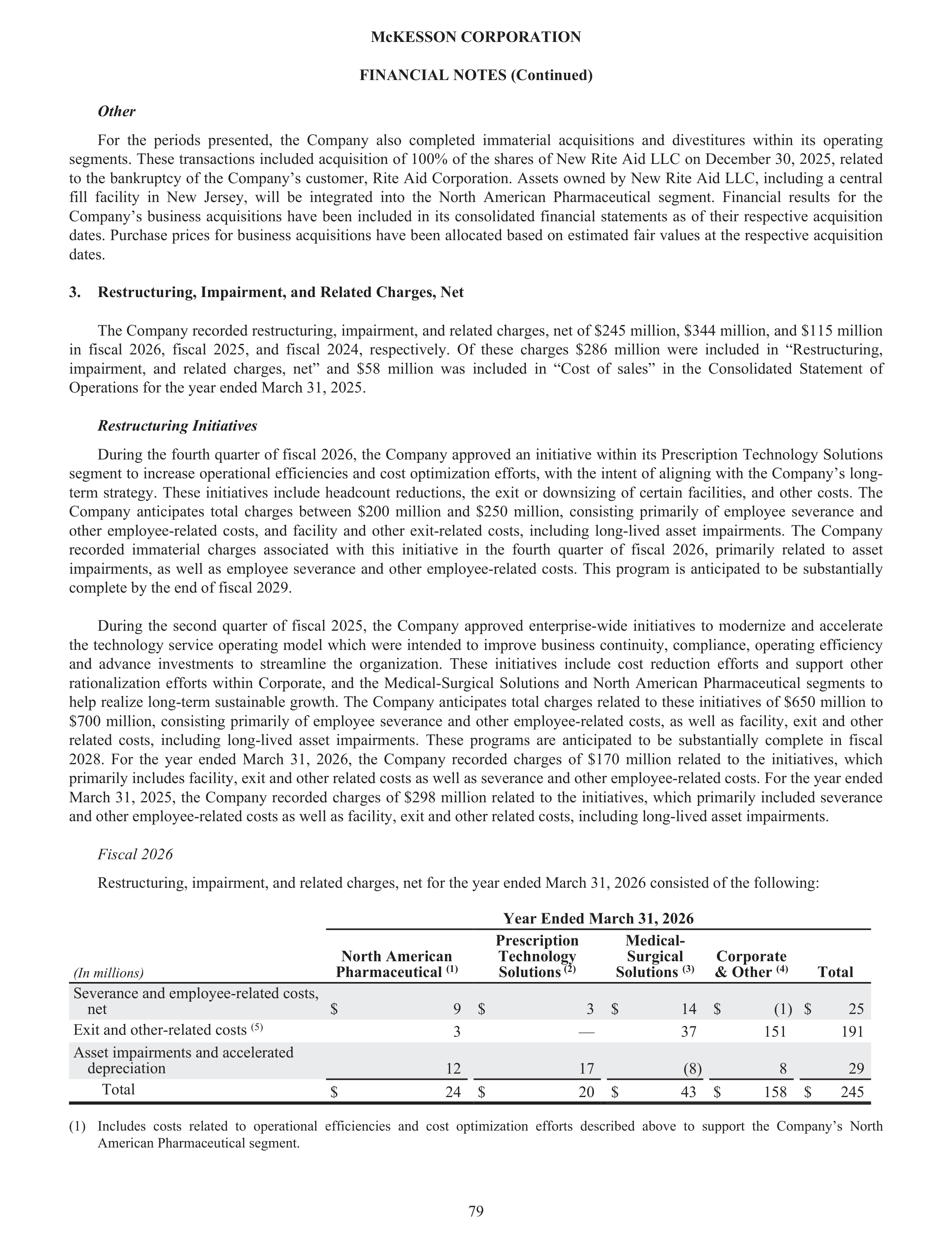
Othe
t
r
For
the
periods
presented,
the
Company
also
completed
immaterial
acquisitions
and
divestitures
within
its
operating
segments. These transactions included acquisition of 100% of the shares of New Rite Aid LLC on December 30, 2025, related
to the bankrupt
r
cy of the Company’s customer, Rite Aid Corporation. Assets owned by New Rite Aid LLC, including a central
fill
facility
in
New
Jersey,
will
be
integrated
into
the
North
American
Pharmaceutical
segment.
Financial
results
for
the
Company’s
business
acquisitions
have
been
included
in
its
consolidated
financial
statements
as
of
their
respective
acquisition
dates. Purchase prices for business acquisitions have been allocated based on estimated fair values at the respective acquisition
dates.
3.
Restructuring, Impairment, and Related Charges, Net
The Company recorded restructur
t
ing, impairment, and related charges, net of $245 million, $344 million, and $115 million
in
fiscal
2026,
fiscal
2025,
and
fiscal
2024,
respectively.
Of
these
charges
$286
million
were
included
in
“Restruc
r
turing,
impairment,
and
related
charges,
net”
and
$58
million
was
included
in
“Cost
of
sales”
in
the
Consolidated
Statement
of
Operations for the year ended March 31, 2025.
Restru
t
cturing Initia
t
tives
During the fourth quarter of fiscal 2026, the Company approved an initiative within its Prescription Technology Solutions
segment to increase operational effi
f
ciencies and cost optimization effo
f
rts, with the intent of aligning with the Company’s long-
term
strategy.
These
initiatives
include
headcount
reductions,
the
exit
or
downsizing
of
certain
facilities,
and
other
costs.
The
Company
anticipates
total
charges
between
$200
million
and
$250
million,
consisting
primarily
of
employee
severance
and
other
employee-related
costs,
and
facility
and
other
exit-related
costs,
including
long-lived
asset
impairments.
The
Company
recorded
immaterial
charges
associated
with
this
initiative
in
the
fourth
quarter
of
fiscal
2026,
primarily
related
to
asset
impairments,
as
well
as
employee
severance
and
other
employee-related
costs.
This
program
is
anticipated
to
be
subs
u
tantially
complete by the end of fiscal 2029.
During
the
second
quarter
of
fiscal
2025,
the
Company
approved
enterprise-wide
initiatives
to
modernize
and
accelerate
the
technology
service
operating
model
which
were
intended
to
improve
business
continuity,
compliance,
operating
effi
f
ciency
and
advance
investments
to
streamline
the
organization.
These
initiatives
include
cost
reduction
effo
f
rts
and
suppor
u
t
other
rationalization
effo
f
rts
within
Corporate,
and
the
Medical-Surgical
Solutions
and
North
American
Pharmaceutical
segments
to
help realize long-term sustainabl
a
e growth. The Company anticipates total charges related to these initiatives of $650 million to
$700
million,
consisting
primarily
of
employee
severance
and
other
employee-related
costs,
as
well
as
facility,
exit
and
other
related
costs,
including
long-lived
asset
impairments.
These
programs
are
anticipated
to
be
subs
u
tantially
complete
in
fiscal
2028.
For
the
year
ended
March
31,
2026,
the
Company
recorded
charges
of
$170
million
related
to
the
initiatives,
which
primarily includes facility, exit and other related costs as well as severance and other employee-related costs. For the year ended
March
31,
2025,
the
Company
recorded
charges
of
$298
million
related
to
the
initiatives,
which
primarily
included
severance
and other employee-related costs as well as facility, exit and other related costs, including long-lived asset impairments.
Fisc
i
al 2026
Restructur
t
ing, impairment, and related charges, net for the year ended March 31, 2026 consisted of the following:
Year Ended March 31, 2026
(In millions)s
North American
Pharmaceutical
(1)
Prescription
Technology
Solutions
(2)
Medical-
Surgical
Solutions
(3)
Corporate
& Other
(4)
Total
Severance and employee-related costs,
net
$
9
$
3
$
14
$
(1)
$
25
Exit and other-related costs
(5)
3
—
37
151
191
Asset impairments and accelerated
depreciation
12
17
(8)
8
29
Total
$
24
$
20
$
43
$
158
$
245
(1)
Includes
costs
related
to
operational
effi
f
ciencies
and
cost
optimization
effo
f
rts
described
above
to
suppor
u
t
the
Company’s
North
American Pharmaceutical segment.
McKESSON CORPORAT
R
ION
FINANCIAL NOTES (Continued)
79
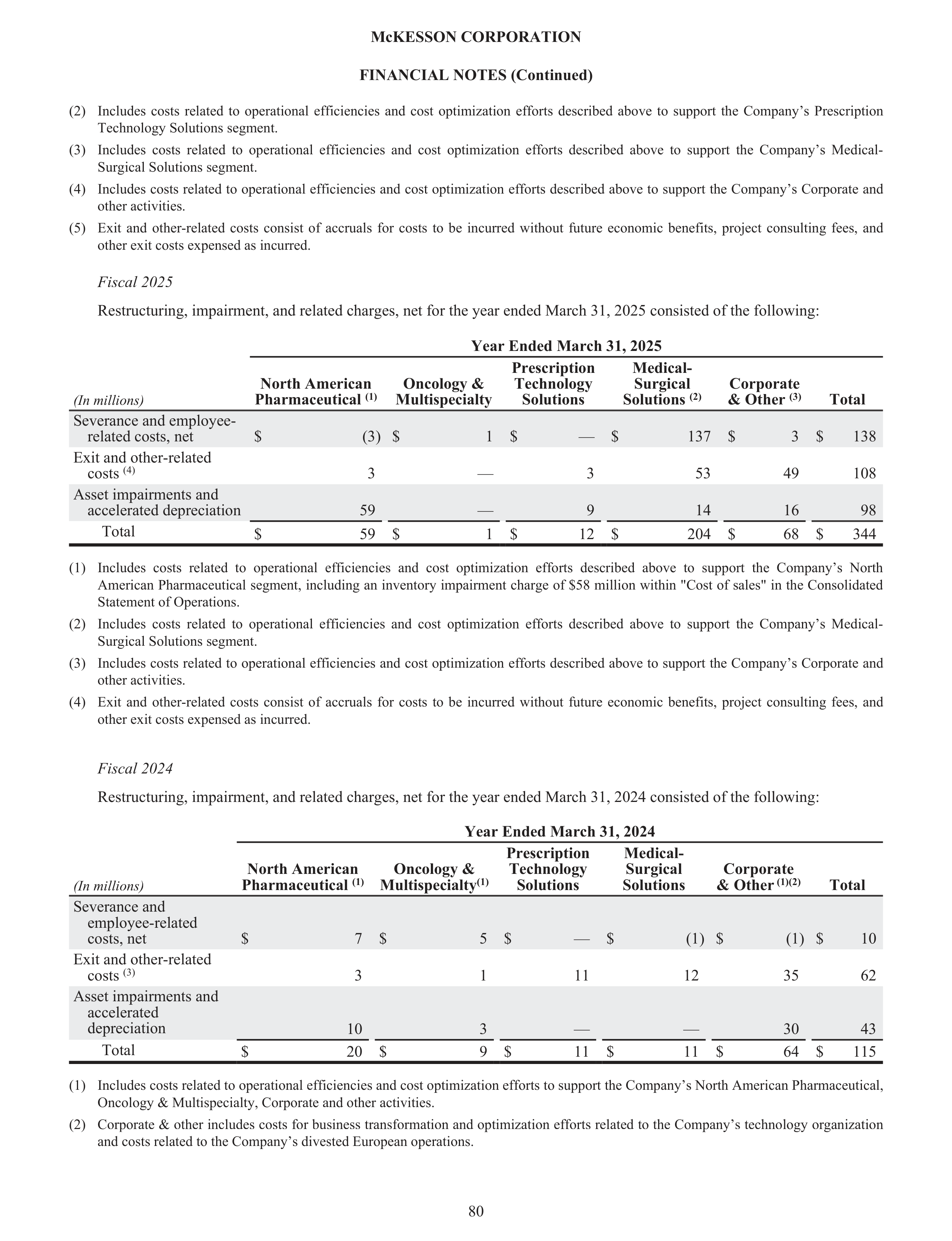
(2)
Includes
costs
related
to
operational
effi
f
ciencies
and
cost
optimization
effo
f
rts
described
above
to
suppor
u
t
the
Company’s
Prescription
Technology Solutions segment.
(3)
Includes
costs
related
to
operational
effi
f
ciencies
and
cost
optimization
effo
f
rts
described
above
to
suppor
u
t
the
Company’s
Medical-
Surgical Solutions segment.
(4)
Includes costs related to operational effi
f
ciencies and cost optimization effo
f
rts described above to suppor
u
t the Company’s Corporate and
other activities.
(5)
Exit
and
other-related
costs
consist
of
accrua
r
ls
for
costs
to
be
incurred
without
future
economic
benefits,
project
consulting
fees,
and
other exit costs expensed as incurred.
Fisc
i
al 2025
Restructur
t
ing, impairment, and related charges, net for the year ended March 31, 2025 consisted of the following:
Year Ended March 31, 2025
(In millions)s
North American
Pharmaceutical
(1)
Oncology &
Multispecialty
Prescription
Technology
Solutions
Medical-
Surgical
Solutions
(2)
Corporate
& Other
(3)
Total
Severance and employee-
related costs, net
$
(3)
$
1
$
—
$
137
$
3
$
138
Exit and other-related
costs
(4)
3
—
3
53
49
108
Asset impairments and
accelerated depreciation
59
—
9
14
16
98
Total
$
59
$
1
$
12
$
204
$
68
$
344
(1)
Includes
costs
related
to
opera itional
ef
ifi
f
icien
icies
and
cost
opti
i
imization
effo
f
rts
desc
iribed
b
above
to
suppor
u
t
hthe
Company’s
North
American
h
Pharmaceu itic
lal segment, in
lcl
di
udi
g
ng an inventory
r
imp
iairment
h
charge of $58 million
i
wi hthin "Cost of sales" in the Consolidated
Statement of Operations.
(2)
I
)
ncludes
costs
related
to
operational
effi
f
ciencies
and
cost
optimization
effo
f
rts
described
above
to
suppor
u
t
the
Company’s
Medical-
Surgical Solutions segment.
(3)
Includes costs related to operational effi
f
ciencies and cost optimization effo
f
rts described above to suppor
u
t the Company’s Corporate and
other activities.
(4)
Exit
and
other-related
costs
consist
of
accrua
r
ls
for
costs
to
be
incurred
without
future
economic
benefits,
project
consulting
fees,
and
other exit costs expensed as incurred.
Fisc
i
al 2024
Restructur
t
ing, impairment, and related charges, net for the year ended March 31, 2024 consisted of the following:
Year Ended March 31, 2024
(In millions)s
North American
Pharmaceutical
(1)
Oncology &
Multispecialty
(1)
Prescription
Technology
Solutions
Medical-
Surgical
Solutions
Corporate
& Other
(1)(2)
Total
Severance and
employee-related
costs, net
$
7
$
5
$
—
$
(1)
$
(1)
$
10
Exit and other-related
costs
(3)
3
1
11
12
35
62
Asset impairments and
accelerated
depreciation
10
3
—
—
30
43
Total
$
20
$
9
$
11
$
11
$
64
$
115
(1)
Includes costs related to operational effi
f
ciencies and cost optimization effo
f
rts to suppor
u
t the Company’s North American Pharmaceutical,
Oncology & Multispecialty, Corporate and other activities.
(2)
Corpor
r
ate & other includes costs for business transfor
f
mation and optimization effo
f
rts related to the Company’s technology organization
and costs related to the Company’s divested European operations.
McKESSON CORPORAT
R
ION
FINANCIAL NOTES (Continued)
80
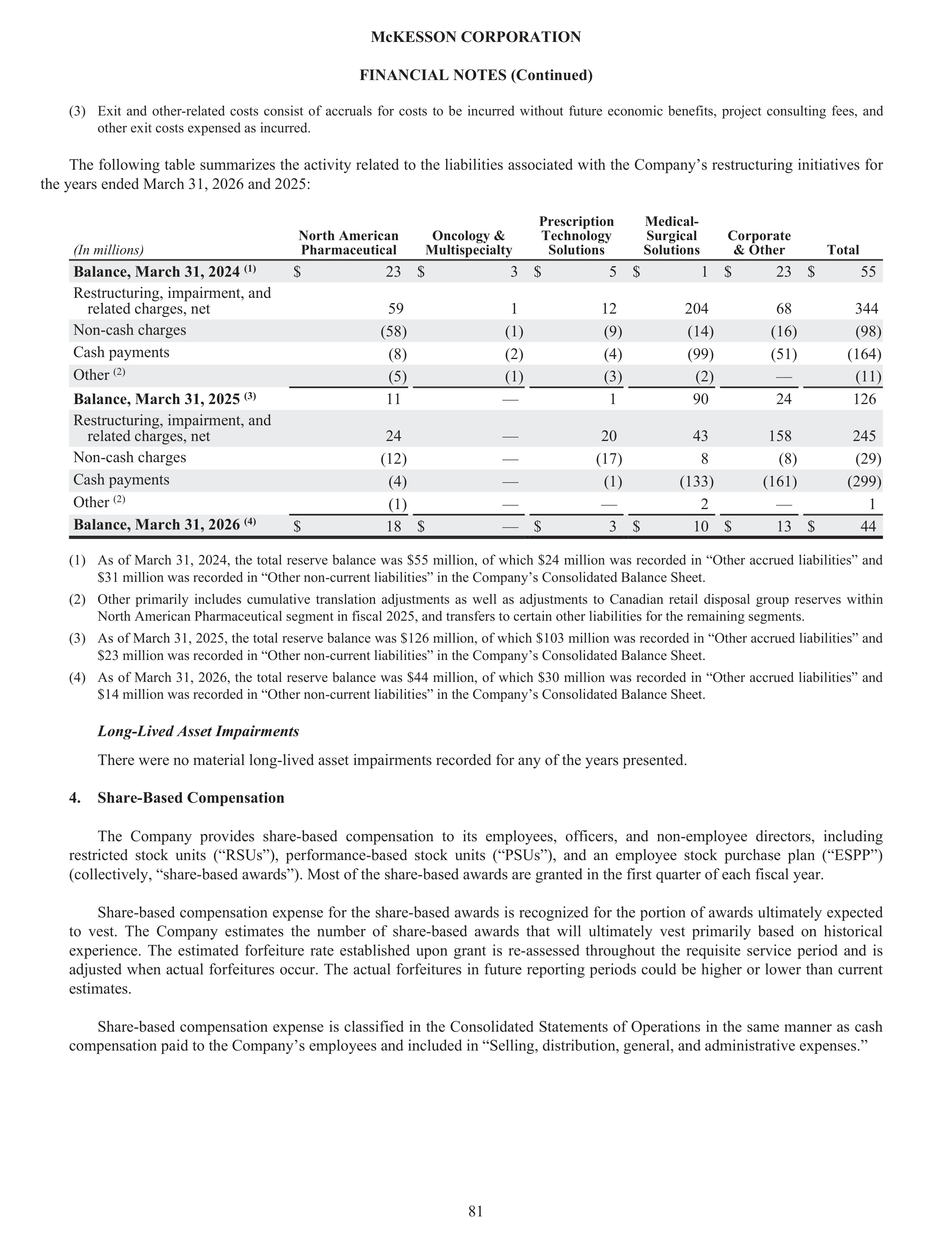
(3)
Exit
and
other-related
costs
consist
of
accrua
r
ls
for
costs
to
be
incurred
without
future
economic
benefits,
project
consulting
fees,
and
other exit costs expensed as incurred.
The following tabl
a
e summarizes the activity related to the liabilities associated with the Company’s restructur
t
ing initiatives for
the years ended March 31, 2026 and 2025:
(In millions)s
North American
Pharmaceutical
Oncology &
Multispecialty
Prescription
Technology
Solutions
Medical-
Surgical
Solutions
Corporate
& Other
Total
Balance, March 31, 2024
(1)
$
23
$
3
$
5
$
1
$
23
$
55
Restructur
t
ing, impairment, and
related charges, net
59
1
12
204
68
344
Non-cash charges
(58)
(1)
(9)
(14)
(16)
(98)
Cash payments
(8)
(2)
(4)
(99)
(51)
(164)
Other
(2)
(5)
(1)
(3)
(2)
—
(11)
Balance, March 31, 2025
(3)
11
—
1
90
24
126
Restructur
t
ing, impairment, and
related charges, net
24
—
20
43
158
245
Non-cash charges
(12)
—
(17)
8
(8)
(29)
Cash payments
(4)
—
(1)
(133)
(161)
(299)
Other
(2)
(1)
—
—
2
—
1
Balance, March 31, 2026
(4)
$
18
$
—
$
3
$
10
$
13
$
44
(1)
As
of
March
31,
2024,
the
total
reserve
balance
was
$55
million,
of
which
$24
million
was
recorded
in
“Other
accrue
r
d
liabi
a
lities”
and
$31 million was recorded in “Other non-current liabi
a
lities” in the Company’s Consolidated Balance Sheet.
(2)
Other
primarily
includes
cumulative
translation
adju
d
stments
as
well
as
adju
d
stments
to
Canadian
retail
disposal
group
reserves
within
North American
h
Pharmaceu itic
lal segment in fiscal 2025, and transfer
f
s to certain other liabi
a
lities for the remaining segments.
(3)
As of March 31, 2025, the total reserve balance was $126 million, of which $103 million was recorded in “Other accrue
r
d liabi
a
lities” and
$23 million was recorded in “Other non-current liabi
a
lities” in the Company’s Consolidated Balance Sheet.
(4)
As
of
March
31,
2026,
the
total
reserve
balance
was
$44
million,
of
which
$30
million
was
recorded
in
“Other
accrue
r
d
liabi
a
lities”
and
$14 million was recorded in “Other non-current liabi
a
lities” in the Company’s Consolidated Balance Sheet.
Long-L
g
ived Asset Impai
m
rm
i
ents
There were no material long-lived asset impairments recorded for any of the years presented.
4.
Share-Based Compensation
The
Company
provides
share-based
compensation
to
its
employees,
offi
f
cers,
and
non-employee
directors,
including
restricted
stock
units
(“RSUs”),
performance-based
stock
units
(“PSUs”),
and
an
employee
stock
purchase
plan
(“ESPP”)
(collectively, “share-based awards”). Most of the share-based awards are granted in the first quarter of each fiscal year.
Share-based compensation expense for the share-based awards is recognized for the portion of awards ultimately expected
to
vest.
The
Company
estimates
the
number
of
share-based
awards
that
will
ultimately
vest
primarily
based
on
historical
experience.
The
estimated
forfeiture
rate
establ
a
ished
upon
grant
is
re-assessed
throughout
the
requisite
service
period
and
is
adju
d
sted
when
actua
t
l
forfeitur
t
es
occur.
The
actua
t
l
forfeitur
t
es
in
future
reporting
periods
could
be
higher
or
lower
than
current
estimates.
Share-based
compensation
expense
is
classified
in
the
Consolidated
Statements
of
Operations
in
the
same
manner
as
cash
compensation paid to the Company’s employees and included in “Selling, distribution, general, and administrative expenses.”
McKESSON CORPORAT
R
ION
FINANCIAL NOTES (Continued)
81
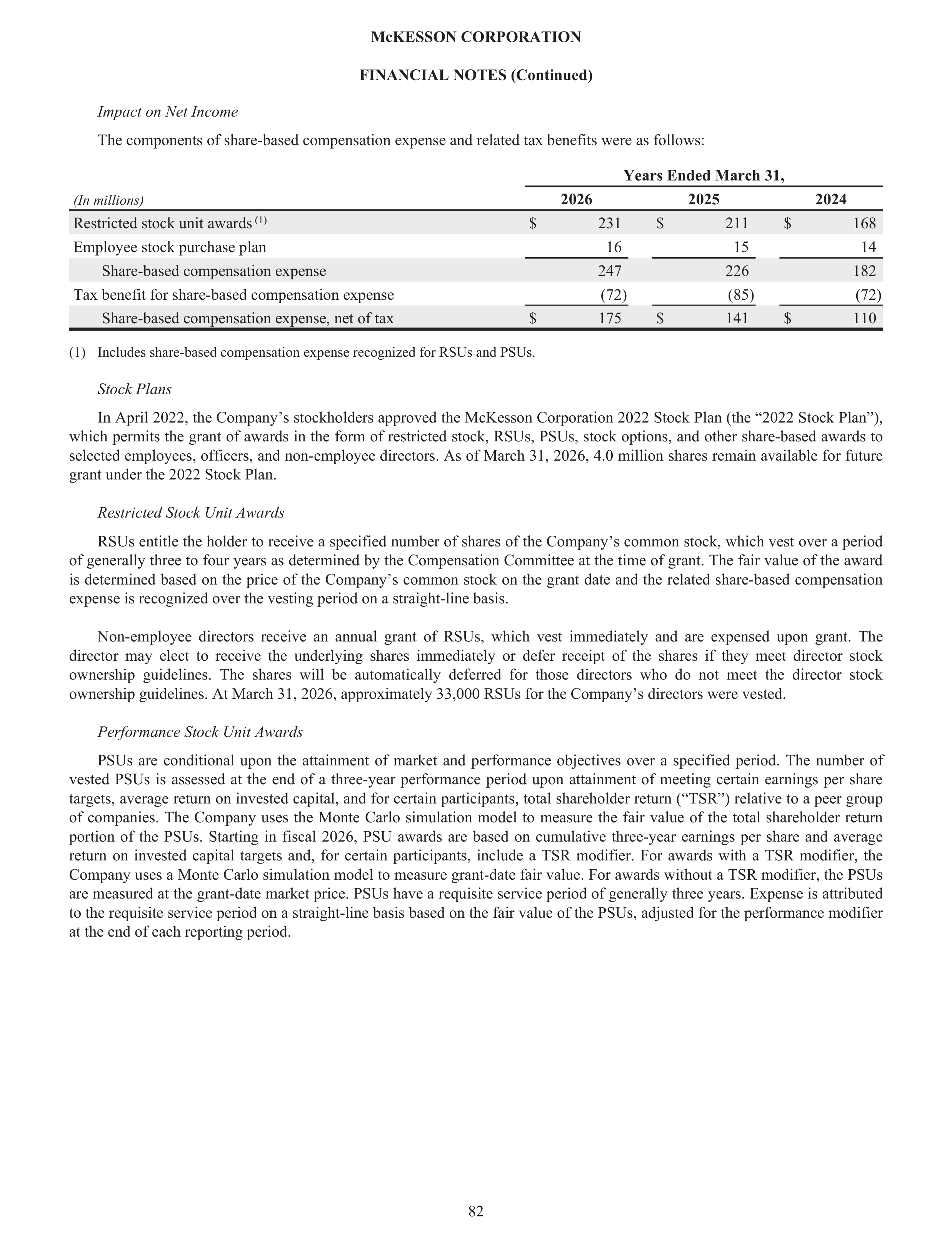
Impac
m
t on Net Income
The components of share-based compensation expense and related tax benefits were as follows:
Years Ended March 31,
(In millions)s
2026
2025
2024
Restricted stock unit awards
(1)
$
231
$
211
$
168
Employee stock purchase plan
16
15
14
Share-based compensation expense
247
226
182
Tax benefit for share-based compensation expense
(72)
(85)
(72)
Share-based compensation expense, net of tax
$
175
$
141
$
110
(1)
Includes share-based compensation expense recognized for RSUs and PSUs.
Stock Plans
In April 2022, the Company’s stockholders approved the McKesson Corporation 2022 Stock Plan (the “2022 Stock Plan”),
which permits the grant of awards in the form of restricted stock, RSUs, PSUs, stock options, and other share-based awards to
selected employees, offi
f
cers, and non-employee directors. As of March 31, 2026, 4.0 million shares remain availabl
a
e for future
grant under the 2022 Stock Plan.
Restri
t
cted Stock Unit Awards
RSUs entitle the holder to receive a specified number of shares of the Company’s common stock, which vest over a period
of generally three to four years as determined by the Compensation Committee at the time of grant. The fair value of the award
is
determined
based
on
the
price
of
the
Company’s
common
stock
on
the
grant
date
and
the
related
share-based
compensation
expense is recognized over the vesting period on a straight-line basis.
Non-employee
directors
receive
an
annual
grant
of
RSUs,
which
vest
immediately
and
are
expensed
upon
grant.
The
director
may
elect
to
receive
the
underlying
shares
immediately
or
defer
receipt
of
the
shares
if
they
meet
director
stock
ownership
guidelines.
The
shares
will
be
automatically
deferred
for
those
directors
who
do
not
meet
the
director
stock
ownership guidelines. At March 31, 2026, approximately 33,000 RSUs for the Company’s directors were vested.
Perfor
f
mance Stock Unit Awards
PSUs
are
conditional
upon
the
attainment
of
market
and
performance
objectives
over
a
specified
period.
The
number
of
vested
PSUs
is
assessed
at
the
end
of
a
three-year
performance
period
upon
attainment
of
meeting
certain
earnings
per
share
targets, average return on invested capital, and for certain participants, total shareholder return (“TSR”) relative to a peer group
of
companies.
The
Company
uses
the
Monte
Carlo
simulation
model
to
measure
the
fair
value
of
the
total
shareholder
return
portion
of
the
PSUs.
Starting
in
fiscal
2026,
PSU
awards
are
based
on
cumulative
three
-
year
earnings
per
share
and
average
return
on
invested
capital
targets
and,
for
certain
participants,
include
a
TSR
modifier.
For
awards
with
a
TSR
modifier,
the
Company uses a Monte Carlo simulation model to measure grant
-
date fair value. For awards without a TSR modifier, the PSUs
are measured at the grant-date market price. PSUs have a requisite service period of generally three years. Expense is attributed
to the requisite service period on a straight-line basis based on the fair value of the PSUs, adju
d
sted for the performance modifier
at the end of each reporting period.
McKESSON CORPORAT
R
ION
FINANCIAL NOTES (Continued)
82
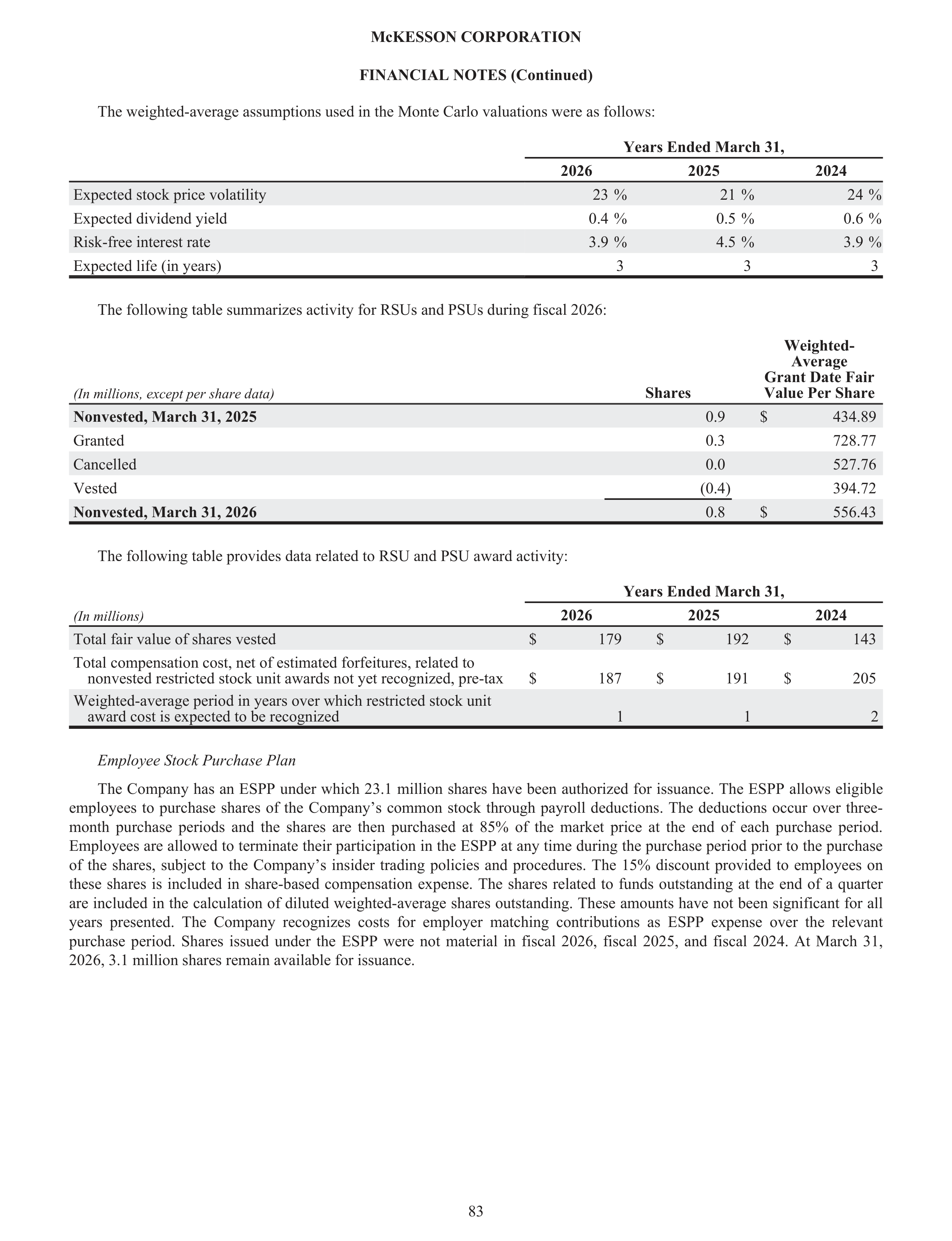
The weighted-average assumptions used in the Monte Carlo valuations were as follows:
Years Ended March 31,
2026
2025
2024
Expected stock price volatilit
2
y
3
%
21
%
24
%
Expected dividend yiel
0
d
.4
%
0.5
%
0.6
%
Risk-free interest rate
3.9
%
4.5
%
3.9
%
Expected lifef
(in years)
3
3
3
The following tabl
a
e summarizes activity for RSUs and PSUs during fiscal 2026:
(In millions, except per share data)
Shares
Weighted-
Average
Grant Date Fair
Value Per Share
Nonvested, March 31, 2025
0.9
$
434.89
Granted
0.3
728.77
Cancelled
0.0
527.76
Vested
(0.4)
394.72
Nonvested, March 31, 2026
0.8
$
556.43
The following tabl
a
e provides data related to RSU and PSU award activity:
Years Ended March 31,
(In millions)s
2026
2025
2024
Total fair value of shares vested
$
179
$
192
$
143
Total compensation cost, net of estimated forfeitures, related to
nonvested restricted stock unit awards not yet recognized, pre-tax
$
187
$
191
$
205
Weighted-average period in years over which restricted stock unit
award cost is expected to be recognized
1
1
2
Empl
m
oyee Stock Purchase Plan
The
Company
has
an
ESPP
under
which
23.1
million
shares
have
been
authorized
for
issuance.
The
ESPP
allows
eligible
employees
to
purchase
shares
of
the
Company’s
common
stock
through
payroll
deductions.
The
deductions
occur
over
three-
month
purchase
periods
and
the
shares
are
then
purchased
at
85%
of
the
market
price
at
the
end
of
each
purchase
period.
Employees are allowed to terminate their participation in the ESPP at any time during the purchase period prior to the purchase
of
the
shares,
subj
u
ect
to
the
Company’s
insider
trading
policies
and
procedur
d
es.
The
15%
discount
provided
to
employees
on
these
shares
is
included
in
share-based
compensation
expense.
The
shares
related
to
funds
outstanding
at
the
end
of
a
quarter
are included in the calculation of diluted weighted-average shares outstanding. These amounts have not been significant for all
years
presented.
The
Company
recognizes
costs
for
employer
matching
contributions
as
ESPP
expense
over
the
relevant
purchase
period.
Shares
issued
under
the
ESPP
were
not
material
in
fiscal
2026,
fiscal
2025,
and
fiscal
2024.
At
March
31,
2026, 3.1 million shares remain availabl
a
e for issuance.
McKESSON CORPORAT
R
ION
FINANCIAL NOTES (Continued)
83
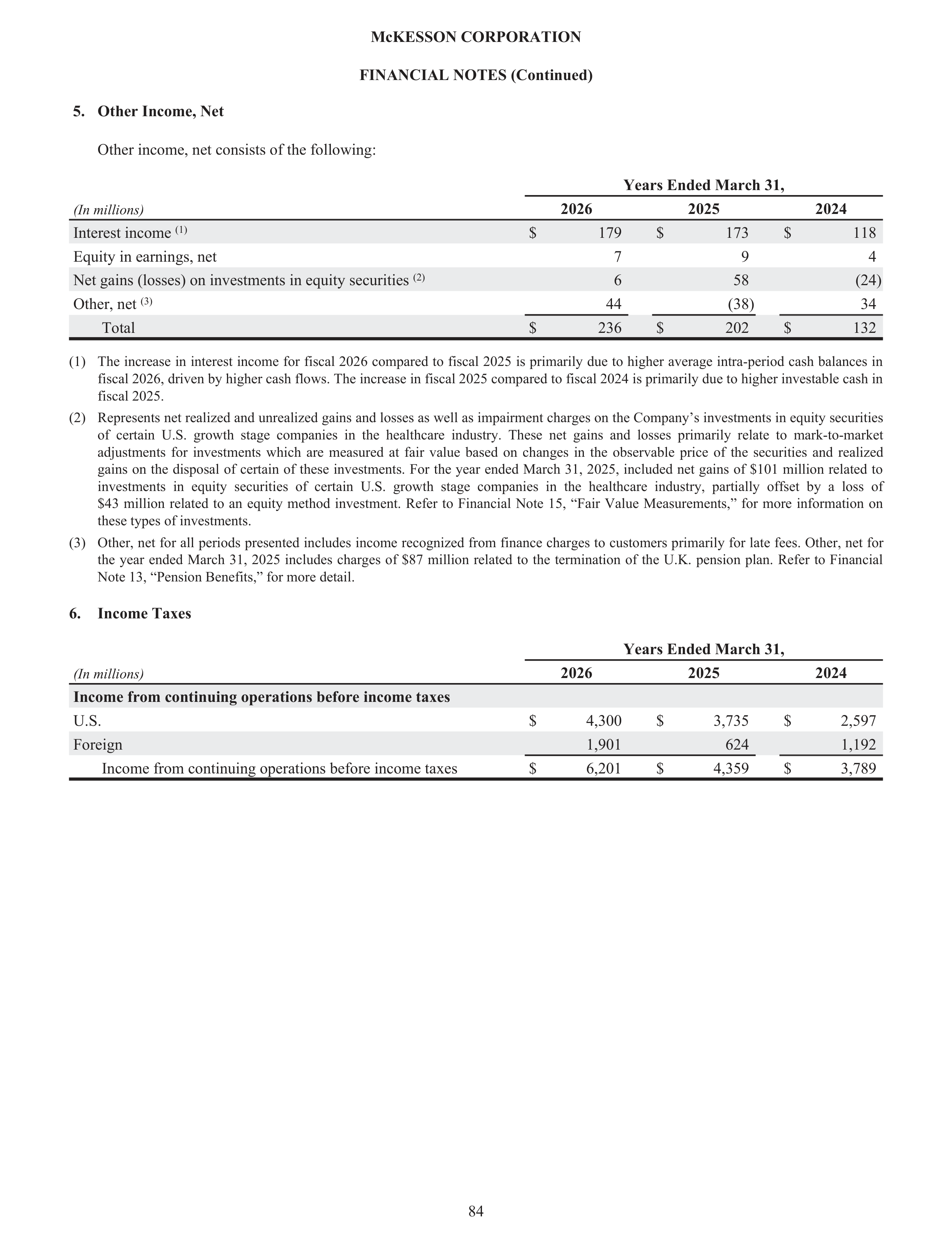
5.
Other Income, Net
Other income, net consists of the following:
Years Ended March 31,
(In millions)s
2026
2025
2024
Interest income
(1)
$
179
$
173
$
118
Equity in earnings, net
7
9
4
Net gains (losses) on investments in equity securities
(2)
6
58
(24)
Other, net
(3)
44
(38)
34
Total
$
236
$
202
$
132
(1)
The increase in interest
income for
fiscal 2026
compared to fiscal 2025 is primarily due to higher average intra
-
period cash balances in
fiscal 2026, driven by higher cash flows. The increase in fiscal 2025 compared to fiscal 2024 is primarily due to higher investable cash in
fiscal 2025.
(2)
Represents net realized and unrealized gains and losses as well as impairment charges on the Company’s investments in equity securities
of
certain
U.S.
growth
stage
companies
in
the
healthcare
industry.
r
These
net
gains
and
losses
primarily
relate
to
mark-to-market
adju
d
stments
for
investments
which
are
measured
at
fair
value
based
on
changes
in
the
observabl
a
e
price
of
the
securities
and
realized
gains
on
the
disposal
of
certain
of
these
investments.
For
the
year
ended
March
31,
2025,
included
net
gains
of
$101
million
related
to
investments
in
equity
securities
of
certain
U.S.
growth
stage
companies
in
the
healthcare
industry,
r
partially
offs
f
et
by
a
loss
of
$43
million
related
to
an
equity
method
investment.
Refer
to
Financial
Note
15,
“Fair
Value
Measurements,”
for
more
information
on
these types of investments.
(3)
Other, net for all periods presented includes income recognized from finance charges to customers primarily for late fees. Other, net for
the
year
ended
March
31,
2025
includes
charges
of
$87
million
related
to
the
termination
of
the
U.K.
pension
plan.
Refer
to
Financial
Note 13, “Pension Benefits,” for more detail.
6.
Income Taxes
Years Ended March 31,
(In millions)s
2026
2025
2024
Income from continuing operations befor
f
e income taxes
U.S.
$
4,300
$
3,735
$
2,597
Foreign
1,901
624
1,192
Income from continuing operations before income taxes
$
6,201
$
4,359
$
3,789
McKESSON CORPORAT
R
ION
FINANCIAL NOTES (Continued)
84
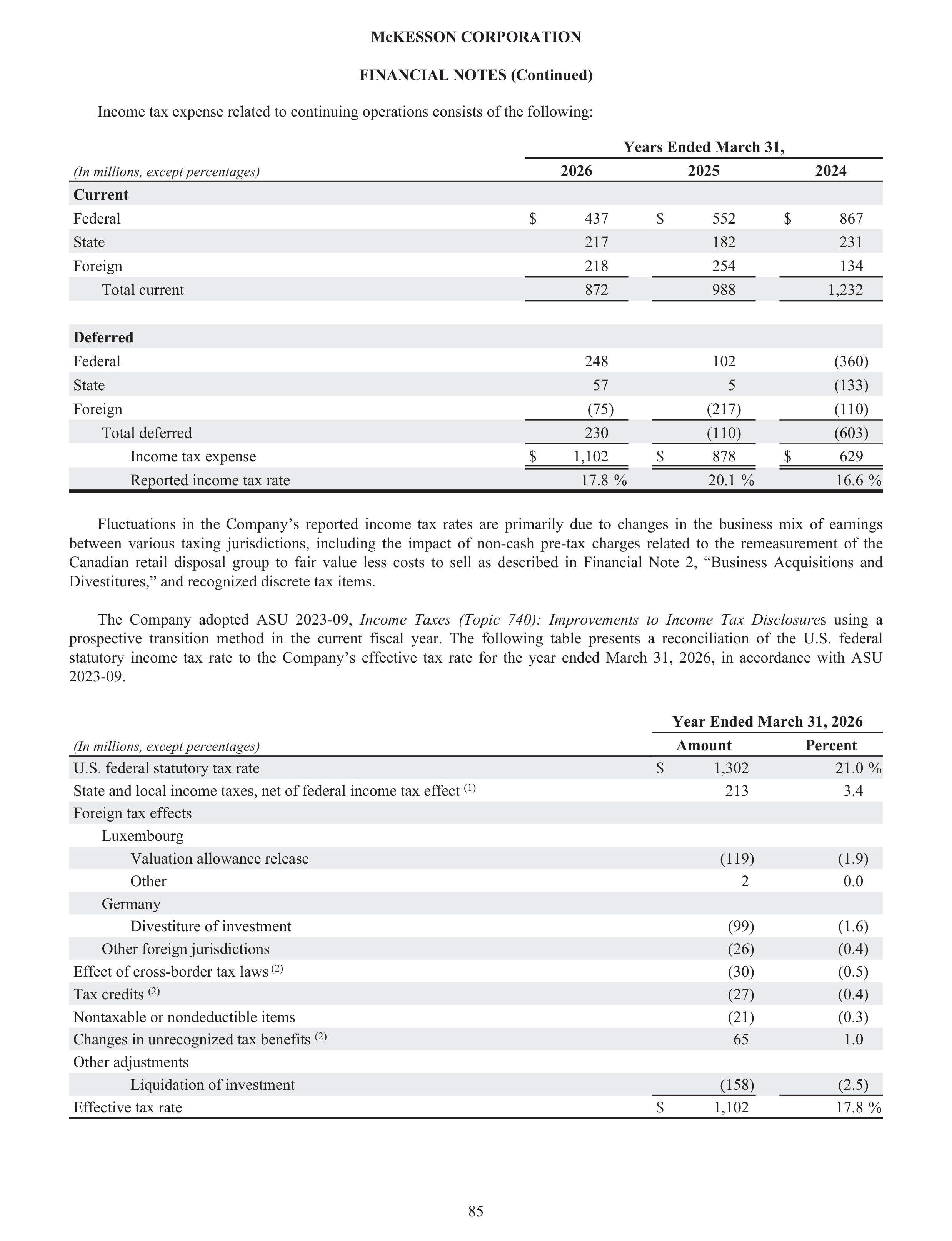
Income tax expense related to continuing operations consists of the following:
Years Ended March 31,
(In millions, except percentages)
2026
2025
2024
Current
Federal
$
437
$
552
$
867
State
217
182
231
Foreign
218
254
134
Total current
872
988
1,232
Deferred
Federal
248
102
(360)
State
57
5
(133)
Foreign
(75)
(217)
(110)
Total deferred
230
(110)
(603)
Income tax expense
$
1,102
$
878
$
629
Reported income tax rate
17.8
%
20.1
%
16.6
%
Fluctuations
in
the
Company’s
reported
income
tax
rates
are
primarily
due
to
changes
in
the
business
mix
of
earnings
between
various
taxing
jurisdictions,
including
the
impact
of
non-cash
pre-tax
charges
related
to
the
remeasurement
of
the
Canadian
retail
disposal
group
to
fair
value
less
costs
to
sell
as
described
in
Financial
Note
2,
“Business
Acquisitions
and
Divestitures,” and recognized discrete tax items.
The
Company
adopted
ASU
2023-09,
Income
Taxes
a
(Topi
T
c
740):
Impr
m
ovements
to
Income
Tax
a
Disc
i
losure
s
using
a
prospective
transition
method
in
the
current
fiscal
year.
The
following
tabl
a
e
presents
a
reconciliation
of
the
U.S.
federal
statut
t
ory
r
income
tax
rate
to
the
Company’s
effe
f
ctive
tax
rate
for
the
year
ended
March
31,
2026,
in
accordance
with
ASU
2023-09.
Year Ended March 31, 2026
(In millions, except percentages)
Amount
Percent
U.S. federal statut
t
ory
r
tax rate
$
1,302
21.0
%
State and local income taxes, net of federal income tax effe
f
ct
(1)
213
3.4
Foreign tax effe
f
cts
Luxembourg
Valuation allowance release
(119)
(1.9)
Other
2
0.0
Germany
Divestiture of investment
(99)
(1.6)
Other foreign jurisdictions
(26)
(0.4)
Effe
f
ct of cross-border tax laws
(2)
(30)
(0.5)
Tax credits
(2)
(27)
(0.4)
Nontaxable or nondeductible items
(21)
(0.3)
Changes in unrecognized tax benefits
(2)
65
1.0
Other adju
d
stments
Liquidation of investment
(158)
(2.5)
Effe
f
ctive tax rate
$
1,102
17.8
%
McKESSON CORPORAT
R
ION
FINANCIAL NOTES (Continued)
85
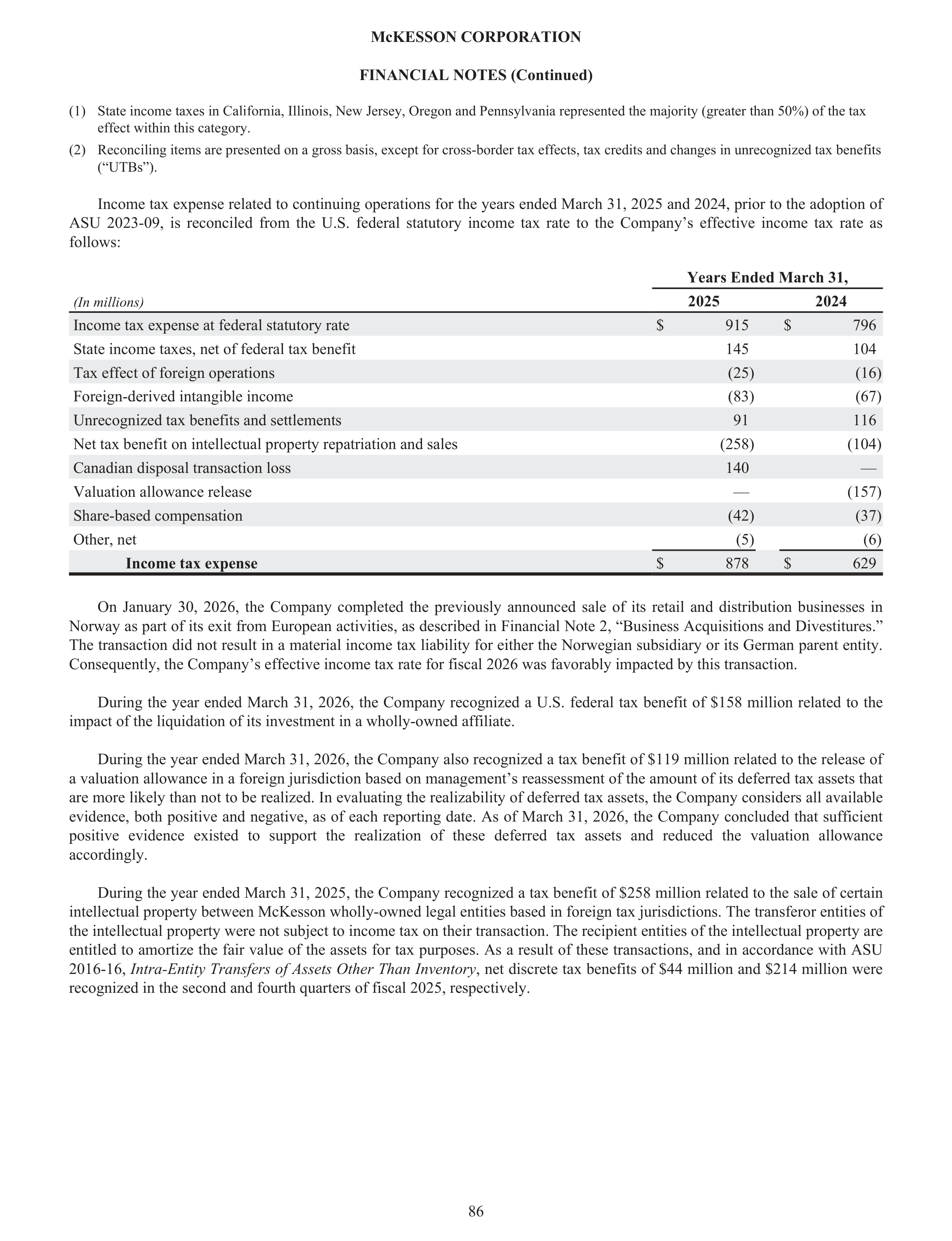
(1)
State income taxes in Califor
f
nia, Illinois, New Jersey, Oregon and Pennsylvania represented the majo
a
rity (greater than 50%) of the tax
effe
f
ct within this category.
r
(2)
Reconciling items are presented on a gross basis, except for cross-border tax effe
f
cts, tax credits and changes in unrecognized tax benefits
(“UTBs”).
Income tax expense related to continuing operations for the years ended March 31, 2025 and 2024, prior to the adoption of
ASU
2023-09,
is
reconciled
from
the
U.S.
federal
statut
t
ory
r
income
tax
rate
to
the
Company’s
effe
f
ctive
income
tax
rate
as
follows:
Years Ended March 31,
(In millions)s
2025
2024
Income tax expense at federal statut
t
ory
r
rate
$
915
$
796
State income taxes, net of federal tax benefit
145
104
Tax effe
f
ct of foreign operations
(25)
(16)
Foreign-derived intangible income
(83)
(67)
Unrecognized tax benefit
f
s and settlements
91
116
Net tax benefit on intellectual property repatriation and sales
(258)
(104)
Canadian disposal transaction loss
140
—
Valuation allowance release
—
(157)
Share-based compensation
(42)
(37)
Other, net
(5)
(6)
Income tax expense
$
878
$
629
On
January
30,
2026,
the
Company
completed
the
previously
announced
sale
of
its
retail
and
distribution
businesses
in
Norway as part of its exit from European activities, as described in Financial Note 2, “Business Acquisitions and Divestitures.”
The transaction did not result in a material income tax liability for either the Norwegian subs
u
idiary or its German parent entity.
Consequently, the Company’s effe
f
ctive income tax rate for fiscal 2026 was favorably impacted by this transaction.
During
the
year
ended
March
31,
2026,
the
Company
recognized
a
U.S.
federal
tax
benefit
of
$158
million
related
to
the
impact of the liquidation of its investment in a wholly-owned affi
f
liate.
During the year ended March 31, 2026, the Company also recognized a tax benefit of $119 million related to the release of
a valuation allowance in a foreign jurisdiction based on management’s reassessment of the amount of its deferred tax assets that
are more likely than not to be realized. In evaluating the realizability of deferred tax assets, the Company considers all availabl
a
e
evidence,
both
positive
and
negative,
as
of
each
reporting
date.
As
of
March
31,
2026,
the
Company
concluded
that
suffic
f
ient
positive
evidence
existed
to
suppor
u
t
the
realization
of
these
deferred
tax
assets
and
reduced
the
valuation
allowance
accordingly.
During the year ended March 31, 2025, the Company recognized a tax benefit of $258 million related to the sale of certain
intellectua
t
l property between McKesson wholly-owned legal entities based in foreign tax jurisdictions. The transfer
f
or entities of
the intellectua
t
l property were not subj
u
ect to income tax on their transaction. The recipient entities of the intellectua
t
l property are
entitled to amortize the fair value of the assets for tax purpos
r
es. As a result of these transactions, and in accordance with ASU
2016-16,
Intra-Entity Transfe
s
rs of Assets Othe
t
r Than Inventory
r
, net discrete tax benefits of $44 million and $214 million were
recognized in the second and fourth quarters of fiscal 2025, respectively.
McKESSON CORPORAT
R
ION
FINANCIAL NOTES (Continued)
86
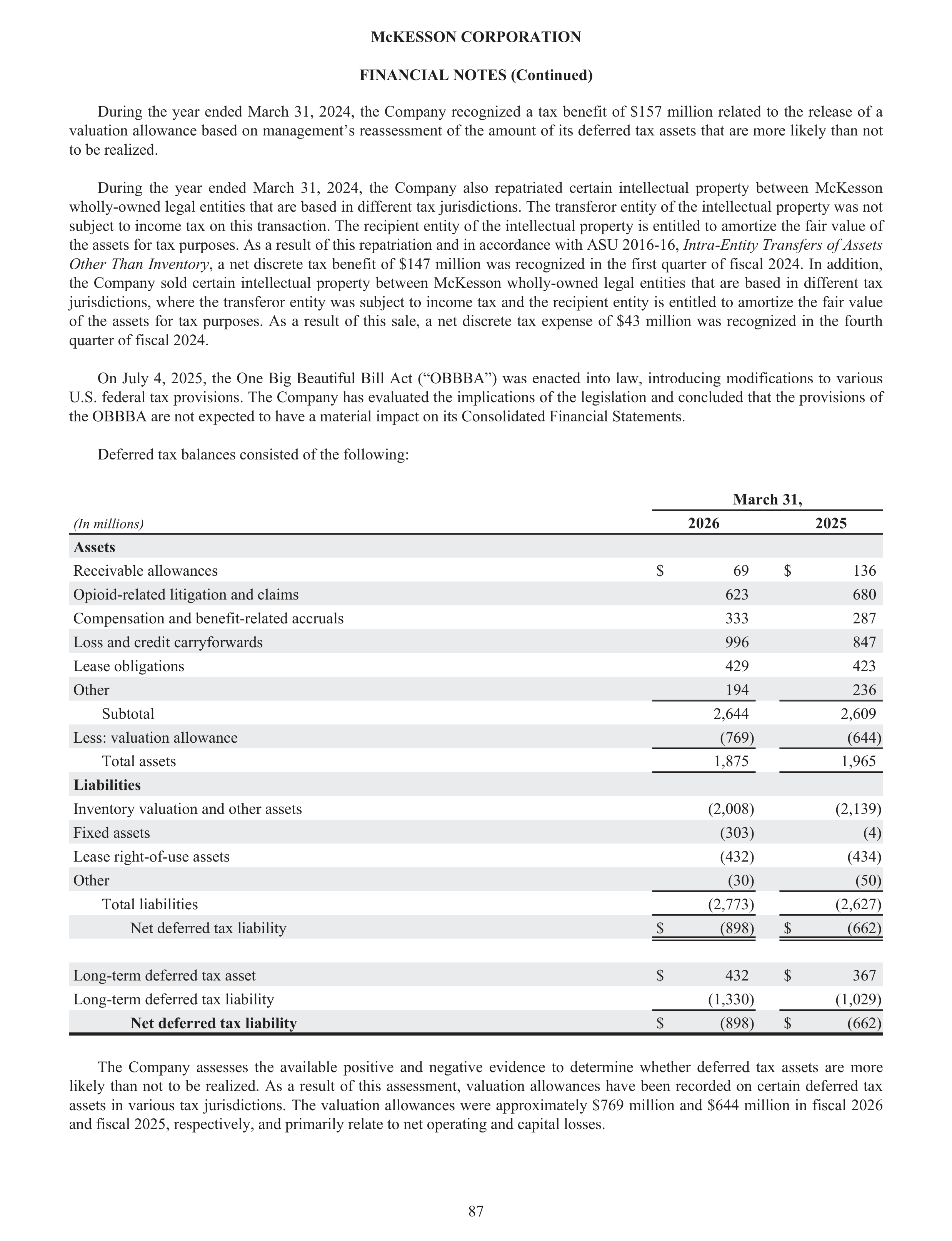
During
the
year
ended
March
31,
2024,
the
Company
recognized
a
tax
benefit
of
$157
million
related
to
the
release
of
a
valuation allowance based on management’s reassessment of the amount of its deferred tax assets that are more likely than not
to be realized.
During
the
year
ended
March
31,
2024,
the
Company
also
repatriated
certain
intellectua
t
l
property
between
McKesson
wholly-owned legal entities that are based in different tax jurisdictions. The transfer
f
or entity of the intellectua
t
l property was not
subj
u
ect to income tax on this transaction. The recipient entity of the intellectua
t
l property is entitled to amortize the fair value of
the assets for tax purpos
r
es. As a result of this repatriation and in accordance with ASU 2016-16,
Intra-Entityt
Transfe
s
rs of Assets
Othe
t
r
Than
Inventory
,
a
net
discrete
tax
benefit
of
$147
million
was
recognized
in
the
first
quarter
of
fiscal
2024.
In
addition,
the
Company
sold
certain
intellectua
t
l
property
between
McKesson
wholly-owned
legal
entities
that
are
based
in
different
tax
jurisdictions, where the transfer
f
or entity was subj
u
ect to income tax and the recipient entity is entitled to amortize the fair value
of
the
assets
for
tax
purpos
r
es.
As
a
result
of
this
sale,
a
net
discrete
tax
expense
of
$43
million
was
recognized
in
the
fourth
quarter of fiscal 2024.
On
July
4,
2025,
the
One
Big
Beautiful
f
Bill
Act
(“OBBBA”)
was
enacted
into
law,
introducing
modifications
to
various
U.S. federal tax provisions. The Company has evaluated the implications of the legislation and concluded that the provisions of
the OBBBA are not expected to have a material impact on its Consolidated Financial Statements.
Deferred tax balances consisted of the following:
March 31,
(In millions)s
2026
2025
Assets
Receivabl
a
e allowances
$
69
$
136
Opioid-related litigation and claims
623
680
Compensation and benefit-related accrua
r
ls
333
287
Loss and credit carryforwards
996
847
Lease obligations
429
423
Other
194
236
Subt
u
otal
2,644
2,609
Less: valuation allowance
(769)
(644)
Total assets
1,875
1,965
Liabilities
Inventory
r
valuation and other assets
(2,008)
(2,139)
Fixed assets
(303)
(4)
Lease right-of-use assets
(432)
(434)
Other
(30)
(50)
Total liabi
a
lities
(2,773)
(2,627)
Net deferred tax liabi
a
lity
$
(898)
$
(662)
Long-term deferred tax asset
$
432
$
367
Long-term deferred tax liability
(1,330)
(1,029)
Net deferred tax liability
$
(898)
$
(662)
The
Company
assesses
the
availabl
a
e
positive
and
negative
evidence
to
determine
whether
deferred
tax
assets
are
more
likely
than
not
to
be
realized.
As
a
result
of
this
assessment,
valuation
allowances
have
been
recorded
on
certain
deferred
tax
assets
in
various
tax
jurisdictions.
The
valuation
allowances
were
approximately
$769
million
and
$644
million
in
fiscal
2026
and fiscal 2025, respectively, and primarily relate to net operating and capi
a
tal losses.
McKESSON CORPORAT
R
ION
FINANCIAL NOTES (Continued)
87
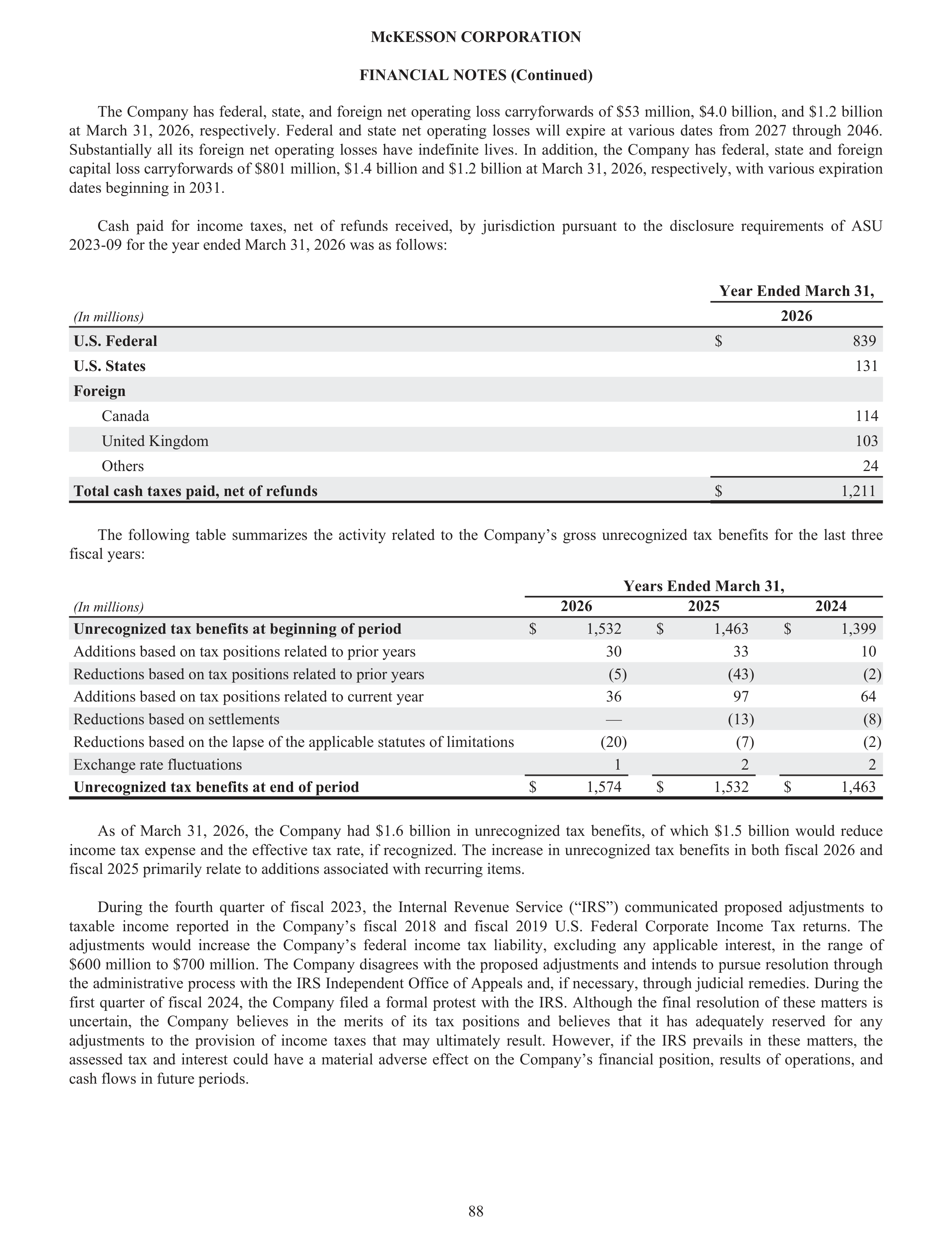
The Company has federal, state, and foreign net operating loss carryforwards of $53 million, $4.0 billion, and $1.2 billion
at
March
31,
2026,
respectively.
Federal
and
state
net
operating
losses
will
expire
at
various
dates
from
2027
through
2046.
Subs
u
tantially
all
its
foreign
net
operating
losses
have
indefinite
lives.
In
addition,
the
Company
has
federal,
state
and
foreign
capital loss carryforwards of $801 million, $1.4 billion and $1.2 billion at March 31, 2026, respectively, with various expiration
dates beginning in 2031.
Cash
paid
for
income
taxes,
net
of
refunds
received,
by
jurisdiction
pursuant
to
the
disclosure
requirements
of
ASU
2023
-
09 for the year ended March 31, 2026 was as follows:
Year Ended March 31,
(In millions)s
2026
U.S. Federal
$
839
U.S. States
131
Foreign
Canada
114
United Kingdom
103
Others
24
Total cash taxes paid, net of refunds
f
$
1,211
The
following
tabl
a
e
summarizes
the
activity
related
to
the
Company’s
gross
unrecognized
tax
benefits
for
the
last
three
fiscal years:
Years Ended March 31,
(In millions)s
2026
2025
2024
Unrecognized tax benefits at beginning of period
$
1,532
$
1,463
$
1,399
Additions based on tax positions related to prior years
30
33
10
Reductions based on tax positions related to prior years
(5)
(43)
(2)
Additions based on tax positions related to current year
36
97
64
Reductions based on settlements
—
(13)
(8)
Reductions based on the laps
a
e of the applicable statut
t
es of limitations
(20)
(7)
(2)
Exchange rate fluctuations
1
2
2
Unrecognized tax benefits at end of period
$
1,574
$
1,532
$
1,463
As
of
March
31,
2026,
the
Company
had
$1.6
billion
in
unrecognized
tax
benefits,
of
which
$1.5
billion
would
reduce
income tax
expense
and
the
effe
f
ctive tax
rate,
if
recognized.
The
increase
in
unrecognized
tax
benefits
in
both
fiscal
2026
and
fiscal 2025 primarily relate to additions associated with recurring items.
During
the
fourth
quarter
of
fiscal
2023,
the
Internal
Revenue
Service
(“IRS”)
communicated
proposed
adju
d
stments
to
taxabl
a
e
income
reported
in
the
Company’s
fiscal
2018
and
fiscal
2019
U.S.
Federal
Corporate
Income
Tax
returns.
The
adju
d
stments
would
increase
the
Company’s
federal
income
tax
liabi
a
lity,
excluding
any
applicable
interest,
in
the
range
of
$600 million to $700 million. The Company disagrees with the proposed adju
d
stments and intends to pursue resolution through
the administrative process with the IRS Independent Offi
f
ce of Appeals and, if necessary, through judicial remedies. During the
first
quarter
of
fiscal
2024,
the
Company
filed
a
formal
protest
with
the
IRS.
Although
the
final
resolution
of
these
matters
is
uncertain,
the
Company
believes
in
the
merits
of
its
tax
positions
and
believes
that
it
has
adequately
reserved
for
any
adju
d
stments
to
the
provision
of
income
taxes
that
may
ultimately
result.
However,
if
the
IRS
prevails
in
these
matters,
the
assessed
tax
and
interest
could
have
a
material
adverse
effe
f
ct
on
the
Company’s
financial
position,
results
of
operations,
and
cash flows in future periods.
McKESSON CORPORAT
R
ION
FINANCIAL NOTES (Continued)
88
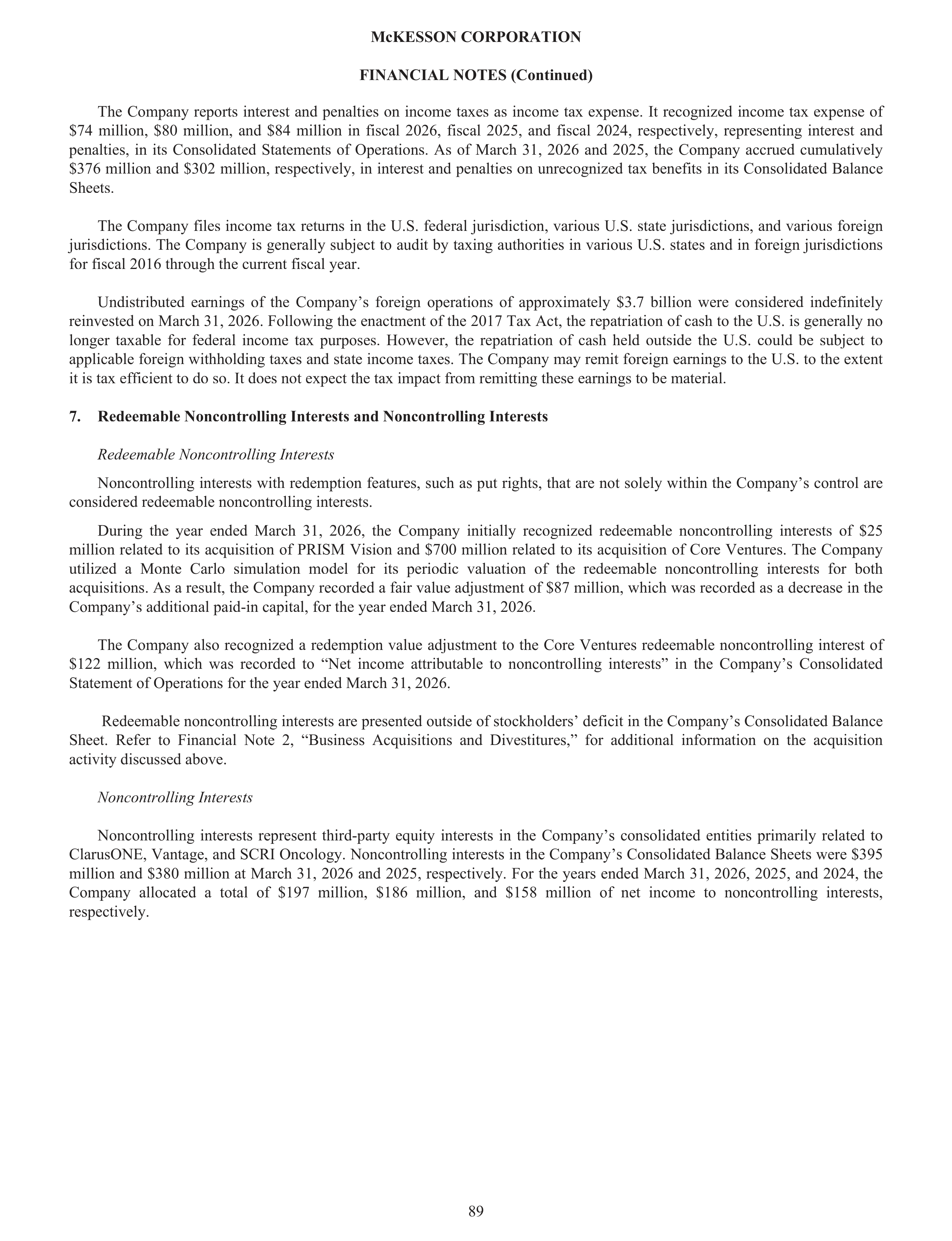
The
Company
reports
interest
and
penalties
on
income
taxes
as
income
tax
expense.
It
recognized
income
tax
expense
of
$74
million,
$80
million,
and
$84
million
in
fiscal
2026,
fiscal
2025,
and
fiscal
2024,
respectively,
representing
interest
and
penalties,
in
its
Consolidated
Statements
of
Operations.
As
of
March
31,
2026
and
2025,
the
Company
accrue
r
d
cumulatively
$376 million and $302 million, respectively, in interest and penalties on unrecognized tax benefits in its Consolidated Balance
Sheets.
The Company files income tax returns in the U.S. federal jurisdiction, various U.S. state jurisdictions, and various foreign
jurisdictions. The Company is generally subj
u
ect to audit by taxing authorities in various U.S. states and in foreign jurisdictions
for fiscal 2016 through the current fiscal year.
Undistributed
earnings
of
the
Company’s
foreign
operations
of
approximately
$3.7
billion
were
considered
indefinitely
reinvested on March 31, 2026. Following the enactment of the 2017 Tax Act, the repatriation of cash to the U.S. is generally no
longer
taxabl
a
e
for
federal
income
tax
purpos
r
es.
However,
the
repatriation
of
cash
held
outside
the
U.S.
could
be
subj
u
ect
to
applicable foreign withholding taxes and state income taxes. The Company may remit foreign earnings to the U.S. to the extent
it is tax effi
f
cient to do so. It does not expect the tax impact from remitting these earnings to be material.
7.
Redeemable Noncontrolling Interests and Noncontrolling Interests
Redeemable Noncontro
t
lling Interestst
Noncontrolling interests with redemption featur
t
es, such as put rights, that are not solely within the Company’s control are
considered redeemable noncontrolling interests.
During
the
year
ended
March
31,
2026,
the
Company
initially
recognized
redeemable
noncontrolling
interests
of
$25
million
related
to
its
acquisition
of
PRISM
Vision
and
$700
million
related
to
its
acquisition
of
Core
Ventur
t
es.
The
Company
utilized
a
Monte
Carlo
simulation
model
for
its
periodic
valuation
of
the
redeemable
noncontrolling
interests
for
both
acquisitions. As a result, the Company recorded a fair value adju
d
stment of $87 million, which was recorded as a decrease in the
Company’s additional paid-in capital, for the year ended March 31, 2026.
The
Company
also
recognized
a
redemption
value
adju
d
stment
to
the
Core
Ventur
t
es
redeemable
noncontrolling
interest
of
$122
million,
which
was
recorded
to
“Net
income
attributable
to
noncontrolling
interests”
in
the
Company’s
Consolidated
Statement of Operations for the year ended March 31, 2026.
Redeemable noncontrolling interests are presented outside of stockholders’ deficit in the Company’s Consolidated Balance
Sheet.
Refer
to
Financial
Note
2,
“Business
Acquisitions
and
Divestitures,”
for
additional
information
on
the
acquisition
activity discussed above.
Noncontro
t
lling Interestst
Noncontrolling
interests
represent
third-party
equity
interests
in
the
Company’s
consolidated
entities
primarily
related
to
Clarus
r
ONE, Vantage, and SCRI Oncology. Noncontrolling interests in the Company’s Consolidated Balance Sheets were $395
million
and
$380
million
at
March
31,
2026
and
2025,
respectively.
For
the
years
ended
March
31,
2026,
2025,
and
2024,
the
Company
allocated
a
total
of
$197
million,
$186
million,
and
$158
million
of
net
income
to
noncontrolling
interests,
respectively.
McKESSON CORPORAT
R
ION
FINANCIAL NOTES (Continued)
89
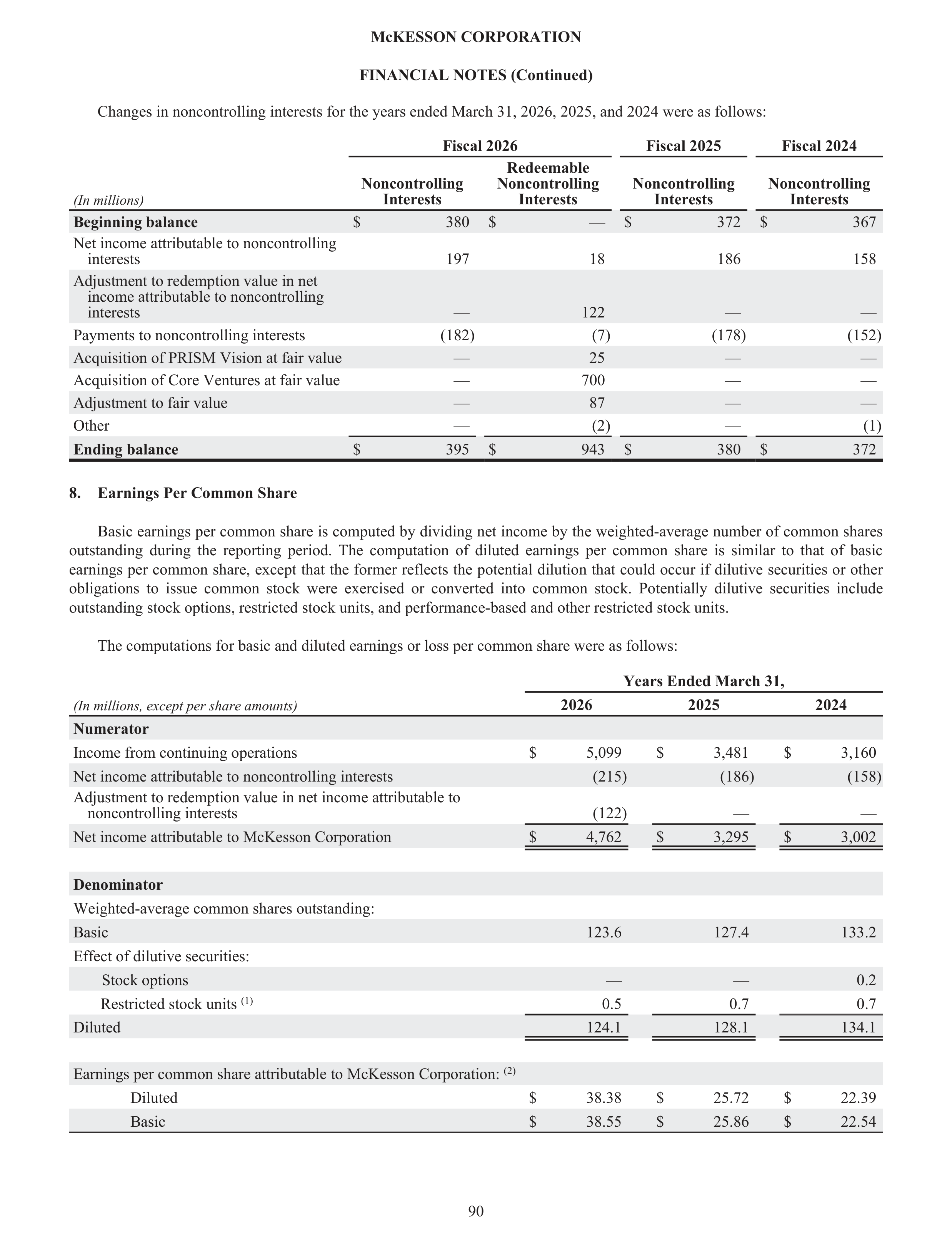
Changes in noncontrolling interests for the years ended March 31, 2026, 2025, and 2024 were as follows:
Fiscal 2026
Fiscal 2025
Fiscal 2024
(In millions)s
Noncontrolling
Interests
Redeemable
Noncontrolling
Interests
Noncontrolling
Interests
Noncontrolling
Interests
Beginning balance
$
380
$
—
$
372
$
367
Net income attributable to noncontrolling
interests
197
18
186
158
Adju
d
stment to redemption value in net
income attributable to noncontrolling
interests
—
122
—
—
Payments to noncontrolling interests
(182)
(7)
(178)
(152)
Acquisition of PRISM Vision at fair value
—
25
—
—
Acquisition of Core Ventur
t
es at fair value
—
700
—
—
Adju
d
stment to fair value
—
87
—
—
Other
—
(2)
—
(1)
Ending balance
$
395
$
943
$
380
$
372
8.
Earnings Per Common Share
Basic earnings per common share is computed by dividing net income by the weighted-average number of common shares
outstanding
during
the
reporting
period.
The
computation
of
diluted
earnings
per
common
share
is
similar
to
that
of
basic
earnings
per
common
share,
except that the
former
reflects
the
potential dilution
that could
occur
if
dilutive
securities
or
other
obligations
to
issue
common
stock
were
exercised
or
converted
into
common
stock.
Potentially
dilutive
securities
include
outstanding stock options, restricted stock units, and performance-based and other restricted stock units.
The computations for basic and diluted earnings or loss per common share were as follows:
Years Ended March 31,
(In millions, except per share amounts)s
2026
2025
2024
Numerator
Income from continuing operations
$
5,099
$
3,481
$
3,160
Net income attributable to noncontrolling interests
(215)
(186)
(158)
Adju
d
stment to redemption value in net income attributable to
noncontrolling interests
(122)
—
—
Net income attributable to McKesson Corporation
$
4,762
$
3,295
$
3,002
Denominator
Weighted-average common shares outstanding:
Basic
123.6
127.4
133.2
Effe
f
ct of dilutive securities:
Stock options
—
—
0.2
Restricted stock units
(1)
0.5
0.7
0.7
Diluted
124.1
128.1
134.1
Earnings per common share attributable to McKesson Corporation:
(2)
Diluted
$
38.38
$
25.72
$
22.39
Basic
$
38.55
$
25.86
$
22.54
McKESSON CORPORAT
R
ION
FINANCIAL NOTES (Continued)
90
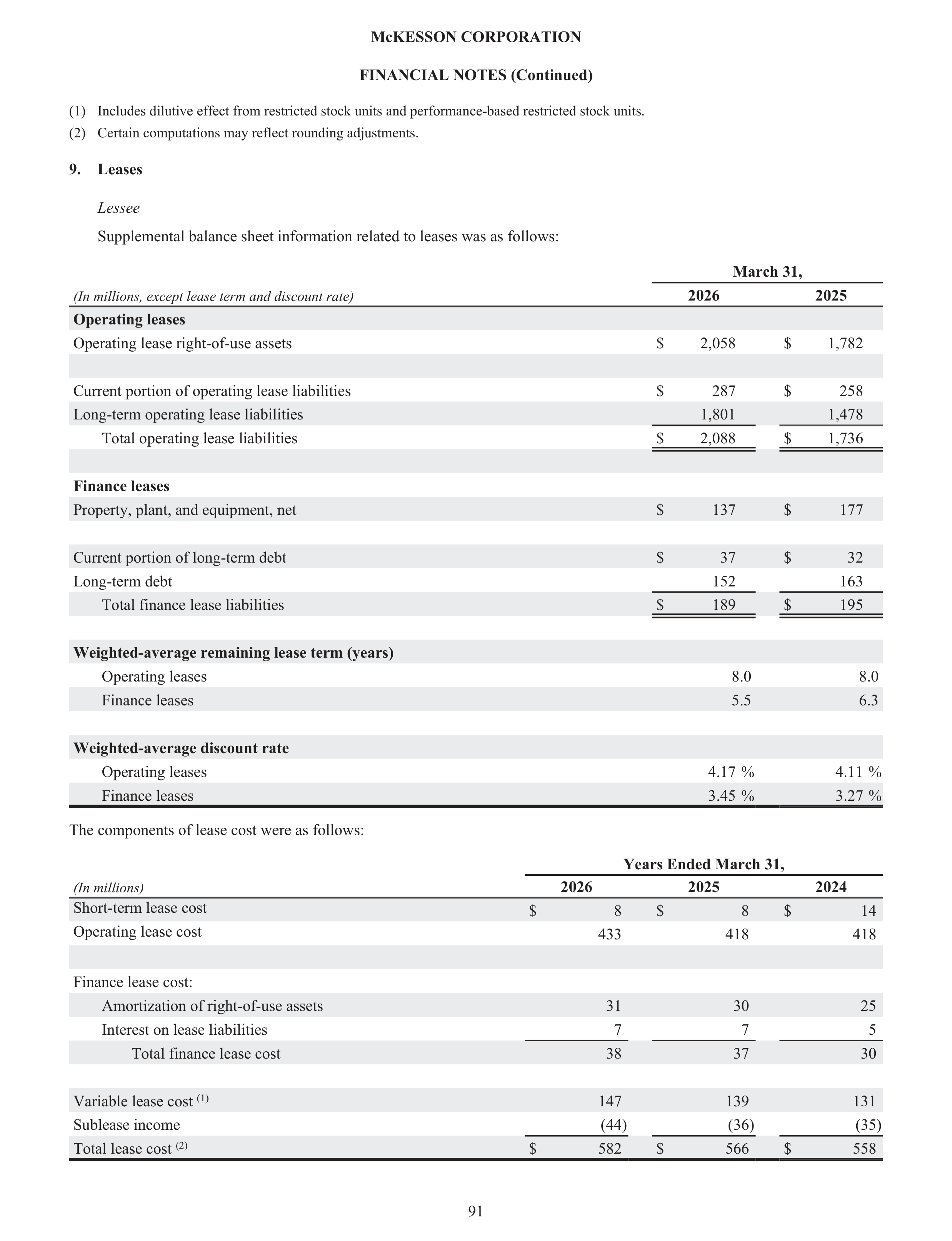
(1)
Includes dilutive effe
f
ct from restricted stock units and performance-based restricted stock units.
(2)
Certain computations may reflect rounding adju
d
stments.
9.
Leases
Lessee
Suppl
u
emental balance sheet information related to leases was as follows:
March 31,
(In millions, except lease term and disc
i
ount rate)e
2026
2025
Operating leases
Operating lease right-of-use assets
$
2,058
$
1,782
Current portion of operating lease liabi
a
lities
$
287
$
258
Long-term operating lease liabilities
1,801
1,478
Total operating lease liabi
a
lities
$
2,088
$
1,736
Finance leases
Property, plant, and equipment, net
$
137
$
177
Current portion of long-term debt
$
37
$
32
Long-term debt
152
163
Total finance lease liabilities
$
189
$
195
Weighted-average remaining lease term (years)
Operating leases
8.0
8.0
Finance leases
5.5
6.3
Weighted-average discount rate
Operating leases
4.17
%
4.11
%
Finance leases
3.45
%
3.27
%
The components of lease cost were as follows:
Years Ended March 31,
(In millions)s
2026
2025
2024
Short-term lease cost
$
8
$
8
$
14
Operating lease cost
433
418
418
Finance lease cost:
Amortization of right-of-use assets
31
30
25
Interest on lease liabi
a
lities
7
7
5
Total finance lease cost
38
37
30
Variable lease cost
(1)
147
139
131
Subl
u
ease income
(44)
(36)
(35)
Total lease cost
(2)
$
582
$
566
$
558
McKESSON CORPORAT
R
ION
FINANCIAL NOTES (Continued)
91
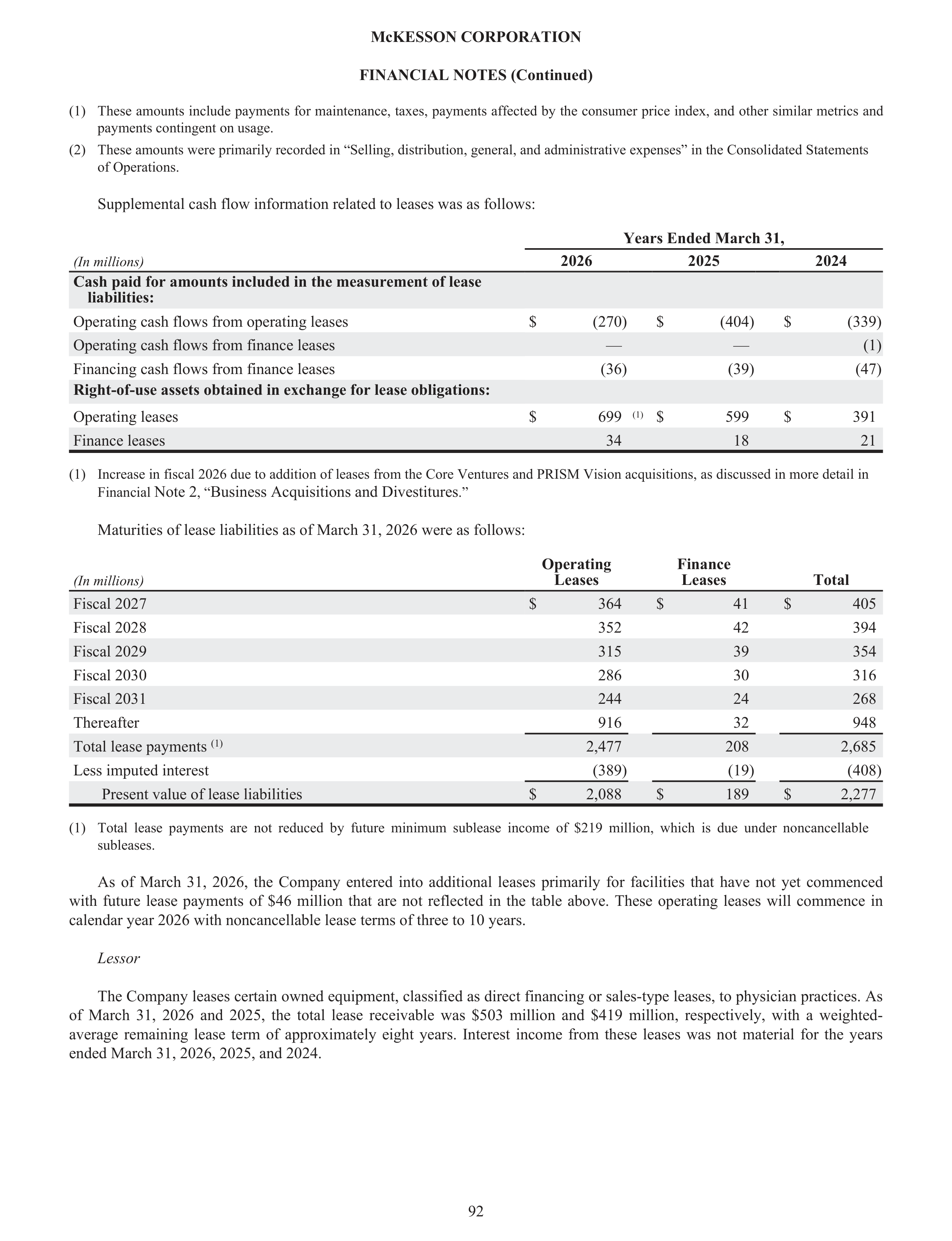
(1)
These
amounts include payments for maintenance,
taxes,
payments affe
f
cted by the consumer price index,
and other
similar metrics and
payments contingent on usage.
(2)
These amounts were primarily recorded in “Selling, distribution, general, and administrative expenses” in the Consolidated Statements
of Operations.
Suppl
u
emental cash flow information related to leases was as follows:
Years Ended March 31,
(In millions)s
2026
2025
2024
Cash paid for amounts included in the measurement of lease
liabilities:
Operating cash flows from operating leases
$
(270)
$
(404)
$
(339)
Operating cash flows from finance leases
—
—
(1)
Financing cash flows from finance leases
(36)
(39)
(47)
Right-of-use assets obtained in exchange for lease obligations:
Operating leases
$
699
(1)
$
599
$
391
Finance leases
34
18
21
(1)
Increase in fiscal 2026 due to addition of leases from the Core Ventur
t
es and PRISM Vision acquisitions, as discussed in more detail in
Financial
Note 2
, “
Business Acquisitions and Divestitures
.”
Maturities of lease liabilities as of March 31, 2026 were as follows:
(In millions)s
Operating
Leases
Finance
Leases
Total
Fiscal 2027
$
364
$
41
$
405
Fiscal 2028
352
42
394
Fiscal 2029
315
39
354
Fiscal 2030
286
30
316
Fiscal 2031
244
24
268
Thereafte
f
r
916
32
948
Total lease payments
(1)
2,477
208
2,685
Less imputed interest
(389)
(19)
(408)
Present value of lease liabilities
$
2,088
$
189
$
2,277
(1)
Total
lease
payments
are
not
reduced
by
future
minimum
subl
u
ease
income
of
$219
million,
which
is
due
under
noncancellabl
a
e
subl
u
eases.
As
of
March
31,
2026,
the
Company
entered
into
additional
leases
primarily
for
facilities
that
have
not
yet
commenced
with
future
lease
payments
of
$46
million
that
are
not
reflected
in
the
tabl
a
e
above.
These
operating
leases
will
commence
in
calendar year 2026 with noncancellable lease terms of three to 10 years.
Lessor
The Company leases certain owned equipment, classified as direct financing or sales-type leases, to physician practices. As
of
March
31,
2026
and
2025,
the
total
lease
receivabl
a
e
was
$503
million
and
$419
million,
respectively,
with
a
weighted-
average
remaining
lease
term
of
approximately
eight
years.
Interest
income
from
these
leases
was
not
material
for
the
years
ended March 31, 2026, 2025, and 2024.
McKESSON CORPORAT
R
ION
FINANCIAL NOTES (Continued)
92
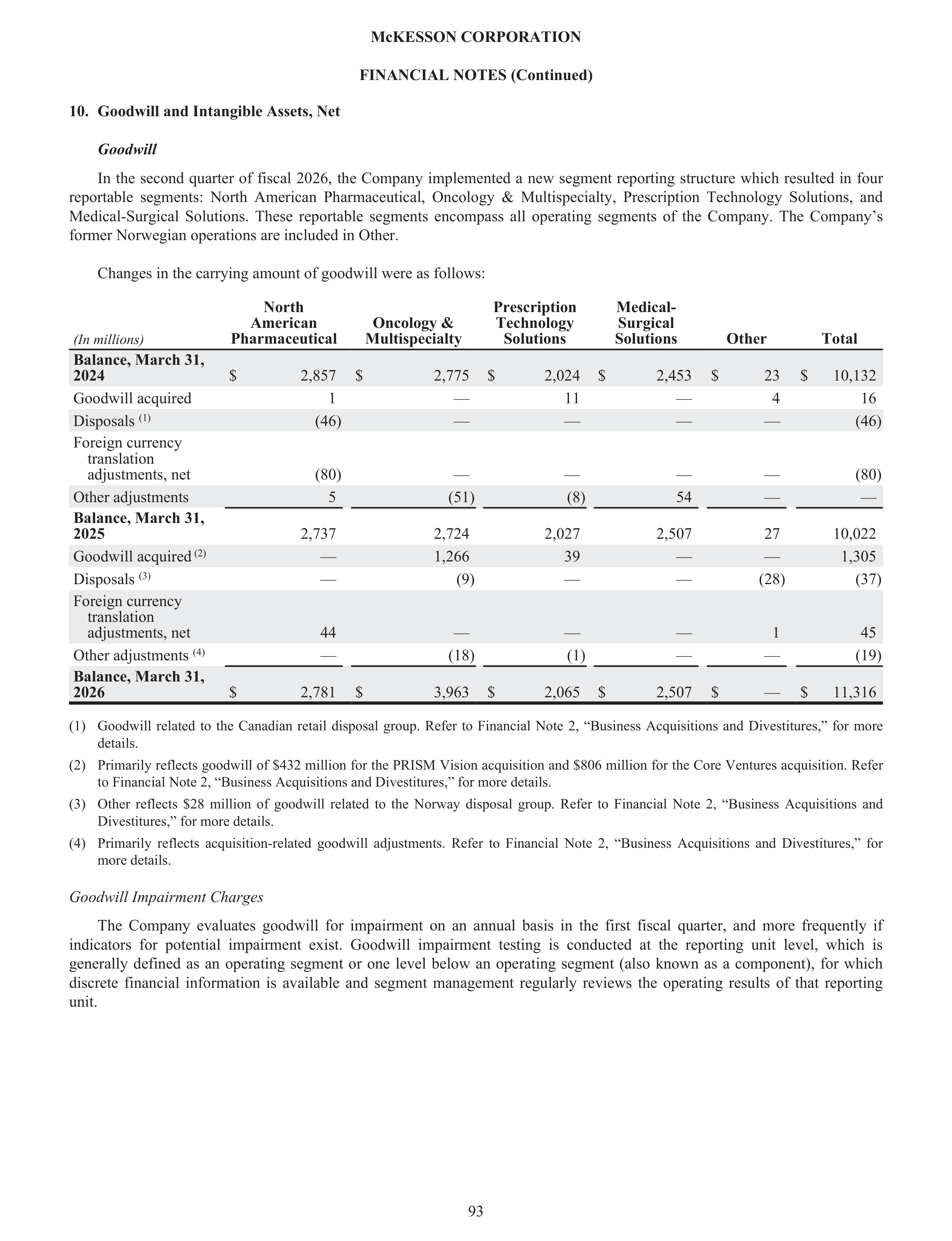
10.
Goodwill and Intangible Assets, Net
Goodwill
In
the
second
quarter
of
fiscal
2026,
the
Company
implemented
a
new
segment
reporting
structur
t
e
which
resulted
in
four
reportabl
a
e
segments:
North
American
Pharmaceutical,
Oncology
&
Multispecialty,
Prescription
Technology
Solutions,
and
Medical-Surgical
Solutions.
These
reportabl
a
e
segments
encompass
all
operating
segments
of
the
Company.
The
Company’s
former Norwegian operations are included in Other.
Changes in the carrying amount of goodwill were as follows:
(In millions)s
North
American
Pharmaceutical
Oncology &
Multispecialty
Prescription
Technology
Solutions
Medical-
Surgical
Solutions
Other
Total
Balance, March 31,
2024
$
2,857
$
2,775
$
2,024
$
2,453
$
23
$
10,132
Goodwill acquired
1
—
11
—
4
16
Disposals
(1)
(46)
—
—
—
—
(46)
Foreign currency
translation
adju
d
stments, net
(80)
—
—
—
—
(80)
Other adju
d
stments
5
(51)
(8)
54
—
—
Balance, March 31,
2025
2,737
2,724
2,027
2,507
27
10,022
Goodwill acquired
(2)
—
1,266
39
—
—
1,305
Disposals
(3)
—
(9)
—
—
(28)
(37)
Foreign currency
translation
adju
d
stments, net
44
—
—
—
1
45
Other adju
d
stments
(4)
—
(18)
(1)
—
—
(19)
Balance, March 31,
2026
$
2,781
$
3,963
$
2,065
$
2,507
$
—
$
11,316
(1)
Goodwill
related
to
the
Canadian
retail
disposal
group.
u
Refer
to
Financial
Note
2,
“Business
Acquisitions
and
Divestitures,”
for
more
details.
(2)
Primarily reflects goodwill of $432 million for the PRISM Vision acquisition and $806 million for the Core Ventur
t
es acquisition. Refer
to Financial Note 2, “Business Acquisitions and Divestitures,” for more details.
(3)
Other
reflects
$28
million
of
goodwill
related
to
the
Norway
disposal
group.
u
Refer
to
Financial
Note
2,
“Business
Acquisitions
and
Divestitures,” for more details.
(4)
Primarily
reflects
acquisition-related
goodwill
adju
d
stments.
Refer
to
Financial
Note
2,
“Business
Acquisitions
and
Divestitures,”
for
more details.
Goodwill Impai
m
rment Charge
r
s
The
Company
evaluates
goodwill
for
impairment
on
an
annual
basis
in
the
first
fiscal
quarter,
and
more
frequently
if
indicators
for
potential
impairment
exist.
Goodwill
impairment
testing
is
conducted
at
the
reporting
unit
level,
which
is
generally
defined
as
an
operating
segment
or
one
level
below
an
operating
segment
(also
known
as
a
component),
for
which
discrete
financial
infor
f
mation
is
availabl
a
e
and
segment
management
regularly
reviews
the
operating
results
of
that
reporting
unit.
McKESSON CORPORAT
R
ION
FINANCIAL NOTES (Continued)
93
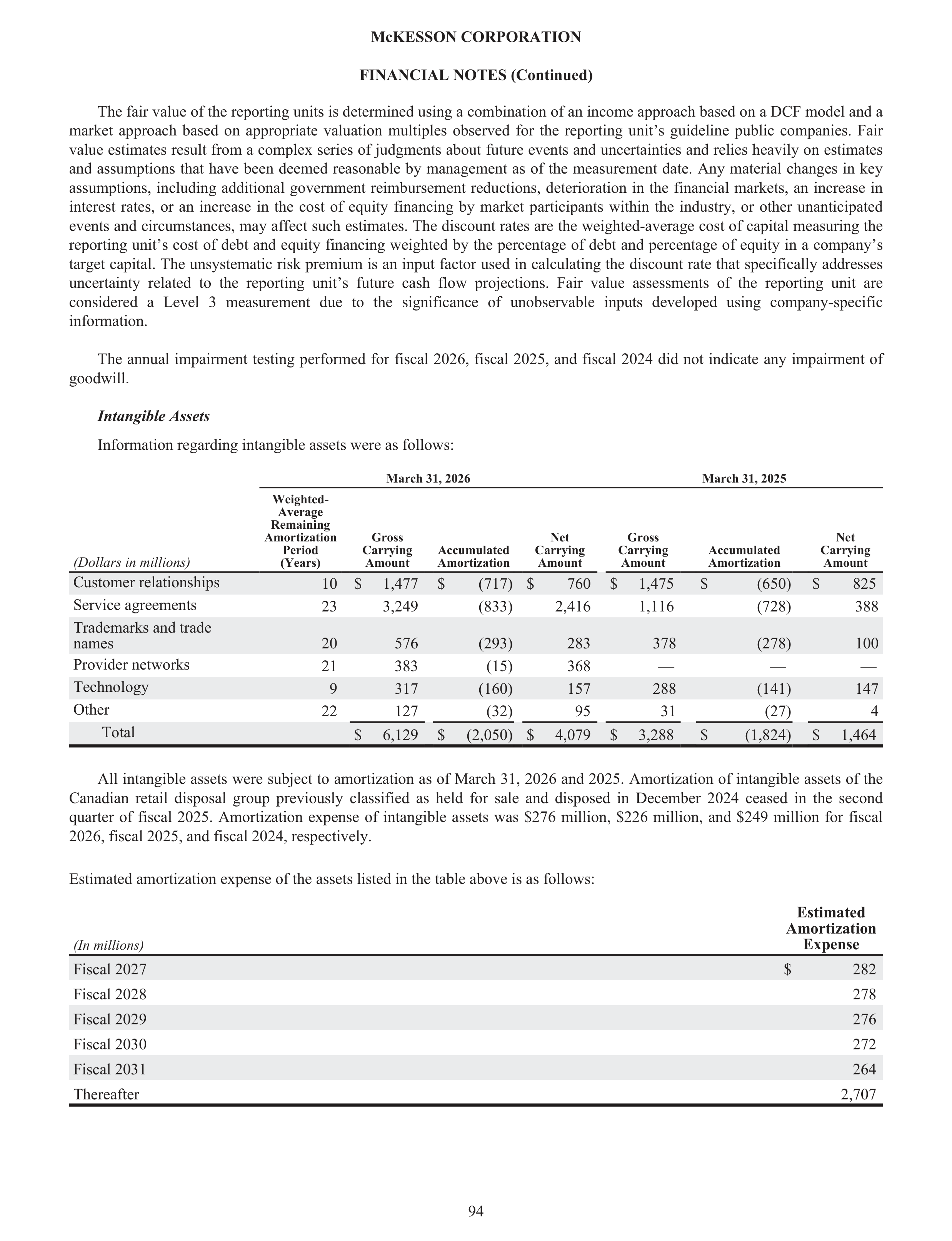
The fair value of the reporting units is determined using a combination of an income approach based on a DCF model and a
market
approach
based
on
appropriate
valuation
multiples
observed
for
the
reporting
unit’s
guideline
public
companies.
Fair
value estimates result from a complex series of judgments about future events and uncertainties and relies heavily on estimates
and
assumptions
that
have
been
deemed
reasonabl
a
e
by
management
as
of
the
measurement
date.
Any
material
changes
in
key
assumptions,
including
additional
government
reimbursement
reductions,
deterioration
in
the
financial
markets,
an
increase
in
interest
rates,
or
an
increase
in
the
cost
of
equity
financing
by
market
participants
within
the
industry,
r
or
other
unanticipated
events and circumstances, may affe
f
ct such estimates. The discount rates are the weighted-average cost of capital measuring the
reporting
unit’s
cost
of
debt
and
equity
financing
weighted
by
the
percentage
of
debt and
percentage of
equity
in
a
company’s
target capital. The unsystematic risk premium is an input factor used in calculating the discount rate that specifically addresses
uncertainty
related
to
the
reporting
unit’s
future
cash
flow
projections.
Fair
value
assessments
of
the
reporting
unit
are
considered
a
Level
3
measurement
due
to
the
significance
of
unobservabl
a
e
inputs
developed
using
company-specific
f
information.
The
annual
impairment
testing
performed
for
fiscal
2026,
fiscal
2025,
and
fiscal
2024
did
not
indicate
any
impairment
of
goodwill.
Intangible Assets
Information regarding intangible assets were as follows:
March 31, 2026
March 31, 2025
(Dollars in millions)s
Weighted-
Average
Remaining
Amortization
Period
(Years)
Gross
Carrying
Amount
Accumulated
Amortization
Net
Carrying
Amount
Gross
Carrying
Amount
Accumulated
Amortization
Net
Carrying
Amount
Customer relationships
10
$
1,477
$
(717)
$
760
$
1,475
$
(650)
$
825
Service agreements
23
3,249
(833)
2,416
1,116
(728)
388
Trademarks and trade
names
20
576
(293)
283
378
(278)
100
Provider networks
21
383
(15)
368
—
—
—
Technology
9
317
(160)
157
288
(141)
147
Other
22
127
(32)
95
31
(27)
4
Total
$
6,129
$
(2,050)
$
4,079
$
3,288
$
(1,824)
$
1,464
All intangible assets were subj
u
ect to amortization as of March 31, 2026 and 2025. Amortization of intangible assets of the
Canadian
retail
disposal
group
previously
classified
as
held
for
sale
and
disposed
in
December
2024
ceased
in
the
second
quarter
of
fiscal
2025.
Amortization
expense
of
intangible
assets
was
$276
million,
$226
million,
and
$249
million
for
fiscal
2026, fiscal 2025, and fiscal 2024, respectively.
Estimated amortization expense of the assets listed in the tabl
a
e above is as follows:
(In millions)s
Estimated
Amortization
Expense
Fiscal 2027
$
282
Fiscal 2028
278
Fiscal 2029
276
Fiscal 2030
272
Fiscal 2031
264
Thereafte
f
r
2,707
McKESSON CORPORAT
R
ION
FINANCIAL NOTES (Continued)
94
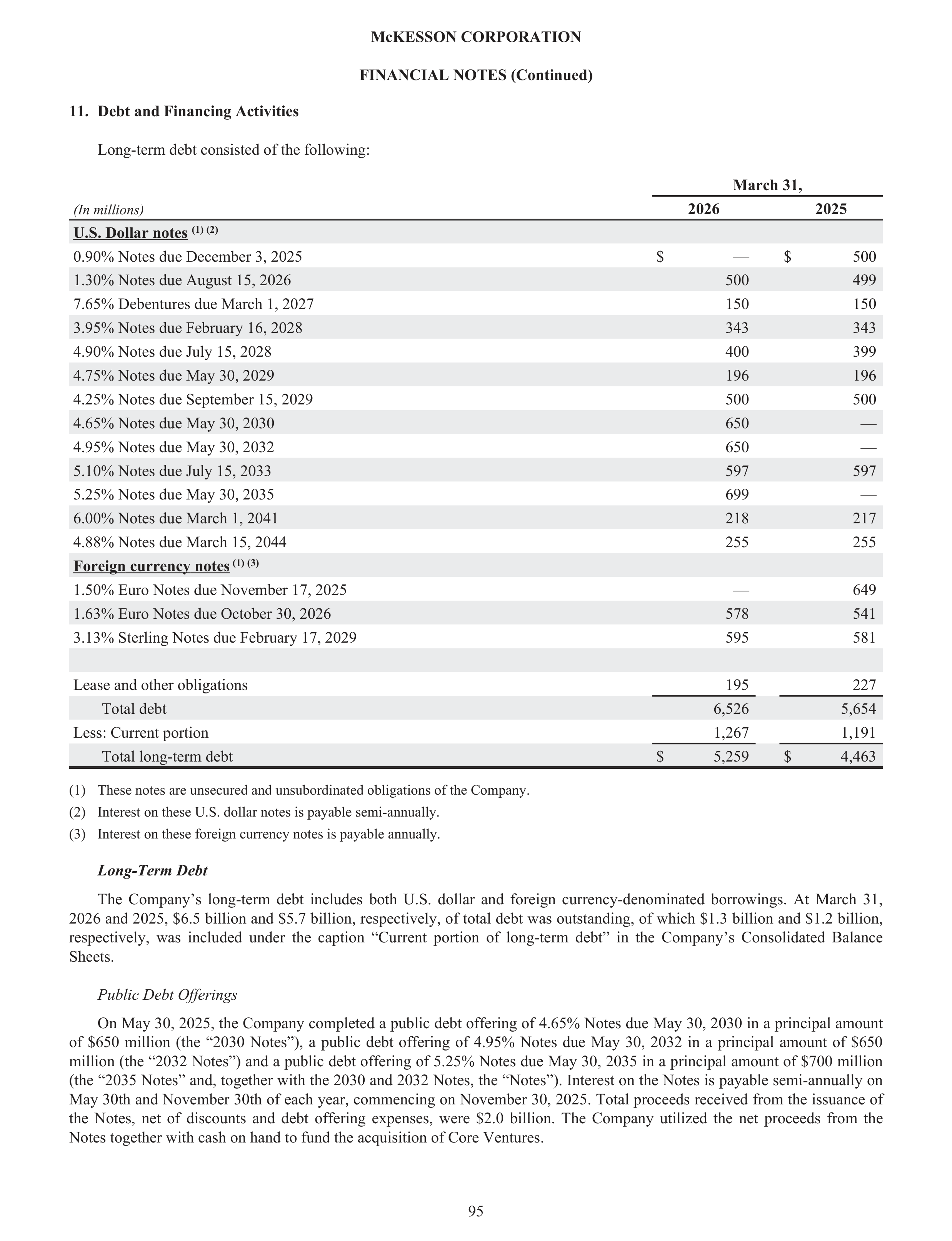
11.
Debt and Financing Activities
Long-term debt consisted of the following:
March 31,
(In millions)s
2026
2025
U.S. Dollar notes
(1) (2)
0.90% Notes due December 3, 2025
$
—
$
500
1.30% Notes due August 15, 2026
500
499
7.65% Debentur
t
es due March 1, 2027
150
150
3.95% Notes due Februa
r
ry 16, 2028
343
343
4.90% Notes due July 15, 2028
400
399
4.75% Notes due May 30, 2029
196
196
4.25% Notes due September 15, 2029
500
500
4.65% Notes due May 30, 2030
650
—
4.95% Notes due May 30, 2032
650
—
5.10% Notes due July 15, 2033
597
597
5.25% Notes due May 30, 2035
699
—
6.00% Notes due March 1, 2041
218
217
4.88% Notes due March 15, 2044
255
255
Foreign currency notes
g
y
(1) (3)
1.50% Euro Notes due November 17, 2025
—
649
1.63% Euro Notes due October 30, 2026
578
541
3.13% Sterling Notes due Februa
r
ry 17, 2029
595
581
Lease and other obligations
195
227
Total debt
6,526
5,654
Less: Current portion
1,267
1,191
Total long-term debt
$
5,259
$
4,463
(1)
These notes are unsecured and unsubordinated obligations of the Company.
(2)
Interest on these U.S. dollar notes is payabl
a
e semi-annually.
(3)
Interest on these foreign currency notes is payabl
a
e annually.
Long-T
g
er
T
m
r
Debt
The
Company’s
long-term
debt
includes
both
U.S.
dollar
and
foreign
currency-denominated
borrowings.
At
March
31,
2026 and 2025, $6.5 billion and $5.7 billion, respectively, of total debt was outstanding, of which $1.3 billion and $1.2 billion,
respectively,
was
included
under
the
caption
“Current
portion
of
long-term
debt”
in
the
Company’s
Consolidated
Balance
Sheets.
Public Debt Offe
f
rings
On May 30, 2025, the Company completed a public debt offe
f
ring of 4.65% Notes due May 30, 2030 in a principal amount
of
$650
million
(the
“2030
Notes”),
a
public
debt
offe
f
ring
of
4.95%
Notes
due
May
30,
2032
in
a
principal
amount
of
$650
million (the “2032 Notes”) and a public debt offe
f
ring of 5.25% Notes due May 30, 2035 in a principal amount of $700 million
(the “2035 Notes” and, together with the 2030 and 2032 Notes, the “Notes”). Interest on the Notes is payabl
a
e semi-annually on
May 30th and November 30th of each year, commencing on November 30, 2025. Total proceeds received from the issuance of
the
Notes,
net
of
discounts
and
debt
offe
f
ring
expenses,
were
$2.0
billion.
The
Company
utilized
the
net
proceeds
from
the
Notes together with cash on hand to fund the acquisition of Core Ventur
t
es.
McKESSON CORPORAT
R
ION
FINANCIAL NOTES (Continued)
95
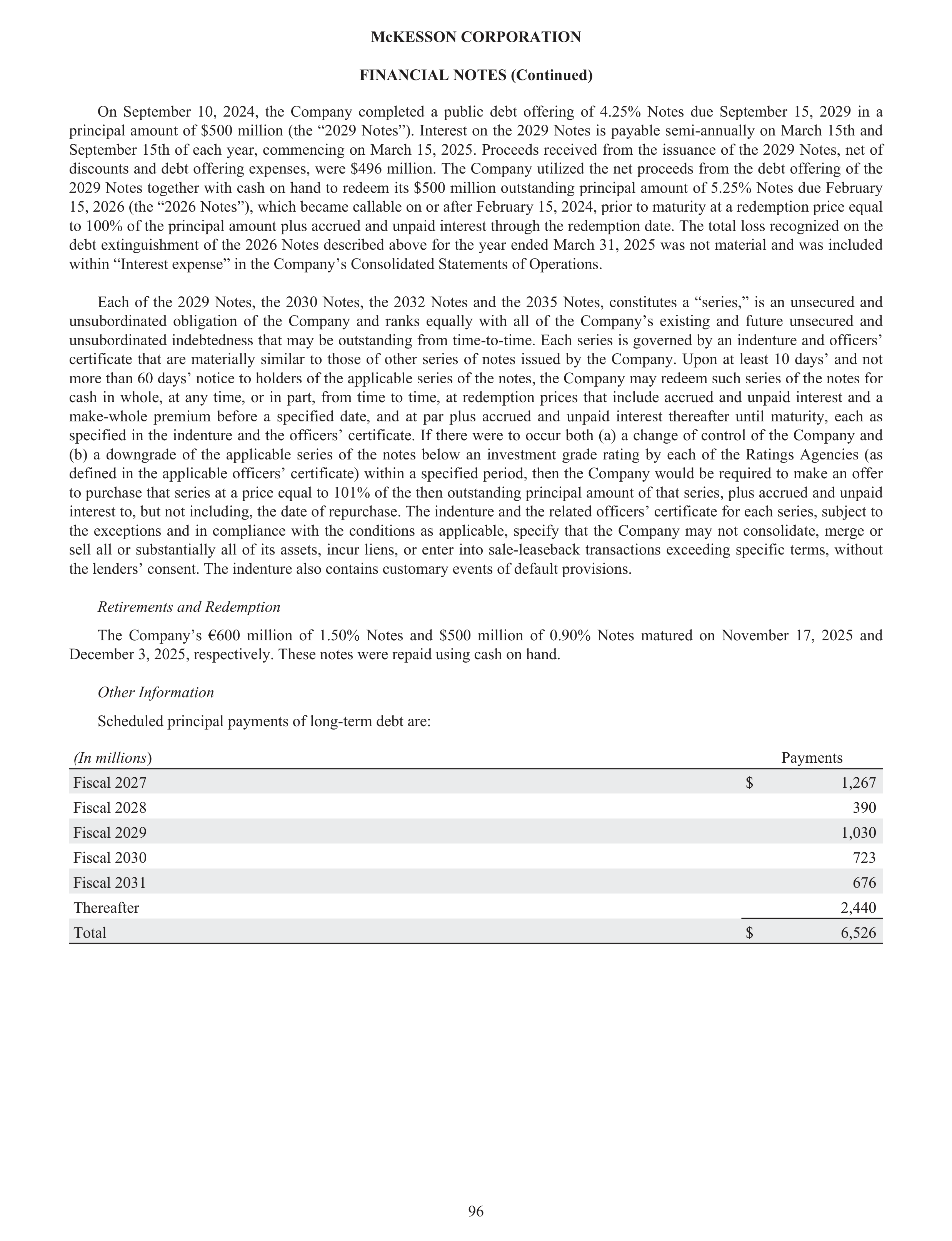
On
September
10,
2024,
the
Company
completed
a
public
debt
offe
f
ring
of
4.25%
Notes
due
September
15,
2029
in
a
principal
amount
of
$500
million
(the
“2029
Notes”).
Interest
on
the
2029
Notes
is
payabl
a
e
semi-annually
on
March
15th
and
September
15th
of
each
year,
commencing
on
March
15,
2025.
Proceeds
received
from
the
issuance
of
the
2029
Notes,
net
of
discounts and debt offe
f
ring expenses, were $496 million. The Company utilized the net proceeds from the debt offe
f
ring of the
2029 Notes together with cash on hand to redeem its $500 million outstanding principal amount of 5.25% Notes due Februa
r
ry
15, 2026 (the “2026 Notes”), which became callabl
a
e on or afte
f
r Februa
r
ry 15, 2024, prior to maturity at a redemption price equal
to 100% of the principal amount plus accrued and unpaid interest through the redemption date. The total loss recognized on the
debt extinguishment of the 2026 Notes described above for the year ended March 31, 2025 was not material and was included
within “Interest expense” in the Company’s Consolidated Statements of Operations.
Each
of
the
2029
Notes,
the
2030
Notes,
the
2032
Notes
and
the
2035
Notes,
constitutes
a
“series,”
is
an
unsecured
and
unsubordinated
obligation
of
the
Company
and
ranks
equally
with
all
of
the
Company’s
existing
and
future
unsecured
and
unsubordinated indebtedness that may be outstanding from time-to-time. Each series is governed by an indentur
t
e and offi
f
cers’
certific
f
ate
that
are
materially
similar
to
those
of
other
series
of
notes
issued
by
the
Company.
Upon
at
least
10
days’
and
not
more than 60 days’ notice to holders of the applicable series of the notes, the Company may redeem such series of the notes for
cash
in
whole,
at
any
time,
or
in
part,
from
time
to
time,
at
redemption
prices
that
include
accrue
r
d
and
unpaid
interest
and
a
make-whole
premium
before
a
specified
date,
and
at
par
plus
accrue
r
d
and
unpaid
interest
thereafte
f
r
until
maturity,
each
as
specified
in
the
indentur
t
e
and
the
offi
f
cers’
certific
f
ate.
If
there
were
to
occur
both
(a)
a
change
of
control
of
the
Company
and
(b)
a
downgrade
of
the
applicable
series
of
the
notes
below
an
investment
grade
rating
by
each
of
the
Ratings
Agencies
(as
defined in the applicable offi
f
cers’ certific
f
ate) within a specified period, then the Company would be required to make an offe
f
r
to purchase that series at a price equal to 101% of the then outstanding principal amount of that series, plus accrued and unpaid
interest to, but not including, the date of repurchase. The indentur
t
e and the related offi
f
cers’ certific
f
ate for each series, subj
u
ect to
the
exceptions
and
in
compliance
with
the
conditions
as
applicable,
specify
that
the
Company
may
not
consolidate,
merge
or
sell
all
or
subs
u
tantially
all
of
its
assets,
incur
liens,
or
enter
into
sale-leaseback
transactions
exceeding
specific
terms,
without
the lenders’ consent. The indentur
t
e also contains customary
r
events of default provisions.
Retirements and Redemption
The
Company’s
€600
million
of
1.50%
Notes
and
$500
million
of
0.90%
Notes
matured
on
November
17,
2025
and
December 3, 2025, respectively. These notes were repaid using cash on hand.
Othe
t
r Info
n
rmation
Scheduled principal payments of long-term debt are:
(In millions
)
Payments
Fiscal 2027
$
1,267
Fiscal 2028
390
Fiscal 2029
1,030
Fiscal 2030
723
Fiscal 2031
676
Thereafte
f
r
2,440
Total
$
6,526
McKESSON CORPORAT
R
ION
FINANCIAL NOTES (Continued)
96
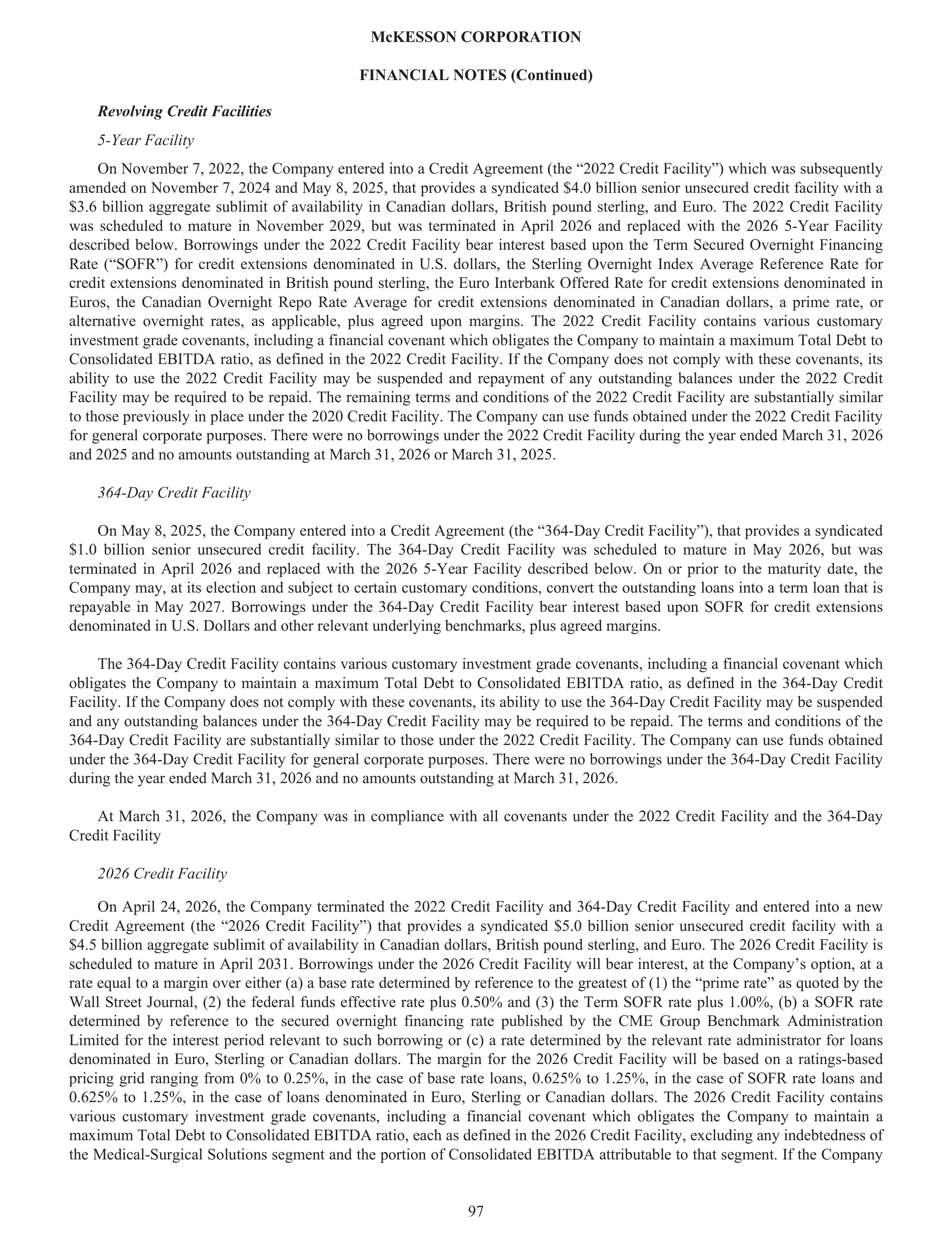
Revolving Credit
d
Facili
i
ti
i
es
5-Year Facility
On November 7, 2022, the Company entered into a Credit Agreement (the “2022 Credit Facility”) which was subs
u
equently
amended on November 7, 2024 and May 8, 2025, that provides a syndicated $4.0 billion senior unsecured credit facility with a
$3.6
billion
aggregate
subl
u
imit
of
availabi
a
lity
in
Canadian
dollars,
British
pound
sterling,
and
Euro.
The
2022
Credit
Facility
was
scheduled
to
matur
t
e
in
November
2029,
but
was
terminated
in
April
2026
and
replaced
with
the
2026
5-Year
Facility
described
below.
Borrowings
under
the
2022
Credit
Facility
bear
interest
based
upon
the
Term
Secured
Overnight
Financing
Rate
(“SOFR”)
for
credit
extensions
denominated
in
U.S.
dollars,
the
Sterling
Overnight
Index
Average
Reference
Rate
for
credit
extensions
denominated
in
British
pound
sterling,
the
Euro
Interbank
Offe
f
red
Rate
for
credit
extensions
denominated
in
Euros,
the
Canadian
Overnight
Repo
Rate
Average
for
credit
extensions
denominated
in
Canadian
dollars,
a
prime
rate,
or
alternative
overnight
rates,
as
applicable,
plus
agreed
upon
margins.
The
2022
Credit
Facility
contains
various
customary
r
investment grade covenants, including a financial covenant which obligates the Company to maintain a maximum Total Debt to
Consolidated
EBITDA
ratio,
as
defined
in
the
2022
Credit
Facility.
If
the
Company
does
not
comply
with
these
covenants,
its
ability
to
use
the
2022
Credit
Facility
may
be
suspended
and
repayment
of
any
outstanding
balances
under
the
2022
Credit
Facility
may
be required
to
be
repaid.
The
remaining
terms
and
conditions
of
the
2022
Credit Facility
are
subs
u
tantially
similar
to those previously in place under the 2020 Credit Facility. The Company can use funds obtained under the 2022 Credit Facility
for general corporate purpos
r
es. There were no borrowings under the 2022 Credit Facility during the year ended March 31, 2026
and 2025 and no amounts outstanding at March 31, 2026 or March 31, 2025.
364-Day
a
Credit Facility
On May 8, 2025, the Company entered into a Credit Agreement (the “364-Day Credit Facility”), that provides a syndicated
$1.0
billion
senior
unsecured
credit
facility.
The
364-Day
Credit
Facility
was
scheduled
to
mature
in
May
2026,
but
was
terminated
in
April
2026
and
replaced
with
the
2026
5-Year
Facility
described
below.
On
or
prior
to
the
maturity
date,
the
Company may, at its election and subj
u
ect to certain customary
r
conditions, convert the outstanding loans into a term loan that is
repayabl
a
e
in
May
2027.
Borrowings
under
the
364-Day
Credit
Facility
bear
interest
based
upon
SOFR
for
credit
extensions
denominated in U.S. Dollars and other relevant underlying benchmarks, plus agreed margins.
The 364-Day Credit Facility contains various customary
r
investment grade covenants, including a financial covenant which
obligates
the
Company
to
maintain
a
maximum
Total
Debt
to
Consolidated
EBITDA
ratio,
as
defined
in
the
364-Day
Credit
Facility. If the Company does not comply with these covenants, its ability to use the 364-Day Credit Facility may be suspended
and any outstanding balances under the 364-Day Credit Facility may be required to be repaid. The terms and conditions of the
364-Day Credit Facility are subs
u
tantially similar to those under the 2022 Credit Facility. The Company can use funds obtained
under the 364-Day Credit Facility for general corporate purpos
r
es. There were no borrowings under the 364-Day Credit Facility
during the year ended March 31, 2026 and no amounts outstanding at March 31, 2026.
At
March
31,
2026,
the
Company
was
in
compliance
with
all
covenants
under
the
2022
Credit
Facility
and
the
364-Day
Credit Facility
2026 Credit Facilityt
On
April
24,
2026,
the
Company
terminated
the
2022
Credit
Facility
and
364-Day
Credit
Facility
and
entered
into
a
new
Credit
Agreement
(the
“2026
Credit
Facility”)
that
provides
a
syndicated
$5.0
billion
senior
unsecured
credit
facility
with
a
$4.5 billion aggregate subl
u
imit of availabi
a
lity in Canadian dollars, British pound sterling, and Euro. The 2026 Credit Facility is
scheduled to mature in April 2031. Borrowings under the 2026 Credit Facility will bear interest, at the Company’s option, at a
rate equal to a margin over either (a) a base rate determined by reference to the greatest of (1) the “prime rate” as quoted by the
Wall
Street
Journal,
(2)
the
federal
funds
effe
f
ctive
rate
plus
0.50%
and
(3)
the
Term
SOFR
rate
plus
1.00%,
(b)
a
SOFR
rate
determined
by
reference
to
the
secured
overnight
financing
rate
published
by
the
CME
Group
Benchmark
Administration
Limited
for
the
interest
period
relevant
to
such
borrowing
or
(c)
a
rate
determined
by
the
relevant
rate
administrator
for
loans
denominated
in
Euro,
Sterling
or
Canadian
dollars.
The
margin
for
the
2026
Credit
Facility
will
be
based
on
a
ratings-based
pricing
grid
ranging
from
0%
to
0.25%,
in
the
case
of
base
rate
loans,
0.625%
to
1.25%,
in
the
case
of
SOFR
rate
loans
and
0.625%
to
1.25%,
in
the
case
of
loans
denominated
in
Euro,
Sterling
or
Canadian
dollars.
The
2026
Credit
Facility
contains
various
customary
r
investment
grade
covenants,
including
a
financial
covenant
which
obligates
the
Company
to
maintain
a
maximum Total Debt to Consolidated EBITDA ratio, each as defined in the 2026 Credit Facility, excluding any indebtedness of
the Medical-Surgical Solutions segment and the portion of Consolidated EBITDA attributable to that segment. If the Company
McKESSON CORPORAT
R
ION
FINANCIAL NOTES (Continued)
97
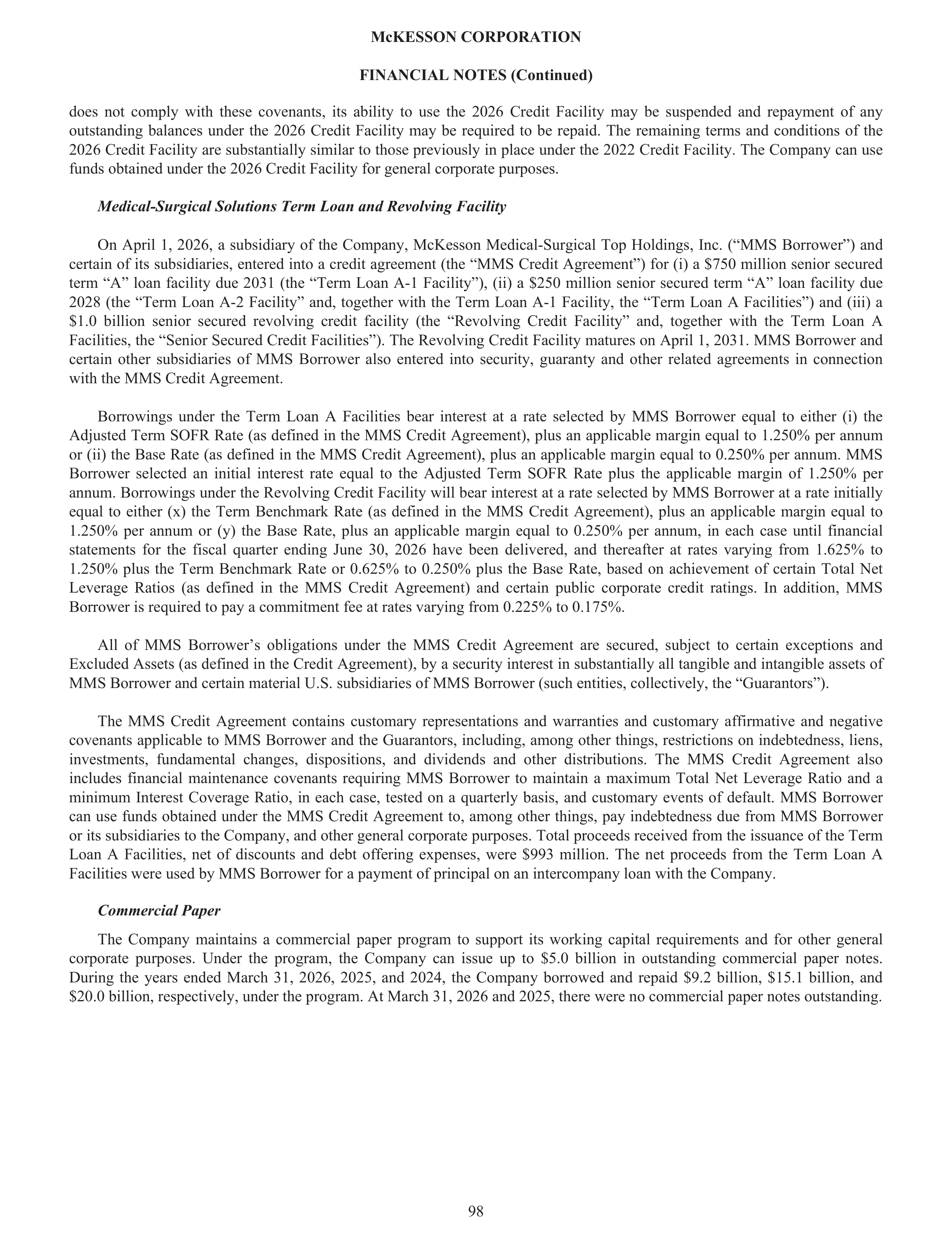
does
not
comply
with
these
covenants,
its
ability
to
use
the
2026
Credit
Facility
may
be
suspended
and
repayment
of
any
outstanding
balances
under
the
2026
Credit
Facility
may
be
required
to
be
repaid.
The
remaining
terms
and
conditions
of
the
2026 Credit Facility are subs
u
tantially similar to those previously in place under the 2022 Credit Facility. The Company can use
funds obtained under the 2026 Credit Facility for general corporate purpos
r
es.
Medical-Sur
-
gi
r
cal Solutions Term Loan and Revolving Facilit
i
yt
On
April
1,
2026,
a
subs
u
idiary
of
the
Company,
McKesson
Medical-Surgical
Top
Holdings,
Inc.
(“MMS
Borrower”)
and
certain of its subs
u
idiaries, entered into a credit agreement (the “MMS Credit Agreement”) for (i) a $750 million senior secured
term
“A”
loan
facility
due
2031
(the
“Term
Loan
A-1
Facility”),
(ii)
a
$250
million
senior
secured
term
“A”
loan
facility
due
2028
(the
“Term
Loan
A-2
Facility”
and,
together
with
the
Term
Loan
A-1
Facility,
the
“Term
Loan
A
Facilities”)
and
(iii)
a
$1.0
billion
senior
secured
revolving
credit
facility
(the
“Revolving
Credit
Facility”
and,
together
with
the
Term
Loan
A
Facilities, the “Senior Secured Credit Facilities”). The Revolving Credit Facility matures on April 1, 2031. MMS Borrower and
certain
other
subs
u
idiaries
of
MMS
Borrower
also
entered
into
security,
guaranty
and
other
related
agreements
in
connection
with the MMS Credit Agreement.
Borrowings
under
the
Term
Loan
A
Facilities
bear
interest
at
a
rate
selected
by
MMS
Borrower
equal
to
either
(i)
the
Adju
d
sted Term SOFR Rate (as defined in the MMS Credit Agreement), plus an applicable margin equal to 1.250% per annum
or (ii) the Base Rate (as defined in the MMS Credit Agreement), plus an applicable margin equal to 0.250% per annum. MMS
Borrower
selected
an
initial
interest
rate
equal
to
the
Adju
d
sted
Term
SOFR
Rate
plus
the
applicable
margin
of
1.250%
per
annum. Borrowings under the Revolving Credit Facility will bear interest at a rate selected by MMS Borrower at a rate initially
equal
to
either
(x)
the
Term
Benchmark
Rate
(as
defined
in
the
MMS
Credit
Agreement),
plus
an
applicable
margin
equal
to
1.250%
per
annum
or
(y)
the
Base
Rate,
plus
an
applicable
margin
equal
to
0.250%
per
annum,
in
each
case
until
financial
statements
for
the
fiscal
quarter
ending
June
30,
2026
have
been
delivered,
and
thereafte
f
r
at
rates
varying
from
1.625%
to
1.250%
plus
the
Term
Benchmark
Rate
or
0.625%
to
0.250%
plus
the
Base
Rate,
based
on
achievement
of
certain
Total
Net
Leverage
Ratios
(as
defined
in
the
MMS
Credit
Agreement)
and
certain
public
corporate
credit
ratings.
In
addition,
MMS
Borrower is required to pay a commitment fee at rates varying from 0.225% to 0.175%.
All
of
MMS
Borrower’s
obligations
under
the
MMS
Credit
Agreement
are
secured,
subj
u
ect
to
certain
exceptions
and
Excluded Assets (as defined in the Credit Agreement), by a security interest in subs
u
tantially all tangible and intangible assets of
MMS Borrower and certain material U.S. subs
u
idiaries of MMS Borrower (such entities, collectively, the “Guarantors”).
The
MMS
Credit
Agreement
contains
customary
r
representations
and
warranties
and
customary
r
affi
f
rmative
and
negative
covenants applicable to MMS Borrower and the Guarantors, including, among other things, restrictions on indebtedness, liens,
investments,
fundamental
changes,
dispositions,
and
dividends
and
other
distributions.
The
MMS
Credit
Agreement
also
includes
financial
maintenance
covenants
requiring
MMS
Borrower
to
maintain
a
maximum
Total
Net
Leverage
Ratio
and
a
minimum
Interest
Coverage
Ratio,
in
each
case,
tested
on
a
quarterly
basis,
and
customary
r
events
of
default.
MMS
Borrower
can
use
funds
obtained
under
the
MMS
Credit
Agreement
to,
among
other
things,
pay
indebtedness
due
from
MMS
Borrower
or its subs
u
idiaries to the Company, and other general corporate purposes. Total proceeds received from the issuance of the Term
Loan
A
Facilities,
net
of
discounts
and
debt
offe
f
ring
expenses,
were
$993
million.
The
net
proceeds
from
the
Term
Loan
A
Facilities were used by MMS Borrower for a payment of principal on an intercompany loan with the Company.
Commercial Pape
a
r
The
Company
maintains
a
commercial
pape
a
r
program
to
suppor
u
t
its
working
capital
requirements
and
for
other
general
corporate
purpos
r
es.
Under
the
program,
the
Company
can
issue
up
to
$5.0
billion
in
outstanding
commercial
pape
a
r
notes.
During
the
years
ended
March
31,
2026,
2025,
and
2024,
the
Company
borrowed
and
repaid
$9.2
billion,
$15.1
billion,
and
$20.0 billion, respectively, under the program. At March 31, 2026 and 2025, there were no commercial pape
a
r notes outstanding.
McKESSON CORPORAT
R
ION
FINANCIAL NOTES (Continued)
98
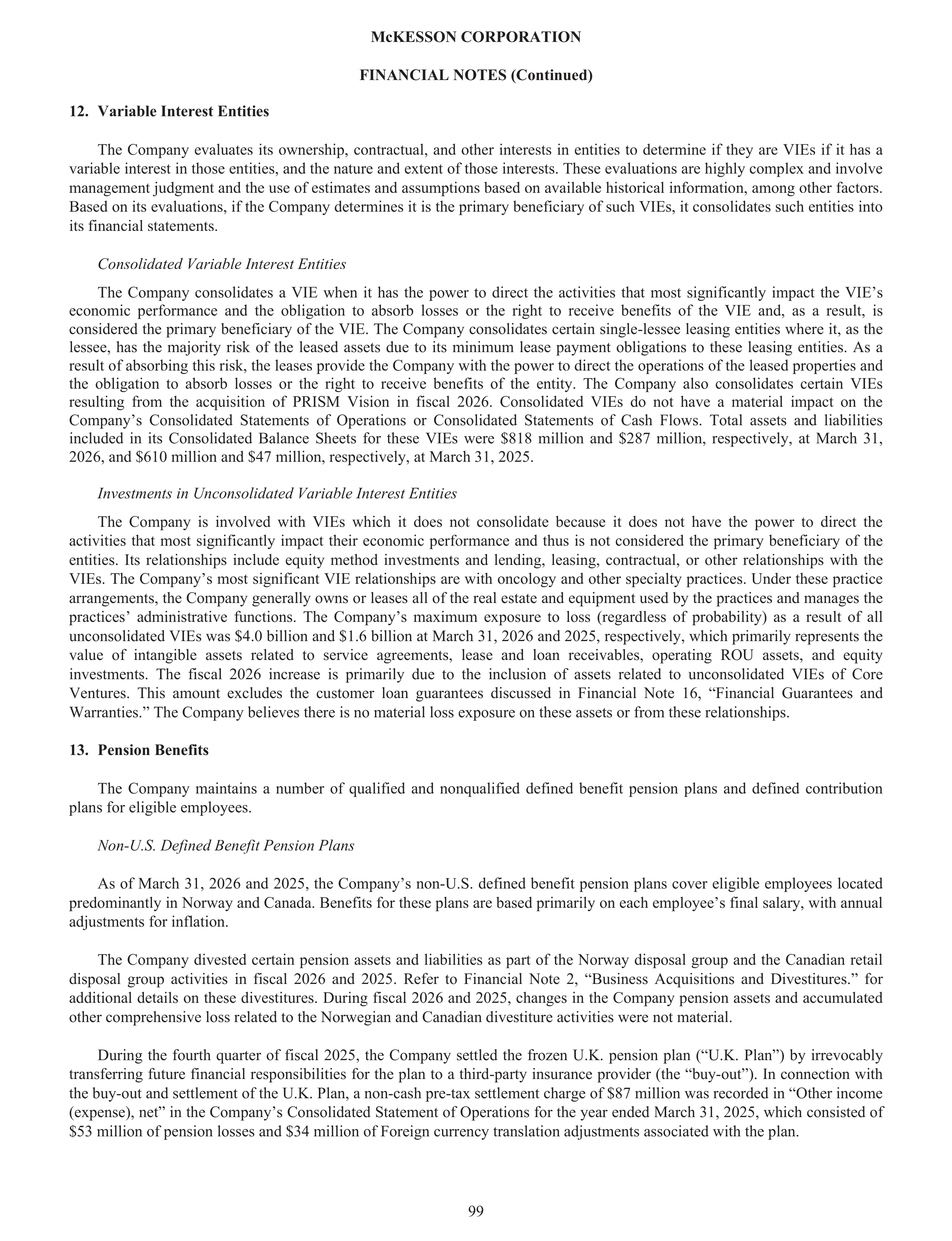
12.
Variable Interest Entities
The
Company
evaluates
its
ownership,
contractua
t
l,
and
other
interests
in
entities
to
determine
if
they
are
VIEs
if
it
has
a
variable interest in those entities, and the nature and extent of those interests. These evaluations are highly complex and involve
management judgment and the use of estimates and assumptions based on availabl
a
e historical information, among other factors.
Based on its evaluations, if the Company determines it is the primary
r
beneficiary
r
of such VIEs, it consolidates such entities into
its financial statements.
Consolidat
d
ed Variable Interest Entities
The
Company
consolidates
a
VIE
when
it
has
the
power
to
direct
the
activities
that
most
significantly
impact
the
VIE’s
economic
performance
and
the
obligation
to
absorb
losses
or
the
right
to
receive
benefits
of
the
VIE
and,
as
a
result,
is
considered the primary
r
beneficiary
r
of the VIE. The Company consolidates certain single-lessee leasing entities where it, as the
lessee,
has
the
majo
a
rity
risk
of
the
leased
assets
due
to
its
minimum
lease
payment
obligations
to
these
leasing
entities.
As
a
result of absorbing this risk, the leases provide the Company with the power to direct the operations of the leased properties and
the
obligation
to
absorb
losses
or
the
right
to
receive
benefits
of
the
entity.
The
Company
also
consolidates
certain
VIEs
resulting
from
the
acquisition
of
PRISM
Vision
in
fiscal
2026.
Consolidated
VIEs
do
not
have
a
material
impact
on
the
Company’s
Consolidated
Statements
of
Operations
or
Consolidated
Statements
of
Cash
Flows.
Total
assets
and
liabilities
included
in
its
Consolidated
Balance
Sheets
for
these
VIEs
were
$818
million
and
$287
million,
respectively,
at
March
31,
2026, and $610 million and $47 million, respectively, at March 31, 2025.
Investments in Unconsolidat
d
ed Variable Interest Entities
The
Company
is
involved
with
VIEs
which
it
does
not
consolidate
because
it
does
not
have
the
power
to
direct
the
activities
that
most
significantly
impact
their
economic
perfor
f
mance
and
thus
is
not
considered
the
primary
beneficiary
r
of
the
entities.
Its
relationships
include
equity
method
investments
and
lending,
leasing,
contractua
t
l,
or
other
relationships
with
the
VIEs. The Company’s most significant VIE relationships are with oncology and other specialty practices. Under these practice
arrangements, the Company generally owns or leases all of the real estate and equipment used by the practices and manages the
practices’
administrative
functions.
The
Company’s
maximum
exposure
to
loss
(regardless
of
probabi
a
lity)
as
a
result
of
all
unconsolidated VIEs was $4.0 billion and $1.6 billion at March 31, 2026 and 2025, respectively, which primarily represents the
value
of
intangible
assets
related
to
service
agreements,
lease
and
loan
receivabl
a
es,
operating
ROU
assets,
and
equity
investments.
The
fiscal
2026
increase
is
primarily
due
to
the
inclusion
of
assets
related
to
unconsolidated
VIEs
of
Core
Ventur
t
es.
This
amount
excludes
the
customer
loan
guarantees
discussed
in
Financial
Note
16,
“Financial
Guarantees
and
Warranties.” The Company believes there is no material loss exposure on these assets or from these relationships.
13.
Pension Benefits
The
Company
maintains
a
number
of
qualifie
f
d
and
nonqualified
defined
benefit
pension
plans
and
defined
contribution
plans for eligible employees.
Non-U.S. Defi
e
ned Benefit
e
Pension Plans
As
of
March
31,
2026
and
2025,
the
Company’s
non-U.S.
defined
benefit
pension
plans
cover
eligible
employees
located
predominantly in Norway and Canada. Benefits for these plans are based primarily on each employee’s final salary, with annual
adju
d
stments for inflation.
The
Company
divested
certain
pension
assets
and
liabi
a
lities
as
part
of
the
Norway
disposal
group
and
the
Canadian
retail
disposal
group
activities
in
fiscal
2026
and
2025.
Refer
to
Financial
Note
2,
“Business
Acquisitions
and
Divestitures.”
for
additional details on these divestitures. During fiscal 2026 and 2025, changes in the Company pension assets and accumulated
other comprehensive loss related to the Norwegian and Canadian divestiture activities were not material.
During
the
fourth
quarter
of
fiscal
2025,
the
Company
settled
the
frozen
U.K.
pension
plan
(“U.K.
Plan”)
by
irrevocably
transfer
f
ring future financial responsibilities for the plan to a third-party insurance provider (the “buy-out”). In connection with
the buy-out and settlement of the U.K. Plan, a non-cash pre-tax settlement charge of $87 million was recorded in “Other income
(expense), net” in the Company’s Consolidated Statement of Operations for the year ended March 31, 2025, which consisted of
$53 million of pension losses and $34 million of Foreign currency translation adju
d
stments associated with the plan.
McKESSON CORPORAT
R
ION
FINANCIAL NOTES (Continued)
99
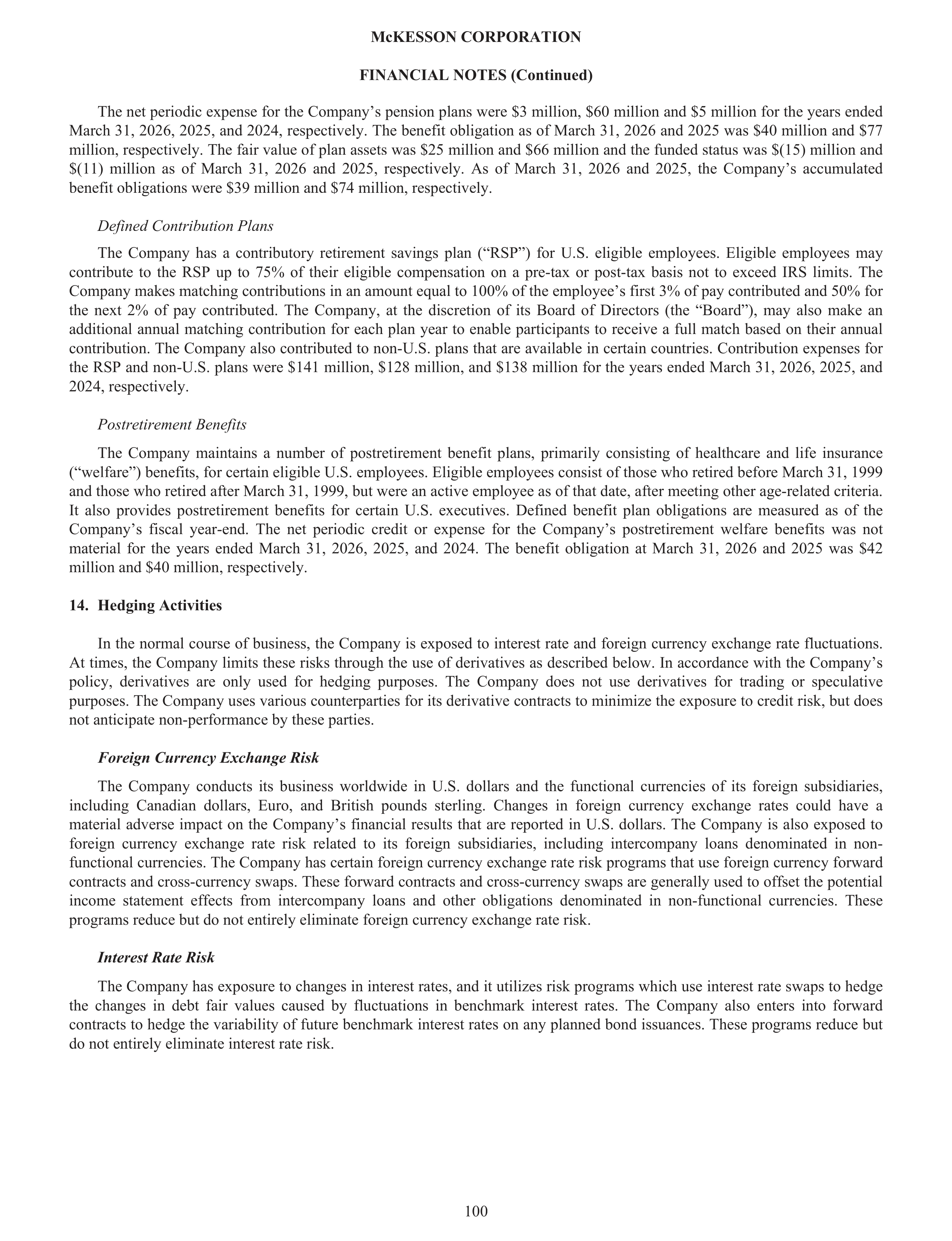
The net periodic expense for the Company’s pension plans were $3 million, $60 million and $5 million for the years ended
March 31, 2026, 2025, and 2024, respectively. The benefit obligation as of March 31, 2026 and 2025 was $40 million and $77
million, respectively. The fair value of plan assets was $25 million and $66 million and the funded status
t
was $(15) million and
$(11)
million
as
of
March
31,
2026
and
2025,
respectively.
As
of
March
31,
2026
and
2025,
the
Company’s
accumulated
benefit obligations were $39 million and $74 million, respectively.
Defin
e
ed Contri
t
bution Plans
The
Company
has
a
contributory
r
retirement
savings
plan
(“RSP”)
for
U.S.
eligible
employees.
Eligible
employees
may
contribute
to
the
RSP
up
to
75%
of
their
eligible
compensation
on
a
pre-tax
or
post-tax
basis
not
to
exceed
IRS
limits.
The
Company makes matching contributions in an amount equal to 100% of the employee’s first 3% of pay contributed and 50% for
the
next
2%
of
pay
contributed.
The
Company,
at
the
discretion
of
its
Board
of
Directors
(the
“Board”),
may
also
make
an
additional
annual
matching
contribution
for
each
plan
year
to
enable
participants
to
receive
a
full
match
based
on
their
annual
contribution. The Company also contributed to non-U.S. plans that are availabl
a
e in certain countries. Contribution expenses for
the RSP and non-U.S. plans were $141 million, $128 million, and $138 million for the years ended March 31, 2026, 2025, and
2024, respectively.
Postre
t
tirement Benefit
e
st
The
Company
maintains
a
number
of
postretirement
benefit
plans,
primarily
consisting
of
healthcare
and
life
insurance
(“welfar
f
e”) benefits, for certain eligible U.S. employees. Eligible employees consist of those who retired before March 31, 1999
and those who retired afte
f
r March 31, 1999, but were an active employee as of that date, afte
f
r meeting other age-related criteria.
It
also
provides
postretirement
benefits
for
certain
U.S.
executives.
Defined
benefit
plan
obligations
are
measured
as
of
the
Company’s
fiscal
year-end.
The
net
periodic
credit
or
expense
for
the
Company’s
postretirement
welfar
f
e
benefits
was
not
material
for
the
years
ended
March
31,
2026,
2025,
and
2024.
The
benefit
obligation
at
March
31,
2026
and
2025
was
$42
million and $40 million, respectively.
14.
Hedging Activities
In the normal course of business, the Company is exposed to interest rate and foreign currency exchange rate fluctuations.
At times, the Company limits these risks through the use of derivatives as described below. In accordance with the Company’s
policy,
derivatives
are
only
used
for
hedging
purpos
r
es.
The
Company
does
not
use
derivatives
for
trading
or
speculative
purpos
r
es. The Company uses various counterpa
r
rties for its derivative contracts to minimize the exposure to credit risk, but does
not anticipate non-performance by these parties.
Foreign
g
Currency
c
Exchange Risk
i
The
Company
conducts
its
business
worldwide
in
U.S.
dollars
and
the
functional
currencies
of
its
foreign
subs
u
idiaries,
including
Canadian
dollars,
Euro,
and
British
pounds
sterling.
Changes
in
foreign
currency
exchange
rates
could
have
a
material
adverse
impact
on
the
Company’s
financial
results
that
are
reported
in
U.S.
dollars.
The
Company
is
also
exposed
to
foreign
currency
exchange
rate
risk
related
to
its
foreign
subs
u
idiaries,
including
intercompany
loans
denominated
in
non-
functional currencies. The Company has certain foreign currency exchange rate risk programs that use foreign currency forward
contracts and cross-currency swaps. These forward contracts and cross-currency swaps are generally used to offs
f
et the potential
income
statement
effe
f
cts
from
intercompany
loans
and
other
obligations
denominated
in
non-functional
currencies.
These
programs reduce but do not entirely eliminate foreign currency exchange rate risk.
Interest Rate Risk
i
The Company has exposure to changes in interest rates, and it utilizes risk programs which use interest rate swaps to hedge
the
changes
in
debt
fair
values
caused
by
fluctuations
in
benchmark
interest
rates.
The
Company
also
enters
into
forward
contracts to hedge the variability of future benchmark interest rates on any planned bond issuances. These programs reduce but
do not entirely eliminate interest rate risk.
McKESSON CORPORAT
R
ION
FINANCIAL NOTES (Continued)
100
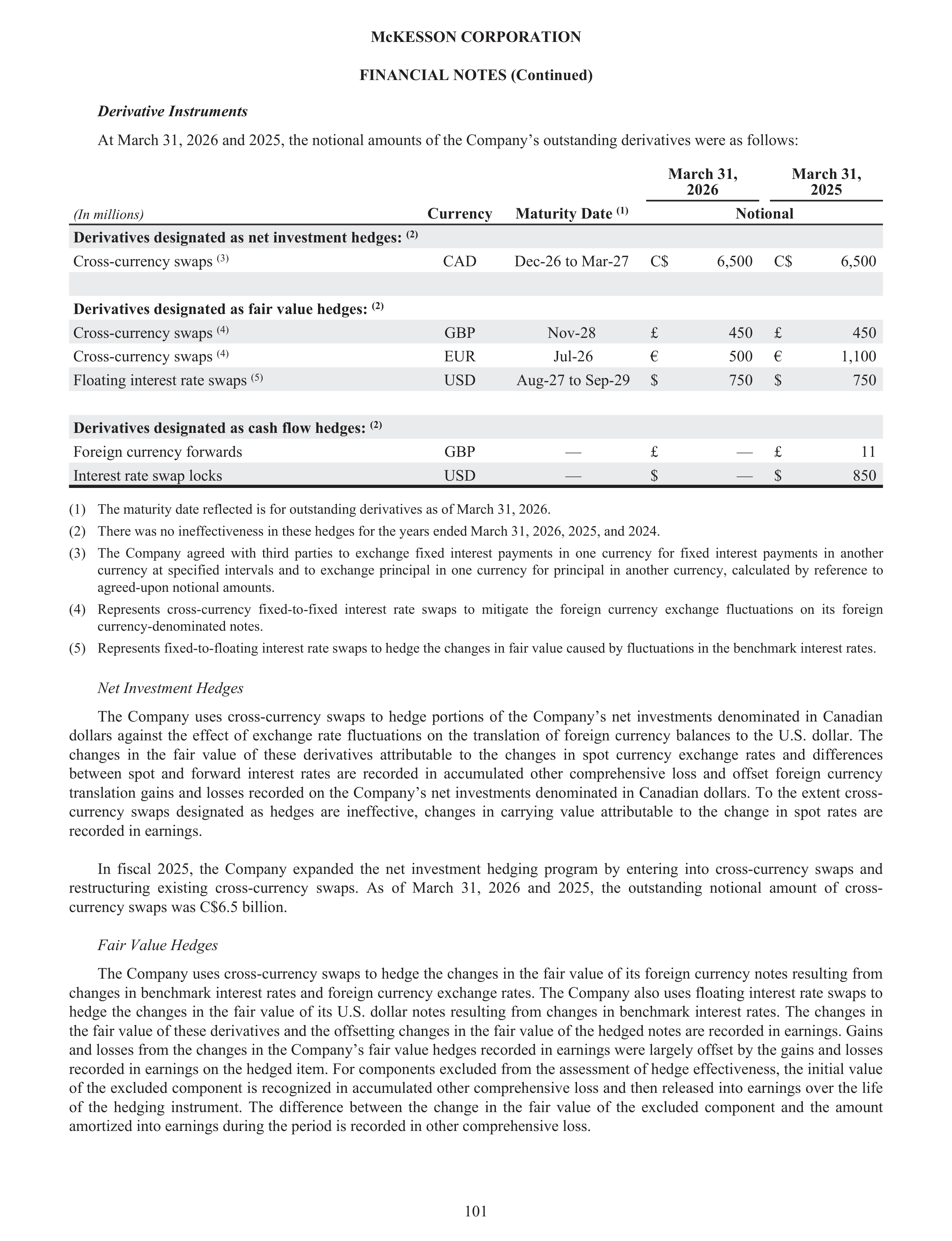
Derivative Instru
t
mentst
At March 31, 2026 and 2025, the notional amounts of the Company’s outstanding derivatives were as follows:
March 31,
2026
March 31,
2025
(In millions)s
Currency
Maturity Date
(1)
Notional
Derivatives designated as net investment hedges:
(2)
Cross-currency swaps
(3)
CAD
Dec-26 to Mar-27
C$
6,500
C$
6,500
Derivatives designated as fair value hedges:
(2)
Cross-currency swaps
(4)
GBP
Nov-28
£
450
£
450
Cross-currency swaps
(4)
EUR
Jul-26
€
500
€
1,100
Floating interest rate swaps
(5)
USD
Aug-27 to Sep-29
$
750
$
750
Derivatives designated as cash flow hedges:
(2)
Foreign currency forwards
GBP
—
£
—
£
11
Interest rate swap locks
USD
—
$
—
$
850
(1)
The maturity date reflected is for outstanding derivatives as of March 31, 2026.
(2)
There was no ineffe
f
ctiveness in these hedges for the years ended March 31, 2026, 2025, and 2024.
(3)
The
Company
agreed
with
third
parties
to
exchange
fixed
interest
payments
in
one
currency
for
fixed
interest
payments
in
another
currency
at
specifie
f
d
intervals
and
to
exchange
principal
in
one
currency
for
principal
in
another
currency,
calculated
by
reference
to
agreed-upon
u
notional amounts.
(4)
Represents
cross-currency
fixed-to-fixed
interest
rate
swaps
to
mitigate
the
foreign
currency
exchange
fluctuations
on
its
foreign
currency-denominated notes.
(5)
Represents fixed-to-floating interest rate swaps to hedge the changes in fair value caused by fluctuations in the benchmark interest rates.
Net Investment Hedges
The
Company
uses
cross-currency
swaps
to
hedge
portions
of
the
Company’s
net
investments
denominated
in
Canadian
dollars
against
the
effe
f
ct
of
exchange
rate
fluctuations
on
the
translation
of
foreign
currency
balances
to
the
U.S.
dollar.
The
changes
in
the
fair
value
of
these
derivatives
attributable
to
the
changes
in
spot
currency
exchange
rates
and
differences
between
spot
and
forward
interest
rates
are
recorded
in
accumulated
other
comprehensive
loss
and
offs
f
et
foreign
currency
translation gains and losses recorded on the Company’s net investments denominated in Canadian dollars. To the extent cross-
currency
swaps
designated
as
hedges
are
ineffe
f
ctive,
changes
in
carrying
value
attributable
to
the
change
in
spot
rates
are
recorded in earnings.
In
fiscal
2025,
the
Company
expanded
the
net
investment
hedging
program
by
entering
into
cross-currency
swaps
and
restructur
t
ing
existing
cross-currency
swaps.
As
of
March
31,
2026
and
2025,
the
outstanding
notional
amount
of
cross-
currency swaps was C$6.5 billion.
Fair Value Hedges
The Company uses cross-currency swaps to hedge the changes in the fair value of its foreign currency notes resulting from
changes in benchmark interest rates and foreign currency exchange rates. The Company also uses floating interest rate swaps to
hedge
the
changes
in
the
fair
value
of
its
U.S.
dollar
notes
resulting
from
changes
in
benchmark
interest
rates.
The
changes
in
the fair value of these derivatives and the offs
f
etting changes in the fair value of the hedged notes are recorded in earnings. Gains
and losses from the changes in the Company’s fair value hedges recorded in earnings were largely offs
f
et by the gains and losses
recorded in earnings on the hedged item. For components excluded from the assessment of hedge effe
f
ctiveness, the initial value
of the excluded component is recognized in accumulated other comprehensive loss and then released into earnings over the lifef
of
the
hedging
instrument.
The
difference
between
the
change
in
the
fair
value
of
the
excluded
component
and
the
amount
amortized into earnings during the period is recorded in other comprehensive loss.
McKESSON CORPORAT
R
ION
FINANCIAL NOTES (Continued)
101
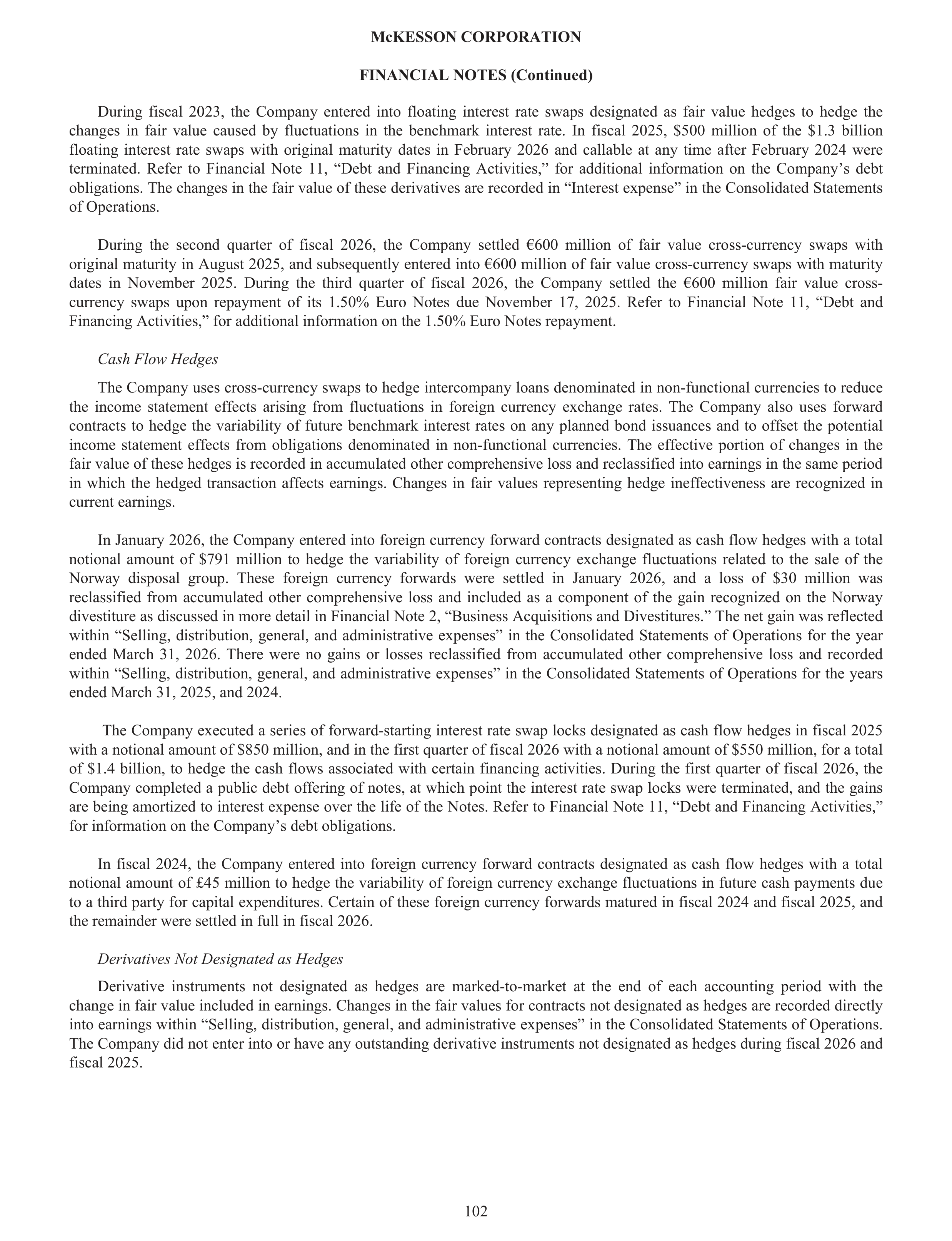
During
fiscal
2023,
the
Company
entered
into
floating
interest
rate
swaps
designated
as
fair
value
hedges
to
hedge
the
changes
in
fair
value
caused
by
fluctuations
in
the
benchmark
interest
rate.
In
fiscal
2025,
$500
million
of
the
$1.3
billion
floating
interest
rate
swaps
with
original
maturity
dates
in
Februa
r
ry
2026
and
callabl
a
e
at
any
time
afte
f
r
Februa
r
ry
2024
were
terminated.
Refer
to
Financial
Note
11,
“Debt
and
Financing
Activities,”
for
additional
information
on
the
Company’s
debt
obligations. The changes in the fair value of these derivatives are recorded in “Interest expense” in the Consolidated Statements
of Operations.
During
the
second
quarter
of
fiscal
2026,
the
Company
settled
€600
million
of
fair
value
cross-currency
swaps
with
original maturity in August 2025, and subs
u
equently entered into €600 million of fair value cross-currency swaps with maturity
dates
in
November
2025.
During
the
third
quarter
of
fiscal
2026,
the
Company
settled
the
€600
million
fair
value
cross-
currency
swaps
upon
repayment
of
its
1.50%
Euro
Notes
due
November
17,
2025.
Refer
to
Financial
Note
11,
“Debt
and
Financing Activities,” for additional information on the 1.50% Euro Notes repayment.
Cash Flow Hedges
The Company uses cross-currency swaps to hedge intercompany loans denominated in non-functional currencies to reduce
the
income
statement
effe
f
cts
arising
from
fluctuations
in
foreign
currency
exchange
rates.
The
Company
also
uses
forward
contracts
to
hedge
the
variability
of
future
benchmark
interest
rates
on
any
planned
bond
issuances
and
to
offs
f
et
the
potential
income
statement
effe
f
cts
from
obligations
denominated
in
non-functional
currencies.
The
effe
f
ctive
portion
of
changes
in
the
fair value of these hedges is recorded in accumulated other comprehensive loss and reclassified into earnings in the same period
in
which
the
hedged
transaction
affe
f
cts
earnings.
Changes
in
fair
values
representing
hedge
ineffe
f
ctiveness
are
recognized
in
current earnings.
In January 2026, the Company entered into foreign currency forward contracts designated as cash flow hedges with a total
notional
amount
of
$791
million
to
hedge
the
variability
of
foreign
currency
exchange
fluctuations
related
to
the
sale
of
the
Norway
disposal
group.
These
foreign
currency
forwards
were
settled
in
January
2026,
and
a
loss
of
$30
million
was
reclassified
from
accumulated
other
comprehensive
loss
and
included
as
a
component
of
the
gain
recognized
on
the
Norway
divestiture as discussed in more detail in Financial Note 2, “Business Acquisitions and Divestitures.” The net gain was reflected
within
“Selling,
distribution,
general,
and
administrative
expenses”
in
the
Consolidated
Statements
of
Operations
for
the
year
ended
March
31,
2026.
There
were
no
gains
or
losses
reclassified
from
accumulated
other
comprehensive
loss
and
recorded
within
“Selling,
distribution,
general,
and
administrative
expenses”
in
the
Consolidated
Statements
of
Operations
for
the
years
ended March 31, 2025, and 2024.
The Company executed a series of forward-starting interest rate swap locks designated as cash flow hedges in fiscal 2025
with a notional amount of $850 million, and in the first quarter of fiscal 2026 with a notional amount of $550 million, for a total
of
$1.4
billion,
to
hedge
the
cash
flows
associated
with
certain
financing
activities.
During
the
first
quarter
of
fiscal
2026,
the
Company completed a public debt offe
f
ring of notes, at which point the interest rate swap locks were terminated, and the gains
are being amortized to interest expense over the life of the Notes. Refer to Financial Note 11, “Debt and Financing Activities,”
for information on the Company’s debt obligations.
In
fiscal
2024,
the
Company
entered
into
foreign
currency
forward
contracts
designated
as
cash
flow
hedges
with
a
total
notional amount of
£45
million to hedge the variability
of
foreign currency exchange fluctuations in future cash
payments due
to a third party for capital expenditures. Certain of these foreign currency forwards matured in fiscal 2024 and fiscal 2025, and
the remainder were settled in full in fiscal 2026.
Derivatives Not Designat
i
ed as Hedges
Derivative
instruments
not
designated
as
hedges
are
marked-to-market
at
the
end
of
each
accounting
period
with
the
change in fair value included in earnings. Changes in the fair values for contracts not designated as hedges are recorded directly
into earnings within “Selling, distribution, general, and administrative expenses” in the Consolidated Statements of Operations.
The Company did not enter into or have any outstanding derivative instruments not designated as hedges during fiscal 2026 and
fiscal 2025.
McKESSON CORPORAT
R
ION
FINANCIAL NOTES (Continued)
102
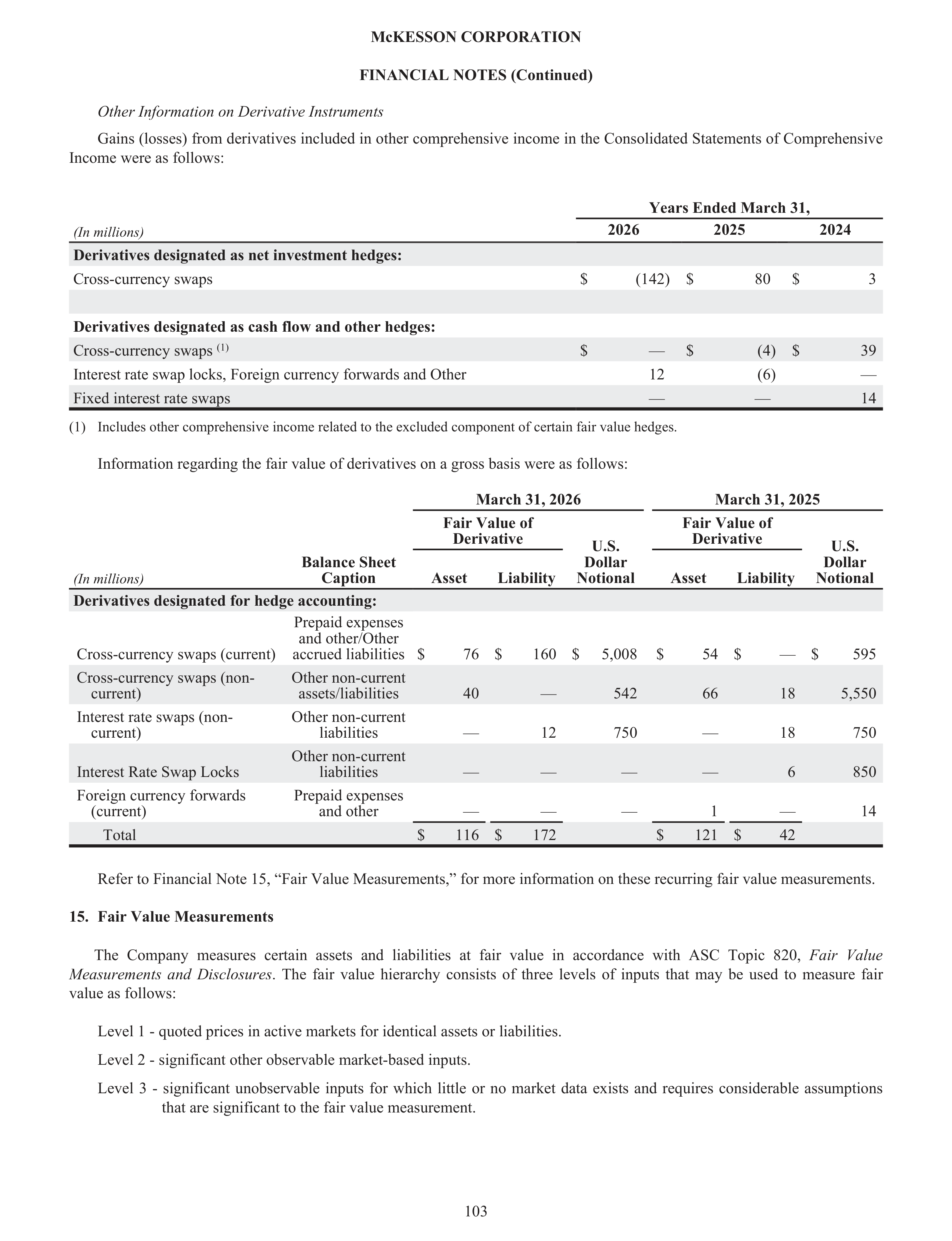
Othe
t
r Info
n
rmation on Derivative Instru
t
mentst
Gains (losses) from derivatives included in other comprehensive income in the Consolidated Statements of Comprehensive
Income were as follows:
Years Ended March 31,
(In millions)s
2026
2025
2024
Derivatives designated as net investment hedges:
Cross-currency swaps
$
(142)
$
80
$
3
Derivatives designated as cash flow and other hedges:
Cross-currency swaps
(1)
$
—
$
(4)
$
39
Interest rate swap locks, Foreign currency forwards and Other
12
(6)
—
Fixed interest rate swaps
—
—
14
(1)
Includes other comprehensive income related to the excluded component of certain fair value hedges.
Information regarding the fair value of derivatives on a gross basis were as follows:
Balance Sheet
Caption
March 31, 2026
March 31, 2025
Fair Value of
Derivative
U.S.
Dollar
i
Fair Value of
Derivative
U.S.
Dollar
Notional
(In millions)s
Asset
Liability
A
Notional
sset
Liability
Derivatives designated for hedge accounting:
Cross-currency swaps (current)
Prepaid expenses
and other/Other
accrue
r
d liabilities
$
76
$
160
$
5,008
$
54
$
—
$
595
Cross-currency swaps (non-
current)
Other non-current
assets/liabi
a
lities
40
—
542
66
18
5,550
Interest rate swaps (non-
current)
Other non-current
liabilities
—
12
750
—
18
750
Interest Rate Swap Locks
Other non-current
liabilities
—
—
—
—
6
850
Foreign currency forwards
(current)
Prepaid expenses
and other
—
—
—
1
—
14
Total
$
116
$
172
$
121
$
42
Refer to Financial Note 15, “Fair Value Measurements,” for more information on these recurring fair value measurements.
15.
Fair Value Measurements
The
Company
measures
certain
assets
and
liabilities
at
fair
value
in
accordance
with
ASC
Topic
820,
Fair
Value
Measurements
and
Disc
i
losures
.
The
fair
value
hierarchy
consists
of
three
levels
of
inputs
that
may
be
used
to
measure
fair
value as follows:
Level 1 - quoted prices in active markets for identical assets or liabilities.
Level 2 - significant other observabl
a
e market-based inputs.
Level
3
-
significant
unobservabl
a
e
inputs
for
which
little
or
no
market
data
exists
and
requires
considerable
assumptions
that are significant to the fair value measurement.
McKESSON CORPORAT
R
ION
FINANCIAL NOTES (Continued)
103
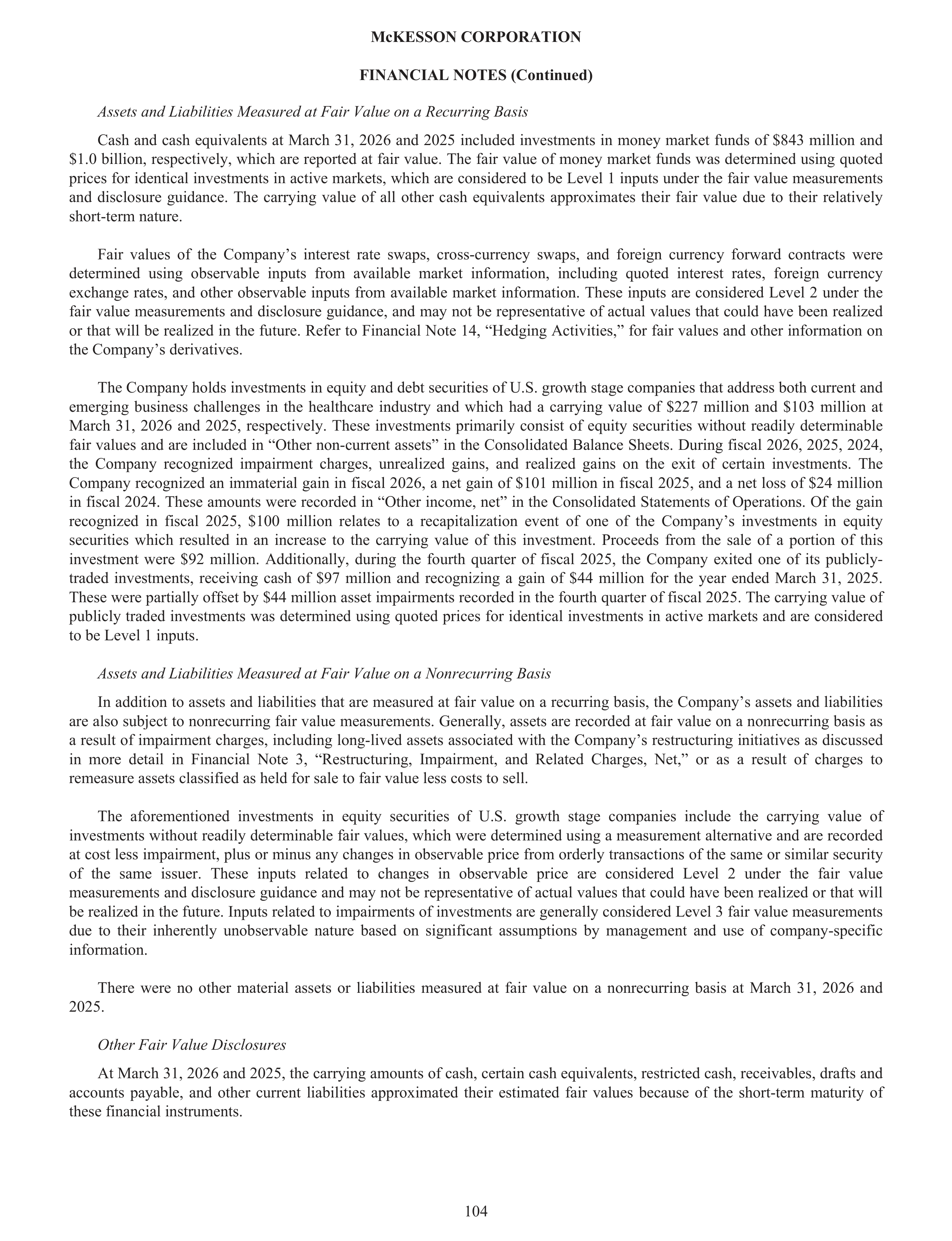
Assets and Liabilities Measured at Fair Value on a Recurring Basisi
Cash
and
cash
equivalents
at
March
31,
2026
and
2025
included
investments
in
money
market
funds
of
$843
million
and
$1.0 billion, respectively, which are reported at fair value. The fair value of money market funds was determined using quoted
prices for identical investments in active markets, which are considered to be Level 1 inputs under the fair value measurements
and
disclosure
guidance.
The
carrying
value
of
all
other
cash
equivalents
approximates
their
fair
value
due
to
their
relatively
short-term nature.
Fair
values
of
the
Company’s
interest
rate
swaps,
cross-currency
swaps,
and
foreign
currency
forward
contracts
were
determined
using
observabl
a
e
inputs
from
availabl
a
e
market
information,
including
quoted
interest
rates,
foreign
currency
exchange
rates,
and
other
observabl
a
e
inputs
from
availabl
a
e
market
information.
These
inputs
are
considered
Level
2
under
the
fair value measurements and disclosure guidance, and may not be representative of actua
t
l values that could have been realized
or that will be realized in the future. Refer to Financial Note 14, “Hedging Activities,” for fair values and other information on
the Company’s derivatives.
The Company holds investments in equity and debt securities of U.S. growth stage companies that address both current and
emerging
business
challenges
in
the
healthcare
industry
r
and
which
had
a
carrying
value
of
$227
million
and
$103
million
at
March
31,
2026
and
2025,
respectively.
These
investments
primarily
consist
of
equity
securities
without
readily
determinable
fair values and are included in “Other non-current assets” in the Consolidated Balance Sheets. During fiscal 2026, 2025, 2024,
the
Company
recognized
impairment
charges,
unrealized
gains,
and
realized
gains
on
the
exit
of
certain
investments.
The
Company recognized an immaterial gain in fiscal 2026, a net gain of $101 million in fiscal 2025, and a net loss of $24 million
in fiscal 2024. These amounts were recorded in “Other income, net” in the Consolidated Statements of Operations. Of the gain
recognized
in
fiscal
2025,
$100
million
relates
to
a
recapi
a
talization
event
of
one
of
the
Company’s
investments
in
equity
securities
which
resulted
in
an
increase
to
the
carrying
value
of
this
investment.
Proceeds
from
the
sale
of
a
portion
of
this
investment
were
$92
million.
Additionally,
during
the
fourth
quarter
of
fiscal
2025,
the
Company
exited
one
of
its
publicly-
traded
investments,
receiving
cash
of
$97
million
and
recognizing
a
gain
of
$44
million
for
the
year
ended
March
31,
2025.
These were partially offs
f
et by $44 million asset impairments recorded in the fourth quarter of fiscal 2025. The carrying value of
publicly traded investments was determined using quoted prices for identical investments in active markets and are considered
to be Level 1 inputs.
Assets and Liabilities Measured at Fair Value on a Nonrecurring Basisi
In addition to assets and liabilities that are measured at fair value on a recurring basis, the Company’s assets and liabi
a
lities
are also subj
u
ect to nonrecurring fair value measurements. Generally, assets are recorded at fair value on a nonrecurring basis as
a result of impairment charges, including long-lived assets associated with the Company’s restructur
t
ing initiatives as discussed
in
more
detail
in
Financial
Note
3,
“Restructuring,
Impairment,
and
Related
Charges,
Net,”
or
as
a
result
of
charges
to
remeasure assets classified as held for sale to fair value less costs to sell.
The
afor
f
ementioned
investments
in
equity
securities
of
U.S.
growth
stage
companies
include
the
carrying
value
of
investments without readily determinable fair values, which were determined using a measurement alternative and are recorded
at cost less impairment, plus or minus any changes in observabl
a
e price from orderly transactions of the same or similar security
of
the
same
issuer.
These
inputs
related
to
changes
in
observabl
a
e
price
are
considered
Level
2
under
the
fair
value
measurements and disclosure guidance and may not be representative of actua
t
l values that could have been realized or that will
be realized in the future. Inputs related to impairments of investments are generally considered Level 3 fair value measurements
due
to
their
inherently
unobservabl
a
e
nature
based
on
significant
assumptions
by
management
and
use
of
company-specific
f
information.
There
were
no
other
material
assets
or
liabilities
measured
at
fair
value
on
a
nonrecurring
basis
at
March
31,
2026
and
2025.
Othe
t
r Fair Value Disc
i
losures
At March 31, 2026 and 2025, the carrying amounts of cash, certain cash equivalents, restricted cash, receivabl
a
es, drafts
f
and
accounts
payabl
a
e,
and
other
current
liabi
a
lities
approximated
their
estimated
fair
values
because
of
the
short-term
maturity
of
these financial instruments.
McKESSON CORPORAT
R
ION
FINANCIAL NOTES (Continued)
104
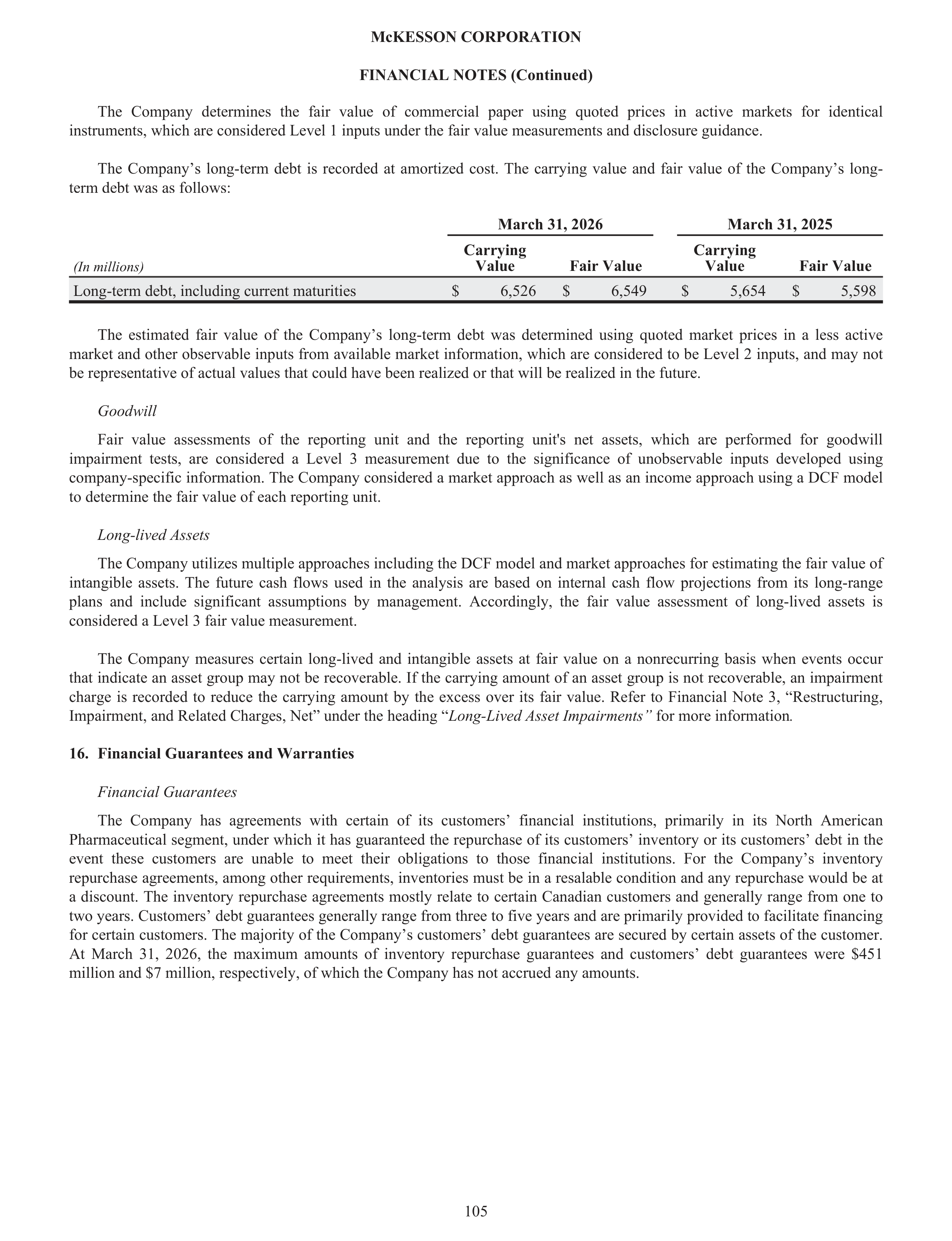
The
Company
determines
the
fair
value
of
commercial
pape
a
r
using
quoted
prices
in
active
markets
for
identical
instruments, which are considered Level 1 inputs under the fair value measurements and disclosure guidance.
The
Company’s
long-term
debt
is
recorded
at
amortized
cost.
The
carrying
value
and
fair
value
of
the
Company’s
long-
term debt was as follows:
March 31, 2026
March 31, 2025
(In millions)s
Carrying
Value
Fair Value
Carrying
Value
Fair Value
Long-term debt, including current maturities
$
6,526
$
6,549
$
5,654
$
5,598
The
estimated
fair
value
of
the
Company’s
long-term
debt
was
determined
using
quoted
market
prices
in
a
less
active
market and other observabl
a
e inputs from availabl
a
e market information, which are considered to be Level 2 inputs, and may not
be representative of actual values that could have been realized or that will be realized in the future.
Goodwill
Fair
value
assessments
of
the
reporting
unit
and
the
reporting
unit's
net
assets,
which
are
performed
for
goodwill
impairment
tests,
are
considered
a
Level
3
measurement
due
to
the
significance
of
unobservabl
a
e
inputs
developed
using
company-specific information. The Company considered a market approach as well as an income approach using a DCF model
to determine the fair value of each reporting unit.
Long-lived Assets
The Company utilizes multiple approaches including the DCF model and market approaches for estimating the fair value of
intangible
assets.
The
future
cash
flows
used
in
the
analysis
are
based
on
internal
cash
flow
projections
from
its
long-range
plans
and
include
significant
assumptions
by
management.
Accordingly,
the
fair
value
assessment
of
long-lived
assets
is
considered a Level 3 fair value measurement.
The
Company
measures
certain
long-lived
and
intangible
assets
at
fair
value
on
a
nonrecurring
basis
when
events
occur
that indicate an asset group may not be recoverabl
a
e. If the carrying amount of an asset group is not recoverabl
a
e, an impairment
charge
is
recorded
to
reduce
the
carrying
amount
by
the
excess
over
its
fair
value.
Refer
to
Financial
Note
3,
“Restructuring,
Impairment, and Related Charges, Net” under the heading “
Lo
“
ng-Lived Asset Impai
m
rments”
for more information
.
16.
Financial Guarantees and Warranties
Financial Guarantees
The
Company
has
agreements
with
certain
of
its
customers’
financial
institutions,
primarily
in
its
North
American
Pharmaceutical segment, under which it has guaranteed the repurchase of its customers’ inventory
r
or its customers’ debt in the
event
these
customers
are
unabl
a
e
to
meet
their
obligations
to
those
financial
institutions.
For
the
Company’s
inventory
r
repurchase agreements, among other requirements, inventories must be in a resalabl
a
e condition and any repurchase would be at
a
discount.
The
inventory
r
repurchase
agreements
mostly
relate
to
certain
Canadian
customers
and
generally
range
from
one
to
two years. Customers’ debt guarantees generally range from three to five years and are primarily provided to facilitate financing
for certain customers. The majo
a
rity of the Company’s customers’ debt guarantees are secured by certain assets of the customer.
At
March
31,
2026,
the
maximum
amounts
of
inventory
r
repurchase
guarantees
and
customers’
debt
guarantees
were
$451
million and $7 million, respectively, of which the Company has not accrue
r
d any amounts.
McKESSON CORPORAT
R
ION
FINANCIAL NOTES (Continued)
105
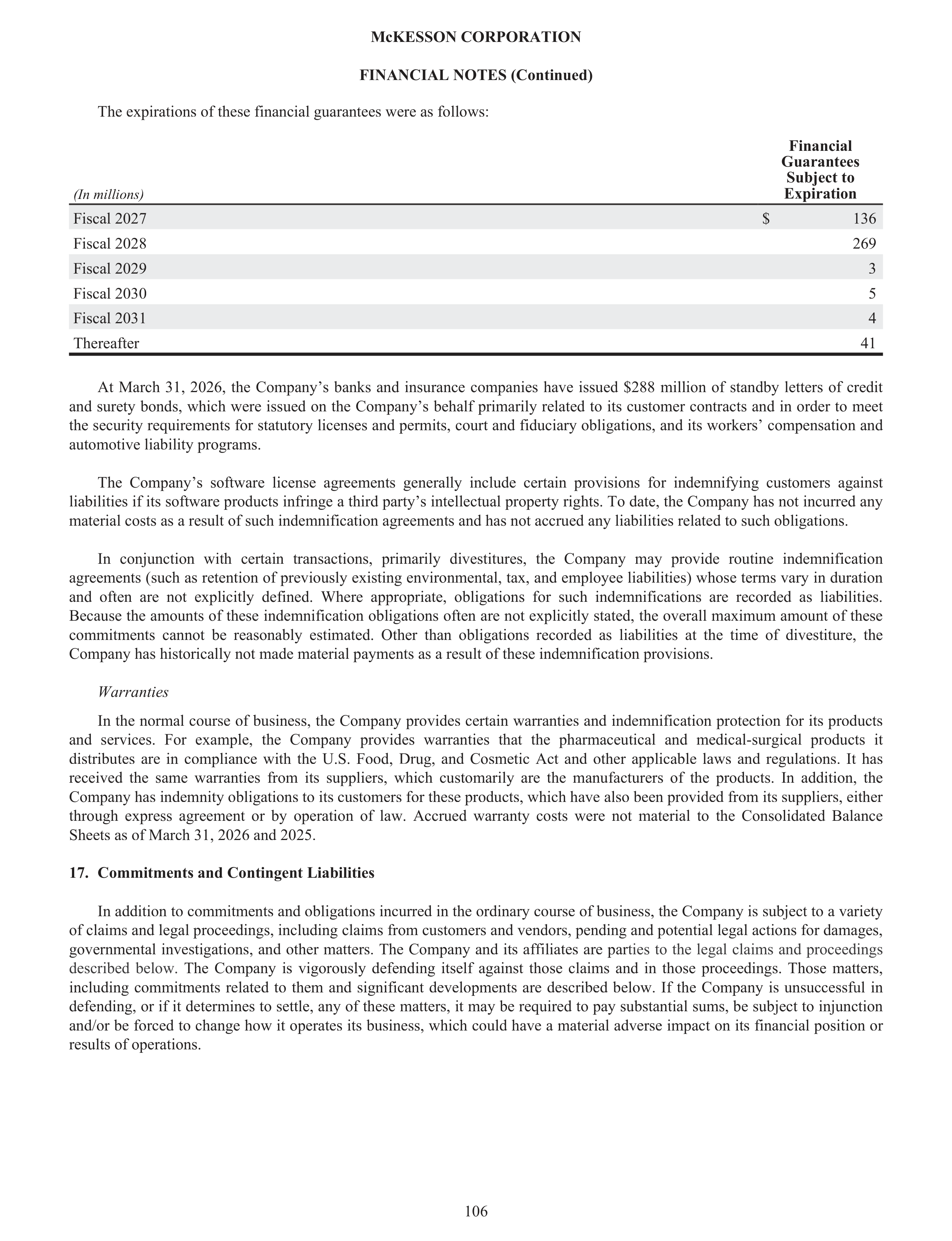
The expirations of these financial guarantees were as follows:
(In millions)s
Financial
Guarantees
Subject to
Expiration
Fiscal 2027
$
136
Fiscal 2028
269
Fiscal 2029
3
Fiscal 2030
5
Fiscal 2031
4
Thereafte
f
r
41
At
March
31,
2026,
the
Company’s
banks
and
insurance
companies
have
issued
$288
million
of
standby
letters
of
credit
and
surety
bonds,
which
were
issued
on
the
Company’s
behalf
primarily
related
to
its
customer
contracts
and
in
order
to
meet
the security requirements for statut
t
ory
r
licenses and permits, court and fiduciary obligations, and its workers’ compensation and
automotive liabi
a
lity programs.
The
Company’s
software
license
agreements
generally
include
certain
provisions
for
indemnifyi
f
ng
customers
against
liabi
a
lities if its software products infringe a third party’s intellectual property rights. To date, the Company has not incurred any
material costs as a result of such indemnific
f
ation agreements and has not accrue
r
d any liabi
a
lities related to such obligations.
In
conjunction
with
certain
transactions,
primarily
divestitur
t
es,
the
Company
may
provide
routine
indemnific
f
ation
agreements (such as retention of previously existing environmental, tax, and employee liabi
a
lities) whose terms vary in duration
and
ofte
f
n
are
not
explicitly
defined.
Where
appropriate,
obligations
for
such
indemnific
f
ations
are
recorded
as
liabi
a
lities.
Because the amounts of these indemnific
f
ation obligations ofte
f
n are not explicitly stated, the overall maximum amount of these
commitments
cannot
be
reasonabl
a
y
estimated.
Other
than
obligations
recorded
as
liabi
a
lities
at
the
time
of
divestitur
t
e,
the
Company has historically not made material payments as a result of these indemnific
f
ation provisions.
Warranties
In the normal course of business, the Company provides certain warranties and indemnific
f
ation protection for its products
and
services.
For
example,
the
Company
provides
warranties
that
the
pharmaceutical
and
medical-surgical
products
it
distributes
are
in
compliance
with
the
U.S.
Food,
Drug,
r
and
Cosmetic
Act
and
other
applicable
laws
and
regulations.
It
has
received
the
same
warranties
from
its
suppl
u
iers,
which
customarily
are
the
manufact
f
ur
t
ers
of
the
products.
In
addition,
the
Company has indemnity obligations to its customers for these products, which have also been provided from its suppl
u
iers, either
through
express
agreement
or
by
operation
of
law.
Accrue
r
d
warranty
costs
were
not
material
to
the
Consolidated
Balance
Sheets as of March 31, 2026 and 2025.
17.
Commitments and Contingent Liabilities
In addition to commitments and obligations incurred in the ordinary course of business, the Company is subj
u
ect to a variety
of claims and legal proceedings, including claims from customers and vendors, pending and potential legal actions for damages,
governmental
investigations,
and
other
matters.
The
Company
and
its
affi
f
liates
are
par
ties
to
the
legal
claims
and
proceedings
described
below.
The
Company
is
vigorously
defending
itself
against
those
claims
and
in
those
proceedings.
Those
matters,
including
commitments
related
to
them
and
significant
developments
are
described
below.
If
the
Company
is
unsuccessful
f
in
defending, or if it determines to settle, any of these matters, it may be required to pay subs
u
tantial sums, be subj
u
ect to inju
n
nction
and/or be forced to change how it operates its business, which could have a material adverse impact on its financial position or
results of operations.
McKESSON CORPORAT
R
ION
FINANCIAL NOTES (Continued)
106
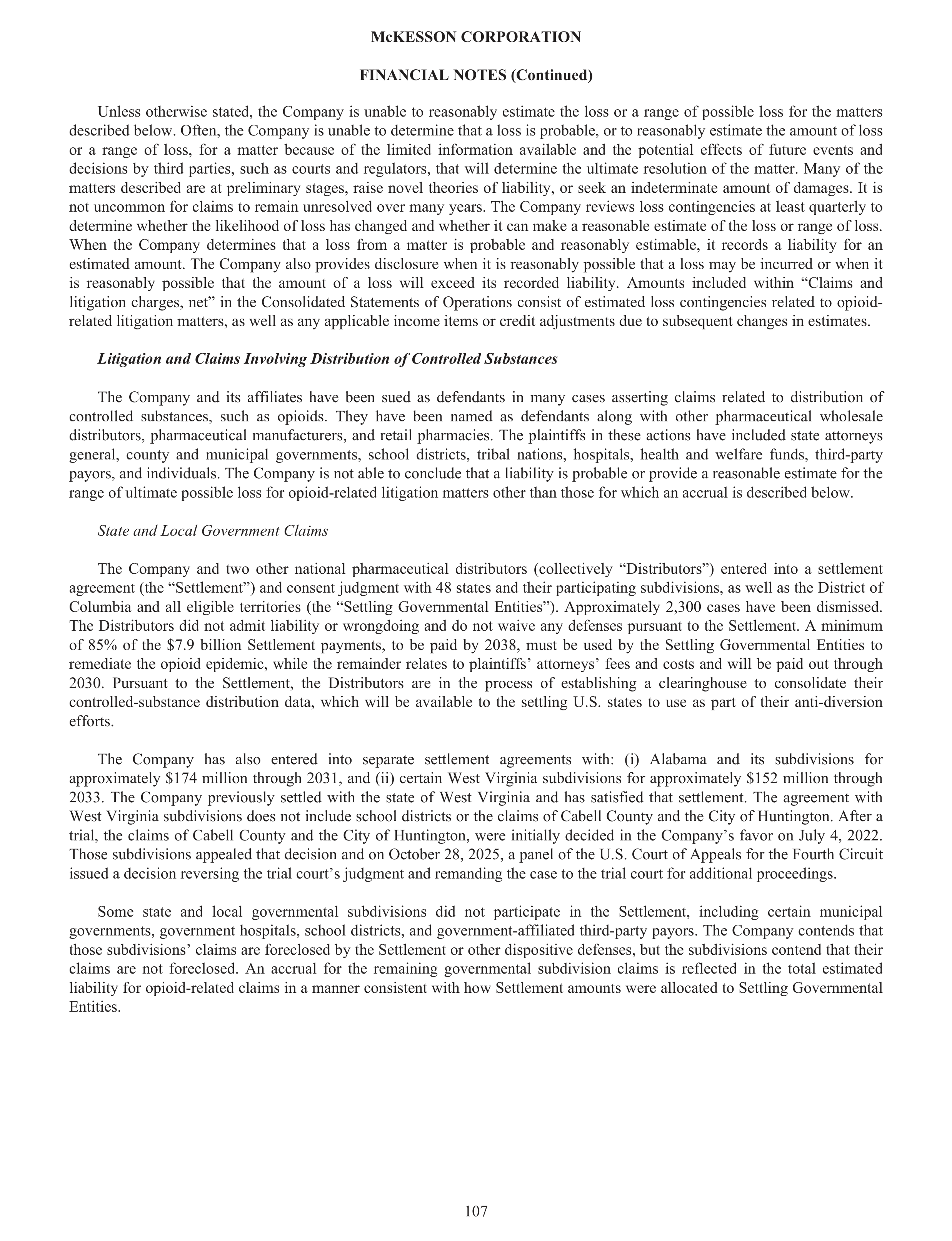
Unless
otherwise
stated,
the
Company
is
unabl
a
e
to
reasonabl
a
y
estimate
the
loss
or
a
range
of
possible
loss
for
the
matters
described below. Ofte
f
n, the Company is unabl
a
e to determine that a loss is probabl
a
e, or to reasonabl
a
y estimate the amount of loss
or
a
range
of
loss,
for
a
matter
because
of
the
limited
information
availabl
a
e
and
the
potential
effe
f
cts
of
future
events
and
decisions
by
third
parties,
such
as
courts
and
regulators,
that
will
determine
the
ultimate
resolution
of
the
matter.
Many
of
the
matters
described
are
at
preliminary
r
stages,
raise
novel
theories
of
liabi
a
lity,
or
seek
an
indeterminate
amount
of
damages.
It
is
not uncommon for claims to remain unresolved over many years. The Company reviews loss contingencies at least quarterly to
determine whether the likelihood of loss has changed and whether it can make a reasonabl
a
e estimate of the loss or range of loss.
When
the
Company
determines
that
a
loss
from
a
matter
is
probabl
a
e
and
reasonabl
a
y
estimabl
a
e,
it
records
a
liabi
a
lity
for
an
estimated amount. The Company also provides disclosure when it is reasonabl
a
y possible that a loss may be incurred or when it
is
reasonabl
a
y
possible
that
the
amount
of
a
loss
will
exceed
its
recorded
liabi
a
lity.
Amounts
included
within
“Claims
and
litigation
charges,
net”
in
the
Consolidated
Statements
of
Operations
consist
of
estimated
loss
contingencies
related
to
opioid-
related litigation matters, as well as any applicable income items or credit adju
d
stments due to subs
u
equent changes in estimates.
Litig
i
atio
t
n and Clai
l
ms
i
Involving Dist
i
ri
t
bution of Contro
t
lled Substan
t
ces
The
Company
and
its
affi
f
liates
have
been
sued
as
defendants
in
many
cases
asserting
claims
related
to
distribution
of
controlled
subs
u
tances,
such
as
opioids.
They
have
been
named
as
defendants
along
with
other
pharmaceutical
wholesale
distributors,
pharmaceutical
manufact
f
ur
t
ers,
and
retail
pharmacies.
The
plaintiffs
f
in
these
actions
have
included
state
attorneys
general,
county
and
municipal
governments,
school
districts,
tribal
nations,
hospitals,
health
and
welfar
f
e
funds,
third-party
payors, and individuals. The Company is not able to conclude that a liabi
a
lity is probabl
a
e or provide a reasonabl
a
e estimate for the
range of ultimate possible loss for opioid-related litigation matters other than those for which an accrua
r
l is described below.
State and Local Government Claims
The
Company
and
two
other
national
pharmaceutical
distributors
(collectively
“Distributors”)
entered
into
a
settlement
agreement (the “Settlement”) and consent judgment with 48 states and their participating subdi
u
visions, as well as the District of
Columbia
and
all
eligible
territories
(the
“Settling
Governmental
Entities”).
Approximately
2,300
cases
have
been
dismissed.
The
Distributors
did
not
admit
liabi
a
lity
or
wrongdoing
and
do
not
waive
any
defenses
pursuant
to
the
Settlement.
A
minimum
of
85%
of
the
$7.9
billion
Settlement
payments,
to
be
paid
by
2038,
must
be
used
by
the
Settling
Governmental
Entities
to
remediate
the
opioid
epidemic,
while
the
remainder
relates
to
plaintiffs
f
’
attorneys’
fees
and
costs
and
will
be
paid
out
through
2030.
Pursuant
to
the
Settlement,
the
Distributors
are
in
the
process
of
establ
a
ishing
a
clearinghouse
to
consolidate
their
controlled-subs
u
tance
distribution
data,
which
will
be
availabl
a
e
to
the
settling
U.S.
states
to
use
as
part
of
their
anti-diversion
effo
f
rts.
The
Company
has
also
entered
into
separate
settlement
agreements
with:
(i)
Alabama
and
its
subdi
u
visions
for
approximately
$174
million
through
2031,
and
(ii)
certain
West
Virginia
subdi
u
visions
for
approximately
$152
million
through
2033.
The
Company
previously
settled
with
the
state
of
West
Virginia
and
has
satisfied
that
settlement.
The
agreement
with
West Virginia subdi
u
visions does not include school districts or the claims of Cabe
a
ll County and the City of Huntington. Afte
f
r a
trial,
the
claims
of
Cabe
a
ll
County
and
the
City
of
Huntington,
were
initially
decided
in
the
Company’s
favor
on
July
4,
2022.
Those subdi
u
visions appealed that decision and on October 28, 2025, a panel of the U.S. Court of Appeals for the Fourth Circuit
issued a decision reversing the trial court’s judgment and remanding the case to the trial court for additional proceedings.
Some
state
and
local
governmental
subdi
u
visions
did
not
participate
in
the
Settlement,
including
certain
municipal
governments, government hospitals, school districts, and government-affiliated third-party payors. The Company contends that
those subdi
u
visions’ claims are foreclosed by the Settlement or other dispositive defenses, but the subdi
u
visions contend that their
claims
are
not
foreclosed.
An
accrua
r
l
for
the
remaining
governmental
subdi
u
vision
claims
is
reflected
in
the
total
estimated
liabi
a
lity for opioid-related claims in a manner consistent with how Settlement amounts were allocated to Settling Governmental
Entities.
McKESSON CORPORAT
R
ION
FINANCIAL NOTES (Continued)
107
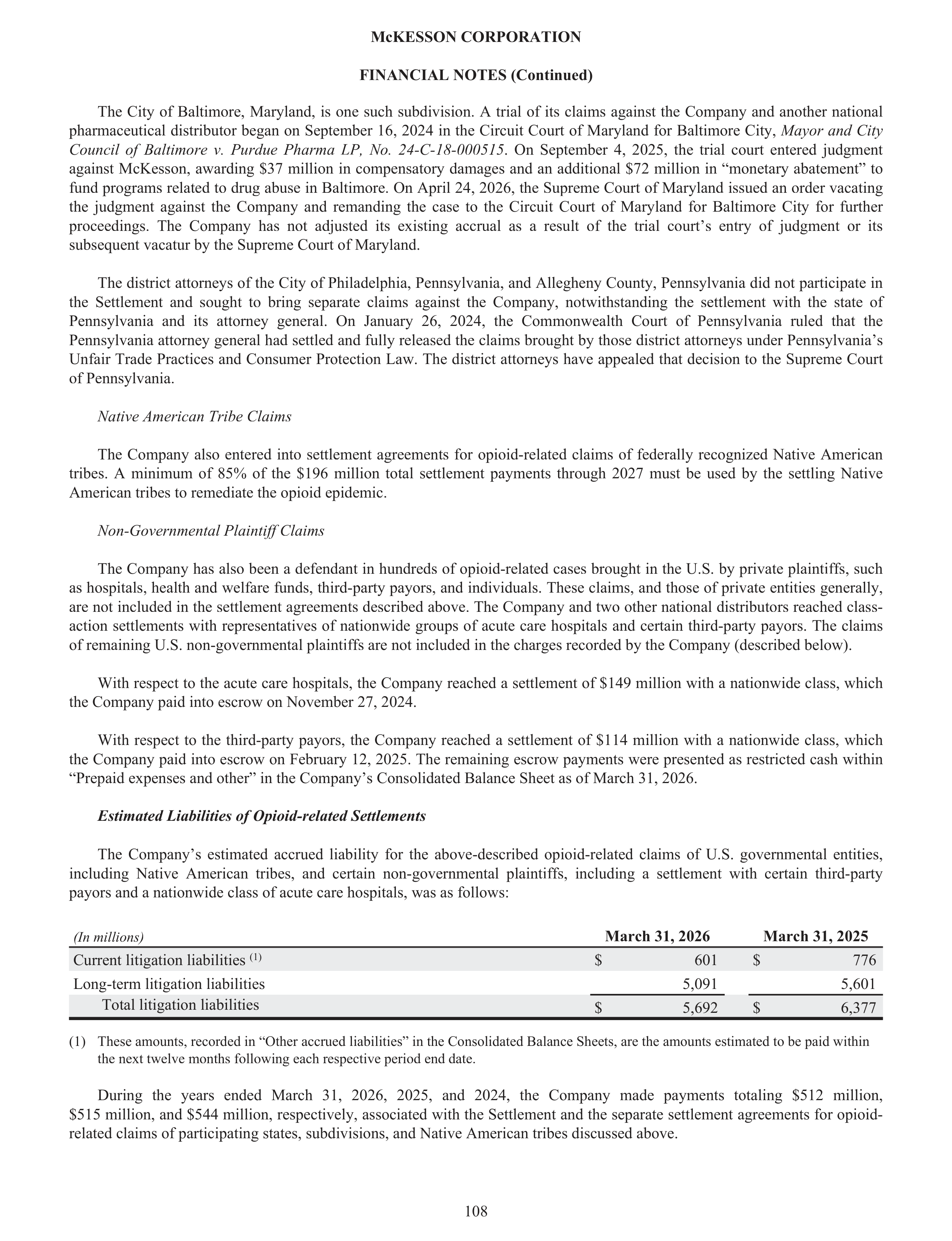
The
City
of
Baltimore,
Maryland,
is
one
such
subdi
u
vision.
A
trial
of
its
claims
against
the
Company
and
another
national
pharmaceutical distributor
began on September
16, 2024
in the Circuit Court of
Maryland for
Baltimore City,
Mayo
a
r and City
Council
of
Baltimore
v.
Purdue
d
Pharma
LP,
P
No.
24-C-18-000515
.
On
September
4,
2025,
the
trial
court
entered
judgment
against
McKesson,
awarding
$37
million
in
compensatory
damages
and
an
additional
$72
million
in
“monetary
abatement”
to
fund programs related to drug
r
abuse in Baltimore. On April 24, 2026, the Supr
u
eme Court of Maryland issued an order vacating
the
judgment
against
the
Company
and
remanding
the
case
to
the
Circuit
Court
of
Maryland
for
Baltimore
City
for
further
proceedings.
The
Company
has
not
adju
d
sted
its
existing
accrua
r
l
as
a
result
of
the
trial
court’s
entry
r
of
judgment
or
its
subs
u
equent vacatur by the Supr
u
eme Court of Maryland.
The district attorneys of the City of Philadelphia, Pennsylvania, and Allegheny County, Pennsylvania did not participate in
the
Settlement
and
sought
to
bring
separate
claims
against
the
Company,
notwithstanding
the
settlement
with
the
state
of
Pennsylvania
and
its
attorney
general.
On
January
26,
2024,
the
Commonwealth
Court
of
Pennsylvania
ruled
that
the
Pennsylvania attorney general had settled and fully released the claims brought by those district attorneys under Pennsylvania’s
Unfair Trade Practices and Consumer Protection Law. The district attorneys have appealed that decision to the Supr
u
eme Court
of Pennsylvania.
Native American Tribe Claims
The
Company
also
entered
into
settlement
agreements
for
opioid-related
claims
of
federally
recognized
Native
American
tribes.
A
minimum
of
85%
of
the
$196
million
total
settlement
payments
through
2027
must
be
used
by
the
settling
Native
American tribes to remediate the opioid epidemic.
Non-Governmental Plaintifff
Claims
The Company has also been a defendant in hundreds of opioid-related cases brought in the U.S. by private plaintiffs
f
, such
as hospitals, health and welfar
f
e funds, third-party payors, and individuals. These claims, and those of private entities generally,
are not included in the settlement agreements described above. The Company and two other national distributors reached class-
action
settlements
with
representatives
of
nationwide
groups
of
acute
care
hospitals
and
certain
third-party
payors.
The
claims
of remaining U.S. non-governmental plaintiffs
f
are not included in the charges recorded by the Company (described below).
With respect to the acute care hospitals, the Company reached a settlement of $149 million with a nationwide class, which
the Company paid into escrow on November 27, 2024.
With
respect
to
the
third-party
payors,
the
Company
reached
a
settlement
of
$114
million
with
a
nationwide
class,
which
the Company paid into escrow on Februa
r
ry 12, 2025. The remaining escrow payments were presented as restricted cash within
“Prepaid expenses and other” in the Company’s Consolidated Balance Sheet as of March 31, 2026.
Estimated Liabilit
i
ie
t
s of Opioid-r
d
elat
l
ed
t
Settlementst
The
Company’s
estimated
accrued
liabi
a
lity
for
the
above-described
opioid-related
claims
of
U.S.
governmental
entities,
including
Native
American
tribes,
and
certain
non-governmental
plaintiffs
f
,
including
a
settlement
with
certain
third-party
payors and a nationwide class of acute care hospitals, was as follows:
(In millions)s
March 31, 2026
March 31, 2025
Current litigation liabilities
(1)
$
601
$
776
Long-term litigation liabilities
5,091
5,601
Total litigation liabilities
$
5,692
$
6,377
(1)
These amounts, recorded in “Other accrue
r
d liabi
a
lities” in the Consolidated Balance Sheets, are the amounts estimated to be paid within
the next twelve months following each respective period end date.
During
the
years
ended
March
31,
2026,
2025,
and
2024,
the
Company
made
payments
totaling
$512
million,
$515 million, and $544 million, respectively, associated with the Settlement and the separate settlement agreements for opioid-
related claims of participating states, subdi
u
visions, and Native American tribes discussed above.
McKESSON CORPORAT
R
ION
FINANCIAL NOTES (Continued)
108
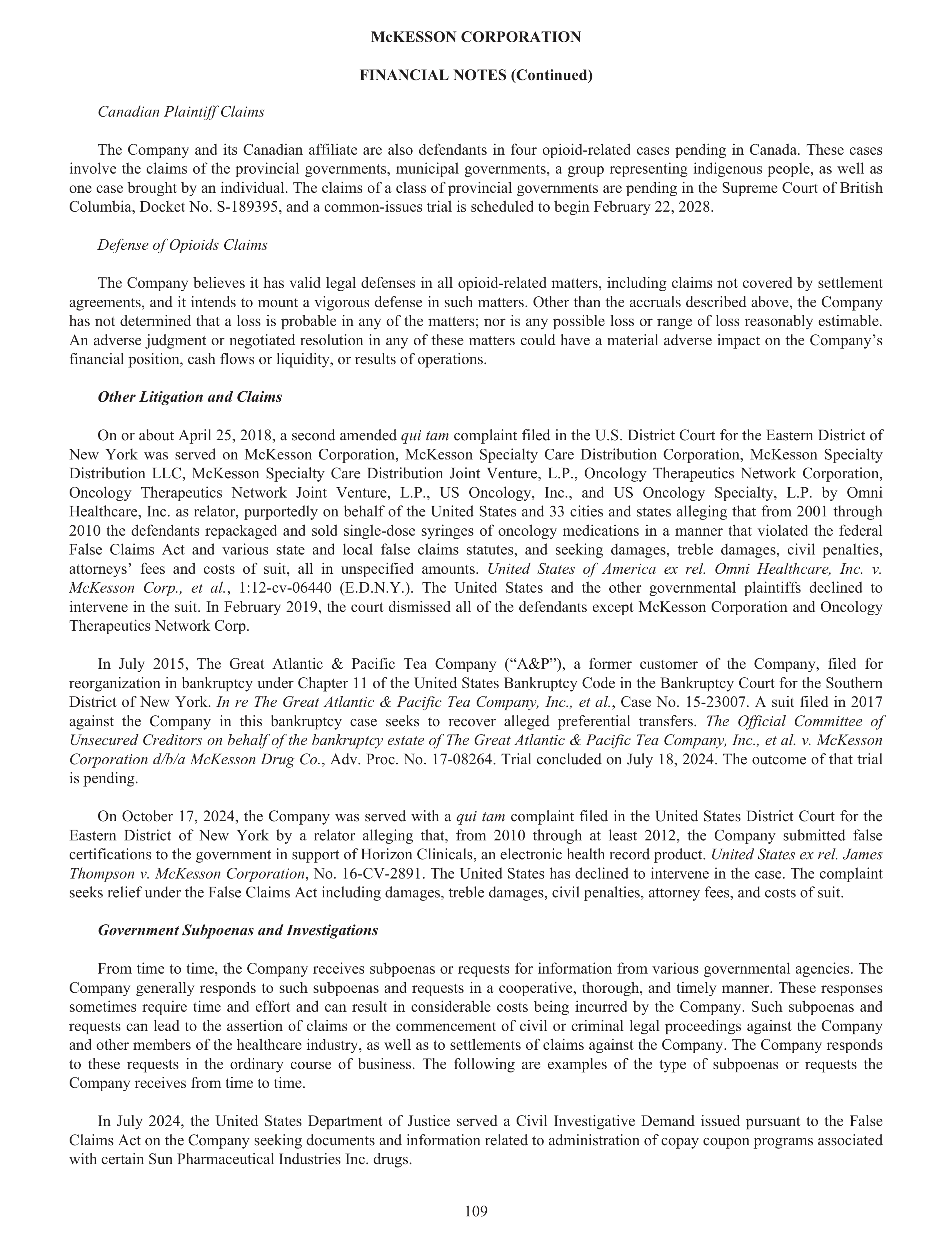
Canadian Plaintiff Claims
The
Company
and
its
Canadian
affi
f
liate
are
also
defendants
in
four
opioid-related
cases
pending
in
Canada.
These
cases
involve
the
claims
of
the
provincial
governments,
municipal
governments,
a
group
representing
indigenous
people,
as
well
as
one case brought by an individual. The claims of a class of provincial governments are pending in the Supr
u
eme Court of British
Columbia, Docket No. S-189395, and a common-issues trial is scheduled to begin Februa
r
ry 22, 2028.
Defe
e
nse of Opioids
d
Claims
The Company believes it has valid legal defenses in all opioid-related matters, including claims not covered by settlement
agreements, and it intends to mount a vigorous defense in such matters. Other than the accrua
r
ls described above, the Company
has
not determined
that a
loss
is
probabl
a
e
in
any
of
the matters; nor
is
any
possible
loss
or
range
of
loss
reasonabl
a
y
estimable.
An
adverse
judgment
or
negotiated
resolution
in
any
of
these
matters
could
have
a
material
adverse
impact
on
the
Company’s
financial position, cash flows or liquidity, or results of operations.
Othe
t
r Litig
i
atio
t
n and Clai
l
ms
i
On or about April 25, 2018, a second amended
qui tam
complaint filed in the U.S. District Court for the Eastern District of
New
York
was
served
on
McKesson
Corporation,
McKesson
Specialty
Care
Distribution
Corporation,
McKesson
Specialty
Distribution
LLC,
McKesson
Specialty
Care
Distribution
Joint
Ventur
t
e,
L.P.,
Oncology
Therapeutics
Network
Corporation,
Oncology
Therapeutics
Network
Joint
Ventur
t
e,
L.P.,
US
Oncology,
Inc.,
and
US
Oncology
Specialty,
L.P.
by
Omni
Healthcare,
Inc.
as
relator,
purpor
r
tedly
on
behalf
of
the
United
States
and
33
cities
and
states
alleging
that
from
2001
through
2010
the
defendants
repackaged
and
sold
single-dose
syringes
of
oncology
medications
in
a
manner
that
violated
the
federal
False
Claims
Act
and
various
state
and
local
false
claims
statut
t
es,
and
seeking
damages,
treble
damages,
civil
penalties,
attorneys’
fees
and
costs
of
suit,
all
in
unspecified
amounts.
United
States
of
America
ex
rel.
Omni
Healthcare,
Inc.
v.
McKe
c
sson
Corp.,
et
al.
,
1:12-cv-06440
(E.D.N.Y.).
The
United
States
and
the
other
governmental
plaintiffs
f
declined
to
intervene
in
the
suit.
In
Februa
r
ry
2019,
the
court
dismissed
all
of
the
defendants
except
McKesson
Corporation
and
Oncology
Therapeutics Network Corp.
In
July
2015,
The
Great
Atlantic
&
Pacific
Tea
Company
(“A&P”),
a
former
customer
of
the
Company,
filed
for
reorganization in bankrupt
r
cy under Chapter 11 of the United States Bankrupt
r
cy Code in the Bankrupt
r
cy Court for the Southern
District
of
New
York.
In
re
The
Great
Atlantic
&
Pacifi
i
c
Tea
Company,y
Inc.,
et
al.
,
Case
No.
15-23007.
A
suit
filed
in
2017
against
the
Company
in
this
bankrupt
r
cy
case
seeks
to
recover
alleged
prefer
f
ential
transfer
f
s.
The
Offi
f
cial
Committee
of
Unsecured Creditors on behalfl
of the bankru
k
pt
u
cy estate of The Great Atlantic & Pacific
i
Tea Company,y
Inc., et al. v. McKe
c
sson
Corporation d/b/
/
a/
McKe
c
sson Drug Co.
, Adv. Proc. No. 17-08264. Trial concluded on July 18, 2024. The outcome of that trial
is pending.
On
October
17,
2024,
the
Company
was
served
with
a
qui
tam
complaint
filed
in
the
United
States
District
Court
for
the
Eastern
District
of
New
York
by
a
relator
alleging
that,
from
2010
through
at
least
2012,
the
Company
subm
u
itted
false
certific
f
ations to the government in suppor
u
t of Horizon Clinicals, an electronic health record product.
United States ex rel. James
Thomps
m
on v. McKe
c
sson Corporation
, No. 16-CV-2891. The United States has declined to intervene in the case. The complaint
seeks relief under the False Claims Act including damages, treble damages, civil penalties, attorney fees, and costs of suit.
Government Subpoe
b
nas and Investig
t
atio
t
ns
From time to time, the Company receives subpoe
u
nas or requests for information from various governmental agencies. The
Company
generally
responds
to
such
subpoe
u
nas
and
requests
in
a
cooperative,
thorough,
and
timely
manner.
These
responses
sometimes
require
time
and
effo
f
rt
and
can
result
in
considerable
costs
being
incurred
by
the
Company.
Such
subpoe
u
nas
and
requests
can
lead
to
the
assertion
of
claims
or
the
commencement
of
civil
or
criminal
legal
proceedings
against
the
Company
and other members of the healthcare industry,
r
as well as to settlements of claims against the Company. The Company responds
to
these
requests
in
the
ordinary
course
of
business.
The
following
are
examples
of
the
type
of
subpoe
u
nas
or
requests
the
Company receives from time to time.
In
July
2024,
the
United
States
Department
of
Justice
served
a
Civil
Investigative
Demand
issued
pursuant
to
the
False
Claims Act on the Company seeking documents and information related to administration of copay coupon programs associated
with certain Sun Pharmaceutical Industries Inc. drugs
r
.
McKESSON CORPORAT
R
ION
FINANCIAL NOTES (Continued)
109
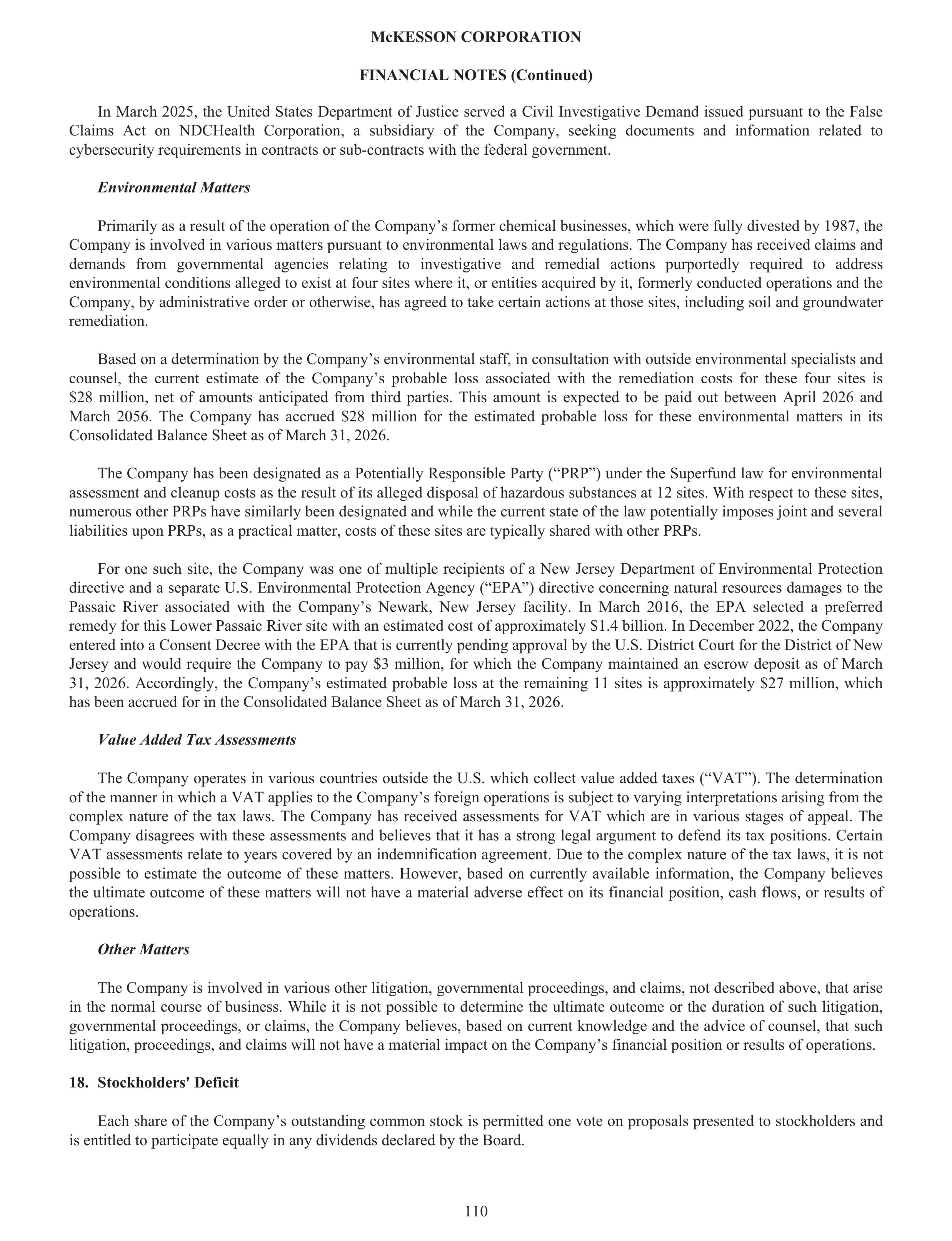
In
March
2025,
the
United
States
Department
of
Justice
served
a
Civil
Investigative
Demand
issued
pursuant
to
the
False
Claims
Act
on
NDCHealth
Corporation,
a
subs
u
idiary
of
the
Company,
seeking
documents
and
information
related
to
cybersecurity requirements in contracts or sub-
u
contracts with the federal government.
Enviro
i
nmental Matter
t
sr
Primarily as a result of the operation of the Company’s former chemical businesses, which were fully divested by 1987, the
Company is involved in various matters pursuant to environmental laws and regulations. The Company has received claims and
demands
from
governmental
agencies
relating
to
investigative
and
remedial
actions
purpor
r
tedly
required
to
address
environmental conditions alleged to exist at four sites where it, or entities acquired by it, formerly conducted operations and the
Company, by administrative order or otherwise, has agreed to take certain actions at those sites, including soil and groundwater
remediation.
Based on a determination by the Company’s environmental staff,
f
in consultation with outside environmental specialists and
counsel,
the
current
estimate
of
the
Company’s
probabl
a
e
loss
associated
with
the
remediation
costs
for
these
four
sites
is
$28
million,
net
of
amounts
anticipated
from
third
parties.
This
amount
is
expected
to
be
paid
out
between
April
2026
and
March
2056.
The
Company
has
accrue
r
d
$28
million
for
the
estimated
probabl
a
e
loss
for
these
environmental
matters
in
its
Consolidated Balance Sheet as of March 31, 2026.
The Company has been designated as a Potentially Responsible Party (“PRP”) under the Supe
u
rfund law for environmental
assessment and cleanup costs as the result of its alleged disposal of hazardous subs
u
tances at 12 sites. With respect to these sites,
numerous other PRPs have similarly been designated and while the current state of the law potentially imposes joint and several
liabi
a
lities upon PRPs, as a practical matter, costs of these sites are typically shared with other PRPs.
For
one
such
site,
the
Company
was
one
of
multiple
recipients
of
a
New
Jersey
Department
of
Environmental
Protection
directive and a separate U.S. Environmental Protection Agency (“EPA”) directive concerning natural resources damages to the
Passaic
River
associated
with
the
Company’s
Newark,
New
Jersey
facility.
In
March
2016,
the
EPA
selected
a
prefer
f
red
remedy for this Lower Passaic River site with an estimated cost of approximately $1.4 billion. In December 2022, the Company
entered into a Consent Decree with the EPA that is currently pending approval by the U.S. District Court for the District of New
Jersey
and
would
require
the
Company
to
pay
$3
million,
for
which
the
Company
maintained
an
escrow
deposit
as
of
March
31,
2026.
Accordingly,
the
Company’s
estimated
probabl
a
e
loss
at
the
remaining
11
sites
is
approximately
$27
million,
which
has been accrue
r
d for in the Consolidated Balance Sheet as of March 31, 2026.
Value Adde
d
d Tax
a
Assessments
The Company
operates
in various
countries outside the U.S.
which collect value added taxes (“VAT”). The determination
of the manner in which a VAT applies to the Company’s foreign operations is subj
u
ect to varying interpretations arising from the
complex
nature
of
the
tax
laws.
The
Company
has
received
assessments
for
VAT
which
are
in
various
stages
of
appeal.
The
Company
disagrees
with
these
assessments
and
believes
that
it
has
a
strong
legal
argument
to
defend
its
tax
positions.
Certain
VAT assessments relate to years covered by an indemnific
f
ation agreement. Due to the complex nature of the tax laws, it is not
possible
to
estimate
the
outcome
of
these
matters.
However,
based
on
currently
availabl
a
e
information,
the
Company
believes
the
ultimate
outcome
of
these
matters
will
not
have
a
material
adverse
effe
f
ct
on
its
financial
position,
cash
flows,
or
results
of
operations.
Othe
t
r Matters
The Company is involved in various other litigation, governmental proceedings, and claims, not described above, that arise
in
the
normal
course
of
business.
While
it
is
not
possible
to
determine
the
ultimate
outcome
or
the
duration
of
such
litigation,
governmental
proceedings,
or
claims,
the
Company
believes,
based
on
current
knowledge
and
the
advice
of
counsel,
that
such
litigation, proceedings, and claims will not have a material impact on the Company’s financial position or results of operations.
18.
Stockholders' Deficit
Each share of the Company’s outstanding common stock is permitted one vote on proposals presented to stockholders and
is entitled to participate equally in any dividends declared by the Board.
McKESSON CORPORAT
R
ION
FINANCIAL NOTES (Continued)
110
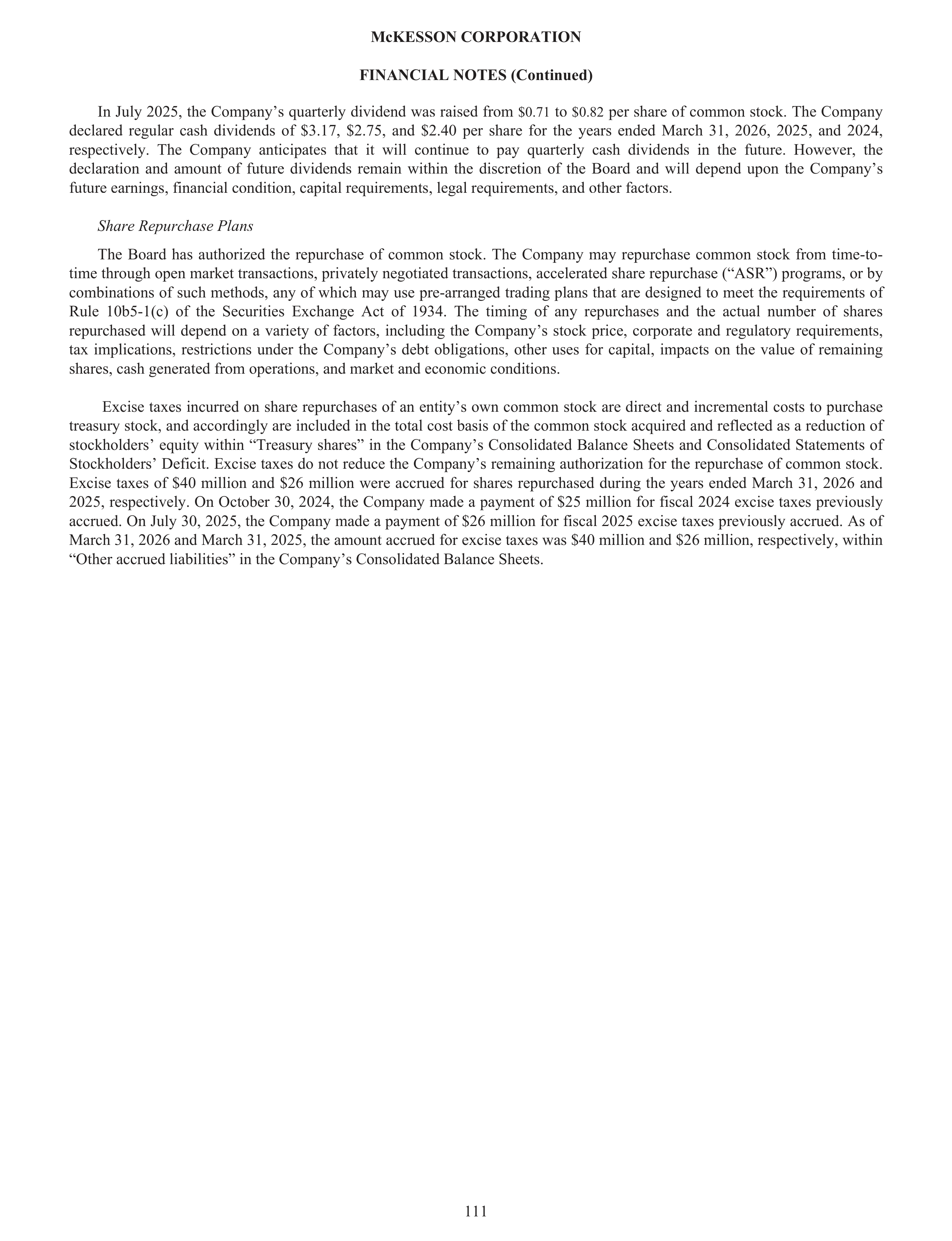
In July 2025, the Company’s quarterly dividend was raised from
$0.71
to
$0.82
per share of common stock. The Company
declared
regular
cash
dividends
of
$3.17,
$2.75,
and
$2.40
per
share
for
the
years
ended
March
31,
2026,
2025,
and
2024,
respectively.
The
Company
anticipates
that
it
will
continue
to
pay
quarterly
cash
dividends
in
the
future.
However,
the
declaration
and
amount
of
future
dividends
remain
within
the
discretion
of
the
Board
and
will
depend
upon
the
Company’s
future earnings, financial condition, capital requirements, legal requirements, and other factors.
Share Repur
e
chase Plans
The
Board
has
authorized
the
repurchase
of
common
stock.
The
Company
may
repurchase
common
stock
from
time-to-
time through open market transactions, privately negotiated transactions, accelerated share repurchase (“ASR”) programs, or by
combinations of such methods, any of which may use pre-arranged trading plans that are designed to meet the requirements of
Rule
10b5-1(c)
of
the
Securities
Exchange
Act
of
1934.
The
timing
of
any
repurchases
and
the
actua
t
l
number
of
shares
repurchased
will
depend
on
a
variety
of
factors,
including
the
Company’s
stock
price,
corporate
and
regulatory
r
requirements,
tax
implications,
restrictions
under
the
Company’s
debt
obligations,
other
uses
for
capital,
impacts
on
the
value
of
remaining
shares, cash generated from operations, and market and economic conditions.
Excise taxes incurred on share repurchases of an entity’s own common stock are direct and incremental costs to purchase
treasury
r
stock, and accordingly are included in the total cost basis of the common stock acquired and reflected as a reduction of
stockholders’
equity
within
“Treasury
r
shares”
in
the
Company’s
Consolidated
Balance
Sheets
and
Consolidated
Statements
of
Stockholders’ Deficit. Excise taxes do not reduce the Company’s remaining authorization for the repurchase of common stock.
Excise
taxes
of
$40
million
and
$26
million
were
accrued
for
shares
repurchased
during
the
years
ended
March
31,
2026
and
2025, respectively. On October 30, 2024, the Company made a payment of $25 million for fiscal 2024 excise taxes previously
accrue
r
d. On July 30, 2025, the Company made a payment of $26 million for fiscal 2025 excise taxes previously accrue
r
d. As of
March 31, 2026 and March 31, 2025, the amount accrue
r
d for excise taxes was $40 million and $26 million, respectively, within
“Other accrue
r
d liabi
a
lities” in the Company’s Consolidated Balance Sheets.
McKESSON CORPORAT
R
ION
FINANCIAL NOTES (Continued)
111
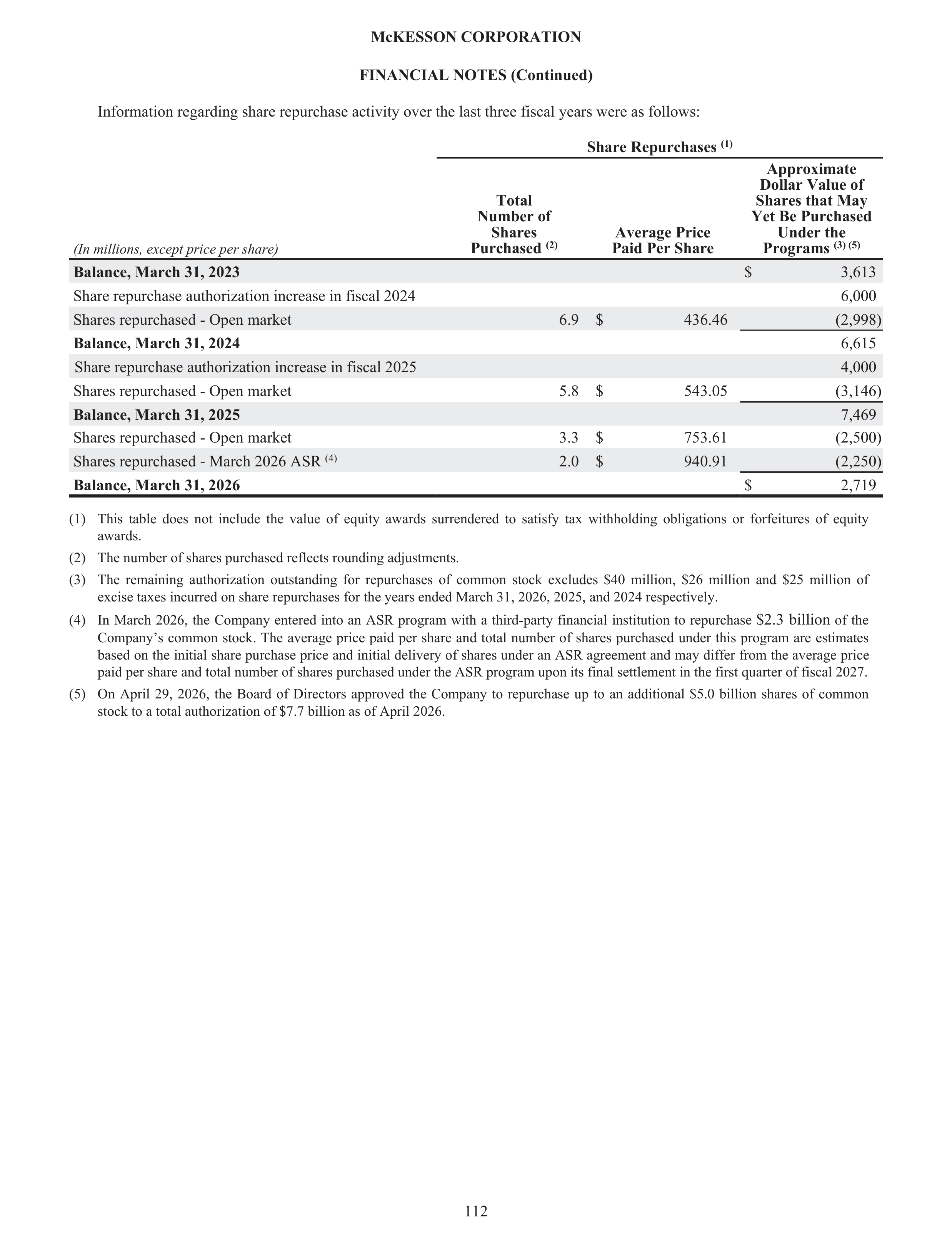
Information regarding share repurchase activity over the last three fiscal years were as follows:
Share Repurchases
(1)
(In millions, except price per share)
Total
Number of
Shares
Purchased
(2)
Average Price
Paid Per Share
Approximate
Dollar Value of
Shares that May
Yet Be Purchased
Under the
Programs
(3) (5)
Balance, March 31, 2023
$
3,613
Share repurchase authorization increase in fiscal 2024
6,000
Shares repurchased - Open market
6.9
$
436.46
(2,998)
Balance, March 31, 2024
6,615
Share repurchase authorization increase in fiscal 2025
4,000
Shares repurchased - Open market
5.8
$
543.05
(3,146)
Balance, March 31, 2025
7,469
Shares repurchased - Open market
3.3
$
753.61
(2,500)
Shares repurchased - March 2026 ASR
(4)
2.0
$
940.91
(2,250)
Balance, March 31, 2026
$
2,719
(1)
This
tabl
a
e
does
not
include
the
value
of
equity
awards
surrendered
to
satisfy
tax
withholding
obligations
or
forfeitures
of
equity
awards.
(2)
The number of shares purchased reflects rounding adju
d
stments.
(3)
The
remaining
authorization
outstanding
for
repurchases
of
common
stock
excludes
$40
million,
$26
million
and
$25
million
of
excise taxes incurred on share repurchases for the years ended March 31, 2026, 2025, and 2024 respectively.
(4)
In
March
2026,
the
Company
entered
into
an
ASR
program
with
a
third-party
financial
institution
to
repurchase
$2.3
billion
of
the
Company’s
common
stock.
The
average
price
paid
per
share
and
total
number
of
shares
purchased
under
this
program
are
estimates
based on the initial share purchase price and initial delivery
r
of shares under an ASR agreement and may differ from the average price
paid per share and total number of shares purchased under the ASR program upon its final settlement in the first quarter of fiscal 2027.
(5)
On
April
29,
2026,
the
Board
of
Directors
approved
the
Company
to
repurchase
up
to
an
additional
$5.0
billion
shares
of
common
stock to a total authorization of $7.7 billion as of April 2026.
McKESSON CORPORAT
R
ION
FINANCIAL NOTES (Continued)
112
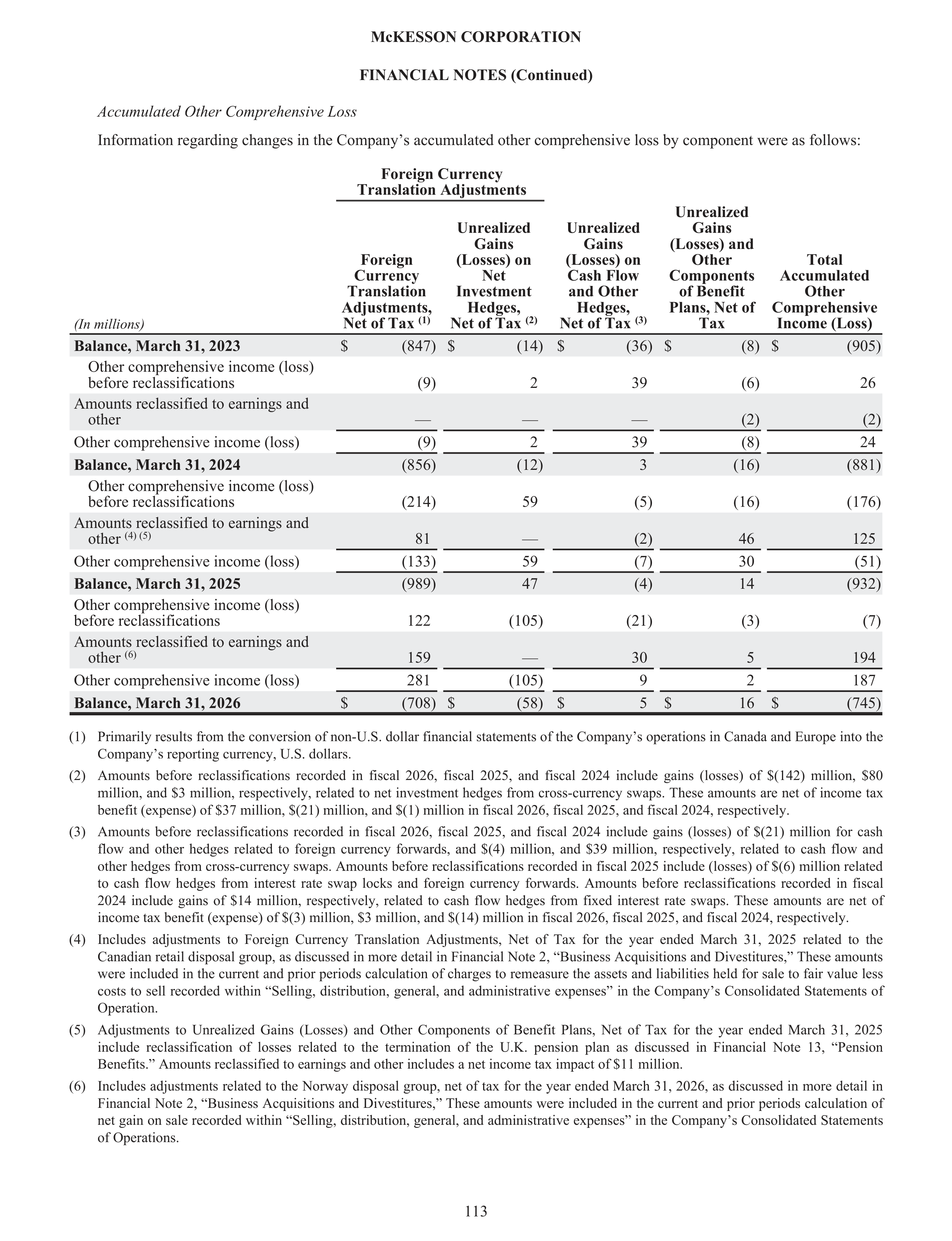
Accumulated Othe
t
r Comprehensive Loss
Information regarding changes in the Company’s accumulated other comprehensive loss by component were as follows:
Foreign Currency
Translation Adju
d
stments
(In millions)s
Foreign
Currency
Translation
Adju
d
stments,
Net of Tax
(1)
Unrealized
Gains
(Losses) on
Net
Investment
Hedges,
Net of Tax
(2)
Unrealized
Gains
(Losses) on
Cash Flow
and Other
Hedges,
Net of Tax
(3)
Unrealized
Gains
(Losses) and
Other
Components
of Benefit
Plans, Net of
Tax
Total
Accumulated
Other
Comprehensive
Income (Loss)
Balance, March 31, 2023
$
(847)
$
(14)
$
(36)
$
(8)
$
(905)
Other comprehensive income (loss)
before reclassifications
(9)
2
39
(6)
26
Amounts reclassified to earnings and
other
—
—
—
(2)
(2)
Other comprehensive income (loss)
(9)
2
39
(8)
24
Balance, March 31, 2024
(856)
(12)
3
(16)
(881)
Other comprehensive income (loss)
before reclassifications
(214)
59
(5)
(16)
(176)
Amounts reclassified to earnings and
other
(4) (5)
81
—
(2)
46
125
Other comprehensive income (loss)
(133)
59
(7)
30
(51)
Balance, March 31, 2025
(989)
47
(4)
14
(932)
Other comprehensive income (loss)
before reclassifications
122
(105)
(21)
(3)
(7)
Amounts reclassified to earnings and
other
(6)
159
—
30
5
194
Other comprehensive income (loss)
281
(105)
9
2
187
Balance, March 31, 2026
$
(708)
$
(58)
$
5
$
16
$
(745)
(1)
Primarily results from the conversion of non-U.S. dollar financial statements of the Company’s operations in Canada and Europe into the
Company’s reporting currency, U.S. dollars.
(2)
Amounts
before
reclassifications
recorded
in
fiscal
2026,
fiscal
2025,
and
fiscal
2024
include
gains
(losses)
of
$(142)
million,
$80
million, and $3 million, respectively, related to net investment hedges from cross-currency swaps. These amounts are net of income tax
benefit (expense) of $37 million, $(21) million, and $(1) million in fiscal 2026, fiscal 2025, and fiscal 2024, respectively.
(3)
Amounts
before
reclassifications
recorded
in
fiscal
2026,
fiscal
2025,
and
fiscal
2024
include
gains
(losses)
of
$(21)
million
for
cash
flow
and
other
hedges
related
to
foreign
currency
forwards,
and
$(4)
million,
and
$39
million,
respectively,
related
to
cash
flow
and
other hedges from cross-currency swaps. Amounts before reclassifications recorded in fiscal 2025 include (losses) of $(6) million related
to
cash
flow
hedges
from
interest
rate
swap
locks
and
foreign
currency
forwards.
Amounts
before
reclassifications
recorded
in
fiscal
2024
include
gains
of
$14
million,
respectively,
related
to
cash
flow
hedges
from
fixed
interest
rate
swaps.
These
amounts
are
net
of
income tax benefit (expense) of $(3) million, $3 million, and $(14) million in fiscal 2026, fiscal 2025, and fiscal 2024, respectively.
(4)
Includes
adju
d
stments
to
Foreign
Currency
Translation
Adju
d
stments,
Net
of
Tax
for
the
year
ended
March
31,
2025
related
to
the
Canadian retail disposal group,
u
as discussed in more detail in Financial Note 2, “Business Acquisitions and Divestitures,” These amounts
were included in the current and prior periods calculation of charges to remeasure the assets and liabi
a
lities held for sale to fair value less
costs
to
sell
recorded
within
“Selling,
distribution,
general,
and
administrative
expenses”
in
the
Company’s
Consolidated
Statements
of
Operation.
(5)
Adjustments
to
Unrealized
Gains
(Losses)
and
Other
Components
of
Benefit
Plans,
Net
of
Tax
for
the
year
ended
March
31,
2025
include
reclassification
of
losses
related
to
the
termination
of
the
U.K.
pension
plan
as
discussed
in
Financial
Note
13,
“Pension
Benefits.” Amounts reclassified to earnings and other includes a net income tax impact of $11 million.
(6)
Includes adju
d
stments related to the Norway disposal group,
u
net of tax for the year ended March 31, 2026, as discussed in more detail in
Financial Note 2, “Business Acquisitions and Divestitures,” These amounts were included in the current and prior periods calculation of
net gain on sale recorded within “Selling, distribution, general, and administrative expenses” in the Company’s Consolidated Statements
of Operations.
McKESSON CORPORAT
R
ION
FINANCIAL NOTES (Continued)
113
19.
Related Party Balances and Transactions
In
fiscal
2026
and
2025,
the
North
American
Pharmaceutical
segment’s
sales
to
one
of
the
Company’s
equity
method
investees
totaled
$1.6
billion
and
$1.1
billion,
respectively.
Trade
receivabl
a
es
related
to
transactions
from
this
investee
were
$443 million and $313 million as of March 31, 2026 and March 31, 2025, respectively.
20.
Segments of Business
Commencing
in
the
second
quarter
of
fiscal
2026,
the
Company
implemented
a
new
segment
reporting
structure
which
resulted
in
four
reportabl
a
e
segments:
North
American
Pharmaceutical,
Oncology
&
Multispecialty,
Prescription
Technology
Solutions,
and
M
d
edic
lal-Surgigical
Solu itions.
h
The
Company’s
former
Norw
g
egian
opera itions
are
in
lcl
d
uded
in
Other.
All
prior
segment
information
has
been
recast
to
reflect
the
Company’s
new
segment
structur
t
e
and
current
period
presentation.
The
organizational
structur
t
e
also
includes
Corporate,
which
consists
of
income
and
expenses
associated
with
administrative
functions
and
projects,
and
the
results
of
certain
investments.
h
These
segment
h
changes
reflflect
how
hthe
Company’s
h
Chief
Execu itive
Offifi
f
cer,
h
who
is
hthe
h
chief
opera iting
de
ici
ision
maker
(“CODM
)”),
lallocates
resources
and
assesses
performance
be
begigi
i
nni
g
ng in
hthe seco
d
nd quarter of fifisc
lal 2026. The factors for determining the reportabl
a
e segments include the manner in which
management
evaluates
the
performance
of
the
Company
combined
with
the
nature
of
the
individual
business
activities.
The
Company
evaluates
the
performance
of
its
operating
segments
on
a
number
of
measures,
including
revenues
and
operating
profit
f
before interest expense and income taxes.
The CODM uses operating profit
f
before interest expense and income taxes to assess performance and allocate resources for
each
reportabl
a
e
segment
during
the
Company’s
annual
long-term
planning
process
and
through
quarterly
operating
reviews
focused on each segment’s results compared to the budget and rolling forecast. The CODM is regularly provided with budgeted
or forecasted expense information for the segment and also uses consolidated expense information. Assets by segment are not a
measure used to assess the performance of the Company by the CODM and thus are not reported in the Company’s disclosures.
The
North
American
Pharmaceutical
segment
provides
distribution
and
logistics
services
for
branded,
generic,
specialty,
biosimilar and over-the-counter pharmaceutical drug
r
s along with other healthcare-related products to customers in the U.S. and
Canada.
In
addition,
the
segment
sells
financial,
operational,
and
clinical
solutions
to
pharmacies
(retail,
hospital,
alternate
sites) and provides consulting, outsourcing, technological, and other services. The U.S. distribution operations were previously
included
in
the
former
U.S.
Pharmaceutical
reportabl
a
e
segment,
and
the
Canadian
operations
were
previously
included
in
the
former International reportabl
a
e segment.
The
Oncology
&
Multispecialty
segment
includes
provider
solutions
that
encompass
specialty
drug
r
distribution,
group
purchasing
organizations,
infusion
services,
direct
to
patient
pharmacy
capabilities,
cell
and
gene
therapy
services
with
InspiroGene, technology solutions, practice consulting services, and vaccine distribution. In
d
addidi ition,
hthe segment suppor
u
ts
hthe
U.S
Oncology
gy
Network,
one
of
hthe
la
g
rgest
networks
of
phys
physician-led,
integrat
d
ed,
commu
ini yty
b
-bas
d
ed
onc
lol
gy
ogy
prac itices
dedidicated
to
d
advancing
hihigh-
gh-quality
lity,
evididence-based
cancer
care
in
hthe
U.S.
h
The
segment
lalso
in
lcl
d
udes
PRISM
i
Vi
ision,
h
which
drives
pa itient
outcomes
in
a
re itina
and
h
ophthalm
lol
gy
ogy
se
i
tti
g
ng.
Co
b
mbin
d
ed
i
wi hth
Sarah
Cannon
Resear
h
ch
Institute
and
hthe
te
h
ch
l
nol
gy
ogy
business,
Ontada,
hthis
segment
pr
i
ovides
resear
h
ch,
in
isight
ghts,
te
h
ch
l
nologi
ogies,
and
services
hthat
d
address
and
improve
cancer and sp
i
ecialty
lty care. This segment was previously reflected in the former U.S. Pharmaceutical reportabl
a
e segment.
The Prescription Technology Solutions segment helps solve medication access, affo
f
rdability, and adherence challenges for
patients by working across healthcare to connect patients, pharmacies, providers, pharmacy benefit managers, health plans, and
biopharma
companies.
Prescription
Technology
Solutions
serves
the
Company’s
biopharma
and
lifef
sciences
partners,
delivering
innovative
solutions
that
help
people
get
the
medicine
they
need
to
live
healthier
lives.
This
segment
offe
f
rs
technology
services,
which
includes
electronic
prior
authorization,
prescription
price
transparency,
benefit
insight,
dispensing
suppor
u
t
services,
and
patient
enrollment,
in
addition
to
third-party
logistics
and
wholesale
distribution
suppor
u
t
designed
to
benefit stakeholders.
McKESSON CORPORAT
R
ION
FINANCIAL NOTES (Continued)
114
The
Medical-Surgical
Solutions
segment
is
a
leading
provider
of
medical-surgical
suppl
u
ies,
labor
a
atory
r
equipment
and
pharmaceutical
distribution,
logistics,
and
other
services
to
non-acute
settings
in
the
U.S.
These
include
healthcare
providers
operating
in
ambulatory
r
care
environments,
such
as
physician
offi
f
ces,
surgery
r
centers,
and
hospital
reference
labs
a
,
as
well
as
extended
care
settings,
including
nursing
homes,
hospice
and
home
health
care
agencies,
government
facilities
and
online
marketpl
t
aces
and
retailers.
This
segment
offe
f
rs
national
brand
medical-surgical
products
as
well
as
its
own
line
of
more
than
4,000
high-quality
products
through
a
network
of
distribution
centers
in
the
U.S.
During
fiscal
2026,
the
Company
announced
its intention to separate this segment into an independent company. As a part of the separation strategy, on April 20, 2026, the
Company
announced
it
had
entered
into
a
definitive
agreement
under
which
funds
managed
by
affi
f
liates
of
Apollo
Global
Management,
Inc.
(“Apollo
Funds”)
will
acquire
approximately
13%
minority
ownership
interest
in
the
Medical
-
Surgical
Solutions
segment
through
an
investment
of
approximately
$1.25
billion
in
the
segment’s
convertible
prefer
f
red
equity.
This
transaction is subj
u
ect to regulatory
r
approvals and customary
r
closing conditions.
The Company’s former Norwegian operations, which provided distribution and services to wholesale and retail customers
in
Norway
where
it
owned,
partnered,
or
franchised
with
retail
pharmacies,
were
included
in
Other.
During
fiscal
2026,
the
Company
completed
the
previously
announced
transaction
to
sell
its
Norway
disposal
group.
Refer
to
Financial
Note
2,
“Business Acquisitions and Divestitures,” for more information.
McKESSON CORPORAT
R
ION
FINANCIAL NOTES (Continued)
115
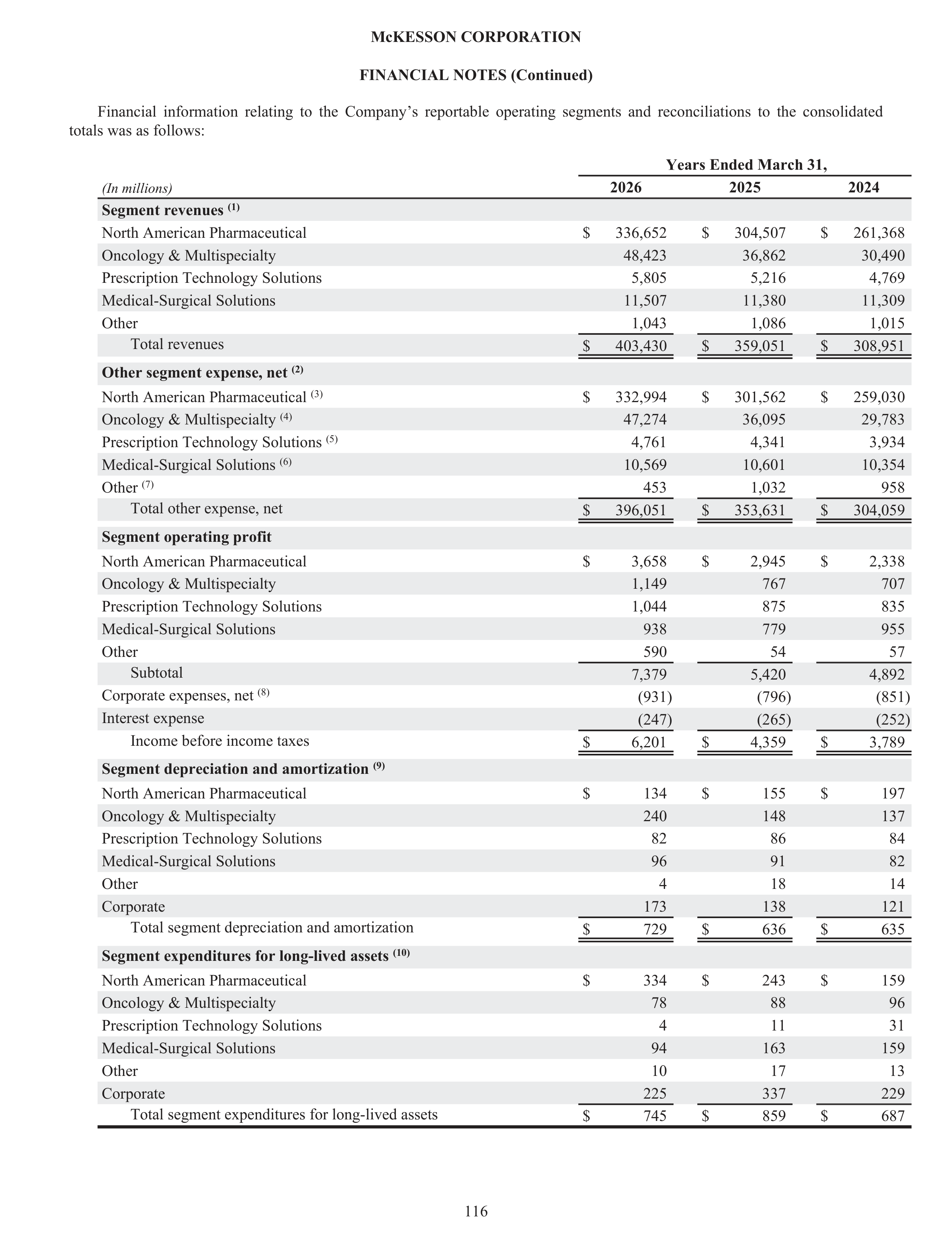
Financial
information
relating
to
the
Company’s
reportabl
a
e
operating
segments
and
reconciliations
to
the
consolidated
totals was as follows:
ars Ended March 31,
(In millions)s
2026
2025
2024
Segment revenues
(1)
North American Pharmaceutical
$
336,652
$
304,507
$
261,368
Oncology & Multispecialty
48,423
36,862
30,490
Prescription Technology Solutions
5,805
5,216
4,769
Medical-Surgical Solutions
11,507
11,380
11,309
Other
1,043
1,086
1,015
Total revenues
$
403,430
$
359,051
$
308,951
Other segment expense, net
(2)
North American Pharmaceutical
(3)
$
332,994
$
301,562
$
259,030
Oncology & Multispecialty
(4)
47,274
36,095
29,783
Prescription Technology Solutions
(5)
4,761
4,341
3,934
Medical-Surgical Solutions
(6)
10,569
10,601
10,354
Other
(7)
453
1,032
958
Total other expense, net
$
396,051
$
353,631
$
304,059
Segment operating profit
f
North American Pharmaceutical
$
3,658
$
2,945
$
2,338
Oncology & Multispecialty
1,149
767
707
Prescription Technology Solutions
1,044
875
835
Medical-Surgical Solutions
938
779
955
Other
590
54
57
Subt
u
otal
7,379
5,420
4,892
Corporate expenses, net
(8)
(931)
(796)
(851)
Interest expense
(247)
(265)
(252)
Income before income taxes
$
6,201
$
4,359
$
3,789
Segment depreciation and amortization
(9)
North American Pharmaceutical
$
134
$
155
$
197
Oncology & Multispecialty
240
148
137
Prescription Technology Solutions
82
86
84
Medical-Surgical Solutions
96
91
82
Other
4
18
14
Corporate
173
138
121
Total segment depreciation and amortization
$
729
$
636
$
635
Segment expenditures for long-lived assets
(10)
North American Pharmaceutical
$
334
$
243
$
159
Oncology & Multispecialty
78
88
96
Prescription Technology Solutions
4
11
31
Medical-Surgical Solutions
94
163
159
Other
10
17
13
Corporate
225
337
229
Total segment expenditures for long-lived assets
$
745
$
859
$
687
McKESSON CORPORAT
R
ION
FINANCIAL NOTES (Continued)
116
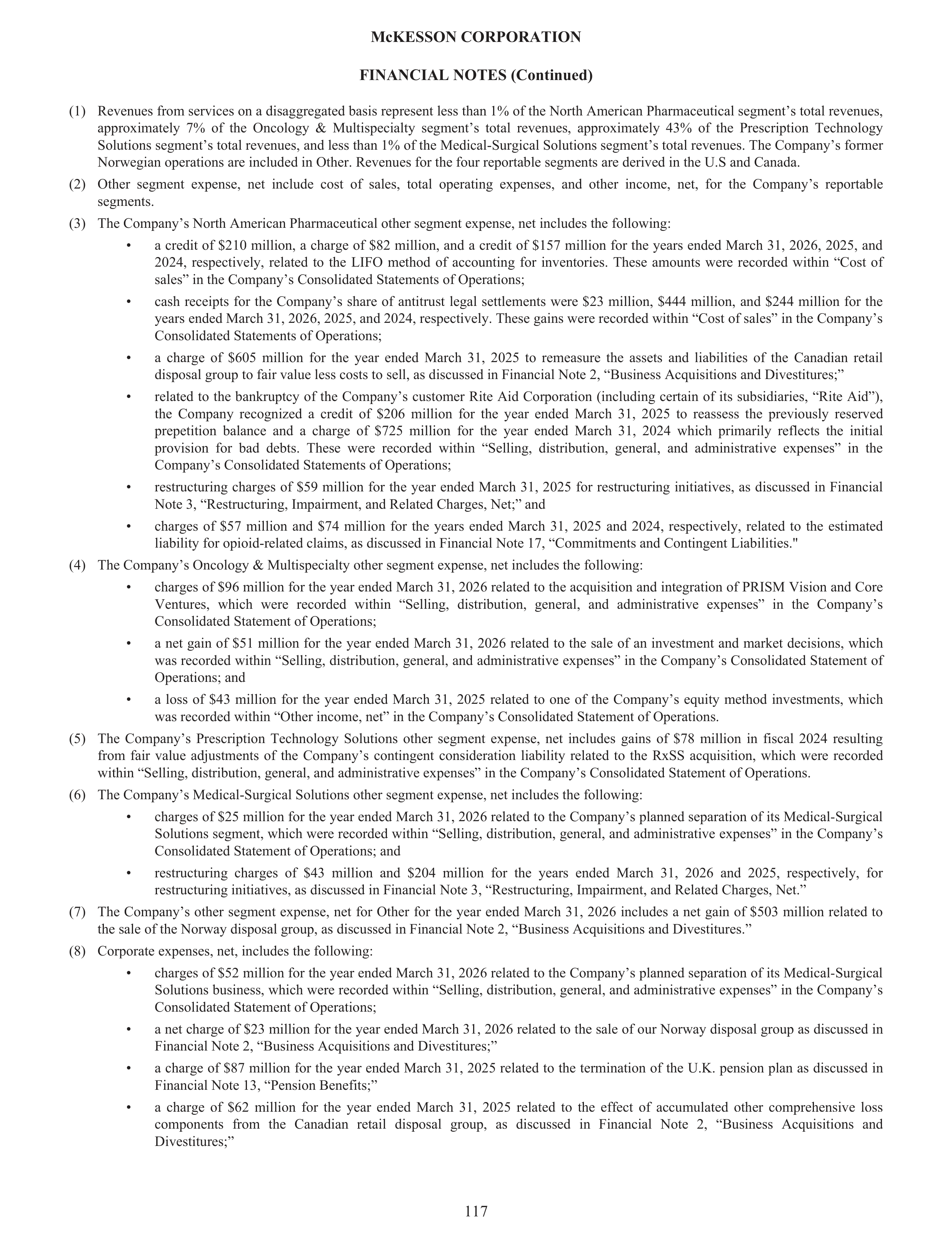
(1)
Revenues from services on a disaggregated basis represent less than 1% of the North American Pharmaceutical segment’s total revenues,
approximately
7%
of
the
Oncology
&
Multispecialty
segment’s
total
revenues,
approximately
43%
of
the
Prescription
Technology
Solutions segment’s total revenues, and less than 1% of the Medical-Surgical Solutions segment’s total revenues. The Company’s former
Norwegian operations are included in Other. Revenues for the four reportabl
a
e segments are derived in the U.S and Canada.
(2)
Other
segment
expense,
net
include
cost
of
sales,
total
operating
expenses,
and
other
income,
net,
for
the
Company’s
reportabl
a
e
segments.
(3)
The Company’s North American Pharmaceutical other segment expense, net includes the following:
•
a credit of $210 million, a charge of $82 million, and a credit of $157 million for the years ended March 31, 2026, 2025, and
2024,
respectively,
related
to
the
LIFO
method
of
accounting
for
inventories.
These
amounts
were
recorded
within
“Cost
of
sales” in the Company’s Consolidated Statements of Operations;
•
cash
receipts
for
the
Company’s
share
of
antitrus
r
t
legal
settlements
were
$23
million,
$444
million,
and
$244
million
for
the
years ended March 31, 2026, 2025, and 2024, respectively. These gains were recorded within “Cost of sales” in the Company’s
Consolidated Statements of Operations;
•
a
charge
of
$605
million
for
the
year
ended
March
31,
2025
to
remeasure
the
assets
and
liabi
a
lities
of
the
Canadian
retail
disposal group to fair value less costs to sell, as discussed in Financial Note 2, “Business Acquisitions and Divestitures;”
•
related
to
the
bankrupt
r
cy
of
the
Company’s
customer
Rite
Aid
Corporation
(including
certain
of
its
subs
u
idiaries,
“Rite
Aid”),
the
Company
recognized
a
credit
of
$206
million
for
the
year
ended
March
31,
2025
to
reassess
the
previously
reserved
prepetition
balance
and
a
charge
of
$725
million
for
the
year
ended
March
31,
2024
which
primarily
reflects
the
initial
provision
for
bad
debts.
These
were
recorded
within
“Selling,
distribution,
general,
and
administrative
expenses”
in
the
Company’s Consolidated Statements of Operations;
•
restruc
r
turing
charges
of
$59
million
for
the
year
ended
March
31,
2025
for
restructur
t
ing
initiatives,
as
discussed
in Financial
Note 3, “Restructuring, Impairment, and Related Charges, Net;” and
•
charges
of
$57
million
and
$74
million
for
the
years
ended
March
31,
2025
and
2024,
respectively,
related
to
the
estimated
liabi
a
lity for opioid-related claims, as discussed in Financial Note 17, “Commitments and Contingent Liabilities."
(4)
The Company’s Oncology & Multispecialty other segment expense, net includes the following:
•
charges of $96 million for the year ended March 31, 2026 related to the acquisition and integration of PRISM Vision and Core
Ventur
t
es,
which
were
recorded
within
“Selling,
distribution,
general,
and
administrative
expenses”
in
the
Company’s
Consolidated Statement of Operations;
•
a
net
gain
of
$51
million
for
the
year
ended
March
31,
2026
related
to
the
sale
of
an
investment
and
market
decisions,
which
was recorded within “Selling, distribution, general, and administrative expenses” in the Company’s Consolidated Statement of
Operations; and
•
a
loss
of
$43
million
for
the
year
ended
March
31,
2025
related
to
one
of
the
Company’s
equity
method
investments,
which
was recorded within “Other income, net” in the Company’s Consolidated Statement of Operations.
(5)
The
Company’s
Prescription
Technology
Solutions
other
segment
expense,
net
includes
gains
of
$78
million
in
fiscal
2024
resulting
from
fair
value
adju
d
stments
of
the
Company’s
contingent
consideration
liabi
a
lity
related
to
the
RxSS
acquisition,
which
were
recorded
within “Selling, distribution, general, and administrative expenses” in the Company’s Consolidated Statement of Operations.
(6)
The Company’s Medical-Surgical Solutions other segment expense, net includes the following:
•
charges of $25 million for the year ended March 31, 2026 related to the Company’s planned separation of its Medical
-
Surgical
Solutions segment, which were recorded within “Selling, distribution, general, and administrative expenses” in the Company’s
Consolidated Statement of Operations; and
•
restruc
r
turing
charges
of
$43
million
and
$204
million
for
the
years
ended
March
31,
2026
and
2025,
respectively,
for
restructur
t
ing initiatives, as discussed in Financial Note 3, “Restructuring, Impairment, and Related Charges, Net.”
(7)
The
Company’s
other
segment
expense,
net
for
Other
for
the
year
ended
March
31,
2026
includes
a
net
gain
of $503
million
related
to
the sale of the Norway disposal group, as discussed in Financial Note 2, “Business Acquisitions and Divestitures.”
(8)
Corpor
r
ate expenses, net, includes the following:
•
charges of $52 million for the year ended March 31, 2026 related to the Company’s planned separation of its Medical
-
Surgical
Solutions business, which were recorded within “Selling, distribution, general, and administrative expenses” in the Company’s
Consolidated Statement of Operations;
•
a net charge of $23 million for the year ended March 31, 2026 related to the sale of our Norway disposal group as discussed in
Financial Note 2, “Business Acquisitions and Divestitures;”
•
a charge of $87 million for the year ended March 31, 2025 related to the termination of the U.K. pension plan as discussed in
Financial Note 13, “Pension Benefits;”
•
a
charge
of
$62
million
for
the
year
ended
March
31,
2025
related
to
the
effe
f
ct
of
accumulated
other
comprehensive
loss
components
from
the
Canadian
retail
disposal
group,
as
discussed
in
Financial
Note
2,
“Business
Acquisitions
and
Divestitures;”
McKESSON CORPORAT
R
ION
FINANCIAL NOTES (Continued)
117
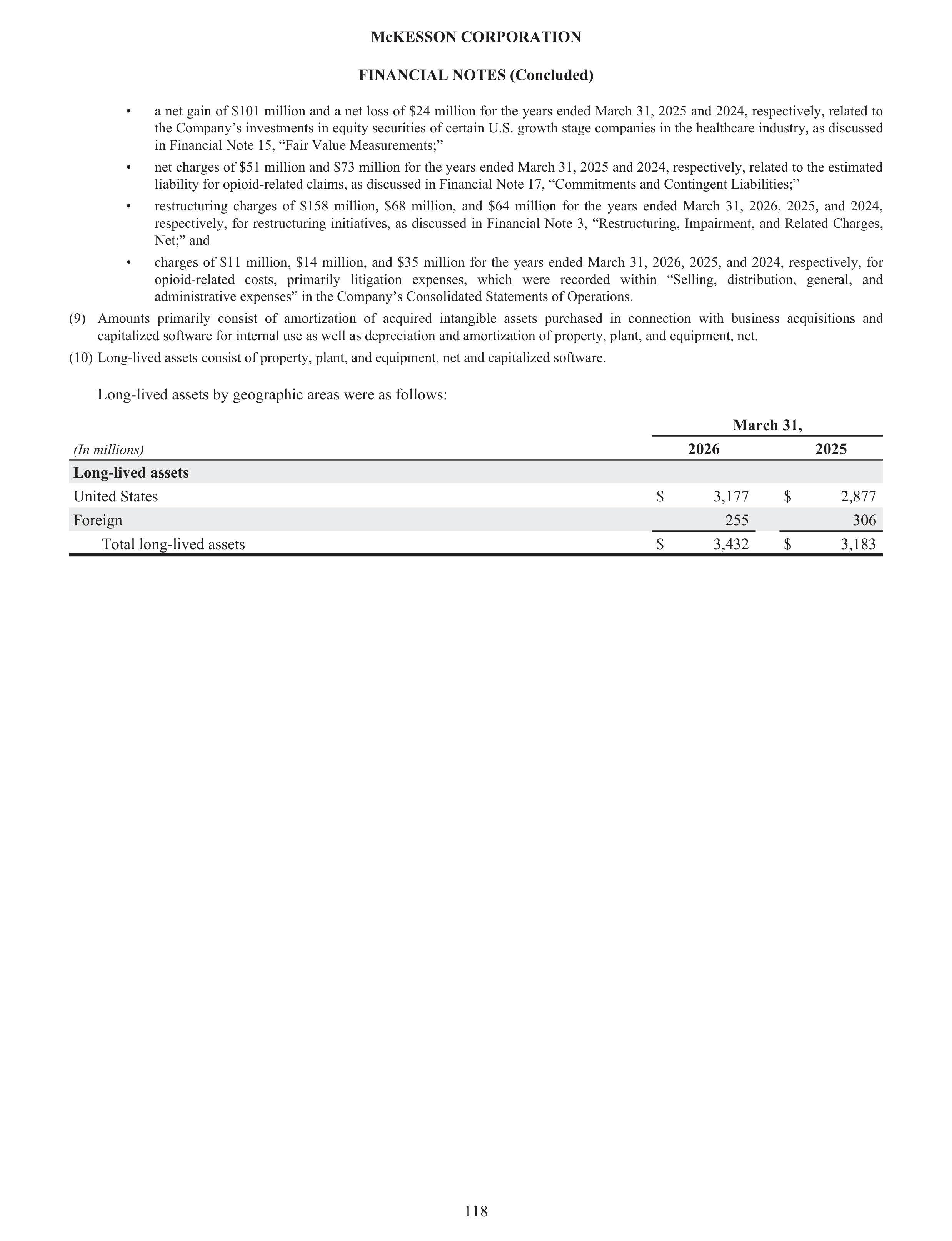
•
a net gain of $101 million and a net loss of $24 million for the years ended March 31, 2025 and 2024, respectively, related to
the Company’s investments in equity securities of certain U.S. growth stage companies in the healthcare industry,
r
as discussed
in Financial Note 15, “Fair Value Measurements;”
•
net charges of $51 million and $73 million for the years ended March 31, 2025 and 2024, respectively, related to the estimated
liabi
a
lity for opioid-related claims, as discussed in Financial Note 17, “Commitments and Contingent Liabilities;”
•
restruc
r
turing
charges
of
$158
million,
$68
million,
and
$64
million
for
the
years
ended
March
31,
2026,
2025,
and
2024,
respectively,
for
restruc
r
turing
initiatives,
as
discussed
in
Financial
Note
3,
“Restructuring,
Impairment,
and
Related
Charges,
Net;” and
•
charges
of
$11
million,
$14
million,
and
$35
million
for
the
years
ended
March
31,
2026,
2025,
and
2024,
respectively,
for
opioid-related
costs,
primarily
litigation
expenses,
which
were
recorded
within
“Selling,
distribution,
general,
and
administrative expenses” in the Company’s Consolidated Statements of Operations.
(9)
Amounts
primarily
consist
of
amortization
of
acquired
intangible
assets
purchased
in
connection
with
business
acquisitions
and
capitalized software for
f
internal use as well as depreciation and amortization of property, plant, and equipment, net.
(10)
Long-lived assets consist of property, plant, and equipment, net and capitalized software.
Long-lived assets by geographic areas were as follows:
March 31,
(In millions)s
2026
2025
Long-lived assets
United States
$
3,177
$
2,877
Foreign
255
306
Total long-lived assets
$
3,432
$
3,183
McKESSON CORPORAT
R
ION
FINANCIAL NOTES (Concluded)
118
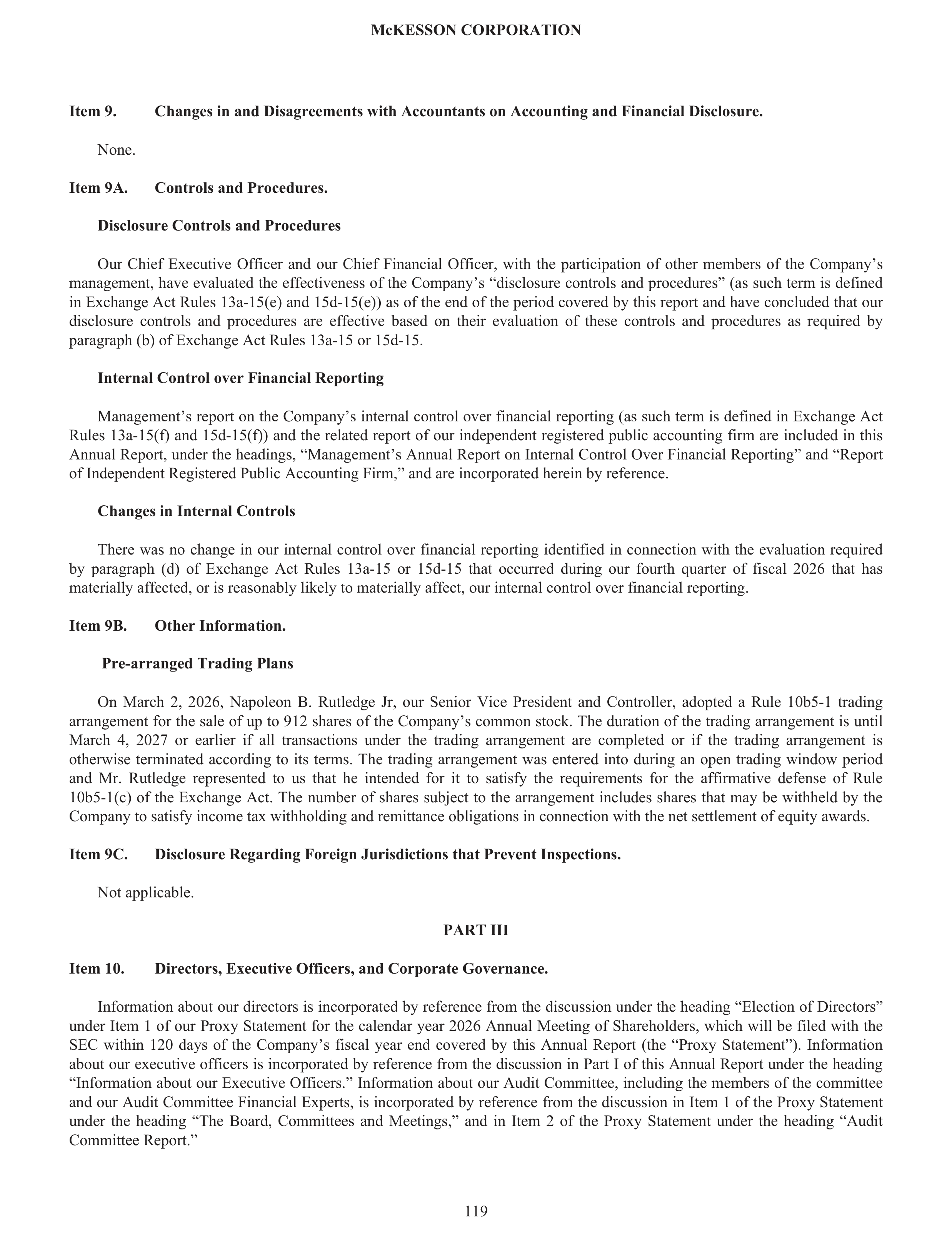
Item 9.
Changes in and Disagreements with Accountants on Accounting and Financial Disclosure.
None.
Item 9A.
Controls and Procedures.
Disclosure Controls and Procedures
Our
Chief
Executive
Offi
f
cer
and
our
Chief
Financial
Offi
f
cer,
with
the
participation
of
other
members
of
the
Company’s
management, have evaluated the effe
f
ctiveness of the Company’s “disclosure controls and procedur
d
es” (as such term is defined
in Exchange Act Rules 13a-15(e) and 15d-15(e)) as of the end of the period covered by this report and have concluded that our
disclosure
controls
and
procedur
d
es
are
effe
f
ctive
based
on
their
evaluation
of
these
controls
and
procedur
d
es
as
required
by
paragraph (b) of Exchange Act Rules 13a-15 or 15d-15.
Internal Control over Financial Reporting
Management’s report on the Company’s internal control over financial reporting (as such term is defined in Exchange Act
Rules 13a-15(f)
and
15d-15(f)) and the related report of
our independent registered public accounting firm are included in this
Annual Report, under the headings, “Management’s Annual Report on Internal Control Over Financial Reporting” and “Report
of Independent Registered Publ
u
ic Accounting Firm,” and are incorporated herein by reference.
Changes in Internal Controls
There
was
no
change
in
our
internal
control
over
financial
reporting
identifie
f
d
in
connection
with
the
evaluation
required
by
paragraph
(d)
of
Exchange
Act
Rules
13a-15
or
15d-15
that
occurred
during
our
fourth
quarter
of
fiscal
2026
that
has
materially affe
f
cted, or is reasonabl
a
y likely to materially affe
f
ct, our internal control over financial reporting.
Item 9B.
Other Information.
Pre-arranged Trading Plans
On
March
2,
2026,
Napol
a
eon
B.
Rutledge
Jr,
our
Senior
Vice
President
and
Controller,
adopted
a
Rule
10b5-1
trading
arrangement for the sale of up to 912 shares of the Company’s common stock. The duration of the trading arrangement is until
March
4,
2027
or
earlier
if
all
transactions
under
the
trading
arrangement
are
completed
or
if
the
trading
arrangement
is
otherwise
terminated
according
to
its
terms.
The
trading
arrangement
was
entered
into
during
an
open
trading
window
period
and
Mr.
Rutledge
represented
to
us
that
he
intended
for
it
to
satisfy
the
requirements
for
the
affi
f
rmative
defense
of
Rule
10b5-1(c)
of
the
Exchange
Act.
The
number
of
shares
subj
u
ect
to
the
arrangement
includes
shares
that
may
be
withheld
by
the
Company to satisfy income tax withholding and remittance obligations in connection with the net settlement of equity awards.
Item 9C.
Disclosure Regarding Foreign Jurisdictions that Prevent Inspections.
Not applicable.
PART III
Item 10.
Directors, Executive Offi
f
cers, and Corporate Governance.
Information about our directors is incorporated by reference from the discussion under the heading “Election of Directors”
under
Item 1
of
our
Proxy
Statement for
the
calendar
year
2026
Annual Meeting
of
Shareholders,
which
will be
filed
with
the
SEC
within
120
days
of
the
Company’s
fiscal
year
end
covered
by
this
Annual
Report
(the
“Proxy
Statement”).
Information
about our executive offi
f
cers is incorporated by reference from the discussion in Part I of this Annual Report under the heading
“Infor
f
mation about our Executive Offi
f
cers.” Information about our Audit Committee, including the members of the committee
and our Audit Committee Financial Experts, is incorporated by reference from the discussion in Item 1 of the Proxy Statement
under
the
heading
“The
Board,
Committees
and
Meetings,”
and
in
Item
2
of
the
Proxy
Statement
under
the
heading
“Audit
Committee Report.”
McKESSON CORPORAT
R
ION
119
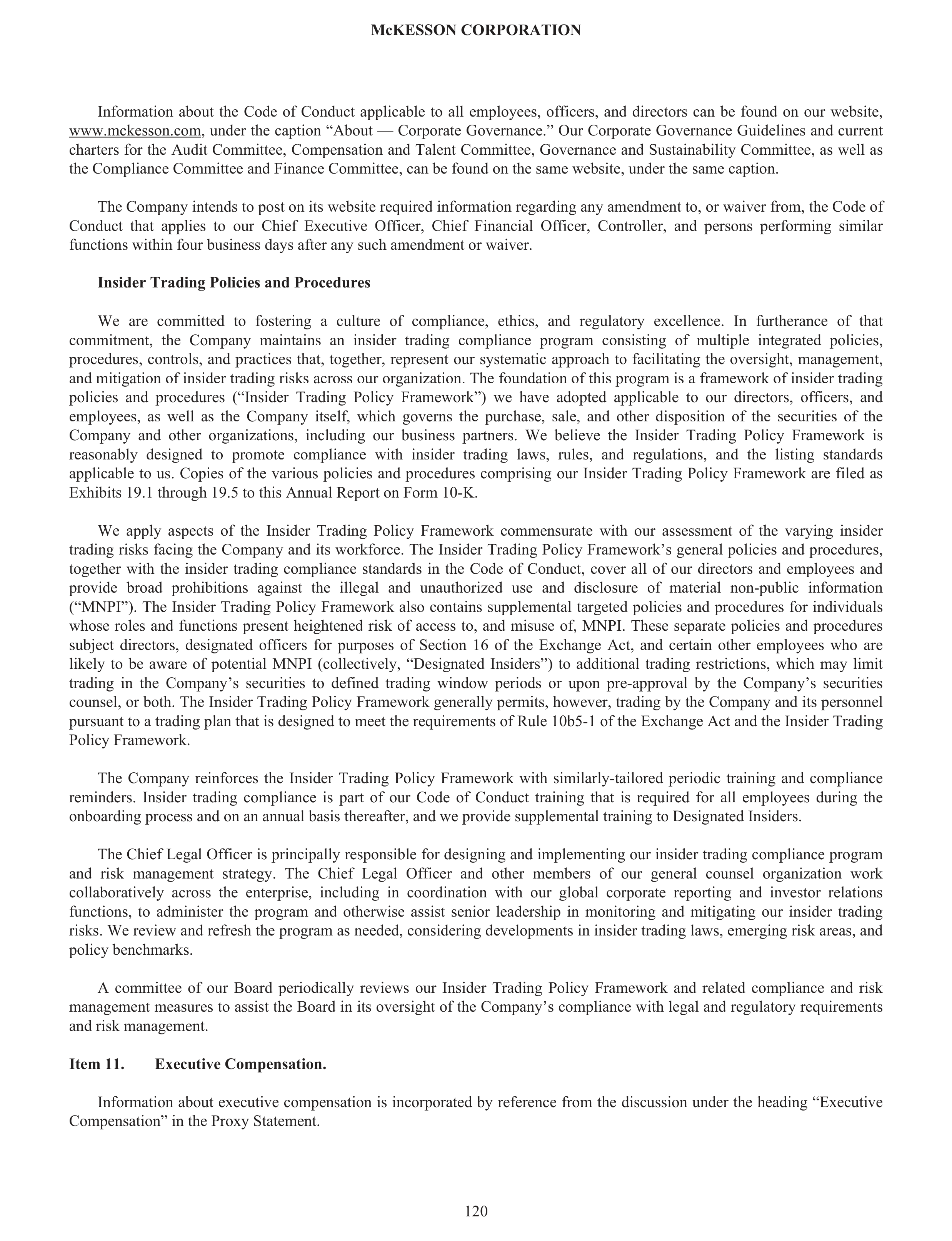
Information
about
the
Code
of
Conduct
applicable
to
all
employees,
offi
f
cers,
and
directors
can
be
found
on
our
website,
www.mckesson.com, under the capt
a
ion “About — Corporate Governance.” Our Corporate Governance Guidelines and current
charters for
the Audit Committee,
Compensation and Talent Committee,
Governance and Sustainabi
a
lity Committee, as well as
the Compliance Committee and Finance Committee, can be found on the same website, under the same caption.
The Company intends to post on its website required information regarding any amendment to, or waiver from, the Code of
Conduct
that
applies
to
our
Chief
Executive
Offi
f
cer,
Chief
Financial
Offi
f
cer,
Controller,
and
persons
performing
similar
functions within four business days afte
f
r any such amendment or waiver.
Insider Trading Policies and Procedures
We
are
committed
to
fostering
a
culture
of
compliance,
ethics,
and
regulatory
r
excellence.
In
furtherance
of
that
commitment,
the
Company
maintains
an
insider
trading
compliance
program
consisting
of
multiple
integrated
policies,
procedur
d
es,
controls,
and
practices
that,
together,
represent
our
systematic
approach
to
facilitating
the
oversight,
management,
and mitigation of insider trading risks across our organization. The foundation of this program is a framework of insider trading
policies
and
procedur
d
es
(“Insider
Trading
Policy
Framework”)
we
have
adopted
applicable
to
our
directors,
offi
f
cers,
and
employees,
as
well
as
the
Company
itself,
which
governs
the
purchase,
sale,
and
other
disposition
of
the
securities
of
the
Company
and
other
organizations,
including
our
business
partners.
We
believe
the
Insider
Trading
Policy
Framework
is
reasonabl
a
y
designed
to
promote
compliance
with
insider
trading
laws,
rules,
and
regulations,
and
the
listing
standards
applicable
to
us.
Copies
of
the
various
policies
and
procedur
d
es
comprising
our
Insider
Trading
Policy
Framework
are
filed
as
Exhibits 19.1 through 19.5 to this Annual Report on Form 10-K.
We
apply
aspects
of
the
Insider
Trading
Policy
Framework
commensurate
with
our
assessment
of
the
varying
insider
trading risks facing the Company and its workforce. The Insider Trading Policy Framework’s general policies and procedur
d
es,
together
with
the
insider
trading
compliance
standards
in
the
Code
of
Conduct,
cover
all
of
our
directors
and
employees
and
provide
broad
prohibitions
against
the
illegal
and
unauthorized
use
and
disclosure
of
material
non-public
information
(“MNPI”).
The
Insider
Trading
Policy
Framework
also
contains
suppl
u
emental
targeted
policies
and
procedur
d
es
for
individuals
whose
roles
and
functions
present
heightened
risk
of
access
to,
and
misuse
of,f
MNPI.
These
separate
policies
and
procedur
d
es
subj
u
ect
directors,
designated
offi
f
cers
for
purpos
r
es
of
Section
16
of
the
Exchange
Act,
and
certain
other
employees
who
are
likely
to
be
aware
of
potential
MNPI
(collectively,
“Designated
Insiders”)
to
additional
trading
restrictions,
which
may
limit
trading
in
the
Company’s
securities
to
defined
trading
window
periods
or
upon
pre-approval
by
the
Company’s
securities
counsel, or both. The Insider Trading Policy Framework generally permits, however, trading by the Company and its personnel
pursuant to a trading plan that is designed to meet the requirements of Rule 10b5-1 of the Exchange Act and the Insider Trading
Policy Framework.
The
Company
reinforces
the
Insider
Trading
Policy
Framework
with
similarly-tailored
periodic
training
and
compliance
reminders.
Insider
trading
compliance
is
part
of
our
Code
of
Conduct
training
that
is
required
for
all
employees
during
the
onboarding process and on an annual basis thereafte
f
r, and we provide suppl
u
emental training to Designated Insiders.
The Chief Legal Offi
f
cer is principally responsible for designing and implementing our insider trading compliance program
and
risk
management
strategy.
The
Chief
Legal
Offi
f
cer
and
other
members
of
our
general
counsel
organization
work
collabor
a
atively
across
the
enterprise,
including
in
coordination
with
our
global
corporate
reporting
and
investor
relations
functions,
to
administer
the
program
and
otherwise
assist
senior
leadership
in
monitoring
and
mitigating
our
insider
trading
risks. We review and refresh the program as needed, considering developments in insider trading laws, emerging risk areas, and
policy benchmarks.
A
committee
of
our
Board
periodically
reviews
our
Insider
Trading
Policy
Framework
and
related
compliance
and
risk
management measures to assist the Board in its oversight of the Company’s compliance with legal and regulatory
r
requirements
and risk management.
Item 11.
Executive Compensation.
Information
about
executive
compensation
is
incorporated
by
reference
from
the
discussion
under
the
heading
“Executive
Compensation” in the Proxy Statement.
McKESSON CORPORAT
R
ION
120
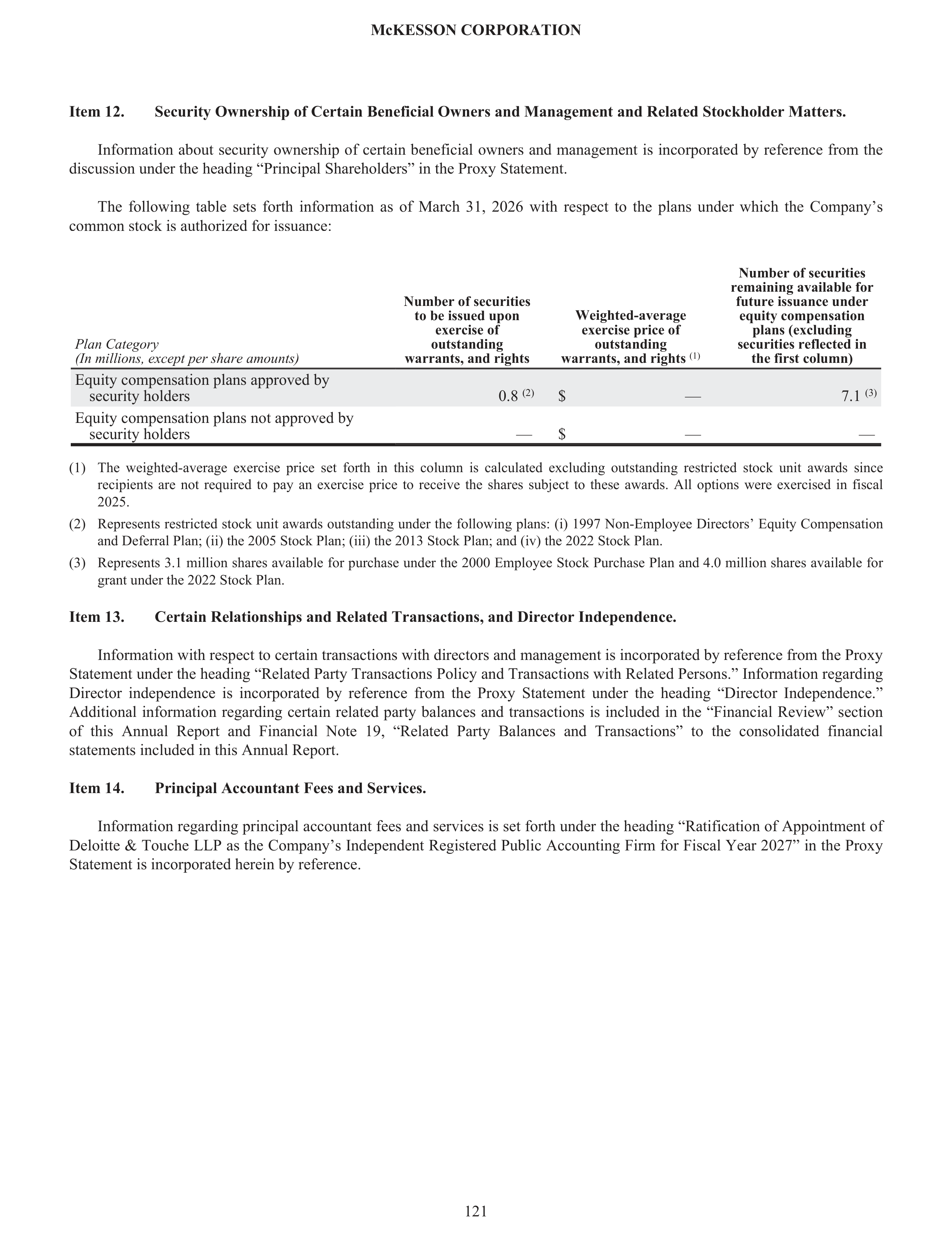
Item 12.
Security Ownership of Certain Beneficial Owners and Management and Related Stockholder Matters.
Information
about
security
ownership
of
certain
beneficial
owners
and
management
is
incorporated
by
reference
from
the
discussion under the heading “Principal Shareholders” in the Proxy Statement.
The
following
tabl
a
e
sets
forth
information
as
of
March
31,
2026
with
respect
to
the
plans
under
which
the
Company’s
common stock is authorized for issuance:
Plan Categor
e
y
r
(In millions, except per share amounts)s
Number of securities
to be issued upon
exercise of
outstanding
warrants, and rights
Weighted-average
exercise price of
outstanding
warrants, and rights
(1)
Number of securities
remaining available for
future issuance under
equity compensation
plans (excluding
securities refle
f
cted in
the first column)
Equity compensation plans approved by
security holders
0.8
(2)
$
—
7.1
(3)
Equity compensation plans not approved by
security holders
—
$
—
—
(1)
The
weighted-average
exercise
price
set
forth
in
this
column
is
calculated
excluding
outstanding
restricted
stock
unit
awards
since
recipients
are
not
required
to
pay
an
exercise
price
to
receive
the
shares
subj
u
ect
to
these
awards.
All
options
were
exercised
in
fiscal
2025.
(2)
Represents restricted stock unit awards outstanding under the following plans: (i) 1997 Non-Employee Directors’ Equity Compensation
and Deferral Plan; (ii) the 2005 Stock Plan; (iii) the 2013 Stock Plan; and (iv) the 2022 Stock Plan.
(3)
Represents 3.1 million shares availabl
a
e for purchase under the 2000 Employee Stock Purchase Plan and 4.0 million shares availabl
a
e for
grant under the 2022 Stock Plan.
Item 13.
Certain Relationships and Related Transactions, and Director Independence.
Information with respect to certain transactions with directors and management is incorporated by reference from the Proxy
Statement under the heading “Related Party Transactions Policy and Transactions with Related Persons.” Information regarding
Director
independence
is
incorporated
by
reference
from
the
Proxy
Statement
under
the
heading
“Director
Independence.”
Additional
information
regarding
certain
related
party
balances
and
transactions
is
included
in
the
“Financial
Review”
section
of
this
Annual
Report
and
Financial
Note
19,
“Related
Party
Balances
and
Transactions”
to
the
consolidated
financial
statements included in this Annual Report.
Item 14.
Principal Accountant Fees and Services.
Information regarding principal accountant fees and services is set forth under the heading “Ratific
f
ation of Appointment of
Deloitte & Touche LLP as the Company’s Independent Registered Publ
u
ic Accounting Firm for Fiscal Year 2027” in the Proxy
Statement is incorporated herein by reference.
McKESSON CORPORAT
R
ION
121
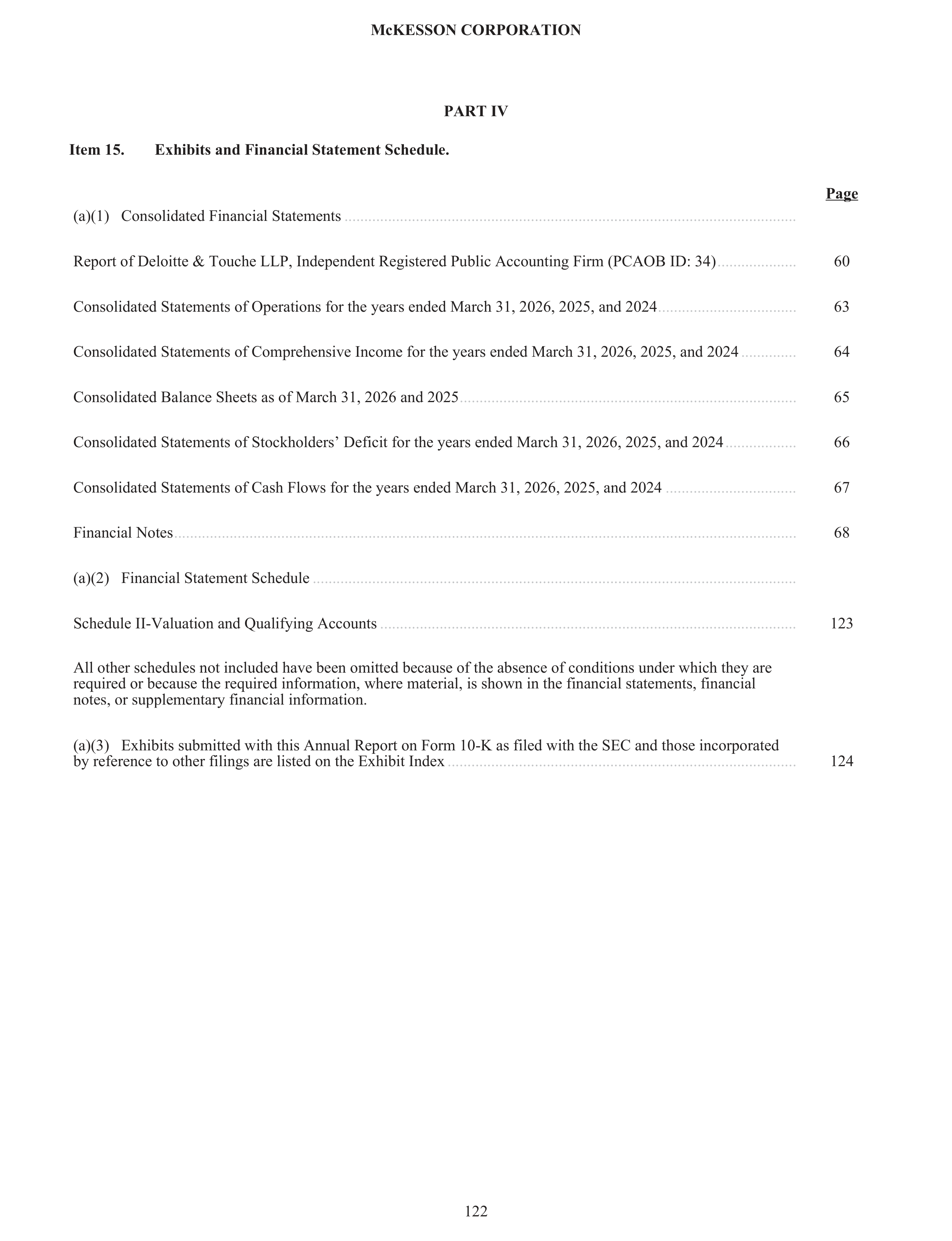
PART IV
Item 15.
Exhibits and Financial Statement Schedule.
Page
g
(a)(1)
Consolidated Financial Statements
..................................................................................................................
Report of Deloitte & Touche LLP, Independent Registered Public Accounting Firm (PCAOB ID: 34)
....................
60
Consolidated Statements of Operations for the years ended March 31, 2026, 2025, and 2024
...................................
63
Consolidated Statements of Comprehensive Income for the years ended March 31, 2026, 2025, and 2024
..............
64
Consolidated Balance Sheets as of March 31, 2026 and 2025
.....................................................................................
65
Consolidated Statements of Stockholders’ Deficit for the years ended March 31, 2026, 2025, and 2024
..................
66
Consolidated Statements of Cash Flows for the years ended March 31, 2026, 2025, and 2024
.................................
67
Financial Notes
.............................................................................................................................................................
68
(a)(2)
Financial Statement Schedule
..........................................................................................................................
Schedule II-Valuation and Qualifying Accounts
.........................................................................................................
123
All other schedules not included have been omitted because of the absence of conditions under which they are
required or because the required information, where material, is shown in the financial statements, financial
notes, or suppl
u
ementary financial information.
(a)(3)
Exhibits submitted with this Annual Report on Form 10-K as filed with the SEC and those incorporated
by reference to other filings are listed on the Exhibit Index
........................................................................................
124
McKESSON CORPORAT
R
ION
122
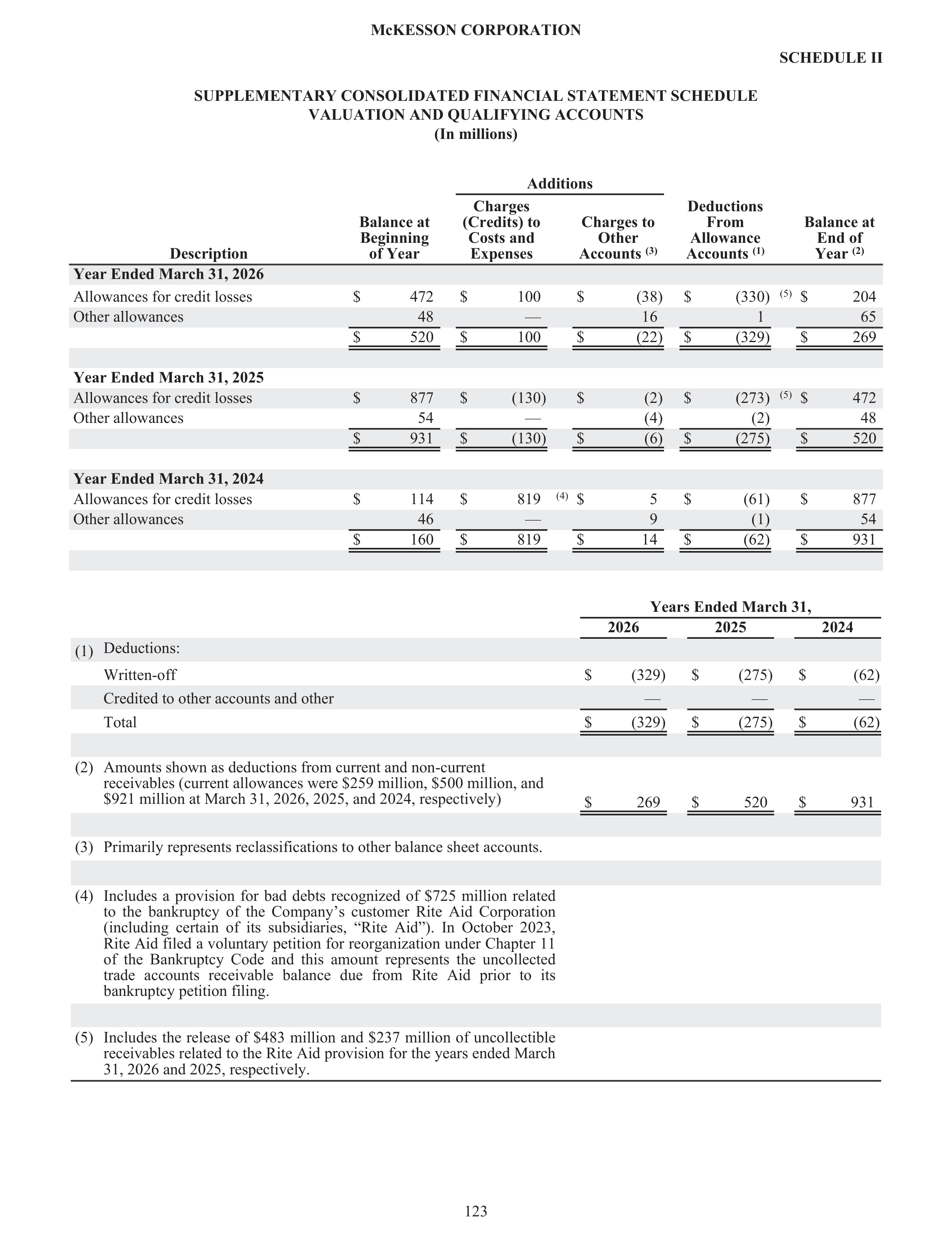
SCHEDULE II
SUPPLEMENTARY CONSOLIDATED FINANCIAL STATEMENT SCHEDULE
VALUATION AND QUALIFYING ACCOUNTS
(In millions)
ditions
Description
Balance at
Beginning
of Year
Charges
(Credits) to
Costs and
Expenses
Charges to
Other
Accounts
(3)
Deductions
From
Allowance
Accounts
(1)
Balance at
End of
Year
(2)
Year Ended March 31, 2026
Allowances for credit losse
$
s
472
$
100
$
(38)
$
(330)
(5)
$
204
Other allowances
48
—
16
1
65
$
520
$
100
$
(22)
$
(329)
$
269
Year Ended March 31, 2025
Allowances for credit losses
$
877
$
(130)
$
(2)
$
(273)
(5)
$
472
Other allowances
54
—
(4)
(2)
48
$
931
$
(130)
$
(6)
$
(275)
$
520
Year Ended March 31, 2024
Allowances for credit losses
$
114
$
819
(4)
$
5
$
(61)
$
877
Other allowances
46
—
9
(1)
54
$
160
$
819
$
14
$
(62)
$
931
Years Ended March 31,
2026
2025
2024
(1)
Deductions:
Written-off
$
f
(329)
$
(275)
$
(62)
Credited to other accounts and other
—
—
—
Total
$
(329)
$
(275)
$
(62)
(2)
Amounts shown as deductions from current and non-current
receivabl
a
es (current allowances were $259 million, $500 million, and
$921 million at March 31, 2026, 2025, and 2024, respectively)
$
269
$
520
$
931
(3)
Primarily represents reclassifications to other balance sheet accounts.
(4)
Includes
a
provision
for
bad
debts
recognized
of
$725
million
related
to
the
bankrupt
r
cy
of
the
Company’s
customer
Rite
Aid
Corporation
(including
certain
of
its
subs
u
idiaries,
“Rite
Aid”).
In
October
2023,
Rite Aid filed a voluntary
r
petition for reorganization under Chapter 11
of
the
Bankrupt
r
cy
Code
and
this
amount
represents
the
uncollected
trade
accounts
receivabl
a
e
balance
due
from
Rite
Aid
prior
to
its
bankrupt
r
cy petition filing.
(5)
Includes
the
release
of
$483
million
and
$237
million
of
uncollectible
receivabl
a
es related to the Rite Aid provision for the years ended March
31, 2026 and 2025, respectively.
McKESSON CORPORAT
R
ION
123
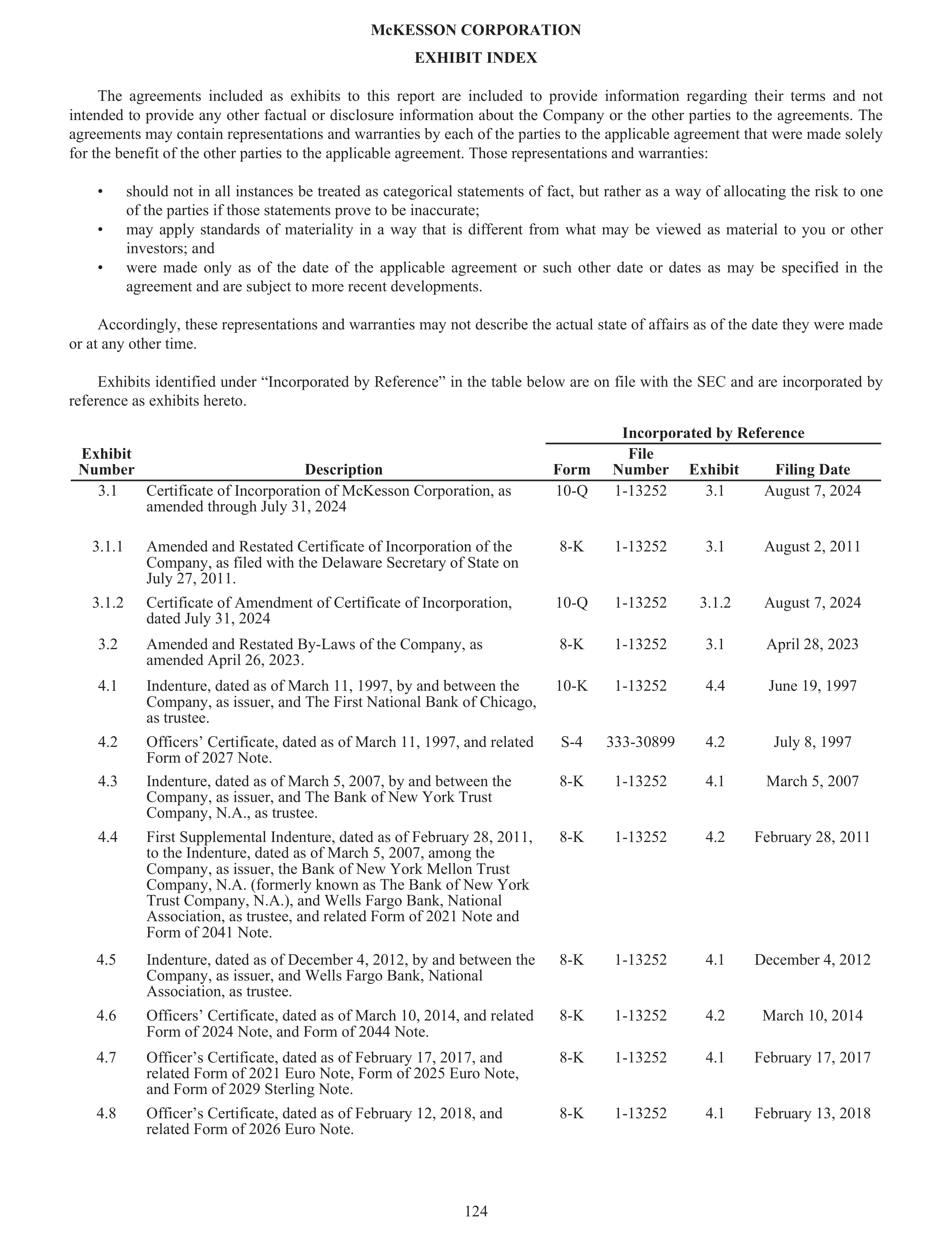
EXHIBIT INDEX
The
agreements
included
as
exhibits
to
this
report
are
included
to
provide
information
regarding
their
terms
and
not
intended
to
provide
any
other
factua
t
l
or
disclosure
information
about
the
Company
or
the
other
parties
to
the
agreements.
The
agreements may contain representations and warranties by each of the parties to the applicable agreement that were made solely
for the benefit of the other parties to the applicable agreement. Those representations and warranties:
•
should not in all instances be treated as categorical statements of fact, but rather as a way of allocating the risk to one
of the parties if those statements prove to be inaccurate;
•
may
apply
standards
of
materiality
in
a
way
that
is
different
from
what
may
be
viewed
as
material
to
you
or
other
investors; and
•
were
made
only
as
of
the
date
of
the
applicable
agreement
or
such
other
date
or
dates
as
may
be
specified
in
the
agreement and are subj
u
ect to more recent developments.
Accordingly, these representations and warranties may not describe the actua
t
l state of affa
f
irs as of the date they were made
or at any other time.
Exhibits identifie
f
d under “Incorpor
r
ated by Reference” in the tabl
a
e below are on file with the SEC and are incorporated by
reference as exhibits hereto.
3.1
Certificate of Incorporation of McKesson Corporation, as
amended through July 31, 2024
10-Q
1-13252
3.1
August 7, 2024
3.1.1
Amended and Restated Certificate of Incorporation of the
Company, as filed with the Delaware Secretary of State on
July 27, 2011.
8-K
1-13252
3.1
August 2, 2011
3.1.2
Certificate of Amendment of Certificate of Incorporation,
dated July 31, 2024
10-Q
1-13252
3.1.2
August 7, 2024
3.2
Amended and Restated By-Laws of the Company, as
amended April 26, 2023.
8-K
1-13252
3.1
April 28, 2023
4.1
Indenture, dated as of March 11, 1997, by and between the
Company, as issuer, and The First National Bank of Chicago,
as trustee.
10-K
1-13252
4.4
June 19, 1997
4.2
Officers’ Certificate, dated as of March 11, 1997, and related
Form of 2027 Note.
S-4
333-30899
4.2
July 8, 1997
4.3
Indenture, dated as of March 5, 2007, by and between the
Company, as issuer, and The Bank of New York Trust
Company, N.A., as trustee.
8-K
1-13252
4.1
March 5, 2007
4.4
First Supplemental Indenture, dated as of February 28, 2011,
to the Indenture, dated as of March 5, 2007, among the
Company, as issuer, the Bank of New York Mellon Trust
Company, N.A. (formerly known as The Bank of New York
Trust Company, N.A.), and Wells Fargo Bank, National
Association, as trustee, and related Form of 2021 Note and
Form of 2041 Note.
8-K
1-13252
4.2
Februa
r
ry 28, 2011
4.5
Indenture, dated as of December 4, 2012, by and between the
Company, as issuer, and Wells Fargo Bank, National
Association, as trustee.
8-K
1-13252
4.1
December 4, 2012
4.6
Officers’ Certificate, dated as of March 10, 2014, and related
Form of 2024 Note, and Form of 2044 Note.
8-K
1-13252
4.2
March 10, 2014
4.7
Officer’s Certificate, dated as of February 17, 2017, and
related Form of 2021 Euro Note, Form of 2025 Euro Note,
and Form of 2029 Sterling Note.
8-K
1-13252
4.1
Februa
r
ry 17, 2017
4.8
Officer’s Certificate, dated as of February 12, 2018, and
related Form of 2026 Euro Note.
8-K
1-13252
4.1
Februa
r
ry 13, 2018
Incorporated by Reference
Exhibit
Number
Description
Form
File
Number
Exhibit
Filing Date
McKESSON CORPORAT
R
ION
124
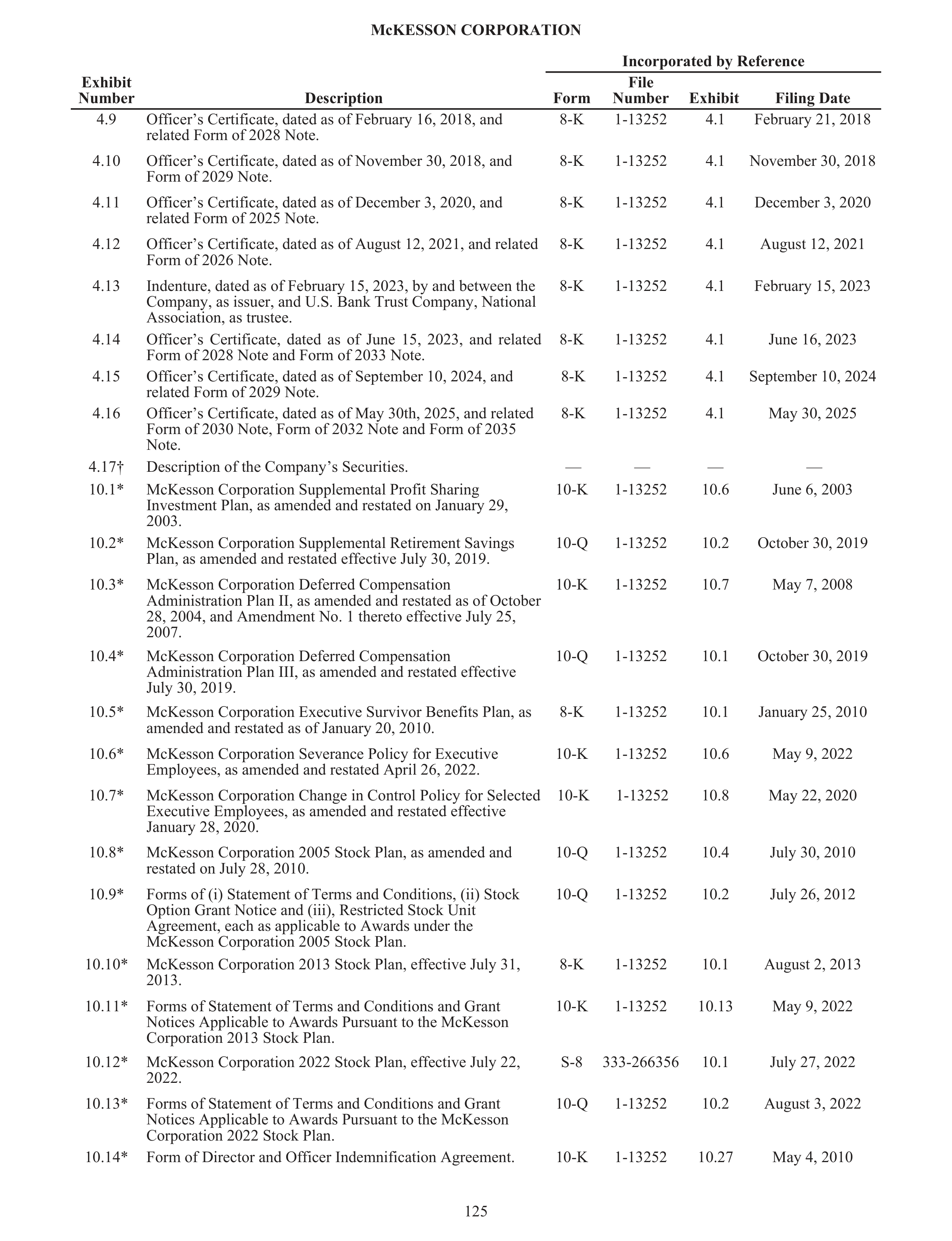
4.9
Officer’s Certificate, dated as of February 16, 2018, and
related Form of 2028 Note.
8-K
1-13252
4.1
Februa
r
ry 21, 2018
4.10
Officer’s Certificate, dated as of November 30, 2018, and
Form of 2029 Note.
8-K
1-13252
4.1
November 30, 2018
4.11
Officer’s Certificate, dated as of December 3, 2020, and
related Form of 2025 Note.
8-K
1-13252
4.1
December 3, 2020
4.12
Officer’s Certificate, dated as of August 12, 2021, and related
Form of 2026 Note.
8-K
1-13252
4.1
August 12, 2021
4.13
Indenture, dated as of February 15, 2023, by and between the
Company, as issuer, and U.S. Bank Trust Company, National
Association, as trustee.
8-K
1-13252
4.1
Februa
r
ry 15, 2023
4.14
Officer’s
Certificate,
dated
as
of
June
15,
2023,
and
related
Form of 2028 Note and Form of 2033 Note.
K
1-13252
4.1
June 16, 2023
4.15
Officer’s Certificate, dated as of September 10, 2024, and
related Form of 2029 Note.
8-K
1-13252
4.1
September 10, 2024
4.16
Officer’s Certificate, dated as of May 30th, 2025, and related
Form of 2030 Note, Form of 2032 Note and Form of 2035
Note.
8-K
1-13252
4.1
May 30, 2025
4.17†
Description of the Company’s Securities.
—
—
—
—
10.1*
McKesson Corporation Supplemental Profit Sharing
Investment Plan, as amended and restated on January 29,
2003.
10-K
1-13252
10.6
June 6, 2003
10.2*
McKesson Corporation Supplemental Retirement Savings
Plan, as amended and restated effective July 30, 2019.
10-Q
1-13252
10.2
October 30, 2019
10.3*
McKesson Corporation Deferred Compensation
Administration Plan II, as amended and restated as of October
28, 2004, and Amendment No. 1 thereto effective July 25,
2007.
10-K
1-13252
10.7
May 7, 2008
10.4*
McKesson Corporation Deferred Compensation
Administration Plan III, as amended and restated effective
July 30, 2019.
10-Q
1-13252
10.1
October 30, 2019
10.5*
McKesson Corporation Executive Survivor Benefits Plan, as
amended and restated as of January 20, 2010.
8-K
1-13252
10.1
January 25, 2010
10.6*
McKesson Corporation Severance Policy for Executive
Employees, as amended and restated April 26, 2022.
10-K
1-13252
10.6
May 9, 2022
10.7*
McKesson Corporation Change in Control Policy for Selected
Executive Employees, as amended and restated effective
January 28, 2020.
10-K
1-13252
10.8
May 22, 2020
10.8*
McKesson Corporation 2005 Stock Plan, as amended and
restated on July 28, 2010.
10-Q
1-13252
10.4
July 30, 2010
10.9*
Forms of (i) Statement of Terms and Conditions, (ii) Stock
Option Grant Notice and (iii), Restricted Stock Unit
Agreement, each as applicable to Awards under the
McKesson Corporation 2005 Stock Plan.
10-Q
1-13252
10.2
July 26, 2012
10.10*
McKesson Corporation 2013 Stock Plan, effective July 31,
2013.
8-K
1-13252
10.1
August 2, 2013
10.11*
Forms of Statement of Terms and Conditions and Grant
Notices Applicable to Awards Pursuant to the McKesson
Corporation 2013 Stock Plan.
K
1-13252
10.13
May 9, 2022
10.12*
McKesson Corporation 2022 Stock Plan, effective July 22,
2022.
S-8
333-266356
10.1
July 27, 2022
10.13*
Forms of Statement of Terms and Conditions and Grant
Notices Applicable to Awards Pursuant to the McKesson
Corporation 2022 Stock Plan.
Q
1-13252
10.2
August 3, 2022
10.14*
Form of Director and Officer Indemnification Agreement.
10-K
1-13252
10.27
May 4, 2010
Incorporated by Reference
Exhibit
Number
Description
Form
File
Number
Exhibit
Filing Date
McKESSON CORPORAT
R
ION
125
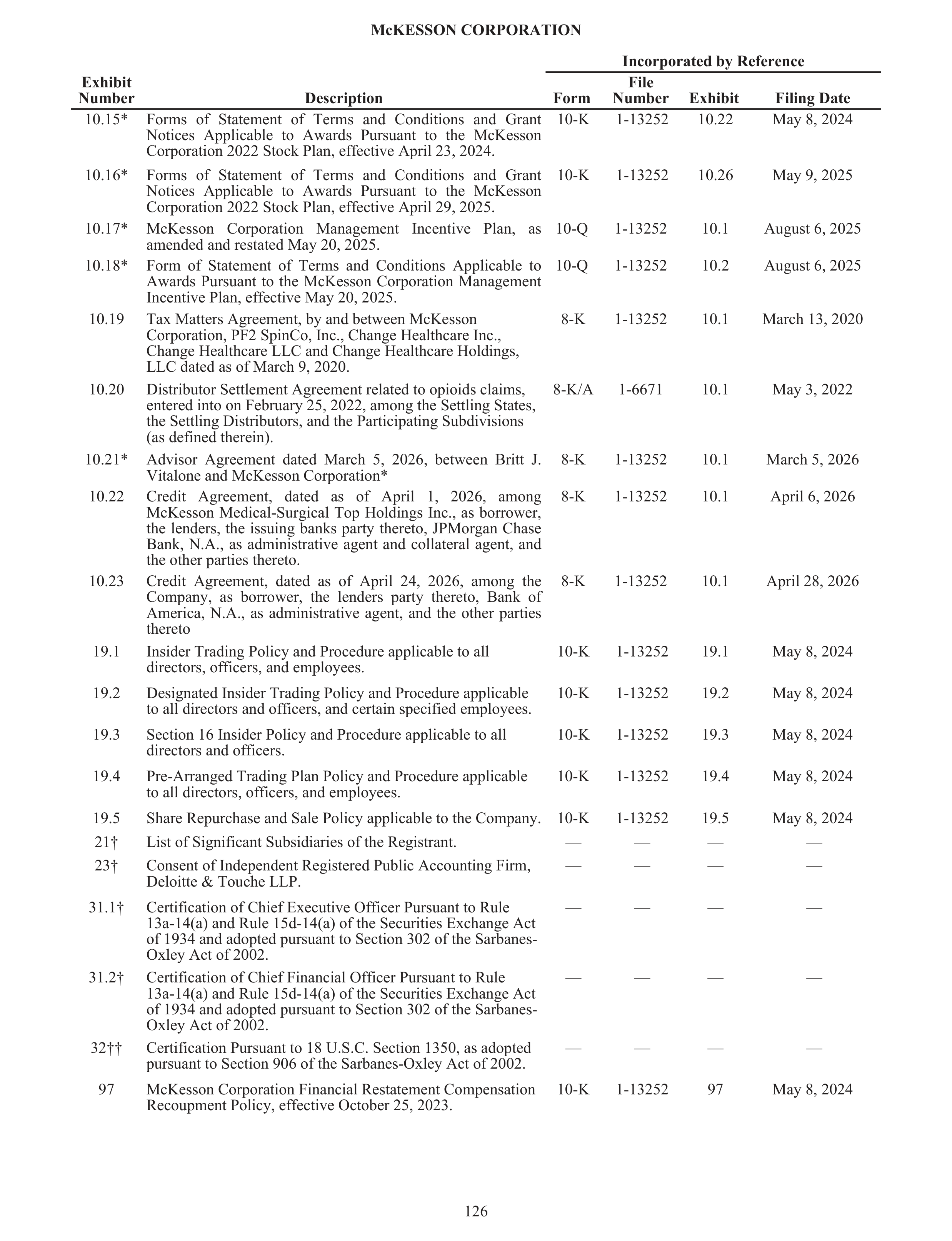
10.15*
Forms
of
Statement
of
Terms
and
Conditions
and
Grant
Notices
Applicable
to
Awards
Pursuant
to
the
McKesson
Corporation 2022 Stock Plan, effective April 23, 2024.
10-K
1-13252
10.22
May 8, 2024
10.16*
Forms
of
Statement
of
Terms
and
Conditions
and
Grant
Notices
Applicable
to
Awards
Pursuant
to
the
McKesson
Corporation 2022 Stock Plan, effective April 29, 2025.
10-K
1-13252
10.26
May 9, 2025
10.17*
McKesson
Corporation
Management
Incentive
Plan,
as
amended and restated May 20, 2025.
10-Q
1-13252
10.1
August 6, 2025
10.18*
Form
of
Statement
of
Terms
and
Conditions
Applicable
to
Awards
Pursuant
to
the
McKesson
Corporation
Management
Incentive Plan, effective May 20, 2025.
10-Q
1-13252
10.2
August 6, 2025
10.19
Tax Matters Agreement, by and between McKesson
Corporation, PF2 SpinCo, Inc., Change Healthcare Inc.,
Change Healthcare LLC and Change Healthcare Holdings,
LLC dated as of March 9, 2020.
K
1-13252
10.1
March 13, 2020
10.20
Distributor Settlement Agreement related to opioids claims,
entered into on February 25, 2022, among the Settling States,
the Settling Distributors, and the Participating Subdivisions
(as defined therein).
8-K/A
1-6671
10.1
May 3, 2022
10.21*
Advisor
Agreement
dated
March
5,
2026,
between
Britt
J.
Vitalone and McKesson Corporation*
8-K
1-13252
10.1
March 5, 2026
10.22
Credit
Agreement,
dated
as
of
April
1,
2026,
among
McKesson
Medical-Surgical
Top
Holdings
Inc.,
as
borrower,
the
lenders,
the
issuing
banks
party
thereto,
JPMorgan
Chase
Bank,
N.A.,
as
administrative
agent
and
collateral
agent,
and
the other parties thereto.
8-K
1-13252
10.1
April 6, 2026
10.23
Credit
Agreement,
dated
as
of
April
24,
2026,
among
the
Company,
as
borrower,
the
lenders
party
thereto,
Bank
of
America,
N.A.,
as
administrative
agent,
and
the
other
parties
thereto
8-K
1-13252
10.1
April 28, 2026
19.1
Insider Trading Policy and Procedure applicable to all
directors, officers, and employees.
10-K
1-13252
19.1
May 8, 2024
19.2
Designated Insider Trading Policy and Procedure applicable
to all directors and officers, and certain specified employees.
10-K
1-13252
19.2
May 8, 2024
19.3
Section 16 Insider Policy and Procedure applicable to all
directors and officers.
K
1-13252
19.3
May 8, 2024
19.4
Pre-Arranged Trading Plan Policy and Procedure applicable
to all directors, officers, and employees.
10-K
1-13252
19.4
May 8, 2024
19.5
Share Repurchase and Sale Policy applicable to the Company.
10-K
1-13252
19.5
May 8, 2024
21†
List of Significant Subsidiaries of the Registrant.
—
—
—
—
23†
Consent of Independent Registered Public Accounting Firm,
Deloitte & Touche LLP.
—
—
—
—
31.1†
Certification of Chief Executive Officer Pursuant to Rule
13a-14(a) and Rule 15d-14(a) of the Securities Exchange Act
of 1934 and adopted pursuant to Section 302 of the Sarbanes-
Oxley Act of 2002.
—
—
—
—
31.2†
Certification of Chief Financial Officer Pursuant to Rule
13a-14(a) and Rule 15d-14(a) of the Securities Exchange Act
of 1934 and adopted pursuant to Section 302 of the Sarbanes-
Oxley Act of 2002.
—
—
—
—
32††
Certification Pursuant to 18 U.S.C. Section 1350, as adopted
pursuant to Section 906 of the Sarbanes-Oxley Act of 2002.
—
—
—
—
97
McKesson Corporation Financial Restatement Compensation
Recoupment Policy, effective October 25, 2023.
10-K
1-13252
97
May 8, 2024
Incorporated by Reference
Exhibit
Number
Description
Form
File
Number
Exhibit
Filing Date
McKESSON CORPORAT
R
ION
126
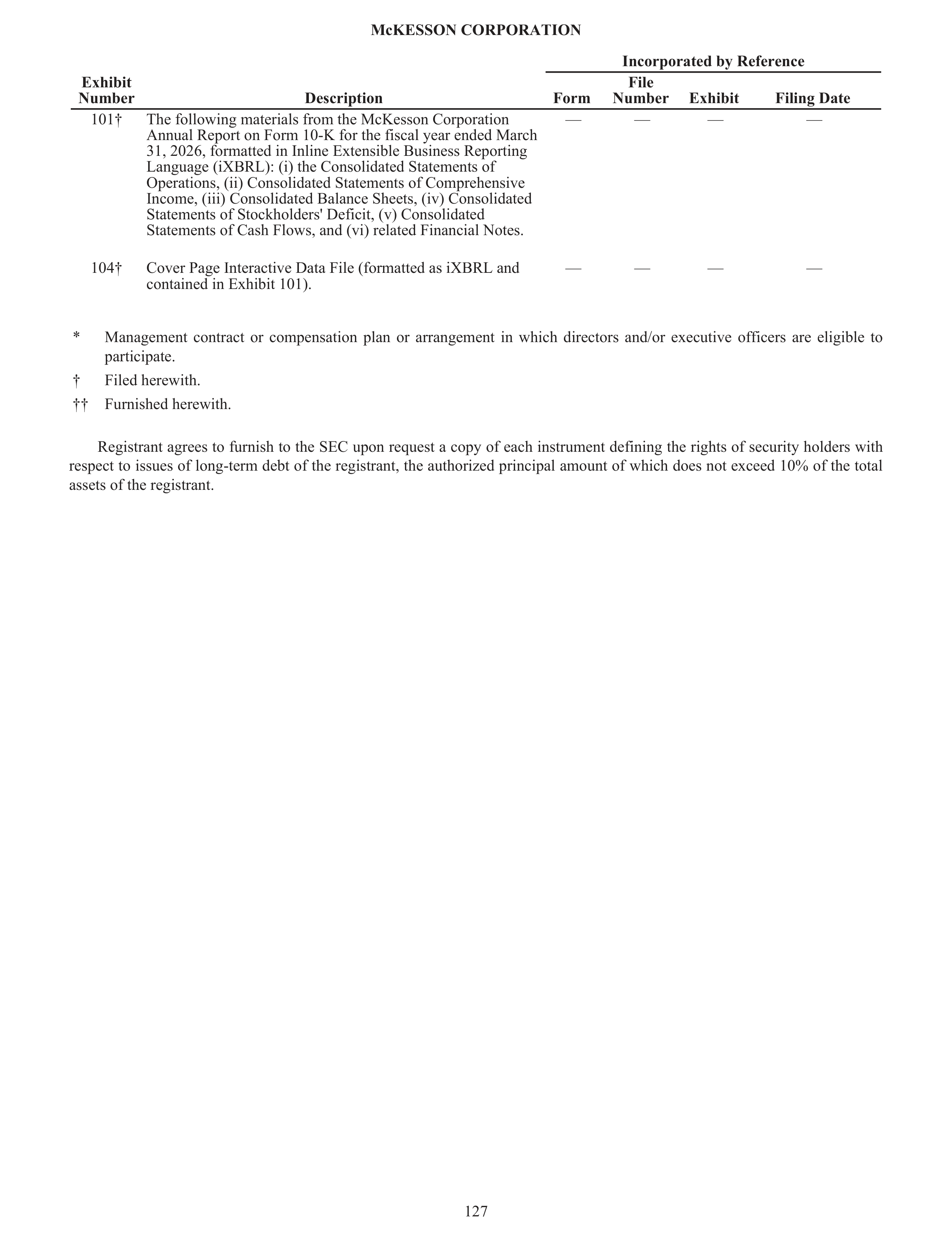
101†
The following materials from the McKesson Corporation
Annual Report on Form 10-K for the fiscal year ended March
31, 2026, formatted in Inline Extensible Business Reporting
Language (iXBRL): (i) the Consolidated Statements of
Operations, (ii) Consolidated Statements of Comprehensive
Income, (iii) Consolidated Balance Sheets, (iv) Consolidated
Statements of Stockholders' Deficit, (v) Consolidated
Statements of Cash Flows, and (vi) related Financial Notes.
—
—
—
—
104†
Cover Page Interactive Data File (formatted as iXBRL and
contained in Exhibit 101).
—
—
—
—
Incorporated by Reference
Exhibit
Number
Description
Form
File
Number
Exhibit
Filing Date
*
Management
contract
or
compensation
plan
or
arrangement
in
which
directors
and/or
executive
offi
f
cers
are
eligible
to
participate.
†
Filed herewith.
††
Furnished herewith.
Registrant agrees to furnish to the SEC upon request a copy of each instrument defining the rights of security holders with
respect to issues of long-term debt of the registrant, the authorized principal amount of which does not exceed 10% of the total
assets of the registrant.
McKESSON CORPORAT
R
ION
127

Item 16.
Form 10-K Summary.
None.
McKESSON CORPORAT
R
ION
128
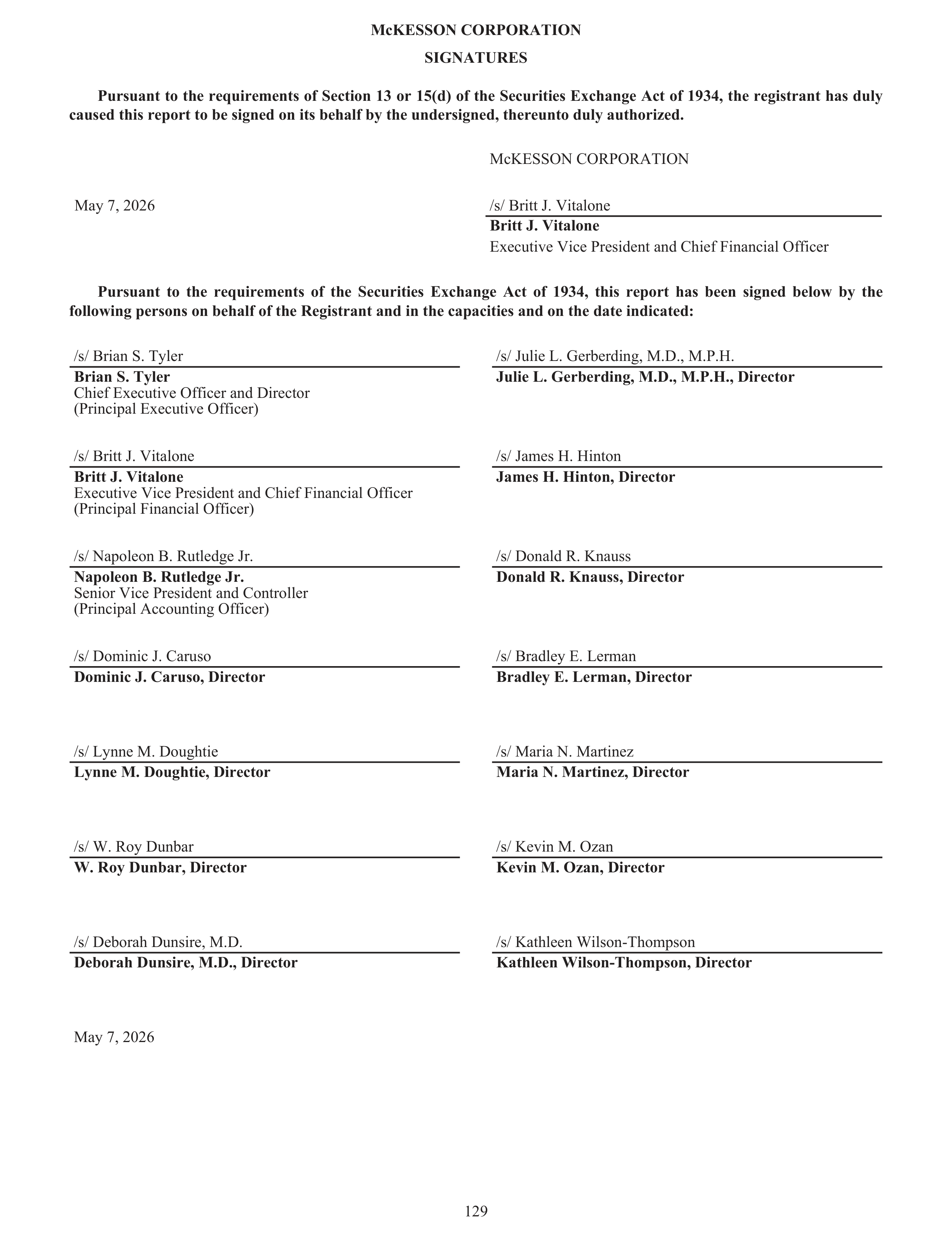
SIGNATURES
Pursuant to the requirements of Section 13 or 15(d) of the Securities Exchange Act of 1934, the registrant has duly
caused this report to be signed on its behalf by the undersigned, thereunto duly authorized.
McKESSON CORPORAT
R
ION
May 7, 2026
/s/ Britt J. Vitalone
Britt J. Vitalone
Executive Vice President and Chief Financial Offi
f
cer
Pursuant
to
the
requirements
of
the
Securities
Exchange
Act
of
1934,
this
report
has
been
signed
below
by
the
following persons on behalf of the Registrant and in the capacities and on the date indicated:
/s/ Brian S. Tyler
/s/ Julie L. Gerberding, M.D., M.P.H.
Brian S. Tyler
Chief Executive Offi
f
cer and Director
(Principal Executive Offi
f
cer)
Julie L. Gerberding, M.D., M.P.H., Director
/s/ Britt J. Vitalone
/s/ James H. Hinton
Britt J. Vitalone
Executive Vice President and Chief Financial Offi
f
cer
(Principal Financial Offi
f
cer)
James H. Hinton, Director
/s/ Napol
a
eon B. Rutledge Jr.
/s/ Donald R. Knauss
Napoleon B. Rutledge Jr.
Senior Vice President and Controller
(Principal Accounting Offi
f
cer)
Donald R. Knauss, Director
/s/ Dominic J. Caruso
/s/ Bradley E. Lerman
Dominic J. Caruso, Director
Bradley E. Lerman, Director
/s/ Lynne M. Doughtie
/s/ Maria N. Martinez
Lynne M. Doughtie, Director
Maria N. Martinez, Director
/s/ W. Roy Dunbar
/s/ Kevin M. Ozan
W. Roy Dunbar, Director
Kevin M. Ozan, Director
/s/ Deborah Dunsire, M.D.
/s/ Kathleen Wilson-Thompson
Deborah Dunsire, M.D., Director
Kathleen Wilson-Thompson, Director
May 7, 2026
McKESSON CORPORAT
R
ION
129

[THIS PAGE INTENTIONALLY LEFT BLANK]

[THIS PAGE INTENTIONALLY LEFT BLANK]

[THIS PAGE INTENTIONALLY LEFT BLANK]
Forward-Looking Statements
This report contains forward-looking statements within the meaning of Section 27A of the Securities Act of
˜ˤ˞˞̗ íŠĐ̗ ĘĉƥľūŠ̗ ˝˜.̗ ūİ̗ ƥĹĘ̗ ĘĉƭƑľƥľĘƙ̗ .NJĉĹíŠıĘ̗ ĉƥ̗ ūİ̗ ˜ˤ˞˟̠̗
FūƑDžíƑĐ̰
ŕūūŒľŠı̗ ƙƥíƥĘŞĘŠƥƙ̗ ŞíNj̗ ĈĘ̗ ľĐĘŠƥľǝĘĐ̗
by their use of terminology such as “believes,” “expects,” “anticipates,” “may,” “will,” “should,” “seeks,”
“approximately,” “intends,” “projects,” “plans,” “estimates,” “targets,” or the negative of these words or other
ĉūŞƎíƑíĈŕĘ̗ ƥĘƑŞľŠūŕūıNj̠̗
¹ĹĘ̗ ĐľƙĉƭƙƙľūŠ̗ ūİ̗ ǝŠíŠĉľíŕ̗ ƥƑĘŠĐƙ̡̗
ƙƥƑíƥĘıNj̡̗
ƎŕíŠƙ̡̗
íƙƙƭŞƎƥľūŠƙ̡̗
ĘNJƎĘĉƥíƥľūŠƙ̡̗
or intentions may also include forward-looking statements. Forward-looking statements involve risks and
ƭŠĉĘƑƥíľŠƥľĘƙ̗ ƥĹíƥ̗ ĉūƭŕĐ̗ ĉíƭƙĘ̗ íĉƥƭíŕ̗ ƑĘƙƭŕƥƙ̗ ƥū̗ ĐľǚĘƑ̗ ŞíƥĘƑľíŕŕNj̗ İƑūŞ̗ ƥĹūƙĘ̗ ƎƑūŏĘĉƥĘĐ̡̗
íŠƥľĉľƎíƥĘĐ̡̗
ūƑ̗ ľŞƎŕľĘĐ̠̗
Although it is not possible to predict or identify all such risks and uncertainties, they include, but are not limited
to, the factors discussed in Item 1A of Part I of the Company’s most recent Annual Report on Form 10-K under
¥ľƙŒ̗ FíĉƥūƑƙ̗̀
íŠĐ̗ ľŠ̗ ūƭƑ̗ ƎƭĈŕľĉŕNj̗ íDŽíľŕíĈŕĘ̗ .̗ ǝྊıƙ̗ íŠĐ̗ ƎƑĘƙƙ̗ ƑĘŕĘíƙĘƙ̠̗
¥ĘíĐĘƑƙ̗ íƑĘ̗ ĉíƭƥľūŠĘĐ̗ Šūƥ̗ ƥū̗ ƎŕíĉĘ̗
ƭŠĐƭĘ̗ ƑĘŕľíŠĉĘ̗ ūŠ̗ İūƑDžíƑĐ̰
ŕūūŒľŠı̗ ƙƥíƥĘŞĘŠƥƙ̡̗
DžĹľĉĹ̗ ƙƎĘíŒ̗ ūŠŕNj̗ íƙ̗ ūİ̗ ƥĹĘ̗ ĐíƥĘ̗ ƙƭĉĹ̗ ƙƥíƥĘŞĘŠƥƙ̗ DžĘƑĘ̗ ǝƑƙƥ̗
made. Except to the extent required by federal securities laws, we undertake no obligation to publicly release
ƥĹĘ̗ ƑĘƙƭŕƥ̗ ūİ̗ íŠNj̗ ƑĘDŽľƙľūŠƙ̗ ƥū̗ íŠNj̗ İūƑDžíƑĐ̰
ŕūūŒľŠı̗ ƙƥíƥĘŞĘŠƥƙ̗ ƥū̗ ƑĘǞĘĉƥ̗ ĘDŽĘŠƥƙ̗ ūƑ̗ ĉľƑĉƭŞƙƥíŠĉĘƙ̗ íİƥĘƑ̗ ƥĹĘ̗ ĐíƥĘ̗
ƥĹĘ̗ ƙƥíƥĘŞĘŠƥƙ̗ íƑĘ̗ ŞíĐĘ̡̗
ūƑ̗ ƥū̗ ƑĘǞĘĉƥ̗ ƥĹĘ̗ ūĉĉƭƑƑĘŠĉĘ̗ ūİ̗ ƭŠíŠƥľĉľƎíƥĘĐ̗ ĘDŽĘŠƥƙ̠








© 2026 McKesson Corporation. All rights reserved.
McKesson Corporation
6555 State Highway 161
Irving, TX 75039
www.mckesson.com