
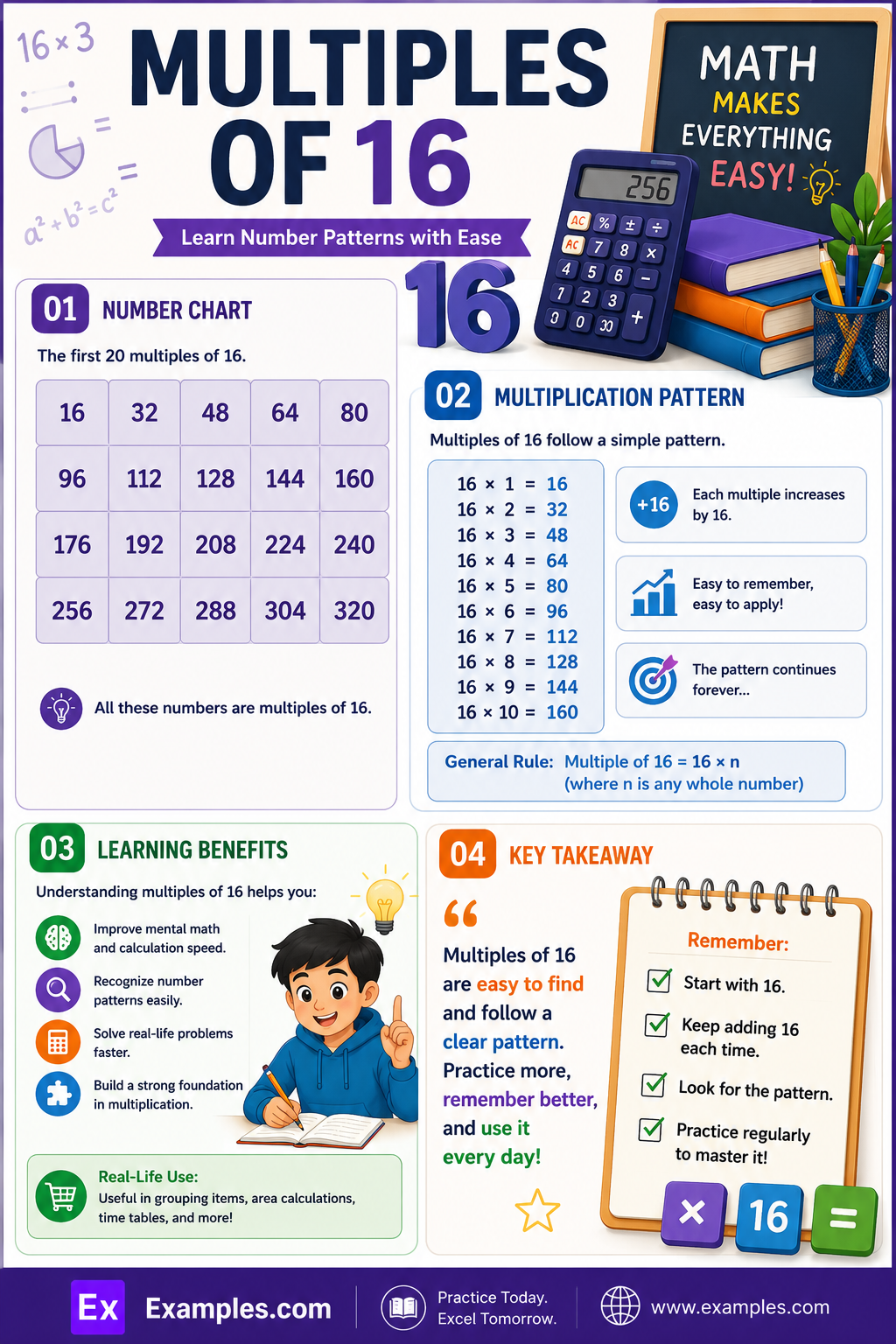
Multiples of 16 are numbers obtained by multiplying 16 by whole numbers. Learning multiples strengthens multiplication skills and number pattern recognition. They are useful in mathematics, mental calculation, and problem-solving.
What are Multiples of 16?
Multiples of 16 are numbers that result from multiplying 16 by any integer (e.g., 16, 32, 48, 64). These numbers are evenly divisible by 16 without leaving a remainder. Examples include 16, 32, and 48.
For example, 48, 80, 128 and 144 are all multiples of 16, 168is not a multiple of 16 for the following reasons:
| Number | Reason | Remainder |
|---|---|---|
| 48 | 48÷16 = 3 (an integer) | 0 |
| 80 | 80÷16 = 5 (an integer) | 0 |
| 128 | 128÷16 = 8 (an integer) | 0 |
| 144 | 144÷16 = 9 (an integer) | 0 |
| 168 | 168÷16 = 10.5 (not an integer) | 8 |
List of First 100 Multiples of 16 with Remainders
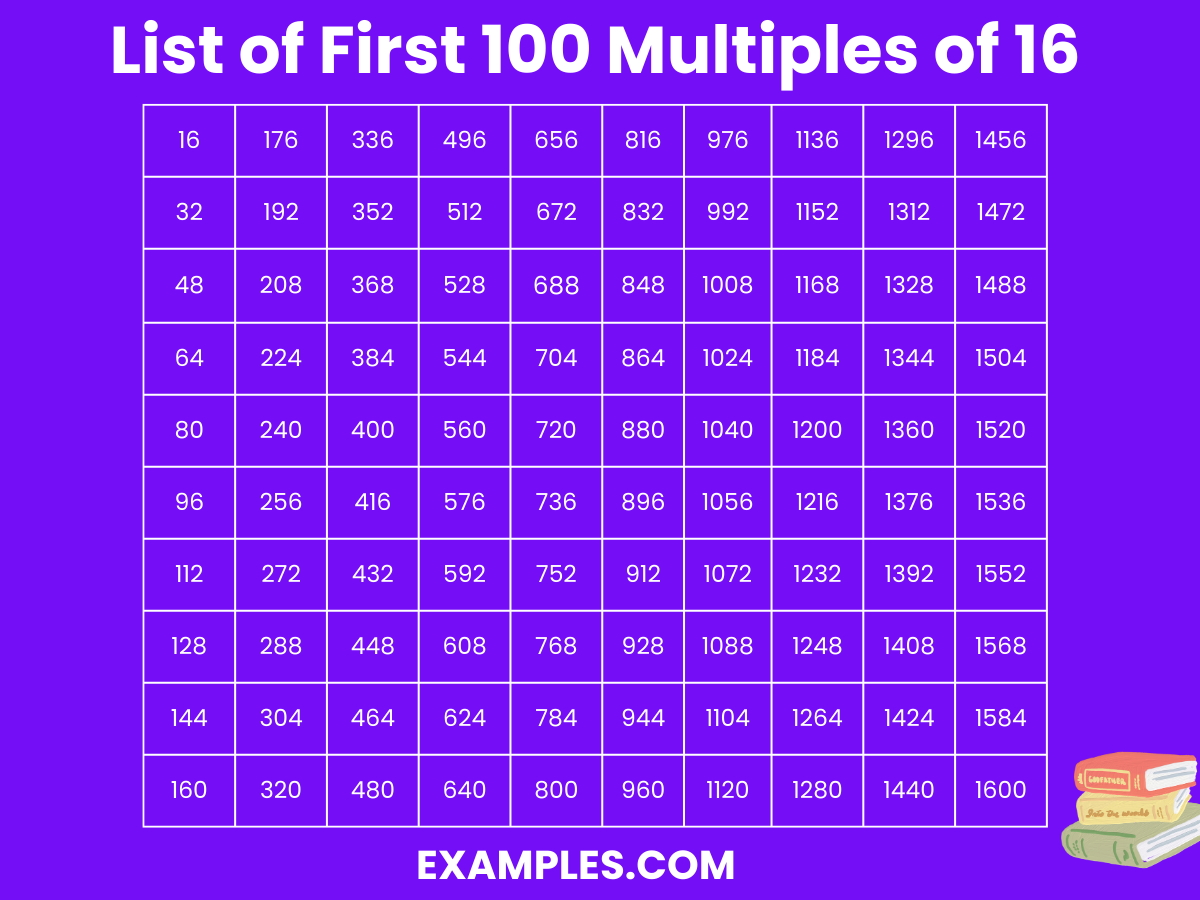
| Number | Calculation | Remainder |
|---|---|---|
| 16 | 16÷16 = 1, so 16 is divisible by 16. | 0 |
| 32 | 32÷16 = 2, so 32 is divisible by 16. | 0 |
| 48 | 48÷16 = 3, so 48 is divisible by 16. | 0 |
| 64 | 64÷16 = 4, so 64 is divisible by 16. | 0 |
| 80 | 80÷16 =5, so 80 is divisible by 16. | 0 |
| 96 | 96÷16 = 6, so 96 is divisible by 16. | 0 |
| 112 | 112÷16 = 7, so 112 is divisible by 16. | 0 |
| 128 | 128÷16 = 8, so 128 is divisible by 16. | 0 |
| 144 | 144÷16 = 9, so 144 is divisible by 16. | 0 |
| 160 | 160÷16 = 10, so 160 is divisible by 16. | 0 |
| 176 | 176÷16 = 11, so 176 is divisible by 16. | 0 |
| 192 | 192÷16 = 12, so 192 is divisible by 16. | 0 |
| 208 | 208÷16 = 13, so 208 is divisible by 16. | 0 |
| 224 | 224÷16 = 14, so 224 is divisible by 16. | 0 |
| 240 | 240÷16 = 15, so 240 is divisible by 16. | 0 |
| 256 | 256÷16 = 16, so 256 is divisible by 16. | 0 |
| 272 | 272÷16 = 17, so 272 is divisible by 16. | 0 |
| 288 | 288÷16 = 18, so 288 is divisible by 16. | 0 |
| 304 | 304÷16 = 19, so 304 is divisible by 16. | 0 |
| 320 | 320÷16 = 20, so 320 is divisible by 16. | 0 |
| 336 | 336÷16 = 21, so 336 is divisible by 16. | 0 |
| 352 | 352÷16 = 22, so 352 is divisible by 16. | 0 |
| 368 | 368÷16 = 23, so 368 is divisible by 16. | 0 |
| 384 | 384÷16 = 24, so 384 is divisible by 16. | 0 |
| 400 | 400÷16 = 25, so 400 is divisible by 16. | 0 |
| 416 | 416÷16 = 26, so 416 is divisible by 16. | 0 |
| 432 | 432÷16 = 27, so 432 is divisible by 16. | 0 |
| 448 | 448÷16 = 28, so 448 is divisible by 16. | 0 |
| 464 | 464÷16 = 29, so 464 is divisible by 16. | 0 |
| 480 | 480÷16 = 30, so 480 is divisible by 16. | 0 |
| 496 | 496÷16 = 31, so 496 is divisible by 16. | 0 |
| 512 | 512÷16 = 32, so 512 is divisible by 16. | 0 |
| 528 | 528÷16 = 33, so 528 is divisible by 16. | 0 |
| 544 | 544÷16 = 34, so 544 is divisible by 16. | 0 |
| 560 | 560÷16 = 35, so 560 is divisible by 16. | 0 |
| 576 | 576÷16 = 36, so 576 is divisible by 16. | 0 |
| 592 | 592÷16 = 37, so 592 is divisible by 16. | 0 |
| 608 | 608÷16 = 38, so 608 is divisible by 16. | 0 |
| 624 | 624÷16 = 39, so 624 is divisible by 16. | 0 |
| 640 | 640÷16 = 40, so 640 is divisible by 16. | 0 |
| 656 | 656÷16 = 41, so 656 is divisible by 16. | 0 |
| 672 | 672÷16 = 42, so 672 is divisible by 16. | 0 |
| 688 | 688÷16 = 43, so 688 is divisible by 16. | 0 |
| 704 | 704÷16 = 44, so 704 is divisible by 16. | 0 |
| 720 | 720÷16 = 45, so 720 is divisible by 16. | 0 |
| 736 | 736÷16 = 46, so 736 is divisible by 16. | 0 |
| 752 | 752÷16 = 47, so 752 is divisible by 16. | 0 |
| 768 | 768÷16 = 48, so 768 is divisible by 16. | 0 |
| 784 | 784÷16 = 49, so 784 is divisible by 16. | 0 |
| 800 | 800÷16 = 50, so 800 is divisible by 16. | 0 |
| 816 | 816÷16 = 51, so 816 is divisible by 16. | 0 |
| 832 | 832÷16 = 52, so 832 is divisible by 16. | 0 |
| 848 | 848÷16 = 53, so 848 is divisible by 16. | 0 |
| 864 | 864÷16 = 54, so 864 is divisible by 16. | 0 |
| 880 | 880÷16 = 55, so 880 is divisible by 16. | 0 |
| 896 | 896÷16 = 56, so 896 is divisible by 16. | 0 |
| 912 | 912÷16 = 57, so 912 is divisible by 16. | 0 |
| 928 | 928÷16 = 58, so 928 is divisible by 16. | 0 |
| 944 | 944÷16 = 59, so 944 is divisible by 16. | 0 |
| 960 | 960÷16 = 60, so 960 is divisible by 16. | 0 |
| 976 | 976÷16 = 61, so 976 is divisible by 16. | 0 |
| 992 | 992÷16 = 62, so 992 is divisible by 16. | 0 |
| 1008 | 1008÷16 = 63, so 1008 is divisible by 16. | 0 |
| 1024 | 1024÷16 = 64, so 1024 is divisible by 16. | 0 |
| 1040 | 1040÷16 = 65, so 1040 is divisible by 16. | 0 |
| 1056 | 1056÷16 = 66, so 1056 is divisible by 16. | 0 |
| 1072 | 1072÷16 = 67, so 1072 is divisible by 16. | 0 |
| 1088 | 1088÷16 = 68, so 1088 is divisible by 16. | 0 |
| 1104 | 1104÷16 = 69, so 1104 is divisible by 16. | 0 |
| 1120 | 1120÷16 = 70, so 1120 is divisible by 16. | 0 |
| 1136 | 1136÷16 = 71, so 1136 is divisible by 16. | 0 |
| 1152 | 1152÷16 = 72, so 1152 is divisible by 16. | 0 |
| 1168 | 1168÷16 = 73, so 1168 is divisible by 16. | 0 |
| 1184 | 1184÷16 = 74, so 1184 is divisible by 16. | 0 |
| 1200 | 1200÷16 = 75, so 1200 is divisible by 16. | 0 |
| 1216 | 1216÷16 = 76, so 1216 is divisible by 16. | 0 |
| 1232 | 1232÷16 = 77, so 1232 is divisible by 16. | 0 |
| 1248 | 1248÷16 = 78, so 1248 is divisible by 16. | 0 |
| 1264 | 1264÷16 = 79, so 1264 is divisible by 16. | 0 |
| 1280 | 1280÷16 = 80, so 1280 is divisible by 16. | 0 |
| 1296 | 1296÷16 = 81, so 1296 is divisible by 16. | 0 |
| 1312 | 1312÷16 = 82, so 1312 is divisible by 16. | 0 |
| 1328 | 1328÷16 = 83, so 1328 is divisible by 16. | 0 |
| 1344 | 1344÷16 = 84, so 1344 is divisible by 16. | 0 |
| 1360 | 1360÷16 = 85, so 1360 is divisible by 16. | 0 |
| 1376 | 1376÷16 = 86, so 1376 is divisible by 16. | 0 |
| 1392 | 1392÷16 = 87, so 1392 is divisible by 16. | 0 |
| 1408 | 1408÷16 = 88, so 1408 is divisible by 16. | 0 |
| 1424 | 1424÷16 = 89, so 1424 is divisible by 16. | 0 |
| 1440 | 1440÷16 = 90, so 1440 is divisible by 16. | 0 |
| 1456 | 1456÷16 = 91, so 1456 is divisible by 16. | 0 |
| 1472 | 1472÷16 = 92, so 1472 is divisible by 16. | 0 |
| 1488 | 1488÷16 = 93, so 1488 is divisible by 16. | 0 |
| 1504 | 1504÷16 = 94, so 1504 is divisible by 16. | 0 |
| 1520 | 1520÷16 = 95, so 1520 is divisible by 16. | 0 |
| 1536 | 1536÷16 = 96, so 1536 is divisible by 16. | 0 |
| 1552 | 1552÷16 = 97, so 1552 is divisible by 16. | 0 |
| 1568 | 1568÷16 = 98, so 1568 is divisible by 16. | 0 |
| 1584 | 1584÷16 = 99, so 1584 is divisible by 16. | 0 |
| 1600 | 1600÷16 = 100, so 1600 is divisible by 16. | 0 |
Read More About Multiples of 16
Important Notes
Identify the Number to Test: Begin with the number you want to check if it is a multiple of 16.
Divide by 16: Perform the division of the number by 16.
Determine the Quotient and Remainder: Calculate both the quotient and the remainder from the division.
Check the Remainder: Examine the remainder. If the remainder is 0, the number is a multiple of 16. If the remainder is not 0, the number is not a multiple of 16.
Conclusion: Summarize the result. If the remainder is 0, confirm that the number is a multiple of 16. If the remainder is not 0, state that the number is not a multiple of 16.
Examples on Multiples of 16
Example 1: 64
- Identify the Number to Test: 64
- Divide by 16: 64 ÷ 16
- Determine the Quotient and Remainder: Quotient = 4, Remainder = 0
- Check the Remainder: Remainder is 0
- Conclusion: 64 is a multiple of 16.
Example 2: 112
- Identify the Number to Test: 112
- Divide by 16: 112 ÷ 16
- Determine the Quotient and Remainder: Quotient = 7, Remainder = 0
- Check the Remainder: Remainder is 0
- Conclusion: 112 is a multiple of 16.
Example 3: 256
- Identify the Number to Test: 256
- Divide by 16: 256 ÷ 16
- Determine the Quotient and Remainder: Quotient = 16, Remainder = 0
- Check the Remainder: Remainder is 0
- Conclusion: 256 is a multiple of 16.
FAQs
A multiple of 16 is any number that can be evenly divided by 16 without leaving a remainder. Examples include 16, 32, 48, and 64.
To determine if a number is a multiple of 16, divide it by 16. If the remainder is 0, the number is a multiple of 16.
Yes, 160 is a multiple of 16. When you divide 160 by 16, the quotient is 10 and the remainder is 0.
The first five multiples of 16 are 16, 32, 48, 64, and 80.
168 is not a multiple of 16 because when you divide 168 by 16, the quotient is 10 with a remainder of 8.
Yes, 256 is a multiple of 16. When you divide 256 by 16, the quotient is 16 and the remainder is 0.
Yes, negative numbers can be multiples of 16. For example, -32 and -48 are multiples of 16.
To find the next multiple of 16 after 144, simply add 16 to 144. The result is 160.
The greatest multiple of 16 that is less than 200 is 192.
A quick way to identify multiples of 16 is to check if the last four digits of the number form a multiple of 16. However, this method is more practical for larger numbers.