The Riddle of Experience vs. Memory Informative Speech
Good morning, everyone. Have you ever looked back on a vacation and thought, “That was an
amazing trip,” even though you remember being tired, stressed, or uncomfortable during parts of it?
Or have you remembered a difficult event as much worse than it actually felt while it was happening?
These questions point to a fascinating feature of the human mind: the person who experiences an
event in the moment is not always the same person who later remembers and evaluates it.
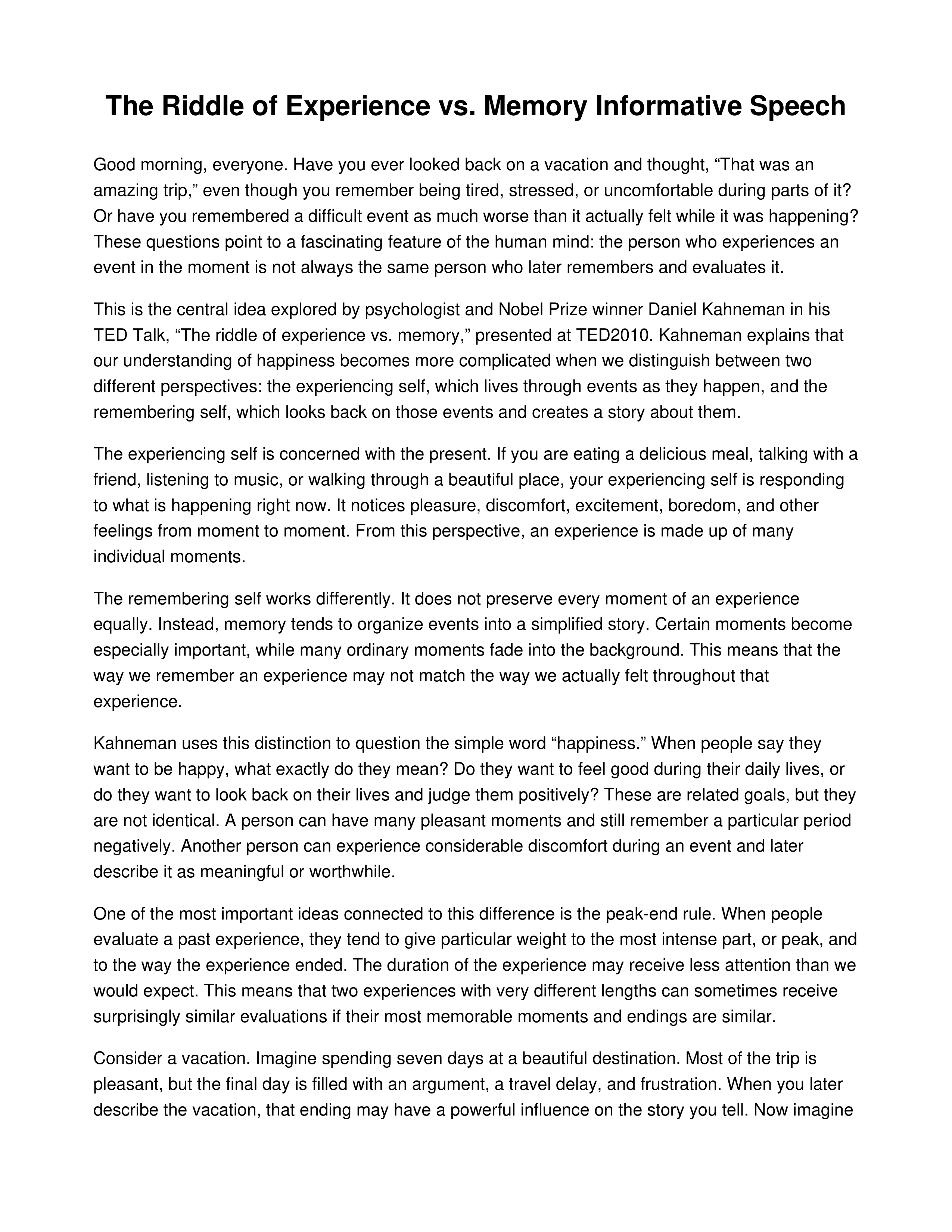
This is the central idea explored by psychologist and Nobel Prize winner Daniel Kahneman in his
TED Talk, “The riddle of experience vs. memory,” presented at TED2010. Kahneman explains that
our understanding of happiness becomes more complicated when we distinguish between two
different perspectives: the experiencing self, which lives through events as they happen, and the
remembering self, which looks back on those events and creates a story about them.
The experiencing self is concerned with the present. If you are eating a delicious meal, talking with a
friend, listening to music, or walking through a beautiful place, your experiencing self is responding
to what is happening right now. It notices pleasure, discomfort, excitement, boredom, and other
feelings from moment to moment. From this perspective, an experience is made up of many
individual moments.
The remembering self works differently. It does not preserve every moment of an experience
equally. Instead, memory tends to organize events into a simplified story. Certain moments become
especially important, while many ordinary moments fade into the background. This means that the
way we remember an experience may not match the way we actually felt throughout that
experience.
Kahneman uses this distinction to question the simple word “happiness.” When people say they
want to be happy, what exactly do they mean? Do they want to feel good during their daily lives, or
do they want to look back on their lives and judge them positively? These are related goals, but they
are not identical. A person can have many pleasant moments and still remember a particular period
negatively. Another person can experience considerable discomfort during an event and later
describe it as meaningful or worthwhile.
One of the most important ideas connected to this difference is the peak-end rule. When people
evaluate a past experience, they tend to give particular weight to the most intense part, or peak, and
to the way the experience ended. The duration of the experience may receive less attention than we
would expect. This means that two experiences with very different lengths can sometimes receive
surprisingly similar evaluations if their most memorable moments and endings are similar.
Consider a vacation. Imagine spending seven days at a beautiful destination. Most of the trip is
pleasant, but the final day is filled with an argument, a travel delay, and frustration. When you later
describe the vacation, that ending may have a powerful influence on the story you tell. Now imagine
another trip that contains several ordinary days but finishes with a wonderful evening that becomes
the emotional highlight. The second vacation may remain more positive in memory even if the
overall experience was not objectively better.
Kahneman also discusses a famous medical example involving colonoscopy patients. In research
conducted with colleagues, patients reported their discomfort over time and later gave an overall
evaluation of the procedure. The findings suggested that the ending of the procedure could strongly
influence the remembered experience. In one condition, the procedure was extended with a less
painful period. Although the patients experienced additional time, their later evaluation could be
more favorable because of the way the experience ended.
This example illustrates an important psychological distinction: an experience can be unpleasant
while it is happening, yet the memory of that experience can be shaped by how it concludes. It also
shows why simply adding up every moment of pleasure and pain does not always predict how
people will remember an event.
The difference between experience and memory has practical consequences. Think about
restaurants, hotels, hospitals, schools, workplaces, and entertainment. People do not evaluate these
environments only by what happens every second. They also remember particular moments and
endings. A service provider that creates a strong final interaction may leave a better overall
impression than one that provides a similar experience but ends poorly.
The same principle can affect personal decisions. We often choose future activities based on
memories of previous experiences. If our memories are selective, then our decisions can also be
influenced by the parts of an experience that remained most vivid. We might return to a place
because we remember one extraordinary evening, or avoid something because one painful moment
dominates the entire memory.
There is another cognitive trap that Kahneman discusses: the focusing illusion. When we think about
how a particular circumstance will affect our happiness, we can give that circumstance more
importance than it deserves simply because it is the thing we are currently focusing on. For example,
someone might believe that getting a certain job, moving to a particular city, or buying a particular
possession will dramatically change their life. But everyday well-being is influenced by many factors,
including relationships, routines, health, work, and ordinary experiences that are easy to overlook
when we focus on one major goal.
This does not mean that our memories are useless or that we should ignore them. Memory helps us
learn, build identity, maintain relationships, and make decisions. The lesson is simply that memory is
a reconstruction rather than a perfect recording. Our remembered selves organize the past into
stories, and those stories influence how we understand our lives.
The distinction also raises an important question about what governments, businesses, and
institutions should measure when they try to improve people's well-being. If we care only about what
people remember, we may overlook how they actually experience everyday life. If we care only
about moment-to-moment feelings, we may ignore meaning, achievement, and the stories people
build around their lives. A complete understanding of well-being may need to consider both
perspectives.
For individuals, this idea offers a useful way to think about our own lives. We can pay attention to
how we actually feel in the present rather than constantly postponing happiness until a future
achievement. At the same time, we can recognize that the memories we create will shape how we
later understand our lives. Meaningful endings, memorable moments, and positive experiences can
all become part of the stories we carry forward.
Ultimately, “The Riddle of Experience vs. Memory” teaches us that happiness is more complicated
than a single number or feeling. We have a self that lives through experiences and a self that
remembers and evaluates them. These two perspectives can sometimes disagree, and
understanding that disagreement can help us make better decisions about how we spend our time.
So the next time you finish a vacation, a difficult project, a meal, a performance, or an important day,
pause before deciding what the experience meant. Ask yourself two questions: “How did I actually
feel while I was experiencing it?” and “How will I probably remember it later?” The answers may be
different. And that difference reveals something remarkable about the human mind: we do not simply
live our experiences. We also turn them into stories, and those stories help shape how we
understand our lives. Thank you.