The Secret Language of Trees Informative Speech
Good morning, everyone. Imagine standing in a forest and looking around. You see trunks,
branches, leaves, and sunlight filtering through the canopy. The forest may appear quiet, but
beneath your feet an extraordinary exchange is taking place. Tree roots are interacting with fungi,
plants are responding to chemical signals, and resources can move through underground networks.
Trees do not speak with voices, but they have biological ways of sensing, signaling, and responding
to the world around them.
The title “The Secret Language of Trees” is the name of a TED-Ed lesson created by Camille
Defrenne and forest ecologist Suzanne Simard in 2019. The lesson explores how trees interact
through root systems and symbiotic fungi called mycorrhizae. Simard's research has helped change
the way many people think about forests—not as collections of isolated trees, but as complex
communities in which plants, fungi, soil organisms, and other living things interact. This speech
explains the science behind that hidden communication while separating evidence from the tempting
idea that trees communicate exactly like humans.
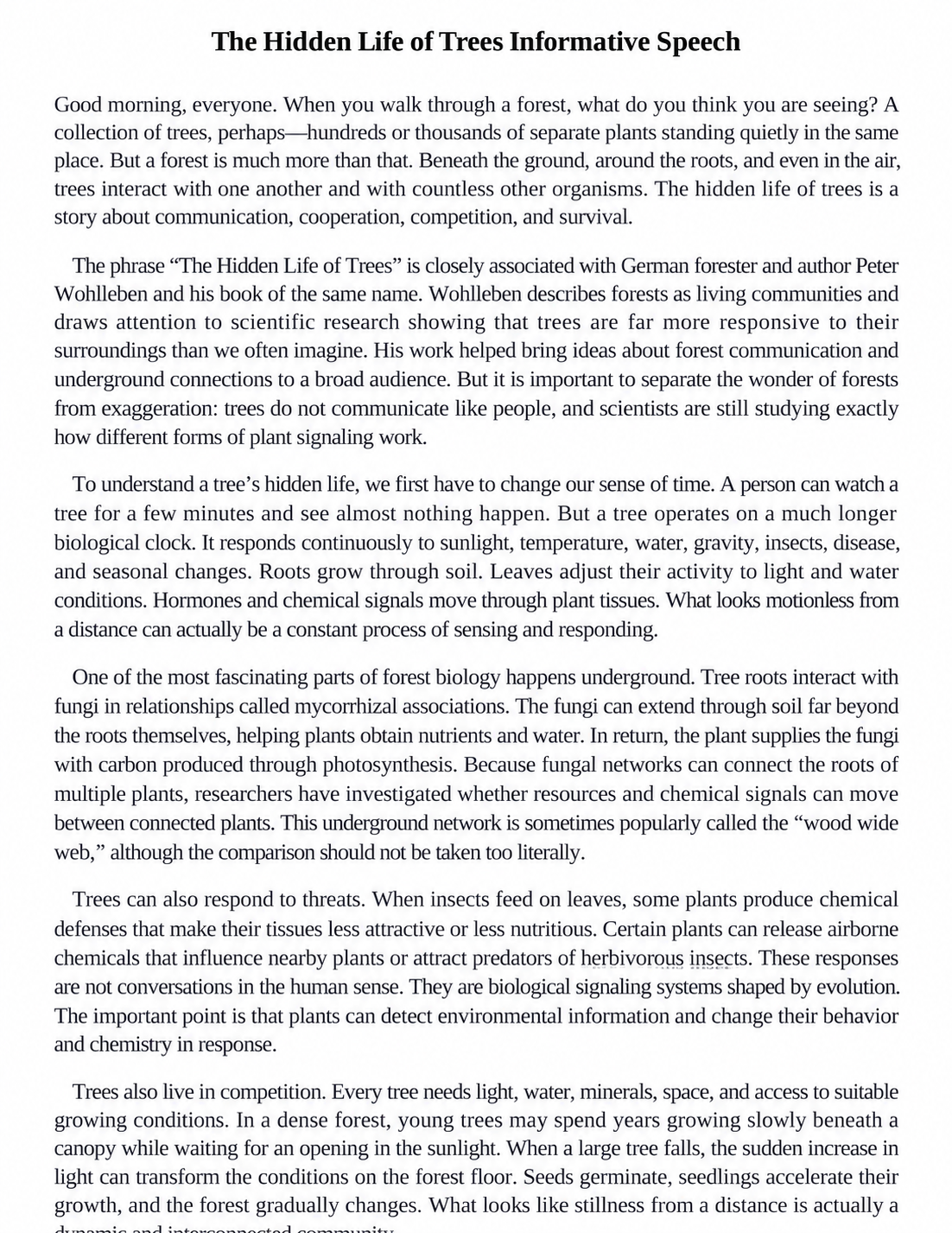
To understand tree communication, we first need to look underground. Tree roots are not alone in
the soil. Many form partnerships with fungi in relationships known as mycorrhizae. The fungus grows
microscopic threads called mycelium through the soil, greatly increasing the area through which it
can encounter water and nutrients. The tree provides the fungus with carbon compounds produced
through photosynthesis, while the fungus can help the tree acquire nutrients such as phosphorus
and nitrogen. Both partners can benefit from this relationship.
In some forests, fungal networks can connect the roots of multiple plants. These networks are
sometimes described as a “wood wide web.” The phrase is memorable, but it should not be
interpreted as a literal internet. The network is biological, and the movement of substances through it
depends on complex interactions among roots, fungi, soil conditions, and plant physiology.
Scientists have demonstrated resource and signal movement in experimental settings, while the
importance and scale of these exchanges in natural forests continue to be studied.
Trees also communicate through chemicals above and below ground. When plants are attacked by
herbivores, they can activate defensive responses. Some plants release volatile organic compounds
into the air. These chemicals can affect nearby plants or attract organisms that prey on the
herbivores. This is not a conversation made of sentences. It is a sophisticated biological signaling
system in which chemical information can change the behavior or physiology of organisms nearby.
The forest floor contains another layer of communication. Roots interact with microorganisms, and
those relationships can influence nutrient availability, plant health, and competition. Soil is not simply
dirt holding trees upright. It is a living environment filled with fungi, bacteria, organic matter, minerals,
water, and countless interactions. A tree's survival therefore depends partly on relationships that are
almost completely invisible when we look at the forest from above.
One of the most interesting questions is whether trees help one another. Research associated with
Suzanne Simard has investigated whether carbon and other resources can move between
connected trees, including between larger established trees and younger plants. Such transfers
have been observed under particular conditions, but scientists continue to investigate how common,
significant, and ecologically important they are in different forests. The strongest conclusion is not
that every tree selflessly feeds every neighbor. Forest relationships are more complicated than that.
Trees compete as well as cooperate. They compete for sunlight, water, nutrients, and space. A tree
growing beneath a dense canopy may receive only a small fraction of the light available to the trees
above it. At the same time, plants can benefit from fungal partnerships and other ecological
relationships. Nature does not always fit into simple categories such as cooperation or competition.
Both forces can operate simultaneously, and the balance can change with environmental conditions.
Older, larger trees can also play important ecological roles. In Simard's work, the term “mother trees”
refers to large, older trees that are highly connected to surrounding plants through fungal networks.
These trees may influence the surrounding forest through their roots, fungal relationships, and the
resources they capture. When old trees die, they continue to affect the ecosystem by becoming
habitat and returning organic matter to the soil. Their value therefore extends beyond the years in
which they are visibly growing.
The science of tree communication also changes how we think about forest management. If forests
are interconnected systems, removing individual trees can affect more than the tree itself. Logging
can alter light levels, soil conditions, root networks, fungal communities, moisture, and habitat. This
does not mean every tree should remain untouched. Sustainable forestry involves balancing human
needs with ecological processes. But understanding forest connections can help managers make
more informed decisions about biodiversity and long-term resilience.
There is an important caution, however. Popular descriptions sometimes make trees sound like
humans with hidden personalities. We may hear that trees “talk,” “share wisdom,” or “remember”
their relatives. These phrases can make science easier to imagine, but they are metaphors. Trees
have no brains or nervous systems like ours. Their signaling is based on chemical, physiological,
electrical, and ecological processes. We can appreciate the complexity of those processes without
claiming that trees think or communicate in the human sense.
The deeper lesson is that forests operate at a scale that our senses are poorly equipped to perceive.
We see a trunk and a canopy, but we do not see the fungal threads extending through the soil. We
cannot easily observe chemical messages moving through roots or airborne compounds released
after an attack. We cannot watch a forest change over centuries in a single lifetime. Scientific tools
allow researchers to reveal pieces of this hidden world, and each discovery shows how much more
there is to understand.
The secret language of trees is therefore not a mysterious language of words. It is a language of
biological signals, chemical exchanges, roots, fungi, water, nutrients, and environmental responses.

It shows that a forest is not merely a group of separate trees standing next to one another. It is an
interconnected ecosystem in which organisms affect one another in ways that are often invisible to
us.
So the next time you walk through a forest, listen differently—even if you hear no words. Think about
the roots beneath the soil, the fungi surrounding them, the chemical signals moving through the
ecosystem, and the countless organisms contributing to forest life. Trees may be silent to our ears,
but they are far from inactive. Their hidden interactions help forests survive, regenerate, and adapt.
Understanding that hidden world gives us a deeper reason to study and protect the forests on which
so much life depends. Thank you.