


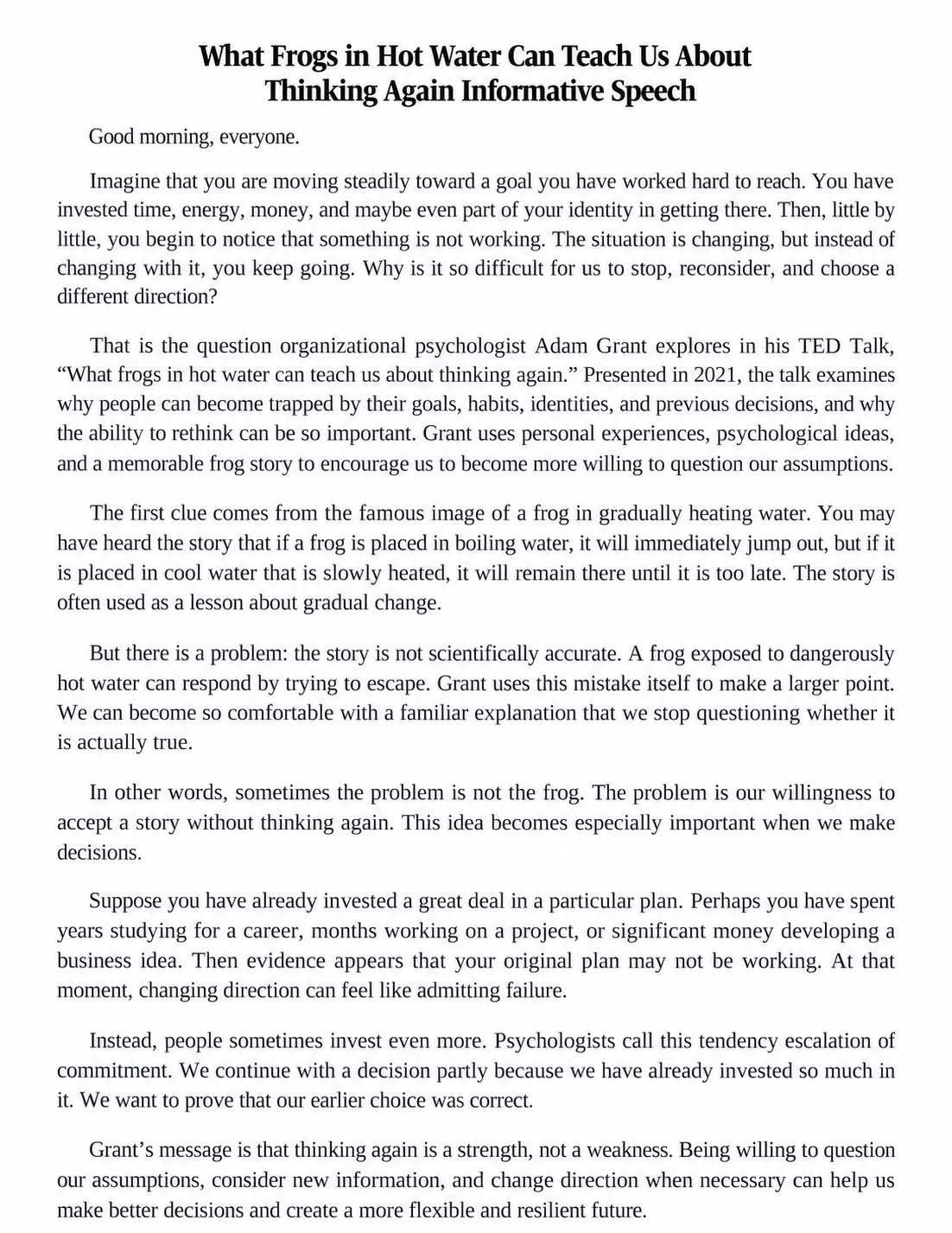
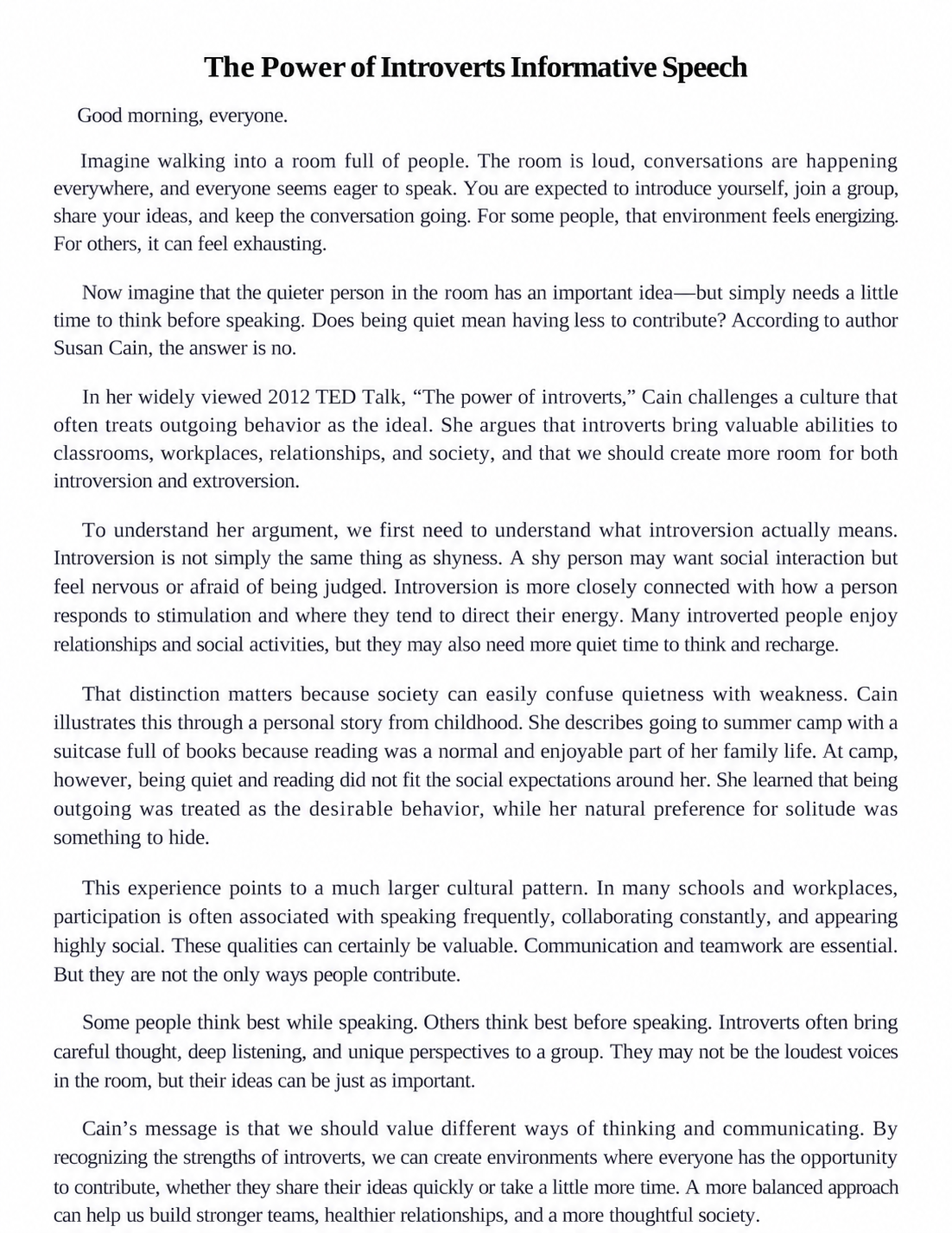
An informative speech teaches an audience about a specific topic by presenting clear facts, useful information, data, and evidence rather than trying to persuade them to accept a particular opinion. Students, educators, professionals, and speakers use informative speeches to explain ideas, describe subjects, clarify complex concepts, or demonstrate how something works. The best informative speeches make unfamiliar information easy to understand by combining focused research, logical organization, relevant examples, and confident delivery. Whether you are explaining a scientific discovery, describing a historical event, introducing a technology, or demonstrating a practical process, an effective informative speech gives your audience knowledge they can understand and remember.
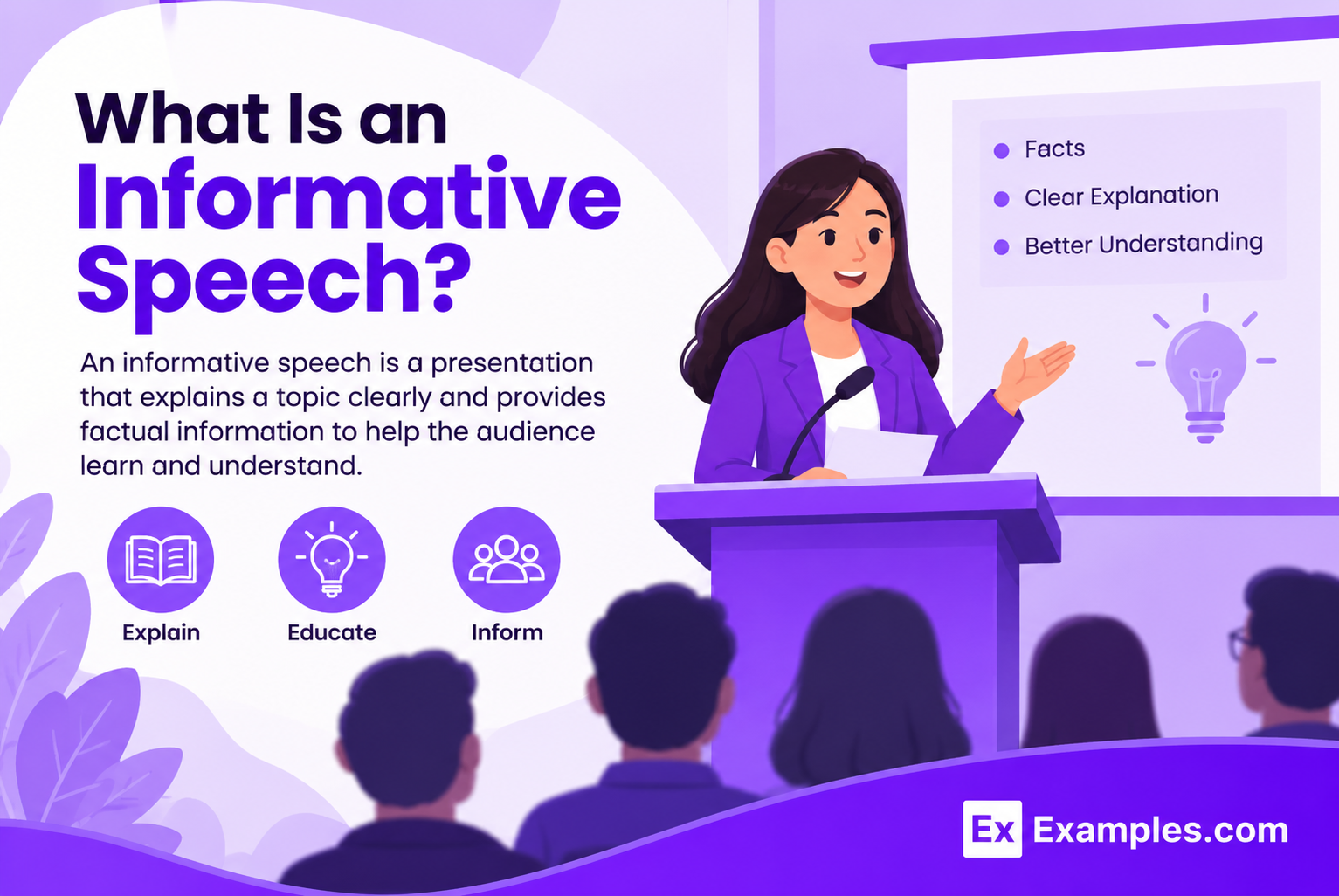
What Is an Informative Speech?
An informative speech teaches an audience about a specific topic using clear facts, data, examples, and evidence rather than personal opinions or persuasion. It can define a concept, explain how something works, describe a subject, or demonstrate a process in an easy-to-understand way.
What Are the Main Types of Informative Speeches?
Definition Informative Speech
A Definition Informative Speech explains the meaning, characteristics, or significance of a concept, term, theory, or idea.
Explanation Informative Speech
An Explanation Informative Speech describes how something works, why it happens, or how different parts of a topic are connected.
Description Informative Speech
A Description Informative Speech creates a clear mental picture of a person, place, object, event, or subject through specific details.
Demonstration Informative Speech
A Demonstration Informative Speech teaches an audience how to complete a task or follow a process through clear, organized steps.
Person Informative Speech
A Person Informative Speech provides factual information about an important individual, including their background, achievements, and contributions.
Place Informative Speech
A Place Informative Speech informs an audience about a location by explaining its history, features, significance, and unique characteristics.
Event Informative Speech
An Event Informative Speech explains a historical, cultural, scientific, or social event by presenting relevant facts, causes, developments, and effects.
Process Informative Speech
A Process Informative Speech breaks down a procedure or system into logical stages so the audience can understand how it happens.
Concept Informative Speech
A Concept Informative Speech explores an abstract idea, principle, or theory by explaining its meaning, importance, and practical relevance.
Object Informative Speech
An Object Informative Speech provides factual information about a physical item, explaining its features, purpose, uses, or significance.
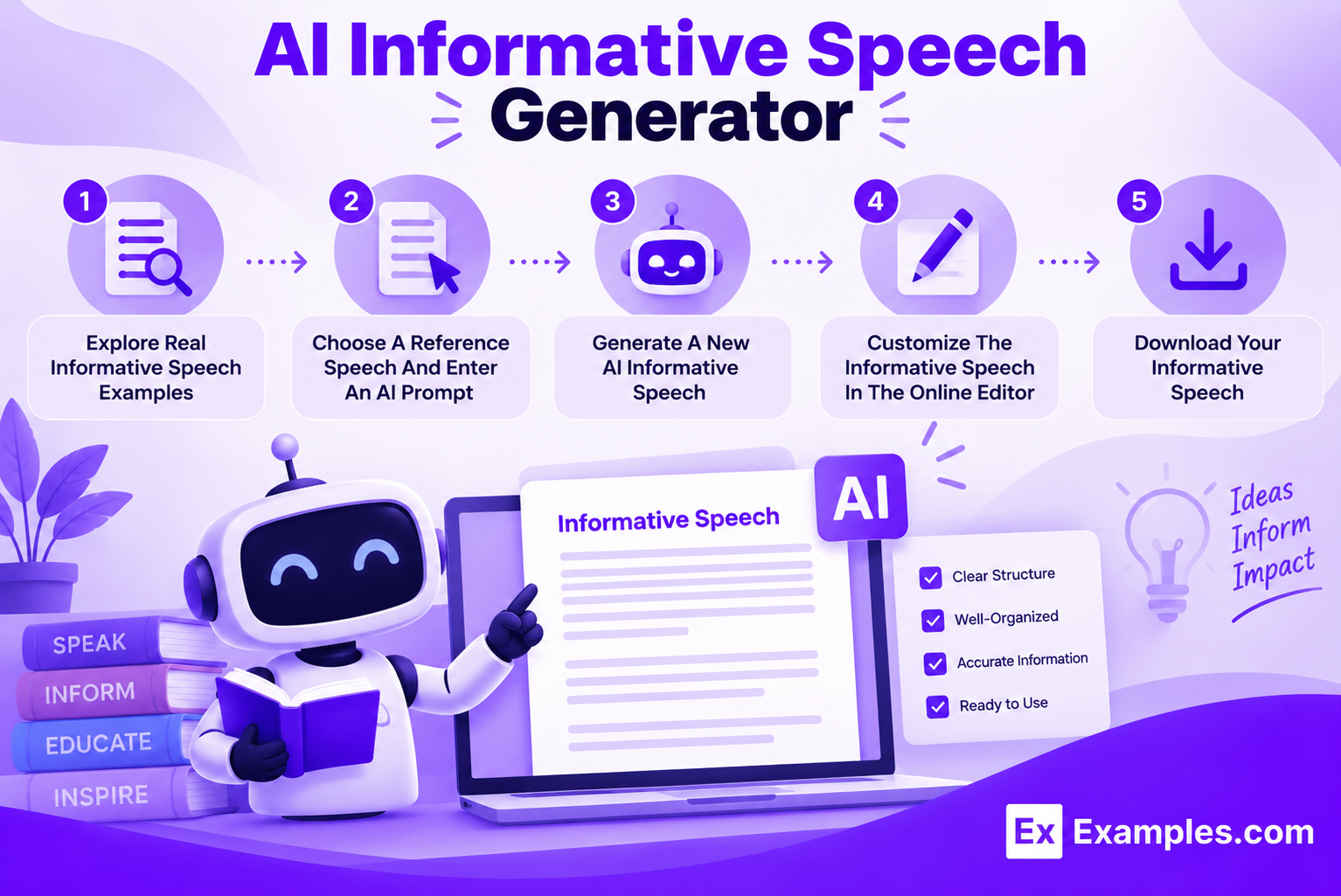
How Do I Generate Informative Speeches Using Real Speech Examples?
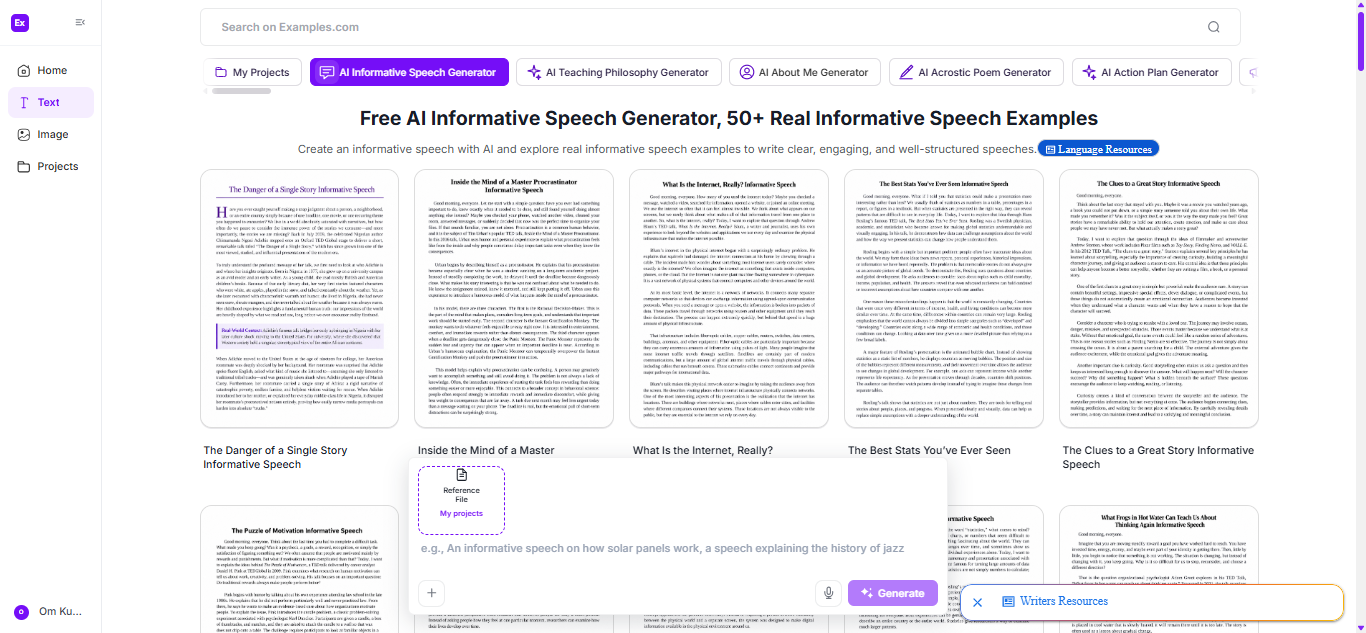
Explore Real Informative Speech Examples
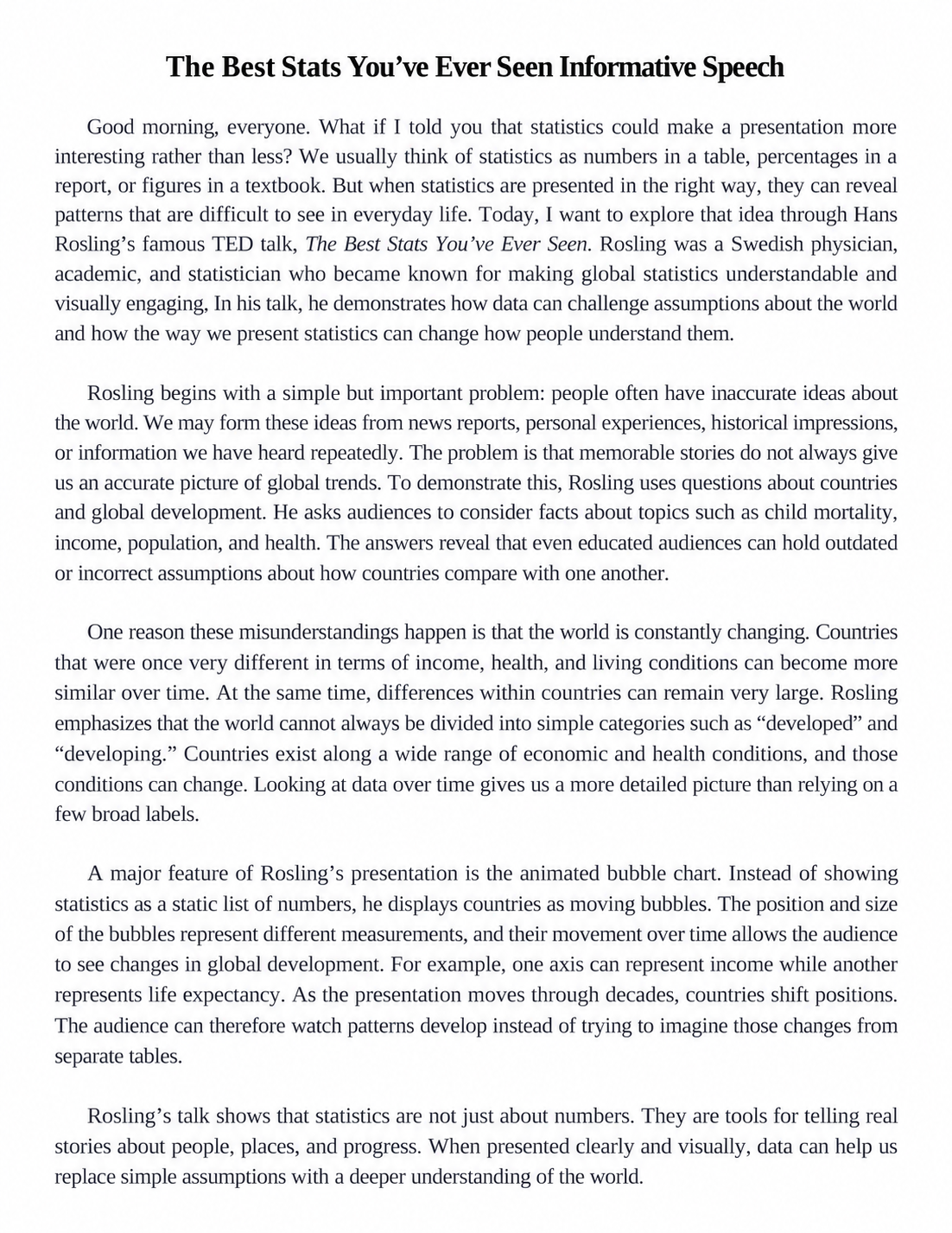
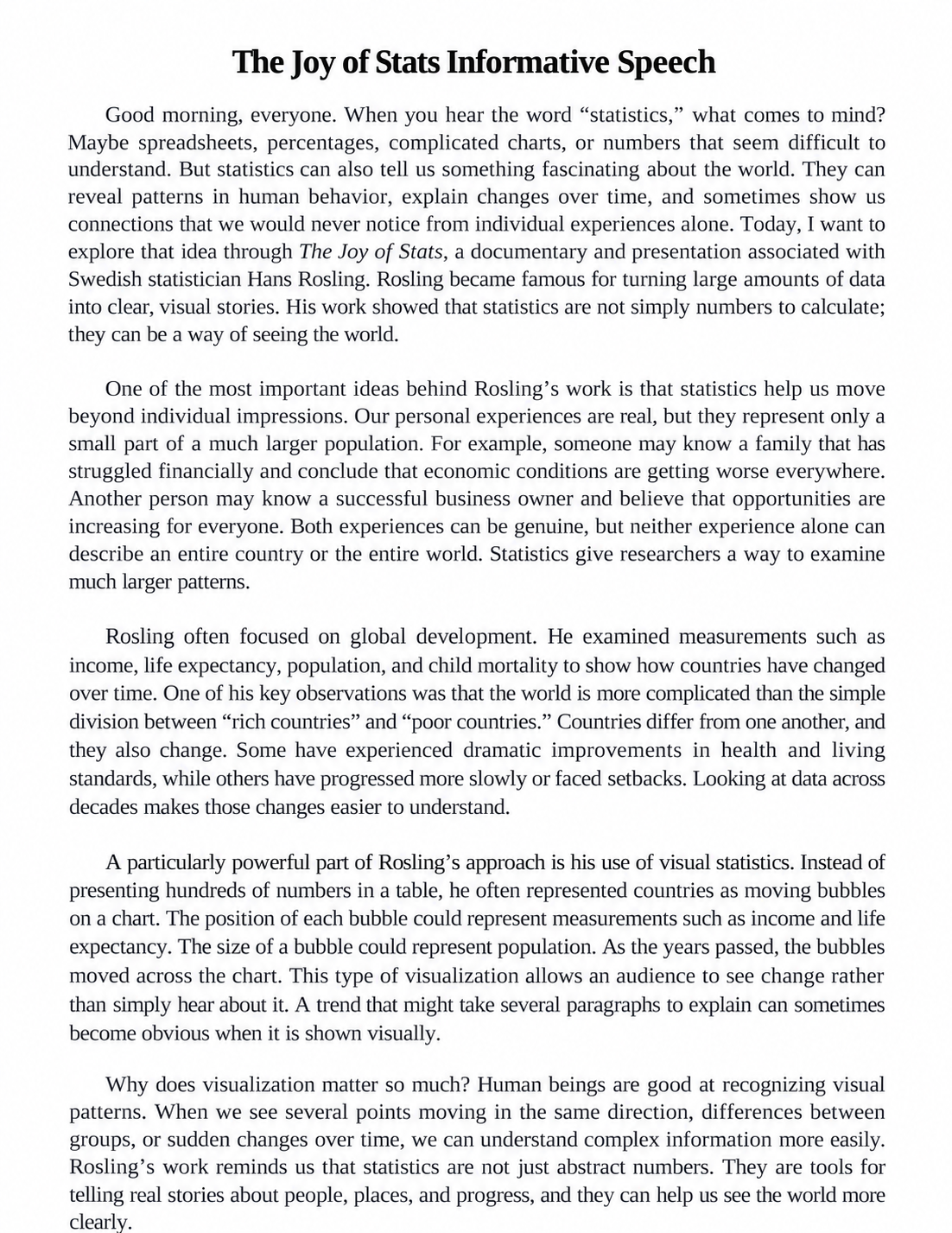
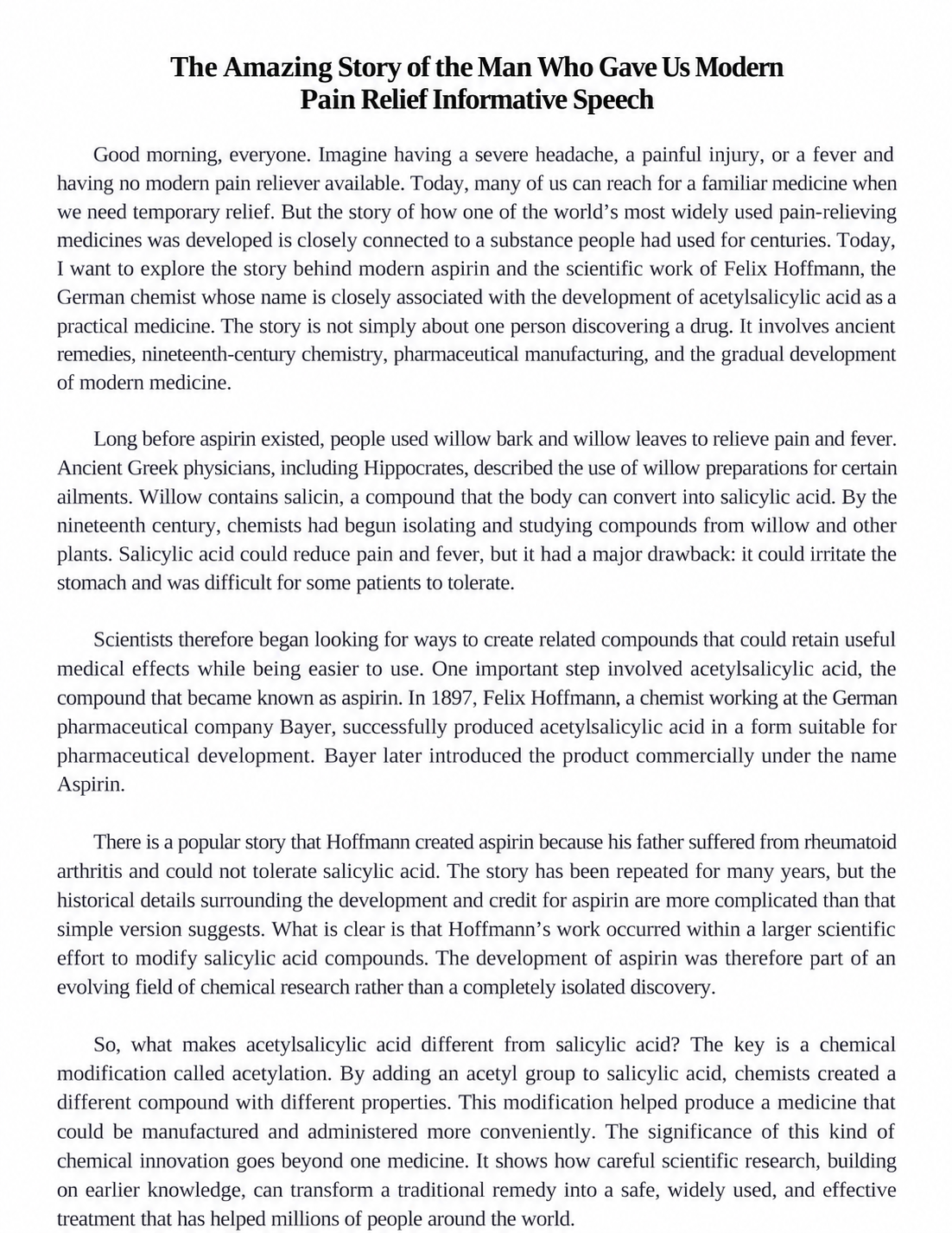
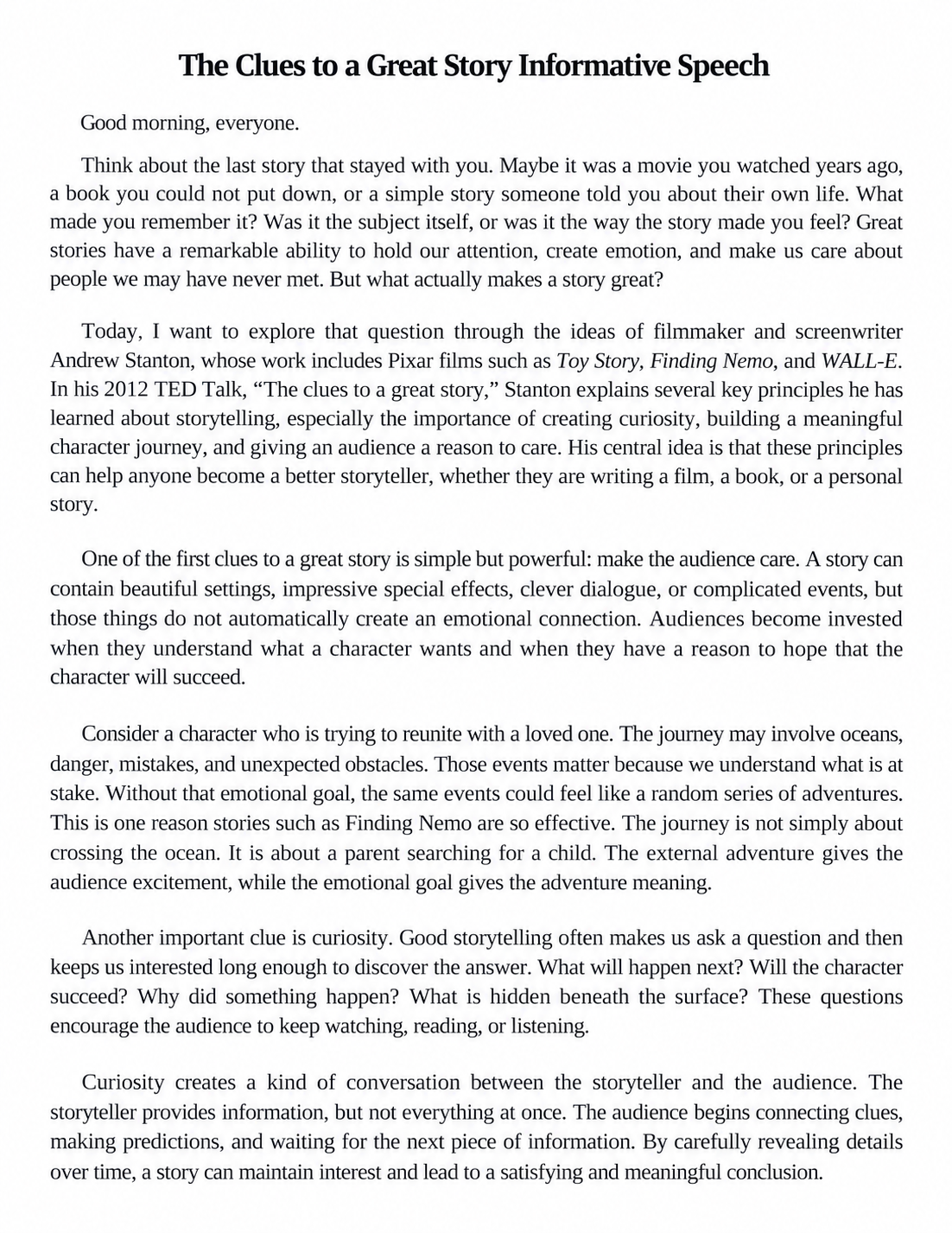
Browse real informative speech examples to understand effective speech structure, organization, supporting points, transitions, and conclusions. Reviewing real examples helps you create clear, informative, and well-organized speeches for different topics and audiences.
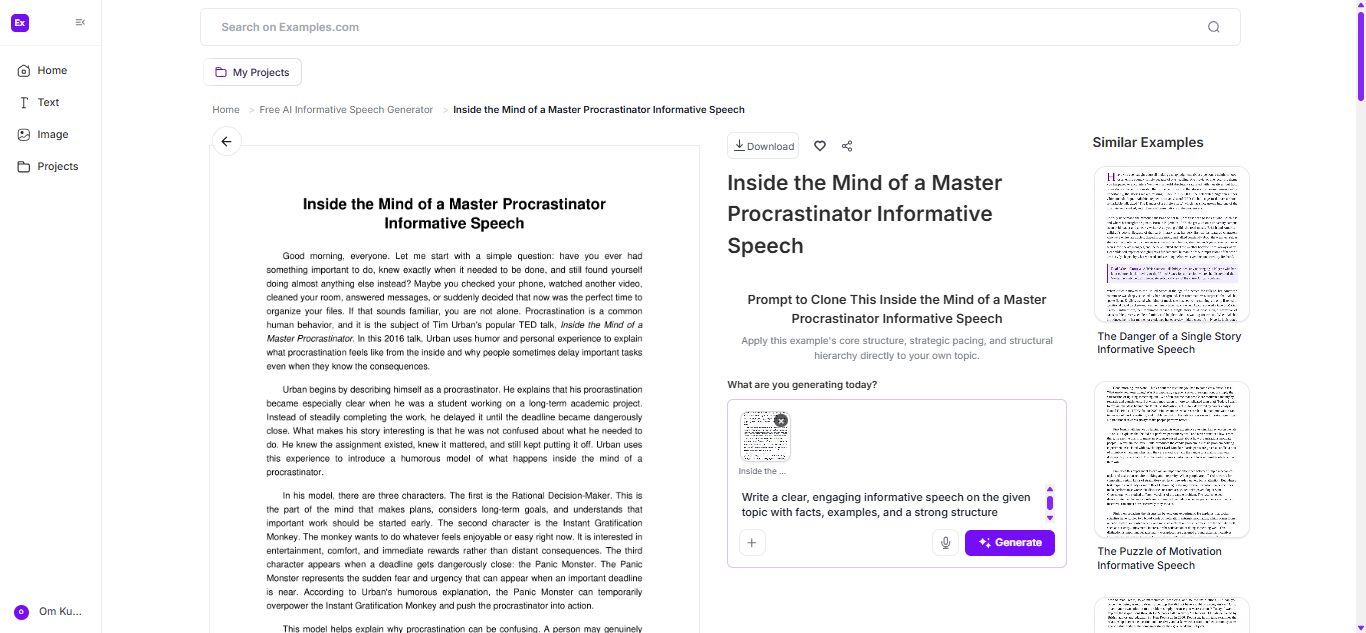
Choose A Reference Speech And Enter An AI Prompt
Select a reference speech and describe your requirements, including the topic, audience, purpose, key points, tone, length, and information you want to explain.
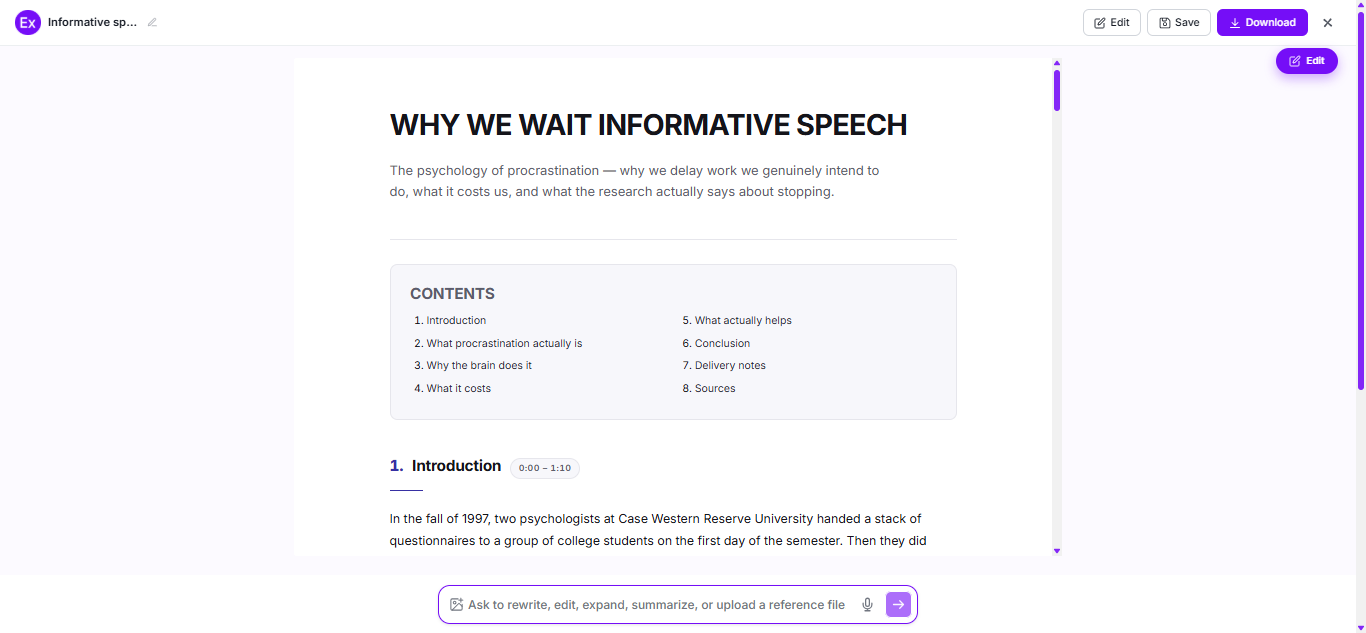
Generate A New AI Informative Speech
The AI generates a customized informative speech based on your prompt, organizing the content into a clear introduction, body, supporting evidence, transitions, and conclusion.
Customize The Informative Speech In The Online Editor
Edit the topic, main points, supporting details, examples, wording, transitions, and conclusion to make the speech accurate, engaging, and appropriate for your audience.
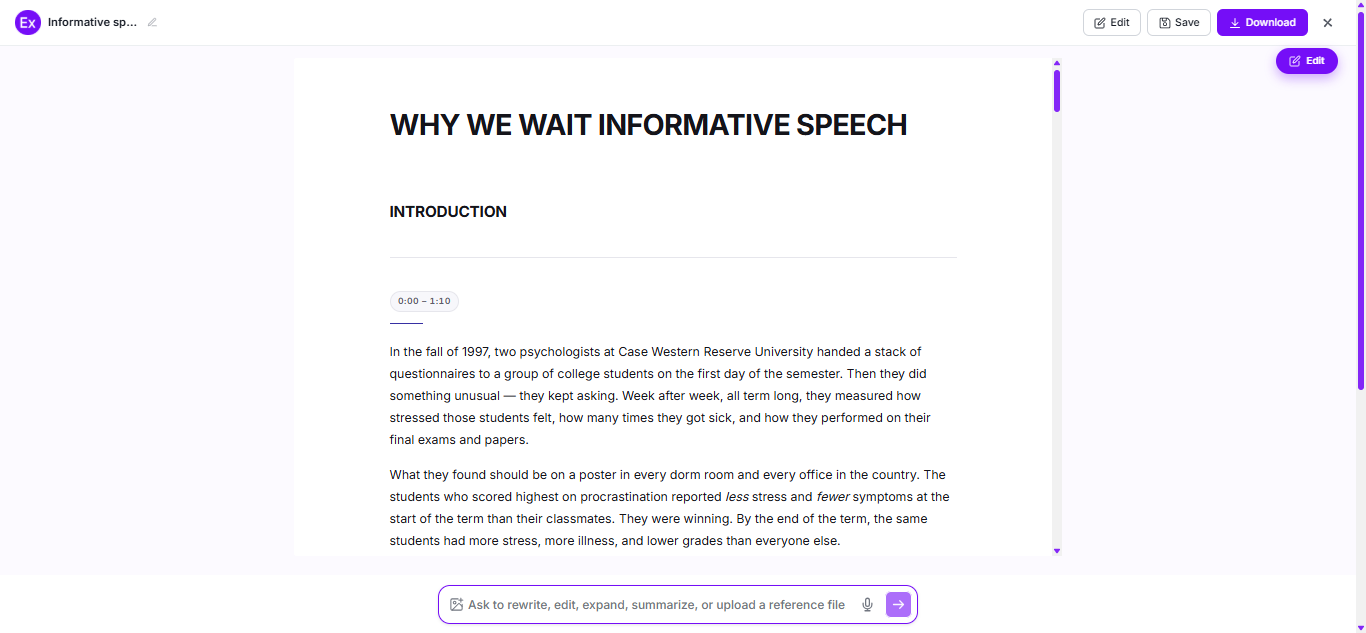
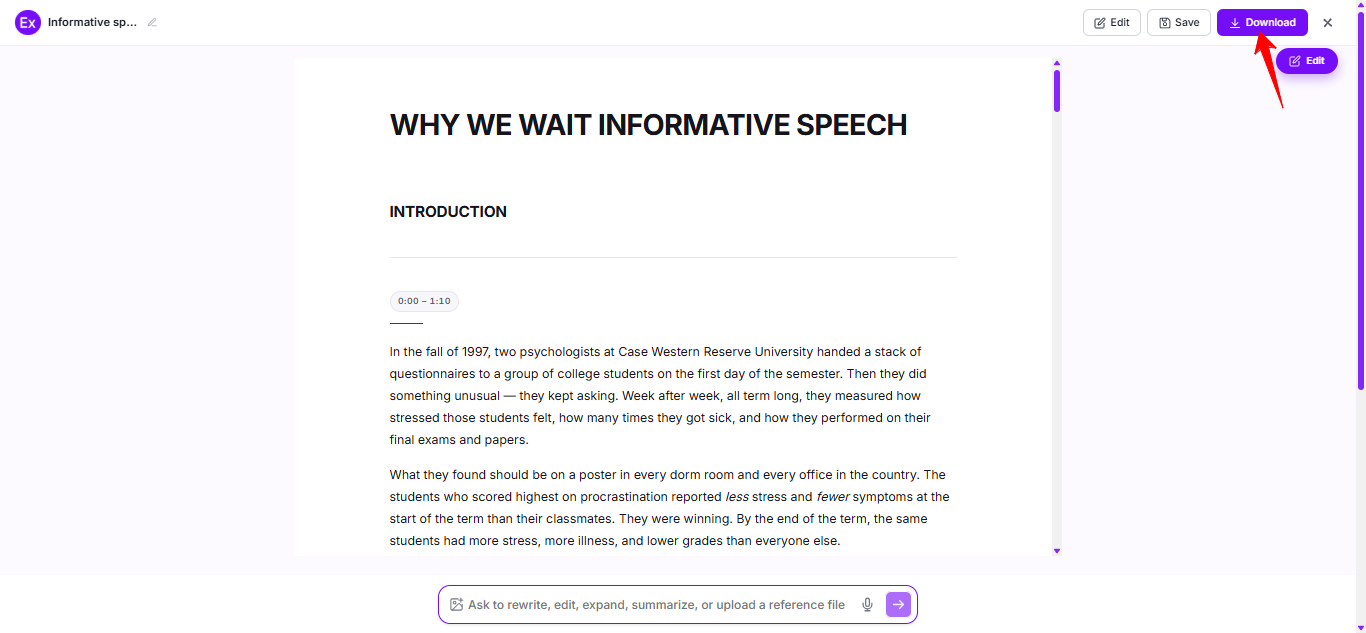
Download Your Informative Speech
Download your completed informative speech as a PDF for reviewing, printing, or keeping as a reference while preparing for your presentation.
AI Informative Speech Editing Features
AI Content Generation
Generate a well-structured informative speech based on your topic, audience, purpose, and required key points.
Smart Speech Editing
Add, remove, or revise sections, supporting points, examples, and explanations to improve your speech.
Automatic Formatting
Organize the introduction, main points, transitions, and conclusion into a clear and professional speech structure.
Speech Customization
Adjust the topic, tone, length, wording, examples, and level of detail to fit your audience and presentation needs.
Instant PDF Download
Download your completed informative speech as a PDF for reviewing, printing, or preparing for your presentation.
What Is the Purpose of an Informative Speech?
The purpose of an informative speech is to teach an audience about a specific topic by presenting accurate facts, explanations, examples, and evidence. It helps listeners understand unfamiliar ideas, concepts, people, places, events, objects, or processes without primarily trying to persuade them or change their opinions.
Which Essential Elements Should I Include in Every Informative Speech?
- Clear Topic: Clearly identify what the speech is about and keep the discussion focused.
- Strong Introduction: Capture attention, introduce the topic, establish credibility, and preview the main points.
- Informative Thesis: State the central idea or main message the audience should understand.
- Organized Main Points: Present two to five key points in a logical order that is easy to follow.
- Supporting Evidence: Use relevant facts, statistics, examples, and research to explain and support important information.
- Clear Transitions: Connect each point with smooth transitions so the audience can follow the progression of ideas.
- Audience-Relevant Examples: Include examples that make complex or unfamiliar information easier to understand.
- Engaging Delivery: Use an appropriate pace, tone, emphasis, eye contact, and confident speaking style.
- Strong Conclusion: Summarize the main points, reinforce the central idea, and end with a memorable final statement.
How Do I Write a Better Opening for an Informative Speech?
Start With a Strong Hook
Open with a surprising fact, thought-provoking question, brief story, or relevant statement that immediately captures the audience’s attention.
Introduce the Topic Clearly
Tell the audience exactly what the informative speech will explain and establish why the topic is worth their attention.
Establish Your Credibility
Briefly explain your connection to the topic or mention the research you used to show the audience that your information is trustworthy.
State the Central Idea
Present a clear thesis or central idea that tells the audience what they should understand or learn from the speech.
Preview the Main Points
Briefly introduce the key points you will cover so the audience knows what to expect and can follow the speech more easily.
Why Should I Use Real Informative Speech Examples to Create My Own Speech?
- Real informative speech examples show how effective speeches organize a topic into a clear introduction, body, and conclusion.
- They help you understand how speakers explain complex ideas using facts, evidence, examples, and easy-to-follow language.
- Reviewing real examples can help you identify strong opening hooks that capture attention without turning the speech into a persuasive argument.
- Examples provide practical guidance on how to develop main points and connect them with smooth transitions.
- They can help you understand how much information is appropriate for a particular speech length and audience.
- Studying different examples gives you ideas for presenting familiar or unfamiliar subjects in an engaging and understandable way.
- Real speeches demonstrate how research, statistics, examples, and other supporting information can strengthen an explanation.
- They help you recognize effective conclusions that reinforce the central idea and leave the audience with a clear understanding of the topic.
- Using examples as references can make the writing process easier because you can see how a complete informative speech works before creating your own.
- The goal is to use real examples for structure, inspiration, and learning, while developing original content that reflects your own topic, research, and audience.
What Common Informative Speech Mistakes Should I Avoid?
- Choosing a Broad Topic: Keep your topic focused enough to explain clearly within the available time.
- Using Weak Evidence: Use accurate facts, relevant examples, and reliable research to support your information.
- Adding Too Much Information: Include only the most useful points instead of overwhelming your audience with unnecessary details.
- Poor Organization: Arrange your ideas logically with clear transitions between sections.
- Lack of Audience Focus: Explain the topic at a level your audience can easily understand.
- Reading the Entire Speech: Practice your delivery so you can speak naturally and confidently.
- Ending Without a Conclusion: Summarize the main points and give the audience a clear final takeaway.
An informative speech typically lasts 5 to 10 minutes, depending on the assignment, audience, and topic. A 5-minute speech usually focuses on a few key points, while a 10-minute speech can provide more detailed explanations and supporting evidence. Always follow the specific time limit given for your presentation.
Informative Speech Ideas for Different Subjects
- Science: Space, climate, human biology
- Technology: AI, cybersecurity, smartphones
- History: Ancient civilizations, major events, inventions
- Health: Sleep, nutrition, fitness
- Environment: Recycling, conservation, renewable energy
- Business: Entrepreneurship, marketing, finance
- Education: Learning, schools, educational technology
- Psychology: Memory, habits, emotions
- Arts and Culture: Music, photography, traditions
- Everyday Life: Transportation, cooking, personal finance
FAQs
What Makes an Informative Speech Different From a Persuasive Speech?
An informative speech explains a topic objectively, while a persuasive speech aims to influence the audience’s beliefs, opinions, or actions.
Can an Informative Speech Include Personal Examples?
Yes, personal examples can clarify information, provided they support the topic and do not replace factual evidence or research.
How Many Main Points Should an Informative Speech Have?
Most informative speeches work well with two to five focused main points that provide enough information without overwhelming the audience.
What Topics Work Best for an Informative Speech?
The best topics are focused, researchable, relevant to the audience, and capable of being explained clearly within the available presentation time.
Should I Use Statistics in an Informative Speech?
Yes, relevant statistics can make information more credible and specific when they are accurate, understandable, and directly connected to your topic.
How Can I Keep an Informative Speech Interesting?
Use clear explanations, relevant examples, surprising facts, engaging openings, and smooth transitions to maintain audience attention throughout your presentation.
What Should I Include in the Conclusion?
Restate the central idea, briefly summarize the main points, and finish with a memorable statement that reinforces what the audience learned.
How Do I Choose the Right Informative Speech Structure?
Choose a structure based on your topic, using chronological, topical, cause-and-effect, spatial, or process organization when appropriate.
Can I Use Visual Aids in an Informative Speech?
Yes, visual aids such as charts, images, diagrams, and presentations can simplify complex information and help audiences understand important points.
How Can I Practice an Informative Speech Effectively?
Practice aloud several times, time your delivery, review difficult sections, and rehearse transitions to improve confidence and speaking fluency.