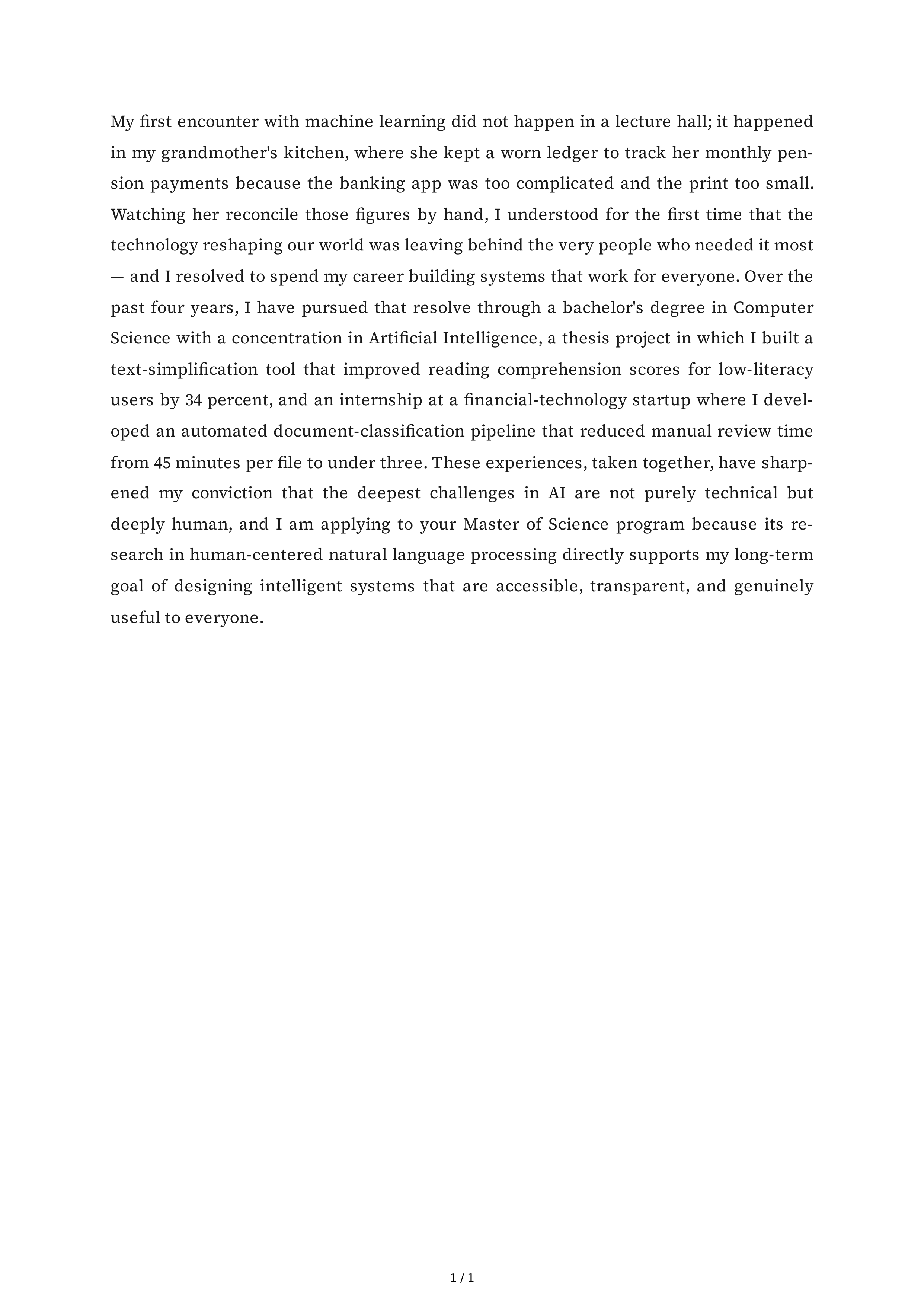
My first encounter with machine learning did not happen in a lecture hall; it happened
in my grandmother's kitchen, where she kept a worn ledger to track her monthly pen-
sion payments because the banking app was too complicated and the print too small.
Watching her reconcile those figures by hand, I understood for the first time that the
technology reshaping our world was leaving behind the very people who needed it most
— and I resolved to spend my career building systems that work for everyone. Over the
past four years, I have pursued that resolve through a bachelor's degree in Computer
Science with a concentration in Artificial Intelligence, a thesis project in which I built a
text-simplification tool that improved reading comprehension scores for low-literacy
users by 34 percent, and an internship at a financial-technology startup where I devel-
oped an automated document-classification pipeline that reduced manual review time
from 45 minutes per file to under three. These experiences, taken together, have sharp-
ened my conviction that the deepest challenges in AI are not purely technical but
deeply human, and I am applying to your Master of Science program because its re-
search in human-centered natural language processing directly supports my long-term
goal of designing intelligent systems that are accessible, transparent, and genuinely
useful to everyone.
1 / 1