My Projects
Home
Free AI Conclusion Paragraph Generator
Literature Review Conclusion Paragraph
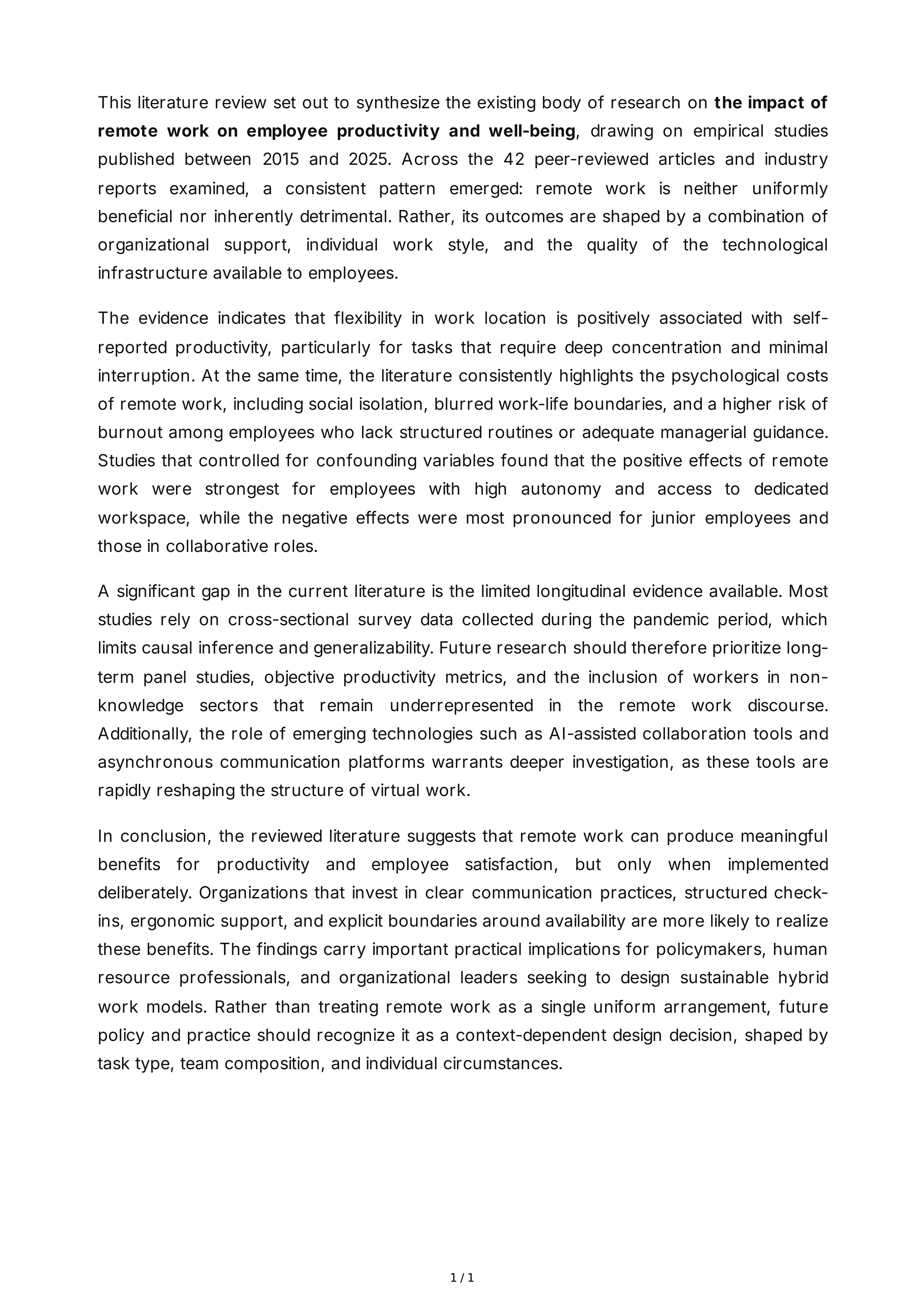
This
literature
review
set
out
to
synthesize
the
existing
body
of
research
on
the
impact
of
remote
work
on
employee
productivity
and
well
-
being
,
drawing
on
empirical
studies
published
between
2015
and
2025.
Across
the
42
peer
-
reviewed
articles
and
industry
reports
examined
,
a
consistent
pattern
emerged
:
remote
work
is
neither
uniformly
beneficial
nor
inherently
detrimental
.
Rather
,
its
outcomes
are
shaped
by
a
combination
of
organizational
support
,
individual
work
style
,
and
the
quality
of
the
technological
infrastructure
available
to
employees
.
The
evidence
indicates
that
flexibility
in
work
location
is
positively
associated
with
self
-
reported
productivity
,
particularly
for
tasks
that
require
deep
concentration
and
minimal
interruption
.
At
the
same
time
,
the
literature
consistently
highlights
the
psychological
costs
of
remote
work
,
including
social
isolation
,
blurred
work
-
life
boundaries
,
and
a
higher
risk
of
burnout
among
employees
who
lack
structured
routines
or
adequate
managerial
guidance
.
Studies
that
controlled
for
confounding
variables
found
that
the
positive
effects
of
remote
work
were
strongest
for
employees
with
high
autonomy
and
access
to
dedicated
workspace
,
while
the
negative
effects
were
most
pronounced
for
junior
employees
and
those
in
collaborative
roles
.
A
significant
gap
in
the
current
literature
is
the
limited
longitudinal
evidence
available
.
Most
studies
rely
on
cross
-
sectional
survey
data
collected
during
the
pandemic
period
,
which
limits
causal
inference
and
generalizability
.
Future
research
should
therefore
prioritize
long
-
term
panel
studies
,
objective
productivity
metrics
,
and
the
inclusion
of
workers
in
non
-
knowledge
sectors
that
remain
underrepresented
in
the
remote
work
discourse
.
Additionally
,
the
role
of
emerging
technologies
such
as
AI
-
assisted
collaboration
tools
and
asynchronous
communication
platforms
warrants
deeper
investigation
,
as
these
tools
are
rapidly
reshaping
the
structure
of
virtual
work
.
In
conclusion
,
the
reviewed
literature
suggests
that
remote
work
can
produce
meaningful
benefits
for
productivity
and
employee
satisfaction
,
but
only
when
implemented
deliberately
.
Organizations
that
invest
in
clear
communication
practices
,
structured
check
-
ins
,
ergonomic
support
,
and
explicit
boundaries
around
availability
are
more
likely
to
realize
these
benefits
.
The
findings
carry
important
practical
implications
for
policymakers
,
human
resource
professionals
,
and
organizational
leaders
seeking
to
design
sustainable
hybrid
work
models
.
Rather
than
treating
remote
work
as
a
single
uniform
arrangement
,
future
policy
and
practice
should
recognize
it
as
a
context
-
dependent
design
decision
,
shaped
by
task
type
,
team
composition
,
and
individual
circumstances
.
1 / 1