Oncology Interest Medical School Personal
Statement
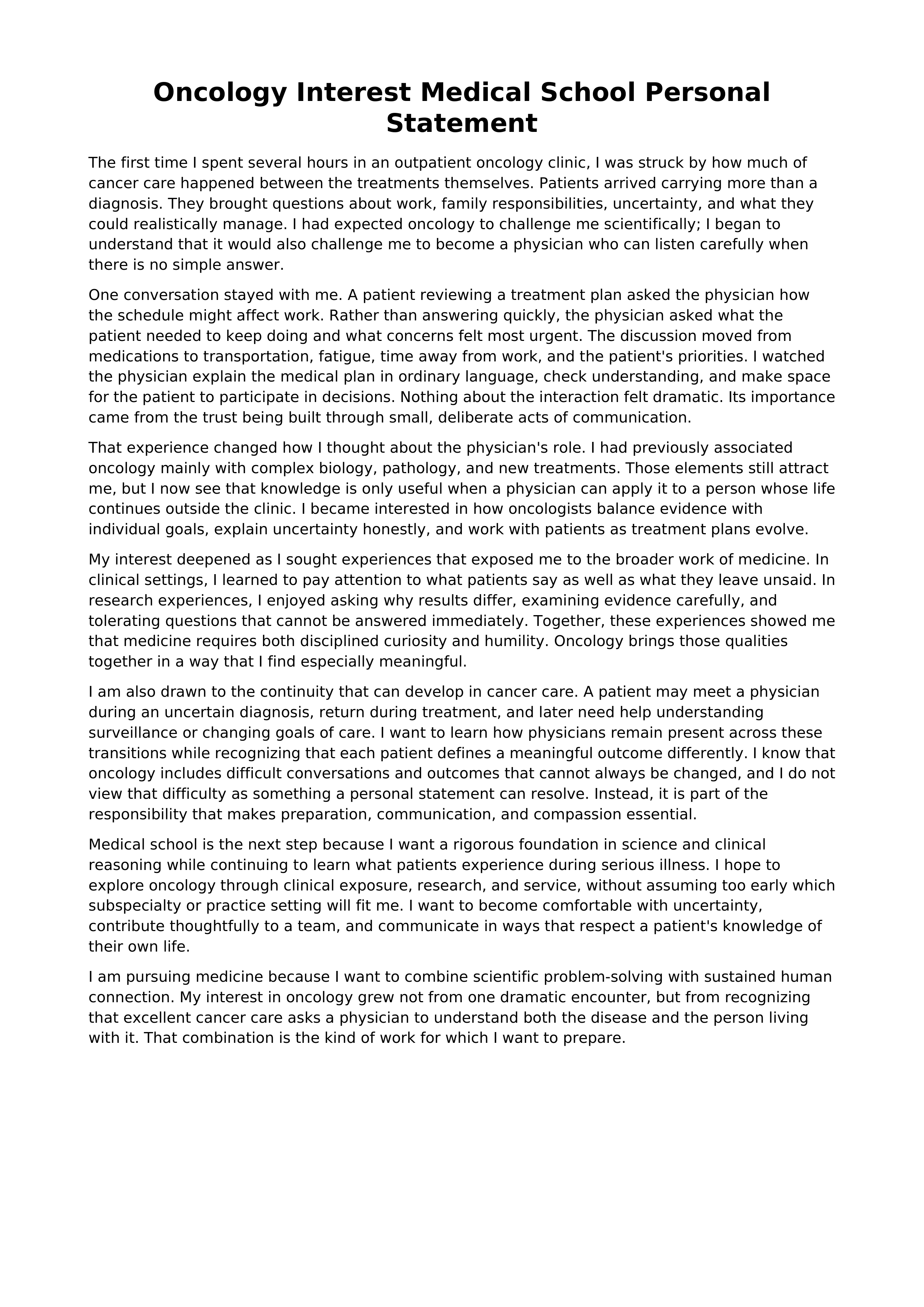
The first time I spent several hours in an outpatient oncology clinic, I was struck by how much of
cancer care happened between the treatments themselves. Patients arrived carrying more than a
diagnosis. They brought questions about work, family responsibilities, uncertainty, and what they
could realistically manage. I had expected oncology to challenge me scientifically; I began to
understand that it would also challenge me to become a physician who can listen carefully when
there is no simple answer.
One conversation stayed with me. A patient reviewing a treatment plan asked the physician how
the schedule might affect work. Rather than answering quickly, the physician asked what the
patient needed to keep doing and what concerns felt most urgent. The discussion moved from
medications to transportation, fatigue, time away from work, and the patient's priorities. I watched
the physician explain the medical plan in ordinary language, check understanding, and make space
for the patient to participate in decisions. Nothing about the interaction felt dramatic. Its importance
came from the trust being built through small, deliberate acts of communication.
That experience changed how I thought about the physician's role. I had previously associated
oncology mainly with complex biology, pathology, and new treatments. Those elements still attract
me, but I now see that knowledge is only useful when a physician can apply it to a person whose life
continues outside the clinic. I became interested in how oncologists balance evidence with
individual goals, explain uncertainty honestly, and work with patients as treatment plans evolve.
My interest deepened as I sought experiences that exposed me to the broader work of medicine. In
clinical settings, I learned to pay attention to what patients say as well as what they leave unsaid. In
research experiences, I enjoyed asking why results differ, examining evidence carefully, and
tolerating questions that cannot be answered immediately. Together, these experiences showed me
that medicine requires both disciplined curiosity and humility. Oncology brings those qualities
together in a way that I find especially meaningful.
I am also drawn to the continuity that can develop in cancer care. A patient may meet a physician
during an uncertain diagnosis, return during treatment, and later need help understanding
surveillance or changing goals of care. I want to learn how physicians remain present across these
transitions while recognizing that each patient defines a meaningful outcome differently. I know that
oncology includes difficult conversations and outcomes that cannot always be changed, and I do not
view that difficulty as something a personal statement can resolve. Instead, it is part of the
responsibility that makes preparation, communication, and compassion essential.
Medical school is the next step because I want a rigorous foundation in science and clinical
reasoning while continuing to learn what patients experience during serious illness. I hope to
explore oncology through clinical exposure, research, and service, without assuming too early which
subspecialty or practice setting will fit me. I want to become comfortable with uncertainty,
contribute thoughtfully to a team, and communicate in ways that respect a patient's knowledge of
their own life.
I am pursuing medicine because I want to combine scientific problem-solving with sustained human
connection. My interest in oncology grew not from one dramatic encounter, but from recognizing
that excellent cancer care asks a physician to understand both the disease and the person living
with it. That combination is the kind of work for which I want to prepare.