Preventive Medicine Interest Medical School Personal
Statement
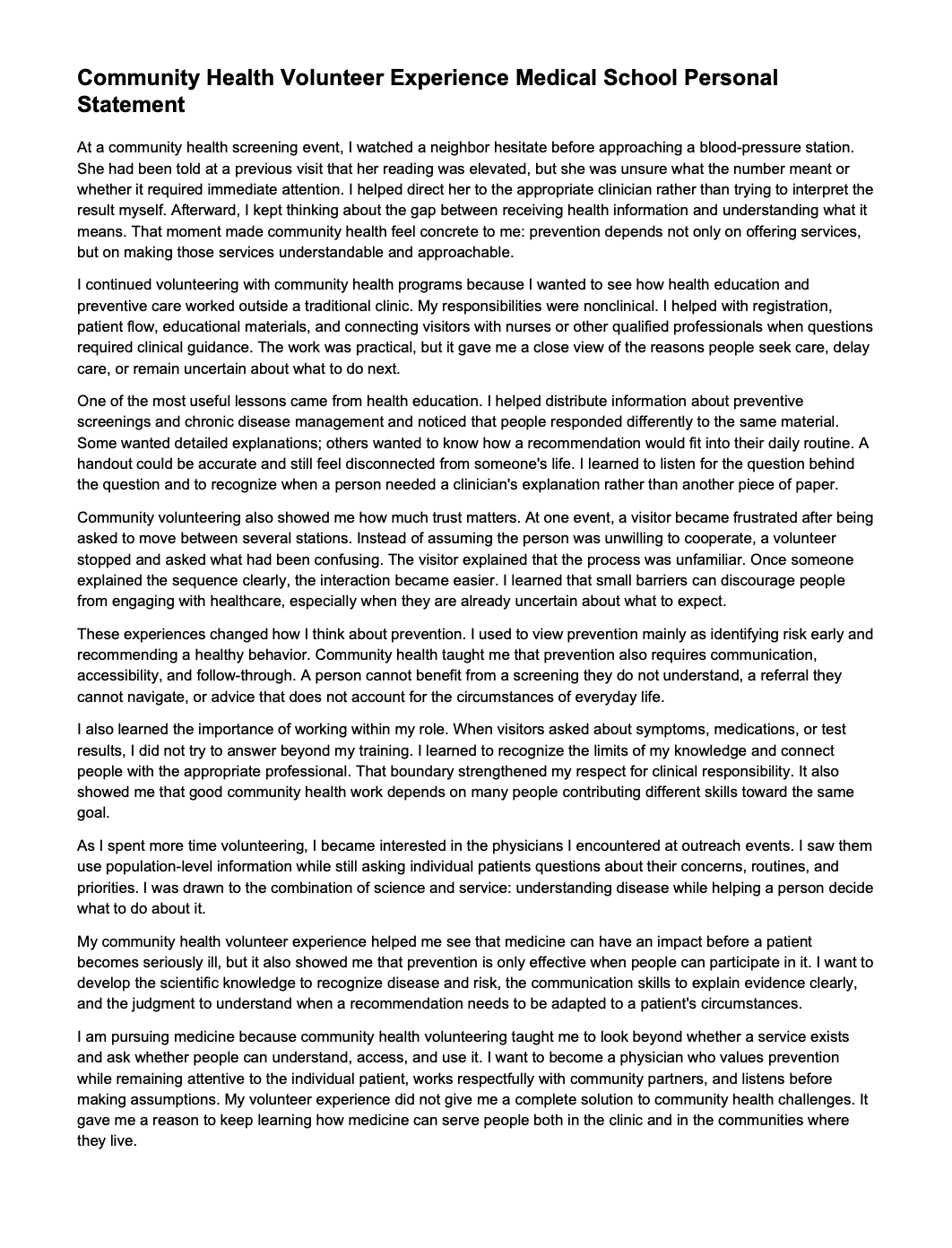
During a community health screening organized through my university, I expected the most useful
part of the day to be helping people understand their blood pressure and blood glucose readings.
Instead, I found myself thinking about the people who might never have reached a screening event at
all. A conversation with a middle-aged participant, who had known for years that his blood pressure
was high but had struggled to make regular care fit around work and transportation, changed the way
I thought about prevention. The problem was not simply a number on a chart. It was the environment
around the patient and the opportunities available before illness became more difficult to manage.
That experience led me to ask a question that has stayed with me: how can physicians use what they
learn from individual patients to prevent illness across larger groups? As I explored medicine, I
became increasingly interested in the space where clinical care and public health meet. I value the
physician's responsibility to understand the person in front of them, but I am equally interested in
recognizing patterns, identifying risk, and improving the conditions that shape health before patients
become seriously ill.
My coursework and health-related volunteer experiences strengthened this interest. While helping
with community outreach, I saw that health information is only useful when people can act on it. A
recommendation about screening, nutrition, vaccination, or medication adherence can sound
straightforward in an exam room while becoming much harder to follow when a patient is balancing
work, family responsibilities, limited transportation, or uncertainty about the healthcare system. These
experiences taught me to listen without assuming that a missed appointment reflects a lack of
concern. They also showed me why prevention requires both clinical knowledge and attention to
context.
Research further changed how I understand prevention. Working with health data made me
appreciate how patterns that seem abstract can represent real differences in people's lives. I became
interested in how physicians can use evidence to identify risk factors, evaluate preventive
interventions, and communicate health information responsibly. I do not see population-level work as
separate from patient care. Rather, I see it as an extension of the same responsibility: understanding
what contributes to illness and using that knowledge to make care more effective and accessible.
Preventive medicine appeals to me because it asks physicians to think upstream without losing sight
of individual patients. I want to develop strong clinical skills while learning how screening, vaccination,
health education, epidemiology, and system-level interventions can reduce preventable disease. I am
especially interested in working with communities to design interventions that are practical,
evidence-based, and responsive to local needs rather than assuming that one approach will work for
everyone.
Medical school will give me the clinical foundation to ask better questions about prevention and the
scientific training to evaluate possible answers. I hope to become a physician who can move
comfortably between a patient conversation and a population-level problem, using each perspective
to strengthen the other. My interest in preventive medicine began with a single conversation at a
community screening, but it has grown into a commitment to understand not only how to treat
disease, but how physicians can help make illness less likely to occur in the first place.