Ligeia Essay Introduction
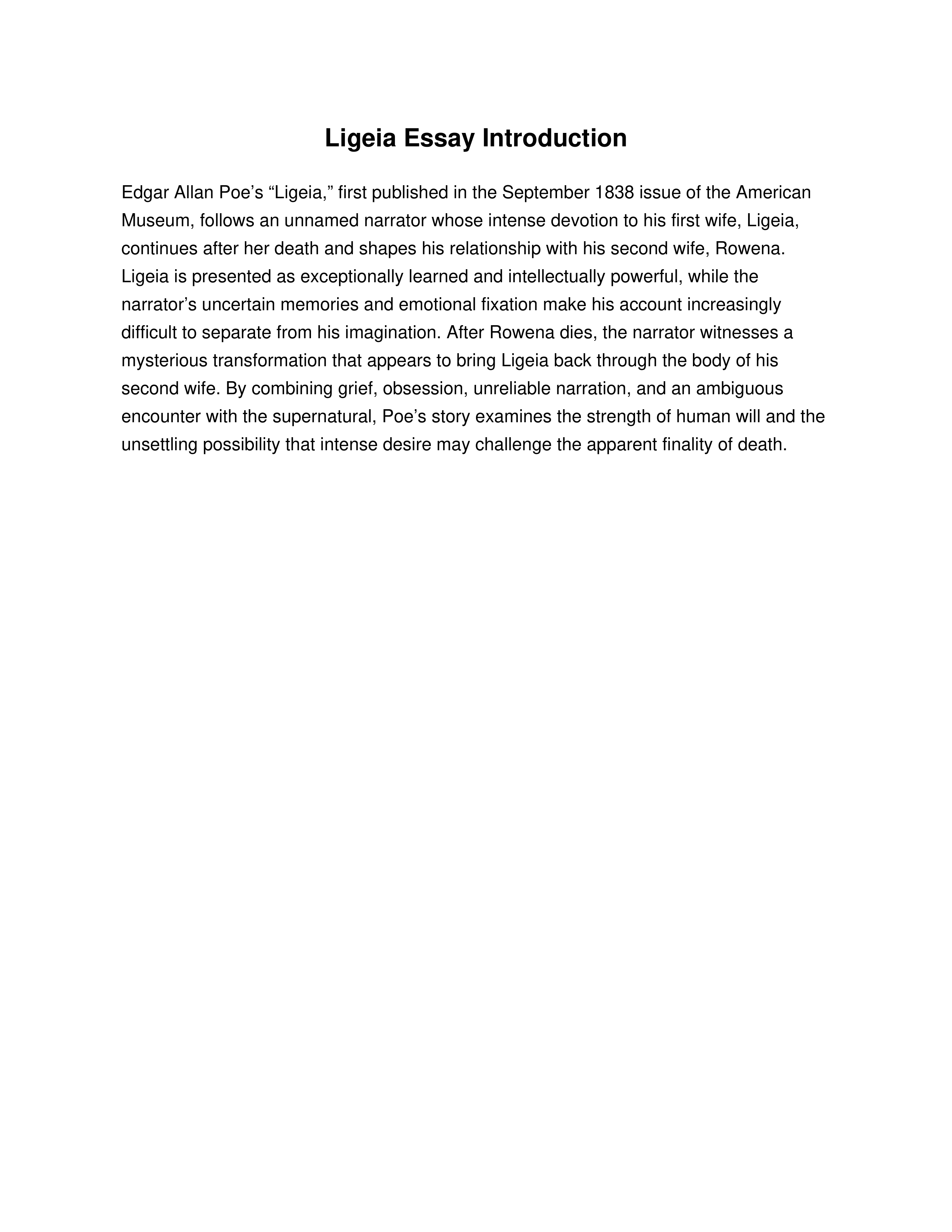
Edgar Allan Poe’s “Ligeia,” first published in the September 1838 issue of the American
Museum, follows an unnamed narrator whose intense devotion to his first wife, Ligeia,
continues after her death and shapes his relationship with his second wife, Rowena.
Ligeia is presented as exceptionally learned and intellectually powerful, while the
narrator’s uncertain memories and emotional fixation make his account increasingly
difficult to separate from his imagination. After Rowena dies, the narrator witnesses a
mysterious transformation that appears to bring Ligeia back through the body of his
second wife. By combining grief, obsession, unreliable narration, and an ambiguous
encounter with the supernatural, Poe’s story examines the strength of human will and the
unsettling possibility that intense desire may challenge the apparent finality of death.