
EXECUTIVE
OFFICE
OF
THE
PRESIDENT
OFFICE
OF
MANAGEMENT
AND
BUDGET
WASHINGTON
,
D.C.
20503
TH
E
DIRECTOR
May 22, 2026
M-26-14
MEMORANDUM TO THE HEADS OF EXECUTIVE DEPARTMENTS AND AGENCIES
FROM:
Russell
T.
Vought
('\
'\
J\
~
D1rector
V
\
\l
J\J
~
SUBJECT:
Ensuring Effective and Efficient Agency Logging and Network Visibility to
Defend Against Evolving Cyber Threats
As recognized by President Trump' s Management Agenda,
1
agencies
2
must "defend
against and persistently combat cyber enemies," who continue to evolve in scale, speed, and
sophistication. Threat actors have increasingly used automation and aiiificial intelligence to
accelerate attacks against critical systems. These enhanced capabilities can help threat actors
rapidly gain unauthorized access to a system, move from that system to others, and maintain
their illicit access undetected over a substantial period
of
time. To mitigate the risk posed by
these intensifying digital threats, agencies need the ability to rapidly detect, respond to, and
analyze anomalous activity on their networks. Key to that ability is appropriate event
logging
the timely and consistent recording
of
significant activities that take place in an information
system. Agencies rely on information from logs to understand activity across their systems,
recognize events that require attention, and support the analysis and response actions that protect
sensitive data and maintain operations.
In 2021 ,
0MB
issued Memorandum M-21-31 ,
Improving the Federal Government 's
Investigative
and
Remediation Capabilities Related to Cybersecurity Incidents,
to raise
lo
gging
baselines and enhance agencies' knowledge
of
events occun-ing in their systems. Implementation
of
that memorandum improved foundational capabilities across agencies. However, some
requirements, such as the retention
of
vast quantities
of
logging data without clear utility, proved
neither operationally feasible nor cost-effective for most agencies. To address these
inefficiencies and the evolving cyber threat environment, this memorandum directs agencies to
employ a risk-based, prioritized logging approach.
1
Available at https://www.whitehouse.gov/wp-content/uploads/2025/
12
/M-26-03-Presidents-Management
Agenda.pdf.
2
For the purposes
of
this memorandum, "agency" has the meaning given
in
44 U.S.C. § 3502. The requirements
established by this memorandum do not apply to national security systems,
as
defined
in
44 U.S.
C.
§ 3552(b)(6), or
to systems
of
the Department
of
Defense or Intelligence Community that are described
in
44 U.S.
C.
§ 3553(e).
Effective immediately, OMB Memorandum M-21-31 is rescinded. Going forward, as
described below, agencies shall work within an adaptive framework that enables them to
effectively and efficiently monitor their networks while minimizing red tape and containing
costs.
Prioritization
In organizing and resourcing their logging activities, agencies must prioritize two
objectives:
1.
Continuous Event Monitoring (CEM)
Logs, log management, and logging infrastructure that enable agencies to monitor
network activity in real time, promptly flag anomalous activity, and respond to that activity in
a timely manner. These logs are typically ingested and monitored by a Security Operations
Center (SOC).
2.
Threat Hunting, Investigation, Response, and Forensics (THIRF)
Logs, log management, and logging infrastructure that enable agencies to investigate
and perform forensic analysis of network activity after a known or suspected compromise with
the purpose of mitigating, remediating, and recovering from threat actor activity. To enable
THIRF, agencies must maintain sufficient hot and cold storage as well as the capability to
retrieve and centralize logging data from multiple sources to map attack patterns.
Each agency must pursue these objectives with respect to all information systems
owned or operated by the agency or by third parties on the agency’s behalf, including any
Internet of Things (IoT) devices or operational technology (OT) that is part of or constitutes
such an information system.
3
Reference Architecture
Within 90 days of the date of this memorandum, the Cybersecurity and Infrastructure
Security Agency (CISA), in coordination with OMB and the Chief Information Security Officer
(CISO) Council, will develop a logging reference architecture (LRA) that satisfies the
requirements in this memorandum and assists agencies in meeting CEM and THIRF objectives.
The LRA will serve as a core source of guidance for agencies on how to implement their CEM
and THIRF logging capabilities, allowing them to build upon their progress under M-21-31
while affording them greater flexibility to accommodate their disparate mission requirements and
associated cybersecurity risks. Agencies must adhere to the reference architecture by the
timelines outlined in the “agency actions” section of this memorandum. The LRA will be
published at
https://www.cisa.gov/Logging
.
3
For the purposes of this memorandum, “information system” has the meaning given in 44 U.S.C. § 3502(8).
2
Agency Logging Plan
Agencies must submit an Agency Logging Plan to OMB and CISA within 90 days of the
publication of the LRA. This plan must describe the operational steps required for the agency to
deploy and maintain effective CEM and THIRF objectives. The plan will document the series of
actions that will be taken to achieve the minimum baseline requirements defined in this
memorandum as well as any additional log collection and activities that will be conducted to
achieve CEM and THIRF objectives, with consideration given to the agency’s threat
environment, risk profile, and mission as provided in the guidance of the CISA Logging
Reference Architecture. Each agency should periodically update its plan as necessary.
Measuring Maturity
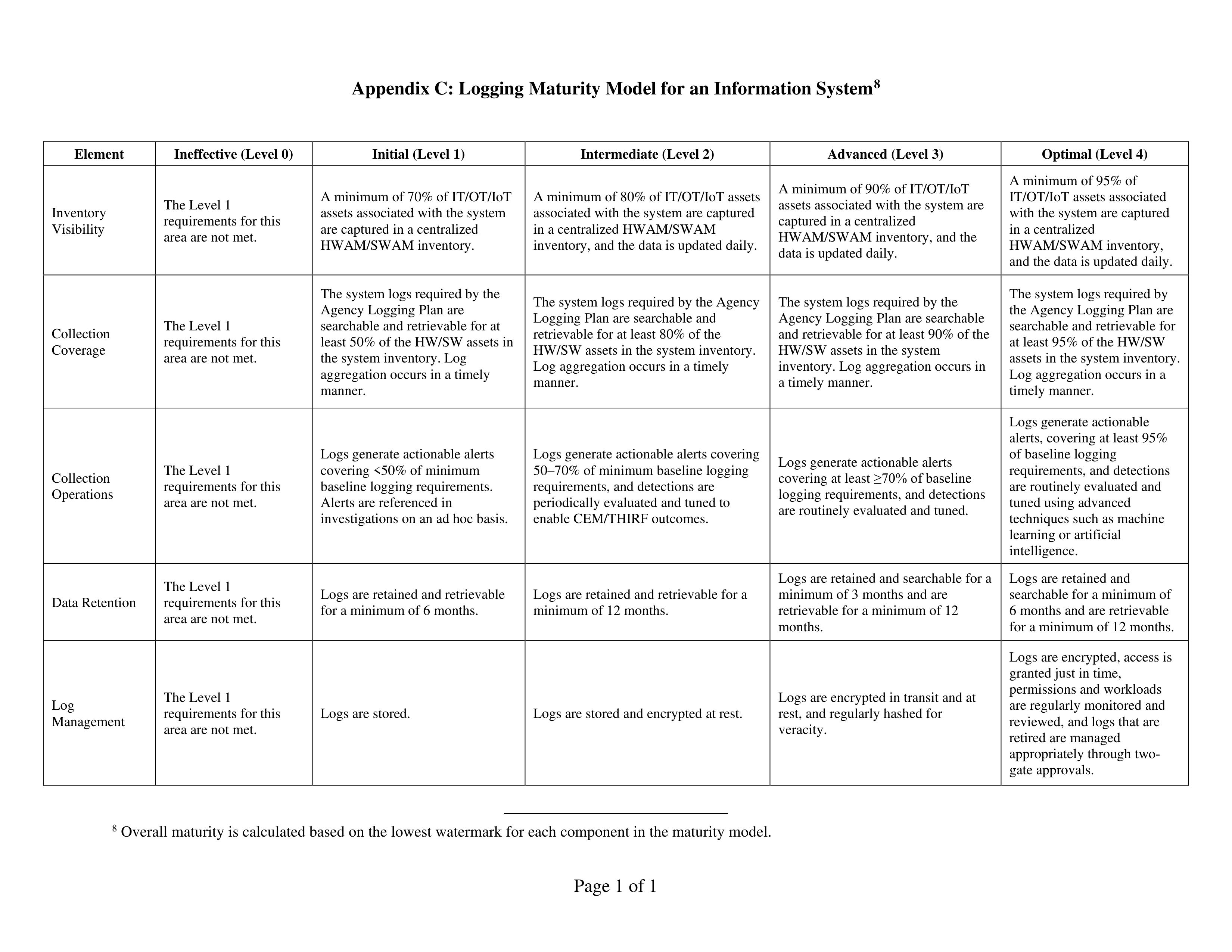
This memorandum establishes a revised maturity model (Appendix C) to guide and
measure agency implementation of logging requirements. The maturity model defines a set of
performance benchmarks that correspond to varying levels of proficiency and sophistication in
the following functions: visibility into system inventory, log management planning, log
collection, and data retention. Agencies will measure and report on progress in terms of the
percentage of systems that are determined to be operating at each maturity level.
Log Access Requirements
In the event of a known or suspected compromise of one or more Federal networks, agencies
shall provide logs and other relevant data to CISA and the Federal Bureau of Investigation (FBI)
upon request, to the extent consistent with applicable law, to assist in incident response,
investigation, and remediation. Agencies shall provide such data in a format and by means
agreed upon by the agency and CISA or the FBI as appropriate. To the greatest extent
practicable, agencies shall provide access to logs within the timeframes requested by CISA or the
FBI.
In cases in which agency data is subject to relevant statutory, regulatory, or judicial
access restrictions, the Directors of CISA and the FBI will comply with any processes and
procedures required to access such data or work with the agency to develop an appropriate
administrative accommodation consistent with any such restrictions, if such an accommodation
is legally available.
Agency Actions
CISA, in coordination with OMB and the CISO Council, will:
1) Publish the LRA within 90 days of the date of this memorandum;
2) Notify agencies within five business days of any published updates to the LRA; and
3) Provide logging implementation technical support and advice to agencies through
channels such as frequently asked questions (FAQs), interagency engagements (e.g.,
workshops, focus groups, communities of practice), training, or direct support
opportunities, as appropriate.
3
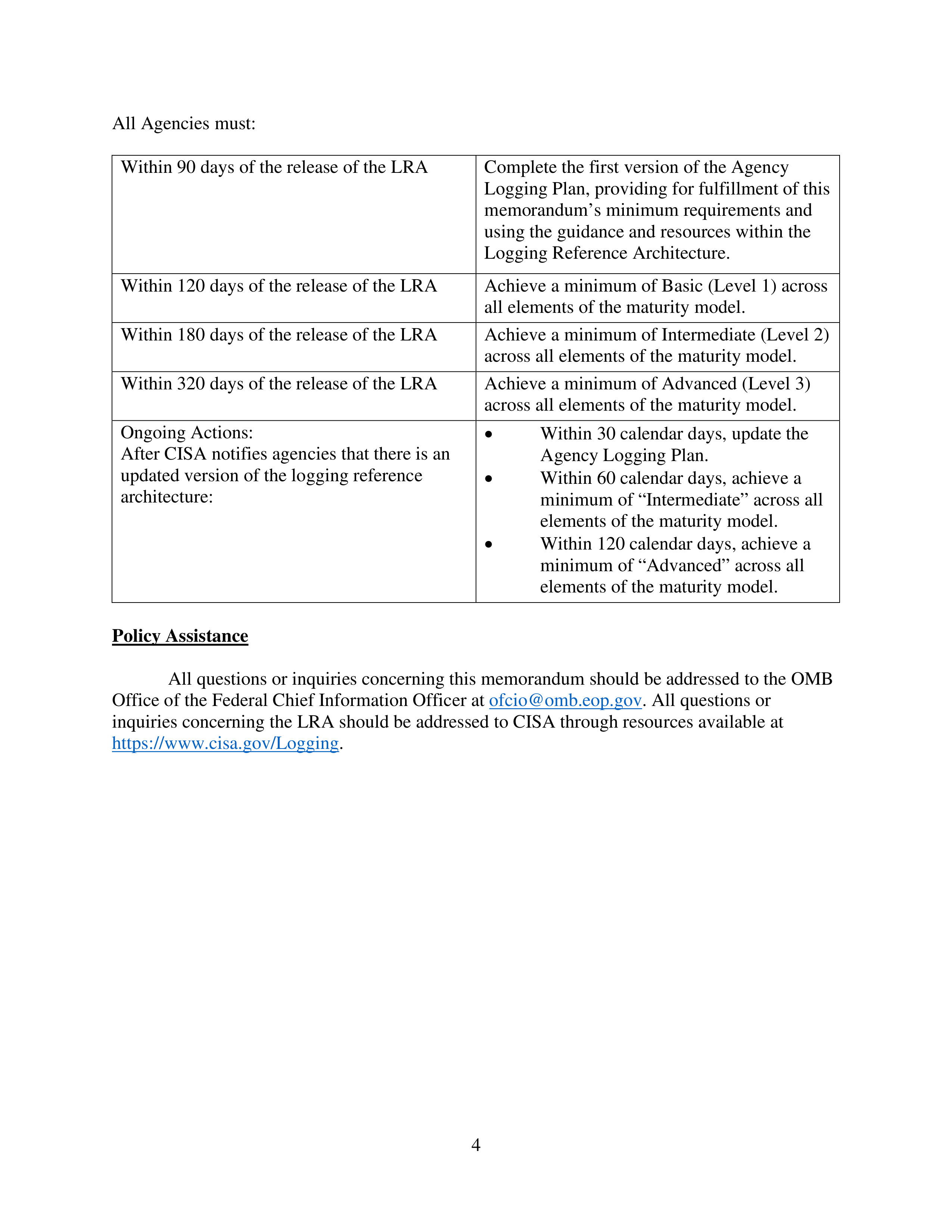
All Agencies must:
Within 90 days of the release of the LRA
Complete the first version of the Agency
Logging Plan, providing for fulfillment of this
memorandum’s minimum requirements and
using the guidance and resources within the
Logging Reference Architecture.
Within 120 days of the release of the LRA
Achieve a minimum of Basic (Level 1) across
all elements of the maturity model.
Within 180 days of the release of the LRA
Achieve a minimum of Intermediate (Level 2)
across all elements of the maturity model.
Within 320 days of the release of the LRA
Achieve a minimum of Advanced (Level 3)
across all elements of the maturity model.
Ongoing Actions:
After CISA notifies agencies that there is an
updated version of the logging reference
architecture:
•
Within 30 calendar days, update the
Agency Logging Plan.
•
Within 60 calendar days, achieve a
minimum of “Intermediate” across all
elements of the maturity model.
•
Within 120 calendar days, achieve a
minimum of “Advanced” across all
elements of the maturity model.
Policy Assistance
All questions or inquiries concerning this memorandum should be addressed to the OMB
Office of the Federal Chief Information Officer at
ofcio@omb.eop.gov
. All questions or
inquiries concerning the LRA should be addressed to CISA through resources available at
https://www.cisa.gov/Logging
.
4
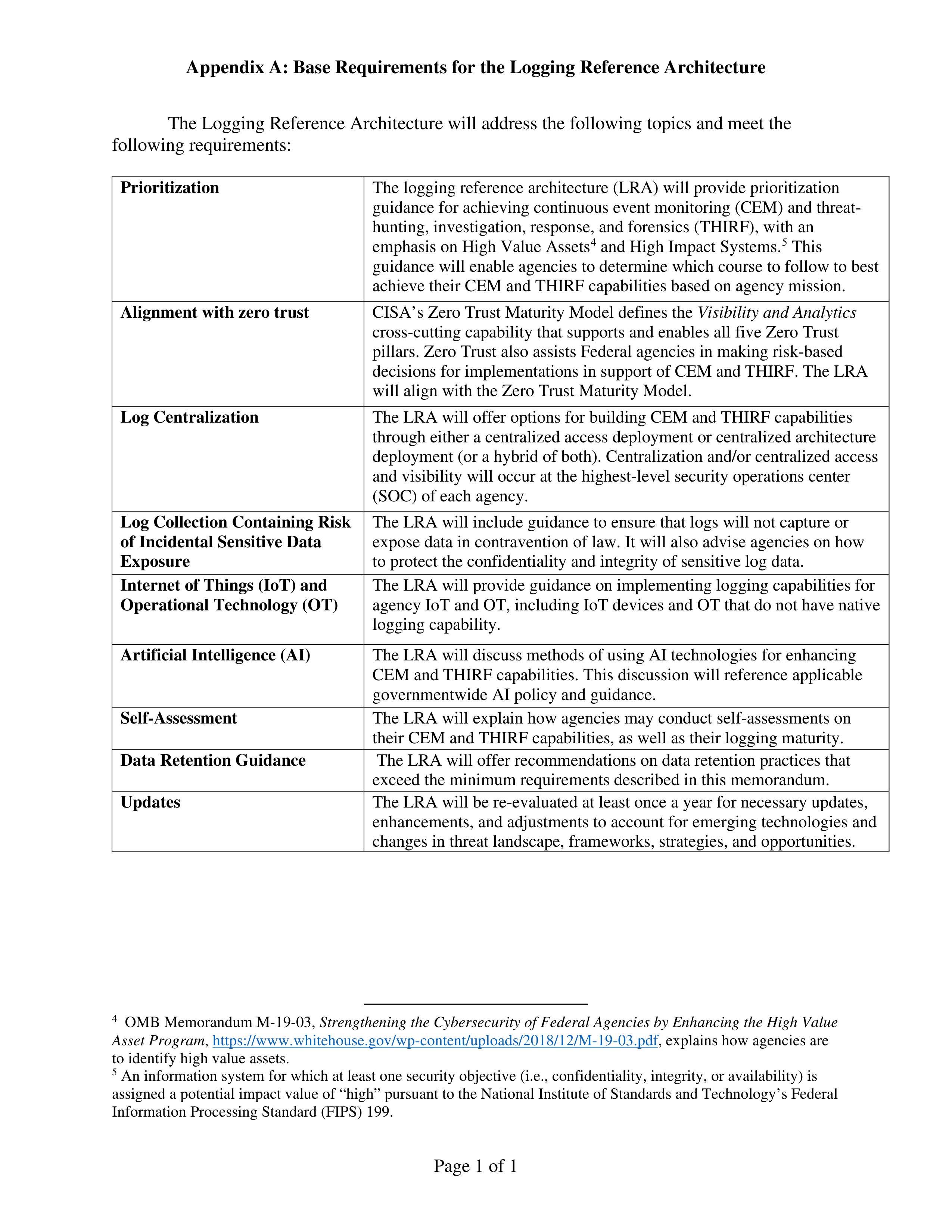
Appendix A: Base Requirements for the Logging Reference Architecture
The Logging Reference Architecture will address the following topics and meet the
following requirements:
Prioritization
The logging reference architecture (LRA) will provide prioritization
guidance for achieving continuous event monitoring (CEM) and threat-
hunting, investigation, response, and forensics (THIRF), with an
emphasis on High Value Assets
4
and High Impact Systems.
5
This
guidance will enable agencies to determine which course to follow to best
achieve their CEM and THIRF capabilities based on agency mission.
Alignment with zero trust
CISA’s Zero Trust Maturity Model defines the
Visibility and Analytics
cross-cutting capability that supports and enables all five Zero Trust
pillars. Zero Trust also assists Federal agencies in making risk-based
decisions for implementations in support of CEM and THIRF. The LRA
will align with the Zero Trust Maturity Model.
Log Centralization
The LRA will offer options for building CEM and THIRF capabilities
through either a centralized access deployment or centralized architecture
deployment (or a hybrid of both). Centralization and/or centralized access
and visibility will occur at the highest-level security operations center
(SOC) of each agency.
Log Collection Containing Risk
of Incidental Sensitive Data
Exposure
The LRA will include guidance to ensure that logs will not capture or
expose data in contravention of law. It will also advise agencies on how
to protect the confidentiality and integrity of sensitive log data.
Internet of Things (IoT) and
Operational Technology (OT)
The LRA will provide guidance on implementing logging capabilities for
agency IoT and OT, including IoT devices and OT that do not have native
logging capability.
Artificial Intelligence (AI)
The LRA will discuss methods of using AI technologies for enhancing
CEM and THIRF capabilities. This discussion will reference applicable
governmentwide AI policy and guidance.
Self-Assessment
The LRA will explain how agencies may conduct self-assessments on
their CEM and THIRF capabilities, as well as their logging maturity.
Data Retention Guidance
The LRA will offer recommendations on data retention practices that
exceed the minimum requirements described in this memorandum.
Updates
The LRA will be re-evaluated at least once a year for necessary updates,
enhancements, and adjustments to account for emerging technologies and
changes in threat landscape, frameworks, strategies, and opportunities.
4
OMB Memorandum M-19-03,
Strengthening the Cybersecurity of Federal Agencies by Enhancing the High Value
Asset Program
,
https://www.whitehouse.gov/wp-content/uploads/2018/12/M-19-03.pdf
, explains how agencies are
to identify high value assets.
5
An information system for which at least one security objective (i.e., confidentiality, integrity, or availability) is
assigned a potential impact value of “high” pursuant to the National Institute of Standards and Technology’s Federal
Information Processing Standard (FIPS) 199.
Page 1 of 1
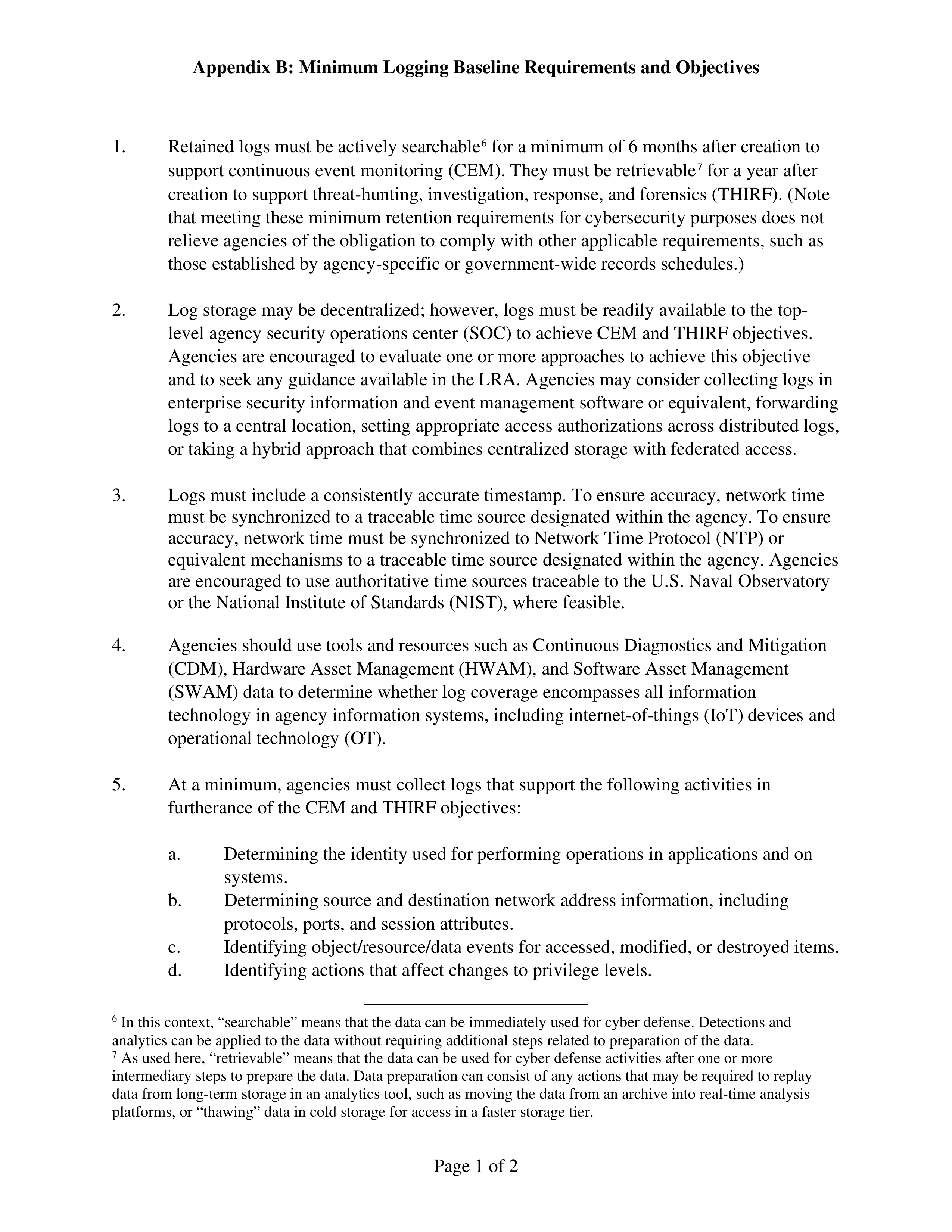
Appendix B: Minimum Logging Baseline Requirements and Objectives
1.
Retained logs must be actively searchable
6
for a minimum of 6 months after creation to
support continuous event monitoring (CEM). They must be retrievable
7
for a year after
creation to support threat-hunting, investigation, response, and forensics (THIRF). (Note
that meeting these minimum retention requirements for cybersecurity purposes does not
relieve agencies of the obligation to comply with other applicable requirements, such as
those established by agency-specific or government-wide records schedules.)
2.
Log storage may be decentralized; however, logs must be readily available to the top-
level agency security operations center (SOC) to achieve CEM and THIRF objectives.
Agencies are encouraged to evaluate one or more approaches to achieve this objective
and to seek any guidance available in the LRA. Agencies may consider collecting logs in
enterprise security information and event management software or equivalent, forwarding
logs to a central location, setting appropriate access authorizations across distributed logs,
or taking a hybrid approach that combines centralized storage with federated access.
3.
Logs must include a consistently accurate timestamp. To ensure accuracy, network time
must be synchronized to a traceable time source designated within the agency. To ensure
accuracy, network time must be synchronized to Network Time Protocol (NTP) or
equivalent mechanisms to a traceable time source designated within the agency. Agencies
are encouraged to use authoritative time sources traceable to the U.S. Naval Observatory
or the National Institute of Standards (NIST), where feasible.
4.
Agencies should use tools and resources such as Continuous Diagnostics and Mitigation
(CDM), Hardware Asset Management (HWAM), and Software Asset Management
(SWAM) data to determine whether log coverage encompasses all information
technology in agency information systems, including internet-of-things (IoT) devices and
operational technology (OT).
5.
At a minimum, agencies must collect logs that support the following activities in
furtherance of the CEM and THIRF objectives:
a.
Determining the identity used for performing operations in applications and on
systems.
b.
Determining source and destination network address information, including
protocols, ports, and session attributes.
c.
Identifying object/resource/data events for accessed, modified, or destroyed items.
d.
Identifying actions that affect changes to privilege levels.
6
In this context, “searchable” means that the data can be immediately used for cyber defense. Detections and
analytics can be applied to the data without requiring additional steps related to preparation of the data.
7
As used here, “retrievable” means that the data can be used for cyber defense activities after one or more
intermediary steps to prepare the data. Data preparation can consist of any actions that may be required to replay
data from long-term storage in an analytics tool, such as moving the data from an archive into real-time analysis
platforms, or “thawing” data in cold storage for access in a faster storage tier.
Page 1 of 2
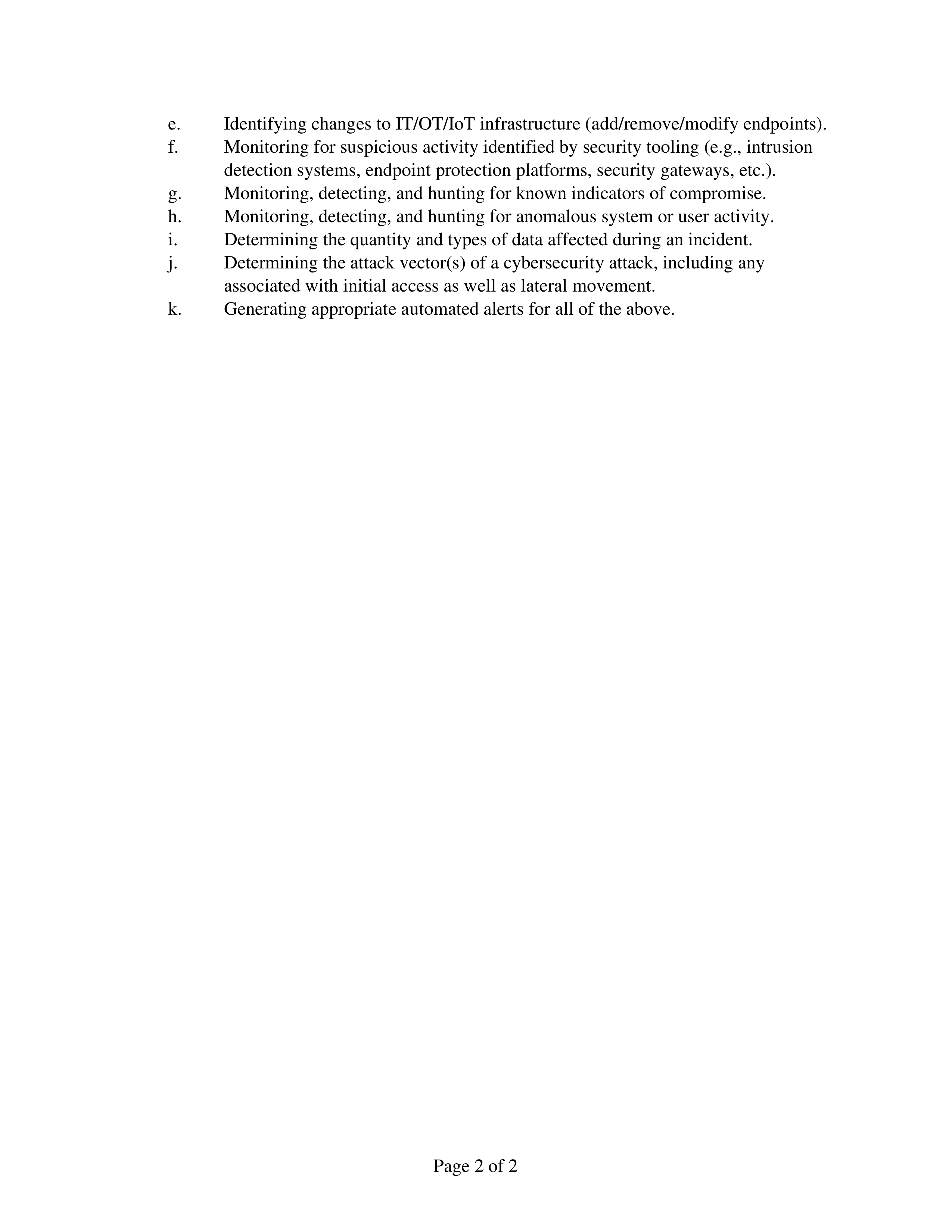
e.
Identifying changes to IT/OT/IoT infrastructure (add/remove/modify endpoints).
f.
Monitoring for suspicious activity identified by security tooling (e.g., intrusion
detection systems, endpoint protection platforms, security gateways, etc.).
g.
Monitoring, detecting, and hunting for known indicators of compromise.
h.
Monitoring, detecting, and hunting for anomalous system or user activity.
i.
Determining the quantity and types of data affected during an incident.
j.
Determining the attack vector(s) of a cybersecurity attack, including any
associated with initial access as well as lateral movement.
k.
Generating appropriate automated alerts for all of the above.
Page 2 of 2
Appendix C: Logging Maturity Model for an Information System
8
Element
Ineffective (Level 0)
Initial (Level 1)
Intermediate (Level 2)
Advanced (Level 3)
Optimal (Level 4)
Inventory
Visibility
The Level 1
requirements for this
area are not met.
A minimum of 70% of IT/OT/IoT
assets associated with the system
are captured in a centralized
HWAM/SWAM inventory.
A minimum of 80% of IT/OT/IoT assets
associated with the system are captured
in a centralized HWAM/SWAM
inventory, and the data is updated daily.
A minimum of 90% of IT/OT/IoT
assets associated with the system are
captured in a centralized
HWAM/SWAM inventory, and the
data is updated daily.
A minimum of 95% of
IT/OT/IoT assets associated
with the system are captured
in a centralized
HWAM/SWAM inventory,
and the data is updated daily.
Collection
Coverage
The Level 1
requirements for this
area are not met.
The system logs required by the
Agency Logging Plan are
searchable and retrievable for at
least 50% of the HW/SW assets in
the system inventory. Log
aggregation occurs in a timely
manner.
The system logs required by the Agency
Logging Plan are searchable and
retrievable for at least 80% of the
HW/SW assets in the system inventory.
Log aggregation occurs in a timely
manner.
The system logs required by the
Agency Logging Plan are searchable
and retrievable for at least 90% of the
HW/SW assets in the system
inventory. Log aggregation occurs in
a timely manner.
The system logs required by
the Agency Logging Plan are
searchable and retrievable for
at least 95% of the HW/SW
assets in the system inventory.
Log aggregation occurs in a
timely manner.
Collection
Operations
The Level 1
requirements for this
area are not met.
Logs generate actionable alerts
covering <50% of minimum
baseline logging requirements.
Alerts are referenced in
investigations on an ad hoc basis.
Logs generate actionable alerts covering
50–70% of minimum baseline logging
requirements, and detections are
periodically evaluated and tuned to
enable CEM/THIRF outcomes.
Logs generate actionable alerts
covering at least ≥70% of
baseline
logging requirements, and detections
are routinely evaluated and tuned.
Logs generate actionable
alerts, covering at least 95%
of baseline logging
requirements, and detections
are routinely evaluated and
tuned using advanced
techniques such as machine
learning or artificial
intelligence.
Data Retention
The Level 1
requirements for this
area are not met.
Logs are retained and retrievable
for a minimum of 6 months.
Logs are retained and retrievable for a
minimum of 12 months.
Logs are retained and searchable for a
minimum of 3 months and are
retrievable for a minimum of 12
months.
Logs are retained and
searchable for a minimum of
6 months and are retrievable
for a minimum of 12 months.
Log
Management
The Level 1
requirements for this
area are not met.
Logs are stored.
Logs are stored and encrypted at rest.
Logs are encrypted in transit and at
rest, and regularly hashed for
veracity.
Logs are encrypted, access is
granted just in time,
permissions and workloads
are regularly monitored and
reviewed, and logs that are
retired are managed
appropriately through two-
gate approvals.
8
Overall maturity is calculated based on the lowest watermark for each component in the maturity model.
Page 1 of 1