NEWSPAPER NOTICE - PAGE B-1
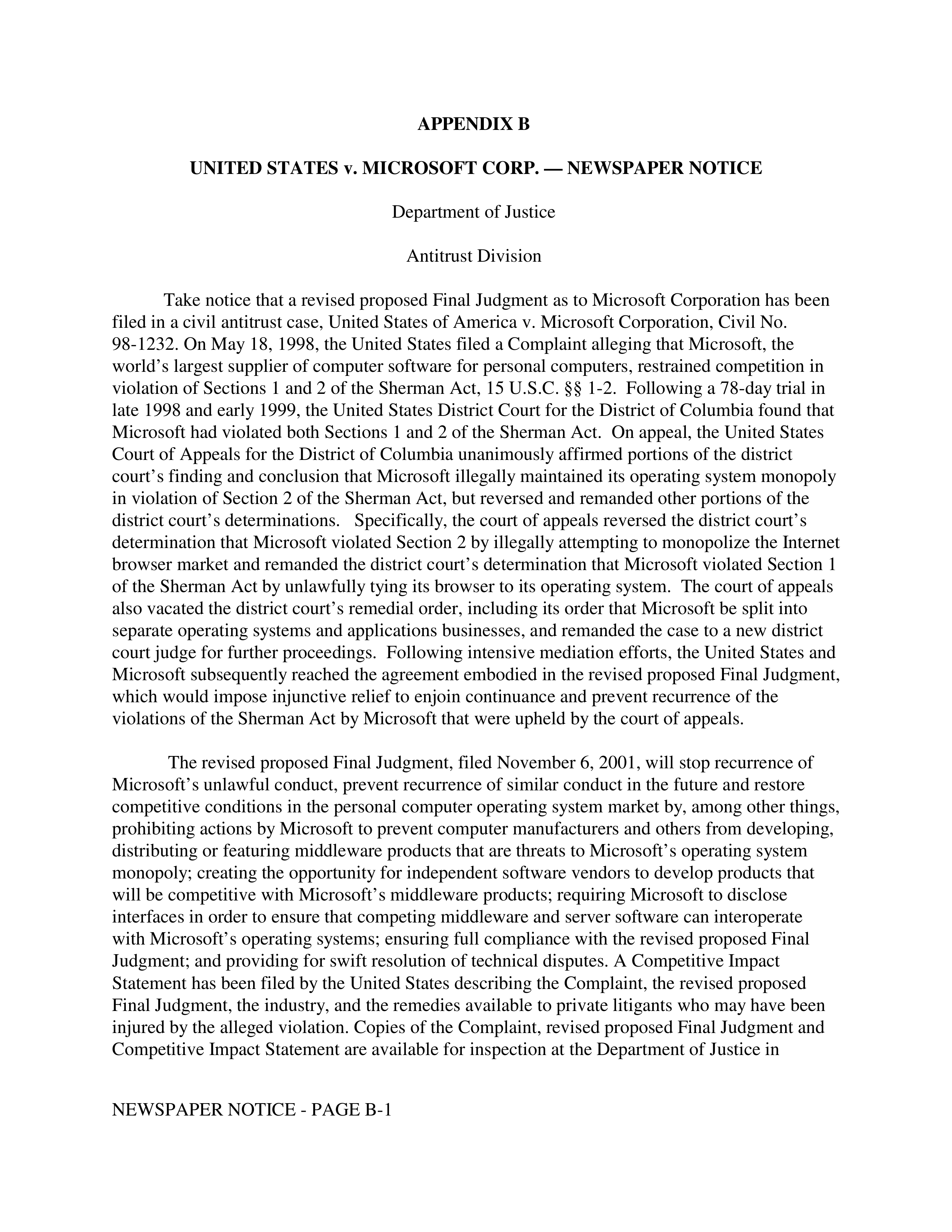
APPENDIX B
UNITED STATES v. MICROSOFT CORP. — NEWSPAPER NOTICE
Department of Justice
Antitrust Division
Take notice that a revised proposed Final Judgment as to Microsoft Corporation has been
filed in a civil antitrust case, United States of America v. Microsoft Corporation, Civil No.
98-1232. On May 18, 1998, the United States filed a Complaint alleging that Microsoft, the
world’s largest supplier of computer software for personal computers, restrained competition in
violation of Sections 1 and 2 of the Sherman Act, 15 U.S.C. §§ 1-2. Following a 78-day trial in
late 1998 and early 1999, the United States District Court for the District of Columbia found that
Microsoft had violated both Sections 1 and 2 of the Sherman Act. On appeal, the United States
Court of Appeals for the District of Columbia unanimously affirmed portions of the district
court’s finding and conclusion that Microsoft illegally maintained its operating system monopoly
in violation of Section 2 of the Sherman Act, but reversed and remanded other portions of the
district court’s determinations. Specifically, the court of appeals reversed the district court’s
determination that Microsoft violated Section 2 by illegally attempting to monopolize the Internet
browser market and remanded the district court’s determination that Microsoft violated Section 1
of the Sherman Act by unlawfully tying its browser to its operating system. The court of appeals
also vacated the district court’s remedial order, including its order that Microsoft be split into
separate operating systems and applications businesses, and remanded the case to a new district
court judge for further proceedings. Following intensive mediation efforts, the United States and
Microsoft subsequently reached the agreement embodied in the revised proposed Final Judgment,
which would impose injunctive relief to enjoin continuance and prevent recurrence of the
violations of the Sherman Act by Microsoft that were upheld by the court of appeals.
The revised proposed Final Judgment, filed November 6, 2001, will stop recurrence of
Microsoft’s unlawful conduct, prevent recurrence of similar conduct in the future and restore
competitive conditions in the personal computer operating system market by, among other things,
prohibiting actions by Microsoft to prevent computer manufacturers and others from developing,
distributing or featuring middleware products that are threats to Microsoft’s operating system
monopoly; creating the opportunity for independent software vendors to develop products that
will be competitive with Microsoft’s middleware products; requiring Microsoft to disclose
interfaces in order to ensure that competing middleware and server software can interoperate
with Microsoft’s operating systems; ensuring full compliance with the revised proposed Final
Judgment; and providing for swift resolution of technical disputes. A Competitive Impact
Statement has been filed by the United States
describing the Complaint, the revised proposed
Final Judgment, the industry, and the remedies available to private litigants who may have been
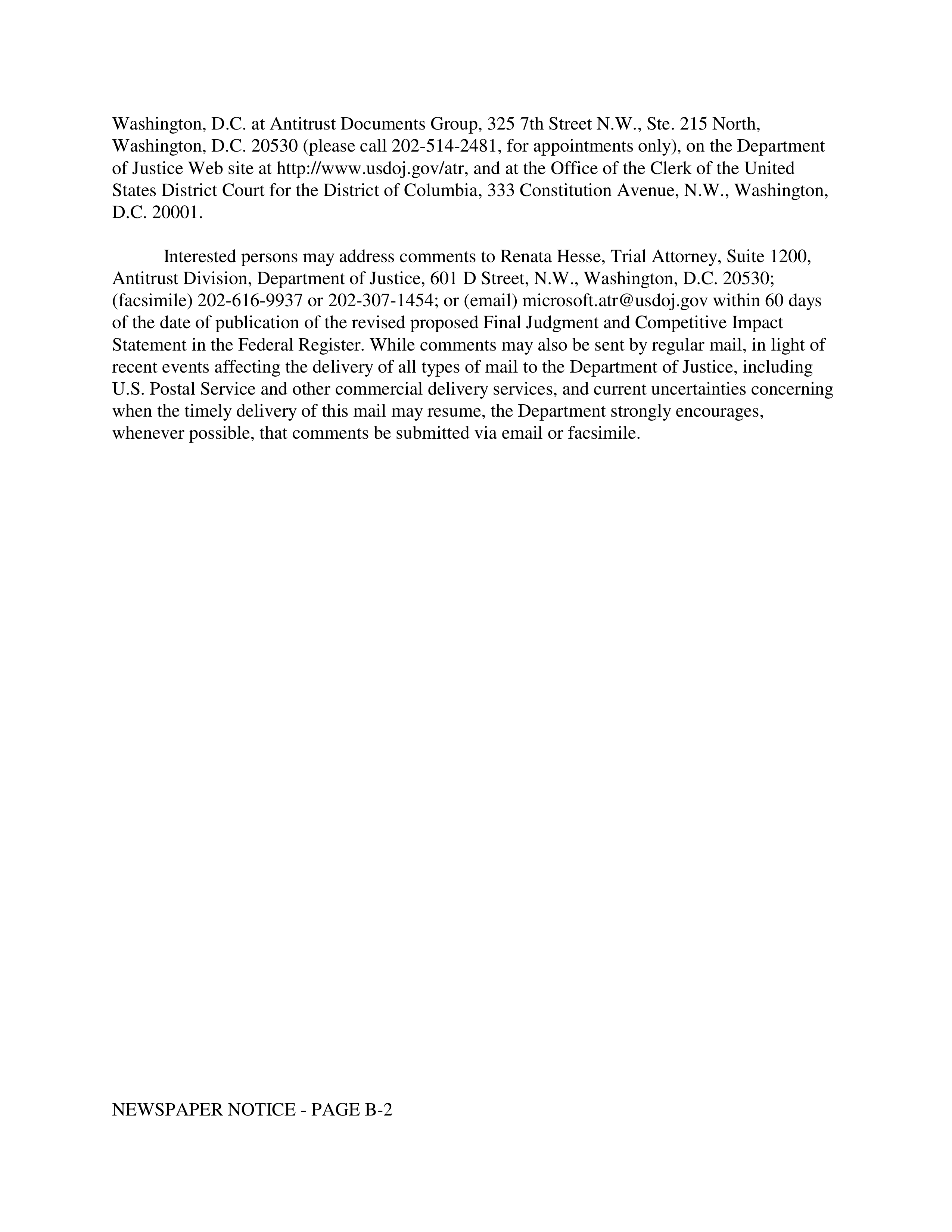
injured by the alleged violation. Copies of the Complaint, revised proposed Final Judgment and
Competitive Impact Statement are available for inspection at the Department of Justice in