HIGHER LAW PERSUASIVE SPEECH
William H. Seward — U.S. Senate, March 11, 1850
Speech on the Admission of California / “Higher Law” Speech
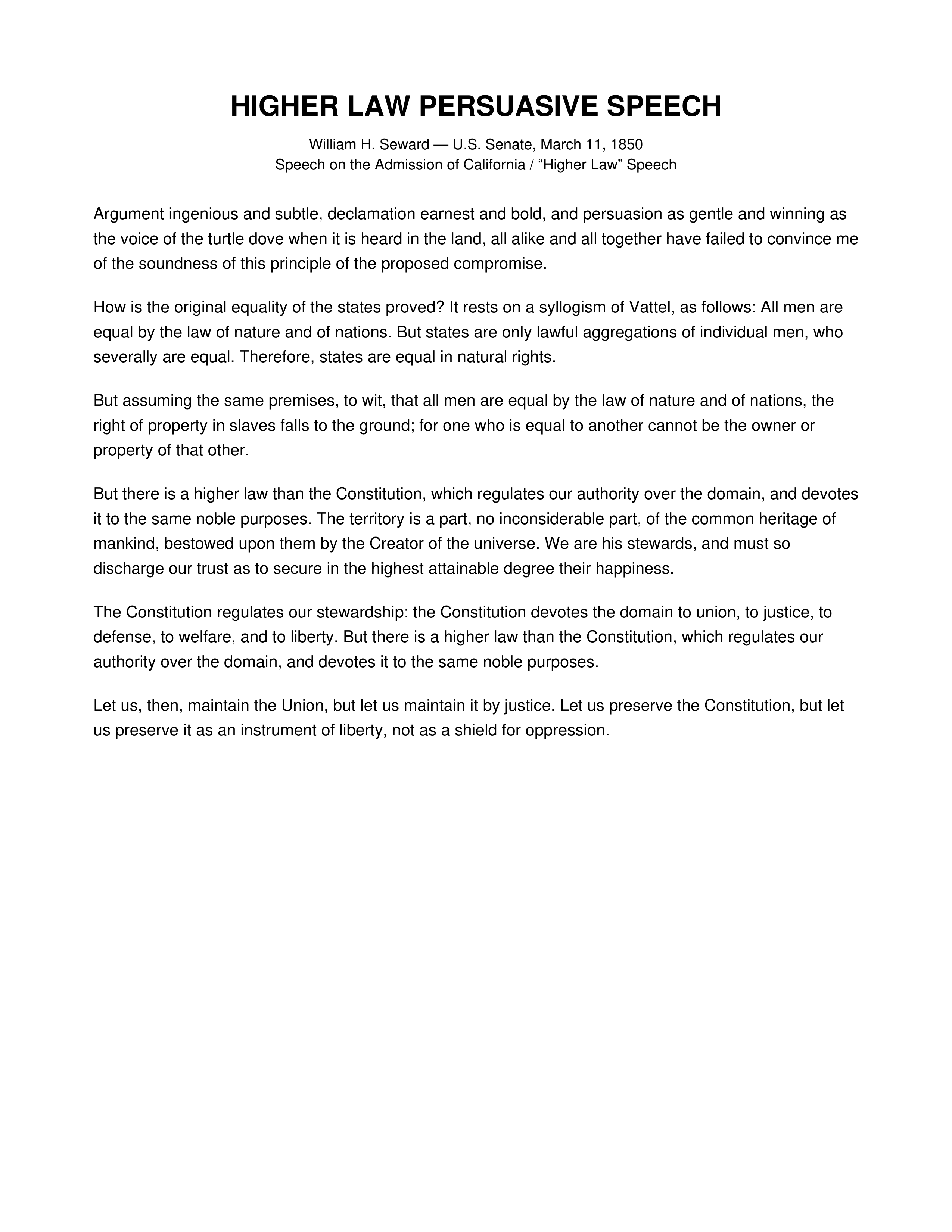
Argument ingenious and subtle, declamation earnest and bold, and persuasion as gentle and winning as
the voice of the turtle dove when it is heard in the land, all alike and all together have failed to convince me
of the soundness of this principle of the proposed compromise.
How is the original equality of the states proved? It rests on a syllogism of Vattel, as follows: All men are
equal by the law of nature and of nations. But states are only lawful aggregations of individual men, who
severally are equal. Therefore, states are equal in natural rights.
But assuming the same premises, to wit, that all men are equal by the law of nature and of nations, the
right of property in slaves falls to the ground; for one who is equal to another cannot be the owner or
property of that other.
But there is a higher law than the Constitution, which regulates our authority over the domain, and devotes
it to the same noble purposes. The territory is a part, no inconsiderable part, of the common heritage of
mankind, bestowed upon them by the Creator of the universe. We are his stewards, and must so
discharge our trust as to secure in the highest attainable degree their happiness.
The Constitution regulates our stewardship: the Constitution devotes the domain to union, to justice, to
defense, to welfare, and to liberty. But there is a higher law than the Constitution, which regulates our
authority over the domain, and devotes it to the same noble purposes.
Let us, then, maintain the Union, but let us maintain it by justice. Let us preserve the Constitution, but let
us preserve it as an instrument of liberty, not as a shield for oppression.