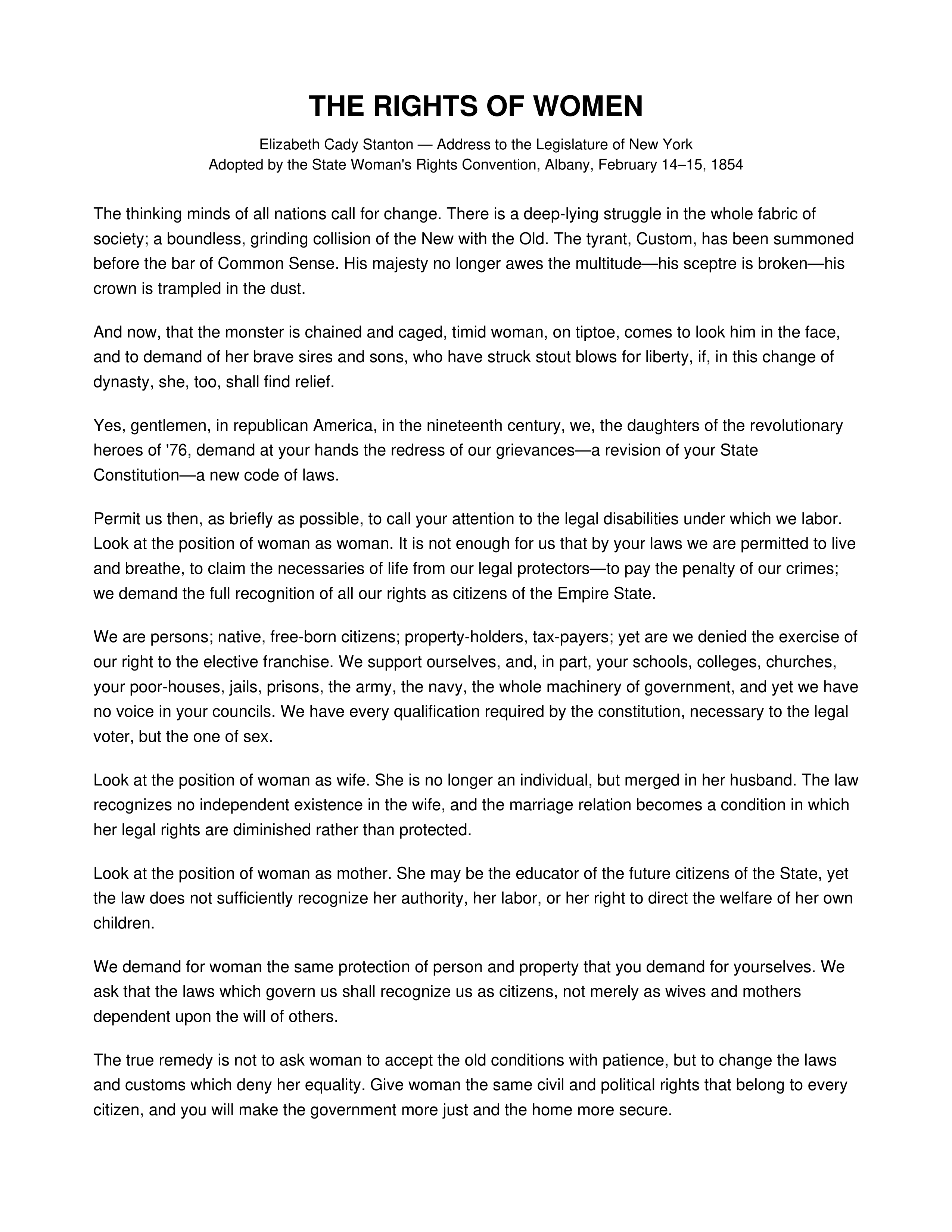
THE RIGHTS OF WOMEN
Elizabeth Cady Stanton — Address to the Legislature of New York
Adopted by the State Woman's Rights Convention, Albany, February 14–15, 1854
The thinking minds of all nations call for change. There is a deep-lying struggle in the whole fabric of
society; a boundless, grinding collision of the New with the Old. The tyrant, Custom, has been summoned
before the bar of Common Sense. His majesty no longer awes the multitude—his sceptre is broken—his
crown is trampled in the dust.
And now, that the monster is chained and caged, timid woman, on tiptoe, comes to look him in the face,
and to demand of her brave sires and sons, who have struck stout blows for liberty, if, in this change of
dynasty, she, too, shall find relief.
Yes, gentlemen, in republican America, in the nineteenth century, we, the daughters of the revolutionary
heroes of '76, demand at your hands the redress of our grievances—a revision of your State
Constitution—a new code of laws.
Permit us then, as briefly as possible, to call your attention to the legal disabilities under which we labor.
Look at the position of woman as woman. It is not enough for us that by your laws we are permitted to live
and breathe, to claim the necessaries of life from our legal protectors—to pay the penalty of our crimes;
we demand the full recognition of all our rights as citizens of the Empire State.
We are persons; native, free-born citizens; property-holders, tax-payers; yet are we denied the exercise of
our right to the elective franchise. We support ourselves, and, in part, your schools, colleges, churches,
your poor-houses, jails, prisons, the army, the navy, the whole machinery of government, and yet we have
no voice in your councils. We have every qualification required by the constitution, necessary to the legal
voter, but the one of sex.
Look at the position of woman as wife. She is no longer an individual, but merged in her husband. The law
recognizes no independent existence in the wife, and the marriage relation becomes a condition in which
her legal rights are diminished rather than protected.
Look at the position of woman as mother. She may be the educator of the future citizens of the State, yet
the law does not sufficiently recognize her authority, her labor, or her right to direct the welfare of her own
children.
We demand for woman the same protection of person and property that you demand for yourselves. We
ask that the laws which govern us shall recognize us as citizens, not merely as wives and mothers
dependent upon the will of others.
The true remedy is not to ask woman to accept the old conditions with patience, but to change the laws
and customs which deny her equality. Give woman the same civil and political rights that belong to every
citizen, and you will make the government more just and the home more secure.