THE RIGHTS OF LABOR
Delivered by John L. Lewis • National Radio Broadcast • September 3, 1937
My fellow countrymen:
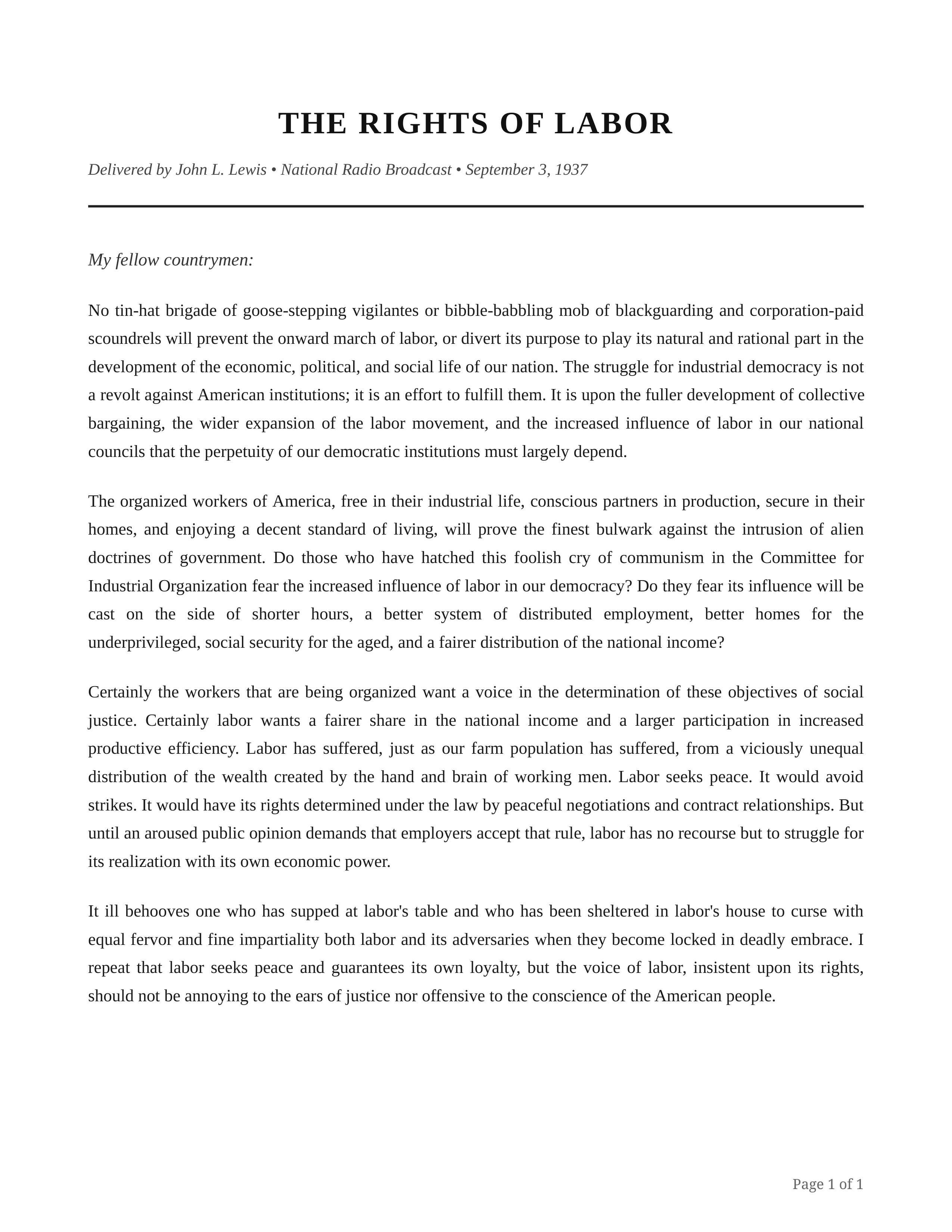
No tin-hat brigade of goose-stepping vigilantes or bibble-babbling mob of blackguarding and corporation-paid
scoundrels will prevent the onward march of labor, or divert its purpose to play its natural and rational part in the
development of the economic, political, and social life of our nation. The struggle for industrial democracy is not
a revolt against American institutions; it is an effort to fulfill them. It is upon the fuller development of collective
bargaining, the wider expansion of the labor movement, and the increased influence of labor in our national
councils that the perpetuity of our democratic institutions must largely depend.
The organized workers of America, free in their industrial life, conscious partners in production, secure in their
homes, and enjoying a decent standard of living, will prove the finest bulwark against the intrusion of alien
doctrines of government. Do those who have hatched this foolish cry of communism in the Committee for
Industrial Organization fear the increased influence of labor in our democracy? Do they fear its influence will be
cast on the side of shorter hours, a better system of distributed employment, better homes for the
underprivileged, social security for the aged, and a fairer distribution of the national income?
Certainly the workers that are being organized want a voice in the determination of these objectives of social
justice. Certainly labor wants a fairer share in the national income and a larger participation in increased
productive efficiency. Labor has suffered, just as our farm population has suffered, from a viciously unequal
distribution of the wealth created by the hand and brain of working men. Labor seeks peace. It would avoid
strikes. It would have its rights determined under the law by peaceful negotiations and contract relationships. But
until an aroused public opinion demands that employers accept that rule, labor has no recourse but to struggle for
its realization with its own economic power.
It ill behooves one who has supped at labor's table and who has been sheltered in labor's house to curse with
equal fervor and fine impartiality both labor and its adversaries when they become locked in deadly embrace. I
repeat that labor seeks peace and guarantees its own loyalty, but the voice of labor, insistent upon its rights,
should not be annoying to the ears of justice nor offensive to the conscience of the American people.
Page 1 of 1