
an overview for chevron leaders and OE practitioners
operational excellence
management system
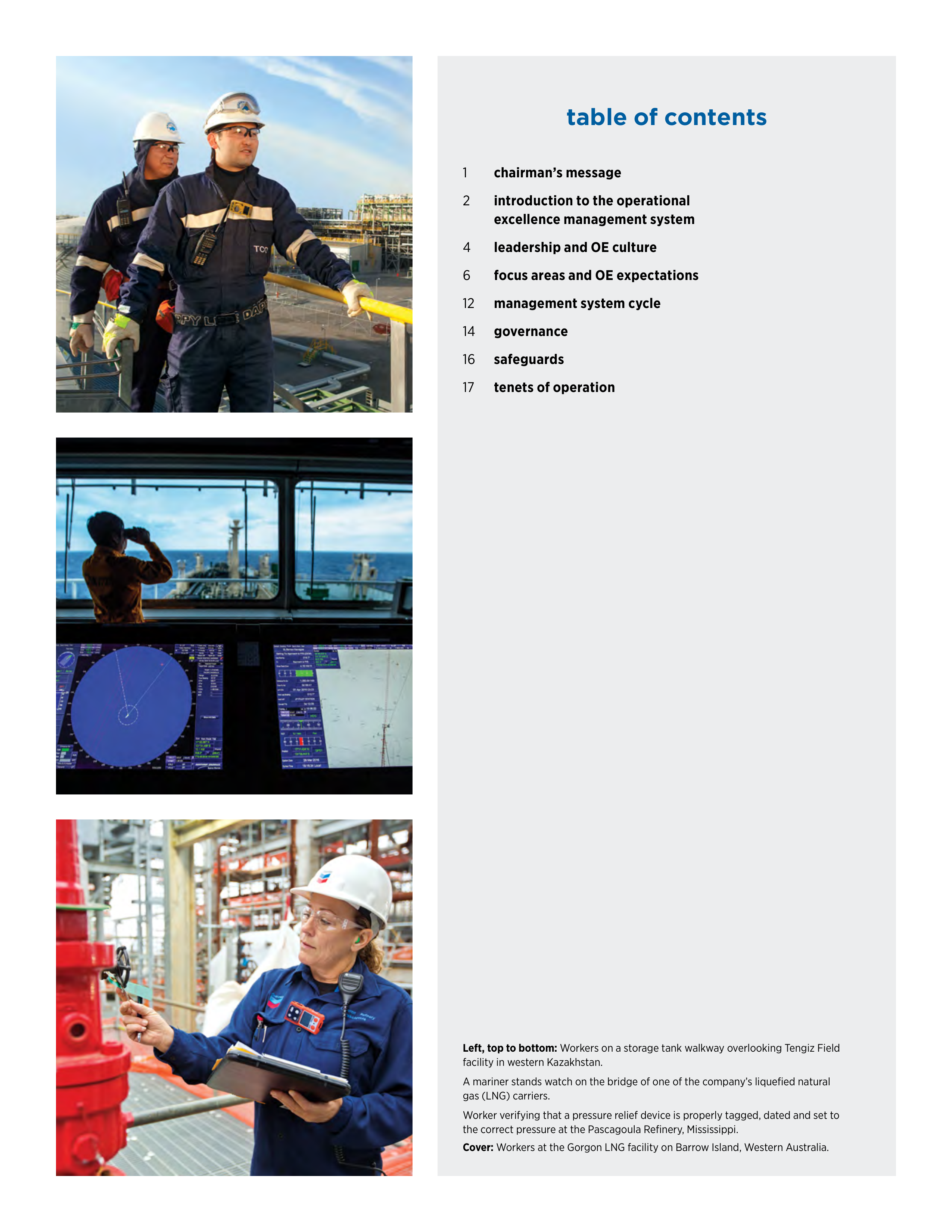

Left, top to bottom:
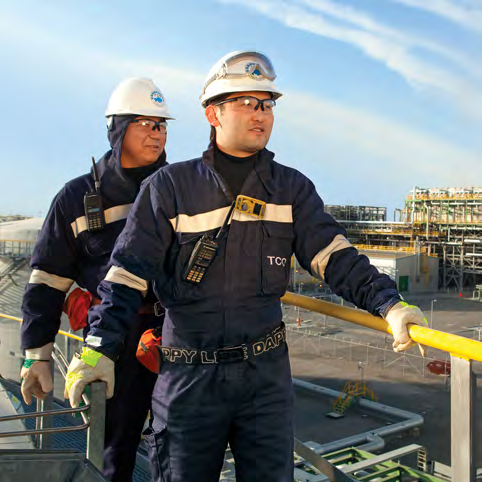
Workers on a storage tank walkway overlooking Tengiz Field
facility in western Kazakhstan.
A mariner stands watch on the bridge of one of the company’s liquefied natural
gas (LNG) carriers.
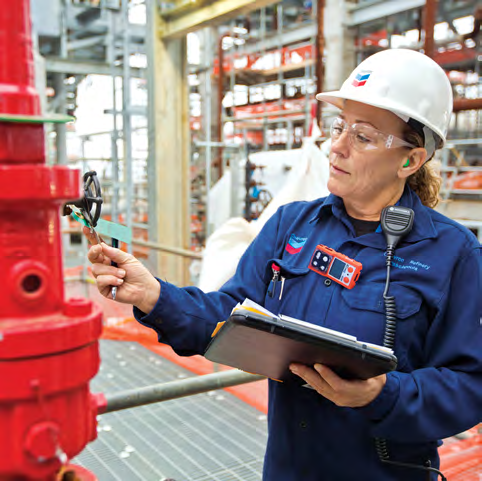
Worker verifying that a pressure relief device is properly tagged, dated and set to
the correct pressure at the Pascagoula Refinery, Mississippi.
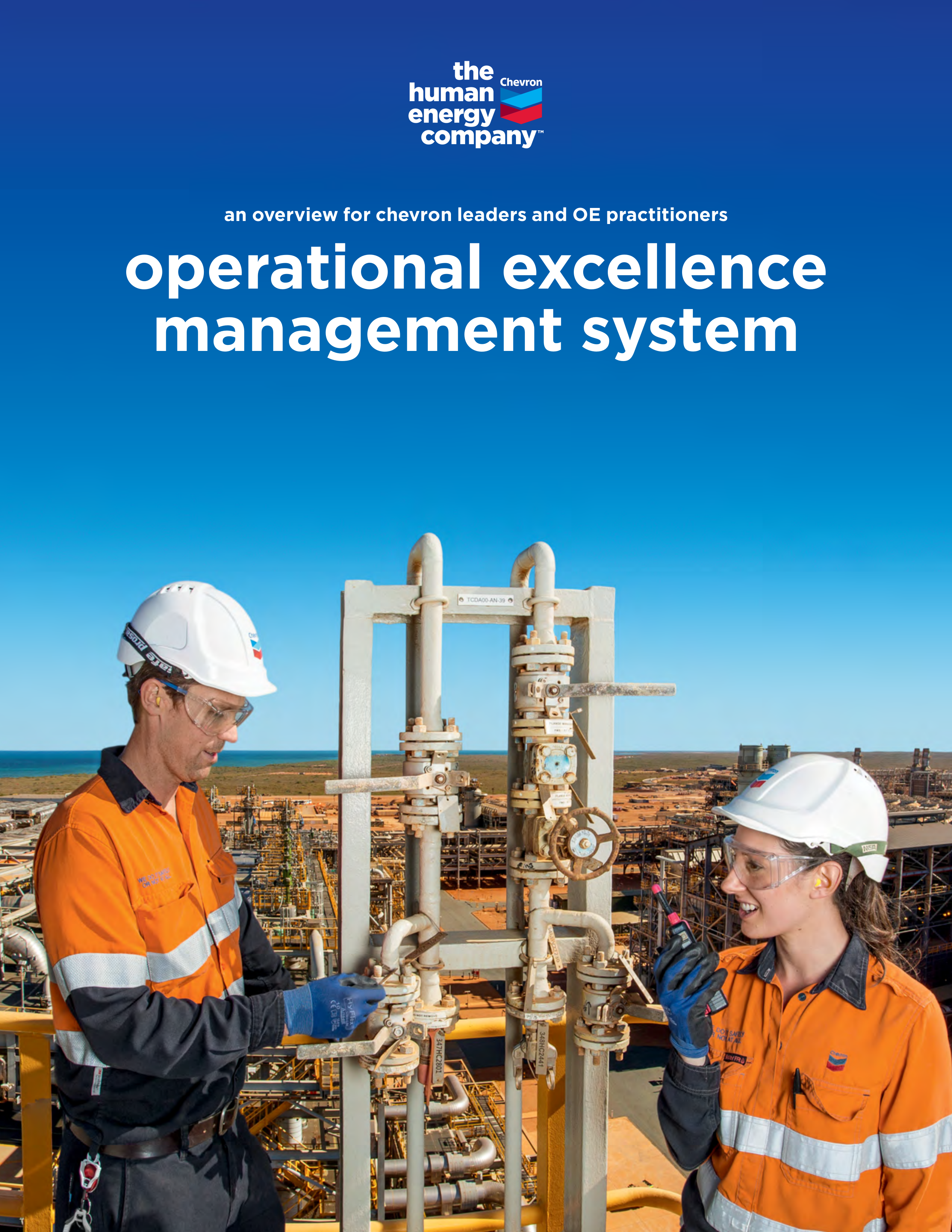
Cover:
Workers at the Gorgon LNG facility on Barrow Island, Western Australia.
table of contents
1
chairman’s message
2
introduction to the operational
excellence management system
4
leadership and OE culture
6
focus areas and OE expectations
12
management system cycle
14
governance
16
safeguards
17
tenets of operation


When we launched our Operational Excellence Management System (OEMS)
in 2004, we put in place a comprehensive and prescriptive system to improve our
health, environmental and safety performance. The results speak for themselves —
we’ve made dramatic improvements in important measures of personal and
process safety, reliability, and environmental performance.
In fact, on many metrics we lead the industry. We should
be proud of our progress in living up to our commitment to
protect people and the environment.
OEMS has given us a solid foundation, but we know there
remain areas for improvement. Specifically, we need to
eliminate high-consequence personal and process safety
events. This means no fatalities or serious injuries and
no fires, spills or explosions that can affect people or
communities. To achieve this objective, we’ve developed
the first significant update to OEMS. This update retains
many of the core elements of the original, but is simpler in
structure and easier to understand.
Leaders are accountable for performance and are expected
to apply increased focus on three key areas with the workforce:
•
Understand the high-consequence risks that we and our
contractors manage every day
•
Clearly identify the safeguards that mitigate these risks
•
Assure that the safeguards are in place and functioning
as intended
Our Chevron Way values guide our actions and underpin
strong OE performance that is fundamental to our company’s
success. OE is a competitive advantage in hiring and
retaining the best workforce and vital to building trust with
communities and governments.
We all have a role to understand and mitigate risks and to
maintain and assure safeguards. I encourage you to read and
understand OEMS and to implement it with the passion and
commitment I know we share.
Sincerely,
values
“Our Chevron Way
values guide our actions
and underpin strong
OE performance that is
fundamental to our
company’s success.”
— Mike Wirth
Chairman of the Board and CEO
1
Operational Excellence (OE) puts into action
our Chevron Way value of protecting
people and the environment and helps us
achieve Chevron’s vision to be the
global energy company most admired
for its people, partnership and performance
Operational Excellence systematically
manages workforce safety and health, process
safety, reliability and integrity, environment,
efficiency, security, and stakeholders
in order to meet our OE objectives
operational
excellence
management
system
2
safeguards
management
system cycle
leadership and
OE culture
focus areas
and OE
expectations
a
s
s
u
r
a
n
c
e
r
i
s
k
m
a
n
a
g
e
m
e
n
t
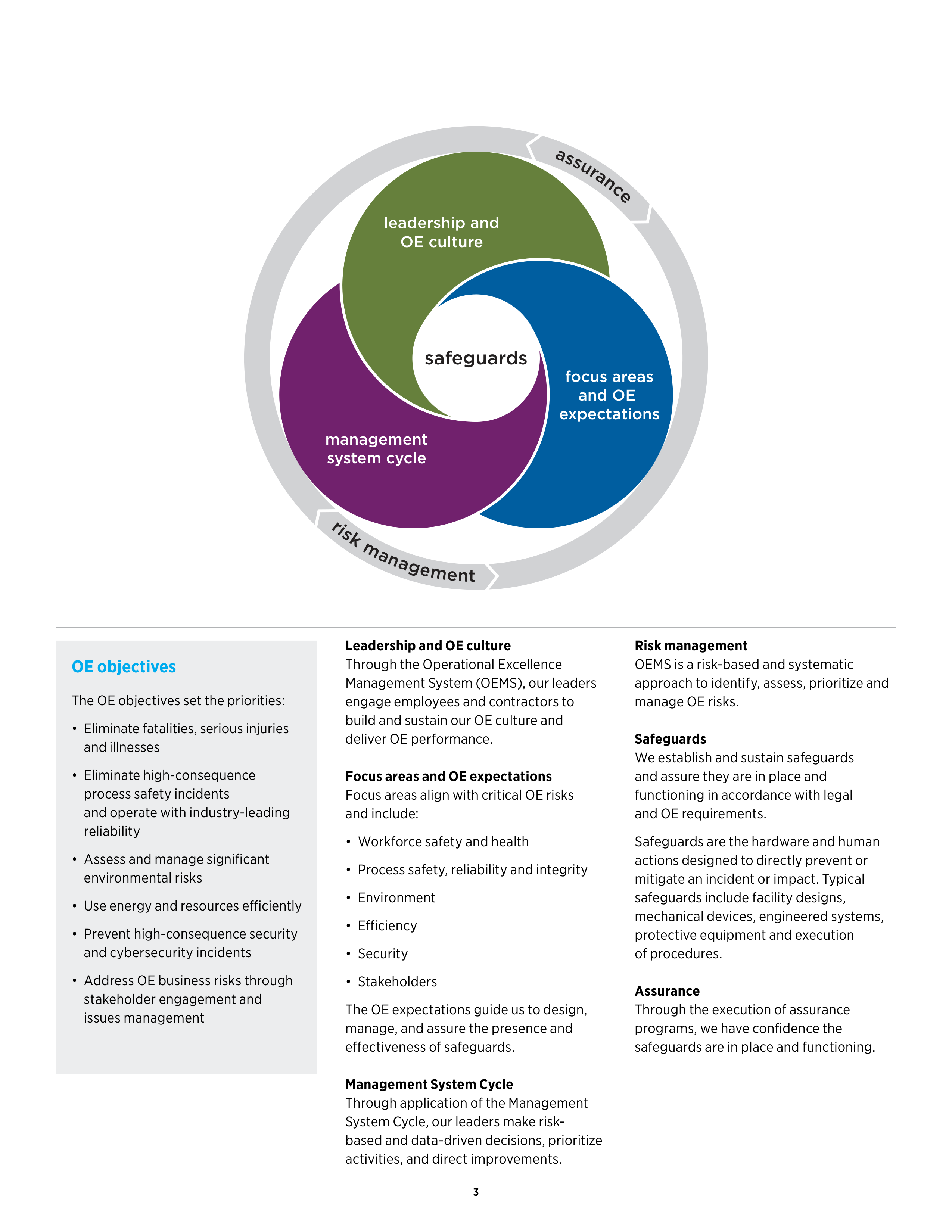
Leadership and OE culture
Through the Operational Excellence
Management System (OEMS), our leaders
engage employees and contractors to
build and sustain our OE culture and
deliver OE performance.
Focus areas and OE expectations
Focus areas align with critical OE risks
and include:
• Workforce safety and health
• Process safety, reliability and integrity
• Environment
• Efficiency
• Security
• Stakeholders
The OE expectations guide us to design,
manage, and assure the presence and
effectiveness of safeguards.
Management System Cycle
Through application of the Management
System Cycle, our leaders make risk-
based and data-driven decisions, prioritize
activities, and direct improvements.
Risk management
OEMS is a risk-based and systematic
approach to identify, assess, prioritize and
manage OE risks.
Safeguards
We establish and sustain safeguards
and assure they are in place and
functioning in accordance with legal
and OE requirements.
Safeguards are the hardware and human
actions designed to directly prevent or
mitigate an incident or impact. Typical
safeguards include facility designs,
mechanical devices, engineered systems,
protective equipment and execution
of procedures.
Assurance
Through the execution of assurance
programs, we have confidence the
safeguards are in place and functioning.
OE objectives
The OE objectives set the priorities:
• Eliminate fatalities, serious injuries
and illnesses
• Eliminate high-consequence
process safety incidents
and operate with industry-leading
reliability
• Assess and manage significant
environmental risks
• Use energy and resources efficiently
• Prevent high-consequence security
and cybersecurity incidents
• Address OE business risks through
stakeholder engagement and
issues management
3
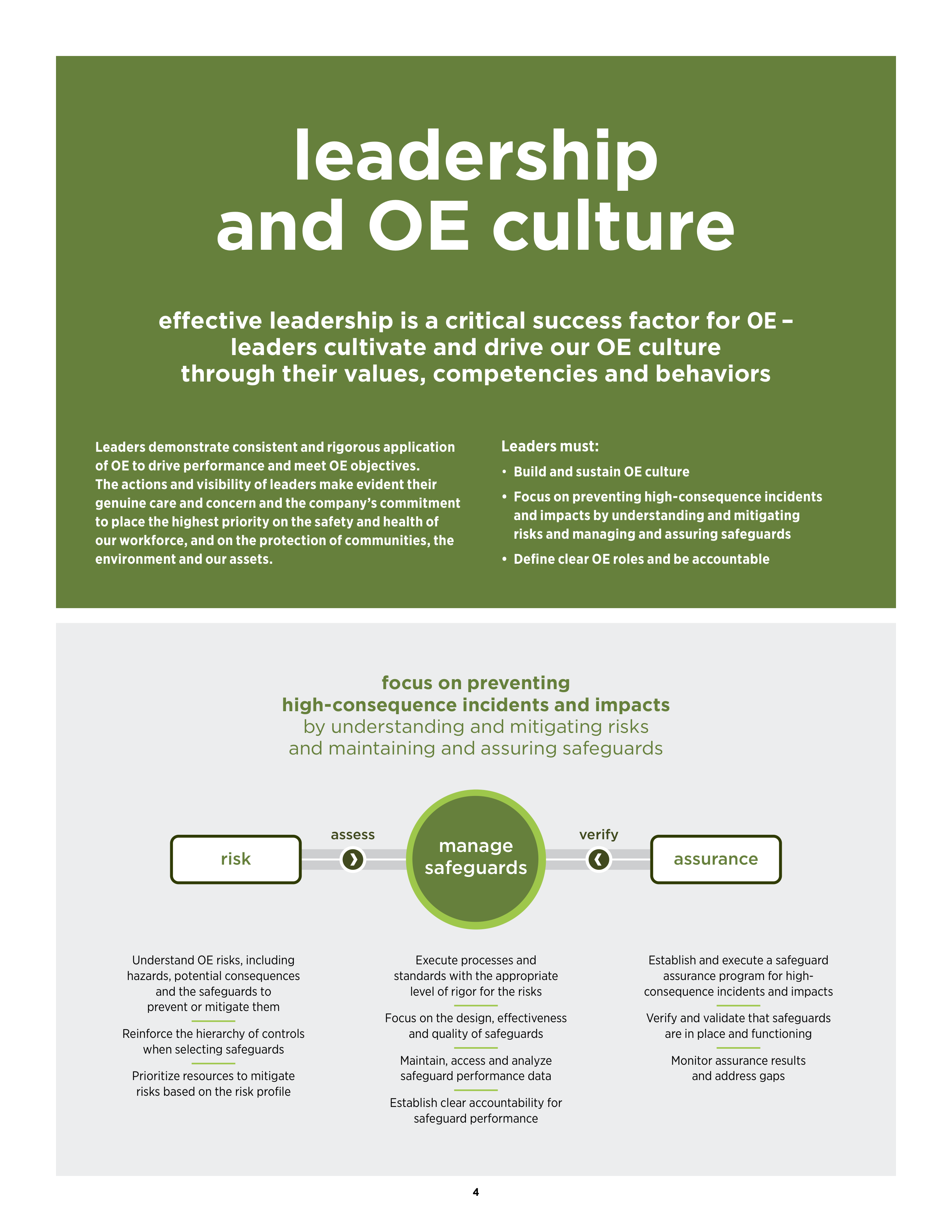
assess
verify
manage
safeguards
risk
assurance
Establish and execute a safeguard
assurance program for high-
consequence incidents and impacts
Verify and validate that safeguards
are in place and functioning
Monitor assurance results
and address gaps
Execute processes and
standards with the appropriate
level of rigor for the risks
Focus on the design, effectiveness
and quality of safeguards
Maintain, access and analyze
safeguard performance data
Establish clear accountability for
safeguard performance
Understand OE risks, including
hazards, potential consequences
and the safeguards to
prevent or mitigate them
Reinforce the hierarchy of controls
when selecting safeguards
Prioritize resources to mitigate
risks based on the risk profile
effective leadership is a critical success factor for
OE
–
leaders cultivate and drive our OE culture
through their values, competencies and behaviors
Leaders must:
•
Build and sustain OE culture
• Focus on preventing high-consequence incidents
and impacts by understanding and mitigating
risks and managing and assuring safeguards
• Define clear OE roles and be accountable
leadership
and OE culture
focus on preventing
high-consequence incidents and impacts
by understanding and mitigating risks
and maintaining and assuring safeguards
Leaders demonstrate consistent and rigorous application
of OE to drive performance and meet OE objectives.
The actions and visibility of leaders make evident their
genuine care and concern and the company’s commitment
to place the highest priority on the safety and health of
our workforce, and on the protection of communities, the
environment and our assets.
4
Above:
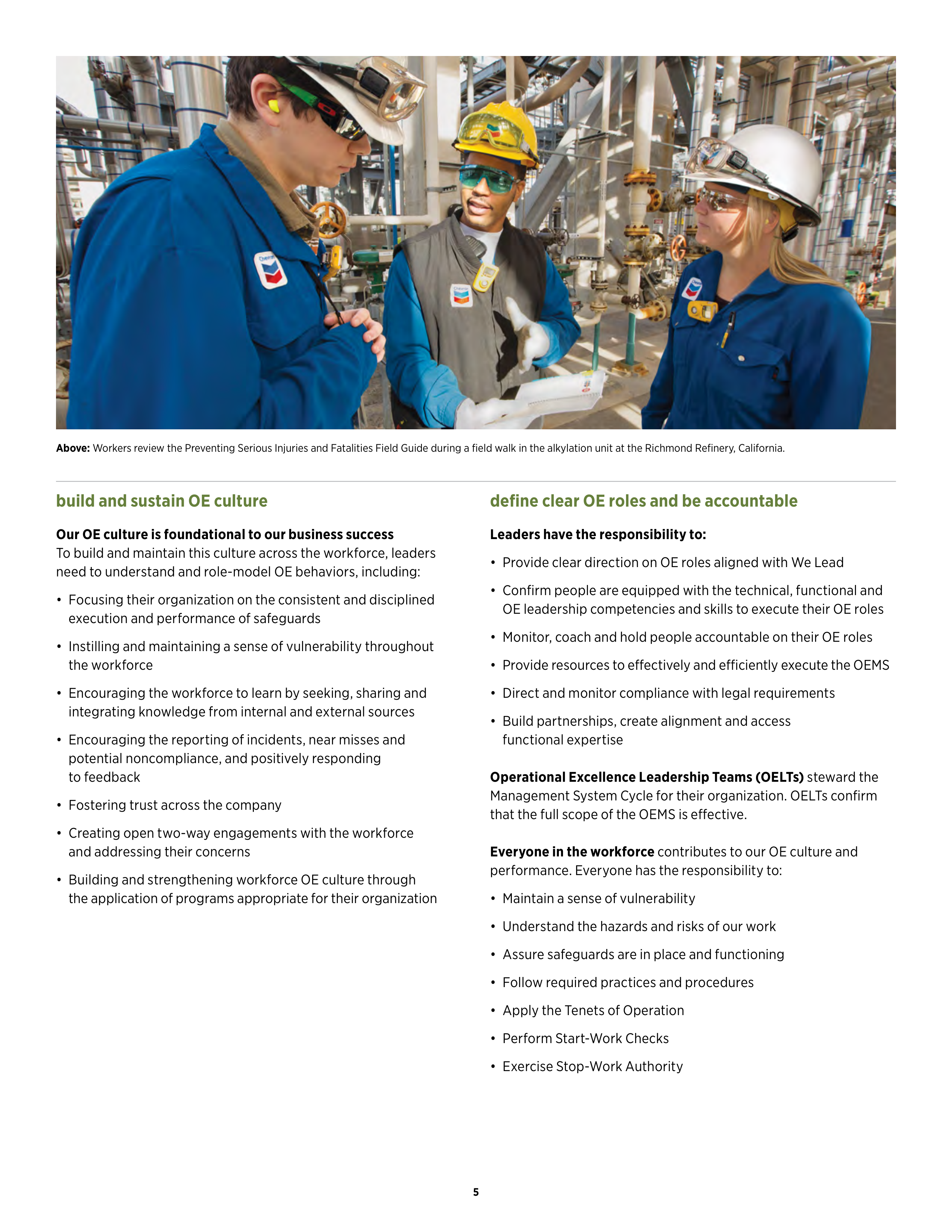
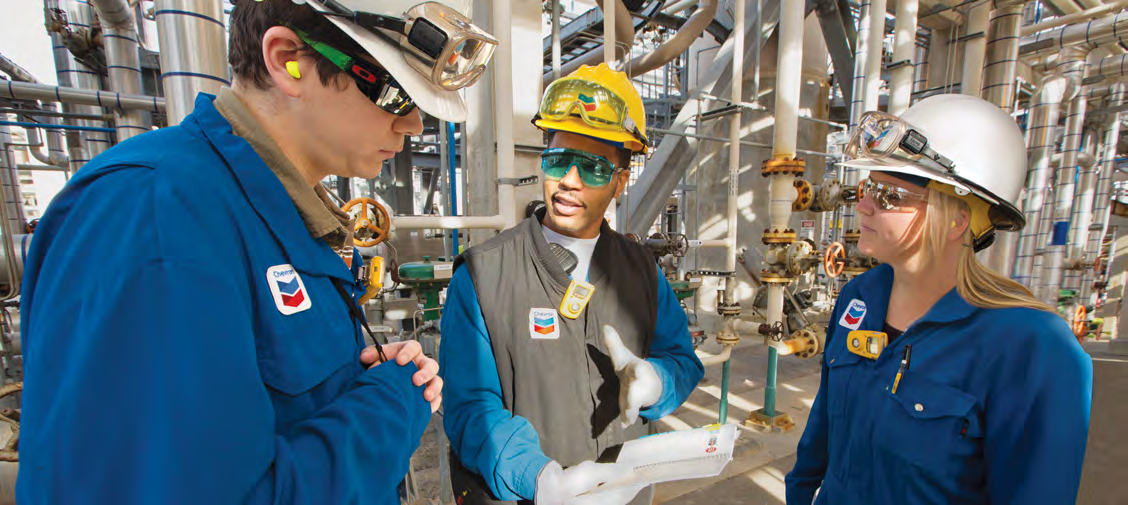
Workers review the Preventing Serious Injuries and Fatalities Field Guide during a field walk in the alkylation unit at the Richmond Refinery, California.
build and sustain OE culture
Our OE culture is foundational to our business success
To build and maintain this culture across the workforce, leaders
need to understand and role-model OE behaviors, including:
• Focusing their organization on the consistent and disciplined
execution and performance of safeguards
• Instilling and maintaining a sense of vulnerability throughout
the workforce
• Encouraging the workforce to learn by seeking, sharing and
integrating knowledge from internal and external sources
• Encouraging the reporting of incidents, near misses and
potential noncompliance, and positively responding
to feedback
• Fostering trust across the company
• Creating open two-way engagements with the workforce
and addressing their concerns
• Building and strengthening workforce OE culture through
the application of programs appropriate for their organization
define clear OE roles and be accountable
Leaders have the responsibility to:
• Provide clear direction on OE roles aligned with We Lead
• Confirm people are equipped with the technical, functional and
OE leadership competencies and skills to execute their OE roles
• Monitor, coach and hold people accountable on their OE roles
• Provide resources to effectively and efficiently execute the OEMS
• Direct and monitor compliance with legal requirements
• Build partnerships, create alignment and access
functional expertise
Operational Excellence Leadership Teams (OELTs)
steward the
Management System Cycle for their organization. OELTs confirm
that the full scope of the OEMS is effective.
Everyone in the workforce
contributes to our OE culture and
performance. Everyone has the responsibility to:
• Maintain a sense of vulnerability
• Understand the hazards and risks of our work
• Assure safeguards are in place and functioning
• Follow required practices and procedures
• Apply the Tenets of Operation
• Perform Start-Work Checks
• Exercise Stop-Work Authority
5
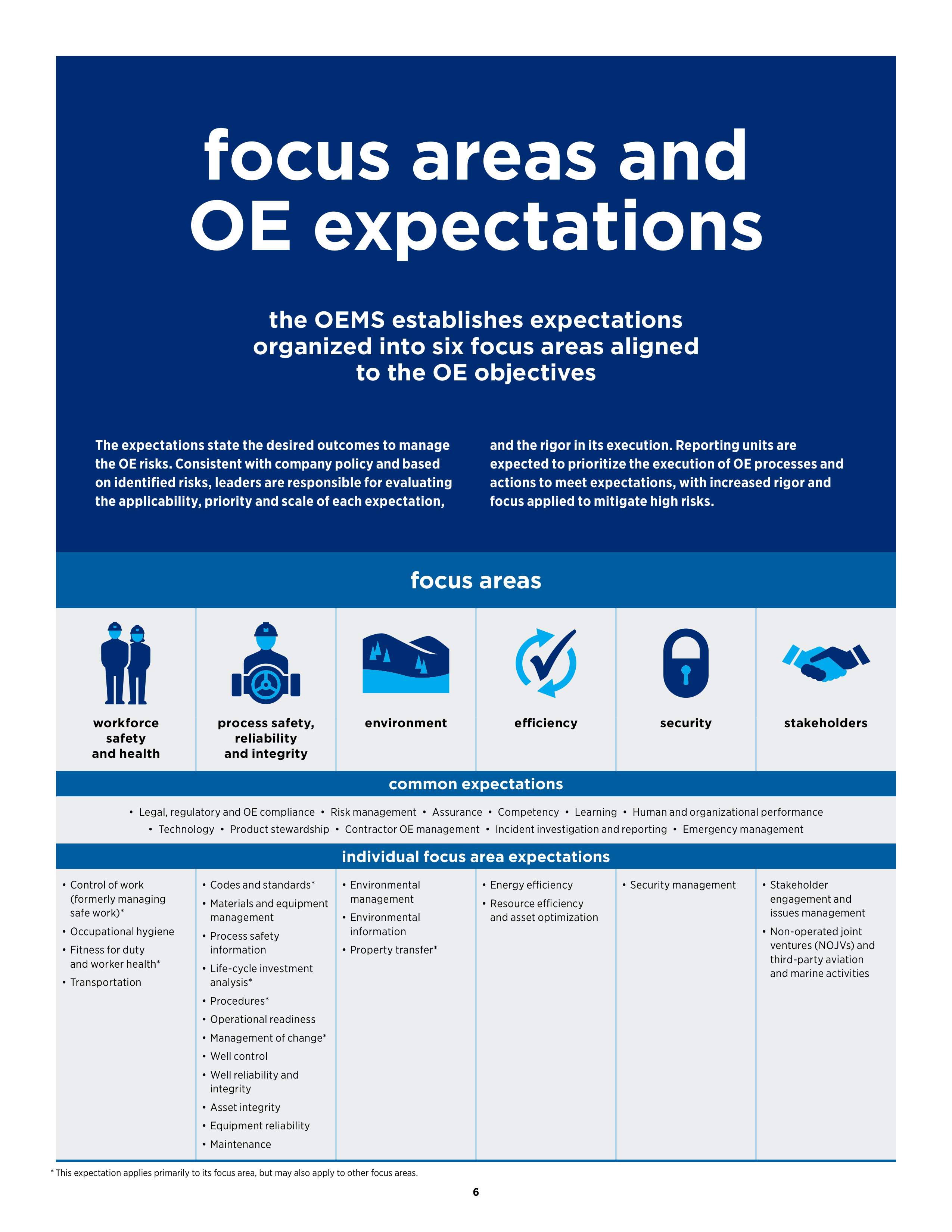
focus areas and
OE expectations
the OEMS establishes expectations
organized into six focus areas aligned
to the OE objectives
* This expectation applies primarily to its focus area, but may also apply to other focus areas.
The expectations state the desired outcomes to manage
the OE risks. Consistent with company policy and based
on identified risks, leaders are responsible for evaluating
the applicability, priority and scale of each expectation,
and the rigor in its execution. Reporting units are
expected to prioritize the execution of OE processes and
actions to meet expectations, with increased rigor and
focus applied to mitigate high risks.
focus areas
workforce
safety
and health
process safety,
reliability
and integrity
environment
efficiency
security
stakeholders
common expectations
• Legal, regulatory and OE compliance • Risk management • Assurance • Competency • Learning • Human and organizational performance
• Technology • Product stewardship • Contractor OE management • Incident investigation and reporting • Emergency management
individual focus area expectations
• Control of work
(formerly managing
safe work)*
• Occupational hygiene
• Fitness for duty
and worker health*
• Transportation
• Codes and standards*
• Materials and equipment
management
• Process safety
information
• Life-cycle investment
analysis*
• Procedures*
• Operational readiness
• Management of change*
• Well control
• Well reliability and
integrity
• Asset integrity
• Equipment reliability
• Maintenance
• Environmental
management
• Environmental
information
• Property transfer*
• Energy efficiency
• Resource efficiency
and asset optimization
• Security management
• Stakeholder
engagement and
issues management
• Non-operated joint
ventures (NOJVs) and
third-party aviation
and marine activities
6
Common expectations support the OE objective
of each focus area.
Legal, regulatory and OE compliance
Systematically understand, manage and comply with all
applicable health, environment and safety laws and regulations,
and OE policy and requirements.
• Identify and comply with internal and external requirements
• Identify and report noncompliance issues to management
in a timely manner and track corrective actions to closure
• Enable the workforce to freely and anonymously report
existing and potential violations of law and company policy,
without fear of retribution or any adverse company action
because of reporting. Include appropriate and timely
investigation to address the report
Risk management
Systematically assess risks and identify safeguards. Develop
a risk profile to prioritize risk reduction and assurance programs,
taking into account the expectations of our stakeholders.
Evaluate facility-, activity- and product-related risks across
the life cycle of the business, including:
• Safety and health risks from physical, chemical and
biological workplace exposures
• Process safety, reliability and integrity risks of facilities,
wells and the subsurface
• Environmental risks, including current and emerging
environmental issues and related social and community
health issues
• Security risks to personnel, assets and the business
• Social, community, political and reputational risks to the
business and potential impacts from our business
Assurance
Execute an assurance program prioritized by the risk profile,
to confirm that safeguards are in place, functioning, and meet
internal and external requirements. Use the outputs of risk
management studies to establish assurance priorities across
focus areas. The assurance program includes:
• Verifying the OEMS, processes and safeguards through business
unit, functional and corporate assurance programs and audits
• Analyzing and acting on safeguard performance data
identified through assurance activities
• Applying learning from assurance analyses to improve risk
assessment quality and support risk-based decision making
Competency
Identify, build and sustain competency standards for roles critical
to OE performance based on risk, consequence and operational
complexity. In order to demonstrate role competency, assess,
manage and document the qualifications and skills required.
Learning
Systematically integrate and support organizational practices to
seek, share and apply knowledge to strengthen safeguards and
mitigate OE risks.
Human and organizational performance
Apply human and organizational performance principles and
concepts to build and maintain error-tolerant systems that decrease
reliance on people as safeguards and reduce the risk of error.
Technology
Apply technology and digital tools to increase the effectiveness,
reliability and efficiency of safeguards, deliver safer designs, and
reduce risk.
Product stewardship
Manage and communicate potential health, environment, safety
and integrity hazards, and risks of our products from development
through end use, including raw materials, manufacturing,
distribution, storage, use, transportation, recycling and disposal.
Contractor OE management
Assess and manage OE risks from:
• Contracted activities executed on Chevron premises or within
reporting boundaries
• Contracted activities that deliver facility design and fabrication
services to our businesses
Incident investigation and reporting
Identify, report, record and investigate incidents, analyze root
causes and trends, correct deficiencies, and share and adopt
relevant lessons learned.
Emergency management
Prepare for and respond to incidents and manage crises that
could affect personnel, the environment, assets, communities and
the business.
common expectations
7
workforce safety and health
We provide a safe and healthy workplace for our
employees and contractors. Our highest priorities
are to eliminate fatalities and prevent serious
injuries and illnesses.
Control of work (formerly managing safe work)
Assess workplace safety and health hazards and manage
risks associated with the execution and control of work.
Address work activities that utilize safe work practices and
procedures, including:
• Bypassing critical protections
• Confined space entry
• Diving
• Electrical work
• Excavation
• Hot work
• Isolation of hazardous energy
• Lifting and rigging
• Permit to work
• Portable gas detection
• Simultaneous operations
• Work at heights
• Others as identified by enterprise
or local operations
Occupational hygiene
Manage risks associated with workplace exposures to physical,
chemical and biological agents that may adversely affect
workforce health.
Fitness for duty and worker health
Promote a workforce that is physically, psychologically and
cognitively fit to perform essential work tasks and is not impaired
by the effects of fatigue, drugs or alcohol. Promote worker
health through health education and health protection activities.
Transportation
Manage risk in the use of aviation equipment, marine vessels,
motor vehicles, mobile construction equipment and other modes
of transportation.
Many expectations are addressed through OE processes
and standards. Processes follow the Chevron standardized
five-component model, which should be written as simply
and clearly as possible. For these expectations to be
successfully executed by the workforce, and for safeguards
to be effectively applied, the requirements of processes
and standards should be integrated into practical work
instructions, training, procedures, tools and other methods.
Expectations should be systematically addressed using a process approach.
This enables consistency and standardization across the enterprise.
the process approach
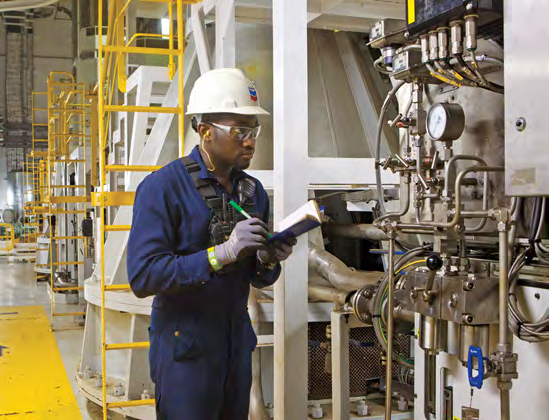
Above:
Worker checks controls on the Agbami facility, offshore Nigeria.
8
process safety, reliability and integrity
We manage the integrity of operating systems
through design principles and engineering
and operating practices to prevent and mitigate
process safety incidents. We execute reliability
programs so that equipment, components
and systems perform their required functions
across the full asset life cycle.
Codes and standards
Apply company and Chevron-adopted industry codes and
standards for the design, construction, modification, operation,
maintenance, decommissioning and restoration of facilities.
Materials and equipment management
Manage OE risks to Chevron that are related to materials and
equipment we procure for use in our facilities.
Process safety information
Develop, maintain and use process safety information and asset
data, including information on hazards of materials, process
technology and equipment. Apply the information to enable
effective risk assessments and engineering, operations and
maintenance activities.
Life-cycle investment analysis
In capital investment and expense decisions, assess life cycle
risks and trade-offs considering safety, the environment, reliability,
efficiency, security and our reputation.
Procedures
Develop, maintain and reinforce consistent use of procedures for
activities that support safe and reliable operations, health, and the
environment across the life cycle of the business. These include,
but are not limited to:
• Operating procedures for all phases of operation, including
startup, shutdown, routine operations, addressing abnormal
conditions and preparation for/return from maintenance
• Maintenance procedures to safely maintain equipment in order
to enable its continued service in support of reliable operations
Operational readiness
Conduct reviews prior to startup for all new and modified
facilities, including:
• An Operational Readiness Review to confirm adherence
to standards and the suitability for startup
• A Pre-Startup Safety Review to confirm compliance with
applicable technical codes and standards and that applicable
process safety systems are in place, equipment is in safe
condition and people are competent to execute a safe startup
Management of change
Manage proposed changes to design, equipment, operations,
products and organizations prior to implementation. Evaluate OE
risks associated with changes, notify and train affected workforce
of the change, and update documentation.
Well control
Manage the prioritized OE risks of wells activities by:
• Developing, maintaining and using wells standards and
guidelines to plan and execute work
• Verifying that the requirements for WellSafe®* certification
are in place and effective
Well reliability and integrity
Maintain the integrity and reliability of wells:
• Determine potential well failure mechanisms and actions to
prevent or mitigate their occurrence
• Perform standardized operation, data acquisition,
surveillance, condition monitoring, maintenance and
well intervention activities
• Prioritize, plan and schedule well work, including reducing idle
wells through return-to-service or plugging and abandonment as
guided by the asset retirement strategy
Asset integrity
Maintain the integrity of equipment, structures and protection
devices for the prevention and mitigation of potential incidents.
Perform analysis of failure modes and effects, and complete
necessary inspection and testing programs.
Equipment reliability
Identify and resolve facility and equipment reliability performance
gaps and repetitive or recurring failures to improve reliability
and optimize life-cycle costs. Use failure analysis to determine
causes of failures. Take action to resolve system-level root causes
and appropriately share lessons learned.
Maintenance
Prioritize, plan, schedule and complete necessary maintenance for
all structures, equipment and protective devices.
*WellSafe is a federally registered service mark of Chevron Intellectual Property LLC.
9

environment
We protect the environment through
responsible design, development, operations
and asset retirement.
Environmental management
Protect the environment and community health using a risk-
and data-driven approach that addresses potential acute and
cumulative impacts. Identify environmental risks and apply
mitigation hierarchy across an asset life cycle to guide selection
of safeguards that:
• Prevent accidental releases
• Reduce air emissions
• Conserve energy and reduce greenhouse gases
• Manage wastes and wastewater, including those disposed
of at third-party facilities
• Conserve and protect water and natural resources
• Retire idle assets and reclaim impacted sites
Conduct monitoring, analyze performance, and identify and
address gaps.
Environmental information
Develop and maintain current and historical asset and
environmental condition information, including facility designs,
operational practices, regulatory requirements and monitoring
results. Use environmental information in the assessment
and management of environmental risks across the asset life
cycle, from initial investment through retirement, divestment
or relinquishment.
Property transfer
For potential transaction projects involving the transfer of
real property, identify and manage OE risks from early in the
project through closing and transition. Track and manage
post-transaction OE obligations.
Above:
Sunrise on the Kern River in the San Joaquin Valley business unit.
chevron’s
environmental principles
Our environmental principles are embedded in our enterprise
strategy and risk management processes to guide our
decisions and our actions. The entire workforce plays an
important role in meeting our commitment to do business
in environmentally responsible ways.
Include the environment in decision making
We all make decisions that may affect the environment.
From our everyday actions to major capital investments, we
make better decisions when we consider the environment.
Reduce our environmental footprint
We use our business processes to identify and manage
risks to the environment and reduce potential environmental
impacts throughout the life of our assets.
Operate responsibly
We apply our Tenets of Operation and improve reliability and
process safety to prevent accidental releases.
Steward our sites
We work to decommission, remediate and reclaim operating
and legacy sites with the aim of beneficial reuse.
10
We engage stakeholders to foster trust, build
relationships, and promote two-way dialogue to
manage potential impacts and create business
opportunities. We work with our stakeholders in a
socially responsible and ethical manner, consistent
with our respect for human rights, to create a safer,
more inclusive business environment.
Stakeholder engagement and issues management
Manage social, political and reputational risks to the company,
address potential business impacts, and generate business value by:
• Building and maintaining relationships with external
stakeholders, including governments and the communities
where we operate
• Identifying, assessing and prioritizing issues
• Developing and executing issue management, stakeholder
engagement and social impact management plans,
systematically tracking engagements and issues, and
validating effectiveness of plans
We work with our partners to responsibly manage
Chevron’s non-operated joint venture partnerships
and third-party aviation and marine activities.
Non-operated joint ventures (NOJVs) and third-party aviation
and marine activities
Manage Chevron’s interests while conducting business with other
operators by:
• Assessing and monitoring operators’ health, environment
and safety management system execution in the NOJV
• Using the Complex Well Tool for the assessment of NOJV
well operations
• Assessing and confirming risk management of aviation activities
and marine vessels and facilities
efficiency
We use energy and resources efficiently to
continually improve and drive value.
Energy efficiency
Address energy efficiency in facility design and systematically
manage throughout the life cycle of assets to improve
operational performance.
Resource efficiency and asset optimization
Maximize value, increase profitability and drive asset life-cycle
management through the efficient utilization of assets and
resources (materials, people and time), including:
• Establishing metrics and targets
• Applying process improvement methods such as Lean Sigma and
optimization reviews
• Measuring and monitoring performance
security
We protect personnel, facilities, information,
systems, business operations and our reputation.
We proactively identify security risks, develop
personnel and sustainable programs to mitigate
those risks, and continually evaluate the
effectiveness of these efforts.
Security management
Provide a secure physical and cyber environment in which business
operations can be successfully conducted. Develop, implement and
integrate risk-based security management and assurance plans
into emergency management, business continuity and information
security plans in order to address and mitigate security risks to
personnel, assets and the business.
stakeholders
11
conduct
assessment
develop
plan
establish
or validate
objectives
execute and review
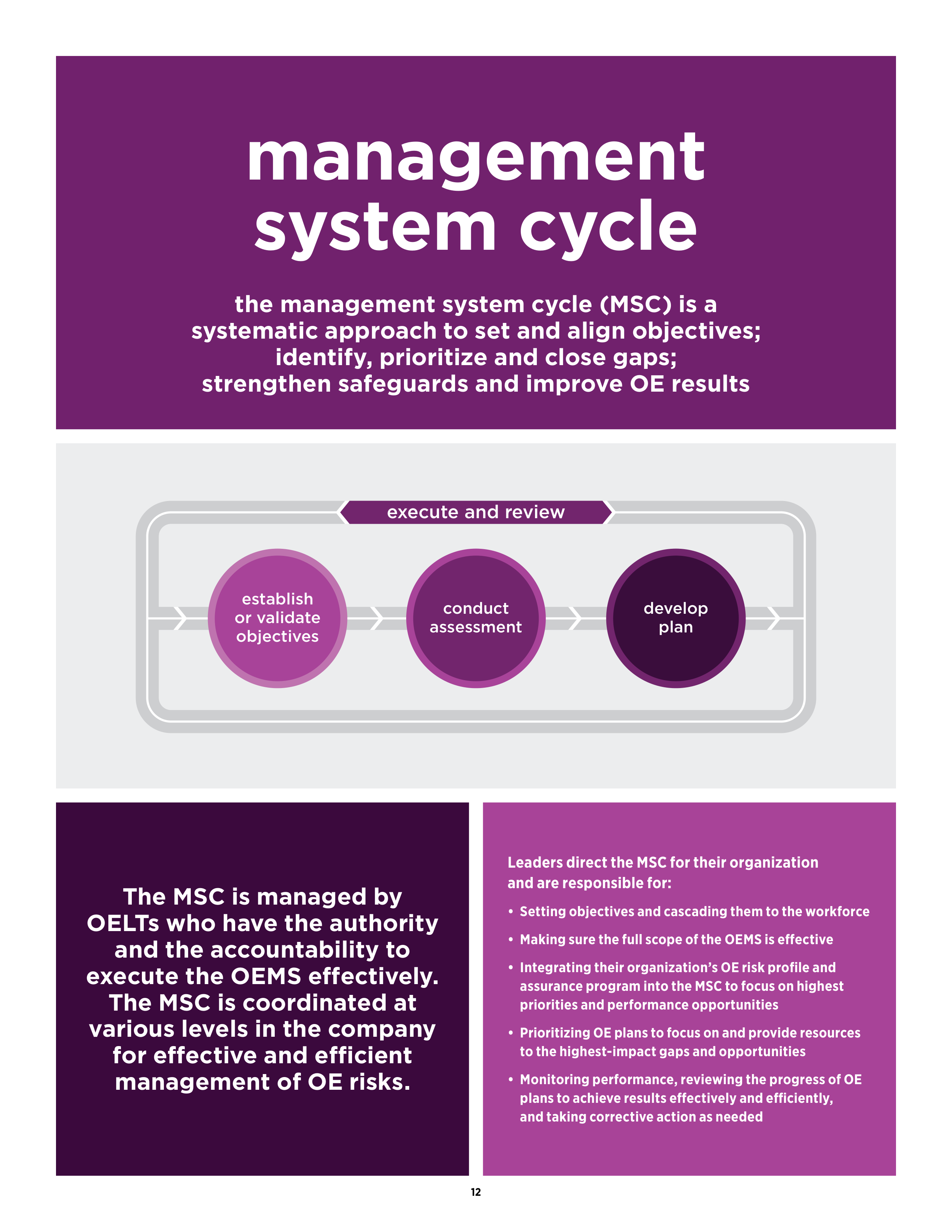
the management system cycle (MSC) is a
systematic approach to set and align objectives;
identify, prioritize and close gaps;
strengthen safeguards and improve OE results
management
system cycle
Leaders direct the MSC for their organization
and are responsible for:
• Setting objectives and cascading them to the workforce
• Making sure the full scope of the OEMS is effective
• Integrating their organization’s OE risk profile and
assurance program into the MSC to focus on highest
priorities and performance opportunities
• Prioritizing OE plans to focus on and provide resources
to the highest-impact gaps and opportunities
• Monitoring performance, reviewing the progress of OE
plans to achieve results effectively and efficiently,
and taking corrective action as needed
The MSC is managed by
OELTs who have the authority
and the accountability to
execute the OEMS effectively.
The MSC is coordinated at
various levels in the company
for effective and efficient
management of OE risks.
12
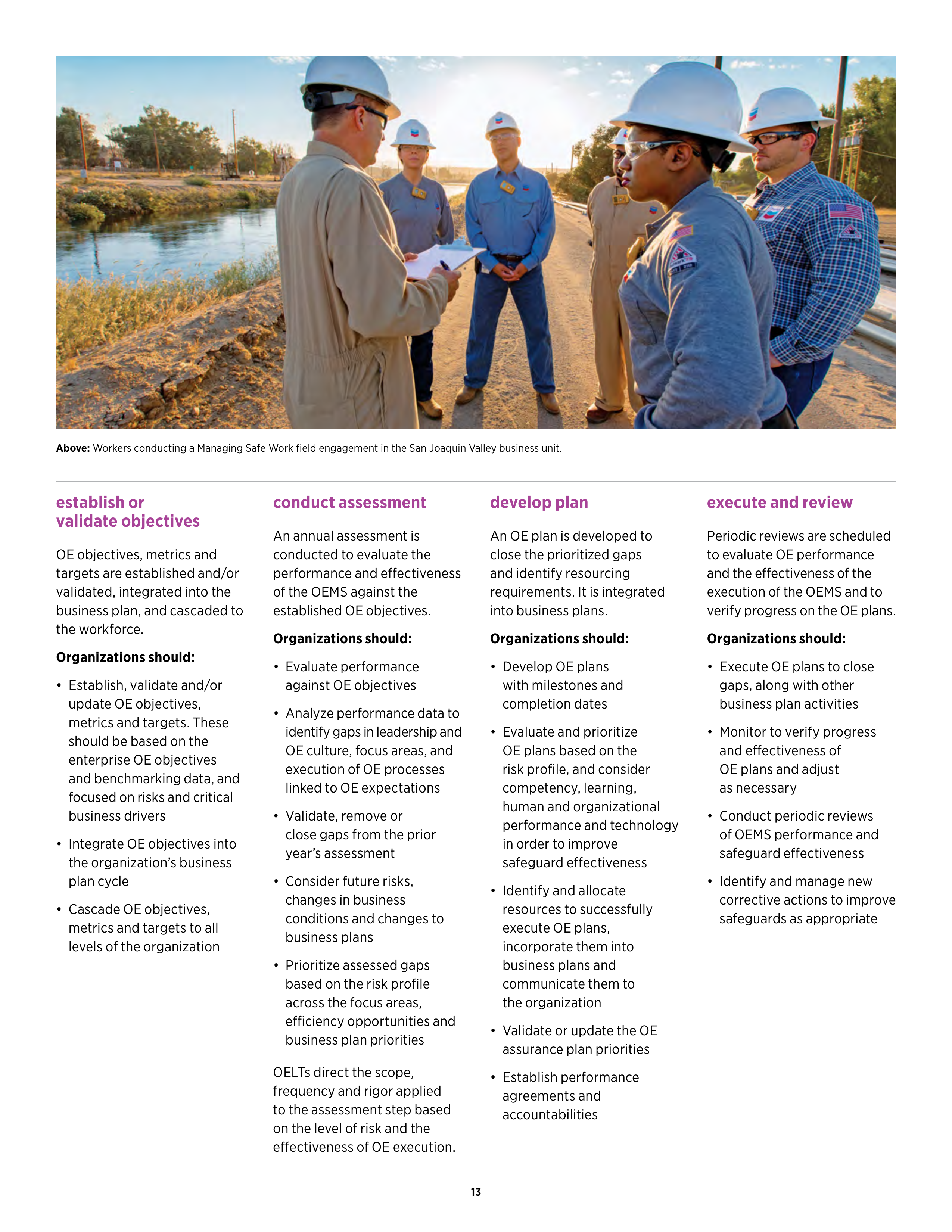
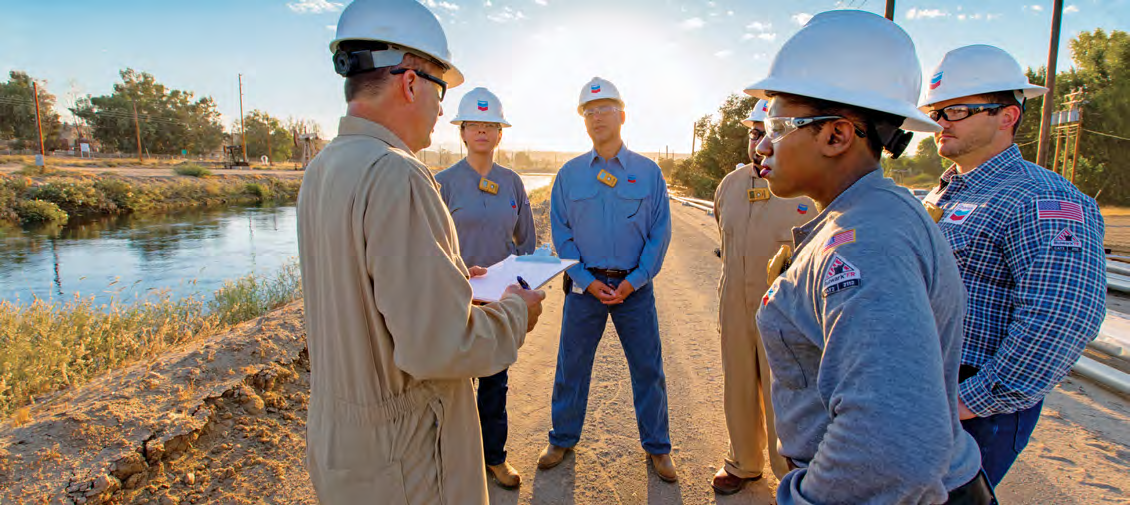
Above:
Workers conducting a Managing Safe Work field engagement in the San Joaquin Valley business unit.
establish or
validate objectives
OE objectives, metrics and
targets are established and/or
validated, integrated into the
business plan, and cascaded to
the workforce.
Organizations should:
• Establish, validate and/or
update OE objectives,
metrics and targets. These
should be based on the
enterprise OE objectives
and benchmarking data, and
focused on risks and critical
business drivers
• Integrate OE objectives into
the organization’s business
plan cycle
• Cascade OE objectives,
metrics and targets to all
levels of the organization
conduct assessment
An annual assessment is
conducted to evaluate the
performance and effectiveness
of the OEMS against the
established OE objectives.
Organizations should:
• Evaluate performance
against OE objectives
• Analyze performance data to
identify gaps in leadership and
OE culture, focus areas, and
execution of OE processes
linked to OE expectations
• Validate, remove or
close gaps from the prior
year’s assessment
• Consider future risks,
changes in business
conditions and changes to
business plans
• Prioritize assessed gaps
based on the risk profile
across the focus areas,
efficiency opportunities and
business plan priorities
OELTs direct the scope,
frequency and rigor applied
to the assessment step based
on the level of risk and the
effectiveness of OE execution.
develop plan
An OE plan is developed to
close the prioritized gaps
and identify resourcing
requirements. It is integrated
into business plans.
Organizations should:
• Develop OE plans
with milestones and
completion dates
• Evaluate and prioritize
OE plans based on the
risk profile, and consider
competency, learning,
human and organizational
performance and technology
in order to improve
safeguard effectiveness
• Identify and allocate
resources to successfully
execute OE plans,
incorporate them into
business plans and
communicate them to
the organization
• Validate or update the OE
assurance plan priorities
• Establish performance
agreements and
accountabilities
execute and review
Periodic reviews are scheduled
to evaluate OE performance
and the effectiveness of the
execution of the OEMS and to
verify progress on the OE plans.
Organizations should:
• Execute OE plans to close
gaps, along with other
business plan activities
• Monitor to verify progress
and effectiveness of
OE plans and adjust
as necessary
• Conduct periodic reviews
of OEMS performance and
safeguard effectiveness
• Identify and manage new
corrective actions to improve
safeguards as appropriate
13
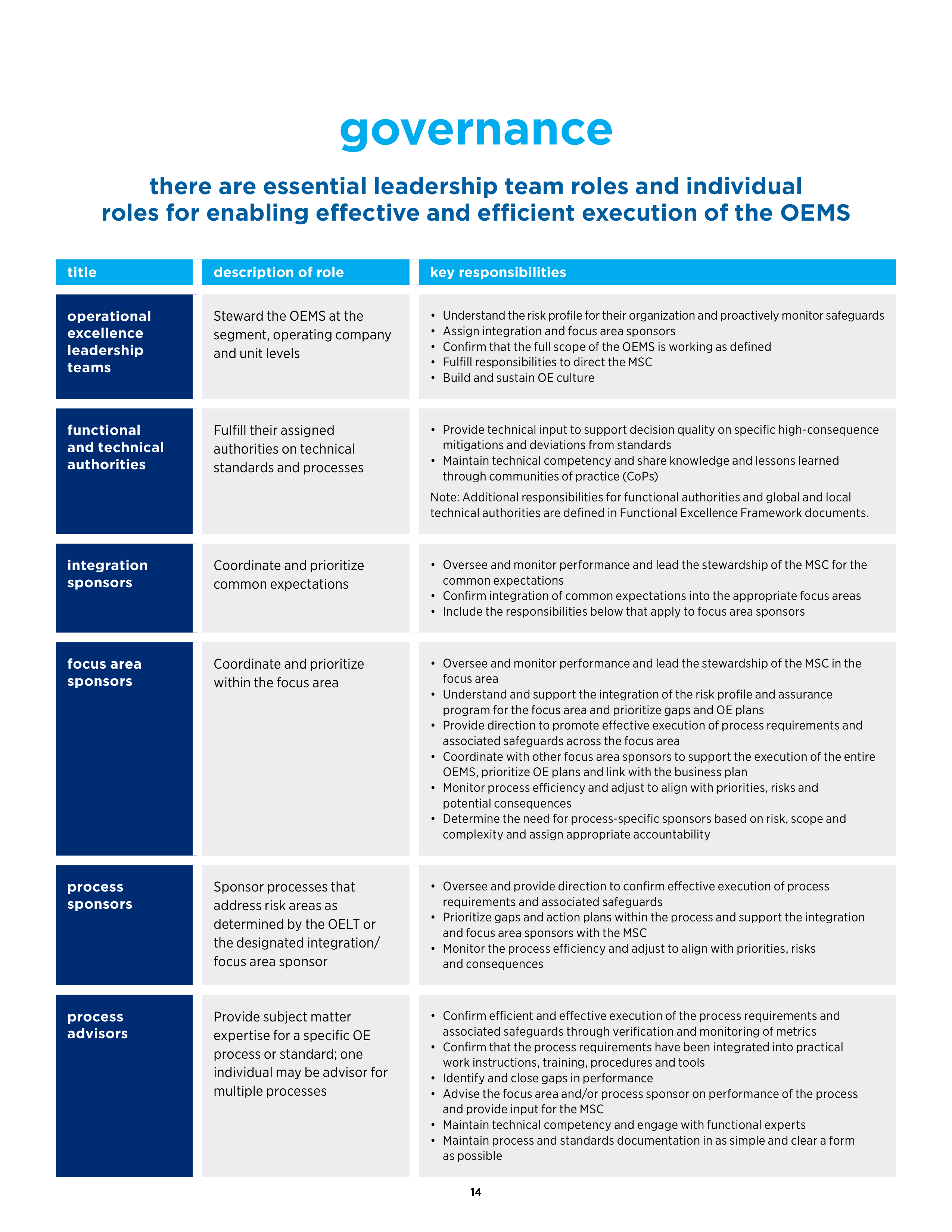
there are essential leadership team roles and individual
roles for enabling effective and efficient execution of the OEMS
governance
title
description of role
key responsibilities
operational
excellence
leadership
teams
Steward the OEMS at the
segment, operating company
and unit levels
•
Understand the risk profile for their organization and proactively monitor safeguards
•
Assign integration and focus area sponsors
•
Confirm that the full scope of the OEMS is working as defined
•
Fulfill responsibilities to direct the MSC
•
Build and sustain OE culture
functional
and technical
authorities
Fulfill their assigned
authorities on technical
standards and processes
•
Provide technical input to support decision quality on specific high-consequence
mitigations and deviations from standards
•
Maintain technical competency and share knowledge and lessons learned
through communities of practice (CoPs)
Note: Additional responsibilities for functional authorities and global and local
technical authorities are defined in Functional Excellence Framework documents.
integration
sponsors
Coordinate and prioritize
common expectations
•
Oversee and monitor performance and lead the stewardship of the MSC for the
common expectations
•
Confirm integration of common expectations into the appropriate focus areas
•
Include the responsibilities below that apply to focus area sponsors
focus area
sponsors
Coordinate and prioritize
within the focus area
•
Oversee and monitor performance and lead the stewardship of the MSC in the
focus area
•
Understand and support the integration of the risk profile and assurance
program for the focus area and prioritize gaps and OE plans
•
Provide direction to promote effective execution of process requirements and
associated safeguards across the focus area
•
Coordinate with other focus area sponsors to support the execution of the entire
OEMS, prioritize OE plans and link with the business plan
•
Monitor process efficiency and adjust to align with priorities, risks and
potential consequences
•
Determine the need for process-specific sponsors based on risk, scope and
complexity and assign appropriate accountability
process
sponsors
Sponsor processes that
address risk areas as
determined by the OELT or
the designated integration/
focus area sponsor
•
Oversee and provide direction to confirm effective execution of process
requirements and associated safeguards
•
Prioritize gaps and action plans within the process and support the integration
and focus area sponsors with the MSC
•
Monitor the process efficiency and adjust to align with priorities, risks
and consequences
process
advisors
Provide subject matter
expertise for a specific OE
process or standard; one
individual may be advisor for
multiple processes
•
Confirm efficient and effective execution of the process requirements and
associated safeguards through verification and monitoring of metrics
•
Confirm that the process requirements have been integrated into practical
work instructions, training, procedures and tools
•
Identify and close gaps in performance
•
Advise the focus area and/or process sponsor on performance of the process
and provide input for the MSC
•
Maintain technical competency and engage with functional experts
•
Maintain process and standards documentation in as simple and clear a form
as possible
14
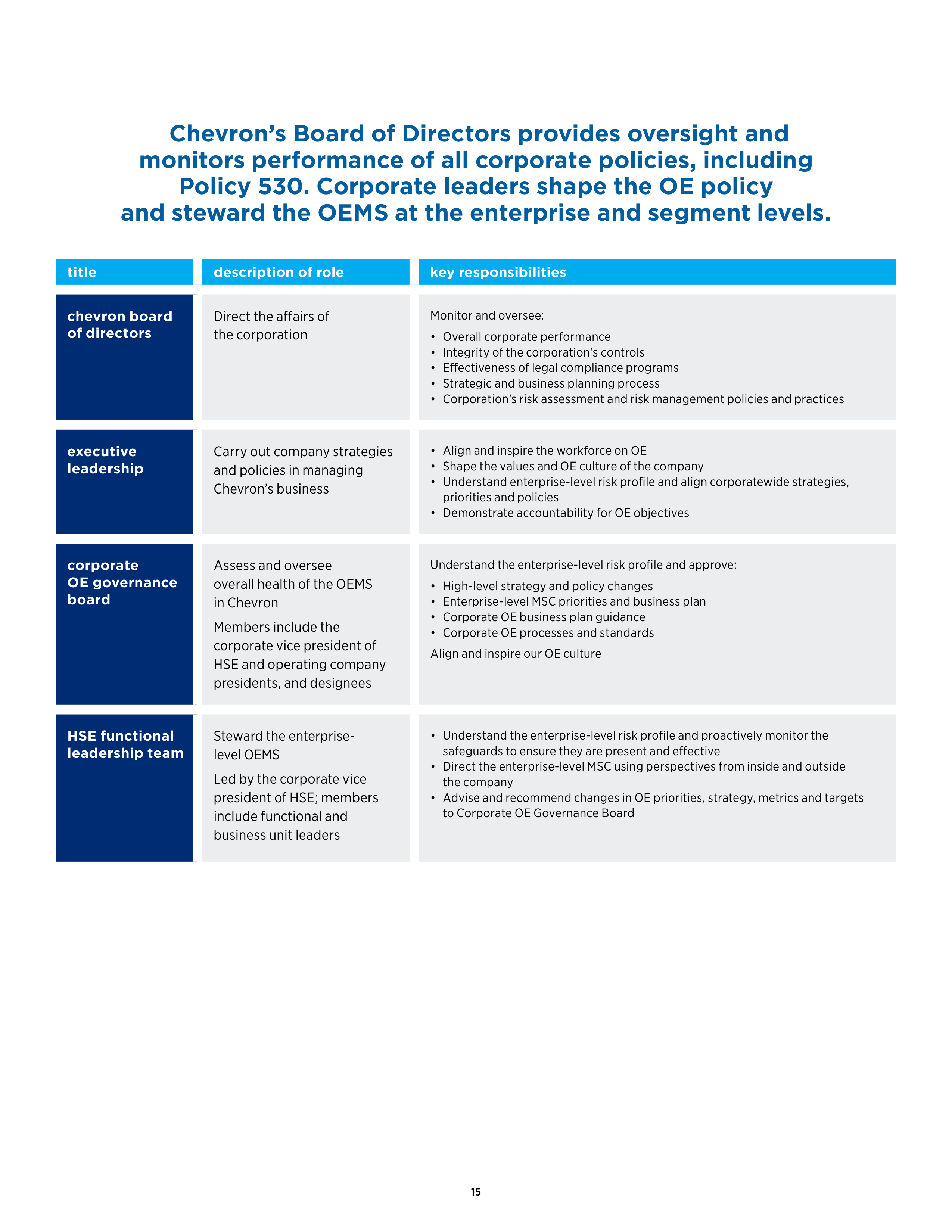
Chevron’s Board of Directors provides oversight and
monitors performance of all corporate policies, including
Policy 530. Corporate leaders shape the OE policy
and steward the OEMS at the enterprise and segment levels.
title
description of role
key responsibilities
chevron board
of directors
Direct the affairs of
the corporation
Monitor and oversee:
•
Overall corporate performance
•
Integrity of the corporation’s controls
•
Effectiveness of legal compliance programs
•
Strategic and business planning process
•
Corporation’s risk assessment and risk management policies and practices
executive
leadership
Carry out company strategies
and policies in managing
Chevron’s business
•
Align and inspire the workforce on OE
•
Shape the values and OE culture of the company
•
Understand enterprise-level risk profile and align corporatewide strategies,
priorities and policies
•
Demonstrate accountability for OE objectives
corporate
OE governance
board
Assess and oversee
overall health of the OEMS
in Chevron
Members include the
corporate vice president of
HSE and operating company
presidents, and designees
Understand the enterprise-level risk profile and approve:
•
High-level strategy and policy changes
•
Enterprise-level MSC priorities and business plan
•
Corporate OE business plan guidance
•
Corporate OE processes and standards
Align and inspire our OE culture
HSE functional
leadership team
Steward the enterprise-
level OEMS
Led by the corporate vice
president of HSE; members
include functional and
business unit leaders
•
Understand the enterprise-level risk profile and proactively monitor the
safeguards to ensure they are present and effective
•
Direct the enterprise-level MSC using perspectives from inside and outside
the company
•
Advise and recommend changes in OE priorities, strategy, metrics and targets
to Corporate OE Governance Board
15
most effective
least effective
substitution
engineering
controls
administrative
controls
PPE
elimination
Physically remove the
hazard – change
the system of work.
Replace substances or
systems of work
with less hazardous
alternatives.
Isolate people from the
hazard. Design to prevent
incidents or mitigate
consequences.
Provide safe work
practices and
procedures.
Protect the worker with
personal protective
equipment.
event
causes
consequences
hazard
hazard
event
preventive
safeguards
(hardware/human)
mitigative
safeguards
(hardware/human)
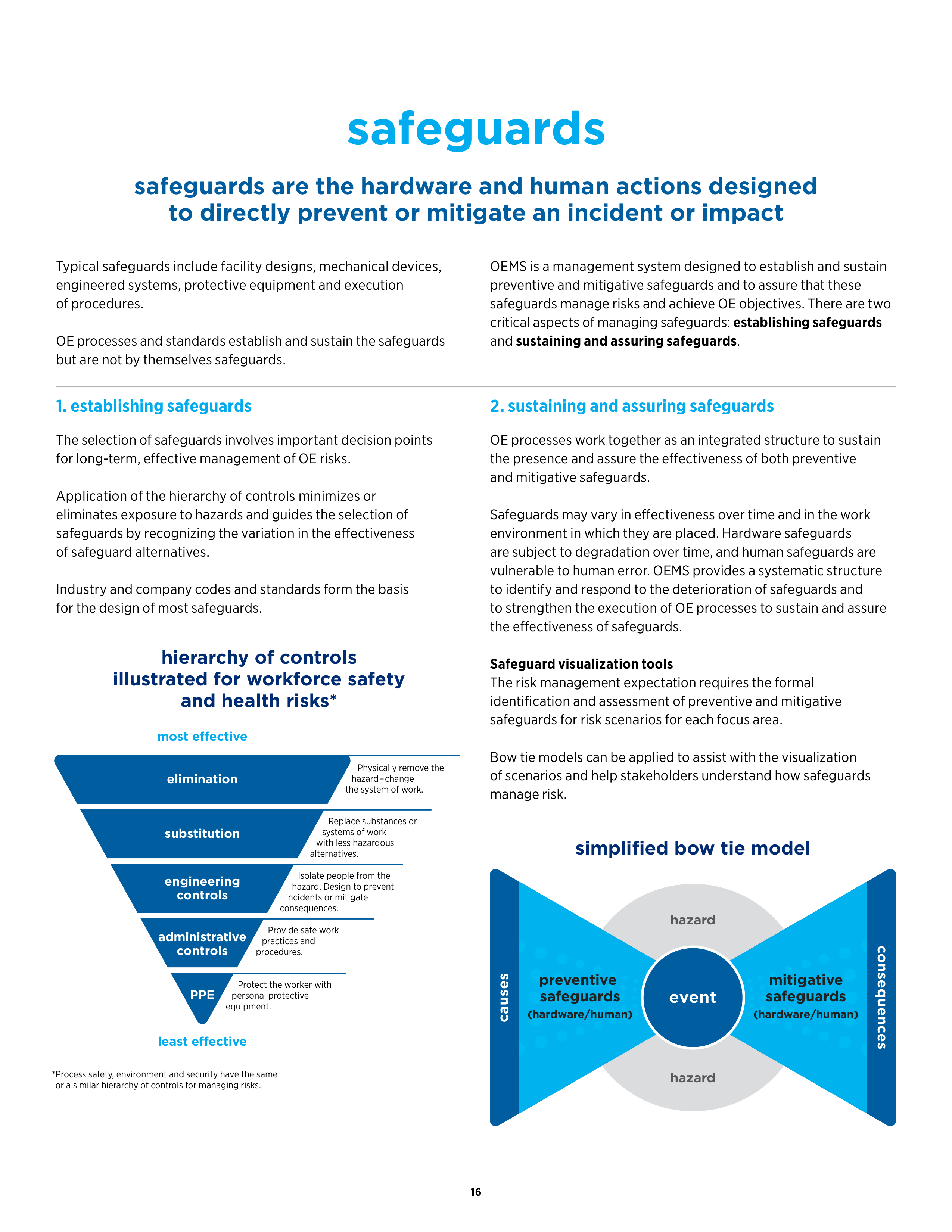
safeguards are the hardware and human actions designed
to directly prevent or mitigate an incident or impact
safeguards
Typical safeguards include facility designs, mechanical devices,
engineered systems, protective equipment and execution
of procedures.
OE processes and standards establish and sustain the safeguards
but are not by themselves safeguards.
OEMS is a management system designed to establish and sustain
preventive and mitigative safeguards and to assure that these
safeguards manage risks and achieve OE objectives. There are two
critical aspects of managing safeguards:
establishing safeguards
and
sustaining and assuring safeguards
.
1. establishing safeguards
The selection of safeguards involves important decision points
for long-term, effective management of OE risks.
Application of the hierarchy of controls minimizes or
eliminates exposure to hazards and guides the selection of
safeguards by recognizing the variation in the effectiveness
of safeguard alternatives.
Industry and company codes and standards form the basis
for the design of most safeguards.
2. sustaining and assuring safeguards
OE processes work together as an integrated structure to sustain
the presence and assure the effectiveness of both preventive
and mitigative safeguards.
Safeguards may vary in effectiveness over time and in the work
environment in which they are placed. Hardware safeguards
are subject to degradation over time, and human safeguards are
vulnerable to human error. OEMS provides a systematic structure
to identify and respond to the deterioration of safeguards and
to strengthen the execution of OE processes to sustain and assure
the effectiveness of safeguards.
Safeguard visualization tools
The risk management expectation requires the formal
identification and assessment of preventive and mitigative
safeguards for risk scenarios for each focus area.
Bow tie models can be applied to assist with the visualization
of scenarios and help stakeholders understand how safeguards
manage risk.
hierarchy of controls
illustrated for workforce safety
and health risks*
simplified bow tie model
*Process safety, environment and security have the same
or a similar hierarchy of controls for managing risks.
16
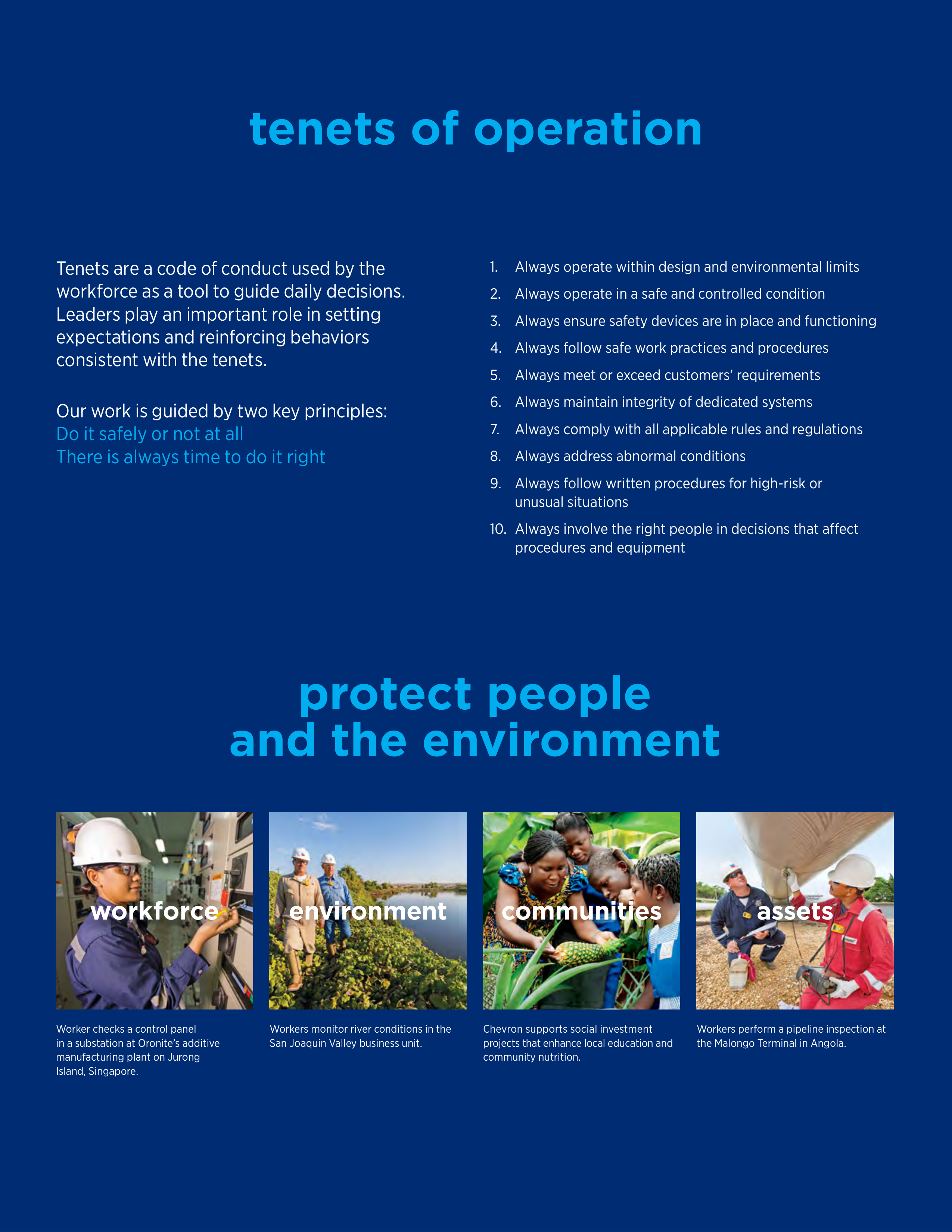


tenets of operation
protect people
and the environment
Worker checks a control panel
in a substation at Oronite’s additive
manufacturing plant on Jurong
Island, Singapore.
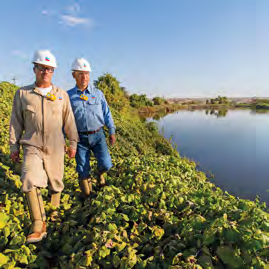
Workers monitor river conditions in the
San Joaquin Valley business unit.
Chevron supports social investment
projects that enhance local education and
community nutrition.
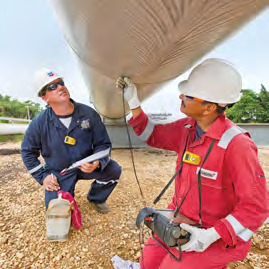
Workers perform a pipeline inspection at
the Malongo Terminal in Angola.
Tenets are a code of conduct used by the
workforce as a tool to guide daily decisions.
Leaders play an important role in setting
expectations and reinforcing behaviors
consistent with the tenets.
Our work is guided by two key principles:
Do it safely or not at all
There is always time to do it right
1.
Always operate within design and environmental limits
2.
Always operate in a safe and controlled condition
3.
Always ensure safety devices are in place and functioning
4.
Always follow safe work practices and procedures
5.
Always meet or exceed customers’ requirements
6.
Always maintain integrity of dedicated systems
7.
Always comply with all applicable rules and regulations
8.
Always address abnormal conditions
9.
Always follow written procedures for high-risk or
unusual situations
10.
Always involve the right people in decisions that affect
procedures and equipment


Chevron Corporation
6001 Bollinger Canyon Road, San Ramon, CA 94583-2324 USA
www.chevron.com
© 2021 Chevron Corporation. All rights reserved.