
(Revised January 1, 2026)
0
Berkeley Campus Code of Student Conduct
General Overview
The University of California at Berkeley is a community of scholars committed to maintaining
an environment that encourages personal and intellectual growth. It is a community with high
standards and high expectations for those who choose to become a part of it, including
established rules of conduct intended to foster behaviors that are consistent with a civil and
educational setting. Members of the University community are expected to comply with all laws,
University policies and campus regulations, conducting themselves in ways that support a
scholarly environment. In this context, students are guided by the UC Berkeley Campus Code of
Student Conduct (“Code”).
This interim revision of the Code of Student Conduct is issued to comply with UC Office of the
President issuance of the revised Policies Applying to Campus Activities, Organizations and
Students (PACAOS 100.00) Appendix H: Student Conduct Investigation and Resolution
Frameworks.
For More Information:
Center for Student Conduct
203 Sproul Hall
MC 2432
Berkeley, CA 94720
Phone: (510) 643-9069
Email:
studentconduct@berkeley.edu
https://conduct.berkeley.edu/
(Revised January 1, 2026)
1
Table of Contents
I.
Definitions ....................................................................................................................................................... 4
A.
Student ...................................................................................................................................................................... 4
B.
Student Organization ........................................................................................................................................... 4
C.
Notice ......................................................................................................................................................................... 4
D.
Days ............................................................................................................................................................................ 4
E.
Committee on Student Conduct ....................................................................................................................... 5
1.
Composition of Committee .......................................................................................................................................................................5
2.
Hearing Panels ...............................................................................................................................................................................................5
3.
Duration of Appointment ..........................................................................................................................................................................5
F.
Independent Hearing Officer ............................................................................................................................ 5
II.
Jurisdiction .................................................................................................................................................. 5
A.
Generally .................................................................................................................................................................. 5
B.
Off-Campus Conduct ............................................................................................................................................. 5
C.
Conduct on Other UC Campuses ....................................................................................................................... 6
III.
Student Rights ............................................................................................................................................ 6
A.
Notice of Conduct Charges ................................................................................................................................. 6
B.
Requesting a Conduct Record ........................................................................................................................... 6
C.
Presumption of Innocence ................................................................................................................................. 6
D.
Choosing Not to Participate ............................................................................................................................... 6
E.
Hearing ...................................................................................................................................................................... 6
F.
Appeal ........................................................................................................................................................................ 7
G.
Advisors & Support Persons ............................................................................................................................. 7
IV.
Conduct Procedures .................................................................................................................................. 7
A.
Administration of the Code of Conduct ......................................................................................................... 7
1.
The Center for Student Conduct ............................................................................................................................................................7
2.
The Independent Hearing Officer .........................................................................................................................................................7
3.
Procedures and Timelines ........................................................................................................................................................................7
B.
Filing a Complaint and Investigation of Allegations ................................................................................ 7
1.
Filing a Complaint
.........................................................................................................................................................................................7
2.
Sexual Violence and Sexual Harassment Complaints ..................................................................................................................8
3.
Harassment and Discrimination Complaints ..................................................................................................................................8
4.
Complaints Relating to University Housing .....................................................................................................................................8
5.
Allegations of Research Misconduct ....................................................................................................................................................8
6.
Allegations of Graduate Academic Misconduct ..............................................................................................................................8
7.
Request for Restorative Justice Services ...........................................................................................................................................8
C.
Response to Alleged Misconduct ..................................................................................................................... 8
1.
Case Not Pursued ..........................................................................................................................................................................................8
2.
Alternative Resolution................................................................................................................................................................................9
3.
Case Charged ...................................................................................................................................................................................................9
D.
Resolution of Charged Cases .......................................................................................................................... 10
1.
No Finding of Responsibility/Notification..................................................................................................................................... 10
2.
Faculty Resolution of Undergraduate Academic Violations.................................................................................................. 10
3.
Student Conduct Administrative Resolution ................................................................................................................................ 11
4.
Formal Hearing Processes ..................................................................................................................................................................... 12
5.
Appeals ........................................................................................................................................................................................................... 16
6.
Interim Measures ....................................................................................................................................................................................... 17
(Revised January 1, 2026)
2
V.
Grounds for Discipline .......................................................................................................................... 18
102.01 - Academic Misconduct .................................................................................................................................. 18
102.02 - Other Dishonesty .......................................................................................................................................... 18
102.03 - Forgery.............................................................................................................................................................. 18
102.04 - Theft ................................................................................................................................................................... 18
102.05 - Electronic Resources ................................................................................................................................... 18
102.06 - Unauthorized Conduct ................................................................................................................................ 18
102.07 - University Housing ....................................................................................................................................... 18
102.08 - Physical Abuse ............................................................................................................................................... 18
102.09 - Harassment ..................................................................................................................................................... 18
102.10 - Stalking ............................................................................................................................................................. 19
102.11 - (Rescinded by UCOP on October 9, 2009)............................................................................................ 19
102.12 - Hazing................................................................................................................................................................ 19
102.13 - Obstruction of University Activities ...................................................................................................... 19
102.14 - Disorderly Conduct ...................................................................................................................................... 19
102.15 - Disturbing the Peace ................................................................................................................................... 19
102.16 - Failure to Comply .......................................................................................................................................... 19
102.17 - Controlled Substances ................................................................................................................................ 19
102.18 - Alcohol .............................................................................................................................................................. 19
102.19 - Destructive Devices ..................................................................................................................................... 20
102.20 - Weapons ........................................................................................................................................................... 20
102.21 - Disciplinary Actions ..................................................................................................................................... 20
102.22 - Notice of Emergency Suspension ............................................................................................................ 20
102.23 - Course Materials ........................................................................................................................................... 20
102.24 - Terrorizing Conduct .................................................................................................................................... 20
102.25 - Violation of Privacy ...................................................................................................................................... 20
102.26 - Camping or Lodging ..................................................................................................................................... 21
102.27 - Other Policies or Regulations................................................................................................................... 21
VI.
Conduct Sanctions .................................................................................................................................. 21
Warning (Non-Reportable) ........................................................................................................................................ 21
Warning for Student Organizations ........................................................................................................................ 21
Disciplinary Probation ................................................................................................................................................. 21
Loss of Privileges and Exclusion from Activities ................................................................................................ 21
Suspension ........................................................................................................................................................................ 21
Dismissal ........................................................................................................................................................................... 22
Exclusion from Areas of the Campus or from Official University Functions ............................................ 22
Restitution ........................................................................................................................................................................ 22
Revocation of Awarding of Degree .......................................................................................................................... 22
Other ................................................................................................................................................................................... 22
A.
Stay of Sanction........................................................................................................................................................................................... 22
B.
Other Actions ............................................................................................................................................................................................... 22
C. Additional Student Organization Sanctions .................................................................................................................................. 22
VII.
Miscellaneous ....................................................................................................................................... 22
A.
Actions for Pending Cases ............................................................................................................................... 22
1.
Records Hold ................................................................................................................................................................................................ 22
2.
Deferral or Withholding of Degree .................................................................................................................................................... 23
B.
Maintenance of Student Conduct Records ................................................................................................ 23
1.
University Policy, State and Federal Law ....................................................................................................................................... 23
2.
Campus Policy Regarding Retention of Records ........................................................................................................................ 23
3.
Posting on Transcripts ............................................................................................................................................................................ 23
(Revised January 1, 2026)
3
4.
Expunging of Conduct Records ........................................................................................................................................................... 23
C.
Application of the Code .................................................................................................................................... 24
D.
Revisions of the Code ........................................................................................................................................ 24
E.
Threats to Health and Safety/Disruptive or Illegal Activity .............................................................. 24
1.
Threats to Health and Safety ................................................................................................................................................................ 24
2.
Disruptive and Illegal Activity ............................................................................................................................................................. 24
Appendix I: Emergency Suspension ............................................................................................................. 24
Appendix II: Academic Misconduct .............................................................................................................. 26
A.
Cheating ................................................................................................................................................................. 26
B.
Plagiarism ............................................................................................................................................................. 26
C.
False Information and Representation and Fabrication or Alteration of Information ........... 26
D.
Theft or Damage of Intellectual Property ................................................................................................. 26
E.
Alteration of University Documents............................................................................................................ 26
Appendix III. The Restorative Educational Practices Initiative (REPAIR) ....................................... 27
A.
Restorative Justice Pathway........................................................................................................................... 27
1.
Request for Services and Party Engagement ................................................................................................................................ 27
2.
Repair Plans .................................................................................................................................................................................................. 27
3.
Failure to Reach or Complete Repair Plans ................................................................................................................................... 28
4.
Repair Plans and Conduct Records ................................................................................................................................................... 28
(Revised January 1, 2026)
4
I.
Definitions
A.
Student
1.
The term "student" for the purposes of this Code means an individual for
whom the University maintains student records and who:
a)
is enrolled in or registered with an academic program of the University;
b)
has completed the immediately preceding term, is not presently enrolled, and is
eligible for re-enrollment, including the recess periods between academic terms;
or
c)
is on an approved educational leave or other approved leave status, or is on filing-
fee status.
2.
The Code also applies to:
a)
applicants who become students, for offenses committed as part of the application
process;
b)
applicants who become students, for offenses committed on campus and/or while
participating in University-related events or activities that take place following a
student's submittal of the application through the student’s official enrollment; or
c)
former students for offenses committed while a student.
Individuals enrolled in UC Berkeley Extension who do not meet the definitions listed above are subject
to the UC Berkeley Extension Code of Student Conduct.
B.
Student Organization
Unless otherwise stated, wherever this Code refers to “student” the same also applies to registered
student organizations. “Student organization” means any group or organization of students of the
University of California, Berkeley that has obtained official recognition as a student organization from
an office or department of the campus.
Registered student organizations are subject to the revocation of recognition by/affiliation with the
university, and the individual members of those student organizations are subject to discipline under
the Code. Communications with student organizations will be directed to the president, principal
officer, student group signatory, or other students designated by the group to act as an agent on behalf
of the group.
Intercollegiate Athletic teams and other groups of students participating in programs that are
University-managed can be subjected to consequences at the group or organization level by their
responsible administrator, and the individual members of those student organizations are subject to
discipline under the Code.
Organizations that are unrecognized, unaffiliated, and/or otherwise not established with the
University are not subject to discipline by the University, however, the individual student members of
those organizations are subject to discipline under the Code.
C.
Notice
Wherever written notice to the student is required by the Code, it will be conclusively presumed to have
been furnished if the notice is sent to the student by email to the email address most recently filed with
the Registrar’s office. It will be conclusively presumed that written notice to a student organization has
been furnished if the notice is sent by email to the email address provided upon registering for
University recognition.
D.
Days
The term “day” is defined as a full business day and does not include Saturdays, Sundays, legal
holidays or University designated administrative holidays. With the mutual consent of the student,
the Center for Student Conduct and the hearing body, hearings may be held outside of normal business
hours, on Saturdays, Sundays or administrative holidays. The count of days will begin on the first day
following the date of action and/or from which a deadline is set.
(Revised January 1, 2026)
5
E.
Committee on Student Conduct
1.
Composition of Committee
The Committee on Student Conduct is the body of individuals who serve on hearing panels
and consists of faculty, staff and both graduate and undergraduate students. The Independent
Hearing Officer is responsible for overseeing the recruitment, organization and training of the
Committee. One undergraduate student may be nominated by the recognized student
government and one graduate student may be nominated by the Graduate Assembly.
Additional students are solicited from the community at large for appointment to the
committee. Faculty members are recommended or appointed by the Academic Senate
Committee on Committees. All members of the committee are appointed by the Chancellor or
their designee.
2.
Hearing Panels
Hearing panels are generally comprised of five members of the Committee on Student
Conduct and include: one faculty member, one undergraduate student, one graduate student,
one staff member and the faculty or staff chair. Hearings may be heard by a quorum of three
members of the Committee on Student Conduct so long as the faculty or staff chair and one
student are included on the panel.
a)
If the case involves an alleged academic violation, at least two of the individuals
hearing the case must be members of the faculty, one of whom must be the chair.
b)
If the case involves an alleged non-academic violation, a member of the faculty is
not required on the panel; however, the chair must be a staff member.
3.
Duration of Appointment
Faculty and staff appointments to the Committee normally last for a term of one year with the
possibility of extension to be determined by the Independent Hearing Officer. Student
appointments to the Committee normally last for a term of one year. Members may be
appointed for successive terms.
F.
Independent Hearing Officer
The Independent Hearing Officer is appointed by the Vice Chancellor for Student Affairs. Because it
is intended that the Independent Hearing Officer operate independently of the Center for Student
Conduct, neither shall report to the other nor to the direct supervisor of the other. The Independent
Hearing Officer shall not participate in
ex parte
communications regarding the merits of a pending
case, except that the Independent Hearing Officer may consult the Office of Legal Affairs for legal
advice.
II.
Jurisdiction
A.
Generally
These provisions govern student conduct on, or as it relates to, University property, or at official
University functions and University-sponsored programs conducted away from the campus.
University property is defined for purposes of this Code as all land, buildings, facilities or other
grounds or structures, or any item in possession of or owned, used, maintained or controlled by the
University or designated by the campus as subject to these policies, including the International House.
University property also includes computers and network systems owned, maintained or controlled
by the University or funded by University budgets or designated by the campus as subject to these
policies.
B.
Off-Campus Conduct
Student conduct that occurs off University property is subject to the Code where it a) adversely affects
the health, safety, or security of any other member of the University community, or the mission of the
University, or b) involves academic work or any records or documents of the University.
Jurisdiction may also be exercised over off-campus conduct, where the off-campus behavior includes,
but is not limited to, allegations of physical assault, battery, credible threats of violence, or illegal
possession or use of weapons, explosives or destructive devices.
In determining whether or not to exercise jurisdiction over such conduct, the Center for Student
Conduct will consider the seriousness of the alleged offense, the risk of harm involved, whether the
(Revised January 1, 2026)
6
victim(s) are members of the campus community and/or whether the off-campus conduct is part of a
series of actions that occurred both on and off University property.
C.
Conduct on Other UC Campuses
A student at one campus of the University who is accused of violation(s) of University policies or
campus regulations on another campus of the University, at an official function of that campus, or at
any site at which a University function is sponsored, shall be subject to the disciplinary procedures of
either the former or the latter campus as agreed by designees of both campuses. The imposition of any
recommendations for disciplinary sanctions arising from these procedures must be reviewed and
approved by both campuses before the sanctions are imposed.
III.
Student Rights
Students charged with violations of the Code are advised of their due process rights when they meet with
Center for Student Conduct staff and throughout the process. They are entitled to the following procedural
protections:
A.
Notice of Conduct Charges
If the Center for Student Conduct determines that a student will be charged with violations of the Code,
a notice is emailed to the student within ten (10) days after a complaint is filed or initiated by Student
Conduct (unless the ten day period is extended by the Independent Hearing Officer [see Procedures
and Timelines]). The Alleged Violation Letter identifies the sections of the Code the student is charged
with violating and includes a description of the facts supporting the charge(s) (see Cases Charged).
The University may bring charges against a former student for offenses committed while a student
within six (6) months after termination of student or student organization status. This limitation does
not apply to cases that involve academic dishonesty or fraud affecting the acquisition of a degree, over
which the University maintains indefinite jurisdiction.
Notwithstanding the above, charges alleging a violation of the UC Policy on Sexual Violence and Sexual
Harassment and the UC Anti-Discrimination Policy will be filed in accordance with those policies.
B.
Requesting a Conduct Record
The student may request a copy of the student’s own conduct record at any time. The Center for Student
Conduct must provide a copy within three (3) days of such requests. Generally, a student’s conduct
record contains the applicable incident report(s), meeting and decision letters, and other documents
related to student conduct incidents in which the student has been involved. The release of such
information may be subject to limitations imposed by state and federal law (see the Berkeley Campus
Policy Governing Disclosure of Information from Student Records).
C.
Presumption of Innocence
It is presumed that a student charged with a violation of the Code is not responsible for such violations
unless the student admits responsibility or it is determined otherwise following the administrative
resolution or a formal hearing (see Standard of Proof, Section IV.D.2.d.5).
D.
Choosing Not to Participate
The conduct process works best when students and staff work collaboratively to resolve a case. Students
may choose not to participate in the resolution of their charges. In this situation the Center for Student
Conduct will proceed to resolve the charge without the participation of the student (see Resolution of
Charged Cases). When the investigation, administrative resolution, or formal hearing process continues
without the student’s participation, the decisions of the Center for Student Conduct, Independent
Hearing Officer, the hearing body, the Dean of Students or their designee, and/or the Appeal Officer or
their designee will have the same force and effect as if the student had participated. Students may also
choose to remain silent during any portion of the conduct process and no inference will be drawn from
the decision of the student to remain silent. However, when a party selectively participates in the
process, such as choosing to answer some but not all questions posed, it may be considered in evaluating
the party’s credibility.
E.
Hearing
Students charged with violations of the Code are encouraged to fully explore the administrative
resolution of their case with the Center for Student Conduct. In cases where a separation student status
sanction is imposed, they may, however, elect to have resolution of the case through a formal
administrative or panel hearing (see Formal Hearing Processes).
(Revised January 1, 2026)
7
F.
Appeal
Students have a right to submit a written appeal under certain defined grounds as it relates to
administrative resolution or formal hearing processes (see Appeals).
G.
Advisors & Support Persons
Students may be accompanied by one advisor and/or one support person at any stage of the process. A
student may select an advisor of their choosing or request that the University provide one; the student
is responsible for any expenses associated with selecting an advisor not provided by the University. The
advisor will have access to training regarding the procedures for student conduct investigation and
resolution. An advisor and/or support person may be present with the written permission of the
student. The advisor and/or the support person may be any person (including an advocate, attorney,
friend, or family member) who is not otherwise a party involved in the incident or a witness. With
written permission from the student, the advisor will receive updates along with the student during the
adjudication process of the alleged violation. The advisor’s primary role is to provide guidance through
the process. The support person’s primary role is to provide emotional support. All communication
must come from the student; the advisor and/or the support person may not write or speak on behalf
of a student or otherwise disrupt any meetings or proceedings in any manner. An advisor and/or
support person may be excluded from participation by the Independent Hearing Officer or Center for
Student Conduct staff member should they fail to adhere to these procedures. If a student has requested
an advisor be assigned to them, the process will not begin without an advisor being identified. However,
the conduct process will not be delayed due to repeated or ongoing unavailability of a particular advisor.
IV.
Conduct Procedures
A.
Administration of the Code of Conduct
1.
The Center for Student Conduct
The Center for Student Conduct is responsible on behalf of the campus for intake of complaints
alleging violations of the Code, investigation of alleged violations, issuing charges of Code
violations, facilitating the administrative resolution process, presentation of cases at formal
hearings, submitting appeal responses to the designated appeal officer, and implementing
resolution plans (sanctions). The Center for Student Conduct administers complaints of both
academic and non-academic violations of the Code. Faculty members may also resolve
academic violations directly with the student through the faculty disposition process (see
Faculty Resolution of Undergraduate Academic Violations).
2.
The Independent Hearing Officer
The Independent Hearing Officer is responsible for resolving procedural matters described in
this Code (see Resolution of Charged Cases), administering the formal hearing process (see
Formal Hearing Processes), presiding over formal hearings, and deciding all procedural and
evidentiary matters related to formal hearings. The Independent Hearing Officer may
additionally be delegated to serve as the appeal officer for cases that do not proceed to a formal
hearing (see Designation of Appeal Officer).
3.
Procedures and Timelines
Each case is handled individually and, while due process is always provided, every procedure
outlined in the Code may not be used in a particular case. All investigations shall be concluded
promptly, generally within sixty (60) to ninety (90) days of when a student is notified of the
allegations, unless there is a good cause extension. All deadlines and time requirements in this
document may be extended for good cause as determined by the Independent Hearing Officer
or upon the agreement of the Center for Student Conduct and the responding student. Requests
for extensions of deadlines must be made in writing to the Independent Hearing Officer. The
Independent Hearing Officer will notify appropriate parties whether or not the extension is
granted, and if an extension is granted, the specific date of the new deadline or event.
B.
Filing a Complaint and Investigation of Allegations
1.
Filing a Complaint
Most cases begin with a complaint alleging that a student has committed an academic or non-
academic violation of the Code. Any member of the faculty or staff, a student, or any other
person may file a complaint with the Center for Student Conduct within sixty (60) days of the
date the reporting party knew or should reasonably have known of the alleged violation unless
law or an external agency requires that information be withheld. The Center for Student
Conduct may waive the 60-day limitation whenever the complaint may result in suspension or
(Revised January 1, 2026)
8
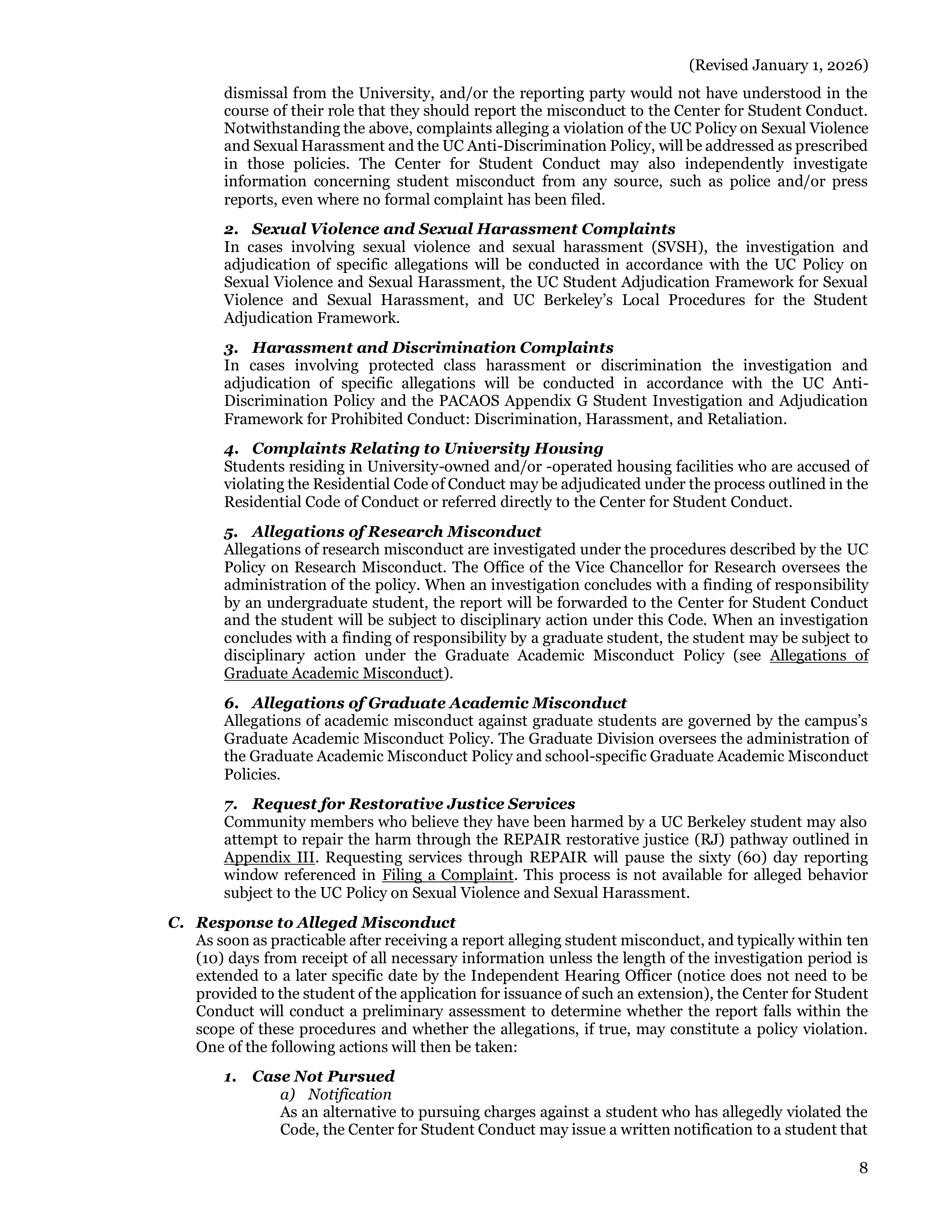
dismissal from the University, and/or the reporting party would not have understood in the
course of their role that they should report the misconduct to the Center for Student Conduct.
Notwithstanding the above, complaints alleging a violation of the UC Policy on Sexual Violence
and Sexual Harassment and the UC Anti-Discrimination Policy, will be addressed as prescribed
in those policies. The Center for Student Conduct may also independently investigate
information concerning student misconduct from any source, such as police and/or press
reports, even where no formal complaint has been filed.
2.
Sexual Violence and Sexual Harassment Complaints
In cases involving sexual violence and sexual harassment (SVSH), the investigation and
adjudication of specific allegations will be conducted in accordance with the UC Policy on
Sexual Violence and Sexual Harassment, the UC Student Adjudication Framework for Sexual
Violence and Sexual Harassment, and UC Berkeley’s Local Procedures for the Student
Adjudication Framework.
3.
Harassment and Discrimination Complaints
In cases involving protected class harassment or discrimination the investigation and
adjudication of specific allegations will be conducted in accordance with the UC Anti-
Discrimination Policy and the PACAOS Appendix G Student Investigation and Adjudication
Framework for Prohibited Conduct: Discrimination, Harassment, and Retaliation.
4.
Complaints Relating to University Housing
Students residing in University-owned and/or -operated housing facilities who are accused of
violating the Residential Code of Conduct may be adjudicated under the process outlined in the
Residential Code of Conduct or referred directly to the Center for Student Conduct.
5.
Allegations of Research Misconduct
Allegations of research misconduct are investigated under the procedures described by the UC
Policy on Research Misconduct. The Office of the Vice Chancellor for Research oversees the
administration of the policy. When an investigation concludes with a finding of responsibility
by an undergraduate student, the report will be forwarded to the Center for Student Conduct
and the student will be subject to disciplinary action under this Code. When an investigation
concludes with a finding of responsibility by a graduate student, the student may be subject to
disciplinary action under the Graduate Academic Misconduct Policy (see Allegations of
Graduate Academic Misconduct).
6.
Allegations of Graduate Academic Misconduct
Allegations of academic misconduct against graduate students are governed by the campus’s
Graduate Academic Misconduct Policy. The Graduate Division oversees the administration of
the Graduate Academic Misconduct Policy and school-specific Graduate Academic Misconduct
Policies.
7.
Request for Restorative Justice Services
Community members who believe they have been harmed by a UC Berkeley student may also
attempt to repair the harm through the REPAIR restorative justice (RJ) pathway outlined in
Appendix III. Requesting services through REPAIR will pause the sixty (60) day reporting
window referenced in Filing a Complaint. This process is not available for alleged behavior
subject to the UC Policy on Sexual Violence and Sexual Harassment.
C.
Response to Alleged Misconduct
As soon as practicable after receiving a report alleging student misconduct, and typically within ten
(10) days from receipt of all necessary information unless the length of the investigation period is
extended to a later specific date by the Independent Hearing Officer (notice does not need to be
provided to the student of the application for issuance of such an extension), the Center for Student
Conduct will conduct a preliminary assessment to determine whether the report falls within the
scope of these procedures and whether the allegations, if true, may constitute a policy violation.
One of the following actions will then be taken:
1.
Case Not Pursued
a)
Notification
As an alternative to pursuing charges against a student who has allegedly violated the
Code, the Center for Student Conduct may issue a written notification to a student that
(Revised January 1, 2026)
9
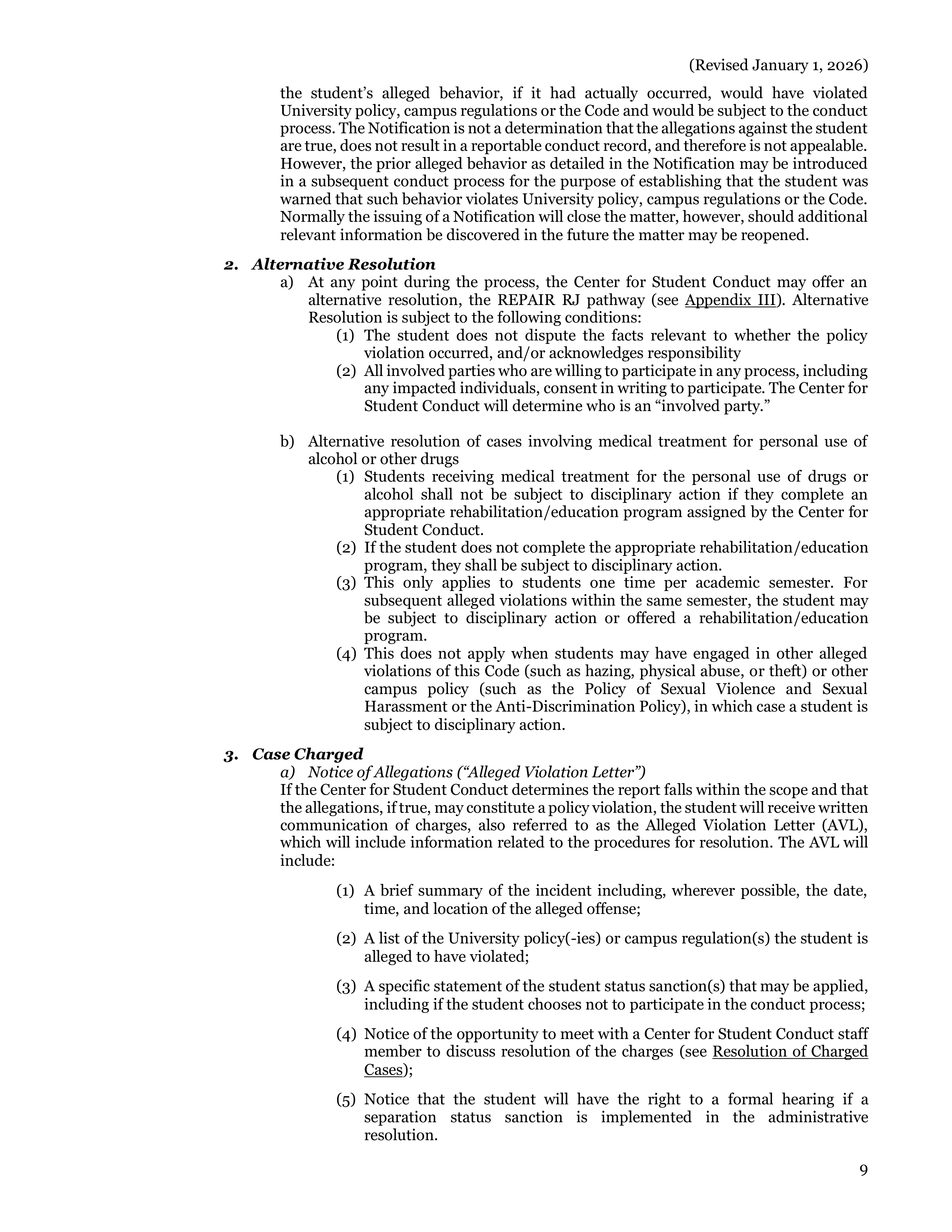
the student’s alleged behavior, if it had actually occurred, would have violated
University policy, campus regulations or the Code and would be subject to the conduct
process. The Notification is not a determination that the allegations against the student
are true, does not result in a reportable conduct record, and therefore is not appealable.
However, the prior alleged behavior as detailed in the Notification may be introduced
in a subsequent conduct process for the purpose of establishing that the student was
warned that such behavior violates University policy, campus regulations or the Code.
Normally the issuing of a Notification will close the matter, however, should additional
relevant information be discovered in the future the matter may be reopened.
2.
Alternative Resolution
a)
At any point during the process, the Center for Student Conduct may offer an
alternative resolution, the REPAIR RJ pathway (see Appendix III). Alternative
Resolution is subject to the following conditions:
(1)
The student does not dispute the facts relevant to whether the policy
violation occurred, and/or acknowledges responsibility
(2)
All involved parties who are willing to participate in any process, including
any impacted individuals, consent in writing to participate. The Center for
Student Conduct will determine who is an “involved party.”
b)
Alternative resolution of cases involving medical treatment for personal use of
alcohol or other drugs
(1)
Students receiving medical treatment for the personal use of drugs or
alcohol shall not be subject to disciplinary action if they complete an
appropriate rehabilitation/education program assigned by the Center for
Student Conduct.
(2)
If the student does not complete the appropriate rehabilitation/education
program, they shall be subject to disciplinary action.
(3)
This only applies to students one time per academic semester. For
subsequent alleged violations within the same semester, the student may
be subject to disciplinary action or offered a rehabilitation/education
program.
(4)
This does not apply when students may have engaged in other alleged
violations of this Code (such as hazing, physical abuse, or theft) or other
campus policy (such as the Policy of Sexual Violence and Sexual
Harassment or the Anti-Discrimination Policy), in which case a student is
subject to disciplinary action.
3.
Case Charged
a)
Notice of Allegations (“Alleged Violation Letter”)
If the Center for Student Conduct determines the report falls within the scope and that
the allegations, if true, may constitute a policy violation, the student will receive written
communication of charges, also referred to as the Alleged Violation Letter (AVL),
which will include information related to the procedures for resolution. The AVL will
include:
(1)
A brief summary of the incident including, wherever possible, the date,
time, and location of the alleged offense;
(2)
A list of the University policy(-ies) or campus regulation(s) the student is
alleged to have violated;
(3)
A specific statement of the student status sanction(s) that may be applied,
including if the student chooses not to participate in the conduct process;
(4)
Notice of the opportunity to meet with a Center for Student Conduct staff
member to discuss resolution of the charges (see Resolution of Charged
Cases);
(5)
Notice that the student will have the right to a formal hearing if a
separation status sanction is implemented in the administrative
resolution.
(Revised January 1, 2026)
10
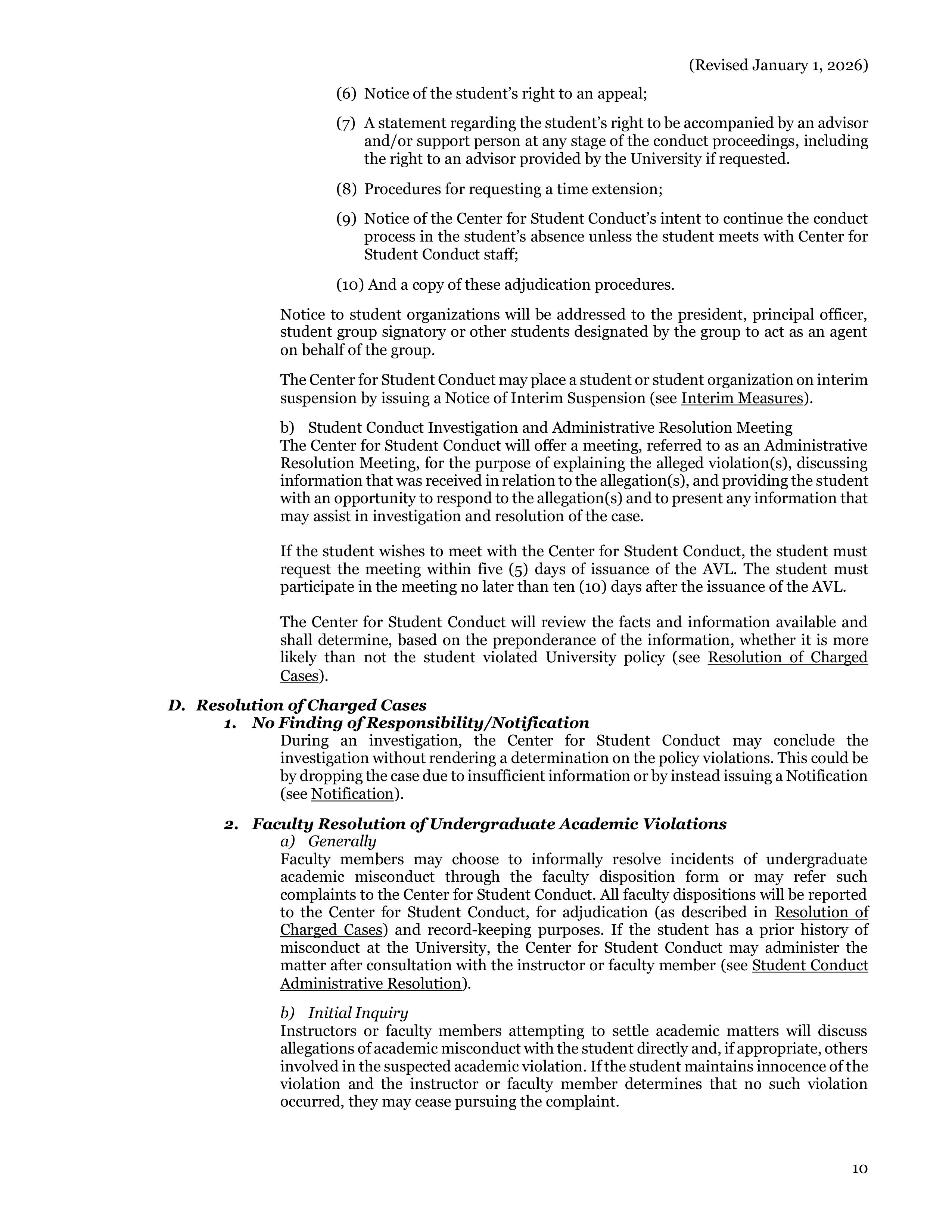
(6)
Notice of the student’s right to an appeal;
(7)
A statement regarding the student’s right to be accompanied by an advisor
and/or support person at any stage of the conduct proceedings, including
the right to an advisor provided by the University if requested.
(8)
Procedures for requesting a time extension;
(9)
Notice of the Center for Student Conduct’s intent to continue the conduct
process in the student’s absence unless the student meets with Center for
Student Conduct staff;
(10) And a copy of these adjudication procedures.
Notice to student organizations will be addressed to the president, principal officer,
student group signatory or other students designated by the group to act as an agent
on behalf of the group.
The Center for Student Conduct may place a student or student organization on interim
suspension by issuing a Notice of Interim Suspension (see Interim Measures).
b)
Student Conduct Investigation and Administrative Resolution Meeting
The Center for Student Conduct will offer a meeting, referred to as an Administrative
Resolution Meeting, for the purpose of explaining the alleged violation(s), discussing
information that was received in relation to the allegation(s), and providing the student
with an opportunity to respond to the allegation(s) and to present any information that
may assist in investigation and resolution of the case.
If the student wishes to meet with the Center for Student Conduct, the student must
request the meeting within five (5) days of issuance of the AVL. The student must
participate in the meeting no later than ten (10) days after the issuance of the AVL.
The Center for Student Conduct will review the facts and information available and
shall determine, based on the preponderance of the information, whether it is more
likely than not the student violated University policy (see Resolution of Charged
Cases).
D.
Resolution of Charged Cases
1.
No Finding of Responsibility/Notification
During an investigation, the Center for Student Conduct may conclude the
investigation without rendering a determination on the policy violations. This could be
by dropping the case due to insufficient information or by instead issuing a Notification
(see Notification).
2.
Faculty Resolution of Undergraduate Academic Violations
a)
Generally
Faculty members may choose to informally resolve incidents of undergraduate
academic misconduct through the faculty disposition form or may refer such
complaints to the Center for Student Conduct. All faculty dispositions will be reported
to the Center for Student Conduct, for adjudication (as described in Resolution of
Charged Cases) and record-keeping purposes. If the student has a prior history of
misconduct at the University, the Center for Student Conduct may administer the
matter after consultation with the instructor or faculty member (see Student Conduct
Administrative Resolution).
b)
Initial Inquiry
Instructors or faculty members attempting to settle academic matters will discuss
allegations of academic misconduct with the student directly and, if appropriate, others
involved in the suspected academic violation. If the student maintains innocence of the
violation and the instructor or faculty member determines that no such violation
occurred, they may cease pursuing the complaint.
(Revised January 1, 2026)
11
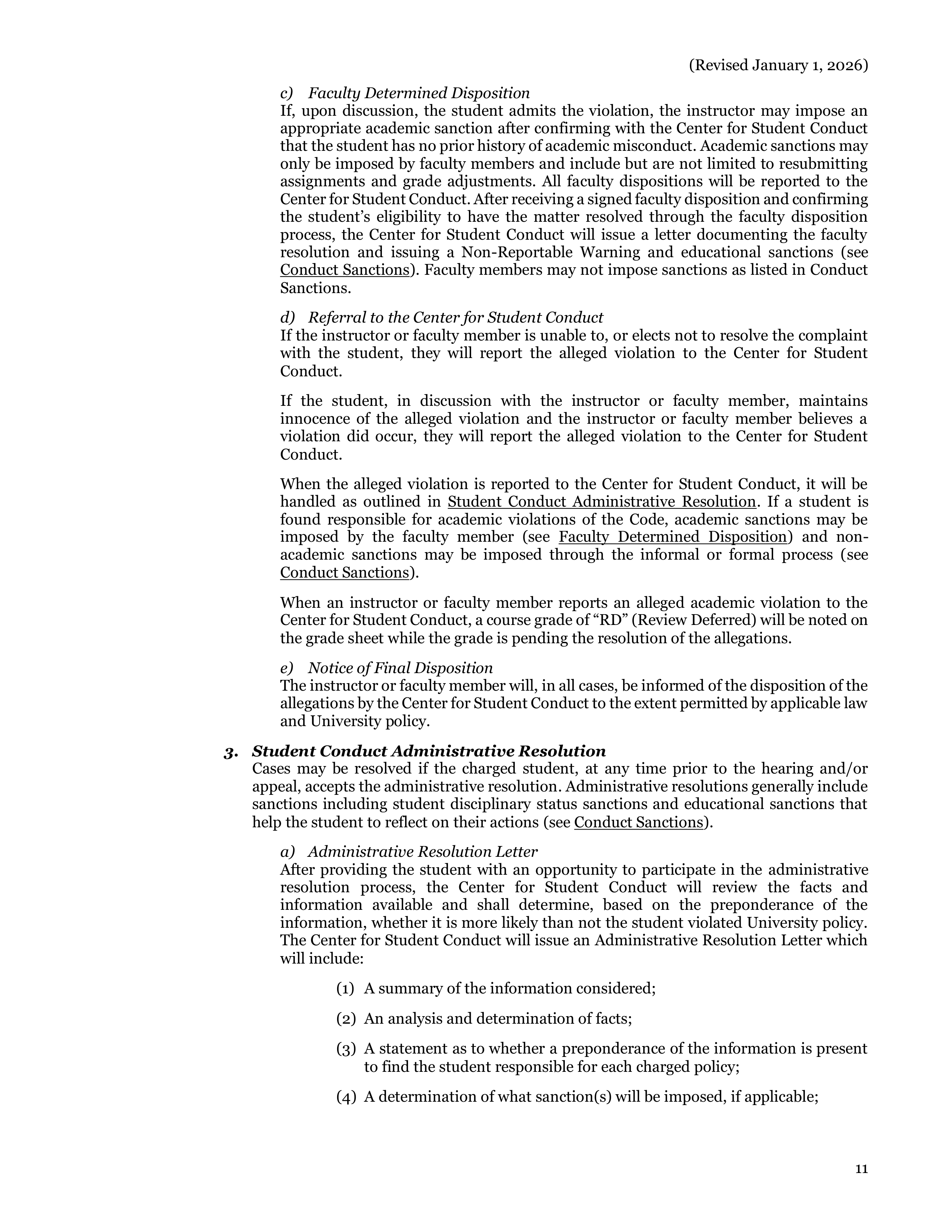
c)
Faculty Determined Disposition
If, upon discussion, the student admits the violation, the instructor may impose an
appropriate academic sanction after confirming with the Center for Student Conduct
that the student has no prior history of academic misconduct. Academic sanctions may
only be imposed by faculty members and include but are not limited to resubmitting
assignments and grade adjustments. All faculty dispositions will be reported to the
Center for Student Conduct. After receiving a signed faculty disposition and confirming
the student’s eligibility to have the matter resolved through the faculty disposition
process, the Center for Student Conduct will issue a letter documenting the faculty
resolution and issuing a Non-Reportable Warning and educational sanctions (see
Conduct Sanctions). Faculty members may not impose sanctions as listed in Conduct
Sanctions.
d)
Referral to the Center for Student Conduct
If the instructor or faculty member is unable to, or elects not to resolve the complaint
with the student, they will report the alleged violation to the Center for Student
Conduct.
If the student, in discussion with the instructor or faculty member, maintains
innocence of the alleged violation and the instructor or faculty member believes a
violation did occur, they will report the alleged violation to the Center for Student
Conduct.
When the alleged violation is reported to the Center for Student Conduct, it will be
handled as outlined in Student Conduct Administrative Resolution. If a student is
found responsible for academic violations of the Code, academic sanctions may be
imposed by the faculty member (see Faculty Determined Disposition) and non-
academic sanctions may be imposed through the informal or formal process (see
Conduct Sanctions).
When an instructor or faculty member reports an alleged academic violation to the
Center for Student Conduct, a course grade of “RD” (Review Deferred) will be noted on
the grade sheet while the grade is pending the resolution of the allegations.
e)
Notice of Final Disposition
The instructor or faculty member will, in all cases, be informed of the disposition of the
allegations by the Center for Student Conduct to the extent permitted by applicable law
and University policy.
3.
Student Conduct Administrative Resolution
Cases may be resolved if the charged student, at any time prior to the hearing and/or
appeal, accepts the administrative resolution. Administrative resolutions generally include
sanctions including student disciplinary status sanctions and educational sanctions that
help the student to reflect on their actions (see Conduct Sanctions).
a)
Administrative Resolution Letter
After providing the student with an opportunity to participate in the administrative
resolution process, the Center for Student Conduct will review the facts and
information available and shall determine, based on the preponderance of the
information, whether it is more likely than not the student violated University policy.
The Center for Student Conduct will issue an Administrative Resolution Letter which
will include:
(1)
A summary of the information considered;
(2)
An analysis and determination of facts;
(3)
A statement as to whether a preponderance of the information is present
to find the student responsible for each charged policy;
(4)
A determination of what sanction(s) will be imposed, if applicable;
(Revised January 1, 2026)
12
(5)
A statement of the student’s response options, including hearing and/or
appeal
b)
Response to Administrative Resolution
(1)
The student’s options will be determined based on the student status
sanction included in the Administrative Resolution.
(1)
Non-Separation student status sanctions include a Non-
Reportable Warning, Student Organization Warning, and
Disciplinary Probation
(2)
Separation
student
status
sanctions
include
Suspension,
Dismissal, Revocation of a Degree Previously Awarded, and
Revocation of Student Organization Recognition.
(2)
Options and Timelines for the Administrative Resolution:
(1)
If the student accepts the Administrative Resolution, the outcome
of the violation and imposed sanctions are final, and no hearing
or appeal will follow. The student can accept by affirmatively
stating so in writing, or by allowing the following applicable
timelines to pass:
(2)
If the Administrative Resolution does not include a separation
status sanction, the student may appeal. The appeal must be
submitted in writing within 10 days of issuance of the
Administrative Resolution Letter (see Appeals).
(3)
If the Administrative Resolution includes a separation status
sanction and the student does not accept responsibility for the
policy violation, the student may request a formal hearing (see
Formal Hearing Process). The request must be made in writing
within 5 days of issuance of the Administrative Resolution Letter.
(4)
If the Administrative Resolution includes a separation status
sanction, and the student accepts responsibility for the policy
violation, but wishes to appeal the sanction, the student may
appeal specifically on the ground that the sanctions are
disproportionate. The student must submit a written intent to
appeal within 5 days of issuance of the Administrative Resolution
Letter, then the student will have an additional 5 days to submit
their written appeal (see Appeals).
(3)
When a hearing or appeal is permitted under the procedures outlined
above, the implementation of sanctions will be deferred pending the final
outcome of the case.
(4)
If the student does not respond in the timeframes listed above, the
outcome is final and no hearing or appeal will follow.
4.
Formal Hearing Process
In a case where a separation status is included in the Administrative Resolution, the student
may choose to have the case resolved through the formal hearing process. The student may
indicate a choice of a panel or administrative hearing; if the student does not select a hearing
type, or if the student stops participating in the formal process without indicating a hearing
type, the case will be conducted as an administrative hearing.
The hearing notice will be sent by the Independent Hearing Officer within ten (10) days of
referral from the Center for Student Conduct, scheduled to occur within a reasonable timeline.
The Independent Hearing Officer will provide written notice to the Center for Student Conduct
and to the charged student of the date, time and location of the hearing, to occur no less than
10 days from the date of the hearing notice. The Independent Hearing Officer may determine,
for good cause that the date of the hearing should be continued to a later specific date or that
(Revised January 1, 2026)
13
the time or place of the hearing should be changed. The student or the Center for Student
Conduct may also request a continuance for such good cause. A good cause for continuance
includes, but is not limited to, final examinations, panelist availability, significant illness, etc.
The Independent Hearing Officer will provide reasonable notice to the parties of any changes
to the date, time or location of the hearing.
a)
Panel Hearing
Panel hearing cases are presented to hearing panels comprised of members of the
Committee on Student Conduct, which act as the hearing body and make a
determination regarding the alleged violation(s). Panel hearings are presided over by
the Independent Hearing Officer.
b)
Administrative Hearing
Administrative hearings are conducted by the Independent Hearing Officer, who shall
act as the hearing body and make determinations regarding the alleged violation(s). In
all other respects, administrative hearings are conducted in the same manner as panel
hearings.
c)
Pre-Hearing Process
(1)
Exchange of Information
The Independent Hearing Officer will establish a procedure for the parties to
exchange information prior to the formal hearing. The exchange will occur no
later than five (5) days prior to the hearing, unless the Independent Hearing
Officer sets an earlier date for the exchange. The parties will exchange copies
of all information relevant to the incident to be shared at the hearing and a list
of possible witnesses. The list of possible witnesses should be annotated with
details regarding the relevance of each witness to the case. The Independent
Hearing Officer may exclude witnesses from participating in the hearing
should they be irrelevant to the matter at hand or redundant in content.
The Independent Hearing Officer may exclude any information from the
hearing that a party fails to include in its exchange of information or fails to
exchange according to these procedures. The release of information pursuant
to this section may be subject to limitations imposed by state and federal law
(see Berkeley Campus Policy Governing Disclosure of Information from
Student Records).
(2)
Pre-Hearing and Procedural Matters
The Independent Hearing Officer will review and decide on any procedural
matters either in advance of or during the hearing as necessary and
appropriate. These matters include but are not limited to: limits on each side’s
time for presentation, exclusion of duplicated or irrelevant matters, or order
of presentation of information. The Independent Hearing Officer will make
such decisions based upon the specific circumstances of the case in order to
promote the fair and efficient resolution of the hearing.
The Independent Hearing Officer will rule on and remedy any violations of a
charged student’s procedural rights with regard to the Conduct process and
this Code. If the Independent Hearing Officer determines that a violation of
the student’s procedural rights has occurred, the Independent Hearing Officer
may take whatever actions are necessary with respect to the pending case to
remedy any harm resulting from the violation, including but not limited to
exclusion of evidence or dismissal of some or all of the charges.
Prior to the hearing, if a charged student believes the information or evidence
is not sufficient to conclude that it is more likely than not that the student
committed the violation(s), and/or if the student believes that the alleged
violation is not within the jurisdiction of the Code, the student may ask the
Independent Hearing Officer to dismiss the charge.
The Independent Hearing Officer may establish procedures for submission
and determination of all pre-hearing matters.
(Revised January 1, 2026)
14
d)
The Hearing
(1)
Presentation of Information
Hearings are not conducted according to formal rules of procedure and
evidence. The responding student and the Center for Student Conduct will
each be given an opportunity to make both opening and closing statements.
The members of the hearing panel, the Independent Hearing Officer, the
responding student and the Center for Student Conduct shall all be allowed an
opportunity to question each witness. Once the hearing body has completed its
questioning of a witness, the Center for Student Conduct and the responding
student will each be given the opportunity to ask any remaining questions.
(2)
Question and Answer
No person is required to provide information against one’s own self in any
conduct proceeding. Information shared will normally not be admissible
unless the opposing party is afforded a reasonable opportunity to confront and
ask questions of the witness. It is the responsibility of the student to ensure
that the student’s witnesses are present. However, if a witness is unavailable
or declines to attend, the Independent Hearing Officer will determine whether
written or other recorded statements of such witness will be admitted.
(3)
All Information Presented at the Hearing
The hearing body’s decision will be based only upon information introduced at
the hearing. Neither the charged student nor the Center for Student Conduct
may communicate information regarding the merits of the case or its
disposition to the hearing body without the other party being afforded an
opportunity to respond.
(4)
Choosing Not to Appear
Unless good cause is shown, if the student does not appear at the hearing, the
hearing body may find the student responsible for some or all of the charges
and may recommend some or all of the proposed sanctions against the student.
The hearing body’s decision will be based only upon the information available
at the hearing, and that information may be introduced informally. If the
Center for Student Conduct does not appear at the hearing, the Independent
Hearing Officer may dismiss the charges against the student.
(5)
Standard of Proof
The Center for Student Conduct bears the burden of proving the charges. The
standard of proof for all hearings is a preponderance of evidence. A
preponderance of evidence is defined as “more likely to be true than not.”
(6)
Admissibility of Information
Admissible information is the sort upon which responsible persons are
accustomed to rely in the conduct of serious affairs, and is not restricted to
evidence admissible under the strict rules of evidence of a court of law. The
hearing body will not consider information that it determines has been
obtained by fundamentally unfair means.
(7)
Prior Conduct Record
The hearing body will take into account the student’s prior conduct record,
including Notifications (for the purpose of establishing the student had actual
knowledge the behavior violated the Code), if any, only for the purpose of
determining an appropriate sanction unless the information is considered to
be relevant to the charges.
e)
Hearing Body’s Determination and Dean of Students’ Decision
The hearing body is responsible for determining, based on the evidence presented at
the hearing, whether it is more likely than not that the responding student violated the
Code with respect to each charged violation. Where the hearing is conducted before a
hearing panel, the Independent Hearing Officer shall not participate in the panel’s
deliberations, nor shall the Independent Hearing Officer make recommendations to
the panel regarding what decision the panel should make. If by a majority vote, the
(Revised January 1, 2026)
15
hearing body determines that it is more likely than not that the student violated the
Code, then the sanctioning phase of the hearing will immediately commence. The
Independent Hearing Officer will outline the procedures for this phase, which includes
a presentation of information related to the sanctions by the Center for Student
Conduct and the responding student.
The hearing body’s decision will be documented in a report that includes a summary
of the relevant facts, the student’s behavior, and a determination of whether the
student has been found responsible or not of each alleged violation of the Code of
Student Conduct. The hearing body will also recommend to the Dean of Students or
their designee specific sanctions to be imposed if it finds the student in violation of the
Code. The hearing body will deliver the report to the Independent Hearing Officer
within ten (10) days of the hearing, and the Independent Hearing Officer will promptly
send the report to the Dean of Students. The Independent Hearing Officer will also
send the hearing report to the Center for Student Conduct for the student’s file.
Based upon the findings of the hearing body and any recommendation for sanctioning,
the Dean of Students or their designee will issue a written statement. The written
statement, also referred to as the Dean’s Decision Letter, will be issued for all hearings,
regardless of whether there is a finding of responsibility. The Dean’s Decision Letter
will state the policy determinations of the hearing body and, should there be a finding
of responsibility, will assign the sanction(s). The Dean of Students or their designee
has sole authority in assigning sanctions. The letter will also provide a statement of the
parties’ right to appeal and the procedures to appeal. The Dean’s Decision Letter and
hearing body’s report will be sent to the charged student within ten (10) days of
receiving the hearing body’s report.
f)
Recommendation to Revoke Degree Previously Conferred
If the hearing body determines that a student has committed an act of academic
misconduct or fraud affecting the acquisition of the student’s degree, the Dean of
Students or their designee may forward a recommendation that the degree be revoked
to the Committee on Courses of the Academic Senate.
The Dean of Students’ or their designee’s recommendation will not be forwarded to the
Committee on Courses until expiration of the time to file a written appeal (see Appeals)
or until determination that the appeal by the Vice Chancellor for Student Affairs or
their designee has been completed.
The Committee on Courses makes the final decision as to revocation of the degree. This
determination is not appealable to the Vice Chancellor for Student Affairs.
g)
Consolidation of Hearings
Cases in which more than one student is charged with violating the same Code
section(s) and which depend on common evidence may, at the discretion of the
Independent Hearing Officer, either be considered jointly in a single consolidated
hearing or be assigned to separate, individual hearings. All charged students must
waive their rights to confidentiality before the hearing may be consolidated (see
Berkeley Campus Policy Governing Disclosure of Information from Student Records),
unless a consolidated hearing can be conducted in a manner that doesn’t violate
University or campus policy regarding the privacy rights of students.
When an individual student is alleged to have violated the Code in separate incidents,
the cases may be resolved in a single hearing process when appropriate as determined
by the Independent Hearing Officer.
h)
Recording of Hearing
The Independent Hearing Officer will make an official recording of the hearing, a copy
of which must be made available to the charged student upon request. In some
instances the recording may have to be transcribed before it can be released (see
Berkeley Campus Policy Governing Disclosure of Information from Student Records).
(Revised January 1, 2026)
16
i)
Hearings Generally Closed to the Public
In order to protect the privacy of the student, hearings are closed to the public unless
an exception is granted by the Independent Hearing Officer upon written request by
the student. The student may request an open hearing by submitting a written request
for a public hearing along with a waiver of confidentiality to the Independent Hearing
Officer within a reasonable time in advance of the scheduled hearing date. If the
request for an open hearing is denied, the Independent Hearing Officer will provide a
rationale in writing. In a consolidated hearing, all charged students must waive their
rights to confidentiality and to a closed hearing before the hearing may be opened to
the public. The Independent Hearing Officer may close any hearing to the public when
necessary to maintain order or to protect the rights of the participants including the
privacy rights of student witnesses or others.
5.
Appeals
The student may appeal the Administrative Resolution when the outcome does not include
a separation status sanction. When an Administrative Resolution includes a separation
status sanction, a student may submit an appeal after a hearing determination, or may
appeal the sanctions included in the Administrative Resolution if they accept responsibility
for the policy violation(s).
a)
Designation of Appeal Officer
(1)
If a hearing has not occurred, then the Independent Hearing Officer shall act
as the Appeal Officer. The Independent Hearing Officer may designate another
person to act as the Appeal Officer.
(2)
If a hearing has occurred, then the Vice Chancellor for Student Affairs shall act
as the Appeal Officer. The Vice Chancellor may designate another person to
act as the Appeal Officer
b)
Appeal Submission Procedure and Timeline
The timelines for a written appeal are as follows:
(1)
If the administrative resolution does not include a separation status sanction,
the student must submit the written appeal within ten (10) days of the issuance
of the Administrative Resolution Letter.
(2)
If the Administrative Resolution includes a separation status sanction, and the
student does not request a formal hearing, the student must submit the written
intent to appeal the sanctions to the Center for Student Conduct within five (5)
days of issuance of the Administrative Resolution Letter, and then will have an
additional five (5) days to submit the written appeal.
(3)
If the case proceeded to a hearing, the student or the Center for Student
Conduct must submit the written appeal within ten (10) days of the issuance
of the Dean’s Decision Letter.
(4)
The written appeal should be submitted to the Center for Student Conduct.
When such an appeal is timely submitted, a copy of the appeal must promptly
be sent to the other party. Within seven (7) days of receiving the copy, the other
party may submit a written response to the appeal.
c)
Suspension of Sanctions Before the Appeal
The filing of a timely appeal suspends the imposition of sanctions until the appeal
is decided, but interim action may be taken as determined by the Dean of Students
or their designee. Grades or degrees may be withheld pending conclusion of the
appeal.
d)
Basis for the Appeal
An appeal must be based on one of the following grounds:
(1)
New information not available at the time of the Administrative Resolution,
the absence of which can be shown to have materially affected the outcome.
(i)In cases where a hearing has occurred, the appeal ground is based on new
information not available at the time of the hearing, the absence of which
can be shown to have materially affected the outcome
(Revised January 1, 2026)
17
(2)
There was a procedural error in the process that materially affected the
outcome;
(3)
The proposed sanction is disproportionate given the findings of fact.
(i)If the Administrative Resolution includes a separation status sanction, and
the student accepts responsibility for a violation and the case does not
proceed to a hearing, then the appeal can only be based on the ground the
sanctions are disproportionate to the findings of fact.
e)
Final Determination of Appeal
The Appeal Officer will review the record of the case and will make the final
determination of all cases appealed under these regulations. Except in cases where
the appeal is based upon newly discovered evidence, the Appeal Officer will not
consider information that was not part of that record, other than the student's prior
conduct record, if any.
The Appeal Officer may approve, reject, or modify the decision and sanction in
question, or remand the case to a prior procedural point. Where the appeal is based
upon new information, the case may be referred back for further consideration.
Absent good cause for an extension, the Appeal Officer will issue a written decision
to the student and the Center for Student Conduct within fifteen (15) days of
receiving the appeal and all related documents, including a response to the appeal.
Once issued, the decision of the Appeal Officer is final.
6.
Interim Measures
Pending the final determination of alleged violation, the interim measure known as an interim
suspension may temporarily exclude a student from classes, specified activities, areas of
campus, or the entire campus. These exclusions are set forth in a Notice of Interim Suspension
issued by the Center for Student Conduct.
A student will be restricted only to the minimum extent necessary and when there is reasonable
cause to believe that the student's participation in University activities or presence at specified
areas of the campus will lead to physical abuse, threats of violence, or conduct that threatens
the health or safety of any person on University property or at official University functions, or
other disruptive activity incompatible with the orderly operation of the campus. A student
placed on interim suspension will be given prompt notice of the reason for the interim
suspension and the duration of the interim suspension. Any interim suspension will be
reviewed by the Chancellor or their designee within twenty-four hours of issuance by the Center
for Student Conduct.
The student will be provided with the opportunity for a prompt hearing before the Independent
Hearing Officer regarding the merit of the interim suspension. Interim Suspension hearings
are not recorded. After reviewing the merit at the Interim Suspension hearing, the Independent
Hearing Officer will issue a written determination that may cancel, modify or uphold the
Interim Suspension during the course of the Interim Suspension hearing. If an interim
suspension is determined by the Independent Hearing Officer to have been issued improperly,
then the University will engage in reasonable efforts to assist an individual who has been
disadvantaged with respect to employment or academic status resulting from the suspension.
Interim Suspensions may be periodically reviewed by the Independent Hearing Officer for
appropriateness as circumstances change through the length of a case. Generally, an Interim
Suspension is in effect for the duration of the investigation and adjudication of the conduct
case. Notices of Interim Suspension and determinations regarding the merits of an Interim
Suspension and related exclusions shall be maintained by the Center for Student Conduct
record keeping purposes. The Center for Student Conduct will issue an Alleged Violation Letter
concerning the alleged conduct that led to the Notice of Interim Suspension within ten (10)
days following the issuance of the Notice of Interim Suspension. In cases involving sexual
violence, and sexual harassment (SVSH), the Office for the Prevention of Harassment and
Discrimination (OPHD) will issue a Notice of Investigation as described by the procedures
outlined in the UC Student Adjudication Framework for Sexual Violence and Sexual
(Revised January 1, 2026)
18
Harassment, and UC Berkeley’s Local Procedures for the Student Adjudication Framework.
Failure of a student to comply with the requirements of an interim suspension is a violation of
this Code.
V.
Grounds for Discipline
The Chancellor may impose discipline for the commission or attempted commission (including aiding or
abetting in the commission or attempted commission) of the following types of violations by students (as
specified by University Policy 100.00), as well as such other violations as may be specified in campus
regulations:
102.01 - Academic Misconduct
All forms of academic misconduct including but not limited to cheating, fabrication, plagiarism, or
facilitating academic dishonesty.
See Appendix II of this Code for further explanation of academic misconduct.
102.02 - Other Dishonesty
Other forms of dishonesty including but not limited to fabricating information, bribery, furnishing false
information, or reporting a false emergency to the University.
102.03 - Forgery
Forgery, alteration, or misuse of any University document, record, key, electronic device, or identification.
102.04 - Theft
Theft of, conversion of, destruction of, or damage to any property of the University, or any property of
others while on University premises, or possession of any property when the student had knowledge or
reasonably should have had knowledge that it was stolen.
102.05 - Electronic Resources
Theft or abuse of University computers and other University electronic resources such as computer and
electronic communications facilities, systems, and services. Abuses include (but are not limited to)
unauthorized entry, use, transfer, or tampering with the communications of others; interference with the
work of others and with the operation of computer and electronic communications facilities, systems, and
services; or copyright infringement (for example, the illegal file-sharing of copyrighted materials).
Use of University computer and electronic communications facilities, systems, or services that violates
other University policies or campus regulations.
Please refer to the Acceptable Use of Technology Resources (“Acceptable Use” Policy for additional
information.
102.06 - Unauthorized Conduct
Unauthorized entry to, possession of, receipt of, or use of any University services; equipment; resources;
or properties, including the University’s name, insignia, or seal.
102.07 - University Housing
Violation of policies, regulations, or rules governing University-owned, -operated, or -leased housing
facilities or other housing facilities located on University property.
102.08 - Physical Abuse
Physical abuse including but not limited to physical assault; threats of violence; or other conduct that
threatens the health or safety of any person.
Sexual Violence (including Sexual Assault – Penetration, Sexual Assault – Contact, and Relationship
Violence) is defined by the University of California Policy on Sexual Violence and Sexual Harassment.
102.09 - Harassment
Harassment defined as conduct that is so severe and/or pervasive, and objectively offensive, and that so
substantially impairs a person's access to University programs or activities that the person is effectively
denied equal access to the University's resources and opportunities.
(Revised January 1, 2026)
19
Harassment based on a protected category is defined by the University of California Anti-Discrimination
Policy. Pursuant to PACAOS section 104.90, sanctions may be enhanced for conduct motivated on the
basis of the protected categories defined in the University of California Anti-Discrimination Policy.
Sexual Harassment is defined by the University of California Policy on Sexual Violence and Sexual
Harassment.
102.10 - Stalking
Stalking behavior in which a student repeatedly engages in a course of conduct directed at another person
and makes a credible threat with the intent to place that person in reasonable fear for his or her safety, or
the safety of his or her family; where the threat is reasonably determined by the University to seriously
alarm, torment, or terrorize the person; and where the threat is additionally determined by the University
to serve no legitimate purpose.
Stalking of a sex-based nature is defined by the University of California Policy on Sexual Violence and
Sexual Harassment.
102.11 - (Rescinded by UCOP on October 9, 2009)
102.12 - Hazing
Participation in hazing or any intentional, knowing, or reckless act, activity, or method committed by a
person (whether individually or in concert with other persons) against another person or persons,
including current, former, or prospective students, regardless of the willingness of such other person or
persons to participate, that is committed in the course of a preinitiation, an initiation into, an affiliation
with, or the maintenance of membership in, an official or unofficial student organization or other student
group that
(i) causes or creates a risk, above the reasonable risk encountered in the course of participation in
the institution of higher education or the organization (such as the physical preparation necessary
for participation in an athletic team), of physical or psychological injury, including personal
degradation or disgrace, and/or
(ii) the person knew or should have known was likely to cause serious bodily injury.
More information can be found in the Student Hazing Prevention and Campus Response Policy.
102.13 - Obstruction of University Activities
Obstruction or disruption of teaching, research, administration, disciplinary procedures, or other
University activities.
102.14 - Disorderly Conduct
Disorderly or lewd conduct.
102.15 - Disturbing the Peace
Participation in a disturbance of the peace or unlawful assembly. (see Berkeley Campus Regulations
Implementing University Policies for further information.)
102.16 - Failure to Comply
Failure to identify oneself to, or comply with the directions of, a University official or other public official
acting in the performance of the official’s duties while on University property or at official University
functions; or resisting or obstructing such University or other public officials in the performance of or the
attempt to perform their duties.
102.17 - Controlled Substances
Unlawful manufacture, distribution, dispensing, possession, use, or sale of, or the attempted
manufacture, distribution, dispensing, or sale of controlled substances, identified in federal and state law
or regulations.
102.18 - Alcohol
Manufacture, distribution, dispensing, possession, use, or sale of, or the attempted manufacture,
distribution, dispensing, or sale of alcohol that is unlawful or otherwise prohibited by, or not in
compliance with, University policy or campus regulations.
(Revised January 1, 2026)
20
102.19 - Destructive Devices
Possession, use, storage, or manufacture of explosives, firebombs, or other destructive devices.
102.20 - Weapons
Possession, use, storage or manufacture of a firearm or other weapon.
102.21 - Disciplinary Actions
Violation of the conditions contained in the terms of a disciplinary action imposed under this Code or
campus regulations.
102.22 - Notice of Emergency Suspension
Violation of the conditions contained in a written Notice of Emergency Suspension issued pursuant to
Appendix I (Emergency Suspension) of this Code or violation of orders issued during a declared state of
emergency (see University Policy on Campus Emergencies, Section 52.00).
102.23 - Course Materials
Selling, preparing, or distributing for any commercial purpose course lecture notes or video or audio
recordings of any course unless authorized by the University in advance and explicitly permitted by the
course instructor in writing. The unauthorized sale or commercial distribution of course notes or
recordings by a student is a violation of these Policies whether or not it was the student or someone else
who prepared the notes or recordings.
Copying for any commercial purpose handouts, readers or other course materials provided by an
instructor as part of a University of California course unless authorized by the University in advance and
explicitly permitted by the course instructor or the copyright holder in writing (if the instructor is not the
copyright holder).
102.24 - Terrorizing Conduct
Conduct, where the actor means to communicate a serious expression of intent to terrorize, or acts in
reckless disregard of the risk of terrorizing, one or more University students, faculty, or staff. 'Terrorize'
means to cause a reasonable person to fear bodily harm or death, perpetrated by the actor or those acting
under the actor’s control. 'Reckless disregard' means consciously disregarding a substantial risk. This
section applies without regard to whether the conduct is motivated by race, ethnicity, personal animosity,
or other reasons. This section does not apply to conduct that constitutes the lawful defense of oneself, of
another, or of property.
102.25 - Violation of Privacy
Making a video recording, audio recording, taking photographs, or streaming audio/video of any person
in a location where the person has a reasonable expectation of privacy, without that person’s knowledge
and express consent.
Looking through a hole or opening, into, or otherwise viewing, by means of any instrumentality, the
interior of a private location without the subject’s knowledge and express consent.
Making a video recording, audio recording, or streaming audio/video of private, non-public conversations
and/or meetings, without the knowledge and express consent of all recorded parties.
These provisions do not extend to public events or discussions, nor to lawful official law or policy
enforcement activities. These provisions may not be utilized to impinge upon the lawful exercise of
constitutionally protected rights of freedom of speech or assembly.
Definitions:
“Express consent” is clear, unmistakable and voluntary consent that may be in written, oral or
nonverbal form.
“Private locations” are settings where the person reasonably expected privacy. For example, in most
cases the following are considered private locations: residential living quarters, bathrooms, locker
rooms, and personal offices.
“Private, non-public conversations and/or meetings” include any communication carried on in
circumstances that reasonably indicate that any party wants the communication to be confined to the
parties, but excludes a communication made in a public gathering, or in any other circumstance in
(Revised January 1, 2026)
21
which the parties to the communication may reasonably expect that the communication may be
overheard or recorded.
Invasions of Sexual Privacy are defined by the University of California Policy on Sexual Violence and
Sexual Harassment.
102.26 - Camping or Lodging
Camping or lodging on University property other than in authorized facilities.
102.27 - Other Policies or Regulations
Violation of any other University policy or campus regulation including violations of the University of
California Policy on Sexual Violence and Sexual Harassment and the University of California Anti-
Discrimination Policy.
VI.
Conduct Sanctions
When a student is found in violation of University policies or campus regulations, any of the following
sanctions or combination thereof may be imposed. The administrator determining the sanction will
consider the then-current version of PACAOS Appendix H, which describes principles applicable to
sanctioning and other actions that could be appropriate in the resolution of a student conduct complaint,
when determining the appropriate sanction.
Sanctions [for any violations of Section 102.00, Grounds for Discipline] may be enhanced where an
individual was selected because of the individual's race, color, national or ethnic origin, citizenship, sex,
religion, age, sexual orientation, gender identity, pregnancy, marital status, ancestry, service in the
uniformed services, physical or mental disability, medical condition, or perceived membership in any of
these classifications.
Warning (Non-Reportable)
Written notice or reprimand to the student that a violation of specified University policies or campus
regulations has occurred and that continued or repeated violations of University policies or campus
regulations may be cause for further disciplinary action. A non-reportable warning may be issued in
instances of deliberate and serious violations as well as for repeat, non-egregious violations. Once issued,
a non-reportable warning will not create a reportable conduct record, and records of the warning will be
maintained only for in-house reference in case of subsequent violations.
Warning for Student Organizations
Written notice or reprimand to the student organization that a violation of specified University policies
or campus regulations has occurred and that continued or repeated violations of University policies or
campus regulations may be cause for further disciplinary action. A warning may be issued in instances of
deliberate and serious violations as well as for repeat, non-egregious violations.
Disciplinary Probation
A status imposed for a specified period of time during which a student must demonstrate conduct that
conforms to University standards of conduct. Conditions restricting the student's privileges or eligibility
for activities may be imposed. Misconduct during the probationary period or violation of any conditions
of the probation may result in further disciplinary action, normally in the form of Suspension or
Dismissal. Disciplinary probation will typically be issued in response to more egregious violations and
recurring serious violations to communicate to the student that further violations will most likely lead to
temporary or permanent removal from campus.
Loss of Privileges and Exclusion from Activities
Exclusion from participation in designated privileges and activities for a specified period of time.
Violation of any conditions in the written Notice of Loss of Privileges and Exclusion from Activities, or
violation of University policies or campus regulations during the period of the sanction may be cause for
further disciplinary action, normally in the form of Probation, Suspension or Dismissal.
Suspension
Termination of student status at the campus for a specified period of time with reinstatement thereafter
certain, provided that the student has complied with all conditions imposed as part of the suspension and
provided that the student is otherwise qualified for reinstatement. Suspensions will typically be issued in
cases of extraordinarily serious first-time violations and for subsequent violations of a serious degree after
a warning or disciplinary probation has been administered. Violation of the conditions of Suspension or
(Revised January 1, 2026)
22
of University policies or campus regulations during the period of Suspension may be cause for further
disciplinary action, normally in the form of Dismissal.
A student may not transfer or register for courses at another campus or location of the University of
California during the period of Suspension.
Dismissal
Termination of student status for an indefinite period. Readmission to the University requires the specific
approval of the Chancellor of the campus to which a dismissed student has applied. Dismissal will
typically be used in cases that cannot be appropriately addressed with a suspension because the recurring
nature of multiple violations or the extraordinary caliber of a single violation demonstrates that the
student does not deserve an opportunity to return to campus. Readmission after dismissal may be granted
only under exceptional circumstances.
Exclusion from Areas of the Campus or from Official University Functions
Exclusion of a student as part of a disciplinary sanction from specified areas of the campus or other
University-owned, -operated, or -leased facilities, or other facilities located on University property, or
from official University functions, when there is reasonable cause for the University to believe that the
student's presence there will lead to physical abuse, threats of violence, or conduct that threatens the
health or safety of any person on University property or at official University functions, or other disruptive
activity incompatible with the orderly operation of the campus.
Restitution
A requirement for restitution in the form of reimbursement may be imposed for expenses incurred by the
University or other parties resulting from a violation of these policies. Such reimbursement may take the
form of monetary payment or appropriate service to repair or otherwise compensate for damages.
Restitution may be imposed on any student who alone, or through group or concerted activities,
participates in causing the damages or costs.
Revocation of Awarding of Degree
Subject to the concurrence of the Academic Senate, revocation of a degree obtained by fraud or other
academic dishonesty. Such revocation is subject to review on appeal by the Chancellor.
Other
Other disciplinary actions, such as monetary fines, community service, or holds on requests for
transcripts, diplomas, deferral or withholding of a degree,
or other student records to be sent to third
parties, as set forth in campus regulations.
A.
Stay of Sanction
The imposition of any sanction may be held in abeyance pending future conduct.
B.
Other Actions
Other appropriate action, including, but not limited to, additional academic assignments.
C. Additional Student Organization Sanctions
1.
In addition to the sanctions listed above, violations by student organizations may also result
in revocation of the organization's recognition or revocation of recognition of the organization's
officers.
2.
A recognized student organization may be sanctioned where a member or members of the
organization violated the Code with the knowledge and consent of the organization's officers,
or acted in concert with other members of the organization.
VII.
Miscellaneous
A.
Actions for Pending Cases
1.
Records Hold
A hold may be placed on transcripts and/or diploma(s) or other records as a sanction and/or
until a student satisfies the terms and conditions of any sanction imposed.
(Revised January 1, 2026)
23
2.
Deferral or Withholding of Degree
An academic degree may be deferred when disciplinary proceedings are pending or when a
student's full compliance with disciplinary sanctions is pending, or withheld when academic
dishonesty or fraud affected the acquisition of the student's degree.
B.
Maintenance of Student Conduct Records
1.
University Policy, State and Federal Law
Conduct case records and all supporting documentation will be maintained according to the
University policies and applicable State and Federal laws concerning maintenance and
disclosure of student records, protection of a student's right of privacy, and the disclosure of
personal student information.
2.
Campus Policy Regarding Retention of Records
Student conduct records are confidential and are separate from the student’s academic record.
These records will be maintained by the Center for Student Conduct and will generally contain
the applicable incident report(s) and/or police report(s), meeting and decision letters, and
other relevant documents related to student conduct incidents as determined by the Center for
Student Conduct. The Center for Student Conduct will retain student conduct records
according to the following schedule:
(1)
In cases where the final disposition is dismissal from the University, or revocation of a
degree, the records will be retained for fifty (50) years from the end of the academic
year in which the student no longer attends the University.
(2)
Student conduct records in all other cases will be retained for five (5) years after the
end of the academic year in which the case is closed or as otherwise required by law,
provided there are no incomplete sanctions or conditions. No student conduct records
will be destroyed while there are outstanding holds, sanctions or conditions, or when
a matter is pending or on hold.
(3)
When there have been repeated violations of the Code of Student Conduct, all student
conduct records pertaining to an individual student will be retained five (5) years from
the end of the academic year in which the most recent case is closed. Conduct records
may be retained for longer periods of time or permanently, if so specified in the
sanction or if required by law such as the Campus Security Act.
(4)
Records that are subject to maintenance under the Campus Security Act (also known
as the Jeanne Clery Act) will be retained for seven (7) years after the end of the
academic year in which the case is closed or as otherwise required by law (whichever
is longer)
(5)
Conduct records of student organizations will be maintained for seven (7) years after
the end of the academic year in which the case is closed or as otherwise required by
law. In cases where the final disposition is Revocation of University Recognition, all
records shall be maintained for a period of fifty (50) years from the end of the academic
year in which the organization is no longer recognized by the University.
3.
Posting on Transcripts
When, as a result of a violation of the Code of Student Conduct, a student is suspended, the fact
that suspension was imposed must be posted on the academic transcript for the duration of the
suspension. When a student is dismissed, the fact that dismissal was imposed must be posted
on the academic transcript permanently.
4.
Expunging of Conduct Records
Conduct records may be expunged by the Dean of Students or their designee for good cause,
upon written request of a student who has a conduct record. Factors to be considered in review
of such petitions shall include:
(Revised January 1, 2026)
24
(1)
The person’s conduct record as a whole;
(2)
The conduct of the student subsequent to the violation;
(3)
The nature of the violation(s) and the severity of any damage, injury, or harm
resulting from it.
Conduct records retained for less than 120 days or designated as “permanent” shall not be
expunged without unusual and compelling justification.
Expunged files may be so marked, shall not be kept with active conduct records, and shall not
leave any student with a conduct record.
C.
Application of the Code
Conduct for violations of University policies or campus regulations may be imposed whether or not
such violations are also violations of law, and whether or not proceedings are or have been pending in
the courts involving the same acts. The proceedings described herein are separate and distinct from
criminal or civil proceedings which may arise from identical circumstances and which apply to students
as citizens at large. Whenever it is possible and reasonable to do so, student conduct cases will be
handled in an informal manner that encourages students to learn from their experiences and be positive
contributors to the community.
D.
Revisions of the Code
The Chancellor consults faculty, staff and students, including representatives of student governments,
in the revision of the Berkeley Campus Code of Student Conduct except when such revisions result from
changes to University-wide policies or are specifically mandated by law. Any member of the campus
community may submit written proposals to change the provisions of this Code to the Chancellor at
any time. Prior to the adoption of a revised Code of Student Conduct, all proposed modifications are
submitted to the Office of Legal Affairs for review for consistency with University-wide policies and the
law.
E.
Threats to Health and Safety/Disruptive or Illegal Activity
1.
Threats to Health and Safety
In cases involving behavior that is willfully disruptive or presents a threat to the health or safety
of others, interim suspension or exclusion pursuant to California Penal Code Section 626 may
be invoked in addition to or instead of the initiation of conduct action (see Interim Measures).
2.
Disruptive and Illegal Activity
Independent of the procedures described above, the Berkeley Campus Chief of Police or other
designated officer may exclude disruptive students from the campus under the Berkeley
Campus Procedures for Implementing Section 626 of the State Penal Code. Such exclusions
may be ordered where there is reasonable cause to believe that the individual has engaged in
an activity which (1) willfully disrupts the orderly operation of the campus and (2) is illegal
under criminal statutes other than Section 626.4. (see for further information.)
Copies of all campuswide and University policies referenced herein are available
online at http://conduct.berkeley.edu/policies/.
Appendix I: Emergency Suspension
During a state of emergency, Chancellors or their designated representatives are empowered to impose Emergency
Suspension on any student, faculty member, or employee when there is a reasonable cause to believe:
(1)
The individual has participated in a disturbance of the peace or unlawful assembly, or has acted in violation
of the campus emergency orders, has committed an act of physical violence or has threatened to commit such
an act, or has committed a theft or has damaged property; or
(Revised January 1, 2026)
25
(2)
The individual's presence on campus will lead to violation of campus emergency orders, violence,
intimidation, damage to property, or other disruptive activity incompatible with the orderly operation of the
campus.
If Emergency Suspension is imposed by a designated representative of the Chancellor, such representative shall
immediately inform the Chancellor and submit a written report on the action to the Chancellor as soon as is
reasonably possible. The report must contain a description of the person suspended, including the person's name
and, if available, address and phone number, and a statement of the facts giving rise to the suspension. If the
Chancellor does not affirm the action of the designated representative within twenty-four hours after being
informed that the suspension has been imposed, the suspension will be deemed void and a reasonable effort will be
made to inform the person who was suspended that the suspension is void.
Any individual placed on Emergency Suspension will be given written confirmation of the suspension, either by
delivering it to the individual personally, by mailing it to the individual's last known address of record or by emailing
it to the individual’s last known email address of record. The confirmation will inform the individual of the
procedures by which the validity of the Emergency Suspension can be appealed, including the opportunity to obtain
a special hearing on the Emergency Suspension in accordance with applicable campus procedures. If an individual
is found to have been unjustifiably placed on Emergency Suspension, the University is committed to a policy
whereby reasonable efforts are taken to assist an individual who has been disadvantaged in employment or
academic status.
The outcome of the appeal will have no bearing on University conduct proceedings arising from the behavior which
gave rise to the Emergency Suspension.
Any individual placed under Emergency Suspension shall not, during the period of suspension, enter upon specified
areas of the campus or engage in specified activities, as set forth in the written Notice of Emergency Suspension.
The exclusion or restriction will be limited to the minimum extent necessary to protect the health and safety of
persons or property, or to maintain the orderly operation of the campus.
Violation of any condition set forth in the Notice of Emergency Suspension will subject the individual to disciplinary
proceedings based upon such violation.
(Revised January 1, 2026)
26
Appendix II: Academic Misconduct
This appendix provides students with a further explanation of different forms of academic misconduct. This list is
not exhaustive. Individual departments at the University of California, Berkeley may have differing expectations for
students, and therefore students are responsible for clarifying the standards and expectations of their individual
departments.
A.
Cheating
Cheating includes fraud, deceit, or dishonesty in an academic assignment, or using or attempting to use
materials, or assisting others in using materials that are prohibited or inappropriate in the context of
the academic assignment in question.
B.
Plagiarism
Plagiarism includes use of intellectual material produced by another person without acknowledging its
source. Plagiarism also includes self-plagiarism.
C.
False Information and Representation and Fabrication or Alteration of
Information
Furnishing false information, failing to identify oneself honestly, fabricating or altering information
and presenting it as legitimate, or providing false or misleading information to an instructor or any
other University official in an academic context.
D.
Theft or Damage of Intellectual Property
Sabotaging or stealing another person’s work, improper access to or electronically interfering with the
property of another person or the University, or obtaining or distributing a copy of an exam or
assignment without the permission of the instructor.
E.
Alteration of University Documents
Forgery of an instructor’s signature, submitting an altered transcript of grades to or from another
institution or employer, putting one’s name on another individual’s work, or falsely altering a previously
graded exam or assignment.
(Revised January 1, 2026)
27
Appendix III. The Restorative Educational Practices Initiative (REPAIR)
A. Restorative Justice Pathway
1.
Request for Services and Party Engagement
a)
The restorative justice pathway aims to provide those who may have been harmed
by student behavior and students who may have engaged in harmful behavior with
an additional resolution option, in lieu of formal conduct charges. It is an elective
option capable of addressing a broad range of alleged student behavior. The
process will be initiated by a Request for Services filed through the Center for
Student Conduct’s website.
b)
A Center for Student Conduct staff member will conduct an intake meeting with
the requesting party within 5 days of receipt of the Request for Services. If the
requesting party and the Center for Student Conduct staff member determine that
the matter can be resolved through restorative justice, the Center for Student
Conduct staff member will invite the student who allegedly engaged in the harmful
behavior to their own restorative justice intake meeting within 5 days.
c)
The student who is alleged to have engaged in harmful behavior may decline the
invitation. If the invitation is declined, the Center for Student Conduct will inform
the requesting party, who may then choose to formally report the behavior for
potential adjudication as outlined in Section IV.C. If the invitation is declined,
information gathered by the Center for Student Conduct staff member regarding
the Request for Services will not be disclosed to other campus offices unless such
disclosure is required by UC or campus policy or by law, or is necessary to respond
to an emergency or to mitigate threats of imminent harm to self or others.
Examples of mandatory disclosures include but are not limited to SVSH reporting
obligations, CANRA reporting obligations, and subpoenas. If a disclosure subject
to mandatory report under the SVSH policy is necessary, the parties will be
provided with support options and informed of reporting obligations. The
information may also be disclosed if the requesting party explicitly agrees to
disclose it as part of a formal report to engage in the adjudication procedures
outlined under Section IV.C.
d)
If the student who is alleged to have engaged in harmful behavior accepts the
invitation, the parties will attempt to reach a mutually agreed upon resolution
called a Repair Plan within forty-five (45) days of all parties agreeing to engage in
the process.
e)
Requesting services will not be treated as a report of an alleged violation. However,
requesters should engage with the Center for Student Conduct within sixty (60)
days if they believe that the alleged behavior could be in violation of the Berkeley
Student Code of Conduct.
2.
Repair Plans
a)
Repair
Plans
are
collaboratively
designed
agreements
that
encourage
accountability and healing without punitive intent. They are designed with input
from all parties and attempt to address the harm(s) that brought the parties to the
Restorative Justice process. When appropriate, Repair Plans may include referrals
to campus or community resources that can support accountability and healing.
Although Repair Plans may include temporary or permanent periods of separation
from the campus or other sanctions (e.g. warning or probation), Repair Plans
recognize that those features alone cannot repair harm. The student responsible
for the harm must play an active role in making things right as a way of rebuilding
trust, mending relationships, and making positive contributions to the campus
community.
b)
Repair Plans should aim to be completed within sixty (60) days from the date of
agreement. However, timelines can shift as needed to account for the
considerations listed within the Repair Plan.
(Revised January 1, 2026)
28
3.
Failure to Reach or Complete Repair Plans
a)
Because this is a voluntary process, either party or both may choose to end their
engagement with the restorative justice pathway. Additionally, the restorative
justice pathway may not be a practicable model to reach a mutually agreed upon
resolution in some cases after it is attempted. As a result, the restorative resolution
pathway can be stopped by any party, including the Center for Student Conduct,
before a Repair Plan is agreed upon and a requesting party may seek a formal
report. No new information learned in the restorative justice pathway should be
used by the parties in the adjudication procedures outlined under Cases Charged
unless the use of that information is necessary to carry out the obligations of the
campus pursuant to campus polices or law.
b)
The parties will be given an opportunity to design contingencies for the potential
failure of part or all of the Repair Plan, which could include a referral to
disciplinary processes outlined in Cases Charged.
c)
The requesting party may request that the Center for Student Conduct bring formal
charges against a student for the original alleged harm if they believe a student is
intentionally failing to act upon an agreed Repair Plan. A requesting party may also
report any alleged further misconduct adjudication outlined in Cases Charged.
4.
Repair Plans and Conduct Records
In almost all circumstances, matters resolved through the restorative justice pathway will not
result in a reportable conduct record. If, however, the parties conclude during the restorative
justice pathway that it will help repair harm created as a result of the reported behavior, or
prevent future harm, to designate the matter as creating a reportable conduct record, then that
agreement can be included in the Repair Plan. The Center for Student Conduct will respond
accordingly to future record requests for information about the student responsible for causing
harm. Most often though, the Center for Student Conduct will simply maintain records
regarding the restorative justice pathway and the parties involved that are necessary to comply
with FERPA, Clery, and/or other applicable laws or campus record retention policies.