


March 19, 2021
Shannon B. Kinney
ConocoPhillips Company
shannon.kinney@conocophillips.com
Re:
ConocoPhillips Company
Incoming letter dated January 6, 2021
Dear Ms. Kinney:
This letter is in response to your correspondence dated January 6, 2021 concerning the
shareholder proposal (the “Proposal”) submitted to ConocoPhillips Company (the
“Company”) by Follow This (the “Proponent”) for inclusion in the Company’s proxy
materials for its upcoming annual meeting of security holders. We also have received
correspondence from the Proponent dated February 15, 2021. Copies of all of the
correspondence on which this response is based will be made available on our website at
https://www.sec.gov/corpfin/2020-2021-shareholder-proposals-no-action.
Sincerely,
Dorrie Yale
Special Counsel
Enclosure
cc:
Mark Van Baal
Follow This
markvanbaal@follow-this.org
March 19, 2021
Response of the Office of Chief Counsel
Division of Corporation Finance
Re:
ConocoPhillips Company
Incoming letter dated January 6, 2021
The Proposal requests that the company address the risks and opportunities
presented by the global transition towards a lower emissions energy system by setting
emission reduction targets covering the greenhouse gas (GHG) emissions of the
Company’s operations as well as their energy products (Scope 1, 2, and 3).
We are unable to concur in your view that the Company may exclude the Proposal
under rule 14a-8(i)(7). In our view, the Proposal does not seek to micromanage the
Company to such a degree that exclusion of the Proposal would be appropriate.
Although the Commission has stated that a proposal seeking to impose specific time-
frames or specific methods for implementing complex policies may be excludable
because it seeks to micromanage a company (Exchange Act Release No. 34-40018 (May
21, 1998)), the Proposal only asks the Company to set emission reduction targets; it does
not impose a specific method for doing so.
We are also unable to concur in your view that the Company may exclude the
Proposal under rule 14a-8(i)(10). Based on the information that you have presented, it
does not appear that the Company’s policies and practices compare favorably with the
guidelines of the Proposal.
Sincerely,
Jacqueline Kaufman
Attorney-Adviser

Follow This
Anthony Fokkerweg 1
1059 CM Amsterdam
The Netherlands
www.follow-this.org
McKenzie Ursch
Legal Advisor
+31 6 40 16 26 72
mckenzieursch@follow-this.org
15 February 2021
By Electronic Mail (shareholderproposals@sec.gov)
Office of the Chief Counsel
Division of Corporation Finance
U.S. Securities and Exchange Commission
100 F Street, NE
Washington, D.C. 20549
CC: Shannon Kinney, Corporate Secretary, ConocoPhillips
Re: Shareholder Proposal to ConocoPhillips requesting emissions reduction targets
Dear Sir/Madam,
We
are
writing
in
response
to
the
no-action
letter
(the
‘Company
Letter’)
sent
on
January
6th,
2021
by
ConocoPhillips
(the
‘Company’).
In
their
letter,
the
Company
asserts
that
it may exclude the shareholder
proposal
(the
‘Proposal’)
submitted
by
Follow
This
(the
‘Proponent’)
from
the
Company’s
proxy
materials
on
the
basis
that
it
contravenes
SEC
regulations
relating
to
micromanagement
and
substantial
implementation
laid
out
in
Rule
14a-8(i)(7)
and
14a-8(i)(10).
The
Company
has
requested
that
the
Commission's
Division
of
Corporation
Finance
(the
‘Staff”)
shall
not
recommend
enforcement
action
if
the
Company
omits
the
Proposal from their proxy materials. We respectfully disagree and ask that you do
not affirm this request.
In
accordance
with
Staff
Legal
Bulletin
14D
(CF),
a
copy
of
this
letter
is
being
sent
to
the
Company’s
corporate secretary, Shannon B. Kinney, by electronic mail.
Summary
The Proposal requests ‘emission reduction targets covering the greenhouse gas (GHG) emissions of the
company’s operations as well as their energy products (Scope 1, 2, and 3).’
The Company Letter claims the Proposal may be excluded on the following two grounds:
●
‘The Company may exclude the Proposal under Rule 14a-8(i)(10) because the Company has
substantially implemented the Proposal through the Company’s publicly disclosed emission
targets’
The Company has publicly disclosed emissions reduction targets for the operations (Scope 1 and 2, which
constitutes approximately 15% of the emissions specified in the Proposal).
1
The Proposal requests
emissions reduction targets for both the operations and the products of the Company (Scope 1, 2, and 3).
In absence of reduction targets for product emissions (Scope 3, which constitutes approximately 85% of
the emissions specified in the Proposal) the Proposal is not substantially implemented.
●
‘The Company may exclude the Proposal under Rule 14a-8(i)(7) because the Proposal seeks to
address matters related to the Company's ordinary business operations by impermissibly
micromanaging the Company’
A request to set targets that cover all emissions on a company-wide level, by nature, does not
micromanage the Company. It addresses a high-level, general policy issue without dictating minutia such
as time-frames or exact reduction percentages. The Proposal was deliberately worded to grant
management maximum flexibility and simply asks shareholders to affirm or deny that the Company
should set emission reduction targets for its operations and products.
This letter shall expand on the rebuttal of the arguments of the Company in detail, conclusively
demonstrating that all arguments put forth by the Company are not valid, and that the Proposal must be
included in the Company’s proxy materials, to be voted upon by fellow shareholders at the Company’s
2021 AGM.
Analysis
1. Substantially Implemented.
The
Company’s
claims of substantial implementation may be rebutted on two grounds. First, based on the
Company’s
claims
that
their
current
policies
and
disclosures
serve
to
satisfy
the
essential
goal
of
the
Proposal.
This
is
decidedly
false;
the
Company’s
interpretation
of
the
essential
objective
of
the Proposal
is
erroneous.
Accordingly,
all
subsequent
arguments
based
thereon
are
misleading.
Second,
the
1
CDP reports that for the oil & gas sector around 90% of emissions sit in Scope 3 categories,
emphasizing the importance for improved Scope 3 disclosure and calculation methodologies.
Goldman Sachs has stated that Scope 3 emissions are 86% of total emissions.
Company’s
argument
of
substantial
implementation
is
based
on
an
improper
understanding
of
the
scope
of Rule 14a-8(i)(10)
1.1 Erroneous Interpretation of the Essential Objective of the Proposal
The
Company
Letter
misinterprets
the
essential
objective
of
Proposal.
In
their
argument
for
substantial
implementation,
the
Company
states
the
essential
objective
of
the
Proposal
is
to
address
the
risks
and
opportunities
of
the
energy
transition.
Such
an
interpretation
clearly
suits
their
argument,
but
disregards
the
Proposal’s
request
for
company-wide
emission
reduction
targets.
Scientific
consensus
indicates
a
dramatic
reduction
in
emissions
is
required
to avert the oncoming climate crisis; for this reason, emission
reduction
targets
constitute
the central objective of the Proposal. Sporadic, piecemeal emission reductions
will
not
suffice.
The
Proposal
was
deliberately
worded
to
request
such
overarching
emission
reductions
targets, leaving the methods and timeframes up to the Company.
The
Company
claims
that
their
publicly
disclosed
emission
targets
(Scope
1
and
2)
satisfy
the
essential
goal
of
the
Proposal. However, the Company’s reporting fails to address the risks and opportunities of the
energy
transition
as
delineated
by
the
Proposal.
This
is
most
evidenced
by
the
discrepancy
between
the
Company’s
position
on
Scope
3.
Had
the
Proponent
desired
action
to
address
Scope
3
emissions
other
than
emissions
reduction
targets,
the
Proposal
would
have
been
worded accordingly. Scope 3, or product
emissions,
account
for
around
85%
of
an
oil
company’s
total
emissions;
it
is
for
this
reason
that
the
essential
goal
of
the
Proposal
is
that
the
Company
adopts
company-wide
emission
reductions
targets
for
both their operations (Scope 1 and 2) and products (Scope 3).
2
The
Company
asserts
that
their
current
policies
address
the
goal
of
setting
emission reduction targets for
all
emissions.
However,
referring
to
page
80
of
their
‘2019
Sustainability
Report’,
the
Company
states
that
their
target
does
not
cover
Scope
3
emissions. Instead, they address this problem through advocating
and
supporting
a
price
on
carbon. The specifics of how the Company envisions such a pricing scheme are
clarified
on
pages
90-91
of
the
same
report,
however,
pragmatic
and
tangible
steps
for
its
adoption
and
implementation
are
notably
lacking.
There
are
a
couple
interesting
caveats.
First,
they
argue
that
implementation
of
a
carbon
pricing
scheme
should
result
in
the elimination of other laws and regulations
aimed at reducing carbon and other GHG emissions. Next, the Company states that they advocate for such
a
price
only in the US, not on a global level. Such a scheme has the potential to lead to carbon leakage: an
increase
in
GHG
emissions
in
one
country
due
to
emission
reductions
in
another
country
resultant
from
new
policy.
We
reiterate
that
scientific
consensus
is
clear
in
its
assertion
that
the
single
most
effective
way
to
achieve
a well below 2°C pathway is through widespread emission reductions across many sectors
and
industries;
this
must
therefore
include
product
emissions.
Nothing
short
of
this
satisfies the essential
goal of the Proposal, either in its specific measures, or its broader goal.
In
absence
of
Scope
3,
company-wide
emission
reductions
targets,
the
Company
cannot
claim
that
they
have
substantially
implemented the Proposal. Other initiatives do not suffice. If the Proponent had wished
for
increased
advocacy
for
Carbon
pricing,
or
for
more
substantial
disclosures,
the
Proposal
would
have
been
worded
as
such;
the
Proponent
was
as
clear
as
possible in their ask without risking running afoul of
the micromanagement exclusion.
2
ibid.
1.2 Improper application of 14a-8(i)(10)
The
Company’s
claims
for
substantial
implementation
may
also
be
rebutted
as
the
Company
has
misinterpreted
or
misrepresented
the
scope
of
the
substantially
implemented
exclusion.
The
Company
cites
the
Commission’s
1998
release,
stating that the Commission does not require implementation in full
or
exactly
as
presented by the proponent.
3
However, the Staff has also consistently denied no-action relief
when
modest
differences
exist
between
company
policy
and the goals of the proposal. For instance, there
was
a
proposal
which
would
have
required
the
names
and
actual
attendance
of
all
outside
directors
at
company
meetings.
4
In
the
no-action
letter,
the
Staff
found
that
the
company’s
requirement
to
disclose
names
of
directors
who
attended
75%
or
fewer
meetings
did
not
constitute
substantial
implementation.
Clearly,
the
differences
between the Proposal and the actions of the Company are radically more different
than those of the given example.
Further,
the
Staff
has
also
denied
no-action
relief
when
the
actions
of
the
Company
did
not
satisfy
the
proposal’s
overall
objective.
In
one
example,
shareholders
requested
that
an
independent
third
party
collect
and
calculate
proxies
to
“insure
that
all
voting
materials
which
identify
shareholders
be
kept
permanently
confidential.”
The
company
argued
for
substantial
implementation
by
pointing
to
the
existing
use
of
an
independent
third
party
to
receive
and
tabulate
proxies.
The
Staff
concluded
the
proposal
had
not
been
substantially
implemented
because
corporate
policies
did
not
envision
an “overall
system
of
confidentiality.”
5
This
is
analogous
to
the
present
instance,
as
the
Proposal
requests
Company
wide
emission
reduction
targets;
simply
because
the
Company
has
some
policies
in place to engage with
the problems presented by climate change does not serve to constitute substantial implementation.
When
first
devised
and
enacted,
14a-8(i)(10)
had
the
unambiguous
function
of
promoting
efficiency;
it
was
implemented
to
exclude
proposals
which
touched
upon
issues
that
were
moot and hence of no value
for
inclusion
in
a
company’s
proxy
statement.
This
served
to
benefit
shareholders
and
companies
alike;
shareholders
did
not
need
to study and decide upon issues which would have no impact on the company’s
operations.
Companies
did
not
have
to
expend
capital and assets producing proxy statements and tallying
pointless votes.
However,
as
time
passed,
the
Commission
changed
the
purpose
of
this
rule;
this
is
evidenced
by
the
numerous
no-action
letters
cited
by
the
Company
as
analogous
to
the
relationship
between
Proposal
and
the
actions
of
the
Company.
It
is
essential
to
understand
that
Staff
decisions
do
not
serve
as
binding
precedent.
6
A
decision
taken
by
the
Staff
in
one
instance
does
not
provide
a
conclusive determination of
the
outcome
of
any
other proposals. This is delineated in the Commission's 1998 release, where they state
that
decisions
about
the
excludability
of
a
given
proposal
‘will
be
made
on
a
case-by-case
basis,
taking
into account factors such as the nature of the proposal and the circumstances of the company to which it is
directed.’
7
3
Amendments to Rules on Shareholder Proposals, Release No. 34-40018 (May 28, 1998).
4
Playboy Ent., Inc., SEC No-Action Letter, 1983 WL 28578 (Aug. 18, 1983)
5
First Bank Sys., Inc., SEC No-Action Letter, 1992 WL 43421 (Feb. 27, 1992)
6
Supra (n3)
7
ibid
.
Though
superficially
based
on
claims
of
efficiency,
application
of
this
provision
has
been
expanded
to
exclude
proposals
with
imbricated
but
differing
subject
matter.
Instead
of
engendering
efficiency,
this
supersedes
shareholders
by
delivering
subjective
decisions
about
the
significance
of
these
differences,
often
in
the
face
of
protest
or
disagreement
from
the
proponent.
For
instance,
the
Staff,
in
place
of
the
shareholders,
concluded
that
the
need
for
an
external
monitor
to
be
a
‘respected
human
rights
organization’ was substantially trivial to the point that it permitted exclusion.
8
This
perspective
conveys a dismal image of shareholders. A sensible proponent would typically not spend
their
time
or
money
to
request
measures
already
implemented
by
the
Company.
Clearly
there
is
a
difference
between
the
request
of
a
proposal
and
the
corresponding
action,
or
lack
thereof,
taken
by
management.
Ignoring
this
distinction
insinuates
that
the
Proponent
and
their fellow shareholders are not
equipped
to
assess the Company’s current policies in comparison with those put forth by the Proposal. An
expanded
scope
of
exclusion
on
these
grounds
leads
to
a
greater
number
of
challenges
as
companies
request
no-action
relief
based
on
substantial
implementation,
serving
to
hinder
shareholders’s
ability
to
exercise
their
right
to
participate
in
determining the behavior of the company. This is further impacted by
the
fact
that
rule
14a-8
is
the
only
tangible
manner
for
shareholders
to
collectively
engage
with
and
influence corporate policies.
In
addition,
this
paradigm
deprives
the
board
of
directors
of
information
about
the
position
of
shareholders
on
a
given
issue.
Most
resolutions
solely
recommend,
as
opposed
to
compel
or
demand,
a
certain
course
of
action
from
the
company;
as
such,
even
without
majority
support,
shareholder
voting
behavior
indicates
the
perspective
of
shareholders
to
each
other,
as
well
as
to
the
management
and
the
board.
Finally,
where
material
differences
do
exist
between
the
policies
of
a
company
and
the
essential
request
of
a
proposal,
shareholders
are in a better position than the Staff to decide if the company should consider
the
proposal.
When such differences are manifestly present, the burden of proof rests with the company in
terms
of
establishing
the
possibility
of
exclusion.
Specifically
when
shareholders
disagree
that
the
company has substantially implemented the proposal, the Staff should favor inclusion in lieu of exclusion;
this
upholds
the
right of shareholders, allowing them to be the ones to determine if such differences do, in
fact, matter.
For these reasons, the Proposal is not excludable pursuant to Rule 14a-8(i)(10).
2. Ordinary Business
The
Company
Letter
also
argues
that
the
Proposal
may
be
excluded
on
the
grounds
of
14a-8(i)(7),
as
it
seeks
to
address
matters
related
to
the
Company’s
ordinary
business
operations
in
a
way
which
impermissibly micromanages the Company. Specifically, the Company contends that the Proposal focuses
on
company-wide,
rigid,
quantitative
emission
reduction
targets
which
would
interfere
with
‘complex
operating
decisions’
and micromanage the Company’s response to an important policy issue. They further
assert
that
the
Proposal
is
‘prescriptive
in
its
stated
goal’
as
it
requests
the
Company
to
adopt
GHG
8
The Talbots Inc, SEC No-Action Letter, 2002 WL 1058537 (Apr. 5, 2002)
emission
reduction
targets
covering
the
Company’s
operations
and
energy
products.
However,
this
is
arrantly
false.
The
Proposal
does
not
focus
on
intricate
details,
but
on
much
more
high-level,
general
issues
and
policies
concerning
the
Company’s
climate
policy.
In
fact,
the
Proposal
was
deliberately
worded
to
grant
management
maximum
flexibility
in
terms
of
how
the
goal
of
the
Proposal
is
implemented,
leaving
matters
such
as
the
timing
and
reduction
amounts
under
the
discretion
of
management.
2.1 Company Wide Targets are not Micromanagerial
The
Company
asserts
that
developing
emission
reduction
targets
requires
complex
decisions
to
be
made
by
experts
and
management.
In
their
own
words,
they
state
that
‘the
Proposal
takes the specific, detailed
decision-making
surrounding
whether
to
adopt
targets,
at
what
levels
and
in
what
timeframes
out
of
the
hands
of
management.’
This
is
an
evident
mischaracterization
of
the
Proposal.
The
only
decision
taken
out
of
the
hands
of
management
is
whether
or
not
to
set
targets;
the
specifics
of
timing
and
reduction
levels
are
left
to
their
discretion.
Had
the
Proponent
not
been
required to draft this proposal with pointed
consideration
of
the
potential
for
exclusion
on
grounds
of
micromanagement,
the
Proponent
would
have
requested
much
more
specific
and
progressive
targets.
This
is
evidenced
by
how
the
Proposal
relates
to
the
Paris
Agreement.
The
Proposal
indicates
that
the
Paris
Agreement
provides
guidance
vis-à-vis
scientific
consensus
on
action
required
to
limit
temperature
rise
to well below 2 degrees celsius, but does
not require the Company to set targets bound to levels contained in the agreement.
2.2 Wording of the Proposal is Purposefully Non-prescriptive
The
wording
of
the
Proposal
is
not
prescriptive.
Affirming
this
no-action
request
would
set
a
dangerous
precedent,
muting
the
voices
of
shareholders
who request the board and management to reduce its impact
on
society.
This
is
affirmed
consistently
by
SEC
practice,
and
enshrined
in
the
Commission's
1998
release.
9
In
this
release,
contrary
to what is asserted by the Company, the Commission states that they did
not
intend
for
all
proposals
which
seek
detail,
timeframes
or
methods
to
be
considered
to
inherently
interfere
with
management’s
ability
to
conduct
their
daily
business
operations.
For
example,
concerning
level
of
detail,
there
could
be
a
significant
social
policy
issue
at
stake
if
there
are
large
differences
between current company policy and what is sought by the proposal.
In
the
present
case,
such
a
large
difference
exists.
The
Proposal
requests
company-wide
emission
reduction
targets
for
all
operations
and
products
(100%
of
the
total
emissions
directly
and
indirectly
caused
by
the
Company).
The
Company
only
has
emission
reduction
targets
in place for their operations
(approximately
15%
of
the
Company’s
emissions).
The
discrepancy
of
the
Proposal
and
the
Company’s
policy
is
approximately
85%
of
the
Company’s
total
emissions,
which
constitutes
173.4
Million
Tonnes
of
CO2
equivalent
per
year.
This
undoubtedly
constitutes
a
large
difference.
The
Proposal
requests
shareholders
to
address
this
issue
in
a
manner
which
leaves
as
much
discretion
to
the
management
as
possible.
9
Supra (n3)
2.3
The
Proposal
is
Appropriate
for
Shareholder
Decision
and
Unrestrictive
in
Manner
of
Implementation
Further,
the
Company
asserts
that
one
of
the
underlying
principles
for
allowing exclusion on the basis of
ordinary
business
is
that
it
presents
complex
policy
issues
‘shareholders,
as
a
group,
would
not
be
in
a
place
to
make
an
informed
judgement’.
The
question
of
the
Proposal
is
one
which
investors,
board,
and
management
can
understand
and
respond
to;
it
is
construed in a broad and intelligible way, which simply
asks
shareholders
to
affirm
or
deny
that
the
Company
should
set
emission
reduction
targets
for
its
operations
and
products.
Indeed,
with
the
current
consensus
and
wide
coverage
on
the
dangers
of
fossil
fuel,
any
reasonable
member
of
society
has
the
resources
and
information
available
to
decide
whether
global emitters should have concrete emission reduction targets.
The
Company
also
cites
the
supporting
statement,
asserting
that
it
provides
specific
and
restrictive
methods
for
implementing
the
Proposal.
First,
the
supporting
statement
is
meant
to
provide
context
and
advice;
the
request
of
the Proposal is confined to the resolved statement. Next, the Company recapitulates
aspects
of
the
supporting
statement
as
an
inflexible
demand.
For
example,
they
state
that
the
Proposal
asserts
that
‘diversification
into
renewables
is
the
method
for
obtaining
the
ends
sought
by
the
proposal’(emphasis
added).
This is a manipulation of the wording of the supporting statement to serve the
argument
of
the
Company.
In
point
of
fact,
the
supporting
statement
reads as follows, ‘Diversification in
renewable
energy
is
an
increasingly
viable
opportunity
to
decrease
risks’(emphasis
added);
the Proposal
merely
presents
renewables
as
one
possible
option
to
decrease
risks,
not
the
sole
means to effectuate the
Proposal.
2.4
Staff
Procedure
Dictates
Case-By-Case
Approach;
Nevertheless
Precedent
Recognises
the
Importance of Climate Resolutions
The
Company
cites
a
number
of
examples
as
evidence
that
the
SEC
has
upheld
exclusion
of
proposals
which
prescribe
specific
methods
for
addressing
a
complex
policy.
However,
the
proposals
in
these
instances
were
probing
far
more into the day-to-day business of the respective companies than the current
Proposal
does.
For
example,
one
proposal
specified
an
exact
carbon
price
of
$15.
10
Another
proposal
prescribed
specific
timeframes and required alignment with the Paris Agreement.
11
The proposals referred
to
by
the
Company
were
very
specific
in
terms
of
details
and
methods
for
achieving
the
intended
goal.
This
contrasts
strongly
with
the
Proposal,
which
does
not
stipulate
any
timeframe and does not prescribe
what the emission targets should be; these decisions are left up to management.
While
the
Company
does
provide
a
number
of
examples,
all
examples
cited
occured
over
the
past
four
years.
Notably,
during
that
period,
the
Commission
was
overseen
by
an administration which considered
climate
change
to be a ‘hoax’ and routinely upended measures meant to curb the emission of GHG. While
we
must
not
be
hasty
and
jump
to
conclusions,
it
is
also
improper
to
deny
the
tacit
influence
an
administration may have on its organs.
10
ExxonMobil Corporation No-action letter (March 6, 2020)
11
ExxonMobil Corporation No-action letter (April 2, 2019)
There
are
a
substantial
number
of
proposals
over
the
past
decades
in
which
the
Staff
has
denied
excludability
of
proposals
that
were
more
prescriptive
than
the
current
proposal. For instance, a proposal
requesting
the
adoption
of
quantitative,
time
bound,
carbon
dioxide
reduction
goals
to
reduce
corporate
carbon
emissions
was
found
not to be excludable.
12
The Staff also did not concur with a no-action request
for
another
proposal
requesting
the
adoption
of quantitative goals for reducing total GHG emissions from
the
Company’s
products
and
operations.
13
Clearly,
there
are
instances
when
the
Staff
has
allowed
proposals which request emission reductions, even in a prescriptive way.
Nevertheless,
the
Staff
is
to
address
each
proposal
on
a
case-by-case
basis;
they
are
not
bound
by
decisions
taken
on
no-action
requests
in
the
past.
14
For
this
reason,
the
legitimacy
of
the
decisions
rendered
over
the
past
years
becomes
a
moot
point;
we
are
closer
than
ever
before to impending climate
collapse
and
the
necessary
action
has
not
been
taken.
One
of
the
points
of consideration for the Staff are
the
specific
circumstances
of
the
company.
We
are
continually
passing
benchmarks
on
the
way
to
an
unsustainable
world; what may not have constituted the large differences which permitted excludability in
the
past
will
constitute
them
today.
The
urgency
of
this
is
affirmed
by
the
President’s
recent
executive
order,
passed
on
his
first
day
in
office,
requiring
all
agencies
to
review
and
address
all
regulation
and
other
actions
which contravene the national objective of responding to the threat of climate change, which
specifically includes reference to a reduction in GHG emissions.
15
2.5 Proposal is Vital for Upholding Shareholder Democracy on Important Social Policy Issues
With
the
argument
that the Proposal probes too deeply into the Company’s policy and inhibits managerial
discretion,
the
Company
prohibits
understanding
and
visibility
of
investor
sentiment
about
changing
the
Company’s
behavior.
This
would
be
an
affront to shareholder democracy and affirm a dangerous pattern:
that
decisions
of
the
Company
which
have wide-ranging impacts for all members of society are under the
exclusive purview of management.
The
Company
emphasizes
the
excludability
of
the
Proposal
in
spite
of
its
relation
to
a
significant
social
policy
issue by asserting the Proposal is micromanagerial; proposals which touch upon a significant social
policy
issue
without
micromanaging
are
not
excludable.
The
SEC
has routinely affirmed that such topics
are
appropriate
for
a
shareholder
vote,
and
doctrinal
sources
argue
that
it
is
not
only
a
right
of
shareholders
to
voice
their
opinion
on
such
issues,
but
in
fact
a
duty.
16
The Proposal leaves management
the
maximum
amount
of
discretion
possible
without
compromising
on
the
essential
objective
of
the
Proposal.
For these reasons, the Proposal is not excludable pursuant to Rule 14a-8(i)(7).
12
Great Plains Energy Incorporated No-Action Letter (February 5, 2015)
13
Exxon Mobil Corporation No-action letter (March 23, 2007)
14
Supra (n3)
15
Executive Order 13990 Protecting Public Health and the Environment and Restoring Science to Tackle the Climate Crisis, 86
FR 7037, (7037-7043) 2021-01765 Signed 20 January 2021
16
Medical Committee for Human Rights v. SEC 432 F.2d 659 United States Court of Appeals, District of Columbia Circuit
Conclusion
Based on the aforementioned arguments, the Proposal should not be excluded based on Rule 14a-8(i)(7)
or 14a-8(i)(10). We request the Staff not to concur with the Company’s no-action request, thereby
requiring the Proposal be included in the Company’s proxy materials to be distributed in anticipation of
their 2021 AGM. If you have any questions, I am available at +31 6 40 16 26 72, or
mckenzieursch@follow-this.org
.
Sincerely,
McKenzie Ursch
Mark van Baal
Legal Advisor
Founder-Director
Conoc
riP
hillips
January 6, 2021
By Electronic Mail (shareholderproposals@sec.gov)
Office
of
Chief Counsel
Division
of
Corporation Finance
U.S. Securities and Exchange Commission
100 F Street, N.E.
Washington, D.C. 20549
Re:
ConocoPhillips 2021 Annual Meeting
Shannon
B.
Kinney
Deputy General
Co
unsel,
Chief
Compliance Officer and
Corporate Secretary
ConocoPhillips
Company
925 N. Eldrid
ge
Par
k
wa
y
Houston,
TX
77079
Telephone: (281) 293-2623
shannon.kinney@conocophillips.com
Omission
of
Shareholder Proposal Submitted by Follow This
Ladies and Gentlemen:
ConocoPhillips (the "Company") respectfully requests confomation that the St
aff
of
the
Division
of
Corporation Finance (the
"Staff')
of
the U.S. Securities and Exchange Commission
(the
"C
ommission") will not recommend enforcement action be taken
if
the Company omits the
enclosed shareholder proposal (including the accompanying supporting statement, the
"Proposal") submitted by Follow This (the "Proponent") from the proxy materials that the
Company intends to distribute in connection with
th
e Company
's
2021 annual meeting
of
shareholders (the
"2
021
Proxy Materials") in reliance on Rule 14a-8 promulgated under the
Securities Exchange Act
of
1934, as amended.
The Company intends to file the definitive 2021 Proxy Materials with the Commission
on
or about March 29, 2021.
In
accordance with Rule 14a-8G), this lett
er
is being submitted not
later than 80 calendar days before the Company intends to file the definitive 2021 Proxy
Materials.
A copy
of
this letter and its exhibits are also being sent to the Proponent as notice
of
the
Company's intent to omit the Proposal from the 2021 Proxy Materials. Rule 14a-8(k) and
Staff
Legal Bulletin No. 14D (November 7, 2008) require shareholder proponents to send companies a
copy
of
any conespondence that proponents elect to submit to the Commission
or
the Staff.
Accordingly,
if
the Proponent elects to submit conespondence to the Commission
or
the Staff
with respect to the Proposal, we respectfully request that a copy
of
that correspondence be
concunently furnished to the undersigned on behalf
of
the Company.
Office
of
Chief Counsel
Division
of
Corporation Finance
U.S. Securities and Exchange Commission
January 6, 2021
Page 2
I.
The Proposal
The Proposal requests the inclusion
of
the following resolution in the 2021 Proxy
Materials:
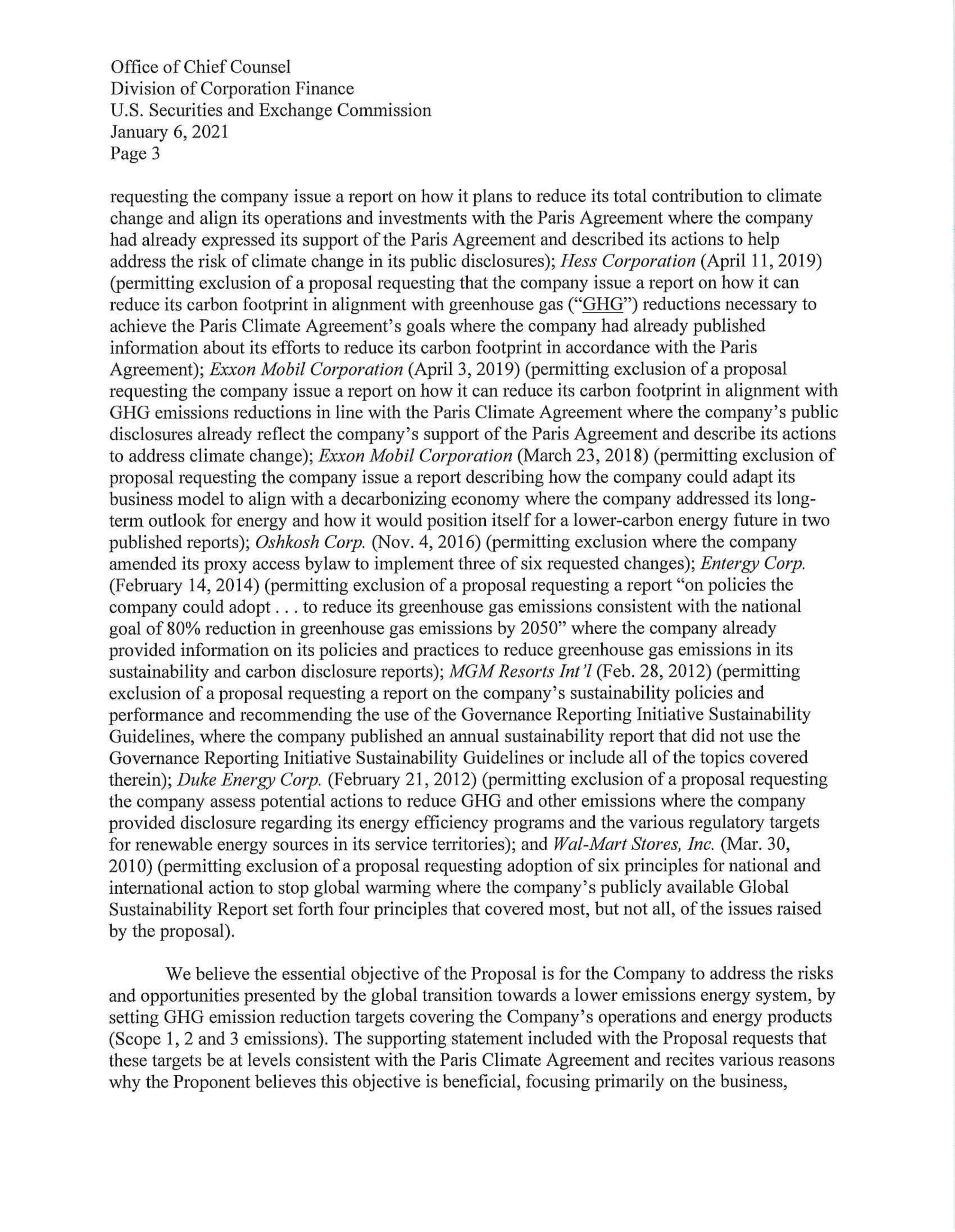
RESOLVED: Shareholders request the company to address the risks and
oppo1tunities presented by the global transition towards a lower emissions
energy system by setting emission reduction targets covering the greenhouse
gas (GHG) emissions
of
the company's operations as well as their energy
products (Scope 1, 2, and 3).
The Proposal was submitted to the Company on November 30, 2020. A copy
of
the
Proposal and all related correspondence with the Proponent is included as Exhibit A to this letter.
II.
Bases
For
Exclusion
As discussed in detail below, the Company believes
it
may properly exclude the Proposal
from the 2021 Proxy Materials pursuant to:
•
Rule 14a-8(i)(10) because the Company has substantially implemented the Proposal
through the Company's publicly disclosed emission targets; and
•
Rule 14a-8(i)(7) because the Proposal seeks to address matters related to the
Company's ordinary business operations by impermissibly micromanaging the
Company.
A.
The Company may exclude the Proposal under Rule 14a-8(i)(10) because the
Company has substantially implemented the Proposal through the
Company's publicly disclosed emission targets.
Rule 14a-8(i)(l 0) permits the exclusion
of
a shareholder proposal
if
the company has already
substantially implemented the proposal. The Commission has stated that "substantial"
implementation does not require implementation in
full
or exactly as presented by the proponent.
See
Exchange Act Release No. 34-40018 (May 21, 1998, n.30). Rather, the
Staff
has consistently
permitted the exclusion
of
a proposal as substantially implemented under Rule 14a-8(i)( 10) when
the Staff has determined that the company's policies, practices and procedures
or
public
disclosures compare favorably with the guidelines
of
the proposal.
See, e.g., Texaco, Inc.
(March
28, 1991) (permitting exclusion
of
a proposal requesting that the company adopt the Valdez
Principles where the company had already adopted policies, practices and procedures regarding
the environment). The
Staff
has also regularly provided no-action relief under Rule 14a-8(i)(10)
when a company has substantially implemented the "essential objective"
of
a proposal, even
if
the company did not take the exact action requested by the proponent, did not implement the
proposal in every detail
or
exercised discretion in dete1mining how to implement the proposal.
See, e.g., Exxon Mobil Co,poration
(March 20, 2020) (permitting exclusion
of
a proposal
Office
of
Chief
Counsel
Division
of
Corporation Finance
U.S. Securities and Exchange Commission
January 6, 2021
Page 3
requesting the company issue a repo1t
on
how
it
plans to reduce its total contribution to climate
change and align its operations and investments with the Paris Agreement where the company
had already expressed its suppo1t
of
the Paris Agreement and described its actions to help
address the risk
of
climate change
in
its public disclosures);
Hess Corporation
(April
11
, 2019)
(permitting exclusion
of
a proposal requesting that the company i
ss
ue
a repo1t
on
how it can
reduce its carbon footprint
in
alignment with greenhouse gas ("GHG") reductions necessaiy
to
achieve
th
e Paris Climate Agreement's goals where the company had already published
information about its effmts to reduce its carbon footprint in accordance with the Paris
Agreement);
Exxon Mobil Cmporation
(April 3, 2019) (permitting exclusion
of
a proposal
requesting the company issue a repo1t
on
how
it
can
reduce its carbon footprint
in
alignment with
GHG
emissions reductions
in
line with the Paris Climate Agreement where the company
's
public
disclosures already reflect the company's support
of
the Paris Agreement and describe its actions
to address climate change);
Exxon Mobil Corporation
(March 23, 2018) (permitting exclusion
of
proposal requesting the company issue a repo1t describing how the company could adapt its
business model to align with a decarbonizing economy where the company addressed its long-
term outlook for energy and how it would position itse
lf
for a lo
wer
-carbon energy future
in
two
published repmts);
Oshkosh Corp.
(Nov. 4, 2016) (permitting exclusion where the company
amended its proxy access bylaw to implement three
of
six requested changes);
Entergy Corp.
(Februaiy 14, 2014) (permitting exclusion
of
a proposal requesting a
repmt
"on
policies the
company could adopt
...
to reduce its greenhouse gas emissions consistent with the national
goal
of
80% reduction in greenhouse gas emissions
by
2050" where the company already
provided information
on
its policies and practices to reduce greenhouse gas
em
issions
in
its
sustainability and carbon disclosure repmts);
MGM
Resorts
Int
'!
(Feb. 28, 2012) (permitting
exclusion
of
a proposal requesting a repo1t on the company's sustainability policies and
performance and recommending the use
of
the Governance Repo1ting Initiative Sustainability
Guidelines, where the company published an annual sustainability repo1t that did
not
use the
Governance Reporting Initiative Sustainability Guidelines
or
include all
of
the topics covered
therein);
Duke Energy Corp.
(February
21
, 2012) (permitting exclusion
of
a proposal requesting
the company assess potential actions to reduce GHG and other emissions where the company
provided disclosure regarding its energy efficiency programs and the various regulatory targets
for renewable energy sources in its service territories); and
Wal-Mart Stores, In
c.
(Mar. 30,
2010) (permitting exclusion
of
a proposal requesting adoption
of
six principles for national and
international action to stop global warming where the company's publicly available Global
Sustainability Repmt set fo1th four principles that covered most, but not all,
of
th
e issues raised
by the proposal).
We believe the essential objective
of
the Proposal is for the Company to address the risks
and opportunities presented by the global transition towards a low
er
emissions energy system, by
setting GHG emission reduction targets covering the Company's operations and energy products
(Scope 1, 2 and 3 emissions). The suppo1ting statement included with the Proposal requests that
these tai·gets be at levels consistent with the Paris Climate Agreement and recites various reasons
why the Proponent believes this objective is beneficial, focusing primarily on the business,
Office
of
Chief
Counsel
Division
of
Corporation Finance
U.S. Securities and Exchange Commission
Januaiy 6, 2021
Page4
financial, legal and market risks that the Company may face in the future as the world seeks to
limit the impact
of
global climate change.
The Company suppo1ts the Paris Climate Agreement and has taken and continues to take
significant action to help address global climate change. In paiticular, the Company has
substantially implemented the Proposal through the Company's existing
GHG
emission intensity
reduction targets. These targets are publicly disclosed
in
the Sustainability section
of
the
Company's website under the heading Emission Reduction Targets and each year
in
the
Company's annual Sustainability
Repo11
.
1
In
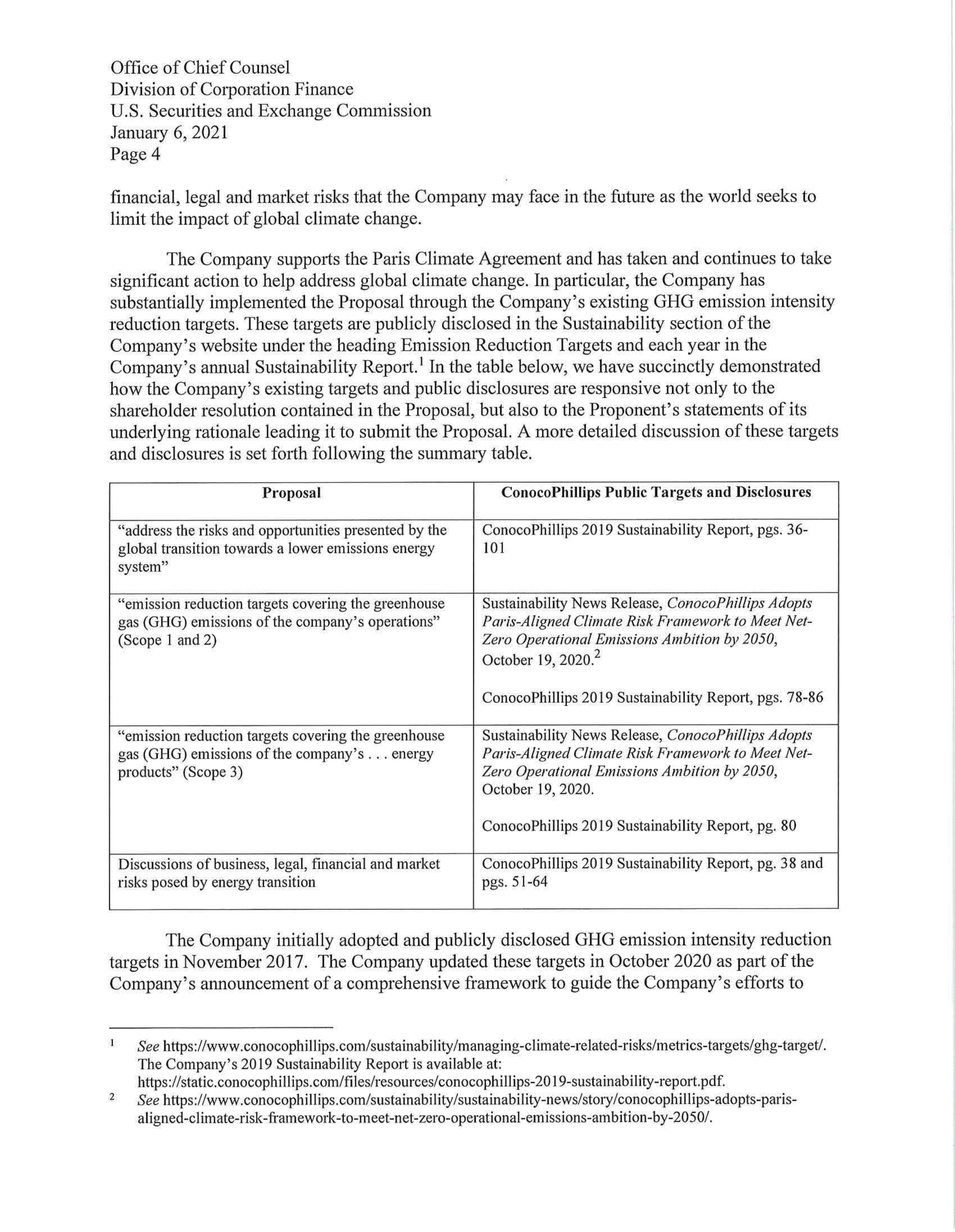
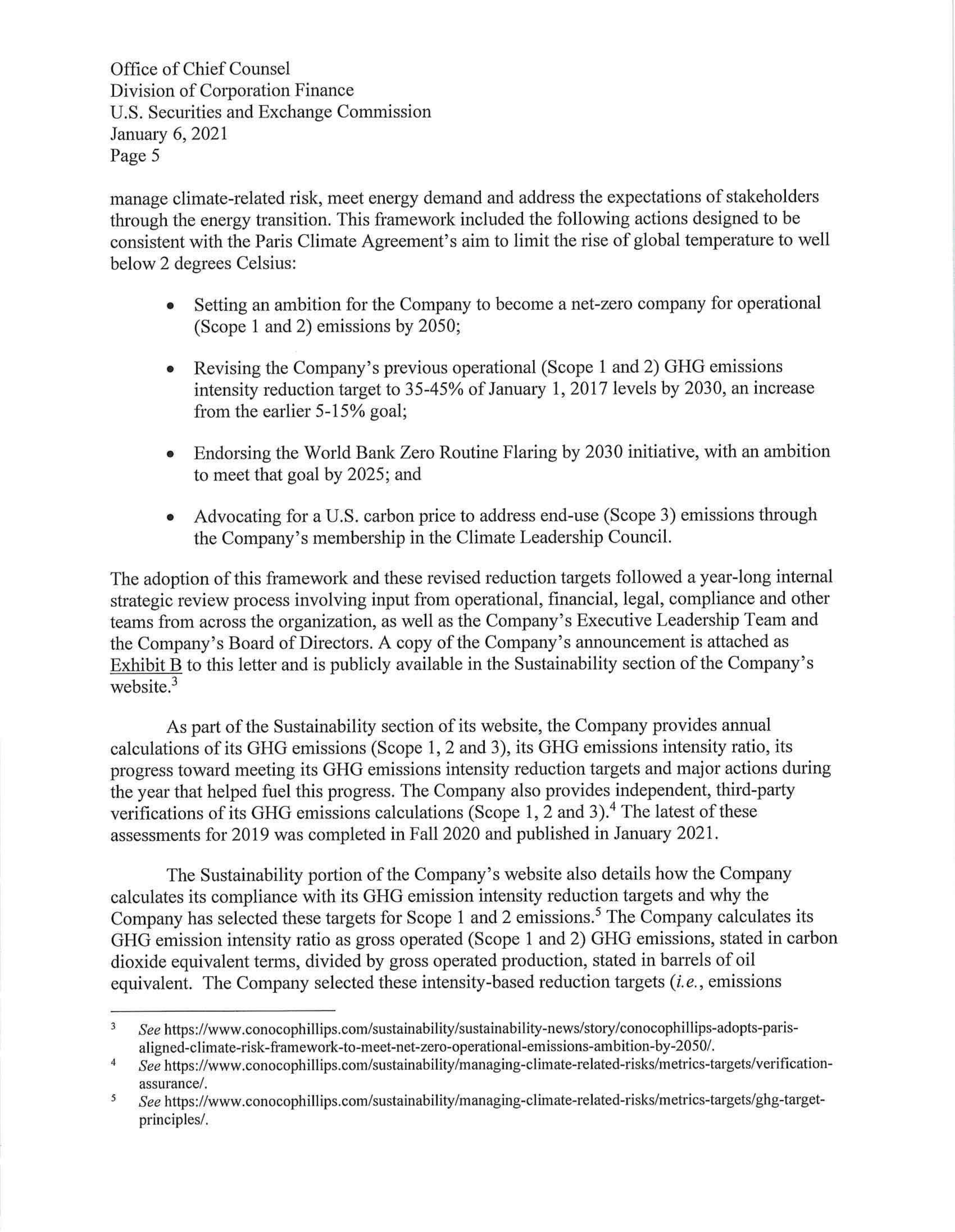
the table below, we have succinctly demonstrated
how
the Company's
ex
isting targets and public disclosures are responsive
not
only to the
shareholder resolution contained
in
th
e Proposal, but also to the Proponent's statements
of
its
underlying rationale leading
it
to submit the Proposal. A more detailed discussion
of
these targets
and disclosures is set fo1th following the summary table.
Proposal
ConocoPhillips Public Targets and Disclosures
"address the risks and opp01tunities presented
by
the
ConocoPhillips
20
19 Susta
in
ability Repo1i, pgs.
36-
global transition towards a low
er
emissions energy
101
system"
"emission reduction targets covering the
gree
nhou
se
Sustainability News Release,
ConocoPhillips Adopts
gas (GHG) emissions
of
the company's operation
s"
Paris-Aligned Climate Risk Framework
to
Meet Net-
(Scope 1 and
2)
Zero Operational Emissions Ambition
by
2050,
October
19,
2020.
2
Co
nocoPhillips 2019 Sustainability Report, pgs. 78-86
"e
mission reduction targets covering the greenhouse
Sustainability News Release,
ConocoPhillips Adopts
gas (GHG) emissions
of
the company's
...
energy
Paris-Aligned Climate Risk Framewo
rk
to Meet Net-
products" (Scope 3)
Zero Operational Emissions Ambition
by
2050,
October 19, 2020.
ConocoPhillips
20
19 Sustainability Report, pg. 80
Discussions
of
business, le
ga
l, financial and market
Co
nocoPhillips
20
19 Sustainability Rep
011,
pg. 3 8 and
risks posed by energy transition
pgs. 5 1-64
The
Company initially adopted and publicly disclosed GHG
em
ission intensity reduction
targets
in
November 2017. The Company updated these targets in October 2020
as
pait
of
th
e
Company's announcement
of
a comprehensive framework to guide the Company's efforts to
See
https://www.conocophillips.com/sustainabi
li
ty/managing-climate-related-risks/metrics-targets/ghg-target/.
The
Company's
2019 Sustainability Report is available at:
http
s:/
/static. conocoph i
11
i ps. com/fi I es/resources/ con ocophillips-2019-sustainab i Ii ty-report. pdf.
See
https://www.conocophi
ll
ips.com/sustainability/sustainability-news/sto1y/conocophillips-adopts-paris-
aligned-climate-risk-framework-to-meet-net-zero-operational-emissions-ambition-by-2050/.
Office
of
Chief
Counsel
Division
of
Corporation Finance
U.S. Securities and Exchange Commission
January 6, 2021
Page 5
manage climate-related risk, meet energy demand and address the expectations
of
stakeholders
through the energy transition. This framework included the following actions designed to
be
consistent with the Paris Climate Agreement's aim to limit the rise
of
global temperature to well
below 2 degrees Celsius:
•
Setting an ambition for the Company to become a net-zero company for operational
(Scope 1 and 2) emissions by 2050;
•
Revising the Company's previous operational (Scope 1 and 2)
GHG
emissions
intensity reduction target to 35-45%
of
January 1, 2017 levels by 2030, an increase
from the earlier 5-15% goal;
•
Endorsing the World Bank Zero Routine Flaring by 2030 initiative, with
an
ambition
to meet that goal by 2025; and
•
Advocating for a U.S. carbon price to address end-use (Scope 3) emissions through
the Company's membership
in
the Climate Leadership Council.
The adoption
of
this framework and these revised reduction targets followed a year-long internal
strategic review process involving input from operational, financial, legal, compliance and other
teams from across the organization, as well as the Company's Executive Leadership Team and
the Company's Board
of
Directors. A copy
of
the Company's announcement is attached as
Exhibit B to this letter and is publicly available in the Sustainability section
of
the Company's
website.
3
As
part
of
the Sustainability section
of
its website, the Company provides annual
calculations
of
its
GHG
emissions (Scope
1,
2 and 3), its GHG emissions intensity ratio, its
progress toward meeting its GHG emissions intensity reduction targets and major actions during
the year that helped fuel this progress. The Company also provides independent, third-patty
verifications
of
its
GHG
emissions calculations (Scope 1, 2 and 3).
4
The latest
of
these
assessments for 2019
was
completed in Fall 2020 and published
in
January 2021.
The Sustainability portion
of
the Company's website also details how the Company
calculates its compliance with its
GHG
emission intensity reduction targets and why the
Company has selected these targets for Scope 1 and 2 emissions.
5
The Company calculates its
GHG emission intensity ratio as gross operated (Scope 1 and 2) GHG emissions, stated in carbon
dioxide equivalent terms, divided by gross operated production, stated in ban-els
of
oil
equivalent. The Company selected these intensity-based reduction targets
(i.e.,
emissions
See
https://www.conocophillips.com/sustainability/sustainability-news/story/conocophillips-adopts
-p
aris-
aligned-climate-risk-framework-to-meet-net-zero-operational-emissions-ambition-by-2050/.
See
https://www.conocophillips.com/sustainability/managing-climate-related-risks/metrics-targets/verification-
assurance/.
See
https
:/
/www.
conocophi
11
i ps. com/sustainability /managing-climate-related-risks/metrics-targets/ ghg-tar
get
-
princi p les/.
Office
of
Chief
Counsel
Division
of
Corporation Finance
U.S. Securities and Exchange Commission
January 6, 2021
Page6
relative to production) rather than absolute emissions reduction targets based
on
the
dynamic
business environment in which the Company operates. The Company often accelerates
or
defers
projects, and regularly buys, sells
or
swaps potential oil and gas developments. Adopting
an
absolute target rather than an intensity-based target could force these decisions to be made based
primarily
on
emissions, omitting consideration
of
a multitude
of
other factors, such as safety,
operations, and infrastructure. For example, any absolute target the Company adopted could
be
rendered meaningless through the disposition
of
a large asset without the Company taking any
action with regard to the efficiency
of
its remaining assets. Likewise, the acquisition
of
a large
asset could render achievement
of
an
absolute emissions reduction target impossible
notwithstanding other work the Company does to lower its emissions.
The
adoption
of
an
intensity reduction target allows the Company to withstand any asset changes and provides an
incentive to reduce emissions across all
of
the Company's assets. Beyond its intensity-based
reduction targets, the Company's announced ambition to become a net-zero company for
operational (Scope 1 and 2) emissions by 2050 is a longer-term absolute
GHG
net-emissions
reduction target.
The
Company's announced
GHG
emissions intensity reduction targets and advocacy for
a U.S. carbon price, and even the goal
of
consistency with the Paris Climate Agreement's aim to
limit the rise
of
global temperature to well below 2 degrees Celsius, directly address the
Proposal's essential objective. These actions show the Company's commitment to addressing the
risks and oppo1tunities presented
by
the global transition towards a lower emissions energy
system. With the exception
of
the treatment
of
Scope 3 emissions, these actions even align with
the Proposal's preference for addressing these risks and opportunities through GHG emissions
reduction targets rather than through other means.
With regard to Scope 3 emissions, which refers to emissions from sources that are neither
owned nor controlled by the Company,
the
Company determined to advocate for a U.S. carbon
price (or tax) rather than setting a similar GHG reduction target.
For
oil and natural gas
exploration and production companies, Scope 3 emissions
pr
imarily relate
to
the use
of
the
energy products sold. The Company differs from integrated energy companies that have set
Scope 3 emission reduction aspirations
in
that the Company does
not
produce "energy products."
Instead, the Company produces crude oil and natural gas, both
of
which require fmther
processing before becoming energy products.
The
Company does not control the products its
crude oil is transformed into, nor
how
those products are made, marketed and used. In addition,
the
Company's
Scope 3 emissions are someone
else's
Scope
1
or 2 emissions, resulting
in
substantial double counting throughout the economy.
6
As
a result, the Company believes that the
best way to address Scope 3 emission reductions is through constructive climate policy
6
For
example, the Company's Scope 3 emissions from refining oil are a refiner's Scope 1 emissions. The
combustion
of
that oil
in
the fotm
ofa
fmished product such
as
gasoline are Scope 3
em
issions for the
Company, the refiner and the marketer. Further, the Company's Scope 3 combustion emissions for natural
gas
might
be
an electricity producer's Scope 1 emissions and might also be the Company's Scope 2 emissions
relating to purchased power used
in
the
Company's
operations.
Office
of
Chief
Counsel
Division
of
Corporation Finance
U.S. Securities and
Exchange
Commission
January
6,
2021
Page 7
advocacy. Nonetheless,
the
Company does calculate and publicly disclose its Scope 3 emissions
annually based
on
net
equity production numbers.
7
While the Proponent requests
the
Company to set
GHG
emission reduction targets
on
Scope
3 emissions, which
the
Company
has
not
set, substantial implementation does
not
require
implementation
in
full
or
exactly as presented
by
the
Proposal. Rather,
the
Company's
pub
lic
disclosures and deliberative process
make
clear that it has
(1)
carefully evaluated
the
use
of
emissions reduction targets
on
its Scope 1, 2 and 3 emissions, (2) set reduction targets with
regard to
Scope
1 and 2
GHG
em
issions intensity and (3)
chosen
to address
the
risks and
oppmiunities presented through
the
energy transition
with
regard
to
Scope 3
em
issions by
advocating for a U.S.
carbon
price.
The
Company set its overall
GHG
emissions reduction strategy
for
three reasons, which
mirror several
of
the categories
of
risks driving the
Proponent's
desire to see the Proposal
implemented:
•
To
demonstrate
that
the Company is continuing to take
GHG
emissions reductions
seriously and managing climate-related risks
and
issues throughout
the
business;
•
To
suppmi
internal decision-making so
that
the
Company's
businesses
can
build
GHG
regulatory
risk
into planning as early as possible
in
the
approval processes; and
•
To
ensure that
the
Company has the appropriate risk
management
discussions
regarding climate-related issues as
the
Company goes
through
the life-cycle
of
its
assets.
Fmiher,
the
Company's
annual Sustainability
Repo11
aligns
with
the
recommendations
of
the
Task
Force
on
climate-related Financial Disclosure and provides extensive and
in
depth
commentary
on
(1)
the
Company's
governance framework for
managing
climate-related risks,
8
(2)
how
climate risks
impact
the
Company's
strategic decision
making
process, including related
scenario analysis
to
reduce
the
risk
of
stranded assets and
carbon
pricing legislation,
9
and (3)
how
the Company assesses
and
manages climate related risks.
10
These
disclosures and
considerations all directly address
the
risks
on
which the Proposal is based, showing
that
the
essential objective
of
the Proposal
has
been
well considered
and
addressed through the
Company's
existing policies.
As
a result, by adopting
the
GHG
emissions reduction strategy discussed above to
address the risks presented by
the
world's
efforts to reduce
the
impact
of
global climate change,
and through its extensive public disclosures,
the
Company has substantially implemented
the
1
See
https:/ /www. conocoph i
11
ips.
com/sustainab i I ity /managing-c I imate-related-risks/metri cs-targets/ ghg-
emiss ions/.
8
See
ConocoPhillips 2019 Sustainability Repmt, pgs. 40-45.
9
See
ConocoPhillips 2019 Sustainability Repmt, pgs. 50-55.
10
See
ConocoPhillips 2019 Sustainability Report, pgs. 56-71.
Office
of
Chief
Counsel
Division
of
Corporation Finance
U.S. Securities and Exchange Commission
January 6, 2021
Page 8
essential objective
of
the Proposal.
As
a result, the Company may properly exclude the Proposal
pursuant to Rule 14a-8(i)(10).
B.
The Company may exclude the Proposal under Rule 14a-8(i)(7) because the
Proposal seeks to address matters related
to
the Company's ordinary
business operations by impermissibly micromanaging the Company.
Rule 14a-8(i)(7) permits a company to
omit
from its proxy materials a shareholder
proposal that relates to the company's "ordinary business operations." The Commission has
stated that the policy underlying the ordinary business operation exclusion is
"to
confine the
resolution
of
ordinary business problems to management and the board
of
directors, since
it
is
impracticable for shareholders to decide
how
to solve such problems at an annual shareholders
meeting." Exchange Act Release No. 34-40018 (May 21, 1998). The Commission further
articulated two central considerations for dete1mining the application
of
the ordinary business
operation exclusion. The first is that certain tasks are "so fundamental to management's ability to
run a company on a day-to-day basis that they could not, as a practical matter, be subject to
direct shareholder oversight."
Id.
The second consideration relates to "the degree to which the
proposal seeks to 'micro-manage' the company by probing too deeply into matters
of
a complex
nature upon which shareholders, as a group, wou
ld
not
be
in
a position to make an informed
judgment."
Id.
(footnote omitted). While the first consideration is based
on
the subject matter
of
the proposal, the second looks only to the degree to which the proposal micromanages the
company. Staff Legal Bulletin No. 14J (October 23, 2018). As a result, a proposal that is not
excludable under the first consideration may still
be
excludable solely based
on
the second.
Id.
In
Staff
Legal Bulletin
No
. 14K (October 16, 2019) ("Staff Legal Bulletin 14K
"),
the
Staff stated that, in evaluating arguments under the micromanagement prong
of
Rule 14a-8(i)(7),
it
conducts
an
assessment
of
the level
of
"prescriptiveness"
of
the proposal:
"[I]f
the method or strategy for implementing the action requested by the
proposal is overly prescriptive, thereby potentially limiting the judgment and
discretion
of
the board and management, the proposal may be viewed
as
micromanaging the company
...
When a proposal prescribes specific actions
that the company's management
or
the board must unde1take without
affording them sufficient flexibility
or
discretion in addressing the complex
matter presented by the proposal, the proposal may micromanage the
company to such a degree that exclusion
of
the proposal would
be
warranted."
Fmther, when analyzing the underlying concern
or
central purpose
of
a proposal, the Staff stated
that
it
looks to the entirety
of
the proposal, including assertions
in
the supp01ting statement that
modify or refocus the intent
of
the proposal.
Id.
The evaluation
of
the manner in which the proposal seeks to address the subject matter
raised, rather than the subject matter itself, is critical to the analysis
of
whether the proposal
micromanages the company. For this reason, the Staff has repeatedly allowed exclusion under
Office
of
Chief Counsel
Division
of
Corporation Finance
U.S. Securities and Exchange Commission
January 6, 2021
Page 9
Rule 14a-8(i)(7)
of
proposals touching
on
significant policy issues where the proposals se
ek
to
micromanage the company by specifying the manner in which the company should address the
policy issue.
See, e.g., Exxon Mobil Corporation
(March 6, 2020) (proposal requesting adoption
of
a specified pricing structure to reduce carbon dioxide production);
Exxon Mobil Corporation
(March 6, 2020) (proposal requesting establishment
of
board committee to oversee climate risk);
Exxon Mobil Corporation
(April 2, 2019) (proposal requesting disclosure
of
GHG
emissions
targets in line with Paris Climate Agreement goals);
The Goldman Sachs Group, Inc.
(March 12,
2019) (proposal requesting adoption
of
a policy to reduce the carbon footprint
of
the company's
loan and investment p01tfolios
in
alignment with the Paris Climate Agreement);
Wells Fargo
&
Company
(March 5, 2019) (same);
Devon Energy Co,poration
(March 4, 2019,
recon. denied
April 1, 2019) (proposal requesting a report
of
sho1t-, medium- and long-term GHG targets
aligned with the Paris Climate Agreement);
Verizon Communications Inc.
(March 6, 2018)
(proposal requesting a rep01t evaluating potential to achieve net-zero GHG emissions by a fixed
date);
EOG
Resources, Inc.
(Februaiy 26, 2018,
recon. denied
March 12, 2018) (proposal
requesting adoption
of
company-wide, quantitative, time-bound GHG emissions reduction
targets excludable despite company's acknowledgment that environmental sustainability and
climate change are significant policy issues); and
Apple Inc.
(December 21, 2017) (proposal
requesting a repo1t evaluating potential to achieve net-zero
GHG
emissions by a fixed date
excludable despite company's acknowledgment that reduction
of
GHG
emissions is a significant
policy issue).
In
Staff Legal Bulletin 14 K, the Staff discussed a pair
of
recent no-action letters decided
under the micromanagement portion
of
Rule 14a-8(i)(7) with regard
to
proposals requesting
repo1ts
on
the adoption
of
GHG
emissions reduction tai·gets based
on
the levels
of
prescriptiveness
of
each proposal.
In
Devon Energy Corporation (March 4, 2019,
recon. denied
April 1, 2019), the Staff permitted exclusion
of
a proposal seeking sho1t-, medium-
and long-
term GHG targets aligned with the Paris Climate Agreement based
on
micromanagement. This
decision was made because the proposal "prescrib[ ed] the method for addressing reduction
of
greenhouse gas emissions]" by requiring adoption
of
"time-bound targets" and "changes in
operations to meet those goals." Staff Legal Bulletin
14
K.
By
contrast, the
Staff
refused to
provide no-action relief
in
Anadarko Petroleum Corp. (Mai·. 4, 2019), where a proposal
requesting a report
on
if, and how, the company planned to address climate change and align
operations with the Paris Climate Agreement did not micromanage the company because
it
"deferred to management's discretion" how and whether to address the company's carbon
footprint. Staff Legal Bulletin 14K.
In this instance, the Proposal focuses on company-wide, rigid, quantitative reduction
targets that would impermissibly interfere with complex operating decisions and would
micromanage the Company's response to an impo1tant policy issue. The Proposal is prescriptive
in
its stated goal -
requesting the Company to adopt GHG emission reduction targets covering
the Company's operations and energy products (Scope 1, 2 and 3 emissions).
11
The suppo1ting
11
To the extent the Proposal deals more generally with the Company's efforts "to address the risks and
opp01tunities presented by the global transition towards a lower emissions energy system," including through
Office
of
Chief
Counsel
Division
of
Corporation Finance
U.S. Securities and Exchange Commission
January 6, 2021
Page 10
statement included as
part
of
the Proposal clarifies this goal
in
several important and restrictive
ways:
•
Focusing
on
reducing emissions from energy products (Scope 3 emissions) as
essential to
(1)
achieving the aims
of
the Paris Climate Agreement, (2) obtaining a
global net-zero emission energy system and (3) pursuing effmts to limit global
waiming to
1.5
degrees Celsius;
•
Clarifying that "absolute" Scope 3 emissions,
in
paiticular, must be limited to
obtain the goals listed above;
•
Asking that the target levels set consistent with the Paris Climate Agreement,
which implies both levels
of
reduction and timelines for these reductions to be
effective; and
•
Implying that diversification into renewable energy is the method for obtaining
the ends sought
by
the Proposal.
The Company's GHG emissions and the emissions resulting from use
of
its products
result from the Company's highly complex operations and changes in those operations over time.
These operations occur throughout the world at a significant number
of
prope1ties and locations;
similarly, the Company's products are sold throughout the world. These complex operations
require the Company's management to manage countless factors
on
a day-to-day basis,
including:
•
specific management decisions regarding existing projects around the world;
•
expansions and enhancements to those projects as well as the development
of
similai·
new
such projects to offset the natural decline
of
oil and gas fields and to
grow the Company's businesses;
•
anticipated customer demand and
how
best to succeed
in
highly competitive
global mai·kets;
•
the pmtfolio
of
investment oppo11unities available to the Company that would
provide attractive returns to shareholders;
•
how
best to manage
GHG
emissions from these operations
as
well as the wide
variety
of
operational and other risks inherent
in
many
of
the Company's
businesses;
setting emission reduction targets other than "absolute" emission reduction targets,
we
submit that the Proposal
has been substantially implemented as discussed previously.
Office
of
Chief
Counsel
Division
of
Corporation Finance
U.S. Securities and Exchange Commission
Januaiy 6, 2021
Page
11
•
how
best to comply with complex and evolving legal and environmental
requirements that vary widely across the many jurisdictions
in
which the
Company, either directly or through affiliated entities, conducts business; and
•
many other technical and management considerations.
Developing GHG emission reduction targets, even with respect to operations over which
the Company exercises control (Scope
1
and 2 emissions), requires complex decisions to be
made
by
experts and management, taking into account among other things analyses and
projections regarding the Company's
cunent
and future operations; anticipated technological,
economic and geopolitical developments; anticipated changes in government regulation; and
projected changes in the amount and mix
of
global energy and petroleum product requirements.
However, the Proposal takes the specific, detailed decision-making surrounding whether to adopt
targets, at what levels and
in
what timeframes
out
of
the hands
of
management.
The
Company's
recent update
of
its climate risk strategy in October 2020 was the product
of
a year-long process
with touch points through the organization, including:
•
Input throughout
the
year by the Company's operational divisions, the Company's
Sustainable Development Leadership Team and
p011ions
of
the Company's
Executive Leadership Team;
•
Review and approval by the Company's full Executive Leadership Team;
•
Review and approval by the Public Policy Committee
of
the Board
of
Directors
in
July 2020; and
•
A discussion with members
of
the
Board
of
Directors
in
September 2020, with
review
by
the full Board
of
Directors
in
October 2020
in
connection with the
Board's annual review
of
the Company's overall strategy.
The Proponent even implicitly acknowledges the complexity
of
this process and the substantial
number
of
concerns which must
be
simultaneously addressed by setting an emission reduction
target, noting
at
various points
in
the suppo11ing statement that actions by oil and gas companies
with
regard
to
climate change involve balancing government regulations, threat
of
litigation,
competition from renewable energy competitors, and various financial and market risks such as
commodity price movement and costs from stranded assets. This acknowledgement only goes to
show
how
the imposition
of
GHG emission reduction targets, paiticularly those required to
be
in
alignment with the quantities and timeframes
of
the Paris Climate Agreement, micromanages an
oil and gas exploration and production company such
as
the Company
to
an
impermissible
degree.
The
Proponent simply intends to substih1te its weighing
of
these factors for those
of
the
Company's management and Board
of
Directors.
While the Company ultimately adopted its Scope
1
and 2 emissions reduction targets
in
a
manner substantially as contemplated by the Proponent, it does not prevent
the
Proposal from
Office
of
Chief
Counsel
Division
of
Corporation Finance
U.S. Securities and Exchange Commission
January 6, 2021
Page 12
impennissibly micromanaging the Company's operations.
In
paiticular, after weighing all
relevant factors as part
of
its year-long review process, the Company determined that a reduction
target for Scope 3 emissions was
not
the best approach for the Company. Instead, the Company
proposed and suppo1ts a U.S. carbon tax to ensure reduction
of
these Scope 3 emissions for the
various reasons discussed above. The complexities associated with the Company's Scope 3
emissions are even greater than those addressed through the Company's Scope
1
and 2 emissions
because the Company does not control its Scope 3 emissions in a direct manner. All
of
these
complexities in the decision making are swept aside by the Proposal
's
cursory requirement
of
a
Scope 3 emissions reduction target. As a result, this Scope 3 emission reduction target
micromanages the Company to a far greater degree than the remainder
of
the Proposal, and
certainly far more than proposals the Staff has permitted to
be
excluded
on
the basis
of
micromanagement for requiring the establishment
of
emissions targets.
See, e.g.,
TJX
Companies, Inc.
(March 3, 2017) (permitting exclusion
of
a proposal requesting a report
on
th
e
company ability to achieve
"net
-zero" GHG emissions from
th
e company's business and
operations, without requiring emissions associated with the company
's
products be considered).
For these reasons, the Proposal seeks to micromanage the operations
of
the Company to
an impe1missible extent, and the Company may properly exclude the Proposal pursuant to Rule
14a-8(i)(7).
III.
Conclusion
Based
on
the forego
in
g, the Company respectfully requests the Staff concur that the
Company may exclude the Proposal from the 2021 Proxy Materials. Should the Staff disagree
with the conclusions
in
this letter, or should any additional information be desired in suppmt
of
the Company's position, we would appreciate the opportunity to confer with the Staff concerning
these matters prior to the issuance
of
the
Staffs
response.
Please do not hesitate to contact me at (281) 293-2623
if
you require any additional
information relating to this matter.
Enclosures
cc:
Mark van Baal, Founder-Director
McKenzie Ursch, Legal Advisor
(Follow This)
Sincerely,
Shannon B. Kinney


Office
of
Chief Counsel
Division
of
Corporation Finance
U.S. Securities and Exchange Commission
Januaiy 6, 2021
Exhibit A
Proposal and Related Correspondence
Haghpeykar,
Lois
M.
(LDZX)
From:
Sent:
To:
Cc:
Subject:
Attachments:
Dear Shannon,
Mark van
Baal
I
Follow This
Monday, November
30,
2020 8:18
AM
Kinney, Shannon B
(LDZX)
Rose,
Kelly B
(LDZX
);
Cox
, Whitney A
(LDZX);
Mclane, Charlotte G
(LDZX)
; McKenzie
Ursch; maartenvandeweijer@follow-this.org; Betsy
Middleton
[EXTERNAL]Shareholder proposal
for
2021
annual meeting
ConocoPhillips_ -_Cover _letter_signed.pdf; Climate_ Targets_Resolution_2021
_ ConocoPhillips_signed.pdf; Binck_ -_Proof_of_ownership_ -_ ConocoPhillips_signed.pdf;
ConocoPhillips_ -_ Cover _letter _signing_log.pdf; Climate_ Targets_Resolution_2021
_ConocoPhillips_signing_log.pdf;
Binck_ -_Proof_of_ownership_ -_ ConocoPhillips_signing_log.pdf
!
I
••
JI
I,.
We hope this email finds
you
well.
Please find attached a proposal intended
for
inclusion in
the
proxy materials
of
the
2021 AGM. Included
with
the
resolution
is
a cover
letter,
as
well
as
proof
of
ownership.
We
have also attached
the
signing logs
wh
ich verify
the
digital
signatures.
If
you
have any questions,
or
would
like
to
discuss
the
proposal, please
do
not
hesitate
to
contact
us.
We welcome
your
feedback.
We
look forward
to
hearing
from
you.
For today, could you kindly confirm receipt?
With
best regards,
Mark
van
Baal
I
Follow This
I
+ 31 6 22 42 45 42
McKenzie Ursch, legal advisor Follow This
I
+3164016
26 72
1
30
November 2020
Ms. Shannon Kinney
Corporate Secretary
925 N. Eldridge Parkway
Houston, Texas 77079
Re: Shareholder proposal for 2021 annual meeting
Dear Ms. Kinney,
On
behalf
of
Follow This, we submit the enclosed shareowner proposal for inclusion in the proxy
statement that ConocoPhillips plans to circulate to shareowners in anticipation
of
the
2021 annual
meeting. The proposal
is
being submitted in accordance with
SEC
Rule
I
4a-8 and relates to their climate
change policies.
Follow This is located at Anthony Fokkerweg I, 1059
CM
Amsterdam,
The
Netherlands. They have
beneficially owned more than $2,000 worth
of
ConocoPhillips common stock for over one year, and
intend to continue ownership
of
these shares through
the
date
of
the 2021 annual meeting, which a
representative is prepared to attend.
In additi
on
to the proposal, a letter from BinckBank, the record holder, confirming the aforementioned
ownership, has been included with this letter.
We
would be pleased to discuss the issues presented by this proposal with you.
If
you require any
additional information, please advise.
Sincerely,
Mark
Van
Baal
Founder-Director Follow This
McKenzie
Ursch
Legal
Advisor
Follow This
Resolution
at
2021
AGM
of
ConocoPhillips
("the
company")
Filed
by
Follow
This
WHEREAS:
In the
coming
decades,
the
world will
reduce greenhouse
gas (GHG)
emissions
to
curb
climate
change. Companies that
fail
to reduce overall emissions will
incur
substantial financial risks,
especially fossil fuel
companies.
RESOLVED: Shareholders request the company
to
address the risks
and
opportunities presented by
the
global transition towards a lower emissions
energy
system by setting emission
reduction
targets
covering the greenhouse gas (GHG) emissions
of
the company's operations as well as their
energy
products
(Scope 1,
2,
and
3).
SUPPORTING STATEMENT:
As responsible shareholders
we
perceive the increasing business risks to
companies
in
the fossil fuel exploration and production sector. Fossil fuel companies are increasingly subject to
GHG emission regulations, face climate change litigation, and encounter new competitors in the energy transition
from fossil fuels to renewable energy. Meanwhile, the energy transition also provides great opportunities.
Companies that are willing and able to engage in innovations and reforms are likely to survive and thrive.
We, the shareholders, therefore support ConocoPhilips in setting emissions reduction targets for all emissions
(Scope 1, 2, and 3), the most simple and least prescriptive way to
add
ress these risks and opportunities.
The global political pledge to curb climate change, the resulting future regulations for the fossil fuel industry to
reduce their overall emissions, and the decreasing costs
of
renewable energy add to the risk that capital
expenditures in fossil fuel projects will become stranded assets. Furthermore, fossil fuel companies are
increasingly sued for their role in the climate crisis: not only for their Scope 1 and 2 emissions but also for their
Scope 3 emissions.
Reducing absolute emissions from the use
of
energy products (Scope 3) is essential to achievi
ng
the goal of the
Paris Climate Agreement to limit global warming to well below 2°c above pre-industrial levels,
to
aim for a global
net-zero-emission energy system, and to pursue efforts to limit the temperature increase to 1.5°
C.
Backing from investors that insist on Paris-consistent targets for all emissions (Scope 1, 2, and 3) continues to
gain momentum; in Europe, in 2020,
an
unprecedented number of shareholders voted for climate targets
resolutions.
The company's financial results currently greatly depend on the price of oil. Diversification in renewable energy
is an increasingly viable opportunity to decrease risks.
Taking the above points into consideration, we encourage you to set targets that are inspirational for society,
employees, shareholders, and the energy sector, allowing the company to meet an increasing demand for energy
while reducing GHG emissions to levels consistent with the global intergovernmental consensus specified by the
Paris Climate Agreement.
You have our support.
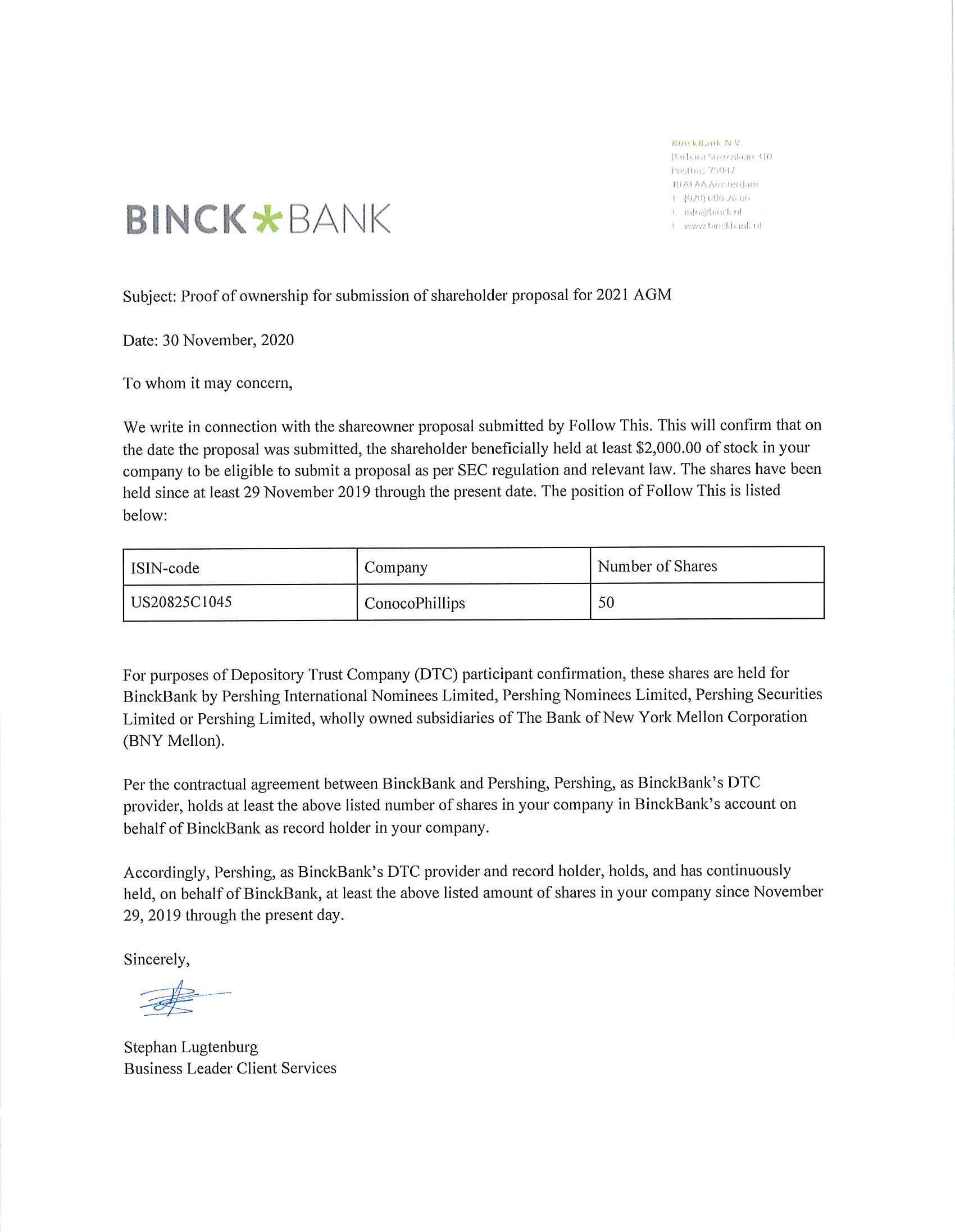
BINCK*
BANK
l'I
Ill
t.
PO
I/
l!l/d/1/1/111
•
t,•111,1111
I tt//!))11
1
.111
/\
\)II
Subject:
Proof
of
ownership for submission
of
shareholder proposal for 2021 AGM
Date: 30 November, 2020
To
whom it may concern,
We write in connection with the shareowner proposal submitted
by
Follow This. This will confirm that
on
the date the proposal
was
submitted, the shareholder beneficially held
at
least $2,000.00
of
stock
in
your
company
to
be
eligible to submit a proposal as per SEC regulation and relevant law. The shares
ha
ve been
held since
at
least
29
November 2019 through the present date.
The
position
of
Follow This is listed
below:
I SIN-code
Company
Number
of
Shares
US20825C I 045
ConocoPhillips
50
For
purposes
of
Depository Trust Company (OTC) participant confirmation, these shares are held for
BinckBank by Pershing International Nominees Limited, Pershing Nominees Limited, Pershing Securities
Limited
or
Pershing Limited, wholly owned subsidiaries
of
The
Bank
of
New
York Mellon
Co
rporation
(BNY Mellon).
Per the contractual agreement between BinckBank and Pershing, Pershing, as BinckBank's
OTC
provider, holds
at
lea
st
the
above listed number
of
shares in
your
company
in
BinckBank's account
on
behalf
ofBinckBank
as
record holder in your company.
Accordingly, Pershing, as BinckBank's OTC provider and record holder, holds, and has continuously
held,
on
behalf
ofBinckBank,
at
least the above listed amount
of
shares
in
your company sin
ce
November
29, 2019 through the present day.
Sincerely,
Stephan Lugtenburg
Business Leader Client Services
~
SignRequest
Document ID:
9VY722J2
info@follow-this.org
Document name:
Sent on:
From:
To:
Subject:
Message:
Please sign
th
is
document.
Kind regards,
i
nfo
@fol
low
-this.org
IP address:
User agent:
info@follow
-t
his.org
Email address verification:
markvanbaal@follow-this.org
Ema
il address verification:
Text added, page
1:
Signat
ur
e added, page 1:
IP address:
U
se
r agent:
Docume
nt
signed:
mckenzieursch@follow-this.org
Email address verification:
Text added, page 1:
Signing
Log
ConocoPhillips - Cover l
etter
SHA256 secu
rity
hash:
7c18255365480433f4f4b0d09ac6fbb209c283a0ba133be 76942317817321 e59
Nov. 30, 2020, 1 :52 p.m. (
UTC
)
Sign Request
on
beha
lf
of
(info@follow-this.org)
markvanbaal@follow-this.org, mckenz
ieur
sch@follow-this.org
info@follow-this.org has sent
you
a SignRequest
87.
214.1
17.142
Mozilla/5.0 (Macintosh; I
ntel
Mac
OS
X 1
O_
14_6) AppleWebKi
t/
537.36 (KHTML, like Gecko) Chrome/87.0.4280.67 Safari/
537
.36
Ve
rified
by
SignRequest
Verified
by
Sign
Req
uest
Mar
k Van
Baa
l
Founder-Director
Fo
llow This
83.219,72.138
Mozilla/5.0 (Macintosh;
Intel
Mac
OS
X 1
O_
13_6) AppleWebK
it
/
605.
1.1
5 (KHTML, like Gecko) Version/13.1.2 Safari/605.1.15
Nov. 30, 2020, 1 :54 p.m. (
UTC)
Ve
rified by SignRequest
McKenzie Ursch
Legal Advisor
Fo
llow This
Page 1/2
G
SignRequest
Signature added, page 1:
IP address:
User agent:
Document
signed:
Signing
Log
87.214.117.142
Mozilla/5,0 (Macintosh;
Intel
Mac
OS
X 1
O_
14
_6)
AppleWebKit/
537.36 (KHTML, like Gecko) Chrome/87.0.4280.67 Safari/
537.36
Nov. 30, 2020, 1 :54 p.m.
(UTC)
Page
2/2
~
SignRequest
Document ID: WYR7145Y
info@follow-this.org
Document nam
e:
Sen
t
on
:
From:
To:
Subject:
Message:
Please sign this document.
Kind regards,
info
@
fo
llow-
th
is.org
IP a
ddr
ess:
User agent:
info@follow-this.org
Email address verification:
markvanbaal@follow-this.org
Email address ve
rifi
cation:
Signa
tur
e added, page
1:
IP
add
ress:
User agent
Document signed:
Signing
Log
C
limat
e Targets Resolution
2021
Con
ocoP
hi
llip
s.pdf
SHA256 sec
urit
y hash:
0075 f
aef
a c24b37f 1886e 70713d44899c1 0eaSb 7 a66ccf c4c4433 f22272a46c9
Nov. 30, 2020, 2:04 p.m.
(U
T
C)
Sign
Req
uest on behalf
of
(info@follow-this.or
g)
markvanbaal@follow-this.org
info
@follow-this.org has sent
you
a Sign Request
87.2
14
.117.142
Mozilla/5.0 (Macin
tos
h;
Intel
Mac
OS
X 1
O_
14
_6)
AppleWebKit/
537.36
(K
HTML, like Gecko) Chrome/87.0.4280.67
Sa
f
ari/
537.36
Verified
by
SignRequest
Verified
by
Sig
n
Req
uest
83.219.72.138
Mozilla/5.0 (Maci
nt
os
h;
Intel
Mac
OS
X 1
O_
1
3_6)
AppleWebKit/
605
.1.1
5 (KHTML, like Gecko) Version/13.1.2 Safari/605.1.15
Nov. 30, 2020, 2:05 p.m.
(UTC)
Page 1/1
~
SignRequest
Document ID:
W6JLQXZ2
info@follow-this.org
Document name:
Sent
on:
From:
To
:
Subject:
Message:
Please sign this document.
Kind regards,
info@follow-
th
is.org
IP address:
User agent:
info@follow-this.org
Email address verification:
slugtenburg@binck.nl
Email address verification:
Sign
ature
added, page
1:
IP address:
U
se
r agent:
Document signed:
Signing
Log
Binck -
Proof
of
ow
ner
ship
-
ConocoPhillip
s.
pdf
S
HA
256 security hash:
Sad0b941 b8e56fdae61 e2012a6d64112d277d921 b54f3e61087d1 feca9483f61
Nov. 30, 2020, 1:25 p.m.
(UTC)
SignRequest
on
behalf
of
(info@follow-this.org)
slugtenburg@binck.nl
info@follow-this
.or
g has
se
nt
yo
u a Sign Request
87.214.
11
7.142
Mozilla/5.0 (Macintosh;
Intel
Mac
OS
X 1
O_
14
_6)
AppleWebKit/
537.36
(K
HTML, like Gecko) Chrome/87.0.4280.67 Safari/
537.36
Verified by Sign Request
Verified
by
Sign Request
185.16.141.5
Mozilla/5.0
(W
indows NT 10.0; Win64; x64) AppleWebKit/
537.36 (KHTM
L,
like Gecko) Chrome/70.0.3538.102 Safa
ri
/
537.36 Edge/18.18363
Nov. 30, 2020, 1:33 p.m.
(UTC)
Page 1/1
Haghpeylcar,
Lois
M.
(LDZX)
From:
Sent:
To
:
Cc:
Subject:
Attachments:
Mark,
Kinney, Shannon B
(LDZX)
Tuesda
y,
December 08, 2020 4:39
PM
Mark van
Baal
I
Follow This
Cox,
Whitney A (lDZX); Mclane, Charlotte G (lDZX); McKenzie
Ursch;
maartenvandeweijer@follow-this.org; Betsy Middleton
RE:
[EXTERNAl)Shareholder proposal
for
2021
annual meeting
20201208163058.pdf
Please find attached a Notice
of
Deficiency informing you
of
a defect in your submission.
Thanks,
Shannon
Shannon Weinberg Kinney
Deputy General Counsel, Chief Compliance Officer and Corporate Secretary
ConocoPhillips Company
925
N.
Eldridge Parkway
Houston, TX 77079
Phone: 281-293-2623
E-Mail: shannon.kinney@conocophillips.com
This information is protected
from
disclosure
and
may be PRIVILEGED
&
CONFIDENTIAL.
If
you received
this
email
in
error,
please
contact
me
immediately. Thank
you.
From:
Mark van Baal
I
Follow This
Sent:
Monday, November 30, 2020 8:18 AM
To:
Kinney, Shannon B {lDZX)
<S
hannon.Kinney@conocophillips.com>
Cc:
Rose,
Kelly B
(LDZX)
;
Cox,
Whitney
A (lDZX)
;
Mclane,
Charlotte G (lDZX)
<C
harlotte.G.Mclane@conocophillips.com
>;
McKenzie Ursch ; maartenvandeweijer@follow-this.org; Betsy
Middleton
Subject:
[EXTERNAl]Shareholder proposal
for
2021 annual meeting
•. ,.
J,
l
I
.'...\
D
ea
r Shannon,
We hope this email finds you well.
Please find attached a proposal intended
for
inclusion in
the
proxy materials
of
the
2021 AGM. Included
with
the
resolution
is
a
cover
lette
r,
as
well
as
proof
of
ownership. We have also attached
the
signing logs which verify
the
digital
signatures.
1
If
you have any questions,
or
would like
to
discuss the proposal, please do
not
hesitate
to
contact
us.
We welcome
your
feedback.
We look forward
to
hearing
from
you.
For today, could you kindly confirm receipt?
With best regards,
Mark van
Baal
I
Follow This
I
+ 31 6
22
42 45 42
McKenzie Ursch, legal advisor Follow This
I
+3164016
26
72
Confidentiality Notice:
This e-mail, along
with
any attachments, may
be
proprietary, privileged, confidential,
or
otherwise legally exempt
from
disclosure, and
it
is
intended exclusively
for
the individual
or
entity
to
which
it
is
addressed. Any dissemination, copying,
use
of,
or
reliance upon
such
information by
or
to
anyone
other
than addressee
is
prohibited.
If
you are
not
the
named
addressee, please notify
the
sender immediately by reply e-mail and delete all copies
of
this e-mail message and any
attachments.
2
Conoc
riP
hillips
December
8,
2020
By
E-mail
Follow
This
Anthony Fokkerweg 1
1059
CM
Amsterdam
The
Netherlands
Attention:
Mark
Van
Baal, Founder-Director
McKenzie Ursch, Legal Advisor
Shannon B. Kinney
Deputy General Counsel, Chief Compliance
Officer and Corporate Secretary
ConocoPhillips
Company
925 N. Eldridge Parkway
Houston,
TX
77079
Telephone: (281) 293-2623
Email:
shannon.J<inney@conocophlllips.com
Re
: Notice
of
Deficiency -
Proposal
for
2021
Annual
Meeting
Dear
Messrs.
van
Baal
and
Ursch:
I
am
writing
to
acknowledge receipt
on
November
30,
2020
of
the
shareholder proposal dated
November
30,
2020
(the
"Proposal") submitted to ConocoPhillips
by
Follow This (the
"Proponent").
In
order
to properly consider
your
request, and
in
accordance
with
Rule
14a-8
of
the
Securities Exchange
Act
of
1934, as amended,
we
hereby
inform
you
of
a
defect
in
your
submission, as described below.
Verification
of
Stock Ownership
In
order to
be
eligible
to
submit
a proposal,
Rule
14a-8(b) requires
that
a stockholder
must
submit
sufficient
proof
that
the
stockholder
has
continuously
held
at
least $2,000
in
market
value,
or
1
%,
of
the
company's
securities entitled to
be
voted
on
the proposal
for
at least
one
year
preceding
and
including
the
date the stockholder submits
the
proposal.
The
records for ConocoPhillips
common
stock do
not
indicate that
the
Proponent
is
the
"record"
holder
of
ConocoPhillips
common
stock. Because
the
Proponent
is
not
the
"record
"
holder
of
its
shares
of
ConocoPhillips
common
stock,
Rule
14a-8(b) specifies
that
the
Proponent
must
provide
sufficient
proof
of
the
Proponent's
ownership
of
ConocoPhillips
common
stock through one
of
the
following methods:
1. A written statement from the
"record"
holder
of
the
Proponent's
shares verifying
that
the
Proponent
owned
and
has continuously held
at
least $2,000
in
market
value, or 1
%,
of
shares
of
ConocoPhillips
common
stock
for
at
least
one
year
preceding and including
November
30, 2020;
or
Page2
December 8, 2020
2. A copy
of
a Schedule 13D, Schedule 13G, Form 3, Form 4 or Form 5,
or
amendments to
those documents
or
updated forms, filed with the U.S. Securities and Exchange Commission
("SEC") reflecting the Proponent's ownership
of
the required number
or
amo1.1nt
of
shares
of
ConocoPhillips common stock as
of
or
before the date
on
which the
one
year eligibility
period referenced in clause
(1)
above begins (as well as any subsequent amendments to
those documents or forms reporting a change in ownership), and a written statement from
the Proponent that
it
continuously held the required number
or
amount
of
shares
of
ConocoPhillips common stock for such one-year period as
of
the date
of
the statement.
When demonstrating ownership
of
shares
of
ConocoPhillips common stock
by
submitting a written
statement from the "record" holder
of
the
Proponent's shares as set forth in clause (1) above, please
note that
most
large U.S. brokers and battles deposit their customers' securities with, and hold those
securities through, The Depository Trust Company ("DTC"). DTC is a registered clearing agency
that acts as a securities depository and is also known through the account name
of
its nominee, Cede
&
Co. The brokers and banks depositing customer securities with, and holding these securities
tlU'ough,
DTC
are often referred to as
DTC
participants. Under SEC Staff Legal Bulletin Nos. 14F
and 14G, only DTC participants and their affiliates are viewed as "record" holders
of
securities that
are deposited
at
DTC.
To
date we have not received
proof
that the Proponent satisfies the ownership requirements
contained
in
Rule 14a-8(b ). While
we
note the letter from BinckBank accompanying the Proposal
and pmporting to evidence the Proponent's ownership
of
shares
of
ConocoPhillips common stock,
this letter is insufficient because BinckBank is
not
a DTC participant. You should be able to find
out
the
name
of
the applicable DTC participant
or
affiliate holding the Proponent's shares
by
asking
the broker
or
bank where the Proponent's shares are held.
1
Based solely
on
the letter
you
provided
from BinckBaitlc accompanying the Proposal, the DTC participant appears to be
one
or more
affiliates
of
The Bank
of
New
York Mellon Corporation.
To
demonstrate ownership
of
shares
of
ConocoPhillips common stock
by
submitting a written
statement from the "record" holder
of
shares, you
will
need to obtain proof
of
ownership from
the
DTC
participant or affiliate through which the Proponent's shares are held as follows:
1.
If
the
broker or bank where the Proponent's shares are held is a DTC participant or an
affiliate
of
a DTC participant, the Proponent needs to submit a written statement from the
broker or bank verifying the Proponent continuously held the requisite number
of
shares for
the one-year period preceding and including November 30, 2020.
2.
If
the broker or bank where the Proponent's shares are held is not a DTC participant
or
an
affiliate
of
a DTC participant, the Proponent needs to submit
proof
of
ownership from the
DTC
participant
or
affiliate
of
a
DTC
participant through which the Proponent's share are
held verifying that the Proponent continuously held the requisite number
of
shares for the
one-year period preceding and including November 30, 2020.
If
the DTC participant or
affiliate
of
a DTC participant that holds the Proponent's shares knows the broker
or
bank's
holdings, but does
not
know the Proponent's holdings, the Proponent may satisfy the
proof
You
can
confirm whether the broker
or
bank through which the Proponent holds shares
is
a
DTC
participant
by
checking DTC's participant
list,
which
is currently available
on
the Internet
at:
http://www.dtcc.com/
-/
media/Files/Downloads/client-center/DTC/alpha.ashx.
i
L
Page 3
December 8, 2020
of
ownership requirements by submitting two proof
of
ownership
statements-one
from the
Proponent's broker
or
bank confirming the Proponent's ownership and the other from the
OTC participant
or
affiliate
of
a
DTC
participant confirming the ownership by the
Proponent's bank or broker.
Please review SEC
Staff
Legal Bulletin Nos. 14F and
140
carefully before submitting any
additional
proof
of
ownership to ensure that it is compliant.
Timclinc for Response and Conclusion
Under Rule 14a-8(f)(l), your response to remedy the deficiency
set
forth
in
this letter must be
postmarked,
or
transmitted electronically, within
14
calendar days
of
your receipt
of
this letter.
Please note that, because your submission has
not
satisfied the procedural requirement described
above,
we
have
not
yet determined whether your submission could be omitted from the
ConocoPhillips proxy statement
on
other grounds.
If
you adequately correct the procedural
deficiency described above within the 14-day time frame,
we
reserve the right to omit the proposal
pursuant to Rule 14a-8
if
another valid basis for exclusion exists.
Please send the requested documentation to my attention:
Shannon B. Kinney
ConocoPhillips Company
P.O.
Box
4783
Houston,
TX
77210
Alternatively, you may transmit any response by email to
me
at:
shannon.ldnney@conocophillips.com.
If
you
have any questions or would like to speak with a representative from ConocoPhillips about
your
proposal, please contact
me
at (281) 293-2623. For your convenience,
we
are transmitting a
copy
of
Rule 14a-8 as well
as
Staff
Legal Bulletin Nos. 14F and
140
with this letter.
2
Best regards,
Sh
~
l)
Deputy General Counsel,
Chief
Compliance Officer and Corporate Secretary
Attachments
An
electronic version
of
Rule
14a-8
as
well
as
the
attached Staff
Legal
Bulletins are available
as
follow:
•
Rule
14a-8:
https://www.ecfr.gov/cgi-bin/text-
idx?SJD
=39c04b828a760a57 df22fea553 70e950&mc=true&node=se
17
.4.240
_ I l 4a_
68&rgn
=div8.
•
Staff
Legal
Bulletin
No.
14F:
https://www.sec.gov/interps/legal/cfslbl4f.htm.
•
Staff
Legal
Bulletin
No.
140:
https://www.sec.gov/interps/legal/cfslbl4g.
htm
.
ELECTRONIC
CODE
OF
FEDERAL
REGULATIONS
e-CFR
data
is
,
current
as
of
November
30
, 2020
Title 17
~
Chapter
II
-4
Part 240
-4
§240.14a-8
Title 17: Commodity and Securities Exchanges
PART
240
-
GENERAL RULES
AND
REGULATIONS, SECURITIES EXCHANGE
ACT
OF
1934
§240.14a-8 Shareholder proposals.
Link to an amendment published
at
85 FR 70294, Nov. 4, 2020.
This section addresses when a company must include a shareholder's proposal in its
proxy statement and. identify the proposal in its form
of
proxy when the company holds an
annual
or
special meeting
of
shareholders. In summary, in
order
to have your shareholder
proposal included
on
a company's proxy card, and included along with any supporting
statement in its proxy statement, you must be eligible and follow certain procedures.
Under
a
few
specific circumstances, the company is permitted to exclude your proposal, but only after
submitting its reasons to the Commission. We structured this section in a question-and-
answer format so that
it
is easier to understand.
The
references
to
"you" are
to
a shareholder
seeking
to
submit the proposal.
(a)
Question 1:
What
is
a proposal? A shareholder proposal is your recommendation
or
requirement
that
the company and/or its board
of
directors take action, which you intend
to
present
at
a meeting of the company's shareholders. Your proposal should state
as
clearly
as
possible the course
of
action that you believe
the
company should follow.
If
your
proposal is
placed on the company's proxy card,
the
company must also provide
in
the form
of
proxy
means
for
shareholders
to
specify by boxes a choice between approval
or
disapproval,
or
abstention. Unless otherwise indicated, the word "proposal"
as
used
in
this section refers
both
to
your
proposal, and to your corresponding statement in support
of
your proposal (if
any).
(b)
Question
2:
Who
is eligible
to
submit a proposal, and
how
do I demonstrate
to
the
company that I am eligible? (1) In order
to
be eligible
to
submit a proposal, you must
have
continuously held at least $2,000 in market value,
or
1 %,
of
the
company's securities entitled
to
be voted
on
the proposal
at
the
meeting
for
at
least one
year
by the date you submit the
proposal. You must continue to hold those securities through the date
of
the meeting.
(2)
If
you are the registered holder
of
your securities, which means that your
name
appears in the company's records
as
a shareholder, the company can verify
your
eligibility on
its own, although you will still have to provide the company with a written statement that you
intend to continue to hold the securities through the date
of
the meeting
of
shareholders.
However, if like many shareholders you are not a registered holder, the company likely does
not know that you are a shareholder, or how many shares you own. In this case, at the time
you submit your proposal, you must prove your eligibility to the company in one
of
two ways:
(i) The first way is to submit to the company a written statement from the "record" holder
of
your securities (usually a brok
er
or
bank) verifying that, at the time you submitted your
proposal, you continuously held the securities for at least one year. You must also include
your own written statement that you intend
to
continue to hold the securities through the date
of
the meeting
of
shareholders; or
(ii) The second way
to
prove ownership applies only
if
you have filed a Schedule 13D
(§240.13d-101 ), Schedule 13G (§240.13d-102), Form 3 (§249.103
of
this chapter), Form 4
(§249.104
of
this chapter) and/or Form 5 (§249.105
of
this chapter),
or
amendments
to
those
documents
or
updated forms, reflecting your ownership
of
the shares as
of
or before the date
on which the one-year eligibility period begins.
If
you have filed one
of
these documents with
the SEC, you may demonstrate your eligibility by submitting
to
the company:
(A) A copy
of
the schedule and/or form, and any subsequent amendments reporting a
change in your ownership level;
(B) Your written statement that you continuously held the required number
of
shares
for
the one-year period as
of
the date
of
the statement; and
(C) Your written statement that you intend to continue ownership
of
the shares through
the date
of
the company's annual
or
special meeting.
(c)
Question
3:
How many proposals may I submit? Each shareholder may submit
no
more than one proposal
to
a company for a particular shareholders' meeting.
(d)
Question
4:
How
long can my proposal be? The proposal, including any
accompanying supporting statement, may not exceed 500 words.
(e)
Question 5:
What is the deadline for submitting a proposal? (1)
If
you are submitting
your proposal for the company's annual meeting, you can in most cases find the deadline in
last year's proxy statement. However,
if
the company did not hold an annual meeting last
year,
or
has changed the date
of
its meeting for this year more than 30 days from last year's
meeting, you can usually find the deadline in one
of
the company's quarterly reports on Form
10-Q (§249.308a
of
this chapter),
or
in shareholder reports
of
investment companies under
§270.30d-1
of
this chapter
of
the Investment Company Act
of
1940. In order to avoid
controversy, shareholders should submit their proposals by means, including electronic
means, that permit them to prove the date
of
delivery.
(2) The deadline is calculated in the following manner
if
the proposal is submitted for a
regularly scheduled annual meeting. The proposal must be received at the company's
principal executive offices not less than 120 calendar days before the date
of
the company's
proxy statement released to shareholders in connection with the previous year's annual
meeting. However,
if
the company did not hold an annual meeting the previous year,
or
if
the
date
of
this vear's annual meetina has been chanaed bv more than 30 davs from the date
of
-
-
•
..:,,J
-·
-
•
••
-
-
• •
..:.J
••
•
••
.,
-
-
-
-
•
-
-
••
•
•✓
•
-
the previous year's meeting, then the deadline is a reasonable time before the company
begins to print and send its proxy materials.
(3)
If
you are submitting your proposal
for
a meeting
of
shareholders other than a
regularly scheduled annual meeting, the deadline is a reasonable time before the company
begins to print and send its proxy materials.
(f)
Question 6:
What if I fail
to
follow one
of
the eligibility or procedural requirements
explained in answers
to
Questions 1 through 4
of
this section? (1) The company may exclude
your proposal, but only after it has notified you
of
the problem, and you have failed
adequately to correct
it.
Within 14 calendar days
of
receiving your proposal, the company
must notify you in writing of any procedural or eligibility deficiencies, as well as
of
the time
frame for your response. Your response must be postmarked,
or
transmitted electronically, no
later than 14 days from the date you received the company's notification. A company need
not provide you such notice
of
a deficiency
if
the deficiency cannot be remedied, such as
if
you fail to submit a proposal by the company's properly determined deadline.
If
the company
intends
to
exclude the proposal,
it
will later have to make a submission under §240.14a-8
and provide you with a copy under Question 10 below, §240.14a-8U).
(2)
If
you fail
in
your promise to hold the required number
of
securities through the date
of the meeting
of
shareholders, then the company will be permitted
to
exclude all
of
your
proposals from its proxy materials for any meeting held in the following two calendar years.
(g)
Question
7:
Who
has the burden of persuading the Commission or its staff
that
my
proposal can be excluded? Except as otherwise noted, the burden is on the company
to
demonstrate that it is entitled
to
exclude a proposal.
(h)
Question 8:
Must I appear personally at the shareholders' meeting to present the
proposal? (1) Either you, or your representative who is qualified under state law to present
the proposal on your behalf, must attend the meeting to present the proposal. Whether you
attend the meeting yourself
or
send a qualified representative
to
the meeting in your place,
you should make sure that you,
or
your representative, follow the proper state law
procedures
for
attending the meeting and/or presenting your proposal.
(2)
If
the company holds its shareholder meeting in whole
or
in part via electronic media,
and the company permits you or your representative to present your proposal via such
media, then you may appear through electronic media rather than traveling
to
the meeting
to
appear in person.
(3)
If
you or your qualified representative fail to appear and present the proposal, without
good cause, the company will be permitted
to
exclude all
of
your proposals from its proxy
materials
for
any meetings held in the following two calendar years.
(i)
Question 9:
If
I have complied with the procedural requirements, on what other bases
may a company rely
to
exclude my proposal? (1) Improper under state law:
If
the proposal is
not a proper subject for action by shareholders under the laws
of
the jurisdiction
of
the
company's organization;
NOTE
TO PARAGRAPH
(i)(1 ): Depending on the subject matte
r,
some proposals are not
considered proper under state
law
if
they would be binding on the company
if
approved by
shareholders. In our experience, most proposals that are cast as recommendations
or
requests that
the board
of
directors take specified action are proper under state
law.
Accordingly, we will assume
that a proposal drafted as a recommendation or suggestion
is
proper unless the company
demonstrates otherwise.
(2)
Violation
of
law:
If
the proposal would, if implemented, cause the company to violate
any state, federal, or foreign
law
to which it is subject;
NOTE
TO PARAGRAPH
(i)(2):
We
will not apply this basis for exclusion to permit exclusion
of
a
proposal on grounds that it would violate foreign law
if
compliance with the foreign law would result in
a violation
of
any
state
or
federal law.
(3)
Violation
of
proxy
rules
:
If
the proposal
or
supporting statement is contrary to
any
of
the Commission's proxy rules, including §240.14a-9, which prohibits materially false
or
misleading statements in proxy soliciting materials;
(4)
Personal grievance; special interest:
If
the proposal relates
to
the redress
of
a
personal claim
or
grievance against the company
or
any other person,
or
if
it is designed
to
result
in
a benefit to you,
or
to further a personal interest, which is not shared by the other
shareholders
at
large;
(5)
Relevance:
If
the proposal relates to operations which account for less than 5 percent
of
the company's total assets
at
the end
of
its most recent fiscal year, and for less than 5
percent
of
its net earnings and gross sales for its most recent fiscal year, and is not otherwise
significantly related
to
the company's business;
(6)
Absence
of
power/authority:
If
the company would lack the power
or
authority
to
implement the proposal;
(7)
Management functions:
If
the proposal deals with a matter relating
to
the company's
ordinary business operations;
(8)
Director elections:
If
the proposal:
(i) Would disqualify a nominee who is standing
for
election;
(ii) Would remove a
di
rector from office before his
or
her term expired;
(iii) Questions the competence, business judgment, or character
of
one
or
more
nominees or directors;
(iv) Seeks
to
include a specific individual
in
the company's proxy materials
for
election
to
the board
of
directors;
or
(v) Otherwise could affect the outcome
of
the upcoming election
of
directors.
(9)
Conflicts
with
company's proposal:
If
the proposal directly conflicts with one
of
the
company's own proposals
to
be submitted to shareholders at the same meeting;
NOTE
TO
PARAGRAPH
(i)(9): A company's submission to the Commission under this section
should specify the points
of
conflict with the company's proposal.
(10)
Substantially implemented:
If the company has already substantially implemented
the proposal;
NoTE
TO
PARAGRAPH
(i)(1 0): A company may exclude a shareholder proposal that would provide
an advisory vote or seek future advisory votes to approve the compensation
of
executives as
disclosed pursuant to Item 402
of
Regulation S-K (§229.402
of
this chapter) or any successor to Item
402 (a "say-on-pay vote") or that relates to the frequency
of
say-on-pay votes, provided that in the
most recent shareholder vote required by §240.14a-21 (b)
of
this chapter a single year
(i.e.,
one, two,
or three years) received approval
of
a majority
of
votes cast on the matter and the company has
adopted a policy on the frequency
of
say-on-pay votes
that
is consistent with the choice
of
the
majority
of
votes cast in the most recent shareholder vote required
by
§240.14a-21 (b)
of
this chapter.
(11)
Duplication:
If
the proposal substantially duplicates another proposal previously
submitted to the company by another proponent that will be included in the company's proxy
materials
for
the same meeting;
(12)
Resubmissions:
If the proposal deals with substantially the same subject matter as
another proposal or proposals that has
or
have been previously included in the company's
proxy materials within the preceding 5 calendar years, a company may exclude it from its
proxy materials for any meeting held within 3 calendar years
of
the last time it was included
if
the proposal received:
(i) Less than 3%
of
the vote
if
proposed once within the preceding 5 calendar years;
(ii) Less than 6%
of
the vote on its last submission to shareholders
if
proposed twice
previously within the preceding 5 calendar years; or
(iii) Less than 10%
of
the vote on its last submission
to
shareholders
if
proposed three
times or more previously within the preceding 5 calendar years; and
(13)
Specific amount
of
dividends:
If
the proposal relates to specific amounts
of
cash
or
stock dividends.
U)
Question 1
O:
What procedures must the company follow if it intends to exclude
my
proposal? (1)
If
the company intends to exclude a proposal from its proxy materials, it must
file its reasons with the Commission no later than 80 calendar days before it files its definitive
proxy statement and form
of
proxy with the Commission. The company must simultaneously
provide you with a copy
of
its submission. The Commission staff may permit the company
to
mal<e
its submission later than 80 days before the company files its definitive proxy
statement
and
form
of
proxy,
if
the company demonstrates good cause for missing the
deadline.
(2) The company must file six paper copies of the following:
(i) The proposal;
(ii) An explanation
of
why
the
company believes that it may exclude the proposal, which
should,
if
possible, refer to the most recent applicable authority, such as prior Division letters
issued under the rule; and
(iii) A supporting opinion
of
counsel when such reasons are based on matters
of
state or
foreign law.
(k)
Question
11
:
May I submit my own statement to the Commission responding
to
the
company's arguments?
Yes, you may submit a response, but it is
not
required. You should try to submit
any
response
to
us, with a copy to
the
company, as soon as possible after
the
company makes
its submission. This way, the Commission staff will have time to consider fully your
submission before it issues its response. You should submit six paper copies
of
your
response.
(I)
Question
12:
If
the company includes
my
shareholder proposal in its proxy materials,
what information about me must it include along with
the
proposal itself?
(1)
The
company's proxy statement must include your name and address, as well as the
number
of
the company's voting securities that you hold. However, instead
of
providing that
information,
the
company may instead include a statement that it will provide the information
to shareholders promptly upon receiving an oral
or
written request.
(2)
The
company is not responsible for the contents
of
your proposal
or
supporting
statement.
(m)
Question
13:
What can I
do
if
the company includes
in
its proxy statement reasons
why
it believes shareholders should not vote in favor
of
my
proposal, and I disagree with
some
of
its statements?
(1) The company may elect
to
include in its proxy statement reasons
why
it believes
shareholders should vote against
your
proposal. The company is allowed to make arguments
reflecting its own point of view,
just
as you may express your own point
of
view
in your
proposal's supporting statement.
(2) However,
if
you believe that the company's opposition to your proposal contains
materially false
or
misleading statements that may violate our anti-fraud rule, §240.14a-9,
you should promptly send to the Commission staff and the company a letter explaining the
reasons for your view, along with a copy
of
the
company's statements opposing your
proposal.
To
the
extent possible, your letter should include specific factual information
demonstrating the inaccuracy
of
the company's claims. Time permitting, you
may
wish
to
try
to
work out your differences with the company by yourself before contacting the Commission
staff.
(3) We require the company to send you a copy
of
its statements opposing your
proposal before it sends its proxy materials, so that you may bring
to
our attention any
materially false or misleading statements, under the following timeframes:
(i)
If
our no-action response requires that you make revisions
to
your proposal
or
supporting statement as a condition to requiring the company
to
include it in its proxy
materials, then the company must provide you with a copy
of
its opposition statements no
later than 5 calendar days after the company receives a copy
of
your revised proposal; or
(ii) In all other cases, the company must provide you with a copy
of
its opposition
statements no later than 30 calendar days before its files definitive copies
of
its proxy
statement and form
of
proxy under §240.14a-6.
[63 FR 29119, May 28, 1998; 63 FR 50622, 50623, Sept. 22, 1998, as amended at 72 FR 4168, Jan.
29, 2007; 72 FR 70456, Dec. 11, 2007;
73
FR 977, Jan. 4, 2008;
76
FR 6045, Feb. 2, 2011;
75
FR
56782, Sept. 16,
201
0]
Need assistance?
Ho
me
I
Pr
evious Pa
9e
U.S.
Securities
and
Exchange
Comm
ss10
Division
of
Corporation Finance
Securities
and
Exchange Commission
Shareholder Proposals
Staff
Legal Bulletin No.
14F
(CF)
Action:
Publication
of
CF
Staff
Legal Bulletin
Date:
October 18, 2011
summary:
This
staff
legal bulletin provides Information for companies and
shareholders regarding Rule
14a-8
under the Securities Exchange Act
of
1934.
Supplementary
Infot·mation:
The statements
In
this
bulletin represent
the
views
of
the
Division
of
Corporation Finance
(the
"Division"). This
bulletin Is
not
a rule, regulation
or
statement
of
the
Securities and
Exchange Commission
(the
"Commission"). Further,
the
Commission has
neither
approved
nor
disapproved Its content.
Contacts:
For
further
Information, please contact
the
Division's Office
of
Chief Counsel
by
calling
(202)
551-3500
or
by
submitting
a web-based
request form
at
http
_
s://www.sec
.
go
v
/forms/corp
_fin_lnterpretlve.
A.
The
purpose
of
this
bulletin
This bulletin
Is
part
of
a continuing
effort
by
the
Division to provide
guidance on
Important
Issues arising
under
Exchange Act Rule 14a-8.
Specifically, this bulletin contains Information regarding:
• Brokers and banks
that
constitute
"record"
holders under Rule
14a-
8(b
)(2)(i)
for
purposes
of
verifying
whether
a beneficial owner is
eligible
to
submit
a proposal under Rule
14a-8;
• Common errors shareholders can avoid when submitting
proof
of
ownership
to
companies;
• The submission
of
revised proposals;
• Procedures
for
withdrawing no-action requests regarding proposals
submitted
by
multiple proponents; and
• The Division's new process for
transmitting
Rule
14a-8
no-action
responses
by
email.
You
can find additional guidance regarding Rule
14a-8
In
the
following
bulletins
that
are available on
the
Commission's website: SLB No,
14,
SLB
No.
14A,
SLB
No. 14B,
SLB
No, 14C,
SLB
No.
14D and
SLB
No, 14E.
B.
The
types
of
brokers
and
banks
that
constitute
"record"
holders
under
Rule
14a-8(b)(2)(i)
fo1·
purposes
of
verifying
whether
a
beneficial
owner
is
eligible
to
submit
a
proposal
under
Rule
14a
- 8
1.
Eligibility
to
submit
a proposal
under
Rule
14a-8
To
be eligible to submit a shareholder proposal, a shareholder
must
have
continuously held
at
least $2,000
In
market
value,
or
1
%,
of
the
company's
securities entitled
to
be voted on the proposal
at
the
shareholder meeting
for
at
least one year as
of
the
date
the
shareholder submits
the
proposal.
The shareholder
must
also continue
to
hold
the
required
amount
of
securities through
the
date
of
the meeting and
must
provide
the
company
with a written statement
of
Intent to do so,1
The steps
that
a shareholder
must
take
to
verify his
or
her eligibility
to
submit a proposal depend on how
the
shareholder owns the securities.
There are
two
types
of
security holders In
the
U.S.: registered owners and
beneficial owners.
2.
Registered owners have a direct relationship with
the
Issuer because
their
ownership
of
shares
Is
listed
on
the
records maintained
by the Issuer
or
its transfer agent.
If
a shareholder Is a registered owner,
the company
can
Independently confirm
that
the shareholder's holdings
satisfy Rule 14a-8(b)'s eligibility requirement.
The vast
majority
of
Investors In shares Issued by U.S. companies, however,
are beneficial owners, which means
that
they
hold
their
securities
In
book-
entry
form through a securities Intermediary, such as a broker
or
a bank.
Beneficial owners are sometimes referred to
as
"street
name"
holders. Rule
14a-8{b)(2)(1) provides
that
a beneficial owner can provide
proof
of
ownership
to
support his
or
her eligibility
to
submit a proposal
by
submitting a written statement "from the 'record' holder
of
[the]
securities
(usually a broker
or
bank)," verifying
that,
at
the
time
the
proposal was
submitted, the shareholder held
the
required amount
of
securities
continuously for
at
least one year}
2.
The
role
of
the
Depository
Trust
Company
Most large U.S. brokers and banks deposit
their
customers' securities with,
and hold those securities through, the Depository Trust Company ("DTC"), a
registered clearing agency acting as a securities depository. Such brokers
and banks are often referred to as "participants" In
DTC.
1 The names
of
these
DTC
participants, however, do
not
appear
as
the
registered owners
of
the securities deposited
with
DTC
on
the
list
of
shareholders maintained
by
the company or, more typically, by Its transfer agent. Rather,
DTC's
nominee, Cede
&
Co., appears on the shareholder
list
as
the
sole registered
owner
of
securities deposited with
DTC
by
the
DTC
participants. A company
can request from
DTC
a "securities position listing" as
of
a specified date,
which Identifies the
DTC
participants having a position
In
the company's
securities and the number
of
securities held by each
DTC
participant
on
that
date .
.2
3.
Brol<ers
and
banl<s
that
constitute
"record"
holders
under
Rule
14a-8(b)(2){i)
for
pui·poses
of
verifying
whether
a
beneficial
owner
is
eligible
to
submit
a proposal
under
Rule
14a-8
In
The Hain Celestial Group, Inc.
(Oct. 1, 2008),
we
took
the position
that
an
Introducing broker could be considered a "record" holder
for
purposes
of
Rule
14a-8(b)(2)(1).
An
Introducing broker Is a broker
that
engages
In
sales
and other activities Involving customer contact, such as opening customer
accounts and accepting customer orders,
but
Is
not
permitted
to
maintain
custody
of
customer funds and securities .
.§
Instead, an Introducing broker
engages another broker, known as a "clearing broker," to hold custody
of
client funds and securities,
to
clear and execute customer trades, and
to
handle other functions such
as
Issuing confirmations
of
customer trades and
customer account statements. Clearing brokers generally are
DTC
participants; Introducing brokers generally are not.
As
Introducing brokers
generally are not
DTC
participants, and therefore typically do
not
appear on
DTC's
securities position listing,
Hain Ce/est/a/
has required companies
to
accept proof
of
ownership letters from brokers in cases where, unlike
the
positions
of
registered owners and brokers and banks
that
are
DTC
participants,
the
company
Is
unable
to
verify
the
positions against Its own
or
Its transfer agent's records
or
against
DTC's
securities position listing.
In
light
of
questions we have received following two recent court cases
relating to proof
of
ownership under Rule 14a-sZ and in
light
of
the
Commission's discussion
of
registered and beneficial owners in the Proxy
Mechanics Concept Release, we have reconsidered
our
views
as
to
what
types
of
brokers and banks should be considered
"record"
holders under
Rule 14a-8(b)(2)(1). Because
of
the transparency
of
OTC
participants'
positions In a company's securities, we will take
the
view going forward
that, for Rule
14a-8(b)(2)(i)
purposes, only
DTC
participants should be
viewed
as
"record" holders
of
securities
that
are deposited
at
DTC.
As
a
result, we will no longer follow
Hain Celestial.
We
believe
that
taking this approach as
to
who constitutes a "record" holder
for purposes
of
Rule 14a-8(b)(2)(1) will provide greater certainty to
beneficial owners and companies.
We
also note
that
this approach is
consistent with Exchange Act Rule 12g5-1 and a 1988
staff
no-action
letter
addressing
that
rule,~ under which brokers and banks
that
are
DTC
participants are considered to
be
the record holders
of
securities on deposit
with
DTC
when calculating the number
of
record holders for purposes
of
Sections 12{g) and
lS(d)
of
the Exchange Act.
Companies have occasionally expressed
the
view
that,
because
DTC's
nominee,
Cede
&
Co.,
appears on the shareholder list as
the
sole registered
owner
of
securities deposited with
DTC
by the
DTC
participants, only
OTC
or
Cede
&
Co.
should be viewed
as
the
"record"
holder
of
the
securities held
on
deposit
at
OTC
for purposes
of
Rule 14a-8(b)(2)(1).
We
have never
interpreted the rule
to
require a shareholder to obtain a
proof
of
ownership
letter
from
DTC
or
Cede
&
Co., and nothing
In
this guidance should
be
construed as changing
that
view.
How can a shareholder determine
whether
his
or
her
broker
or
bank is a
OTC
participant?
Shareholders and companies can confirm whether a particular broker
or
bank is a
DTC
participant by checking
DTC's
participant list, which is
currently available on
the
Internet
at
htt
p:
//www.dtcc
.
com/
;-.
/medla/
Files/Downloads/cllent-
center/
OTC/a
lpha.ashx.
What
if
a shareholder's
broker
or
bank
is
not
on OTC's participant list?
The shareholder will need to obtain proof
of
ownership from
the
DTC
participant through which the securities are held. The shareholder
should be able to find
out
who this
OTC
participant is by asking the
shareholder's broker
or
bank.2
If
the
OTC
participant knows the shareholder's broker
or
bank's
holdings,
but
does
not
know the shareholder's holdings, a shareholder
could satisfy Rule 14a-8(b)(2)(1)
by
obtaining and submitting
two
proof
of
ownership statements verifying
that,
at
the
time
the proposal was
submitted, the required
amount
of
securities were continuously held
for
at
least one year -
one from
the
shareholder's broker or bank
confirming
the
shareholder's ownership, and
the
other
from
the
DTC
participant confirming
the
broker
or
bank's ownership.
How will the
staff
process no-action requests
that
argue
for
exclusion on
the basis
that
the shareholder's
proof
of
ownership is
not
from a
OTC
participant?
The
staff
will grant no-action relief
to
a company
on
the basis
that
the
shareholder's
proof
of
ownership
Is
not
from a
OTC
participant only
if
the company's notice
of
defect describes
the
required proof
of
ownership In a manner
that
Is
consistent with the guidance contained
In
this bulletin. Under Rule
14a-8(f)(1),
the
shareholder will have an
opportunity to obtain the requisite proof
of
ownership
after
receiving the
notice
of
defect.
C.
Common
errors
shareholders can
avoid
when
submitting
proof
of
ownership
to
companies
In
this section, we describe two common errors shareholders make when
submitting proof
of
ownership for purposes
of
Rule
14a-8(b)(2),
and
we
provide guidance on how
to
avoid these errors.
First, Rule 14a-8(b) requires a shareholder
to
provide proof
of
ownership
that
he
or
she has "continuously held
at
least $2,000
In
market
value,
or
1
%,
of
the
company's securities entitled
to
be voted on
the
proposal
at
the
meeting
for
at
least one year
QY.
the
date
v.ou
submit the RrQposal"
(emphasis added).
10
We
note
that
many proof
of
ownership letters do
not
satisfy this requirement because
they
do
not
verify the shareholder's
beneficial ownership for the entire one-year period preceding and Including
the date the proposal Is submitted.
In
some cases, the
letter
speaks
as
of
a
date
before
the date
the
proposal
Is
submitted, thereby leaving a gap
between
the
date
of
the
verification and the date
the
proposal is submitted.
In
other cases, the
letter
speaks
as
of
a date
after
the
date
the
proposal
was submitted
but
covers a period
of
only
one year, thus falling
to
verify
the shareholder's beneficial ownership over
the
required full one-year
period preceding the date
of
the proposal's submission.
Second, many letters fail
to
confirm continuous ownership
of
the
securities.
This
can
occur when a broker
or
bank submits a
letter
that
confirms
the
shareholder's beneficial ownership
only
as
of
a specified date
but
omits any
reference to continuous ownership for a one-year period.
We
recognize
that
the
requirements
of
Rule 14a-8(b) are highly prescriptive
and can cause Inconvenience for shareholders when submitting proposals.
Although our administration
of
Rule 14a-8(b) is constrained
by
the
terms
of
the rule, we believe
that
shareholders can avoid the two errors highlighted
above by arranging
to
have
their
broker
or
bank provide
the
required
verification
of
ownership as
of
the date
they
plan
to
submit the proposal
using the following format:
"As
of
(date the proposal is submitted], [name
of
shareholder]
held, and has held continuously for
at
least one
year,
[number
of
securities] shares
of
[company name] [class
of
securities]."
ll
As
discussed above, a shareholder may also need to provide a separate
written statement from
the
OTC
participant through which the shareholder's
securities are held
If
the
shareholder's broker
or
bank
Is
not
a
OTC
participant.
D.
The
submission
of
revised proposals
On
occasion, a shareholder will revise a proposal
after
submitting It
to
a
company. This section addresses questions we have received regarding
revisions to a proposal
or
supporting statement.
1.
A
shareholder
submits a
timely
proposal.
The
shareholder
then
submits a revised proposal
before
the
company's
deadline
for
receiving proposals. Must
the
company
accept
the
revisions?
Yes.
In
this situation, we believe the revised proposal serves
as
a
replacement
of
the
Initial proposal.
By
submitting a revised proposal,
the
shareholder has effectively withdrawn the Initial proposal. Therefore, the
shareholder
Is
not
In violation
of
the one-proposal I Imitation In Rule 14a-
8( c).12
If
the company Intends
to
submit a no-action request,
It
must
do so
with respect
to
the
revised proposal.
We
recognize
that
In Question and Answer E.2
of
SLB
No.
14, we Indicated
that
If
a shareholder makes revisions
to
a proposal before
the
company
submits Its no-action request,
the
company
can
choose whether
to
accept
the revisions. However, this guidance has led some companies
to
believe
that,
In cases where shareholders
attempt
to make changes to an Initial
proposal, the company
Is
free to Ignore such revisions even
If
the
revised
proposal Is submitted before the company's deadline
for
receiving
shareholder proposals.
We
are revising
our
guidance
on
this Issue to make
clear
that
a company
may
not Ignore a revised proposal
In
this sltuatlon.
13
2.
A
shareholder
submits
a
timely
proposal.
After
the
deadline
for
receiving proposals,
the
shareholder
submits
a revised proposal.
Must
the
company
accept
the
revisions?
No.
If
a shareholder submits revisions
to
a proposal
after
the
deadline for
receiving proposals under Rule 14a-8(e),
the
company Is
not
required to
accept the revisions. However,
If
the
company does
not
accept
the
revisions,
It
must
treat
the
revised proposal
as
a second proposal and
submit a notice stating Its Intention
to
exclude the revised proposal,
as
required by Rule
14a-8(j).
The company's notice may cite Rule 14a-8(e)
as
the reason for excluding
the
revised proposal.
If
the
company does
not
accept the revisions and Intends
to
exclude
the
Initial proposal,
It
would
also need
to
submit Its reasons for excluding the initial proposal.
3.
If
a
shareholder
submits a revised proposal, as
of
which
date
must
the
shareholder
prove
his
or
her
share
ownership?
A shareholder must prove ownership as
of
the
date
the
original proposal Is
submitted. When the Commission has discussed revisions to proposals,11
It
has
not
suggested
that
a revision triggers a requirement
to
provide proof
of
ownership a second time.
As
outlined In Rule 14a-8(b), proving ownership
Includes providing a written statement
that
the shareholder Intends
to
continue to hold the securities through
the
date
of
the shareholder meeting.
Rule
14a-8(f)(2)
provides
that
If
the shareholder "falls In
[his
or
her]
promise
to
hold the required number
of
securities through
the
date
of
the
meeting
of
shareholders, then
the
company will be permitted
to
exclude all
of
[the
same shareholder's] proposals from Its
proxy
materials
for
any
meeting held
In
the following two calendar years." With these provisions
In
mind,
we
do
not
Interpret Rule 14a-8
as
requiring additional proof
of
ownership when a shareholder submits a revised proposal.
15
E.
Procedures
for
withdrawing
no-action
requests
for
proposals
submitted
by
multiple
proponents
We
have previously addressed the requirements for withdrawing a Rule
14a-8 no-action request In
SLB
Nos. 14 and 14C.
SLB
No. 14 notes
that
a
company should Include with a withdrawal
letter
documentation
demonstrating
that
a shareholder has withdrawn
the
proposal.
In
cases
where a proposal submitted by multiple shareholders
Is
withdrawn,
SLB
No.
14C states
that,
If
each shareholder has designated a lead Individual
to
act
on
its
behalf and
the
company Is able
to
demonstrate
that
the Individual Is
authorized
to
act on behalf
of
all
of
the
proponents, the company need
only
provide a letter from
that
lead Individual Indicating
that
the
lead Individual
Is withdrawing
the
proposal on behalf
of
all
of
the
proponents.
Because there is no relief granted by
the
staff
In
cases where a no-action
request
Is
withdrawn following the withdrawal
of
the related proposal, we
recognize
that
the
threshold
for
withdrawing a no-action request need not
be overly burdensome. Going forward, we will process a withdrawal request
If
the
company provides a
letter
from the lead filer
that
Includes a
representation
that
the
lead filer
Is
authorized
to
withdraw
the
proposal on
behalf
of
each proponent Identified In
the
company's no-action request.
16
F.
Use
of
email
to
transmit
our
Rule
14a-8
no-action
responses
to
companies
and
proponents
To
date, the Division has transmitted copies
of
our
Rule 14a-8 no-action
responses, Including copies
of
the correspondence we have received In
connection with such requests, by U.S. mall
to
companies and proponents.
We
also post
our
response and the related correspondence
to
the
Commission's website shortly after issuance
of
our
response.
In
order
to
accelerate delivery
of
staff
responses
to
companies and
proponents, and
to
reduce
our
copying and postage costs, going forward,
we Intend
to
transmit
our
Rule 14a-8 no-action responses
by
email
to
companies and proponents.
We
therefore encourage both companies and
proponents
to
Include email contact Information In
any
correspondence
to
each
other
and
to
us.
We
will use U.S. mall
to
transmit
our
no-action
response
to
any company
or
proponent
for
which we do
not
have email
contact Information.
Given
the
availability
of
our
responses and the related correspondence on
the Commission's website and
the
requirement under Rule 14a-8
for
companies and proponents
to
copy each
other
on correspondence
submitted to the Commission, we believe
It
Is
unnecessary
to
transmit
copies
of
the
related correspondence along
with
our
no-action response.
Therefore, we Intend
to
transmit
only
our
staff
response and
not
the
correspondence we receive from the parties.
We
will continue
to
post
to
the
Commission's website copies
of
this correspondence
at
the
same time
that
we post
our
staff
no-action response.
1
See
Rule
14a-8(b),
2
For an explanation
of
the
types
of
share ownership In the U.S., see
Concept Release on U.S. Proxy System, Release
No
. 34-62495 (July
14,
2010)
[75
FR
42982) ("Proxy Mechanics Concept Release"),
at
Section
II.A
.
The
term
"beneficial
owner"
does
not
have a uniform meaning
under
the
federal securities laws.
It
has a different meaning
In
this bulletin as
compared
to
"beneficial
owner"
and "beneficial ownership" In Sections 13
and 16
of
the Exchange Act. Our use
of
the
term
In this bulletin
Is
not
Intended
to
suggest
that
registered owners are
not
beneficial owners
for
purposes
of
those Exchange Act provisions.
See
Proposed Amendments
to
Rule 14a-8 under
the
Securities Exchange Act
of
1934 Relating
to
Proposals
by
security
Holders, Release
No.
34-12598 (July 7, 1976)
[41
FR
29982),
at
n.2 ("The
term
'beneficial
owner'
when used In the context
of
the
proxy
rules, and
In
light
of
the purposes
of
those rules, may be Interpreted
to
have a broader meaning than
It
would for certain
other
purpose[s]
under
the
federal securities laws, such as reporting pursuant
to
the
WIiiiams
Act."),
.3.
If
a shareholder has filed a Schedule
130,
Schedule 13G, Form 3, Fann 4
or
Fann 5 reflecting ownership
of
the required
amount
of
shares, the
shareholder may Instead prove ownership
by
submitting
a copy
of
such
filings and providing the additional Information
that
Is described In Rule
14a-8(b)(2)(11) .
.1
OTC
holds the deposited securities
In
"fungible bulk," meaning
that
there
are
no
specifically Identifiable shares directly owned by
the
OTC
participants.
Rathe1;
each
OTC
participant holds a pro rata
interest
or
position In the aggregate
number
of
shares
of
a particular Issuer held
at
OTC.
Correspondingly, each customer
of
a
DTC
participant -
such as an
Individual Investor -
owns a pro rata Interest in
the
shares In which
the
DTC
participant has a pro rata Interest.
See
Proxy Mechanics Concept Release,
at
Section 11.B.2.a.
2
See
Exchange Act Rule 17Ad-8.
§
See
Net Capital Rule, Release
No.
34-31511 (Nov. 24, 1992)
[57
FR
56973]
("Net Capital Rule Release"),
at
Section
II.C.
Z See
KBR
Inc.
v.
Chevedden,
Civil Action
No.
H-11-0196, 2011 U.S. Dist.
LEXIS 36431, 2011
WL
1463611 (S.D. Tex.
Apr.
4,
2011);
Apache Corp.
v.
Chevedden,
696
F.
Supp. 2d 723 (S.D. Tex. 2010).
In
both cases,
the
court
concluded
that
a securities Intermediary was
not
a record holder
for
purposes
of
Rule 14a-8(b) because
It
did not appear on a list
of
the
company's non-objecting beneficial owners
or
on any
DTC
securities
position listing,
nor
was the Intermediary a
DTC
participant.
.a
Techne Corp.
(Sept. 20, 1988).
2
In
addition,
If
the
shareholder's broker Is an Introducing broker, the
shareholder's account statements should Include
the
clearing broker's
Identity and telephone number.
See
Net Capital Rule Release,
at
Section
II.C.(111)
. The clearing broker will generally be a
DTC
participant.
1
°
For purposes
of
Rule
14a-8(b),
the submission date
of
a proposal will
generally precede the company's receipt date
of
the
proposal, absent
the
use
of
electronic
or
other
means
of
same-day delivery.
11 This format
Is
acceptable for purposes
of
Rule
14a-8(b),
but
It
Is
not
mandatory
or
exclusive.
11.
As
such,
It
Is
not
appropriate
for
a company
to
send a notice
of
defect
for
multiple proposals
under
Rule 14a-8(c) upon receiving a revised proposal.
13
This position will apply
to
all proposals submitted
after
an initial proposal
but
before
the
company's deadline
for
receiving proposals, regardless
of
whether
they are explicitly labeled
as
"revisions"
to
an Initial proposal,
unless
the
shareholder affirmatively Indicates an
Intent
to
submit
a second,
additional
proposal
for
Inclusion in
the
company's proxy materials.
In
that
case,
the
company
must
send
the
shareholder a notice
of
defect pursuant
to
Rule
14a-8(f)(l)
If
It
Intends
to
exclude either proposal
from
Its
proxy
materials in reliance on Rule 14a-8(c).
In
light
of
this
guidance, with
respect
to
proposals
or
revisions received before a company's deadline
for
submission, we will
no
longer follow
Layne Christensen
Co.
(Mar.
21,
2011)
and
other
prior
staff
no-action letters
In
which we took
the
view
that
a
proposal would violate the Rule 14a-8(c) one-proposal limitation
If
such
proposal is submitted
to
a company
after
the company has
either
submitted
a Rule 14a-8 no-action request
to
exclude an earlier proposal submitted by
the same proponent or notified the proponent
that
the earlier proposal was
excludable under the rule.
14
See,
e.g
.,
Adoption
of
Amendments Relating
to
Proposals by Security
Holders, Release
No.
34-12999 (Nov. 22, 1976) [41
FR
52994].
15
Because
the
relevant date
for
proving ownership under Rule 14a-8{b)
Is
the date the proposal Is submitted, a proponent who does
not
adequately
prove ownership in connection with a proposal Is
not
permitted
to
submit
another proposal for the same meeting on a
later
date.
16
Nothing
In
this
staff
position has any effect
on
the status
of
any
shareholder proposal
that
Is
not
withdrawn by
the
proponent
or
Its
authorized representative.
http://www.sec.gov/interps/legal/cfslb14f.htm
Home
I
Previous Page
Modified:
10/18/2011
Ho
me
I
P
re
viou
s
Pag
e
U.S.
Secur
ties
and
Exchange
Comm
I
ssI01
Division
of
Corporation Finance
Securities
and
Exchange Commission
Shareholder
Proposals
Staff
Legal Bulletin No,
14G
(CF)
Action:
Publication
of
CF
Staff
Legal Bulletin
Date:
October 16, 2012
Summary:
This
staff
legal bulletin provides Information
for
companies and
shareholders regarding Rule 14a-8 under
the
Securities Exchange Act
of
1934.
Supplementary
Informat
ion:
The statements in
this
bulletin represent
the views
of
the
Division
of
Corporation Finance
(the
"Division"). This
bulletin Is
not
a rule, regulation
or
statement
of
the
Securities and
Exchange Commission
(the
"Commission"). Further,
the
Commission has
neither approved
nor
disapproved Its content.
Contacts:
For
further
Information, please contact the Division's Office
of
Chief Counsel by calling (202) 551-3500
or
by submitting a web-based
request form
at
h
tt
ps:
//
www.
se
c.gov/form
s/c
orp_
ft
n_
lnt
erpret
jve.
A.
The
purpose
of
this bulletin
This bulletin Is
part
of
a continuing
effort
by
the
Division
to
provide
guidance on
Important
Issues arising under Exchange Act Rule 14a-8.
Specifically, this bulletin contains information regarding:
• the parties
that
can
provide proof
of
ownership
under
Rule 14a-8(b)
(2)(1)
for purposes
of
verifying whether a beneficial owner Is eligible
to
submit a proposal under Rule 14a-8;
•
the
manner
In
which companies should notify proponents
of
a failure
to
provide proof
of
ownership for the one-year period required under
Rule
14a-8(b)(l);
and
• the use
of
website references in proposals and supporting
statements.
You
can find additional guidance regarding Rule 14a-8 In
the
following
bulletins
that
are available
on
the Commission's website:
SLB
No. 14, SLB
No
. 14A,
SLB
No. 14B,
SLB
No, 14C,
SLB
No.
140,
SLB
No. 14E and SLB
No,
14
F.
B.
Parties
that
can
provide
proof
of
ownership
under
Rule
14a
-
8(b)
{2)(i)
for
purposes
of
verifying
whether
a
beneficial
owner
is
eligible
to
submit
a proposal
under
Rule
14a-8
1.
Sufficiency
of
proof
of
ownership
letters
provided
by
affiliates
of
DTC
participants
for
purposes
of
Rule
14a
-
8{b)(2)
(i)
To
be eligible to submit a proposal
under
Rule 14a-8, a shareholder
must,
among
other
things, provide documentation evidencing
that
the
shareholder has continuously held
at
least
$2,000
In
market
value,
or
1
%,
of
the
company's securities entitled
to
be voted on
the
proposal
at
the
shareholder meeting for
at
least one
year
as
of
the
date the shareholder
submits
the
proposal.
If
the shareholder
Is
a beneficial owner
of
the
securities, which means
that
the securities are held In book-entry form
through a securities Intermediary, Rule 14a-8(b)(2)(1) provides
that
this
documentation
can
be
In
the
form
of
a
"written
statement
from
the
'record'
holder
of
your
securities (usually a
broker
or
bank) .... "
In
SLB
No.
14F,
the Division described Its view
that
only
securities
Intermediaries
that
are participants In
the
Deposit
ory
Trust Company
("DTC") should be viewed
as
"record"
holders
of
securities
that
are
deposited
at
DTC
for
purposes
of
Rule 14a-8(b)(2)(1). Therefore, a
ben
ef
icial owner
must
obtain a
proof
of
ownership
letter
from
the
DTC
participant through which Its securities are held
at
OTC
In order
to
satisfy
the
proof
of
ownership requirements In Rule 14a-8.
During
the
most
recent proxy season, some companies questioned
the
sufficiency
of
proof
of
ownership letters
from
entitles
that
were
not
themselves
OTC
participants,
but
were affiliates
of
DTC
participants.! By
virtue
of
the
affiliate relationship, we believe
that
a securities Intermediary
holding shares through Its affiliated
DTC
participant should
be
In a position
to
verify
Its customers' ownership
of
securities. Accordingly, we are
of
the
view
that,
for
purposes
of
Rule
14a-8(b)(2)(1), a proof
of
ownership
letter
from an affiliate
of
a
DTC
participant satisfies the requirement
to
provide a
proof
of
ownership
letter
from
a
DTC
participant.
2.
Adequacy
of
proof
of
ownership
letters
from
securities
intermediaries
that
are
not
brol<ers
or
banl<s
We
understand
that
there are circumstances In which securities
Intermediaries
that
are
not
brokers
or
banks maintain securities accounts In
the ordinary course
of
their
business. A shareholder who holds securities
through a securities Intermediary
that
Is
not
a broker
or
bank can satisfy
Rule
14a-8's documentation requirement
by
submitting a proof
of
ownership
letter
from
that
securities intermediary.2
If
th
e securities
Intermediary Is
not
a
DTC
participant
or
an affiliate
of
a
OTC
participant,
then the shareholder will also need
to
obtain a
proof
of
ownership
letter
from the
DTC
participant
or
an affiliate
of
a
DTC
participant
that
can
verify
the holdings
of
the securities Intermediary.
C.
Manner
in which comI>anies
should
notify
proponents
of
a
failure
to
provide
proof
of
ownership
fo1•
the
one-year
period
required
under
Rule
14a-8{b)(1)
As
discussed
In
Section C
of
SLB
No.
14F, a common
error
In
proof
of
ownership letters
Is
that
they
do
not
verify a proponent's beneficial
ownership for the entire one-year period preceding and Including
the
date
the proposal was submitted,
as
required by Rule
14a-8(b)(1).
In
some
cases,
the
letter
speaks as
of
a date
before
the date
the
proposal was
submitted, thereby leaving a gap between the date
of
verification and
the
date
the
proposal was submitted.
In
other
cases,
the
letter
speaks
as
of
a
date
after
the date the proposal was submitted
but
covers a period
of
only
one year, thus falling
to
verify the proponent's beneficial ownership over
the
required full one-year period preceding the date
of
the proposal's
submission.
Under Rule
14a-8(f),
If
a proponent falls
to
follow one
of
the ellglblllty
or
procedural requirements
of
the rule, a company may exclude the proposal
only
If
It
notifies the proponent
of
the
defect and the proponent falls
to
correct It.
In
SLB No.
14
and
SLB
No.
14B, we explained
that
companies
should provide adequate detail about
what
a proponent
must
do
to
remedy
all eligibility
or
procedural defects.
We
are concerned
that
companies' notices
of
defect are
not
adequately
describing
the
defects
or
explaining what a proponent
must
do
to
remedy
defects In
proof
of
ownership letters. For example, some companies' notices
of
defect make no mention
of
the
gap In the period
of
ownership covered by
the proponent's
proof
of
ownership
letter
or
other
specific deficiencies
that
the company has Identified.
We
do
not
believe
that
such notices
of
defect
serve the purpose
of
Rule
14a-8(f).
Accordingly, going forward, we will
not
concur In
the
exclusion
of
a proposal
under Rules
14a-8(b)
and
14a-8(f)
on the basis
that
a proponent's proof
of
ownership does
not
cover
the
one-year period preceding and Including
the
date the proposal Is submitted unless the company provides a notice
of
defect
that
Identifies
the
specific date on which
the
proposal was submitted
and explains
that
the
proponent
must
obtain a new proof
of
ownership
letter
verifying continuous ownership
of
the
requisite
amount
of
securities
for the one-year period preceding and Including such date
to
cure the
defect.
We
view
the proposal's date
of
submission
as
the date
the
proposal
Is postmarked
or
transmitted electronically. Identifying in the notice
of
defect the specific date on which
the
proposal was submitted will help a
proponent
better
understand how
to
remedy the defects described above
and will
be
particularly helpful
In
those instances in which
it
may
be
difficult
for a proponent
to
determine the date
of
submission, such as when the
proposal
Is
not postmarked on the same day
it
Is placed in
the
mall.
In
addition, companies should Include copies
of
the postmark
or
evidence
of
electronic transmission with
their
no-action requests.
D.
Use
of
website
addresses
in proposals
and
supporting
statements
Recently, a
number
·
of
proponents have Included
In
their
proposals
or
in
their
supporting statements the addresses
to
websites
that
provide
more
Information about
their
proposals.
In
some cases, companies have
sought
to
exclude either
the
website address
or
the
entire proposal
due
to
the
reference to
the
website address.
In
SLB
No.
14, we explained
that
a reference
to
a website address In a
proposal does
not
raise the concerns addressed by
the
500-word limitation
In Rule
14a-8(d).
We
continue
to
be
of
this view and, accordingly, we will
continue
to
count a website address as one word for purposes
of
Rule 14a-
8(
d).
To
the
extent
that
the
company seeks
the
exclusion
of
a website
reference In a proposal,
but
not
the proposal Itself, we will continue
to
follow
the
guidance stated
In
SLB
No.
14,
which provides
that
references to
website addresses In proposals
or
supporting statements could be subject
to exclusion
under
Rule 14a-8(1)(3)
If
the
Information contained on
the
website
Is
materially false
or
misleading, Irrelevant
to
the
subject
matter
of
the proposal
or
otherwise
In
contravention
of
the proxy rules, Including Rule
14a-9)
In
light
of
the growing Interest In Including references to website addresses
In
proposals and supporting statements, we are providing additional
guidance on
the
appropriate use
of
website addresses
In
proposals and
supporting statements.1
1.
References
to
website
addresses
in
a proposal
or
supporting
statement
and
Rule
14a-8{1)(3)
References
to
websites
In
a proposal
or
supporting
statement
may raise
concerns
under
Rule 14a-8(1)(3).
In
SLB
No.
14B, we stated
that
the
exclusion
of
a proposal under
Rule
14a
-8
(1)(3)
as
vague and Indefinite
may
be appropriate
If
neither
the
shareholders voting on
the
proposal,
nor
the
company In Implementing the proposal
(if
adopted), would be able to
determine with any reasonable certainty exac
tly
what
actions
or
measures
the
proposal requires.
In
evaluating
whether
a proposal
may
be excluded
on this basis, we consider only the Information contained
In
the
proposal
and supporting statement and determine whether, based on
that
Information, shareholders and the company
can
determine
what
actions the
proposal seeks.
If
a proposal
or
supporting statement refers
to
a website
that
provides
Information necessary for shareholders and
the
company to understand
with
reasonable certainty exactly what actions or measures
the
proposal
requires, and such Information
Is
not
also contained
In
the proposal or in
the supporting statement, then we believe the proposal would raise
concerns under Rule 14a-9 and would be subject
to
exclusion under Rule
14a-8(1)(3)
as
vague and Indefinite.
By
contrast,
If
shareholders and
the
company
can
understand
with
reasonable certainty exactly
what
actions
or
measures the proposal requires without reviewing
the
Information provided
on the website, then we believe
that
the
proposal would
not
be subject
to
exclusion under Rule 14a-8(1)(3) on the basis
of
the reference to
the
website address.
In
this case, the Information on
the
website only
supplements the Information contained In
the
proposal and In the
supporting statement.
2.
Providing
the
company
with
the
materials
that
will
be
published
on
the
referenced
website
We
recognize
that
if
a proposal references a website
that
Is
not
operational
at
the
time
the proposal Is submitted,
It
will be Impossible
for
a company
or
the
staff
to evaluate whether
the
website reference
may
be excluded.
In
our
view, a reference to a non-operational website In a proposal
or
supporting statement could be excluded under Rule 14a-8(1)(3)
as
Irrelevant
to
the
subject
matter
of
a proposal.
We
understand, howeve
r,
that
a proponent may wish to include a reference
to
a website containing
Information related
to
the proposal
but
wait
to activate the website until
It
becomes clear
that
the
proposal will be Included In
the
company's proxy
materials. Therefore, we will
not
concur
that
a reference to a website
may
be excluded
as
Irrelevant under Rule 14a-8(1)(3) on the basis
that
It
is
not
yet
operational
If
the proponent,
at
the
time
the
proposal
Is
submitted,
provides the company with
the
materials
that
are Intended
for
publication
on the website and a representation
that
the
website will become
operational at, or prior to, the time the company files Its definitive proxy
materials.
3.
Potential
issues
that
may
arise
if
the
content
of
a
referenced
website
changes
after
the
proposal is
submitted
To
the
extent
the
Information
on
a website changes
after
submission
of
a
proposal and the company believes
the
revised Information renders the
website reference excludable under Rule 14a-8, a company seeking
our
concurrence
that
the
website reference
may
be excluded
must
submit a
letter
presenting Its reasons for doing so. Whlle Rule
14a-8(j)
requires a
company
to
submit Its reasons for exclusion with
the
Commission
no
later
than 80 calendar days before
It
files Its definitive proxy materials, we
may
concur
that
the
changes to the referenced website constitute "good cause"
for
the
company
to
file Its reasons for excluding the website reference
after
the 80-day deadline and grant the company's request
that
the
80-day
requirement be waived.
1
An
entity
Is an
"affiliate"
of
a
OTC
participant
If
such
entity
directly,
or
indirectly through one
or
more Intermediaries, controls
or
Is controlled by,
or
Is
under common control with, the
DTC
participant.
l
Rule 14a-8(b)(2)(1) Itself acknowledges
that
the
record holder
Is
"usually,"
but
not
always, a broker
or
bank.
J.
Rule
14a-9 prohibits statements In proxy materials which,
at
the
time
and
In the
light
of
the
circumstances under which they are made, are false
or
misleading with respect
to
any material fact,
or
which
omit
to state
any
material fact necessary In order to make
the
statements
not
false
or
misleading.
1
A website
that
provides more Information about a shareholder proposal
may constitute a proxy solicitation under the proxy rules. Accordingly, we
remind shareholders who elect to Include website addresses In
their
proposals to comply with all applicable rules regarding proxy solicitations.
http://www.sec.gov/interps/legal/cfslb14g.htm
Home
I
Previous Page
Modifie
d:
10/16/2012
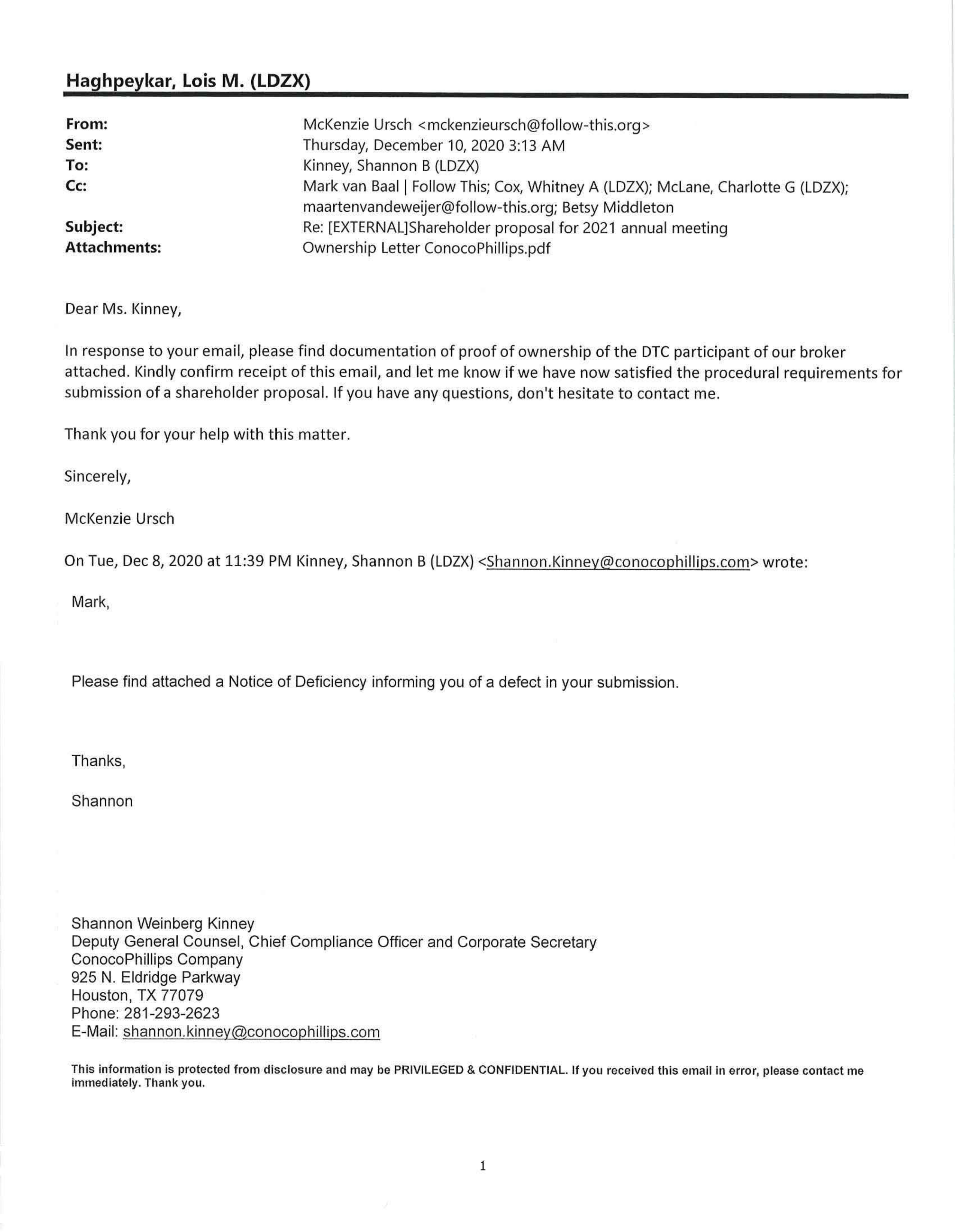
Haghpeyl<ar,
Lois
M.
(LDZX)
From:
Sent:
To:
Cc
:
Subject:
Attachments:
Dear Ms. l<inney,
McKenzie Ursch
<
mckenzieursch@follow-this.org
>
Thursday, December
10,
2020 3
:13
AM
Kinney, Shannon B
(LDZX)
Mark van
Baal
I
Follow
This
;
Cox,
Whitney A
(LDZX);
Mclane, Charlotte
G
(LDZX);
maartenvandeweijer@follow-this
.o
rg; Betsy Middleton
Re:
[EXTERNAL]Shareholder proposal
for
2021 annual meeting
Ownership Letter ConocoPhillips.pdf
In response
to
your
email, please find documentation
of
proof
of
ownership
of
the
DTC
participant
of
our
broker
attached. Kindly confirm receipt
of
this email, and
let
me know
if
we have
now
satisfied
the
procedural requirements
for
submission
of
a shareholder proposal.
If
you have any questions,
don't
hesitate
to
contact me.
Thank you
for
your
help
with
this
matter.
Sincerely,
McKenzie Ursch
On Tue,
Dec
8, 2020
at
11:39
PM
Kinney, Shannon B
{LDZX)
<S
ha
nn
on
.K
inney@conocophillips.com> wrote:
Mark,
Please find attached a Notice
of
Deficiency informing you
of
a defect in your submission.
Thanks,
Shannon
Shannon Weinberg Kinney
Deputy General Counsel, Chief Compliance Officer and Corporate Secretary
ConocoPhillips Company
925
N.
Eldridge Parkway
Houston, TX 77079
Phone: 281-293-2623
E-Mail: shannon.kinney@conocophillips.com
This information is protected
from
disclosure
and
may
be PRIVILEGED
&
CONFIDENTIAL.
If
you
received
this
ema
il
In e
rr
or, please
contact
me
immediately. Thank you.
1
From:
Mark
van
Baal
I
Follow This
Sent:
Monday, November 30, 2020 8:18 AM
To:
Kinney, Shannon B
(LDZX)
<Shannon.l
Cc:
Rose,
Kelly B
(LDZX)
<l; Cox,
Whitney
A
(LDZX)
;
Mclane,
Charlotte G
(LDZX)
;
McKenzie Ursch ; maartenvandeweijer@follow-this.org; Betsy
Middleton
Subject:
[EXTERNAL]Shareholder proposal
for
2021 annual meeting
I
•
Dear Shannon,
We hope this email finds you well.
Please
find attached a proposal intended
for
inclusion in
the
proxy materials
of
the
2021 AGM. Included
with
the
resolution
is
a cover letter,
as
well
as
proof
of
ownership. We have also attached
the
signing logs which verify the
digital signatures.
If
you have any questions,
or
would like
to
discuss
the
proposa
l,
please do
not
hesitate
to
contact us. We welcome
your
feedback.
We look forward
to
hearing
from
you.
For today, could
you
kindly confirm receipt?
With
best regards,
Mark van
Baal
I
Follow This
I
+
31 6 22
42
45 42
2


McKenzie Ursch, legal advisor Follow This
I
+3164016
26
72
Confidentiality Notice:
This
e-mail, along with any attachments, may
be
proprietary, privileged, confidential,
or
otherwise legally exempt from
disclosure, and
it
is
intended exclusively
for
the
individual
or
entity to which
it
is
addressed. Any dissemination,
copying,
use
of,
or
reliance upon such information by
or
to
anyone
other
than addressee
is
prohibited.
If
you are
not
the named addressee, please
notify
the
sender immediately by reply e-mail and delete all copies
of
this e-mail message
and any attachments.
3
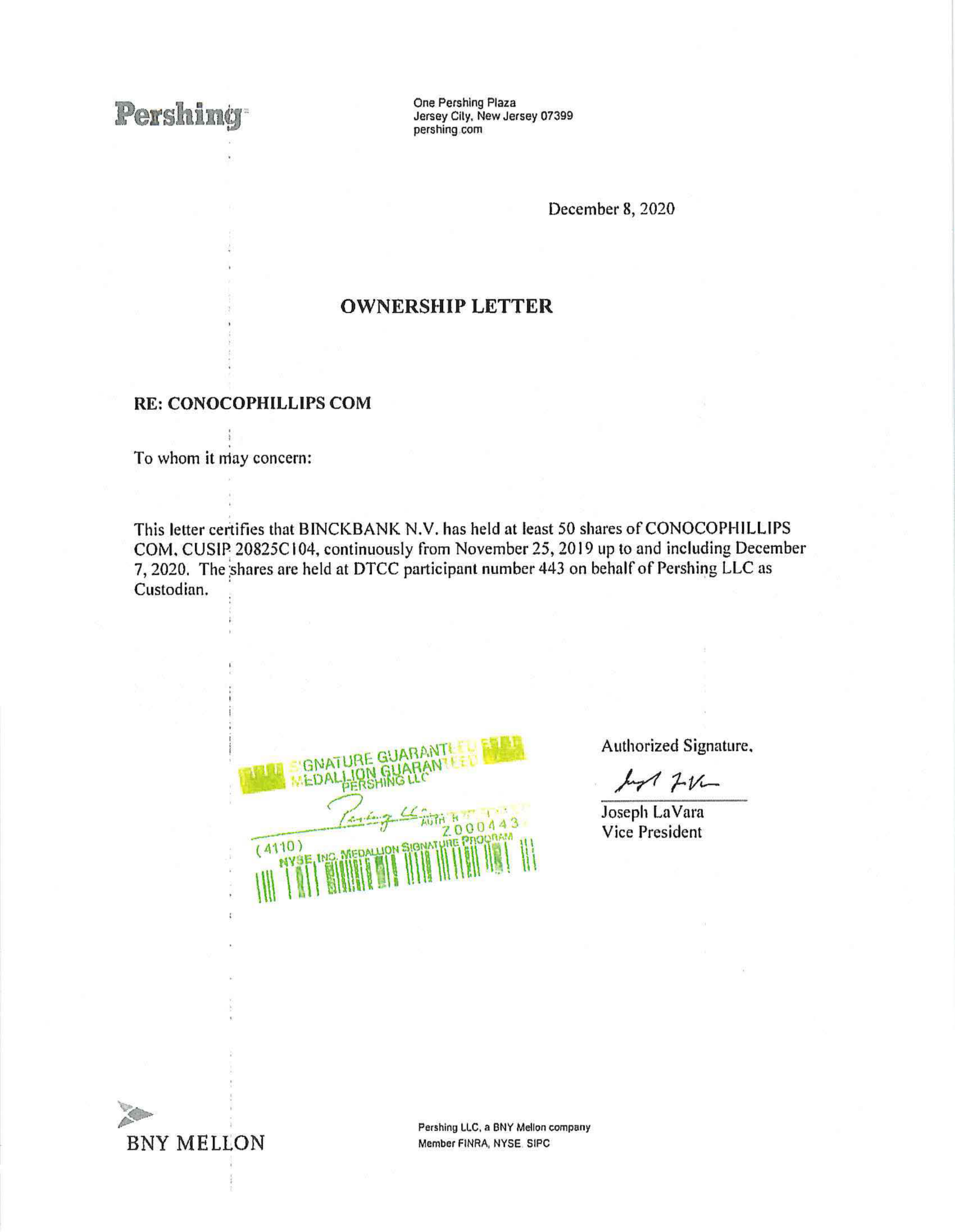
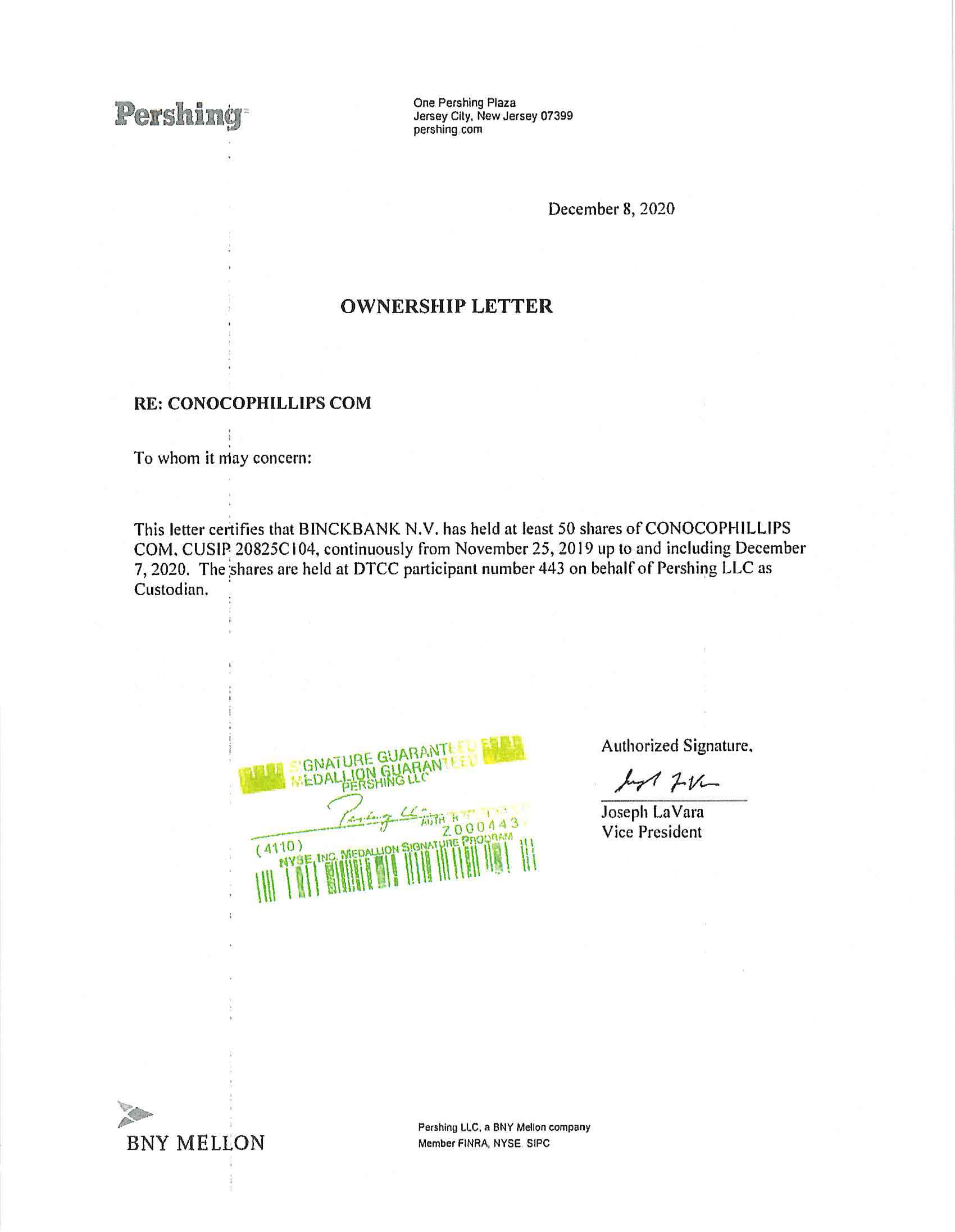
One
Pershing Plaza
Jersey
City,
New Jersey 07399
pershing
com
December 8, 2020
OWNERSHIP LETTER
RE:
CONOCOPHILLIPS
COM
To
whom
it
may
concern:
This letter certifies
that
BINCKBANK
N.V.
has
held
at least
50
shares
of
CONOCOPHILLIPS
COM.
CU
SIP
20825C
I 04, continuously
from
November 25, 2019
up
to
and
including December
7,
2020. The :shares
are
held
at
DTCC
participant number
443
on behalf
of
Pershi~g
LLC
as
Custodian.
·
":♦
p
BNY
MELLON
Per
s
hing
LLC
, a
BNY
Mellon
company
Member
FJNR
A,
NYSE
SIPC
Authorized Signature.
Joseph LaVara
Vice
President
Haghpeylcar,
Lois
M.
(LDZX)
From:
Sent:
To:
Cc:
Subject:
Dear Ms. Kinney,
McKenzie Ursch
<
mckenzieur
sc
h@follow-this.org >
Wednesday, December
23, 2020 2:58
PM
Kinney, Shannon B
(LDZX)
Betsy Middleton;
Cox,
Whitney A (
LDZ
X);
Mark van
Baal
I
Follow
Thi
s;
Mclane, Charlotte
G (LDZX); maartenvandeweijer@follow-this.org
Re:
[E
XTERNA
L]
Shareholder proposal
for
2021
annual meeting
I hope this finds you well, and prepared
to
take a nice and relaxing holiday.
I am wondering
if
you had a
moment
to
look
over
the
document
at
ion I send, and
if
so,
whether
we have
now
rectified
the
deficiencies and have satisfied
the
requirements
for
submission
of
a shareholder resolution. Could you kindly
let
me
know?
I wish you a very merry Christmas, and a good transition
into
the
new
year.
Sincerely,
McKenzie Ursch
On
Thu,
10
Dec
2020
at
10:13,
McKenzie
Ur
sc
h <mckenzieur
sc
h@foll
ow-t
his.org>
wrote:
Dear Ms. Kinney,
In
response
to
your
email, please find documentation
of
proof
of
ownership
of
the
OTC
participant
of
our
broker
attached. Kindly confirm receipt
of
this email, and
let
me
know
if
we
have
now
satisfied
the
procedural
requirements
for
submission
of
a shareholder proposal.
If
you have any questions,
don't
hesitate
to
contact me.
Thank you
for
your
help
with
this matter.
Sincerely,
McKenzie Ursch
On
Tue, Dec
8,
2020
at
11:39
PM Kinney, Shannon B
(LDZX)
<Shannon.l
wrote:
Mark,
Please find attached a Notice
of
Deficiency informing you
of
a defect
in
your submission.
Thanks,
Shannon
1
Shannon Weinberg Kinney
Deputy General Counsel, Chief Compliance Officer and Corporate Secretary
ConocoPhillips Company
925
N.
Eldridge Parkway
Houston,
TX
77079
Phone: 281-293-2623
E-Mail: shannon.kinney@conocophillips.com
This information
is
protected
from
disclosur
e
and
may be PRIVILEGED
&
CONFIDENTIAL.
If
you
received
this
email
in
error, please contact me
immediately. Thank you.
From:
Mark
van
Baal
I
Follow This
Sent:
Monday, November
30,
2020
8:18
AM
To:
Kinney, Shannon B
(LDZX)
<S
hannon.Kinney@conocophillips.com>
Cc:
Rose,
Kelly B
(LDZX)
;
Cox
,
Whitney
A
(LDZX)
;
Mclane,
Charlotte G
(LDZX)
<Cha
rlotte.G.McLane@conocophillips.com>;
McKenzie Ursch ; maartenvandeweij
er@fo
llow
-t
his.org; Betsy Middleton
<betsy
middleton@follow
-this.org>
Subject:
[EXTERNAL)Shareholder proposal
for
2021
annual meeting
,
..
Dear Shannon,
We hope this email finds you well.
Please
find attached a proposal intended
for
inclusion in
the
proxy materials
of
the
2021
AGM. Included
with
the
resolution
is
a cover letter,
as
well
as
proof
of
ownership. We have also attached
the
signing logs which verify
the
digital signatures.
If
you have any questions,
or
would
like
to
discuss the proposal, please do
not
hesitate
to
contact
us
. We welcome
your
feedback.
2
We
look forward
to
hearing
from
you.
For today, could you kindly confirm receipt?
With best regards,
Mark van
Baal
I
Follow This
I
+ 31 6
22
42 45 42
McKenzie Ursch, legal advisor Follow This
I
+3164016
26
72
Confidentiality Notice:
This e-mail, along
with
any attachments, may
be
proprietary, privileged, confidential,
or
otherwise legally exempt
from disclosure, and
it
is
intended exclusively
for
the individual
or
entity
to
which
it
is
addressed. Any dissemination,
copying, use of,
or
reliance upon such information by
or
to
anyone other than addressee
is
prohibited.
If
you are not
th
e named addressee, please
notify
the
sender immediately by reply e-mail and delete all copies
of
this e-mail
message and any attachments.
3


Office
of
Chief Counsel
Division
of
Corporation Finance
U.S. Securities and Exchange Commission
January 6, 2021
Exhibit B
Comprehensive Climate Framework Announced on October 19, 2020
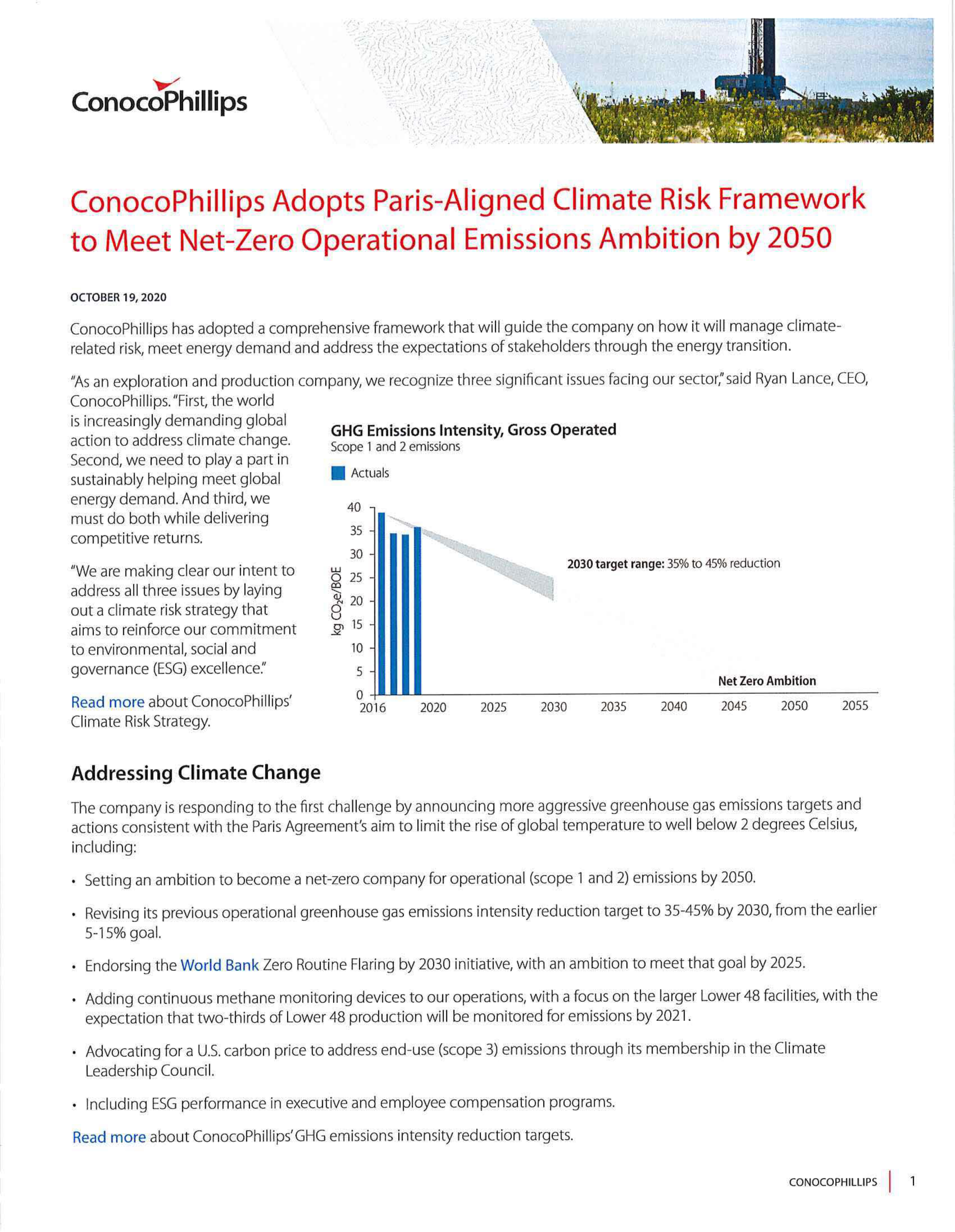
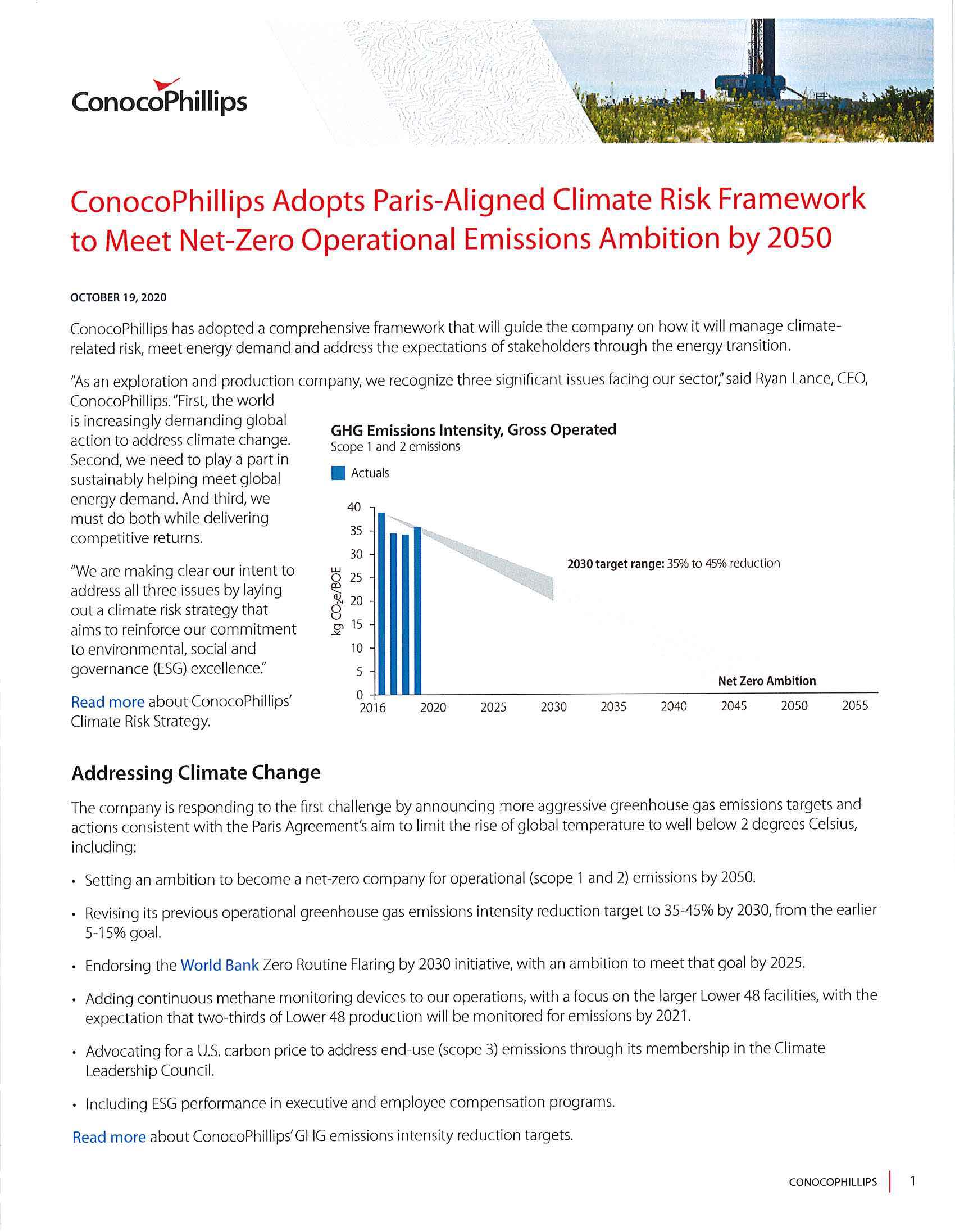
y
ConocoPhillips
',
!
'
ConocoPhillips
Adopts
Paris-Aligned
Climate
Risk
Framework
to
Meet Net-
Zero
Operational
Emissions
Ambition
by
2050
OCTOBER
1
9,
2020
ConocoPhillips has adopted a comprehensive framework
that
wi
ll
guide
the
company on
how
it
w ill manage climate-
related risk,
meet
energy demand a
nd
address
the
expectations
of
stakeholders
through
the
energy transition.
"As
an exploration and production company,
we
recognize
thr
ee significant issues facing
our
sector;'said
Ryan
Lance,
CEO,
ConocoPhillips.
"Fi
rst,
the
world
is
increasingly
demanding
global
action
to
address climate change.
Second,
we
need
to
play a part in
sustainably helping
meet
global
energy demand. And third,
we
must
do
both
whi
le deliver
ing
competitive returns.
"We are making clear
our
i
ntent
to
address a
ll
three issues
by
laying
out
a cli
mate
risk strategy that
aims
to
reinforce our
commitment
to environmental, social and
governance
(ESG)
excellence:'
GHG
Emissions
Intensity,
Gross
Operated
Scope
1 and 2
emissions
■
Actuals
40
35
30
UJ
2030
targ
et
range:
35%
to
45%
reduction
O
25
~
'¼
20
0
~
15
-"'-
10
5
Net
Zero
Ambition
Read
more
about ConocoPhillips'
Climate
Risk
Strategy.
0
+--
.._.._.._
_________
___
__________
_
2016
2020
2025
2030
2035
2040
2045
2050
2055
Addressing Climate Change
The company
is
responding
to
the first
cha
llenge
by
announcing more aggressive greenhouse gas emissions targets and
actions consistent
with
the
Paris
Agreement's aim
to
l
imit
the
ri
se
of
global temperature
to
well
be
l
ow
2 degrees
Cels
iu
s,
including:
Setting
an
amb
i
tion
to
become a net-zero
company
for operational (scope 1 and
2)
emissions
by
2050.
•
Revis
ing its previous operational greenhouse gas emissions intensity reduction target
to
35-45% by 2030, from
the
earlier
5-15% goal.
Endorsing
the
World Bank Zero Routine Flaring by 2030 initiative, with an
ambition
to
meet
that
goal
by
2025.
Adding continuous m
et
hane
monitor
i
ng
devices
to
our
operations, w i
th
a focus on
the
larger Lower 48
fac
ilities,
with
the
expectation
that
two-thirds
of
Lower 48 production wi
ll
be
monitored for
em
issions by 202
1.
Advocati
ng
for a
U.S.
carbon p
ri
ce
to
address
end-
u
se
(scope
3)
emissions through its membership in
the
Climate
Leadership Counci
l.
Including
ESG
performance in executive and employee compensation progr
ams.
Read
more
about
ConocoPhillips'GHG emissions intensity reduction targets.
CONOCOP
HILLI
PS
I
1
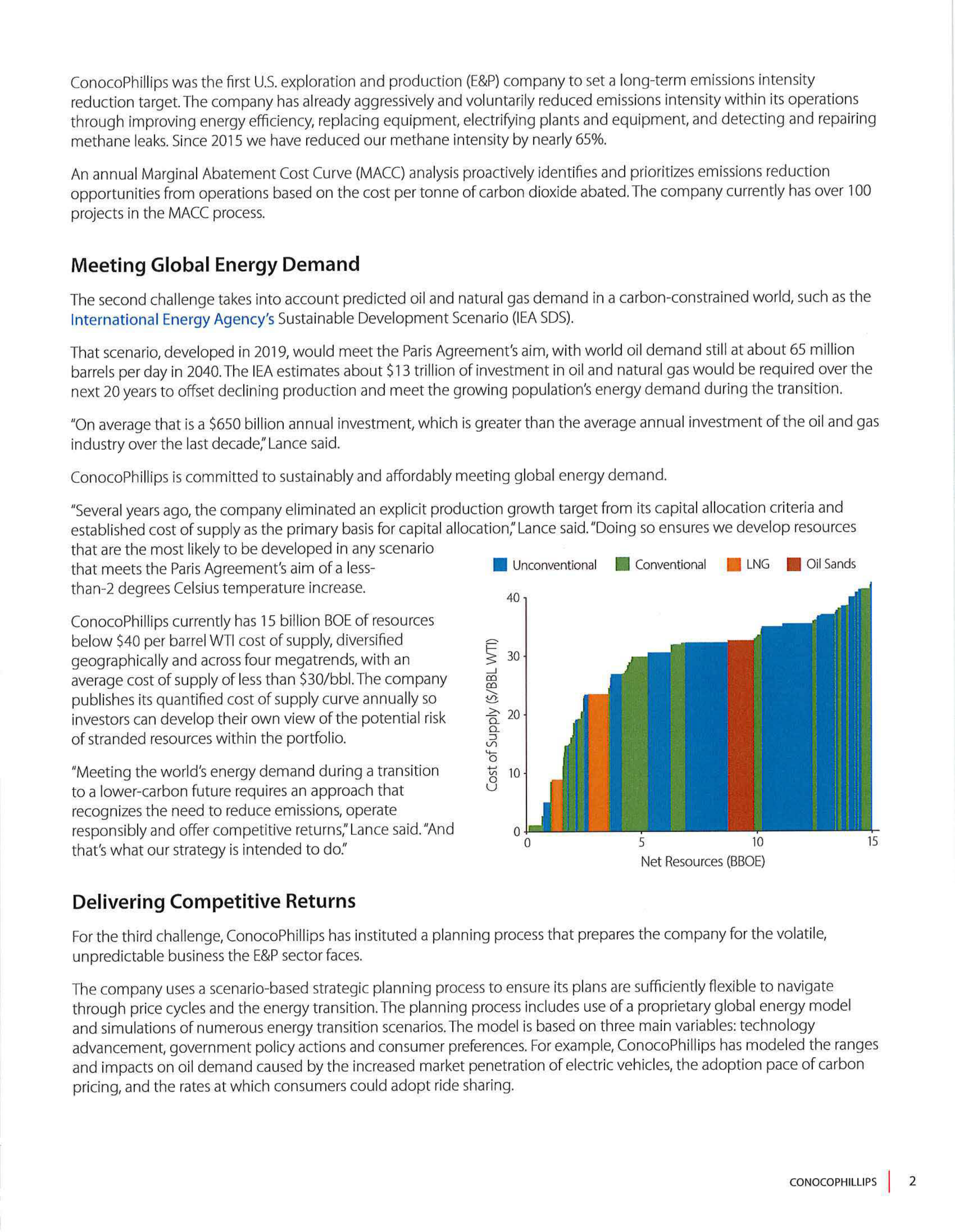
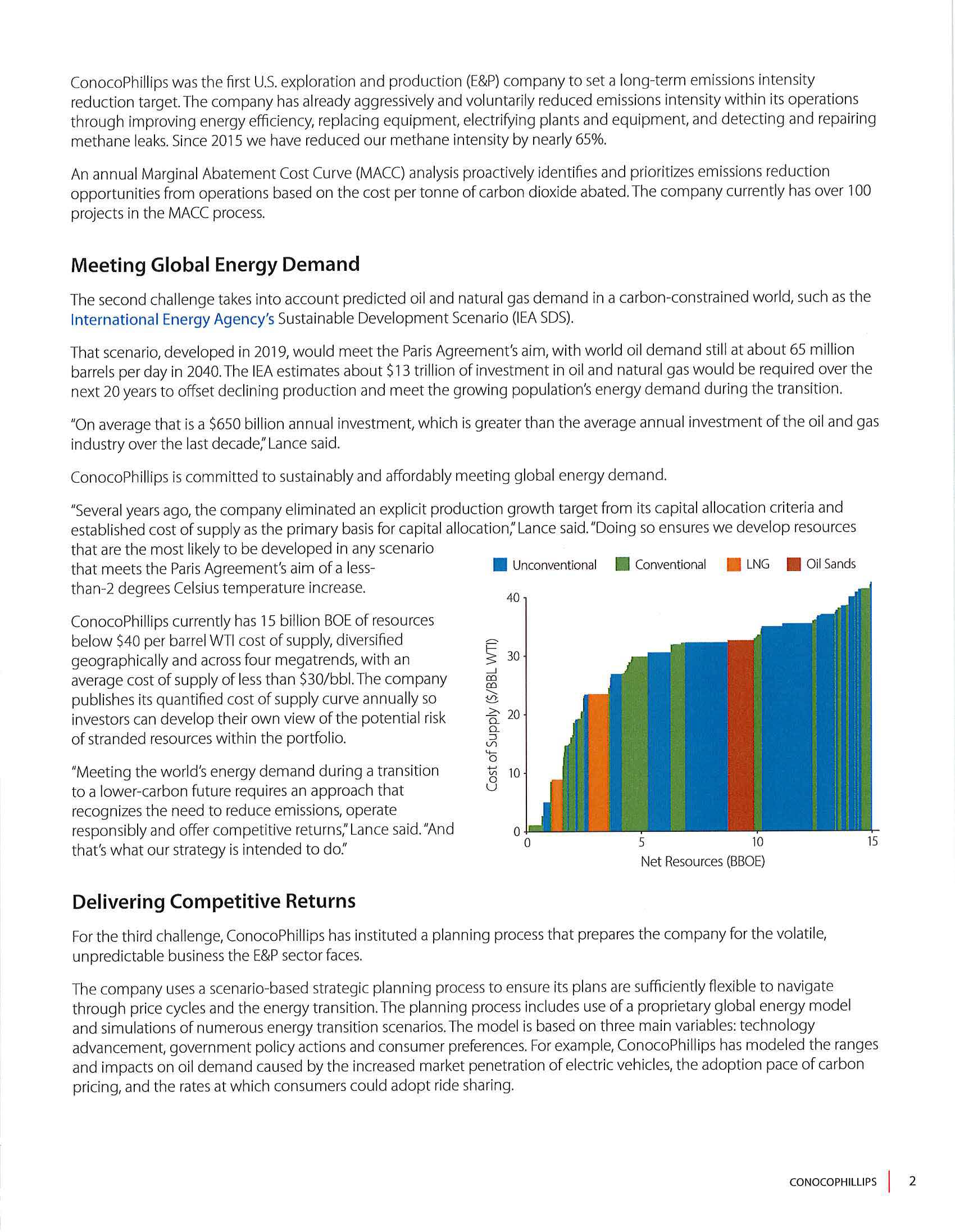
ConocoPhillips was
the
first U
.S.
exploration
and
production
(E&P)
compa
ny
to
set a long-term emissions
int
ensi
ty
reduction target. The company has already aggressively and voluntarily re
duced
emi
ss
ions intensity
within
its
ope
r
at
ions
through improving energy efficiency, replacing
equ
ipment, electrifying plants and equipment, and detecting and repairing
methane l
eaks.
Since 2015
we
have reduced
our
methane intensity by nearly 65%.
An annual Marginal Abatement Cost Curve (MAC() anal
ys
is proactively
ident
ifies and priorit
izes
emissions reduction
opportunities from operations based
on
the
cost
per
tonne
of
ca
r
bon
dioxide abated. The
company
currently has over 100
projects in the MACC process.
Meeting Global Energy Demand
The second challenge takes
into
account predicted oil and natural gas
demand
in a carbon-constrained world, such
as
the
I
nternat
ional Energy Agency's Sustainable Development Scenario
(IEA
SOS).
Th
at
scenario, developed in 2019,
would
meet
the
Paris
Agreement's aim, w
it
h
wor
ld oil demand still at about 65 mil
li
on
barrels per day in 2040. The
IE
A estimates
about
$13 trillion of investment in oil and nat
ur
al
gas
would
be
required over
the
next 20
years
to offset declining
production
and meet
the
grow
ing population's energy demand during
the
transition.
"On average
that
is
a $650 billion annual inves
tment,
which
is
greater than
the
average annual investment
of
the
oil and gas
industry over
the
last decade;' Lance said.
ConocoPhillips
is
committed
to
sustainably and affordably meeting global energy demand.
"Several years ago,
the
company el
imin
ated an explicit production
growth
tar
get
from i
ts
capital allocation cr
it
eria and
established cost
of
supply
as
the
primary basis for capital allocation;' Lance said. "
Doing
so
ensures
we
develop resources
that are
the
most
likely
to
be developed in any scenario
that
meets the
Paris
Agreement's aim
of
a l
ess-
than-2 degrees Celsius temperature increase.
ConocoPh
ill
ips currently
has
15 billion
BOE
of resources
bel
ow
$40 per barrel WTI cost
of
supply, diversified
geographically and across four megatrends,
with
an
average cost
of
supply
of
le
ss
than $30/bbl. The
company
publishes its quantified cost
of
supply curve annually
so
investo
rs
can develop their
own
view
of
the potential risk
of
stranded resources
within
the
portfolio.
"Meeting the world's energy demand
dur
ing a trans
it
ion
to
a lower-carbon future requir
es
an approach
that
recogniz
es
the
need
to
reduce emissions, operate
responsibly and offer
compet
itive returns;'
La
nce
said
. "And
that's
what
our
strategy
is
intended
to
do:·
Delivering Competitive Returns
■
Uncon
venti
onal
40
~
30
__J
Cll
Cll
i2i
~
20
0.
::i
V)
0
....,
10
8
0
0
■
Conventional
■
L
NG
■
Oil
Sands
5
10
Net
Resources
(BBOE)
For
the
third challenge, ConocoPhillips h
as
instituted a planning process
that
prepar
es
th
e company for
the
volatil
e,
unpredictable bu
siness
the
E&P
sector faces.
The company uses a scenario-based strategic planning pro
cess
to
ensure its plans are suffici
ent
ly
flexible
to
navigate
through price cycles and
th
e ener
gy
transition. The planning process includes
use
of a
prop
rietary global energy
mode
l
15
and simulations
of
numerous energy
tr
ansition scenarios. The model
is
based on three main variabl
es:
technology
advancement, government policy actions and consumer preferences. For example, ConocoPh
il
lip
s
has
modeled the ranges
and
imp
acts on oil demand
ca
used
by
the
increased market penetration
of
electric vehicles,
the
adop
tion
pace
of
carbon
pricing, and
the
rat
es
at
wh
ich cons
um
ers
could
adopt
ride sharing.
CONOCOPH
ILLI
PS
I
2
cs
20-0017
The strategic choices that ConocoPhillips
ma
kes
for its business plans are informed
by
a rigorous revi
ew
of scenario
outcomes and tests of possible paths
across
market environments. The
company
provides a full review
of
i
ts
strategy and
plans, including scenarios,
to
its board of directors annually. It also routinely engages stakeholders and publish
es
an annual
r
eport
on
how
it
manages climate-related
risks.
Read
more
about
ConocoPhillips' scenario planning.
Co
nocoPhillips h
as
expanded
the
scope
of
its planning process
to
inclu
de
the evaluation
of
low-carbon
opportunit
i
es
and
technologies that can close
ly
integrate
wi
th
it
s global operations, markets and competenci
es
.
This includes a feasibility assessment across three themes: carbon cap
tu
re
and utilization,
the
hydrogen economy, and
al
ternative energy technologies that can reduce
the
emissions i
nt
ensity
of
current operations. Future
dec
isions
on
potent
i
al
investments in th
ese
options will
be
based
on
t
he
disciplined capital allocation criteria governing the company's strategy
today,
as
we
ll
as
the
impact
of
meeting
the
2050 net-zero operational emissions
ambitio
n.
"We are
going
to
increase
the
work
we
are
doing
to
better understand all
opportun
it
ies
to
deliver effective emissions
r
educt
ion projects while sti
ll
providing
sha
reholders competitive returns;'Lance said.
According
to
La
n
ce,
th
e
new
climate risk strategy marks an
important
step
to
de
monstrate
the
comm
i
tment
by
ConocoPhilli
ps
to
r
ed
uce emissions, safely provide affordable ener
gy
and deliver
competit
ive performance
through
cycles.
"Addressed
comp
rehensivel
y,
our
actions are consistent
wit
h
our
stated corpora
te
purpose:
to
create benefit for
al
l
our
stakeholders;' Lance said.
Access
i
nvestor
slides
.
CONOCOP
HI
LLIPS
I
3