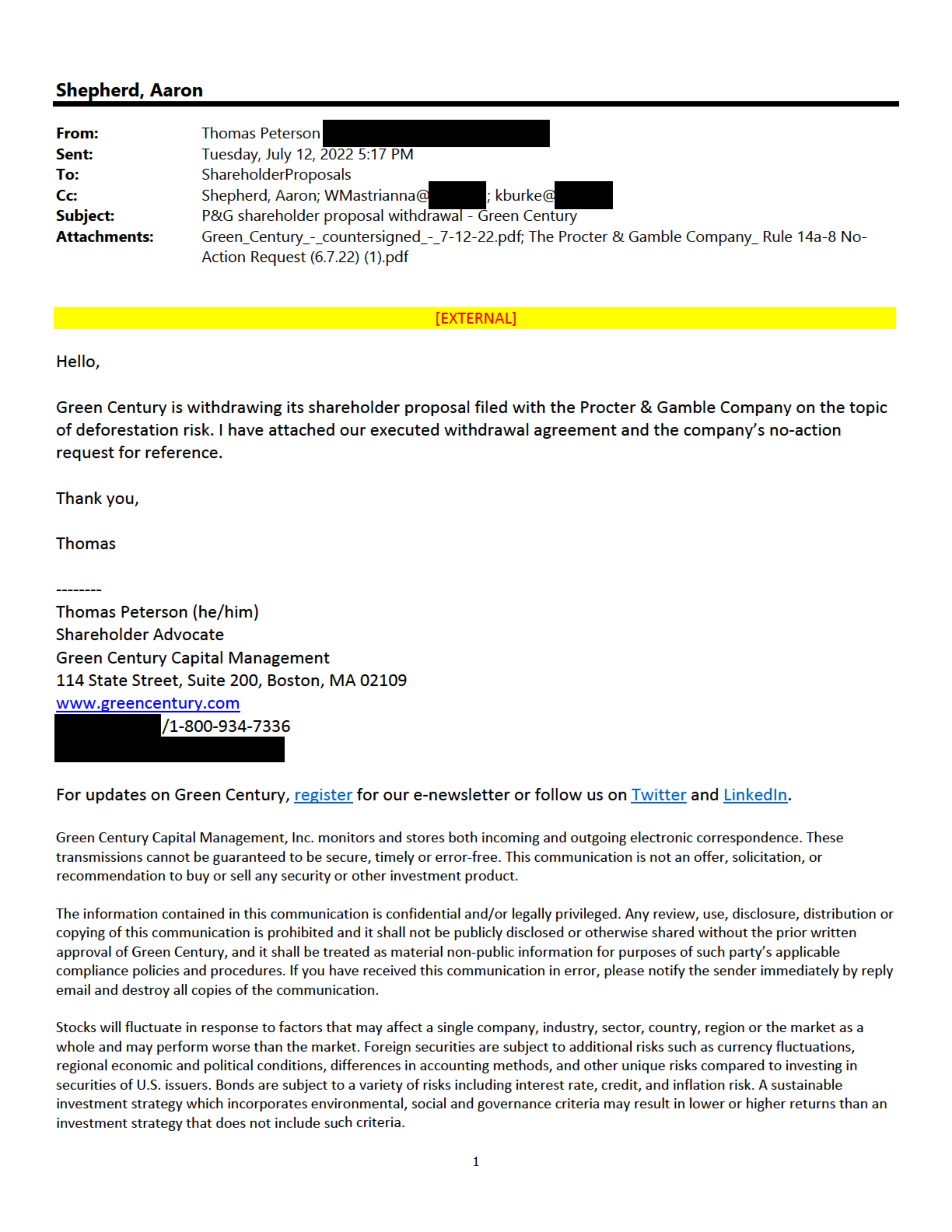

July 18, 2022
Aaron B. Shepherd
The Procter & Gamble Company
Re:
The Procter & Gamble Company (the “Company”)
Incoming letter dated July 13, 2022
Dear Aaron B. Shepherd:
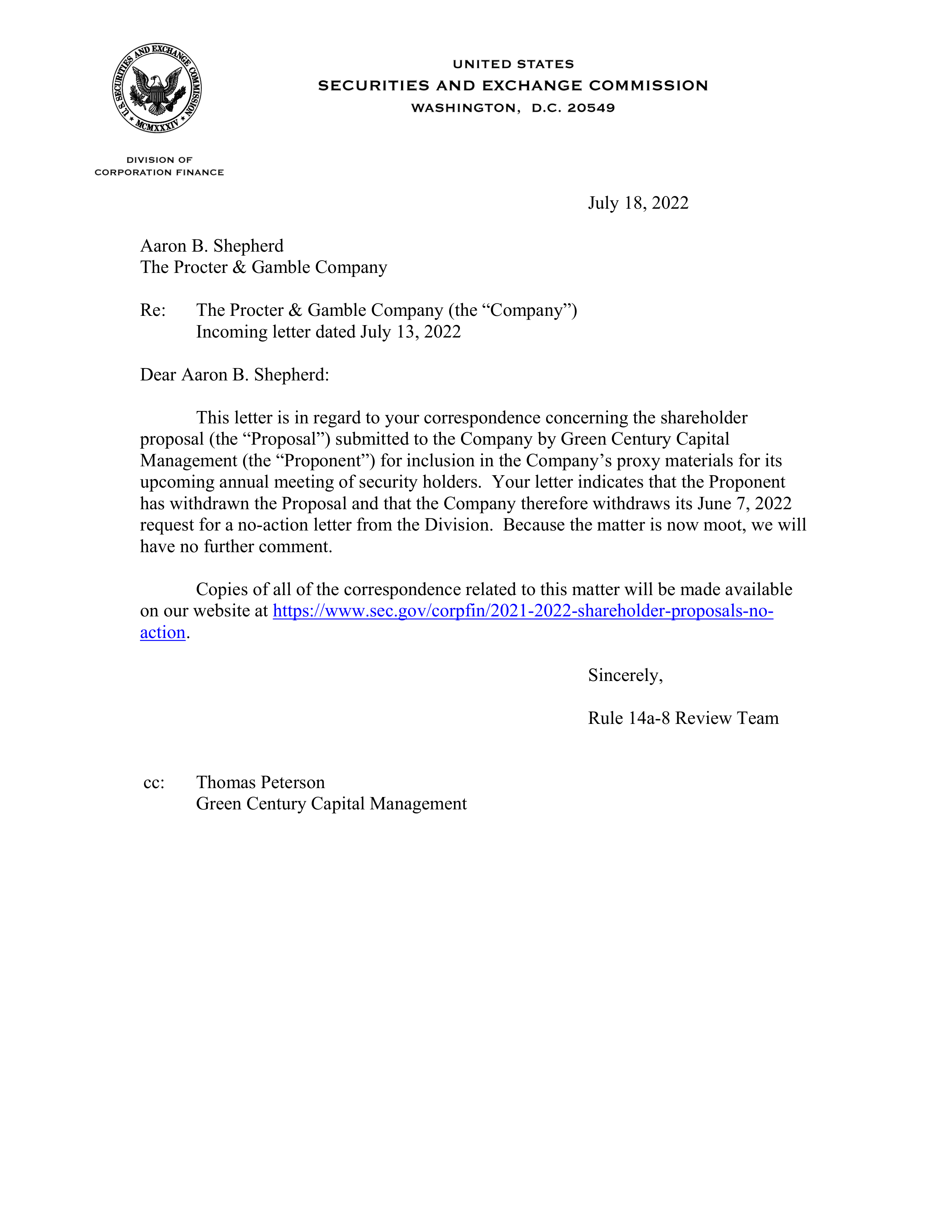
This letter is in regard to your correspondence concerning the shareholder
proposal (the “Proposal”) submitted to the Company by Green Century Capital
Management (the “Proponent”) for inclusion in the Company’s proxy materials for its
upcoming annual meeting of security holders. Your letter indicates that the Proponent
has withdrawn the Proposal and that the Company therefore withdraws its June 7, 2022
request for a no-action letter from the Division. Because the matter is now moot, we will
have no further comment.
Copies of all of the correspondence related to this matter will be made available
on our website at
https://www.sec.gov/corpfin/2021-2022-shareholder-proposals-no-
action
.
Sincerely,
Rule 14a-8 Review Team
cc:
Thomas Peterson
Green Century Capital Management
June 7, 2022
By Electronic Mail
Office of Chief Counsel
Division of Corporation Finance
U.S. Securities and Exchange Commission
100 F Street, N.E.
Washington, DC 20549
Re: The Procter & Gamble Company — Shareholder Proposal
Submitted by the Green Century Equity Fund
Ladies and Gentlemen:
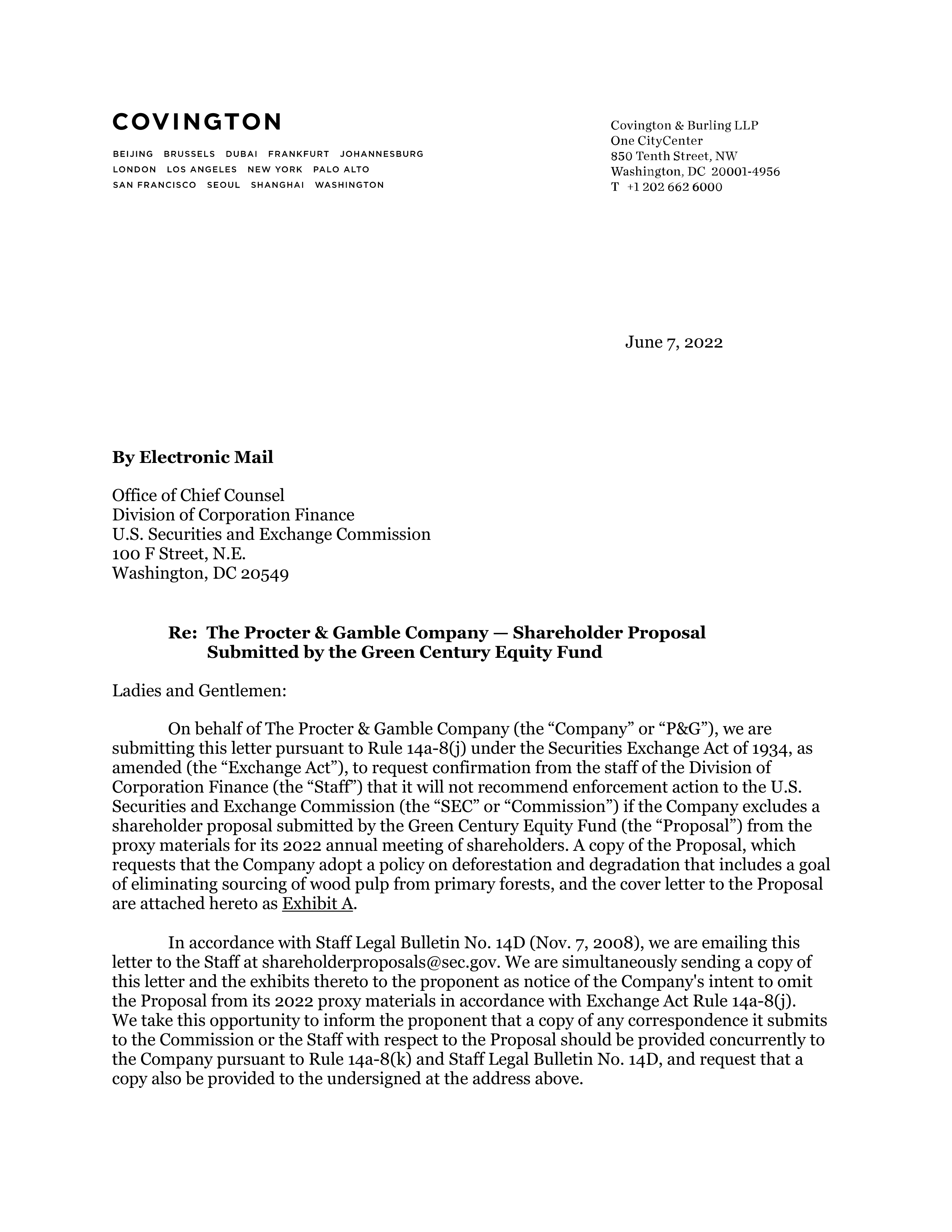
On behalf of The Procter & Gamble Company (the “Company” or “P&G”), we are
submitting this letter pursuant to Rule 14a-8(j) under the Securities Exchange Act of 1934, as
amended (the “Exchange Act”), to request confirmation from the staff of the Division of
Corporation Finance (the “Staff”) that it will not recommend enforcement action to the U.S.
Securities and Exchange Commission (the “SEC” or “Commission”) if the Company excludes a
shareholder proposal submitted by the Green Century Equity Fund (the “Proposal”) from the
proxy materials for its 2022 annual meeting of shareholders. A copy of the Proposal, which
requests that the Company adopt a policy on deforestation and degradation that includes a goal
of eliminating sourcing of wood pulp from primary forests, and the cover letter to the Proposal
are attached hereto as Exhibit A.
In accordance with Staff Legal Bulletin No. 14D (Nov. 7, 2008), we are emailing this
letter to the Staff at shareholderproposals@sec.gov. We are simultaneously sending a copy of
this letter and the exhibits thereto to the proponent as notice of the Company's intent to omit
the Proposal from its 2022 proxy materials in accordance with Exchange Act Rule 14a-8(j).
We take this opportunity to inform the proponent that a copy of any correspondence it submits
to the Commission or the Staff with respect to the Proposal should be provided concurrently to
the Company pursuant to Rule 14a-8(k) and Staff Legal Bulletin No. 14D, and request that a
copy also be provided to the undersigned at the address above.
COVINGTON
BEIJING
BRUSSELS
DUBAI
FRANKFURT
JOHANNESBURG
LONDON
LOS
ANGELES
NEW
YORK
PALO
ALTO
SAN
FRANCISCO
SEOUL
SHANGHAI
WASHINGTON
Covington
&
Burling LLP
One
CityCe
nter
850
Tenth
Street,
NW
Washington, DC 20001-4956
T
+
1
202
662
6000
Office of Chief Counsel
June 7, 2022
Page 2
THE PROPOSAL
The Proposal states:
Resolved
: Shareholders request that Procter & Gamble adopt a policy on deforestation
and degradation that includes a goal of eliminating sourcing of wood pulp from primary
forests by 2030 in alignment with international goals, and report on progress in
implementing the policy by disclosing its comprehensive primary forest footprint as soon
as practicable and on an ongoing basis.
BASIS FOR EXCLUSION
We request that the Staff concur in our view that the Proposal may be excluded from the
Company’s 2022 proxy materials pursuant to Rule 14a-8(i)(7), because the Proposal relates to
the Company’s ordinary business operations.
BACKGROUND — THE COMPANY’S FORESTRY PRACTICES AND PROGRAMS
The Company is committed to the responsible sourcing of wood pulp and has already
established a policy that prohibits deforestation and the degradation of intact forests. The
Company does not manufacture wood pulp, but sources wood pulp in order to make and sell
certain Company products, such as tissue, towel, and absorbent hygiene products. These
products, such as diapers and toilet paper, are ultimately sold through several of the Company’s
business units, including Family Care, Baby Care, and Feminine Care. While wood pulp is a
necessary component of these products, the Company’s overall footprint in the wood pulp
industry is relatively small. The Company currently purchases less than 3% of the wood pulp
produced in Canada and only about 1% of the wood product from Canada used in the United
States.
The Company’s wood pulp and forestry policies and programs have been in place for
many years. The Company has also taken action over the last decade to increase the breadth and
impact of these efforts. The Company is committed to transparency regarding these efforts and
publishes a wide range of data and disclosures about its forestry practices on its ESG Portal.
1
In
March 2021, the Company published a comprehensive Forestry Practices Report that was based
on a review conducted by the Company to identify opportunities to further increase the scale,
pace, and rigor of its responsible sourcing efforts.
2
As part of this review, the Company updated
its Wood Pulp Sourcing Policy, which was further updated in October 2021.
3
The Company also
completed and published a supplement in June 2021 to the Forestry Practices Report (the
1
The Company’s ESG Portal is available at:
https://www.pginvestor.com/esg/esg-overview/default.aspx
.
2
The Forestry Practices Report, which includes the Company’s Wood Pulp Sourcing Policy and Palm Oil Sourcing
Policy as appendices, was furnished as an exhibit to a Form 8-K filed on March 29, 2021. The Report is also available
at:
https://s1.q4cdn.com/695946674/files/doc_downloads/2021/03/ForestryPracticesReport_3-29-21.pdf
.
3
The updated Wood Pulp Sourcing Policy is available at:
https://s1.q4cdn.com/695946674/files/doc_downloads/
esg/2021/Forestry/06/8958_P-G_WoodPulp_Policy_A-3.pdf
.
COVINGTON
Office of Chief Counsel
June 7, 2022
Page 3
“Supplement”), which further discusses the Company’s wood pulp footprint and several aspects
of the Company’s forestry sourcing practices.
4
The Supplement provides a detailed discussion of
the Company’s evaluation of whether a commitment to eliminate wood pulp sourcing from
intact forest landscapes would be prudent for the Company and its stakeholders. The
Supplement also addresses additional aspects of the responsible sourcing of forestry materials,
such as intact forest landscapes, intact forest areas, high carbon stock (HCS) and high
conservation value (HCV) forests; free, prior, and informed consent (FPIC); and compliance
monitoring. We refer to the Supplement, Forestry Practices Report, and Wood Pulp Sourcing
Policy collectively as the “Forestry Materials” (attached to this letter as Exhibits B, C, and D,
respectively). These policies and reports are representative of the Company’s efforts to
responsibly source wood pulp for its products.
The Company’s existing policies prohibit deforestation and forest degradation and aim to
protect or conserve special sites, respect human and labor rights, and affirm the rights of
Indigenous groups. The Company does not own or manage forests but endeavors to ensure that
sound forest management practices are used in its wood pulp supply chain. The Company
reviews all wood pulp suppliers to ensure they are providing the Company with wood pulp that
complies with the Company’s Wood Pulp Sourcing Policy and forest certification requirements.
The Company diligently pursues sourcing that protects forests and the communities that rely on
them. In sum, the Company’s wood pulp supply chain efforts, including robust certification
requirements, responsible sourcing efforts, sourcing transparency, and affirmative conservation
actions, are all designed to meet the Company’s commitment to responsibly source wood pulp.
We note that the Proposal uses various terms when referring to forests that are within
the scope of the Proposal: the term “primary forests” is used in the resolved clause, but the
Proposal also refers to “intact forests” and “primary boreal forests.” The Proposal’s supporting
statement appears to use primary forests and intact forests interchangeably, but the Company
understands these terms to be distinct. The Company believes that “intact forests” or “intact
forest landscapes” (IFLs) generally refer to significant, unbroken forest areas minimally
impacted by human activity.
5
The Proposal refers to a primary forest as a “a forest that has never
been logged and has developed following natural disturbances and under natural processes.”
The Company believes that Proposal’s definition of primary forest is broadly construed and does
not align with the Company’s understanding of intact forests and IFLs. The Proposal’s definition
of primary forests may include what the Company understands to be IFLs, but would also
encompass an additional expanse of forests that are not mapped or delineated in certain
jurisdictions in which the Company sources wood pulp.
ANALYSIS
I.
The Proposal should be excluded under Rule 14a-8(i)(7) because it relates to
the Company's ordinary business operations.
4
The Forestry Practices Report Supplement is available at:
https://s1.q4cdn.com/695946674/files/doc_downloads/
esg/2021/Forestry/06/Forestry_Practices_Report_6-3-21.pdf
.
5
Under its technical definition, an IFL also has certain size and dimensional requirements, such as a minimum area
of 500 km
2
, to enable consistent identification and mapping.
COVINGTON
Office of Chief Counsel
June 7, 2022
Page 4
Overview of Rule 14a-8(i)(7)
Rule 14a-8(i)(7) permits the exclusion of a shareholder proposal from a company’s proxy
materials if the proposal “deals with a matter relating to the company's ordinary business
operations.” The Commission has stated that the purpose of the ordinary business exception is
“to confine the resolution of ordinary business problems to management and the board of
directors, since it is impracticable for shareholders to decide how to solve such problems at an
annual shareholders meeting.”
Amendments to Rules on Shareholder Proposals
, SEC Rel. No.
34-40018 (May 21, 1998). The Commission has further stated that the policy underlying this
exclusion rests on two “central considerations,” specifically whether the proposal (i) concerns
tasks that are “so fundamental to management's ability to run a company on a day-to-day basis
that they could not, as a practical matter, be subject to direct shareholder oversight” and (ii)
“seeks to ‘micromanage’ the company by probing too deeply into matters of a complex nature
upon which shareholders, as a group, would not be in a position to make an informed
judgment.”
Id.
A.
The Proposal should be excluded under Rule 14a-8(i)(7) because it concerns
the Company’s ordinary business operations and does not focus on a
significant social policy issue.
The Proposal Concerns the Ordinary Business Matters of Product Development, the
Offer of Products for Sale, and Relationships with Suppliers
The Proposal should be excluded under Rule 14a-8(i)(7) because it concerns the
Company’s ordinary business operations, including the Company’s product development, the
offer of products for sale, and supplier relationships. The Proposal is concerned with the
Company’s product development and the Staff has previously held that “[p]roposals concerning
product development are generally excludable under [R]ule 14a-8(i)(7).”
See
DENTSPLY Int’l.
Inc.
(Mar. 21, 2013) (proposal requesting a report summarizing the company’s policies and
plans for phasing out mercury from company products was excludable under Rule 14a-8(i)(7) as
relating to product development). Where a proposal seeks to remove or eliminate a component
or material included within a company’s product, the Staff has frequently held that the proposal
is excludable under Rule 14a-8(i)(7) as it relates to the ordinary business concept of product
development.
See
Mondelez International, Inc.
(Feb. 23, 2016) (proposal requesting the
elimination of nanomaterials from company products was excludable under Rule 14a-8(i)(7) as
relating to product development);
Ball Corp.
(Feb. 4, 2016) (proposal requesting that the
company phase out the use of BPA from its products was excludable under Rule 14a-8(i)(7) as
relating to product development); and
PPG Industries, Inc.
(Feb. 26, 2015) (a proposal
requesting the elimination of the use of lead in paint and coatings in company products was
excludable under Rule 14a-8(i)(7) as relating to product development).
The Proposal is clearly concerned with product development matters because it requests
that the Company eliminate a specific material, namely primary forest-sourced wood pulp, from
its supply chains. Wood pulp is necessary to manufacture a range of Company products and the
elimination of certain wood pulp sourcing would effectively change the composition of certain
Company products in ways that would be detrimental to consumers and to the Company’s
business. The Proposal compares favorably to the proposals that the Staff allowed to be excluded
COVINGTON
Office of Chief Counsel
June 7, 2022
Page 5
in
DENTSPLY
,
Mondelez
,
Ball
and
PPG
as each of these proposals also concerned the
elimination of a specific material used in the production of a company product. For example, the
proposal in
Mondelez
noted that “Mondelez Dentyne Ice gum has been found in independent
laboratory testing to contain nanoparticles of titanium dioxide, a metal oxide used to whiten
foods” and requested that the company eliminate the use of these nanoparticles. The
Mondelez
proposal identified a product component (nanoparticles) and the proposal requested the
company eliminate that component from a product (gum). Similarly, the Proposal identifies a
product component (primary forest-sourced wood pulp) and calls for eliminating that
component from Company products (e.g., diapers and toilet paper).
In addition to proposals that concern product development, the Staff has long permitted
the exclusion of proposals that concern a company’s products and services. The Staff has stated
that “[p]roposals concerning the sale of particular products are generally excludable under
[R]ule 14a-8(i)(7)” and has permitted the exclusion of proposals where a company is asked to
phase out or eliminate a product.
See
Dillard's, Inc.
(Feb. 27, 2012) (a proposal that requested
the company phase out the sale of fur from raccoon dogs was excludable under Rule 14a-8(i)(7)
as relating to the products offered for sale by the company). The Staff has also permitted the
exclusion of proposals that relate to a company’s products and services but are not limited in
scope to specific products.
See Amazon.com, Inc.
(Mar. 17, 2016) (a proposal that concerned
recycling, pollution and public health problems from waste generated as a result of the sale of
electronics to customers was excludable under Rule 14a-8(i)(7) as relating to the company's
products and services);
Wal-Mart Stores, Inc.
(“Porter”) (Mar. 26, 2010) (a proposal urging the
company to adopt a policy requiring that all products and services offered for sale in U.S. stores
be manufactured or produced in the U.S. was excludable under Rule 14a-8(i)(7) as relating to
the products and services offered for sale by the company); and
Wal-Mart Stores, Inc.
(“Green
Century”) (Mar. 24, 2006) (a proposal that called for minimizing customer exposure to a list of
toxic substances in company products was excludable under Rule 14a-8(i)(7) as relating to the
sale of particular products). Although the text of the Proposal is concerned with the Company’s
wood pulp supply chain, it necessarily concerns the Company’s products, which are
manufactured using this sourced wood pulp. As in
Wal-Mart (2010)
, the Proposal imposes a
condition upon products sold by the Company (that they not contain wood pulp sourced from
primary forests) and accordingly, the Proposal concerns the Company’s products. The Proposal
would limit the Company’s wood pulp supply and hinder its ability to make high-performing
paper products. The Proposal’s request directly relates to the Company’s ordinary business
operations, and therefore the Proposal is excludable under Rule 14a-8(i)(7).
The Proposal also implicates the Company’s supplier relationships, which the Staff has
held to be ordinary business operations.
See Foot Locker, Inc.
(Mar. 3, 2017) (a proposal
concerning the company’s monitoring of the use of subcontractors by the company's overseas
apparel suppliers was excludable under Rule 14a-8(i)(7) as “the proposal relates broadly to the
manner in which the company monitors the conduct of its suppliers and their subcontractors”).
In addition, the Staff has permitted the exclusion of proposals that sought an assessment of a
specific aspect of companies’ supply chains.
See
The Home Depot, Inc.
(Mar. 20, 2020)
(permitting exclusion under Rule 14a-8(i)(7) for a proposal that called for a report on the extent
of known usage of prison labor in the company’s supply chain); and
The TJX Companies, Inc.
(Mar. 20, 2020) (permitting exclusion under Rule 14a-8(i)(7) for a proposal that called for a
report assessing the effectiveness of current company policies for preventing prison labor in the
company’s supply chain). The Proposal includes direct and indirect references to the Company’s
COVINGTON
Office of Chief Counsel
June 7, 2022
Page 6
relationships with and evaluation of its suppliers. The resolved clause of the Proposal
specifically relates to “sourcing” in the Company’s wood pulp supply chain and the supporting
statement refers to wood pulp “suppliers” and “sources.” In addition, the Company is not aware
of any definitive industry or government mapping of primary forests in the jurisdictions where it
sources wood pulp. The Proposal would therefore require the Company to engage its suppliers to
assess whether their wood pulp has been sourced from a primary forest, assuming a universally
accepted definition of a “primary forest” can be ascertained, and then eliminate that sourcing.
Based on the Company’s sourcing experience and conversations with suppliers, the Company
does not believe that it can practically dictate to its suppliers that they not source wood pulp that
may include a small amount of fibers from primary forests. In fact, the Company expects that
mandating such a commitment would likely have the unintended consequence of simply shifting
this wood pulp supply to other industries and companies globally, many of whom may be willing
to accept less responsible practices or requirements for their sourcing. The Company does not
manufacture wood pulp, and it is clear that the Proposal relates to the Company’s supplier
relationships for its sourced wood pulp. Therefore, the Proposal is excludable under Rule 14a-
8(i)(7).
The Proposal Does Not Focus on a Significant Social Policy Issue Under Rule 14a-
8(i)(7)
The Proposal does not focus on a significant social policy issue under Rule 14a-8(i)(7).
Despite the proponent’s invocation of carbon emissions, human rights and free, prior, and
informed consent (FPIC), the central purpose and concern of the proposal is the adoption of a
policy on deforestation and degradation and the elimination of wood pulp sourced from primary
forests.
6
The Proposal does not focus on a significant social policy issue but is highly focused on
the Company’s product development, the offer of products for sale, and supplier relationships,
which are all ordinary business matters. The Company’s sourcing of wood pulp from different
forest classifications directly concerns ordinary business operations, because sourcing is
inextricably linked to the fundamental core of the Company’s business operations, namely the
sale of products. The Company’s forestry policies also concern ordinary business operations
because they have been crafted in the context of sourcing wood pulp for Company products.
Disclosures concerning the Company’s “primary forest footprint” and the actions the Company
would take pursuant to the Proposal involve ordinary business matters because these
disclosures and actions are in furtherance of the Proposal’s desire to alter Company products by
changing what materials the Company can source to manufacture those products. While the
Proposal expresses policy views regarding wood pulp sourcing, these sentiments are ultimately
focused on how the Company uses wood pulp in its products. The Proposal’s comments
regarding carbon emissions, human rights and FPIC are peripheral to the subject matter and
6
The Company’s Supplement and Wood Pulp Sourcing Policy outline the Company’s clear and unambiguous support
of FPIC. As stated in both the Supplement and the Wood Pulp Sourcing Policy, “P&G respects the rights of indigenous
and local communities to give or withhold their free, prior, and informed consent (FPIC) for development of land they
own legally, communally or by customary rights.” The Supplement and Wood Pulp Sourcing Policy also outline the
Company’s expectations for its suppliers regarding FPIC: FPIC processes should be done in a culturally appropriate
manner and follow credible methodologies such as the Guidelines on Free, Prior and Informed Consent of the United
Nations Collaborative Programme on Reducing Emissions from Deforestation and forest Degradation (UN-REDD)
and the Free, Prior and Informed Consent Manual of the Food and Agriculture Organization of the United Nations
(FAO).
COVINGTON
Office of Chief Counsel
June 7, 2022
Page 7
actions to be taken pursuant to the Proposal and do not have a bearing on the overall
interpretation of the Proposal.
The Staff has permitted the exclusion of proposals under Rule 14a-8(i)(7) even where
significant social policy issues have been raised in the body of a proposal.
See
Amazon.com, Inc
.
(Apr. 8, 2022) (proposal requesting a report on the distribution of stock-based incentives
throughout the company’s workforce was excludable under Rule 14a-8(i)(7) as the proposal
“relate[d] to, but [did] not transcend, ordinary business matters”);
BlackRock, Inc.
(Apr. 4,
2022) (proposal requesting a public report on the potential risks of omitting “viewpoint” and
“ideology” from the company’s EEO policy was excludable under Rule 14a-8(i)(7) as the
proposal “relate[d] to, but [did] not transcend, ordinary business matters”);
The Goldman Sachs
Group, Inc.
(Mar. 8, 2022,
recon. denied
Mar. 21, 2022) (proposal requesting a study on the
external costs created by underwriting multi-class equity offerings was excludable under Rule
14a-8(i)(7) as the proposal “relate[d] to, but [did] not transcend, ordinary business matters”);
and
The TJX Companies, Inc.
(Apr. 9, 2021) (a proposal seeking information about the
company’s monitoring of supplier compliance with the Company’s policy that prohibited prison
labor was excludable under Rule 14a-8(i)(7) because the proposal “[did] not transcend the
[c]ompany’s ordinary business operations”). As held by the Staff in the various no-action letters
cited above, secondary references to significant social policy issues will not automatically
immunize a proposal from exclusion under the ordinary business exception if the proposal does
not focus on a significant social policy issue. The central focus of the Proposal is the adoption of
a policy on deforestation and degradation with a goal of eliminating wood pulp sourcing from
primary forests in the Company’s supply chains: this focus directly implicates the Company’s
ability to sell its products and further implicates ordinary business matters such as product
development and supplier oversight. The Proposal does not focus on a significant social policy
issue and therefore should be excluded under Rule 14a-8(i)(7).
B
.
The Proposal should be excluded under Rule 14a-8(i)(7) because it seeks to
micromanage the Company.
Micromanagement Overview
The Commission and Staff have long held that a proposal that seeks to micromanage a
company is excludable under Rule 14a-8(i)(7). The Commission has stated that the exclusion of
a proposal under Rule 14a-8(i)(7) on the grounds that the proposal micromanages a company
“may come into play in a number of circumstances, such as where the proposal involves intricate
detail, or seeks to impose specific time-frames or methods for implementing complex policies.”
Id
. The Commission further stated that the micromanagement consideration stands for “the
general proposition that some proposals may intrude unduly on a company’s ‘ordinary business’
operations by virtue of the level of detail that they seek.”
Id
.
The Proposal micromanages the Company and its forestry policies and programs by
imposing specific methods for implementing complex policies, seeks intricate detail, and
supplants and limits the judgement of management and the board of directors. The Proposal
requests that the Company adopt a policy on deforestation and degradation, set a goal of
eliminating sourcing of wood pulp from primary forests by 2030 and also to disclose the
Company’s “comprehensive primary forest footprint as soon as practicable.” The Proposal is
concerned with the Company’s forestry practices, their relation to primary forests, and the
COVINGTON
Office of Chief Counsel
June 7, 2022
Page 8
sourcing of wood pulp. The actions required by the Proposal probe too deeply into matters of a
complex nature upon which shareholders, as a group, would not be in a position to make an
informed judgment and seek to micromanage the Company to such a degree that exclusion of
the Proposal is appropriate under Rule 14a-8(i)(7).
The Proposal Micromanages the Company’s Forestry Policies and Programs By
Imposing Specific Methods for Implementing Complex Policies
The Proposal’s request that the Company eliminate sourcing of wood pulp from primary
forests micromanages the Company by imposing a specific method (eliminating wood pulp
sourced from primary forests) for implementing a complex policy (the responsible sourcing of
materials for the Company’s consumer products). The Proposal probes deeply into the ordinary
business operations that undergird the Company’s manufacture of consumer products that
contain wood pulp. The Company’s supply chain for wood pulp is complex. Wood pulp is created
through the harvesting of mature trees from publicly and privately-owned forests. This
harvesting is prompted largely by other purposes, such as harvesting for lumber. A forest is
typically managed by a person who is distinct from the landowner and further distinct from the
company harvesting or even milling the trees. Byproducts from lumber production and other
timber are sold to pulp companies, and the Company buys pulp from these entities. The lumber
industry is the main purchaser of wood products from these forests, and the Company is a
relatively small stakeholder in the countries in which it sources pulp. The differing stakeholders
in the pulp supply chain further compound its complexity. Additionally, the land from which
wood pulp originates contains various species of trees and is located in various countries,
topographies, and natural environments.
The Proposal would require the Company to assess whether each pertinent Company
product was manufactured using wood pulp from a tree, in a primary forest, that was harvested,
processed, and sold to the Company. This level of specificity is precisely the kind of complex
action upon which shareholders are not in a position to make an informed judgment. The
Proposal probes impermissibly into the Company’s ordinary business operations and the
logistical and organizational management of its supply chain. As noted above, the Company’s
responsible sourcing policies are robust yet complex because they mirror the intricacies of the
Company’s global supply chain for wood pulp. Eliminating sourcing from primary forests in the
Company’s wood pulp supply chain would impose a specific method for implementing this
complex policy, and therefore micromanages the Company.
We also note that the Proposal would dictate the specific composition of the wood pulp
that the Company sources from its suppliers. The Proposal would not require the Company to
eliminate its sourcing of all wood pulp, but effectively mandates that the Company not source
wood pulp made from certain trees that may have come from a primary forest. Determining the
specific composition of wood pulp is an important component of the Company’s production
decisions, as different tree fibers are used for distinct purposes, provide unique performance
benefits for consumers, and are even a source of competitive advantage for the Company.
Conceivably, the Proposal would require that the Company not source some wood pulp that is
physically the same as other wood pulp because the Proposal creates an artificial classification of
permitted and non-permitted wood pulp. Such a classification is not contemplated by industry
standards or in responsible sourcing classifications. In summary, the Proposal would dictate
which categories of wood pulp are acceptable for the Company’s use.
COVINGTON
Office of Chief Counsel
June 7, 2022
Page 9
The Proposal Micromanages the Company’s Forestry Policies and Programs By
Seeking Intricate Detail
The Proposal also seeks an intricate level of detail that micromanages the Company. The
Proposal is concerned with the Company’s forestry practices and eliminating sourcing from
primary forests, but also requires the Company to disclose “its comprehensive primary forest
footprint as soon as practicable” and update this disclosure “on an ongoing basis.” As noted
above, the Company does not own forestry land and does not manufacture wood pulp. The
supporting statement does not elaborate or provide clarifying detail regarding this request and it
is unclear how the Company would provide disclosures regarding a physical footprint that is
does not have. It is possible that the Proposal is requesting that the Company disclose the
primary forest footprint of its wood pulp suppliers. To satisfy the Proposal, the Company
presumably would have to undertake a detailed, and potentially fruitless, investigation of its
various supplier’s physical forest footprints. Such an investigation would involve a complex and
expensive assessment of supply locations, land management certifications and chain of custody
certifications in the Company’s land, harvesting and pulp mill supply chains. As noted above,
the Company is not aware of any definitive industry or government mapping of primary forests
in the jurisdictions where it sources wood pulp. The Proposal would require the Company to
undertake expansive and detailed efforts to establish whether its wood pulp is sourced from
primary forests, as defined by the Proposal, even before acting to eliminate that sourcing. The
Proposal’s potential request for elaborate information regarding the physical forestry footprint
of the Company’s wood pulp suppliers may be impracticable and impermissibly micromanages
the Company by seeking intricate detail.
The Proposal Micromanages the Company’s Forestry Policies and Programs By
Supplanting and Limiting the Judgement of Management
The Proposal further micromanages the Company’s forestry practices and responsible
sourcing policies by substituting the proponent’s own goals in place of the Company’s current
goals of no deforestation, no degradation, and ensuring the responsible management of the
world’s forests and conscientious use of forest products. The language of the Proposal itself
indicates a clear intention to micromanage the Company’s
existing
forestry policies and
programs: the Proposal states that “PG’s commitments and actions fall short” and states that the
Company’s current policies and programs are “insufficient.” The Company’s existing forestry
and responsible sourcing policies and programs have been carefully developed and calibrated to
responsibly meet the Company’s goals. The Proposal would impose specific and granular
methods for implementing the Company’s global-reaching forestry practices and programs in
substitution of the Company’s own methods. The specific cast of the Proposal leaves no
discretion to management in the application of the Proposal. By requiring the Company to
eliminate sourcing from primary forests “as rapidly as possible,” the Proposal supplants and
limits the judgement of management to such a degree as to micromanage the Company.
The Company’s forestry policies and programs for responsibly sourcing materials are
public commitments by the Company. As noted above, the Company published a comprehensive
Forestry Practices Report in March of 2021 that was based on a review conducted by the
Company to identify opportunities to increase the scale, pace, and rigor of the Company’s
forestry efforts. This report, in conjunction with the Company’s other Forestry Materials,
COVINGTON
Office of Chief Counsel
June 7, 2022
Page 10
outlines management’s strategy for responsibly sourcing materials in the Company’s supply
chain as well as the Company’s overall forestry practices. The report notes the multiple criteria
the Company uses for sustainable forest management, including:
•
Ensuring no deforestation;
•
Replanting and reforestation after harvesting;
•
Preserving water, soil and air;
•
Protecting biodiversity;
•
Respecting the right of Indigenous peoples; and
•
Protecting endangered species.
The Proposal would seek to supplant the Company’s comprehensive approach to forestry issues
with the proponent’s singular focus on primary forests, thereby impermissibly micromanaging
the Company.
Additionally, the Company has specific policies, initiatives, and goals in place to address
responsible sourcing and sound forestry practices that would be disrupted by the Proposal’s call
for a specific strategy focused solely on primary forests. For example, the Company is committed
to working directly with supply chain partners and NGOs to grow the supply of Forest
Stewardship Council (FSC)-certified wood pulp in order to overcome the low supply of FSC-
certified materials currently available. FSC is one of the world's most trusted forest certifications
and sourcing FSC certified wood pulp is an important element of the Company’s forestry
practices. The Company has set specific FSC certification targets for its Family Care (paper)
business:
•
sourcing 75% FSC-certified wood pulp before 2022;
•
sourcing 95% FSC-certified wood pulp from Ontario and Quebec, areas of focus for
caribou protection, by 2022; and
•
pursuing 100% FSC-certified wood pulp sourcing by 2030.
The Company successfully met the 2022 targets noted above. The Company also requires its
wood pulp suppliers to be certified by third party certification systems, including the FSC,
Sustainable Forestry Initiative, and Programme for the Endorsement of Forest Certification.
These three forest certification systems, used by 100% of the Company’s wood pulp suppliers,
require that suppliers adhere to the multiple criteria for sound forest management, as noted
above.
The Company’s broad forestry practices and programs for responsible wood pulp
sourcing would be impermissibly micromanaged by the call to eliminate sourcing from primary
forests. Sourcing from certain classifications of forests is just one of the larger set of forest
management issues that are considered by both the Company and the leading certification
frameworks. As there is no definitive industry or government mapping of primary forests, the
Proposal would require the Company to first undertake a multinational project to determine
what forests in the jurisdictions in which it sources wood pulp are primary forests as defined by
the Proposal. Requiring the elimination of sourcing from primary forests at the expense of the
Company’s other forestry initiatives would involve a complex reassessment of supply locations,
land management certifications and chain of custody certifications in the land, harvesting and
COVINGTON
Office of Chief Counsel
June 7, 2022
Page 11
pulp mill supply chains. Such a reassessment, and the implementation of a goal to eliminate
sourcing from primary forests “as rapidly as possible,” would directly micromanage the
Company’s tiered FSC-certified wood pulp goals as well as the multiple criteria (noted above)
that the Company requires its suppliers adhere to. The acquisition of wood pulp from new or
existing sources would impact management’s existing responsible sourcing goals and timeline
and would act to limit the judgment and discretion of management in such a way as to
micromanage the Company.
Exclusion Under Rule 14a-8(i)(7) Due to Micromanagement Would be Consistent with
Recent Staff No-Action Letter Decisions
The Staff has previously found that a proposal micromanages a company, and is
therefore excludable under Rule 14a-8(i)(7), where it imposes specific methods for
implementing complex policies, seeks intricate detail or limits the flexibility and discretion of
management and the board of directors.
See Johnson & Johnson
(“JLens”) (Feb. 12, 2020)
(proposal concerning awards granted under an annual cash incentive program was found to
have micromanaged the company by imposing specific methods for implementing complex
policies);
Johnson & Johnson
(“Vermont Pension Investment Committee”) (Feb. 12, 2020)
(proposal requesting justifications when financial performance measures are adjusted to exclude
legal or compliance cost was found to have micromanaged the company by seeking intricate
detail); and
Exxon Mobil Corporation
(Mar. 6, 2020) (proposal requesting the formation of a
new board committee on climate risk was found to have micromanaged the company by limiting
the board’s flexibility and discretion).
See also Verizon Communications Inc.
(Mar. 17, 2022)
(the proposal micromanaged the company by “probing too deeply into matters of a complex
nature by seeking disclosure of intricate details regarding the [c]ompany's employment and
training practices”);
American Express Co.
(Mar. 11, 2022) (same);
Deere & Co.
(Jan. 3, 2022)
(same).
The Staff has further indicated that proposals relating to company products, and the
materials within those products, can micromanage a company and are excludable under Rule
14a-8(i)(7). In
RH
(May 11, 2018) the Staff held that a proposal encouraging the company “to
enact a policy that will ensure that no down products are sold” micromanaged the company by
seeking to impose specific methods for implementing complex policies and was excludable
under Rule 14a-8(i)(7). The Staff similarly held in
Amazon.com, Inc.
(“Oxfam America”) (Apr. 3,
2019) that a proposal that urged the company to “commit to conducting and making available to
shareholders human rights impact assessments for at least three food products the [c]ompany
sells that present a high risk of adverse human rights impacts” micromanaged the company by
seeking to impose specific methods for implementing complex policies in place of the ongoing
judgments of management.
The
RH
proposal concerned down feathers used in certain Restoration Hardware
products and sought the enactment of a policy to ensure that no down products were sold by the
company. The
RH
proposal discussed the company’s use of “down-alternatives” and suggested
that the “transition” and “phasing out” of down products would be feasible given that the
company already used down-alternatives inside some of its products. Just as the
RH
proposal
was focused on eliminating down materials from being included in products sold by Restoration
Hardware, so too does the Proposal focus on eliminating primary forest-sourced wood pulp
from products sold by the Company. Both the
RH
proposal and the Proposal refer to proponent-
COVINGTON
Office of Chief Counsel
June 7, 2022
Page 12
acceptable materials used within company products (down-alternatives and non-primary forest-
sourced wood pulp, respectively) and both proposals supplant management’s decisions
regarding the composition of company products for the proponents’ specific preferences. The
Staff determined that the
RH
proposal micromanaged the company by seeking to impose
specific methods (eliminating certain materials used in company products) for implementing
complex policies (determining what components to include within the materials used to fashion
certain company products). The Proposal is analogous to the
RH
proposal and accordingly,
micromanages the Company to such a degree as to be excludable under Rule 14a-8(i)(7).
The
Amazon
proposal requested that the company commit to assessing human rights
impacts “for at least three food products Amazon sells that present a high risk of adverse human
rights impacts.” The
Amazon
proposal also stated that the assessments “should specify the
standards used, identify and assess actual and potential adverse impacts associated with the
product and describe how the findings will be integrated in order to prevent and/or remedy
impacts.” The supporting statement made clear that the proposal was concerned with Amazon’s
supply chain and expected that the human rights assessments would cover certain “product
types across suppliers.” Not only did the
Amazon
proposal seek to impose specific methods for
implementing complex policies, but its focus on human rights considerations in the company’s
supply chain was aimed at supplanting the judgement of management. Amazon noted that it had
already “undertaken numerous initiatives to address this issue in ways that the [c]ompany
believes are best for its customers, its business, people involved in the supply chain, and the
planet.” The
Amazon
proposal’s call for a detailed analysis of the human rights impacts of three
products, when the company had already developed initiatives to address the wider issue
implicated by the proposal, mirrors the Proposal’s call for of the elimination of sourcing from
primary forests when the Company has already developed initiatives to address the wider issues
implicated by the proposal, including the elimination of deforestation, forest degradation and
the responsible sourcing of materials. Both proposals impose specific methods for implementing
complex policies in place of the ongoing judgments of management. As with the
Amazon
proposal, the Proposal micromanages the Company and is therefore, excludable under Rule 14a-
8(i)(7).
CONCLUSION
Based on the foregoing analysis, and on behalf of the Company, we respectfully request
that the Staff concur that the Company may exclude the Proposal and supporting statements
from its 2022 proxy materials under Rule 14a-8(i)(7).
*
*
*
*
*
COVINGTON
Office of Chief Counsel
June 7, 2022
Page 13
If the Staff disagrees with the Company's view that it can omit the Proposal, we request
the opportunity to confer with the Staff prior to the final determination of the Staff's position. If
the Staff has any questions regarding this request or requires additional information, please
contact me at (202) 662-5297.
Very truly yours,
Kerry S. Burke
cc:
Aaron B. Shepherd
Director & Assistant General Counsel
The Procter & Gamble Company
Thomas Peterson
Green Century Capital Management
COVINGTON

Exhibit A

$SULO
7KH3URFWHU *DPEOH&RPSDQ\
FR7KH&RUSRUDWH6HFUHWDU\¶V2IILFH
2QH3URFWHU *DPEOH3OD]D
&LQFLQQDWL2+
5H6KDUHKROGHUSURSRVDOIRU$QQXDO6KDUHKROGHU0HHWLQJ
'HDU&RUSRUDWH6HFUHWDU\
*UHHQ
&HQWXU\
&DSLWDO
0DQDJHPHQW
,QF
*UHHQ
&HQWXU\
LV
WKH
LQYHVWPHQW
DGYLVRU DJHQW PDQDJHU DQG
UHSUHVHQWDWLYH
RI
WKH *UHHQ &HQWXU\ )XQGV *UHHQ &HQWXU\ &DSLWDO 0DQDJHPHQW ,QF LV ILOLQJ WKH HQFORVHG
VKDUHKROGHU
SURSRVDO
RQ
EHKDOI
RI
WKH
*UHHQ
&HQWXU\
(TXLW\
)XQG
WKH
³3URSRVDO´
WR
EH
LQFOXGHG
LQ WKH
SUR[\
VWDWHPHQW
RI
7KH
3URFWHU
*DPEOH
&RPSDQ\
3*
WKH
³&RPSDQ\´
IRU
LWV
DQQXDO PHHWLQJ
RI VKDUHKROGHUV LQ DFFRUGDQFH ZLWK 5XOH D RI WKH *HQHUDO 5XOHV DQG 5HJXODWLRQV RI WKH 6HFXULWLHV DQG
([FKDQJH$FWRI&)5D
3HU
5XOH
D
WKH
*UHHQ
&HQWXU\
(TXLW\
)XQG
LV
WKH
EHQHILFLDO
RZQHU
RI
DW
OHDVW
ZRUWK
RI
WKH
&RPSDQ\¶V
VWRFN
:H
KDYH
KHOG
WKH
UHTXLVLWH
QXPEHU RI VKDUHV IRU RYHU RQH \HDU DQG ZH ZLOO FRQWLQXH WR
KROG
VXIILFLHQW
VKDUHV
LQ
WKH
&RPSDQ\
WKURXJK
WKH
GDWH
RI
WKH
&RPSDQ\¶V
DQQXDO
VKDUHKROGHUV
PHHWLQJ9HULILFDWLRQRIRZQHUVKLSIURPD'7&SDUWLFLSDWLQJEDQNLVHQFORVHG
'XH
WR
WKH
LPSRUWDQFH
RI
WKH
LVVXH
DQG
RXU
QHHG
WR
SURWHFW
RXU
ULJKWV
DV
VKDUHKROGHUV
ZH
DUH
ILOLQJ
WKH
HQFORVHGSURSRVDOIRULQFOXVLRQLQWKHSUR[\VWDWHPHQWIRUDYRWHDWWKHQH[WVKDUHKROGHUV¶PHHWLQJ
:H
DUH
DYDLODEOH
WR
PHHW
ZLWK
WKH
&RPSDQ\
YLD
WHOHFRQIHUHQFH
RQ
0D\
WK
DQG
WK
EHWZHHQ
DPDQGSP (DVWHUQ7LPH,IQHLWKHURIWKHVH WLPHVLVDFFHSWDEOHZHFDQSURYLGHDGGLWLRQDORSWLRQV
:H
ZRXOG
ZHOFRPH
WKH
RSSRUWXQLW\
WR
GLVFXVV
WKH
VXEMHFW
RI
WKH
HQFORVHG
SURSRVDO
ZLWK
FRPSDQ\
UHSUHVHQWDWLYHV
3OHDVH
GLUHFW
DOO
FRUUHVSRQGHQFH
WR
7KRPDV
3HWHUVRQ
6KDUHKROGHU
$GYRFDWH
DW
*UHHQ
&HQWXU\&DSLWDO0DQDJHPHQW+HPD\EHUHDFKHGDW
DQG
:H ZRXOG DSSUHFLDWH FRQILUPDWLRQ RI UHFHLSW RI WKLV SURSRVDO YLD HPDLO DV HQFRXUDJHG E\ 6(& 6WDII /HJDO
%XOOHWLQ1R/&)
7KDQN\RXIRU\RXUDWWHQWLRQWRWKLVPDWWHU
6LQFHUHO\
*5((1&(1785<&$3,7$/0$1$*(0(17,1&
6WDWH6WUHHW6XLWHƒ%RVWRQ0$
WHOƒ
ID[
ZZZJUHHQFHQWXU\FRP
•♦
A
GREEN
'f
'
CENTURY
FUNDS

/HVOLH6DPXHOULFK
3UHVLGHQW
7KH*UHHQ&HQWXU\)XQGV
*UHHQ&HQWXU\&DSLWDO0DQDJHPHQW,QF
*5((1&(1785<&$3,7$/0$1$*(0(17,1&
6WDWH6WUHHW6XLWHƒ%RVWRQ0$
WHOƒ
ID[
ZZZJUHHQFHQWXU\FRP
•♦
A
GREEN
'f
'
CENTURY
FUNDS
Whereas:
Procter & Gamble (PG) is one of the largest pulp product manufacturers globally. Wood pulp
is among the leading drivers of primary forest degradation.
$FFRUGLQJWRWKH&RQYHQWLRQRQ%LRORJLFDO'LYHUVLW\DSULPDU\IRUHVWLV³DIRUHVWWKDWKDV
never been
ORJJHGDQGKDVGHYHORSHGIROORZLQJQDWXUDOGLVWXUEDQFHVDQGXQGHUQDWXUDOSURFHVVHV´3ULPDU\
VRPHWLPHVDOVRFDOOHG³LQWDFW´
forests store 30-50 percent more carbon than previously disturbed forests
and harbor unique biodiversity. Experts from the International Union for Conservation of Nature argue
WKDW³ZHFDQQRWUHVROYHWKHFOLPDWHRUELRGLYHUVLW\FULVHVZLWKRXWSULRULWL]LQJWKHSURWHFWLRQRISULPDU\
IRUHVWV´
The latest Intergovernmental Panel on Climate Change
UHSRUWIRXQGWKDW³
avoiding the conversion of
carbon-rich primary peatlands, coastal wetlands and forests is particularly important as most carbon lost
from those ecosystems are irrecoverable through restoration by the 2050 timeline of achieving net zero
carbon emissions
´
Thirty-
IRXUSHUFHQWRI3*¶VSXOSFRPHVIURP&DQDGDLQFOXGLQJIURPSULPDU\ERUHDOIRUHVWV&DQDGD¶V
ERUHDOZKLFKFRQVWLWXWHVSHUFHQWRIWKHZRUOG¶VUHPDLQLQJLQWDFWIRUHVWDQGVWRUHVWZLFHDVPXFK
carbon per hectare as tropical forests, experiences the third highest rate of intact forest landscape loss
globally. Industrial logging in Canada releases tens of millions of metric tons of carbon annually, which
are emissions roughly equivalent to
&DQDGD¶VWDUVDQGVSURGXFWLRQZLWK
demand for pulp a significant
driver of this forest clearcutting.
PG has not adopted a time-bound commitment to eliminate forest degradation, inclusive of sourcing from
primary forests and intact forest landscapes, and faces ongoing concerns about insufficient actions to
ensure the protection of
KXPDQULJKWVLQWKHFRPSDQ\¶VVXSSO\FKDLQV3*¶VFRPPLWPHQWVDQGDFWLRQVIDOO
VKRUWRILQYHVWRUV¶H[SHFWDWLRQV,Q
voting shareholders approved a resolution urging PG to assess
³HOLPLQDW>LQJ@GHIRUHVWDWLRQDQGWKHGHJUDGDWLRQRILQWDFWIRUHVWVLQLWVVXSSO\FKDLQV´
PG sources significant volumes of pulp that are covered by weak certification systems like SFI and PEFC,
ZKLOH3*¶VWLPHOLQHIRUDFKLH
ving full FSC certification for wood pulp stretches until 2030. Certification
alone is insufficient, and SFI, PEFC, and FSC Controlled Wood certification systems expose PG to
controversial suppliers.
In its 2021 10-K, PG acknowledges
UHSXWDWLRQDOGDPDJHFRXOGPDWHULDOO\LPSDFWFRPSDQ\ILQDQFHV3*¶V
inadequate enforcement of free, prior, and informed consent (FPIC) and continued sourcing from primary
forests has subjected it to escalating public pressure campaigns from 135 organizations, and to high-
profile media criticism.
7RDOLJQZLWKWKH&23*ODVJRZ/HDGHUV¶'HFODUDWLRQFRPPLWPHQWWR³ZRUNFROOHFWLYHO\WRKDOWDQG
UHYHUVHIRUHVWORVVDQGODQGGHJUDGDWLRQE\´3*PXVWHOLPLQDWHSULPDU\IRUHVWVRXUFLQJDVUDSLGO\
as possible.
Resolved:
Shareholders request that Procter & Gamble adopt a policy on deforestation and degradation
that includes a goal of eliminating sourcing of wood pulp from primary forests by 2030 in alignment with
international goals, and report on progress in implementing the policy by disclosing its comprehensive
primary forest footprint as soon as practicable and on an ongoing basis.

Exhibit B


June 7, 2021
1
Forestry Practices Report Supplement
FORESTRY
PRACTICES
REPORT
SUPPLEMENT
Following the publication of our
Forestry Practices Report
in March 2021, P&G received a request for additional
information on our forestry practices, including the
Company’s assessment of the benefits and drawbacks of
committing to eliminate sourcing from intact forests in its
wood pulp and palm oil supply chains. In keeping with our
goal of transparency, we are pleased to provide the
following supplemental discussion of our footprint and
several aspects of our forestry sourcing practices,
including whether a commitment to eliminate certain
sourcing would be prudent for the Company and its
stakeholders. We continue to provide additional
information on our forestry practices and impact generally
on our ESG for Investors site at
https://www.pginvestor.com/esg/environmental/forestry
.
IT'S
OUR
HOME
O
June 7, 2021
2
Forestry Practices Report Supplement
INTACT FOREST LANDSCAPES,
INTACT FOREST AREAS, HIGH
CONSERVATION VALUE (HCV),
AND HIGH CARBON STOCK (HCS)
FORESTS
P&G uses wood pulp, palm oil, and palm kernel oil in several of our product
categories. Each of these materials has a different supply chain, and we have
developed tailored policies and approaches to managing our impact in each.
Even though we do not own or manage commercial forests and our footprint is
relatively small in both the palm oil and wood pulp supply chains, we continue
to play a key role in working to ensure that our procurement and
manufacturing practices promote sustainability of the world’s forest resources.
Intact forest landscapes (IFLs) are generally understood as significant, unbroken forest
areas minimally impacted by human activity.
1
High Conservation Value (HCV) forests are
areas that have been designated to have critical or important environmental, cultural,
ecological, or landscape values, which can include IFLs. Similarly, High Carbon Stock (HCS)
forests are areas of high biodiversity and carbon in tropical regions, as identified by the
High Carbon Stock Approach.
In assessing our impact on these forest areas and the robustness of our current practices
and commitments, we have looked at various aspects, including:
•
P&G’s policies and commitments
•
Requirements of highly regarded certification systems
•
P&G’s footprint
•
P&G’s ability to maintain and expand its positive influence in the industry
Overall, we already prohibit the conversion of these forest areas in our palm oil supply chain,
and we conclude that a wholesale commitment to eliminate sourcing from IFLs in our
wood pulp supply chain would have unintended consequences that would drive more
negative than positive impacts for both conservation efforts and the Company.
PALM OIL
As described further in this supplement, P&G’s
Palm Oil Sourcing Policy
effectively prohibits
the conversion of intact forest landscapes for palm oil production. Palm oil is produced
from the fruit of the oil palm tree. The palm fruit is harvested from trees located on both
large oil palm plantations and smallholder farms. After each harvest, the oil palm tree
continues to grow and produce fruit during its lifespan. As palm fruit is processed to
1
This general definition is based on the widely-used Global Forest Watch and IFL Mapping Team
definition of an intact forest landscape (
https://www.globalforestwatch.org/
and
https://glad.umd.edu/intactforests/method.html
), which we use when discussing IFLs throughout this
supplement.
June 7, 2021
3
Forestry Practices Report Supplement
produce palm oil, the palm kernels—the seeds of the palm fruit—are separated and
crushed to create palm kernel oil. P&G primarily purchases this palm kernel oil, not palm oil.
P&G’s overall palm oil footprint is relatively small. P&G currently uses less than 1% of the
global palm oils production. Further, most of this use is palm kernel oil, a byproduct of palm
oil production. Despite this relatively small footprint and the fact that P&G does not own or
play a direct role in the cultivation of palm, we nevertheless believe it is possible to work for
and towards sustainable and responsible palm use broadly in the industry.
As outlined in our
Palm Oil Sourcing Policy
, we prohibit new development on HCV and HCS
forests and reference the HCS Approach as the integrated methodology for assessing HCS
and HCV landscapes. These provisions are also incorporated into the Roundtable for
Sustainable Palm Oil Production (RSPO) Principles & Criteria.
2
Both of these forest
designations, HCV and HCS, generally include IFLs in their scope. Accordingly, the inclusion
of these elements in our Policy and our requirement for suppliers to follow RSPO P&Cs
effectively prohibit conversion of IFLs for palm production.
Based on our analysis of our current policies, certification programs, and related efforts, we
believe our robust Palm Oil Sourcing policy and approach, which prohibits conversion of
HCS and HCV forests (and therefore, IFLs) in our palm oil supply chain, remains appropriate
and in both the Company’s and its many stakeholders’ best interests.
WOOD PULP
Similarly, P&G is committed to sourcing wood pulp responsibly, ensuring that forests in our
supply chain are managed sustainably and in line with our policies. Wood pulp is largely a
byproduct of the lumber industry. The best mature trees are harvested and cut into high-
value lumber products. The byproducts of these higher-quality trees, like chips and
shavings, are combined with other timber to create wood pulp for use in making paper
products. Because the production of lumber and wood pulp requires the harvesting of
trees, P&G’s
Wood Pulp Sourcing Policy
focuses on prohibiting deforestation and illegal
logging, protecting HCV forests, supporting human rights (including Free, Prior, and
Informed Consent), securing third-party certification, monitoring supplier compliance, and
transparently addressing grievances.
Regarding sourcing from HCVs and IFLs, P&G’s Wood Pulp Sourcing Policy prohibits
deforestation—the conversion of forests to non-forest uses—and protects these forest areas
by requiring that our suppliers not harvest from such areas without third-party certification.
We believe that requiring certification helps ensure that HCVs and IFLs are properly
identified, managed in collaboration with local stakeholders, and monitored for ongoing
health and status.
Specifically, and as outlined further in our Forestry Practices Report and on our ESG for
Investors, P&G requires 100% of the wood pulp we source to be certified by a third-party
certification system that ensures forests are responsibly managed. Our current certification
systems are the
Forestry Stewardship Council (FSC)
,
Sustainable Forestry Initiative
, and
Programme for the Endorsement of Forest Certification
.
These systems
also require regular
2
The RSPO is a global, multi-stakeholder initiative that provides certification of sustainably produced
palm oil. The 2018 RSPO Principles and Criteria integrate the requirements of P&G’s sourcing policy and
provides a highly regarded standard for biodiversity protection and assurance. P&G requires suppliers
to be members of RSPO, and we are on target to achieve our accelerated goal of 100% RSPO certified
palm oil for all P&G brands by the end of 2021.
June 7, 2021
4
Forestry Practices Report Supplement
audits by independent third-party certification bodies, such as Preferred by Nature, PwC,
SCS Global Services, SGS, SAI Global, KPMG, and others.
In evaluating our certification systems, we maintain a preference for FSC certified fibers and
continue to press for their expanded sourcing. FSC standards require the protection—i.e.,
non-harvesting—of 60-80% of an IFL over its lifetime,
3
regardless of how the timber is used
or whose supply chain it enters, and these standards apply to all P&G suppliers. This limited
harvesting is permitted to help balance the important needs of the environment,
biodiversity, and Indigenous groups and the economic needs of workers and local
communities. Because of this restrictive approach and our geographic footprint, we
estimate that less than 1% of P&G’s global wood pulp sourcing includes IFLs. And these
areas are responsibly managed as described in this supplement and our Forestry Practices
Report and policies.
This also reflects P&G’s relatively small footprint in the wood pulp industry overall. For
example, P&G purchases less than 3% of the wood pulp produced in Canada (whose forests
we recognize are an area of focus for stakeholders) and only about 1% of the wood pulp
used in the United States. When viewed as a percentage of the overall wood products
produced by the lumber industry, P&G uses significantly less than 1% of Canada’s wood
products. In addition, more than 90% of Canada’s forests are on publicly owned land, and
the Canadian government prohibits deforestation and closely regulates harvesting
practices and applies land-use planning requirements through legislation and other
policies.
We have further researched whether a commitment to eliminate P&G’s small amount of
wood pulp sourced from IFLs would have the benefit of helping conserve forest land.
Although such a commitment would theoretically remove these areas from P&G’s supply
chain, our assessment is that it would not eliminate their use in the industry generally or
likely conserve any incremental forest land. Specifically, based on our extensive sourcing
experience and conversations with suppliers and other stakeholders, we do not believe that
we can practically dictate that our suppliers not source wood pulp that may include a small
amount of fibers from IFLs. In fact, we expect that making such a commitment and
mandate would likely have the unintended consequence of simply shifting this supply to
other industries and companies globally, many of whom may be willing to accept less
responsible practices or requirements for their sourcing. Such a commitment would also
practically limit P&G’s wood pulp supply and hinder our ability to make the high-
performing paper products that consumers want and need, significantly impacting our
business. We are also not aware of any IFL requirements in any recognized certification or a
similar commitment in any large manufacturer’s forestry policies.
As a result, we believe the benefits of committing to eliminate sourcing from IFLs and
related forest areas in our wood pulp supply chain are currently far outweighed by the
downsides. As described above, such a commitment is unlikely to conserve incremental
forest land. In fact, it is more likely to remove P&G as a voice for responsible sourcing
practices in the industry. Accordingly, we continue to believe that our Wood Pulp Sourcing
Policy and commitments, marked by seeking to achieve the highest levels of certification
where possible and providing significant transparency on our efforts, position P&G to have
industry-leading practices that enable us to provide consumer-preferred products,
promote long-term value, and safeguard forest health for generations to come. By
3
FSC standards also use the Global Forest Watch definition of an intact forest landscape
(
https://www.globalforestwatch.org/
). in
June 7, 2021
5
Forestry Practices Report Supplement
adhering to these standards and working broadly to influence the industry, we can better
help ensure IFLs and related forest areas are broadly conserved.
FREE, PRIOR, AND INFORMED
CONSENT (FPIC)
In assessing our approach, we also wanted to provide additional clarity on how
P&G’s forestry policies address FPIC. Both our
Palm Oil Policy and Supplier
Expectations
and our
Wood Pulp Sourcing Policy
explicitly respect and protect
human rights, which are fundamental to the way we manage our business. Not
only do we support the
U.N. Guiding Principles for Business and Human Rights
,
we expect our suppliers to have the necessary policies and procedures in place
to follow our
Responsible Sourcing Guidelines for External Business Partners
.
These policies and procedures include supporting the
United Nations Declaration on the
Rights of Indigenous Peoples
, which declares that indigenous peoples have the right to full
enjoyment, as a collective or as individuals, of all human rights and fundamental freedoms.
P&G respects the rights of indigenous and local communities to give or withhold their free,
prior, and informed consent for development of land they own legally, communally, or by
customary rights. The FPIC processes should be done in a culturally appropriate manner
and follow credible methodologies such as the
UN-REDD (2012) Guidelines on Free, Prior
and Informed Consent
and
FAO (2015) Free, Prior and Informed Consent Manual
. In
addition, each of the certification systems we use in our forest supply chains—FSC, SFI,
PEFC, and RSPO—has specific provisions that speak to ensuring FPIC.
We discuss further below our approach to monitoring our suppliers’ compliance with these
expectations.
COMPLIANCE MONITORING AND
ACTION
In evaluating our commitments and efforts, we also recognize the need to
continue to monitor compliance with our policies and take appropriate
corrective action where necessary. In our compliance monitoring program and
our non-compliance protocols, we use several strategies.
For example, in our palm oil supply chain, we use satellite monitoring technology to detect
forest clearance that may violate our Policy. Our monitoring partner
Earthqualizer
directly
sends us alerts of any potential non-compliance. If we receive such an alert, whether via our
satellite monitoring or other credible sources, we follow a formal grievance management
process and publicly report the status of grievances via an online report. This strategy helps
us address issues when they do occur and ensure that we remain an advocate for
responsible palm oil sourcing globally.
June 7, 2021
6
Forestry Practices Report Supplement
Similarly, we continuously review wood pulp suppliers to ensure they provide us with
sustainably sourced fiber and follow our
Wood Pulp Sourcing Policy
and certification
standards, including respecting FPIC. For example, P&G conducts with each supplier semi-
annual sustainability audits, biennial forest field assessments, and quarterly evaluations of
sustainability efforts and plans. We also conduct annual sustainability summits with our
Canadian suppliers. If non-compliance is identified, we work with our suppliers and
certification partners to investigate these claims and take appropriate actions, which are
shared on our
ESG for Investors site
.
Across our palm oil and wood pulp policies, our non-compliance protocols and actions can
include:
•
Immediate halts to further development activities or suspension of down-stream
purchasing from the area in question
•
Reduced purchases
•
Suspension or elimination of purchases
•
Termination of agreements
•
Development of restoration or compensation plans, as appropriate
Our compliance and grievances processes are outlined in each policy, again available on
the Forestry section of our
ESG for Investors site
. In addition, P&G has a
P&G Business
Conduct System
to allow those both inside and outside the Company to raise concerns.
We continue to examine and further develop and strengthen our non-compliance
protocols in our palm oil and wood pulp, including their application to our supplier’s
enterprise-wide operations, and will continue to provide updates in our public policies and
on our ESG for Investors.

Exhibit C



P&G FORESTRY PRACTICES REPORT
| MARCH 2021
FORESTRY
PRACTICES
REPORT
MARCH 2021
P&G conducted an assessment to identify opportunities to increase the scale, pace, and rigor of
our efforts to eliminate deforestation and the degradation of intact forests in our wood pulp and
palm oil supply chains. This report provides additional background, summarizes key findings, and
highlights the outcomes and new actions we are taking in this important area.
IT'S
OUR
HOME

P&G FORESTRY PRACTICES REPORT
| MARCH 2021
EXECUTIVE SUMMARY
P&G is committed to responsible sourcing of materials like wood pulp, palm oil, and palm kernel oil, which we use in several of our
product categories. These materials help us meet consumers’ needs and demands for high performing products that improve their lives,
and we continually work to ensure that we are following responsible practices in our supply chains for them. To help us further enhance
our responsible sourcing work, P&G engaged internal and external stakeholders, including expert teams, key suppliers, and NGOs, to
review our current wood pulp and palm oil sourcing practices and progress, to assess opportunities to increase the scale, pace, and rigor
of our efforts, and ultimately to identify additional specific actions we could take. While P&G’s existing efforts have been comprehensive,
rigorous, and delivering significant progress in ensuring responsible sourcing practices, we identified and committed to several new
actions and goals:
•
We have accelerated the pace of our certification targets – accelerating our Palm Oil RSPO (Roundtable on Sustainable
Palm Oil) certification target by 1 year and our wood pulp FSC (Forest Stewardship Council) certification target by 3 years
for our Family Care business.
•
We have adopted new, industry leading FSC certification targets for our P&G Family Care business – committing to
source 75% FSC-certified wood pulp before 2022. As part of this accelerated progress, 95% of wood pulp we source from
Ontario and Quebec, areas of focus for caribou protection, will be FSC certified before 2022. P&G Family Care has also
declared a new ambition to achieve 100% FSC certification by 2030 and will work with partners to try and overcome the
low supply of FSC-certified fibers available, which stands in the way of that goal today.
•
We have implemented a new public reporting process to share information on the palm grievances we receive via our
grievance reporting systems, and we have already published our first Palm Oil grievance tracking report.
•
We have increased the transparency and scope of data reporting on our forestry practices – significantly increasing data
on our wood pulp and palm oil sourcing, creating a new ESG portal to provide improved access to information on our
overall ESG efforts (including Forestry), and we will report to CDP’s Forestry Survey.
•
We have updated our Palm Oil, Paper Packaging and Wood Pulp Sourcing Policies – providing greater transparency and
integrating additional rigor into our supply chain expectations.
•
Going beyond our responsible sourcing compliance, we continue to expand the scale of our efforts to protect, improve
and restore forests and improve livelihoods. This includes a new partnership with WWF-Malaysia (World Wildlife Fund)
to protect the Malayan tiger and its habitat.
We describe our assessment process and detailed conclusions further below. Comprehensive information on our expanded
efforts, policies, and reporting is available in the Forestry section of our ESG portal:
https://www.pginvestor.com/esg/environmental/forestry/default.aspx
. Overall, our assessment reinforced that issues
related to wood pulp and palm oil can be complex and challenging. We continue to learn from our supply chain and NGO
partners and value the input they have provided to help inform our efforts. Further accelerating efforts will require all
stakeholders – industry, government, and civil society – to work together. As a result, we will look for opportunities to
continue to partner with others to help further accelerate positive impacts and will remain committed to transparently
communicating our progress.
Certain statements in this report including estimates projections statements relating to our plans objectives and expected results and the
assumptions upon which those statements are based are “forward-looking statements” within the meaning of the Private Securities Litigation
Reform Act of 1995 Section 27A of the Securities Act of 1933 and Section 21E of the Securities Exchange Act of 1934. These forward-looking
statements generally are identified by the words “believe” “project” “expect” “anticipate” “estimate” “intend” “strategy” “future” “opportunity” “plan”
“may” “should” “will” “would” “will be” “will continue” “will likely result” and similar expressions. Forward-looking statements are based on current
expectations and assumptions which are subject to risks and uncertainties that may cause results to differ materially from those expressed or
implied in the forward-looking statements. We undertake no obligation to update or revise publicly any forward-looking statements whether
because of new information future events or otherwise except to the extent required by law. For additional information concerning factors that
could cause actual results and events to differ materially from those projected herein please refer to our most recent 10-K/A 10-K 10-Q and 8-K
reports.

P&G FORESTRY PRACTICES REPORT
| MARCH 2021
REVIEW PROCESS
P&G has had wood pulp and palm oil policies and programs in place for many years and has taken action over the last five
years to increase the breadth and impact our efforts. In Fiscal Year 2021, P&G conducted a detailed review of our forestry-
related programs to assess if and how we could even further increase the scale, pace, and rigor of our efforts. This process
included:
•
Benchmarking our policies and performance vs. peers in our industry
•
Consulting with NGO partners to solicit input and ideas
•
Engaging with suppliers to assess the feasibility and challenges associated with accelerating current efforts
•
Sharing initial conclusions from our assessment with some of our largest shareholders, providing them an
opportunity to comment on the direction and ambition of our proposed actions
We then reviewed the findings and recommendations with key internal stakeholders and senior leaders, arriving at the
conclusions and actions outlined in this report.
PALM OIL
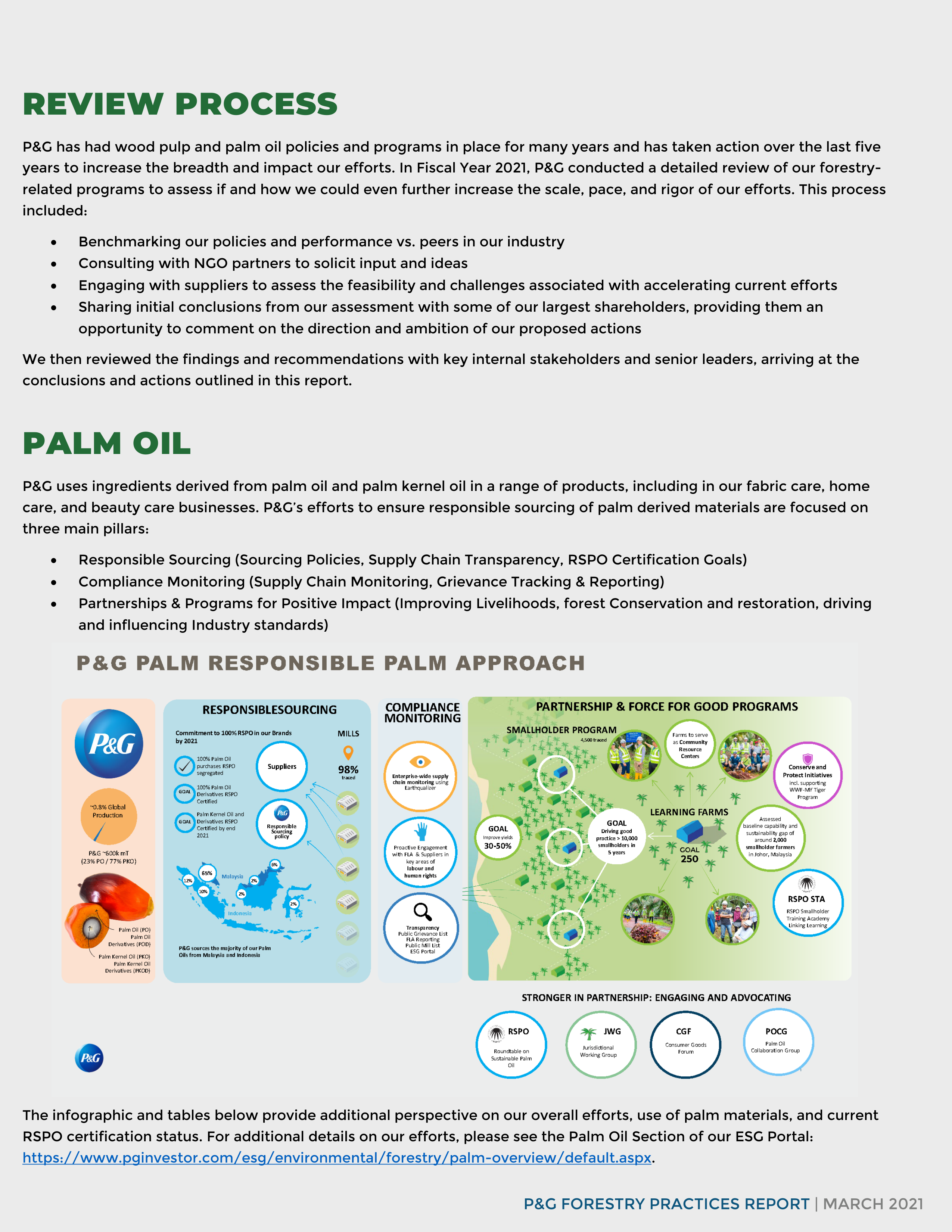
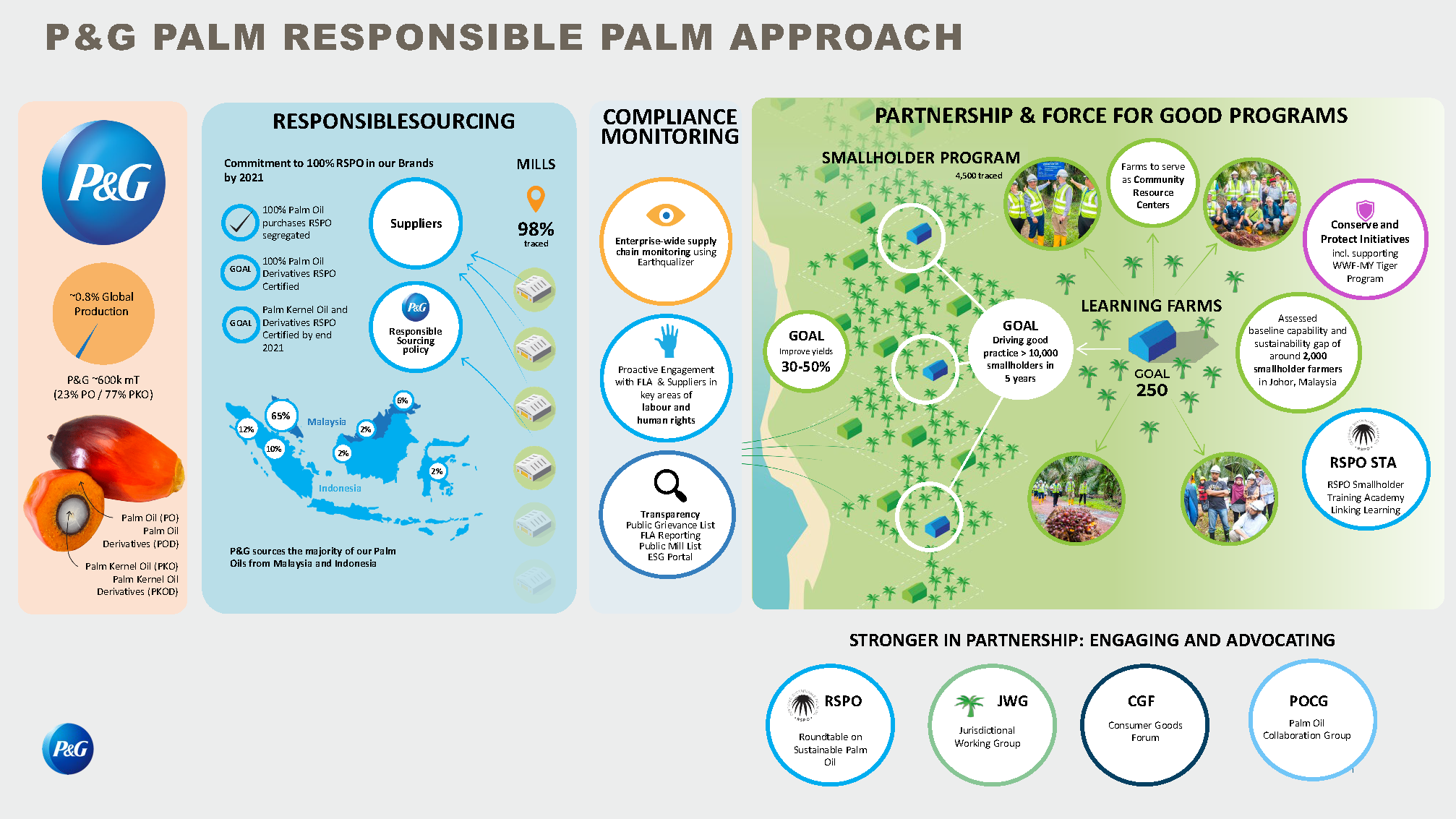
P&G uses ingredients derived from palm oil and palm kernel oil in a range of products, including in our fabric care, home
care, and beauty care businesses. P&G’s efforts to ensure responsible sourcing of palm derived materials are focused on
three main pillars:
•
Responsible Sourcing (Sourcing Policies, Supply Chain Transparency, RSPO Certification Goals)
•
Compliance Monitoring (Supply Chain Monitoring, Grievance Tracking & Reporting)
•
Partnerships & Programs for Positive Impact (Improving Livelihoods, forest Conservation and restoration, driving
and influencing Industry standards)
The infographic and tables below provide additional perspective on our overall efforts, use of palm materials, and current
RSPO certification status. For additional details on our efforts, please see the Palm Oil Section of our ESG Portal:
https://www.pginvestor.com/esg/environmental/forestry/palm-overview/default.aspx
.
P&G
PALM
RESPONSIBLE
PALM
APPROACH
-0
.8%Gklbal
Production
I
P&
G ~5
oo
k
mT
(23%
P0/77
%PK0 )
Pal
mK
emelO
il (
pt(
Q)
Pa
l
mKer
ro?ICll
De
riw
ti
ves
iPK
OO
)
RESPONSIBLESOURCING
COMPLIANCE
Commitment
to
100%
RSPO
In
our
Brilnds
MILLS
by2021
0
1DO'A
P
almOil
pcrchases
R
SPO
segr
ega
tro
e
100-A Palm
Oil
Oeriv;itive-;
R
SPO
Cl!ftifil!d
e
P
alm·
K·
!!rnelOi
l and
Der
i
va
tives
R
SPO
Cl!ftif1
l'dbyend
2021
P&G
5
aur
ce5
th
e
111,1
jo
rky
of°"'
Pa
lm
Oh
fr
om Malily.;ia a
nd
lndone5ia
98%
MONITORING
PARTNERSHIP
&
FORCE
FOR
GOOD PROGRAMS
SMALLHOLDER
PROGRAM
STRONGER
IN
PARTNERSHIP
: ENGAGING AND ADVOCATING
8
'
m
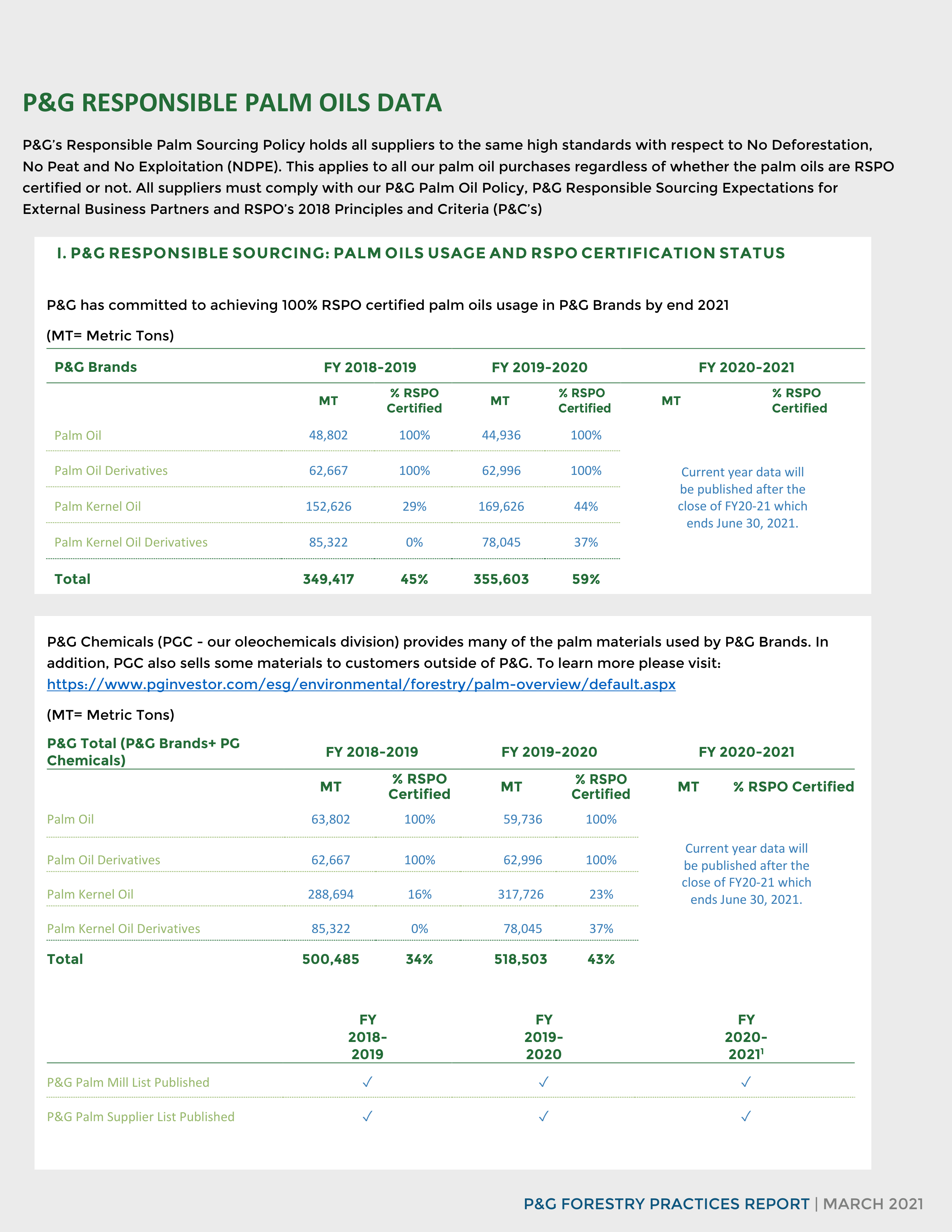

P&G FORESTRY PRACTICES REPORT
| MARCH 2021
P&G RESPONSIBLE PALM OILS DATA
P&G’s Responsible Palm Sourcing Policy holds all suppliers to the same high standards with respect to No Deforestation,
No Peat and No Exploitation (NDPE). This applies to all our palm oil purchases regardless of whether the palm oils are RSPO
certified or not. All suppliers must comply with our P&G Palm Oil Policy, P&G Responsible Sourcing Expectations for
External Business Partners and RSPO’s 2018 Principles and Criteria (P&C’s)
I.
P&G RESPONSIBLE SOURCING: PALM OILS USAGE AND RSPO CERTIFICATION STATUS
P&G has committed to achieving 100% RSPO certified palm oils usage in P&G Brands by end 2021
(MT= Metric Tons)
P&G Brands
FY 2018-2019
FY 2019-2020
FY 2020-2021
MT
% RSPO
Certified
MT
% RSPO
Certified
MT
% RSPO
Certified
Palm Oil
48,802
100%
44,936
100%
Current year data will
be published after the
close of FY20-21 which
ends June 30, 2021.
Palm Oil Derivatives
62,667
100%
62,996
100%
Palm Kernel Oil
152,626
29%
169,626
44%
Palm Kernel Oil Derivatives
85,322
0%
78,045
37%
Total
349,417
45%
355,603
59%
P&G Chemicals (PGC - our oleochemicals division) provides many of the palm materials used by P&G Brands. In
addition, PGC also sells some materials to customers outside of P&G. To learn more please visit:
https://www.pginvestor.com/esg/environmental/forestry/palm-overview/default.aspx
(MT= Metric Tons)
P&G Total (P&G Brands+ PG
Chemicals)
FY 2018-2019
FY 2019-2020
FY 2020-2021
MT
% RSPO
Certified
MT
% RSPO
Certified
MT
% RSPO Certified
Palm Oil
63,802
100%
59,736
100%
Current year data will
be published after the
close of FY20-21 which
ends June 30, 2021.
Palm Oil Derivatives
62,667
100%
62,996
100%
Palm Kernel Oil
288,694
16%
317,726
23%
Palm Kernel Oil Derivatives
85,322
0%
78,045
37%
Total
500,485
34%
518,503
43%
FY
2018-
2019
FY
2019-
2020
FY
2020-
2021
1
P&G Palm Mill List Published
✓
✓
✓
P&G Palm Supplier List Published
✓
✓
✓
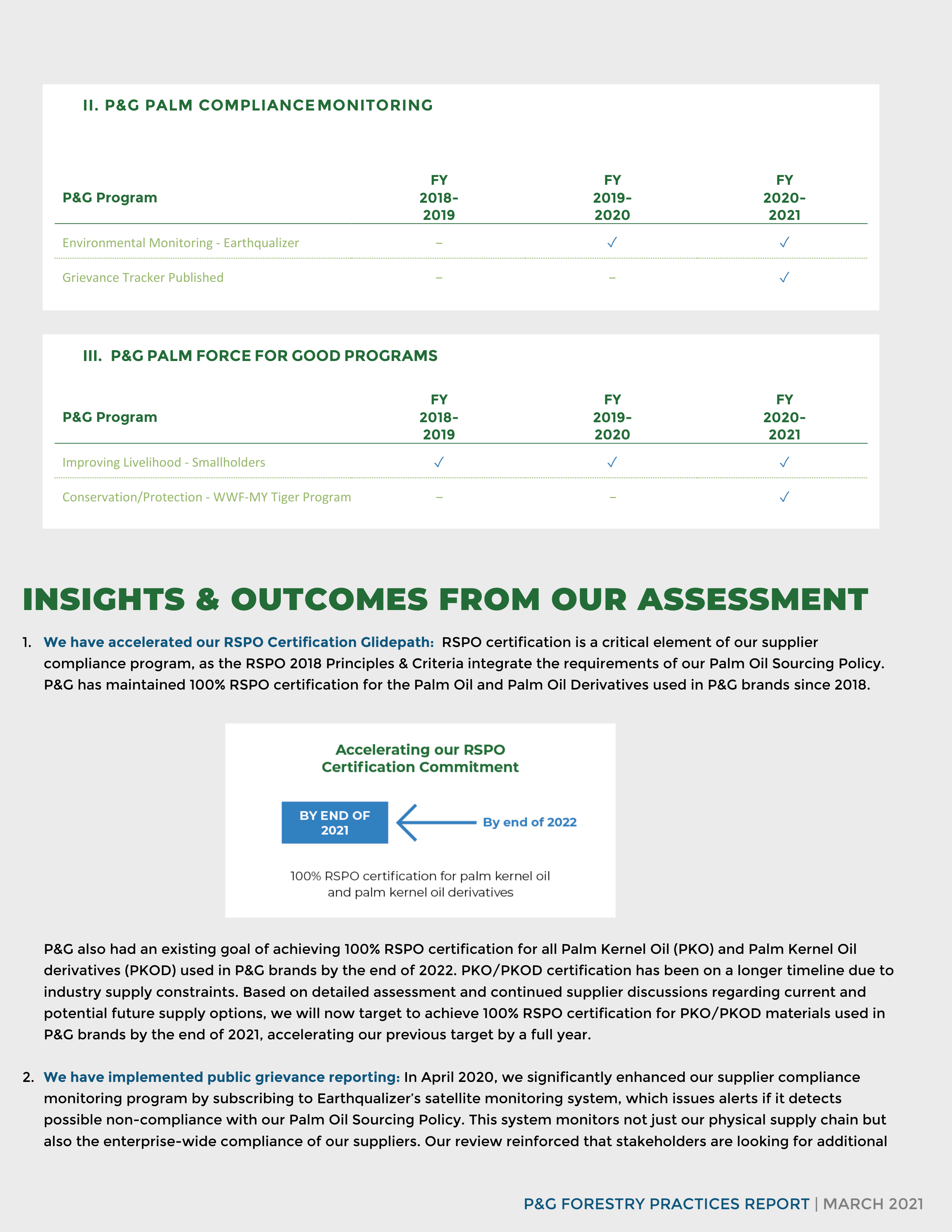

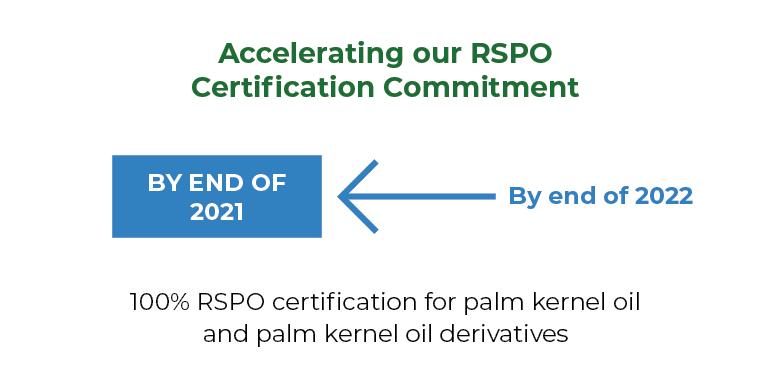
P&G FORESTRY PRACTICES REPORT
| MARCH 2021
INSIGHTS & OUTCOMES FROM OUR ASSESSMENT
1.
We have accelerated our RSPO Certification Glidepath:
RSPO certification is a critical element of our supplier
compliance program, as the RSPO 2018 Principles & Criteria integrate the requirements of our Palm Oil Sourcing Policy.
P&G has maintained 100% RSPO certification for the Palm Oil and Palm Oil Derivatives used in P&G brands since 2018.
P&G also had an existing goal of achieving 100% RSPO certification for all Palm Kernel Oil (PKO) and Palm Kernel Oil
derivatives (PKOD) used in P&G brands by the end of 2022. PKO/PKOD certification has been on a longer timeline due to
industry supply constraints. Based on detailed assessment and continued supplier discussions regarding current and
potential future supply options, we will now target to achieve 100% RSPO certification for PKO/PKOD materials used in
P&G brands by the end of 2021, accelerating our previous target by a full year.
2.
We have implemented public grievance reporting:
In April 2020, we significantly enhanced our supplier compliance
monitoring program by subscribing to Earthqualizer’s satellite monitoring system, which issues alerts if it detects
possible non-compliance with our Palm Oil Sourcing Policy. This system monitors not just our physical supply chain but
also the enterprise-wide compliance of our suppliers. Our review reinforced that stakeholders are looking for additional
III. P&G PALM FORCE FOR GOOD PROGRAMS
P&G Program
FY
2018-
2019
FY
2019-
2020
FY
2020-
2021
Improving Livelihood - Smallholders
✓
✓
✓
Conservation/Protection - WWF-MY Tiger Program
‒
‒
✓
II. P&G PALM COMPLIANCE MONITORING
P&G Program
FY
2018-
2019
FY
2019-
2020
FY
2020-
2021
Environmental Monitoring - Earthqualizer
‒
✓
✓
Grievance Tracker Published
‒
‒
✓
Accelerating our RSPO
Certification
Commitment
BY
END
OF
2021
•<----
By
end
of
2022
10
0% RSPO
ce
rtifi
catio
n
for
pa
lm
kernel oil
a
nd
pa
lm
kernel
oil de
ri
vat ives

P&G FORESTRY PRACTICES REPORT
| MARCH 2021
insight into the findings of this and other grievance reporting systems and the actions P&G is taking in response to
reports. As a result, we will now implement a system to publicly share information on grievances we receive via the
Earthqualizer system as well as P&G’s existing grievance reporting system. In addition, we will share the actions taken
against suppliers who have been in violation of our Palm Oil Sourcing Policy. Additional details on P&G’s Palm Oil
Grievance Tracker can be found here:
https://s1.q4cdn.com/695946674/files/doc_downloads/esg/2021/PG_ESG_Palm_Oils_Grievance_Tracker_FINAL.pdf
3.
We have strengthened our Palm Oil Sourcing Policy
:
Our review also identified the need to clarify and update certain
aspects of our Palm Oil Sourcing Policy. Accordingly, we updated our supply chain expectations, clarifying and revising
aspects like cut-off dates, restoration expectations, and the protection of human rights, land rights, and environmental
supporters. We also integrated into the Policy the enhanced compliance monitoring and grievance tracking discussed
above. Our updated policy can be found attached and here:
https://s1.q4cdn.com/695946674/files/doc_downloads/esg/2021/PG_ESG_FOREST_POSITIVE_PALM_SOURCING_PO
LICY_FINAL.pdf
4.
We will continue to advance Conservation and Restoration Efforts:
P&G’s palm oil efforts have included a formal
program to improve the livelihood of palm smallholders (small, independent farmers) by helping them increase their
yields from existing lands. P&G created the Centre for Sustainable Smallholders and is developing core learning farms,
where agronomists work with smallholders to implement agricultural practices that have been shown to increase yields
by up to 30%.
In 2019 we communicated our intent to expand the scale and scope of our efforts
to include conservation
and protection of sensitive areas in key sourcing regions. After evaluating potential opportunities, we have now
launched our first project: a partnership with WWF-Malaysia to support tiger conservation in Malaysia. Additional details
on this effort can be found here:
https://www.wwf.org.my/media_and_information/media_centre/?28585/PG-
Partners-with-WWF-Malaysia-to-Protect-the-Malayan-Tiger-and-its-Habitat
5.
We are committed to continuing to review and identify opportunities
to increase our palm oil efforts. We have
integrated these new program attributes into the information in our online portal and will continue to provide updates
on our progress and programs here:
https://www.pginvestor.com/esg/environmental/forestry/palm-
overview/default.aspx
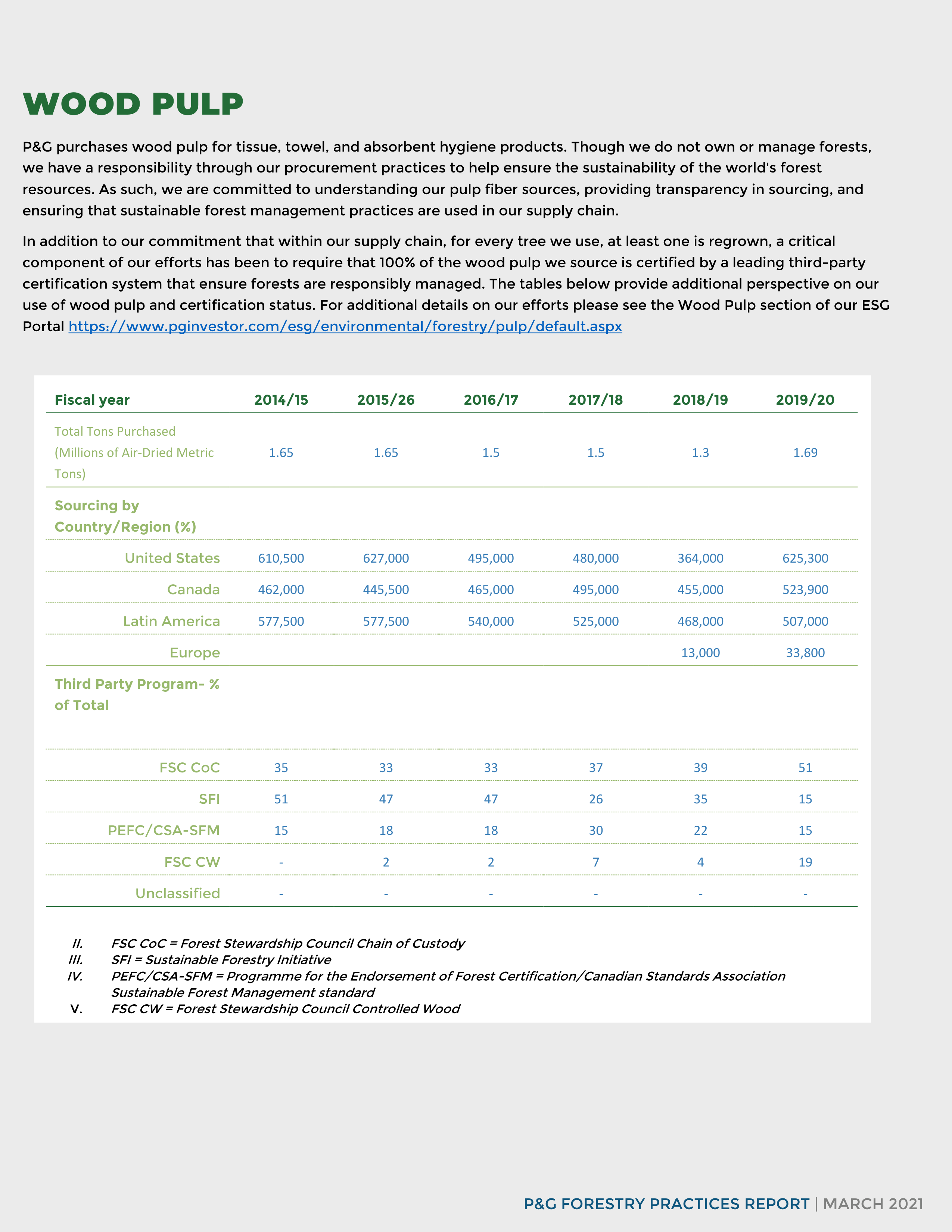

P&G FORESTRY PRACTICES REPORT
| MARCH 2021
WOOD PULP
P&G purchases wood pulp for tissue, towel, and absorbent hygiene products. Though we do not own or manage forests,
we have a responsibility through our procurement practices to help ensure the sustainability of the world's forest
resources. As such, we are committed to understanding our pulp fiber sources, providing transparency in sourcing, and
ensuring that sustainable forest management practices are used in our supply chain.
In addition to our commitment that within our supply chain, for every tree we use, at least one is regrown, a critical
component of our efforts has been to require that 100% of the wood pulp we source is certified by a leading third-party
certification system that ensure forests are responsibly managed. The tables below provide additional perspective on our
use of wood pulp and certification status. For additional details on our efforts please see the Wood Pulp section of our ESG
Portal
https://www.pginvestor.com/esg/environmental/forestry/pulp/default.aspx
Fiscal year
2014/15
2015/26
2016/17
2017/18
2018/19
2019/20
Total Tons Purchased
(Millions of Air-Dried Metric
Tons)
1.65
1.65
1.5
1.5
1.3
1.69
Sourcing by
Country/Region (%)
United States
610,500
627,000
495,000
480,000
364,000
625,300
Canada
462,000
445,500
465,000
495,000
455,000
523,900
Latin America
577,500
577,500
540,000
525,000
468,000
507,000
Europe
13,000
33,800
Third Party Program- %
of Total
FSC CoC
35
33
33
37
39
51
SFI
51
47
47
26
35
15
PEFC/CSA-SFM
15
18
18
30
22
15
FSC CW
-
2
2
7
4
19
Unclassified
-
-
-
-
-
-
II.
FSC CoC = Forest Stewardship Council Chain of Custody
III.
SFI = Sustainable Forestry Initiative
IV.
PEFC/CSA-SFM = Programme for the Endorsement of Forest Certification/Canadian Standards Association
Sustainable Forest Management standard
V.
FSC CW = Forest Stewardship Council Controlled Wood
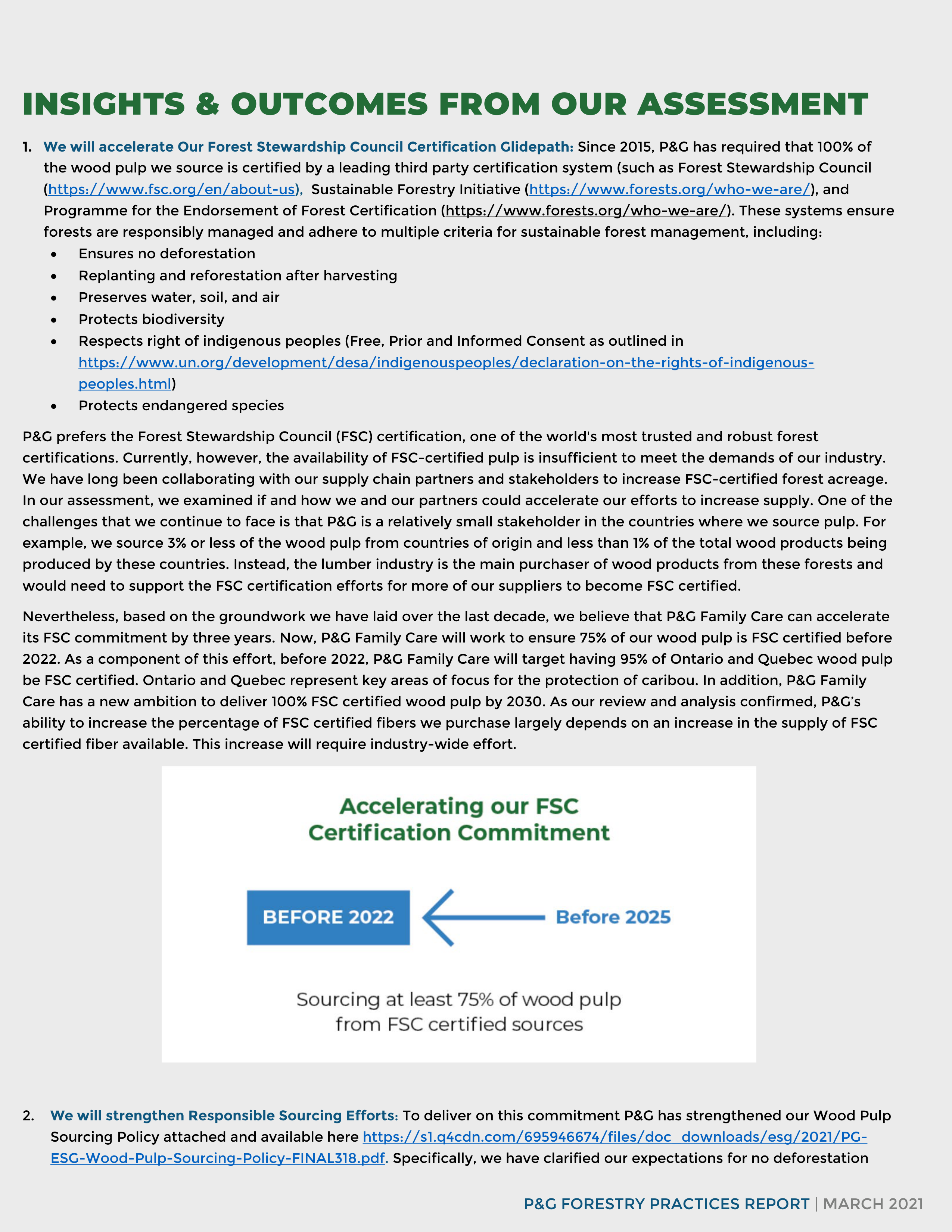

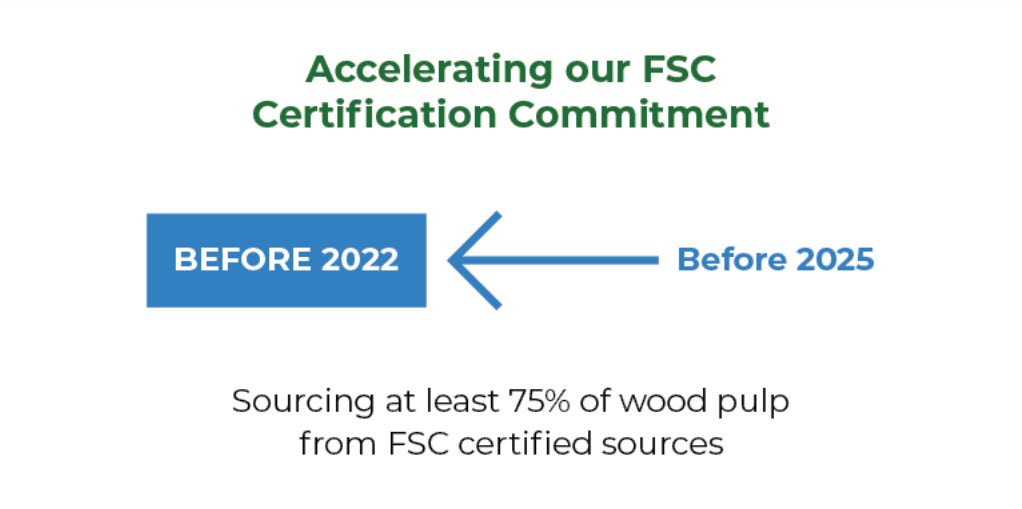
P&G FORESTRY PRACTICES REPORT
| MARCH 2021
INSIGHTS & OUTCOMES FROM OUR ASSESSMENT
1.
We will accelerate Our Forest Stewardship Council Certification Glidepath:
Since 2015, P&G has required that 100% of
the wood pulp we source is certified by a leading third party certification system (such as Forest Stewardship Council
(
https://www.fsc.org/en/about-us
),
Sustainable Forestry Initiative (
https://www.forests.org/who-we-are/
), and
Programme for the Endorsement of Forest Certification (https://www.forests.org/who-we-are/). These systems ensure
forests are responsibly managed and adhere to multiple criteria for sustainable forest management, including:
•
Ensures no deforestation
•
Replanting and reforestation after harvesting
•
Preserves water, soil, and air
•
Protects biodiversity
•
Respects right of indigenous peoples (Free, Prior and Informed Consent as outlined in
https://www.un.org/development/desa/indigenouspeoples/declaration-on-the-rights-of-indigenous-
peoples.html
)
•
Protects endangered species
P&G prefers the Forest Stewardship Council (FSC) certification, one of the world's most trusted and robust forest
certifications. Currently, however, the availability of FSC-certified pulp is insufficient to meet the demands of our industry.
We have long been collaborating with our supply chain partners and stakeholders to increase FSC-certified forest acreage.
In our assessment, we examined if and how we and our partners could accelerate our efforts to increase supply. One of the
challenges that we continue to face is that P&G is a relatively small stakeholder in the countries where we source pulp. For
example, we source 3% or less of the wood pulp from countries of origin and less than 1% of the total wood products being
produced by these countries. Instead, the lumber industry is the main purchaser of wood products from these forests and
would need to support the FSC certification efforts for more of our suppliers to become FSC certified.
Nevertheless, based on the groundwork we have laid over the last decade, we believe that P&G Family Care can accelerate
its FSC commitment by three years. Now, P&G Family Care will work to ensure 75% of our wood pulp is FSC certified before
2022. As a component of this effort, before 2022, P&G Family Care will target having 95% of Ontario and Quebec wood pulp
be FSC certified. Ontario and Quebec represent key areas of focus for the protection of caribou. In addition, P&G Family
Care has a new ambition to deliver 100% FSC certified wood pulp by 2030. As our review and analysis confirmed, P&G’s
ability to increase the percentage of FSC certified fibers we purchase largely depends on an increase in the supply of FSC
certified fiber available. This increase will require industry-wide effort.
2.
We will strengthen Responsible Sourcing Efforts
:
To deliver on this commitment P&G has strengthened our Wood Pulp
Sourcing Policy attached and available here
https://s1.q4cdn.com/695946674/files/doc_downloads/esg/2021/PG-
ESG-Wood-Pulp-Sourcing-Policy-FINAL318.pdf
.
Specifically, we have clarified our expectations for no deforestation
Accelerating our
FSC
Certification
Commitment
BEFORE
2022
•(-----
Before
2025
Sourcing
at
least 75%
of
wood
pulp
from
FSC
certified
sources

P&G FORESTRY PRACTICES REPORT
| MARCH 2021
confirmed the protection of the rights of Indigenous Peoples and included stricter forest certification requirements. In
addition, we will share the actions taken against suppliers who have been in violation of our Wood Pulp Sourcing
Policy.
3.
We will increase Sourcing Transparency:
For many years P&G has tracked and reported annually the amount of wood
pulp it purchases from suppliers certified under each of the forest certification schemes. As we assessed how we could
enhance our transparency in this area we recognized an opportunity to provide more details about our sourcing to
external stakeholders. Accordingly, we will become an industry-leader in wood pulp transparency sharing additional
data on metrics like sourcing volume, regions, certification schemes, relative size of sourcing, tree harvesting timing,
and others. This information can be found via our new ESG portal.
4.
We will advance Conservation Efforts:
P&G and our Family Care brands go beyond responsible sourcing and support
efforts to keep forests as forests for generations to come. We established several new efforts this past year and have
been able to expand on a number of them.
•
P&G has been collaborating with the Arbor Day Foundation to plant 1 million trees between 2020-2025 in areas
devasted by natural disasters, an increase in our initial commitment to the program. Generations to come will see
the long-term benefits of trees planted, through a restored ecosystem, carbon sequestration and improved air and
water quality for local communities.
•
Since July 2020, P&G Family Care, pulp supplier Suzano, and World Wildlife Fund have been collaborating on the
Atlantic Forest Landscape Restoration Project in Brazil. This effort will produce forest landscape restoration and
rehabilitation plans and methodologies for several degraded forest and agricultural landscapes in the Brazilian state
of Espírito Santo.
•
In November 2020, we joined with longtime partner the Rainforest Alliance on its launch of the Forest Allies
Community of Practice, serving as a founding member. The Forest Allies community is focused on protecting,
restoring, and enabling responsible management of tropical forests.
•
We continue to work with the Nature Conservancy and the American Forest Foundation to help family forest owners
in the U.S. better manage their forests
More information on these programs is available at
https://us.pg.com/mapping-our-impact/
.
We will continue to partner with stakeholders to assess our programs and progress and look for new opportunities to
further enhance our efforts. We have integrated these new program elements into the information in our online portal
https://www.pginvestor.com/esg/environmental/forestry/pulp/default.aspx
.

P&G FORESTRY PRACTICES REPORT
| MARCH 2021
INCREASING TRANSPARENCY
& REPORTING
As part of our assessment process, we heard directly from investors and other stakeholders their desire for greater
transparency and reporting by companies on both general issues related to environmental, social, and governance topics
as well as the specific matters covered in this report. Therefore, to enhance our overall reporting and transparency, we will:
1.
Launch an online portal that will provide improved access to relevant information and data related to key ESG topics.
This portal will include relevant policies, a description of our overall management efforts, progress against goals, and
relevant data and metrics. We plan to evolve this content over time, but the initial version of this portal, which includes
the most up to date information on our palm oil and wood pulp efforts, is now available via
https://www.pginvestor.com/esg/esg-overview/default.aspx
.
2.
Respond to CDP Forest Survey
:
We will respond to the CDP Forest Survey during their next reporting window.
CONCLUSION
In conclusion, our assessment reinforced that supply chain and reporting issues related to wood pulp and palm oil are
complex and challenging. Nevertheless, we continue to learn from our supply chain and NGO partners and value the input
they have provided to this assessment and our efforts more generally. Further accelerating our work will require all
stakeholders – industry, government, and civil society – to work collaboratively toward our shared goal of eliminating
deforestation and the degradation of intact forests. As we do our part, we will continue to partner with others to help
further accelerate positive impacts and will remain committed to transparently communicating our challenges and
progress.
Attachment A: Palm Oil Sourcing Policy
(updated March 2021)
Attachment B: Wood Pulp Sourcing Policy
(updated March 2021)

Exhibit D




P&G’S FOREST
POSITIVE
SOURCING
POLICY
Protection of forests and other natural ecosystems is
critical for maintaining biodiversity, combating climate
change, and sustaining livelihoods. As part of our overall
sustainability goals, P&G is committed to eliminating
deforestation and ecosystem conversion from our supply
chains and safeguarding human rights across our
operations and suppliers. Given that wood pulp, fiber-
based packaging, and palm oil are valuable renewable
resources, we have a sourcing policy to address each
commodity.
P&G sources wood pulp for tissue, towel, and absorbent
hygiene products and palm oil for fabric, home, and
personal care products. We also source paper-based
packaging to house and transport our products. We will
diligently pursue sourcing that protects forests and the
communities that rely on them. We aim to eliminate
deforestation, protect or conserve special sites, respect
human and labor rights, and affirm the rights of
Indigenous Groups.
OCTOBER
2021
IT'S
OUR
HOME
,
..
P&G's
Forest
Positive
Sourcing
Policy


WOOD PULP SOURCING POLICY
P&G sources wood pulp that is used in the production of products in Family
Care, Baby Care, and Feminine Care business units such as paper towels,
diapers, feminine hygiene products, and toilet paper. P&G will ensure the
forests harvested for our pulp are managed sustainably and responsibly. As part
of this effort, we will continuously review all pulp suppliers to ensure they are
providing us with sustainably sourced fiber that complies with this policy.
INCREASE FOREST POSITIVE IMPACTS
NO ILLEGAL LOGGING
NO DEFORESTATION
•
•
•
OCTOBER
2021
P&G is
focused
on
having
a
Forest
Positive
impact
and
as
such,
suppliers
are
expected
to
play
a
part
in
conservation
and
restoration
efforts
beyond
maintaining
forest
certification
.
Projects
such
as
reforestation
efforts
,
improving
degraded
lands
,
partnering
with
Indigenous
Peoples,
and
protecting
endangered
species
are
elements
of
our
Forest
Positive
approach
.
P&G
will
not
use
illegally
sourced
fiber
or
conflict
timber
in
our
products
.
We
will
document
that
fiber
is
legally
harvested
and
that
other
legal
requirements
are
met.
P&G
does
not
allow
deforestation
and
does
not
permit
forest
degradation
in
our
sourcing
.
The
cutoff
date
after
which
deforestation
or
conversion
is
considered
non-compliant
is
November
1,
1994
.
Permanent
conversion
of
land
from
forests
to
non-forest
increases
greenhouse
gas
emissions
and
has
negative
effects
on
biodiversity
and
the
local
communities
that
rely
on
them.
P&G
works
with
suppliers
and
stakeholders
to
address
deforestation
concerns
in
high-risk
areas. P&G's
commitment
to
increasing
the
use
ofthird-
party
certification
lowers
the
risk
of
deforestation
and
forest
degradation
within
our
supply
chain.
P&G
does
not
support
conversion
of
forests
to
non-natural
ecosystems
in
our
supply
chain
.
In
restricted
situations
,
conversion
of
forest
to
other
non-forest
rare
natural
ecosystems
such
as
wetlands,
savannahs
,
and
native
grasslands
could
occur.
The
following
conversion
types
are
not
allowed
in
our
supply
chain:
Agricultural
land
including
commercial
crops
or
livestock
Commercial
and
residential
developments
Tree
plantations
with
non-native
trees,
heavy
reliance
on
chemicals
,
or
lack
key
elements
of
natural
forests
2
P&G's
Forest
Positive
Sourcing
Policy


PROTECT HIGH CONSERVATION VALUE (HCV) AREAS
RESPECTING HUMAN RIGHTS
•
•
FREE, PRIOR AND INFORMED CONSENT
MINIMUM FOREST CERTIFICATION
OCTOBER
2021
P&G
will
source
only
from
suppliers
that
do
not
harvest
from
forests
that
are
mapped
High
Conservation
Value
(HCV)
areas
without
third-party
certification.
HCV
areas
have
been
designated
to
have
critical
or
important
environmental,
cultural,
ecological,
or
landscape
values.
These
areas also
include
peatlands
and
high
carbon
stock
forests
. P&G
supports
multi-stakeholder
efforts
to
develop
information
sources
and
tools
that
will
help
suppliers
identify
these
areas
on
their
own
properties
and
in
their
procurement
of
wood
raw
materials
from
third-parties
(e.g.
www
.
hcvnetwork
.
org
).
At
P&G,
respect
for
Human
Rights
is
fundamental
to
the
way
we
manage
our
business
.
We
support
the
U.N.
Guiding
Principles
for
Business
and
Human
Rights
which
respects
and
honors
the
principles
of
internationally
recognized
human
rights
including
:
Those
rights
expressed
in
The
International
Bill
of
Human
Rights
(i.e.,
Universal
Declaration
of
Human
Rights
and
the
International
Covenants
on
Economic,
Social
and
Cultural
Rights
and
Civil &
Political
Rights.)
and
The
principles
concerning
fundamental
rights
as
set
out
in
the
International
Labor
Organization
Declaration
on
Fundamental
Principles
and
Rights
at
Work
.
As
such,
suppliers
are
expected
to
have
the
necessary
policies
and
procedures
in
place
to
follow
P&G's
Responsible
Sourcing
Guidelines
for
External
Business
Partners
.
The
Guidelines
explain
the
global
standards
to
be
followed
on
behalf
of
P&G.
External
business
partners,
their
subcontractors
and
suppliers
are
expected
to
be
informed
of
and
share
P&G's
commitment
to
these
standards
. P&G
supports
the
United
Nations
Declaration
on
the
Rights
of
Indigenous
Peoples
,
which
declares
that
indigenous
peoples
have
the
right
to
full
enjoyment,
as a
collective
or
as
individuals,
of
all
human
rights
and
fundamental
freedoms
.
P&G
respects
the
rights
of
indigenous
and
local
communities
to
give
or
withhold
their
free,
prior,
and
informed
consent
(FPIC)
for
development
of
land
they
own
legally,
communally
or
by
customary
rights
.
On
an
ongoing
basis,
we
expect
our
suppliers
to
have
the
necessary
mechanisms
in
place
to
respect,
protect,
and
promote
FPIC,
particularly
in
the
case
of
Indigenous
Peoples.
The
FPIC
processes
should
be
done
in
a
culturally
appropriate
manner
and
follow
credible
methodologies
such
as
the
UN-REDD
(2012)
Guidelines
on
Free.
Prior
and
Informed
Consent
and
FAO (2015) Free.
Prior
and
Informed
Consent
Manual.
To
support
the
implementation
of
our
environmental
and
social
commitments,
all
wood
pulp
sourced
by
P&G is
required
to
be
certified
by
one
of
the
following
third-party
certification
systems:
Forest
Stewardship
Council®
(FSC®).
Sustainable
Forestry
Initiative®
3
P&G's
Forest
Positive
Sourcing
Policy


•
•
•
ENSURE EFFICIENT USE OF RESOURCES
•
•
•
•
OCTOBER
2021
(SFI
®
),
or
Programme
for
the
Endorsement
of
Forest
Certification
(PEFC).
Within
these
systems
, P&G
only
accepts
the
following
certification
claims
:
FSC:
FSC
700%,
FSC
Mix
Credit,
and
FSC
Controlled
Wood
SFI: 700%
SFI
Certified
Chain
of
Custody
PEFC: 700% PEFC
Certified
Chain
of
Custody
These
claims
require
rigorous
annual
third-party,
independent
audits
of
forests
and
reviews
of
supplier's
internal
due
diligence
systems.
Critical
criteria
essential
to
sustainable
forest
management
evaluated
during
these
audits
include,
but
are
not
limited
to
,
high
conservation
value
areas,
protection
of
endangered
species, UN DRIP
and/or
FPIC
for
Indigenous
Peoples
and
local
communities,
and
deforestation
or
conversion
.
These
audits
must
be
conducted
by
companies
accredited
to
conduct
forest
management
audits
by
Assurance
Services
International
or
the
International
Accreditation
Service
such
as
Preferred
by
Nature,
PwC
,
SCS
Global
Services,
SGS,
SAi
Global
,
and
KPMG.
P&G
has
preference
for
FSC
certified
materials
and
encourages
suppliers
to
get
their
sourcing
forests
and
supply
chains
fully
FSC
certified
to
the
FSC
Forest
Management
Standard
. P&G
joins
many
premier
environmental
non-governmental
organizations
in
considering
FSC
the
gold-standard
of
forestry
certification
systems
.
FSC
protects
biodiversity
and
ecosystems,
supports
Indigenous
Peoples
and
local
communities,
and
protects
sensitive
lands.
P&G
believes
that
we
should
invest
our
resources
where
we
can
make
the
greatest
sustainability
improvements
and
will
partner
with
suppliers
to
:
Focus
on
source
reduction
in
the
long
term
or
use
of
less
fiber
through
development
of
innovative
technologies
that
provide
maximum
product
performance
using
minimal
fiber
.
Evaluate
the
use
of
non-forest
derived
sources
of
fiber
,
recognizing
that
alternatives
must
also
meet
principles
of
sustainable
management
.
Explore
and
implement
energy
and
w
ater
conservation
opportunities
in
our
paper
making
operations.
Invest
in
research
to
identify
the
technical
breakthroughs
needed
to
allo
w
us
to
use
alternative
fibers
in
our
premium
products
without
an
impact
on
product
performance,
manufacturing
efficiency,
resource
and
energy
usage
and
waste
generation
.
4
P&G's
Forest
Positive
Sourcing
Policy


RIGOROUS PREVENTION OF & MONITORING FOR NON-CONFORMANCE
•
•
•
ADDRESSING FORESTRY GRIEVANCES
OCTOBER
2021
P&G
continuously
reviews
wood
pulp
suppliers
to
ensure
they
provide
us
with
sustainably
sourced
fiber
and
follow
this
policy.
To
evaluate
compliance
suppliers
are
required
to
participate
in:
Semiannual
sustainability
desk-side
audits
Biennial
forest
field
assessments
including
management
plan
appraisal
Quarterly
evaluations
of
sustainability
efforts
and
plans
.
These
processes
include
reviews
of
deforestation
,
biodiversity,
high
conservation
value
areas,
and
Indigenous
Peoples'
rights,
including
FPIC. P&G
meets
with
relevant
Indigenous
People
and
local
communities
to
understand
their
perspective
on
the
supplier
's free,
prior
,
and
informed
consent
process
to
ensure
the
engagement
is
taking
place
in
a
culturally
appropriate
manner,
place,
and
time
.
When
necessary,
we
will
bring
in
expert
third
parties
to
assist
in
these
evaluations
.
The
P&G
Business
Conduct
System
and
the
Worldwide
Business
Conduct
Helpline
are
other
mechanisms
P&G uses
to
monitor
compliance.
It
is a
grievance
system
to
allow
those
both
inside
and
outside
the
company
to
raise
concerns,
with
or
without
identification
.
Alleged
non-compliances
to
this
and
any
P&G
policies
identified
during
any
of
these
activities
will
follow
our
Forestry
Grievance
Process. This
three-phase
process
of
Evaluate,
Investigate,
and
Remediate
allows
P&G
to
ensure
our
policies
are
being
followed
.
Potential
actions
by
P&G
when
non-compliances
are
confirmed
are
to
engage,
suspend,
or
terminate
supplier
relationships
. Scale,
scope
,
and
irremediability
of
the
allegation
are
used
to
determine
the
level
of
P&G
response
.
More
details
can
be
found
in
the
Forestry
Grievance
Process
.
We
have
and
will
continue
to
share
the
results
and
status
of
investigations,
plans
,
and
actions
taken
at
P&G's
ESG
for
Investors
website
.
All
public
disclosures
will
maintain
confidentiality
of
anonymous
grievance
submitters
and
proprietary
information.
5
P&G's
Forest
Positive
Sourcing
Policy
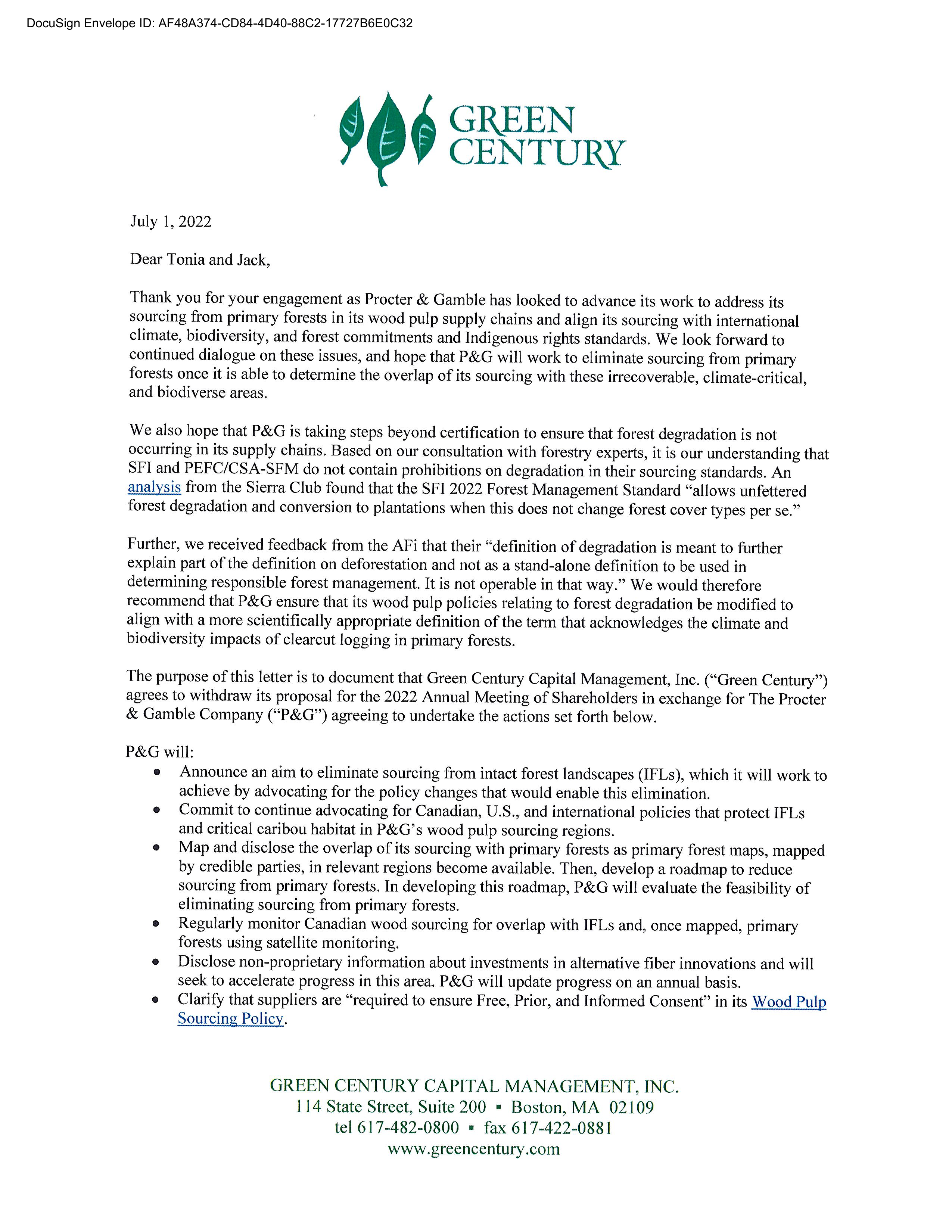
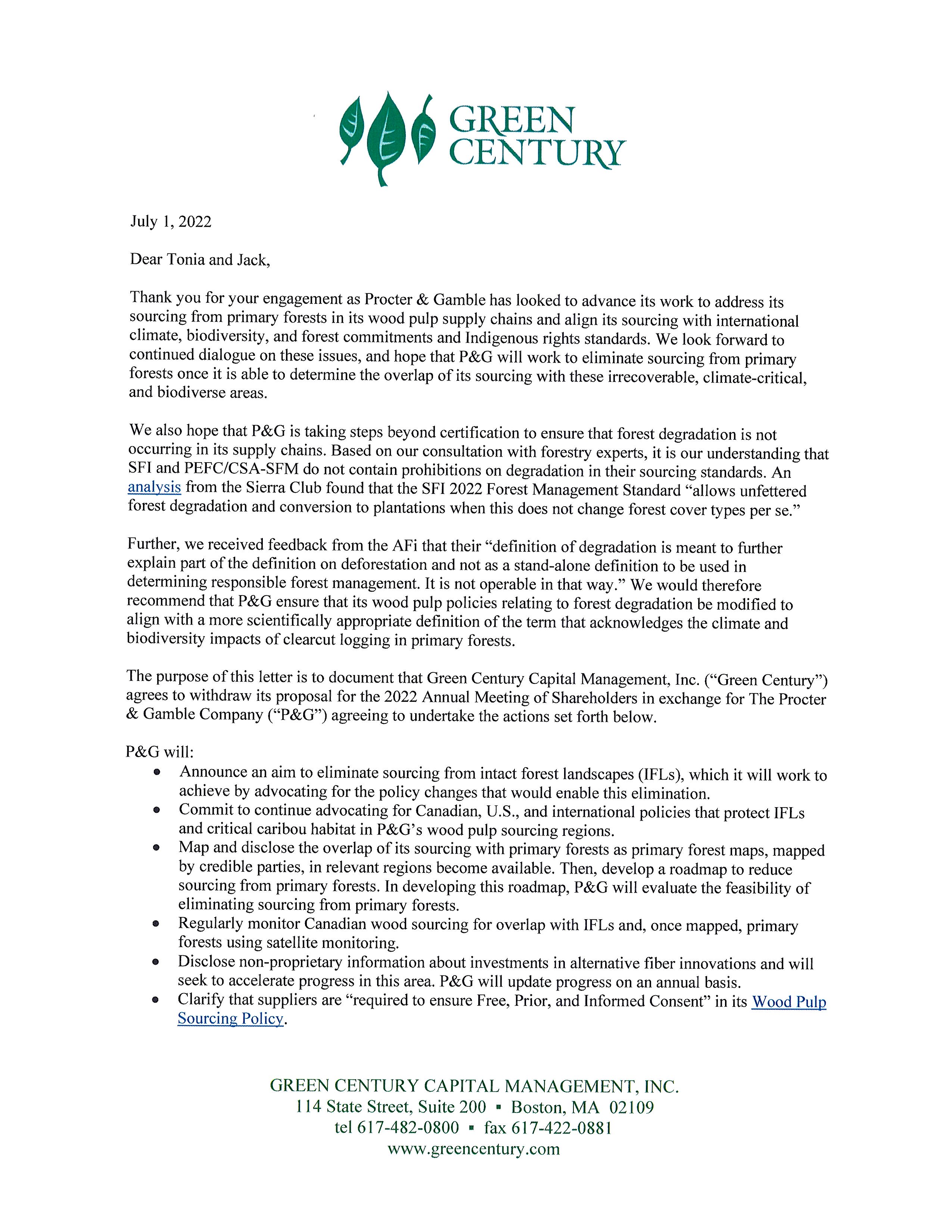
DocuSign Envelope ID: AF48A374-CD84-4D40-88C2-17727B6E0C32
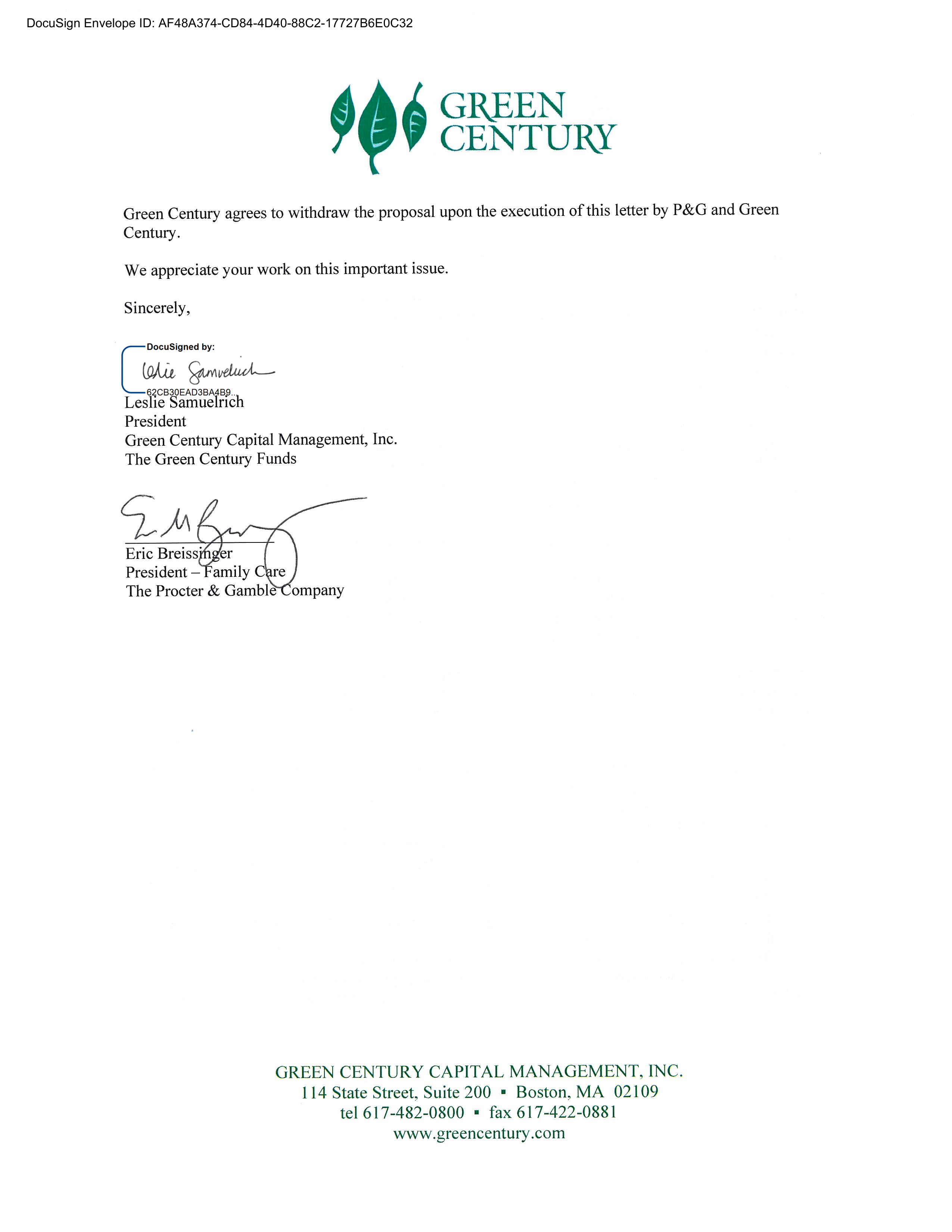

DocuSign Envelope ID: AF48A374-CD84-4D40-88C2-17727B6E0C32

Legal Division
1 Procter & Gamble Plaza
Cincinnati, OH 45202
July 13, 2022
By Electronic Mail to
shareholderproposals@sec.gov
Office of Chief Counsel
Division of Corporation Finance
U.S. Securities and Exchange Commission
100 F Street, N.E.
Washington, DC 20549
Re: The Procter & Gamble Company — Shareholder Proposal
Submitted by the Green Century Equity Fund
Ladies and Gentlemen:
In a letter dated June 7, 2022, The Procter & Gamble Company (the “Company”), by its
counsel, requested confirmation pursuant to Rule 14a-8(j) under the Securities Exchange Act of
1934, as amended, that the staff of the Division of Corporation Finance would not recommend
enforcement action to the U.S. Securities and Exchange Commission if the Company excluded a
shareholder proposal (the “Proposal”) submitted by the Green Century Equity Fund (“Green
Century”) from the proxy materials for its 2022 annual meeting of shareholders.
On July 12, 2022, Green Century confirmed its withdrawal of the Proposal by email to
the SEC and to the Company (attached as Exhibit A). In reliance thereon, the Company is
withdrawing its No-Action request.
If the Staff has any questions with respect to this matter, please contact me at (513) 983-
1100.
Very truly yours,
Aaron B. Shepherd
Director & Assistant General
Counsel
cc:
Thomas Peterson, Green Century Capital Management
Kerry S. Burke, Covington

EXHIBIT A