

50 South Sixth Street | Suite 1500 | Minneapolis, MN | 55402-1498 | T 612.340.2600 | F 612.340.2868 |
dorsey.com
February 4, 2025
VIA ONLINE SHAREHOLDER PROPOSAL PORTAL
U.S. Securities and Exchange Commission
Division of Corporation Finance
Office of Chief Counsel
100 F Street, NE
Washington, DC 20549
Re:
Delta Air Lines, Inc.
Shareholder Proposal of the Comptroller of the City of New York and
the SOC Investment Group
Securities Exchange Act of 1934
—
Rule 14a-8
Ladies and Gentlemen:
This letter is to inform you that our client Delta Air Lines, Inc. (“Delta” or the “Company”)
intends to omit from its proxy statement and form of proxy for its 2025 Annual Meeting of
Shareholders (collectively, the “Proxy Materials”) a shareholder proposal (the “Proposal”) and
statement in support thereof (the “Supporting Statement”) received from the Comptroller of the
City of New York and the SOC Investment Group (the “Proponents”), by letters dated January 3,
2025 and January 6, 2025, respectively.
Pursuant to Rule 14a-8(j) promulgated under the Securities Exchange Act of 1934, as amended
(the “Exchange Act”), we have:
•
filed this letter with the Securities and Exchange Commission (the “Commission”) no
later than eighty (80) calendar days before the Company intends to file its definitive
Proxy Materials with the Commission; and
•
concurrently sent a copy of this correspondence to the Proponents.
Rule 14a-8(k) and Staff Legal Bulletin No. 14D (Nov. 7, 2008) (“SLB 14D”) provide that
shareholder proponents are required to send companies a copy of any correspondence that the
proponents elect to submit to the Commission or the staff of the Division of Corporation Finance
(the “Staff”). Accordingly, we are taking this opportunity to inform the Proponents that if the
Proponents elect to submit additional correspondence to the Commission or the Staff with
respect to the Proposal, a copy of such correspondence should be furnished concurrently to the
undersigned on behalf of the Company pursuant to Rule 14a-8(k) and SLB 14D.

Division of Corporation Finance
Office of Chief Counsel
February 4, 2025
Page 2
THE PROPOSAL
The Proposal states:
RESOLVED:
Investors request that the Board of Directors prepare a report on Delta Air Lines’
(“Delta”) efforts to address heat-related dangers to workers throughout its operations.
The report should be produced at reasonable cost, exclude confidential or proprietary
information, and should be disclosed on Delta’s website no later than December 31,
2025.
A copy of the Proposal and the Supporting Statement is attached to this letter as Exhibit A.
BASES FOR EXCLUSION
We hereby respectfully request that the Staff concur in our view that the Proposal may be
excluded from the Proxy Materials pursuant to:
•
Exchange Act Rule 14a-8(i)(7), on the basis that the Proposal relates to, and does not
transcend, the Company’s ordinary business operations, and
•
Exchange Act Rule l4a-8(i)(10), on the basis that the Company has substantially
implemented the Proposal.
In reliance on the announcement by the Staff, we have omitted all correspondence that is not
directly relevant to this no-action request. See Announcement Regarding Personally Identifiable
and Other Sensitive Information in Rule 14a-8 Submissions and Related Materials,
available at
https://www.sec.gov/corpfin/announcement/announcement-14a-8-submissions-pii-20211217
(last updated Dec. 17, 2021).
BACKGROUND
Delta’s culture of care calls for the Company to listen actively, seek input regularly and respond
to employee feedback in connection with the Company’s goal to prioritize the overall wellness,
including physical wellness, of Delta’s more than 100,000 employees. In regards to workplace
safety, Delta continues to enhance its approach to combat the risks that extreme heat poses to its
workers throughout its operations.
•
The Company works with aircraft manufacturers to evaluate and improve the safety of
Delta aircraft under extreme heat.

Division of Corporation Finance
Office of Chief Counsel
February 4, 2025
Page 3
•
The Company requires all ground employees to complete training to help recognize the
signs and symptoms of heat stress and heat stroke and to take appropriate actions.
•
Delta complies with breathability standards to ensure employee uniforms function well in
the heat.
•
On high heat days, Delta offers a range of additional protective gear and services,
including water stations and cooling towels, and the Company implements precautionary
measures to keep its employees safe and comfortable.
•
In 2024, Delta expanded its temperature alert system to include heat, so that local stations
can be alerted of hot weather conditions. These alerts help teams enact their hot weather
plans to prepare employees and ground support equipment, and to ensure cool
temperatures onboard the aircraft.
•
Delta is upgrading air conditioning units across its system, and developed alerting
notifications that identify stations that reach certain parameters that may increase their
risk of a hot cabin event occurring. These alerts allow for timely preparation – not only of
Delta’s equipment to support onboard customers, but also so that Delta’s employees, who
are exposed to higher outside air temperatures, have the necessary means to manage
them. In 2024, Delta invested $4 million in air conditioning units at stations with the
highest risk of hot cabins.
Since 2017, Delta has maintained an Federal Aviation Administration (“FAA”) accepted Safety
Management System, which provides the enterprise structure for identifying and managing
safety risks and promoting safety culture. Delta remains compliant with Occupational Safety and
Health Administration (“OSHA”) Federal and State regulations intended to address heat-related
injuries and illnesses; this includes the use of OSHA-mandated Workplace Hazard Assessments
(“WHA”).
Beyond regulatory compliance, since 2023 Delta has proactively partnered with the Korey
Stringer Institute to aid Delta in evaluating safety aspects of employee uniforms and promoting
the use of Heat and Cold Stress Injury Prevention Plans through roadshows across the Delta
system. These plans are described in greater detail under Section II.B of this letter. The Korey
Stringer Institute aims to be a world-renowned leader, in part, by developing
and disseminating practical strategies to promote health and safety best practices. Further, Delta
is an active member of several prominent industry groups including the Airlines for America
(A4A) Safety Council, A4A Ground Safety Group (currently serving as Vice Chair), the
National Safety Council and the American Industrial Hygiene Association. Delta routinely
exchanges best practices and benchmarks safety performance through these venues, including
mitigation practices for heat related issues.

Division of Corporation Finance
Office of Chief Counsel
February 4, 2025
Page 4
ANALYSIS
I.
The Proposal May Be Excluded Under Rule 14a-8(i)(7) Because the Proposal
Relates To, and Does Not Transcend, The Company
’
s Ordinary Business
Operations.
The Proposal requests a report on the Company’s procedures regarding workplace safety,
specifically pertaining to the Company’s “efforts to address heat-related dangers to workers
throughout its operations.” As discussed below, the Proposal may be omitted under Rule 14a-
8(i)(7) as it relates to the Company’s ordinary business of maintaining a safe workplace, and it
does not focus on any significant social policy issue that transcends the Company’s ordinary
business operations.
A.
Background on the Standard.
Rule 14a-8(i)(7) permits a company to omit from its proxy materials a shareholder proposal that
relates to the company’s “ordinary business” operations. According to the Commission’s release
accompanying the 1998 amendments to Rule 14a-8, the term “ordinary business” refers to
matters that are not necessarily “ordinary” in the common meaning of the word, but instead the
term “is rooted in the corporate law concept [of] providing management with flexibility in
directing certain core matters involving the company’s business and operations.” Exchange Act
Release No. 34-40018 (May 21, 1998) (the “1998 Release”). In the 1998 Release, the
Commission stated that the underlying policy of the ordinary business exclusion is “to confine
the resolution of ordinary business problems to management and the board of directors, since it is
impracticable for shareholders to decide how to solve such problems at an annual shareholders
meeting.”
The ordinary business exclusion rests on two central considerations.
Id
. The first consideration,
which is applicable to this Proposal, is the subject matter of the proposal: that “[c]ertain tasks
are so fundamental to management’s ability to run a company on a day-to-day basis that they
could not, as a practical matter, be subject to direct shareholder oversight.” The Commission
cited examples of such ordinary business tasks, including “management of the workforce, such
as the hiring, promotion, and termination of employees, decisions on production quality and
quantity, and the retention of suppliers.”
Id
. The second consideration is the degree to which the
proposal attempts to “micro-manage” the company by “probing too deeply into matters of a
complex nature upon which shareholders, as a group, would not be in a position to make an
informed judgment.”
Id
.
In Staff Legal Bulletin No. 14L (Nov. 3, 2021) (“SLB 14L”), the Staff has recently taken the
position that shareholder proposals “focusing on sufficiently significant social policy issues . . .
generally would not be considered to be excludable, because the proposals would transcend the

Division of Corporation Finance
Office of Chief Counsel
February 4, 2025
Page 5
day-to-day business matters and raise policy issues so significant that it would be appropriate for
a shareholder vote.” In determining whether a proposal presents a policy issue that transcends
the ordinary business of the company, the Staff noted that it will focus on “the social policy
significance of the issue that is the subject of the shareholder proposal. In making this
determination, the [S]taff will consider whether the proposal raises issues with a broad societal
impact, such that they transcend the ordinary business of the company,” regardless of whether a
nexus exists between the policy issue and the company.
Id
.
Additionally, a shareholder proposal being framed in the form of a request for a report does not
change the nature of the proposal. The Commission has stated that a proposal requesting the
dissemination of a report may be excludable under Rule 14a-8(i)(7) if the subject matter of the
proposed report is within the ordinary business of the issuer. See Exchange Act Release No. 34-
20091 (Aug. 16, 1983); and
Johnson Controls, Inc.
(avail. Oct. 26, 1999) (“[Where] the subject
matter of the additional disclosure sought in a particular proposal involves a matter of ordinary
business . . . it may be excluded under [R]ule 14a-8(i)(7).”).
B.
The Proposal Is Excludable Because It Relates to The Ordinary Business of
Delta’s Workplace Safety Policies.
The Staff has long allowed companies to exclude, as relating to ordinary business operations,
proposals seeking to influence management’s decisions with respect to workplace safety matters,
because such decisions fit squarely within the management function of a company and require
complex analyses beyond the ability of shareholders as a group. In
Amazon.com, Inc
. (Apr. 1,
2020, recon. denied, Apr. 9, 2020), the Staff concurred with the exclusion of a proposal that
requested a report that “describe[s] the [b]oard’s oversight process of safety management,
staffing levels, inspection and maintenance of [c]ompany facilities and equipment” and details
the company’s efforts to “reduce the risk of accidents” to its workforce. In allowing omission of
the proposal under Rule 14a-8(i)(7), the Staff noted that “the [p]roposal focuses on workplace
accident prevention, an ordinary business matter, and does not transcend the Company’s ordinary
business operations.” Similarly, in
AT&T Inc
. (avail. Mar. 14, 2024), the proposal requested a
report on the company’s “due diligence process for preventing health and safety violations in
AT&T’s supply chain for wireless communications services.” The Staff concurred in the
company’s argument that the proposal relates to ordinary business matters, including “a number
of complex considerations, which may include processes related to receiving reports of
compliance with various laws and regulations governing tower climber safety, the review and
selection of training programs and certifications, collaboration with industry organizations,
relationships with suppliers and contract negotiations.”
Id
. See also
Exxon Mobil Corporation
(avail. Mar. 22, 2022) (permitting exclusion of a proposal requesting a report on flaring events
and the risk of industrial accidents that may arise from the use of temporary replacement
workers);
The Home Depot, Inc.
(avail. Mar. 20, 2020) (permitting exclusion of a proposal
requesting a report on the company’s use of prison labor with the supporting statement citing to

Division of Corporation Finance
Office of Chief Counsel
February 4, 2025
Page 6
unsafe or unhealthy working conditions on the basis that the proposal was excludable as relating
to overall workplace safety, workplace conditions, and general worker compensation issues);
The
TJX Companies
(avail. Mar. 20, 2020) (same);
The Chemours Co
. (avail. Jan. 17, 2017)
(permitting exclusion of a proposal requesting a report “on the steps the [c]ompany has taken to
reduce the risk of accidents” on the basis that the proposal related to ordinary business
activities);
Pilgrim
’
s Pride Corp
. (avail. Feb. 25, 2016) (permitting exclusion of a proposal
requesting a report describing the company’s policies, practices, performance, and improvement
targets related to occupational health and safety).
Here, consistent with the precedent cited above, the Proposal is concerned with workplace safety
management, and seeks a report detailing the Company’s “efforts to address heat-related dangers
to workers throughout its operations.” The Supporting Statement reiterates this focus on
workplace safety, referencing recent increases in heat-related workplace fatalities across all
industries, and also references favorably various “domestic policy initiatives” aimed to inform or
improve corporate workplace safety procedures. As such, the Proposal directly relates to
workplace safety and the management of the Company’s workforce.
The Proposal is properly excludable under Rule 14a-8(i)(7) because the Company’s processes for
maintaining a safe workplace are a fundamental aspect of its day-to-day operations, and involve
many complex considerations best suited for the Company’s management. These considerations
include compliance with various laws and regulations pertaining to airport workplace safety
around the world, such as the regulations established by OSHA and state agencies governing
workplace safety, including for heat-related weather conditions. Other management
considerations include development and maintenance of Company-specific workplace safety
policies, collaboration with industry experts and airport partners regarding the latest information
and data aimed to improve the Company’s workplace safety policies, training of employees on
such policies, and updating aircraft technology to improve aircraft performance under heat
conditions. These processes form a part of Delta’s routine, day-to-day operations. For Delta,
workplace safety is an ordinary business matter that only Delta’s management can address and
cannot be subject to shareholder oversight as a practical matter. Thus, as in the precedent
discussed above, the Proposal may properly be excluded under Rule 14a-8(i)(7) as relating to the
Company’s ordinary business operations.
C.
The Proposal Does Not Focus on a Sufficiently Significant Social Policy Issue
That Transcends the Company’s Ordinary Business Operations.
In its 1998 Release, the Commission distinguished proposals pertaining to ordinary business
matters that are excludable under Rule 14a-8(i)(7) from those that “focus on” significant social
policy issues. The Commission stated, “proposals relating to [ordinary business] matters but
focusing on sufficiently significant social policy issues (e.g., significant discrimination matters)
generally would not be considered to be excludable, because the proposals would transcend the

Division of Corporation Finance
Office of Chief Counsel
February 4, 2025
Page 7
day-to-day business matters and raise policy issues so significant that it would be appropriate for
a shareholder vote.”
However, proposals that have only peripheral implications for a potentially significant social
policy issue such as human capital management are not enough to transform an otherwise
ordinary business proposal into one that transcends ordinary business. In
Amazon.com Inc.
(avail. Apr. 7, 2022), the Staff permitted exclusion of a proposal requesting a report on risks to
the company relating to the staffing of its business and operations, despite the suggestion by the
proponent that the focus was on human capital management.
See also Walmart Inc.
(avail. Apr.
8, 2019) (concurring with the exclusion of a proposal requesting that the board prepare a report
evaluating the risk of discrimination that may result from the company’s policies and practices
for hourly workers taking absences from work for personal or family illness because it related to
the company’s ordinary business operations, i.e., the company’s management of its workforce,
and “[did] not focus on an issue that transcends ordinary business matters”);
PetSmart, Inc.
(avail. Mar. 24, 2011) (concurring with the exclusion of a proposal requesting that the board
require suppliers to certify that they had not violated animal cruelty-related laws, finding that
while animal cruelty is a significant social policy issue, the scope of laws covered by the
proposals was too broad); and
Union Pacific Corp.
(avail. Feb. 25, 2008) (permitting exclusion
of the proposal under the ordinary business operations exclusion, despite the proposal’s request
for disclosure of the company’s efforts to protect its operations from terrorist attacks and “other
homeland security incidents.”).
Here, the Proposal presents a broad request that Delta commission a report on its “efforts to
address heat-related dangers to workers throughout its operations”, and cites industry-wide
incidents related to airport workplace safety involving extreme heat. While the Supporting
Statement makes reference to one heat-related incident occurring at the Company, the general
workplace safety concerns that arise in any workplace in which employees are tasked with
working outside in hot climates is not unique to Delta and does not transcend its day-to-day
operations of ensuring its policies protect its workers in all weather conditions. In contrast, the
Proposal does implicate a wide range of the Company’s ordinary business operations, including
compliance with applicable global laws and regulations, safety procedures required by various
airports, staffing considerations, and even first-aid procedures to be followed to address illness or
injury. As such, the Proposal’s broad scope necessarily implicates the Company’s ordinary
business operations and is excludable despite references to workplace safety and extreme heat as
a potential social policy.
Safety, including workforce safety, is Delta’s highest priority. The issues raised in the Proposal,
however, do not transcend the everyday management of employee safety issues that are incident
to the Company’s ordinary business operations. As with the proposals discussed above, even if
certain aspects of the Company’s workplace safety program were deemed to implicate significant
policy issues, the Proposal’s broad request does not transcend the day-to-day safety management

Division of Corporation Finance
Office of Chief Counsel
February 4, 2025
Page 8
issues that are incident to the Company’s ordinary business operations, and as such, the Proposal
is properly excludable under Rule 14a-8(i)(7).
The Company is aware that the Staff has been unable to concur with the exclusion of workforce
safety proposals under Rule 14a-8(i)(7) where the proposal related to the company’s role in
creating unsafe working conditions, but respectfully submits that the Proposal is distinguishable
from these precedents. For example, in
Amazon.com Inc.
(avail. Apr. 6, 2022), the proposal
requested that the company commission an audit and report on “working conditions and
treatment that [company] warehouse workers face, including the impact of its policies,
management, performance metrics, and targets”, citing in the supporting statement a state audit
of the company finding “a direct connection between Amazon’s employee monitoring and
discipline systems and workplace [injuries].” In
Dollar General Corp.
(avail. Mar. 31, 2023), the
proposal requested that the company commission an audit on “the impact of the company’s
policies and practices on the safety and well-being of workers,” citing the company’s OSHA
penalties incurred for “numerous willful, repeated, and serious workplace safety violations.” In
Dollar General Corp.
, the Staff noted that the proposal “transcend[ed] ordinary business matters
because it raises human capital management issues with a broad societal impact.” Additionally,
in
Uber Technologies, Inc.
(avail. March 21, 2024), the proposal requested that the board of
directors “commission an independent third-party audit on driver health and safety, evaluating
the effects of the Company’s performance metrics, policies, and procedures on driver health and
safety across markets,” citing studies indicating that drivers continued potentially unsafe rides
due to company policies on “deactivation or income loss.” The foregoing proposals raised
concerns about each company’s role in creating unsafe working conditions. Here, the Proposal is
distinguishable from these precedents because the Proposal does not contain any allegations that
the Company has violated any laws or regulations or otherwise adopted policies or procedures
that have led to safety violations or created an unsafe environment. To the extent that there have
been heat-related incidents, they have been isolated and quickly addressed instead of a product of
work conditions created by the Company’s policies or work conditions otherwise within the
Company’s control.
Because the Proposal relates to the ordinary business matters regarding the Company’s
workplace safety policies and procedures and does not raise an issue that transcends the
Company’s ordinary business operations, the Proposal is excludable under Rule 14a-8(i)(7).
II.
The Proposal May Be Excluded under Rule 14a-8(i)(10) Because the Proposal Has
Been Substantially Implemented.
A.
Background on the Standard.
Rule 14a-8(i)(10) permits a company to exclude a shareholder proposal from its proxy materials
if “the company has already substantially implemented the proposal.” The Commission stated in

Division of Corporation Finance
Office of Chief Counsel
February 4, 2025
Page 9
1976 that the predecessor to Rule 14a-8(i)(10) was “designed to avoid the possibility of
shareholders having to consider matters which already have been favorably acted upon by the
management.” SEC Release No. 34-12598 (July 7, 1976). Originally, the staff narrowly
interpreted this predecessor rule and granted no-action relief only when proposals were “‘fully’
effected” by the company. SEC Release No. 34-19135 (Oct. 14, 1982). By 1983, however, the
Commission recognized that the “previous formalistic application of [the rule] defeated its
purpose” because proponents were successfully convincing the Staff to deny no-action relief by
submitting proposals that differed from existing company policy by only a few words. SEC
Release No. 34-20091 (Aug. 16, 1983). Therefore, in 1983, the Commission adopted a revised
interpretation to the rule to permit the omission of proposals that had been “substantially
implemented” and subsequently codified this revised interpretation in SEC Release No. 34-
40018 (May 21, 1998). Thus, when a company has already taken action to address the
underlying concerns and essential objectives of a shareholder proposal, the proposal has been
“substantially implemented” and may be excluded. See, e.g.,
General Mills, Inc.
(avail. Aug. 6,
2021);
salesforce.com, inc.
(avail. Apr. 20, 2021);
Alphabet Inc.
(avail. Apr. 16, 2021); and
Comcast Corporation
(avail. Apr. 9, 2021).
Applying this standard, the Staff has noted that “a determination that the company has
substantially implemented the proposal depends upon whether [the company’s] particular
policies, practices and procedures compare favorably with the guidelines of the proposal.”
Texaco, Inc.
(avail. March 28, 1991). The Staff has concurred that, when substantially
implementing a stockholder proposal, companies can address aspects of implementation in ways
that may differ from the manner in which the stockholder proponent would implement the
proposal.
B.
Delta Has Substantially Implemented the Proposal By Providing the Requested
Information in its Public Disclosures.
The Staff has provided no-action relief under Rule 14a-8(i)(10) when a company has
substantially implemented, and therefore satisfied, the “essential objective” of a proposal, even if
the company did not take the exact action requested by the proponent or did not implement the
proposal in every detail, or, with respect to shareholder proposals requesting reports, the
company has provided relevant public disclosures in another form.
See, e.g.,
Starbucks
Corporation
(avail. Jan. 19, 2022) (permitting the exclusion of a proposal seeking a workplace
non-discrimination audit where the company had met the essential objective of the proposal in its
recent civil rights audit and other public disclosures);
Hess Corp.
(avail. Apr. 11, 2019)
(permitting the exclusion of a proposal requesting a report on aligning the company’s carbon
footprint with the necessary greenhouse gas reductions to achieve the Paris Agreement’s goal
where the company had met the essential objective of the proposal through its most recent
sustainability report, its responses to the Carbon Disclosure Project Climate Change
Questionnaire, and its 2018 Investor Day Presentation);
Mondelēz International, Inc.
(avail. Mar.

Division of Corporation Finance
Office of Chief Counsel
February 4, 2025
Page 10
7, 2014) (permitting the exclusion of a proposal requesting a report on the company’s process for
identifying and analyzing potential and actual human rights risks of the company’s operations
and supply chain where the company had achieved the essential objective of the proposal by
publicly disclosing its risk-management processes); and
Exxon Mobil Corp.
(avail. Mar. 17,
2011) (permitting the exclusion of a proposal requesting a report on the company’s process for
identifying and analyzing potential and actual human rights risks of the steps the Company has
taken to reduce the risk of accidents).
Here, the Company’s existing public disclosures already substantially implement the Proposal.
The Proposal requests that the Company’s Board of Directors prepare a report on the Company’s
efforts to address heat-related dangers to workers throughout its operations and make it available
on the Company’s website. As summarized and discussed in further detail below, the Company
has already publicly disclosed Delta’s efforts to address heat-related dangers to workers
throughout its operations in the Company’s 2023 Environmental, Social and Governance Report
(the “2023 ESG Report”), which will be enhanced in its upcoming 2024 report.
Environmental, Social and Governance Reports
The Company’s 2023 ESG Report implements the Proposal by providing detail on policies in
place to combat the risks that extreme heat poses to its workers throughout operations. In
particular, the report provides disclosures on Delta’s work with aircraft manufacturers to
evaluate and improve the safety of Delta aircrafts and strategies for high-heat days for keeping
employees on the ground safe. These efforts were implemented in connection with the
Company’s location-specific Heat and Cold Stress Injury Prevention Plans, which increase
awareness and help prevent occupational heat and cold related illnesses at operating divisions
with employees who work outdoors. Under the plans, local management teams train employees
on signs and symptoms of heat illness and cold stress and preventive measures; ensure access to
water and shade for employees working outdoors; implement heat acclimatization practices that
facilitate gradual exposure to extreme environments; and develop emergency preparedness plans.
There are additional safety practices for high heat days when the ambient heat index is exceeded.
The practices include scheduling work for cooler parts of the day or season, providing more
protective gear, frequent rest periods, observation for alertness and signs and symptoms of heat
illness, and facilitating contact with emergency medical services.
For its 2024 report, which is expected to be released in May 2025, the Company is preparing an
updated overview on its efforts to ensure the safety of customers and employees, including
business partners, on the ground as well as in airplane cabins. The 2024 report will discuss $4
million of investments in air conditioning units for cabins and other facilities at high-temperature
stations, and additional policy and procedural enhancements for identifying and addressing heat-
related dangers, including required training and education related to implementation of
prevention plans.


Division of Corporation Finance
Office of Chief Counsel
February 4, 2025
Page 11
The Company has established a steering committee composed of senior operational and safety
leaders, which oversees a working group whose function is to continually review the Company’s
policies and practices related to heat exposure in aircraft cabins. Under the supervision of the
steering committee, the working group monitors equipment condition and performance and
reviews customer surveys specific to cabin comfort, including heat. The working committee is
responsible for recommending policy and process improvements and coordinating investments to
support these improvements.
In sum, the Company, through its publicly released 2023 ESG Report and upcoming 2024 report,
already provides information regarding its commitment to address heat-related dangers to
workers throughout its operations, including its practices to mitigate the risk of accidents. This
information ranges from a statement of the Company’s general commitment to specific
information about how risks are identified and managed by various operating groups. These
reports are reviewed by the Board of Directors and made available on the Company’s website.
As such, Delta has substantially implemented the Proposal, and it may be excluded from the
Proxy Materials in reliance on Rule 14a-8(i)(10).
CONCLUSION
For the foregoing reasons, please confirm that the Staff will not recommend any enforcement
action to the Commission if the Proposal is omitted from the Proxy Materials. Should the Staff
disagree with our conclusions regarding the omission of the Proposal, or should any additional
information be desired in support of the Company’s position, we would appreciate an
opportunity to confer with the Staff concerning these matters prior to the issuance of the Staff’s
Rule 14a-8 response. If we can provide any additional correspondence to address any questions
that the Staff may have with respect to this no-action request, please do not hesitate to call me at
612-492-6109 or via email at hoang.cam@dorsey.com.
Sincerely,
DORSEY & WHITNEY LLP
Enclosures
cc:
Alan T. Rosselot, Delta Air Lines, Inc.
Michael Garland, Assistant Comptroller, City of New York
Tejal K. Patel, Executive Director, SOC Investment Group
Exhibit A
Proposal and Supporting Statement
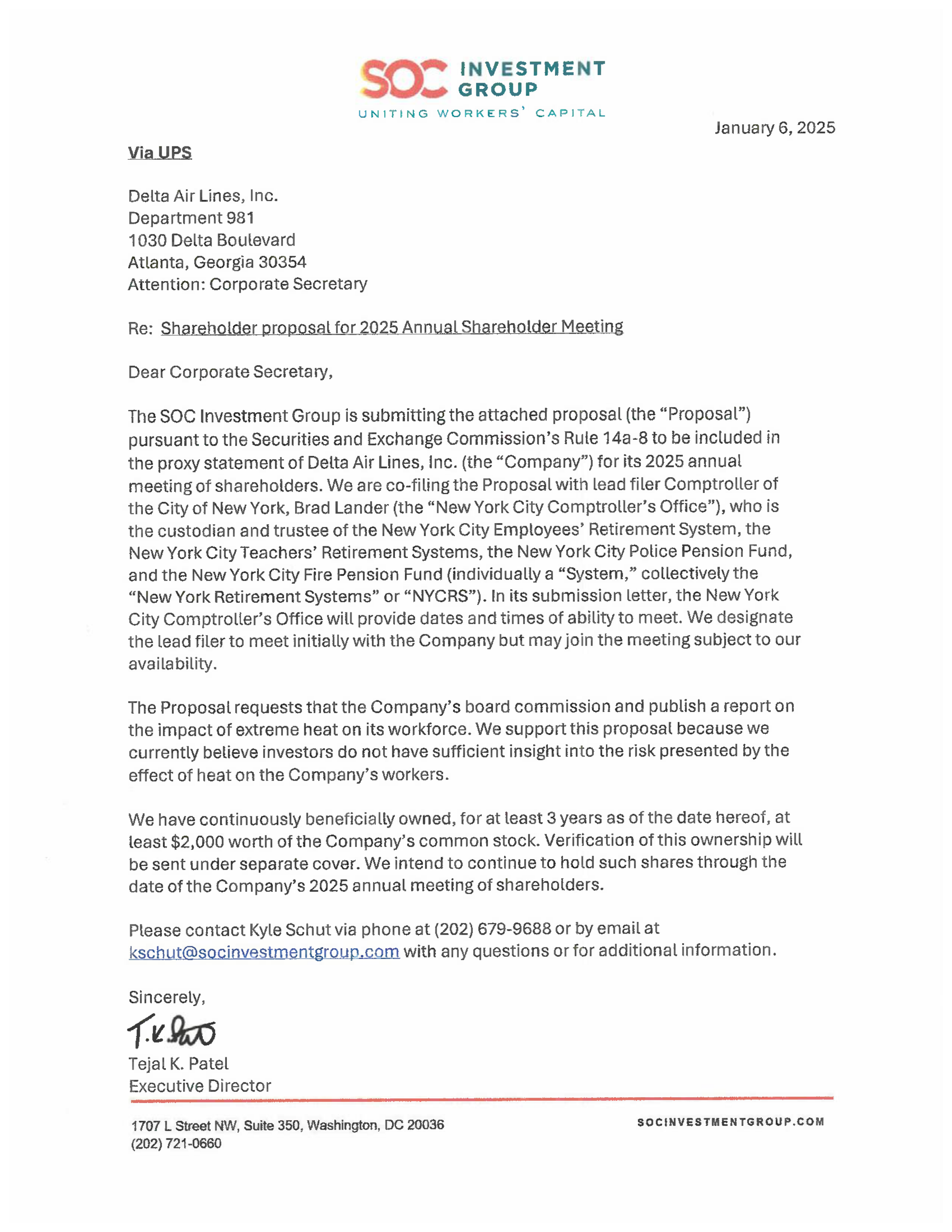






January 3, 2025
Peter Carter
Chief Legal Officer and Corporate Secretary
Delta Air Lines, Inc.
Department 981
1030 Delta Boulevard
Atlanta, GA 30354
Dear Mr. Carter:
I write to you on behalf of the Comptroller of the City of New York, Brad Lander. The Comptroller
is the custodian and a trustee of the New York City Employees’ Retirement System, the New York
City Teachers’ Retirement Systems, the New York City Police Pension Fund, and the New York
City Fire Pension Fund (individually a “System,” collectively the “New York Retirement Systems”
or “NYCRS”). The Systems’ boards of trustees have authorized the Comptroller to submit and
otherwise act on the Systems’ behalf with respect to the enclosed shareholder proposal, and to
inform you of the NYCRS’ intention to present the shareholder proposal for the consideration and
vote of stockholders at the Company’s next annual meeting.
Therefore, we offer the enclosed proposal for the consideration and vote of shareholders at the
Company’s next annual meeting. It is submitted to you in full compliance with Rule 14a-8 of the
Securities Exchange Act of 1934, and I ask that it be included in the Company's proxy statement.
Each System is the beneficial owner of at least $25,000 in market value of the Company’s
securities entitled to vote on the shareholder proposal and have held such stock continuously for
at least one year. Furthermore, each System intends to continue to hold at least $25,000 worth of
these securities through the date of the Company’s next annual meeting. Proof of continuous
ownership for the requisite time period will be sent by the NYCRS’ custodian bank, State Street
Bank and Trust Company, under separate cover.
We welcome the opportunity to discuss the shareholder proposal with you and are available to
meet with the Company via teleconference at 2 pm ET on either January 21, 2025 or January 23,
2025.
Please note that if the Company believes that the Systems or the enclosed shareholder proposal
has failed to meet one or more of the eligibility or procedural requirements set forth in answers
to Questions 1 through 4 of Rule 14a-8, the Company must notify us in writing of any alleged
deficiency within 14 calendar days of receiving the proposal and provide us with an opportunity
to respond to any alleged deficiency within 14 days of receiving the Company’s written
notification.
Michael Garland
ASSISTANT COMPTROLLER
CORPORATE GOVERNANCE AND
RESPONSIBLE INVESTMENT
C
ITY OF
N
EW
Y
ORK
O
FFICE OF THE
C
OMPTROLLER
B
RAD
L
ANDER
─────────────
M
UNICIPAL
B
UILDING
O
NE
C
ENTRE
S
TREET
,
8
TH
FLOOR NORTH
N
EW
Y
ORK
,
N.Y.
10007-2341
T
EL
:
(212) 669-2517
F
AX
:
(212) 669-4072
MGARLAN@COMPTROLLER.NYC.GOV
I can be contacted at the phone number or email address set forth above to address any further
questions the Company may have about the enclosed proposal.
Sincerely,
Michael Garland
Enclosure
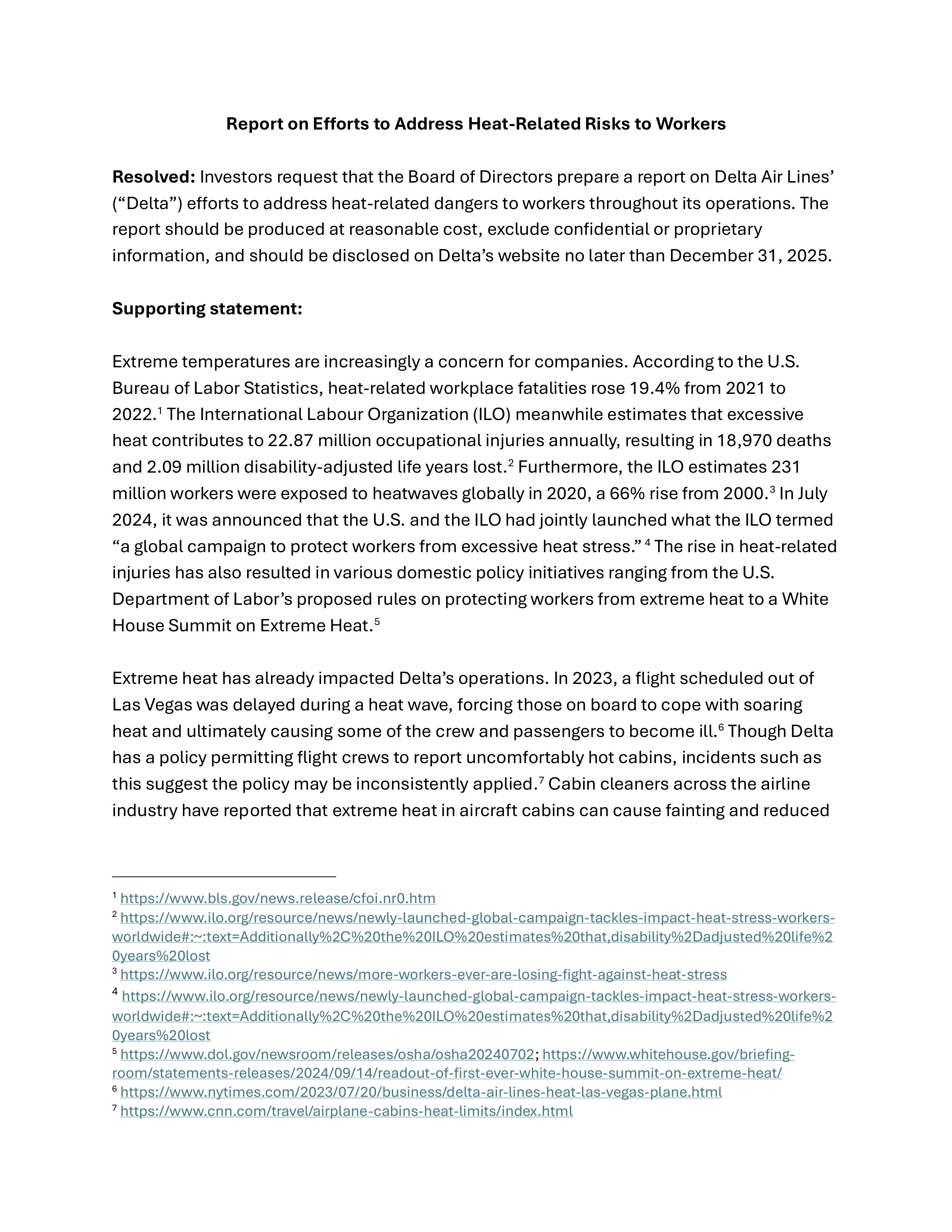
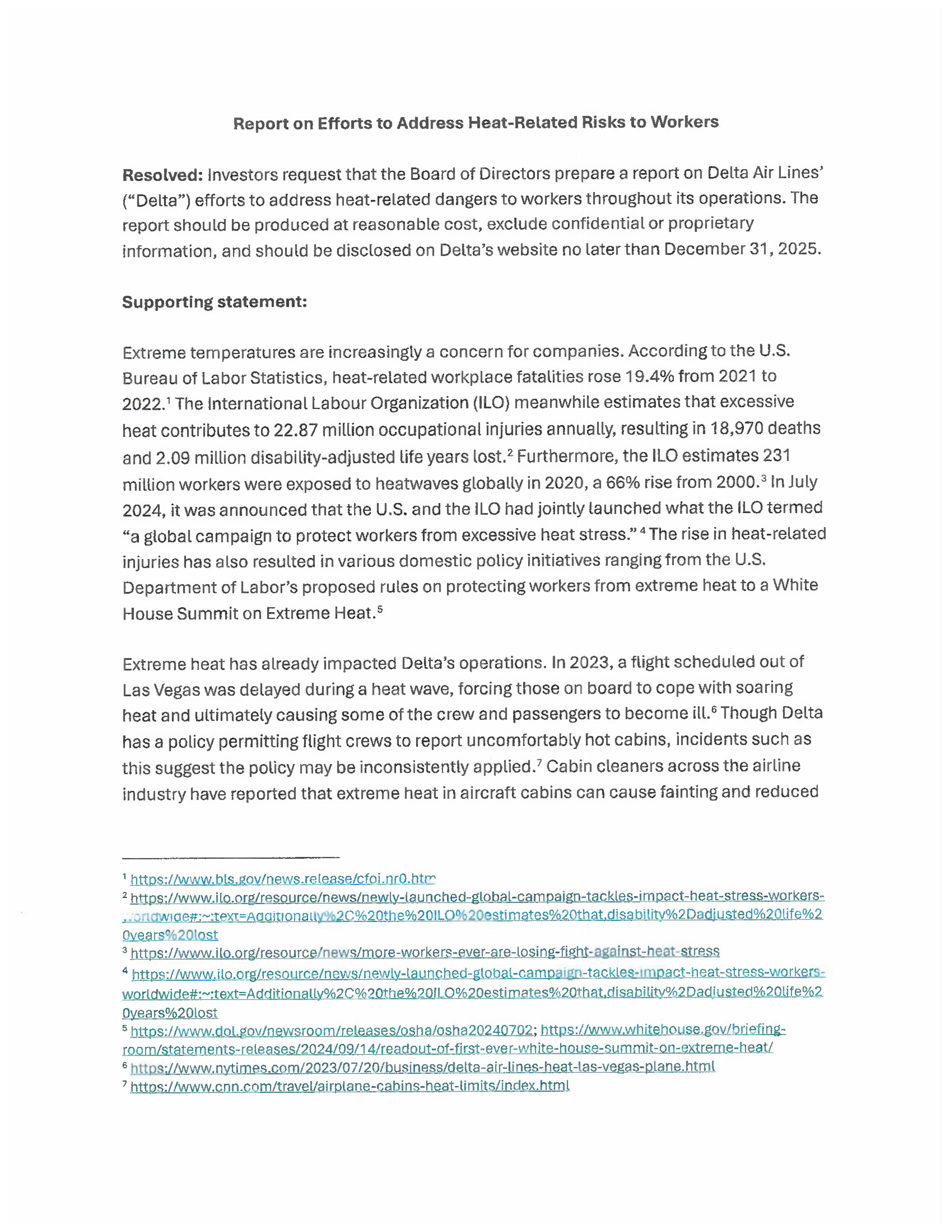
Report on Efforts to Address Heat-Related Risks to Workers
Resolved:
Investors request that the Board of Directors prepare a report on Delta Air Lines’
(“Delta”) efforts to address heat-related dangers to workers throughout its operations. The
report should be produced at reasonable cost, exclude confidential or proprietary
information, and should be disclosed on Delta’s website no later than December 31, 2025.
Supporting statement:
Extreme temperatures are increasingly a concern for companies. According to the U.S.
Bureau of Labor Statistics, heat-related workplace fatalities rose 19.4% from 2021 to
2022.
1
The International Labour Organization (ILO) meanwhile estimates that excessive
heat contributes to 22.87 million occupational injuries annually, resulting in 18,970 deaths
and 2.09 million disability-adjusted life years lost.
2
Furthermore, the ILO estimates 231
million workers were exposed to heatwaves globally in 2020, a 66% rise from 2000.
3
In July
2024, it was announced that the U.S. and the ILO had jointly launched what the ILO termed
“a global campaign to protect workers from excessive heat stress.”
4
The rise in heat-related
injuries has also resulted in various domestic policy initiatives ranging from the U.S.
Department of Labor’s proposed rules on protecting workers from extreme heat to a White
House Summit on Extreme Heat.
5
Extreme heat has already impacted Delta’s operations. In 2023, a flight scheduled out of
Las Vegas was delayed during a heat wave, forcing those on board to cope with soaring
heat and ultimately causing some of the crew and passengers to become ill.
6
Though Delta
has a policy permitting flight crews to report uncomfortably hot cabins, incidents such as
this suggest the policy may be inconsistently applied.
7
Cabin cleaners across the airline
industry have reported that extreme heat in aircraft cabins can cause fainting and reduced
1
https://www.bls.gov/news.release/cfoi.nr0.htm
2
https://www.ilo.org/resource/news/newly-launched-global-campaign-tackles-impact-heat-stress-workers-
worldwide#:~:text=Additionally%2C%20the%20ILO%20estimates%20that,disability%2Dadjusted%20life%2
0years%20lost
3
https://www.ilo.org/resource/news/more-workers-ever-are-losing-fight-against-heat-stress
4
https://www.ilo.org/resource/news/newly-launched-global-campaign-tackles-impact-heat-stress-workers-
worldwide#:~:text=Additionally%2C%20the%20ILO%20estimates%20that,disability%2Dadjusted%20life%2
0years%20lost
5
https://www.dol.gov/newsroom/releases/osha/osha20240702
;
https://www.whitehouse.gov/briefing-
room/statements-releases/2024/09/14/readout-of-first-ever-white-house-summit-on-extreme-heat/
6
https://www.nytimes.com/2023/07/20/business/delta-air-lines-heat-las-vegas-plane.html
7
https://www.cnn.com/travel/airplane-cabins-heat-limits/index.html
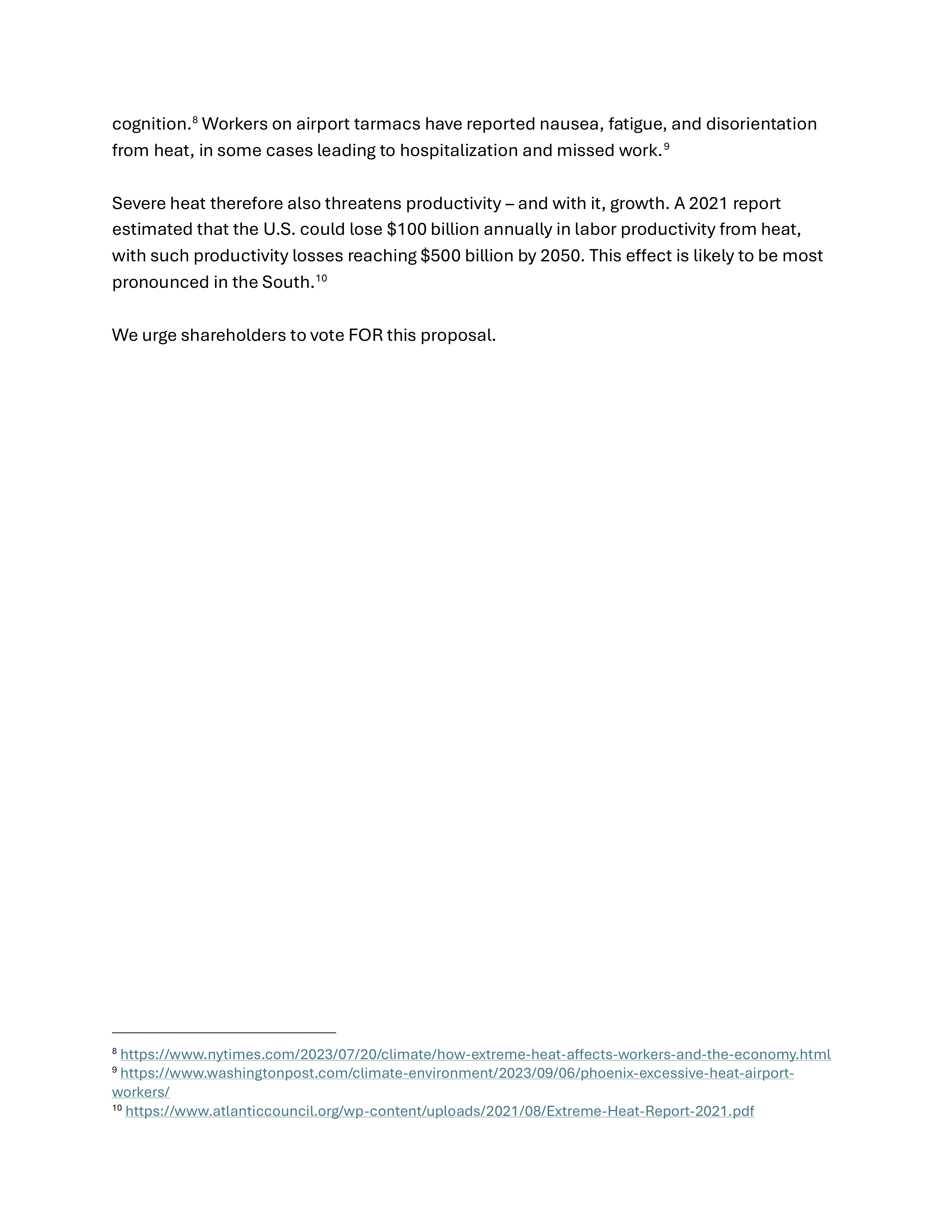
cognition.
8
Workers on airport tarmacs have reported nausea, fatigue, and disorientation
from heat, in some cases leading to hospitalization and missed work.
9
Severe heat therefore also threatens productivity – and with it, growth. A 2021 report
estimated that the U.S. could lose $100 billion annually in labor productivity from heat,
with such productivity losses reaching $500 billion by 2050. This effect is likely to be most
pronounced in the South.
10
We urge shareholders to vote FOR this proposal.
8
https://www.nytimes.com/2023/07/20/climate/how-extreme-heat-affects-workers-and-the-economy.html
9
https://www.washingtonpost.com/climate-environment/2023/09/06/phoenix-excessive-heat-airport-
workers/
10
https://www.atlanticcouncil.org/wp-content/uploads/2021/08/Extreme-Heat-Report-2021.pdf