
FIRM/AFFILIATE OFFICES
-----------
BOSTON
CHICAGO
HOUSTON
LOS ANGELES
NEW YORK
PALO ALTO
WILMINGTON
-----------
BEIJING
BRUSSELS
FRANKFURT
HONG KONG
LONDON
MOSCOW
MUNICH
PARIS
SÃO PAULO
SEOUL
SHANGHAI
SINGAPORE
TOKYO
TORONTO
S
KADDEN
,
A
RPS
,
S
LATE
,
M
EAGHER
&
F
LOM LLP
1440 NEW YORK AVENUE, N.W.
WASHINGTON, D.C. 20005-2111
________
TEL: (202) 371-7000
FAX: (202) 393-5760
www.skadden.com
DIRECT DIAL
202-371-7180
DIRECT FAX
202-661-9010
EMAIL ADDRESS
BRIAN.BREHENY@SKADDEN.COM
January 11, 2021
BY EMAIL (shareholderproposals@sec.gov)
U.S. Securities and Exchange Commission
Division of Corporation Finance
Office of Chief Counsel
100 F Street, N.E.
Washington, D.C. 20549
Re: Shareholder Proposal Submitted by CtW Investment Group
Ladies and Gentlemen:
This letter is submitted on behalf of JPMorgan Chase & Co., a Delaware
corporation (the “Company”), pursuant to Rule 14a-8(j) promulgated under the
Securities Exchange Act of 1934, as amended (the “Exchange Act”). The Company
requests that the staff of the Division of Corporation Finance (the “Staff”) of the U.S.
Securities and Exchange Commission (the “Commission”) not recommend
enforcement action if the Company omits from its proxy materials for the
Company’s 2021 Annual Meeting of Shareholders (the “2021 Annual Meeting”) the
shareholder proposal and supporting statement (the “Proposal”) submitted by CtW
Investment Group (the “Proponent”).
This letter provides an explanation of why the Company believes it may
exclude the Proposal and includes the attachments required by Rule 14a-8(j). In
accordance with Section C of Staff Legal Bulletin 14D (Nov. 7, 2008) (“SLB 14D”),
this letter is being submitted by email to shareholderproposals@sec.gov. A copy of
this letter also is being sent to the Proponent as notice of the Company’s intent to
omit the Proposal from the Company’s proxy materials for the 2021 Annual
Meeting.
Rule 14a-8(k) and Section E of SLB 14D provide that shareholder proponents
are required to send companies a copy of any correspondence that the shareholder
proponents elect to submit to the Commission or the Staff. Accordingly, we are
Office of Chief Counsel
January 11, 2021
Page 2
taking this opportunity to remind the Proponent that if the Proponent submits
correspondence to the Commission or the Staff with respect to the Proposal, a copy
of that correspondence should be furnished concurrently to the Company.
Background
The Company received the Proposal on November 12, 2020, along with a
cover letter from the Proponent and a letter from Amalgamated Bank verifying the
Proponent’s stock ownership in the Company. Copies of the Proposal, cover letter
and related correspondence are attached hereto as Exhibit A.
Summary of the Proposal
The text of the resolution contained in the Proposal follows:
RESOLVED that shareholders of JPMorgan Chase & Co. (“JPMorgan”)
urge the Board of Directors to oversee a racial equity audit analyzing
JPMorgan’s adverse impacts on nonwhite stakeholders and communities
of color. Input from civil rights organizations, employees, and customers
should be considered in determining the specific matters to be analyzed.
A report on the audit, prepared at reasonable cost and omitting
confidential or proprietary information, should be publicly disclosed on
JPMorgan’s website.
Bases for Exclusion
We hereby respectfully request that the Staff concur in the Company’s view
that it may exclude the Proposal from the 2021 proxy materials pursuant to:
•
Rule 14a-8(i)(10) because the Company has substantially implemented
the Proposal; and
•
Rule 14a-8(i)(7) because the Proposal deals with matters relating to the
Company’s ordinary business operations.
Analysis
While we believe the Proposal should be excluded for the reasons set forth
below, the arguments contained within this letter should not be misconstrued to
suggest that racial equity is anything but a matter of the utmost importance to the
Company. Commitments to integrity, fairness and responsibility are foundational
principles at JPMorgan Chase & Co. The Company believes there is no place for
racism, prejudice or discrimination within it or elsewhere. The Company is
committed to fostering inclusive and diverse environments in the Company and the
Office of Chief Counsel
January 11, 2021
Page 3
communities it serves. As part of this, the Company has made and continues to
make substantial commitments to advance racial equity and to combat systemic
racism, including with respect to how it serves its customers and clients, its
investments in communities and its support for employees. As discussed in more
detail below, the Company’s significant commitments include:
1.
Committing $30 billion through business, community and policy
solutions to close the racial wealth divide, support employees and break
down barriers of systemic racism;
2.
Increasing diversity, inclusion and equality across leadership,
underrepresented groups and at the Company, overall;
3.
Continuing investments in Advancing Black Pathways in an effort to
strengthen the economic foundation of the Black community; and
4.
Increasing diversity in the Company’s supply chain.
The Company’s commitments and its many initiatives and related public disclosures,
some of which are described in this letter, reflect the Company’s ongoing
commitment to advance racial equity and report on its progress, as requested by the
Proposal.
A.
The Proposal May Be Excluded Pursuant to Rule 14a-8(i)(10) Because the
Company Has Substantially Implemented the Proposal.
Rule 14a-8(i)(10) permits a company to exclude a shareholder proposal if the
company has already substantially implemented the proposal. The Commission
adopted the “substantially implemented” standard in 1983 after determining that the
“previous formalistic application” of the rule defeated its purpose, which is to “avoid
the possibility of shareholders having to consider matters which already have been
favorably acted upon by the management.”
See
Exchange Act Release No. 34-20091
(Aug. 16, 1983) (the “1983 Release”); Exchange Act Release No. 34-12598 (July 7,
1976). In adopting this standard, the Commission made it clear that the actions
requested by a proposal need not be “fully effected” provided that they have been
“substantially implemented” by the company.
See
1983 Release.
Applying this standard, the Staff has consistently permitted the exclusion of a
proposal when it has determined that the company’s policies, practices and
procedures or public disclosures compare favorably with the guidelines of the
proposal.
See, e.g.
,
Devon Energy Corp.
(Apr. 1, 2020)
*
;
Johnson & Johnson
(Jan.
* Citations marked with an asterisk indicate Staff decisions issued without a letter.
Office of Chief Counsel
January 11, 2021
Page 4
31, 2020)
*
;
Pfizer Inc.
(Jan. 31, 2020)
*
;
The Allstate Corp.
(Mar. 15, 2019);
Johnson
& Johnson
(Feb. 6, 2019);
United Cont’l Holdings, Inc.
(Apr. 13, 2018);
eBay Inc.
(Mar. 29, 2018);
Kewaunee Scientific Corp.
(May 31, 2017);
Wal-Mart Stores, Inc.
(Mar. 16, 2017);
Dominion Resources, Inc.
(Feb. 9, 2016);
Ryder System, Inc.
(Feb.
11, 2015);
Wal-Mart Stores, Inc.
(Mar. 27, 2014).
In addition, the Staff has permitted exclusion under Rule 14a-8(i)(10) where
the company already addressed the underlying concerns and satisfied the essential
objectives of the proposal, even if the proposal had not been implemented exactly as
proposed by the proponent. For example, in
Oshkosh Corp.
(Nov. 4, 2016), the Staff
permitted exclusion under Rule 14a-8(i)(10) of a proposal asking the board to amend
certain provisions of the company’s proxy access bylaw in accordance with the six
“essential elements” specified in the proposal. In arguing that the proposal had been
substantially implemented, the company explained that it had adopted three of the six
proposed changes in the proposal. Although the proposal asked for the adoption of
all of the proposed changes, the Staff concluded that the company’s bylaw
amendments “compare favorably with the guidelines of the proposal” and that the
company substantially implemented the proposal. Similarly in
PG&E Corp.
(Mar.
10, 2010), the Staff permitted exclusion under Rule 14a-8(i)(10) of a proposal
requesting that the company provide a report disclosing, among other things, the
company’s standards for choosing the organizations to which the company makes
charitable contributions and the “business rationale and purpose for each of the
charitable contributions.” In arguing that the proposal had been substantially
implemented, the company referred to a website where the company had described
its policies and guidelines for determining the types of grants that it makes and the
types of requests that the company typically does not fund. Although the proposal
appeared to contemplate disclosure of each and every charitable contribution, the
Staff concluded that the company had substantially implemented the proposal.
See
also, e.g.
,
The Wendy’s Co.
(Apr. 10, 2019) (permitting exclusion under Rule
14a-8(i)(10) of a proposal requesting a report assessing human rights risks of the
company’s operations, including the principles and methodology used to make the
assessment, the frequency of assessment and how the company would use the
assessment’s results, where the company had a code of ethics and a code of conduct
for suppliers and disclosed on its website the frequency and methodology of its
human rights risk assessments);
MGM Resorts Int’l
(Feb. 28, 2012) (permitting
exclusion under Rule 14a-8(i)(10) of a proposal requesting a report on the
company’s sustainability policies and performance, including multiple objective
statistical indicators, where the company published an annual sustainability report);
Exelon Corp.
(Feb. 26, 2010) (permitting exclusion under Rule 14a-8(i)(10) of a
proposal requesting a report disclosing policies and procedures for political
contributions and monetary and non-monetary political contributions where the
company had adopted corporate political contributions guidelines).
Office of Chief Counsel
January 11, 2021
Page 5
In particular, in
JPMorgan Chase & Co.
(Feb. 5, 2020) the Staff permitted
exclusion under Rule 14a-8(i)(10) of a proposal requesting that the company’s board
review the Business Roundtable’s Statement on the Purpose of a Corporation,
provide oversight and guidance as to how the statement should alter the company’s
governance and management system and publish recommendations regarding
implementation of the statement. The company argued that it had substantially
implemented the proposal because it already operated in accordance with the
principles set forth in the Business Roundtable’s Statement on the Purpose of a
Corporation, which conclusion was supported by the company’s corporate
governance and nominating committee. In permitting exclusion of the proposal, the
Staff stated that “it appears that the board’s actions compare favorably with the
guidelines of the [p]roposal and that the company has, therefore, substantially
implemented the [p]roposal,” noting in particular the company’s representation that
“the [c]orporate [g]overnance & [n]ominating [c]ommittee of the [b]oard again
reviewed the BRT Statement and determined that no additional action or assessment
is required, as the [c]ompany already operates in accordance with the principles set
forth in the BRT Statement with oversight and guidance by the [b]oard of [d]irectors,
consistent with the [b]oard’s fiduciary duties.”
See also
Apple Inc.
(Dec. 17, 2020)*.
In this instance, the Company has substantially implemented the Proposal,
the essential objective of which is to obtain a report on ways the Company can
advance racial equity. In particular, the Proposal’s supporting statement notes that
such an assessment could help “obtain a complete picture of how [the Company]
contributes to, and could help dismantle, systemic racism.” As described below, the
Company already publishes extensive information relating to its current efforts and
future commitments to address systemic racism and advance racial equity. The
Company works with and considers feedback from nonprofit partners, employees
and customers, and considers work done across the Company, including for example,
the work of the Company’s
Policy
Center, Office of Diversity & Inclusion and the
JPMorgan Chase Institute, which engage with policy, business, community, and
nonprofit leaders. Moreover, as described in the Company’s definitive proxy
statement for the 2020 annual meeting of shareholders,
1
many of these positions and
practices are overseen and reviewed by the Public Responsibility Committee of the
Board of Directors (the “Board”).
1
See
the Company’s Definitive Proxy Statement for its 2020 Annual Meeting of Shareholders
,
available at
https://www.sec.gov/Archives/edgar/data/19617/000119312520098865/d822689ddef14a.htm.
Office of Chief Counsel
January 11, 2021
Page 6
In this regard, the Company’s website features an “Impact” landing page,
which describes the Company’s various initiatives to advance racial equity.
2
Accessible through that landing page is a “Path Forward” website, which provides
detailed information on the Company’s plan to advance racial equity by committing
$30 billion over the next five years to “drive an inclusive recovery [from the
COVID-19 pandemic], support employees and break down barriers of systemic
racism.”
3
The Path Forward website acknowledges the problems of historical
systemic racism, noting that “[s]tructural barriers in the U.S. have created profound
racial inequalities, made worse by the COVID-19 pandemic. The existing racial
wealth gap puts a strain on families’ economic mobility and restricts the U.S.
economy.” Moreover, the Company’s Chairman and Chief Executive Officer
addresses these issues on the Path Forward website, stating that “[s]ystemic racism is
a tragic part of America’s history” and that “[w]e can do more and do better to break
down systems that have propagated racism and widespread economic inequality,
especially for Black and Latinx people. It’s long past time that society addresses
racial inequities in a more tangible, meaningful way.” Similarly, the Company’s
Global Head of Diversity and Inclusion is quoted on the website as saying, “[w]e
have a responsibility to intentionally drive economic inclusion for people that have
been left behind. The COVID-19 crisis has exacerbated long-standing inequities for
Black and Latinx people around the world. This moment is a catalyst to create
change and build an economy that creates and sustains opportunity and racial equity
for Black and Latinx communities.”
After acknowledging the problem of systemic racism, the Path Forward
website proceeds to describe, in detail, the Company’s significant commitment to
advancing racial equity. For example, the website discloses that the Company plans
to “promote and expand affordable housing and homeownership for underserved
communities” by originating 40,000 new home purchase loans for Black and Latinx
households through an additional $8 billion commitment in mortgages. In addition,
the website notes that the Company intends to promote Black- and Latinx-owned
businesses by providing an additional 15,000 loans to small businesses in majority-
Black and -Latinx communities up to $2 billion and to spend an additional $750
million with Black and Latinx suppliers. The website also highlights that the
Company has committed to invest equity in early-stage companies that create
opportunities in underserved communities, with a particular focus on serving the
needs of Black and Latinx people.
Recognizing that “[t]here are significant racial disparities in the financial
health of Black and Latinx households, which serve as a barrier to achieve financial
2
See
Impact
, available at https://www.jpmorganchase.com/impact.
3
See Our Path Forward
, available at https://www.jpmorganchase.com/impact/path-forward.
Office of Chief Counsel
January 11, 2021
Page 7
stability, meet their long-term financial goals and build wealth,” the Path Forward
website notes that the Company also has committed to help improve financial health
and access to banking in Black and Latinx communities by helping one million
people open low-cost checking or savings accounts. In particular, the website
explains that the Company has committed to hiring 150 new community managers,
opening new Community Center branches in underserved communities and
materially increasing marketing spend to reach more customers who are currently
underserved, unbanked or underbanked. Similarly, the website notes that the
Company has committed to investing up to $50 million in the form of capital and
deposits in Black and Latinx-led Minority Depository Institutions (“MDI”) and
Community Development Financial Institutions (“CDFI”), and continuing to mentor
and advise select MDIs and CDFIs to help them achieve future success.
The Path Forward website also describes the Company’s commitment to
enhancing diversity by accelerating its investment in employees and “build[ing] a
more diverse and inclusive workforce.” Noting that “[w]e will take actions to build a
more equitable and representative workforce, and support solutions and job training
to advance racial equity in the workforce,” the website states that the Company will
hold executives accountable “by incorporating priorities and progress into year-end
performance evaluations and compensation decisions” for members of the Operating
Committee and their direct reports. In addition to adopting initiatives to promote
workforce diversity, the website emphasizes that the Company is partnering with
third parties to advance racial equity and increase internal accountability. Notably,
as described on the Path Forward website, the Company has committed to creating
partnerships with Historically Black Colleges and Universities (“HBCU”) through
curriculum development, scholarships and mentorship programs to increase the
pipeline of HBCU students entering the financial planning profession. The website
also notes that the Company intends to support non-profit organizations led by
diverse individuals to create innovative workforce solutions and provide job training
to close opportunity gaps in the labor market and advance racial equity in the
workforce. Moreover, the website highlights that the Company has committed to
regularly track its progress on racial equity and share results with senior leadership,
as well as externally with the Chase Advisory Panel (which engages with national
consumer policy groups), to assess performance and enforce accountability.
While the $30 billion commitment and accompanying initiatives described on
the Path Forward website represent a significant step in the Company’s efforts to
advance racial equity, the Company’s commitment to racial equity is not limited only
to those initiatives. For example, on the Company’s “Real change, right now”
website, accessible directly from the Company’s main webpage, the Company
describes its other programs and financial contributions to advance racial equity,
many of which predate the commitments described on the Path Forward website.
These include, among others: hiring and mentoring students of color; advancing
Office of Chief Counsel
January 11, 2021
Page 8
policies to help lower barriers to jobs for people with criminal backgrounds;
advocating for criminal justice reform; making homeownership more accessible to
communities of color; expanding access to capital for minority-owned businesses;
investing to drive inclusive growth and create greater economic opportunity; opening
more bank branches in majority-minority communities; supporting civil rights
organizations, such as the Leadership Conference Education Fund, N.A.A.C.P. Legal
Defense and Educational Fund, Inc., the National Urban League, Inc., the Equal
Justice Initiative, and diverse-led nonprofit organizations; and promoting a diverse
and inclusive culture for the Company’s employees and business.
4
As emphasized
by the Company’s Chairman and Chief Executive Officer, “[w]e have a collective
responsibility to stand up and take serious action to address centuries of structural
racism. We can all do better and do more.”
The Company’s “Real change, right now” website also includes links to the
Company’s other racial equity initiatives, such as Advancing Black Pathways, which
aims to expand economic opportunity for the Black community,
5
The Fellowship
Initiative, which matches high school students in underserved communities with
employee mentors,
6
and The
Policy
Center, which focuses on solutions to drive
inclusive economic growth, such as advocating for federal and state policy changes
to remove barriers to employment for people with criminal backgrounds.
7
In this
regard, the Company recently announced a commitment to triple the number of
young people it engages with through The Fellowship Initiative over the next
decade.
8
Given the Company’s multiple public commitments and initiatives to
advance racial equity and combat systemic racism, the Company has satisfied the
Proposal’s essential objective of obtaining a report on ways the Company can
advance racial equity and its public disclosures and actions compare favorably with
4
See Real change, right now
, available at https://www.jpmorganchase.com/impact/real-change-
right-now.
5
See Advancing Black Pathways
, available at
https://www.jpmorganchase.com/impact/people/advancing-black-pathways.
6
See The Fellowship Initiative
, available at
https://www.jpmorganchase.com/impact/people/mentoring-skilled-volunteerism/the-fellowship-
initiative.
7
See Policy
Center, available at https://www.jpmorganchase.com/impact/our-approach/policy-
center.
8
See JPMorgan Chase’s The Fellowship Initiative Expands to Help More than 1,000 Young Black
and Latinx Men in U.S. Cities Access Economic Opportunity
, available at
https://www.jpmorganchase.com/news-stories/jpmc-tfi-expands-to-help-more-than-1000-young-
black-latinax-men.
Office of Chief Counsel
January 11, 2021
Page 9
those requested by the Proposal. In addition, at a meeting held on January 7, 2021,
the Corporate Governance & Nominating Committee (the “Committee”) of the
Company’s Board of Directors (the “Board”) reviewed the Proposal. As discussed
further below, the Committee determined that the Company already has assessed its
impact with respect to nonwhite stakeholders and communities of color and has
announced numerous, significant commitments to advance racial equity going
forward. Most notably, in determining the contours of its $30 billion commitment,
the Company assessed ways it could advance racial equity. Accordingly, the
Proposal has been substantially implemented and may be excluded pursuant to Rule
14a-8(i)(10).
B.
The Proposal May Be Excluded Pursuant to Rule 14a-8(i)(7) Because the
Proposal Deals with Matters Relating to the Company’s Ordinary Business
Operations.
Under Rule 14a-8(i)(7), a shareholder proposal may be excluded from a
company’s proxy materials if the proposal “deals with matters relating to the
company’s ordinary business operations.” In Exchange Act Release No. 34-40018
(May 21, 1998), the Commission stated that the policy underlying the ordinary
business exclusion rests on two central considerations. The first recognizes that
certain tasks are so fundamental to management’s ability to run a company on a day-
to-day basis that they could not, as a practical matter, be subject to direct shareholder
oversight. The second consideration relates to the degree to which the proposal
seeks to “micro-manage” the company by probing too deeply into matters of a
complex nature upon which shareholders, as a group, would not be in a position to
make an informed judgment.
1.
The Proposal deals with the Company’s ordinary business operations.
The Commission has stated that a proposal requesting the dissemination of a
report is excludable under Rule 14a-8(i)(7) if the substance of the proposal is within
the ordinary business of the company.
See
1983 Release (“[T]he staff will consider
whether the subject matter of the special report or the committee involves a matter of
ordinary business; where it does, the proposal will be excludable under Rule 14a-
8(c)(7).”);
see also Netflix, Inc.
(Mar. 14, 2016) (permitting exclusion under Rule
14a-8(i)(7) of a proposal that requested a report describing how company
management identifies, analyzes and oversees reputational risks related to offensive
and inaccurate portrayals of Native Americans, American Indians and other
indigenous peoples, how it mitigates these risks and how the company incorporates
these risk assessment results into company policies and decision-making, noting that
the proposal related to the ordinary business matter of the “nature, presentation and
content of programming and film production”).
Office of Chief Counsel
January 11, 2021
Page 10
In accordance with the policy considerations underlying the ordinary business
exclusion, the Staff has permitted exclusion under Rule 14a-8(i)(7) of proposals
relating to the community impacts of a company’s operations. In
Amazon.com, Inc.
(Mar. 28, 2019), for example, the Staff permitted exclusion under Rule 14a-8(i)(7) of
a proposal requesting an analysis of the community impacts of the company’s
operations “considering near- and long-term local economic and social outcomes,
including risks, and the mitigation of those risks, and opportunities arising from its
presence in communities.” In the proposal’s supporting statement, the proponents
argued that the company faced “significant financial and reputational risks” due to its
alleged negative impacts on, among others, housing availability, access to education,
transportation and other infrastructure concerns in the communities in which it
operates. In concurring with the company’s view that the proposal could be
excluded under Rule 14a-8(i)(7), the Staff noted that the proposal “relates generally
to ‘the community impacts’ of the [c]ompany’s operations and does not appear to
focus on an issue that transcends ordinary business matters.”
See also, e.g.
,
Amazon.com, Inc.
(Mar. 16, 2018) (permitting exclusion under Rule 14a-8(i)(7) of a
proposal that requested a report on risks relating to the societal impact of the
company’s growth).
In addition, the Staff has permitted exclusion of proposals that relate to a
company’s relationships with its customers.
See, e.g.
,
JPMorgan Chase & Co.
(Feb.
21, 2019) (permitting exclusion under Rule 14a-8(i)(7) of a proposal that requested
the board complete a report on the impact to customers of the company’s overdraft
policies);
AT&T Inc.
(Dec. 28, 2016) (permitting exclusion under Rule 14a-8(i)(7) of
a proposal that requested the company provide free tools to customers to block
robocalls);
Ford Motor Co.
(Feb. 13. 2013) (permitting exclusion under Rule 14a-
8(i)(7) of a proposal that requested removal of dealers that provided poor customer
service, noting that “[p]roposals concerning customer relations are generally
excludable under rule 14a-8(i)(7)”);
The Coca-Cola Co.
(Jan. 21, 2009,
recon.
denied
Apr. 21, 2009) (permitting exclusion under Rule 14a-8(i)(7) of a proposal that
requested a report on how the company could provide information to customers
regarding the company’s products, noting that the proposal “relat[ed] to Coca-Cola’s
ordinary business operations (i.e., marketing and consumer relations)”).
The Staff also has permitted exclusion under Rule 14a-8(i)(7) of shareholder
proposals relating to the products and services offered by a company.
See, e.g.
,
Pfizer Inc.
(Mar. 1, 2016) (permitting exclusion under Rule 14a-8(i)(7) of a proposal
requesting a report describing the steps the company has taken to prevent the sale of
its medicines to prisons for the purpose of aiding executions, noting that the proposal
“relates to the sale or distribution of [the company’s] products”);
The Walt Disney
Co.
(Nov. 23, 2015) (permitting exclusion under Rule 14a-8(i)(7) of a proposal
requesting that the company’s board of directors approve the release of a specific
film on Blu-ray, noting that the proposal “relates to the products and services offered
Office of Chief Counsel
January 11, 2021
Page 11
for sale by the company”);
Wells Fargo & Co
. (Jan. 28, 2013,
recon. denied
Mar. 4,
2013) (permitting exclusion under Rule 14a-8(i)(7) of a proposal requesting a report
discussing the adequacy of the company’s policies in addressing the social and
financial impacts of the company’s direct deposit advance lending service, noting
that the proposal “relates to products and services offered for sale by the company”).
In this case, the Proposal seeks a wide-ranging report that would address
multiple aspects of the Company’s ordinary business operations, including
community impacts, the Company’s relationships with its customers and the
products and services offered by the Company. In particular, the Proposal requests a
report concerning the Company’s “adverse impacts on nonwhite stakeholders and
communities of color.” The supporting statement also refers to the Company’s
relationships with “the communities it serves.” While both of these concerns have
been specifically recognized by the Staff as ordinary business matters upon which a
proposal may be excluded pursuant to Rule 14a-8(i)(7), the broad scope of the report
requested by the Proposal would also relate to the Company’s decisions regarding
the products and services it offers. Accordingly, consistent with the precedent
described above, the Proposal is excludable under Rule 14a-8(i)(7).
2.
The Company’s Corporate Governance & Nominating Committee has
considered the Proposal’s request and determined that, in light of the
numerous actions already taken by the Company, the Proposal does
not focus on a significant policy issue that transcends the Company’s
ordinary business.
We are aware that a proposal may not be excluded under Rule 14a-8(i)(7) if it
is determined to focus on a significant policy issue. The fact that a proposal may
touch upon a significant policy issue, however, does not preclude exclusion under
Rule 14a-8(i)(7). As stated in Staff Legal Bulletin No. 14I (Nov. 1, 2017) (“SLB
14I”), “whether the significant policy exception applies depends, in part, on the
connection between the significant policy issue and the company’s business
operations.” According to the Staff, a “well-developed discussion of the board’s
analysis” of whether a particular issue is sufficiently significant – because the matter
transcends ordinary business and would be appropriate for a shareholder vote – may
assist the staff in its review of no-action requests under Rule 14a-8(i)(7).
See
SLB
14I. In Staff Legal Bulletin No. 14J (Oct. 23, 2018) (“SLB 14J”), the Staff provided
a non-exclusive list of factors a board might consider in arriving at its conclusion
that an issue is not sufficiently significant in relation to the company. In addition,
the Staff stated that a company’s request for exclusion should “include a discussion
that reflects the board’s analysis of the proposal’s significance to the company” and
should detail “the specific processes employed by the board to ensure that its
conclusions are well-informed and well-reasoned.”
See
SLB 14I;
see also Apple Inc.
(Dec. 2, 2019
recon. denied
Jan. 17, 2020) (permitting exclusion under Rule
Office of Chief Counsel
January 11, 2021
Page 12
14a-8(i)(7) of a proposal requesting a report on risks associated with omitting certain
terms from its equal employment opportunity policy, where the board’s nominating
and corporate governance committee analyzed the proposal and concluded that it did
not present a significant policy issue for the company). In addition, in Staff Legal
Bulletin No. 14K (Oct. 16, 2019) (“SLB 14K”) the Staff reiterated its view of the
utility of a board analysis and provided further guidance on certain factors in such
analysis.
In this instance, the Committee evaluated the Proposal and the Company’s
significant commitments and actions with respect to the issue raised by the Proposal
and concluded the Proposal does not focus on a significant policy issue that
transcends the Company’s ordinary business. In particular, at a meeting held on
January 7, 2021, the Committee reviewed the Proposal, taking into consideration its
own substantial knowledge of the Company, the Company’s operations and business
environment, and input from management. Based on this review, the Committee
determined that, as a result of the numerous actions already taken by the Company,
the Proposal does not present a significant issue that transcends the Company’s
ordinary business. In reaching this conclusion, the Committee reviewed the
following factors, as described in SLB 14J and 14K, and made the following
determinations.
i.
The Company has already made extensive commitments to
advance racial equity and there is not a significant difference
between the objective of the Proposal and what the Company
already has done.
As described in SLB 14K, the Committee considered “[w]hether the
company has already addressed the issue in some manner, including the differences –
or the delta – between the proposal’s specific request and the actions the company
has already taken, and an analysis of whether the delta presents a significant policy
issue for the company.” In accordance with the discussion on pages 5 through 9 of
this letter, the Committee considered that the Company already has assessed its
impact with respect to nonwhite stakeholders and communities of color and, as
informed by this assessment, made numerous, significant commitments to advance
racial equity going forward. The Company also works with and considers feedback
from nonprofit partners and considers work done across the Company, including, for
example, the work of the Company’s
Policy
Center, Office of Diversity & Inclusion
and the JPMorgan Chase Institute, which engage with policy, business, community,
and nonprofit leaders. Most notably, in determining the contours of its $30 billion
commitment, the Company assessed ways it could advance racial equity. In
addition, the Company’s senior leadership has publicly committed to addressing the
problems of racial inequity and systemic racism by developing and committing to a
number of significant initiatives to advance racial equity, including through an
Office of Chief Counsel
January 11, 2021
Page 13
Accountability Framework wherein the Company will hold members of the
Operating Committee and their direct reports accountable toward achieving
company-wide diversity representation goals by incorporating diversity and
inclusion priorities into year-end performance evaluations and compensation
decisions. The Committee also considered that the Public Responsibility Committee
of the Board already provides oversight and review of the Company’s positions and
practices on public policy issues that reflect the Company’s values and impact its
reputation among all of its stakeholders. Although the Company does not provide a
retrospective report on its past actions, given the Company’s significant financial
commitment and its many initiatives outlined above, the Company already is
addressing the Proposal’s goal and the issue of advancing racial equity. Thus, any
remaining differences between the Proposal and the Company’s actions do not
present a significant policy issue to the Company.
ii.
Implementation of the Proposal has no bearing on the
Company’s core business activities and financial statements.
Further, because the Company has already taken a number of significant
actions to advance racial equity and combat systemic racism and there is little
difference between the Proposal’s request and the Company’s current and planned
actions, implementation of the Proposal would not have a clear impact on the
Company’s core business activities and financial statements.
iii.
In light of the Company’s strong commitment to this issue,
shareholders have not demonstrated significant interest in the
type of audit or report requested by the Proposal.
The Company is actively engaged with a number of its shareholders on issues
relating to racial equity and the actions the Company is taking to address these
issues. Indeed, these engagements provide the Company with useful feedback,
which is considered when developing the Company’s policies and commitments.
The Company is not aware, however, of any shareholders other than the Proponent
who have requested an “audit” or report of the type described in the Proposal or who
have submitted a shareholder proposal to the Company requesting an audit or report
on this topic.
iv.
The issue presented by the Proposal has never been voted on.
The Proposal has not been previously voted on by shareholders, nor has
anyone other than the Proponent requested the type of action sought by the Proposal.
Although the Proposal’s specific request has not been considered before, the most
recent time a shareholder proposal on the related topic of gender and racial pay
equity was considered by the Company’s shareholders in 2020, that proposal
received only 9.4% support.

Office of Chief Counsel
January 11, 2021
Page 14
After considering these factors, the Committee determined that the specific
actions requested by the Proposal do not raise a significant policy issue that
transcends the Company’s ordinary business. Accordingly, consistent with the
precedent described above, the Proposal may be excluded pursuant to Rule
14a-8(i)(7) as relating to the Company’s ordinary business operations.
Conclusion
On the basis of the foregoing, the Company respectfully requests the
concurrence of the Staff that the Proposal may be excluded from the Company’s
proxy materials for the 2021 Annual Meeting. If you have any questions or would
like any additional information regarding the foregoing, please do not hesitate to
contact me at (202) 371-7180. Thank you for your prompt attention to this matter.
Very truly yours,
Brian V. Breheny
Enclosure
cc:
Tejal K. Patel
Corporate Governance Director
CtW Investment Group
Molly Carpenter
Corporate Secretary
JPMorgan Chase & Co.

EXHIBIT A
(see attached)


November 12, 2020
JPMorgan Chase & Co.,
Chairman and CEO James Dimon
Office of the Secretary
4 New York Plaza,
New York, NY 10004-2413
Dear Chairman and CEO Dimon:
In light of recent high profile police killings of Black people, the ensuing nationwide protests against
racial injustice, and companies’ responses to these events, we urge the board of JPMorgan Chase & Co.
(“JPMorgan”) to conduct and disclose the results of a racial equity audit that would identify, prioritize,
and remedy the adverse impacts of the company’s policies and practices on non-white stakeholders and
communities of color. The board should engage a variety of key stakeholders in undergoing this audit
and evaluating the specific topics to be addressed, including civil rights organizations, employees, and
customers.
As outlined further below, we believe that this disclosure would demonstrate concrete steps that the
company has taken to address racial injustice and unequal treatment not only in its own workplace, but
also within the community that it serves. JPMorgan, like many other issuers, has made a public
statement supporting Black Lives Matter and racial justice. While these statements are informative to
investors, the meaning is lost without concrete action and introspection by company leadership.
The CtW Investment Group works with pension funds sponsored by unions affiliated with Change to
Win, a federation of unions representing nearly 5.5 million members, to enhance long term shareholder
value. These funds have over $250 billion in assets under management and are substantial JPMorgan
shareholders.
The Banking Industry’s Role in Reinforcing Racial Inequality Raises Concern
The current reckoning on racial injustice facing the financial industry is not new, with the industry
playing a significant role in the economic inequality facing communities of color. White households on
average hold 10 times the wealth of Black households, which is largely attributable to institutionalized
racism within the U.S. financial system. The driving factor for this inequality in wealth distribution is
lenders failing to issue mortgages to minorities. By way of example, for every $1 loaned out to finance
residential properties in white neighborhoods in Chicago from 2012-2018, a mere 12 cents was invested
in Black neighborhoods, despite anti-discrimination laws that were passed in the 1960’s that bar such
practices, known as “redlining.”
1
Mortgage issuances are just one concern, however. Black and Hispanic banking customers have also
been reported to face higher monthly checking account fees than white customers. According to a
recent survey, Black and Hispanic customers reported paying $12 and $16 per month, respectively, for
1
Jennifer Tescher,
American Banker
, “Bankers need to walk the walk on equality,” June 9, 2020,
available at
https://www.americanbanker.com/opinion/bankers-need-to-walk-the-walk-on-equality
.
CtWI•
Investment Group
'l/j
1900
L Street NW, Suite
900
Washington,
DC
20036
202-721-6060
www.clwinveslmenlgroup.com
overdraft penalties and ATM surcharges, versus $5 per month for white customers.
2
A 2018 study by
New America
reinforced these findings, noting that Black and Hispanic communities face higher costs
associated with opening accounts, higher maintenance fees, and larger minimum deposit requirements
than their white counterparts.
3
Given that checking accounts effectively operate as a mechanism to
participate more actively in the economy, these requirements redirect income and reduce the economic
power of people of color, who also typically earn less than white customers. In light of the current
pandemic and the significant spike in unemployment, these requirements threaten to reverse years of
gains in the number of households having access to a bank account.
Further, there is a trend within the financial industry to not only charge more to communities of color,
but exit those markets entirely effectively creating “banking deserts.” In fact, more bank branches have
been closed in predominantly Black neighborhoods, even wealthy ones, than any other community
broken down by race. The lack of mainstream banking makes communities of color even more
vulnerable as they are forced to resort to predatory financial alternatives, such as payday lenders and
check cashing services that often charge significantly more fees than traditional banks.
The lack of bank branches not only impacts personal banking, but commercial banking that is based very
much on the relationship between business owners and financial advisors. A 2018 Federal Reserve
study noted that “banks without a local branch were much less likely to originate small business loans in
that community.”
4
Minority-owned businesses continue to struggle with access to capital, much of
which is restricted by the industry’s low approval rates for funding small businesses within communities
of color. The Federal Reserve has reported that more than half of Black-owned businesses that applied
for a loan were rejected, twice the rate of a white owned business.
5
A study by
The Business Journals
of
its 44 markets found that the four largest banks, including JPMorgan, made 91% fewer Small Business
Administration 7(a) loan guarantees to Black-owned businesses in 2019 than in 2007.
6
These trends have only been exacerbated further as a result of the coronavirus pandemic, with white-
owned businesses receiving 83% of the first-round of loans authorized through the Paycheck Protection
Program (“PPP”), from April 1-17, 2020, according to
Bloomberg
.
7
Although this gap narrowed once a
second tranche of funding was released on April 27, the damage had already been done. Between
February and April 2020, over 41% of Black-owned businesses and 32% of Hispanic-owned businesses
2
Kristopher J. Brooks,
CBS News
, “Blacks and Latinos say they pay higher bank fees, research suggests, they’re
right,” January 16, 2020,
available at
https://www.cbsnews.com/news/minorities-report-paying-higher-banking-
fees-than-white-people-bankrate-survey-says/.
3
Jacob Faber & Terri Friedline, New America,
The Racialized Costs of Banking
, June 2018,
available at
https://d1y8sb8igg2f8e.cloudfront.net/documents/The_Racialized_Costs_of_Banking_2018-06-20_205129.pdf
, p.
4-5.
4
Zach Fox, et. al,
S&P Global
, “Bank Branch Closures Take Greatest Toll on Majority Black Areas,” July 25, 2019, p.
5.
5
Gene Marks,
The Guardian
, “Black owned firms are twice as likely to be rejected for loans. Is this Discrimination?”
January 16, 2020,
available at
https://www.theguardian.com/business/2020/jan/16/black-owned-firms-are-twice-
as-likely-to-be-rejected-for-loans-is-this-discrimination.
6
Matthew Kish & Malia Spencer,
The Business Journals
, “One System Un)equal Access,” October 15, 2020,
available at
https://www.bizjournals.com/portland/news/2020/10/15/unequal-access-how-the-us-financial-
system-is.html?b=1602790745%5E21787983.
7
Jason Grotto et. al.,
Bloomberg
, “White America Got a Head Start on Small-Business Virus Relief,” June 30, 2020,
available at
https://www.bloomberg.com/graphics/2020-ppp-racial-disparity/?sref=cdlcj118
.
went out of business due to the pandemic. Only 17% of white-owned businesses were forced to close
during the same period.
Finally, not only have the financial industry’s external practices adversely impacted communities of
color, but its internal practices reflect little progress in achieving racial equity within the industry’s
workforce and leadership teams. The House Financial Services Committee recently held a hearing on
workforce diversity within the banking industry, noting that at “megabanks,” like JPMorgan, just under
10% of the workforce was Black. More alarming still was the fact that a mere 19% of executive senior
level positions at all banks that reported back to the Committee were held by ethnic or racial
minorities.
8
In order to better evaluate their full impact on communities of color, financial institutions
must review their human capital management practices in relation to employees of color.
JPMorgan’s External and Internal Practices Raise Concerns Regarding Racial Inequality
JPMorgan recently announced a $30 billion initiative to close the racial wealth gap in response to the
Black Lives Matter protests in June 2020. This commitment includes $12 billion to mortgages and
refinance loans for underserved communities, $14 billion to finance affordable housing, and $2 billion in
loans to small businesses in majority Black and Hispanic communities. Simply pledging funds, however,
is not enough to bridge the gap between decades of discrimination and the lack of wealth creation
within Black and Brown communities.
While providing funding to communities of color may appear beneficial at first glance, these initiatives
do not address the inequality in JPMorgan’s own lending practices and product offerings. For example,
in Chicago from 2012 to 2018, JPMorgan loaned out 41 times more funding for mortgages to white
neighborhoods than to Black neighborhoods. In 2017, JPMorgan settled a federal lawsuit for $55 million
related to allegations that mortgage brokers it worked with had discriminated against minority
borrowers from 2006 to 2009 by charging them approximately $1,000 more on average. A letter from
the Senate Banking Committee in late 2019 lists additional multi-million dollar settlements from 2013
and 2014 related to fraudulent lending practices, including predatory lending.
9
The bank’s history of
these discriminatory practices is concerning given it is unclear what steps JPMorgan has taken to remedy
these issues, particularly in the context of its recent financial pledge.
Just late last year, a
New York Times
piece exposed how the company’s practices have effectuated
discrimination in the banking industry. In one instance, a Black client who had received $320,000 in a
wrongful death lawsuit was effectively deemed as undesirable for services. A JPMorgan manager was
quoted as saying, “You’ve got somebody who’s coming from Section 8, never had a nickel to spend,”
further stating, “This is not money she respects. She didn’t earn it.” Also concerning was the treatment
of former NFL player Jimmy Kennedy, who is Black and a former client of JPMorgan. When being denied
an elite service designation, Mr. Kennedy was told by a Black JPMorgan employee, “We’re in Arizona. I
8
House of Representatives, Financial Services Committee,
Diversity and Inclusion: Holding America’s Large Banks
Accountable
, February 2020,
available at
https://docs.house.gov/meetings/BA/BA13/20200212/110498/HHRG-
116-BA13-20200212-SD003-U1.pdf
(see Figures 5 and 6).
9
U.S. Senate, Committee on Banking, Housing, and Urban Affairs, Letter to James Dimon, JP Morgan Chase,
December 19, 2019,
available at
https://www.banking.senate.gov/imo/media/doc/2019.12.19%20-
%20Letter%20to%20JPMC.pdf.
don’t have to tell you about the demographics in Arizona. They don’t see people like you a lot.”
10
We
find it difficult to understand how JPMorgan can work towards racial equality when its own practices
have failed to address race discrimination in providing financial services to customers.
Additionally, the company announced plans to open new branches in cities such as Chicago, Los Angeles,
and Detroit as part of their $30 billion initiative. These new branches do not, however, redress the
bank’s decision to reduce the number of branches in majority Black communities by 22.8% from 2010 to
2018, giving JPMorgan the distinction of most branch closures of all the major national banks in the
United States during that time period. As noted earlier, bank branch closures can not only create
banking deserts, but also prevent the development of personal relationships with bank managers that
are critical to financing small businesses owned by people of color.
The impact of the bank’s policies on Black owned businesses can also be seen in its inequitable
distribution of PPP funding to minority and women owned business. A recent House of Representatives’
report found that JPMorgan applied a policy of only accepting applications for funding from clients with
an existing banking relationship.
11
The design of JPMorgan’s program allowed the wholesale banking
arm (servicing high net worth companies) to utilize a relationship manager to process the application,
resulting in larger commercial clients being processed faster. Small businesses on the other hand that
were existing clients were required to complete an online application. As a result, at the end of the first
round of the PPP 70% of the loans issued by JPMorgan, the country’s largest PPP issuer, went to
majority white congressional districts. We wonder how committed JPMorgan could be to minority
owned small businesses when its actions reflect an apparent disregard of the practical effects of its
policies.
Additionally, though JPMorgan has committed to providing donations to community organizations, the
company has also provided support to the very same law enforcement institutions that are now being
criticized for discrimination and excessive force against Black and Brown communities. JPMorgan holds
a seat on the New Orleans’s police foundation boards, and the company also previously donated over
$4.5 million to the New York City Police Foundation, which was used for “security upgrades” including
security monitoring software for the department’s main data center. Critics see such foundations to
operate as a subversive means of funding equipment outside the public eye, including surveillance tools
that are used by police departments against communities of color. We hope that this proposed audit
would address JPMorgan’s relationships with police foundations.
Lastly, we note that JPMorgan, like many of its peers, appears to be lagging in its own development and
retention of employees of color. The company discloses that over 51% of its workforce are people of
color, yet there were no Black or Hispanic executives within its C-suite until September 2020, after the
Black Lives Matters protests, when the company added new members to its key Operating Committee.
The company has faced numerous allegations of discrimination by Black and Hispanic employees. In
2018, the company paid $19 million to settle allegations of widespread discrimination against Black
10
Emily Flitter,
New York Times
, “This is what racism sounds like in the banking industry,” December 14, 2019,
available at
https://www.nytimes.com/2019/12/11/business/jpmorgan-banking-racism.html.
11
House Select Subcommittee on the Coronavirus Crisis,
Underserved and Unprotected: How the Trump
Administration Neglected the Neediest Small Businesses in the PPP
, October 2020,
available at
https://coronavirus.house.gov/sites/democrats.coronavirus.house.gov/files/PPP%20Report%20Final%20%283%29
.pdf
, p. 5.
financial advisors. Two former JPMorgan home lending advisors who are Hispanic are pursuing claims
that they were assigned poorer, less profitable locations compared to non-Hispanic advisors. In early
2020, a proposed class action was filed alleging JPMorgan had a “segregated employment policy” that
placed Black personal bankers in lower income branches and offered them fewer promotional
opportunities. The company also faces a pending suit related to claims made by a long-time Black
secretary of being subject to repeated bullying and microaggressions by other JPMorgan employees.
Although the company recently mandated diversity training for its employees, there are few details as
to the program, and we question how JPMorgan is monitoring and addressing any equity gaps in
compensation, promotion, and retention of employees of color as it attempts to create a sustainable,
diverse management talent pool.
Conclusion
:
Implementation of any next steps by JPMorgan to address racial injustice and economic inequality
requires careful study of how its products and services have contributed to this imbalance. An audit
that involves consultation by a variety of stakeholders, including employees and community groups, will
provide a framework for this analysis. If you would like to discuss our concerns, please contact my
colleague Tejal K. Patel, Corporate Governance Director, at
tejal.patel@ctwinvestmentgroup.com
.
Sincerely,
Dieter Waizenegger
Executive Director


November 12, 2020
Ms. Molly Carpenter
Secretary at JPMorgan Chase & Co.
Office of the Secretary
4 New York Plaza
New York, NY 10004-2413
Dear Ms. Carpenter:
On behalf of the CtW Investment Group (“CtW”), I hereby submit the enclosed shareholder proposal
(“Proposal”) for inclusion in the JPMorgan Chase & Co. (“Company”) proxy statement to be circulated to
Company shareholders in conjunction with the next annual meeting of shareholders. The Proposal is
submitted under Rule 14(a)-8 (Proposals of Security Holders) of the U.S. Securities and Exchange
Commission’s proxy regulations.
CtW is the beneficial owner of approximately 45 shares of the Company’s common stock, which have been
held continuously for more than a year prior to this date of submission. The Proposal requests that the
Board oversee a racial equity audit analyzing the Company’s adverse impacts on nonwhite stakeholders and
communities of color.
CtW intends to hold the shares through the date of the Company’s next annual meeting of shareholders.
The record holder of the stock will provide the appropriate verification of the fund’s beneficial ownership by
separate letter. Either the undersigned or a designated representative will present the Proposal for
consideration at the annual meeting of shareholders.
If you have any questions or wish to discuss the Proposal, please contact Tejal K. Patel, at (202) 394-8945 or
tejal.patel@ctwinvestmentgroup.com. Copies of correspondence or a request for a “no-action” letter
should be sent to Ms. Patel via the email address listed above.
Sincerely,
Dieter Waizenegger
Executive Director, CtW Investment Group
CtWI•
Investment Group
'l/j
1900
L Street NW,
Suite
900
Washington,
DC
20036
202-721-6060
www.clwinveslmenlgroup.com
RESOLVED that shareholders of JPMorgan Chase & Co. (“JPMorgan”) urge the Board of
Directors to oversee a racial equity audit analyzing JPMorgan’s adverse impacts on nonwhite
stakeholders and communities of color. Input from civil rights organizations, employees, and
customers should be considered in determining the specific matters to be analyzed. A report on
the audit, prepared at reasonable cost and omitting confidential or proprietary information,
should be publicly disclosed on JPMorgan’s website.
SUPPORTING STATEMENT
High-profile police killings of Black people—most recently George Floyd—have
galvanized the movement for racial justice. That movement, together with the disproportionate
impacts of the COVID-19 pandemic have focused the attention of the media, the public and
policy makers on systemic racism, racialized violence and inequities in employment, health
care, and the criminal justice system. In October 2020, JPMorgan committed $30 billion over
five years to further racial equity.
JPMorgan has a conflicted history when it comes to addressing racial injustice within the
communities it serves. The company has faced several lawsuits related to discriminatory
lending practices against communities of color, including a federal lawsuit that settled for $55
million related to mortgage discrimination. JPMorgan has closed numerous branches in
majority-Black communities, reducing its number of branches to 22.8% from 2010 to 2018. A
widely publicized 2019
New York Times
article documented JPMorgan’s overt discriminatory
practices against both its clients and employees, including the belittling of a Black client as
“somebody who is coming from Section 8.”
1
More recently, by the end of the first round of the
Paycheck Protection Program (“PPP”), 70% of the loans issued by JPMorgan, the nation’s largest
PPP issuer, went to majority white congressional districts.
The company also faces several lawsuits from Black and Hispanic employees alleging
they were assigned poorer, less profitable locations or lower income branches. In early 2020, a
proposed class action was filed alleging JPMorgan had a “segregated employment policy” that
placed Black personal bankers in lower income branches and offered them fewer promotional
opportunities. That case has been stayed pending arbitration. The company also faces a
pending suit related to claims made by a long-time Black secretary of being subject to repeated
bullying and microaggressions by other JPMorgan employees.
JPMorgan’s charitable contributions are not fully aligned with its public statements.
JPMorgan has contributed to police foundations in New York and New Orleans, which bypass
normal procurement processes to buy equipment for police departments, including surveillance
technology that has been used to target communities of color and nonviolent protestors.
1
Emily Flitter,
New York Times
, “This is what racism sounds like in the banking industry,” December 14, 2019,
available at
https://www.nytimes.com/2019/12/11/business/jpmorgan-banking-racism.html.

A racial equity audit would help JPMorgan identify, prioritize, remedy and avoid adverse
impacts on nonwhite stakeholders and communities of color. We urge JPMorgan to assess its
behavior through a racial equity lens in order to obtain a complete picture of how it contributes
to, and could help dismantle, systemic racism.
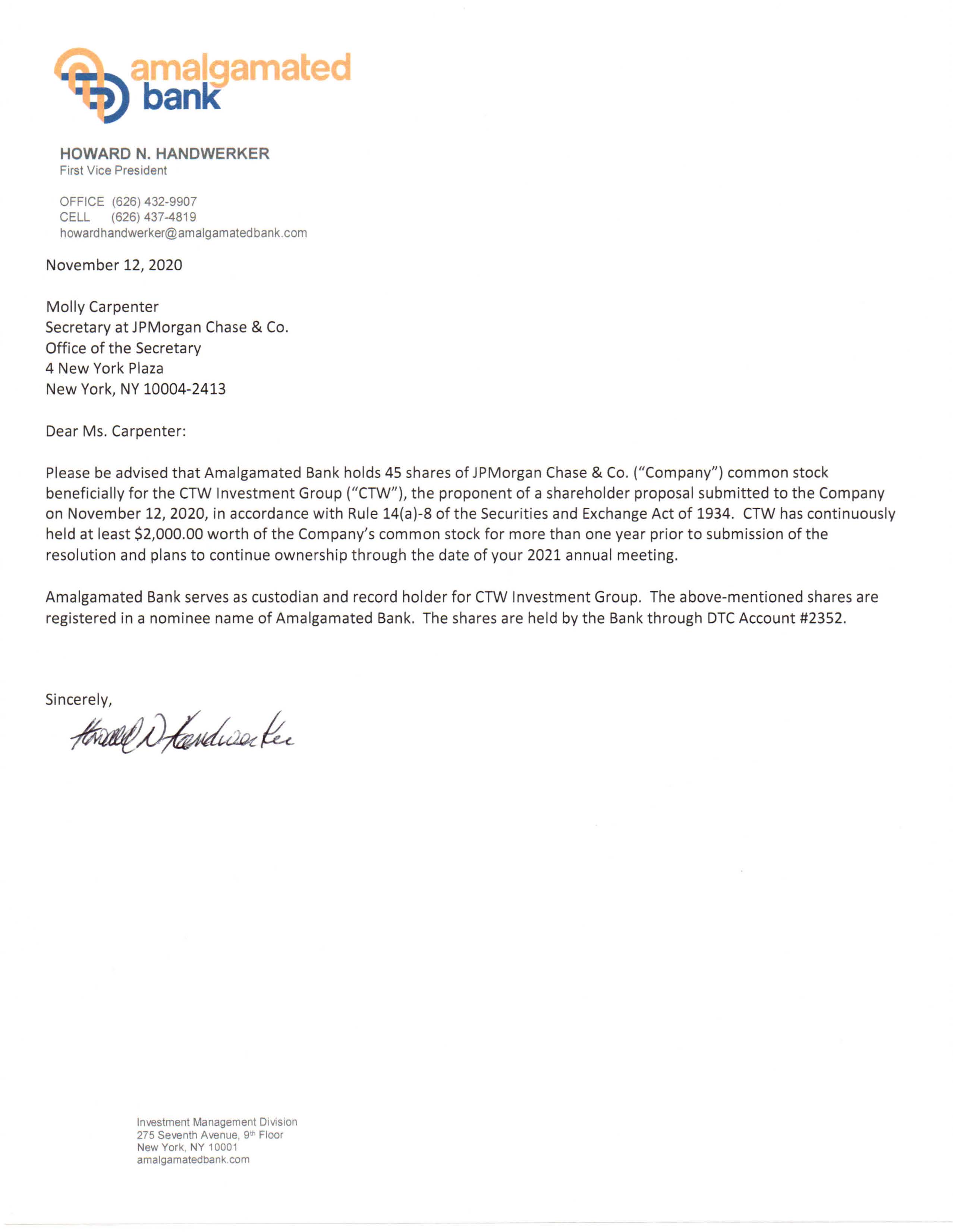
gamated
ban
i<
HOWARD
N.
HANDWERKER
First Vice President
OFFICE (626) 432-9907
CELL
(626) 437-4819
howardhandwerker@amalgamatedbank.com
November 12, 2020
Molly
Carpenter
Secretary at JPMorgan
Chase
&
Co.
Office
of
the Secretary
4 New York
Plaza
New York,
NY
10004-2413
Dear Ms. Carpenter:
Please
be
advised
that
Amalgamated Bank holds
45
shares
of
JPMorgan
Chase
&
Co.
("Company" ) common stock
beneficially
for
the
CTW
Investment Group ("
CTW
"
),
the proponent
of
a shareholder proposal submi
tted
to
the Company
on November
12
, 2020,
in
accordance
with
Ru
le 14(a)-8
of
the Securiti
es
and Exchange Act
of
1934.
CTW
has
continuously
held at least
$2
,000.00
worth
of
the Company's common stock
for
more than one year prior
to
submission
of
the
resolution and plans
to
continue ownership through
the
date
of
your 2021 annual meeting.
Amalgamated Bank serves
as
custodi
an
and record holder
for
CTW
Investment Group.
The
above-mentioned shares are
registered in a nominee name
of
Amalgamated
Bank.
The shares are held by the Bank through
DTC
Account #2352.
Sincerely,
~j)~/£_
Investment Management Division
275 Seventh Avenue, 9
th
Floor
New York,
NY
10001
amalgamatedbank.com