

February 22, 2017
Thomas S. Moffatt
CVS Health Corporation
thomas.moffatt@cvshealth.com
Re:
CVS Health Corporation
Incoming letter dated January 6, 2017
Dear Mr. Moffatt:
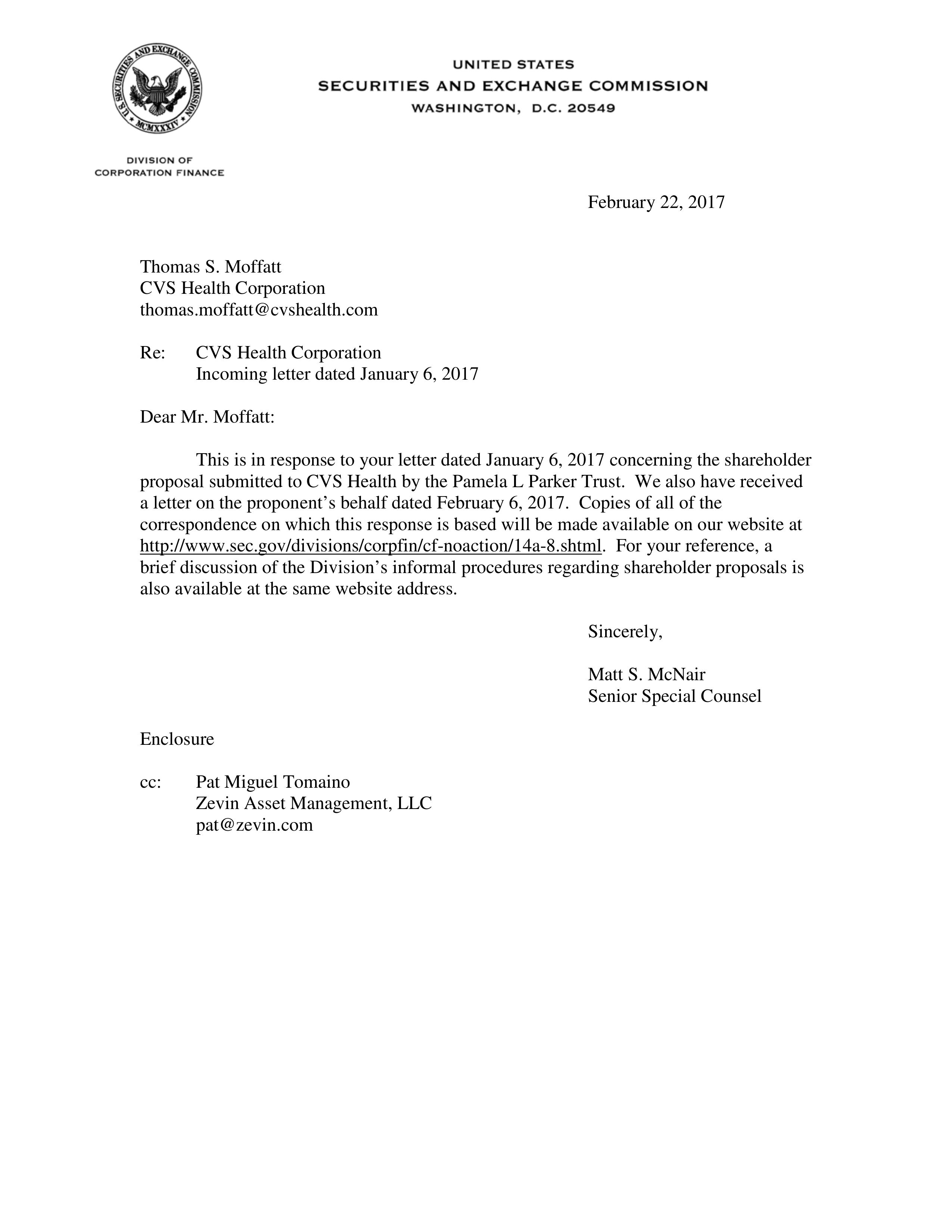
This is in response to your letter dated January 6, 2017 concerning the shareholder
proposal submitted to CVS Health by the Pamela L Parker Trust. We also have received
a letter on the proponent’s behalf dated February 6, 2017. Copies of all of the
correspondence on which this response is based will be made available on our website at
http://www.sec.gov/divisions/corpfin/cf-noaction/14a-8.shtml. For your reference, a
brief discussion of the Division’s informal procedures regarding shareholder proposals is
also available at the same website address.
Sincerely,
Matt S. McNair
Senior Special Counsel
Enclosure
cc:
Pat Miguel Tomaino
Zevin Asset Management, LLC
pat@zevin.com
February 22, 2017
Response of the Office of Chief Counsel
Division of Corporation Finance
Re:
CVS Health Corporation
Incoming letter dated January 6, 2017
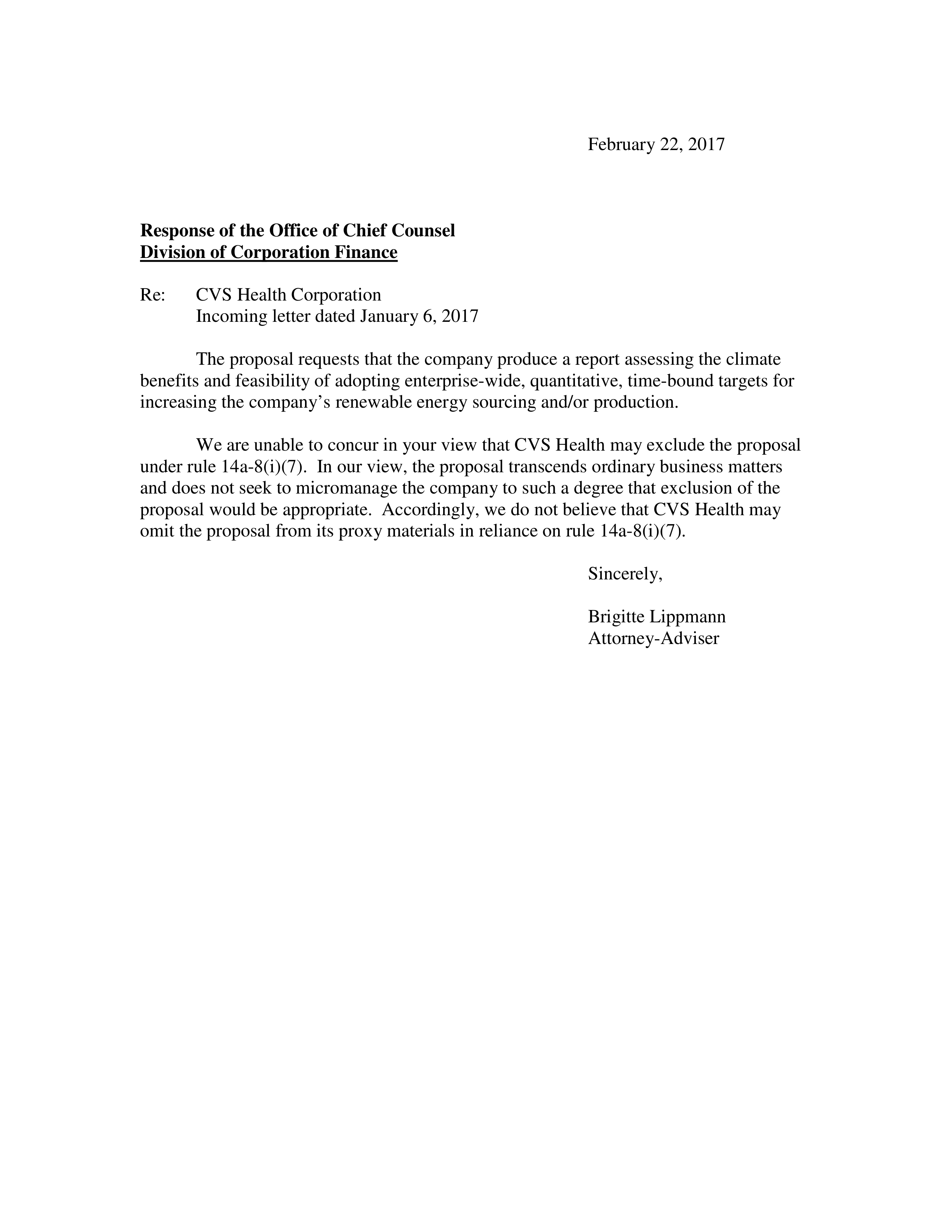
The proposal requests that the company produce a report assessing the climate
benefits and feasibility of adopting enterprise-wide, quantitative, time-bound targets for
increasing the company’s renewable energy sourcing and/or production.
We are unable to concur in your view that CVS Health may exclude the proposal
under rule 14a-8(i)(7). In our view, the proposal transcends ordinary business matters
and does not seek to micromanage the company to such a degree that exclusion of the
proposal would be appropriate. Accordingly, we do not believe that CVS Health may
omit the proposal from its proxy materials in reliance on rule 14a-8(i)(7).
Sincerely,
Brigitte Lippmann
Attorney-Adviser
DIVISION OF CORPORATION FINANCE
INFORMAL PROCEDURES REGARDING SHAREHOLDER PROPOSALS
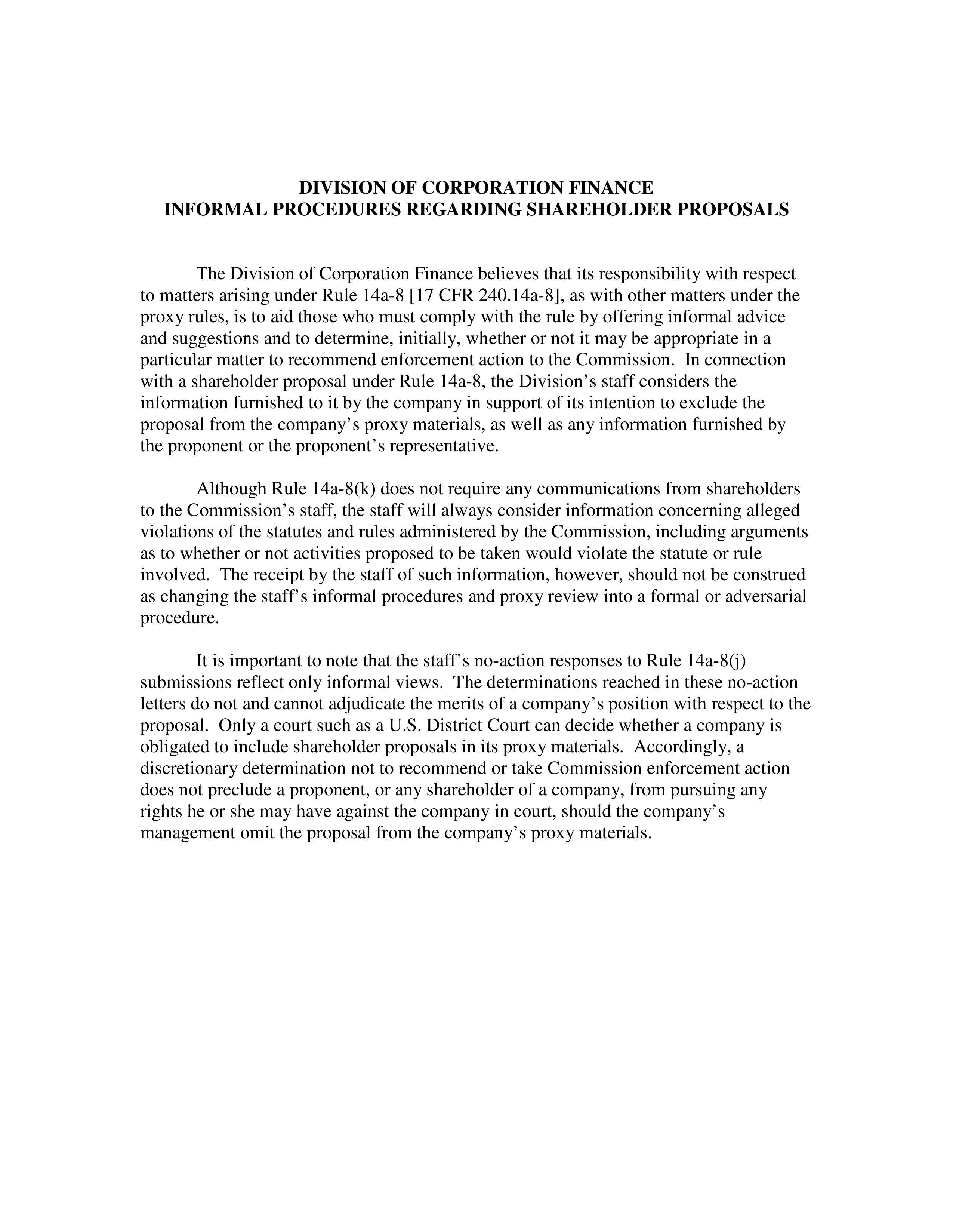
The Division of Corporation Finance believes that its responsibility with respect
to matters arising under Rule 14a-8 [17 CFR 240.14a-8], as with other matters under the
proxy rules, is to aid those who must comply with the rule by offering informal advice
and suggestions and to determine, initially, whether or not it may be appropriate in a
particular matter to recommend enforcement action to the Commission. In connection
with a shareholder proposal under Rule 14a-8, the Division’s staff considers the
information furnished to it by the company in support of its intention to exclude the
proposal from the company’s proxy materials, as well as any information furnished by
the proponent or the proponent’s representative.
Although Rule 14a-8(k) does not require any communications from shareholders
to the Commission’s staff, the staff will always consider information concerning alleged
violations of the statutes and rules administered by the Commission, including arguments
as to whether or not activities proposed to be taken would violate the statute or rule
involved. The receipt by the staff of such information, however, should not be construed
as changing the staff’s informal procedures and proxy review into a formal or adversarial
procedure.
It is important to note that the staff’s no-action responses to Rule 14a-8(j)
submissions reflect only informal views. The determinations reached in these no-action
letters do not and cannot adjudicate the merits of a company’s position with respect to the
proposal. Only a court such as a U.S. District Court can decide whether a company is
obligated to include shareholder proposals in its proxy materials. Accordingly, a
discretionary determination not to recommend or take Commission enforcement action
does not preclude a proponent, or any shareholder of a company, from pursuing any
rights he or she may have against the company in court, should the company’s
management omit the proposal from the company’s proxy materials.

Suite 1125
11 Beacon Street
Boston, MA 02108
Phone (617) 742-6666
WEB
www.zevin.com
EMAIL
invest@zevin.com
February 6, 2017
Via E-Mail:
shareholderproposals@sec.gov
U.S. Securities and Exchange Commission
Division of Corporation Finance
Office of Chief Counsel
100 F Street, N.E.
Washington, D.C. 20549
Re: CVS Health Corporation January 6, 2017 Request to Exclude Shareholder Proposal
Regarding Report on Renewable Energy Targets
Ladies and gentlemen:
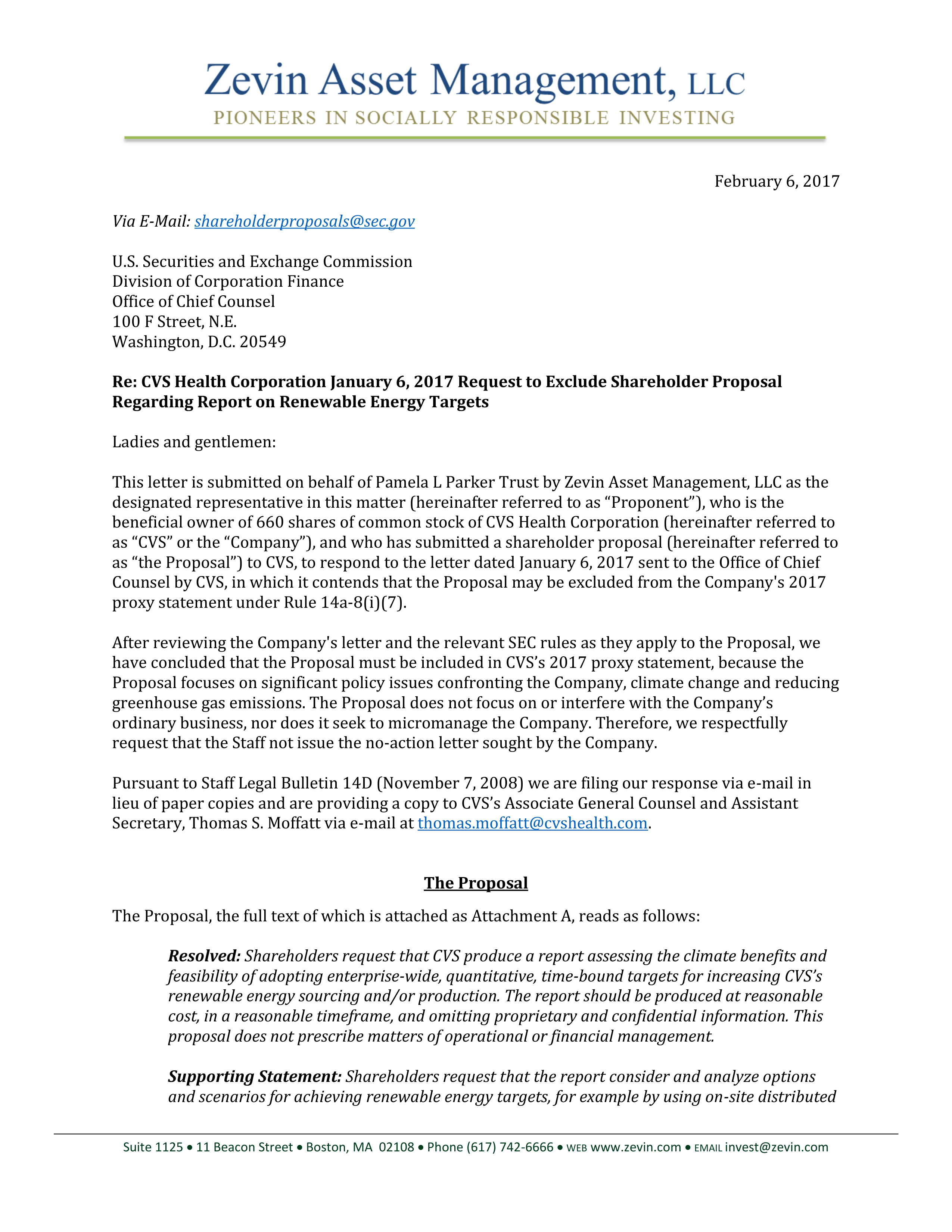
This letter is submitted on behalf of Pamela L Parker Trust by Zevin Asset Management, LLC as the
designated representative in this matter (hereinafter referred to as “Proponent”), who is the
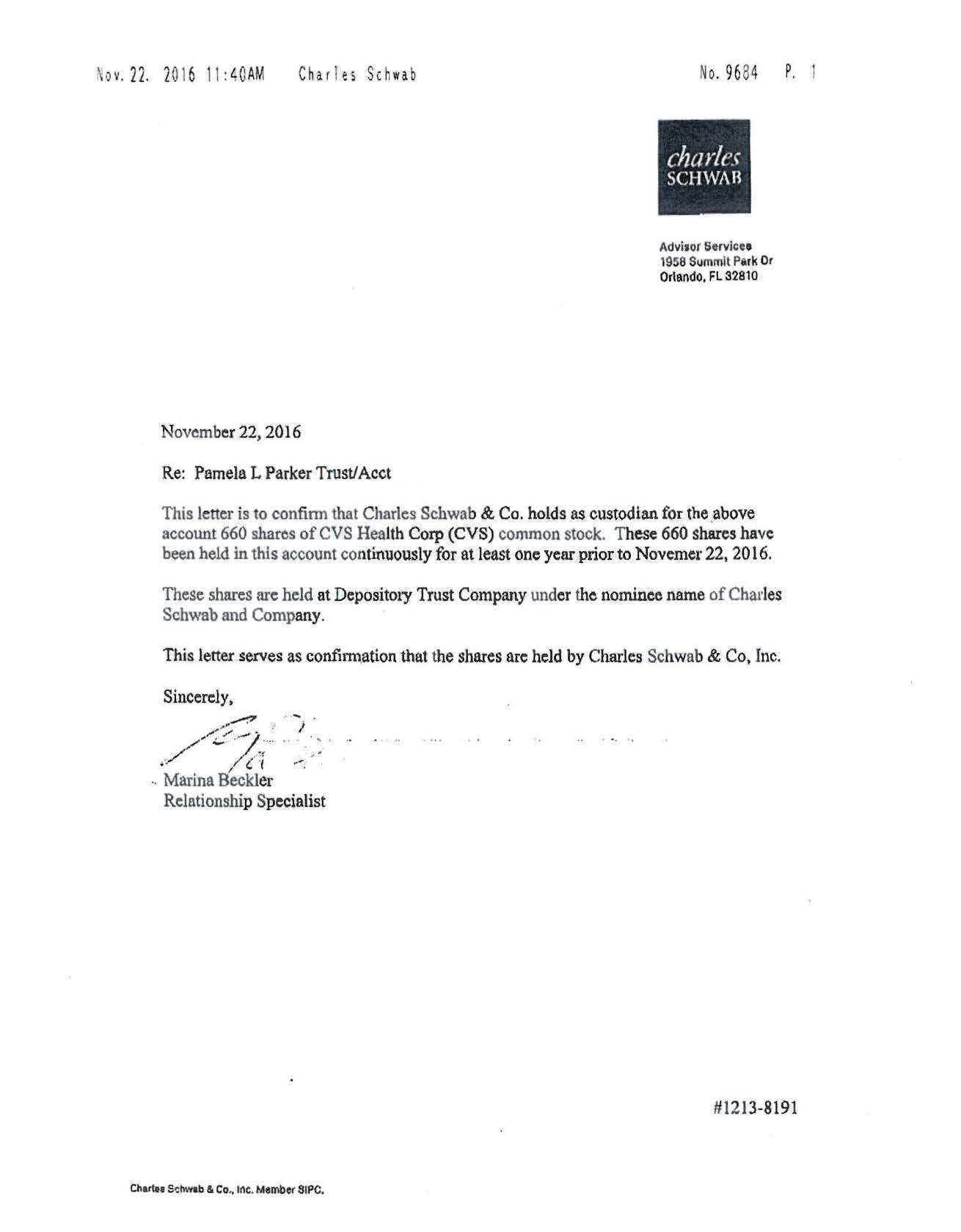
beneficial owner of 660 shares of common stock of CVS Health Corporation (hereinafter referred to
as “CVS” or the “Company”), and who has submitted a shareholder proposal (hereinafter referred to
as “the Proposal”) to CVS, to respond to the letter dated January 6, 2017 sent to the Office of Chief
Counsel by CVS, in which it contends that the Proposal may be excluded from the Company's 2017
proxy statement under Rule 14a-8(i)(7).
After reviewing the Company's letter and the relevant SEC rules as they apply to the Proposal, we
have concluded that the Proposal must be included in CVS’s 2017 proxy statement, because the
Proposal focuses on significant policy issues confronting the Company, climate change and reducing
greenhouse gas emissions. The Proposal does not focus on or interfere with the Company’s
ordinary business, nor does it seek to micromanage the Company. Therefore, we respectfully
request that the Staff not issue the no-action letter sought by the Company.
Pursuant to Staff Legal Bulletin 14D (November 7, 2008) we are filing our response via e-mail in
lieu of paper copies and are providing a copy to CVS’s Associate General Counsel and Assistant
Secretary, Thomas S. Moffatt via e-mail at
thomas.moffatt@cvshealth.com
.
The Proposal
The Proposal, the full text of which is attached as Attachment A, reads as follows:
Resolved:
Shareholders request that CVS produce a report assessing the climate benefits and
feasibility of adopting enterprise-wide, quantitative, time-bound targets for increasing CVS’s
renewable energy sourcing and/or production. The report should be produced at reasonable
cost, in a reasonable timeframe, and omitting proprietary and confidential information. This
proposal does not prescribe matters of operational or financial management.
Supporting Statement:
Shareholders request that the report consider and analyze options
and scenarios for achieving renewable energy targets, for example by using on-site distributed
Office of Chief Counsel
Division of Corporate Finance
U.S. Securities and Exchange Commission
February 6, 2017 – CVS Health – Renewable Energy Targets
Page 2
energy, off-site generation, power purchases, and renewable energy credits, or other
opportunities management would like to consider, at its discretion.
Background
Greenhouse gas (GHG) emissions from human activities are the most significant driver of observed
climate change. In 2015, the Paris Agreement joined nearly all of the world’s countries in a
commitment to limit climate change to an average global warming of 2 degrees Celsius above pre-
industrial temperatures by 2050, with a further goal of limiting warming to 1.5 degrees Celsius.
Both of these ambitious goals are considered critical to heading off the most catastrophic effects of
climate change. It is clear that significant reductions in greenhouse gas emissions on behalf of the
global economy, individual national economies, each business sector, and, critically, all major
corporations will be necessary to meet these critical goals.
CVS is one such corporation. The Company has the formidable challenge of assessing and reducing
its greenhouse gas emissions in line with an effective global response to climate change and
deciding how best to pursue that aim.
Indeed, the Company acknowledges the importance of climate change and GHG emissions to the
long-term sustainability of the Earth and of its operations. In its 2015 Corporate Social
Responsibility (“CSR”) Report, CVS states that “the overall health effects of climate change are likely
to be overwhelmingly negative” and “[w]e have assessed our operational footprint and determined
that energy use and GHG emissions are the most significant impacts.” The Company further states:
“Our strategy for sustainable operations focuses on these impacts [energy use and GHG emissions],
with a priority on reducing GHG emissions because of the link to climate change.”
1
According to CVS’s 2015 CSR report and its January 6, 2017 letter, the Company is mainly focused
on energy efficiency to drive GHG reductions.
Regarding renewable energy purchasing and production, the Company states that it is “constantly
evaluating opportunities through renewable technologies, renewable energy credits, power
purchase agreements, and tax credits.” That approach has evidently resulted in limited renewable
energy deployment: the Company’s renewable energy program currently includes solar panels at
five stores and a sixth store under construction.
2
In its January 6 letter, CVS concedes that it “has
not yet found a practical way to include renewables into its sustainability strategy, outside of
purchasing renewable credits – which have not proven to generate a sufficient return for a publicly
traded company.”
3
However, the Proponent believes that this approach does not take sufficient stock of CVS’s
opportunities to deploy renewable energy. Prices for electricity from sources like wind and solar
are near historic lows as supply continues to expand.
4
The average price of wind energy installed in
1
CVS
, 2015 CSR Report at p. 51,
https://cvshealth.com/sites/default/files/2015-csr-report.pdf
.
2
Ibid. at p. 56.
3
CVS Letter (January 6, 2017) at p. 4.
4
See for example:
Bloomberg
, “
World Energy Hits a Turning Point: “Solar That’s Cheaper Than Wind
,” December 15, 2016;
Bloomberg
, “
Wind and Solar are Crushing Fossil Fuels
,” April 6, 2016;
McKinsey & Company
, “
Lower oil prices but more
renewables: What’s going on
?” June 2015.
•CVS
Health
January
6,
2017
Office of Chief Counsel
Division of Corporate Finance
Securities and Exchange Commission
100 F Street, NE
Washington,
DC
20549
(Via e-mail: shareholderproposals@sec.gov)
Re:
CVS Health
Corp
or
atio
n
Sh
are
ho
l
der
Propos
al
of
th
e Pamela L Pa
rk
er
Trust
Ladies and Gentlemen:
Tho
mas
S.
Moffatt
Vice
President, Asst. Secretary
&
Asst. General Counsel
One
CVS
Dr
ive
MC
1160
Woon
socket, RI 02895
p
401-770-5409
f
401
-216-3758
th om as. moffatt@cvshealth.com
CVS Health Corporation, a Delaware corporation (the
"Comp
any"), in accordance with Rule
14a-8U) under the Securities Exchange Act
of
1934, as amended (the
"Exch
a
nge
Act"
),
is filing
this letter with respect to the shareholder proposal and support
in
g statement (the "
Propo
sal")
submitted by Zevin Asset Management, LLC
on
behalf of the Pamela L Parker Trust (Pamela L
Parker Trust, the "
Propon
ent") in a letter dated November 22, 2016. The Proponent seeks
inclusion of the Proposal in the proxy materials that the Company intends to distribute in
connection with its 2017 Annual Meeting of Shareholders (the "2017
Proxy
Ma
terial
s"). A copy
of the Proposal and all related correspondence with the Proponent are attached hereto as
Exhibit
A.
The Company hereby requests confirm
at
ion that the staff
of
the Office of Chief
Counsel (the
"fil!,ff')
will not recommend enforcement action if, in reliance on Rule 14a-8 of the
Exchange A
ct,
the Company omits the Proposal from its 2017 Proxy Materials.
Pursuant to Rule 14a-8U), this letter is being filed with the Securities and Exchange Commission
(the
"Commi
ss
ion"
) no later than 80 days before the Company files its definitive 201 7 Proxy
Materials. Pursuant to Staff Legal Bulletin No. 14D,
Shareholder Proposals
(Nov. 7, 2008), this
letter is being submitted to the Commission via e-mail to sharehol
de
rproposals@sec.gov.
Rule 14a-8(
k)
and Section E of Staff Legal Bu
ll
etin 14D provi
de
that shareholder proponents are
required to send companies a copy of any correspondence the Proponent elects to submit to
the Commission or the staff of its Division of Corporation Finance. Accordingly,
we
are hereby
informing the Proponent that if the Proponent elects to submit additional correspondence to the
Commission or the Staff with respect to this Proposal, a copy of that correspondence should be
furnished concurrently to the Company.
Pursuant to Rule 14a-8U), a copy of this submission is being sent simultaneously to the
Proponent as notification of the Company's intention to omit the Proposal from its 2017 Proxy
Materials. This letter constitutes the Company's statement of the reasons that it deems t
he
omission of the Proposal to
be
proper.
CVS
pharmacy
I
caremark
I
minute clinic
I
specialty
•CVS
Health
I.
The Proposal
The
Proposal states:
"Resolved:
Shareholders request that CVS produce a report assessing the c
li
mate benefits and
feasibility of adopting enterprise-wide, quantitative, time-bound targets for increasing CVS's
renewable energy sourcing and/or production. The report should be produced at reasonable
cost, in a reasonable timeframe, and omitting proprietary and confidential information. This
proposal does not prescribe matters of operational or financial management."
II.
Statement of Reasons to Exclude the Proposal Pursuant
to
Rule 14a-8(i)(7)
The Company believes that the Proposal may be properly excluded from its 2017 Proxy
Materials under Rule 14a-8(i)(7) because it implicates the Company's ordinary business
operations.
Pursuant to Rule 14a-8(i)(7), the Proposal is excludable because it
imp
li
cates the Company's
ordinary business operations by: (A) diverting efforts and resources
of
the Company and its
management by prescribing renewable energy targets
as
the means for the Company to power
its business and address climate change and the reduction of its greenhouse gas
("GHG")
emissions, thereby impeding the day-to-day financial and operational management
of
the
Company and (8) micromanaging the manner in which the Company chooses (1) to pursue
climate change
in
itiatives to reduce GHG emissions and (2) to engage in sustainable and
environmentally-friendly initiatives, thereby probing too deeply into matters of a compl
ex
nature
upon which shareholders,
as
a group, would not
be
in a position to make an informed judgment.
A.
The Proposal May be Excluded Pursuant to Rule
14a
-8(i)(7) Because the
Proposal Involves t
he
Ordinary Business Operations
of
the Company.
Rule 14a-8(i)(7) permits the omission
of
a shareholder proposal that deals with a
ma
tter relating
to the ordinary business operations of a company. The core basis for exclusion under
Rule 14a-8(i)(7) is to protect the authority of a company's board of directors to manage the
bus
in
ess and affairs of the company. In the adopting release to the amended shareholder
proposal rules, the Commission stated that the "general underly
in
g policy of this exclusion is
consistent with the policy of most state corporate laws: to confine the resolution of ordinary
business problems to management and the board of directors, since it is impracticable for
shareholders to decide how to solve such problems at an annual shareholders meeting."
Exchange
Act
Release
No.
34-40018
(May 21, 1998)
("1998 Release").
Under Commission and Staff precedent, a shareholder proposal is considered "ordinary
business" when it relates to matters that are so fundamental to management's ability to run a
company on a day-to-day basis that, as a practical matter, they are
not
appropriate for
shareholder oversight.
See 1998 Release.
The 1998 Release further provided that "the term
['ordinary bus
in
ess'] refers to matters that are not necessarily 'ordinary' in the common meaning
of
the word, and is rooted in the corporate law concept providing management with flexibility in
directing certain core matters involving the company's business and operations."
CVS
pharmacy / caremark / minute clinic
I
specialty
•CVS
Health
Generally, certain social
po
li
cy matters, such as sustainability, rise above the ordinary course of
business. However, the Sta
ff
has specifically stated that "in those cases in which a proposal's
underlying subject matter involves an ordinary business matter to the company, the proposal
generally
wi
ll
be
excludable under Rule 14a-8(i)(7)."
Staff Legal Bulletin No. 14E
(Oct. 27,
2009). Further, the Staff has also noted in the 1998 Release that a central consideration
of
the
ordinary business exclusion is that "[c]ertain tasks are so fundamental to management's ability
to run a company on a day-to-day basis that they could not, as a practical matter,
be
subject to
direct shareholder oversight."
See 1998 Release.
While this Proposal has a general theme of
sustainability, it focuses on
an
ordinary business matter fundamental
to
the ability
of
the
Company's management to run the business -
financial and operational management, including
the choice of energy technology, climate change initiatives and the implementation of such
initiatives
in
the manner best befitting the Company.
Moreover, while the Proposal is styled as a request for a report, the Commission has held that
proposals seeking a report are to be evaluated under Rule 14a-8(i)(7) through consideration of
the underlying subject matter of the proposal and to be excluded where that subject matter
involves ordinary business matters.
See Exchange
Act
Release
No.
34-20091
(August 16,
1983). The underlying subject matter of the Proposal, as demonstrated by the supporting
statements and the content of the requested report, pertain to the institution of specific
renewable energy targets in connection with the reduction of GHG emissions.
The supporting statements to the Proposal indicate that the Proponent believes the only
meaningful way to address GHG emissions and climate change is through the specific targets
for the use and production of renewable energy. Such statements include:
"the United States needs to reduce annual greenhouse gas (GHG) emissions
approximately 80 percent. This will involve a significant shift to renewable energy."
"Investors are concerned that CVS may be behind other large corporations which are
developing quantitative renewable energy goals in response
to
climate change."
"Failure to set a renewable energy target may impede the Company's
GHG
reduction
strategy."
"options and scenarios for achieving renewable energy targets, for example by using on-
site dis
tr
ibuted energy, off-site generation, power purchases, and renewable energy
credits, or other opportunities
..
. "
Through the requirement that such report be on the feasibility
of
enterprise-wide quantitative,
time-bound targets for increasing CVS's renewable energy sourcing and/or production, the
Proposal demands that the Company invest time and money in the assessment and
implementation of
an
energy and investment policy involving the purchase and production
of
renewable energy.
As
such and as discussed below, this Proposal seeks to determine the
choice of energy technology that the Company will use
in
its operations by making the
determination for management that the Company must shift to renewable energy.
The
Staff has
concluded
on
mu
ltiple occasions that proposals seeking to prescribe the kind of energy
technolo
gy
a company uses are excludable as an ordinary business matter.
See First Energy
CVS
pharmacy
I
caremark / minute clinic / specialty
•CVS
Health
Corp.
(avail. Mar.
8,
2013) (concurring that a proposal "requiring management to alter the mix of
energy sources ... which would require the
Co
mpany to significantly alter ... its day-to-day use of
various energy sources
..
. [and] to adopt certain 'strategies and quantitative goals"' was
excludable as relating to ordinary business operations).
In
particular, in response to a similar
proposal from the same Proponent in 2015, the Staff concurred that
the
proposal from the
Proponent seeking quantitative targets to increase renewable energy sourcing and production
and demanding that the Company pursue an energy and investment policy involving the
purchase of renewable energy and carbon reduction investments
was
excludable as relating to
ordinary business matters. See CVS
Health
(avail. March
8,
2016). Similarly, here, the
Proposal seeks to mandate the kind of energy technology that the Company uses in its
operations by requiring it to pursue and use renewable energy, which would require a significant
shift from the mixture of ener
gy
the Company currently uses based on availability, facility
capacity and needs for each store or distribution center location across the country. Such a
report on the feasibility of enterprise-wi
de
, quantitative, time-bound targets necessitates the
Company to focus on renewable energy not only as its energy technology for operations, but
also as its primary means to address GHG emissions and c
li
mate change.
Thus, the Proposal impedes the ability of management to best determine the most effective and
efficient means to operate the Company, including through it selection of energy technologi
es
to
use as the Proposal repeatedly notes the need for quantitative targets for use
of
renewable
energy. The assessment, selection and implementation of such means, however, are best left
to management's evaluation of the feasibility and financial impact that such programs may have
on
the Company. The Company is constantly assessing its environmental impact strategy and
describes the measures that management has determined to be most effective in the
Company's 2015 Corporate Social Responsibility Repo
rt
(the
"2015
CSR
R
epo
rt"
),
which was
published by the Company
in
May 201
6.
CVS Health has spent a significant amount
of
time
researching options for renewable energy, but the Company has not yet found a practical way to
include
renewables
into i
ts
sus
tainability
strategy,
outside
of purchasing
rene
wable
cred
its -
which have not proven to generate a sufficient return for a publicly traded company. Instead,
the Company has focused on a number of strategies and initiatives that have had immediate
and measurable impact. For instance, management has implemented
an
energy management
system through which it can "manage, monitor and adjust
li
ghting, HVAC and other
systems .
..
thus helping [the Company] drive energy efficiency consistently across [its] stores,
distribution centers and other facilities." See
2015
CSR
Report
at
55. Furthe
r,
the Company has
disclosed that it has "three main sources of energy use [that] contribute to
[i
ts]
GHG
emissions"
and is actively p
ur
suing a number of energy technology initiatives. Management specifically
"r
emain[s] focused
on
achieving energy efficiency in operational areas where [the Company]
can have the biggest impact, including
li
ghting and the centralized management
of
energy use,
as
well
as
through transportation and distribution efficiencies", indicating that management is
better positioned to assess the kind of energy technology to employ in day-to-day operations.
See 2015 CSR Report
at
52
and
55.
Furthermore, the Staff has also deemed that proposals seeking a report on strategy for energy
use management relate to expenses and the financial management
of
the company, as is the
case here. See
Apple Inc.
(avail. Dec. 5, 2014) (concurring that "a report ... estimating the total
CVS
pharmacy
I
caremark
I
minute
clinic/
specialty
•CVS
Health
investment in
...
renewable sources of electricity" was excludable because it related to the
company's "choice of technologies in management of its energy expenses"
).
The supporting
statement of the Proposal focus on operational and financial management matters, including the
Company's selection
of
its energy technology, in particular:
a.
"Costs
of
generating electricity from sources
li
ke wind and solar have been
declining rapidly and are influencing companies' response to climate change."
b.
"The EPA currently lists 78 Fortune 500 companies as purchasing renewable
energy (or certificates)
..
. CVS Health Corporation
..
.
has
taken halting steps in this
direction."
c.
"Failure to set a renewable energy target may impede
the
Company's GHG
reduction strategy. By setting quantitative goals on renewable energy, [the)
Company can strengthen its current climate change strategy, respond ably to
energy market changes, move closer to achieving
GHG
reductions, and help
meet the global need for cleaner energy"
d.
" ... consider and analyze options and scenarios for achieving renewable energy
targets, for example by using on-site distributed energy, off-site generation,
power purchases, and renewable energy credits, or other opportunities"
Management, however, is better positioned to determine the proper energy uses and sources
for the Company. The Company operates approximately 9,700 reta
il
drugstores, as well as
several dozen other offices and facilities throughout the United States. Many
of
the
Company's
existing facilities are leased and/or are in smaller or older buildings,
wh
ich restricts the
Company's ability to insta
ll
renewable energy technology such as solar panels or wind turbines.
Further, energy needs fluctuate based on extreme weather across the country. Therefore,
requiring a shift to renewable energy sourcing and/or production intrudes
in
areas in which
shareholders lack business expertise and an intimate knowledge
of
the Company's business
as
it disregards existing contracts for supply of energy and production
of
products and sourcing
with suppliers and third parties, as we
ll
as
business
in
itiatives and strategies that may make the
institution of such methods impractical for an expanding business. It also fails to account for the
quantity and quality of available sources of renewable energy, particularly given the nationwide
operations
of
the Company and the lack
of
abundant and reliable renewable energy in certain
regions. Forcing the Company to assess and establish quantitative, time-bound renewable
energy targets would hinder the Company from running its daily business efficiently and
economically as the energy needed by the Company to run its daily business may rely on
existing contracts or infrastructure that cannot support specific and potentially unsuitable targets
for renewable energy sourci
ng
and production.
As
such, the Proposal should
be
excludable
as
relating to ordinary business matters, much as the Staff concurred in
the
exclusion
of
a similar
proposal from the Proponent
in
2015.
See generally,
CVS
Health
(avail. March 8, 2016).
Moreover, as a pharmacy innovation company with "thousands of reta
il
pharmacies, an
expanding footprint
as
a result of recent acquisitions and a growing supply chain" the Company
is already committed to assessing and reducing direct and indirect environmental impacts.
See
2015
CSR
Report
at
48.
The Company has invested significant resources
in
assessing the
CVS
pharmacy
I
caremark
I
minute clinic / specialty
•CVS
Health
energy technology mix and best means for the Company to reduce G HG emissions and
address climate change. Those means
do
not at this time include quantitative renewable
energy targets or a feasibility report on company-wi
de
implementation of such quantitative and
time-bound targets. Those means and that energy technology policy does include the
monitoring of environmental and economic payback of new technologies and alternative energy
sources and the evaluation of "opportunities through renewable technologies, renewable energy
credits, power purchase agreements, and tax credits," decisions that management is best
equipped to make.
See 2015 CSR Report
at
56.
Still, the Proponent wants the Company to focus time, money and efforts on renewable energy
quantitative targets across the entire Company and implementation scenarios; however, a
shareholder cannot understand the complexities
of
energy management for the Company or the
most prudent and effective mechanisms for the Company to address
GHG
emissions and
climate change. Here,
as
argued in response to
in
a proposal submitted to
FUR
Systems, Inc.
in 2013 (the
"FLIR Proposa
l"
),
the statements put forth in the Proposal "center on the day-to-
day management
of
energy use
at
the Company's facilities, which could not be more
fundamental to the ordinary business of the Company." Further, just
as
in the
FUR
Proposal,
the Proposal "focuses squarely on the potential costs and benefits related to the Company's
energy use management" through supporting statements such as "[c]osts of generating
electricity from sources like wind and solar have been declining rapidly" and "[f]ailure to set a
renewable energy target may impede the Company's GHG reduction strategy. By setting
quantitative goals on renewable energy, our Company ... respond ably to energy market
changes." Given that day-to-day management
of
financial affairs and other similar matters are
ordinary business, the Staff reiterated in
FUR
that "[p]roposals that concern the manner in
which a company manages its expenses are generally excludable under rule 14a-8(i)(7)."
See
FUR
Systems, Inc.
(avai
l.
February 6, 2013). Therefore, exclusion
of
this Proposal is
warranted.
While the Staff has declined to employ the 14a-8(i)(7) ordinary business rationale to exclude
some proposals that sought to advance the use of renewable energy, those proposals are
distinguishable as they were directed at companies whose main business is to produce and
de
li
ver energy, unlike the Company, which is a consumer
of
energy.
Compare ExxonMobil
Corporation
(avail. March 12, 2007) (proposal to adopt a policy
of
significantly increasing
renewable energy sourcing globally, with recommended goals in the range of 15% -
25% of its
energy sourcing by between 2015 and 2025) and
Duke Energy Corporation
(avail. February 13,
2001) (proposal to invest sufficient resources to build new electrical generation from solar and
wind power sources to replace approximately one percent
(1
%)
of
system capacity yearly for the
next twenty years with the goal of having the company producing twenty percent (20%)
of
gener
at
ion capacity from clean renewable sources in 20 years). In contrast to the situations
advanced in the letters noted above, the Company is a consumer of energy and a business that
purchases many
of
its products from thi
rd
parties, over whom it cannot control the use
of
renewable energy. Quantitative targets for renewable energy sourcing and/or production are
simply not as effective as other measures the Company
emp
loys to promote sustainability,
increase energy efficiency or save costs.
CVS
pharmacy
I
caremark / minute clinic / specialty
•CVS
Health
B. The Proposal May be Excluded Pursuant
to
Ru
le 14a-8(i)(7) Because the
Proposal Seeks to Micromanage the Company.
Next, the Proposal also seeks
to
micromanage the decisions
of
the Board
of
Direc
to
rs and
management by dictating the manner in which the Company chooses (a)
to
pursue climate
change initiatives
to
reduce GHG emissions and (b) to engage in sustainable and
environmentally-friendly initiatives, thereby probing too deeply into matters
of
a complex nature
upon which shareholders, as a group, would not be
in
a position
to
make
an informed judgment.
One
of
the central considerations expressed by the Commission with regard
to
the ordinary
business exclusion "involves the degree
to
which the proposal seeks
to
micromanage the
company by probing too deeply into
ma
tters
of
a complex nature upon which shareholders, as a
group, would not be in a position
to
make an informed judgment."
See 1998 Release.
Further,
the Commission has explained that shareholders, as a
gro
up, are not qualified
to
make an
informed judgment on ordinary business matters due to their "lack
of
bus
iness expertise and
their lack
of
intimate knowledge
of
the issuer's business."
See Adoption
of
Amendments
Relating to Proposals
by
Security Holders, Exchange
Act
Release No. 12999 (November
22,
1976).
In seeking enterprise-wide, quantitative, time-bound targets for renewable energy sourcing
and/or production, the Proposal is asking the Company
to
set ambiguously defined quantitative
targets and a deadline for the entire Company. It does not take into account the feasibility,
practicality
or
potential impact
of
such a proposal, such as the considerations relating
to
location
specific needs and existing energy agreements discussed above in Section A.
The
Staff has
long held that proposals related
to
climate change policies that demand specific management
actions, including the implementation
of
certain energy policies, and company-wide courses
of
action are excludable.
See Assurant, Inc.
(avai
l.
Mar. 17, 2009) (concurring that the company
could exclude a proposal calling
for
a report concerning the company's plan
to
address climate
change)
;
General
Electric
Co.
(ava
il.
Jan.
9,
2009)
(concurr
ing
that the
company
could
exclude
a proposal demanding a report on the costs and benefits
of
divesting
the
company's nuclear
energy investment and investing instead
in
renewable energy);
Ryland Group.
Inc.
(avail. Feb.
13, 2006) (concurring that the company could exclude a proposal calling for a report
on
the
company's response
to
pressure
to
increase energy efficiency). It
has
also held that proposals
requiring the implementation
of
certain climate change polices
to
satisfy proposed emissions
targets and the creation
of
an "eco-plan" different than those that have already been
implemented seek
to
micromanage day-to-day decisions
of
a kind
that
are too impractical and
complex
for
direct shareholder oversight. Such proposals "probe too deeply into
ma
tters
of
a
complex nature upon which shareholders, as a group, would not be in a position
to
make an
informed judgment."
See Deere
&
Co.
(avail. October 14, 2016).
Likewise, here, the Company already pursues energy efficiency mechanisms that are
appropriate for and tailored to the Company's business based on the commitment "to reducing
[its] environmental impacts
in
areas
wh
ere [the Company has) a high level
of
control.
The
Company continuously identifies specifying internal and external targets aimed at driving
operational efficiency and reducing
GHG
emissions by "focusing on driving reductions in
GHG
emissions, energy, water and waste."
See 2015 CSR Report at 49.
Yet
the Proposal dictates a
CVS
pharmacy / caremark / minute clinic / specialty
•CVS
Health
shift to renewable energy and insinuates that renewable energy is
the
only means
to
accomplish
GHG emission reduction. The Proposal, therefore, seeks to micromanage the fundamental
operations of the Company's business by directing how the Company should purchase energy,
invest, pursue energy efficiency, reduce costs and enact its sustainability initiatives, all of which
are ordinary management functions that are not appropriate matters
for
direct shareholder
oversight.
The Company has not previously set quantitative renewable energy targets or disclosed a
feasibil
it
y report on such targets, as it is more sensibl
e,
based on the Company's operations and
facility portfolio, to pursue other mechanisms with the goal
of
reduc
in
g GHG emissions and
increasing energy efficiency. Management has determined that the current approach to
reducing GHG emissions should include "monitoring for risks and opportunities, establishing
energy and GHG efficiency programs, and engaging .
..
with ... stakeholders to determine and
prioritize [its] climate-related commitments."
See 2015 CSR Reporl
at
51.
The Company does
not control the ava
il
ability or dependability
of
renewable energy that its operating faciliti
es
may
be able to access and having a numeric commitment in place would compel the Company to
purchase renewable reso
ur
ces that are not economica
ll
y or environmentally feasible, thereby
counterac
ti
ng the Proposal's pr
im
ary cost-saving goal discussed above. The Company does
not set numeric goals or invest in the producti
on
of
reports for the sake
of
having goals without
considering feasibility, market realities and business needs. As a company proud of its
environmental leadership and thoughtful, business-appropriate initiatives, the Company works
hard to integrate measur
es
to reduce GHG emissions, increase energy efficiency, reduce cost
and remain competitiv
e.
The Company closely monitors and reviews the renewable energy
market, and believes that it
is
not a cost-effective investment for the Company and its
shareholders at the present time nor is it the most effective way for the Company to respond to
climate change and reduce GHG emissions.
See 2015 CSR Reporl
at
56.
Thus, the Proposal
seeks to micromanage the way that the Company and its management create and implement a
GHG emission reduction and ene
rg
y efficiency plan, which is currently yielding carbon intensity
reductions that exceed targets, without an understanding of the complexities of the Company's
business. The deta
il
ed, thoughtful and CVS Health Corporation-specific measures described
herein and in the 2015 CSR Report were designed to address the particular impact the
Company's operations have on the environment and the best ways
to
mitigate those effects.
In
sum, the Proposal relates to a fundamental day-to-day aspect of the business
of
the
Company -
the reliable and business-appropriate mix of energy so
ur
ces for the Company and
the manner in
wh
i
ch
the Company can best reduce GHG emissions, address climate change
and enact energy efficiency plans. Accordingly, the decisions previously made and the
initiatives currently implemented by the Board of Dir
ec
tors and management related to these
actions are properly left to the Company and its Board of Directors rather than its shareholders.
For these reasons, the Proposal may be properly excluded under Rule 14a-8(i)(7).
CVS
pharmacy / caremark
I
minute clinic
I
specialty
•CVS
Health
Il
l.
Concl
us
i
on
The
Company respectfully requests
the
Staff's concurrence with its
dec
ision
to
omit
the
Proposal from
the
2016 Proxy Materials and further requests the confirmation
that
the
Staff
will
not recommend any enforcement action in connection with such omission. Please call
the
undersigned at (401) 770-5409 if you should have any questions
or
need additional information
or
as soon as a Staff response is available.
Re
~
urs,
?/~C
Thomas S. Moffatt
Vice President,
Ass
istant Secretary &
Asst. General Counsel -
Corporate
Se
rvices
Attachments
cc w/att:
Pat Mi
gue
l Tomaino,
Asso
ciate Director
of
S
RI
, Zevin
Ass
et
Manageme
nt,
LLC
Stephen
T.
Giove, Shearman & Sterling LLP
CVS
pharmacy / caremark
I
minute clinic
I
specialty


Exhibit
A
Proposal and Related
Correspondence
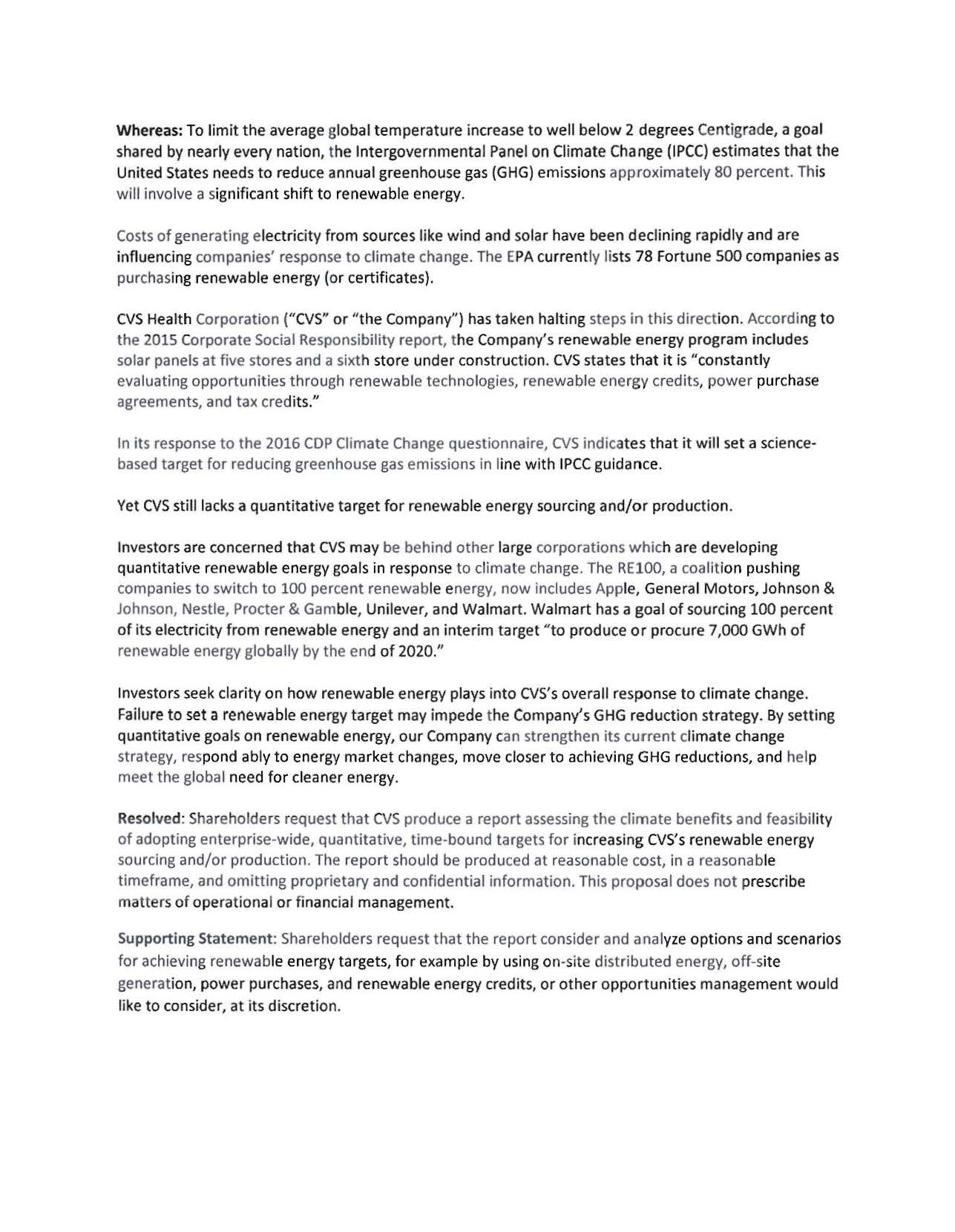
Whereas: To
limit
the
average global temperature increase
to
well
below 2 degrees Ce
nt
igrad
e,
a goal
shared
by
nearly every nation, the Intergovernmental Panel on Climate Change
(IPCC)
estimates
that
the
United States needs
to
reduce annual greenhouse
gas
(GHG)
emissions approximately
80
percent.
Th
is
will invol
ve
a significant shift
to
renewable energy.
Costs
of
generating electricity from sources like wind and
so
lar have been declining rapidly and are
influencing companies' response
to
climate change. The E
PA
cu
r
rent
ly lists
78
Fortune 500 companies
as
purchasing renewable energy (or certificates).
CVS
Health Corporation ("CVS"
or
"the
Company")
has
taken halting steps
in
this
direct
ion. According
to
the 2015 Corporate Social Responsibility report, the Company's renewable energy program includ
es
solar panels
at
five stores and a sixth store under construction.
CVS
states
that
it
is
"const
ant
ly
evaluating opportunities through renewable technologies, renewable energy credits,
power
purcha
se
agreements, and tax credits."
In
its response
to
the
2016
CDP
Climate Change questionnaire,
OJS
indicates
that
it
will set a science-
based target
for
reducing greenhouse
gas
emissions in line
with
IPCC
guidance.
Yet
CVS
still lacks a quantitative target
fo
r renewable energy sourcing
and/or
production.
Investors are concerned
that
OJS
may
be
behind
other
large corporations
whic
h are developing
quantitative renewable energy goals in respon
se
to
climate change. The
RElOO,
a coal
it
ion pushing
companies
to
switch
to
100 percent renewable energy,
now
includes Appl
e,
General
Motors,
Johnson
&
Johnson, Nestle, Procter
&
Gamble,
Un
ilever, and Walmart. Walmart has a goal
of
sourcing
100
percent
of
its electricity
from
renewable energy and
an
interim target
"t
o produce
or
procure 7,000 GWh
of
renewable energy globally
by
the end
of
2020."
Investors
seek
clarity on
how
renewable energy plays
into
CVS's
overall response
to
climate change.
Failure
to
set a renewable energy
target
may impede the Company's
GHG
reduction strategy.
By
setting
quantita
tiv
e goals on renewable energy,
our
Company c
an
strengthen its
current
cl
imate change
strategy,
res
pond ably
to
energy market changes, move closer
to
achieving GHG reductions, and help
meet the global need
for
cleaner energy.
Resolved: Shareholders request that C
VS
produce a
report
assessing
the
climate benefits and feasibil
it
y
of
adopting enterprise-wide, quantitative, time-bound targets
for
increasing
CVS's
renewable energy
sourcing
and/or
production. The rep
ort
should
be
produced at reasonable cost, in a reasonable
timeframe, and
omitting
proprietary and confidential information. This proposal does
not
prescribe
ma
tt
ers
of
o
pe
rational
or
financi
al
management.
Su
pporting Statement: Shareholders request
that
the
report
consider and analyze options and scenarios
for
achieving renewable energy targets,
for
example
by
using on-site dist
ri
bute
d energy,
off
-site
generation, power purchases, and renewable energy credits,
or
other
opportunities management would
like
to
consider, at its discretion.
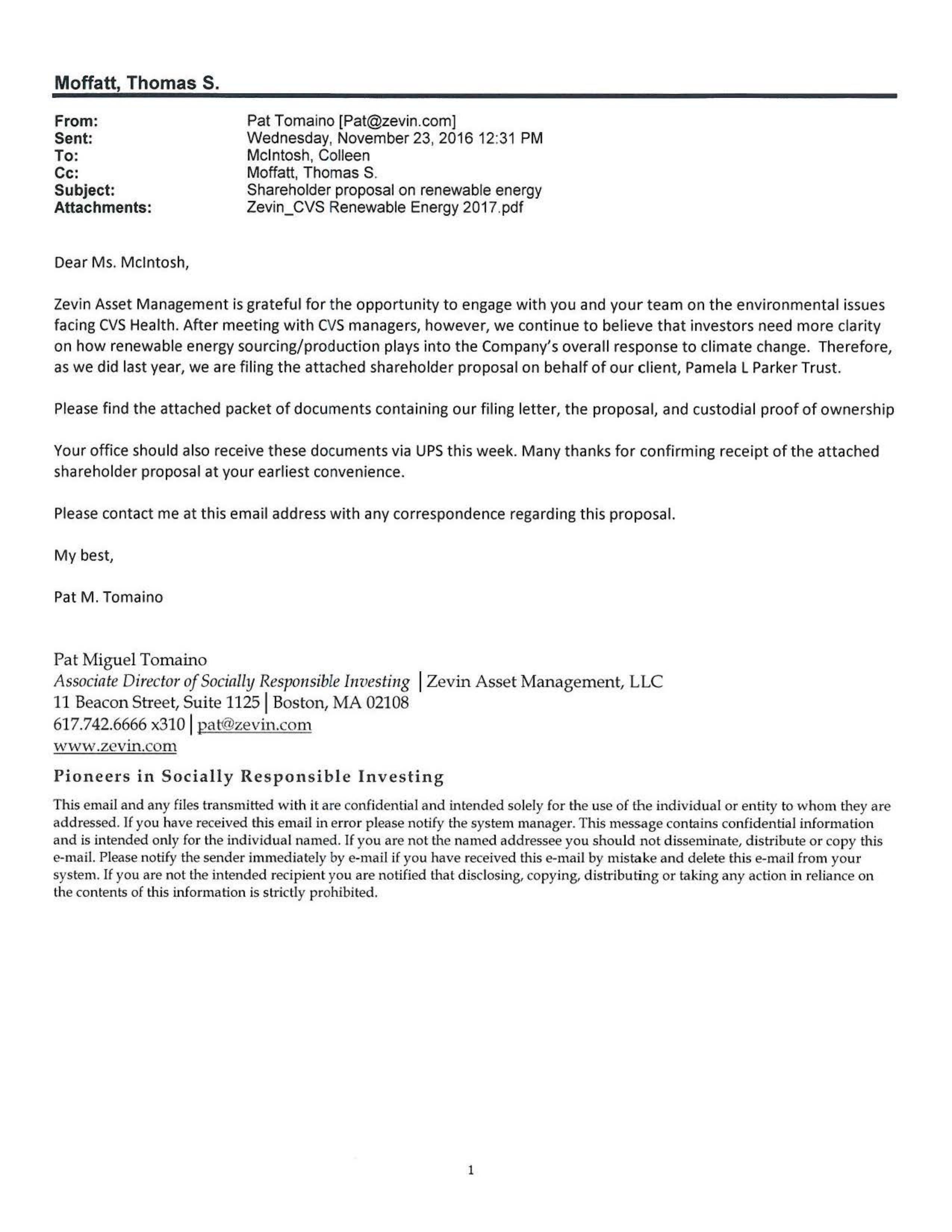
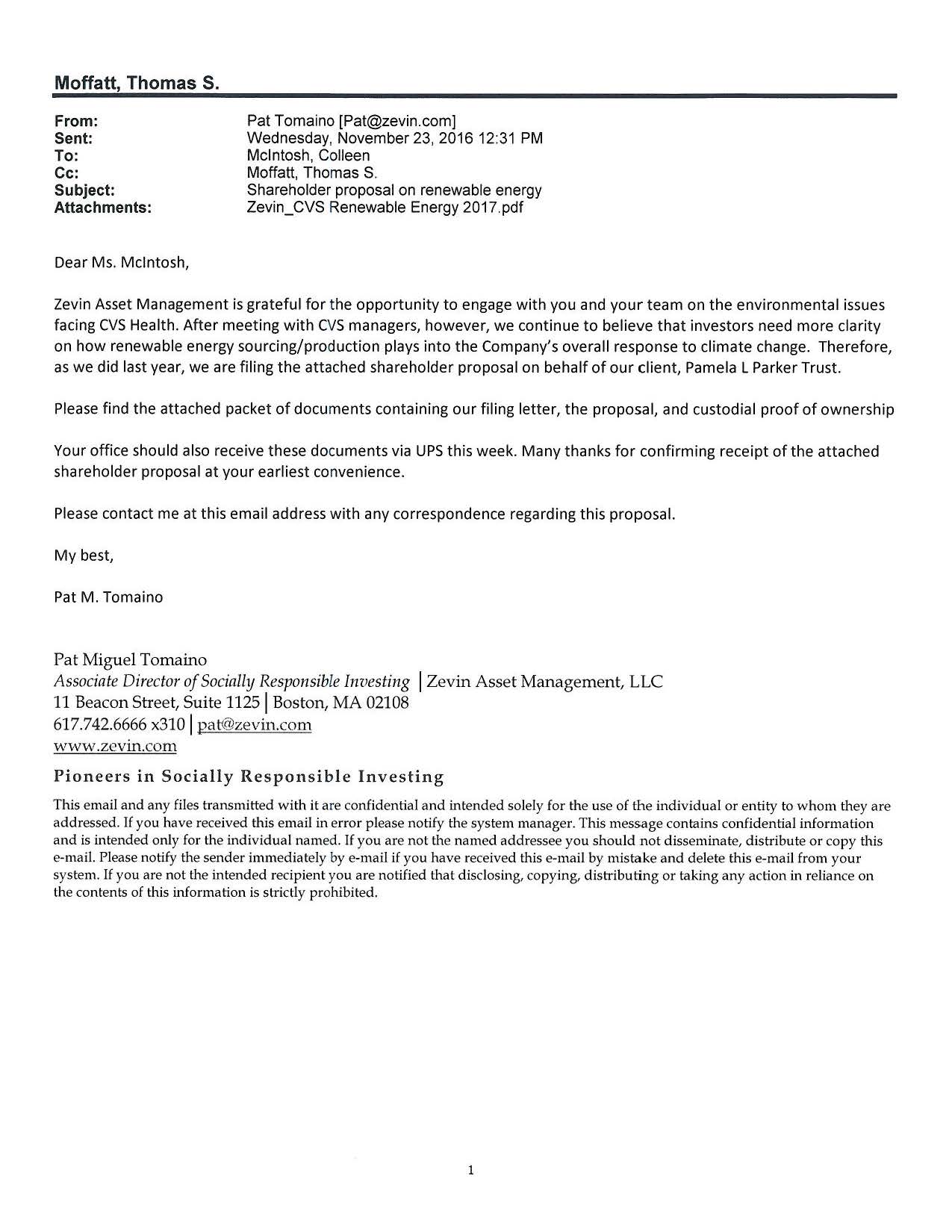
Moffatt, Thomas S.
From:
Sent:
To:
Cc:
Subject:
Attachments:
Dear Ms. Mcintosh,
Pat Tomaino [Pat@zevin.com]
Wednesday, November 23, 2016 12:
31
PM
Mcintos
h,
Colleen
Moffatt, Thomas S.
Shareholder proposal on renewable energy
Zevin_CVS Renewable Energy 2017.pdf
Zevin Asset Management
is
grateful
for
the
opportunity
to
engage
with
you and
your
team on
the
environmental issues
facing
CVS
Health.
After
meeting
with
CVS
managers, however, we continue
to
believe
that
investors need more clarity
on how renewable energy sourcing/production plays
into
the
Company's overall response
to
climate change. Therefore,
as
we did last year, we are filing
the
attached shareholder proposal on behalf
of
our
client, Pamela L Parker Trust.
Please find the attached packet
of
documents containing
our
filing letter,
the
proposal, and custodial
proof
of
ownership
Your office should also receive these documents via
UPS
this week. Many thanks
for
confirming receipt
of
the
attached
shareholder proposal at your earliest convenience.
Please contact me at this email address
with
any correspondence regarding this proposal.
My
best,
Pat M. Tomaino
Pat
Miguel
Tomaino
Associate
Director
of
S
ocially
Responsib
le Investing
I
Zevin
Asset
Managemen
t, L LC
11 Beacon Street, Suite 1125
I
Boston, MA 02108
617.742.6666
x310
I
pat@zevin.com
www
.zevin.
com
Pioneers
in
Socially
Responsible
Investing
This email and
any
files transmitted with
it
are confidential
and
intended solely for the use of the individual or entity to
whom
they
are
addressed.
If
you have received
th
is email in error please notify the system manager. This message contains confidential information
and
is
int
ended only for the individual named.
If
you
are
not the named addressee you should
not
disseminate, distribute or copy this
e-mail. Please notify the sender immediately by e-mail
if
you
have received this e-mail by mistake
and
delete this e-mail from
your
system.
If
you are not the intended recipient you
are
notified that disclosing, copying, distributing
or
taking any action in reliance
on
the contents of this information
is
strictly prohibited.
1
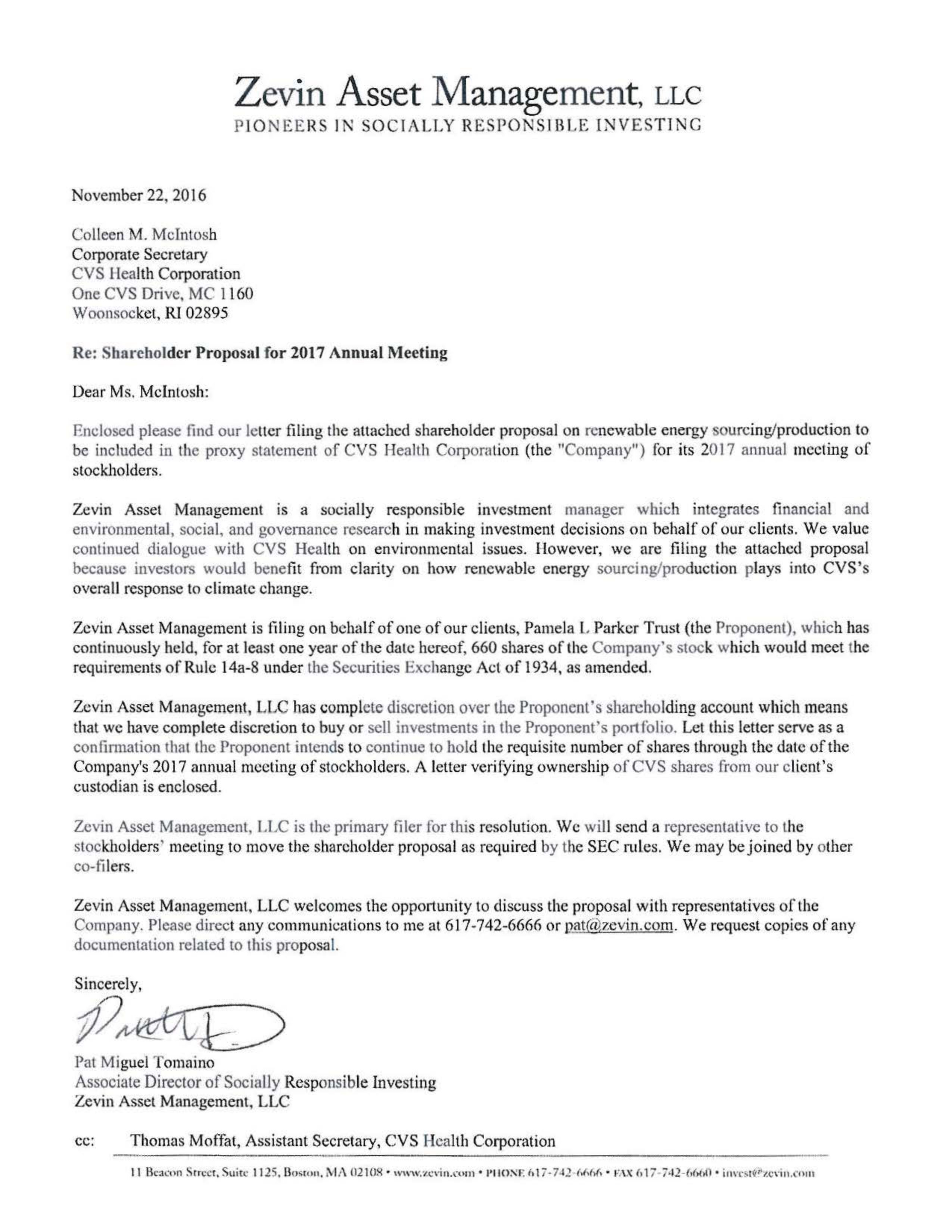
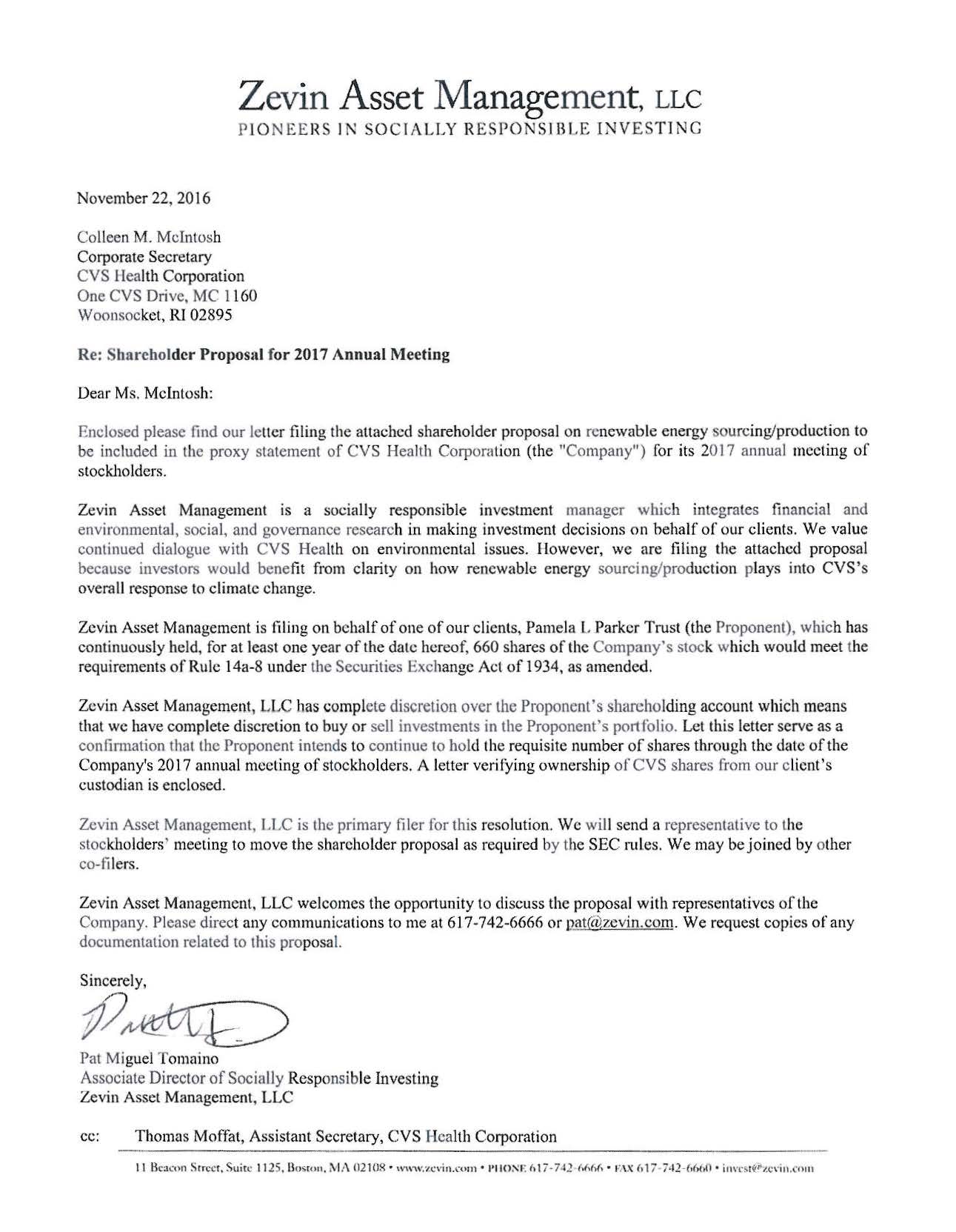
November 22, 2016
Co
lleen
M.
M
ci
ntosh
Corporate Secretary
Zevin Asset Management,
LLC
Pl ON
E.
£ RS IN
so
cr
ALLY
R
£S
PONSlBL
E
INV
ES
TI
N G
CVS 1 l
ea
lth Corporation
One CVS Drive, MC 1160
Woonsocket, RI 02895
Re: Shareholder Proposal for 2017 Annual Meeting
Dear Ms. Mcintosh:
Enclosed please find
our
teller filing the attached shareholder proposal on
re
newable
ene
rgy
so
urcing/producti
on
to
be
in
cluded
in
th
e proxy statement of
CV
S H
ea
lth Corporation (the "Company") for its 2017 annual meeting
of
stockholders.
Zevin Asset Management is a
so
cially responsible investment manager which int
eg
rates financial and
environmental, social, and governan
ce
research in making investment decisions
on
behalf
of
our
clients.
We
value
continued dialogue with CVS Health
on
environmental issues. However, we are filing the attached proposal
because investors would benefit from clarity on how renewable energy sourcing/production plays into
CVS'
s
overall response
to
climate change.
Zcvin Asset Management
is
filing
on
behalf
of
one
of
our
clients, Pamela L Parker Trust (the Proponent), which has
continuously held, for
at
least
one
year
of
the date
hereof
, 660 shares
of
the
Company's
stock which would meet t
he
requirements
of
Ruic 14a-8 under the Securiti
es
Exchange Acl
of
1934, as amended.
Zevin Asset Management, LLC
has
compl
ete
discretion over the Proponen
t's
shareholding account whicb means
that we have complete discretion to buy or sell investments in the Proponent's portfolio. Let this letter serve as a
confinnation
thal.
lhc Proponent intends
to
continue
to
h
ol
d the requisite number
of
shares through the date
of
the
Company's 2017 annual meeting
of
stockholders. A letter veri tying ownership
of
CVS
shares from
our
client's
custodian is enclose.cl.
Zevin Asset Management, LLC is the primary filer for this resolution.
We
will
send
a representative to the
stockholders' meeting
to
move the shareholder proposal as required by the
SEC
rules.
We
may be
jo
ined by other
co-tilers.
Zevin Asset Management,
LLC
welcomes the opportunity to discuss the proposal
with
representatives
of
the
Company. Please dir
ec
t any communications to me at 617-742-6666
or
pat(
@,
zevin.com.
We
request copies
of
any
documentation related
to
this proposal.
Sincerely,
p}
~
Pat
Mi
guel Tomaino
Associate Director
of
Socially Responsible Investing
Zevin Asset Management,
LLC
cc:
Thom
as
Moffat, Assistant Secretary,
CVS
Health Corporation
11 Bca.:nn
Srr
cc
1.
Su
i
cc
11
25. llo
,;
wn,
Mi\
02108 •
www
:1c•'ill.\·
0111
•
1•1
10~~
:
61
7 -
7-12.
f.t.(>f,
•
U X
(1
l 7-
i4
2-66
611
•
i
mTs
t
~,.
l~
\
' 1
11.cn
11
1
Zevin Asset Management
PIONE
ER
S
IN SOCIALLY
RESPONSIBLE
INVESTING
Novem
ber
22,
2016
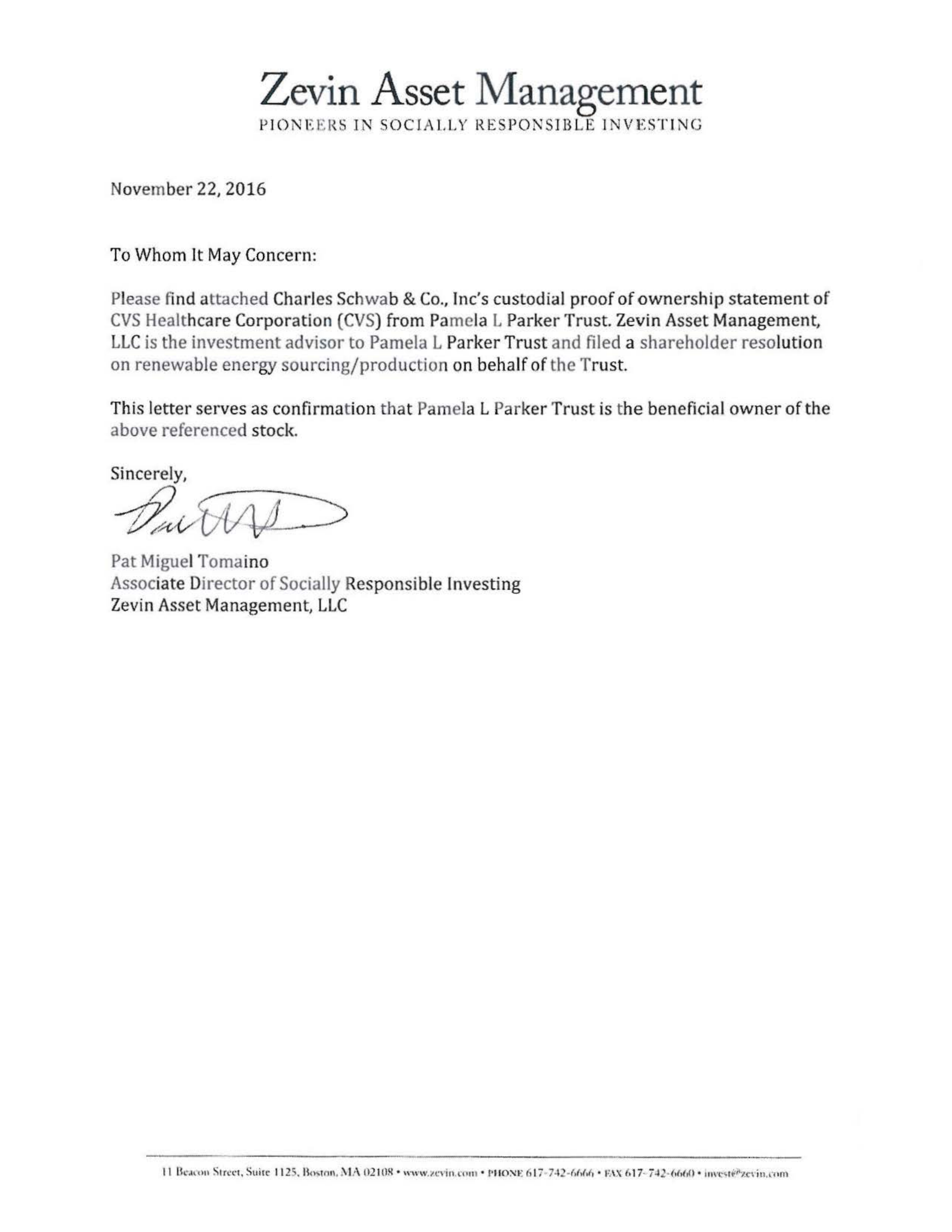
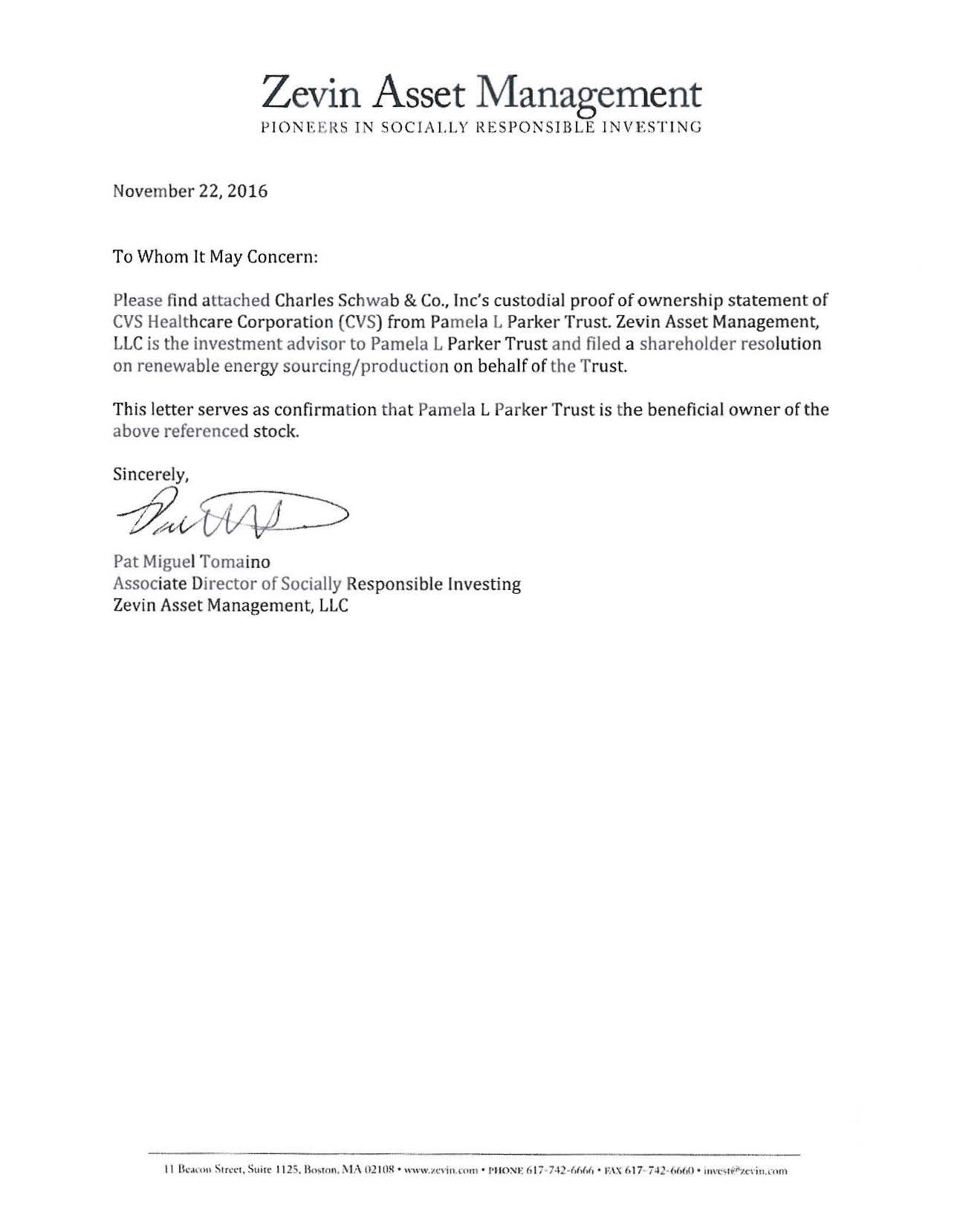
To Whom It May Concern:
Pl
ease
fi
nd a
ttached
Charles Sch
wa
b
&
Co.,
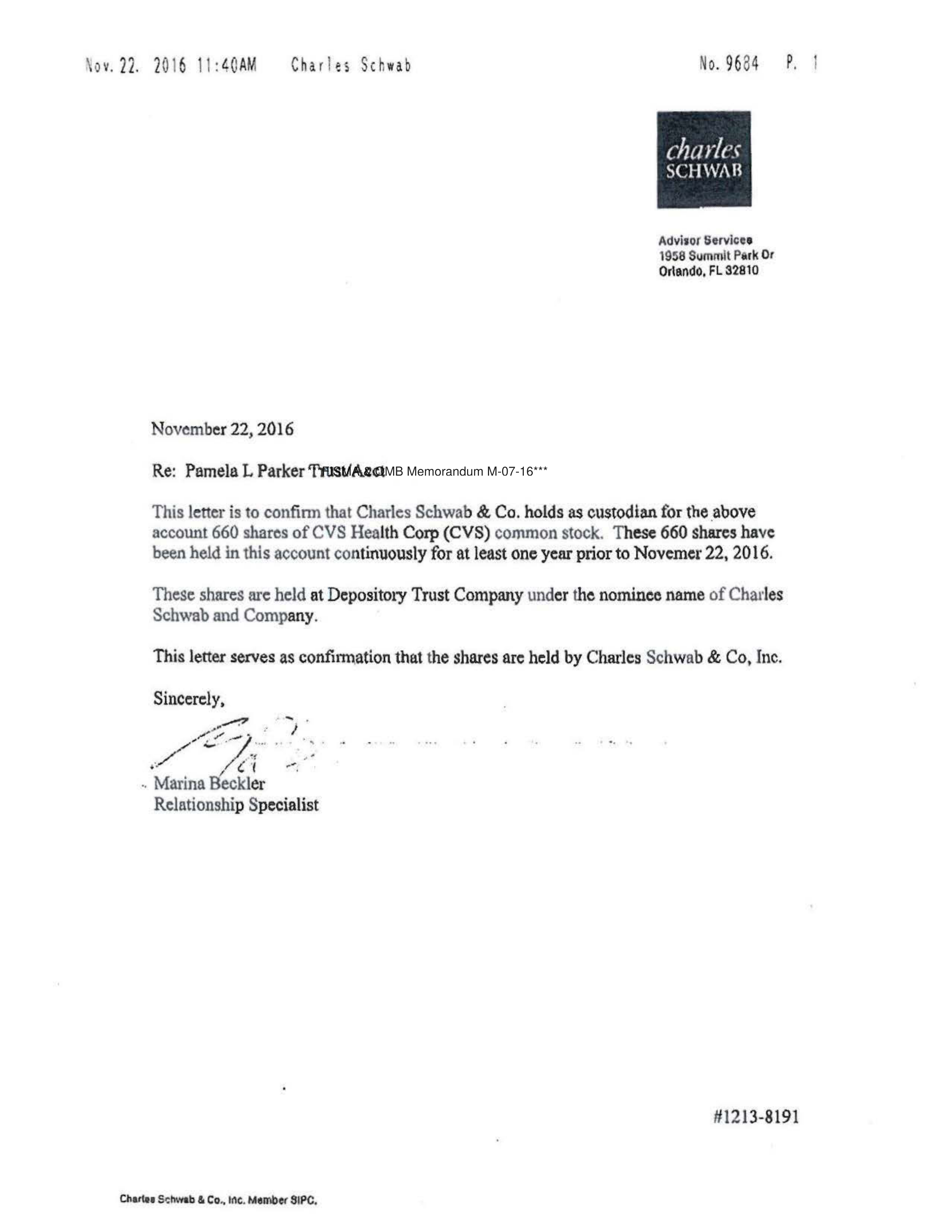
Inc's custodial
proof
of
ownership
statement
of
CVS
Healt
hcare
Corporation
(CV
S) from Pa
me
la L
Parker
Trust.
Zevin
Asset
Management,
LLC
is
the
investment
advisor
to
Pam
ela
L
Parker
Trust
and
filed a
shareholder
reso
lut
i
on
on
renewa
ble
ene
r
gy
so
u
rcing/prod
uction
on
beha
.lf
of
the Trust.
This
letter
serves
as
confirmati
on
that
Pamela L
Park
er
Trust
is t
he
beneficial
owner
of
the
above
reference
d stock.
Sincerely,
ti'.v
~
Pat
Miguel Tomaino
Associate D
irector
of
Socially Responsible Investing
Zevin Asset
Management,
LLC
·-
--
------
-
------
·
··-
·
--
-
-








***FISMA & OMB Memorandum M-07-16***
MB Memorand
MB Memorandu
Moffatt, Thomas S.
From:
Mc
intosh, Colleen
Sent:
To
:
Wednesday, November
23
, 2016 12:42 PM
Pat Tomaino
Cc:
Moffatt, Thomas
S.
Subject:
RE: Shareholder proposal on renewable energy
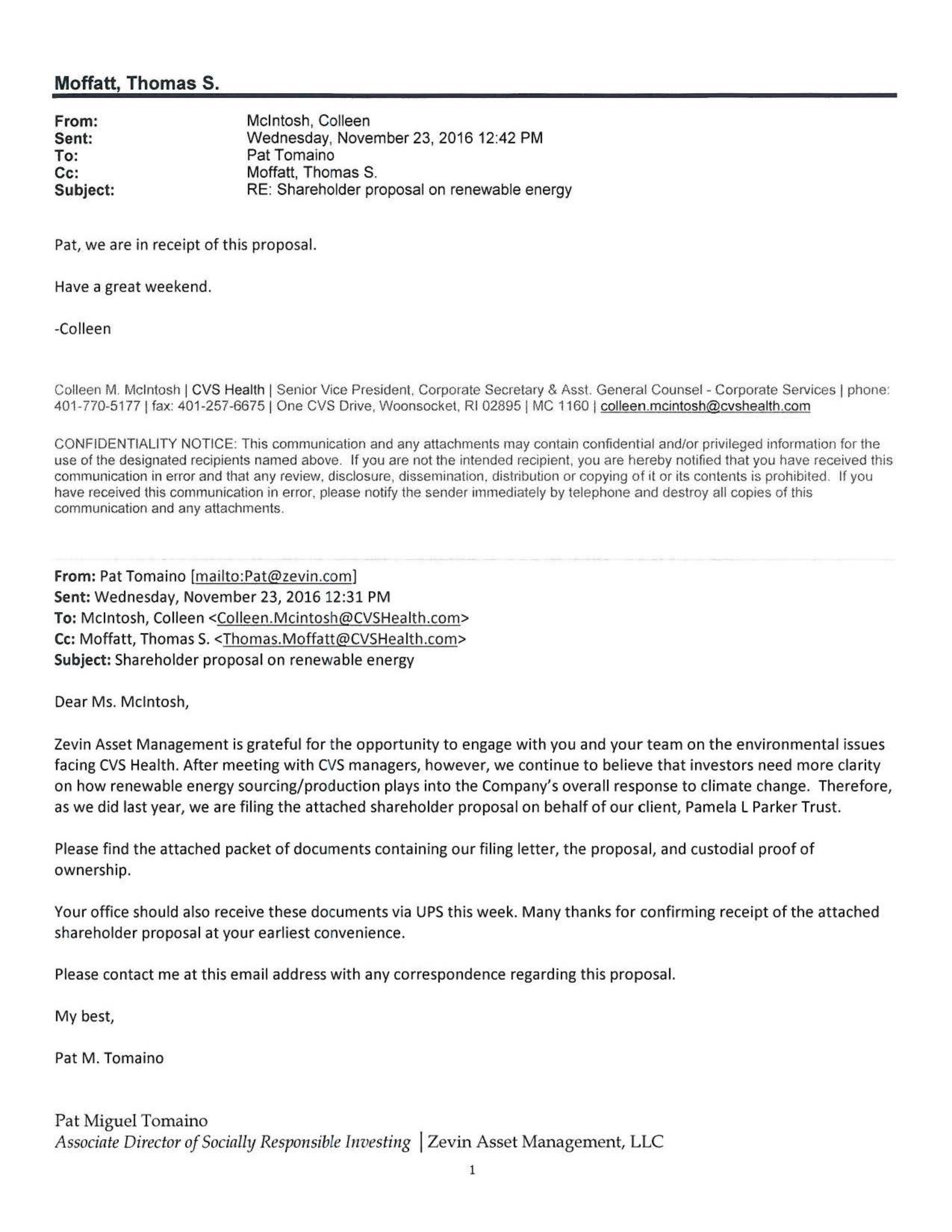
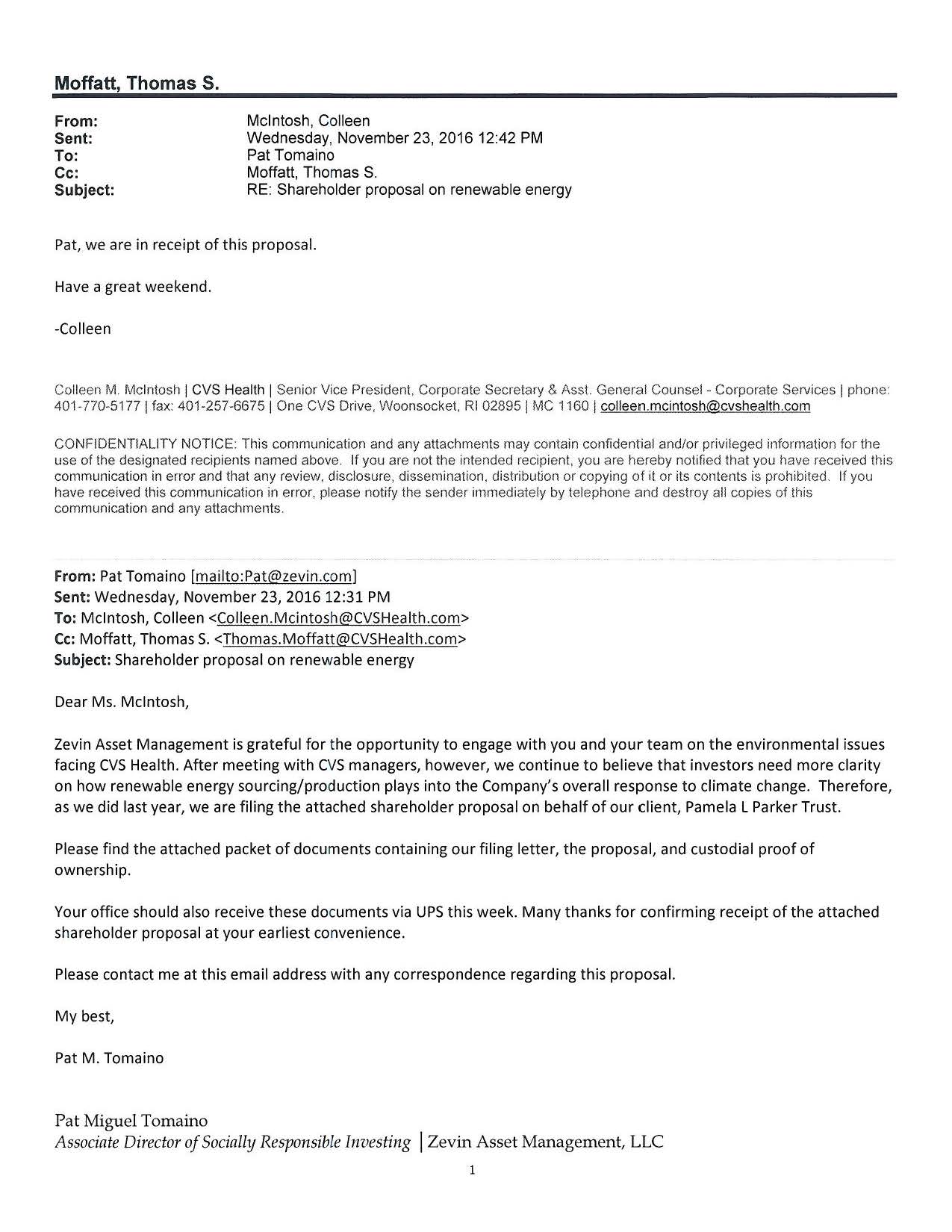
Pat,
we
are in receipt
of
th
is
proposal.
Have a great weekend.
-Colleen
Colleen M. Mcintosh
I
CVS Health
I
Senior Vice President. Corporate Secretary
&
Asst. General Counsel -
Corporate Services
I
phone:
401-770-51771fax:401-257-6675
1 One CVS Drive, Woonsocket.
RI
028951MC1
160
i
colleen.mcintosh@cvshealth.com
CONFIDENTIALITY NOTICE: This communication and any attachments may contain confidential and/or privileged information for the
use
of
the designated recipients named above.
If
you are not the intended recipient, you are hereby notified that you have received this
communication in error and that any review. disclosure, dissemination. distribution
or
copying
of
it
or
its contents is prohibited.
If
you
have received this communication in error, please notify the sender immediately by telephone and destroy all copies
of
this
communication and any attachments.
From:
Pat Tomaino [mailto:Pat@zevin.com]
Sent:
Wednesday, November
23, 2016 12:31
PM
To:
Mc
intosh,
Co
lleen
Cc:
Moffatt,
Thomas S.
Subject:
Shareholder proposal
on
renewable energy
Dear Ms. Mcintosh,
Zevin Asset Management is
grateful
for
the
opportun
i
ty
to
engage wi
th
you and
your
team
on
the
env
i
ronmental
issues
facing
CVS
Health.
After
meet
ing wi
th
CVS managers, however,
we
continue
to
believe
that
investors need
more
clari
ty
on
how
renewable energy
sourcing/product
ion plays i
nto
the
Company's overall response
to
cl
i
mate
change. Therefore,
as
we
did last year,
we
are
fi
ling
the
attached sharehol
der
proposal
on
behalf
of
our
client, Pamela
L
Pa
r
ker
Trust.
Please find the attached packet
of
documents
containing
our
fi
ling letter, the proposal, and custodi
al
proof
of
ow
nership.
Your office should also receive these docu
ments
via
UPS
this
week.
Many
thanks
fo
r
confi
rm
ing r
eceipt
of
the
attached
shareholder proposal
at
your
earli
est
convenience.
Please contact
me
at
th
is email address
with
any correspondence regarding
this
proposal.
My
best,
Pat M. Tomaino
Pat Miguel
Toma
in
o
Associate
Director
of
Socially
Responsib
le Investing
I
Ze
vin
Asset Management, LLC
1


11
Beacon Street, Suite 1125
I
Boston,
MA
02108
617.742.6666 x310
I
pat
@zevin.com
W'\VW
.zevin.com
Pioneers
in
Socially
R
es
ponsible
Investing
This email and any files transmitted
wi
th it are confidential
and
intended solely for the use of the individual or entity to whom they are
addressed.
If
you have received this email in error please notify the system manager. This message contains confidential information
and
is intended only for the individual named.
If
you are
not
the named addressee you should
not
disseminate, distribute or copy this
e-mail. Please notify the sender immediately
by
e-mail
if
you have received this e-mail by mistake
and
delete this e-mail from
your
system.
If
you are not the intended recipient you are notified that disclosing, copying, distributing
or
taking
any
action in reliance
on
the contents of this information
is
strictly prohibited.
2