O
Chapter 4: The Rivalry and the Model
ur main competitor was Linus Pauling, the world’s
greatest chemist, based at Caltech. He had recently solved
the alpha-helix structure of proteins using simple
cardboard and metal models. We decided to use the same
approach for DNA. However, the data we needed belonged to the
King's College group—specifically Rosalind Franklin. Franklin was
a brilliant, meticulous experimentalist who looked upon our
model-building with deep suspicion. She believed that the
structure must be solved through rigorous mathematical analysis
of X-ray data, not through 'playing with toys.' Our first model, a
three-strand helix, was a humiliation. Franklin pointed out that our
chemistry was fundamentally flawed. Bragg told us to leave DNA to
King's.
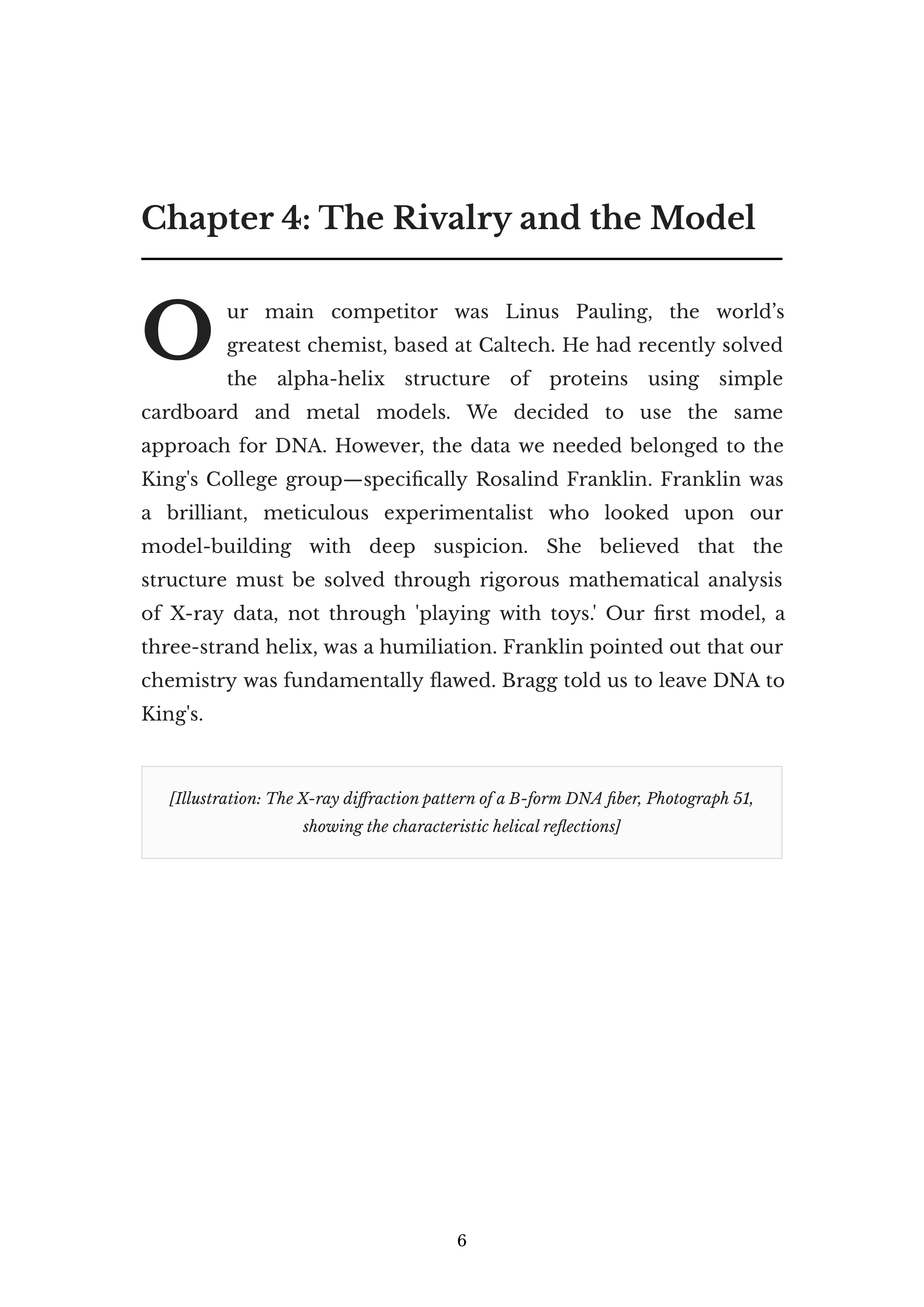
[Illustration: The X-ray diffraction pattern of a B-form DNA fiber, Photograph 51,
showing the characteristic helical reflections]
6