
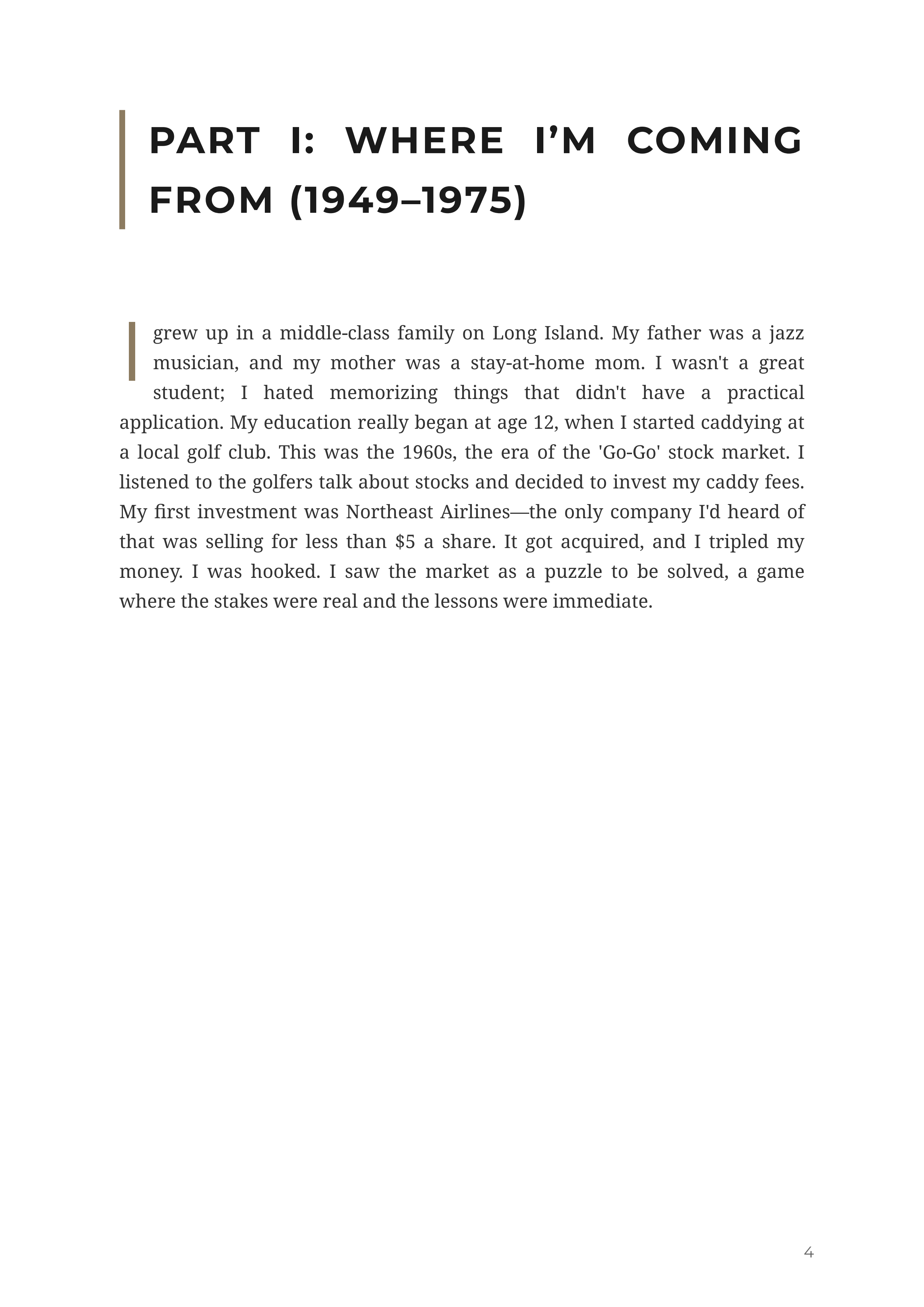

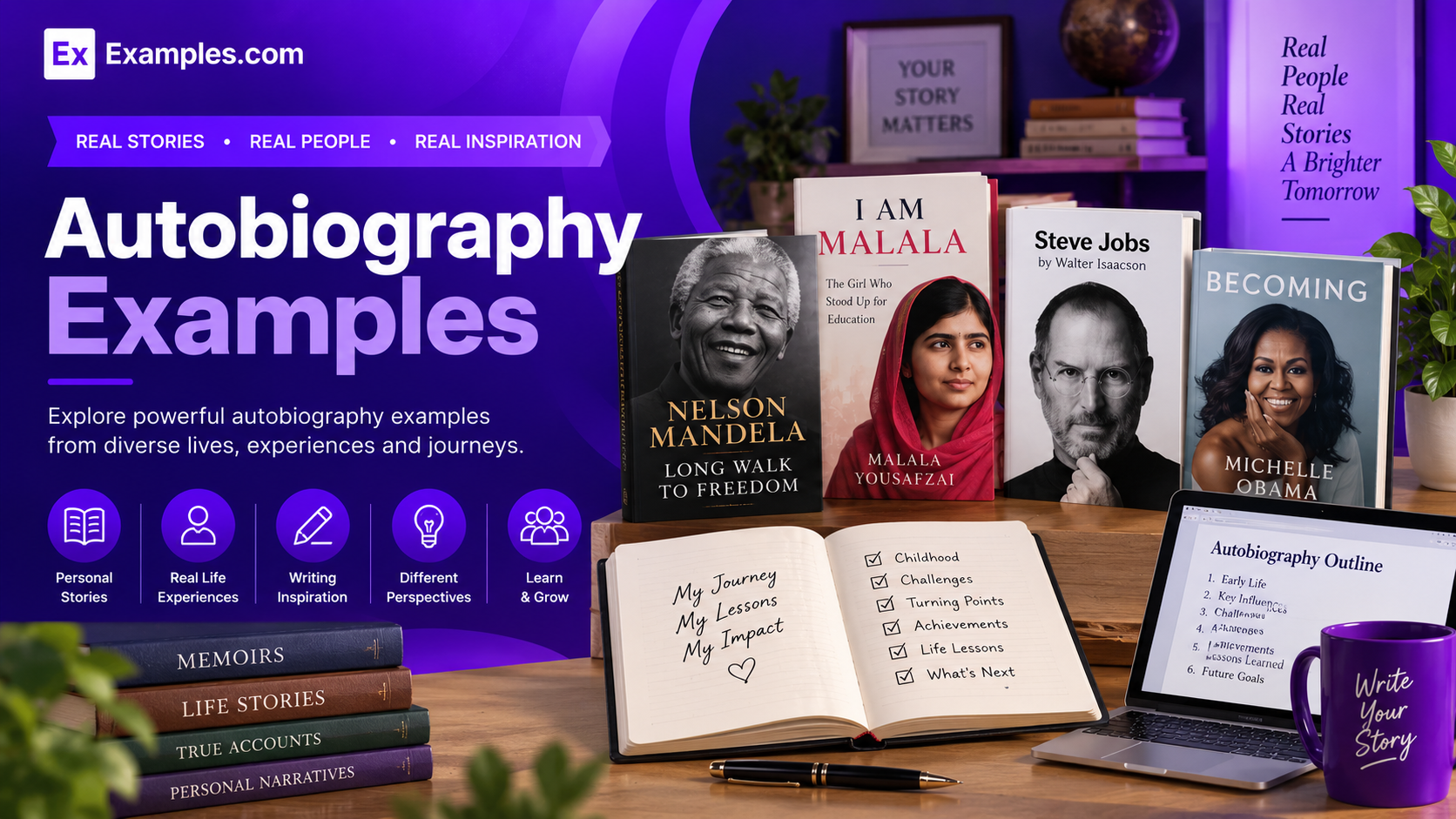
Create a compelling autobiography with AI by exploring real-world autobiography examples, identifying effective storytelling structures, and using those references as inspiration for an original life story. An autobiography is written by the person whose life it describes, so the final narrative should preserve the author’s own experiences, perspective, memories, values, challenges, achievements, and voice. With Examples.com, I can explore established examples, choose a suitable storytelling direction, enter an AI prompt, generate a new autobiography structure or visual presentation, and then customize the result in the Online Editor. The reference example is used only as inspiration. It is not directly edited, copied, or rewritten. I can provide my own life information and use AI to organize those details into a coherent first-person narrative. Before publishing, I should verify dates, names, places, achievements, and other factual details so the finished autobiography accurately represents my life.
What Is An Autobiography?
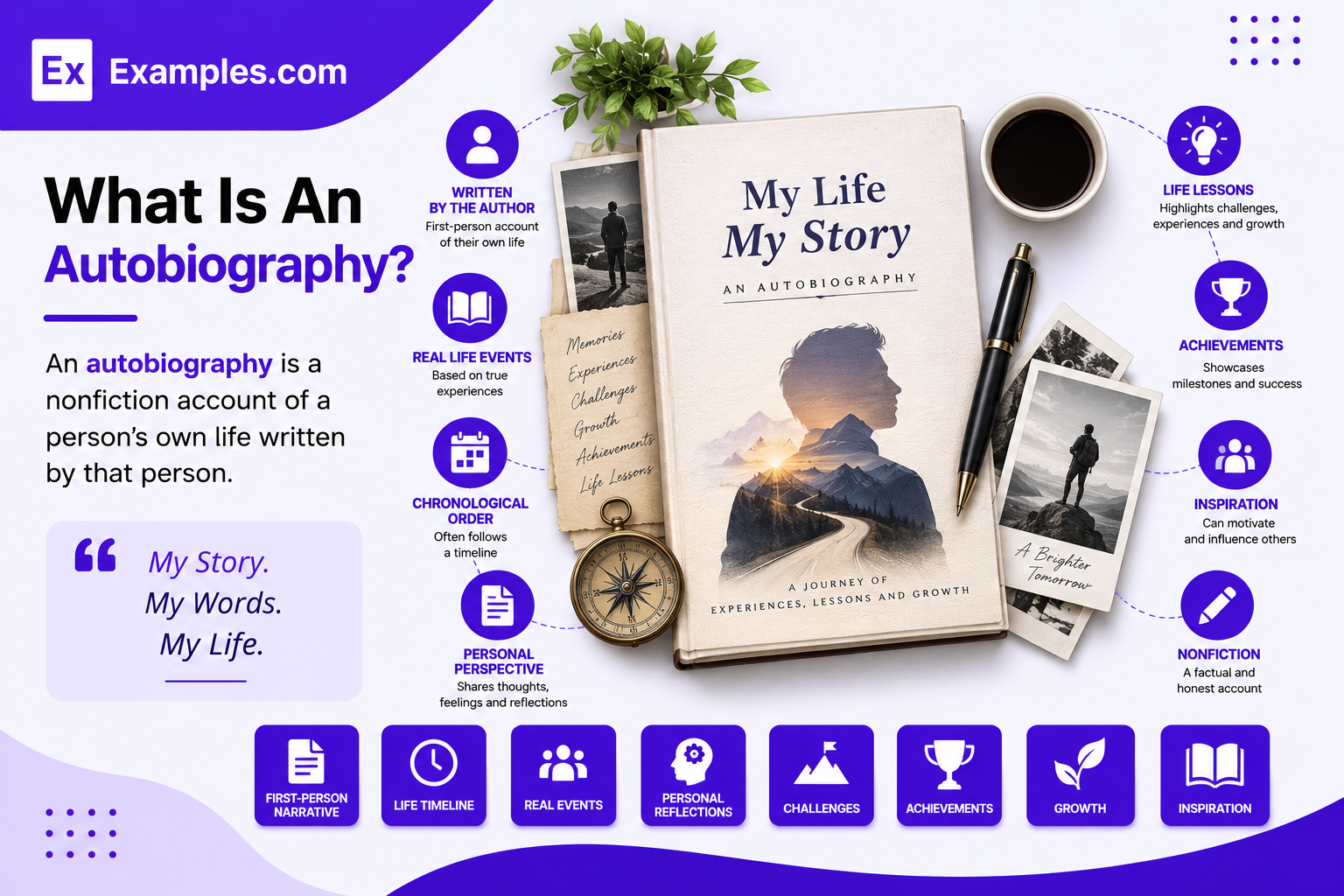
An autobiography is a nonfiction account of a person’s own life written by that person. It normally uses first-person language such as “I,” “me,” and “my” and can cover childhood, education, relationships, career, challenges, achievements, major turning points, and later experiences. Unlike a fictional story, an autobiography is based on the author’s real experiences and memories. It generally has a broad life-story scope, although the author may choose which events deserve the greatest attention. The narrative can follow chronological order while connecting important experiences through themes such as identity, resilience, ambition, family, creativity, education, or personal transformation.
Popular Types Of Autobiographies
Autobiographies can take different forms depending on the author’s life, purpose, audience, and storytelling approach.
Traditional Autobiography
Presents a broad account of the author’s life, generally moving from childhood through major later experiences.
Celebrity Autobiography
Documents the personal experiences, career, relationships, challenges, and achievements of a well-known public figure.
Political Autobiography
Explores political experiences, leadership, public service, major decisions, and events that shaped the author’s career.
Spiritual Autobiography
Focuses on faith, beliefs, personal transformation, spiritual experiences, and changes in the author’s worldview.
Professional Autobiography
Highlights education, career development, professional challenges, accomplishments, and lessons learned through working life.
Autobiographical Memoir
Combines personal life experiences with a stronger thematic or reflective focus, often concentrating on particularly meaningful periods.
Why Should I Use Real Autobiography Examples To Create My Own Autobiography?
Real autobiography examples help me understand how authors transform personal experiences into a readable life story. They show how childhood memories can connect with later achievements, how difficult experiences can become meaningful turning points, and how first-person narration can communicate personality and reflection. Examples can also demonstrate different approaches to chronology, chapter organization, dialogue, historical context, descriptions, and thematic storytelling.
I can use these examples as structural and visual inspiration without copying another author’s story or distinctive writing. Examples.com allows me to select a reference, describe my own experiences through an AI prompt, and generate an original structure based on my information. I can then review the result, add missing memories, correct details, and make sure the final autobiography sounds authentic to my own life and perspective.
How Do I Generate Autobiographies Using Proven Examples From The World’s Best Authors?
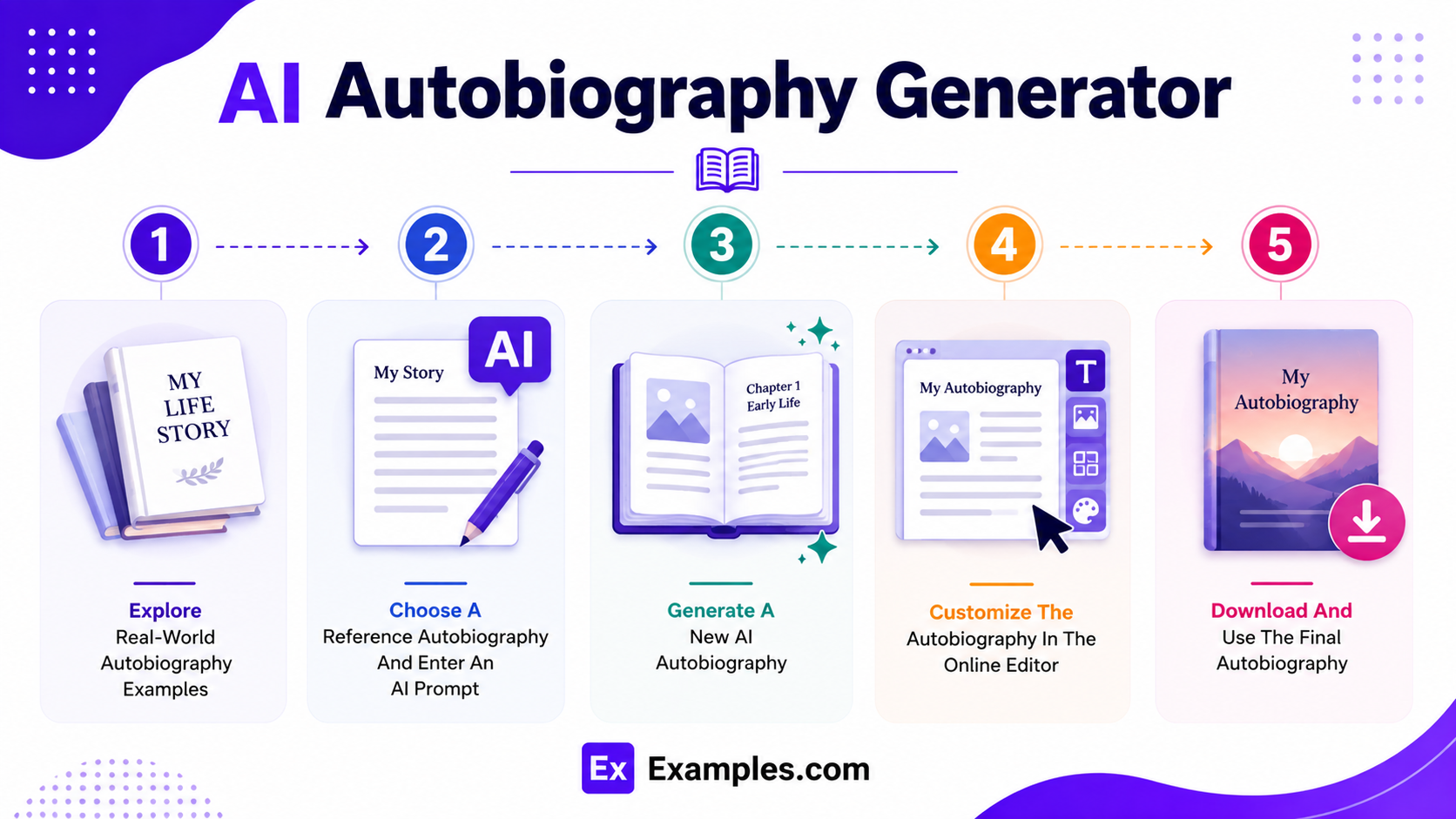
Creating an autobiography becomes easier when I organize my memories before asking AI to structure them. A reference-based process gives me a starting point while keeping my own experiences at the center of the story.
Explore Real-World Autobiography Examples
Browse established autobiography examples to study chapter structures, narrative pacing, first-person storytelling, themes, visual presentation, and approaches to childhood, career, challenges, achievements, and reflection.
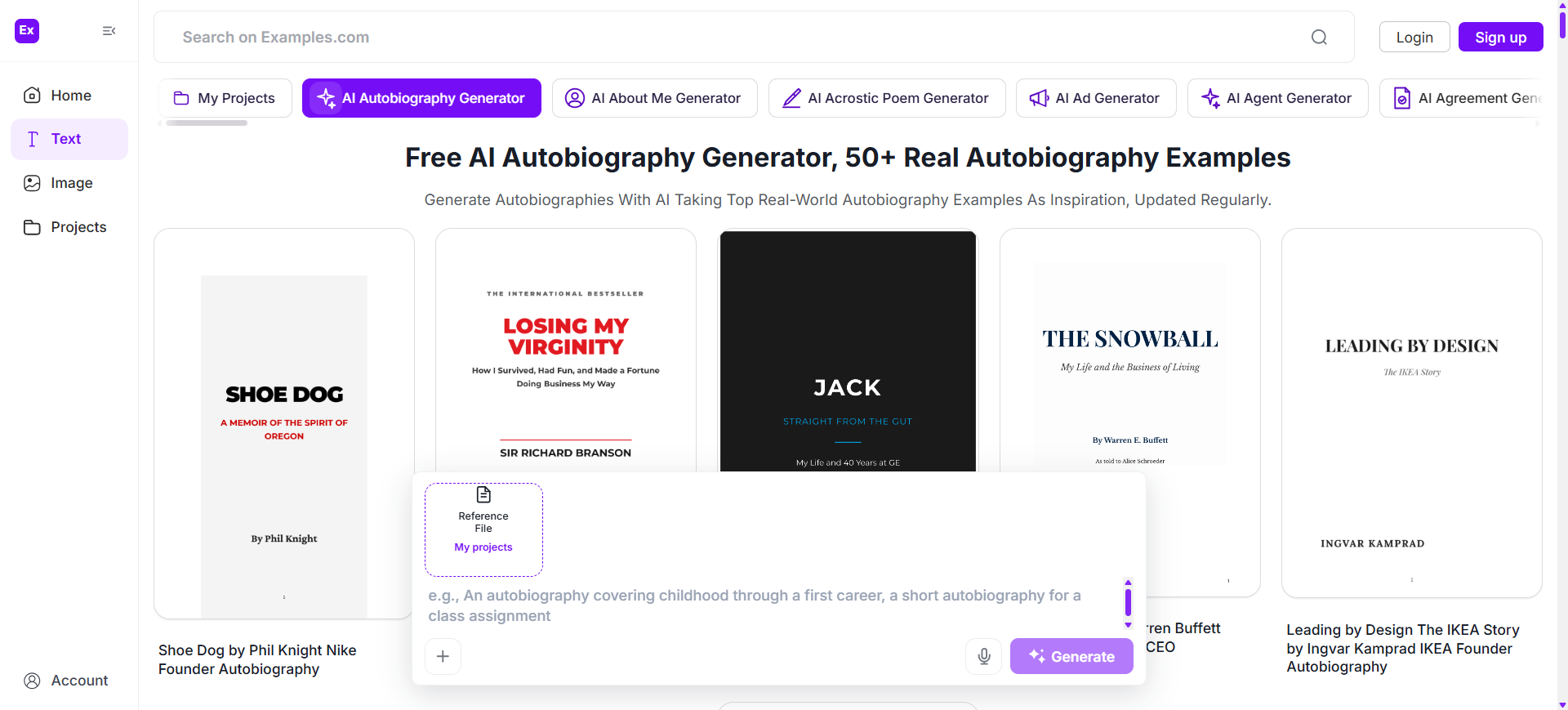
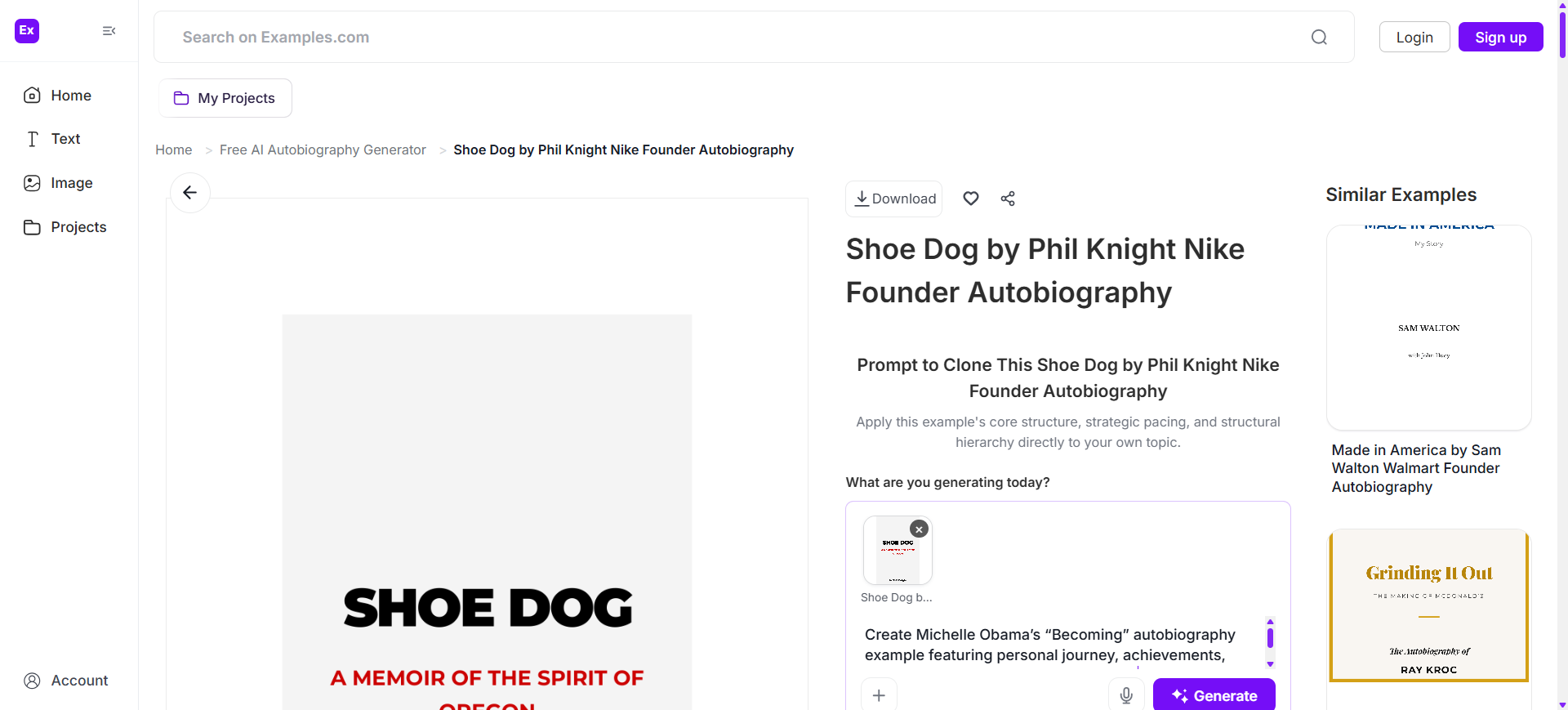
Choose A Reference Autobiography And Enter An AI Prompt
Choose a reference whose structure or presentation suits my goals. Then provide my own life details, including important dates, locations, education, career, relationships, challenges, achievements, turning points, values, and desired tone.
Generate A New AI Autobiography
The AI uses my information and the selected reference as inspiration to create a new autobiography structure or draft. The generated content should remain centered on my experiences rather than reproducing the source author’s story.
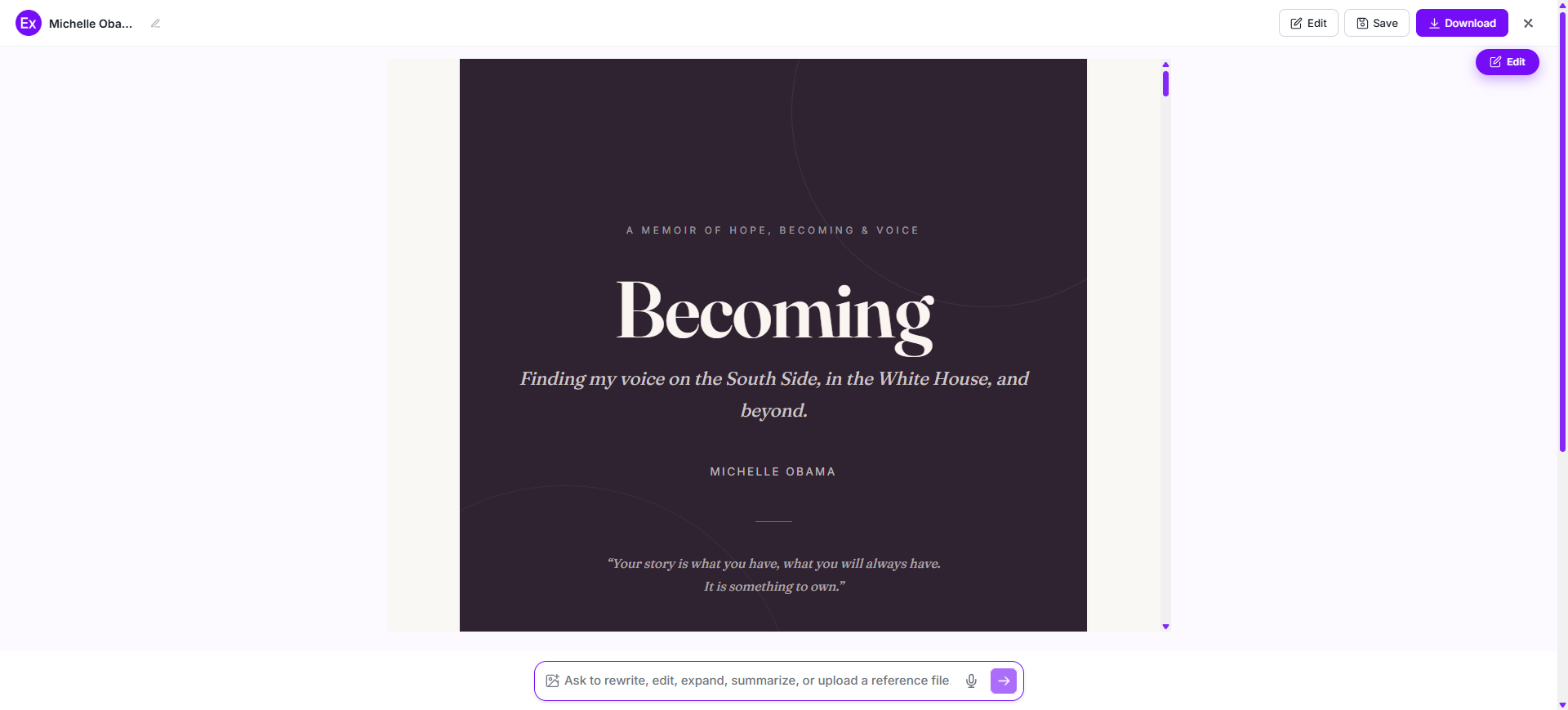
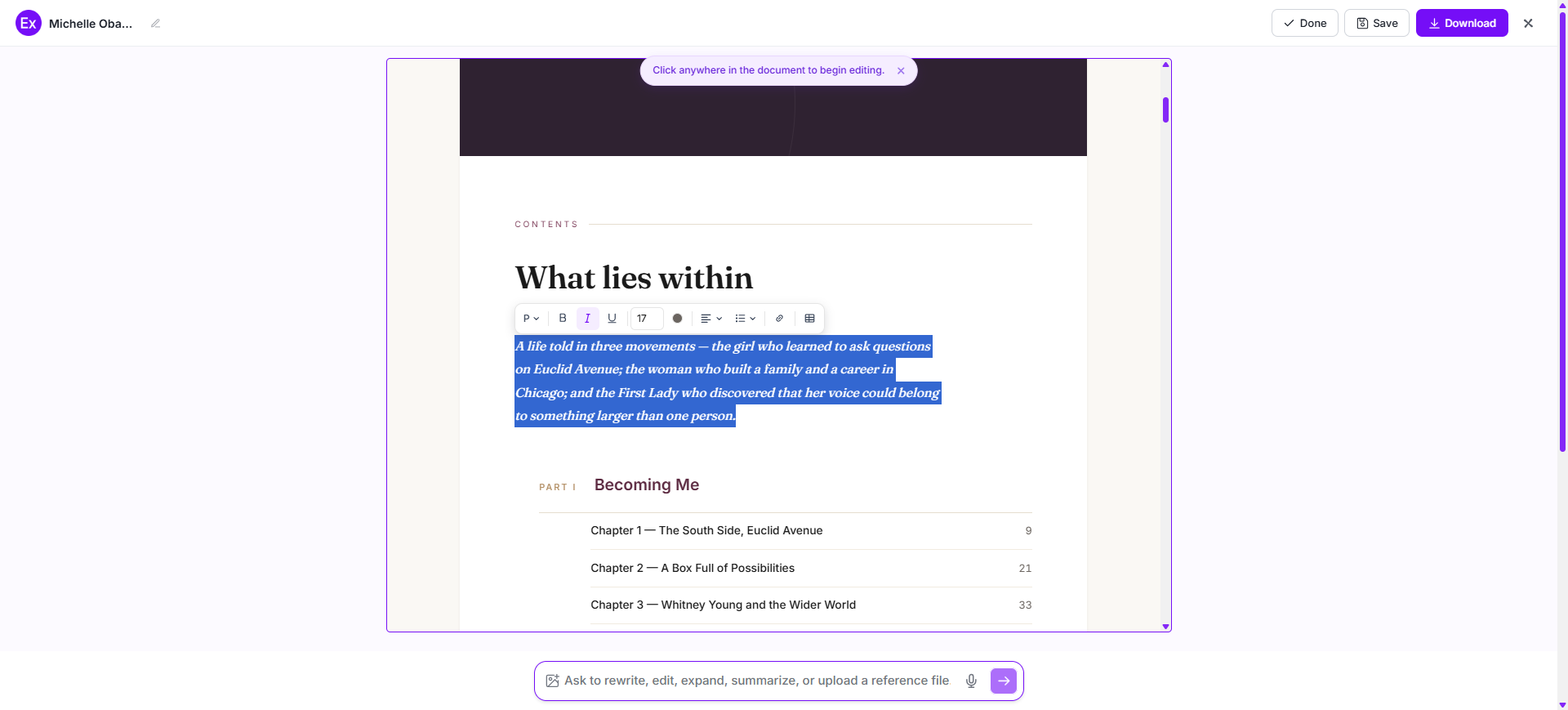
Customize The Autobiography In The Online Editor
Review the generated content and personalize it with accurate memories, photographs, dates, captions, chapter headings, quotations, documents, and other relevant materials. I can also refine the layout and visual presentation.
Download And Use The Final Autobiography
Proofread the completed autobiography carefully, verify important facts, and make final corrections. I can then download the finished design as a PDF for digital sharing, presentation, educational use, or personal documentation.
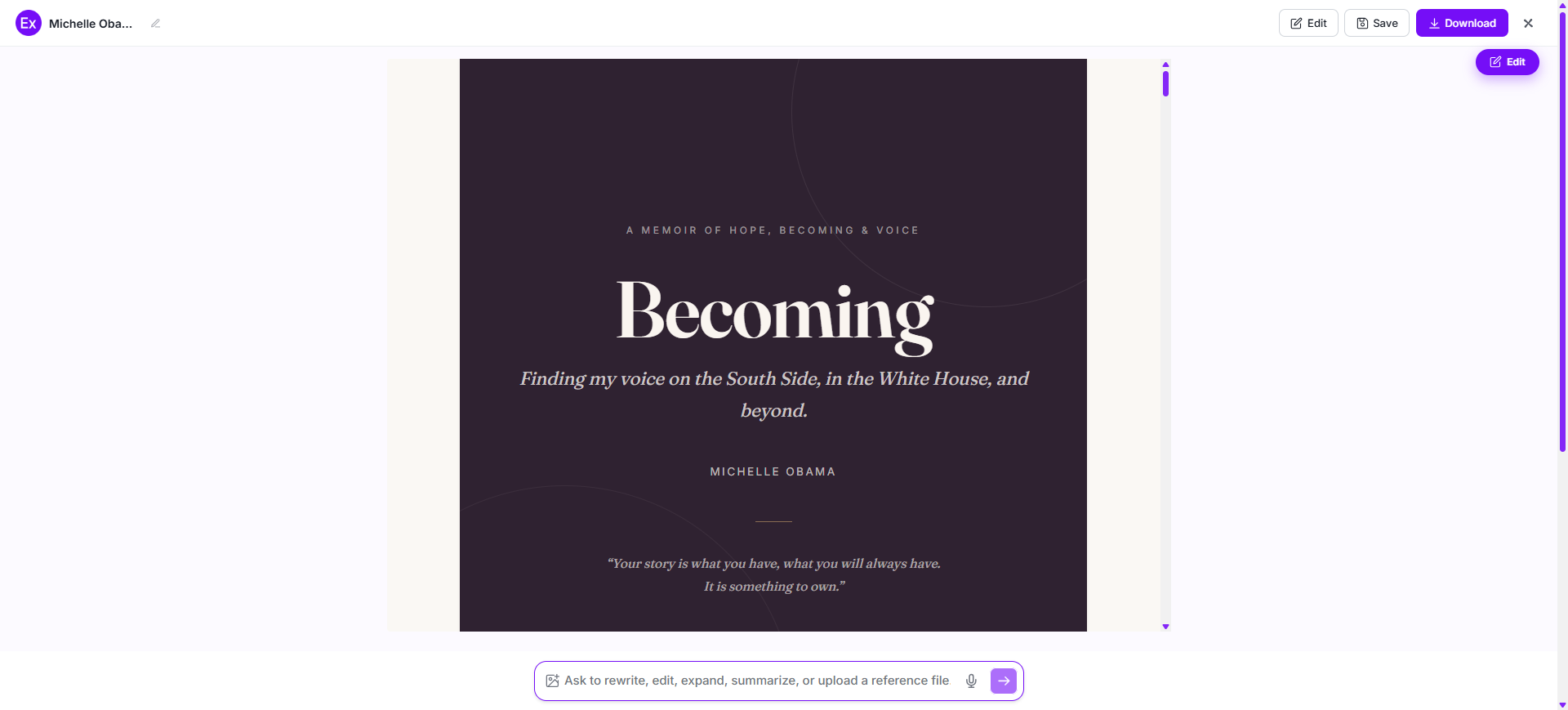
Customize Autobiography Designs Online
An autobiography becomes more personal when its visual presentation reflects the author’s actual journey. After generating a design, I can use the Online Editor to customize chapter headings, photographs, captions, timelines, quotations, colors, typography, and other visual elements. Personal photographs can help connect different stages of life, while carefully selected images can provide context for important places, achievements, relationships, or career milestones.
I can also reorganize the presentation when the automatically generated structure does not match my preferred storytelling order. For example, I might divide the autobiography into childhood, education, early career, major challenge, professional development, achievements, and reflections. The final design should support the story rather than distract from it. I should review every generated statement carefully and replace generic or inaccurate details with my own verified information.
AI Autobiography Editing Features
Examples.com includes multiple AI-powered tools that can help users generate, organize, customize, and refine autobiography designs online.
AI Autobiography Generation
Generate a detailed autobiography based on your life experiences, memories, achievements, relationships, challenges, and personal milestones.
Automatic Life Story Structure
Organize your autobiography into a clear chronological structure with an introduction, childhood, education, major experiences, turning points, achievements, and reflective conclusion.
Autobiography Customization
Update personal experiences, important events, people, locations, emotions, accomplishments, and life lessons to accurately represent your unique story.
Grammar And Style Improvement
Improve grammar, sentence structure, vocabulary, clarity, consistency, and overall writing style while preserving your authentic personal voice.
Personal Reflection Enhancement
Strengthen reflections, emotions, insights, challenges, and lessons learned to make your autobiography more meaningful and engaging.
Instant PDF Download
Download your completed autobiography as a PDF for printing, reviewing, sharing, or keeping as a finished personal record.
Standard Autobiography Sizes And Formats
The appropriate autobiography format depends on whether I am creating a digital presentation, printable document, visual biography board, or social-media-style summary.
| Format | Common Size | Best Use |
|---|---|---|
| A4 Portrait | 210 × 297 mm | Printable autobiography pages |
| A5 Portrait | 148 × 210 mm | Compact personal booklets |
| US Letter | 8.5 × 11 in | North American documents |
| A3 Portrait | 297 × 420 mm | Large visual autobiography pages |
| Landscape | 1920 × 1080 px | Digital presentations |
| Portrait | 1080 × 1920 px | Mobile storytelling |
| Square | 1080 × 1080 px | Social or visual summaries |
For a traditional written autobiography, portrait-oriented pages provide enough room for paragraphs, photographs, headings, and captions. A larger format can be useful when photographs and timelines are central to the presentation. Digital formats can be adapted to the platform where the autobiography will ultimately be viewed.
Essential Elements Every Autobiography Should Include
A strong autobiography combines factual life information with personal reflection, context, and an authentic first-person perspective.
- First-Person Perspective – Use first-person narration to communicate experiences from the author’s own point of view.
- Early Life – Introduce childhood, family circumstances, hometown, early interests, and formative experiences that help establish the story.
- Education – Describe important schools, subjects, teachers, qualifications, or educational experiences that influenced later decisions.
- Career Journey – Explain major jobs, projects, professional decisions, accomplishments, setbacks, and career transitions.
- Challenges – Include meaningful difficulties and explain how they affected the author’s choices, development, and outlook.
- Major Achievements – Highlight accomplishments that genuinely shaped the author’s personal or professional journey.
- Turning Points – Identify experiences that changed direction, priorities, relationships, beliefs, or ambitions.
- Historical Context – Explain relevant social, cultural, technological, political, or economic circumstances surrounding important life events.
- Reflection – Show what the author learned from significant experiences and how those lessons influenced later life.
- Personal Voice – Maintain language, observations, perspectives, and reflections that make the story feel authentic to the person who lived it.
How Do I Design A Better Autobiography?
A strong autobiography is more than a chronological list of events. It should help readers understand what happened, why it mattered, how it changed the author, and what was learned from it.
- Start With A Clear Life-Story Theme – Identify the central idea that connects the major experiences in the autobiography. This could be perseverance, creativity, family, education, leadership, discovery, or personal growth.
- Build A Reliable Life Timeline – List important dates and events before writing. Include birth, childhood milestones, education, employment, relationships, relocations, achievements, challenges, and other significant turning points.
- Choose Meaningful Stories – Not every memory needs equal space. Select experiences that reveal personality, demonstrate change, explain important decisions, or contribute something meaningful to the overall story.
- Write In A Genuine First-Person Voice – Use language that sounds natural to the author. Avoid overly formal wording when it does not reflect the person’s personality, and preserve distinctive perspectives and observations.
- Add Context Around Major Events – Explain what was happening around an important experience. Family circumstances, community conditions, technological changes, historical events, education, or professional environments can make a personal story easier to understand.
- Show Challenges And Responses – Describe significant obstacles honestly, then explain how you responded. The most useful section is often not simply what went wrong, but what the experience taught you.
- Balance Achievements With Difficulties – An autobiography should not read like a résumé. Include accomplishments alongside mistakes, uncertainty, failures, difficult decisions, and lessons learned to create a more credible narrative.
- Use Photographs Strategically – Choose photographs that contribute information or emotional context. A childhood photograph, school picture, workplace image, travel photograph, or milestone image can support a particular chapter.
- Create Strong Chapter Transitions – Each chapter should naturally lead into the next stage of life. Explain how one experience influenced a later decision instead of presenting unrelated events as isolated entries.
- End With Reflection – Conclude by considering what the journey means today. A strong ending can discuss lessons, values, relationships, accomplishments, unresolved ambitions, or hopes for the future.
Common Autobiography Design Mistakes To Avoid
Avoiding common autobiography design and writing mistakes helps create a life story that feels authentic, organized, readable, and meaningful.
- Listing Events Without Reflection → Explain Their Meaning – Explain why important experiences mattered and how they changed your perspective.
- Including Unverified Dates → Check Important Facts – Check dates, names, locations, qualifications, and other factual details before publication.
- Making Every Event Equally Important → Prioritize Meaningful Experiences – Give more space to experiences that shaped your identity or changed your direction.
- Using A Generic Voice → Preserve Personal Expression – Rewrite artificial-sounding passages so the language reflects your genuine personality.
- Overloading Pages With Text → Improve Visual Structure – Break long sections into chapters, headings, short paragraphs, photographs, quotations, and timelines.
- Ignoring Difficult Experiences → Address Meaningful Challenges – Address meaningful challenges honestly while focusing on their context, consequences, and lessons.
- Using Irrelevant Photographs → Select Supporting Images – Select images that directly support the life stage or event being discussed.
- Treating AI Output As Automatically Factual → Verify Generated Content – Personally verify every important statement before using the generated autobiography.
How Can I Share My Life Story Using An Autobiography?
An autobiography can serve different purposes depending on the audience and the author’s goals. I can adapt its structure, length, tone, and visual presentation to make the story appropriate for each situation.
Personal Family History
Create a lasting record of childhood memories, family stories, important relatives, traditions, places, and experiences that future generations may want to understand.
Educational Project
Students can organize personal experiences into chapters covering family background, education, interests, achievements, challenges, and future ambitions.
Professional Story
Professionals can document career development, major projects, leadership experiences, lessons, accomplishments, and decisions that influenced their working life.
Public Figure Story
Public figures can use an autobiography to present personal experiences, career milestones, challenges, and perspectives directly from their own point of view.
Personal Brand
Entrepreneurs, creators, artists, and professionals can use selected autobiographical experiences to communicate their background, values, motivation, and expertise.
Legacy Documentation
A carefully organized autobiography can preserve memories, photographs, accomplishments, personal reflections, and historical experiences for family members and future readers.
Which Autobiography Sizes Perform Best?
The best size depends on whether the autobiography is primarily text-based, visual, printable, or intended for digital viewing.
| Autobiography Format | Best For | Main Advantage |
|---|---|---|
| A4 Portrait | Detailed personal stories | Excellent balance of text and images |
| US Letter | Formal documents | Familiar professional page format |
| A5 Portrait | Compact life stories | Easy to print and handle |
| A3 Portrait | Visual timelines | More room for photographs |
| 1920 × 1080 px | Presentations | Wide digital storytelling canvas |
| 1080 × 1920 px | Mobile stories | Optimized for vertical screens |
| 1080 × 1080 px | Social summaries | Simple square presentation |
For a comprehensive autobiography, A4 or US Letter portrait is generally the most practical choice because these dimensions provide sufficient space for readable paragraphs, photographs, captions, and chapter headings. If the goal is a visual life-story presentation rather than a conventional book, larger pages or landscape digital formats can provide more room for timelines and photographic compositions.
Autobiography Ideas For Different Industries
Different professional and personal fields can use autobiographical storytelling to document experiences, development, achievements, and lessons.
- Business And Entrepreneurship – Document the journey from an early business idea through founding, failures, important partnerships, growth, leadership lessons, and major milestones.
- Education – Create a story covering childhood learning, influential teachers, academic challenges, qualifications, discoveries, and the educational experiences that shaped future ambitions.
- Technology – Focus on technical interests, early experimentation, major projects, career development, innovation, important collaborators, and lessons from solving difficult problems.
- Creative Arts – Artists, designers, musicians, and writers can document creative beginnings, influences, major works, experimentation, setbacks, exhibitions, performances, and artistic development.
- Sports – Athletes can organize their stories around early training, mentors, competitions, injuries or setbacks, victories, discipline, team experiences, and lessons learned through competition.
- Healthcare – Healthcare professionals can discuss education, formative experiences, professional development, meaningful work experiences, challenges, and the values that shaped their approach to their profession.
- Public Service – A public servant can document education, community experiences, public responsibilities, important decisions, challenges, accomplishments, and lessons learned while serving others.
- Science And Research – Researchers can explain early curiosity, education, discoveries, experiments, collaborations, failures, breakthroughs, and the people or experiences that influenced their scientific path.
- Travel And Exploration – Build the autobiography around places visited, cultural experiences, important journeys, unexpected challenges, relationships, discoveries, and the ways travel changed the author’s worldview.
- Family And Community – Create a personal historical record centered on family relationships, hometown experiences, traditions, important celebrations, community events, challenges, achievements, and memories worth preserving.
Autobiography Writing Structure
A useful structure can help prevent a long life story from becoming difficult to follow. I can organize the autobiography into logical stages while allowing particularly important experiences to receive additional attention.
Beginnings
Introduce the author’s birth, family, hometown, early surroundings, and the environment in which the story begins.
Childhood
Describe formative memories, friendships, interests, family relationships, early challenges, and experiences that influenced personality.
Education
Cover schools, teachers, subjects, academic achievements, struggles, extracurricular interests, and important lessons.
Finding Direction
Explain early ambitions, changing interests, important decisions, mentors, and experiences that began shaping the author’s future.
Career And Opportunity
Describe entering professional life, early responsibilities, major projects, workplace experiences, and important accomplishments.
Challenges And Turning Points
Focus on significant obstacles, failures, difficult choices, unexpected changes, and the responses that shaped the next stage of life.
Growth And Achievement
Show how experience, persistence, relationships, and learning contributed to later accomplishments.
Relationships And Community
Discuss people who played important roles in the author’s journey and explain their influence where appropriate.
Reflection
Look back at major decisions, lessons, successes, failures, and changes in values or priorities.
The Road Ahead
End with current circumstances, future ambitions, continuing projects, hopes, and the perspective gained from the journey.
Autobiography vs. Biography vs. Memoir
These life-writing formats are related, but they have different authorship and scope.
| Format | Who Writes It? | Typical Focus |
|---|---|---|
| Autobiography | The subject | The author’s own broad life story |
| Biography | Another person | Someone else’s life |
| Memoir | Usually the subject | A particular period, theme, or experience |
| Profile | Usually another writer | A concise portrait of a person |
| Personal Essay | The subject | One idea or personal experience |
The defining feature of an autobiography is authorship by the person whose life is being described. A memoir may also be written in the first person, but it usually concentrates more narrowly on particular experiences, themes, or periods rather than attempting to document an entire life.
FAQs
What Is The Main Purpose Of An Autobiography?
The main purpose of an autobiography is to document and communicate the author’s own life experiences, important events, challenges, achievements, relationships, perspectives, and personal development from the author’s point of view.
Does An Autobiography Have To Cover An Entire Life?
A traditional autobiography generally presents a broad account of the author’s life, but the amount of detail given to different periods can vary. Some sections may receive substantially more attention because they are more important to the overall story.
Is An Autobiography Written In First Person?
Yes. Autobiographies normally use first-person narration because the author is writing about their own experiences. Words such as “I,” “me,” and “my” are therefore common.
What Is The Difference Between An Autobiography And A Memoir?
An autobiography generally provides a broad account of the author’s life, while a memoir usually concentrates on a particular period, experience, relationship, theme, or set of memories within that life.
Can AI Write My Autobiography?
AI can help organize your information, develop chapter structures, improve wording, and create presentation concepts. However, you should provide the real experiences and verify the generated information so the final autobiography accurately represents your life.
What Should I Include In A Personal Autobiography?
Important components can include early life, family background, education, career, relationships, challenges, achievements, turning points, historical context, personal values, lessons learned, and reflections on the future.
Should An Autobiography Include Photographs?
Photographs are optional, but they can significantly strengthen a visual autobiography by documenting people, places, achievements, and periods of the author’s life. Captions should accurately identify relevant details.
How Do I Make An Autobiography Interesting?
Choose meaningful experiences, use specific details, maintain an authentic first-person voice, explain turning points, balance successes with challenges, provide useful context, and show how important experiences changed the author over time.