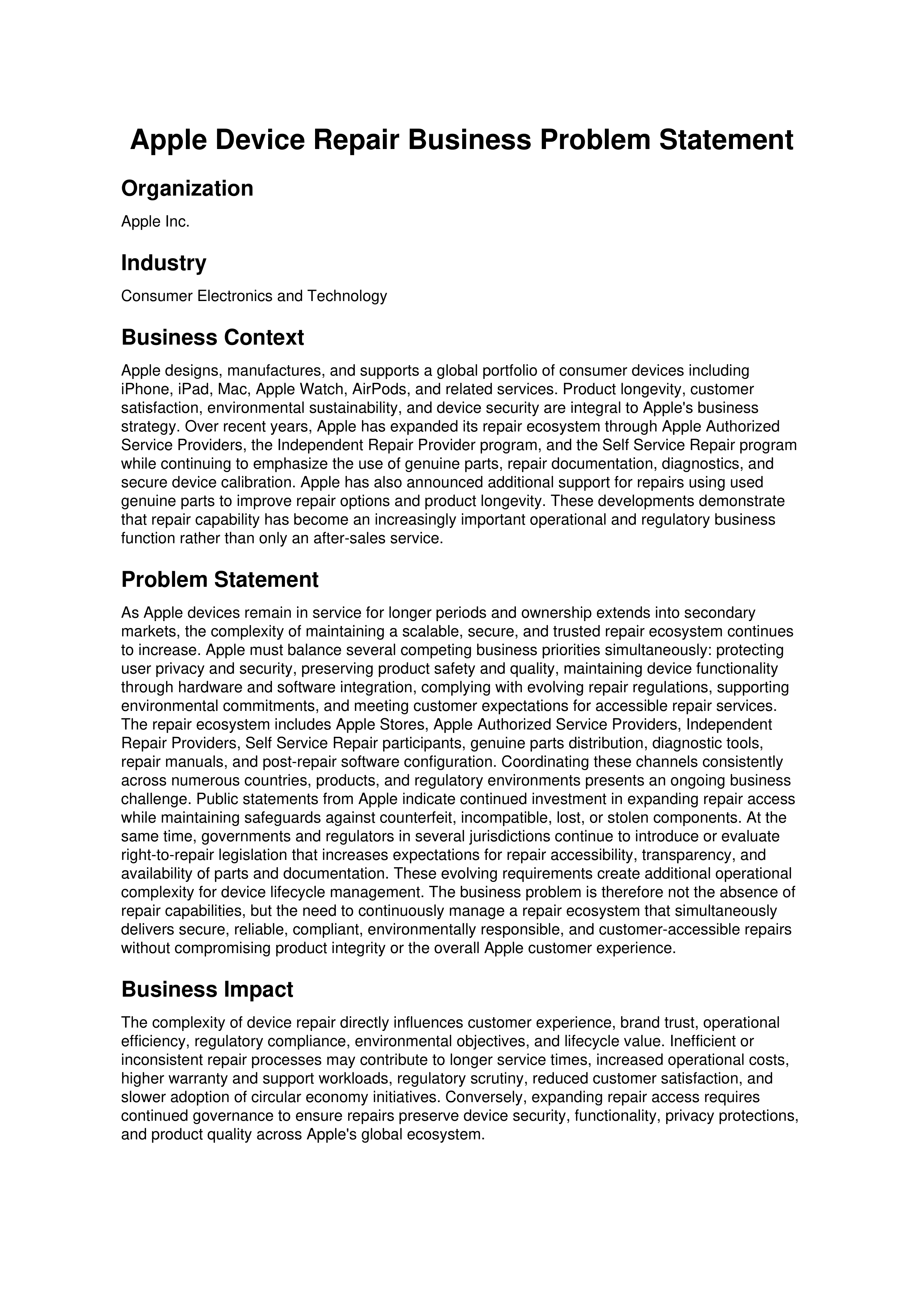
Apple Device Repair Business Problem Statement
Organization
Apple Inc.
Industry
Consumer Electronics and Technology
Business Context
Apple designs, manufactures, and supports a global portfolio of consumer devices including
iPhone, iPad, Mac, Apple Watch, AirPods, and related services. Product longevity, customer
satisfaction, environmental sustainability, and device security are integral to Apple's business
strategy. Over recent years, Apple has expanded its repair ecosystem through Apple Authorized
Service Providers, the Independent Repair Provider program, and the Self Service Repair program
while continuing to emphasize the use of genuine parts, repair documentation, diagnostics, and
secure device calibration. Apple has also announced additional support for repairs using used
genuine parts to improve repair options and product longevity. These developments demonstrate
that repair capability has become an increasingly important operational and regulatory business
function rather than only an after-sales service.
Problem Statement
As Apple devices remain in service for longer periods and ownership extends into secondary
markets, the complexity of maintaining a scalable, secure, and trusted repair ecosystem continues
to increase. Apple must balance several competing business priorities simultaneously: protecting
user privacy and security, preserving product safety and quality, maintaining device functionality
through hardware and software integration, complying with evolving repair regulations, supporting
environmental commitments, and meeting customer expectations for accessible repair services.
The repair ecosystem includes Apple Stores, Apple Authorized Service Providers, Independent
Repair Providers, Self Service Repair participants, genuine parts distribution, diagnostic tools,
repair manuals, and post-repair software configuration. Coordinating these channels consistently
across numerous countries, products, and regulatory environments presents an ongoing business
challenge. Public statements from Apple indicate continued investment in expanding repair access
while maintaining safeguards against counterfeit, incompatible, lost, or stolen components. At the
same time, governments and regulators in several jurisdictions continue to introduce or evaluate
right-to-repair legislation that increases expectations for repair accessibility, transparency, and
availability of parts and documentation. These evolving requirements create additional operational
complexity for device lifecycle management. The business problem is therefore not the absence of
repair capabilities, but the need to continuously manage a repair ecosystem that simultaneously
delivers secure, reliable, compliant, environmentally responsible, and customer-accessible repairs
without compromising product integrity or the overall Apple customer experience.
Business Impact
The complexity of device repair directly influences customer experience, brand trust, operational
efficiency, regulatory compliance, environmental objectives, and lifecycle value. Inefficient or
inconsistent repair processes may contribute to longer service times, increased operational costs,
higher warranty and support workloads, regulatory scrutiny, reduced customer satisfaction, and
slower adoption of circular economy initiatives. Conversely, expanding repair access requires
continued governance to ensure repairs preserve device security, functionality, privacy protections,
and product quality across Apple's global ecosystem.