Problem Statement 6:
Product Category Creation for Healthcare Kiosks in India
Category:
Artificial Intelligence, Machine Learning, Computer Vision, Federated Learning,
Healthcare, Electronic Health Records (EHRs), Telemedicine,
Participants:
Engineering Students or MBA Students with Engineering background
Prerequisites:
Understanding of Artificial Intelligence, Machine Learning, Computer Vision, Federated
Learning
Understanding of Govt. of India policies and initiatives to transform Indian healthcare
industry, Digital India Mission, Ayushman Bharat Digital Mission, National Health
Database, Digital Public Infrastructure, Digital Health Incentive Scheme (DHIS)
Understanding of Product management to guide Intel on features required through every
step of a product’s lifecycle — from development to positioning, competition mapping,
market requirements document and pricing — by focusing on the product and its
customers first and foremost.
Background
– Healthcare Sector in India
The healthcare sector in India is one of the largest employers in the country with 7.5 million
people employed as of FY24. The Indian healthcare market is currently valued at around US$
638 billion.
The demand for Indian healthcare professionals is expected to double nationally and globally by
FY30 due to a shortage of healthcare workers in India. India has 1.7 nurses per 1,000 people and
a doctor-to-patient ratio of 1:1500 nationwide which is worse than WHO standard
recommendation of doctor-to- patient ratio of 1:1000. India’s health expenditure increased from
1.4% to 1.9% of the GDP from 2017-18 to 2023-24 which is still below the target of 2.5% set by
National Health Policy 2017. In actual terms, the Indian government has allocated Rs. 99,858
crore (US$ 11.50 billion) to the healthcare sector in the Union Budget 2025-26 for the
development, maintenance, and enhancement of the country's healthcare system.
India's healthcare landscape is undergoing a digital transformation, driven by government
initiatives, policy reforms, and technological advancements. With a rapidly growing population
and increasing demand for quality healthcare, digital health solutions are playing a crucial role
in enhancing accessibility, a
Ư
ordability, and e
Ư
iciency.
Digital healthcare infrastructure in India is evolving to bridge the gap between urban and rural
healthcare services, leveraging telemedicine, electronic health records (EHRs), and artificial
intelligence (AI)-driven diagnostics. Govt. of India’s healthcare initiatives, such as the Ayushman
Bharat Digital Mission (ABDM) and the Digital Health Incentive Scheme (DHIS), have the
potential to set a global benchmark for digital healthcare transformation. India is focusing on
achieving the largest digitization drive in the World by following basic principles like:
1.
Interoperability and Standardization: Ensuring seamless data exchange between key
stakeholders
2.
Data Management at Scale: Using the e
Ư
orts put on creating the India Stack which is a
digital public infrastructure platform designed to facilitate presence-less, paperless,
and cashless services in India.
3.
Public-Private Partnerships (PPP): Encouraging PPP model for quick innovation,
deployment and scale.
4.
Focus on A
Ư
ordability and Accessibility: Leveraging Govt. initiatives like Digital India,
Ayushman Bharat Digital Mission (ABDM), Digital Health Incentive Scheme (DHIS),
National Health Database (NHDB), Ayushman Bharat Health Account (ABHA) and
Pradhan Mantri Ayushman Bharat Health Infrastructure Mission (PM-ABHIM) to bridge
the gap between Urban and Rural India in terms of accessibility to quality health
services while keeping a
Ư
ordability as the focus.

5.
Create di
Ư
erentiated delivery models: Indian Govt. is also creating a
comprehensive health service delivery mechanism spanning preventive, promotive,
curative, rehabilitative and palliative care. There are two complementary components
– Comprehensive Primary Healthcare Units (Ayushman Arogya Mandirs) and
Comprehensive Health Insurance for poor populations (PM-JAY: Pradhan Mantri Jan
Arogya Yojana). Ayushman Arogya Mandirs are envisaged to deliver expanded range
services that go beyond Maternal and child health care services to include care for
non -communicable diseases, palliative and rehabilitative care, Oral, Eye and ENT
care, mental health and first level care for emergencies and trauma, including free
essential drugs and diagnostic services. PM-JAY is the largest insurance scheme to
cover more than 10 crore Indian poor with a INR 5 lakh insurance cover to provide
access to secondary and tertiary care.
6.
Vishwa Guru: India’s digital health models, with focus on leveraging Artificial
Intelligence, Machine Learning, Federated Learning and Telemedicine, could serve as
template for other developing nations in the World to adopt and use for large scale
Digital Public Infrastructure in Healthcare.
Introduction – Healthcare Kiosk
A self-service kiosk has become a regular fixture in many businesses irrespective of its size.
Whether at an airport or in a supermarket or in things easier for both customers and businesses.
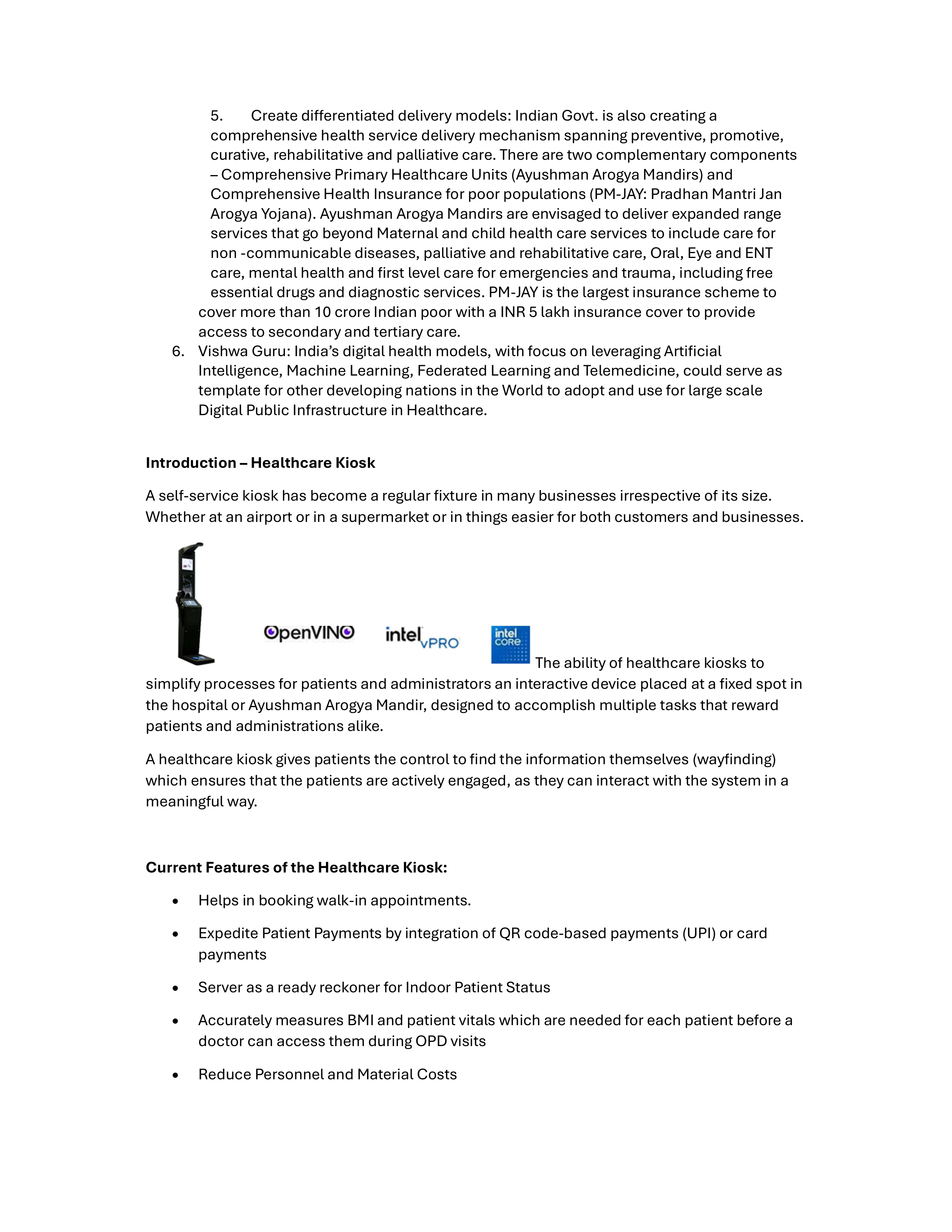
The ability of healthcare kiosks to
simplify processes for patients and administrators an interactive device placed at a fixed spot in
the hospital or Ayushman Arogya Mandir, designed to accomplish multiple tasks that reward
patients and administrations alike.
A healthcare kiosk gives patients the control to find the information themselves (wayfinding)
which ensures that the patients are actively engaged, as they can interact with the system in a
meaningful way.
Current Features of the Healthcare Kiosk:
Helps in booking walk-in appointments.
Expedite Patient Payments by integration of QR code-based payments (UPI) or card
payments
Server as a ready reckoner for Indoor Patient Status
Accurately measures BMI and patient vitals which are needed for each patient before a
doctor can access them during OPD visits
Reduce Personnel and Material Costs
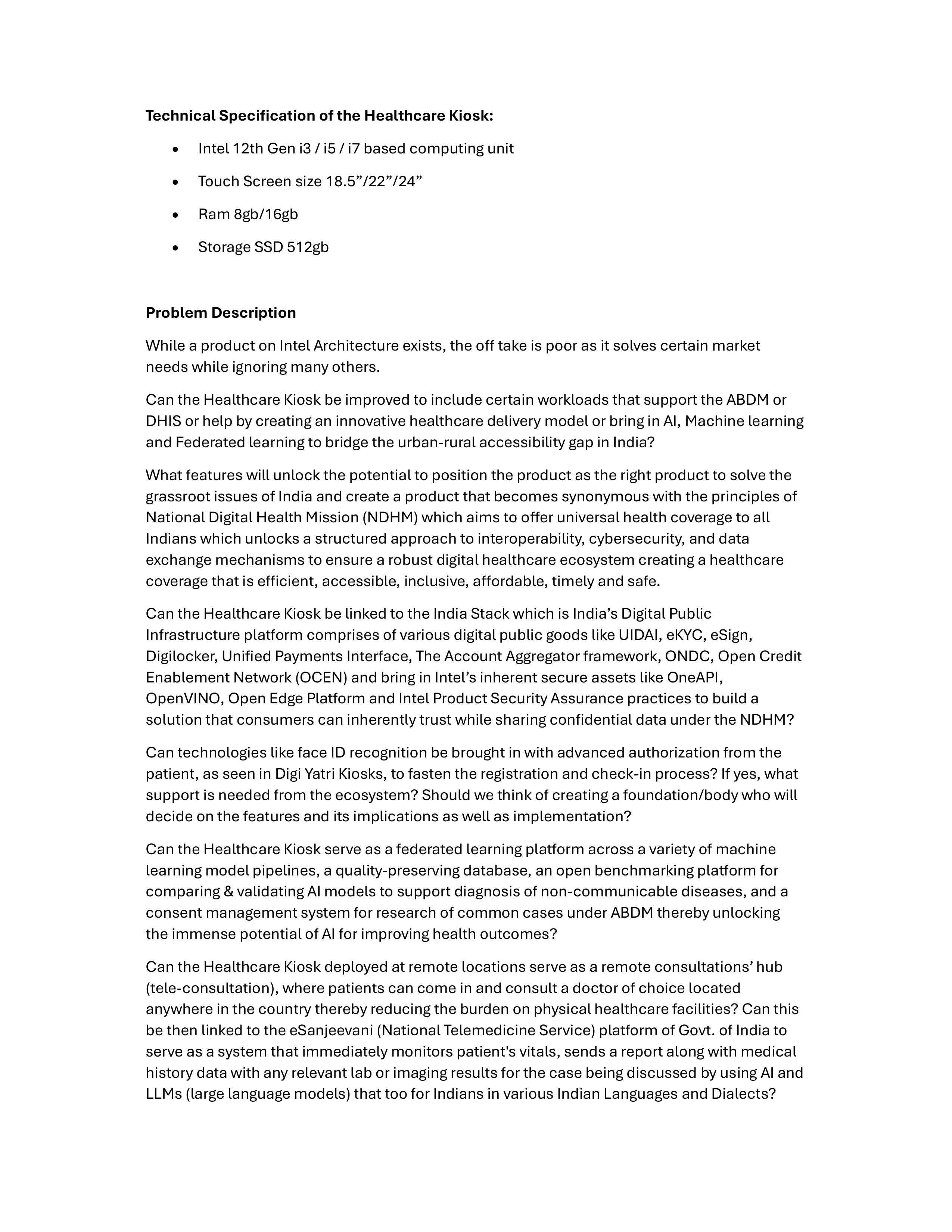
Technical Specification of the Healthcare Kiosk:
Intel 12th Gen i3 / i5 / i7 based computing unit
Touch Screen size 18.5”/22”/24”
Ram 8gb/16gb
Storage SSD 512gb
Problem Description
While a product on Intel Architecture exists, the o
Ư
take is poor as it solves certain market
needs while ignoring many others.
Can the Healthcare Kiosk be improved to include certain workloads that support the ABDM or
DHIS or help by creating an innovative healthcare delivery model or bring in AI, Machine learning
and Federated learning to bridge the urban-rural accessibility gap in India?
What features will unlock the potential to position the product as the right product to solve the
grassroot issues of India and create a product that becomes synonymous with the principles of
National Digital Health Mission (NDHM) which aims to o
Ư
er universal health coverage to all
Indians which unlocks a structured approach to interoperability, cybersecurity, and data
exchange mechanisms to ensure a robust digital healthcare ecosystem creating a healthcare
coverage that is e
Ư
icient, accessible, inclusive, a
Ư
ordable, timely and safe.
Can the Healthcare Kiosk be linked to the India Stack which is India’s Digital Public
Infrastructure platform comprises of various digital public goods like UIDAI, eKYC, eSign,
Digilocker, Unified Payments Interface, The Account Aggregator framework, ONDC, Open Credit
Enablement Network (OCEN) and bring in Intel’s inherent secure assets like OneAPI,
OpenVINO, Open Edge Platform and Intel Product Security Assurance practices to build a
solution that consumers can inherently trust while sharing confidential data under the NDHM?
Can technologies like face ID recognition be brought in with advanced authorization from the
patient, as seen in Digi Yatri Kiosks, to fasten the registration and check-in process? If yes, what
support is needed from the ecosystem? Should we think of creating a foundation/body who will
decide on the features and its implications as well as implementation?
Can the Healthcare Kiosk serve as a federated learning platform across a variety of machine
learning model pipelines, a quality-preserving database, an open benchmarking platform for
comparing & validating AI models to support diagnosis of non-communicable diseases, and a
consent management system for research of common cases under ABDM thereby unlocking
the immense potential of AI for improving health outcomes?
Can the Healthcare Kiosk deployed at remote locations serve as a remote consultations’ hub
(tele-consultation), where patients can come in and consult a doctor of choice located
anywhere in the country thereby reducing the burden on physical healthcare facilities? Can this
be then linked to the eSanjeevani (National Telemedicine Service) platform of Govt. of India to
serve as a system that immediately monitors patient's vitals, sends a report along with medical
history data with any relevant lab or imaging results for the case being discussed by using AI and
LLMs (large language models) that too for Indians in various Indian Languages and Dialects?
Can the Healthcare Kiosk self-propose a preliminary diagnosis and develop an appropriate
treatment plan which can then be taken to a doctor for a second opinion before acting on the AI
generated diagnosis and treatment plan?
Can the Healthcare Kiosk be used to Connecting Health and Wellness Centers (HWCs) or other
hospitals with specialist doctors from anywhere in the Country for tele-consultation for better
healthcare accessibility in remote areas or for sharing the tacit knowledge database? This Kiosk
can share the patient's vitals report along with medical history data with any relevant lab or
imaging results to the doctor located thousands of kms away so that the doctor understands
the history and recommends the right treatment plan.
While all the above themes look interesting, we need to think about the features that can be
developed in todays’ World across the product lifecycle, a
Ư
ordability in Indian context, funding
sources to tap into, Go-to-Market motions, the potential challenges in implementing a solution
like this in terms of regulations, product certifications, ground level deployment and overall
patient journey.
Expected Outcome:
Mapping of current features and future features along with HW requirements (current
and future), SKUs, etc. based on the feature introduction for the Healthcare Kiosk
keeping in mind the 5 stages of Product Management - (1) product development, (2)
introduction, (3) growth, (4) maturity, and (5) decline.
Go-to-Market Blueprint for reaching target customers, building demand, and gaining a
competitive advantage keeping in mind the various stakeholders like HW OEM,
Independent Software Vendors (ISVs) and System Integrators (SIs) as well as the
customer support mechanisms.
Market requirements Document (MRD) to help define the market’s requirements or
demand for a specific product, typically containing information on the product’s vision,
the competitive landscape, business analysis, and revenue opportunity, as well as a list
of features
.