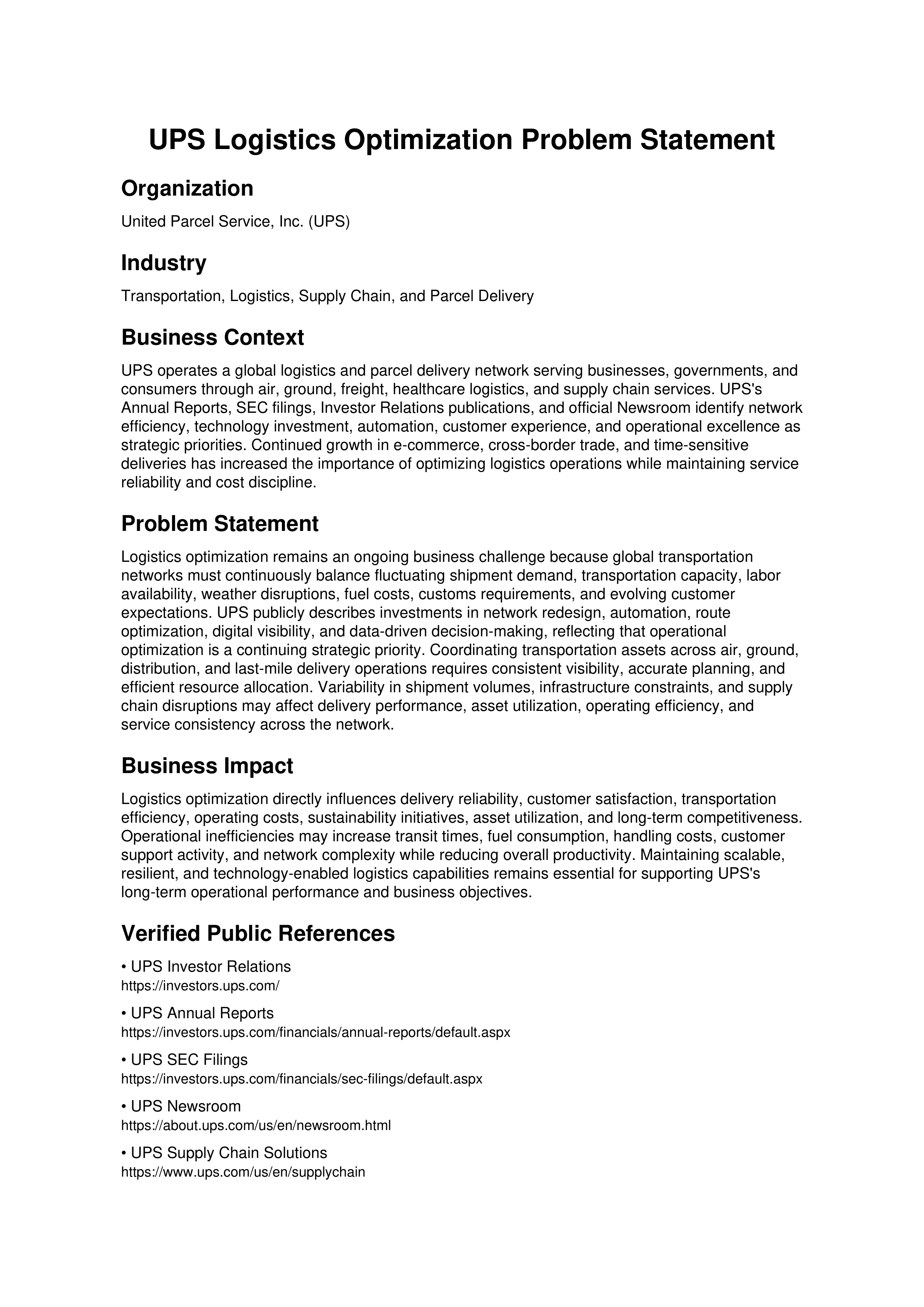
UPS Logistics Optimization Problem Statement
Organization
United Parcel Service, Inc. (UPS)
Industry
Transportation, Logistics, Supply Chain, and Parcel Delivery
Business Context
UPS operates a global logistics and parcel delivery network serving businesses, governments, and
consumers through air, ground, freight, healthcare logistics, and supply chain services. UPS's
Annual Reports, SEC filings, Investor Relations publications, and official Newsroom identify network
efficiency, technology investment, automation, customer experience, and operational excellence as
strategic priorities. Continued growth in e-commerce, cross-border trade, and time-sensitive
deliveries has increased the importance of optimizing logistics operations while maintaining service
reliability and cost discipline.
Problem Statement
Logistics optimization remains an ongoing business challenge because global transportation
networks must continuously balance fluctuating shipment demand, transportation capacity, labor
availability, weather disruptions, fuel costs, customs requirements, and evolving customer
expectations. UPS publicly describes investments in network redesign, automation, route
optimization, digital visibility, and data-driven decision-making, reflecting that operational
optimization is a continuing strategic priority. Coordinating transportation assets across air, ground,
distribution, and last-mile delivery operations requires consistent visibility, accurate planning, and
efficient resource allocation. Variability in shipment volumes, infrastructure constraints, and supply
chain disruptions may affect delivery performance, asset utilization, operating efficiency, and
service consistency across the network.
Business Impact
Logistics optimization directly influences delivery reliability, customer satisfaction, transportation
efficiency, operating costs, sustainability initiatives, asset utilization, and long-term competitiveness.
Operational inefficiencies may increase transit times, fuel consumption, handling costs, customer
support activity, and network complexity while reducing overall productivity. Maintaining scalable,
resilient, and technology-enabled logistics capabilities remains essential for supporting UPS's
long-term operational performance and business objectives.
Verified Public References
• UPS Investor Relations
https://investors.ups.com/
• UPS Annual Reports
https://investors.ups.com/financials/annual-reports/default.aspx
• UPS SEC Filings
https://investors.ups.com/financials/sec-filings/default.aspx
• UPS Newsroom
https://about.ups.com/us/en/newsroom.html
• UPS Supply Chain Solutions
https://www.ups.com/us/en/supplychain