Artificial Intelligence and Job Loss Research Questions
1.
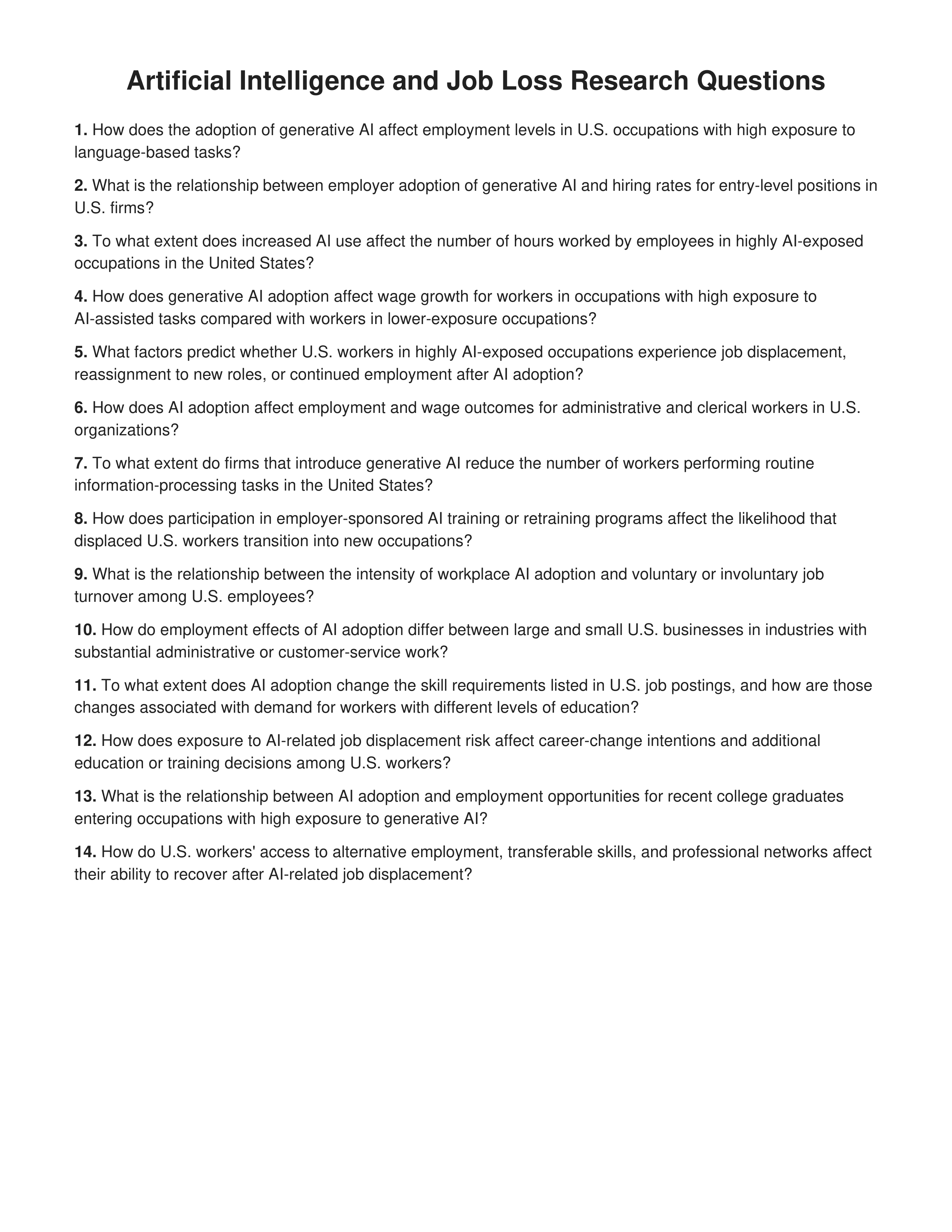
How does the adoption of generative AI affect employment levels in U.S. occupations with high exposure to
language-based tasks?
2.
What is the relationship between employer adoption of generative AI and hiring rates for entry-level positions in
U.S. firms?
3.
To what extent does increased AI use affect the number of hours worked by employees in highly AI-exposed
occupations in the United States?
4.
How does generative AI adoption affect wage growth for workers in occupations with high exposure to
AI-assisted tasks compared with workers in lower-exposure occupations?
5.
What factors predict whether U.S. workers in highly AI-exposed occupations experience job displacement,
reassignment to new roles, or continued employment after AI adoption?
6.
How does AI adoption affect employment and wage outcomes for administrative and clerical workers in U.S.
organizations?
7.
To what extent do firms that introduce generative AI reduce the number of workers performing routine
information-processing tasks in the United States?
8.
How does participation in employer-sponsored AI training or retraining programs affect the likelihood that
displaced U.S. workers transition into new occupations?
9.
What is the relationship between the intensity of workplace AI adoption and voluntary or involuntary job
turnover among U.S. employees?
10.
How do employment effects of AI adoption differ between large and small U.S. businesses in industries with
substantial administrative or customer-service work?
11.
To what extent does AI adoption change the skill requirements listed in U.S. job postings, and how are those
changes associated with demand for workers with different levels of education?
12.
How does exposure to AI-related job displacement risk affect career-change intentions and additional
education or training decisions among U.S. workers?
13.
What is the relationship between AI adoption and employment opportunities for recent college graduates
entering occupations with high exposure to generative AI?
14.
How do U.S. workers' access to alternative employment, transferable skills, and professional networks affect
their ability to recover after AI-related job displacement?