Artificial Intelligence Research Questions
1.
How does AI-assisted triage affect patient wait times and clinician workload in emergency departments at
U.S. hospitals?
2.
Does access to an AI-based radiology decision-support tool improve the accuracy of lung-nodule detection
compared with standard image review among practicing radiologists?
3.
To what extent do automated hiring systems produce differences in candidate selection rates across
demographic groups in U.S. entry-level recruitment?
4.
How does disclosing the use of generative AI in customer-service responses affect customers’ trust and
willingness to continue using a service?
5.
Among students at U.S. public universities, how is frequent use of generative AI for academic writing
associated with performance on independently written assessments?
6.
How do teacher training and school-level AI policies influence responsible generative AI use among high
school students in U.S. public schools?
7.
What factors predict whether U.S. employees will rely on generative AI for routine knowledge-work tasks,
particularly when the system provides uncertain or incomplete answers?
8.
Does AI-assisted software development reduce task completion time and post-release defect rates among
junior developers compared with conventional development workflows?
9.
How does an AI-based phishing detection system compare with rule-based email filters in identifying
malicious messages in midsize U.S. organizations?
10.
How does the adoption of AI tools in U.S. customer-service centers affect average handling time,
first-contact resolution, and customer satisfaction after accounting for case complexity?
11.
How do patients’ perceptions of transparency and human oversight influence their willingness to accept
recommendations produced by AI-supported clinical decision systems?
12.
To what extent does predictive-maintenance AI reduce unplanned equipment downtime in U.S.
manufacturing facilities compared with scheduled maintenance alone?
13.
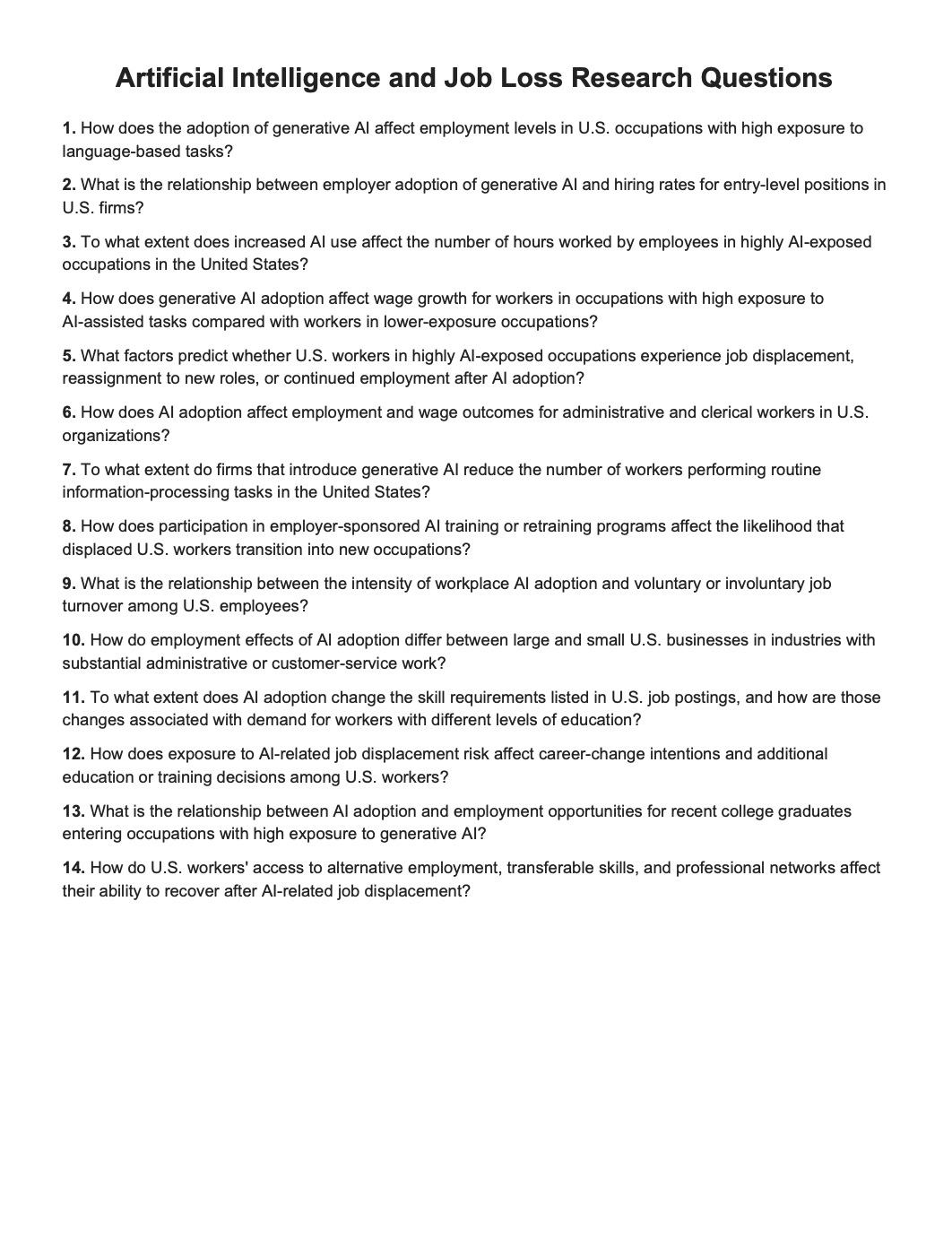
What is the relationship between AI adoption and changes in the distribution of routine versus non-routine
tasks among customer-service workers in the United States?
14.
How does AI-based transaction monitoring affect fraud-detection rates and false-positive rates in U.S.
financial institutions?
15.
Which organizational governance practices are most strongly associated with the reliable and responsible
use of generative AI in U.S. businesses?