
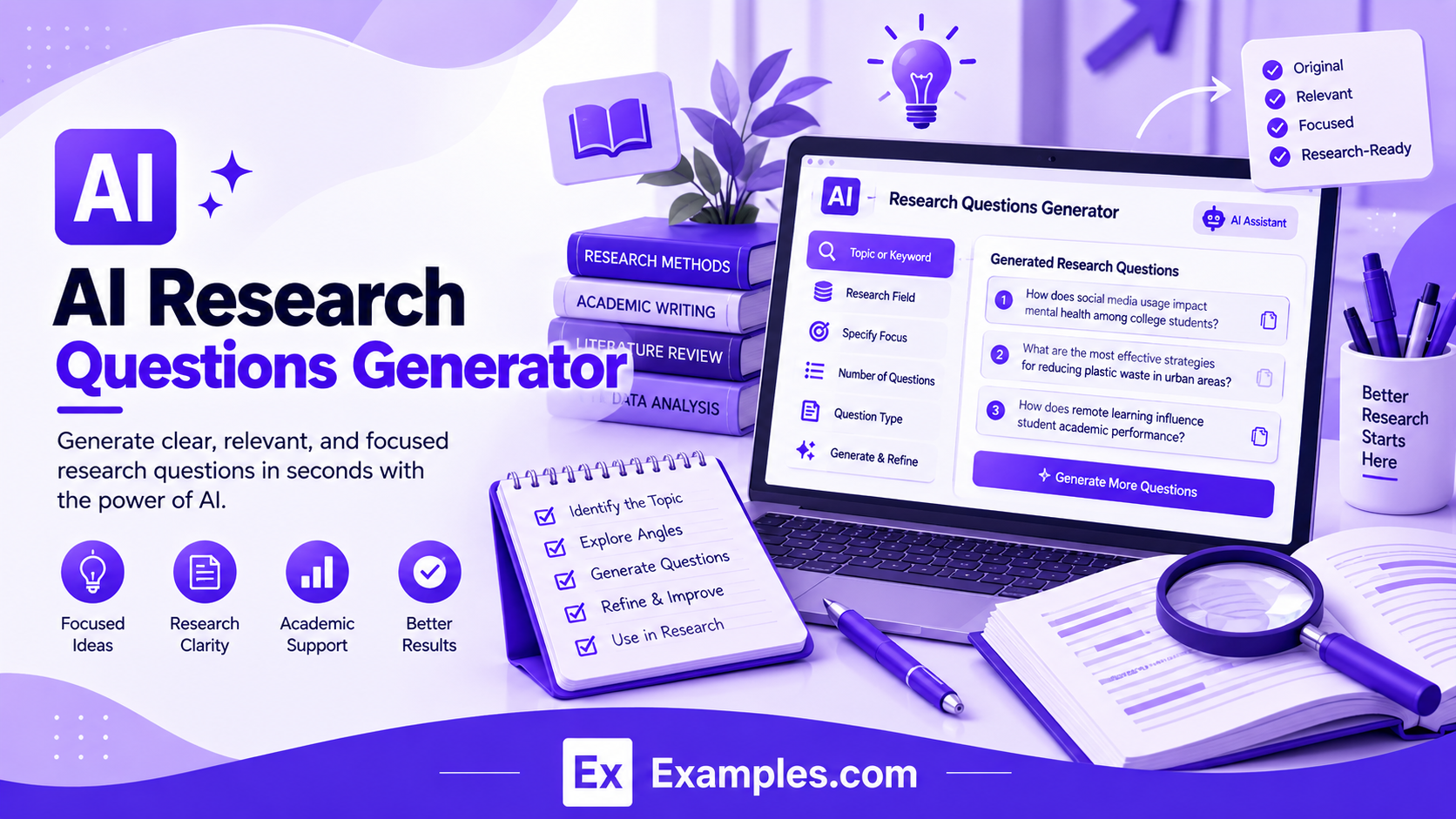
Research questions are clear, focused questions that define what a researcher wants to investigate, understand, compare, or explain through a research study. A strong research question identifies a specific area of inquiry and provides direction for collecting and analyzing information. Unlike a broad research topic, a research question is written as a question and is specific enough to guide the scope, methods, evidence, and objectives of a research project.
What Is a Research Question?
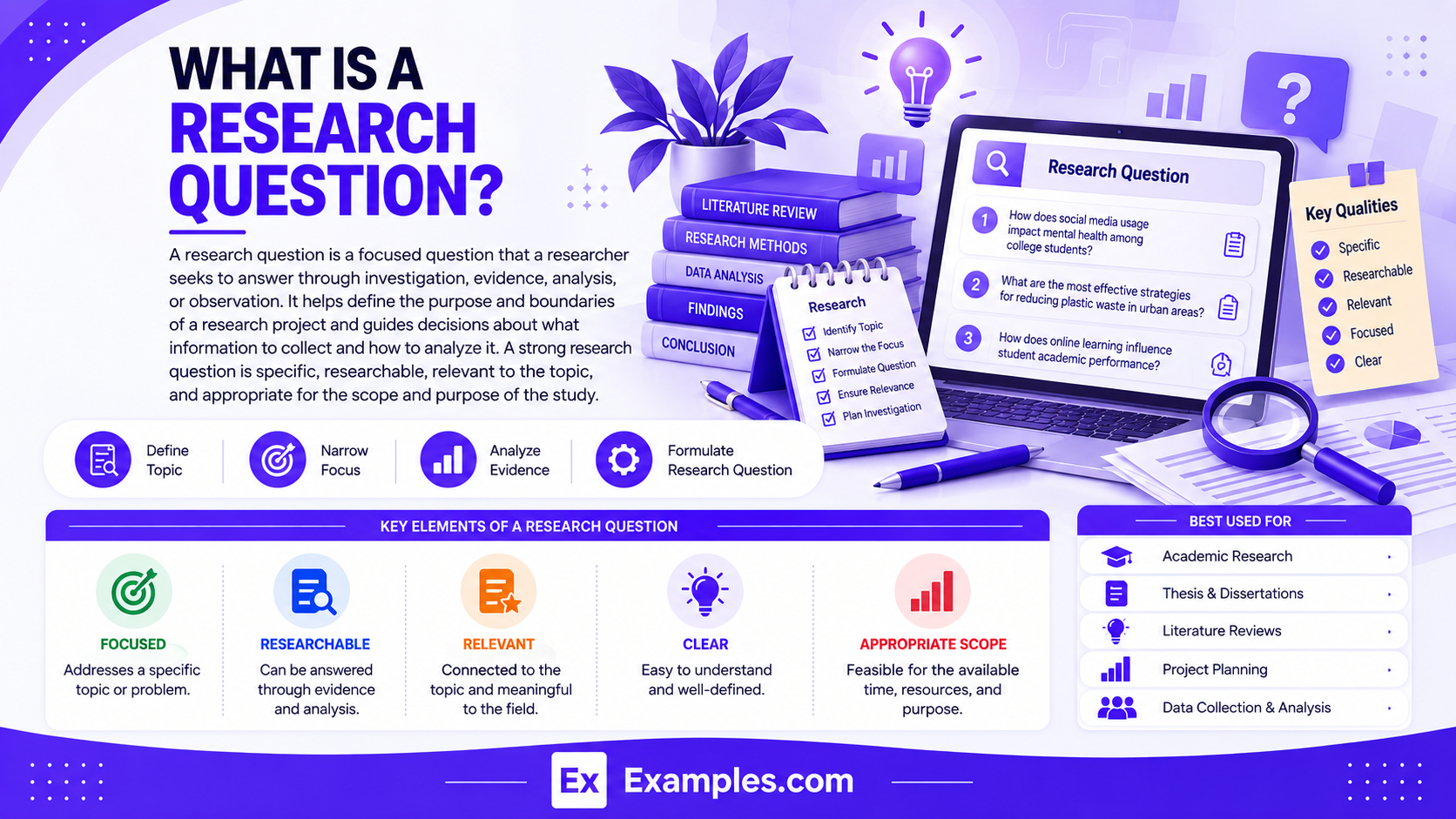
A research question is a focused question that a researcher seeks to answer through investigation, evidence, analysis, or observation. It helps define the purpose and boundaries of a research project and guides decisions about what information to collect and how to analyze it. A strong research question is specific, researchable, relevant to the topic, and appropriate for the scope and purpose of the study.
What Are the Different Types of Research Questions?
Descriptive Research Questions
A Descriptive Research Question asks about the characteristics, patterns, behaviors, conditions, or experiences of a particular population, situation, or phenomenon.
Exploratory Research Questions
An Exploratory Research Question investigates an issue or subject that requires greater understanding, especially when existing knowledge or research is limited.
Comparative Research Questions
A Comparative Research Question examines differences or similarities between two or more groups, conditions, variables, populations, or situations.
Relationship-Based Research Questions
A Relationship-Based Research Question investigates whether or how two or more variables, factors, experiences, or conditions are connected.
Experimental Research Questions
An Experimental Research Question examines the effects of an intervention, treatment, condition, or controlled change on a particular outcome.
Qualitative Research Questions
A Qualitative Research Question explores experiences, perceptions, meanings, beliefs, behaviors, or perspectives using qualitative methods such as interviews, observations, or focus groups.
Quantitative Research Questions
A Quantitative Research Question focuses on measurable variables, numerical relationships, differences, patterns, or outcomes that can be examined using quantitative data.
Community Research Questions
A Community Research Question examines issues, experiences, needs, behaviors, or conditions affecting a particular community or population.
Academic Research Questions
An Academic Research Question focuses on a topic within a scholarly discipline and is designed to guide investigation, analysis, and evidence-based conclusions.
Applied Research Questions
An Applied Research Question focuses on a practical problem and seeks information that can support decisions, improvements, solutions, policies, or professional practice.
How Do I Generate Research Questions Using Real Examples?
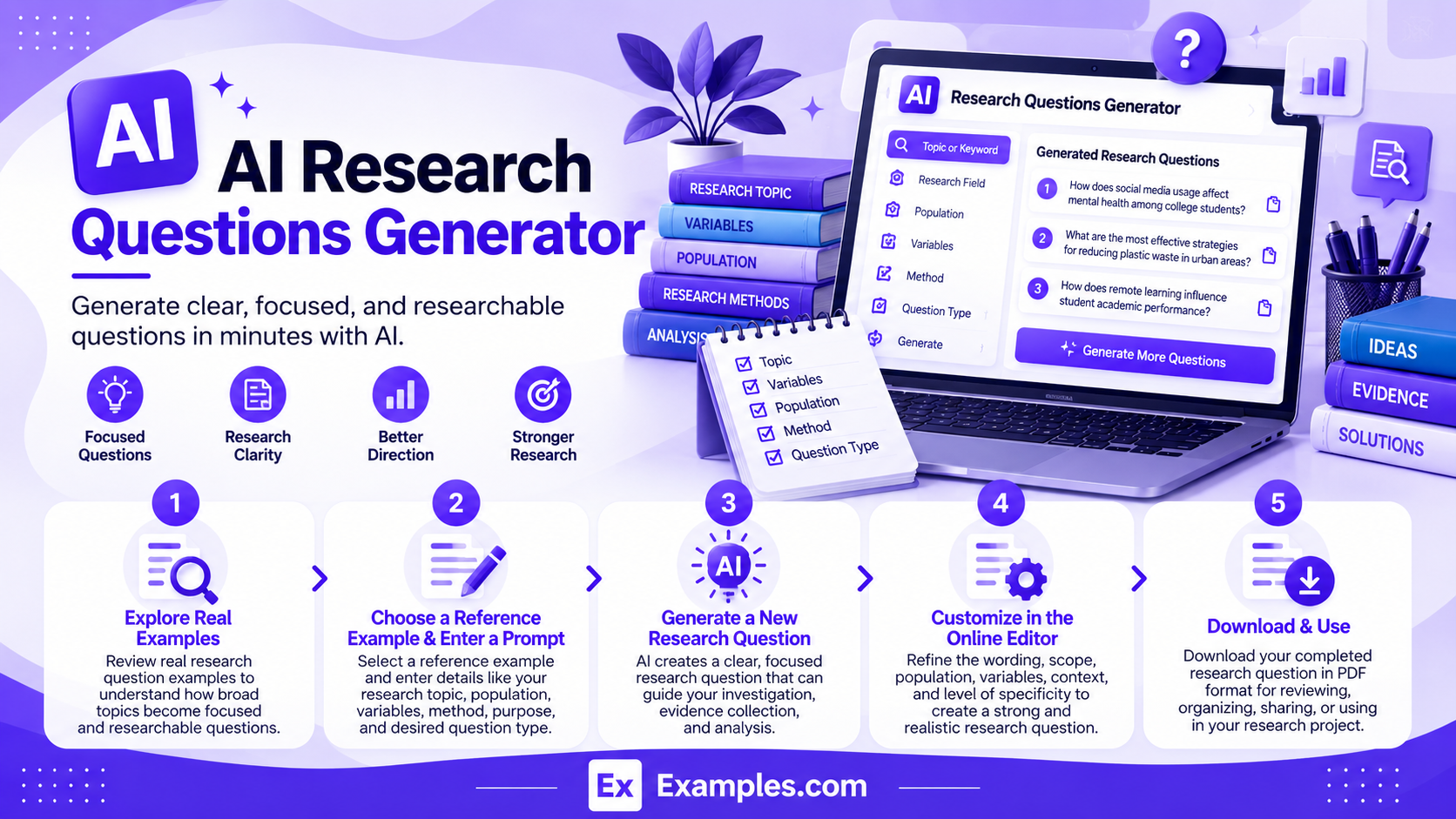
Explore Real Research Question Examples
Review real research question examples to understand how broad topics can be transformed into specific, focused questions that guide research. Examples can help you identify useful question structures, research variables, populations, relationships, comparisons, and areas of inquiry.
Choose A Reference Example And Enter An AI Prompt
Choose a reference research question and describe what you need in your prompt, including the research topic, population, variables, context, research method, purpose, scope, and desired question type. A specific prompt helps produce focused questions that match the goals of your research project.
Generate A New AI Research Question
Generate a new research question from your prompt. The AI can turn a broad research topic, problem, or area of interest into a focused question that can guide investigation, evidence collection, and analysis.
Customize The Research Question In The Online Editor
Refine the generated research question in the online editor by adjusting the wording, scope, population, variables, context, and level of specificity. Remove unnecessary details and make sure the question can realistically be investigated within the available time, evidence, and research methods.
Download And Use Your Research Question
Download your completed research question in PDF format for reviewing, organizing, sharing, printing, or using as a reference while developing a research proposal, paper, project, or study.
What Makes a Good Research Question?
A good research question is clear, focused, specific, relevant, and researchable. It should identify a meaningful area of inquiry without being so broad that the study becomes difficult to manage or so narrow that there is insufficient information to investigate it. Strong research questions are written in precise language, avoid unnecessary assumptions, align with the purpose and methods of the study, and provide a clear direction for collecting and analyzing evidence.
AI Research Question Editing Features
AI Research Question Generation
Generate focused research questions based on a research topic, problem, population, variables, field of study, or research objective you provide.
Smart Question Editing
Rewrite, shorten, expand, or refine a research question to improve clarity, specificity, focus, and researchability.
Topic-to-Question Conversion
Turn a broad research topic or subject into a focused question that can guide systematic investigation and analysis.
Research Question Customization
Adjust the population, variables, context, comparison, research method, and scope to create a question that matches the intended study.
Scope and Focus Refinement
Remove unnecessary information and narrow overly broad questions so they are realistic, manageable, and appropriate for the available research resources.
Instant PDF Download
Download your completed research question in PDF format for reviewing, organizing, printing, sharing, or using as a research reference.
What Are the Essential Elements of a Research Question?
- Clear Research Topic: Identify the subject, issue, phenomenon, or problem the research will investigate.
- Focused Inquiry: Ask a specific question rather than addressing an extremely broad area of study.
- Researchable Problem: Make sure the question can be investigated using available evidence, data, observations, or other appropriate research methods.
- Relevant Population: Identify the group, participants, organizations, texts, cases, or subjects being studied when relevant.
- Key Variables or Concepts: Identify important variables, factors, experiences, or concepts involved in the investigation when appropriate.
- Clear Context: Define the setting, environment, time period, field, or circumstances that are important to the research.
- Appropriate Scope: Keep the question manageable for the available time, resources, data, and research requirements.
- Neutral Wording: Avoid wording that assumes a particular conclusion or expresses a personal bias unless the research design specifically requires it.
- Purposeful Inquiry: Ensure the question addresses a meaningful problem, gap, comparison, relationship, or area of understanding.
- Alignment With Methods: Make sure the question can be answered using the research approach, evidence, and analysis methods planned for the study.
How Do I Write a Research Question?
- Choose the Research Topic: Identify the broad subject, issue, problem, or area that interests you.
- Research the Topic: Review existing information and studies to understand what is already known and where questions or gaps remain.
- Identify the Research Problem: Determine the specific issue, uncertainty, relationship, difference, or experience that you want to investigate.
- Define the Scope: Decide which population, variables, context, time period, or conditions the research will focus on.
- Choose the Question Type: Determine whether the study requires a descriptive, exploratory, comparative, relationship-based, qualitative, quantitative, or experimental question.
- Use Clear Question Words: Begin with wording such as “What,” “How,” “Why,” “To what extent,” or “What is the relationship between,” depending on the purpose of the research.
- Make It Researchable: Check that the question can realistically be answered through appropriate evidence, data, observations, interviews, experiments, or other research methods.
- Avoid Bias and Assumptions: Use neutral wording and avoid embedding a preferred conclusion into the question.
- Make It Specific: Remove unnecessary concepts and narrow the question until its purpose and boundaries are clear.
- Review and Refine: Make sure the final question is clear, focused, relevant, researchable, and aligned with the goals and methods of the study.
Why Should I Use Real Research Question Examples to Create My Own Research Question?
- Real examples show how broad research topics can become specific and researchable questions.
- They help you understand the difference between a research topic, research problem, and research question.
- They provide useful wording patterns for descriptive, comparative, exploratory, qualitative, and quantitative questions.
- They show how researchers define populations, variables, contexts, and relationships within a question.
- They help you avoid vague, overly broad, biased, or unanswerable questions.
- They make it easier to develop a research question that matches the purpose and scope of your study.
What Common Research Question Mistakes Should I Avoid?
- Making It Too Broad: Avoid questions that cover too many populations, variables, or issues to investigate effectively.
- Making It Too Narrow: Do not create a question so limited that there is insufficient information or evidence to answer it.
- Using a Topic Instead of a Question: A phrase such as “Social media and students” is a topic, not a research question.
- Asking an Unresearchable Question: Make sure the question can be investigated through evidence, data, observation, analysis, or another appropriate method.
- Embedding the Answer: Avoid wording that assumes a particular conclusion before the research begins.
- Using Biased Language: Keep the question neutral and avoid language that unfairly favors one viewpoint.
- Including Too Many Questions: A research question should have a clear central purpose rather than combining several unrelated questions.
- Ignoring the Population or Context: Define who or what is being studied and under what circumstances when those details are necessary.
- Using Vague Terms: Replace unclear words such as “good,” “bad,” “effective,” or “important” with terms that can be examined more precisely.
- Ignoring the Research Method: Make sure the question can actually be addressed using the type of evidence and methodology planned for the study.
What Is the Difference Between a Research Topic and a Research Question?
| Research Topic | Research Question |
|---|---|
| A broad subject or area of interest. | A focused question that the researcher seeks to answer. |
| Usually expressed as a word or phrase. | Written as a complete question. |
| Identifies what the research is generally about. | Defines what the researcher specifically wants to investigate. |
| Can cover a large area of knowledge. | Narrows the topic into a manageable area of inquiry. |
| Does not necessarily identify a specific research problem. | Usually addresses a particular problem, relationship, comparison, experience, or uncertainty. |
| Helps establish the general direction of a study. | Guides the collection, analysis, and interpretation of evidence. |
Research Question Ideas for Different Fields
- Education: How does the use of collaborative learning affect student participation in high school classrooms?
- Healthcare: How do patient education programs influence medication adherence among adults with chronic conditions?
- Psychology: What factors are associated with academic stress among college students?
- Business: How does remote work affect employee collaboration and job satisfaction in U.S. organizations?
- Technology: How does the use of artificial intelligence influence productivity among software development teams?
- Environmental Studies: What factors influence recycling participation among households in urban communities?
- Social Media: How does social media use affect students’ perceptions of academic performance and peer comparison?
- Public Health: How do community-based health education programs influence preventive health behaviors?
- Nursing: How does nurse-patient communication affect patient satisfaction in hospital settings?
- Cybersecurity: What factors influence employees’ adherence to cybersecurity practices in organizations?
FAQs
What Is a Research Question?
A research question is a clear and focused question that defines what a researcher wants to investigate, understand, compare, or explain through a research study.
How Long Should a Research Question Be?
A research question should be concise enough to remain clear while including enough information to define the research focus, population, variables, context, or other important boundaries.
Can a Research Question Be One Word?
No. A research question should be a complete question that communicates a specific area of inquiry rather than simply naming a topic.
What Should a Research Question Include?
A research question may include the research topic, population, variables, context, relationship, comparison, or phenomenon being investigated, depending on the purpose of the study.
Can a Research Question Be a Yes or No Question?
A yes-or-no question can sometimes be used for limited research purposes, but many research questions are designed to encourage deeper investigation, explanation, comparison, or analysis.
Should a Research Question Be Specific?
Yes. A research question should be focused enough to guide a manageable study while still allowing sufficient evidence or data to investigate the issue.
What Makes a Research Question Researchable?
A research question is researchable when it can be investigated using appropriate evidence, data, observations, interviews, experiments, documents, or other suitable research methods.
How Is a Research Question Different From a Hypothesis?
A research question identifies what the researcher wants to investigate, while a hypothesis is a testable prediction or proposed explanation that can be examined through research.
Can a Research Project Have More Than One Research Question?
Yes. A research project can include multiple related research questions when they address different aspects of the same research problem and remain within the study’s scope.
Can AI Help Me Create a Research Question?
Yes, AI can help turn broad topics into focused research questions, suggest different question types, refine wording, and narrow the scope when you provide accurate information about the research topic, purpose, and intended study.