
1
Investment Policy Statement
for
The Community Foundation of Howard County
Approved by Board of Trustees October 17, 2018
Updated/Amended February 28, 2023
2
Table of Contents
I.
Introduction ................................................................................................................... 4
Purpose ................................................................................................................................... 4
II.
Information about The Community Foundation of Howard County ................................. 4
Mission Statement .................................................................................................................. 5
Tax/Regulatory Status ............................................................................................................. 5
Gifts of Securities .................................................................................................................... 5
III.
Responsibilities of Fund Representatives ........................................................................ 5
Board of Trustees .................................................................................................................... 5
Investment Committee ........................................................................................................... 5
President & Chief Executive Officer ........................................................................................ 6
Investment Advisor (s) ............................................................................................................ 6
Investment Manager(s) ........................................................................................................... 7
IV.
Investment Manager Selection Criteria ........................................................................... 7
V.
Spending Guidelines ....................................................................................................... 8
VI.
Guidelines for the Investment Fund ................................................................................ 9
Investment Objectives ............................................................................................................ 9
Time Horizon ........................................................................................................................... 9
Investment Guidelines ............................................................................................................ 9
Allowable Investments .......................................................................................................... 10
Allowable Investment Vehicles ............................................................................................. 10
Risk Tolerance ....................................................................................................................... 10
Portfolio Return Objectives .................................................................................................. 11
Mission-Aligned Objectives ................................................................................................... 11
Asset Allocation & Performance Evaluation ......................................................................... 11
VII.
Restrictions .................................................................................................................. 13
VIII.
Rebalancing .................................................................................................................. 13
IX.
Investment Monitoring and Control Procedures............................................................ 14
Reports .................................................................................................................................. 14
Meetings and Communications with Investment Advisors .................................................. 14
Adoption ............................................................................................................................. 15
Appendix 1: Community Foundation of Howard County Investment Policy Governance ....... 16

3
Appendix 2: Asset Class Definitions & Style Indices .............................................................. 17
Appendix 3: Treatment of Excess Business Holdings in Donor-Advised Funds ....................... 21
4
I.
Introduction
The Community Foundation of Howard County Endowment Fund is comprised of a limited
partnership interest in a real estate project and the Investment Fund. The Investment Fund is
the principal vehicle for the management of liquid assets. Donor-advised funds with differing
distributions and recipients are co-mingled in the Investment Fund with the unrestricted
endowment assets for investment purposes.
Purpose
The purpose of the Investment Fund is to create a perpetual source of funds so that The
Community Foundation of Howard County can continue to meet the charitable needs of
Howard County.
The purpose of this Investment Policy is to establish a clear understanding as to the investment
goals, objectives and management policies applicable to the Investment Fund.
This statement:
▪
Describes an appropriate risk position for the Investment Fund;
▪
Establishes investment guidelines regarding the selection of Investment Managers,
permissible securities and diversification of assets;
▪
Specifies the criteria for evaluating the performance of the Investment Managers and of
the Investment Fund as a whole; and
▪
Defines the responsibilities of the Board of Trustees, the Investment Committee, the
President & Chief Executive Officer and other parties responsible for the management
of the Investment Fund.
The Board of Trustees believes that the investment policies described in this statement should
be dynamic. These policies should reflect the financial needs and circumstances of The
Community Foundation of Howard County, the time horizon available for investment and the
Board of Trustees’ philosophy and duties regarding the investment of these assets. These
policies will be reviewed and revised periodically to ensure they adequately reflect changes
related to The Community Foundation of Howard County’s financial condition and the Board of
Trustees’ tolerance for risk and the capital markets.
II.
Information about The Community Foundation of Howard
County
Address:
6680 Martin Road, Columbia, MD 21044
Telephone:
(410) 730 7840
Primary Contact:
Beverly White-Seals, President & CEO
Fiscal Year End:
December 31
st
5
Mission Statement
Educating and engaging the community to inspire life-long giving for the advancement of
Howard County residents and nonprofits supporting civic, cultural, environment and education.
Tax/Regulatory Status
The Community Foundation of Howard County is organized as a non-profit organization in
accordance with the Internal Revenue Service Regulations, Section 501(c)(3). Accordingly, the
income and earnings of the organization are exempt from State and Federal taxes.
Gifts of Securities
Gifts of securities to The Community Foundation of Howard County should be sold immediately
and proceeds invested in the Investment Fund, unless specified to the contrary by the donor.
III.
Responsibilities of Fund Representatives
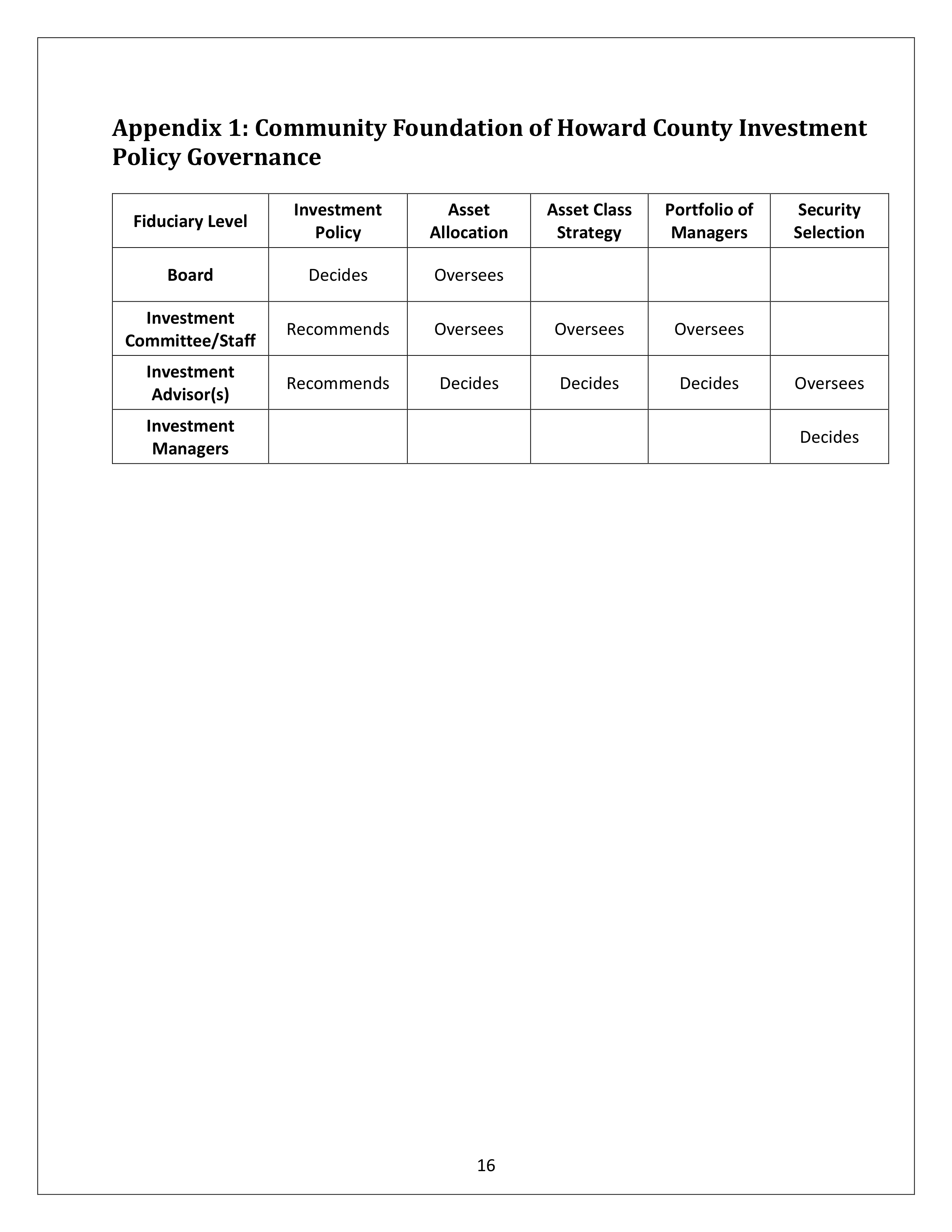
Please refer to Appendix 1 for a table on the governance structure of The Community
Foundation of Howard County.
Board of Trustees
The
Board of Trustees (“Board”)
is responsible for:
▪
Adopting and approving the investment policy and any updates or changes presented by
the Investment Committee;
▪
Defining the investment objectives for the Foundation’s investments;
▪
Determining the amount of distribution from the Unrestricted Fund;
▪
Determining the beneficiaries of the distribution from the Unrestricted Fund, taking into
consideration the preference of the Named Funds within the Unrestricted Fund.
Investment Committee
The
Investment Committee (“Committee”)
is
appointed annually by the Board, the majority of
whom will be members of the Board. The CEO and Board Chair are ex-officio members and
count towards the quorum. The Committee is responsible for:
▪
Reviewing the investment policy annually and recommending to the Board changes to
the policy, guidelines and objectives as needed;
▪
Recommending to the Board, the selection or termination of Investment Advisor(s),
administrators, and custodians for each pool;
▪
Monitoring and evaluating the performance of each Investment Manager/fund and of
the Investment Fund as a whole each quarter;
▪
Reviewing and reporting to the Board the actual asset allocation and performance at
least each quarter-end in order to ensure compliance with asset allocation guidelines;
▪
Overseeing the actions of the President & Chief Executive Officer who has been
delegated the responsibility for the day-to-day oversight of the Investment Fund; and
▪
Executing such other duties as may be described in this policy or delegated by the
6
Board.
▪
Recommending to the Board the appropriate annual spending allocation based on the
Spending Policy.
▪
Reviewing and approving limited partnerships as recommended by Investment
Advisor(s).
President & Chief Executive Officer
The Committee has delegated to the
President & CEO
, a member of the Committee, the
following responsibilities:
▪
The day-to-day oversight of The Community Foundation of Howard County’s investment
assets;
▪
Acting as the primary contact between The Community Foundation of Howard County,
and the Investment Advisor(s), Investment Manager(s), custodian, and any other parties
interested in the management of The Community Foundation of Howard County’s
financial assets;
▪
Facilitating meetings and communications between the Committee and the Investment
Advisor(s), Investment Manager(s) and custodian; Maintaining appropriate records of
the Investment Fund, including the minutes of Investment Committee meetings and
supplying them to the Committee and the Board;
▪
Providing an accounting of the assets and the performance of the Investment Fund to
the Board on an annual basis;
▪
Notifying the Investment Advisor(s) about any gifts of securities received in the
Investment Fund and directing them to be sold immediately upon receipt;
▪
Keeping the Committee and the Investment Advisor(s) informed of any significant
events that may impact The Community Foundation of Howard County; and
▪
Executing such other duties as may be described in this policy or delegated by the
Committee.
Investment Advisor (s)
The
Investment Advisor(s)’s
role is to manage the funds entrusted to it by the Investment
Committee. The Investment Advisor must acknowledge in writing its acceptance of
responsibility as a fiduciary. The day-to-day investment decisions will be managed on a
discretionary basis by the Investment Advisor within the investment and governance
parameters delineated in these investment policies. Specific responsibilities of the Investment
Advisor include, but are not limited to:
▪
Reviewing investment policies and objectives, and suggesting appropriate changes to be
approved by the appropriate responsible party at least on an annual basis;
▪
Proactive asset allocation concerning the existing fund assets and new contributions as
well as periodic rebalancing of the asset allocation. These responsibilities will include
both asset allocation (stock, bond, cash mix) and style allocation (international versus
7
domestic allocation, growth-style versus value-style equities, large-capitalization versus
small-capitalization equities, and long versus short-term bonds);
▪
Rebalancing portfolio as necessary by executing transactions among approved managers
to implement approved targets or to rebalance (for example, when cash is deposited or
withdrawn).
▪
Hiring and terminating specific Investment Managers, who are consistent with the
investment policies, objectives, asset allocation and style allocation strategy with the
exception of limited partnerships which will require the approval of the Investment
Committee;
▪
Measuring, evaluating and reporting the Investment Manager(s)’ performance results
on a quarterly basis;
▪
Attending quarterly meetings as requested;
▪
Maintaining contact with and reporting on changes within the Investment Manager(s)’
organizations; and
▪
Providing ad hoc analyses related to the investment program and other services to
support the Investment Committee, as requested.
Investment Manager(s)
The Investment Managers (which refers to separately managed accounts, mutual funds and
exchange-traded funds) will have full discretion to make all investment decisions for the assets
placed under their jurisdiction. It is the intention of The Community Foundation of Howard
County to utilize mutual funds, exchange-traded funds, Treasury bonds, Treasury Inflation
Protected Securities (TIPS), Limited Partnerships and structured products to implement the
Investment Fund. For mutual funds, exchange-traded funds and other commingled funds, the
prospectus or trust documents of the fund(s) will govern the investment policies of the fund
investments. Where there are differences between the prospectus and this investment policy,
the prospectus shall govern.
IV.
Investment Manager Selection Criteria
Investment managers shall be chosen using the following factors:
▪
Past performance, considered relative to other investments having a similar investment
objective. Consideration shall be given to both performance rankings over various time
frames and consistency of performance;
▪
Costs relative to other funds with like objectives and investment styles;
▪
The manager’s adherence to investment style and size objectives;
▪
Size of the fund;
▪
Length of time the fund/manager has been in existence and length of time it has been
under the direction of the current manager(s) and whether or not there have been
material changes in the manager’s organization and personnel;
▪
The historical volatility and downside risk of each proposed investment;
8
▪
How well each proposed investment complements other assets in the portfolio;
▪
The current economic environment;
▪
The likelihood of future investment success, relative to other opportunities; and
▪
Registration with appropriate regulatory bodies.
V.
Spending Guidelines
The following policy has been adopted for the annual distribution from all monies in the
Investment Fund, with the final decision of the percentage and amount to be made each year
by the Board of Trustees.
The distribution policy for the Investment Fund attempts to balance 1) the desire to make
significant distribution of monies from the Investment Fund with 2) the fiduciary responsibility
for the preservation of capital and growth of principal sufficient to offset the effect of inflation.
In balancing these competing values, the spending policy will be as follows:
▪
The distribution each year will be between 4% and 5% based on an amount equal to a
12 quarter trailing average market value of the Investment Fund as approved by the
Board.
The eligibility requirements for the Endow Maryland Tax Credit requires the following: “The
fund must be a qualified permanent endowment fund that is held in perpetuity by an eligible
community foundation and has an annual spending rate of 5% or less calculated using at least a
12-quarter trailing average of the total amount of the fund.”
This minimum distribution will be based on the calculation formula and not on what has been
actually distributed in the previous year, if that is more. Beginning with the distribution based
on year-end results for 2009, the distribution will be based on the market value of the
Unrestricted Fund on September 30. In calculating the formula the market value of years prior
to 2009, the year-end value of December 31 will continue to be used.
Prior to their action on the amount to be distributed from the Investment Fund, the President &
Chief Executive Officer will be responsible for providing the Investment Committee and the
Board of Trustees a written report with the following information relating to the Investment
Fund: the year-end market value as of September 30 of the current year; the applicable year
end value of the previous two years; the proposed amount of the distribution according to the
Investment Policy, the percentage that represents of the year end value; and the amount of
distributions from the Unrestricted Fund in the previous two years. The President & Chief
Executive Officer will also be responsible for assuring that the distributions planned are
compatible with relevant federal and state laws.
9
The Investment Committee will send to the Board of Trustees the policy calculation for that
year’s distribution together with its recommendation. The Board of Trustees will make the final
determination of the amount and percentage of market value to be distributed from the
Investment Fund for the year.
VI.
Guidelines for the Investment Fund
Investment Objectives
The goal of The Community Foundation of Howard County’s Investment Fund is to provide
preservation of purchasing power and growth of principal in addition to providing a return for
use by the Foundation and its donors for grants and operating expenses.
Time Horizon
The investment guidelines, including the strategic asset allocation, are based upon an
investment time horizon of 10+ years.
Investment Guidelines
The assets in the managed account portion of the Investment Fund shall:
▪
Emphasize investments in marketable securities managed by professional Investment
Managers;
▪
Be broadly diversified by asset class, investment style, number of issues, issue type, and
other factors, consistent with the investment objectives outlines in this investment
policy; and
▪
Be invested with prudent levels of risk and with the expectation that long-term total
returns (yield plus capital appreciation) will maintain and may possibly increase the
purchasing power of the Investment Fund.
These guidelines are consistent with prudent investor standards as well as the standards in
accordance with Maryland Law and the Uniform Prudent Management of Institutional Funds
Act (UPMIFA) adopted by Maryland on April 14, 2009.
Subject to the intent of a donor expressed in a gift instrument, the Community Foundation of
Howard County, in overseeing the Investment Fund, shall consider the charitable purposes of
the Community Foundation of Howard County and the purposes of the donor funds. In addition
to complying with the duty imposed by law, the Investment Advisor shall manage and invest
the Investment Fund exercising ordinary business care and prudence under the facts and
circumstances prevailing at the time of the action or decision, and may incur only costs that are
appropriate and reasonable in relation to the assets, and the mission of the Community
Foundation of Howard County. The following factors, if relevant, must be considered when
making investment management decisions:
a. General economic conditions;
10
b. The possible effect of inflation or deflation;
c. The expected tax consequences, if any, of investment decisions or strategies;
d. The role that each investment or course of action plays within the overall investment
portfolio;
e. The expected total return from income and the appreciation of investments;
f. Other resources of the Community Foundation of Howard County;
g. The needs of the Community Foundation of Howard County and the funds to make
distributions and to preserve capital; and,
h. The special relationship or special value of the asset, if any, to the mission of the
Community Foundation of Howard County.
Management and investment decisions about an individual asset must be made not in isolation
but rather in the context of the Investment Fund portfolio as a whole and as a part of an overall
investment strategy having risk and return objectives reasonably suited to the Investment Fund
and to the Community Foundation of Howard County.
Allowable Investments
The following are allowable investments for the Investment Fund, as defined in Appendix 1 of
this investment policy statement:
▪
Equities
▪
Fixed Income
▪
Alternative Investments
▪
Cash & Cash Equivalents
Allowable Investment Vehicles
The Board shall be authorized to invest the Investment Fund as follows:
▪
Mutual Funds
▪
Exchange Traded Funds
▪
Individual Treasury Bonds
▪
Treasury Inflation Protected Securities (TIPS)
▪
Separately Managed Accounts (SMAs)
▪
Limited Partnerships [Any limited partnerships should be subject to the approval by the
Investment Committee]
▪
Structured Products
Risk Tolerance
Investment theory and historical capital market return data suggest that, over long periods of
time, there is a relationship between the level of investment risk assumed and the level of
return that can be expected. In general, in order to attain higher returns one must accept
higher risk (i.e.. volatility of returns and/or of account values).
11
Given this relationship between risk and return, a fundamental step in determining the
investment policy for the Investment Fund is the determination of the amount of risk the Board
of Trustees can tolerate.
An understanding of investment risk influences how aggressively or conservatively a portfolio
will be invested. Like a scale, risk needs to be balanced with the need for returns to achieve the
investment goals. The Board of Trustees desires long-term investment performance sufficient
to meet the goals. The Board of Trustees understands that to achieve such performance the
portfolio may experience periods of decline. The Board of Trustees further understands that in
a severe market correction, the potential recovery period could be extended.
The Board is comfortable with a risk level of the Investment Fund as measured by volatility
(standard deviation) that is
similar to
the volatility level of the style index when measured over
five-year rolling time periods and a full market cycle. This style index is defined in Appendix 3.
Portfolio Return Objectives
The objectives of the Investment Fund represent a long-term goal of maximizing the returns
without exposure to undue risk, as defined herein. It is understood that fluctuating rates of
return are characteristic of the securities markets. The primary concern should be long-term
appreciation of the assets and consistency of total portfolio returns. Recognizing that short-
term market fluctuations may cause variations in the account performance, the expectations of
the account will be to achieve the following objective over a ten-year time period:
▪
Growth of the portfolio in real terms after meeting spending guidelines to be measured
as Consumer Price Index (CPI) + Spending (4.5%)
Mission-Aligned Objectives
The Community Foundation of Howard County values diversity and seeks to communicate the
importance of that value to all existing and prospective investment managers and to encourage
them to review their commitment to race, equity and inclusion. When hiring investment
managers, the Investment Committee and the investment advisor will make a good faith effort
to identify and include minority/women-owned firms, or minority/women led investment
strategies, in the search process.
The selected investments will target long-term returns that are competitive with investment
managers in their respective asset classes and all benchmark targets deemed appropriate for
the specific asset categories as per the Community Foundation’s Investment Policy Statement.
Asset Allocation & Performance Evaluation
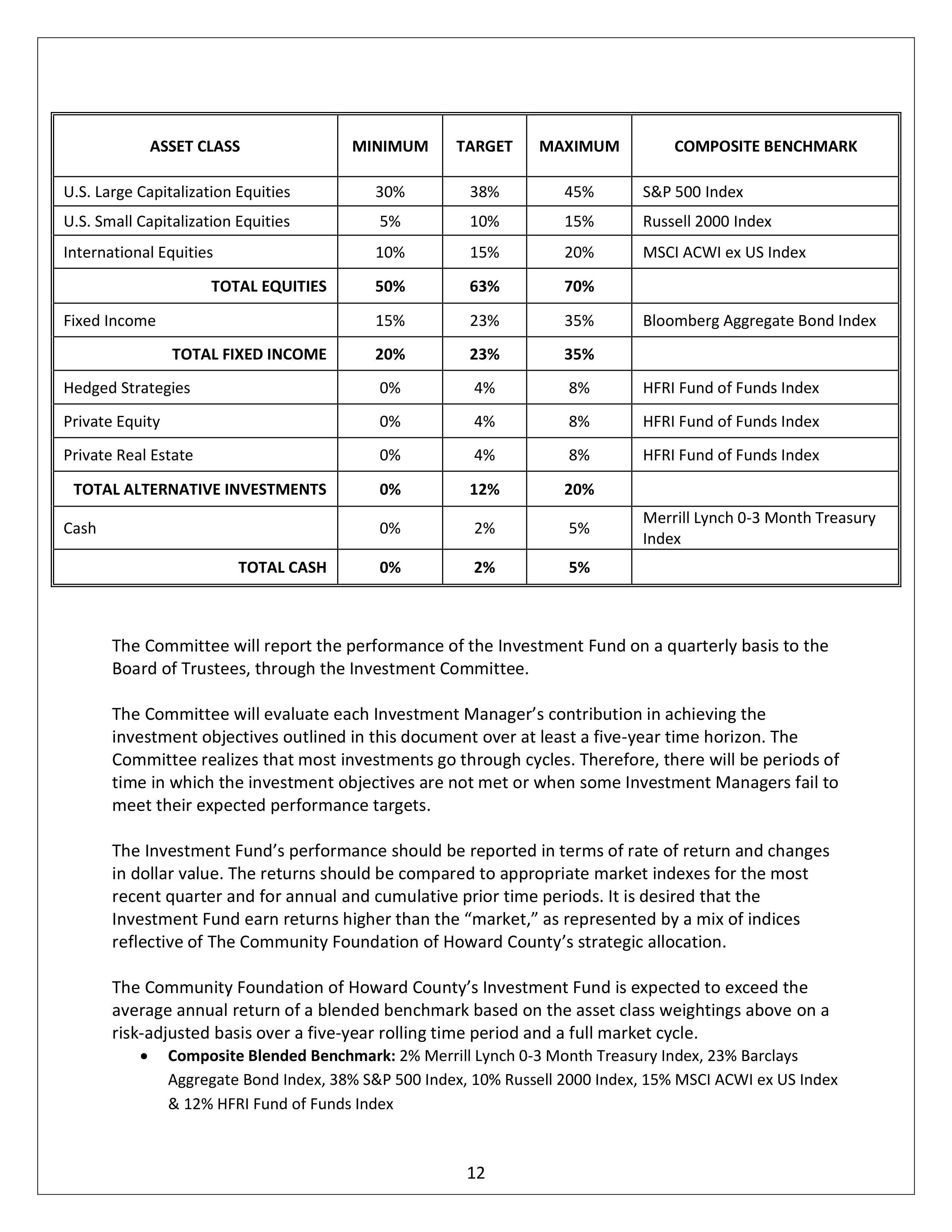
In order to manage the risks and rewards of the Investment Fund, the following asset
categories and ranges have been selected as guidelines for the endowment fund assets. The
broad diversification by asset class is designed to help control the volatility of returns of the
Investment Fund.
12
ASSET CLASS
MINIMUM
TARGET
MAXIMUM
COMPOSITE BENCHMARK
U.S. Large Capitalization Equities
30%
38%
45%
S&P 500 Index
U.S. Small Capitalization Equities
5%
10%
15%
Russell 2000 Index
International Equities
10%
15%
20%
MSCI ACWI ex US Index
TOTAL EQUITIES
50%
63%
70%
Fixed Income
15%
23%
35%
Bloomberg Aggregate Bond Index
TOTAL FIXED INCOME
20%
23%
35%
Hedged Strategies
0%
4%
8%
HFRI Fund of Funds Index
Private Equity
0%
4%
8%
HFRI Fund of Funds Index
Private Real Estate
0%
4%
8%
HFRI Fund of Funds Index
TOTAL ALTERNATIVE INVESTMENTS
0%
12%
20%
Cash
0%
2%
5%
Merrill Lynch 0-3 Month Treasury
Index
TOTAL CASH
0%
2%
5%
The Committee will report the performance of the Investment Fund on a quarterly basis to the
Board of Trustees, through the Investment Committee.
The Committee will evaluate each Investment Manager’s contribution in achieving the
investment objectives outlined in this document over at least a five-year time horizon. The
Committee realizes that most investments go through cycles. Therefore, there will be periods of
time in which the investment objectives are not met or when some Investment Managers fail to
meet their expected performance targets.
The Investment Fund’s performance should be reported in terms of rate of return and changes
in dollar value. The returns should be compared to appropriate market indexes for the most
recent quarter and for annual and cumulative prior time periods. It is desired that the
Investment Fund earn returns higher than the “market,” as represented by a mix of indices
reflective of The Community Foundation of Howard County’s strategic allocation.
The Community Foundation of Howard County’s Investment Fund is expected to exceed the
average annual return of a blended benchmark based on the asset class weightings above on a
risk-adjusted basis over a five-year rolling time period and a full market cycle.
•
Composite Blended Benchmark:
2% Merrill Lynch 0-3 Month Treasury Index, 23% Barclays
Aggregate Bond Index, 38% S&P 500 Index, 10% Russell 2000 Index, 15% MSCI ACWI ex US Index
& 12% HFRI Fund of Funds Index
13
The Investment Fund’s asset allocation shall be reported on a quarterly basis.
Each Investment Managers’ performance will be evaluated in similar fashion according to the
performance standards defined in the table above.
VII. Restrictions
The Investment Fund may not be invested in the following:
▪
Purchases of letter stock, private placements (including “144A” securities), or direct
payments;
▪
Purchases of real estate, oil and gas properties, or other natural resources related
properties with the exception of Real Estate Investment Trusts (REITs) and Private Real
Estate Limited Partnerships;
▪
Debt issued by real estate investment trusts; and
▪
Any other security transaction not specifically authorized in this policy statement, unless
approved, in writing, by the Board.
The following transactions are generally restricted. However, they may be allowed only in
certain mutual funds, exchange-traded funds or other commingled funds, invested in
alternative strategies:
▪
Short sales;
▪
Leveraged transactions;
▪
Commodities transactions;
▪
Puts, calls, straddles, or other option strategies; and
▪
Managed futures.
For Fixed Income Investment, no more than 20% of the allocation can invested in High Yield
instruments.
See Appendix 5 for Treatment of Excess Business Holdings in Donor-Advised Funds.
VIII.
Rebalancing
The portfolio will be reviewed at least on a quarterly basis and more frequently if required, to
ensure that the Investment Fund remains within the approved asset allocation guidelines. The
rebalancing of the portfolio has been delegated to the Investment Advisor(s) who will
recommend rebalancing of the portfolio, if required, to the President & CEO or Chair.
14
IX. Investment Monitoring and Control Procedures
Reports
The Investment Advisor(s) shall provide monthly statements for each account held by The
Community Foundation of Howard County and subject to this Investment Policy. Such reports
shall show values for each asset and all transactions affecting assets within the portfolio,
including additions and withdrawals.
The Advisor(s) shall provide the Investment Committee the following management reports on a
quarterly basis:
▪
Portfolio performance results over varying time periods
▪
Performance results of comparative benchmarks over varying time periods
▪
Review of current asset allocation versus policy guidelines
▪
An annual report showing the portfolio’s performance after adjustments for additions,
withdrawals, gain or loss and inflation.
▪
Any recommendations for changes to the above reports
Meetings and Communications with Investment Advisors
Investment Advisors shall meet with the Investment Committee approximately quarterly to
review and explain the Investment Fund’s performance and any related issues. Investment
Advisor(s) shall also be available on a reasonable basis for telephone and email communication
as needed.
At the quarterly meetings, the Investment Advisor(s) shall keep the Investment Committee
apprised of any material changes in their outlook, report any recent changes to Investment
Managers and recommend changes to limited partnerships if any.
Any recommendations for limited partnerships shall be presented in advance to the Investment
Committee for approval. At the Committee meeting following receipt of the recommendations
to add or change limited partnerships, the Committee shall discuss the recommendations and
by motion either adopt, modify, table or reject the recommendation
.
Other Charitable Funds
From time to time, charitable funds at the Community Foundation of Howard County may be
separately managed and will be subject to the review and approval by the Investment
Committee.
15
Adoption
The Board of Trustees have reviewed, approved and adopted this Investment Policy Statement. This
Investment Policy is to be reviewed periodically by the Investment Committee to determine if any
revisions are warranted by changing circumstances including, but not limited to changes in financial
status, risk tolerance or changes involving Investment Managers. The Board of Trustees, in
consultation with the Investment Committee, reserves the right to make any changes to this
Investment Policy Statement as deemed necessary. All such changes will be made in writing and the
Investment Advisor(s) will be duly informed.
____________________________________________________
____________
Chair, Board of Trustees
Date
____________________________________________________
____________
Chair, Investment Committee
Date
16
Appendix 1: Community Foundation of Howard County Investment
Policy Governance
Fiduciary Level
Investment
Policy
Asset
Allocation
Asset Class
Strategy
Portfolio of
Managers
Security
Selection
Board
Decides
Oversees
Investment
Committee/Staff
Recommends
Oversees
Oversees
Oversees
Investment
Advisor(s)
Recommends
Decides
Decides
Decides
Oversees
Investment
Managers
Decides
17
Appendix 2: Asset Class Definitions & Style Indices
Equities
The equity asset classes should be maintained at risk levels roughly equivalent to the sectors of the
market represented, with the objective of exceeding a nationally recognized index measuring the
performance of the designated sector over a three-year moving time period net of fees and
commissions. Mutual funds and/or exchange-traded funds conforming to the policy guidelines may be
used to implement the investment program. The following definitions shall apply for the purposes of
this policy:
U.S. Large Capitalization Stocks:
A portfolio of stocks comprised primarily of U.S. based companies
with the average of the stocks held having a market value exceeding $6.0 billion and primary shares of
which are traded on a major U.S. stock exchange.
U.S. Mid-Capitalization Stocks
: A portfolio of stocks comprised primarily of U.S. based companies with
the average of the stocks held having a market value between $2.0 billion and $6 billion and primary
shares of which are traded on a major U.S. stock exchange.
U.S. Small Capitalization Stocks:
A portfolio of stocks comprised primarily of U.S. based companies
with the average of the stocks held having a market value less than $2 billion.
International Developed Markets:
Stocks of non-U.S. based companies, located in developed
international markets, the primary shares of which are traded on exchanges outside the U.S.
International Emerging Markets:
Stocks of non-U.S. based companies, located in emerging markets,
the primary shares of which are traded on exchanges outside the U.S.
Real Estate Securities (REITs):
Equity REITs, mortgage REITs, CMO or mortgage-related securities
REITS, Health Care REITS, and equities of real estate operating companies. Equity REITs are those
securities that meet the National Association of Real Estate Investment Trusts’ (NAREIT) asset mix
definition of an equity REIT (currently, equity REITs are those where 75% of assets are equity financed
properties). REITs may be perpetual life REITs or finite life REITs.
Alternative Investments
Alternative investments represent investments in strategies that seek to provide diversification
through innovative and flexible strategies (such as the ability to short, add leverage and hedge).
Diversification standards within each investment shall be according to the prospectus. Investments in
these strategies carry special risks. The fund(s) may utilize aggressive investment strategies, trade in
volatile securities, and use leverage in an attempt to generate superior investment returns.
Some of the underlying strategies are:
Market Neutral:
A strategy in which the manager seeks to profit from both increasing and decreasing
18
prices in a single or numerous markets. Such strategies are often achieved by taking matching long
and short positions in different stocks to increase the return from making good stock selections and
decreasing the return from broad market movements.
Alternative Beta-Replication
:
Alternative beta-replication strategies are designed to deliver the broad
market exposures of the hedge fund universe through a mutual fund or exchange-traded fund. This is
achieved from exposure to liquid broad market factors. Beta-replication is based on the idea that
hedge fund returns can be broken down into different return components: alpha returns, linear and
non-linear beta returns, and fund-specific returns. Beta returns arise from factors driven by systematic
market risks, and they are deemed to be ‘good risks’ as they carry a premium. Beta measures the
sensitivity of hedge fund returns with respect to a given risk factor and indicates how much factor risk
the portfolio is exposed to.
Absolute Return:
Absolute return strategies aim to produce a positive absolute return regardless of
the directions of financial markets. They typically achieve this by investing the portfolio’s assets in low
volatility investments and then taking hedging long and short positions in portfolios of securities that,
when combined, are expected to have modest exposures to market returns. Absolute returns
strategies attempt to have low correlation with financial market performance.
Arbitrage Strategies:
Arbitrage is an investment technique used to take advantage of price differences
in separate markets to generate profits without risk. Arbitrage is carried out by the simultaneous
purchase and sale of an asset in order to profit from a difference in the price. It is a trade that profits
by exploiting price differences of identical or similar financial instruments, on different markets or in
different forms. Arbitrage opportunities exist as a result of market inefficiencies.
Long-Short Strategy:
A long-short strategy is an investing strategy that involves taking long positions in
stocks that are expected to increase in value and short positions in stocks that are expected to
decrease in value. Ideally, the long position will increase in value, and the short position will decline in
value. If this happens, and the positions are of equal size, the long-short fund will benefit. The strategy
will work even if the long position declines in value, provided that the long position outperforms the
short position. Thus, the goal of any long-short strategy is to minimize exposure to the market in
general, and profit from a change in the difference (or spread) between two stocks.
Hedged Equity:
Equity hedging techniques can reduce portfolio volatility, when used appropriately.
Two very basic hedging techniques can be effective tools for controlling portfolio risk when used
together, particularly when markets are volatile. Selling
index call options
and buying
index put
options
are relatively conservative strategies that can be used to help protect the overall value of a
stock portfolio by generating income and limiting losses caused by sharp market declines over a short
period of time.
▪
Selling index call options:
against portfolio holdings allows managers to collect option
premiums in any market environment. In particular, the portfolio receives cash (the
“premium”) from the purchaser. The purchaser of an index call option has the right to any
appreciation in the value of the index over a fixed price (the “exercise price”) on a certain
future date. Since the portfolio will have collected the premium in return for giving up
19
potential stock appreciation, sales of index call options tend to add to relative return
compared to owning an unheeded stock portfolio – in a flat or fluctuating stock market.
Conversely, in a strong upwardly trending market, the sale of index call options may not
compare favorably to an unhedged stock portfolio, though they will mitigate risk.
▪
Buying index put options:
against portfolio holdings can help decrease the potential for loss if
the stock market declines sharply over a short period of time (although the cost of buying put
protection reduces total return if the market does not go down).
Managed Futures:
Managed Futures is a strategy in which professional portfolio managers, known as
Commodity Trading Advisors (CTAs), use futures contracts as a part of their overall investment
strategy. Managed futures provide portfolio diversification among various types of investment styles
and asset classes to help mitigate portfolio risk in a way that is not possible in direct equity
investments. A diversified managed futures portfolio will generally have exposure to a number of
markets such as commodities, energy, agriculture and currency. Introducing futures into a portfolio
reduces risk because of the negative correlation between asset groups.
Private Real Estate Limited Partnerships:
Private real estate investments can offer diversification and
lower correlations to public markets. Additionally, the asset class provides strong return potential
with lower volatility than public equity markets and high-yield bonds.
Private Equity Limited Partnerships:
Private equity investments are typically made through limited
partnerships or limited liability corporations offered by professional investment managers. Private
equity strategies may include venture capital, private equity, and distressed investments.
Fixed Income
Investments in fixed income securities will be managed actively to pursue opportunities presented by
changes in interest rates, credit ratings, and maturity premiums. Mutual funds and/or exchange-
traded funds conforming to the policy guidelines may be used to implement the investment program.
The weighted average maturity of the fixed income portion must be 10 years or less. The following
definitions shall apply for the purposes of this policy:
Core Bonds:
A portfolio comprised primarily of fixed income securities denominated in U.S. dollars
issued by the U.S. Government or U.S. corporations rated investment grade (“BBB”) or better.
Treasury Inflation Protected Securities (TIPS):
A special type of Treasury note or bond that offers
protection from inflation. Like other Treasuries, it pays interest every six months and pays the
principal when the security matures. The difference is that the coupon payments and underlying
principal are automatically increased to compensate for inflation as measured by the Consumer Price
Index (CPI). These are a sub-set of core bonds.
International Bonds:
These are issued by non-US governments or corporations and over significant
portfolio diversification, since US government and corporate debt often move in a similar manner to
U.S. specific events. These bonds most often trade in the currencies of their domestic markets.
20
High-Yield Bonds:
A portfolio comprised primarily of fixed income securities denominated in U.S.
dollars issued by the U.S. Government or U.S. corporations rated below investment-grade, with high
"risk-adjusted" returns. The credit risks of these bonds are compensated for by their higher yields.
Cash and Equivalents
It is generally expected that the Investment Manager(s) will remain fully invested in equities;
however, it is recognized that cash reserves may be utilized from time to time to provide liquidity or
to implement some types of investment strategies. Cash reserves should be held in the custodian’s
money market fund, short-term maturity Treasury securities, insured savings instruments of
commercial banks and savings and loans.
Transactions or unanticipated market actions that cause a deviation from these policy guidelines
should be brought to the attention of the Committee by the Investment Manager(s) prior to executing
transactions, when practical. Such deviations may be authorized in writing by the Committee when
they determine that the deviation does not constitute a material departure from the spirit of this
policy.
21
Appendix 3: Treatment of Excess Business Holdings in Donor-
Advised Funds
Under the Pension Protection Act of 2006 (PPA), the private foundation excess business holdings rules
now apply to donor advised funds as if they were private foundations.
1
That is, the holdings of a
donor advised fund in a business enterprise, together with the holdings of persons who are
disqualified persons with respect to that fund, may not exceed any of the following:
▪
Twenty percent
2
of the voting stock
3
of an incorporated business
▪
Twenty percent of the profits interest of a partnership or joint venture or the beneficial
interest of a trust or similar entity
Ownership of unincorporated businesses that are not substantially related to the fund’s purposes is
also prohibited.
Donor advised funds receiving gifts of interests in a business enterprise after the date of the PPA’s
enactment (August 17, 2006) will have five years to divest holdings that are above the permitted
amount, with the possibility of an additional five years if approved by the Secretary of the Treasury.
Funds that currently hold such assets will have much longer period to divest under the same
complicated transition relief given to privation foundations in 1969.
4
What is a business enterprise?
A “business enterprise” is the active conduct of a trade or business, including any activity which is
regularly carried on for the production of income from the sale of goods or the performance of
services. Specifically excluded from the definition are:
▪
Holdings that take the form of bonds or other debt instruments unless they are a disguised
from of equity
▪
Income from dividends, interest, royalties from the sale of capital assets
▪
Income from leases unless the income would be taxed as unrelated business income
▪
“Functionally-related” businesses and program-related investments
▪
Businesses that derive at least 95 percent of their income from passive sources (dividends,
interest, rent, royalties, capital gains). This will have the effect of excluding gifts of interests in
most family limited partnerships, and other types of holding company arrangements.
1
The language is clear that it is only the donor advised fund – not the sponsoring charity – that is to be treated as a private
foundation. Accordingly, it appears that this section does not apply to assets held by the sponsoring charity’s investment
pools, or assets held by funds that are not donor advised.
2
Thirty-five percent if it can be shown that persons who are not disqualified persons have effective control of the
business.
3
Additionally, the donor advised fund will be barred from holding non-voting stock of an incorporated business unless the
disqualified persons collectively own less than 20 percent of the voting stock. Under the de minimis rule, the donor
advised fund could continue to hold an interest that did not exceed two percent of the voting stock and two percent of the
value. Additional rules apply to cover situations such as mergers, redemptions, and acquisitions.
4
Excess holdings acquired by purchase must be disposed of immediately. If purchases by disqualified persons cause the
donor advised fund to have excess holdings, the donor advised fund will have 90 days to dispose of the excess.
22
Who is a disqualified person?
Donors and persons appointed or designated by donors are disqualified persons if they have – or
reasonably expect to have – advisory privileges with respect to the donor-advised fund by virtue of
their status as donors. Members of donors’ and advisors’ families are also disqualified, but the
section does not define “family” and does not cross-reference either section 4958 or 4946 for the
definition. Finally, the term includes 35-percent controlled entities as defined in section 4958(f)(3)
Assets categorized under the PPA as “Excess Business Holdings”
The Foundation will identify and monitor any new gift to a donor advised fund of any interest
qualifying as an “excess business holding” under the PPA. The Foundation will exercise its best effort
to dispose of the contributed interest at the best possible price within five years of the date of the
gift, as required under the PPA. In any event, the Foundation will disposed of any excess business
holding prior to the five year time limit, except in the event that the Treasury Department grants an
additional five year holding period. The Foundation will notify potential donors of such interests of
this requirement prior to the contribution of such interest.