

NAMS P
OSITION
S
TATEMENT
The 2022 hormone therapy position statement of The North American
Menopause Society
Abstract
“
The
2022
Hormone
Therapy
Position
Statement
of
The
North
American
Menopause
Society
”
(NAMS)
updates
“
The 2017 Hormone Therapy Position Statement of The North American Menopause Society
”
and identifies future re-
search needs. An Advisory Panel of clinicians and researchers expert in the field of women
’
s health and menopause was
recruited by NAMS to review the 2017 Position Statement, evaluate new literature, assess the evidence, and reach con-
sensus on recommendations, using the level of evidence to identify the strength of recommendations and the quality of
the evidence. The Advisory Panel
’
s recommendations were reviewed and approved by the NAMS Board of Trustees.
Hormone therapy remains the most effective treatment for vasomotor symptoms (VMS) and the genitourinary syn-
drome of menopause and has been shown to prevent bone loss and fracture. The risks of hormone therapy differ depend-
ing on type, dose, duration of use, route of administration, timing of initiation, and whether a progestogen is used. Treat-
ment should be individualized using the best available evidence to maximize benefits and minimize risks, with periodic
reevaluation of the benefits and risks of continuing therapy.
For women aged younger than 60 years or who are within 10 years of menopause onset and have no contraindica-
tions,
the
benefit-risk
ratio
is
favorable
for
treatment
of
bothersome
VMS
and
prevention
of
bone
loss.
For
women
who
initiate
hormone
therapy
more
than
10
years
from
menopause
onset
or
who
are
aged
older
than
60
years,
the
benefit-risk ratio appears less favorable because of the greater absolute risks of coronary heart disease, stroke, venous
thromboembolism, and dementia. Longer durations of therapy should be for documented indications such as persistent
VMS, with shared decision-making and periodic reevaluation. For bothersome genitourinary syndrome of menopause
symptoms not relieved with over-the-counter therapies in women without indications for use of systemic hormone ther-
apy, low-dose vaginal estrogen therapy or other therapies (eg, vaginal dehydroepiandrosterone or oral ospemifene) are
recommended.
Key
Words:
Breast
cancer
–
Cardiovascular
disease
–
Cognition
–
Genitourinary
syndrome
of
menopause
–
Hormone therapy
–
Menopause
–
Vasomotor symptoms.
T
his Position Statement uses gender-specific language as
reflected
in
the
referenced
publications.
However,
The
North American Menopause Society recognizes that some
persons
experiencing
menopause
may
identify differently
than
with the gender and pronouns used in the statement.
This
NAMS
Position
Statement
has
been
endorsed
by
the
American
Association
of
Clinical
Endocrinologists;
the
American
Association of Nurse Practitioners; the American Medical Women
’
s
Association; the American Society for Reproductive Medicine;
the Asociacion Argentina para el Estudio del Climacterio; the
Asociacion
Mexicana
para
el
Estudio
del
Climaterio;
the
Australasian
Menopause
Society;
the
Canadian
Menopause
Society;
the
Chilean
Climacteric
Society;
the
Chinese
Meno-
pause
Society;
the
Colombian
Association
of
Menopause;
the
Czech
Menopause
and
Andropause Society;
the
Dutch Meno-
pause Society; the European Menopause and Andropause Soci-
ety; the German Menopause Society; HealthyWomen; the Indian
Menopause Society; the International Osteoporosis Foundation;
the International Society for the Study of Women
’
s Sexual Health;
the Japan Society of Menopause and Women
’
s Health; the Korean
Societyof Menopause; the Mexican College of Specialists in Gyne-
cology
and
Obstetrics;
the
National
Association
of
Nurse
Received May 2, 2022; revised and accepted May 2, 2022.
This
position
statement
was
developed
by
The
North
American
Menopause
Society
(NAMS)
2022
Hormone
Therapy
Position
Statement
Advisory
Panel
consisting of representatives of the NAMS Board of Trustees and other experts
in
women
’
s
health:
Stephanie
S.
Faubion,
MD,
MBA,
FACP,
NCMP,
Lead
;
Carolyn
J.
Crandall,
MD,
MS,
MACP,
NCMP,
FASBMR;
Lori
Davis,
DNP,
FNP-C, NCMP; Samar R. El Khoudary, PhD, MPH, FAHA; Howard N. Hodis,
MD;
Roger
A.
Lobo,
MD;
Pauline
M.
Maki,
PhD;
JoAnn
E.
Manson,
MD,
DrPH,
MACP,
NCMP;
JoAnn
V.
Pinkerton,
MD,
FACOG,
NCMP;
Nanette
F. Santoro, MD; Jan L. Shifren, MD, NCMP; Chrisandra L. Shufelt, MD, MS,
FACP, NCMP; Rebecca C. Thurston, PhD, FABMR, FAPS; Wendy Wolfman,
MD,
FRCSC,
FACOG.
The
NAMS
Board
of
Trustees
conducted
an
independent review and revision and approved the position statement.
This
Position
Statement
was
made
possible
by
donations
to
the
NAMS
Education & Research Fund.
There was no commercial support.
Address
correspondence
to
The
North
American
Menopause
Society;
30050
Chagrin
Blvd,
Suite
120
W;
Pepper
Pike,
OH
44124.
E-mail:
info@menopause.org. Website: www.menopause.org
Menopause, Vol. 29, No. 7, 2022
767
Menopause: The Journal of The North American Menopause Society
Vol. 29, No. 7, pp. 767-794
DOI: 10.1097/GME.0000000000002028
© 2022 by The North American Menopause Society
Practitioners in Women
’
s Health; the Philippine Society of Climac-
teric Medicine; the Society of Obstetricians and Gynaecologists of
Canada;
the
Spanish
Menopause
Society;
the
Taiwanese
Meno-
pause Society; and the Thai Menopause Society.
METHODS
An Advisory Panel of clinicians and research experts
in the
field of women
’
s health and menopause were enlisted to review
“
The 2017 Hormone Therapy Position Statement of The North
American Menopause Society,
”
evaluate the literature published
subsequently, and conduct an evidence-based analysis, with the
goal of reaching consensus recommendations.
NAMS
acknowledges
that
no
single
trial
’
s
findings
can
be
extrapolated to all women. The Women
’
s Health Initiative (WHI)
is the largest, randomized, controlled trial (RCT) of hormone ther-
apy in women aged 50 to 79 years, and its findings were therefore
given prominent consideration. However, it is important to note
that the WHI employed just one route of administration (oral),
one
formulation
of
estrogen (conjugated equine
estrogens [CEE]
0.625 mg), and only one progestogen (medroxyprogesterone ace-
tate [MPA] 2.5 mg), with limited enrollment of women with both-
ersome
vasomotor
symptoms
(VMS;
hot
flashes,
night
sweats)
who
were
aged
younger
than
60
years
or
who
were
fewer
than
10 years from menopause onset
—
the group of women for whom
hormone therapy is currently primarily indicated. In addition, the
WHI trials did not include women with early or premature meno-
pause.
In
achieving
consensus,
the
panel
took
into
consideration
the
level of evidence (RCTs>longitudinal studies>cross-sectional
studies), sample sizes, risk of bias, data from meta-analyses and
systematic
reviews,
and
expert
opinion
from
guidelines
from
other major medical societies, when appropriate.
“
The
2022
Hormone
Therapy
Position
Statement
of
The
North American Menopause Society
”
was written after this ex-
tensive review of the pertinent literature and includes key points
identified
during the
review
process. The resulting manuscript
was
submitted
to
and
reviewed
and
approved
by
the
NAMS
Board of Trustees.
When
recommendations
are
provided,
they
are
graded
ac-
cording to these categories:
•
Level I: Based on good and consistent scientific evidence.
•
Level II: Based on limited or inconsistent scientific evidence.
•
Level III: Based primarily on consensus and expert opinion.
EXPLAINING HORMONE THERAPY RISK
Healthcare professionals caring for menopausalwomen should
understand the basic concepts of relative risk and absolute risk
to
communicate
the
potential
benefits
and
risks
of
hormone
therapy and other therapies. Relative risk (risk ratio) is the ratio
of event rates in two groups, whereas absolute risk (risk differ-
ence)
is the absolute difference
in the
event rates
between
two
groups.
1
Absolute risks are more useful to convey risks and ben-
efits in the clinical setting.
Findings on hormone therapy from RCTs are generally con-
sidered
to
provide
stronger
evidence,
and
those
from
observa-
tional studies should be interpreted with greater caution, given
the potential for confounding. Very small effect sizes may have
more limited clinical or
public health importance, especially if
outcomes are rare (Table 1).
2
Key points
•
Findings from RCTs of hormone therapy can be interpreted
with greater confidence than observational studies. (Level I)
•
Smaller effect
sizes
may
be
less
clinically
relevant,
particu-
larly for rare outcomes. (Level I)
FORMULATION, DOSING, ROUTES OF
ADMINISTRATION, AND SAFETY
Formulation
Estrogens
Available estrogen preparations include CEE, synthetic con-
jugated
estrogens
(CE),
micronized
17
β
-estradiol,
and
ethinyl
estradiol. Conjugated equine estrogens, used in the WHI trials,
contain
a
mixture
of
CE
purified
from
the
urine
of
pregnant
mares, including estrone sulfate. In postmenopausal women, es-
trone
sulfate
is
a
naturally
occurring
estrogen
that
serves
as
a
precursor and intermediate for the formation of estrone (a weak
estrogen) and estradiol (a more potent estrogen and the predom-
inant estrogen in premenopausal and perimenopausal women).
Synthetic CE is a blend of synthetic estrogen substances includ-
ing
estrone
sulfate,
equilin
sulfate,
and
estradiol
sulfate.
Pre-
scription formulations of micronized 17
β
-estradiol are identical
to the structure of estradiol that is produced by the ovaries. Es-
tradiol
is
reversibly
converted to
estrone. Ethinyl
estradiol
is
a
synthetic estrogen primarily used in combination with a proges-
tin in hormone contraceptives.
Progestogens administered with estrogen
Progestogens (general category that includes synthetic progestins
and
progesterone)
commonly
coadministered
with
estrogen
in
women with a uterus include MPA, norethindrone acetate (NETA),
and
micronized
progesterone
(MP).
Medroxyprogesterone
ace-
tate, levonorgestrel, and NETA are synthetic progestins, whereas
MP is structurally identical to the progesterone produced by the
corpus luteum.
Progestogen indication: need for endometrial protection
Chronic
unopposed
endometrial
exposure
to
estrogen
in-
creases
the
risk
for
endometrial
hyperplasia
or
cancer.
3,4
The
menopause-related indication for progestogen use is to prevent
endometrial
overgrowth
and
the
increased
risk
of
endometrial
cancer during estrogen therapy (ET) use. Women with an intact
uterus using systemic ET should receive adequate progestogen,
unless they are taking CEE combined with bazedoxifene (BZA).
5-7
TABLE 1.
Frequency of adverse drug reactions
Very common
≥
1/10
Common (frequent)
≥
1/100 and < 1/10
Uncommon (infrequent)
≥
1/1,000 and < 1/100
Rare
≥
1/10,000 and < 1/1,000 (
≤
10/10,000/y)
Very rare
<1/10,000
Council for International Organizations of Medical Sciences (CIOMS).
2
NAMS POSITION STATEMENT
768
Menopause, Vol. 29, No. 7, 2022
© 2022 The North American Menopause Society
Progestogen dose
and
duration of use are important to ensur-
ing endometrial protection. When adequate progestogen is com-
bined with systemic estrogen, the risk of endometrial neoplasia
is not higher than in untreated women. In the WHI, use of con-
tinuous oral CEE plus MPA daily was associated with a risk of
endometrial
cancer
similar
to
placebo
(hazard
ratio
[HR],
0.81;
95% confidence interval [CI], 0.48-1.36),
8
with significant re-
duction
of
risk
after
a
median
13
years
’
cumulative
follow-up
(HR, 0.67; 95% CI, 0.49-0.91).
9
A systematic review suggested
an increased risk of endometrial hyperplasia with MP containing
estrogen plus progestogen therapy (EPT).
4
A meta-analysis sug-
gested increased risk of endometrial cancer (relative risk [RR],
1.2)
with
noncontinuous
combined
EPT
(type
of
progestogen
not specified) but not with continuous EPT.
10
Oral MP should be
adequately
dosed
for
prevention
of
endometrial
hyperplasia
(eg,
200 mg/d for 12-14 d/mo).
11,12
Off-label use of a levonorgestrel-
containing intrauterine device to prevent endometrial hyperpla-
sia may avoid adverse systemic effects of progestogens and can
protect
against
unwanted
pregnancy
in
women
initiating
hor-
mone therapy for symptom management before their final men-
strual period. There are limited clinical trial data to support this
use.
13
In
women
using
EPT,
unscheduled
bleeding
occurring
more than 6 months after initiation should be investigated.
Tissue-selective estrogen complex
Bazedoxifene, a selective estrogen-receptor modulator (SERM;
estrogen agonist or antagonist), has been combined with CEE to
form a tissue-selective estrogen complex (TSEC). Studies of up
to 2 years in duration suggest that the combination of BZA plus
CEE
provides
endometrial
protection
without
the
need
for
a
progestogen.
7,14-16
In women using BZA plus CEE, unsched-
uled
bleeding
occurring
more
than
6
months
after
initiation
should be investigated.
Dosing
Estrogen therapy
The
therapeutic
goal
should
be to use
the
most
appropriate,
often lowest, effective dose of systemic ET consistent with treat-
ment
goals.
The
appropriate
dose
of
progestogen
is
added
to
provide endometrial protection if a woman has a uterus, unless
CEE is combined with BZA.
Progestogen therapy
Progestogen
dosing-regimen
options
that
provide
for
endo-
metrial safety are dependent on the potency of the progestogen
and
vary
with
the
estrogen
dose.
Different
types
and
doses
of
progestogens,
routes
of
administration,
and
types
of
regimen
(sequential or continuous-combined) may have different associ-
ations
with
health
outcomes,
and
patient
preference
can
and
should
be
considered
because
many
women
will
opt
for
regi-
mens that avoid periodic menstrual bleeding.
17
Routes of administration
For treating VMS, systemic estrogens can be prescribed as oral
drugs; transdermal patches, sprays, and gels; or as vaginal rings.
Meta-analysis
of
estrogen
preparations
found
no
evidence
of
a
significant
difference
between
transdermal
EPT
and
oral
EPT
for
alleviating
VMS.
18
Transdermal
estradiol
and
oral
CEE
are
similarly
effective
in
alleviating
VMS
19
;
however,
clinical
trials
directly
comparing
risk
of
myocardial
infarction
(MI),
stroke,
breast
cancer,
and
venous
thromboembolism
(VTE)
associated
with various estrogen routes and doses are lacking. Progestogens
are available as oral drugs or combination patches with estrogen.
Nonoral
routes
of
administration
(eg,
transdermal,
vaginal)
may
offer
potential
advantages
because
nonoral
routes
bypass
the
first-pass
hepatic
effect;
however,
it
is
unknown
whether
nonoral routes of ET or EPT are associated with lower risk (vs
oral
routes)
of
VTE,
breast
cancer,
and
cardiovascular
(CV)
events because clinical trials have not been designed to examine
those outcomes.
Safety
During the active treatment phase of the WHI, a higher inci-
dence of breast cancer (risk is considered rare; Table 1) was seen
in women assigned to CEE
plus MPA
compared with placebo
but a reduced incidence in women assigned to CEE alone com-
pared with placebo.
20
After a median of 20 years
’
follow-up (in-
cluding intervention and postintervention follow-up), the lower
incidence of breast cancer in women assigned to CEE alone ver-
sus placebo and the higher incidence of breast cancer in women
assigned to CEE plus MPA persisted.
21
In contrast to findings of
the WHI, observational data have shown that breast cancer risk
was increased
in women
using
either systemic
ET or
EPT and
was duration-dependent.
22
Meta-analysis of studies in which most participants (70%) were
aged older
than 60 years and had some degree of comorbidity
shows
that
EPT
is
associated
with
small
increases
in
the
risk
of a coronary event (after 1 y), VTE (after 1 y), stroke (after 3 y),
breast cancer (after 5 y), and gallbladder disease (after 5 y); ET
(included oral, transdermal, subcutaneous, and intranasal prepa-
rations without disaggregation of data by route of administration)
increases the risk of VTE (after 1-2 y), stroke (after 7 y), and gall-
bladder
disease
(after
7
y).
One
trial
examined
outcomes
in
women
aged
50
to
59
years
who
were
relatively
healthy
and
found
that
the
only
significantly
increased
risk
was
of
VTE
in
women on EPT.
23
Although comparative RCT data are lacking,
there
may
be
less
VTE
risk
associated
with
lower
doses
of
oral
ET
than
with
higher
doses.
24,25
Observational
studies
have
not
demonstrated
an
increased
risk
of
VTE
with
trans-
dermal
ET,
and
limited
observational
data
suggest
less
risk
with
transdermal
versus
oral
ET,
but
comparative
RCT
data
again are lacking.
26-28
The choice of progestogen may also af-
fect risk for VTE, with MP potentially being less thrombogenic
than other progestins.
26,28
The WHI provided information on the rare risks of CEE com-
bined with MPA. It is unknown whether oral MP-containing EPT
similarly
increases
the
risk
of
breast
cancer,
stroke,
gallbladder
disease, MI, or VTE because clinical trials have not yet been de-
signed
to
examine
these
outcomes.
Clinical
trials
are
needed
to
establish the effect of different types of progestogens and different
estrogen doses and administration routes on VTE risk.
29
Overall,
ET and EPT are each associated with rare increased risk of gall-
bladder disease, stroke, VTE, and urinary incontinence; EPTalso
is
associated
with
increased
risk
of
breast
cancer.
22,30
Studies
NAMS POSITION STATEMENT
Menopause, Vol. 29, No. 7, 2022
769
were
not
designed
to
determine
whether
the
combination
of
BZA plus CEE further increases the risk of VTE beyond the in-
creased risk conferred by CEE alone.
In women in the
WHI
aged 50 to 59 years,
CEE
plus MPA
(average, 5.6
y of use) or CEE
alone
(average, 7.2
y of use
in
women
with
previous
hysterectomy)
did
not
increase
cancer
mortality or CV mortality after a median of 18 years
’
follow-up
compared
with
placebo.
In
women
aged
50
to
59
years
at
ran-
domization, all-cause mortality was significantly reduced in the
pooled trials versus placebo (HR, 0.69; 95% CI, 0.51-0.94). With
age
groups
combined,
breast
cancer
mortality
was
reduced
in
women
using
CEE
alone
(HR
0.55;
95%
CI,
0.33-0.92),
and
Alzheimer disease or dementia mortality was reduced in women
using
CEE
alone
(HR,
0.74;
95%
CI,
0.59-0.94)
and
in
the
pooled
trials
(HR,
0.85;
95%
CI,
0.74-0.98)
after
a
median
of
18
years
’
follow-up.
31
After
a
median
of
20
years
’
follow-up
(including
intervention
and
postintervention
follow-up),
the
lower breast cancer mortality in women assigned to CEE alone
versus
placebo
persisted,
whereas
breast
cancer
mortality
was
not significantly different in women assigned to CEE plus MPA
versus placebo.
21
Contraindications for oral and transdermal hormone therapy
include unexplained vaginal bleeding; liver disease; prior estrogen-
sensitive cancer (including breast cancer); prior coronary heart dis-
ease (CHD), stroke, MI, or VTE; or personal history or inherited
high risk of thromboembolic disease.
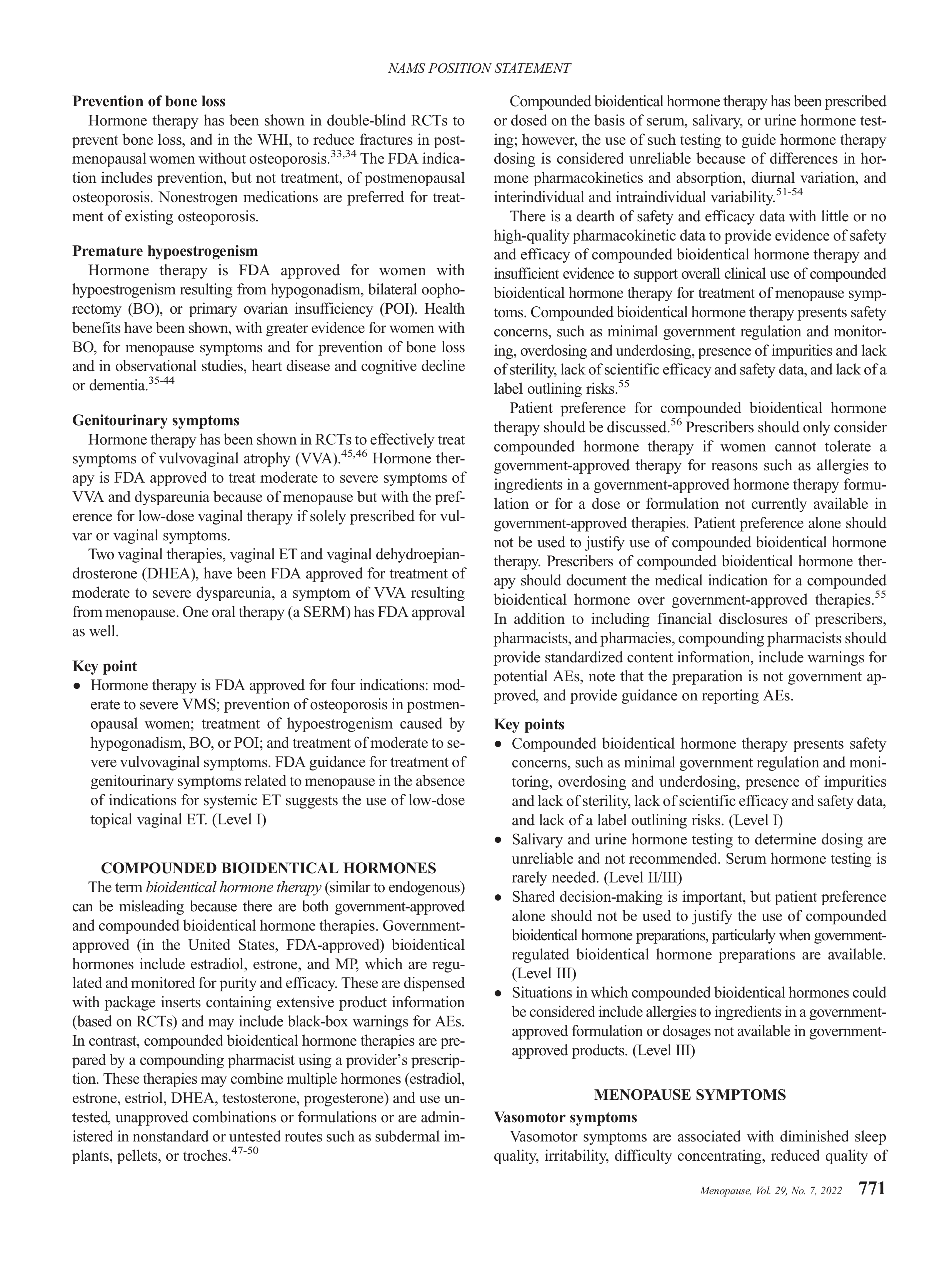
Potential risks of hormone therapy for women aged younger
than 60 years include the rare risk of breast cancer with EPT; en-
dometrial hyperplasia and endometrial cancer with inadequately
opposed estrogen; VTE; and gallbladder disease (Figure 1).
9
More common adverse events (AEs) include nausea, bloating,
weight gain, fluid retention, mood swings (progestogen related),
breakthrough bleeding, headaches, and breast tenderness.
Key points
•
The appropriate, often lowest, effective dose of systemic ET
consistent
with
treatment
goals
that
provides
benefits
and
minimizes risks for the individual woman should be the ther-
apeutic goal. (Level III)
•
The
various
formulations,
doses,
and
routes
of
prescription
hormone therapy preparations have comparable high efficacy
for relieving VMS. (Level I)
•
Formulation, dose, and route of administration for hormone
therapy should be determined individually and reassessed pe-
riodically. (Level III)
•
Different hormone therapy doses, formulations, and routes of
administration
may
have
different
effects
on
target
organs,
potentially allowing options to minimize risk. (Level II)
•
The appropriate formulation, dose, and route of administra-
tion of progestogen is needed to counter the proliferative ef-
fects of systemic estrogen on the endometrium. (Level I)
•
Overall, the increased absolute risks associated with EPTand
ET
are
rare
(<10/10,000/y)
and
include
increased
risk
for
VTE and gallbladder disease. In addition, EPT carries a rare
increased risk for stroke and breast cancer, and if estrogen is
inadequately
opposed,
an
increased
risk
of
endometrial
hy-
perplasia and endometrial cancer. (Level I)
•
The absolute risks are reduced for all-cause mortality, fracture,
diabetes
mellitus
(EPT
and
ET),
and
breast
cancer
(ET)
in
women aged younger than 60 years (Figure 1).
9
(Level I)
FDA-APPROVED INDICATIONS
Vasomotor symptoms
Hormone
therapy
has
been
shown
in
double-blind
RCTs
to
relieve VMS
32
and is FDA approved as first-line therapy for re-
lief of moderate to severe VMS because of menopause.
FIG. 1.
Benefits and risks of the two hormone therapy formulations, conjugated equine estrogens (CEE) alone or in combination with medroxyprogesterone acetate
(MPA), evaluated in the Women
’
s Health Initiative for women aged 50 to 59 years. Risks and benefits are expressed as the difference in number of events
(number in the hormone therapy group minus the number in the placebo group) per 10,000 women per year, with <10 per 10,000 per year representing a rare
event (dashed red line). Adapted from Manson JE, et al.
9
NAMS POSITION STATEMENT
770
Menopause, Vol. 29, No. 7, 2022
© 2022 The North American Menopause Society
Prevention of bone loss
Hormone
therapy
has
been
shown
in
double-blind
RCTs
to
prevent bone loss, and in the WHI, to reduce fractures in post-
menopausal women without osteoporosis.
33,34
The FDA indica-
tion includes prevention, but not treatment, of postmenopausal
osteoporosis.
Nonestrogen
medications
are
preferred
for
treat-
ment of existing osteoporosis.
Premature hypoestrogenism
Hormone
therapy
is
FDA
approved
for
women
with
hypoestrogenism resulting from hypogonadism, bilateral oopho-
rectomy
(BO),
or
primary
ovarian
insufficiency
(POI).
Health
benefits have been shown, with greater evidence for women with
BO,
for
menopause
symptoms
and
for
prevention
of
bone
loss
and in observational studies, heart disease and cognitive decline
or dementia.
35-44
Genitourinary symptoms
Hormone therapy has been shown in RCTs to effectively treat
symptoms of vulvovaginal atrophy (VVA).
45,46
Hormone ther-
apy is FDA approved to treat moderate to severe symptoms of
VVA and dyspareunia because of menopause but with the pref-
erence for low-dose vaginal therapy if solely prescribed for vul-
var or vaginal symptoms.
Two vaginal therapies, vaginal ET and vaginal dehydroepian-
drosterone (DHEA), have been FDA approved for treatment of
moderate
to
severe
dyspareunia,
a
symptom
of
VVA
resulting
from menopause. One oral therapy (a SERM) has FDA approval
as well.
Key point
•
Hormone therapy is FDA approved for four indications: mod-
erate to severe VMS; prevention of osteoporosis in postmen-
opausal
women;
treatment
of
hypoestrogenism
caused
by
hypogonadism, BO, or POI; and treatment of moderate to se-
vere vulvovaginal symptoms. FDA guidance for treatment of
genitourinary symptoms related to menopause in the absence
of
indications for systemic ET suggests the use of low-dose
topical vaginal ET. (Level I)
COMPOUNDED BIOIDENTICAL HORMONES
The term
bioidentical hormone therapy
(similar to endogenous)
can
be
misleading
because
there
are
both
government-approved
and compounded bioidentical hormone therapies. Government-
approved
(in
the
United
States,
FDA-approved)
bioidentical
hormones
include
estradiol,
estrone,
and
MP,
which
are
regu-
lated and monitored for purity and efficacy. These are dispensed
with package
inserts containing extensive
product
information
(based on RCTs) and may include black-box warnings for AEs.
In contrast, compounded bioidentical hormone therapies are pre-
pared by a compounding pharmacist using a provider
’
s prescrip-
tion. These therapies may combine multiple hormones (estradiol,
estrone, estriol, DHEA, testosterone, progesterone) and use un-
tested, unapproved combinations or formulations or are admin-
istered in nonstandard or untested routes such as subdermal im-
plants, pellets, or troches.
47-50
Compounded bioidentical hormone therapy has been prescribed
or dosed on the basis of serum, salivary, or urine hormone test-
ing; however, the use of such testing to guide hormone therapy
dosing
is
considered
unreliable
because
of
differences
in
hor-
mone
pharmacokinetics
and
absorption,
diurnal
variation,
and
interindividual and intraindividual variability.
51-54
There is a dearth of safety and efficacy data with little or no
high-quality pharmacokinetic data to provide evidence of safety
and efficacy of compounded bioidentical hormone therapy and
insufficient evidence to support overall clinical use of compounded
bioidentical hormone therapy for treatment of menopause symp-
toms. Compounded bioidentical hormone therapy presents safety
concerns,
such
as minimal
government
regulation
and
monitor-
ing, overdosing and underdosing, presence of impurities and lack
of sterility, lack of scientific efficacy and safety data, and lack of a
label outlining risks.
55
Patient
preference
for
compounded
bioidentical
hormone
therapy should be discussed.
56
Prescribers should only consider
compounded
hormone
therapy
if
women
cannot
tolerate
a
government-approved
therapy
for
reasons
such
as
allergies
to
ingredients in a government-approved hormone therapy formu-
lation
or
for
a
dose
or
formulation
not
currently
available
in
government-approved therapies. Patient preference alone should
not be used to justify use of compounded bioidentical hormone
therapy.
Prescribers
of
compounded
bioidentical
hormone
ther-
apy should document the medical indication for a compounded
bioidentical
hormone
over
government-approved
therapies.
55
In
addition
to
including
financial
disclosures
of
prescribers,
pharmacists, and pharmacies, compounding pharmacists should
provide standardized content information, include warnings for
potential
AEs, note
that the
preparation
is not
government ap-
proved, and provide guidance on reporting AEs.
Key points
•
Compounded
bioidentical
hormone
therapy
presents
safety
concerns, such as minimal government regulation and moni-
toring,
overdosing
and
underdosing,
presence
of
impurities
and lack of sterility, lack of scientific efficacy and safety data,
and lack of a label outlining risks. (Level I)
•
Salivary and urine hormone testing to determine dosing are
unreliable and not recommended. Serum hormone testing is
rarely needed. (Level II/III)
•
Shared decision-making is important, but patient preference
alone
should
not
be
used
to
justify
the
use
of
compounded
bioidentical hormone preparations, particularly when government-
regulated
bioidentical
hormone
preparations
are
available.
(Level III)
•
Situations in which compounded bioidentical hormones could
be considered include allergies to ingredients in a government-
approved formulation or dosages not available in government-
approved products. (Level III)
MENOPAUSE SYMPTOMS
Vasomotor symptoms
Vasomotor
symptoms
are
associated
with
diminished
sleep
quality,
irritability,
difficulty
concentrating,
reduced
quality
of
NAMS POSITION STATEMENT
Menopause, Vol. 29, No. 7, 2022
771
life,
57
and
poorer
health
status.
58
Frequent
VMS
persisted
on
average
7.4
years
in
the
Study of
Women
’
s
Health Across
the
Nation
59
and
appear
to
be
linked
to
CV,
bone,
and
cognitive
risks.
60-65
Compared with placebo, ET alone or EPTwas found
to reduce weekly symptom frequency by 75% (95% CI, 64.3-82.3)
and significantly reduce symptom severity (odds ratio [OR], 0.13;
95% CI, 0.07-0.23),
34
with no other pharmacologic or alterna-
tive therapy found to provide more relief. Considering the dose,
there are no appreciable differences in the efficacy of oral versus
nonoral
formulations,
but
EPT appears
slightly
more
effective
than ET alone.
Lower doses of hormone therapy (oral CEE 0.3 mg; oral 17
β
-
estradiol
≤
0.5 mg; or estradiol patch
0.025 mg)
may
take 6 to
8 weeks to provide adequate symptom relief. Although the low-
est dose-approved estradiol weekly patch (0.014 mg/d) appears
effective in treating VMS,
66
it is FDA approved only for preven-
tion of osteoporosis.
Progestogen-only formulations have been found to be effective
in
treating
VMS,
67,68
including
MPA
10
mg,
69
oral
megestrol
acetate 20 mg,
70
and MP 300 mg.
68
No long-term studies have
addressed
the
safety
of
progestogen-only
treatment
of
meno-
pause symptoms.
Vasomotor symptoms return in approximately 50% of women
when hormone therapy is discontinued.
71,72
There is no consensus
about whether stopping abruptly or gradually tapering the dose
is preferable.
Sleep disturbances
Sleep disturbances are common after menopause and begin in
perimenopause.
Sleep
disruptions
are
strongly
associated
with
VMS and a decreased quality of life. Poorer sleep quality has been
associated
with
mood
fluctuations, memory
problems,
metabolic
syndrome, obesity, and other CV risk factors. Short (or very long)
sleep duration, poor sleep quality, and insomnia have been asso-
ciated with greater cardiovascular disease (CVD) risk.
73-76
Hormone therapy in the form of low-dose estrogen or proges-
togen
may
improve
chronic
insomnia
in
menopausal
women,
with 14 of 23 studies reviewed showing positive results.
77
There
is some evidence that transdermal ET may benefit sleep in peri-
menopausal women, independent of VMS.
78
Oral
MP
has
mildly
sedating
effects,
reducing
wakefulness
without affecting daytime cognitive functions, possibly through
a
GABA-agonistic
effect,
79
and
should
therefore
be
adminis-
tered at night. A systematic review and meta-analysis concluded
that MP improved sleep-onset latency but not sleep duration or
sleep efficiency in RCTs in postmenopausal women.
80
Genitourinary symptoms
The genitourinary syndrome of menopause (GSM) includes
the signs and symptoms associated with menopause-related es-
trogen deficiency involving changes to the labia, vagina, urethra,
and bladder and includes VVA.
81
Symptoms may include genital
dryness, burning, and irritation; sexual symptoms of diminished
lubrication and pain with sexual activity; and urinary symptoms
of urgency, dysuria, and recurrent urinary tract infections (UTI).
Estrogen therapy, specifically vaginal ET, is an effective treatment
for GSM, with no evidence to suggest a difference in safety or ef-
ficacy between the various vaginal ET preparations.
45,82,83
Low-dose
vaginal
ET
preparations
include
creams,
tablets,
rings,
and
a
softgel
vaginal
insert.
The
different
preparations
all contain estradiol, and one cream preparation contains CEE.
One ring is available for long-term (3 mo) delivery of low-dose
estradiol to the vagina, but another is aimed at providing systemic
levels of estradiol. The low-dose vaginal estradiol products avail-
able result in minimal systemic absorption.
84-86
It is preferred to
insert vaginal products (except for the vaginal ring) in the prox-
imal,
lower
third
of
the
vagina
rather
than
in
the
upper
third.
This improves efficacy for genitourinary symptoms and attenu-
ates estradiol absorption.
86
Because of the potential risk of small increases in circulating
estrogens,
87
the decision to use low-dose vaginal ET in women
with breast cancer should be made in conjunction with their on-
cologists.
88,89
This is particularly important for women on aroma-
tase inhibitors (AIs) with suppressed plasma levels of estradiol,
90
although no increased
risk was seen in
an
observational trial of
survivors
of
breast
cancer
on
tamoxifen
or
aromatase
therapy
with low-dose vaginal ET during 3.5 years
’
mean follow-up.
91
A progestogen is generally not indicated when ET is adminis-
tered vaginally for GSM at the recommended low doses, although
clinical trial data supporting endometrial safety beyond 1 year are
lacking.
85
Vaginal bleeding in a postmenopausal woman requires
thorough evaluation. Long-term follow up of women in the WHI
observational study and in the Nurses
’
Health Study who used
vaginal ET indicated no increased risk of adverse CVor cancer
outcomes.
92,93
Nonestrogen therapies that improve genitourinary symptoms
and
are
approved
for
relief
of
dyspareunia
in
postmenopausal
women include ospemifene
94
and intravaginal DHEA.
95
Urinary tract symptoms (including pelvic floor disorders)
Vaginal ETincreases the number of vessels around the periurethral
and bladder neck region
96
and has been shown to reduce the
frequency and amplitude of detrusor contractions to promote
detrusor muscle relaxation.
97,98
Estrogen therapy, along with
pelvic floor training, pessaries, or surgery, may improve synthe-
sis of collagen and improve vaginal epithelium, but evidence for
effectiveness for pelvic organ prolapse is lacking.
99
Two large trials found that users of systemic hormone therapy
(CEE 0.625 mg plus MPA 2.5 mg) had an increased incidence
of stress incontinence.
100,101
Increased incontinence was found
in women using oral ET alone (relative risk [RR], 1.32; 95% CI,
1.17-1.48)
and
in
those
using
EPT
(RR,
1.11;
95%
CI,
1.04-
1.18).
102
Vaginal
estrogen
use
showed
a
decreased
incidence
of
incontinence (RR, 0.74;
95%
CI,
0.64-0.86) and
overactive
bladder,
with
one
to two
fewer
voids in
24 hours
and
reduced
frequency
and urgency. A
reduced risk of recurrent UTIs with
vaginal but not oral estrogen has been shown in RCTs.
103,104
Sexual function
Systemic hormone therapy and low-dose vaginal ET provide
effective treatment of GSM, improving sexual problems by in-
creasing
lubrication,
blood
flow,
and
sensation
in
vaginal
tis-
sues.
105
Studies
have
not
found
a
significant
effect
of
ET
on
NAMS POSITION STATEMENT
772
Menopause, Vol. 29, No. 7, 2022
© 2022 The North American Menopause Society
sexual interest, arousal, and orgasmic response independent from
its role in treating menopause symptoms.
106-108
If systemic hormone therapy is indicated in women with low
libido,
transdermal
ET
formulations
may
be
preferred
to
oral,
given increased sex hormone-binding globulin and reduced bio-
availability of testosterone with oral ET.
105,109,110
Conjugated
equine
estrogens
combined
with
BZA
relieves
dyspareunia
and
improves
some
aspects
of
sexual
function
in
postmenopausal women.
111-114
Key points
Vasomotor symptoms
•
Vasomotor symptoms may begin during perimenopause, and
frequent
VMS
may
persist
on
average
7.4
years
or
longer.
They
affect
quality
of
life
and
may
be
associated
with
CV,
bone, and brain health. (Level I/II)
•
Hormone therapy remains the gold standard for relief of VMS.
–
Estrogen-alone therapy can be used for symptomatic women
without a uterus. (Level I)
–
For symptomatic
women with a
uterus, EPT or a
TSEC
protects against endometrial neoplasia. (Level I)
•
Shared
decision-making
should
be
used
when
considering
formulation,
route
of
administration,
and
dose
of
hormone
therapy
for
menopause
symptom management,
with
adjust-
ment
tailored
to
symptom
relief,
AEs,
and
patient
prefer-
ences. (Level III)
•
Periodic assessment of the need for ongoing use of hormone
therapy should be individualized on the basis of a woman
’
s
menopause symptoms, general health and underlying medi-
cal
conditions,
risks,
treatment
goals,
and
personal
prefer-
ences. (Level III)
•
Micronized
progesterone
300
mg
nightly
significantly
de-
creases
VMS
(hot flashes and
night sweats)
compared with
placebo
and
improves
sleep.
Synthetic
progestins
have
also
shown benefit for VMS in some studies. No long-term study
results are available, and use of progestogens without estro-
gen for either indication is off-label. (Level II)
Sleep disturbances
•
During the menopause transition, women with VMS are more
likely to report disrupted sleep. (Level I)
•
Hormone therapy improves sleep in women with bothersome
nighttime VMS by reducing nighttime awakenings. Estrogen
may have some effect on sleep, independent of VMS. (Level II)
Genitourinary symptoms
•
Low-dose vaginal ET preparations are effective and generally
safe for the treatment of GSM, with minimal systemic absorp-
tion,
and
are
preferred
over
systemic
therapies
when
ET is
used only for genitourinary symptoms. (Level I)
•
For women with breast cancer, low-dose vaginal ET should
be prescribed in consultation with their oncologists. (Level III)
•
Progestogen therapy is not required with low-dose vaginal es-
trogen, but RCT data are lacking beyond 1 year. (Level II)
•
Nonestrogen
prescription
FDA-approved
therapies
that
im-
prove
VVA
in
postmenopausal
women
include
ospemifene
and intravaginal DHEA. (Level I)
•
Vaginal bleeding in a postmenopausal woman requires thor-
ough evaluation. (Level I)
Urinary tract symptoms (including pelvic floor disorders)
•
Systemic hormone therapy does not improve urinary inconti-
nence and may increase the incidence of stress urinary incon-
tinence. (Level I)
•
Low-dose vaginal ET may provide benefit for urinary symp-
toms, including prevention of recurrent UTIs, overactive blad-
der, and urge incontinence. (Level II)
•
Hormone therapy
does
not
have
FDA
approval
for
any
uri-
nary health indication. (Level I)
Sexual function
•
Both systemic hormone therapy and low-dose vaginal ET in-
crease
lubrication,
blood
flow,
and
sensation
of
vaginal
tis-
sues. (Level I)
•
Systemic hormone therapy generally does not improve sex-
ual
function,
sexual
interest,
arousal,
or
orgasmic
response
independent of
its effect on GSM. (Level I)
•
If sexual function or libido are concerns in women with men-
opause
symptoms,
transdermal
ET
may
be
preferable
over
oral ET because
of minimal effect on sex hormone-binding
globulin and free testosterone levels. (Level II)
•
Low-dose vaginal ET improves sexual function in postmeno-
pausal women with GSM. (Level I)
•
Nonestrogen alternatives FDA approved for dyspareunia in-
clude ospemifene and intravaginal DHEA. (Level I)
PRIMARY OVARIAN INSUFFICIENCY
Women with loss of ovarian function at a young age experi-
ence
an
extended
period
without
ovarian
hormones
compared
with women experiencing menopause at the typical age. Prema-
ture menopause
is
defined
as menopause
before
age
40
years,
and
early
menopause
is
defined
as
menopause
that
occurs
be-
tween the ages of 40 and 45 years. Whereas menopause implies
the
permanent
cessation
of
menses,
POI
describes
the
loss
of
ovarian function before age 40 years but with the potential for
intermittent,
transient
return
of
hormone
production
and
men-
strual
cycles.
Women
with
early
or
premature
loss
of
ovarian
function at any age are at increased risk for AEs related to ovar-
ian
hormone
deficiency.
Causes
of
early
or
premature
loss
of
ovarian function may be genetic, autoimmune, toxic, metabolic,
and iatrogenic, including chemotherapy, radiation, and surgery.
Health risks of POI and premature menopause are well docu-
mented.
40,41
The
strongest
evidence
from
meta-analyses
and
systematic
reviews
links
early
loss
of
ovarian
function
to
de-
creased quality of life and increased risk of fracture, CVD, heart
failure, diabetes mellitus (DM), and overall mortality.
115-121
Other
significant issues may include persistent VMS, loss of fertility,
bone loss, genitourinary symptoms, sexual dysfunction, cogni-
tive and mood changes, and increased risk of dementia, ophthal-
mic conditions, and depression.
40,41,122-124
Although these risks
are generally because of estrogen deficiency, some of these risks
may
be
reflective
of
premature
aging,
as
evidenced
in
some
studies by shortened telomere length.
125
NAMS POSITION STATEMENT
Menopause, Vol. 29, No. 7, 2022
773
In addition to an increased risk of incident CVD, POI and pre-
mature menopause are associated with an increased risk of aortic
stenosis,
VTE,
ischemic
stroke,
coronary
artery
disease,
atrial
fibrillation, and hypertension.
123,126
Early menopause is also as-
sociated with a decreased risk of breast cancer.
127
The
surgical
removal
of
both
ovaries
leads
to
a
much
more
abrupt
loss
of
the
ovarian
steroids
estrogen
and
progesterone
than does natural menopause and includes a significant decrease
in
testosterone
that
does
not
occur
with
natural
menopause.
128
Vasomotor symptoms as well as a variety of estrogen deficiency-
related symptoms and diseases are more frequent and more se-
vere after oophorectomy and can have a major effect on quality
of life.
129,130
In meta-analyses, oophorectomy is associated with
an increased risk of CVD,
131
cognitive dysfunction and dementia,
132
metabolic
syndrome,
133
low
bone
mineral
density
(BMD),
134
and sleep disturbance,
135
with some evidence for elevated frac-
ture risk.
136
Bilateral oophorectomy before age 40 is associated
with elevated rates of incident CVD as well as mitral regurgita-
tion, VTE, heart failure, coronary artery disease, and hyperten-
sion.
123
Other risks may include depression, anxiety, sexual dys-
function, bone loss, parkinsonism, DM, ophthalmologic conditions,
and
stroke,
some
of
which
have
been
shown
in
observational
studies to be reduced by ET.
35
Effective management of POI and premature or early meno-
pause
may
include
appropriate
doses
of hormone
therapy,
cal-
cium with vitamin D, exercise, and screening to detect medical
issues,
as
well
as
fertility
counseling
and
mental
health
ser-
vices.
40
Hormone therapy is recommended at least until the av-
erage
age
of
menopause,
approximately
52
years.
35,40,41
Oral
contraceptives may
be an alternative
form
of hormone therapy
with
contraceptive
benefits,
because
spontaneous
pregnancy
may
occur
in
about
5%
of
women
with
POI.
137
Higher
doses
of
hormone
therapy
may
provide
better
bone
protection
than
oral contraceptives, but this is uncertain.
36,37,138
Unless
contraindications
are
present,
ET
is
indicated
for
women who have had BO before the average age of menopause
to treat VMS, improve BMD, and reduce the risk for osteoporo-
sis.
139
Younger
women
may
require
higher
doses
to
relieve
symptoms
and
protect
against
bone
loss.
41,140
Observational
data reveal potential benefits of ET in reducing risk of cognitive
impairment or dementia and CV mortality in women with early
oophorectomy.
35,141
Estrogen
therapy
may
improve
aspects
of
sexual
function
and
GSM,
particularly
in
women
with
VMS
who have had BO.
107
Vaginal estrogens are effective in treating
symptoms
of
GSM.
45,46,142
Ovarian
conservation
is
recom-
mended, if possible, when hysterectomy for benign indications
is performed in premenopausal women at average risk for ovar-
ian cancer.
143
Key points
•
Women with POI and premature or early menopause may be
at increased risk for fracture, CVD, heart failure, DM, overall
mortality, persistent VMS, loss of fertility, bone loss, genito-
urinary
symptoms,
sexual
dysfunction, cognitive
and
mood
changes,
increased
risk
of
dementia,
open-angle
glaucoma,
depression, and poor quality of life. (Level II)
•
In the absence of contraindications, hormone therapy is rec-
ommended at least until the average age of menopause (ap-
proximately age 52 y), with an option for use of oral contra-
ceptives in healthy younger women. (Level II)
•
Results
of
the
WHI
trials
in
older
women
do
not
apply
to
women with POI or premature or early menopause. (Level II)
•
In
women
with
BO
before
the
average
age
of
menopause,
early initiation of ET, with endometrial protection if the uterus
is preserved, reduces VMS, genitourinary symptoms, risk for
osteoporosis and related fractures, and likely CVD and overall
mortality,
with
benefit
seen
in
observational
studies
for
CV
mortality and cognitive impairment or dementia. (Level II)
•
Fertility preservation and counseling should be explored for
young women at risk for POI. (Level III)
•
Ovarian conservation is recommended when hysterectomy is
performed
for
benign
indications
in
premenopausal women
at average risk for ovarian cancer. (Level II)
SKIN, HAIR, AND SPECIAL SENSES
Estrogen therapy may benefit wound healing through modi-
fying
inflammation,
stimulating
granulation
tissue
formation,
and accelerating re-epithelialization. Estrogen therapy increased
epidermal and dermal thickness, increased collagen and elastin
content,
and
improved
skin
moisture,
with
fewer
wrinkles.
144
Although menopause is associated with a decrease in hair den-
sity and female pattern hair loss, research on the role of hormone
therapy in mitigating these changes is lacking.
145
In
the
WHI,
ET
reduced
intraocular
pressure
in
postmeno-
pausal women and mitigated the risk for open-angle glaucoma
in Black women.
146,147
Similar effects were not seen for EPT.
148
Further,
hormone
therapy
decreased
the
risk
of
neovascular
and
soft
drusen
age-related
macular
degeneration
but
not
early
or
late-stage macular degeneration.
149
Evidence on the effect of hor-
mone therapyon cataract, dryeye disease, and optic nerve disorders
is mixed, and good-quality RCTs are lacking.
150-152
Observational
data linking hormone therapy to hearing loss is mixed.
153,154
Little
is
known
about
olfactory
changes
and
hormone
ther-
apy.
155
In small trials, hormone therapy appears to decrease diz-
ziness or vertigo and improve postural balance.
156,157
Key points
•
Estrogen
therapy
appears
to
have
beneficial
effects
on
skin
thickness
and
elasticity
and
collagen
when
given
at
meno-
pause. (Level II)
•
Changes in hair density and female pattern hair loss worsen
after
menopause,
but
research
is
lacking
regarding
a
role
for hormone therapy in mitigating these changes. (Level II)
•
Hormone therapy appears to decrease the risk of neovascular
and
soft
drusen
age-related
macular
degeneration
but
not
early or late-stage macular degeneration. (Level II)
•
Estrogen therapy appears to reduce intraocular pressure and
mitigate the risk for open-angle glaucoma in Black women.
(Level II)
•
Evidence
of
hormone
therapy
effects
on
cataracts,
optic
nerve
disease,
dry-eye
disease,
and
hearing
loss
is
mixed.
(Level II)
NAMS POSITION STATEMENT
774
Menopause, Vol. 29, No. 7, 2022
© 2022 The North American Menopause Society
•
Little
is
known
about
hormone
therapy
effects
on
olfactory
changes. (Level II)
•
In
small
trials,
hormone
therapy
appears
to
decrease
dizzi-
ness or vertigo and improve postural balance. (Level II)
HORMONE THERAPY AND QUALITY OF LIFE
Quality of life is defined as an overall assessment of one
’
s life
in relation to one
’
s goals and expectations. Quality of life can be
applied
to
one
’
s
mental
and
physical
health,
which
is
termed
health-related
quality
of
life,
or
specifically
to
menopause,
or
menopause-specific quality of life, which emphasizes the bother
and
interference
of
menopause
symptoms.
Clinical
trials
indi-
cate that in women with menopause symptoms, such as VMS,
systemic
hormone
therapy
(ET,
EPT,
TSECs)
can
improve
menopause-specific
quality
of
life.
158-160
These
effects
appear
to
be
explained
largely
by
the
effect
of
hormone
therapy
on
the frequency of these symptoms.
Key points
•
Menopause symptoms are associated with poorer health-related
and menopause-specific quality of life. (Level II)
•
Systemic hormone therapy can improve menopause-specific
quality of life in women experiencing menopause symptoms.
(Level II)
OSTEOPOROSIS
Menopause is associated with increased bone resorption, and
ET
decreases
bone
resorption.
161
For
osteoporosis
treatment,
hormone therapy has not been demonstrated in RCTs to reduce
fractures in postmenopausal women with established osteoporo-
sis; therefore, hormone therapy does not carry an FDA indica-
tion for treatment of osteoporosis.
162,163
In women who have
osteoporosis, hormone therapy
has not
been
demonstrated
in
RCTs
to
decrease
fracture
risk.
In
the
WHI,
for
women
aged
50
to
79
years
(N
=
16,608),
enrolled
without regard to bone density or fracture risk, EPT (0.625 mg
CEE
plus
2.5
mg
MPA)
significantly
increased
lumbar
spine
and total hip BMD by 4.5% and 3.7%, respectively, relative to
placebo and reduced fracture risk.
34
The BMD benefits of pre-
venting
bone
loss
persist
as
long
as
therapy
is
continued
but
abate rapidly when treatment is discontinued. Within a few months,
markers
of
bone
turnover
returned
to
pretreatment
values,
whereas BMD fell to pretreatment levels within 1 to 2 years of
stopping therapy.
164
Women with POI experience long-term AEs on bone density,
in
addition
to
other
health
risks.
35,140
Higher-than-standard
doses of hormone therapy may be needed to provide protection
against bone-density loss in younger women, particularly those
aged younger than 40 years and thus lower future osteoporotic
fracture risk.
140,165
In the setting of prevention, RCTs show that hormone therapy
decreases
fracture
risk.
162,163
Various
oral
and
transdermal
es-
trogen preparations, alone or in combination with progestogens
or BZA, have government approval for prevention of osteoporosis.
A
meta-analysis
and
a
systematic
review,
based
primarily on
the
WHI, demonstrated that 5 to 7 years of hormone therapy signifi-
cantly reduced risk of spine, hip, and nonvertebral fractures.
166,167
During
the
WHI
intervention
phase
in
women
of
all
ages,
the
CEE plus MPA group had six fewer hip fractures per 10,000 women
and six fewer
vertebral fractures per 10,000 women compared
with
the
placebo
group.
9
The
CEE-alone
group
had
six
fewer
hip fractures per 10,000 women and six fewer vertebral fractures
per 10,000 women compared with the placebo group. However,
in the subset of women aged 50 to 59 years at the time of treatment
initiation,
neither
CEE
plus
MPA
nor
CEE
alone was
associated
with decreased risk of hip fracture.
The reason that hormone therapy was not shown to reduce hip
fracture in the subset of women aged 50 to 59 years in the WHI
may be partly because of the lower baseline absolute risk of frac-
ture in women aged between 50 and 59 years who did not have
established osteoporosis.
9,168
In
the
WHI
hormone
therapy
trials,
after
hormone
therapy
discontinuation, there was a return of fracture risk to levels seen
in
women
who
had
received
placebo,
with
no
excess
fracture
risk
observed
after
discontinuation
of
hormone
therapy.
169,170
There
are
no
prospective
fracture
studies
directly
comparing
the
efficacy
of
hormone
therapy
in
preventing
fractures
with
other approved pharmacologic therapies.
Key points
•
Hormone therapy prevents bone loss in healthy postmenopausal
women, with dose-related effects on bone density. (Level I)
•
Hormone therapy reduces fracture risk in healthy postmeno-
pausal women. (Level I)
•
Discontinuing
hormone
therapy
results
in
rapid
bone
loss;
however, no excess in fractures was seen in the WHI after dis-
continuation. (Level I)
•
Hormone
therapy
is
FDA
approved
for
prevention
of
bone
loss, but not for treatment of osteoporosis. (Level I)
•
In the absence of contraindications, in women aged younger
than
60
years
or
within
10
years
of
menopause
onset,
sys-
temic
hormone
therapy
is
an
appropriate
therapy
to
protect
against bone loss. (Level I)
•
Unless
contraindicated,
women
with
premature
menopause
without prior fragility fracture or osteoporosis are best served
with
hormone
therapy
or
oral
contraceptives
to
prevent
bone
density
loss
and
reduce
fracture
risk,
rather
than
other
bone-specific treatments, until the average age of menopause,
when treatment may be reassessed. (Level II)
•
Decisions regarding initiation and discontinuation of hormone
therapy should be made primarily on the basis of extraskeletal
benefits (ie, reduction of VMS) and risks. (Level III)
JOINT PAIN
Direct binding of estrogen to estrogen receptors acts on joint
tissues,
protecting
their
biomechanical
structure
and
function
and maintaining overall joint health, but the exact effect of estro-
gen
on
osteoarthritis
remains
controversial.
171-173
There
is
no
clearly observed association between hormone therapy use and
osteoarthritis.
171
Meta-analyses of clinical trials of ET have reported inconsistent
results. Thus, there is insufficient evidence to form strong con-
clusions regarding the effects of estrogen on osteoarthritis.
173
NAMS POSITION STATEMENT
Menopause, Vol. 29, No. 7, 2022
775
In the WHI, women on CEE plus MPA had less joint pain or
stiffness
compared
with
those
on
placebo
(47.1%
vs
38.4%;
OR, 1.43;
95%
CI,
1.24-1.64) and
more joint
discomfort
after
stopping.
174
In the CEE-alone arm, women randomized to CEE
had a statistically significant reduction in joint pain frequency af-
ter
1
year
compared
with
the
placebo group
(76.3%
vs
79.2%;
P
= .001).
175
In
the
WHI,
using
arthroplasty
as
a
clinical
indicator
of
se-
verely symptomatic osteoarthritis, the association of CEE alone
with any arthroplasty was borderline significant (HR, 0.84; 95%
CI, 0.70-1.00;
P
= .05), but CEE alone did not significantly re-
duce the risk of hip or knee arthroplasty. The EPT trial showed
no relationship between hormone use and arthroplasty risk.
176
Key points
•
Women in the WHI and other studies have less joint pain or stiff-
ness with hormone therapy compared with placebo. (Level I)
•
There is a need for further understanding of estrogen
’
s poten-
tial effect on joint health. (Level III)
SARCOPENIA
Frailty
is
associated
with
AEs
such
as
falls,
hospitalization,
disability, and death.
177
Skeletal muscle has been shown to have
estrogen receptors,
178
but there is a paucity of studies evaluating
the
interplay
between
estrogen
and
muscle.
The
regulation
of
energy
intake
and
expenditure
by
estrogens
in
women
has
not
been
well
studied,
with
limited
basic
and
preclinical
evidence
supporting the concept that the loss of estrogen with menopause
or oophorectomy disrupts energy balance through decreases in
resting energy expenditure and physical activity.
179
Reviews of preclinical studies and limited clinical studies of
hormone
therapy
in
postmenopausal women
suggest
a
benefit
on maintaining or increasing muscle mass and related connective
tissue
and
improving
strength
and
posttraumatic
or
postatrophy
muscle recovery when combined with exercise.
180-182
In the WHI hormone therapy trials, women assigned to ETor
EPT (vs placebo) had early preservation of lean body mass after
3 years, but hormone therapy did not ameliorate long-term loss
in lean body mass associated with aging.
183
Similarly, low-dose
oral estradiol 0.25 mg per day plus cyclical MP did not signifi-
cantly change skeletal muscle mass or lean body mass.
184
Systematic reviews find
that hormone therapy
had neither a
beneficial
nor
harmful
association
with
muscle
mass
185,186
;
therefore, it is likely that interventions other than hormone ther-
apy will have to be developed to aid in the retention of muscle in
aging women.
Key points
•
Development of frailty with aging is a health risk. (Level I)
•
Sarcopenia
and
osteoporosis
are
related
to
aging,
estrogen
depletion, and the menopause transition. (Level II)
•
Intervention to improve bioenergetics and prevent loss of mus-
cle mass, strength, and performance is needed. (Level III)
•
Preclinical
studies
suggest
a
possible
benefit
of
ET when
combined with exercise to prevent the loss of muscle mass,
strength,
and
performance,
but
this
has
not
been
shown
in
clinical trials. (Level II)
GALLBLADDER AND LIVER
Estrogens
increase
biliary
cholesterol
secretion
and
satura-
tion, promote precipitation of cholesterol in the bile, and reduce
gallbladder
motility,
with
increased
bile
crystallization.
187,188
Postmenopause use of estrogen is associated with an increased
risk
of
cholelithiasis,
cholecystitis,
and
cholecystectomy.
23
However,
no
associated
risk
of
biliary
cancer
has
been
demon-
strated.
189
The transdermal route of administration, which bypasses
first-pass metabolism of the liver, has been associated with less
risk
of
gallbladder
disease
in
observational
studies.
190
The
at-
tributable
risk
for
gallbladder
disease
as
self-reported
in
the
WHI
was
an
additional
47
cases
per
10,000
women
per
year
for
CEE
plus
MPA
and
58
cases
per
10,000
women
per
year
for CEE, both statistically significant (
P
< .001).
9
Nonalcoholic
fatty
liver
disease
is
more
common
after
the
menopause
transition
when
the
prevalence
surpasses
men.
191
Older
women
also
have
higher
rates
of
severe
hepatic
fibrosis
and greater mortality compared with men. Animal models have
demonstrated a causal relationship between the loss of estrogen
and increase in fatty liver and steatohepatitis, whereas observa-
tional studies show dietary factors also may exacerbate liver dis-
ease. Preclinical and observational studies suggest possible ben-
efits of hormone therapy on liver fibrosis and fatty liver,
192
but
more research is needed before definitive recommendations can
be made.
Key points
•
Risk of gallstones, cholecystitis, and cholecystectomy is in-
creased with ET and EPT. (Level I)
•
Observational
studies
report
lower
risk
of
gallstones
with
transdermal
hormone
therapy
than
with
oral,
and
with
oral
estradiol compared with CEE, but neither observation is con-
firmed in RCTs. (Level II)
•
In women with hepatitis C and with fatty liver, a slower fibro-
sis progression has been observed with use of hormone ther-
apy, but RCTs are needed to establish the potential benefits
and risks with liver disease. (Level II)
DIABETES MELLITUS, METABOLIC SYNDROME,
AND BODY COMPOSITION
Metabolic syndrome and diabetes
In the WHI, women receiving continuous-combined CEE plus
MPA
had
a
statistically
significant
19%
reduction
(HR,
0.81;
95%
CI,
0.70-0.94;
P
=
.005)
in
the
incidence
of
type
2
DM,
translating
to
16
fewer
cases
per
10,000
person-years
of
therapy.
9
In the CEE-alone cohort, there was a reduction of 14% in new di-
agnoses of type 2 DM (HR, 0.86; 95% CI, 0.76-0.98), translat-
ing to 21 fewer cases per 10,000 person-years. A meta-analysis
of published studies found that EPT reduced multiple components
of
the
metabolic
syndrome;
incidence
of
type
2
DM
was de-
creased by 30%.
193
A second, smaller meta-analysis confirmed
these findings and reported that women with type 2 DM using
ET or EPT had better glycemic control.
194
The benefit reverses
when hormone therapy is discontinued. For these reasons, hor-
mone
therapy
can
be
considered
for
symptomatic
menopausal
women with type 2 DM.
NAMS POSITION STATEMENT
776
Menopause, Vol. 29, No. 7, 2022
© 2022 The North American Menopause Society
Weight and body composition
The
menopause
transition
is
associated
with
an
increase
in
body fat and a decrease in lean body mass, which results in an
increase
in
the
fat-to-lean
ratio
and
decreased
basal
metabolic
rate.
After
controlling
for
body
size
and
ethnicity,
the
average
weight
gain
during
midlife
and
the
menopause
transition
is
1.5 lb per year.
195,196
Central fat distribution (gynoid-to-android
pattern) also occurs after menopause after adjustment for aging,
total body fat, and physical activity level.
196
By about 2 years af-
ter the final menstrual period, weight changes flatten.
197
Women
who used hormone therapy did not have observable differences in
the trajectory of weight or body fat gain compared with those who
did not take hormones, although numbers are relatively small.
Estrogen-progestogen therapy either has no effect on weight
or is associated with less weight gain in women who are using
it than in women who are
not.
198-202
In the
WHI, women ran-
domized
to
hormone
therapy
with
CEE
with
or
without
MPA
had
no
statistically
significant
difference
in
slowing
of
weight
gain and a lesser increase in waist circumference over the first
3 years of use compared with those randomized to placebo. In-
creasing
physical
activity
was
independently
associated
with
less weight gain over time.
195
Key points
•
Hormone
therapy
significantly
reduces
the
diagnosis
of
new-onset type 2 DM, but it is not government approved for
this indication. (Level I)
•
Hormone therapy is not contraindicated in otherwise healthy
women with preexisting type 2 DM and may be beneficial in
terms of glycemic control when used for
menopause symp-
tom management. (Level II)
•
Although
hormone
therapy
may
help
attenuate
abdominal
adipose
accumulation
and
weight
gain
associated
with
the
menopause transition, the effect is small. (Level II)
COGNITION
Small clinical trials support the use of ET for cognitive bene-
fits when initiated immediately after hysterectomy with bilateral
oophorectomy.
203,204
Three
large
RCTs
demonstrated
neutral
effects
of
hormone
therapy
on
cognitive
function
when
used
early in the postmenopause period.
205-207
Two
hypotheses
—
the
critical
window
or
timing
hypothesis
and the
healthy-cell bias
hypothesis
—
provide a framework for
understanding the scientific literature on hormone therapy and
cognition, but neither has been definitively supported in RCTs
of
postmenopausal women.
The
critical window or
timing
hy-
pothesis
208,209
holds that estrogen can confer cognitive benefits
if
given
early
in
the
menopause
transition
but
that
later
use
is
neutral or detrimental. The healthy-cell bias hypothesis
210
holds
that estrogen confers cognitive benefits when the neural substrate
is
“
healthy
”
but not diseased, for example in a woman with DM.
Later initiation of hormone therapy
Several large clinical trials indicate that hormone therapy does
not
improve
memory
or
other
cognitive
abilities
and
that
CEE
plus MPA may be harmful for memory when initiated in women
aged older than 65 years.
211-213
Alzheimer disease
Four
observational
studies
provide
support
for
the
opinion
that the timing of hormone therapy initiation is a significant de-
terminant of Alzheimer disease risk, with early initiation lower-
ing risk and later initiation associated with increased risk.
214-217
However, long-term effects may differ from short-term effects.
Eighteen-year follow-up data from the WHI showed a reduction
in
Alzheimer
disease
mortality
in
women
randomized
to
hor-
mone
therapy;
this
effect
was
significant
for
CEE
alone
but
not for CEE plus MPA and was driven by women aged in their
70s at the time of enrollment.
31
Two nested case-control studies
investigated the risk of dementia associated with hormone ther-
apy use and showed no increased risk overall but did suggest an
increased risk of Alzheimer disease, specifically, with the use of
EPT for more than 5 years.
218
All-cause dementia
In the WHI Memory Study, CEE plus MPA doubled the risk
of all-cause dementia (23 cases/10,000 women) when initiated
in women aged older than 65 years,
213
whereas CEE alone did
not significantly increase the risk of dementia.
219
The effect of
hormone therapy may be modified by baseline cognitive func-
tion, with more favorable effects in women with normal cogni-
tive function before hormone therapy initiation.
220,221
Key points
•
In the absence of more definitive findings, hormone therapy
is not recommended at any age to prevent or treat a decline in
cognitive function or dementia. (Level I)
•
Initiating hormone therapy in women aged older than 65 years
increased the risk for dementia, with an additional 23 cases per
10,000 person-years seen in women randomized to CEE plus
MPA in the WHI Memory Study. (Level I)
•
The effect of hormone therapy may be modified by baseline
cognitive
function,
with
more
favorable
effects
in
women
with normal cognitive function before hormone therapy initi-
ation. (Level II)
•
Estrogen therapy may have cognitive benefits when initiated
immediately after hysterectomy with bilateral oophorectomy,
but hormone therapy in the early natural postmenopause pe-
riod has neutral effects on cognitive function. (Level II)
DEPRESSION
Depressive
symptoms
worsen
as
women
transition
through
menopause,
although
evidence
is
mixed
as
to whether
depres-
sive disorders are more common during the menopause transi-
tion
relative
to
premenopause.
Most
women
who
present
with
depressive disorders during the menopause transition are women
with a history of depression before the menopause transition, and
women with a history of depression are at high risk for recurrence
during the menopause transition.
222
For that reason, clinical guidelines recommend that clinicians
screen for depression in women with a history of depression and use
antidepressants
or
proven
psychotherapies
(eg,
cognitive-behavior
therapy, interpersonal therapy, mindfulness-based cognitive therapy)
as the primary treatment for recurrent major depressive episodes.
223
Use of hormone therapy to treat menopause symptoms such as
NAMS POSITION STATEMENT
Menopause, Vol. 29, No. 7, 2022
777
VMS in midlife women with depression should be considered.
Vasomotor symptoms increase the
risk for
elevated depressive
symptoms,
in
part
because
of
nocturnal
VMS
and
sleep
inter-
ruption,
224
and on a day-to-day basis, VMS co-occur with neg-
ative mood and predict negative mood the next day.
225
Vasomo-
tor
symptoms
appear
to
be
more
strongly
associated
with
the
onset of depressive symptoms than depressive disorders.
226
Estrogen therapy shows some efficacy in the management of
depression in midlife women, but its effect varies by menopause
stage. For perimenopausal women with depression, there is evi-
dence that ET improves depressive symptoms to a degree simi-
lar
to
antidepressant medications.
227
This antidepressant effect
of
ET
applies
to
perimenopausal
women
with
and
without
VMS. In women with major depression treated with ET, depres-
sive symptoms improve in relation to improvements in sleep but
not VMS.
228
Estrogen therapy does not appear to be effective in
treating
depressive
disorders
in
postmenopausal
women,
sug-
gesting a window of opportunity in the perimenopause.
229
Little
is known about the effects of EPT in treating depressive disor-
ders at any menopause stage.
There is some evidence that ETenhances mood and improves
well-being
in
nondepressed
postmenopausal women.
205
Initial
evidence
suggests
that
hormone therapy
(specifically
transder-
mal estradiol with intermittent MP) may prevent the onset of de-
pressive symptoms in euthymic perimenopausal women.
230
Estrogen
therapy
may
augment
clinical
response
to
antidepres-
sants
in
midlife
and
older
women,
preferably
when
also
indicated
for other concurrent menopause-related symptoms such as VMS.
231
Key points
•
There is some evidence that ET has antidepressant effects of
similar magnitude to that observed with antidepressant agents
when administered to depressed perimenopausal women with
or without concomitant VMS. (Level II)
•
Estrogen therapy is ineffective as a treatment for depressive
disorders in postmenopausalwomen. Such evidence suggests
a possible window of opportunity for the effective use of ET
for the management of depressive disorders during the peri-
menopause. (Level II)
•
There is some evidence that ETenhances mood and improves
well-being in nondepressed perimenopausal women. (Level II)
•
Transdermal estradiol with intermittent MP may prevent the
onset
of
depressive
symptoms
in
euthymic
perimenopausal
women,
but
the
evidence
is
not
sufficient
to
recommend
estrogen-based therapies for preventing depression in asymp-
tomatic perimenopausal or postmenopausal women, and the
risks and benefits must be weighed. (Level II)
•
Estrogen-based
therapies
may
augment
clinical
response
to
antidepressants in midlife and older women, preferably when
also indicated for other menopause symptoms such as VMS.
(Level III)
•
Most studies on hormone therapy for the treatment of depression
examined the effects of unopposed estrogen. Data on EPTor for
different progestogens are sparse and inconclusive. (Level II)
•
Estrogen
is
not
government
approved
to
treat
mood
distur-
bance. (Level I)
CARDIOVASCULAR DISEASE AND ALL-CAUSE
MORTALITY
Observational data and reanalysis of older studies by age or
time since menopause, including the WHI, suggest that for healthy
women who are within 10 years of the menopause transition and
who have bothersome menopause symptoms, the benefits of hor-
mone therapy
(ET or
EPT) outweigh
its risks,
with fewer
CVD
events in younger versus older women.
9,31,219,232-242
Initiation of hormone therapy fewer than 10 years after
menopause onset
Surrogate markers of coronary heart disease
Surrogate
markers
of
CHD
are
intermediate
measures
that
have been associated with the development of CVD and events
such as coronary artery calcification (CAC) and subclinical ath-
erosclerosis. Some studies have suggested that initiating hormone
therapy in symptomatic women within 10 years of menopause
may
have
benefit
in
reduction
of
atherosclerosis
progression
as
measured
by
CAC,
243-245
whereas
RCTs
in
younger,
re-
cently
postmenopausal
women
have
not.
246,247
In
the
Early
Versus Late Intervention Trial With Estradiol, hormone therapy
(oral 17
β
-estradiol 1 mg/d plus progesterone vaginal gel 45 mg
administered
sequentially
for
women
with
a
uterus)
reduced
subclinical atherosclerosis progression measured by carotid ar-
tery intima-media thickness after a median of 5 years when ini-
tiated within 6 years (median, 3.5 y) of menopause onset but not
when initiated 10 or more years (median, 14.3 y) afterward.
246
The
Kronos
Early
Estrogen
Prevention
Study
in
healthy
post-
menopausal women aged 42 to 58 years who received hormone
therapy (oral CEE 0.45 mg/d; transdermal estradiol patch 50
μ
g/wk;
each with sequential oral MP 200 mg for 12 d/mo) showed no
effect on subclinical atherosclerosis progression.
247
Meta-analyses of clinical outcomes
A
2015
Cochrane
review of
RCT
data
found
that
hormone
therapy initiated fewer than 10 years after menopause onset lowered
CHD in postmenopausal women (RR, 0.52; 95% CI, 0.29-0.96).
236
It also found a reduction in all-cause mortality (RR, 0.70; 95%,
0.52-0.95) and no increased risk of stroke but an increased risk
of VTE (RR, 1.74; 95% CI, 1.11-2.73).
A
2020
systematic
review
and
meta-analysis
of
RCTs
pub-
lished from 2000 to 2019 showed null effects of hormone therapy
initiated fewer than 10 years after menopause or at an age youn-
ger than 60 years on all-cause mortality, stroke, and VTE.
248
A
2019
systematic
review
and
meta-regression
analysis
of
RCTs that examined the timing hypothesis of hormone therapy
compared with controls or nonusers of hormone therapy found
that younger hormone therapy initiation (participants aged <60 y)
was
associated
with
lower
odds
of
CHD
(OR,
0.61;
95%
CI,
0.37-1.00),
all-cause
mortality
(OR,
0.72;
95%
CI,
0.57-0.91),
and
cardiac
mortality
(OR,
0.61;
95%
CI,
0.37-1.00)
but
with
higher odds of a composite measure of incidence stroke, transient
ischemic
attack,
and
systemic
embolism
(OR,
1.40;
95%
CI,
1.10-1.78).
249
However, the results for CHD, cardiac mortality,
and
all-cause
mortality
were
all
attenuated
after
excluding
open-label
trials
in
which
the
knowledge
of
active
treatment
may affect treatment options and outcomes. Direct comparisons
NAMS POSITION STATEMENT
778
Menopause, Vol. 29, No. 7, 2022
© 2022 The North American Menopause Society
across these meta-analyses may not be applicable, given differ-
ences in inclusion/exclusion criteria and analytical methods that
were applied in each analysis.
Cardiovascular outcomes in the Women
’
s Health Initiative
Intervention phase
For CEE alone, CHD, MI, and coronary artery bypass grafting
or
percutaneous
coronary
intervention
showed
a
lowered
HR
in
women aged younger than 60 years and fewer than 10 years since
menopause onset, including in intention-to-treat analyses.
9
In the
50- to 59-year-old age group, the HR for CHD was elevated but
not
statistically
significant
at
1.34
(95%
CI,
0.82-2.19)
for
CEE
plus MPA. When data from the two WHI trials were combined
and
analyzed,
a
reduction
in
all-cause
mortality
was
shown
in
younger
but
not
in
older
women;
HRs
in
women
aged
50
to
59 years, 60 to 69 years, and 70 to 79 years were 0.69 (95% CI,
0.51-0.94),
1.04
(95%
CI,
0.87-1.25),
and
1.13
(95%
CI,
0.94-1.36), respectively (
P
for
trend
= .01).
31
Cumulative follow-up
For CEE alone, in the 13-year cumulative intervention and post-
intervention
follow-up,
significant
age-treatment
interaction
was
shown for MI such that only in the 50- to 59-year-old age group
a reduction in MI risk was significant (HR, 0.60; 95% CI, 0.39-
0.91).
9
Although
a
similar
interaction
was
not
significant
for
CHD and all-cause mortality, there was a significant reduction in
CHD
risk
(HR,
0.65;
95%
CI,
0.44-0.96)
in
this
age
group.
In
the
18-year
intervention
and
postintervention
cumulative
follow-
up, the reduction in all-cause mortality was shown to be statistically
significant for the 50- to 59-year-old age group (HR, 0.79; 95% CI,
0.64-0.96),
31
although interaction between age and treatment was
not significant. Additional analysis focusing on oophorectomy sta-
tus in the CEE-alone trial revealed a significant age-treatment inter-
action for all-cause mortality; younger women with BO assigned
to CEE alone showed a significant reduction in all-cause mortality
compared with placebo (HR, 0.68; 95% CI, 0.48-0.96).
242
Initiation of hormone therapy more than 10 years from
menopause onset or in women aged older than 60 years
For women who initiated hormone therapy more than 10 years
from
menopause
onset
or
aged
older
than
60
years,
a
2015
Cochrane
meta-analysis found no evidence that hormone ther-
apy
had
an
effect
on
CHD
(RR,
1.07;
95%
CI,
0.96-1.20)
or
all-cause mortality (RR, 1.06; 95% CI, 0.95-1.18), with an aver-
age
follow-up
of
3.8
years.
236
There
was
an
increased
risk
of
stroke
(RR,
1.21;
95%
CI,
1.06-1.38)
and
VTE
(RR,
1.96;
95% CI, 1.37-2.80).
A 2020 systematic review and meta-analysis of RCTs showed
similar results as the 2015
Cochrane
analysis for older women
who
initiated
hormone
therapy.
248
Compared
with
placebo
or
nonusers
of
hormone
therapy,
initiating
hormone
therapy
in
women aged 60 years or older or after 10 years since menopause
had a null effect on CHD (summary estimate, 1.00; 95% CI,
0.87-1.14)
and
all-cause
mortality
(summary
estimate,
1.00;
95% CI 0.96-1.05) but was associated with higher risk of stroke
(summary estimate,
1.17;
95%
CI,
1.01-1.37)
and
VTE
(sum-
mary estimate, 1.79; 95% CI, 1.39-2.29).
Similarly,
in
a
2019
systematic
review
and
meta-regression
analysis of RCTs testing the timing hypothesis, women who ini-
tiated hormone therapy
relative
to placebo
or
nonusers of hor-
mone
therapy
aged
60
years
or
older
showed
a
null
effect
on
CHD and all-cause mortality but was associated with higher risk
of a composite measure of
incidence stroke, transient ischemic
attack, and systemic embolism (OR, 1.52; 95% CI, 1.39-1.71).
249
Attributable risk of stroke in women aged younger than
60 years or within 10 years of menopause onset
The 2015
Cochrane
meta-analysis found no increased risk of
stroke in women who initiated hormone therapy aged younger
than 60 years or fewer than 10 years from menopause onset.
236
In subgroup analysis, the attributable risk of stroke in the WHI
for women who initiated hormone therapy aged younger than
60
years
or
within
10
years
of
menopause
onset
was
rare
(<10/10,000
person-years)
and
statistically
nonsignificant
for CEE plus MPA, with an absolute risk of 5 per 10,000 person-
years,
9,240
similar to other studies.
232
Findings
were
inconsistent
for
CEE-alone
in
the
WHI.
For
women aged 50 to 59 years at randomization, a decrease of 1 per
10,000 person-years was seen for stroke; whereas for women fewer
than 10 years from menopause onset, an increase in 13 strokes per
10,000 person-years was seen.
9
On the basis of only observational studies, lower doses of either
oral
250
or transdermal
251
estrogen may confer less risk of stroke; no
clear association with age has been found. No head-to-head data
comparing oral to transdermal hormone therapy are available.
Venous thromboembolism
Women who began hormone therapy fewer than 10 years af-
ter
menopause
onset
or who were
aged younger
than 60 years
have
higher
risk
of
VTE
compared
with
placebo
(RR,
1.74;
95%
CI,
1.11-2.73),
according
to
the
2015
Cochrane
meta-
analysis.
236
In
a
2020
systematic
review
and
meta-analysis
of
RCTs published between 2000 and 2019, risk of VTE was ele-
vated in women who initiated hormone therapy aged older than
60 years or after 10 years since menopause (summary estimate,
1.79; 95% CI, 1.39-2.29) and a null effect in women who initiated
hormone therapy aged younger than 60 years or within 10 years of
menopause
(summary
estimate,
0.69;
95%
CI
0.25-1.93).
248
Lower doses of oral ET may confer less risk of VTE than higher
doses,
24,25
but
comparative
RCT
data
are
lacking.
Micronized
progesterone
may
be
less
thrombogenic
than
other
progestins.
26
Transdermal hormone therapy has not been associated with VTE
risk in observational studies, limited observational data and a sys-
tematic review suggest less risk with transdermal hormone therapy
than oral
26,27,29
; however, comparative RCT data are lacking.
Areas of scientific uncertainty and need for randomized,
controlled trial data
Although observational studies, meta-analyses of RCTs, and
smaller
RCTs
with
surrogate
CVD
risk
markers
suggest
that
hormone therapy may reduce CVD risk when initiated in women
aged
younger
than
60
years
and/or
who
are within
10
years
of
menopause onset, significant research gaps remain regarding dose,
formulation,
route
of
delivery,
and
duration
of
use.
Furthermore,
NAMS POSITION STATEMENT
Menopause, Vol. 29, No. 7, 2022
779
because
most
RCTs
are
performed
on
North
American
and
European women, future studies should also evaluate the role
of ethnicity with respect to hormone therapy and CVD. Data are
insufficient for risk related to long-term hormone therapy use in
perimenopausal
women
and
in
postmenopausal
women
aged
younger
than
50
years.
23,252
Hormone
therapy
is
not
govern-
ment approved for prevention of CVD.
Key points
•
For healthy symptomatic women aged younger than 60 years
or within 10 years of menopause onset, the favorable effects
of hormone therapy on CHD and all-cause mortality should
be considered against potential rare increases in risks of breast
cancer, VTE, and stroke. (Level I)
•
Hormone therapy is not government approved for primary or
secondary cardioprotection. (Level I)
•
Personal
and
familial risk of CVD,
stroke, VTE,
and
breast
cancer should be considered when initiating hormone therapy.
(Level III)
•
The effects of hormone therapy on CHD may vary depending
on when hormone therapy is initiated in relation to a woman
’
s
age or time since menopause onset. (Level I)
•
Initiation
of
hormone
therapy
in
recently
postmenopausal
women reduced or had no effect on subclinical atherosclero-
sis progression and coronary artery calcification in random-
ized, controlled trials. (Level I)
•
Observational
data
and
meta-analyses show
reduced
risk of
CHD
in
women
who
initiate
hormone
therapy
when
aged
younger than 60 years or within 10 years of menopause on-
set.
Meta-analyses
show
a
null
effect
of
hormone
therapy
on CHD after excluding open-label trials. (Level II)
•
Women who initiate hormone therapy aged older than 60 years
or more than 10 or 20 years from menopause onset are at higher
absolute risks of CHD, VTE, and stroke than women initiating
hormone therapy in early menopause. (Level I)
BREAST CANCER
Breast cancer affects approximately one in eight US women,
so an understanding of the potential effect of hormone therapy
on
breast
cancer
risk
is
of
considerable
importance.
Potential
differences
of
the
effects
of
ET,
EPT,
and
CEE
plus
BZA
on
breast tissue may exist. Different types of estrogen or progesto-
gen, as well as different formulations, timing of initiation, dura-
tion of therapy, and patient characteristics, may play a role in the
effects of hormone therapy on the breast.
Estrogen-progestogen therapy
In
the
WHI,
daily
continuous-combined
CEE
plus
MPA
re-
sulted
in
an
increased
risk
of
breast
cancer,
with
nine
additional
breast cancer cases per 10,000 person-years of therapy.
9
The HR
remained elevated at a median of 20 years
’
cumulative follow-up
in
the
unblended,
postintervention
phase
(HR,
1.28;
95%
CI,
1.13-1.45).
21
Estrogen-alone therapy
Compared
with
women
who
received
placebo,
women
who
received
CEE
alone
in
the
WHI
showed
a
nonsignificant
reduction in breast cancer risk after an average of 7.2 years of ran-
domization, with seven fewer cases of invasive breast cancer per
10,000 person-years of CEE (HR, 0.79; 95% CI, 0.61-1.02).
9
A sig-
nificant reduction in breast cancer became evident in the postinter-
vention phase, with a median 20 years
’
cumulative follow-up (HR,
0.78; 95% CI, 0.65-0.93).
21
Longer duration of hormone therapy use
No
large
RCTs
have
assessed
the
effect
of
long
duration
of
hormone
therapy
use.
Both
the
ET
and
the
EPT
components
of the WHI reported data for finite intervals because both were
terminated
early
because
of
predefined
safety
considerations,
with a median of 7.2 years for ET and 5.6 for EPT. Notably, al-
though long-term follow-up at 13 and 20 years provided infor-
mation about use for 5 to 7 years, no data were available regard-
ing longer-term use. The recent pooled analysis of observational
data in the Collaborative Group Study included information on
duration
of
hormone
therapy
use
in
women
starting
hormone
therapy
when
aged 45 to 54 years.
22
In each age
category,
the
risk of breast cancer increased with duration of use. Specifically,
for ET, the HRs increased from 1.23 (95% CI, 1.11-1.35) for 1 to
4 years of use, to 1.29 (95% CI, 1.21-1.37) for 5 to 9 years, to 1.44
(95%
CI,
1.35-1.53)
for
10
to
14
years,
and
to
1.61
(95%
CI,
1.49-1.74) for 15 or more years. For EPT, increases for similar
periods were 1.66 (95% CI, 1.55-1.78) for 1 to 4 years of use,
1.96 (95% CI, 1.87-2.05) for 5 to 9 years, 2.31 (95% CI, 2.18-
2.44)
for
10
to
14
years,
and
2.68
(95%
CI,
2.44-2.95)
for
15 or more years.
Attributable risk of breast cancer
The attributable risk of breast cancer in women (mean age, 63 y)
randomized to CEE plus MPA in the WHI is less than one addi-
tional case of breast cancer diagnosed per 1,000 users annually,
9
a risk slightly greater than that observed with one daily glass of
wine, less than with two daily glasses, and similar
to the risk re-
ported
with
obesity
and
low
physical
activity.
253,254
Compared
with placebo or nonusers of hormone therapy, there appears to be
no additive effect of hormone therapy with age or elevated personal
breast cancer risk factors on breast cancer incidence.
21,22,255-259
Al-
though
the
relative
risk
of
breast
cancer
associated
with
hor-
mone therapy
use
is similar in women at average or high risk,
the
actual
number
of
cases
or
attributable
risk
will
be
greater
in women with an increased underlying risk.
86
Use of hormone therapy in women with genetic risk factors
for breast cancer
Observational
evidence
suggests
that
hormone
therapy
use
does
not
further
increase
the
relative
risk
of
breast
cancer
in
women
with
a
family
history of
breast
cancer,
in
women
after
oophorectomy
for
BRCA
1
or
2
genetic
variants,
or in women
having
undergone
a
benign
breast
biopsy.
255-258,260-266
A
pro-
spective
longitudinal
cohort
study
of
BRCA
1
genetic
variant
carriers
without
prior
history
of
breast
cancer
who
underwent
BO (mean age, 43.4 y) showed no increased risk of developing
breast cancer associated with any use of hormone therapy after a
mean follow-up of 7.6 years; however, there was a difference be-
tween
ET
and
EPT,
with
a
nonsignificant
increase
in
breast
NAMS POSITION STATEMENT
780
Menopause, Vol. 29, No. 7, 2022
© 2022 The North American Menopause Society
cancer risk associated with the latter.
266
Similarly, the Two Sister
Study of 1,419 sister-matched cases of breast cancer in women
aged younger than 50 years and 1,665 controls showed no in-
creased
risk
of
young-onset
breast
cancer
with
use
of
EPT
(OR,
0.80;
95%
CI,
0.41-1.59),
and
unopposed
estrogen
use
was associated with a reduced diagnosis of young-onset breast
cancer (OR, 0.58; 95% CI, 0.34-0.99).
267
The absolute risk of
breast
cancer
is
low
in
women
with
genetic
variants
who
un-
dergo
risk-reducing
BO
at
a
young
age,
and
use
of
hormone
therapy is considered acceptable.
Role of type of hormone use, dose, and route of administration
Some
but
not
all
observational
data
suggest
that
MP
and
dydrogesterone may have a lesser association with breast can-
cer, whereas
other synthetic progestogens such as MPA
may
have a more adverse effect.
268
Randomized trials are needed
to
confirm
these
findings.
Preclinical
data
suggest
that
CEE
may
have
lesser
effects
on
occult
breast
cancer
growth
than
estradiol,
269
but clinical data from observational studies, such
as the Collaborative Group study, do not report a difference.
22
Regarding route, both oral and transdermal estrogens appear
to have similar effects on number of breast cancers diagnosed,
whereas vaginal estrogens have no effect. Insufficient clinical
data on newer
therapies such as TSECs, including CEE plus
BZA,
are
available
to
assess
their
breast
cancer
risk,
270
al-
though preclinical data suggest greater safety.
271
Mammographic breast density and hormone therapy
Different hormone therapy regimens may be associated with
increased breast density, which may obscure mammographic in-
terpretation.
272
More
mammograms
and
breast
biopsies
were
performed
in
women
receiving
CEE
plus
MPA
than
placebo
in
the
WHI.
273
In
trials
up
to
2-years
’
duration,
breast
cancer,
breast density,
and breast tenderness
showed no difference
be-
tween oral CEE plus BZA and placebo.
274-276
Hormone therapy after breast cancer
Two RCTs reported conflicting outcomes of breast cancer re-
currence with hormone therapy. One study (
“
Hormonal Replace-
ment Therapy After Breast Cancer
—
Is It Safe?
”
) showed an ele-
vated risk of breast cancer
recurrence in hormone therapy users
relative
to
nonusers
after
a
median
follow-up
of
2.1
years
(HR,
3.5;
95%
CI,
1.5-8.1)
277
and
4
years,
(HR,
2.4;
95%
CI,
1.3-
4.2),
278
whereas another trial (Stockholm Breast Cancer Study)
showed no effect on breast cancer recurrence in hormone ther-
apy users relative to nonusers after median follow-up of 4.1 years
(HR, 0.82; 95%
CI,
0.35-1.9)
279
and
10.8
years
(HR,
1.3; 95%
CI,
0.9-1.9) but
did
show an
increased
risk of
breast
cancer in
the contralateral breast (HR, 3.6; 95% CI, 1.2-10.9).
280
Although
systemic
use
of
hormone
therapy
in
survivors
of
breast cancer is generally not advised, if symptoms of estrogen
deficiency are severe and unresponsive to nonhormone options,
women, in consultation with their oncologists, may choose hor-
mone therapy after being fully informed about the risks and ben-
efits. Several observational studies in women with a history of
breast
cancer
have
shown
a
decreased
risk
of
recurrent
breast
cancer
or
neutral
effects
compared
with
nonusers.
281-286
In
addition, mortality was reported to be reduced in breast cancer
survivors who used hormone therapy relative to those who did
not.
282,284
Four
meta-analyses reported similar findings.
281,284-286
A confounding factor in all of these observational studies is that
women at low risk of breast cancer recurrence are more likely to
elect hormone therapy use than women at high risk.
Low-dose vaginal
ET
remains
an
effective
treatment
option
for
GSM
in survivors
of breast cancer,
with minimal
systemic
absorption.
Treatment
with
low-dose
vaginal
ET
or
DHEA
may
be
considered
if
symptoms
persist
after
an
initial
trial
of
nonhormone
therapies
and
in
consultation
with
an
oncologist,
with more concern for women on AIs.
88,90
Breast cancer mortality and hormone therapy
Only one randomized trial, the WHI, examined breast cancer-
specific mortality. After 20 years of median cumulative follow-up,
CEE alonewas associated with significantly lower breast cancer in-
cidence (HR, 0.78; 95% CI, 0.65-0.93) and breast cancer mortality
(HR, 0.60; 95% CI, 0.37-0.97) compared with placebo. In con-
trast,
CEE
plus
MPA was
associated
with
significantly
higher
breast cancer incidence
(HR, 1.28;
95%
CI,
1.13-1.45) but
no
significant
difference
in
breast
cancer
mortality
(HR,
1.35;
95% CI, 0.94-1.95) compared with placebo.
21
The mortality risk of breast cancer in hormone therapy users
has been reported to be reduced in many but not all observational
studies.
287-295
The breast cancers in hormone therapy users (ET
and EPT) appear in most (but not all) studies to have more benign
histologic features (localized, smaller, better differentiated, lower
mean tumor proliferation rate) than in hormone therapy nonusers.
The most recent study, using a large data registry in Finland and
comparing populations rates, reported a reduction in breast can-
cer mortality in users of both ETand EPT.
296
A confounding fac-
tor
in
all
these
studies
is
that
hormone
therapy
users
undergo
more frequent mammograms and diagnostic examinations, espe-
cially with occurrence of signs or symptoms.
297-301
This is likely
to result in earlier diagnosis and therefore more benign histologic
features and lower mortality.
Key points
•
The
risk of breast
cancer
related
to hormone
therapy
use
is
low,
with
estimates
indicating
a
rare
occurrence
(less
than
one
additional
case
per
1,000
women
per
year
of
hormone
therapy use or three additional cases per 1,000 women when
used for 5 years with CEE plus MPA). (Level I)
•
Women should be counseled about the risk of breast cancer
with hormone therapy, putting the data into perspective, with
risk
similar
to
that
of
modifiable
risk
factors
such
as
two
daily alcoholic beverages, obesity, and low physical activity.
(Level III)
•
The effect of hormone therapy on breast cancer risk may de-
pend on the type of hormone therapy, duration of use, regi-
men, prior exposure, and individual characteristics. (Level II)
•
Different hormone therapy regimens may be associated with
increased breast density, which may obscure mammographic
interpretation, leading to more mammograms or more breast
biopsies
and
a
potential
delay
in
breast
cancer
diagnosis.
(Level II)
NAMS POSITION STATEMENT
Menopause, Vol. 29, No. 7, 2022
781
•
A preponderance of data does not show an additive effect of
underlying
breast
cancer
risk
(age,
family
history
of
breast
cancer,
genetic
risk
of
breast
cancer,
benign
breast
disease,
personal
breast
cancer
risk
factors)
and
hormone
therapy
use on breast cancer incidence. (Level II)
•
Insufficient data are available to assess the risk of breast can-
cer with newer therapies such as TSECs, including BZA plus
CEE. (Level II)
•
Observational
evidence
suggests
that
hormone
therapy
use
does
not
further
increase
risk
of
breast
cancer
in
women
at
high risk because of a family history of breast cancer or after
bilateral salpingo-oophorectomy (BSO) for
BRCA 1
or
2
ge-
netic variants. (Level II)
•
Systemic hormone therapy is generally not advised for survi-
vors of breast cancer, although hormone therapy use may be
considered
in
women
with
severe
VMS
unresponsive
to
nonhormone options, with shared decision-making in con-
junction with their oncologists. (Level III)
•
For survivors of breast cancer with GSM, low-dose vaginal
ET or
DHEA
may
be
considered
in
consultation
with
their
oncologists
if
bothersome
symptoms
persist
after
a
trial
of
nonhormone therapy. There is increased concern with low-dose
vaginal ET for women on AIs. (Level III)
•
Regular breast cancer surveillance is advised for all post-
menopausal
women
per
current
breast
cancer
screening
guidelines,
including
those
who
use
hormone
therapy.
(Level I)
ENDOMETRIAL CANCER
Endometrial cancer is the most common gynecologic malig-
nancy in the United States. Unopposed systemic ET in a post-
menopausal woman
with
an
intact
uterus
increases
the
risk
of
endometrial cancer, which is dose- and duration-related. Greater
risk is seen with higher estrogen doses used for longer duration,
and risk persists after discontinuation. Progestogen used contin-
uously or cyclically for 10 to 14 days monthly significantly reduces
this
risk.
With
long-duration
hormone
therapy
use,
observa-
tional studies suggest a potentially increased risk of endometrial
cancer with cyclic progestogen regimens compared with contin-
uous
progestogen
use
and
with
the
use
of
MP
compared
with
other progestogens.
3,4,302
In the WHI, women with a uterus re-
ceiving EPT had a lower risk of endometrial cancer than women
randomized
to
placebo
after
13
years
of
cumulative
follow-up
because of the baseline risk of endometrial cancer in postmeno-
pausal
women
from
endogenous
estrogen
production.
9
Ade-
quate
concomitant
progestogen
is
recommended
for
a
woman
with an intact uterus when using systemic ET.
Low-dose vaginal ET does not appear to increase endometrial
cancer
risk,
92,93
although
trials
with
endometrial
biopsy
end
points are limited to 1 year in duration. Progestogen is not ad-
vised
in
women
using
low-dose
vaginal
ET
for
the
treatment
of GSM, although intermittent use may be considered in women
at increased risk of endometrial cancer. Postmenopausal bleed-
ing
must
be
evaluated
thoroughly
in
any
woman,
whether
she
is using hormone therapy or not, because this may be a sign of
endometrial hyperplasia or cancer.
Hormone therapy after endometrial cancer
Although hormone therapy is generally contraindicated in
women with estrogen-responsive cancers, hormone therapy may
be
used
to
treat
bothersome
menopause
symptoms
in
women
with low-grade, Stage I endometrial cancer after hysterectomy.
Meta-analyses
of
retrospective
studies,
with
one
RCT,
do
not
identify
an
AE
on
the
risk
of
recurrence
or
survival
in
these
cases.
303-306
A woman
’
s oncologist should be included in shared
decision-making. Systemic hormone therapy is not advised with
high-grade, advanced-stage endometrial cancers or with endome-
trial stromal sarcomas or leiomyosarcomas, because there are in-
sufficient studies assessing safety.
307,308
Key points
•
Unopposed systemic ETin a postmenopausalwoman with an
intact uterus increases the risk of endometrial cancer, so ade-
quate progestogen is recommended. (Level I)
•
Low-dose vaginal
ET
does
not
appear
to
increase
endome-
trial
cancer
risk,
although
trials
with
endometrial
biopsy
end points are limited to 1 year in duration. (Level II)
•
Use
of
hormone
therapy
is
an
option
for
the
treatment
of
bothersome menopause symptoms in women with surgically
treated, early stage, low-grade endometrial cancer in consul-
tation
with
a
woman
’
s
oncologist
if
nonhormone
therapies
are ineffective. (Level II)
•
Systemic
hormone
therapy
is
not
advised
with
high-grade,
advanced-stage endometrial cancers or with endometrial stro-
mal sarcomas or leiomyosarcomas. (Level II)
OVARIAN CANCER
Ovarian
cancer
causes
more
deaths
than
any
other
gyneco-
logic malignancy. Use of oral contraceptives is associated with
a significant reduction in ovarian cancer risk. Risk declines with
longer duration of use, with risk reduction seen after 1 to 4 years
of use, which persists for up to 30 years after oral contraceptive
discontinuation.
309
Current and recent use of hormone therapy
is
associated
with
statistically
significant
but
small
increased
risk
of
ovarian
cancer
in
observational
studies,
principally
for
serous
type,
with
an
estimate
of
one
additional
ovarian
cancer
death in 1,700 to 3,300 hormone therapy users.
310,311
This risk
is seen with combined EPT and ET alone and dissipates within
5
years
of
discontinuing
hormone
therapy.
In
the
WHI,
there
was no significant increase in ovarian cancer risk with EPT.
9
Hormone therapy after ovarian cancer
The
use
of
hormone
therapy
after
a
diagnosis
of
epithelial
ovarian cancer does not appear to affect recurrence risk or sur-
vival.
312,313
Although most studies are observational, this finding
also is supported by two RCTs. Several studies identify improved
survival in women with ovarian cancer who use hormone therapy,
but this likely represents selection bias.
307
Use of hormone ther-
apy
is
not
advised
in
women
with
hormone-dependent
ovarian
cancers,
including
granulosa-cell
tumors
and
serous
carcino-
mas.
306,314
Tumors of low malignant potential (borderline) often
affect younger women, with excellent survival rates. Limited data
are available, but hormone therapy may be considered in women
with completely resected disease, especially given the benefits of
NAMS POSITION STATEMENT
782
Menopause, Vol. 29, No. 7, 2022
© 2022 The North American Menopause Society
hormone therapy in the setting of early menopause.
315
Short-term
hormone
therapy
use
appears
safe
in
women
with
BRCA1
and
BRCA2
genetic variants who undergo risk-reducing BSO before
the average age of menopause.
308
Key points
•
Use of oral contraceptives is associated with a significant re-
duction in ovarian cancer risk. (Level I)
•
Current and recent use of hormone therapy is associated with
a
small
but
statistically
significant risk
of ovarian
cancer
in
observational
studies,
principally
for
serous
type,
although
there was
no increase in ovarian
cancer
risk
in women
ran-
domized to EPT in the WHI. (Level II)
•
In women with
a history of ovarian
cancer, benefits of hor-
mone therapy use generally outweighs risks, especially with
bothersome VMS or early menopause; use of hormone ther-
apy is not advised in women with hormone-dependent ovar-
ian
cancers,
including
granulosa-cell
tumors
and
low-grade
serous carcinoma. (Level II)
•
Short-term hormone therapy use appears safe in women with
BRCA1
and
BRCA2
genetic variants who undergo risk-reducing
BSO before the average age of menopause. (Level II)
COLORECTAL CANCER
Colorectal
cancer
is
the
third
most
common
cancer
and
the
third leading cause of cancer death in US women.
309
Risk fac-
tors include physical inactivity, obesity, smoking, and decreased
use
of
screening
strategies,
which
may
be
more
likely
in
hor-
mone therapy nonusers. Observational studies generally support
a reduced risk of colorectal cancer in current hormone therapy
users compared with never users (HR, 0.6-0.8), with no benefit
associated
with
past
hormone
therapy
use.
310-312
In
observa-
tional
studies,
both
EPT and
ET alone
are
associated
with
re-
duced
colorectal
cancer
risk
313,314
and
mortality.
315
Although
confounding may contribute to the reduced risk of colorectal can-
cer seen in hormone therapy users, there is also biologic plausibil-
ity, because estrogen receptors are present in colonic epithelium,
316
and estrogen reduces colon cancer cell growth in vitro.
317
In the WHI trials, use of CEE plus MPA, but not CEE alone,
was
associated
with
a
reduced
risk
of
colorectal
cancer
com-
pared with placebo (HR, 0.62; 95% CI, 0.43-0.89).
9
Although
EPT reduced the risk of colorectal cancer, the cancers that were
detected in EPTusers were more likely to be diagnosed at an ad-
vanced stage, with positive lymph nodes.
318
The reduced risk of
colorectal
cancer
in
EPT users
was
no
longer
seen
during
the
postintervention
phase
of
the
WHI
at
13
years,
and
there
was
no difference in colorectal cancer mortality with either EPT or
ET alone.
31
The reason for disparate findings between observa-
tional studies and the WHI with regard to colorectal cancer risk
and mortality is unclear.
Key points
•
Observational
studies
suggest
a
reduced
incidence
of
colo-
rectal cancer in current hormone therapy users, with reduced
mortality. (Level II)
•
In the WHI, EPT, but not ETalone, reduced colorectal cancer
risk, although cancers diagnosed in EPTusers were diagnosed
at a more advanced stage. There was no difference in colorec-
tal cancer mortality with either EPT or ET. (Level I)
LUNG CANCER
Lung cancer is the second most common cancer and the lead-
ing cause of cancer death in US women.
309
Smoking is the prin-
cipal
risk factor.
An
interaction
between
hormone
therapy
and
lung cancer is biologically plausible because estrogen receptors
(
α
and
β
) and aromatase are identified in both healthy lung tis-
sue and lung cancers.
319,320
Non-small cell lung cancer, includ-
ing adenocarcinoma and squamous cell carcinoma, is the most
common type and the type affected by hormone therapy in ob-
servational studies and RCTs. Observational studies, including
several
large
meta-analyses,
are
conflicting
and
in
aggregate
identify
no
consistent
association
between
hormone
therapy
use and lung cancer risk.
321-327
Smoking may influence the as-
sociation between hormone therapy use and lung cancer risk.
326
For women with lung cancer, the effect of hormone therapy use
on
survival
is
unclear,
with
studies
showing
improved,
wors-
ened, or no difference in risk of death.
In
the
WHI,
in
the
intervention
phase
or
after
a
median
of
13 years
’
cumulative follow-up, the incidence of lung cancer did
not differ significantly between placebo and treatment with CEE
plus MPA or CEE alone.
9
In a post hoc analysis of the intervention
phase of the WHI, women treated with CEE plus MPA had more
deaths
from
lung
cancer
compared
with
placebo
(HR,
1.71;
95%
CI,
1.16-2.52).
328
Cancers were
more likely
to be poorly
differentiated, with distant metastasis. This increase in lung can-
cer deaths was not seen with treatment with CEE alone
329
and
dissipated over time after stopping hormone therapy.
330
Key points
•
There appears to be an overall neutral effect of hormone ther-
apy on lung cancer incidence and survival. (Level II)
•
Smoking
cessation
should
be
encouraged,
with
increased
lung cancer surveillance for older smokers, including current
or past users of hormone therapy. (Level I)
DURATION OF USE, INITIATION AFTER
AGE 60 YEARS, AND DISCONTINUATION OF
HORMONE THERAPY
Benefits of hormone therapy use generally outweigh risks for
healthy women with bothersome menopause symptoms who are
aged younger than 60 years or within 10 years of menopause on-
set. Because increasing risk is observed with advancing age and
extended duration of use,
9,22
women are advised to use the ap-
propriate dose for
the time needed to manage their symptoms.
Because
many
women
will
experience
bothersome
VMS
for
many years, long-duration hormone therapy use may be needed,
and an arbitrary age-based stopping rule is not clinically appro-
priate. Frequent VMS persist on average 7.4 years and for many
more
than
10
years.
59,331
In
a
study
of
Swedish
women
aged
older
than
85
years,
16%
reported
hot
flashes
at
least
several
times
per
week,
332
and
up
to
8%
of
women
continue
to
have
hot flashes for 20 years or longer after menopause.
333
There
are
important
questions
related
to
long-duration
hor-
mone
therapy
use
and
discontinuation
that
are
unanswered
by
NAMS POSITION STATEMENT
Menopause, Vol. 29, No. 7, 2022
783
available
data,
because
the
WHI,
the
longest
adequately
pow-
ered
blinded
RCT,
was
limited
to
5
to
7
years
of
therapy.
In
the WHI, initiating hormone therapy in women aged older than
60 years or more than 10 years beyond the onset of menopause
was
associated
with
greater
risk,
and
initiating
hormones
in
women aged older than 70 years was associated with the highest
risk.
9
It
is
not
known
whether
women
who
initiate
hormone
therapy at the time of menopause and continue use at older ages
will incur the same risks as women initiating hormones later in
life.
The
WHI
studied
only
one
formulation
of
oral
hormones
(CEE with or without MPA). Observational data suggest lower
CVD risk, including VTE and stroke, with other hormone formu-
lations
and
routes
of
administration,
including
transdermal
estra-
diol, lower-dose estrogens, and different progestogens.
25,251,334-336
Mitigation of risk through the appropriate choice of dosing, formu-
lation, and route of administration becomes increasingly important
as women age and with longer duration of therapy. Factors that
should
be
considered
include
severity
of
symptoms,
effective-
ness
of
alternative
nonhormone
and
lifestyle
interventions,
and underlying risk for osteoporosis, CHD, cerebrovascular ac-
cident, VTE, and breast cancer. The decision regarding duration
of treatment and when to stop hormone therapy must be consid-
ered in the context of the individualized risk-benefit profile, as
well as the woman
’
s personal preferences.
337,338
Initiation after age 60 years
Initiation
of
hormone
therapy
in
women
aged
older
than
60 years or more than 10 years from menopause onset has com-
plex
risks
and
requires
careful
consideration,
recognizing
that
there
may
be well-counseled
women
aged
older
than
60
years
who
choose
to
initiate
or
restart
hormone
therapy.
For
women
requesting to initiate hormone therapy because of VMS appear-
ing
many
years
after
menopause
onset,
further
evaluation
is
needed.
Although
new-onset
VMS
in
an
older
woman
could
be
caused
by
estrogen-deficiency,
hot
flashes
or
night
sweats
may be related to an underlying medical problem (eg, obstruc-
tive sleep apnea, hyperthyroidism, carcinoid, lymphoma, Lyme
disease,
tuberculosis,
HIV)
or
medication
or
substance
use
(eg, antidepressants, hypoglycemic agents, or withdrawal from
alcohol or opioids).
Extended use after age 65 years
There is no general rule for stopping systemic hormone therapy
in a woman aged 65 years. The Beers criteria from the American
Geriatrics Society
339
has warnings against the use of hormone
therapy in women aged older than 65 years. However, the recom-
mendation to routinely discontinue systemic hormone therapy in
women aged 65 years and older is neither cited or supported by
evidence
nor
is
it
recommended
by
the
American
College
of
Obstetricians and Gynecologists or The North American Meno-
pause
Society.
340,341
Of
note,
the
continued
use
of
hormone
therapy in healthy women aged older than 65 years at low risk
for breast cancer and CVD is limited by insufficient evidence re-
garding safety, risks, and benefits.
For otherwise healthy women with persistent VMS, continu-
ing hormone therapy beyond age 65 years is a reasonable option
with
appropriate
counseling,
regular
assessment
of
risks
and
benefits,
and
shared
decision-making.
Hormone
therapy
also
may
be
considered
for
prevention
of
fracture
in
healthy
older
women at elevated fracture risk when bothersome VMS persist
or
when
hormone
therapy
remains
the
best
choice
because
of
lack of efficacy or intolerance of other fracture-prevention ther-
apies.
23,340
Long-duration hormone therapy use and use in older
women is not appropriate for
reduction in the risk of CHD or
dementia.
23,236,342
When
providing
hormone
therapy
to
older
women,
clinicians
must
remain
vigilant
about
risk
stratifica-
tion and potential mitigation strategies, such as switching from
oral
to
transdermal
hormone
therapy,
choice
of
progestogen,
and lowering of dose.
337,338
Discontinuation of hormone therapy
Controversy exists regarding how long hormone therapy may
safely
be
used
and
when
it
should
be
discontinued.
Based
on
findings
from the
WHI, breast
cancer
risk becomes
detectable
after
3
to
5
years
in
women
using
EPT.
For
women
without
a
uterus using ET alone, breast cancer
risk did not increase after
7 years, so a longer duration of hormone therapy use may be ac-
ceptable.
There
are
few
studies
to
guide
the
optimal
way
for
women to stop hormone therapy, and VMS will recur in approx-
imately
50%
of
women
after
discontinuation.
71
Data
directly
comparing
the
effects
of
abrupt
discontinuation
with
those
of
slowly tapering are lacking,
343
although clinical experts gener-
ally
advise
gradually
decreasing
hormone
therapy
doses
over
time.
338,343
If hormone therapy is being used for
prevention of
osteoporosis, it is important to remember that protection against
bone density loss and fracture prevention is lost rapidly with dis-
continuation.
164
Although
VMS
generally
improve
with
time,
GSM
worsens
with
prolonged
estrogen
deficiency,
so
women
should
be
provided
with
treatment
options
on
discontinuation
of
systemic
hormone
therapy.
Observational
studies
confirm
the long-term safety of low-dose vaginal ET,
92,93
a highly effec-
tive
treatment
for
GSM.
In the
absence
of
contraindications,
a
woman should determine her preferred hormone therapy formu-
lation, dose, and duration of use, with ongoing assessment and
shared decision-making with her healthcare professional.
337,338
Key points
•
The
safety
profile
of
hormone
therapy
is
most
favorable
when initiated in healthy women aged younger than 60 years
or
within
10
years
of
menopause
onset,
so
initiation
of
hor-
mone therapy by menopausal women aged older than 60 years
requires careful consideration of individual benefits and risks.
(Level I)
•
Long-term
use
of
hormone
therapy,
including
for
women
aged older than 60 years, may be considered in healthy women
at low risk of CVD and breast cancer with persistent VMS or
at elevated risk of fracture for whom other therapies are not ap-
propriate. (Level III)
•
Factors that should be considered include severity of symp-
toms, effectiveness of alternative nonhormone interventions,
and
underlying
risk for
osteoporosis,
CHD,
cerebrovascular
accident, VTE, and breast cancer. (Level III)
•
Hormone therapy does not need to be routinely discontinued
in women aged older than 60 or 65 years. (Level III)
NAMS POSITION STATEMENT
784
Menopause, Vol. 29, No. 7, 2022
© 2022 The North American Menopause Society
•
Mitigation
of
risk
through
use
of
the
lowest
effective
dose
and
potentially
with
a
nonoral
route
of
administration
be-
comes increasingly important as women age and with longer
duration of therapy. (Level III)
•
Longer durations or extended use beyond age 65 should in-
clude
periodic
reevaluation
of
comorbidities
with
consider-
ation of periodic trials of lowering or discontinuing hormone
therapy. (Level III)
•
For women with GSM, low-dose vaginal ET may be consid-
ered for use at any age and for extended duration, if needed.
(Level III)
•
In the absence of contraindications, a woman should determine
her preferred hormone therapy formulation, dose, and duration
of use, with ongoing assessment and shared decision-making
with her healthcare professional. (Level III)
SUMMARY
Hormone therapy formulation, dose, regimen, route of admin-
istration, and the timing of initiation of therapy likely produce dif-
ferent effects, although these have yet to be evaluated in head-to-
head RCTs. There is a significant difference in the benefits and
risks
of
ET
alone
compared
with
EPT.
Decision-making
sur-
rounding
the
use
of
hormone
therapy
should
be
individualized,
with recommendations for the use of the appropriate dose, dura-
tion, regimen, and route of administration required to manage a
woman
’
s symptoms and to meet treatment goals. Given the more
favorable
safety
profile
of
ET
alone,
longer
durations
may
be
more appropriate. Risk stratification by age and time since men-
opause
is
recommended.
Transdermal
routes
of
administration
and lower doses of hormone therapy may decrease risk of VTE
and stroke; however, comparative RCT data are lacking.
Personalization
with
shared
decision-making
remains
key,
with periodic reevaluation to determine an individual woman
’
s
benefit-risk profile. Benefits may include relief of bothersome
VMS,
prevention
of
bone
loss
and
reduction
of
fracture,
treat-
ment of GSM, and improved sleep, well-being, and quality of life.
Absolute
attributable
risks
for
women
in
the
50-
to
59-year-old
age group or within 10 years of menopause onset are low, whereas
the risks of initiation of hormone therapy for women aged 60 years
and older or who are further than 10 years from menopause onset
appear greater, particularly for those aged 70 years and older or
more than 20 years from menopause onset, with more research
needed on potential risks of longer durations of use.
Women
with
POI
and
premature
or
early
menopause
have
higher risks of bone loss, heart disease, and cognitive or affec-
tive
disorders
associated
with
estrogen
deficiency.
In
observa-
tional studies, these risks appear to be mitigated if ET is given
until the average age of menopause, at which time treatment de-
cisions should be reevaluated. In limited observational studies,
women who are
BRCA
-positive and have undergone risk-reducing
BO appear to receive similar benefits from receiving hormone
therapy, with minimal to no increased risk of breast cancer. There
is a paucity of RCT data about the risks of extended duration of
hormone
therapy
in
women
aged
older
than 60
or 65
years,
al-
though observational studies suggest a potential rare risk of breast
cancer with increased duration of hormone therapy. It remains an
individual decision in select, well-counseled women aged older
than 60 or 65 years to continue therapy. There are no data to sup-
port routine discontinuation in women aged 65 years.
For select survivors of breast and endometrial cancer, obser-
vational
data
show
that
use
of
low-dose
vaginal
ET
for
those
who
fail
nonhormone
therapy
for
treatment
of
GSM
appears
safe
and
greatly
improves
quality
of
life
for
many.
The
use
of
systemic hormone therapy needs careful consideration for survi-
vors of estrogen-sensitive cancers and should only be used for
compelling reasons in collaboration with a woman
’
s oncologist
after failure of nonhormone therapies.
Additional
research is
needed on the
thrombotic
risk (VTE,
pulmonary
embolism,
and
stroke)
of
oral
versus
transdermal
therapies (including different formulations, doses, and durations
of therapy). More clinical trial data are needed to confirm or re-
fute the potential beneficial effects of hormone therapy on CHD
and all-cause mortality when initiated in perimenopause or early
postmenopause. Additional areas for research include the breast
effects of different estrogen preparations, including the role for
SERM and TSEC therapies; optimal progestogen or SERM reg-
imens
to
prevent
endometrial
hyperplasia;
the
relationship
be-
tween VMS and the risk for heart disease and cognitive changes;
and the risks of POI. Studies are needed on the effects of longer
use
of low-dose vaginal ET after
breast or endometrial
cancer;
extended use of hormone therapy in women who are early initi-
ators;
improved
tools
to
personalize
or
individualize
benefits
and
risks
of
hormone
therapy;
the
role
of
aging
and
genetics;
and the long-term benefits and risks on women
’
s health of life-
style modification or complementary or nonhormone therapies
if chosen in addition to or over hormone therapy for VMS, bone
health, and CVD risk reduction.
CONCLUSIONS
•
Hormone therapy is the most effective treatment for VMS
and
GSM
and
has
been
shown
to
prevent
bone
loss
and
fracture.
•
Risks
of
hormone
therapy
differ
for
women,
depending
on
type,
dose,
duration
of
use,
route
of
administration,
timing
of initiation, and whether a progestogen is needed. Treatment
should
be
individualized
using
the
best
available
evidence
to
maximize
benefits
and
minimize
risks,
with
periodic
reevaluation.
•
For women aged younger than 60 years or within 10 years of
menopause onset and without contraindications, the benefit-risk
ratio appears favorable for treatment of bothersome VMS and
for the prevention of bone loss and reduction of fracture. Based
on the WHI RCTs, longer duration may be more favorable for
ET than for EPT.
•
For
women
who
initiate
hormone
therapy
more
than
10
or
20
years
from
menopause
onset
or
when
aged
60
years
or
older,
the
benefit-risk
ratio
appears
less
favorable
than
for
younger
women
because
of
greater
absolute
risks
of
CHD,
stroke, VTE, and dementia.
•
For GSM symptoms not relieved with nonhormone therapies,
low-dose vaginal ET or other government-approved therapies
(eg, vaginal DHEA or oral ospemifene) are recommended.
NAMS POSITION STATEMENT
Menopause, Vol. 29, No. 7, 2022
785
ACKNOWLEDGMENTS AND DISCLOSURES
NAMS appreciates the contributions of the Advisory Panel and
thework of the NAMS Board of Trustees on this position statement.
The authors, planners, reviewers, and staff who were in a position to
control and influence the content of this activity were required to dis-
close all financial relationships with any ineligible company within
the last 24 months. Any financial relationships that were determined
by NAMS to be relevant to the activity have been mitigated.
Acknowledgments:
“
The
2022
Hormone
Therapy
Position
Statement of The North
American
Menopause
Society
”
Advi-
sory
Panel:
Lead,
Stephanie
S.
Faubion,
MD,
MBA,
FACP,
NCMP, IF, Professor and Chair, Department of Medicine, Mayo
Clinic,
Jacksonville,
Florida;
Penny
and
Bill
George
Director,
Mayo
Clinic
Women
’
s
Health;
Medical
Director,
The
North
American
Menopause
Society.
Carolyn
J.
Crandall,
MD,
MS,
MACP, NCMP, FASBMR, Professor of Medicine, David Geffen
School of Medicine at the University of California, Los Angeles,
California. Lori Davis, DNP, FNP-C, NCMP, private practice, Ithaca,
New
York.
Samar
R.
El
Khoudary,
PhD,
MPH,
BPharm,
FAHA, Associate Professor, Department of Epidemiology, Epi-
demiology
Data
Center,
University
of
Pittsburgh,
Pittsburgh,
Pennsylvania.
Howard
N.
Hodis,
MD,
Harry
J.
Bauer
and
Dorothy Bauer Rawlins Professorship in Cardiology; Professor
of Medicine and Population and Public Health Sciences; Director,
Atherosclerosis
Research
Unit,
Department
of
Medicine,
Keck
School
of
Medicine
at
University
of
Southern
California,
Los
Angeles, California. Rogerio A. Lobo, MD, Professor of Obstet-
rics and Gynecology and Fellowship Director, Division of Repro-
ductive
Endocrinology,
Columbia
University,
New
York,
New
York.
Pauline
M.
Maki,
PhD,
Professor
of
Psychiatry,
Psychol-
ogy, and Obstetrics and Gynecology; Director of Women
’
s Men-
tal
Health
Research;
Associate
Director
of
the
Center
for
Re-
search on Women and Gender, University of Illinois at Chicago,
Chicago, Illinois. JoAnn E. Manson, MD, DrPH, MACP, NCMP,
Chief, Division of Preventive Medicine, Brigham and Women
’
s
Hospital;
Professor
of
Medicine
and
the
Michael
and
Lee
Bell
Professor of Women
’
s Health, Harvard Medical School, Profes-
sor,
Harvard
TH
Chan
School
of
Public
Health,
Boston,
Massachusetts. JoAnn V. Pinkerton, MD, FACOG, NCMP, Pro-
fessor
of
Obstetrics
and
Gynecology
and
Division
Director
of
Midlife
Health,
The
University
of
Virginia
Health
System,
Charlottesville,
Virginia.
Nanette
F.
Santoro,
MD,
Professor
and E. Stewart Taylor Chair of Obstetrics and Gynecology, Uni-
versity
of
Colorado
School
of
Medicine,
Anschutz
Medical
Campus, Aurora, Colorado. Jan L. Shifren, MD, NCMP, Direc-
tor,
Midlife
Women
’
s
Health
Center,
Massachusetts
General
Hospital; Vincent Trustees Professor of Obstetrics, Gynecology,
and
Reproductive
Biology,
Harvard
Medical
School,
Boston,
Massachusetts. Chrisandra L. Shufelt, MD, MS, FACP, NCMP,
Anita Dann Friedman Endowed Chair in Women
’
s Cardiovas-
cular
Medicine
and
Research;
Associate
Director,
Barbra
Streisand Women
’
s Heart Center and Preventive and Rehabilita-
tive
Cardiac
Center;
Director,
Women
’
s
Hormone
and
Meno-
pause
Program;
Professor
of
Medicine,
Cedars-Sinai
Medical
Center, Los Angeles, California. Rebecca C. Thurston, PhD,
FABMR,
FAPS,
Pittsburgh
Foundation
Chair
in
Women
’
s
Health
and
Dementia;
Professor
of
Psychiatry,
Psychology,
Epidemiology and Clinical and Translational Science; Director,
Women
’
s
Biobehavioral
Health
Research
Program;
Director,
Cardiovascular Behavioral Medicine Research Training Program,
University
of
Pittsburgh,
Pittsburgh,
Pennsylvania.
Wendy
L.
Wolfman,
MD,
FRCSC,
FACOG,
NCMP,
Professor,
Department
of
Obstetrics
and
Gynaecology;
Carol
Mitchell
Chair
in
Mature
Women
’
s Health, University of Toronto, Toronto, Ontario, Canada.
NAMS recognizes the contributions of Ms. Carolyn Develen,
NAMS Chief Operating Officer, and Ms. Kathy Method, MA,
NAMS Communications Manager.
This position statement was reviewed and approved by the
2021-2022
NAMS
Board
of
Trustees:
President,
Chrisandra
L.
Shufelt,
MD,
MS,
FACP,
NCMP,
Anita
Dann
Friedman
Endowed Chair in Women
’
s Cardiovascular Medicine and Re-
search;
Associate
Director,
Barbra
Streisand
Women
’
s
Heart
Center and Preventive and Rehabilitative Cardiac Center; Direc-
tor, Women
’
s Hormone and Menopause Program; Professor of
Medicine,
Cedars-Sinai
Medical
Center,
Los
Angeles,
California.
President-Elect,
Susan D. Reed, MD, MPH, MS, Re-
search
Director,
Women
’
s
Reproductive
Health
Research
Pro-
gram;
Professor
and
Vice
Chair,
Department
of
Obstetrics
and Gynecology;
Adjunct Professor of Epidemiology, Univer-
sity
of
Washington
School
of
Medicine,
Seattle,
Washington.
Secretary
, Claudio N. Soares, MD, PhD, FRCPC, MBA, Profes-
sor
and
Head,
Department
of
Psychiatry,
Queen
’
s
University
School
of
Medicine;
Chair,
Psychedelic
Science
Advisory
Committee,
Queen
’
s
University;
Executive
Lead,
Canadian
Biomarker
Integration
Network
in
Depression
(CAN-BIND);
President and
Chief
Executive
Officer,
CAN-BIND Solutions,
Ontario, Canada.
Treasurer,
Lisa C. Larkin, MD, FACP, NCMP,
IF, Founder and Chief Executive Officer, Ms.Medicine, Cincin-
nati, Ohio.
Medical Director
, Stephanie S. Faubion, MD, MBA,
FACP, NCMP, IF, Professor and Chair, Department of Medicine,
Mayo Clinic, Jacksonville, Florida; Penny and Bill George Di-
rector,
Mayo
Clinic
Center
for
Women
’
s
Health.
Immediate
Past-President
,
Hadine
Joffe,
MD,
MSc,
Executive
Director,
Mary Horrigan Connors Center for Women
’
s Health and Gen-
der
Biology;
Paula
A.
Johnson
Professor
of
Psychiatry
in
the
Field of Women
’
s Health, Harvard Medical School; Executive
Vice
Chair
for
Academic
and
Faculty
Affairs,
Department
of
Psychiatry, Brigham and Women
’
s Hospital, Dana Farber Can-
cer Institute, Harvard Medical School, Boston, Massachusetts.
Janet
S. Carpenter,
PhD,
RN,
FAAN,
Distinguished
Professor,
Audrey Geisel Endowed Chair in Innovation, Indiana University
School of Nursing, Indianapolis, Indiana. Monica M. Christmas,
MD,
FACOG,
NCMP,
Associate
Professor
and
Director
of
the
Menopause Program and Center for Women
’
s Integrated Health,
Section
of
Minimally
Invasive
Gynecologic
Surgery,
UChicago
Medicine
and
Biological
Sciences,
Chicago,
Illinois.
Samar
R.
El Khoudary, PhD, MPH, BPharm, FAHA, Associate Professor,
Department
of
Epidemiology,
Epidemiology
Data
Center,
Uni-
versity of Pittsburgh, Pittsburgh, Pennsylvania. Laurie S Jeffers,
DNP, FNP-BC, NCMP, Clinical Assistant Professor, Rory Meyers
NAMS POSITION STATEMENT
786
Menopause, Vol. 29, No. 7, 2022
© 2022 The North American Menopause Society
College of Nursing at New York University, New York, New York.
Michael R. McClung, MD, FACP, FASBMR, FACE, Founding Di-
rector,
Oregon
Osteoporosis
Center,
Portland,
Oregon; Profes-
sorial
Fellow,
Mary
MacKillop
Institute
for
Health
Research,
Australian
Catholic
University,
Melbourne,
Australia.
Editor-
in-Chief,
Menopause
, Isaac Schiff, CM, MD, Joe Vincent Meigs
Distinguished Professor of Gynecology, Harvard Medical School;
Chief,
Department
of
Obstetrics
and
Gynecology,
Emeritus,
The
Women
’
s
Care
Division,
Massachusetts
General
Hospital,
Boston,
Massachusetts. Wen Shen, MD, MPH, Associate Professor of Gyne-
cologic Specialties; Associate Professor of Oncology Center; Associ-
ate Professor, Johns Hopkins School of Nursing Joint Appointment;
Co-director of Johns Hopkins Women's Wellness and Healthy Aging
Program, Johns Hopkins University School of Medicine, Baltimore,
Maryland. Rebecca C. Thurston, PhD, FABMR, FAPS, Chair, 2022
Scientific
Program
Committee,
Pittsburgh
Foundation
Chair
in
Women
’
s Health and Dementia; Professor of Psychiatry, Psychol-
ogy, Epidemiology and
Clinical
and
Translational
Science;
Di-
rector,
Women
’
s
Biobehavioral
Health
Research
Program;
Di-
rector,
Cardiovascular
Behavioral Medicine Research Training
Program, University of Pittsburgh, Pittsburgh, Pennsylvania.
Financial
disclosures/Conflicts
of
interest:
All
financial
relation-
shipswithineligiblecompanieshavebeenmitigated.For theAdvisory
Panel,
Dr.
Faubion,
Dr.
Crandall,
Dr.
El
Khoudary,
Dr.
Hodis,
Dr.
Lobo, Dr. Manson, Dr. Pinkerton, Dr. Shifren, and Dr. Shufelt each
reports no financial relationships with ineligible companies. Dr. Davis
reports
Advisory
Board
for
Amag
Pharmaceutical,
Scynexis,
and
Mayne Pharma. Dr. Maki reports Advisory Board for Astellas, Bayer,
and Johnson & Johnson; Consultant for Abbvie, Balchem, and Pfizer.
Dr.
Santoro
reports
Advisory
Board
for
Astellas
Pharma,
Ember,
Menogenix,
and
Que
Oncology;
Consultant
for
Ansh
Labs.
Dr.
Thurston
reports
Consultant
for
Astellas
Pharma,
Happify
Health,
Pfizer, Vira Health, and Virtue Health. Dr. Wolfman reports Advisory
Board for Astellas, BioSyent, Lupin, and Pfizer; Speaker for Bayer.
For additional contributors, Ms. Develen and Ms. Method re-
port no financial relationships with ineligible companies.
For
the
NAMS
Board
of
Trustees
members
who
were
not
members of the Advisory Panel:
Dr. Jeffers and Dr. Schiff report
no financial relationships with ineligible companies. Dr. Carpenter re-
ports Consultant/Advisory Board: University of Wisconsin Milwaukee;
Royalties/Patents:MapiTrust;Owner:JSCarpenterLLC.Dr.Christmas
reports
Consultant/Advisory
Board:
FDA
Bone,
Reproductive,
and
Urologic
Products
Committee,
Speakers
’
Bureau:
Alliance
Chicago.
Board
Member:
Hyde
Park
School
of
Dance.
Dr.
Joffe
reports
Consultant/Advisory Board: Bayer, Eisai, Jazz; Grant/Research Sup-
port: Merck, Pfizer. Dr. Larkin reports: Consultant/Advisory Board:
Astellas,
Myovant/Pfizer,
Pharmavite,
Procter
&
Gamble,
Solv
Wellness,
TherapeuticsMD;
Speakers
’
Bureau:
Abbvie;
Board
Member:
HealthyWomen.
Dr.
McClung
reports
Consultant/
Advisory Board: Amgen, Myovant; Speakers
’
Bureau: Alexion;
Board Member: International Osteoporosis Foundation. Dr. Reed
reports:
Grant/Research
Support:
Bayer,
NIH;
Royalties/Patents:
UpToDate
. Dr. Shen reports Stock/Ownership: Astra Zeneca, Akzo
Nobel,
Bristol
Myers
Squibb,
Hologic,
Johnson
&
Johnson,
Merck.
Dr.
Soares
reports
Grant/Research
Support:
Eisai;
Consultant/Advisory Board: Bayer, Eisai, Otsuka, Pfizer; Execu-
tive
Committee
Member:
Canadian
Biomarker
Integration
Net-
work in Depression, CAN-BIND Solutions.
REFERENCES
1.
Barratt A, Wyer PC, Hatala R, et al; Evidence-Based Medicine Teaching
Tips
Working
Group.
Tips
for
teachers
of
evidence-based
medicine:
1.
Relative
risk
reduction,
absolute
risk
reduction
and
number
needed
to treat.
CMAJ
2004;171:353-358.
2.
Council
for
International
Organizations
of
Medical
Science
(CIOMS).
Benefit-Risk Balance for Marketed Drugs: Evaluating Safety Signals
. Report
of CIOMS Working Group IV. Geneva, Switzerland: CIOMS; 1998.
3.
Furness
S,
Roberts
H,
Marjoribanks
J,
Lethaby
A.
Hormone
therapy
in
postmenopausal
women
and
risk
of
endometrial
hyperplasia.
Cochrane
Database Syst Rev
2012;CD000402.
4.
Sjögren LL, Mørch LS, Løkkegaard E. Hormone replacement therapy and
the risk of endometrial cancer: a systematic review.
Maturitas
2016;91:25-35.
5.
Pinkerton JV, Abraham L, Bushmakin AG, et al. Evaluation of the efficacy
and safety of bazedoxifene/conjugated estrogens
for secondary outcomes
including vasomotor symptoms in postmenopausal women by years since
menopause
in
the
Selective
estrogens,
Menopause
and
Response
to
Therapy (SMART) trials.
J Womens Health (Larchmt)
2014;23:18-28.
6.
Mirkin S, Ryan KA, Chandran AB, Komma BS. Bazedoxifene/conjugated
estrogens
for
managing
the
burden
of
estrogen
deficiency
symptoms.
Maturitas
2014;77:24-31.
7.
Pinkerton JV, Harvey JA, Lindsay R, et al. SMART-5 Investigators. Effects
of
bazedoxifene/conjugated
estrogens
on
the
endometrium
and
bone:
a
randomized trial.
J Clin Endocrinol Metab
2014;99:E189-E198.
8.
Anderson
GL,
Judd
HL,
Kaunitz
AM,
et
al.
Women
’
s
Health
Initiative
Investigators.
Effects
of
estrogen
plus
progestin
on
gynecologic
cancers
and
associated
diagnostic
procedures:
the
Women
’
s
Health
Initiative
randomized trial.
JAMA
2003;290:1739-1748.
9.
Manson
JE,
Chlebowski
RT,
Stefanick
ML,
et
al.
Menopausal
hormone
therapy and health outcomes during the intervention and extended poststopping
phases
of
the
Women
’
s
Health
Initiative
randomized
trials.
JAMA
2013;
310:1353-1368.
10.
Hutt S, Mihaies D, Karteris E, et al. Statistical meta-analysis of risk factors
for endometrial cancer and development of a risk prediction model using an
artificial neural network algorithm.
Cancers (Basel)
2021;13:3689.
11.
Stute P, Neulen J, Wildt L. The impact of micronized progesterone on the
endometrium: a systematic review.
Climacteric
2016;19:316-328.
12.
Eden J. The endometrial and breast safety of menopausal hormone therapy
containing
micronised
progesterone:
a
short
review.
Aust
N
Z
J
Obstet
Gynaecol
2017;57:12-15.
13.
Santoro
N,
Teal
S,
Gavito
C,
Cano
S,
Chosich
J,
Sheeder
J.
Use
of
a
levonorgestrel-containing
intrauterine
system
with
supplemental
estrogen
improves symptoms in perimenopausal women: a pilot study.
Menopause
2015;22:1301-1307.
14.
Pickar JH, Yeh IT, Bachmann G, Speroff L. Endometrial effects of a tissue
selective estrogen complex containing bazedoxifene/conjugated estrogens
as a menopausal therapy.
Fertil Steril
2009;92:1018-1024.
15.
Pinkerton JV, Utian WH, Constantine GD, Olivier S, Pickar JH. Relief of
vasomotor symptoms with the tissue-selective estrogen complex containing
bazedoxifene/conjugated
estrogens:
a
randomized,
controlled
trial.
Menopause
2009;16:1116-1124.
16.
Mirkin S, Pinkerton JV, Kagan R, et al. Gynecologic safety of conjugated
estrogens
plus
bazedoxifene:
pooled
analysis
of
five
phase
3
trials.
J Womens Health (Larchmt)
2016;25:431-442.
17.
Jaakkola
S,
Lyytinen H,
Pukkala
E, Ylikorkala
O. Endometrial cancer in
postmenopausal
women
using
estradiol-progestin
therapy.
Obstet
Gynecol
2009;114:1197-1204.
18.
Sarri
G,
Pedder
H,
Dias
S,
Guo
Y,
Lumsden
MA.
Vasomotor
symptoms
resulting
from
natural
menopause:
a
systematic
review
and
network
meta-analysis
of
treatment
effects
from
the
National
Institute
for
Health
and
Care Excellence guideline on menopause.
BJOG
2017;124:1514-1523.
19.
Santoro
N,
Allshouse
A,
Neal-Perry
G,
et
al.
Longitudinal
changes
in
menopausal
symptoms
comparing
women
randomized
to
low-dose
oral
conjugated
estrogens
or
transdermal
estradiol
plus
micronized
progesterone
versus
placebo:
The
Kronos
Early
Estrogen
Prevention
Study.
Menopause
2017;24:238-246.
NAMS POSITION STATEMENT
Menopause, Vol. 29, No. 7, 2022
787
20.
Manson JE, Kaunitz AM. Menopause management
—
getting clinical care
back on track.
N Engl J Med
2016;374:803-806.
21.
Chlebowski RT, Anderson GL, Aragaki AK, et al. Association of menopausal
hormone therapy with breast cancer incidence and mortality during long-term
follow-up
of
the
Women's
Health
Initiative
randomized
clinical
trials.
JAMA
2020;324:369-380.
22.
Collaborative
Group
on
Hormonal
Factors
in
Breast
Cancer.
Type
and
timing of menopausal hormone therapy and breast cancer risk: individual
participant
meta-analysis
of
the
worldwide
epidemiological
evidence.
Lancet
2019;394:1159-1168.
23.
Marjoribanks
J,
Farquhar
C,
Roberts
H,
Lethaby
A,
Lee
J.
Long-term
hormone therapy for perimenopausal and postmenopausal women.
Cochrane
Database Syst Rev
2017;1:CD004143.
24.
Speroff L. Transdermal hormone therapy and the risk of stroke and venous
thrombosis.
Climacteric
2010;13:429-432.
25.
Vinogradova Y, Coupland C, Hippisley-Cox J. Use of hormone replacement
therapy and risk of venous thromboembolism: nested case-control studies
using
the
QResearch
and
CPRD
databases.
BMJ
2019;364:k4810.
Erratum
in:
BMJ
2019;364:l162.
26.
Canonico M, Alhenc-Gelas M, Plu-Bureau G, Olié V, Scarabin PY. Activated
protein
C
resistance
among
postmenopausal
women
using
transdermal
estrogens: importance of progestogen.
Menopause
2010;17:1122-1127.
27.
Canonico
M,
Oger
E,
Plu-Bureau
G,
et
al.
Estrogen
and
Thromboembolism Risk (ESTHER) Study Group. Hormone therapy and
venous thromboembolism among postmenopausal women:
impact
of
the
route
of
estrogen
administration
and
progestogens:
the
ESTHER
study.
Circulation
2007;115:840-845.
28.
Shufelt CL, Manson JE. Menopausal hormone therapy and cardiovascular
disease: the role of formulation, dose, and route of delivery.
J Clin Endocrinol
Metab
2021;106:1245-1254.
29.
Rovinski D, Ramos RB, Fighera TM, Casanova GK, Spritzer PM. Risk of
venous
thromboembolism
events
in
postmenopausal
women
using
oral
versus non-oral hormone therapy: a systematic review and meta-analysis.
Thromb Res
2018;168:83-95.
30.
Gartlehner G, Patel SV, Feltner C, et al. Hormone therapy for the primary
prevention
of
chronic
conditions
in
postmenopausal
women:
evidence
report
and
systematic
review
for
the
US
Preventive
Services
Task
Force.
JAMA
2017;318:2234-2249.
31.
Manson JE, Aragaki AK, Rossouw JE, et al. WHI Investigators. Menopausal
hormone
therapy
and
long-term all-cause
and
cause-specific
mortality:
the
Women
’
s Health Initiative randomized trials.
JAMA
2017;318:927-938.
32.
Maclennan
AH,
Broadbent
JL,
Lester
S,
Moore
V.
Oral
oestrogen
and
combined
oestrogen/progestogen
therapy
versus
placebo
for
hot
flushes.
Cochrane Database Syst Rev
2004:CD002978.
33.
Torgerson DJ, Bell-Syer SE. Hormone replacement therapy and prevention
of
nonvertebral
fractures:
a
meta-analysis
of
randomized
trials.
JAMA
2001;
285:2891-2897.
34.
Cauley JA, Robbins J, Chen Z, et al. Women
’
s Health Initiative Investigators.
Effects
of
estrogen
plus
progestin
on
risk
of
fracture
and
bone
mineral
density:
the
Women
’
s
Health
Initiative
randomized
trial.
JAMA
2003;
290:1729-1738.
35.
Faubion
SS,
Kuhle
CL,
Shuster
LT,
Rocca
WA.
Long-term
health
consequences
of
premature
or
early
menopause
and
considerations
for
management.
Climacteric
2015;18:483-491.
36.
Cartwright
B,
Robinson
J,
Seed
PT,
Fogelman
I,
Rymer
J.
Hormone
replacement
therapy
versus
the
combined
oral
contraceptive
pill
in
premature
ovarian
failure:
a
randomized
controlled
trial
of
the
effects
on
bone mineral density.
J Clin Endocrinol Metab
2016;101:3497-3505.
37.
Popat
VB,
Calis
KA,
Kalantaridou
SN,
et
al.
Bone
mineral
density
in
young
women
with
primary ovarian
insufficiency:
results
of
a
three-year
randomized
controlled
trial
of
physiological
transdermal
estradiol
and
testosterone replacement.
J Clin Endocrinol Metab
2014;99:3418-3426.
38.
Cintron
D,
Rodriguez-Gutierrez
R,
Serrano
V,
et
al.
Effect
of
estrogen
replacement
therapy
on
bone
and
cardiovascular
outcomes
in
women
with
turner
syndrome:
a
systematic
review and
meta-analysis.
Endocrine
2016;55:366-375.
39.
Rocca
WA,
Grosshardt
BR,
Shuster
LT.
Oophorectomy,
estrogen,
and
dementia: a 2014 update.
Mol Cell Endocrinol
2014;389:7-12.
40.
European
Society
for
Human
Reproduction
and
Embryology
(ESHRE)
Guideline Group on POI; Webber L, Davies M, Anderson R, et al. ESHRE
guideline: management of women with premature ovarian insufficiency.
Hum
Reprod
2016;31:926-937.
41.
Panay N, Anderson RA, Nappi RE, et al. Premature ovarian insufficiency: an
International Menopause Society white paper.
Climacteric
2020;23:426-446.
42.
Sullivan
SD,
Sarrel
PM,
Nelson
LM.
Hormone
replacement
therapy
in
young
women
with
primary
ovarian
insufficiency
and
early
menopause.
Fertil Steril
2016;106:1588-1599.
43.
Sarrel
PM,
Sullivan
SD,
Nelson
LM.
Hormone
replacement
therapy
in
young women with surgical primary ovarian insufficiency.
Fertil Steril
2016;
106:1580-1587.
44.
Burgos
N,
Cintron
D,
Latortue-Albino
P,
et
al.
Estrogen-based
hormone
therapy in women with primary insufficiency: a systematic review.
Endocrine
2017;58:413-425.
45.
Lethaby A, Ayeleke RO, Roberts H. Local oestrogen for vaginal atrophy in
postmenopausal women.
Cochrane Database Syst Rev
2016;CD001500.
46.
Biehl
C,
Plotsker
O,
Mirkin
S.
A
systematic
review
of
the
efficacy
and
safety
of
vaginal
estrogen
products
for
the
treatment
of
genitourinary
syndrome of menopause.
Menopaus
e 2019;26:431-453.
47.
Cirigliano M. Bioidentical hormone therapy: a review of the evidence.
J Womens Health (Larchmt)
2007;16:600-631.
48.
Files JA, Ko MG, Pruthi S. Bioidentical hormone therapy.
Mayo Clin Proc
2011;86:673-680.
49.
Sites CK. Bioidentical hormones for menopausal therapy.
Womens Health
(Lond Engl)
2008;4:163-171.
50.
Bhavnani
BR,
Stanczyk
FZ.
Misconception
and
concerns about bioidentical
hormones used for custom-compounded hormone therapy.
J Clin Endocrinol
Metab
2012;97:756-759.
51.
Stanczyk FZ, Matharu H, Winer SA. Bioidentical hormones.
Climacteric
2021;24:38-45.
52.
Committee on Gynecologic Practice and the American Society for Reproductive
Medicine Practice Committee. Committee opinion No. 532: compounded
bioidentical
menopausal
hormone
therapy.
Obstet
Gynecol
2012;
120:411-415.
53.
McBane
SE,
Borgelt
LM,
Barnes
KN,
Westberg
SM,
Lodise
NM,
Stassinos
M.
Use
of
compounded
bioidentical
hormone
therapy
in
menopausal
women:
an
opinion
statement
of
the
Women's
Health
Practice
and
Research
Network
of
the
American
College
of
Clinical
Pharmacy.
Pharmacotherapy
2014;34:410-423.
54.
Fierce
Biotech.
FDA
Takes
Action
Against
Compounded
Menopause
Hormone Therapy Drugs
. January 10, 2008. fda.gov/consumer/updates/
bioidenticals010908.html. Accessed February 22, 2022.
55.
National Academies of Sciences, Engineering, and Medicine; Health and
Medicine
Division;
Board
on
Health
Sciences
Policy;
Committee
on
the
Clinical
Utility
of
Treating
Patients
with
Compounded
Bioidentical
Hormone
Replacement
Therapy,
Jackson
LM,
Parker
RM,
Mattison
DR
(eds).
In:
The
Clinical
Utility
of
Compounded
Bioidentical
Hormone
Therapy:
A
Review
of
Safety,
Effectiveness,
and
Use
.
Washington,
DC:
National Academies Press; 2020.
56.
Thompson
JJ,
Ritenbaugh
C,
Nichter
M.
Why
women
choose
compounded
bioidentical
hormone
therapy: lessons
from a
qualitative
study of menopausal decision-making.
BMC Womens Health
2017;17:97.
57.
Nelson HD. Menopause.
Lancet
2008;371:760-770.
58.
Whiteley
J,
Wagner
JS,
Bushmakin
A,
Kopenhafer L, Dibonaventura M,
Racketa
J.
Impact
of
the
severity
of
vasomotor
symptoms
on
health
status, resource use, and productivity.
Menopause
2013;20:518-524.
59.
Avis
NE,
Crawford
SL,
Greendale
G,
et
al.
Study
of
Women
’
s
Health
Across
the
Nation.
Duration
of
menopausal
vasomotor
symptoms
over
the menopause transition.
JAMA Intern Med
2015;175:531-539.
60.
Thurston RC, Sutton-Tyrrell K, Everson-Rose SA, Hess R, Matthews KA.
Hot flashes and subclinical cardiovascular disease: findings from the Study
of
Women
’
s
Health
Across
the
Nation
Heart
Study.
Circulation
2008;
118:1234-1240.
61.
Thurston RC, Kuller LH, Edmundowicz D, Matthews KA. History of hot
flashes
and
aortic
calcification
among
postmenopausal
women.
Menopause
2010;17:256-261.
62.
Thurston
RC,
Sutton-Tyrrell
K,
Everson-Rose
SA,
Hess
R,
Powell
LH,
Matthews
KA.
Hot
flashes
and
carotid
intima
media
thickness
among
midlife women.
Menopause
2011;18:352-358.
63.
Crandall
CJ,
Aragaki
A,
Cauley
JA,
et
al.
Associations
of
menopausal
vasomotor
symptoms
with
fracture
incidence.
J
Clin
Endocrinol
Metab
2015;100:524-534.
64.
Maki PM. Verbal memory and menopause.
Maturitas
2015;82:288-290.
65.
Thurston
RC,
Aslanidou
Vlachos
HE,
Derby
CA,
et
al.
Menopausal
vasomotor
symptoms
and
risk
of
incident
cardiovascular
disease
events
in SWAN.
J Am Heart Assoc
2021;10:e017416.
66.
Bachmann
GA,
Schaefers
M,
Uddin
A,
Utian
WH.
Lowest
effective
transdermal 17beta-estradiol dose for
relief of hot flushes in postmenopausal
women: a randomized controlled trial.
Obstet Gynecol
2007;110:771-779.
NAMS POSITION STATEMENT
788
Menopause, Vol. 29, No. 7, 2022
© 2022 The North American Menopause Society
67.
Schiff I, Tulchinsky D, Cramer D, Ryan KJ. Oral medroxyprogesterone in
the treatment of postmenopausal symptoms.
JAMA
1980;244:1443-1445.
68.
Hitchcock
CL,
Prior
JC.
Oral
micronized
progesterone
for
vasomotor
symptoms
—
a placebo-controlled randomized trial in healthy postmenopausal
women.
Menopause
2012;19:886-893.
69.
Prior JC, Nielsen JD, Hitchcock CL, Williams LA, Vigna YM, Dean CB.
Medroxyprogesterone
and
conjugated
oestrogen
are
equivalent
for
hot
flushes:
a
1-year
randomized
double-blind
trial
following
premenopausal
ovariectomy.
Clin Sci (Lond)
2007;112:517-525.
70.
Goodwin
JW,
Green
SJ,
Moinpour
CM,
et
al.
Phase
III
randomized
placebo-controlled trial of two doses of megestrol acetate as treatment for
menopausal
symptoms
in
women
with
breast
cancer:
Southwest
Oncology
Group Study 9626.
J Clin Oncol
2008;26:1650-1656.
71.
Ockene
JK,
Barad
DH,
Cochrane
BB,
et
al.
Symptom
experience
after
discontinuing use of estrogen plus progestin.
JAMA
2005;294:183-193.
72.
Brunner RL, Aragaki A, Barnabei V, et al. Menopausal symptom experience
before
and
after
stopping
estrogen
therapy
in
the
Women
’
s
Health
Initiative
randomized, placebo-controlled trial.
Menopause
2010;17:946-954.
73.
Makarem N, St-Onge MP, Liao M, et al. Association of sleep characteristics
with cardiovascular health among women with differences in race/ethnicity
and
menopausal
status:
findings
from
the
American
Heart
Association
Go
Red
for
Women
Strategically
Focused
Network.
Sleep
Health
2019;
5:501-508.
74.
Yin
J,
Jin
X,
Shan
Z,
et
al.
Relationship
of
sleep
duration
with
all-cause
mortality
and
cardiovascular
events:
a
systematic
review
and
dose-response
meta-analysis
of
prospective
cohort
studies.
J
Am
Heart
Assoc
2017;
6:e005947.
75.
Sands-Lincoln M, Loucks EB, Lu B, et al. Sleep duration, insomnia, and
coronary
heart
disease
among
postmenopausal
women
in
the
Women's
Health Initiative.
J Women
’
s Health (Larchmt)
2013;22:477-486.
76.
Lao XQ, Liu X, Deng HB, et al. Sleep quality, sleep duration, and the risk
of
coronary heart disease: a
prospective
cohort
study
with 60,586
adults.
J Clin Sleep Med
2018;14:109-117.
77.
Attarian
H,
Hachul
H,
Guttuso
T,
Phillips
B.
Treatment
of
chronic
insomnia
disorder
in
menopause:
evaluation
of
literature.
Menopause
2015;22:674-684.
78.
Geiger PJ, Eisenlohr-Moul T, Gordon JL, Rubinow DR, Girdler SS. Effect
of perimenopausal transdermal estradiol on self-reported sleep, independent
of
its
effects
on
vasomotor
symptom
bother
and
depressive
symptoms.
Menopause
2019;26:1318-1323.
79.
Schüssler P, Kluge M, Yassouridis A, et al. Progesterone reduces wakefulness
in
sleep
EEG
and
has
no
effect
on
cognition
in
healthy
postmenopausal
women.
Psychoneuroendocrinology
2008;33:1124-1131.
80.
Nolan BJ, Liang B, Cheung AS. Efficacy of micronized progesterone for
sleep:
a
systematic
review
and
meta-analysis
of
randomized
controlled
trial data.
J Clin Endocrinol Metab
2021;106:942-951.
81.
Portman
DJ,
Gass
ML.
Vulvovaginal
Atrophy
Terminology
Consensus
Conference
Panel. Genitourinary syndrome
of
menopause:
new terminology
for
vulvovaginal
atrophy
from
the
International
Society
for
the
Study
of
Women
’
s
Sexual
Health
and
the
North
American
Menopause
Society.
Menopause
2014;21:1063-1068.
82.
Rahn DD, Carberry C, Sanses TV, et al. Society of Gynecologic Surgeons
Systematic Review Group. Vaginal estrogen for genitourinary syndrome of
menopause: a systematic review.
Obstet Gynecol
2014;124:1147-1156.
83.
Nappi RE, Davis SR. The use of hormone therapy for the maintenance
of
urogynecological
and
sexual
health
post
WHI.
Climacteric
2012;
15:267-274.
84.
Santen RJ. Vaginal administration of estradiol: effects of dose, preparation
and timing on plasma estradiol levels.
Climacteric
2015;18:121-134.
85.
The
2020
Genitourinary
Syndrome
of
Menopause
Position
Statement
of
The North American Menopause Society.
Menopause
2020;27:976-992.
86.
Santen RJ, Mirken S, Bernick B, Constantine GD. Systemic estradiol levels
with low-dose vaginal estrogens.
Menopause
2020;27:361-370.
87.
Crandall CJ, Diamant A, Santoro N. Safety of vaginal estrogens: a systematic
review.
Menopause
2020;27:339-360.
88.
Faubion SS, Larkin LC, Stuenkel CA, et al. Management of genitourinary
syndrome of menopause in women with or at high risk for breast cancer:
consensus
recommendations
from
The
North
American
Menopause
Society
and
The
International
Society
for
the
Study
of
Women
’
s
Sexual
Health.
Menopause
2018;25:596-608.
89.
American
College
of
Obstetricians
and
Gynecologists
’
Committee
on
Gynecologic
PracticeFarrell
R.
ACOG
Committee
Opinion
No.
659
summary:
the
use
of
vaginal
estrogen
in
women
with
a
history
of
estrogen-dependent breast cancer.
Obstet Gynecol
2016;127:618-619.
90.
Dixon JM, Renshaw L, Young O, et al. Letrozole suppresses plasma estradiol
and
estrone
sulphate
more
completely
than
anastrozole
in
postmenopausal
women with breast cancer.
J Clin Oncol
2008;26:1671-1676.
91.
Le Ray I, Dell
’
Aniello S, Bonnetain F, Azoulay L, Suissa S. Local estrogen
therapy and risk of breast cancer recurrence among hormone-treated patients:
a nested case-control study.
Breast Cancer Res Treat
2012;135:603-609.
92.
Crandall
CJ,
Hovey
KM,
Andrews
CA,
et
al.
Breast
cancer,
endometrial
cancer, and cardiovascular events in participants who used vaginal estrogen in
the Women
’
s Health Initiative Observational Study.
Menopause
2018;25:11-20.
93.
Bhupathiraju SN, Grodstein F, Stampfer MJ, et al. Vaginal estrogen use and
chronic disease risk in the Nurses
’
Health Study.
Menopause
2018;26:603-610.
94.
Constantine G, Graham S, Portman DJ, Rosen RC, Kingsberg SA. Female
sexual function improved with ospemifene in postmenopausal women with
vulvar
and
vaginal
atrophy:
results
of
a
randomized,
placebo-controlled
trial.
Climacteric
2015;18:226-232.
95.
Labrie
F,
Archer
DF,
Koltun
W,
et
al,
VVA
Prasterone
Research
Group.
Efficacy of
intravaginal dehydroepiandrosterone (DHEA) on moderate to
severe
dyspareunia
and
vaginal
dryness,
symptoms
of
vulvovaginal
atrophy,
and
of
the
genitourinary
syndrome
of
menopause.
Menopause
2016;23:243-256.
96.
Long CY, Liu CM, Hsu SC, Chen YH, Wu CH, Tsai EM. A randomized
comparative
study
of
the
effects
of
oral
and
topical
estrogen
therapy
on
the lower
urinary tract of hysterectomized postmenopausal women.
Fertil
Steril
2006;85:155-160.
97.
Robinson D, Cardozo L, Milsom I, et al. Oestrogens and overactive bladder.
Neurourol Urodyn
2014;33:1086-1091.
98.
Matsubara
S,
Okada
H,
Shirakawa
T,
Gotoh
A,
Kuno
T,
Kamidono
S.
Estrogen
levels
influence
beta-3-adrenoceptor-mediated
relaxation
of
the
female rat detrusor muscle.
Urology
2002;59:621-625.
99.
Ismail
SI,
Bain
C,
Hagen
S.
Oestrogens
for
treatment
or
prevention
of
pelvic
organ
prolapse
in
postmenopausal
women.
Cochrane
Database
Syst Rev
2010;CD007063.
100.
Grady
D,
Brown
JS,
Vittinghoff
E,
Applegate
W,
Varner
E,
Snyder
T,
HERS Research Group. Postmenopausal hormones and incontinence: the
Heart
and
Estrogen/Progestin
Replacement
Study.
Obstet
Gynecol
2001;
97:116-120.
101.
Hendrix SL, Cochrane BB, Nygaard IE, et al. Effects of estrogen with and
without progestin on urinary incontinence.
JAMA
2005;293:935-948.
102.
Cody
JD,
Jacobs
ML,
Richardson
K,
Moehrer
B,
Hextall
A.
Oestrogen
therapy
for
urinary
incontinence
in
post-menopausal
women.
Cochrane
Database Syst Rev
2012;10:CD001405.
103.
Dueñas-Garcia OF, Sullivan G, Hall CD, Flynn MK, O
ʼ
Dell K. Pharmacological
agents to decrease new episodes of recurrent lower urinary tract infections
in postmenopausal women. A systematic review.
Female Pelvic Med Reconstr
Surg
2016;22:63-69.
104.
Ferrante KL, Asanda EJ, Jung CE, Adams-Piper ER, Lukacz ES. Vaginal
estrogen
for
the
prevention
of
recurrent
urinary
tract
infection
in
postmenopausal
women:
a
randomized
clinical
trial.
Female
Pelvic
Med
Reconstr Surg
2021;27:112-117.
105.
Long CY, Liu CM, Hsu SC, Wu CH, Wang CL, Tsai EM. A randomized
comparative
study
of
the
effects
of
oral
and
topical
estrogen
therapy
on
the vaginal
vascularization
and
sexual
function
in
hysterectomized
postmenopausal women.
Menopause
2006;13:737-743.
106.
Shifren JL, Monz BU, Russo PA, Segreti A, Johannes CB. Sexual problems
and
distress
in
United
States
women:
prevalence
and
correlates.
Obstet
Gynecol
2008;112:970-978.
107.
Santoro N, Worsley R, Miller KK, Parish SJ, Davis SR. Role of estrogens
and
estrogen-like compounds
in
female
sexual function and
dysfunction.
J Sex Med
2016;13:305-316.
108.
Wierman
ME,
Nappi
RE,
Avis
N,
et
al.
Endocrine
aspects
of
women
’
s
sexual function.
J Sex Med
2010;7:561-585.
109.
Shifren JL, Desindes S, McIlwain M, Doros G, Mazer NA. A randomized,
open-label
crossover
study
comparing
the
effects
of
oral
versus
transdermal
estrogen
therapy
on
serum
androgens,
thyroid
hormones,
and
adrenal
hormones
in
naturally
menopausal
women.
Menopause
2007;14:985-994.
110.
Taylor
HS,
Tal
A,
Pal
L,
et
al.
Effects
of
oral
vs
transdermal
estrogen
therapy on sexual function in early postmenopause: ancillary study of the
Kronos
Early
Estrogen
Prevention
Study
(KEEPS).
JAMA
Intern
Med
2017;177:1471-1479.
111.
Komm BS, Mirkin S, Jenkins SN. Development of conjugated estrogens/
bazedoxifene,
the
first
tissue
selective
estrogen
complex
(TSEC)
for
management
of
menopausal
hot
flashes
and
postmenopausal
bone
loss.
Steroids
2014;90:71-81.
NAMS POSITION STATEMENT
Menopause, Vol. 29, No. 7, 2022
789
112.
Kagan
R,
Williams
RS,
Pan
K,
Mirkin
S,
Pickar
JH.
A
randomized,
placebo-
and
active-controlled
trial
of
bazedoxifene/conjugated
estrogens
for treatment of moderate to severe vulvar/vaginal atrophy in postmenopausal
women.
Menopause
2010;17:281-289.
113.
Bachmann
G,
Bobula
J,
Mirkin
S.
Effects
of
bazedoxifene/conjugated
estrogens on quality of life in postmenopausal women with symptoms of
vulvar/vaginal atrophy.
Climacteric
2010;13:132-140.
114.
Abraham
L,
Pinkerton
JV,
Messig
M,
Ryan
KA,
Komm
BS,
Mirkin
S.
Menopause-specific
quality
of
life
across
varying
menopausal
populations
with
conjugated
estrogens/bazedoxifene.
Maturitas
2014;78:212-218.
Erratum in:
Maturitas
2014;79:488.
115.
Anagnostis
P,
Siolos
P,
Gkekas
NK,
et
al.
Association
between
age
at
menopause
and
fracture
risk:
a
systematic
review
and
meta-analysis.
Endocrine
2019;63:213-224.
116.
Appiah D, Schreiner PJ, Demerath EW, Loehr LR, Chang PP, Folsom AR.
Association
of
age
at
menopause with
incident
heart
failure:
a
prospective
cohort study and meta-analysis.
J Am Heart Assoc
2016;5:e003769.
117.
Li XT, Li PY, Liu Y, et al. Health-related quality-of-life among patients with
premature
ovarian
insufficiency:
a
systematic
review
and
meta-analysis.
Qual Life Res
2020;29:19-36.
118.
Muka T, Oliver-Williams C, Kunutsor S, et al. Association of age at onset
of
menopause
and
time
since
onset
of
menopause
with
cardiovascular
outcomes, intermediate vascular traits, and all-cause mortality: a systematic
review and meta-analysis.
JAMA Cardiol
2016;1:767-776.
119.
Roeters van Lennep JE, Heida KY, Bots ML, Hoek A, Collaborators of the
Dutch Multidisciplinary Guideline Development Group on Cardiovascular
Risk
Management
After
Reproductive
Disorders.
Cardiovascular
disease
risk
in
women with
premature
ovarian insufficiency:
a
systematic review
and meta-analysis.
Eur J Prev Cardiol
2016;23:178-186.
120.
Zhu D, Chung HF, Dobson AJ, et al. Age at natural menopause and risk of
incident
cardiovascular
disease:
a
pooled
analysis
of
individual
patient
data.
Lancet Public Health
2019;4:e553-e564.
121.
Anagnostis P,Christou K, ArtzouchaltziAM, etal. Early menopause and premature
ovarian insufficiency are associated with increased risk of type 2 diabetes:
a systematic review and meta-analysis.
Eur J Endocrinol
2019;180:41-50.
122.
Schmidt
PJ,
Luff
JA,
Haq
NA,
et
al.
Depression
in
women
with
spontaneous
46,
XX
primary
ovarian
insufficiency.
J
Clin
Endocrinol
Metab
2011;96:E278-E287.
123.
Honigberg
MC, Zekavat
SM, Aragam K, et al. Association
of
premature
natural
and
surgical
menopause
with
incident
cardiovascular
disease.
JAMA
2019;322:2411-2421.
124.
Hulsman CA, Westendorp IC, Ramrattan RS, et al. Is open-angle glaucoma
associated with early menopause? The Rotterdam Study.
Am J Epidemiol
2001;154:138-144.
125.
Fattet AJ,
Toupance
S,
Thornton
SN,
et
al.
Telomere
length
in
granulosa
cells
and
leukocytes:
a
potential
marker
of female
fertility?
A
systematic
review of the literature.
J Ovarian Res
2020;13:96.
126.
Anagnostis P, Theocharis P, Lallas K, et al. Early menopause is associated
with increased risk of arterial hypertension: a systematic review and meta-
analysis.
Maturitas
2020;135:74-79.
127.
Collaborative
Group
on
Hormonal
Factors
in
Breast
Cancer.
Menarche,
menopause,
and
breast
cancer
risk:
individual
participant
meta-analysis,
including
118,964
women
with
breast
cancer
from
117
epidemiological
studies.
Lancet Oncol
2012;13:1141-1151.
128.
Castelo-Branco
C,
Martínez
de
Osaba
MJ,
Vanrezc
JA,
Fortuny
A,
González-Merlo
J.
Effects
of
oophorectomy
and
hormone
replacement
therapy on pituitary-gonadal function.
Maturitas
1993;17:101-111.
129.
Gallicchio L, Whiteman MK, Tomic D, Miller KP, Langenberg P, Flaws JA.
Type
of
menopause,
patterns
of
hormone
therapy
use,
and
hot
flashes.
Fertil Steril
2006;85:1432-1440.
130.
Blümel JE, Chedraui P, Baron G, et al, Collaborative Group for Research of
the Climacteric in Latin America (REDLINC). A large multinational study
of vasomotor symptom prevalence, duration, and impact on quality of life
in middle-aged women.
Menopause
2011;18:778-785.
131.
Atsma F, Bartelink MLEL, Grobbee DE, van der Schouw YT. Postmenopausal
status and early menopause as independent risk factors for cardiovascular
disease: a meta-analysis.
Menopause
2006;13:265-279.
132.
Georgakis
MK,
Beskou-Kontou
T,
Theodoridis
I,
Skalkidou
A,
Petridou
ET.
Surgical
menopause
in
association
with
cognitive
function
and
risk
of
dementia:
a
systematic
review
and
meta-analysis.
Psychoneuroendocrinology
2019;106:9-19.
133.
Pu
D,
Tan
R,
Yu
Q,
Wu
J.
Metabolic
syndrome
in
menopause
and
associated factors: a meta-analysis.
Climacteric
2017;20:583-591.
134.
Fakkert I, Teixeira N, Abma EM, Slart R, Mourits M, de Bock GH. Bone
mineral density and fractures after surgical menopause: systematic review
and meta-analysis.
BJOG
2017;124:1525-1535.
135.
Xu
Q,
Lang
CP.
Examining
the
relationship
between
subjective
sleep
disturbance
and
menopause:
a
systematic
review
and
meta-analysis.
Menopause
2014;21:1301-1318.
136.
Tuppurainen
M,
Kröger
H,
Honkanen
R,
et
al.
Risks
of
perimenopausal
fractures
—
a
prospective
population-based
study.
Acta
Obstet
Gynecol
Scand
1995;74:624-628.
137.
Bidet
M,
Bachelot
A,
Bissauge
E,
et
al.
Resumption
of
ovarian
function
and
pregnancies
in
358
patients
with
premature
ovarian
failure.
J
Clin
Endocrinol Metab
2011;96:3864-3872.
138.
Crofton
PM,
Evans
N,
Bath
LE,
et
al.
Physiological
versus
standard
sex
steroid
replacement
in
young
women
with
premature
ovarian
failure:
effects
on
bone
mass
acquisition
and
turnover.
Clin
Endocrinol
(Oxf)
2010;73:707-714.
139.
Jackson
RD,
Wactawski-Wende
J,
LaCroix
AZ,
et
al,
Women
’
s
Health
Initiative
Investigators.
Effects
of
conjugated
equine
estrogen
on
risk
of
fractures and BMD in postmenopausal women with hysterectomy: results
from
the
Women's
Health
Initiative
randomized
trial.
J
Bone
Miner
Res
2006;21:817-828.
140.
Kaunitz
AM,
Kapoor
E,
Faubion
S.
Treatment
of
women
after
bilateral
salpingo-oophorectomy performed prior to natural menopause.
JAMA
2021;
326:1429-1430.
141.
Rivera
CM,
Grossardt
BR,
Rhodes
DJ,
et
al.
Increased
cardiovascular
mortality after early bilateral oophorectomy.
Menopause
2009;16:15-23.
142.
Archer
DF,
Kimble
TD,
Lin
FDY,
Battucci
S,
Sniukiene
V,
Liu
JH.
A
randomized,
multicenter,
double-blind,
study
to
evaluate
the
safety
and
efficacy
of
estradiol
vaginal
cream
0.003%
in
postmenopausal
women
with vaginal dryness as the most bothersome symptom.
J Womens Health
(Larchmt)
2018;27:231-237.
143.
Mytton J,
Evison
F,
Chilton
PJ,
Lilford RJ.
Removal of
all ovarian
tissue
versus conserving ovarian tissue at time of hysterectomy in premenopausal
patients
with
benign
disease:
study
using
routine
data
and
data
linkage.
BMJ
2017;356:j372.
144.
Thornton
MJ.
Estrogens
and
aging
skin.
Dermatoendocrinol
2013;
5:264-270.
145.
Desai K, Almeida B, Miteva M. Understanding hormonal therapies: overview
for the dermatologist focused on hair.
Dermatology
2021;237:786-791.
146.
Vajaranant TS, Maki PM, Pasquale LR, Lee A, Kim H, Haan MN. Effects
of
hormone
therapy
on
intraocular
pressure:
the
Women's
Health
Initiative-Sight Exam Study.
Am J Ophthalmol
2016;165:115-124.
147.
Vajaranant TS, Ray RM, Pasquale LR, et al. Racial differences in the effects
of
hormone
therapy
on
incident
open-angle
glaucoma
in
a
randomized
trial.
Am J Ophthalmol
2018;195:110-120.
148.
Newman-Casey PA, Talwar N, Nan B, Musch DC, Pasquale LR, Stein JD.
The
potential
association
between
postmenopausal
hormone
use
and
primary open-angle glaucoma.
JAMA Ophthalmol
2014;132:298-303.
149.
Haan
MN,
Klein
R,
Klein
BE,
et
al.
Hormone
therapy
and
age-related
macular
degeneration:
the
Women
’
s
Health
Initiative
Sight
Exam
Study.
Arch Ophthalmol
2006;124:988-992.
150.
Lai K, Cui J, Ni S, Zhang Y, He J, Yao K. The effects of postmenopausal
hormone use on cataract: a meta-analysis.
PLoS One
2013;8:e78647.
151.
Nuzzi R, Scalabrin S, Becco A, Panzica G. Sex hormones and optic nerve
disorders: a review.
Front Neurosci
2019;13:57.
152.
Dang A, Nayeni M, Mather R, Malvankar-Mehta MS. Hormone replacement
therapy
for
dry
eye
disease
patients:
systematic
review
and
meta-analysis.
Can J Opthamol
2020;55:3-11.
153.
Curhan
SG,
Eliassen
AH,
Eavey
RD,
Wang
M,
Lin
BM,
Curhan
GC.
Menopause
and
postmenopausal
hormone
therapy
and
risk
of
hearing
loss.
Menopause
2017;24:1049-1056.
154.
Suh MJ, Oh SK, Lee SB, Kim SH. Effects of endogenous and exogenous
oestrogen exposure on hearing level in postmenopausal women: a cross-
sectional study.
Clin Otolaryngol
2021;46:508-514.
155.
Doty
RL,
Tourbier
I,
Ng
V,
et
al.
Influences
of
hormone
replacement
therapy
on
olfactory
and
cognitive
function
in
postmenopausal
women.
Neurobiol Aging
2015;36:2053-2059.
156.
Coksuer H, Koplay M, Oghan F, Coksuer C, Keskin N, Ozveren O. Effects
of
estradiol-drospirenone
hormone
treatment
on
carotid
artery
intima-media
thickness and vertigo/dizziness in postmenopausal women.
Arch Gynecol
Obstet
2011;283:1045-1051.
157.
Naessen
T,
Lindmark
B,
Lagerström
C,
Larsen
HC,
Persson
I.
Early
postmenopausal hormone therapy improves postural balance.
Menopause
2007;14:14-19.
NAMS POSITION STATEMENT
790
Menopause, Vol. 29, No. 7, 2022
© 2022 The North American Menopause Society
158.
Utian WH, Woods NF. Impact of hormone therapy on quality of life after
menopause.
Menopause
2013;20:1098-1105.
159.
Woods NF, Utian W. Quality of life, menopause, and hormone therapy: an
update
and
recommendations
for
future
research.
Menopause
2018;
25:713-720.
160.
Salpeter
SR,
Cheng
J,
Thabane
L,
Buckley
NS,
Salpeter
EE.
Bayesian
meta-analysis of hormone therapy and mortality in younger postmenopausal
women.
Am J Med
2009;122:1016.e1-1022.e1.
161.
Khosla
S,
Monroe
DG.
Regulation
of
bone
metabolism
by
sex
steroids.
Cold Spring Harb Perspect Med
2018;8:a031211.
162.
Qaseem
A,
Forciea
MA,
McLean
RM,
Denberg
TD,
Clinical
Guidelines
Committee
of
the
American
College
of
Physicians.
Treatment
of
low
bone
density or osteoporosis to prevent fractures in men and women: a clinical
practice
guideline update
from
the
American
College
of
Physicians.
Ann
Intern Med
2017;166:818-839. Erratum in:
Ann Intern Med
2017;167:448.
163.
Crandall CJ, Newberry SJ, Diamant A, et al. Treatment to prevent fractures
in men and women with low bone density or osteoporosis: update of a 2007
report [Internet].
AHRQ Comparative Effectiveness Reviews
2012; Report
No. 12-EHC023-EF.
164.
Papadakis G, Hans D, Gonzalez-Rodriguez E, et al. The benefit of menopausal
hormone
therapy
on
bone
density
and
microarchitecture
persists
after
its
withdrawal.
J Clin Endocrinol Metab
2016;101:5004-5011.
165.
Lindsay R, Gallagher JC, Kleerekoper M, Pickar JH. Effect of lower doses
of conjugated equine estrogens with and without medroxyprogesterone acetate
on bone in early postmenopausal women.
JAMA
2002;287:2668-2676.
166.
Barrionuevo
P,
Kapoor
E,
Asi
N,
et
al.
Efficacy
of
pharmacological
therapies
for
the
prevention
of
fractures
in
postmenopausal
women:
a
network meta-analysis.
J Clin Endocrinol Metab
2019;104:1623-1630.
167.
Fink HA, MacDonald R, Forte ML, et al. Long-term drug therapy and drug
discontinuations and holidays for osteoporosis fracture prevention: a systematic
review.
Ann Intern Med
2019;171:37-50.
168.
Stuenkel CA, Davis SR, Gompel A, et al. Treatment of symptoms of the
menopause:
an
Endocrine
Society
clinical
practice
guideline.
J
Clin
Endocrinol Metab
2015;100:3975-4011.
169.
Heiss G, Wallace R, Anderson GL, et al. WHI Investigators. Health risks
and
benefits
3
years
after
stopping
randomized
treatment
with
estrogen
and progestin.
JAMA
2008;299:1036-1045.
170.
Watts
NB,
Cauley
JA,
Jackson
RD,
et
al.
Women
’
s
Health
Initiative
Investigators.
No
increase
in
fractures
after
stopping
hormone
therapy:
results from the women
’
s health initiative.
J Clin Endocrinol Metab
2017;
102:302-308.
171.
Xiao
YP,
Tian
FM,
Dai
MW,
Wang
WY,
Shao
LT,
Zhang
L.
Are
estrogen-related
drugs
new
alternatives
for
the
management
of
osteoarthritis?
Arthritis Res Ther
2016;18:151.
172.
de
Klerk
BM,
Schiphof
D,
Groeneveld
FP,
et
al.
Limited
evidence
for
a
protective
effect
of
unopposed
oestrogen
therapy
for
osteoarthritis
of
the
hip: a systematic review.
Rheumatology (Oxford)
2009;48:104-112.
173.
Watt
FE.
Hand
osteoarthritis,
menopause
and
menopausal
hormone
therapy.
Maturitas
2016;83:13-18.
174.
Barnabei VM, Cochrane BB, Aragaki AK, et al. Women
’
s Health Initiative
Investigators.
Menopausal
symptoms
and
treatment-related
effects
of
estrogen
and
progestin in
the
Women
’
s
Health
Initiative.
Obstet
Gynecol
2005;105:1063-1073.
175.
Chlebowski
RT,
Cirillo
DJ,
Eaton
CB,
et
al.
Estrogen
alone
and
joint
symptoms in the Women
’
s Health Initiative randomized trial.
Menopause
2013;20:600-608.
176.
Cirillo DJ, Wallace RB, Wu L, Yood RA. Effect of hormone therapy on risk
of
hip
and
knee
joint
replacement
in
the
Women
’
s
Health
Initiative.
Arthritis Rheum
2006;54:3194-3204.
177.
Ahmed
N,
Mandel
R,
Fain
MJ.
Frailty:
an
emerging
geriatric
syndrome.
Am J Med
2007;120:748-753.
178.
Ikeda
K,
Horie-Inoue
K,
Inoue
S.
Functions
of
estrogen
and
estrogen
receptor
signaling on skeletal muscle.
J
Steroid
Biochem
Mol Biol
2019;
191:105375.
179.
Van
Pelt
RE,
Gavin
KM,
Kohrt
WM.
Regulation
of
body
composition
and bioenergetics by estrogens.
Endocrinol Metab Clin North Am
2015;
44:663-676.
180.
Nedergaard
A,
Henriksen
K,
Karsdal
MA,
Christiansen
C.
Menopause,
estrogens and frailty.
Gynecol Endocrinol
2013;29:418-423.
181.
Lightfoot
AP,
Cooper
RG.
The
role
of
myokines
in
muscle
health
and
disease.
Curr Opin Rheumatol
2016;28:661-666.
182.
Tiidus
PM,
Lowe
DA,
Brown
M.
Estrogen
replacement
and
skeletal
muscle:
mechanisms
and population
health.
J Appl
Physiol
(1985)
2013;
115:569-578.
183.
Bea JW, Zhao Q, Cauley JA, et al. Effect of hormone therapy on lean body
mass, falls, and fractures: 6-year results from the Women
’
s Health Initiative
hormone trials.
Menopause
2011;18:44-52.
184.
Kenny AM, Kleppinger A, Wang Y, Prestwood KM. Effects of ultra-low-
dose estrogen therapy on muscle and physical function in older women.
J Am Geriatr Soc
2005;53:1973-1977.
185.
Javed AA, Mayhew AJ, Shea AK, Raina P. Association between hormone
therapy and muscle mass in postmenopausal women: a systematic review
and meta-analysis.
JAMA Netw Open
2019;2:e1910154.
186.
De Spiegeleer A, Beckwée D, Bautmans I, Petrovic M, Sarcopenia Guidelines
Development Group of the Belgian Society of Gerontology and Geriatrics
(BSGG). Pharmacological interventions to improve muscle mass, muscle
strength and physical performance in older people: an umbrella review of
systematic reviews and meta-analyses.
Drugs Aging
2018;35:719-734.
187.
Everson GT, McKinley C, Kern F Jr. Mechanisms of gallstone formation in
women. Effects of exogenous estrogen (Premarin) and dietary cholesterol
on hepatic lipid metabolism.
J Clin Invest
1991;87:237-246.
188.
Cirillo DJ, Wallace RB, Rodabough RJ, et al. Effect of estrogen therapy on
gallbladder disease.
JAMA
2005;293:330-339.
189.
Kilander C, Lagergren J, Konings P, Sadr-Azodi O, Brusselaers N. Menopausal
hormone therapy and biliary tract cancer: a population-based matched cohort
study in Sweden.
Acta Oncol
2019;58:290-295.
190.
Liu
B,
Beral
V,
Balkwill
A,
Green
J,
Sweetland
S,
Reeves
G.
Million
Women Study
Collaborators.
Gallbladder disease and
use
of
transdermal
versus
oral
hormone
replacement
therapy
in
postmenopausal
women:
prospective cohort study.
BMJ
2008;337:a386.
191.
DiStefano JK. NAFLD and NASH in postmenopausal women: implications
for diagnosis and treatment.
Endocrinology
2020;161:bqaa134.
192.
BradyCW.Liverdiseaseinmenopause.
WorldJGastroenterol
2015;21:7613-7620.
193.
Salpeter SR, Walsh JM, Ormiston TM, Greybar E, Buckley NS, Salpeter EE.
Meta-analysis: effect of hormone-replacement therapy on components of the
metabolic syndrome in postmenopausalwomen.
Diabetes Obes Metab
2006;
8:538-554.
194.
Xu
Y,
Lin
J,
Wang
S,
Xiong
J,
Zhu
Q.
Combined
estrogen
replacement
therapy
on
metabolic
control
in
postmenopausal
women
with
diabetes
mellitus.
Kaohsiung J Med Soc
2014;30:350-361.
195.
Sternfeld
B,
Wang
H,
Quesenberry
CP
Jr.,
et
al.
Physical
activity
and
changes
in
weight
and
waist
circumference
in
midlife
women:
findings
from
the
Study
of
Women
’
s
Health
Across
the
Nation.
Am
J
Epidemiol
2004;160:912-922.
196.
Karvonen-Gutierrez
C,
Kim
C.
Association
of
mid-life
changes
in
body
size, body composition and obesity status with the menopausal transition.
Healthcare (Basel)
2016;4:42.
197.
Greendale GA, Sternfeld B, Huang M, et al. Changes in body composition
and weight during the menopause transition.
JCI Insight
2019;4:e124865.
198.
Norman
RJ,
Flight
IH,
Rees
MC.
Oestrogen
and
progestogen
hormone
replacement therapy for
peri-menopausal and post-menopausal women: weight
and body fat distribution.
Cochrane Database Syst Rev
2000:CD001018.
199.
Jensen LB, Vestergaard P, Hermann AP, et al. Hormone replacement therapy
dissociates fat mass and bone mass, and tends to reduce weight gain in early
postmenopausal women:
a
randomized
controlled
5-year
clinical
trial
of
the
Danish Osteoporosis Prevention Study.
J Bone Miner Res
2003;18:333-342.
200.
Guthrie JR, Dennerstein L, Dudley EC. Weight gain and the menopause: a
5-year prospective study.
Climacteric
1999;2:205-211.
201.
Chen Z, Bassford T, Green SB, et al. Postmenopausal hormone therapy and
body
composition
—
a
substudy of
the
estrogen plus
progestin trial of
the
Women
’
s Health Initiative.
Am J Clin Nutr
2005;82:651-656.
202.
Espeland MA, Stefanick ML, Kritz-Silverstein D, et al. Effect of postmenopausal
hormone therapy on body weight and waist and hip girths. Postmenopausal
Estrogen-Progestin
Interventions
Study
Investigators.
J
Clin
Endocrinol
Metab
1997;82:1549-1556.
203.
Phillips
SM,
Sherwin
BB.
Effects
of
estrogen
on
memory
function
in
surgically menopausal women.
Psychoneuroendocrinology
1992;17:485-495.
204.
Sherwin BB. Estrogen and/or androgen replacement therapy and cognitive
functioning in surgically menopausal women.
Psychoneuroendocrinology
1988;13:345-357.
205.
Gleason CE, Dowling NM, Wharton W, et al. Effects of hormone therapy
on
cognition
and mood
in
recently postmenopausal women: findings from
the
randomized,
controlled
KEEPS-Cognitive
and
Affective
Study.
PLoS
Med
2015;12:e1001833.
206.
Espeland MA, Shumaker SA, Leng I, et al, WHIMSY Study Group. Long-
term
effects
on
cognitive
function
of
postmenopausal
hormone
therapy
prescribed
to
women
aged
50
to
55
years.
JAMA
Intern
Med
2013;
173:1429-1436.
NAMS POSITION STATEMENT
Menopause, Vol. 29, No. 7, 2022
791
207.
Henderson VW, St John JA, Hodis HN, et al. Cognitive effects of estradiol
after
menopause:
a
randomized
trial
of
the
timing
hypothesis.
Neurology
2016;87:699-708.
208.
Marder
K,
Sano
M.
Estrogen
to
treat
Alzheimer
’
s
disease:
too
little,
too
late? So what's a woman to do?
Neurology
2000;54:2035-2037.
209.
Resnick
SM,
Henderson
VW.
Hormone
therapy
and
risk
of
Alzheimer
disease: a critical time.
JAMA
2002;288:2170-2172.
210.
Brinton
LA,
Richesson
D,
Leitzmann
MF,
et
al.
Menopausal
hormone
therapy
and
breast
cancer
risk
in
the
NIH-AARP
Diet
and
Health
Study
Cohort.
Cancer Epidemiol Biomarkers Prev
2008;17:3150-3160.
211.
Grady D, Yaffe K, Kristof M, Lin F, Richards C, Barrett-Connor E. Effect
of postmenopausal hormone therapy on cognitive function: the Heart and
Estrogen/progestin Replacement Study.
Am J Med
2002;113:543-548.
212.
Resnick SM, Maki PM, Rapp SR, et al. Women
’
s Health Initiative Study of
Cognitive Aging Investigators. Effects of combination estrogen plus progestin
hormone treatment on cognition and affect.
J Clin Endocrinol Metab
2006;
91:1802-1810.
213.
Shumaker SA, Legault C, Rapp SR, et al, WHIMS Investigators. Estrogen
plus progestin and the incidence of dementia and mild cognitive impairment
in postmenopausal women: the Women
’
s Health Initiative Memory Study: a
randomized controlled trial.
JAMA
2003;289:2651-2662.
214.
Whitmer
RA,
Quesenberry
CP,
Zhou
J,
Yaffe
K.
Timing
of
hormone
therapy
and
dementia:
the
critical
window
theory
revisited.
Ann
Neurol
2011;69:163-169.
215.
Shao
H,
Breitner
JC,
Whitmer
RA,
et
al,
Cache
County
Investigators.
Hormone
therapy
and
Alzheimer
disease
dementia:
new
findings
from
the Cache County Study.
Neurology
2012;79:1846-1852.
216.
Henderson VW, Benke KS, Green RC, Cupples LA, Farrer LA, MIRAGE
Study
Group.
Postmenopausal
hormone
therapy
and
Alzheimer
’
s
disease
risk: interaction with age.
J Neurol Neurosurg Psychiatry
2005;76:103-105.
217.
Imtiaz
B,
Tuppurainen
M,
Rikkonen
T,
et
al.
Postmenopausal
hormone
therapy
and
Alzheimer
disease:
a
prospective
cohort
study.
Neurology
2017;88:1062-1068.
218.
Vinogradova Y, Dening T, Hippisley-Cox J, Taylor L, Moore M, Coupland C.
Use of menopausal hormone therapy and risk of dementia: nested case-control
studies using QResearch and CPRD databases.
BMJ
2021;374:n2182.
219.
Shufelt CL,
Johnson
BD,
Berga
SL, et
al,
Women
’
s
Ischemia
Syndrome
Evaluation
Study
Group.
Timing
of
hormone
therapy,
type
of
menopause,
and coronary disease in women: data from the National Heart, Lung, and
Blood
Institute-sponsored
Women
’
s
Ischemia
Syndrome
Evaluation.
Menopause
2011;18:943-950.
220.
Resnick SM, Espeland MA, Jaramillo SA, et al. Postmenopausal hormone
therapy
and
regional
brain volumes:
the
WHIMS-MRI
Study.
Neurology
2009;72:135-142.
221.
Coker
LH,
Espeland
MA,
Hogan
PE,
et
al,
WHIMS-MRI
Study
Group.
Change
in
brain
and
lesion volumes
after
CEE
therapies:
the
WHIMS-MRI
studies.
Neurology
2014;82:427-434.
222.
Bromberger
JT,
Schott
L,
Kravitz
HM,
Joffe
H.
Risk
factors
for
major
depression during midlife among a community sample of women with and
without
prior
major
depression:
are
they
the
same
or
different?
Psychol
Med
2015;45:1653-1664.
223.
Maki PM, Kornstein SG, Joffe H, et al, Board of Trustees for The North
American Menopause Society (NAMS) and the Women and Mood Disorders
Task
Force
of
the
National
Network
of
Depression
Centers.
Guidelines
for
the evaluation and treatment of perimenopausal depression: summary
and recommendations.
Menopause
2018;25:1069-1085.
224.
Joffe
H,
Crawford
SL,
Freeman
MP,
et
al.
Independent
contributions
of
nocturnal hot flashes and sleep disturbance to depression in estrogen-deprived
women.
J Clin Endocrinol Metab
2016;101:3847-3855.
225.
Gibson
CJ,
Thurston
RC,
Bromberger
JT,
Kamarck
T,
Matthews
KA.
Negative
affect
and
vasomotor
symptoms
in
the
Study
of
Women
’
s
Health
Across the Nation Daily Hormone Study.
Menopause
2011;18:1270-1277.
226.
Worsley
R,
Bell
R,
Kulkarni
J,
Davis
SR.
The
association
between
vasomotor symptoms and depression during perimenopause: a systematic
review.
Maturitas
2014;77:111-117.
227.
Schmidt
PJ,
Nieman
L,
Danaceau
MA,
et
al.
Estrogen
replacement
in
perimenopause-related depression: a preliminary report.
Am J Obstet Gynecol
2000;183:414-420.
228.
Joffe
H,
Petrillo
LF,
Koukopoulos
A,
et
al.
Increased
estradiol
and
improved
sleep,
but
not
hot
flashes,
predict
enhanced
mood
during
the
menopausal transition.
J Clin Endocrinol Metab
2011;96:E1044-E1054.
229.
Morrison MF, Kallan MJ, Ten Have T, Katz I, Tweedy K, Battistini M. Lack
of
efficacy
of
estradiol
for
depression
in
postmenopausal
women:
a
randomized, controlled trial.
Biol Psychiatry
2004;55:406-412.
230.
Gordon JL, Rubinow DR, Eisenlohr-Moul TA, Xia K, Schmidt PJ, Girdler
SS.
Efficacy of
transdermal
estradiol
and
micronized progesterone
in the
prevention
of
depressive
symptoms
in
the
menopause
transition:
a
randomized clinical trial.
JAMA Psychiatry
2018;75:149-157.
231.
Morgan ML, Cook IA, Rapkin AJ, Leuchter AF. Estrogen augmentation
of
antidepressants
in
perimenopausal
depression:
a
pilot
study.
J
Clin
Psychiatry
2005;66:774-780.
232.
Mikkola TS, Tuomikoski P, Lyytinen H, et al. Estradiol-based postmenopausal
hormone therapy and risk of cardiovascular and all-cause mortality.
Menopause
2015;22:976-983.
233.
Savolainen-Peltonen H, Tuomikoski P, Korhonen P, et al. Cardiac death risk
in relation to the age at initiation or the progestin component of hormone
therapies.
J Clin Endocrinol Metab
2016;101:2794-2801.
234.
Tuomikoski
P,
Lyytinen
H,
Korhonen
P,
et
al.
The
risk
of
fatal
stroke
in
Finnish
postmenopausal
hormone
therapy
users
before
and
after
the
Women
’
s Health Initiative: a cohort study.
Maturitas
2015;81:384-388.
235.
Carrasquilla GD, Berglund A, Gigante B, et al. Does menopausal hormone
therapy reduce myocardial infarction risk if initiated early after menopause? A
population-based case-control study.
Menopause
2015;223:598-606.
236.
Boardman HM, Hartley L, Eisinga A, et al. Hormone therapy for preventing
cardiovascular
disease
in
post-menopausal women.
Cochrane
Database
Syst
Rev
2015;CD002229.
237.
Salpeter
SR,
Buckley
NS,
Liu
H,
Salpeter
EE.
The
cost-effectiveness
of
hormone
therapy
in
younger
and
older
postmenopausal women.
Am
J
Med
2009;122:42-52.e2.
238.
Salpeter SR, Walsh JM, Greybar E, Ormiston TM, Salpeter EE. Mortality
associated
with
hormone
replacement
therapy
in
younger
and
older
women: a meta-analysis.
J Gen Intern Med
2004;19:791-804.
239.
Salpeter
SR,
Walsh
JM,
Greybar
E,
Salpeter
EE.
Brief
report:
coronary
heart
disease
events
associated
with
hormone
therapy
in
younger
and
older women. A meta-analysis.
J Gen Intern Med
2006;21:363-366.
240.
Rossouw
JE,
Prentice
RL,
Manson
JE,
et
al.
Postmenopausal
hormone
therapy and risk of cardiovascular disease by age and years since menopause.
JAMA
2007;297:1465-1477. Erratum in:
JAMA
2008;299:1426.
241.
Schierbeck LL, Rejnmark L, Tofteng CL, et al. Effect of hormone replacement
therapy
on
cardiovascular
events
in
recently
postmenopausal
women:
randomised trial.
BMJ
2012;345:e6409.
242.
Manson JE, Aragaki AK, Bassuk SS, et al, WHI Investigators. Menopausal
estrogen-alone
therapy
and
health
outcomes
in
women
with
and
without
bilateral
oophorectomy:
a
randomized
trial.
Ann
Intern
Med
2019;171:406-414.
243.
Akhrass
F,
Evans
AT,
Wang
Y,
et
al.
Hormone
replacement
therapy
is
associated
with
less
coronary
atherosclerosis
in
postmenopausal women.
J Clin Endocrinol Metab
2003;88:5611-5614.
244.
Barrett-Connor
E,
Laughlin
GA.
Hormone
therapy
and
coronary
artery
calcification
in
asymptomatic
postmenopausal
women:
the
Rancho
Bernardo Study.
Menopause
2005;12:40-48.
245.
Manson
JE,
Allison
MA,
Rossouw
JE,
et
al,
WHI
and
WHI-CACS
Investigators.
Estrogen
therapy
and
coronary-artery
calcification.
N
Engl
J Med
2007;356:2591-2602.
246.
Hodis
HN,
Mack
WJ,
Henderson
VW,
et
al,
ELITE
Research
Group.
Effects
of
early
versus
late
postmenopausal
treatment
with
estradiol.
N Engl J Med
2016;374:1221-1231.
247.
Harman SM, Black DM, Naftolin F, et al. Arterial imaging outcomes and
cardiovascular
risk
factors
in
recently
menopausal women:
a
randomized
trial.
Ann Intern Med
2014;161:249-260.
248.
Kim JE, Chang JH, Jeong MJ, et al. A systematic review and meta-analysis
of
effects
of
menopausal
hormone
therapy
on
cardiovascular
diseases.
Sci Rep
2020;10:20631.
249.
Nudy M, Chinchilli VM, Foy AJ. A systematic reviewand meta-regression analysis
to examine the
“
timing hypothesis
”
of hormone replacement therapy on mortality,
coronary heart disease, and stroke.
Int J Cardiol Heart Vasc
2019;22:123-131.
250.
Canonico M, Carcaillon L, Plu-Bureau G, et al. Postmenopausal hormone
therapy and risk of stroke: impact of the route of estrogen administration
and type of progestogen.
Stroke
2016;47:1734-1741.
251.
Renoux C, Dell'Aniello S, Garbe E, Suissa S. Transdermal and oral hormone
replacement therapy and the risk of stroke: a nested case-control study.
BMJ
2010;340:c2519.
252.
El
Khoudary
SR,
Aggarwal
B,
Beckie
TM,
et
al,
American
Heart
Association Prevention
Science Committee
of the
Council
on Epidemiology
and
Prevention;
Council
on
Cardiovascular
and
Stroke
Nursing.
Menopause
transition and
cardiovascular
disease
risk: implication
for
timing
of
early
prevention:
a
scientific
statement
from
the
American
Heart
Association.
Circulation
2020;142:e506-e532.
NAMS POSITION STATEMENT
792
Menopause, Vol. 29, No. 7, 2022
© 2022 The North American Menopause Society
253.
Li CI, Daling JR, Tang MTC, Haugen KL, Porter PL, Malone KE. Use of
antihypertensive medications and breast cancer risk among women aged 55
to 74 years.
JAMA Intern Med
2013;173:1629-1637.
254.
Singletary
SE.
Rating
the
risk
factors
for
breast
cancer.
Ann
Surg
2003;
237:474-482.
255.
Fournier A, Mesrine S, Dossus L, Boutron-Ruault MC, Clavel-Chapelon F,
Chabbert-Buffet
N.
Risk
of
breast
cancer
after
stopping
menopausal
hormone
therapy
in
the
E3N
cohort.
Breast
Cancer
Res
Treat
2014;
145:535-543. Erratum in:
Breast Cancer Res Treat
2014;147:225.
256.
Dupont
WD,
Page
DL.
Menopausal
estrogen
replacement
therapy
and
breast cancer.
Arch Intern Med
1991;151:67-72.
257.
Colditz GA, Egan KM, Stampfer MJ. Hormone replacement therapy and
risk
of
breast
cancer:
results
from
epidemiologic
studies.
Am
J
Obstet
Gynecol
1993;168:1473-1480.
258.
Lécuru
F,
Laforest
H,
Darles
C,
Taurelle
R.
Does
hormone
replacement
therapy
increase
the
risk
of
breast
cancer?
Eur
J
Obstet
Gynecol
Reprod
Biol
1995;62:159-166.
259.
Chlebowski
RT,
Hendrix
SL,
Langer
RD,
et
al,
WHI
Investigators.
Influence of
estrogen plus progestin
on breast
cancer
and mammography
in healthy postmenopausal women: the Women
’
s Health Initiative randomized
trial.
JAMA
2003;289:3243-3253.
260.
Rebbeck
TR,
Friebel
T,
Wagner
T,
et
al,
PROSE
Study
Group.
Effect
of
short-term hormone replacement therapy on breast cancer risk reduction after
bilateral
prophylactic
oophorectomy
in
BRCA1
and
BRCA2
mutation
carriers: the PROSE Study Group.
J Clin Oncol
2005;23:7804-7810.
261.
Eisen A, Lubinski J, Gronwald J, et al. Hereditary Breast Cancer Clinical
Study
Group.
Hormone
therapy
and
the
risk
of
breast
cancer
in
BRCA1
mutation carriers.
J Natl Cancer Inst
2008;100:1361-1367.
262.
Domchek SM, Mitchell G, Lindeman GJ, et al. Challenges to the development
of new agents for molecularly defined patient subsets: lessons from BRCA1/
2-associated breast cancer.
J Clin Oncol
2011;29:4224-4226.
263.
Chai X, Domchek S, Kauff N, Rebbeck T, Chen J. Re: breast cancer
risk
after
salpingo-oophorectomy
in
healthy
BRCA1/2
mutation
carriers:
revisiting
the evidence for risk reduction.
J Natl Cancer Inst
2015;107:djv217.
264.
Gabriel
CA,
Tigges-Cardwell
J,
Stopfer
J,
Erlichman
J,
Nathanson
K,
Domchek
SM.
Use
of
total
abdominal
hysterectomy
and
hormone
replacement
therapy
in
BRCA1
and
BRCA2
mutation
carriers
undergoing
risk-reducing salpingo-oophorectomy.
Fam Cancer
2009;8:23-28.
265.
Heemskerk-Gerritsen BAM, Seynaeve C, van Asperen CJ, et al, Hereditary
Breast and Ovarian Cancer Research Group Netherlands. Breast cancer risk after
salpingo-oophorectomy
in
healthy
BRCA1/2
mutation
carriers:
revisiting
the
evidence for risk reduction.
J Natl Cancer Inst
2015;107:djv033.
266.
Kotsopoulos J, Gronwald J, Karlan BY, et al. Hormone replacement therapy
after
oophorectomy
and
breast
cancer
risk
among
BRCA1
mutation
carriers.
JAMA Oncol
2018;4:1059.
267.
O
’
Brien KM, Fei C, Sandler DP, Nichols HB, DeRoo LA, Weinberg CR.
Hormone
therapy
and
young-onset
breast
cancer.
Am
J
Epidemiol
2015;
181:799-807.
268.
Fournier A, Berrino F, Clavel-Chapelon F. Unequal risks for breast cancer
associated with different hormone replacement therapies: results from the
E3N
cohort
study.
Breast
Cancer
Res
Treat
2008;107:103-111.
Erratum
in:
Breast Cancer Res Treat
2008;107:307-308.
269.
Yue
W,
Wang
J,
Atkins
KA,
et
al.
Effect
of
tissue
selective
estrogen
complex on breast cancer: role of unique properties of conjugated equine
estrogen.
Int J Cancer
2018;143:1259-1268.
270.
Fabian CJ, Nye L, Powers KR, et al. Effect of bazedoxifene and conjugated
estrogen (Duavee) on breast cancer risk biomarkers in high-risk women: a
pilot study.
Cancer Prev Res (Phila)
2019;12:711-720.
271.
Santen RJ, Song Y, Wang JP, Yue W. Preclinical breast effects of a tissue
selective
estrogen
complex
(TSEC)
including
conjugated
estrogen
with
bazedoxifene.
J Steroid Biochem Mol Biol
2017;170:61-64.
272.
Pettersson A, Graff RE, Ursin G, et al. Mammographic density phenotypes and
risk of breast cancer: a meta-analysis.
J Natl Cancer Inst
2014;106:dju078.
273.
Chlebowski RT, Anderson G, Pettinger M, et al. Women
’
s Health Initiative
Investigators. Estrogen plus progestin and breast cancer detection by means
of mammography and breast biopsy.
Arch Intern Med
2008;168:370-377.
274.
Harvey JA, Pinkerton JV, Baracat EC, Shi H, Chines AA, Mirkin S. Breast
density changes in a randomized controlled trial evaluating bazedoxifene/
conjugated estrogens.
Menopause
. 2013;20:138-145.
275.
Pinkerton JV, Harvey JA, Pan K, et al. Breast effects of bazedoxifene-conjugated
estrogens: a randomized controlled trial.
Obstet Gynecol
2013;121:959-968.
276.
Pinkerton
JV,
Pickar
JH,
Racketa
J,
Mirkin
S.
Bazedoxifene/conjugated
estrogens
for
menopausal
symptom
treatment
and
osteoporosis
prevention.
Climacteric
2012;15:411-418.
277.
Holmberg
L,
Anderson
H,
HABITS
Steering
Committee
and
Data
Monitoring Committee. HABITS (Hormonal Replacement Therapy After
Breast
Cancer
—
Is
It
Safe?),
a
randomised
comparison:
trial
stopped.
Lancet
2004;363:453-455.
278.
Holmberg
L,
Iversen
OE,
Rudenstam
CM,
et
al.
HABITS
Study
Group.
Increased
risk
of
recurrence after
hormone
replacement
therapy
in breast
cancer survivors.
J Natl Cancer Inst
2008;100:475-482. Erratum in:
J Natl
Cancer Inst
2008;100:685.
279.
von
Schoultz
E,
Rutqvist
LE,
Stockholm
Breast
Cancer
Study
Group.
Menopausal hormone therapy after breast cancer: the Stockholm randomized
trial.
J Natl Cancer Inst
2005;97:533-535.
280.
Fahlén M, Fornander T, Johansson H, et al. Hormone replacement therapy
after breast cancer: 10 year follow up of the Stockholm randomised trial.
Eur J Cancer
2013;49:52-59.
281.
Col NF, Kim JA, Chlebowski RT. Menopausal hormone therapy after breast
cancer: a meta-analysis and critical appraisal of the evidence.
Breast Cancer
Res
2005;7:R535-R540.
282.
Bush
TL,
Whiteman
M,
Flaws
JA.
Hormone
replacement
therapy
and
breast cancer: a qualitative review.
Obstet Gynecol
2001;98:498-508.
283.
Gambrell
RD
Jr.
Hormone
replacement
therapy
and
breast
cancer
risk.
Arch Fam Med
1996;5:341-348.
284.
Meurer
LN,
Lená
S.
Cancer
recurrence
and
mortality
in
women
using
hormone
replacement
therapy
after
breast
cancer:
meta-analysis.
J
Fam
Pract
2002;51:1056-1062.
285.
Wang Y, Lewin N, Qaoud Y, Rajaee NA, Scheer AS. The oncologic impact
of hormone replacement therapy in premenopausal breast cancer survivors:
a systematic review.
Breast
2018;40:123-130.
286.
Col NF, Hirota LK, Orr RK, Erban JK, Wong JB, Lau J. Hormone replacement
therapy after breast cancer: a systematic review and quantitative assessment of
risk.
J Clin Oncol
2001;19:2357-2363.
287.
Reding KW, Doody DR, McTiernan A, et al. Age-related variation in the
relationship
between
menopausal
hormone
therapy
and
the
risk
of
dying
from breast cancer.
Breast Cancer Res Treat
2011;126:749-761.
288.
Colditz
GA,
Hankinson
SE,
Hunter
DJ,
et
al.
The
use
of
estrogens
and
progestins
and
the
risk
of
breast
cancer
in
postmenopausal
women.
N Engl J Med
1995;332:1589-1593.
289.
Nanda K, Bastian LA, Schulz K. Hormone replacement therapy and the risk
of death from breast cancer: as systematic review.
Am J Obstet Gynecol
2002;
186:325-334.
290.
Chen W, Petitti DB, Geiger AM. Mortality following development of breast
cancer
while
using
oestrogen
or
oestrogen
plus
progestin:
a
computer
record-linkage study.
Br J Cancer
2005;93:392-398.
291.
Pocobelli G, Newcomb PA, Li CI, Cook LS, Barlow WE, Weiss NS. Fatal
breast cancer risk in relation to use of unopposed estrogen and combined
hormone
therapy.
Breast
Cancer
Res
Treat
2014;145:439-447.
Erratum
in:
Breast Cancer Res Treat
2014;145:449.
292.
Newcomb PA, Egan KM, Trentham-Dietz A, et al. Prediagnostic use of hormone
therapy
and
mortality
after
breast
cancer.
Cancer
Epidemiol
Biomarkers
Prev
2008;17:864-871.
Erratum
in:
Cancer
Epidemiol
Biomarkers
Prev
2009;18:1943.
293.
Chlebowski RT, Anderson GL, Gass M, et al, WHI Investigators. Estrogen
plus progestin and breast cancer incidence and mortality in postmenopausal
women.
JAMA
2010;304:1684-1692.
294.
Norman
SA,
Weber
AL,
Localio
AR,
et
al.
Hormone
therapy
and
fatal
breast cancer.
Pharmacoepidemiol Drug Saf
2010;19:440-447.
295.
Benkhadra
K,
Mohammed
K,
Al
Nofal
A,
et
al.
Menopausal
hormone
therapy
and
mortality:
a
systematic
review
and
meta-analysis.
J
Clin
Endocrinol Metab
2015;100:4021-4028.
296.
Mikkola TS, Savolainen-Peltonen H, Tuomikoski P, et al. Reduced risk of
breast cancer
mortality in women using postmenopausal hormone therapy:
a Finnish nationwide comparative study.
Menopause
2016;23:1199-1203.
297.
Gapstur
SM,
Morrow
M,
Sellers
TA.
Hormone
replacement
therapy
and
risk
of
breast
cancer
with
a
favorable
histology:
results
of
the
Iowa
Women
’
s Health Study.
JAMA
1999;281:2091-2097.
298.
Daling JR, Malone KE, Doody DR, et al. Association of regimens of hormone
therapy to prognostic factors among women diagnosed with breast cancer aged
50-64 years.
Cancer Epidemiol Biomarkers Prev
2003;12:1175-1181.
299.
Manjer
J,
Malina
J,
Berglund
G,
Bondeson
L,
Garne
JP,
Janzon
L.
Increased
incidence
of
small
and
well-differentiated
breast
tumours
in
post-menopausal
women
following
hormone-replacement
therapy.
Int
J
Cancer
2001;92:919-922.
300.
Holi K, Isola J, Cuzick J. Low biologic aggressiveness in breast cancer in women
using hormone replacement therapy.
J Clin Oncol
1998;16:3115-3120.
NAMS POSITION STATEMENT
Menopause, Vol. 29, No. 7, 2022
793
301.
Delgado
RC, Lubian Lopez DM.
Prognosis of breast
cancers detected
in
women receiving hormone replacement therapy.
Maturitas
2001;38:147-156.
302.
Trabert
B,
Wentzensen
N,
Yang
HP,
et
al.
Is
estrogen
plus
progestin
menopausal
hormone
therapy
safe
with
respect
to
endometrial
cancer
risk?
Int J Cancer
2013;132:417-426.
303.
Barakat
RR,
Bundy
BN,
Spirtos
NM,
Bell
J,
Mannel
RS,
Gynecologic
Oncology
Group
Study.
Randomized
double-blind
trial
of
estrogen
replacement therapy versus placebo in Stage I or II endometrial cancer: a
Gynecologic Oncology Group Study.
J Clin Oncol
2006;24:587-592.
304.
Shim SH, Lee SJ, Kim SN. Effects of hormone replacement therapy on the
rate of recurrence in endometrial cancer survivors: a meta-analysis.
Eur J
Cancer
2014;50:1628-1637.
305.
Edey KA, Rundle S, Hickey M. Hormone replacement therapy for women
previously
treated
for
endometrial
cancer.
Cochrane
Database
Syst
Rev
2018;5:CD008830.
306.
Harris
BS,
Bishop
KC,
Kuller
JA,
et
al.
Hormonal
management
of
menopausal symptoms in women with a history of gynecologic malignancy.
Menopause
2020;27:243-248.
307.
Del
Carmen
MG,
Rice
LW.
Management
of
menopausal
symptoms
in
women with gynecologic cancers.
Gynecol Oncol
2017;146:427-435.
308.
Rees M, Angioli R, Coleman RL, et al. European Menopause and Andropause
Society
(EMAS)
and
International
Gynecologic
Cancer
Society
(IGCS)
position
statement
on
managing
the
menopause
after
gynecological
cancer:
focus on menopausal symptoms and osteoporosis.
Int J Gynecol Cancer
2020;
30:428-433.
309.
American Cancer Society.
Cancer Facts & Figures 2021
. Atlanta: American
Cancer Society; 2021.
310.
Mørch
LS,
Lidegaard
Ø,
Keiding
N,
Løkkegaard
E,
Kjær
SK.
The
influence
of hormone
therapies on colon and rectal cancer.
Eur J Epidemiol
2016;31:481-489.
311.
Botteri E, Støer NC, Sakshaug S, et al. Menopausal hormone therapy and
colorectal
cancer:
a
linkage
between
nationwide
registries
in
Norway.
BMJ Open
2017;7:e017639.
312.
Jang
YC,
Huang
HL,
Leung
C.
Association
of
hormone
replacement
therapy
with
mortality
in
colorectal
cancer
survivor:
a
systematic
review
and meta-analysis.
BMC Cancer
2019;19:1199.
313.
Lin KJ, Cheung WY, Lai JYC, Giovannucci EL. The effect of estrogen vs.
combined estrogen-progestogen therapy on the risk of colorectal cancer.
Int
J Cancer
2012;130:419-430.
314.
Bhupathiraju SN, Grodstein F, Rosner BA, et al. Hormone therapy use and
risk of chronic disease in the Nurses' Health Study: a comparative analysis
with the Women
’
s Health Initiative.
Am J Epidemiol
2017;15:696-708.
315.
Symer
MM,
Wong
NZ,
Abelson
JS,
Milsom
JW,
Yeo
HL.
Hormone
replacement
therapy
and
colorectal cancer
incidence
and
mortality
in the
prostate,
lung,
colorectal,
and
ovarian
cancer
screening
trial.
Clin
Colorectal
Cancer
2018;17:e281-e288.
316.
Nikolaou S, Qiu S, Fiorentino F, Rasheed S, Tekkis P, Kontovounisios C.
The
prognostic
and
therapeutic
role
of
hormones
in
colorectal
cancer:
a
review.
Mol Biol Rep
2019;46:1477-1486.
317.
Lointier P, Wildrick DM, Boman BM. The effects of steroid hormones on a
human colon cancer cell line in vitro.
Anticancer Res
1992;12:1327-1330.
318.
Chlebowski RT, Wactawski-Wende J, Ritenbaugh C, et al, Women
’
s Health
Initiative
Investigators.
Estrogen
plus
progestin
and
colorectal
cancer
in
postmenopausal women.
N Engl J Med
2004;350:991-1004.
319.
Hsu LH, Chu NM, Kao SH. Estrogen, estrogen receptor and lung cancer.
Int J Mol Sci
. 2017;18:1713.
320.
Abe K, Miki Y, Ono K, et al. Highly concordant coexpression of aromatase
and estrogen receptor beta in non-small cell lung cancer.
Hum Pathol
2010;
41:190-198.
321.
Oh SW, Myung SK, Park JY, Lym YL, Ju W. Hormone therapy and risk of
lung cancer: a meta-analysis.
J Womens Health (Larchmt)
2010;19:279-288.
322.
Pesatori AC, Carugno M, Consonni D, et al. Hormone use and risk for lung
cancer: a pooled analysis from the International Lung Cancer Consortium
(ILCCO).
Br J Cancer
2013;109:1954-1964.
323.
Yao Y, Gu X, Zhu J, Yuan D, Song Y. Hormone replacement therapy in females
can decrease the risk of lung cancer: a meta-analysis.
PLoS One
2013;8:e71236.
324.
Bae
JM,
Kim
EH.
Hormonal
replacement
therapy
and
the
risk
of
lung
cancer
in
women:
an
adaptive
meta-analysis
of
cohort
studies.
J
Prev
Med Public Health
2015;48:280-286.
325.
Jin
C,
Lang
B.
Hormone
replacement
therapy
and
lung
cancer
risk
in
women:
a
meta-analysis
of
cohort
studies:
hormone
replacement
therapy
and lung cancer risk.
Medicine (Baltimore)
2019;98:e17532.
326.
Titan
AL,
He
H,
Lui
N,
et
al.
The
influence
of
hormone
replacement
therapy
on
lung
cancer
incidence
and
mortality.
J
Thorac
Cardiovasc
Surg
2020;159:1546.e4-1556.e4.
327.
Abdel-Rahman O. Lung cancer incidence and mortality in relationship to
hormone
replacement
therapy
use
among
women
participating
in
the
PLCO trial: a post hoc analysis.
Int J Clin Oncol
2020;25:885-891.
328.
Chlebowski RT, Schwartz AG, Wakelee H, et al, Women
’
s Health Initiative
Investigators. Oestrogen plus progestin and lung cancer in postmenopausal
women
(Women
’
s
Health
Initiative
trial):
a
post-hoc
analysis
of
a
randomized trial.
Lancet
2009;374:1243-1251.
329.
Chlebowski
RT,
Anderson
GL,
Manson
JE,
et
al.
Lung
cancer
among
postmenopausal
women
treated
with
estrogen
alone
in
the
Women
’
s
Health Initiative randomized trial.
J Natl Cancer Inst
2010;102:1413-1421.
330.
Chlebowski RT, Wakelee H, Pettinger M, et al. Estrogen plus progestin and
lung cancer: follow-up of the Women
’
s Health Initiative randomized trial.
Clin Lung Cancer
2016;17:10-17.
331.
Gartoulla P, Worsley R, Bell RJ, Davis SR. Moderate to severe vasomotor
and
sexual
symptoms
remain
problematic
for
women
aged
60
to
65 years.
Menopause
2015;22:694-701.
332.
Vikström J, Spetz Holm AC, Sydsjö G, Marcusson J, Wressle E, Hammar
M. Hot flashes still occur in a population of 85-year-old Swedish women.
Climacteric
2013;16:453-459.
333.
Zeleke
BM,
Davis
SR,
Fradkin
P,
Bell
RJ.
Vasomotor
symptoms
and
urogenital atrophy in older women: a systematic review.
Climacteric
2015;
18:112-120.
334.
Stanczyk FZ, Hapgood JP, Winer S, Mishell DR Jr. Progestogens used in
postmenopausal
hormone
therapy:
differences
in
their
pharmacological
properties,
intracellular
actions,
and
clinical
effects.
Endocr
Rev
2013;
34:171-208.
335.
Kaunitz
AM.
Extended
duration
use
of
menopausal
hormone
therapy.
Menopause
2014;21:679-681.
336.
Løkkegaard E, Nielsen LH, Keiding N. Risk of stroke with various types of
menopausal
hormone
therapies:
a
national
cohort
study.
Stroke
2017;
48:2266-2269. Erratum in:
Stroke
2018;49:e142.
337.
Shifren JL, Crandall CJ, Manson JE. Menopausal hormone therapy.
JAMA
2019;321:2458-2459.
338.
Pinkerton JV. Hormone therapy for postmenopausal women.
N Engl J Med
2020;382:446-455.
339.
The
2019
American
Geriatrics
Society
Beers
Criteria®
Update
Expert
Panel.
American Geriatrics Society 2019 updated AGS Beers Criteria® for potentially
inappropriate medication use in older adults.
J Am Geriatr Soc
2019;674-694.
340.
ACOG Practice Bulletin No. 141: management of menopausal symptoms.
Obstet Gynecol
2014;123:202-216.
341.
North
American
Menopause
Society.
The
North
American
Menopause
Society
statement
on
continuing
use
of
systemic
hormone
therapy
after
age 65.
Menopause
2015;22:693.
342.
US Preventive Services Task Force; Grossman DC, Curry SJ, Owens DK,
et al. Hormone therapy for the primary prevention of chronic conditions in
postmenopausal women:
US
Preventive
Services
Task
Force
recommendation
statement.
JAMA
2017;318:2224-2233.
343.
Grady
D,
Sawaya
GF.
Discontinuation
of
postmenopausal
hormone
therapy.
Am J Med
2005;118:163-165.
“
The 2022 Hormone Therapy Position Statement of The North American Menopause Society
”
has been designated a CME ac-
tivity for all NAMS members. NAMS members should log in to the NAMS website, www.menopause.org, and then select Online
CME in the Member Center. CME credit will be available from July 1, 2022, to July 1, 2023.
NAMS POSITION STATEMENT
794
Menopause, Vol. 29, No. 7, 2022
© 2022 The North American Menopause Society