INVESTMENT POLICY STATEMENT
North Orange County Community College District
The purpose of this Investment Policy Statement is to establish a comprehensive strategy for the
acceptance and accumulation of invested assets under the
Futuris Public Entity Investment
Trust
(the "
Trust
"), which has been adopted for use by
North Orange County Community
College District
(the “
Employer
”) for, among other things, to assist the Employer in meeting
applicable funding requirements for the payment of future retiree health and welfare obligations
and other post-employment benefit obligations (generally referred to as “
OPEB Liability
”), but
may also be used to fund other purposes related to excess funds of the Employer as allowable
under applicable law.
This Investment Policy Statement shall be consistent with the governing law, including the Internal
Revenue Code of 1986 as amended from time to time (the "
Code
"), applicable provisions of
Governmental Accounting Standards Board Statement Nos. 74 and 75, California laws, including
applicable provisions of the California Government Code.
TRUST FUNDING STATEMENT
The purpose of the Trust is to provide a uniform method of investing contributions and earnings
of all contributed amounts between funds deposited within the Trust Fund, as such term is defined
within the Trust. The Trust shall be funded primarily by irrevocable contributions made by the
Employer, but may also include other contributions made by any Participant as determined
necessary and appropriate under applicable circumstances and in compliance with underlying legal
requirements. These contributions shall be remitted to the Trust on a discretionary basis, as
determined by and through the direction of the Employer, or such delegated Trust.
RETIREMENT BOARD
The Retirement Board (the "
Retirement Board
") is directly responsible for the implementation
and oversight of this Investment Policy Statement. This responsibility includes the selection and
ongoing evaluation of investments and/or investment managers in accordance with applicable laws
and regulations. However, these investment responsibilities may be delegated to an authorized
third-party trustee. In this case, the Retirement Board has appointed Benefit Trust Company
(“
BTC
”) as Discretionary Trustee and Trust Fund custodian, who may further designate and
delegate any corresponding Investment Manager responsibilities as set forth below. On behalf of
the Trust, and as approved by the Retirement Board, BTC shall administer the assets of the Trust
in such a manner that the investments are:
Prudent; in consideration of the stated purpose of the Trust, any underlying Plan and in
accordance with Article 16, Section 17 of the California Constitution creating a
Retirement System, and California Government Code Sections 53620 through 53622,
as applicable;
Diversified; among a broad range of investment alternatives;
Permitted; in accordance with the terms of the Trust, any applicable Plan document and
DocuSign Envelope ID: 4321B353-BD15-4E1D-A8EF-AD55290AD2E9
2
in accordance with California Government Code Sections 53620 through 53622 and
other applicable requirements;
Selected; for the exclusive benefit of the Plan participants as it relates to the funding of
retiree health and welfare benefits, or as otherwise deemed appropriate for the purposes
set forth by the Trust.
The above notwithstanding, the Retirement Board retains the responsibility to oversee the
management of the Trust, including BTC’s, or any successor trustee’s, requirement that
investments and assets held within the Trust continually adhere to the requirements of California
Government Code.
INVESTMENT OBJECTIVES
The Trust authorizes the use of a broad range of investment choices that have distinctly different
risk and return characteristics. In general, assets held in the Trust Fund will be for the primary
purpose of meeting present and future OPEB Liability obligations and may be invested in
accordance with California Government Code Sections 53600 through 53622 that subject to
applicable legal requirements may provide greater latitude to increase purchasing power and
capital growth potential if deemed prudent to do so.
Though investment responsibilities are delegated to the Trustee, the Retirement Board determines
the target asset allocation that is applicable for this Trust as it relates to those assets held in the
Trust Fund. Attachment A of this Investment Policy details the target asset allocation selected by
the Retirement Board. The target asset allocation may be modified from time to time by amending
the Appendix. Related to the investments and the holding of investments themselves, the Trustee
may cause any or all of the assets of the Trust to be commingled, to the extent such investment
and the issuance thereof would be exempt under the provisions of Sections 2(a)(36), 3(b)(1) or
3(c)(11) of the Investment Company Act of 1940 or Section 3(a)(2) of the Securities Act of 1933,
with the assets of trusts created by others, causing such money to be invested as part of a common
and/or collective trust fund.
PERIODIC ANALYSIS AND EVALUATION
The Retirement Board and/or its designees shall periodically meet with the Trustee to review
investment performance reports that analyze the performance of the managers selected in each
market sector that take into consideration:
adherence to applicable legal constraints on investment prudence;
consistency and adherence to stated investment management style and discipline;
risk adjusted performance relative to managers with similar style;
long-term investment performance relative to appropriate benchmarks; and
changes in investment personnel managing the portfolio
DocuSign Envelope ID: 4321B353-BD15-4E1D-A8EF-AD55290AD2E9
3
ETHICS AND CONFLICT OF INTEREST
Officers, employees, and agents involved in the investment process shall refrain from personal
business activities that could conflict with proper execution of the investment program, or which
could impair their ability to make impartial decisions. Officers, employees, and agents involved in
the investment process shall abide by the California Government Code Section 1090 et seq. and the
California Political Reform Act (California Government Code Section 81000 et seq.)
AMENDMENT
The Retirement Board shall have the right to amend this Policy, in whole or in part, at any time
and from time to time.
ADOPTION
The Retirement Board hereby adopts the provisions of this Investment Policy Statement as of this
29th day of October, 2020.
By:
___________________________________________________________
Fred Williams, Vice Chancellor – Finance and Facilities
By:
___________________________________________________________
Irma Ramos, Vice Chancellor – Human Resources
By:
___________________________________________________________
Markus Burger, Full-Time Faculty Representative
By:
___________________________________________________________
Fola Odebunmi, Full-time Faculty Representative
By:
___________________________________________________________
Theresa Johnston, Classified Representative
By:
___________________________________________________________
Gail Smead, Classified Representative
DocuSign Envelope ID: 4321B353-BD15-4E1D-A8EF-AD55290AD2E9
4
By
:
___________________________________________________________
Jacqueline Rodarte, Trustee Representative
By:
___________________________________________________________
Joe Boyle, Retiree Representative
By:
___________________________________________________________
Jim Phillips, Retiree Representative
DocuSign Envelope ID: 4321B353-BD15-4E1D-A8EF-AD55290AD2E9
5
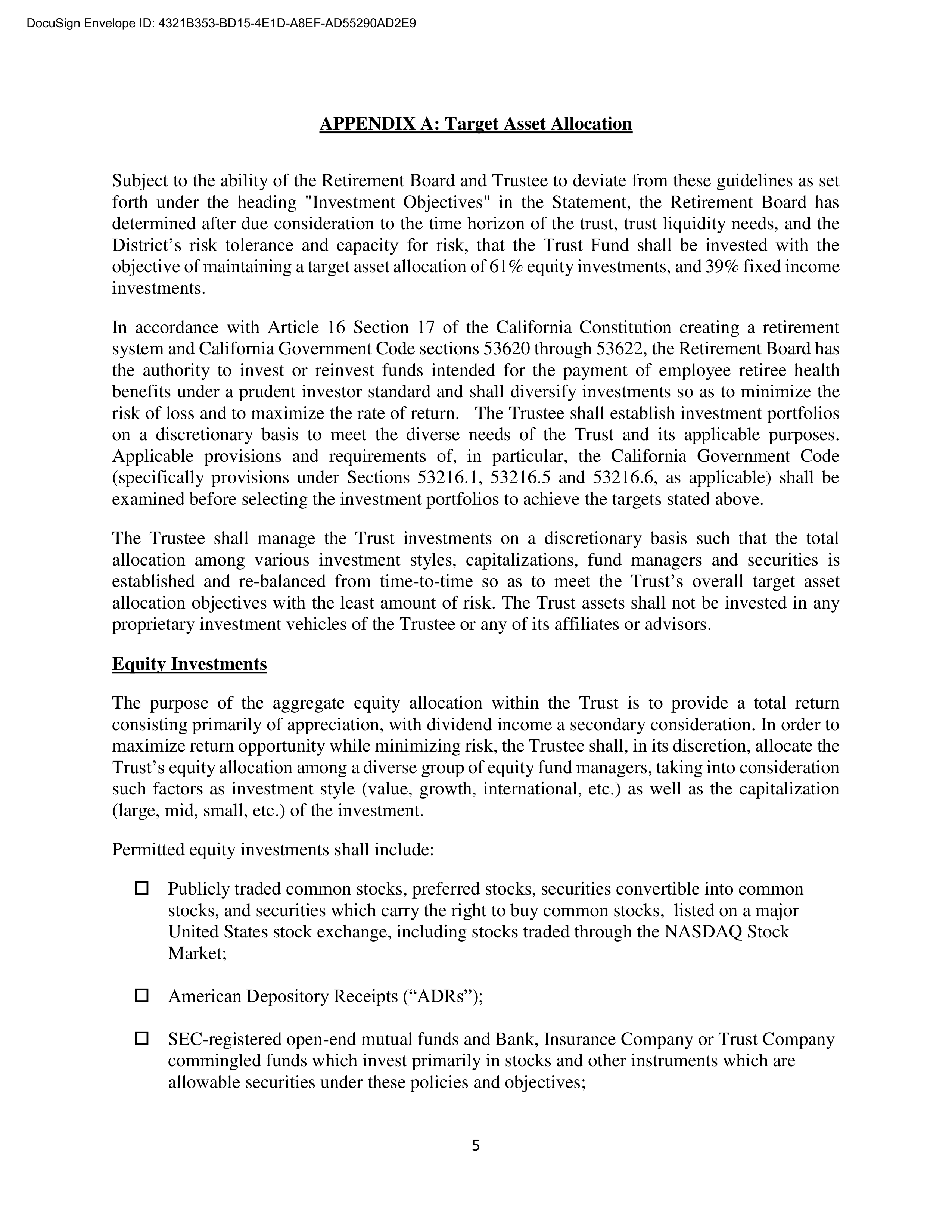
APPENDIX A: Target Asset Allocation
Subject to the ability of the Retirement Board and Trustee to deviate from these guidelines as set
forth under the heading "Investment Objectives" in the Statement, the Retirement Board has
determined after due consideration to the time horizon of the trust, trust liquidity needs, and the
District’s risk tolerance and capacity for risk, that the Trust Fund shall be invested with the
objective of maintaining a target asset allocation of 61% equity investments, and 39% fixed income
investments.
In accordance with Article 16 Section 17 of the California Constitution creating a retirement
system and California Government Code sections 53620 through 53622, the Retirement Board has
the authority to invest or reinvest funds intended for the payment of employee retiree health
benefits under a prudent investor standard and shall diversify investments so as to minimize the
risk of loss and to maximize the rate of return. The Trustee shall establish investment portfolios
on a discretionary basis to meet the diverse needs of the Trust and its applicable purposes.
Applicable provisions and requirements of, in particular, the California Government Code
(specifically provisions under Sections 53216.1, 53216.5 and 53216.6, as applicable) shall be
examined before selecting the investment portfolios to achieve the targets stated above.
The Trustee shall manage the Trust investments on a discretionary basis such that the total
allocation among various investment styles, capitalizations, fund managers and securities is
established and re-balanced from time-to-time so as to meet the Trust’s overall target asset
allocation objectives with the least amount of risk. The Trust assets shall not be invested in any
proprietary investment vehicles of the Trustee or any of its affiliates or advisors.
Equity Investments
The purpose of the aggregate equity allocation within the Trust is to provide a total return
consisting primarily of appreciation, with dividend income a secondary consideration. In order to
maximize return opportunity while minimizing risk, the Trustee shall, in its discretion, allocate the
Trust’s equity allocation among a diverse group of equity fund managers, taking into consideration
such factors as investment style (value, growth, international, etc.) as well as the capitalization
(large, mid, small, etc.) of the investment.
Permitted equity investments shall include:
Publicly traded common stocks, preferred stocks, securities convertible into common
stocks, and securities which carry the right to buy common stocks, listed on a major
United States stock exchange, including stocks traded through the NASDAQ Stock
Market;
American Depository Receipts (“ADRs”);
SEC-registered open-end mutual funds and Bank, Insurance Company or Trust Company
commingled funds which invest primarily in stocks and other instruments which are
allowable securities under these policies and objectives;
DocuSign Envelope ID: 4321B353-BD15-4E1D-A8EF-AD55290AD2E9
6
Closed-end SEC-registered mutual funds which invest primarily in stocks and other
instruments which are allowable securities under these policies and objectives; and
Exchange Traded Funds (“ETFs”) which invest primarily in stocks and other instruments
which are allowable securities under these policies and objectives.
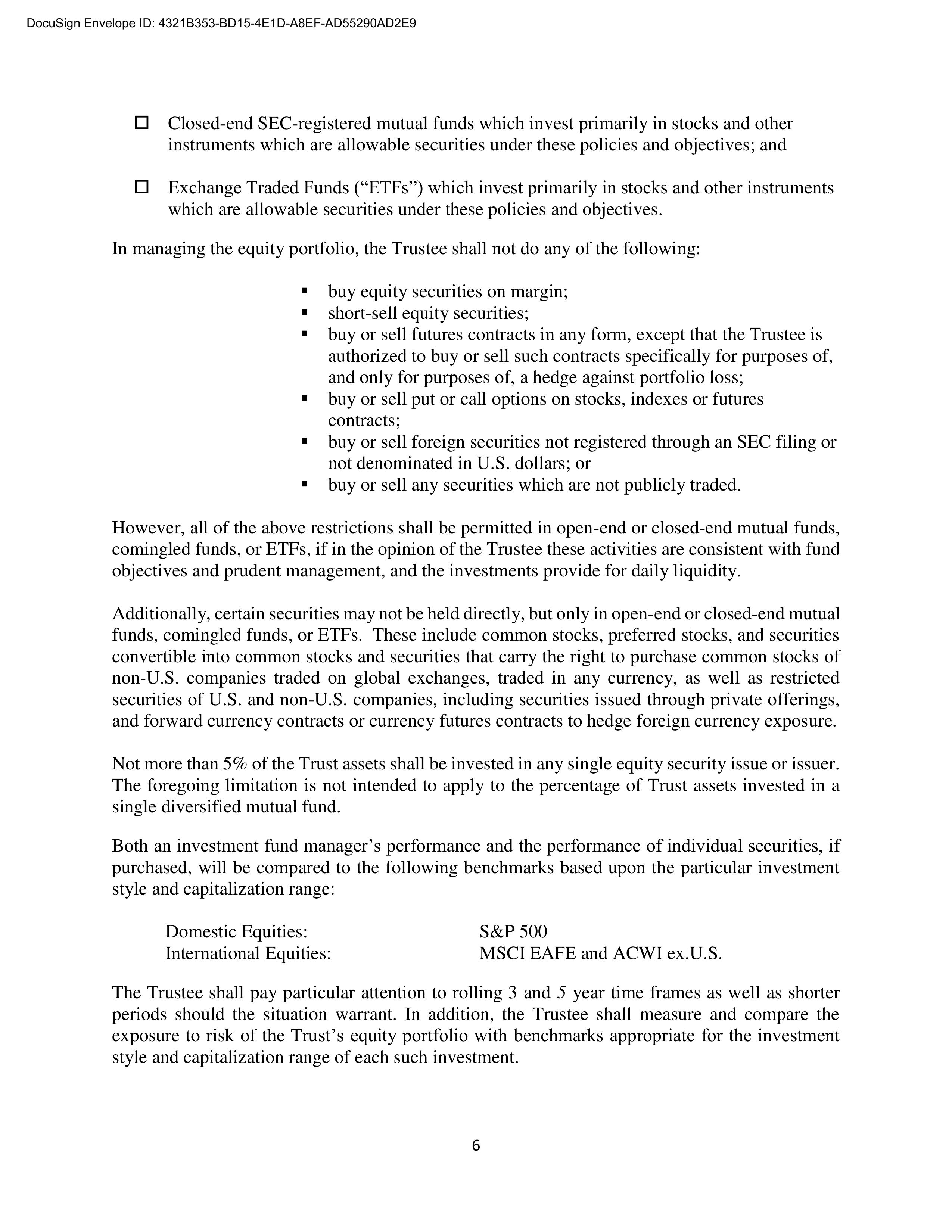
In managing the equity portfolio, the Trustee shall not do any of the following:
buy equity securities on margin;
short-sell equity securities;
buy or sell futures contracts in any form, except that the Trustee is
authorized to buy or sell such contracts specifically for purposes of,
and only for purposes of, a hedge against portfolio loss;
buy or sell put or call options on stocks, indexes or futures
contracts;
buy or sell foreign securities not registered through an SEC filing or
not denominated in U.S. dollars; or
buy or sell any securities which are not publicly traded.
However, all of the above restrictions shall be permitted in open-end or closed-end mutual funds,
comingled funds, or ETFs, if in the opinion of the Trustee these activities are consistent with fund
objectives and prudent management, and the investments provide for daily liquidity.
Additionally, certain securities may not be held directly, but only in open-end or closed-end mutual
funds, comingled funds, or ETFs. These include common stocks, preferred stocks, and securities
convertible into common stocks and securities that carry the right to purchase common stocks of
non-U.S. companies traded on global exchanges, traded in any currency, as well as restricted
securities of U.S. and non-U.S. companies, including securities issued through private offerings,
and forward currency contracts or currency futures contracts to hedge foreign currency exposure.
Not more than 5% of the Trust assets shall be invested in any single equity security issue or issuer.
The foregoing limitation is not intended to apply to the percentage of Trust assets invested in a
single diversified mutual fund.
Both an investment fund manager’s performance and the performance of individual securities, if
purchased, will be compared to the following benchmarks based upon the particular investment
style and capitalization range:
Domestic Equities:
S&P 500
International Equities:
MSCI EAFE and ACWI ex.U.S.
The Trustee shall pay particular attention to rolling 3 and
5
year time frames as well as shorter
periods should the situation warrant. In addition, the Trustee shall measure and compare the
exposure to risk of the Trust’s equity portfolio with benchmarks appropriate for the investment
style and capitalization range of each such investment.
DocuSign Envelope ID: 4321B353-BD15-4E1D-A8EF-AD55290AD2E9
7
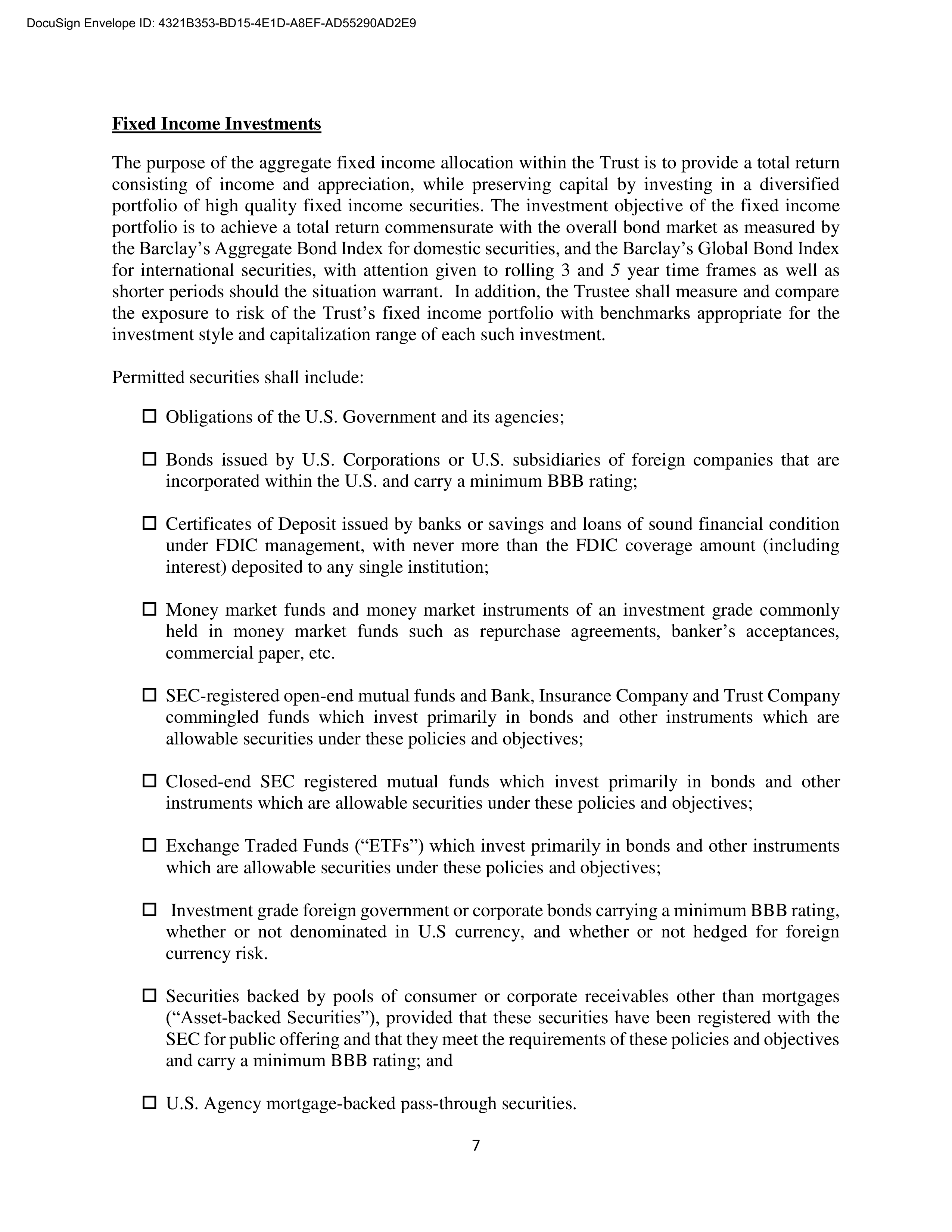
Fixed Income Investments
The purpose of the aggregate fixed income allocation within the Trust is to provide a total return
consisting of income and appreciation, while preserving capital by investing in a diversified
portfolio of high quality fixed income securities. The investment objective of the fixed income
portfolio is to achieve a total return commensurate with the overall bond market as measured by
the Barclay’s Aggregate Bond Index for domestic securities, and the Barclay’s Global Bond Index
for international securities, with attention given to rolling 3 and
5
year time frames as well as
shorter periods should the situation warrant. In addition, the Trustee shall measure and compare
the exposure to risk of the Trust’s fixed income portfolio with benchmarks appropriate for the
investment style and capitalization range of each such investment.
Permitted securities shall include:
Obligations of the U.S. Government and its agencies;
Bonds issued by U.S. Corporations or U.S. subsidiaries of foreign companies that are
incorporated within the U.S. and carry a minimum BBB rating;
Certificates of Deposit issued by banks or savings and loans of sound financial condition
under FDIC management, with never more than the FDIC coverage amount (including
interest) deposited to any single institution;
Money market funds and money market instruments of an investment grade commonly
held in money market funds such as repurchase agreements, banker’s acceptances,
commercial paper, etc.
SEC-registered open-end mutual funds and Bank, Insurance Company and Trust Company
commingled funds which invest primarily in bonds and other instruments which are
allowable securities under these policies and objectives;
Closed-end SEC registered mutual funds which invest primarily in bonds and other
instruments which are allowable securities under these policies and objectives;
Exchange Traded Funds (“ETFs”) which invest primarily in bonds and other instruments
which are allowable securities under these policies and objectives;
Investment grade foreign government or corporate bonds carrying a minimum BBB rating,
whether or not denominated in U.S currency, and whether or not hedged for foreign
currency risk.
Securities backed by pools of consumer or corporate receivables other than mortgages
(“Asset-backed Securities”), provided that these securities have been registered with the
SEC for public offering and that they meet the requirements of these policies and objectives
and carry a minimum BBB rating; and
U.S. Agency mortgage-backed pass-through securities.
DocuSign Envelope ID: 4321B353-BD15-4E1D-A8EF-AD55290AD2E9
8
In managing the fixed income portion of the Trust assets, the Trustee shall not do any of the
following:
buy fixed income securities on margin;
short-sell fixed income securities;
buy or sell futures contracts in any form, except that the Trustee is
authorized to buy or sell such contracts specifically for purposes of,
and only for purposes of, a hedge against portfolio loss;
buy or sell put or call options on bonds, indexes or futures contracts;
buy or sell foreign securities not registered through an SEC filing or
not denominated in U.S. dollars; or
buy or sell any securities which are not publicly traded except U.S.
Government or agency-backed mortgages.
However, all of the above restrictions shall be permitted only in open-end or closed-end mutual
funds, comingled funds, or ETFs, if in the opinion of the Trustee these activities are consistent
with fund objectives, prudent management, risk mitigation, and the investments provide for daily
liquidity. In addition, investment in non-investment grade bonds or loans by such funds shall be
permitted so long as the average aggregate rating of the funds are investment grade, and in the
opinion of the Trustee the proportion of non-investment grade bonds to investment grade bonds in
the portfolio is prudent.
Not more than 5% of the Trust assets shall be invested in any single debt security issue or issuer.
The foregoing limitation is not intended to apply to the percentage of Trust assets invested in a
single diversified mutual fund, nor does the limitation apply to obligations of the U.S. Government
and its agencies, U.S. agency mortgage-backed pass-through securities or to a mutual fund that
invests in such obligations or securities.
Use of Mutual Funds
The Retirement Board envisions that the Trustee will invest predominantly in open and closed-end
mutual funds. The Board recognizes that the limitations and restrictions set forth in this Statement
cannot be imposed on the managers of such mutual funds and that mutual funds held by the Trust
may be managed outside of the requirements of this Statement. Nonetheless, the Trustee shall seek
to identify mutual funds that comply as closely as possible to these guidelines and shall diligently
monitor for prompt removal and replacement of those that do not.
Performance Review
In the execution of its fiduciary responsibilities, the Trustee shall review, on a regular basis, the
performance of the various investments and fund managers employed by the Trust to determine if
assets are being properly managed according to the stated objectives and policies set forth in the
Trust Agreement and in this Statement. The Trustee shall view performance and investment risk
on the basis of a full 3 to 5-year market cycle, though the stated objectives and policies of the
Trustee may result in the prompt sale of a security or dismissal of a fund manager based upon
shorter term results. In addition, any deviation or change in the structure, management or
DocuSign Envelope ID: 4321B353-BD15-4E1D-A8EF-AD55290AD2E9
9
investment style of any fund manager employed shall precipitate a review by the Trustee to
determine whether or not that manager should be retained.
Change of Target Asset Allocation
The Retirement Board may, from time to time, discuss with Trustee the need to change the target
asset allocation for the trust as conditions or characteristics of the Trust, or applicable Fund
requirements change. In the event a change is made, a new Appendix A will be adopted by the
Retirement Board to reflect the change.
DocuSign Envelope ID: 4321B353-BD15-4E1D-A8EF-AD55290AD2E9