Teaching philosophy statement
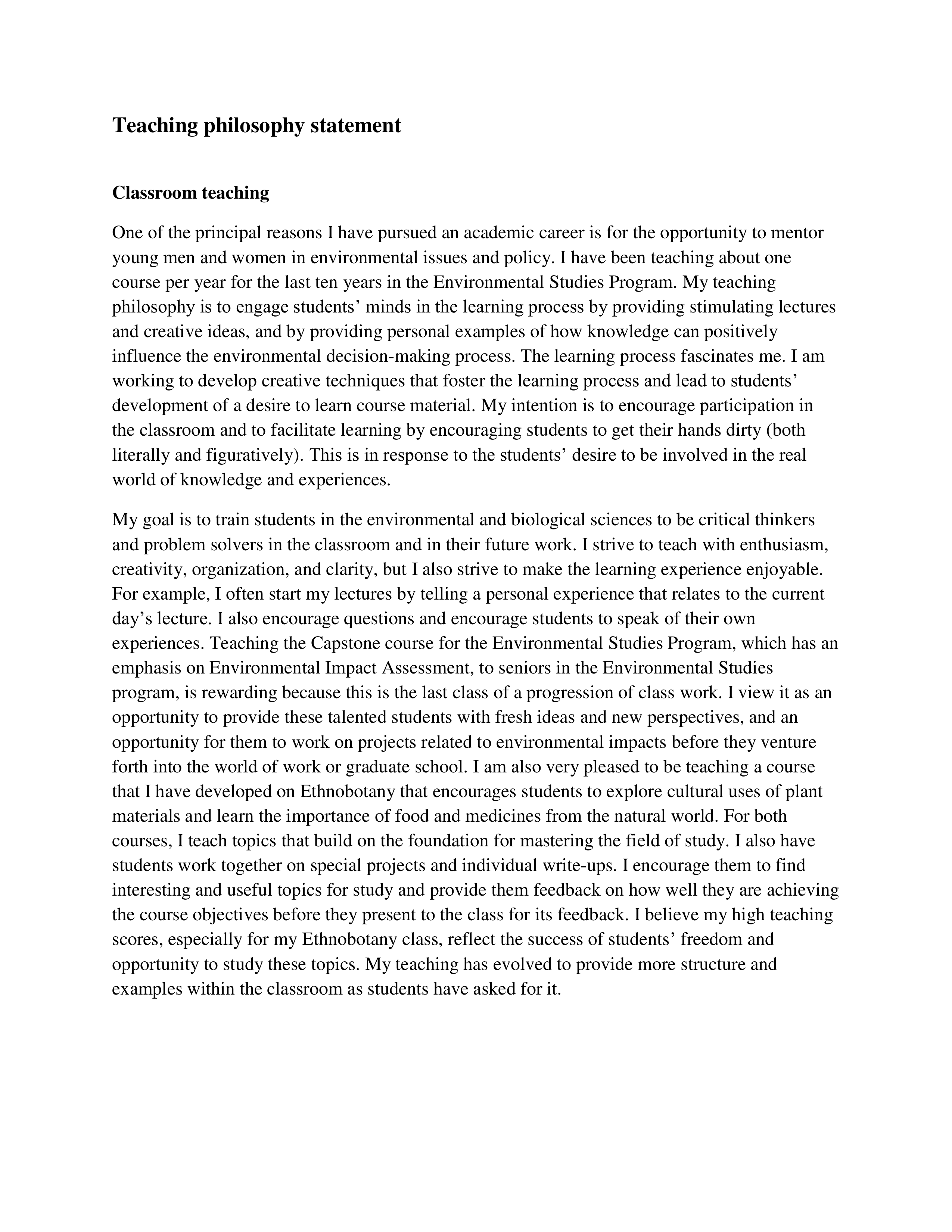
Classroom teaching
One of the principal reasons I have pursued an academic career is for the opportunity to mentor
young men and women in environmental issues and policy. I have been teaching about one
course per year for the last ten years in the Environmental Studies Program. My teaching
philosophy is to engage students’ minds in the learning process by providing stimulating lectures
and creative ideas, and by providing personal examples of how knowledge can positively
influence the environmental decision-making process. The learning process fascinates me. I am
working to develop creative techniques that foster the learning process and lead to students’
development of a desire to learn course material. My intention is to encourage participation in
the classroom and to facilitate learning by encouraging students to get their hands dirty (both
literally and figuratively). This is in response to the students’ desire to be involved in the real
world of knowledge and experiences.
My goal is to train students in the environmental and biological sciences to be critical thinkers
and problem solvers in the classroom and in their future work. I strive to teach with enthusiasm,
creativity, organization, and clarity, but I also strive to make the learning experience enjoyable.
For example, I often start my lectures by telling a personal experience that relates to the current
day’s lecture. I also encourage questions and encourage students to speak of their own
experiences. Teaching the Capstone course for the Environmental Studies Program, which has an
emphasis on Environmental Impact Assessment, to seniors in the Environmental Studies
program, is rewarding because this is the last class of a progression of class work. I view it as an
opportunity to provide these talented students with fresh ideas and new perspectives, and an
opportunity for them to work on projects related to environmental impacts before they venture
forth into the world of work or graduate school. I am also very pleased to be teaching a course
that I have developed on Ethnobotany that encourages students to explore cultural uses of plant
materials and learn the importance of food and medicines from the natural world. For both
courses, I teach topics that build on the foundation for mastering the field of study. I also have
students work together on special projects and individual write-ups. I encourage them to find
interesting and useful topics for study and provide them feedback on how well they are achieving
the course objectives before they present to the class for its feedback. I believe my high teaching
scores, especially for my Ethnobotany class, reflect the success of students’ freedom and
opportunity to study these topics. My teaching has evolved to provide more structure and
examples within the classroom as students have asked for it.
Undergraduate advising
I primarily advise undergraduate students in the Environmental Studies Program. I try to
meet their advising needs and also help them look to the future. I first go over their record of
classes taken and those they need to take. I also note the grades they have been receiving to see
where their strengths and weaknesses lie. After we discuss what they need to take for their
degree program, we discuss what interests them and what they think they would like to do after
they graduate to see if there are courses that will help them in pursuit of a career. I encourage
them to take good classes that they might not have considered. I try to talk to them about
learning skills that they can build on. I also ask them what they would really like to be doing in
five years and discuss ways they can get there. If they don’t know, I encourage them to consider
areas of work and professions that relate to their course of study. I also follow this approach with
students who have other majors, trying to get them to take useful courses, learn skills, and build
their academic portfolio with courses that interest them. I see many of these students outside the
classroom and engage them in conversation about what they are doing. Also, many students
email me with questions. Many of these discussions and communications have led to their
exploration of new ideas or to jobs that I have suggested to them. I also frequently write letters of
recommendation for students I have advised, as they have few others to turn to. I have especially
encouraged young women and minority students, as I want to make sure they realize they can
have careers as field biologists and scientists. I take special pride in having mentored three
students (McNair Fellowship, NIH PREP Program and Bridge Program) who started their
college work at Haskell Indian Nations University and transferred to KU to get undergraduate
degrees, and one has applied to the KU Department of Geography master’s degree program to
work with me on the geography of foodsheds. I have particularly enjoyed my one-on-one
interactions with students, both in and out of the classroom. For the last eight years, I have also
served as the Faculty Advisor for Environs—the student environmental organization—and
helped mentor them in achieving success in recycling programs and in environmental education.
Also, I have recently become the faculty advisor for the KU Student Farm (the new student
community garden).
Graduate and postgraduate advising and mentoring
I take a more collaborative approach to advising and mentoring graduate students. I talk
with them about how we can work together in our lab to pursue ideas and set up experiments and
the collection of data to study them, which will lead toward their theses and degrees. I discuss
what their career interests are, especially to discern what they would like to be doing after they
finish their degrees. By having a research program that involves field work and travel, I often get
to travel with the students, and we get to discuss research ideas, ecological theory and how things
work, and ways to study research questions. I discuss ideas that interest me and, I hope, interest
them also. Through this process, we usually can come up with areas of mutual interest and a
process to study them. During field research, we discuss what they are seeing and what problems
they may be having in data collection, and we begin the discussion of what it means. I let the
graduate students take as much lead in the work as possible but work with them when there are
problems or guidance is needed. We also get to know each other well, and by the time their work
is ending, we discuss the next steps that they want to take with employment, and I help them
with job applications and recommendations. Through this process, I have realized that it is best
to pick graduate students who have interests in the types of work that I conduct in my lab, and to
spell out as clearly as possible my expectations and goals as early as possible in the mentoring
process. This has led to successful collaboration with the graduate students I have worked with,
to them finding jobs that satisfy them, and to lasting interactions and friendships.