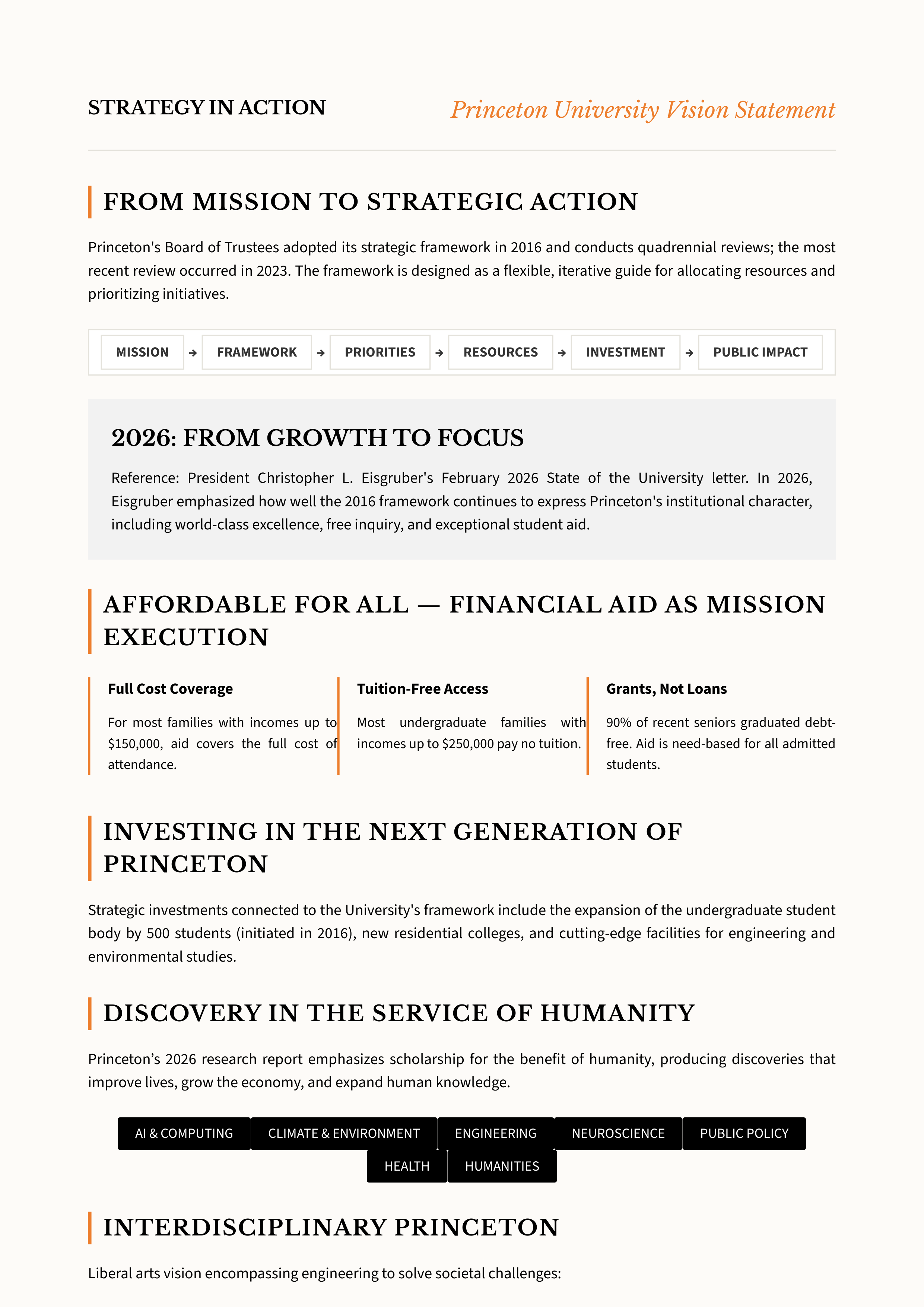
FROM MISSION TO STRATEGIC ACTION
Princeton's Board of Trustees adopted its strategic framework in 2016 and conducts quadrennial reviews; the most
recent review occurred in 2023. The framework is designed as a flexible, iterative guide for allocating resources and
prioritizing initiatives.
MISSION
→
FRAMEWORK
→
PRIORITIES
→
RESOURCES
→
INVESTMENT
→
PUBLIC IMPACT
2026: FROM GROWTH TO FOCUS
Reference: President Christopher L. Eisgruber's February 2026 State of the University letter. In 2026,
Eisgruber emphasized how well the 2016 framework continues to express Princeton's institutional character,
including world-class excellence, free inquiry, and exceptional student aid.
AFFORDABLE FOR ALL — FINANCIAL AID AS MISSION
EXECUTION
Full Cost Coverage
For most families with incomes up to
$150,000, aid covers the full cost of
attendance.
Tuition-Free Access
Most undergraduate families with
incomes up to $250,000 pay no tuition.
Grants, Not Loans
90% of recent seniors graduated debt-
free. Aid is need-based for all admitted
students.
INVESTING IN THE NEXT GENERATION OF
PRINCETON
Strategic investments connected to the University's framework include the expansion of the undergraduate student
body by 500 students (initiated in 2016), new residential colleges, and cutting-edge facilities for engineering and
environmental studies.
DISCOVERY IN THE SERVICE OF HUMANITY
Princeton’s 2026 research report emphasizes scholarship for the benefit of humanity, producing discoveries that
improve lives, grow the economy, and expand human knowledge.
AI & COMPUTING
CLIMATE & ENVIRONMENT
ENGINEERING
NEUROSCIENCE
PUBLIC POLICY
HEALTH
HUMANITIES
INTERDISCIPLINARY PRINCETON
Liberal arts vision encompassing engineering to solve societal challenges:
Princeton University Vision Statement
STRATEGY IN ACTION