STUDIES IN PUBLIC ADMINISTRATION, HEALTH POLICY & EMERGENCY MANAGEMENT
American Red Cross Informative Essay
The American Red Cross: Organizational History, Humanitarian Mandates, and Operational Infrastructure
Academic Survey of Emergency Management & Biomedical Logistics
•
Scholarly Review Series
ABSTRACT:
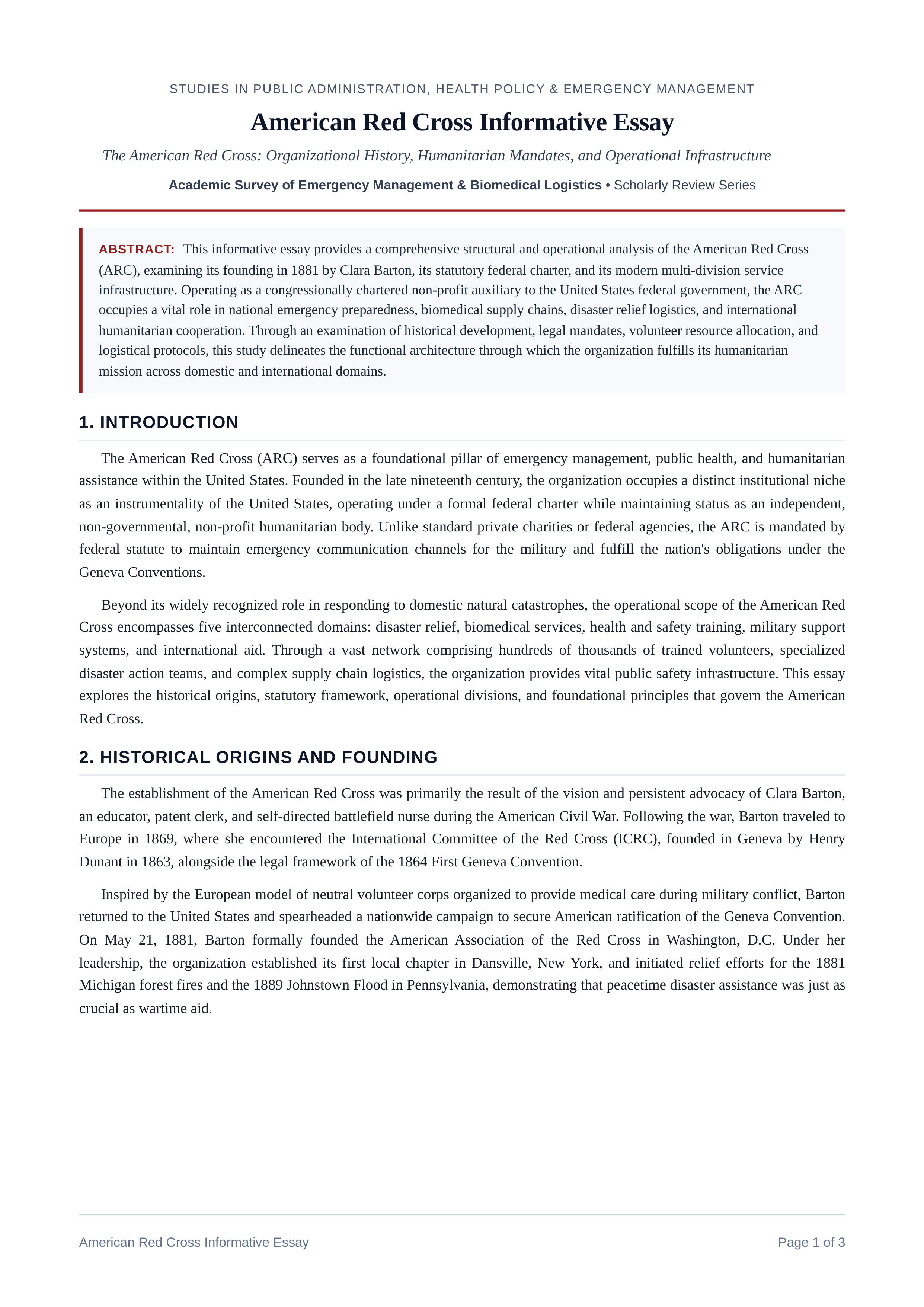
This informative essay provides a comprehensive structural and operational analysis of the American Red Cross
(ARC), examining its founding in 1881 by Clara Barton, its statutory federal charter, and its modern multi-division service
infrastructure. Operating as a congressionally chartered non-profit auxiliary to the United States federal government, the ARC
occupies a vital role in national emergency preparedness, biomedical supply chains, disaster relief logistics, and international
humanitarian cooperation. Through an examination of historical development, legal mandates, volunteer resource allocation, and
logistical protocols, this study delineates the functional architecture through which the organization fulfills its humanitarian
mission across domestic and international domains.
1. INTRODUCTION
The American Red Cross (ARC) serves as a foundational pillar of emergency management, public health, and humanitarian
assistance within the United States. Founded in the late nineteenth century, the organization occupies a distinct institutional niche
as an instrumentality of the United States, operating under a formal federal charter while maintaining status as an independent,
non-governmental, non-profit humanitarian body. Unlike standard private charities or federal agencies, the ARC is mandated by
federal statute to maintain emergency communication channels for the military and fulfill the nation's obligations under the
Geneva Conventions.
Beyond its widely recognized role in responding to domestic natural catastrophes, the operational scope of the American Red
Cross encompasses five interconnected domains: disaster relief, biomedical services, health and safety training, military support
systems, and international aid. Through a vast network comprising hundreds of thousands of trained volunteers, specialized
disaster action teams, and complex supply chain logistics, the organization provides vital public safety infrastructure. This essay
explores the historical origins, statutory framework, operational divisions, and foundational principles that govern the American
Red Cross.
2. HISTORICAL ORIGINS AND FOUNDING
The establishment of the American Red Cross was primarily the result of the vision and persistent advocacy of Clara Barton,
an educator, patent clerk, and self-directed battlefield nurse during the American Civil War. Following the war, Barton traveled to
Europe in 1869, where she encountered the International Committee of the Red Cross (ICRC), founded in Geneva by Henry
Dunant in 1863, alongside the legal framework of the 1864 First Geneva Convention.
Inspired by the European model of neutral volunteer corps organized to provide medical care during military conflict, Barton
returned to the United States and spearheaded a nationwide campaign to secure American ratification of the Geneva Convention.
On May 21, 1881, Barton formally founded the American Association of the Red Cross in Washington, D.C. Under her
leadership, the organization established its first local chapter in Dansville, New York, and initiated relief efforts for the 1881
Michigan forest fires and the 1889 Johnstown Flood in Pennsylvania, demonstrating that peacetime disaster assistance was just as
crucial as wartime aid.
American Red Cross Informative Essay
Page 1 of 3
3. CONGRESSIONAL CHARTER AND STATUTORY MANDATE
In 1900, and extensively reauthorized in 1905, the United States Congress granted the American Red Cross a formal federal
charter (codified in Title 36 of the United States Code). This statutory charter delineates specific public responsibilities,
distinguishing the ARC from all other private non-profit entities. Under this legal framework, the organization is charged with
providing a system of national and international disaster relief and serving as an official medium of voluntary communication
between the people of the United States and their armed forces.
Despite this unique federal relationship, the ARC remains an independent, non-governmental organization governed by an
independent Board of Governors. It does not operate as an executive branch department and does not receive regular annual
federal appropriations for its operational budget; instead, it relies primarily on private donations, foundation grants, and cost-
recovery service fees.
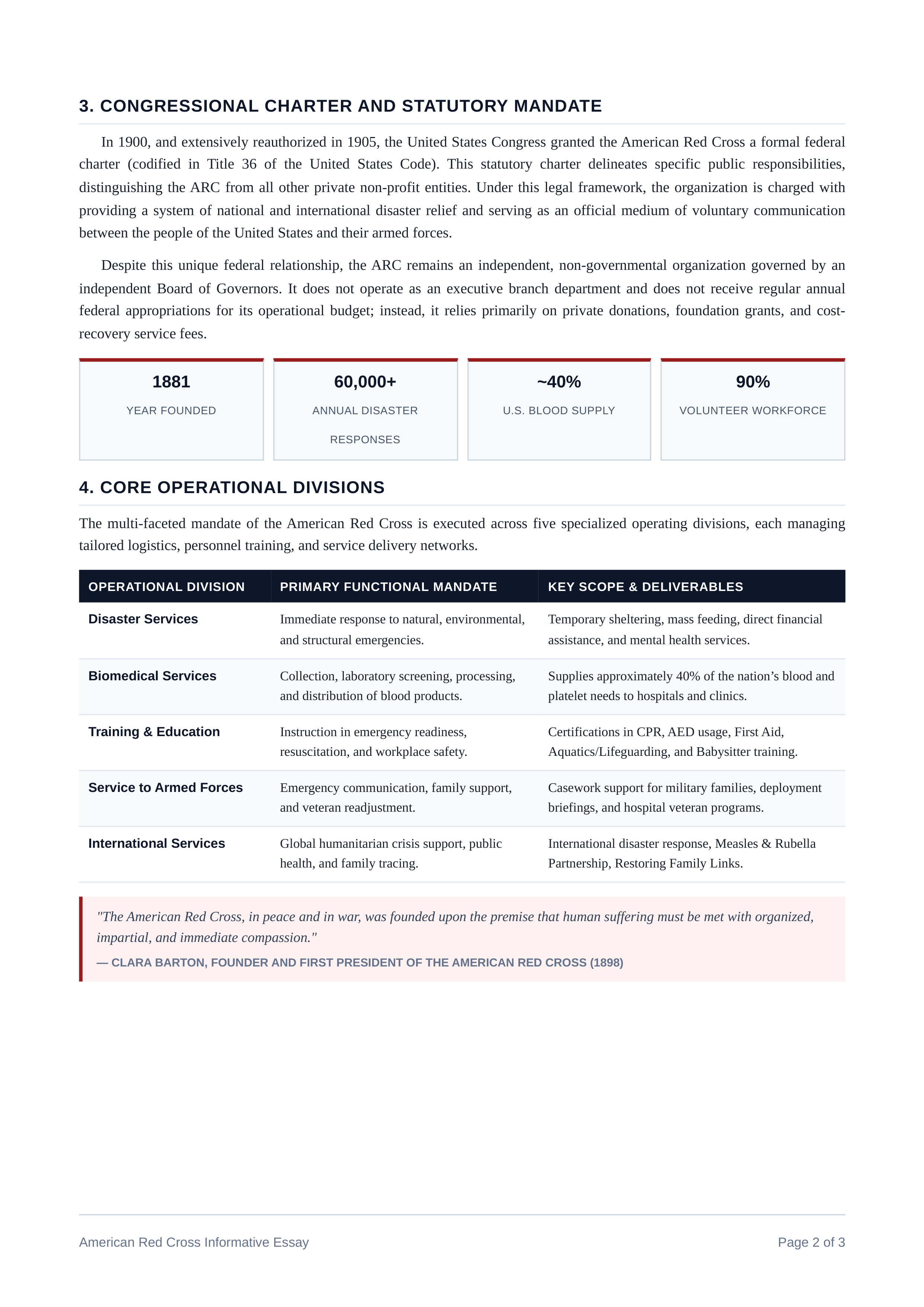
1881
YEAR FOUNDED
60,000+
ANNUAL DISASTER
RESPONSES
~40%
U.S. BLOOD SUPPLY
90%
VOLUNTEER WORKFORCE
4. CORE OPERATIONAL DIVISIONS
The multi-faceted mandate of the American Red Cross is executed across five specialized operating divisions, each managing
tailored logistics, personnel training, and service delivery networks.
OPERATIONAL DIVISION
PRIMARY FUNCTIONAL MANDATE
KEY SCOPE & DELIVERABLES
Disaster Services
Immediate response to natural, environmental,
and structural emergencies.
Temporary sheltering, mass feeding, direct financial
assistance, and mental health services.
Biomedical Services
Collection, laboratory screening, processing,
and distribution of blood products.
Supplies approximately 40% of the nation
’
s blood and
platelet needs to hospitals and clinics.
Training & Education
Instruction in emergency readiness,
resuscitation, and workplace safety.
Certifications in CPR, AED usage, First Aid,
Aquatics/Lifeguarding, and Babysitter training.
Service to Armed Forces
Emergency communication, family support,
and veteran readjustment.
Casework support for military families, deployment
briefings, and hospital veteran programs.
International Services
Global humanitarian crisis support, public
health, and family tracing.
International disaster response, Measles & Rubella
Partnership, Restoring Family Links.
"The American Red Cross, in peace and in war, was founded upon the premise that human suffering must be met with organized,
impartial, and immediate compassion."
—
CLARA BARTON, FOUNDER AND FIRST PRESIDENT OF THE AMERICAN RED CROSS (1898)
American Red Cross Informative Essay
Page 2 of 3
5. BIOMEDICAL OPERATIONS AND SUPPLY LOGISTICS
The American Red Cross operates the largest single non-profit blood collection infrastructure in the United States. Originating
during World War II under the guidance of Dr. Charles R. Drew
—
who developed pioneer techniques for blood plasma processing
and storage
—
the ARC civilian blood collection program was formalized on a nationwide scale in 1948. The program collects
millions of units of whole blood and apheresis donations annually through tens of thousands of mobile and fixed donor stations.
The biomedical supply chain involves rigid microbiological screening, blood component fractionation (producing packed red
blood cells, platelets, and plasma), and cold-chain temperature monitoring. By maintaining national inventory balancing systems,
the ARC redistributes critical blood units to regional trauma centers, cancer clinics, and intensive care units facing localized
shortages or major mass-casualty events.
6. DOMESTIC DISASTER RESPONSE FRAMEWORK
The vast majority of the ARC's 60,000+ yearly responses involve local residential fires, handled by volunteer Disaster Action
Teams (DAT). When major natural disasters occur
—
such as Category 5 hurricanes, wildfires, or regional floods
—
the
organization mobilizes complex logistical operations under the National Response Framework (NRF), where the ARC co-leads
Emergency Support Function #6 (Mass Care, Emergency Assistance, Housing, and Human Services) alongside FEMA.
7. VOLUNTEER INFRASTRUCTURE AND THE SEVEN FUNDAMENTAL PRINCIPLES
A distinctive attribute of the American Red Cross is its reliance on a volunteer-driven operational model. Approximately 90%
of the active workforce consists of unpaid volunteers who staff local leadership positions, manage emergency shelters, and
deliver front-line relief. The organization functions under the Seven Fundamental Principles of the International Red Cross and
Red Crescent Movement:
Humanity, Impartiality, Neutrality, Independence, Voluntary Service, Unity, and Universality
. These
core principles ensure that humanitarian assistance is delivered strictly according to human need without discrimination based on
nationality, race, religious beliefs, or political affiliation.
8. CONCLUSION
The American Red Cross exemplifies the capacity of structured humanitarianism to bridge emergency logistics, biomedical
science, and civic engagement. From its founding by Clara Barton to its contemporary role within the national disaster
infrastructure, the ARC remains an indispensable institution whose readiness and volunteer backbone safeguard public welfare in
times of crisis.
American Red Cross Informative Essay
Page 3 of 3