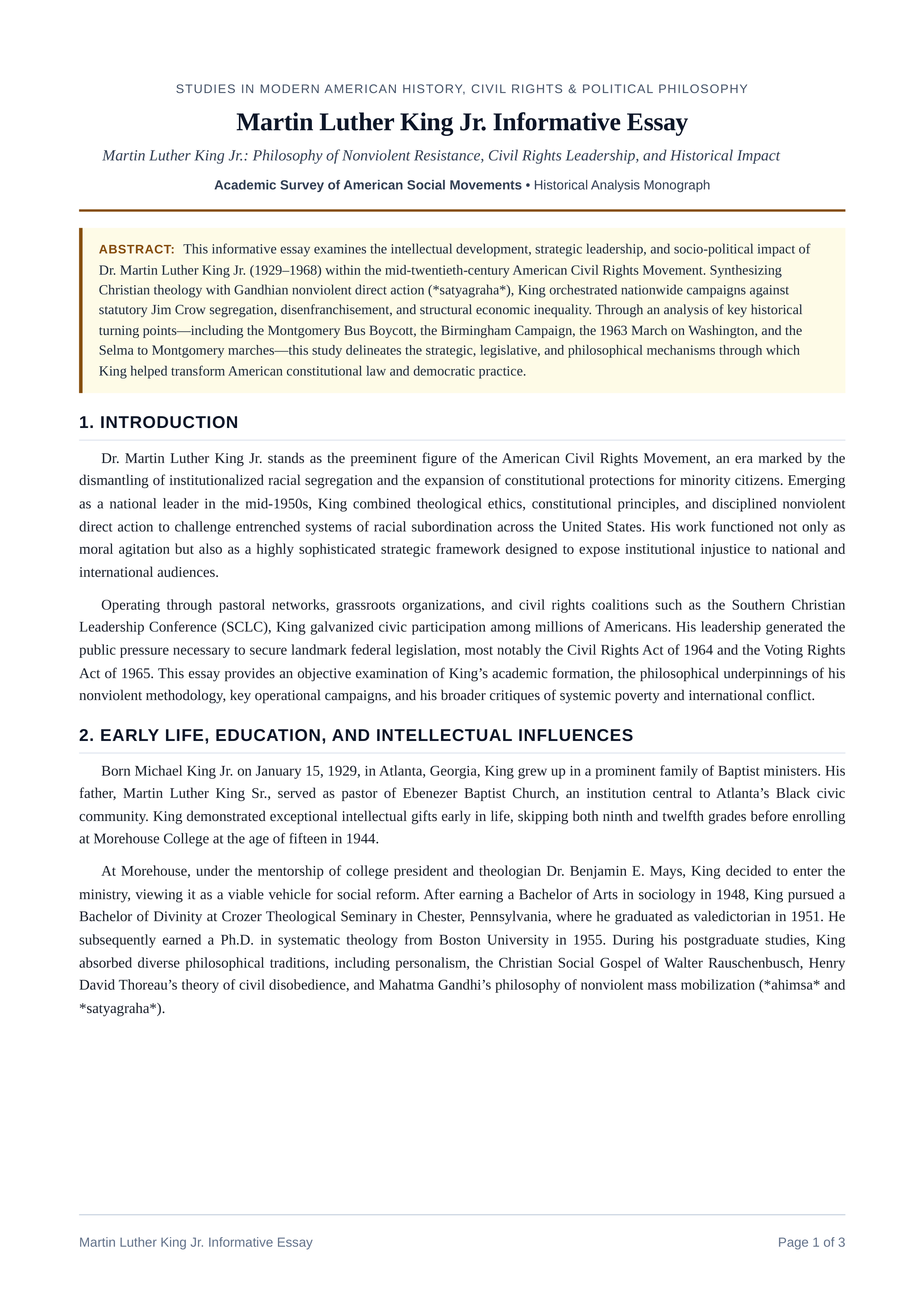
STUDIES IN MODERN AMERICAN HISTORY, CIVIL RIGHTS & POLITICAL PHILOSOPHY
Martin Luther King Jr. Informative Essay
Martin Luther King Jr.: Philosophy of Nonviolent Resistance, Civil Rights Leadership, and Historical Impact
Academic Survey of American Social Movements
•
Historical Analysis Monograph
ABSTRACT:
This informative essay examines the intellectual development, strategic leadership, and socio-political impact of
Dr. Martin Luther King Jr. (1929
–
1968) within the mid-twentieth-century American Civil Rights Movement. Synthesizing
Christian theology with Gandhian nonviolent direct action (*satyagraha*), King orchestrated nationwide campaigns against
statutory Jim Crow segregation, disenfranchisement, and structural economic inequality. Through an analysis of key historical
turning points
—
including the Montgomery Bus Boycott, the Birmingham Campaign, the 1963 March on Washington, and the
Selma to Montgomery marches
—
this study delineates the strategic, legislative, and philosophical mechanisms through which
King helped transform American constitutional law and democratic practice.
1. INTRODUCTION
Dr. Martin Luther King Jr. stands as the preeminent figure of the American Civil Rights Movement, an era marked by the
dismantling of institutionalized racial segregation and the expansion of constitutional protections for minority citizens. Emerging
as a national leader in the mid-1950s, King combined theological ethics, constitutional principles, and disciplined nonviolent
direct action to challenge entrenched systems of racial subordination across the United States. His work functioned not only as
moral agitation but also as a highly sophisticated strategic framework designed to expose institutional injustice to national and
international audiences.
Operating through pastoral networks, grassroots organizations, and civil rights coalitions such as the Southern Christian
Leadership Conference (SCLC), King galvanized civic participation among millions of Americans. His leadership generated the
public pressure necessary to secure landmark federal legislation, most notably the Civil Rights Act of 1964 and the Voting Rights
Act of 1965. This essay provides an objective examination of King
’
s academic formation, the philosophical underpinnings of his
nonviolent methodology, key operational campaigns, and his broader critiques of systemic poverty and international conflict.
2. EARLY LIFE, EDUCATION, AND INTELLECTUAL INFLUENCES
Born Michael King Jr. on January 15, 1929, in Atlanta, Georgia, King grew up in a prominent family of Baptist ministers. His
father, Martin Luther King Sr., served as pastor of Ebenezer Baptist Church, an institution central to Atlanta
’
s Black civic
community. King demonstrated exceptional intellectual gifts early in life, skipping both ninth and twelfth grades before enrolling
at Morehouse College at the age of fifteen in 1944.
At Morehouse, under the mentorship of college president and theologian Dr. Benjamin E. Mays, King decided to enter the
ministry, viewing it as a viable vehicle for social reform. After earning a Bachelor of Arts in sociology in 1948, King pursued a
Bachelor of Divinity at Crozer Theological Seminary in Chester, Pennsylvania, where he graduated as valedictorian in 1951. He
subsequently earned a Ph.D. in systematic theology from Boston University in 1955. During his postgraduate studies, King
absorbed diverse philosophical traditions, including personalism, the Christian Social Gospel of Walter Rauschenbusch, Henry
David Thoreau
’
s theory of civil disobedience, and Mahatma Gandhi
’
s philosophy of nonviolent mass mobilization (*ahimsa* and
*satyagraha*).
Martin Luther King Jr. Informative Essay
Page 1 of 3
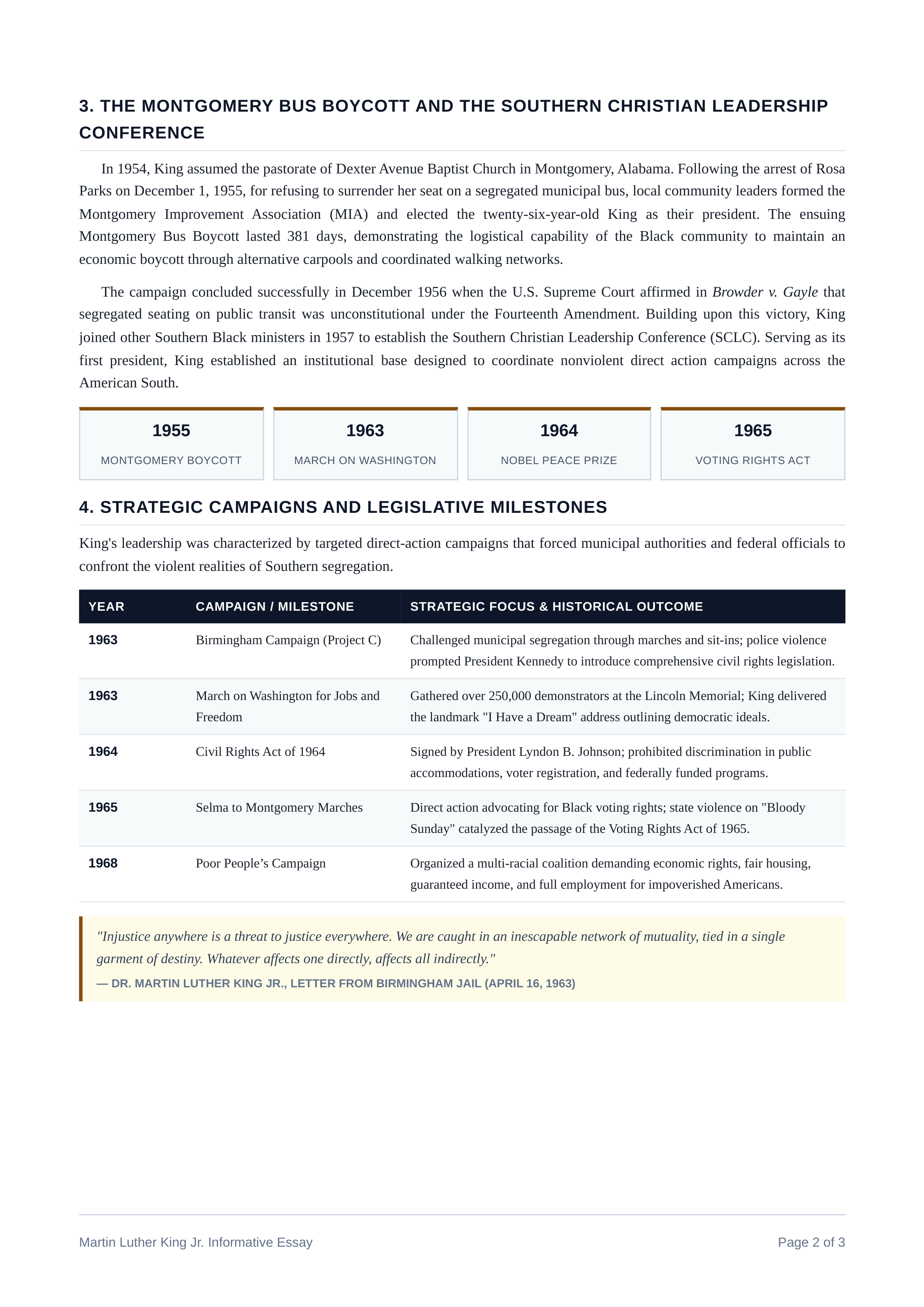
3. THE MONTGOMERY BUS BOYCOTT AND THE SOUTHERN CHRISTIAN LEADERSHIP
CONFERENCE
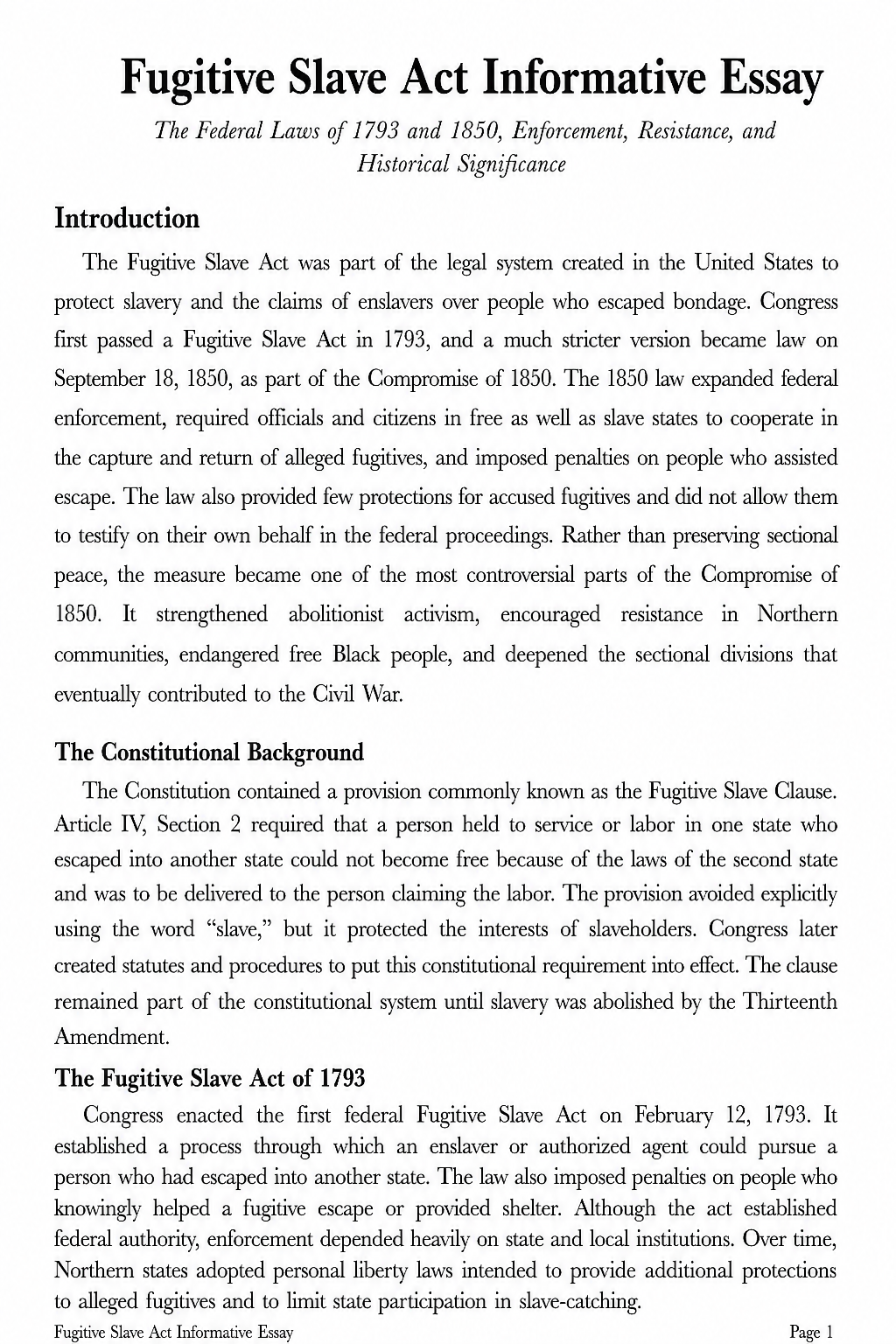
In 1954, King assumed the pastorate of Dexter Avenue Baptist Church in Montgomery, Alabama. Following the arrest of Rosa
Parks on December 1, 1955, for refusing to surrender her seat on a segregated municipal bus, local community leaders formed the
Montgomery Improvement Association (MIA) and elected the twenty-six-year-old King as their president. The ensuing
Montgomery Bus Boycott lasted 381 days, demonstrating the logistical capability of the Black community to maintain an
economic boycott through alternative carpools and coordinated walking networks.
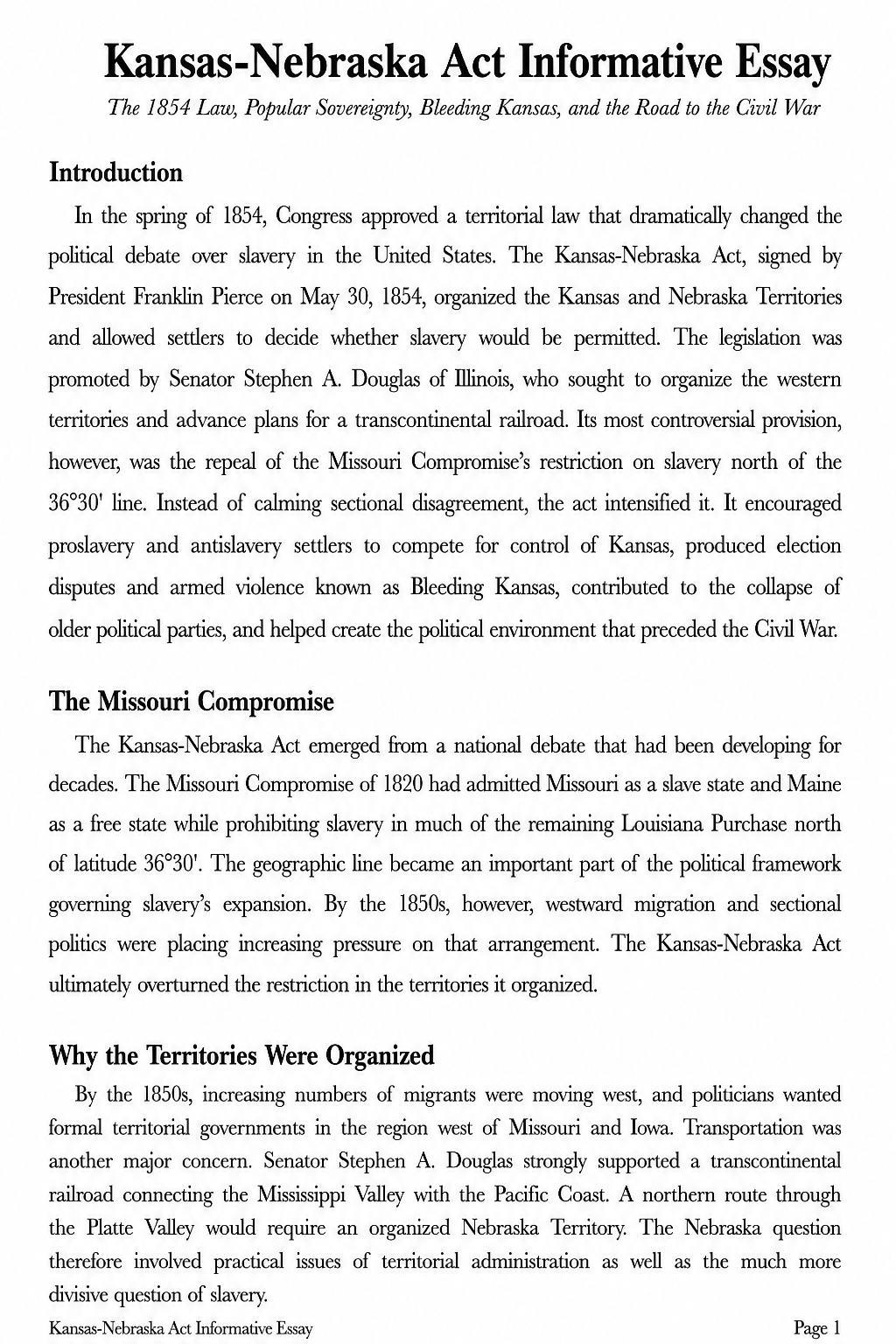
The campaign concluded successfully in December 1956 when the U.S. Supreme Court affirmed in
Browder v. Gayle
that
segregated seating on public transit was unconstitutional under the Fourteenth Amendment. Building upon this victory, King
joined other Southern Black ministers in 1957 to establish the Southern Christian Leadership Conference (SCLC). Serving as its
first president, King established an institutional base designed to coordinate nonviolent direct action campaigns across the
American South.
1955
MONTGOMERY BOYCOTT
1963
MARCH ON WASHINGTON
1964
NOBEL PEACE PRIZE
1965
VOTING RIGHTS ACT
4. STRATEGIC CAMPAIGNS AND LEGISLATIVE MILESTONES
King's leadership was characterized by targeted direct-action campaigns that forced municipal authorities and federal officials to
confront the violent realities of Southern segregation.
YEAR
CAMPAIGN / MILESTONE
STRATEGIC FOCUS & HISTORICAL OUTCOME
1963
Birmingham Campaign (Project C)
Challenged municipal segregation through marches and sit-ins; police violence
prompted President Kennedy to introduce comprehensive civil rights legislation.
1963
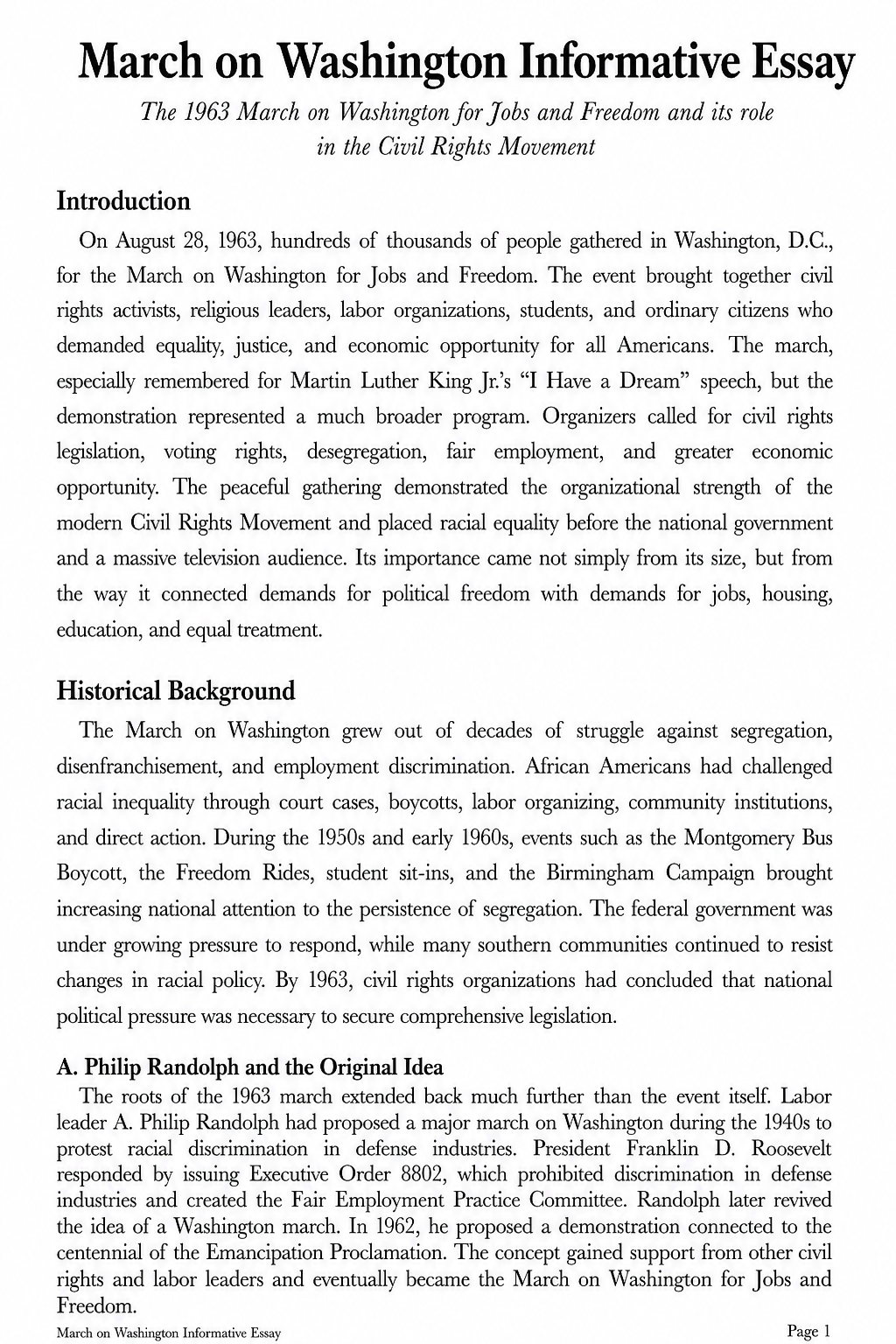
March on Washington for Jobs and
Freedom
Gathered over 250,000 demonstrators at the Lincoln Memorial; King delivered
the landmark "I Have a Dream" address outlining democratic ideals.
1964
Civil Rights Act of 1964
Signed by President Lyndon B. Johnson; prohibited discrimination in public
accommodations, voter registration, and federally funded programs.
1965
Selma to Montgomery Marches
Direct action advocating for Black voting rights; state violence on "Bloody
Sunday" catalyzed the passage of the Voting Rights Act of 1965.
1968
Poor People
’
s Campaign
Organized a multi-racial coalition demanding economic rights, fair housing,
guaranteed income, and full employment for impoverished Americans.
"Injustice anywhere is a threat to justice everywhere. We are caught in an inescapable network of mutuality, tied in a single
garment of destiny. Whatever affects one directly, affects all indirectly."
—
DR. MARTIN LUTHER KING JR., LETTER FROM BIRMINGHAM JAIL (APRIL 16, 1963)
Martin Luther King Jr. Informative Essay
Page 2 of 3
5. THE PHILOSOPHY OF NONVIOLENT RESISTANCE
Central to King
’
s leadership was his systematic philosophy of nonviolence, which he articulated in writings such as
Stride
Toward Freedom
(1958) and
Letter from Birmingham Jail
(1963). King distinguished nonviolence from passive acquiescence,
framing it as an active form of spiritual and moral resistance. His methodology rested on several core tenets: seeking
reconciliation rather than humiliation of opponents, directing resistance against systems of injustice rather than individual
persons, accepting suffering without retaliation, and maintaining goodwill through nonviolent love (*agape*).
In
Letter from Birmingham Jail
, King addressed moderate white clergy who urged gradualism, drawing on classical natural
law theory from Augustine and Thomas Aquinas to distinguish between just and unjust laws. King asserted that an unjust law is a
human code that degrades human personality and that individuals possess a moral obligation to openly and peacefully disobey
such laws while willingly accepting the legal consequences to arouse the community
’
s conscience.
6. BROADENING SCOPE: ECONOMIC JUSTICE AND THE VIETNAM WAR
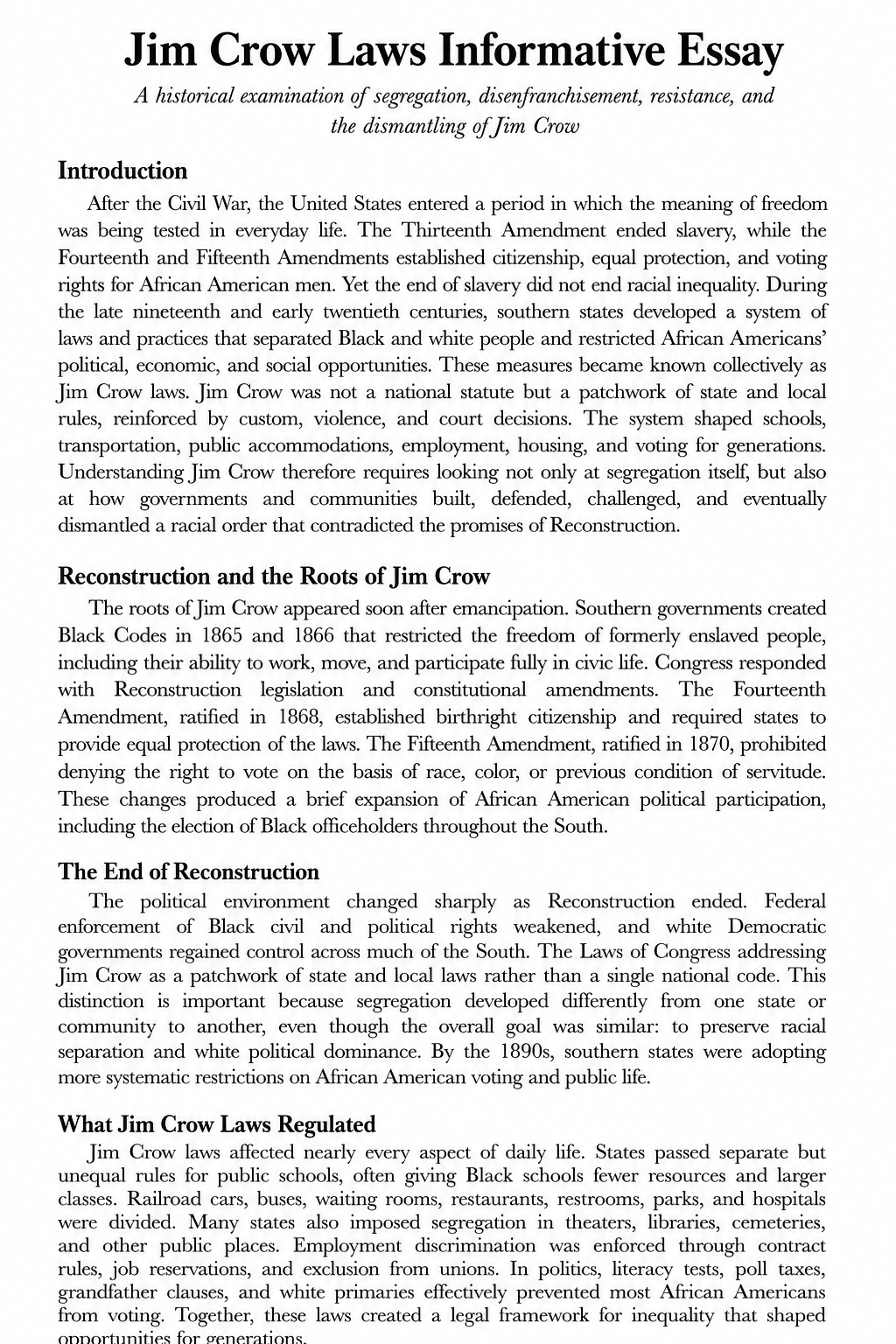
Following the legislative victories of 1964 and 1965, King expanded his focus from Southern legal segregation to the
nationwide challenges of urban poverty, systemic economic disenfranchisement, and international militarism. In 1966, he moved
into an apartment on the West Side of Chicago to launch the Chicago Freedom Movement, targeting discriminatory real estate
practices, segregated schools, and employment inequality in Northern metropolitan areas.
On April 4, 1967, King delivered his controversial address, "Beyond Vietnam: A Time to Break Silence," at Riverside Church
in New York City, openly condemning the Vietnam War and warning that military expenditure was draining resources needed for
domestic anti-poverty programs. In late 1967, King and the SCLC announced the Poor People's Campaign to demand an
economic bill of rights for all impoverished Americans regardless of race. While in Memphis, Tennessee, supporting striking
municipal sanitation workers, King was assassinated on April 4, 1968, at the Lorraine Motel.
7. HISTORICAL IMPACT AND LEGACY
Dr. Martin Luther King Jr.
’
s leadership fundamentally reshaped the legal, political, and social fabric of the United States. His
strategic coordination of nonviolent direct action compelled the federal government to enforce Fourteenth and Fifteenth
Amendment rights that had remained largely dormant across the South since Reconstruction. King
’
s ability to articulate
democratic ideals elevated civil rights from a regional controversy to a universal standard of human dignity.
In recognition of his contributions, King was awarded the Nobel Peace Prize in 1964 at age thirty-five, the youngest recipient
at the time. Posthumously, he was awarded the Presidential Medal of Freedom in 1977 and the Congressional Gold Medal in
2004. In 1983, President Ronald Reagan signed legislation establishing Martin Luther King Jr. Day as a federal holiday, and in
2011, the Martin Luther King Jr. Memorial was dedicated on the National Mall in Washington, D.C., cementing his enduring
legacy in world history.
Martin Luther King Jr. Informative Essay
Page 3 of 3