Jim Crow Laws Informative Essay
Page 1
Jim Crow Laws Informative Essay
A historical examination of segregation, disenfranchisement, resistance, and the
dismantling of Jim Crow
Introduction
After the Civil War, the United States entered a period in which the meaning of freedom
was being tested in everyday life. The Thirteenth Amendment ended slavery, while the
Fourteenth and Fifteenth Amendments established citizenship, equal protection, and voting
rights for African American men. Yet the end of slavery did not end racial inequality. During
the late nineteenth and early twentieth centuries, southern states developed a system of
laws and practices that separated Black and white people and restricted African Americans'
political, economic, and social opportunities. These measures became known collectively as
Jim Crow laws. Jim Crow was not one national statute but a patchwork of state and local
rules, reinforced by custom, violence, and court decisions. The system shaped schools,
transportation, public accommodations, employment, housing, and voting for generations.
Understanding Jim Crow therefore requires looking not only at segregation itself, but also
at how governments and communities built, defended, challenged, and eventually
dismantled a racial order that contradicted the promises of Reconstruction.
Reconstruction and the Roots of Jim Crow
The roots of Jim Crow appeared soon after emancipation. Southern governments created
Black Codes in 1865 and 1866 that restricted the freedom of formerly enslaved people,
including their ability to work, move, and participate fully in civic life. Congress responded
with
Reconstruction
legislation
and
constitutional
amendments.
The
Fourteenth
Amendment, ratified in 1868, established birthright citizenship and required states to
provide equal protection of the laws. The Fifteenth Amendment, ratified in 1870, prohibited
denying the right to vote on the basis of race, color, or previous condition of servitude.
These changes produced a brief expansion of African American political participation,
including the election of Black officeholders throughout the South.
The End of Reconstruction
The political environment changed sharply as Reconstruction ended. Federal
enforcement of Black civil and political rights weakened, and white Democratic
governments regained control across much of the South. The Library of Congress describes
Jim Crow as a patchwork of state and local laws rather than a single national code. This
distinction is important because segregation developed differently from one state or
community to another, even though the overall goal was similar: to preserve racial
separation and white political dominance. By the 1890s, southern states were adopting
more systematic restrictions on African American voting and public life.
What Jim Crow Laws Regulated
Jim Crow Laws Informative Essay
Page 2
Jim Crow regulations affected many ordinary activities. Separate schools were
established for Black and white children, and public transportation could require
passengers to sit in designated sections. Restaurants, theaters, parks, waiting rooms,
restrooms, hospitals, and other public facilities were segregated. In some communities,
signs and posted rules openly identified spaces as reserved for one race. The legal
separation was often accompanied by unequal funding and services. The phrase “separate
but equal” suggested that the two racial groups would receive equivalent treatment, but in
practice Black institutions and facilities frequently received fewer resources and faced
systematic disadvantages.
Segregated Education
Education became one of the clearest examples of the gap between legal language and
lived reality. Southern states commonly maintained separate school systems, and Black
schools were often provided inferior buildings, materials, transportation, or financial
support. Segregation also limited educational opportunities beyond elementary and
secondary schooling. By the twentieth century, African American educators, parents, and
organizations increasingly challenged these inequalities through lawsuits and community
campaigns. The NAACP developed a long-term legal strategy that attacked segregation by
demonstrating that supposedly separate educational facilities were not genuinely equal.
Transportation and Public Accommodations
Railroads became an early testing ground for segregation laws. Louisiana's 1890
Separate Car Act required separate accommodations for Black and white passengers.
Homer Plessy deliberately challenged the law in 1892 by sitting in a whites-only railroad
car. His arrest eventually produced the Supreme Court case Plessy v. Ferguson.
Segregation later extended throughout public transportation and public accommodations.
These rules were more than inconvenient seating arrangements: they established racial
boundaries in public life and signaled that African Americans were expected to occupy a
legally subordinate position.
Plessy v. Ferguson
In 1896, the Supreme Court decided Plessy v. Ferguson and upheld Louisiana's
segregated railroad law. The Court accepted the principle that separate facilities could be
constitutional if they were supposedly equal. This decision gave national legal legitimacy to
the “separate but equal” doctrine and helped protect segregation for decades. Justice John
Marshall Harlan dissented, warning that racial legislation could place a large class of
citizens in a condition of legal inferiority. The National Archives notes that Plessy became
an important constitutional foundation for state-sanctioned segregation until the Supreme
Court later rejected the doctrine in Brown v. Board of Education.
Voting Restrictions
Jim Crow Laws Informative Essay
Page 3
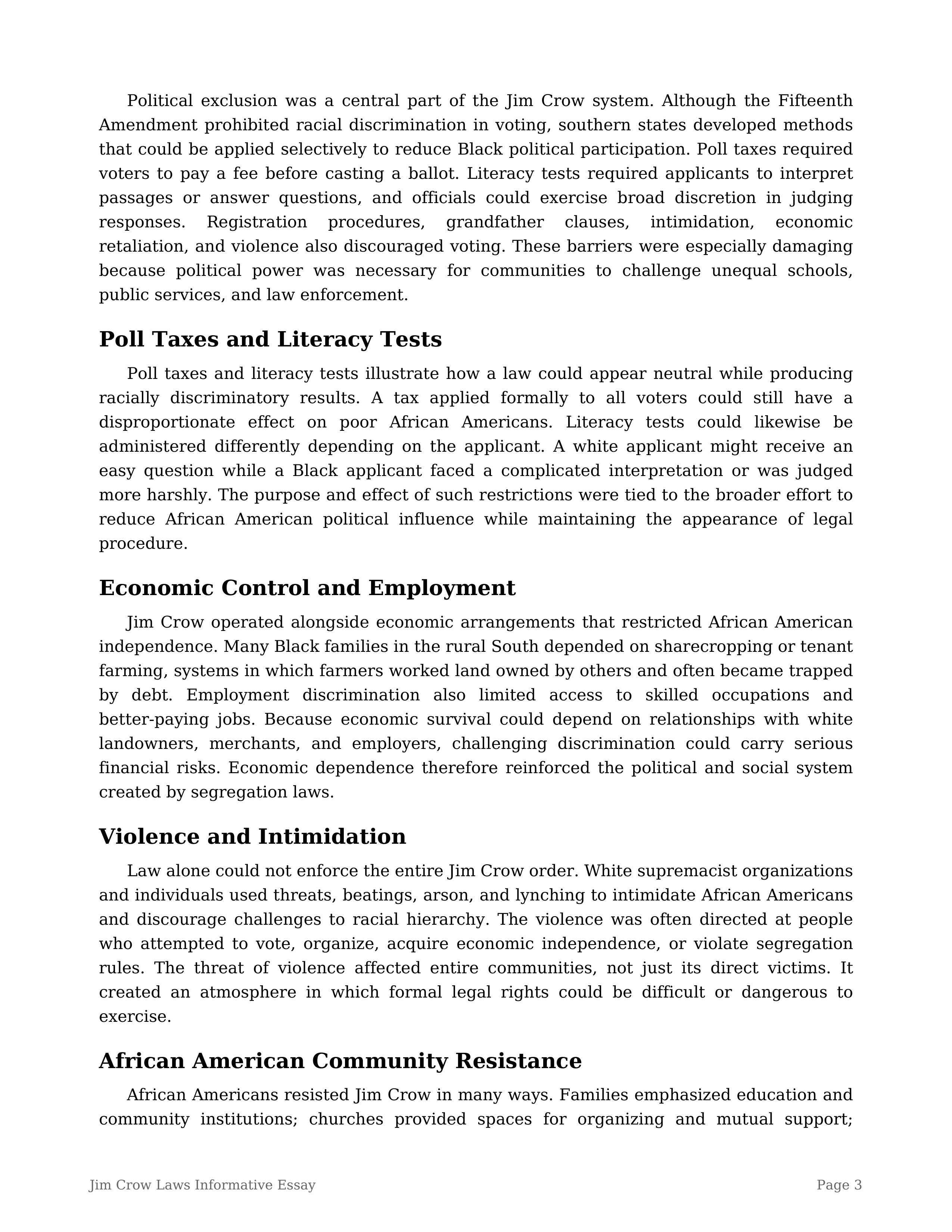
Political exclusion was a central part of the Jim Crow system. Although the Fifteenth
Amendment prohibited racial discrimination in voting, southern states developed methods
that could be applied selectively to reduce Black political participation. Poll taxes required
voters to pay a fee before casting a ballot. Literacy tests required applicants to interpret
passages or answer questions, and officials could exercise broad discretion in judging
responses.
Registration
procedures,
grandfather
clauses,
intimidation,
economic
retaliation, and violence also discouraged voting. These barriers were especially damaging
because political power was necessary for communities to challenge unequal schools,
public services, and law enforcement.
Poll Taxes and Literacy Tests
Poll taxes and literacy tests illustrate how a law could appear neutral while producing
racially discriminatory results. A tax applied formally to all voters could still have a
disproportionate effect on poor African Americans. Literacy tests could likewise be
administered differently depending on the applicant. A white applicant might receive an
easy question while a Black applicant faced a complicated interpretation or was judged
more harshly. The purpose and effect of such restrictions were tied to the broader effort to
reduce African American political influence while maintaining the appearance of legal
procedure.
Economic Control and Employment
Jim Crow operated alongside economic arrangements that restricted African American
independence. Many Black families in the rural South depended on sharecropping or tenant
farming, systems in which farmers worked land owned by others and often became trapped
by debt. Employment discrimination also limited access to skilled occupations and
better-paying jobs. Because economic survival could depend on relationships with white
landowners, merchants, and employers, challenging discrimination could carry serious
financial risks. Economic dependence therefore reinforced the political and social system
created by segregation laws.
Violence and Intimidation
Law alone could not enforce the entire Jim Crow order. White supremacist organizations
and individuals used threats, beatings, arson, and lynching to intimidate African Americans
and discourage challenges to racial hierarchy. The violence was often directed at people
who attempted to vote, organize, acquire economic independence, or violate segregation
rules. The threat of violence affected entire communities, not just its direct victims. It
created an atmosphere in which formal legal rights could be difficult or dangerous to
exercise.
African American Community Resistance
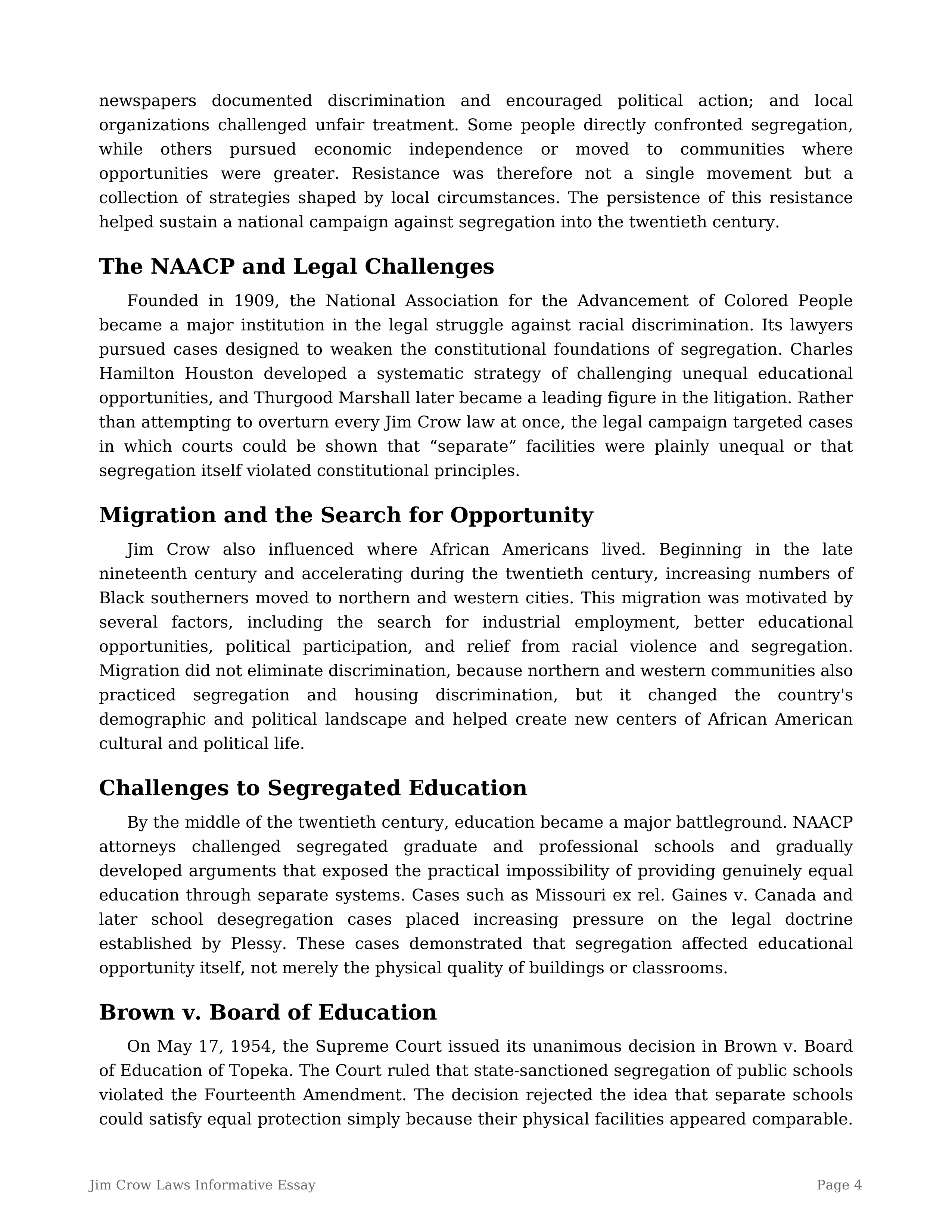
African Americans resisted Jim Crow in many ways. Families emphasized education and
community institutions; churches provided spaces for organizing and mutual support;
Jim Crow Laws Informative Essay
Page 4
newspapers documented discrimination and encouraged political action; and local
organizations challenged unfair treatment. Some people directly confronted segregation,
while others pursued economic independence or moved to communities where
opportunities were greater. Resistance was therefore not a single movement but a
collection of strategies shaped by local circumstances. The persistence of this resistance
helped sustain a national campaign against segregation into the twentieth century.
The NAACP and Legal Challenges
Founded in 1909, the National Association for the Advancement of Colored People
became a major institution in the legal struggle against racial discrimination. Its lawyers
pursued cases designed to weaken the constitutional foundations of segregation. Charles
Hamilton Houston developed a systematic strategy of challenging unequal educational
opportunities, and Thurgood Marshall later became a leading figure in the litigation. Rather
than attempting to overturn every Jim Crow law at once, the legal campaign targeted cases
in which courts could be shown that “separate” facilities were plainly unequal or that
segregation itself violated constitutional principles.
Migration and the Search for Opportunity
Jim Crow also influenced where African Americans lived. Beginning in the late
nineteenth century and accelerating during the twentieth century, increasing numbers of
Black southerners moved to northern and western cities. This migration was motivated by
several factors, including the search for industrial employment, better educational
opportunities, political participation, and relief from racial violence and segregation.
Migration did not eliminate discrimination, because northern and western communities also
practiced segregation and housing discrimination, but it changed the country's
demographic and political landscape and helped create new centers of African American
cultural and political life.
Challenges to Segregated Education
By the middle of the twentieth century, education became a major battleground. NAACP
attorneys challenged segregated graduate and professional schools and gradually
developed arguments that exposed the practical impossibility of providing genuinely equal
education through separate systems. Cases such as Missouri ex rel. Gaines v. Canada and
later school desegregation cases placed increasing pressure on the legal doctrine
established by Plessy. These cases demonstrated that segregation affected educational
opportunity itself, not merely the physical quality of buildings or classrooms.
Brown v. Board of Education
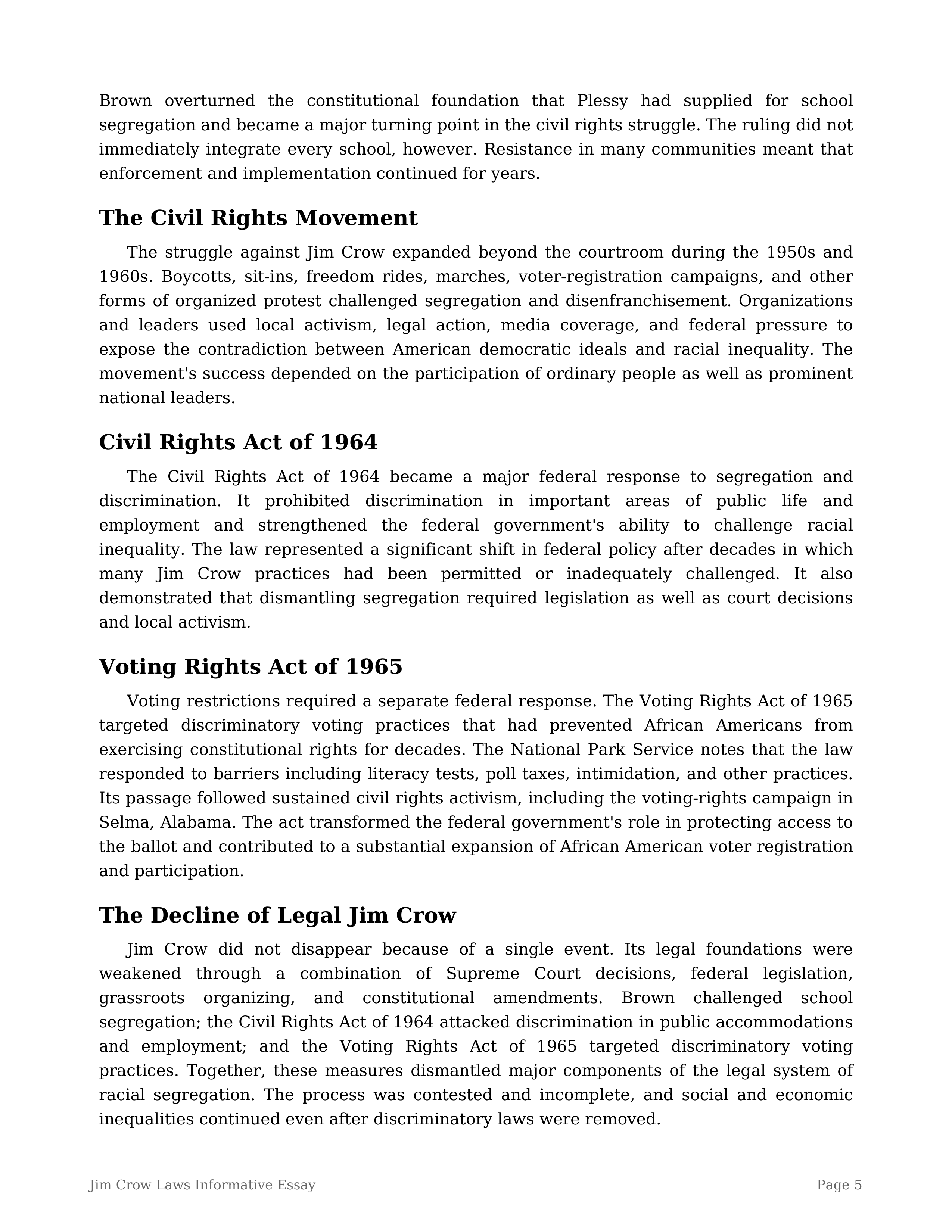
On May 17, 1954, the Supreme Court issued its unanimous decision in Brown v. Board
of Education of Topeka. The Court ruled that state-sanctioned segregation of public schools
violated the Fourteenth Amendment. The decision rejected the idea that separate schools
could satisfy equal protection simply because their physical facilities appeared comparable.
Jim Crow Laws Informative Essay
Page 5
Brown overturned the constitutional foundation that Plessy had supplied for school
segregation and became a major turning point in the civil rights struggle. The ruling did not
immediately integrate every school, however. Resistance in many communities meant that
enforcement and implementation continued for years.
The Civil Rights Movement
The struggle against Jim Crow expanded beyond the courtroom during the 1950s and
1960s. Boycotts, sit-ins, freedom rides, marches, voter-registration campaigns, and other
forms of organized protest challenged segregation and disenfranchisement. Organizations
and leaders used local activism, legal action, media coverage, and federal pressure to
expose the contradiction between American democratic ideals and racial inequality. The
movement's success depended on the participation of ordinary people as well as prominent
national leaders.
Civil Rights Act of 1964
The Civil Rights Act of 1964 became a major federal response to segregation and
discrimination. It prohibited discrimination in important areas of public life and
employment and strengthened the federal government's ability to challenge racial
inequality. The law represented a significant shift in federal policy after decades in which
many Jim Crow practices had been permitted or inadequately challenged. It also
demonstrated that dismantling segregation required legislation as well as court decisions
and local activism.
Voting Rights Act of 1965
Voting restrictions required a separate federal response. The Voting Rights Act of 1965
targeted discriminatory voting practices that had prevented African Americans from
exercising constitutional rights for decades. The National Park Service notes that the law
responded to barriers including literacy tests, poll taxes, intimidation, and other practices.
Its passage followed sustained civil rights activism, including the voting-rights campaign in
Selma, Alabama. The act transformed the federal government's role in protecting access to
the ballot and contributed to a substantial expansion of African American voter registration
and participation.
The Decline of Legal Jim Crow
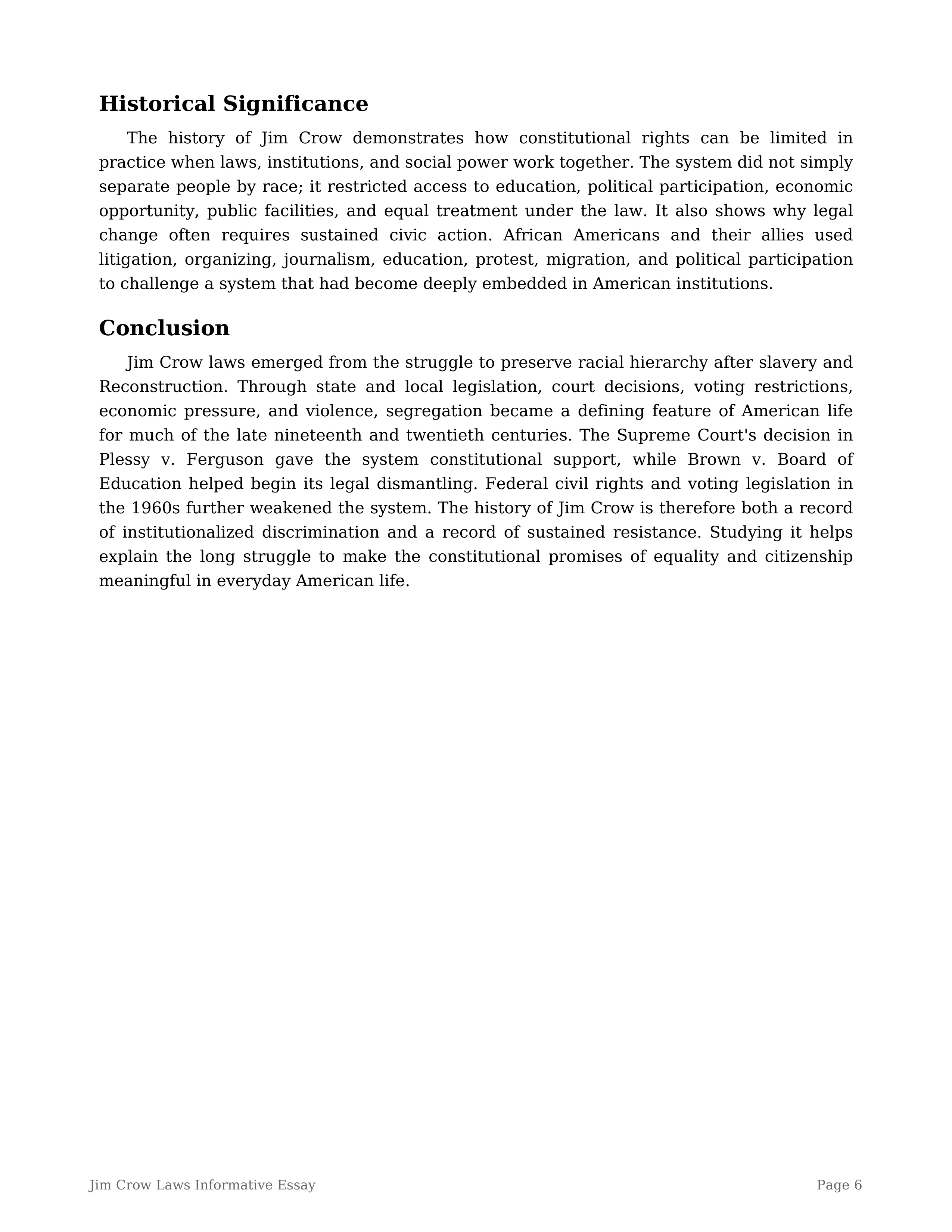
Jim Crow did not disappear because of a single event. Its legal foundations were
weakened through a combination of Supreme Court decisions, federal legislation,
grassroots
organizing,
and
constitutional
amendments.
Brown
challenged
school
segregation; the Civil Rights Act of 1964 attacked discrimination in public accommodations
and employment; and the Voting Rights Act of 1965 targeted discriminatory voting
practices. Together, these measures dismantled major components of the legal system of
racial segregation. The process was contested and incomplete, and social and economic
inequalities continued even after discriminatory laws were removed.
Jim Crow Laws Informative Essay
Page 6
Historical Significance
The history of Jim Crow demonstrates how constitutional rights can be limited in
practice when laws, institutions, and social power work together. The system did not simply
separate people by race; it restricted access to education, political participation, economic
opportunity, public facilities, and equal treatment under the law. It also shows why legal
change often requires sustained civic action. African Americans and their allies used
litigation, organizing, journalism, education, protest, migration, and political participation
to challenge a system that had become deeply embedded in American institutions.
Conclusion
Jim Crow laws emerged from the struggle to preserve racial hierarchy after slavery and
Reconstruction. Through state and local legislation, court decisions, voting restrictions,
economic pressure, and violence, segregation became a defining feature of American life
for much of the late nineteenth and twentieth centuries. The Supreme Court's decision in
Plessy v. Ferguson gave the system constitutional support, while Brown v. Board of
Education helped begin its legal dismantling. Federal civil rights and voting legislation in
the 1960s further weakened the system. The history of Jim Crow is therefore both a record
of institutionalized discrimination and a record of sustained resistance. Studying it helps
explain the long struggle to make the constitutional promises of equality and citizenship
meaningful in everyday American life.