Erie Canal Informative Essay
Page 1
Erie Canal Informative Essay
How a Canal Connected the Atlantic Coast to the American Interior
Introduction
The
Erie
Canal
was
one
of
the
most
important
transportation
projects
in
nineteenth-century America. Completed in 1825, the canal connected the Hudson River at
Albany with Lake Erie at Buffalo, creating a 363-mile water route across New York State. By
crossing the geographic barrier of the Appalachian Mountains through the Mohawk Valley,
the canal linked the Atlantic seaboard with the Great Lakes and the growing American
interior. Its effects reached far beyond transportation: it lowered shipping costs, encouraged
migration and settlement, strengthened New York City’s commercial position, supported
agriculture and manufacturing, and helped connect distant communities through the
movement of people, goods, and ideas.
America Before the Canal
In the early nineteenth century, transportation between the eastern seaboard and the
lands west of the Appalachian Mountains was difficult and expensive. Roads were often rough,
rivers were not always navigable, and overland freight could take weeks to reach eastern
markets. Farmers in the interior could grow crops but often found that transporting bulky
goods made long-distance trade impractical. The problem limited settlement and economic
development and encouraged political leaders to consider canals and other internal
improvements.
The Geographic Challenge
The Appalachian Mountains presented a major obstacle to east-west transportation. New
York had an important natural advantage because the Mohawk Valley formed a relatively low
passage between the Appalachian system and the Adirondack region. Canal advocates
recognized that this route could connect the Hudson River with Lake Erie. The challenge was
turning the natural corridor into a dependable artificial waterway capable of carrying boats
across changing elevations.
The Canal Idea
The idea of improving New York’s waterways developed before construction of the Erie
Canal. Earlier projects improved navigation on portions of the Mohawk and Hudson Rivers.
George Washington and other national leaders recognized that better transportation could
help connect the young republic’s eastern and western regions. After the War of 1812,
interest in internal improvements increased as Americans sought ways to strengthen domestic
commerce and settlement.
DeWitt Clinton and Political Support
Erie Canal Informative Essay
Page 2
New York politician DeWitt Clinton became the canal’s most prominent political advocate.
Supporters argued that a canal would expand trade, encourage settlement, and strengthen
the state economy. Critics doubted whether such a large project was practical and mocked it
as “Clinton’s Folly” or “Clinton’s Ditch.” Despite opposition, New York officials approved the
project and committed state resources to construction.
Construction Begins
Construction of the Erie Canal began in 1817. Engineers and laborers had to cut through
forests, excavate earth and rock, build embankments, construct bridges and aqueducts, and
create locks that could raise and lower boats. Much of the work relied on manual labor
because large modern construction machines did not exist. The project required solving
difficult engineering problems over hundreds of miles of varied terrain.
Engineering the Waterway
The original canal had to cross an elevation difference of more than 570 feet between
Albany and Lake Erie. Locks were essential because boats could not simply travel uphill or
downhill through a continuous waterway. A series of locks raised boats from lower sections to
higher levels and then lowered them again. The completed original canal contained 83 locks,
demonstrating the scale and complexity of the engineering undertaking.
Labor and Construction Communities
Thousands of workers participated in building the canal. Laborers cleared land, dug the
channel, moved soil, constructed stonework, and performed other demanding tasks. Irish
immigrants became an important part of the canal workforce, and workers from other
backgrounds also contributed. Temporary camps and growing settlements developed along
the route, while established communities gained new economic opportunities from the
construction activity.
Opening in 1825
The Erie Canal was completed in 1825. On October 26, Governor DeWitt Clinton began a
ceremonial journey from Buffalo toward New York City, marking the opening of the waterway.
The event celebrated the connection between Lake Erie and the Hudson River. The canal
immediately demonstrated the practical value of linking the Great Lakes region to Atlantic
markets.
Lower Transportation Costs
One of the canal’s most important effects was the dramatic reduction in transportation
costs. Goods that previously had to travel over difficult roads could move by water for much of
their journey. The National Park Service notes that freight costs between Buffalo and New
York City fell dramatically after the canal opened, while travel time also decreased. Lower
transportation expenses made agricultural and natural-resource products more competitive in
distant markets.
Growth of New York City
Erie Canal Informative Essay
Page 3
The canal helped transform New York City into the nation’s leading commercial center.
Goods from the interior could travel down the Erie Canal to the Hudson River and then reach
the port of New York. At the same time, manufactured goods and imported products could
move westward through the same network. The increased flow of commerce strengthened the
city’s position as a major national and international port.
Buffalo and the Great Lakes
Buffalo became a major transportation and commercial hub because it stood at the
western end of the canal. Ships and canal boats could transfer cargo between Lake Erie and
the canal system. The city became a gateway between the Great Lakes and the Atlantic
seaboard. Other communities along the route also expanded as warehouses, mills, stores,
workshops, and transportation services developed around canal traffic.
Agriculture and Market Expansion
The canal changed the economics of farming in upstate New York and the interior.
Farmers could send grain and other agricultural products to larger markets at lower cost.
Instead of producing mainly for local consumption, more farmers could participate in
commercial agriculture. The transportation network also made it easier to obtain tools,
manufactured goods, and other products from eastern cities.
Settlement of the Interior
The Erie Canal encouraged migration into upstate New York and regions farther west.
Improved transportation reduced the isolation of inland communities and made agricultural
land more attractive to settlers. The canal became part of a broader transportation network
connecting New England, New York, the Great Lakes, and eventually the Midwest. Its
influence therefore extended well beyond the canal’s physical banks.
The Canal and Industrial Development
Factories and mills benefited from easier access to markets and raw materials.
Communities along the canal gained opportunities to process agricultural products,
manufacture goods, and provide services to canal travelers. Rochester, Syracuse, Utica, and
Buffalo became important centers of commerce and industry. Waterpower, transportation
access, and growing populations combined to accelerate economic development in many canal
communities.
Movement of People and Ideas
The Erie Canal carried more than freight. People traveled along the waterway, including
migrants, merchants, laborers, and travelers. Newspapers, mail, books, and political
information also moved through the connected transportation network. The canal corridor
therefore helped reduce geographic isolation and contributed to the spread of social,
religious, and political ideas.
The Canal and Social Reform
Erie Canal Informative Essay
Page 4
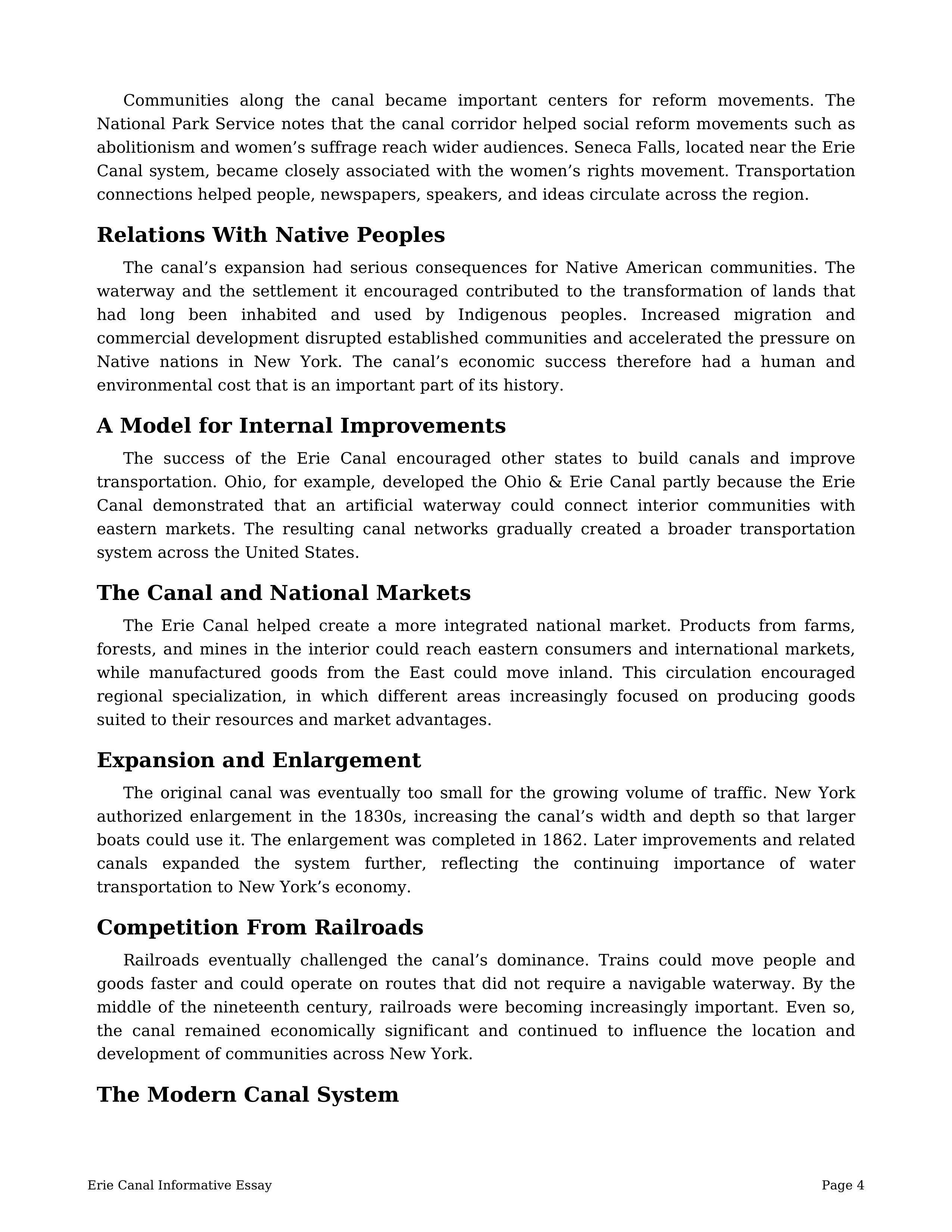
Communities along the canal became important centers for reform movements. The
National Park Service notes that the canal corridor helped social reform movements such as
abolitionism and women’s suffrage reach wider audiences. Seneca Falls, located near the Erie
Canal system, became closely associated with the women’s rights movement. Transportation
connections helped people, newspapers, speakers, and ideas circulate across the region.
Relations With Native Peoples
The canal’s expansion had serious consequences for Native American communities. The
waterway and the settlement it encouraged contributed to the transformation of lands that
had long been inhabited and used by Indigenous peoples. Increased migration and
commercial development disrupted established communities and accelerated the pressure on
Native nations in New York. The canal’s economic success therefore had a human and
environmental cost that is an important part of its history.
A Model for Internal Improvements
The success of the Erie Canal encouraged other states to build canals and improve
transportation. Ohio, for example, developed the Ohio & Erie Canal partly because the Erie
Canal demonstrated that an artificial waterway could connect interior communities with
eastern markets. The resulting canal networks gradually created a broader transportation
system across the United States.
The Canal and National Markets
The Erie Canal helped create a more integrated national market. Products from farms,
forests, and mines in the interior could reach eastern consumers and international markets,
while manufactured goods from the East could move inland. This circulation encouraged
regional specialization, in which different areas increasingly focused on producing goods
suited to their resources and market advantages.
Expansion and Enlargement
The original canal was eventually too small for the growing volume of traffic. New York
authorized enlargement in the 1830s, increasing the canal’s width and depth so that larger
boats could use it. The enlargement was completed in 1862. Later improvements and related
canals expanded the system further, reflecting the continuing importance of water
transportation to New York’s economy.
Competition From Railroads
Railroads eventually challenged the canal’s dominance. Trains could move people and
goods faster and could operate on routes that did not require a navigable waterway. By the
middle of the nineteenth century, railroads were becoming increasingly important. Even so,
the canal remained economically significant and continued to influence the location and
development of communities across New York.
The Modern Canal System
Erie Canal Informative Essay
Page 5
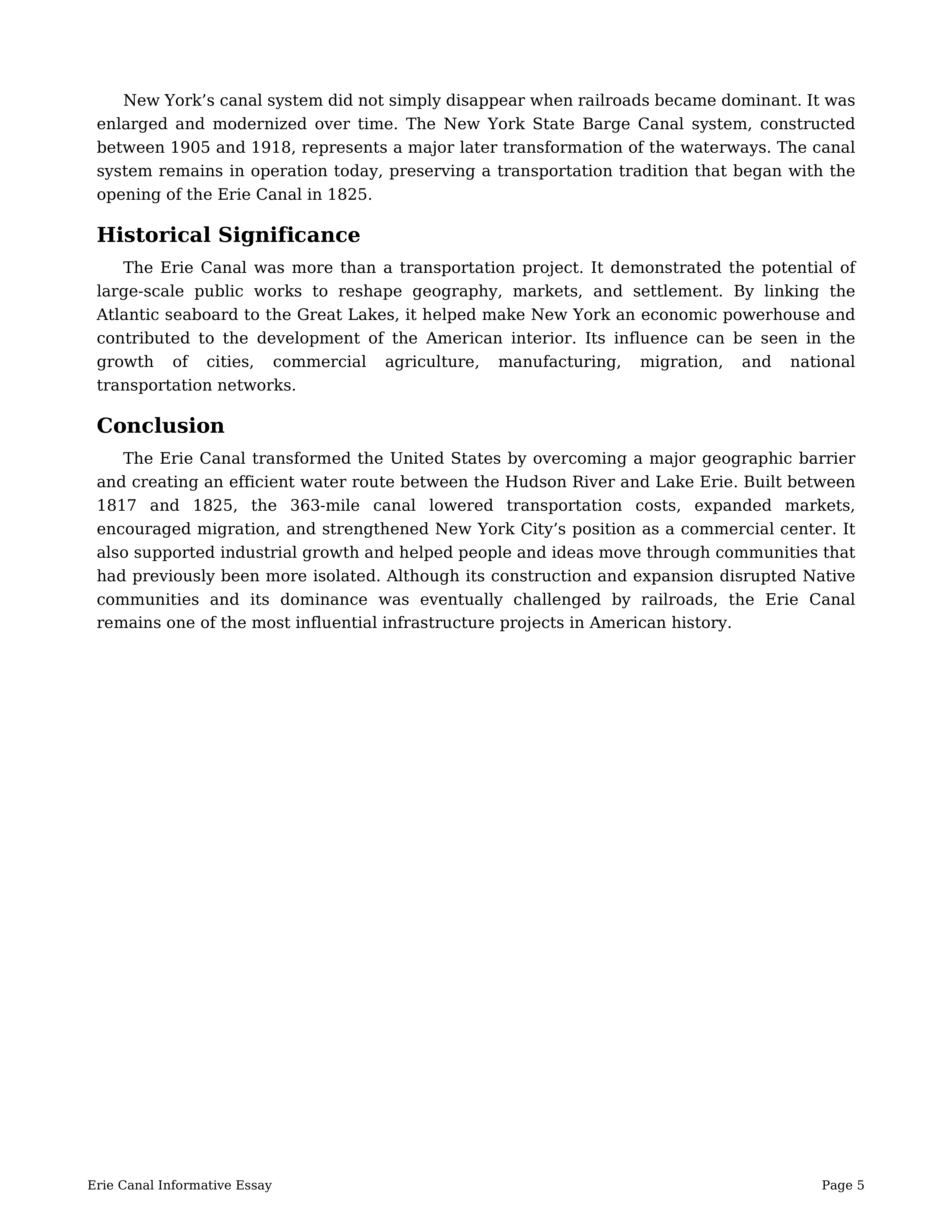
New York’s canal system did not simply disappear when railroads became dominant. It was
enlarged and modernized over time. The New York State Barge Canal system, constructed
between 1905 and 1918, represents a major later transformation of the waterways. The canal
system remains in operation today, preserving a transportation tradition that began with the
opening of the Erie Canal in 1825.
Historical Significance
The Erie Canal was more than a transportation project. It demonstrated the potential of
large-scale public works to reshape geography, markets, and settlement. By linking the
Atlantic seaboard to the Great Lakes, it helped make New York an economic powerhouse and
contributed to the development of the American interior. Its influence can be seen in the
growth
of
cities,
commercial
agriculture,
manufacturing,
migration,
and
national
transportation networks.
Conclusion
The Erie Canal transformed the United States by overcoming a major geographic barrier
and creating an efficient water route between the Hudson River and Lake Erie. Built between
1817 and 1825, the 363-mile canal lowered transportation costs, expanded markets,
encouraged migration, and strengthened New York City’s position as a commercial center. It
also supported industrial growth and helped people and ideas move through communities that
had previously been more isolated. Although its construction and expansion disrupted Native
communities and its dominance was eventually challenged by railroads, the Erie Canal
remains one of the most influential infrastructure projects in American history.