Salem Witch Trials Informative Essay
Page 1
Salem Witch Trials Informative Essay
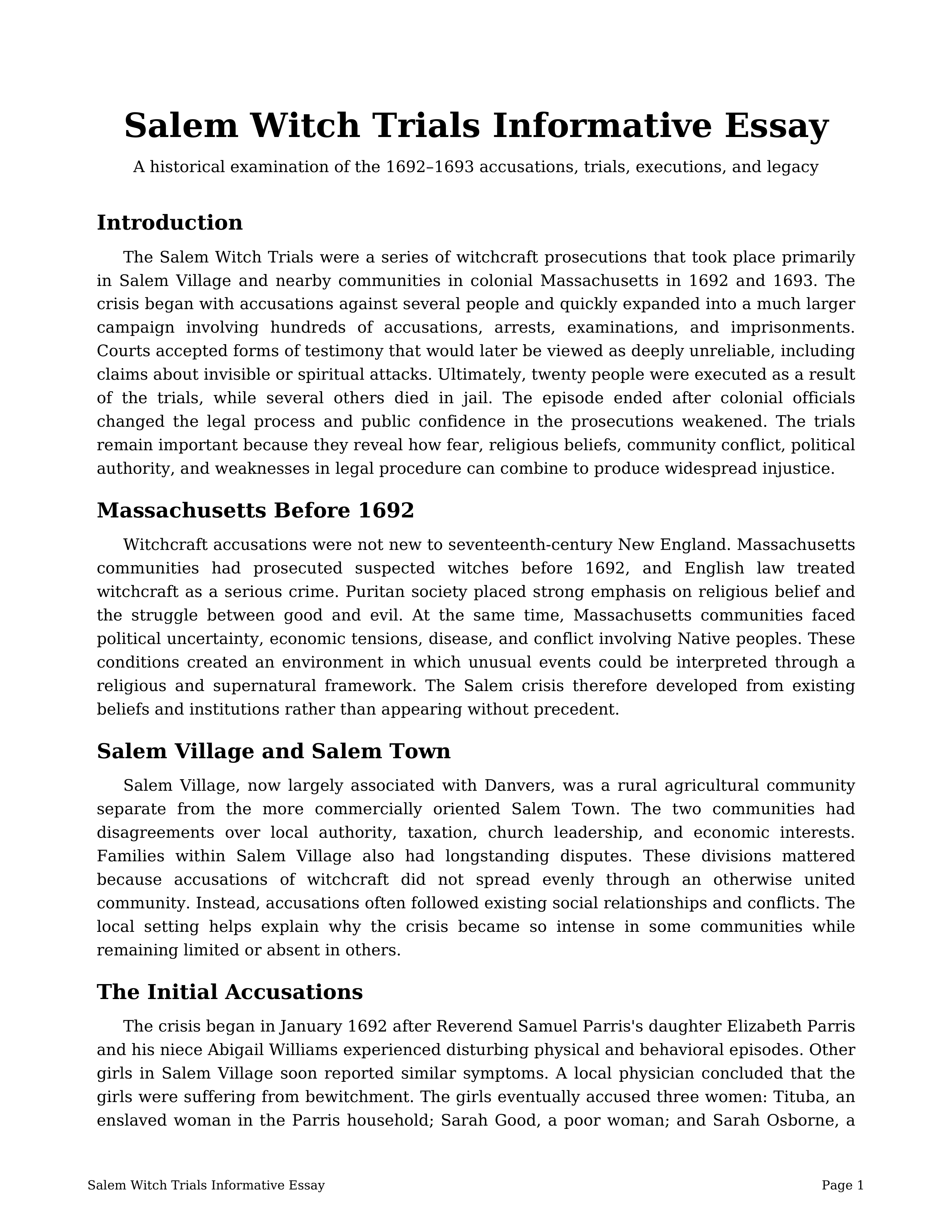
A historical examination of the 1692–1693 accusations, trials, executions, and legacy
Introduction
The Salem Witch Trials were a series of witchcraft prosecutions that took place primarily
in Salem Village and nearby communities in colonial Massachusetts in 1692 and 1693. The
crisis began with accusations against several people and quickly expanded into a much larger
campaign involving hundreds of accusations, arrests, examinations, and imprisonments.
Courts accepted forms of testimony that would later be viewed as deeply unreliable, including
claims about invisible or spiritual attacks. Ultimately, twenty people were executed as a result
of the trials, while several others died in jail. The episode ended after colonial officials
changed the legal process and public confidence in the prosecutions weakened. The trials
remain important because they reveal how fear, religious beliefs, community conflict, political
authority, and weaknesses in legal procedure can combine to produce widespread injustice.
Massachusetts Before 1692
Witchcraft accusations were not new to seventeenth-century New England. Massachusetts
communities had prosecuted suspected witches before 1692, and English law treated
witchcraft as a serious crime. Puritan society placed strong emphasis on religious belief and
the struggle between good and evil. At the same time, Massachusetts communities faced
political uncertainty, economic tensions, disease, and conflict involving Native peoples. These
conditions created an environment in which unusual events could be interpreted through a
religious and supernatural framework. The Salem crisis therefore developed from existing
beliefs and institutions rather than appearing without precedent.
Salem Village and Salem Town
Salem Village, now largely associated with Danvers, was a rural agricultural community
separate from the more commercially oriented Salem Town. The two communities had
disagreements over local authority, taxation, church leadership, and economic interests.
Families within Salem Village also had longstanding disputes. These divisions mattered
because accusations of witchcraft did not spread evenly through an otherwise united
community. Instead, accusations often followed existing social relationships and conflicts. The
local setting helps explain why the crisis became so intense in some communities while
remaining limited or absent in others.
The Initial Accusations
The crisis began in January 1692 after Reverend Samuel Parris's daughter Elizabeth Parris
and his niece Abigail Williams experienced disturbing physical and behavioral episodes. Other
girls in Salem Village soon reported similar symptoms. A local physician concluded that the
girls were suffering from bewitchment. The girls eventually accused three women: Tituba, an
enslaved woman in the Parris household; Sarah Good, a poor woman; and Sarah Osborne, a
Salem Witch Trials Informative Essay
Page 2
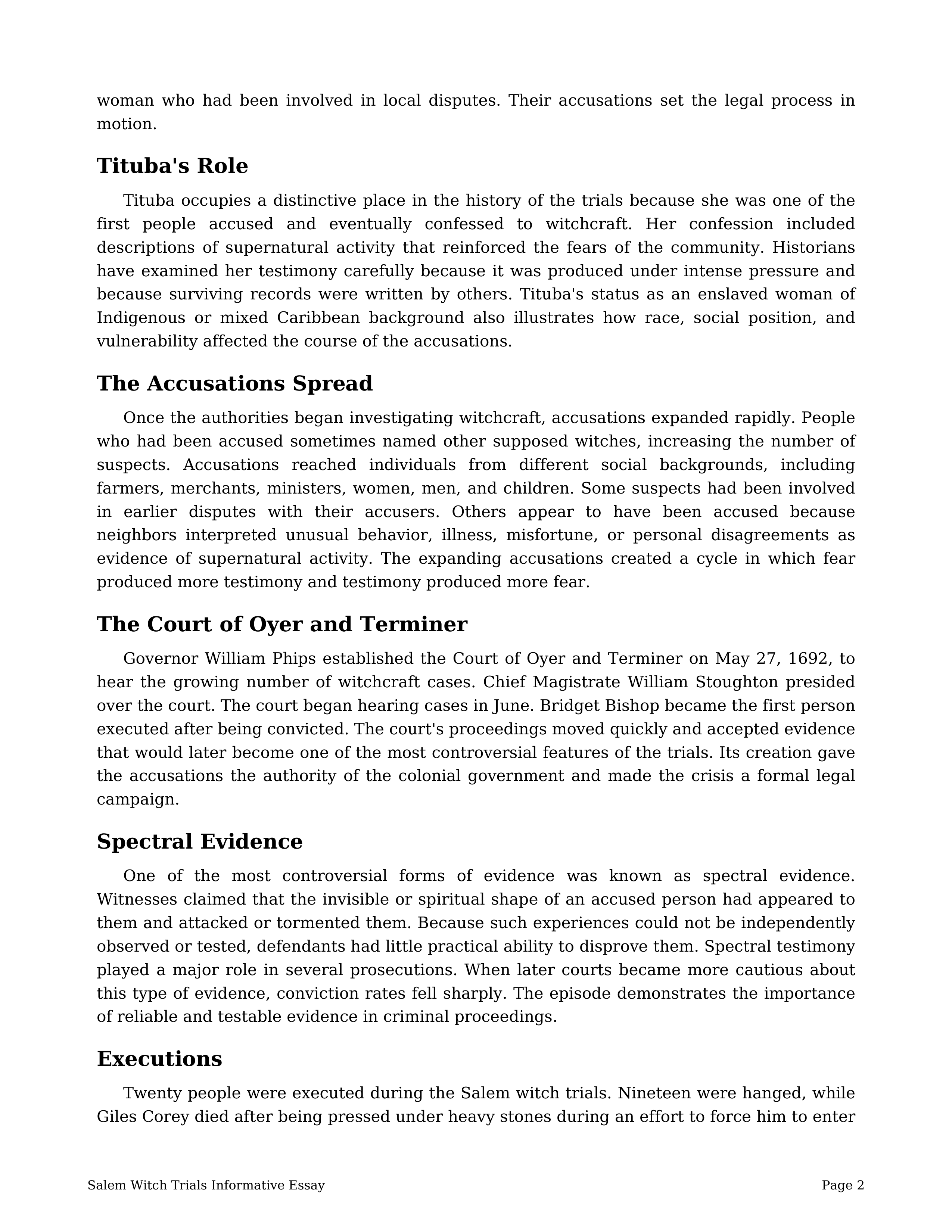
woman who had been involved in local disputes. Their accusations set the legal process in
motion.
Tituba's Role
Tituba occupies a distinctive place in the history of the trials because she was one of the
first people accused and eventually confessed to witchcraft. Her confession included
descriptions of supernatural activity that reinforced the fears of the community. Historians
have examined her testimony carefully because it was produced under intense pressure and
because surviving records were written by others. Tituba's status as an enslaved woman of
Indigenous or mixed Caribbean background also illustrates how race, social position, and
vulnerability affected the course of the accusations.
The Accusations Spread
Once the authorities began investigating witchcraft, accusations expanded rapidly. People
who had been accused sometimes named other supposed witches, increasing the number of
suspects. Accusations reached individuals from different social backgrounds, including
farmers, merchants, ministers, women, men, and children. Some suspects had been involved
in earlier disputes with their accusers. Others appear to have been accused because
neighbors interpreted unusual behavior, illness, misfortune, or personal disagreements as
evidence of supernatural activity. The expanding accusations created a cycle in which fear
produced more testimony and testimony produced more fear.
The Court of Oyer and Terminer
Governor William Phips established the Court of Oyer and Terminer on May 27, 1692, to
hear the growing number of witchcraft cases. Chief Magistrate William Stoughton presided
over the court. The court began hearing cases in June. Bridget Bishop became the first person
executed after being convicted. The court's proceedings moved quickly and accepted evidence
that would later become one of the most controversial features of the trials. Its creation gave
the accusations the authority of the colonial government and made the crisis a formal legal
campaign.
Spectral Evidence
One of the most controversial forms of evidence was known as spectral evidence.
Witnesses claimed that the invisible or spiritual shape of an accused person had appeared to
them and attacked or tormented them. Because such experiences could not be independently
observed or tested, defendants had little practical ability to disprove them. Spectral testimony
played a major role in several prosecutions. When later courts became more cautious about
this type of evidence, conviction rates fell sharply. The episode demonstrates the importance
of reliable and testable evidence in criminal proceedings.
Executions
Twenty people were executed during the Salem witch trials. Nineteen were hanged, while
Giles Corey died after being pressed under heavy stones during an effort to force him to enter
Salem Witch Trials Informative Essay
Page 3
a plea. The first execution was Bridget Bishop on June 10, 1692. Additional executions
occurred in July, August, and September. The victims included both women and men. Their
deaths became the most enduring symbol of the crisis and demonstrated the severe
consequences of allowing accusations and weak evidence to determine criminal guilt.
Imprisonment and Deaths in Jail
Execution was not the only danger faced by accused people. Hundreds were arrested or
imprisoned, often under difficult conditions. At least five people died in jail. Some prisoners
became sick, while families experienced financial hardship because relatives were absent or
property could be affected by legal proceedings. Children were also caught in the accusations.
The experience of imprisonment demonstrates that the Salem crisis affected many more
people than the twenty who were executed.
Why People Believed the Accusations
Several factors helped explain why the accusations gained credibility. Puritan religious
culture emphasized the reality of the Devil and spiritual warfare. Community members also
faced illness, economic uncertainty, political tensions, and memories of earlier conflict. In
such an environment, unexplained events could be interpreted as evidence of supernatural
activity. Once respected authorities accepted the accusations, ordinary residents had
additional reasons to believe that a serious threat existed. Fear and social pressure then
reinforced the process.
Community Conflicts
Local disputes played an important role in the pattern of accusations. Salem Village
contained disagreements involving property, church leadership, family relationships, and
economic interests. Accusations sometimes crossed existing lines of conflict. This does not
mean that every accusation was simply an attempt at revenge. Many participants genuinely
believed that witchcraft was responsible for suffering. Nevertheless, the social structure of
the community influenced who was accused, who was believed, and how conflicts developed.
Gender and Social Status
Women made up a large proportion of those accused and executed, although men were
also prosecuted. Women who were socially vulnerable, elderly, poor, outspoken, or involved in
disputes could become particularly exposed to suspicion. At the same time, accusations also
reached respected members of the community, demonstrating that social status did not
provide complete protection. The case of Rebecca Nurse, an older and highly regarded
woman, showed how quickly reputations could be challenged once accusations gained
momentum.
Children and Young Accusers
Young people played a prominent role in the early accusations. Elizabeth Parris, Abigail
Williams, Ann Putnam Jr., and others described attacks and identified people they believed
were responsible. Their statements were taken seriously by adults and courts. The
Salem Witch Trials Informative Essay
Page 4
prominence of children made the accusations especially powerful because adults interpreted
their distress as evidence of an invisible threat. The episode illustrates how authority can
shape the interpretation of children's experiences, particularly when a community already
expects supernatural explanations.
The Case of Giles Corey
Giles Corey became one of the most notable victims because he refused to enter a plea to
the charges against him. Under English legal practice, authorities used pressing to force a
defendant to plead. Corey was subjected to increasing weight placed on his body and died on
September 19, 1692. Because he did not enter a plea, his property could not be treated in the
same way as the property of a convicted person. His death remains a striking example of the
harsh legal practices surrounding the trials.
The Crisis Begins to Change
By the autumn of 1692, confidence in the prosecutions was declining. Governor Phips had
become increasingly concerned about the proceedings, especially after accusations reached
prominent members of society. In October, he prohibited further arrests, released many of the
accused, and dissolved the Court of Oyer and Terminer. A replacement court continued some
cases but was more cautious about evidence. The change in procedure helped reduce
convictions and contributed to the end of the prosecutions.
The End of the Trials
The later court proceedings in 1693 were significantly different from the earlier trials.
Spectral evidence was no longer accepted in the same way, and many defendants were
acquitted or released. By the middle of 1693, the remaining prisoners had been pardoned. The
crisis had lasted roughly a year and a half, but its effects continued for generations. The end
demonstrated that changes in legal standards and political authority could bring a mass
prosecution to a close even though the underlying community fears had not disappeared
immediately.
Aftermath and Remorse
After the trials ended, some participants expressed regret or acknowledged that the
proceedings had gone wrong. Samuel Sewall, one of the judges, publicly asked for forgiveness
and recognized his responsibility. The colonial government eventually reversed the
convictions and restored the reputations of the accused in stages. These later actions did not
erase the suffering caused by imprisonment, execution, and social stigma, but they
represented an important recognition that the legal system had committed serious errors.
Reversing the Convictions
The legal record of the Salem crisis continued to be addressed long after 1693.
Massachusetts formally reversed the convictions in stages through legislation. The process
demonstrates how historical judgments can be reconsidered when evidence and social
understanding change. Modern commemorations often emphasize the names of the victims
Salem Witch Trials Informative Essay
Page 5
and the importance of protecting defendants from unsupported accusations. The legal
reversal also reflects an enduring recognition that the Salem proceedings failed to meet
standards of justice that later generations considered essential.
Historical Records
The Salem witch trials are unusually well documented. Surviving sources include warrants,
examinations, indictments, depositions, petitions, court records, correspondence, and other
legal materials. These documents allow historians to study what people said, how courts
operated, and how accusations developed. However, the records must be interpreted carefully
because many were written by officials or witnesses and reflect the assumptions of the period.
Historians compare different documents and use contextual evidence to distinguish claims
made during the panic from conclusions supported by historical evidence.
Legacy in American History
The Salem Witch Trials became a powerful example of the dangers of mass fear and unjust
prosecution. Writers, historians, educators, and artists have repeatedly revisited the episode.
Arthur Miller's play The Crucible, for example, used the Salem story to explore political
persecution in a different historical context. Although artistic works can shape public
understanding, they do not always reproduce the historical record exactly. The continuing
interest in Salem reflects the broader question of how societies respond when fear, ideology,
rumor, and authority overwhelm careful judgment.
Lessons About Justice
The Salem crisis offers a historical lesson about the need for reliable evidence, fair
procedures, and protection against public pressure. Courts that accept extraordinary claims
without adequate verification can produce irreversible consequences. The trials also show
how accusations can spread when people believe that identifying additional suspects will
protect a community. Modern legal systems place greater emphasis on evidence, defense
rights, impartial procedures, and standards of proof partly because historical experience has
demonstrated the dangers of abandoning those safeguards.
Conclusion
The Salem Witch Trials were not simply a strange episode caused by belief in magic. They
developed from a combination of religious expectations, community divisions, political
circumstances, social tensions, fear, and a legal system that permitted unreliable forms of
evidence. Beginning with accusations in early 1692, the crisis expanded into hundreds of
prosecutions and resulted in twenty executions and additional deaths in jail. The trials
eventually ended when government officials changed the courts and restricted the use of
spectral evidence. Their legacy remains important because the episode demonstrates how
quickly fear can influence institutions and how difficult it can be to correct injustice after it
has become embedded in a legal process. Studying Salem therefore provides a clearer
understanding of colonial Massachusetts while also showing the enduring importance of
evidence, due process, and careful judgment.